

ISSN 1004-5759 CN 62-1105/S
草业学报 ›› 2025, Vol. 34 ›› Issue (5): 130-145.DOI: 10.11686/cyxb2024253
• 研究论文 • 上一篇
董晓慧( ), 师尚礼(), 尹国丽(), 陈三冬, 巩海强, 刘林波
收稿日期:2024-07-01
修回日期:2024-08-09
出版日期:2025-05-20
发布日期:2025-03-20
通讯作者:
师尚礼,尹国丽
作者简介:ygl@gsau.edu.cn基金资助:
Xiao-hui DONG(), Shang-li SHI(), Guo-li YIN(), San-dong CHEN, Hai-qiang GONG, Lin-bo LIU
Received:2024-07-01
Revised:2024-08-09
Online:2025-05-20
Published:2025-03-20
Contact:
Shang-li SHI,Guo-li YIN
摘要:
探究玉米不同组织微环境与内生菌多样性的关系,对筛选玉米相合性促生菌或生防菌等功能微生物具有重要意义。采用高通量测序技术研究玉米不同器官组织内生细菌和真菌群落多样性,结果表明,玉米内生细菌群落由31个门,93个纲,192个目,340个科,404个属组成。变形菌门和厚壁菌门为优势细菌门,毛螺菌属、根瘤菌属、肠杆菌属及鞘氨醇单胞菌属为优势细菌属,且部分内生细菌表现出不同程度的器官偏好性,表明部分细菌种群存在组织微环境内生专一性。对比各器官组织优势细菌属,根部独有的细菌属是细球菌属和绒毛杆菌属;籽粒中独有的细菌属是葡萄球菌属、绒毛杆菌属、代尔夫特菌属、短波单胞菌属、链球菌属和狭窄梭菌属;叶中独有的细菌群主要是假单胞菌属。玉米根、茎、叶微生物群落组成具有相似性,但与籽粒差异较大。玉米内生真菌群落由12个门,37个纲,84个目,187个科,404个属组成。子囊菌门、担子菌门和壶菌门为优势真菌门,被孢霉属和镰刀菌属为优势真菌属,罗兹菌门是根部独有的优势真菌群。玉米茎、叶和籽粒器官组织间真菌群落组成差异较小,但与根部差异较大。综上,玉米器官组织对内生菌的分布具有较大的影响,不同器官组织内生细菌群落组成差异显著,内生真菌群落组成差异不明显。
董晓慧, 师尚礼, 尹国丽, 陈三冬, 巩海强, 刘林波. 玉米器官组织内生细菌和真菌群落多样性[J]. 草业学报, 2025, 34(5): 130-145.
Xiao-hui DONG, Shang-li SHI, Guo-li YIN, San-dong CHEN, Hai-qiang GONG, Lin-bo LIU. Diversity of endophytic bacterial and fungal communities in different maize organs[J]. Acta Prataculturae Sinica, 2025, 34(5): 130-145.
处理 Treatment | 分类单元 Observed OTUs | 有效序列 Effective sequence | 香农-威纳指数 Shannon-Wiener index | 辛普森指数 Simpson index | Chao1指数 Chao1 index | ACE指数 ACE index | 覆盖度 Coverage |
|---|---|---|---|---|---|---|---|
| GN | 1049±82a | 73944±559a | 8.47±0.30a | 0.99±0.00a | 1672.89±121.27a | 1655.26±113.43b | 0.99±0.00a |
| JN | 913±73b | 70993±4758a | 8.21±0.33a | 0.99±0.00a | 1484.95±43.94b | 2110.03±63.72a | 1.00±0.00a |
| LN | 658±28c | 55470±3250b | 8.35±0.11a | 0.96±0.05a | 956.66±44.63d | 1353.57±26.21c | 1.00±0.00a |
| YN | 865±4b | 53129±2415b | 8.63±0.16a | 0.99±0.00a | 1181.34±2.69c | 1645.59±123.73b | 1.00±0.00a |
表1 细菌样品序列数统计、丰富度与多样性指数
Table 1 Statistics of sequence number, abundance and diversity index of bacterial samples
处理 Treatment | 分类单元 Observed OTUs | 有效序列 Effective sequence | 香农-威纳指数 Shannon-Wiener index | 辛普森指数 Simpson index | Chao1指数 Chao1 index | ACE指数 ACE index | 覆盖度 Coverage |
|---|---|---|---|---|---|---|---|
| GN | 1049±82a | 73944±559a | 8.47±0.30a | 0.99±0.00a | 1672.89±121.27a | 1655.26±113.43b | 0.99±0.00a |
| JN | 913±73b | 70993±4758a | 8.21±0.33a | 0.99±0.00a | 1484.95±43.94b | 2110.03±63.72a | 1.00±0.00a |
| LN | 658±28c | 55470±3250b | 8.35±0.11a | 0.96±0.05a | 956.66±44.63d | 1353.57±26.21c | 1.00±0.00a |
| YN | 865±4b | 53129±2415b | 8.63±0.16a | 0.99±0.00a | 1181.34±2.69c | 1645.59±123.73b | 1.00±0.00a |
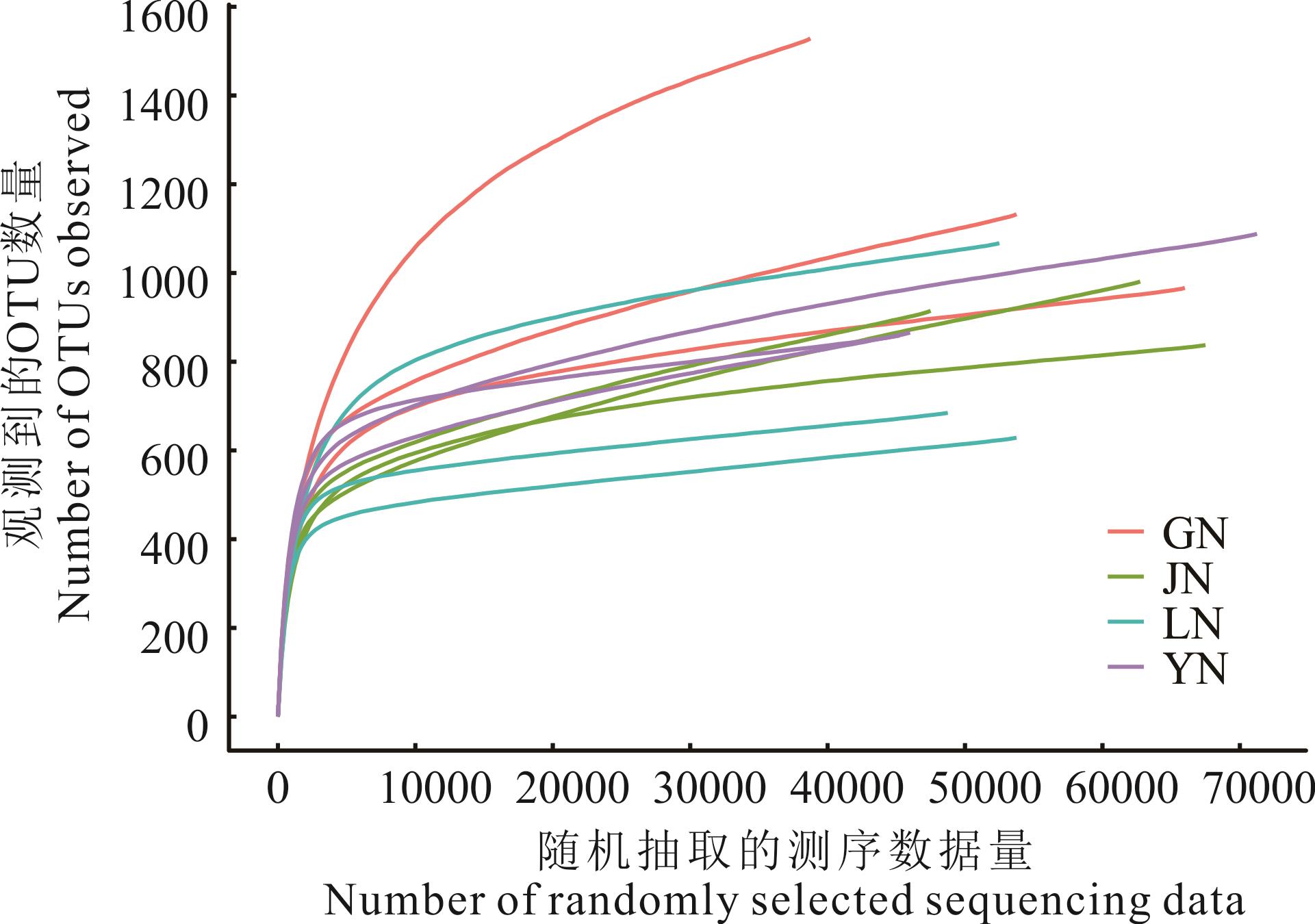
图1 细菌样品稀释曲线GN: 根Root; JN: 茎Stem; LN: 籽粒Grain; YN: 叶Leaf. 下同The same below.
Fig.1 Rarefaction curves for bacterial samples
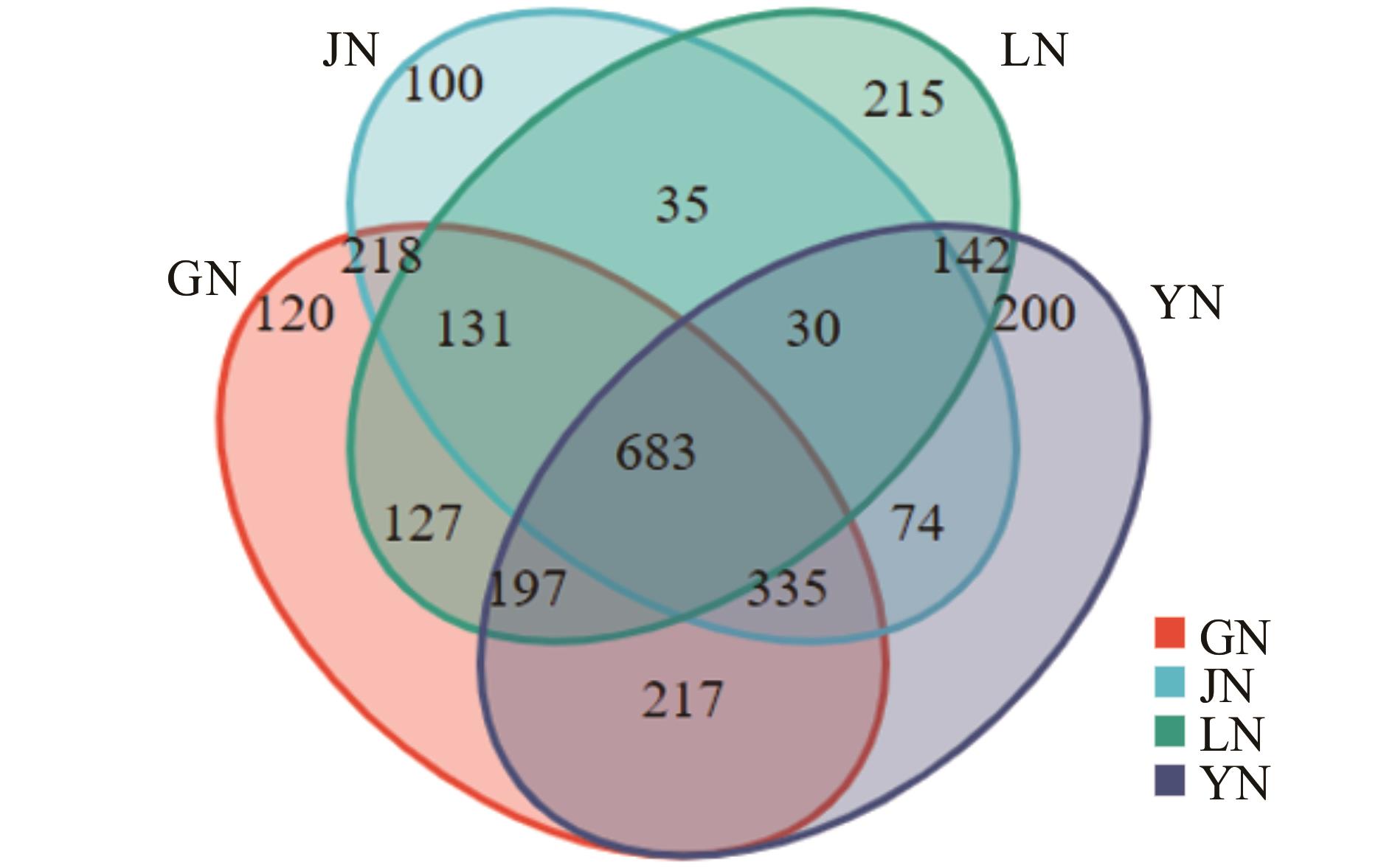
图2 不同器官组织内生细菌物种的Venn分析
Fig.2 Venn analysis of endophytic bacterial species in different organs and tissues
处理 Treatment | 分类单元 Observed OTUs | 有效序列 Effective sequence | 香农-威纳指数 Shannon-Wiener index | 辛普森指数 Simpson index | Chao1指数 Chao1 index | ACE指数 ACE index | 覆盖度 Coverage |
|---|---|---|---|---|---|---|---|
| GN | 1686±3a | 474209±214a | 8.60±0.02a | 0.99±0.00a | 1690.58±5.19a | 1688.77±3.96a | 1.00±0.00a |
| JN | 1691±14a | 467631±8577a | 8.55±0.08a | 0.99±0.00a | 1698.81±5.87a | 1693.88±11.25a | 1.00±0.00a |
| LN | 1681±12a | 473974±970a | 8.61±0.03a | 0.99±0.00a | 1690.58±9.04a | 1683.94±10.11a | 1.00±0.00a |
| YN | 1689±13a | 474064±362a | 8.54±0.06a | 0.99±0.00a | 1690.33±12.66a | 1689.44±13.20a | 1.00±0.00a |
表2 真菌样品序列数统计、丰富度与多样性指数
Table 2 Sequence number statistics, abundance and diversity index of fungi samples
处理 Treatment | 分类单元 Observed OTUs | 有效序列 Effective sequence | 香农-威纳指数 Shannon-Wiener index | 辛普森指数 Simpson index | Chao1指数 Chao1 index | ACE指数 ACE index | 覆盖度 Coverage |
|---|---|---|---|---|---|---|---|
| GN | 1686±3a | 474209±214a | 8.60±0.02a | 0.99±0.00a | 1690.58±5.19a | 1688.77±3.96a | 1.00±0.00a |
| JN | 1691±14a | 467631±8577a | 8.55±0.08a | 0.99±0.00a | 1698.81±5.87a | 1693.88±11.25a | 1.00±0.00a |
| LN | 1681±12a | 473974±970a | 8.61±0.03a | 0.99±0.00a | 1690.58±9.04a | 1683.94±10.11a | 1.00±0.00a |
| YN | 1689±13a | 474064±362a | 8.54±0.06a | 0.99±0.00a | 1690.33±12.66a | 1689.44±13.20a | 1.00±0.00a |
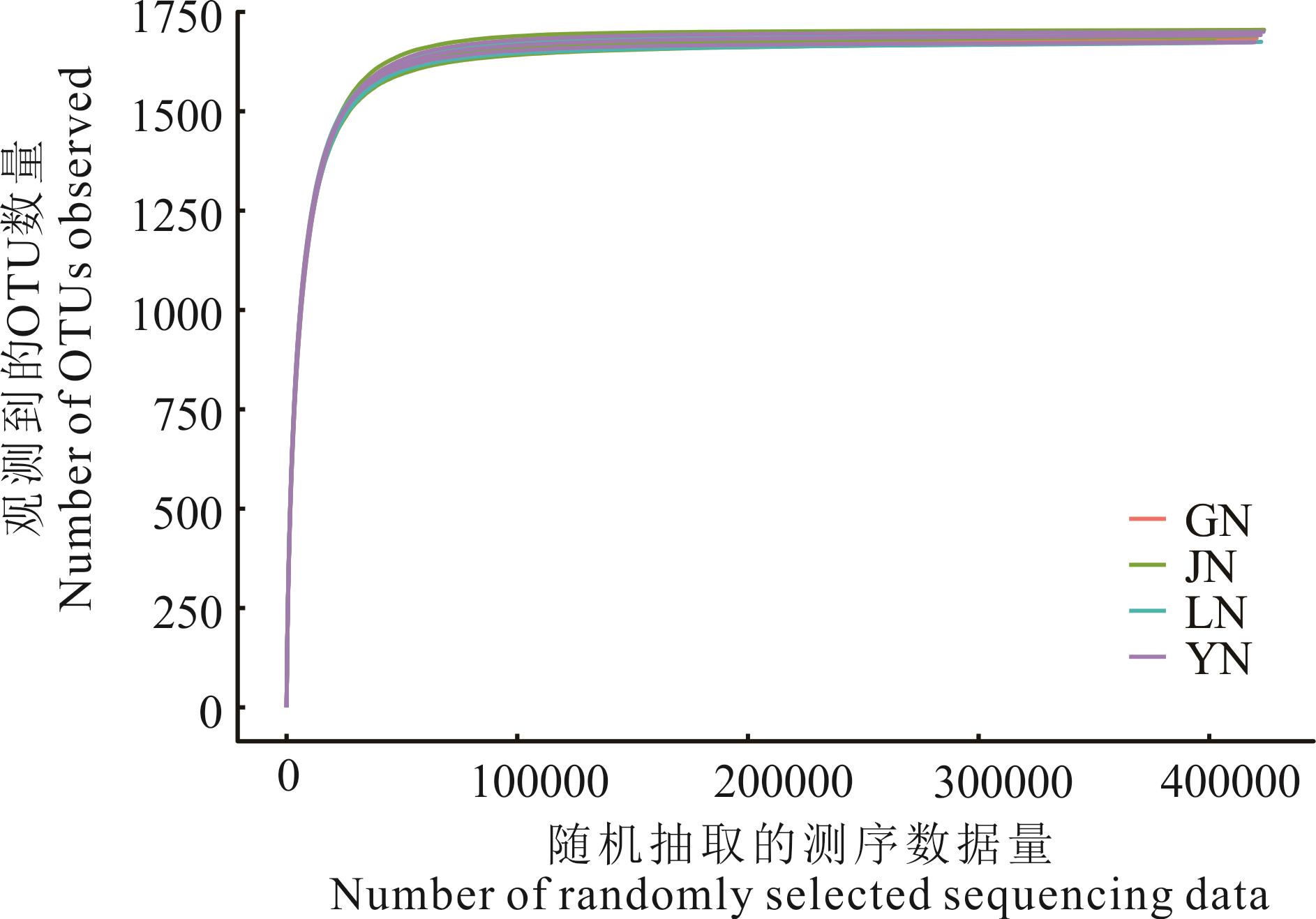
图3 真菌样品稀释曲线
Fig.3 Rarefaction curves for fungal samples

图4 不同器官组织内生真菌物种的Venn分析
Fig.4 Venn analysis of endophytic fungi in different organs and tissues

图5 门分类水平下的细菌群落相对丰度
Fig.5 Relative abundance of bacterial community at phylum level
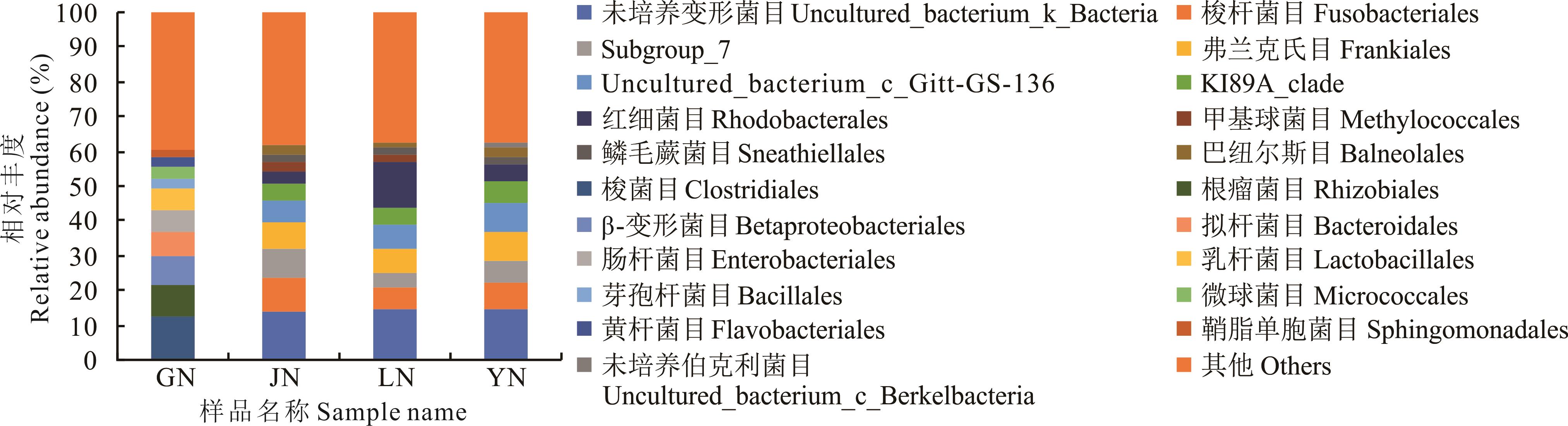
图6 目分类水平下的细菌群落相对丰度
Fig.6 Relative abundance of bacterial community at order level

图7 属分类水平下的细菌群落相对丰度
Fig.7 Relative abundance of bacterial community at the level of genus classification
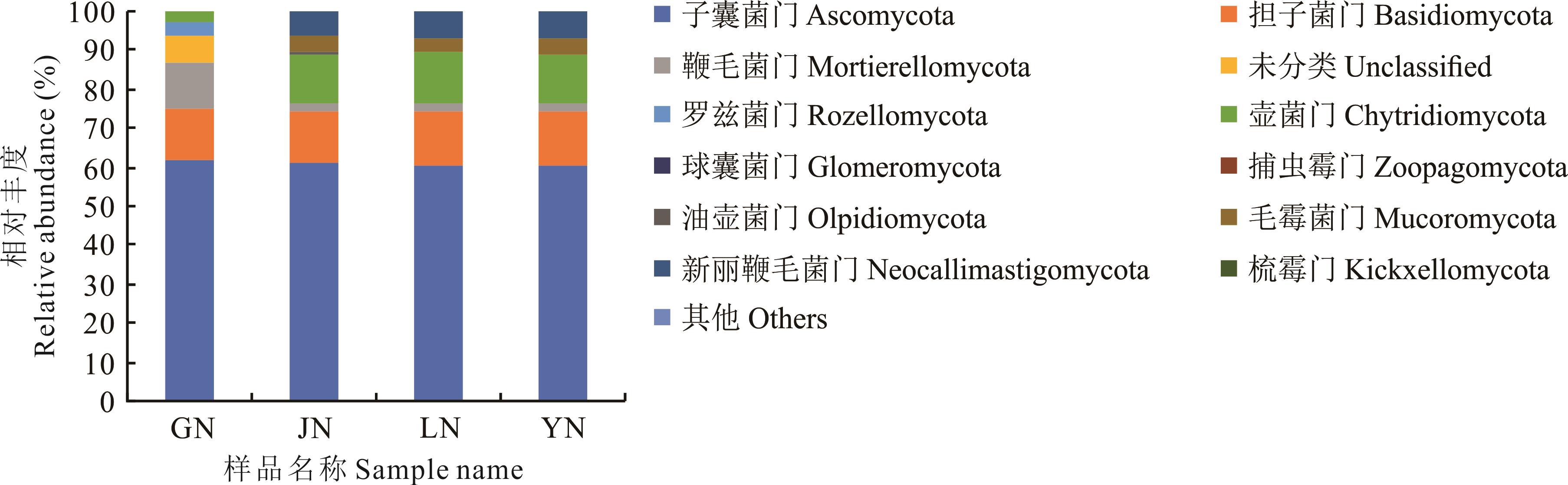
图8 门分类水平下的真菌群落相对丰度
Fig.8 Relative abundance of fungal communities at the phylum level

图9 目分类水平下的真菌群落相对丰度
Fig.9 Relative abundance of fungal communities at the order level
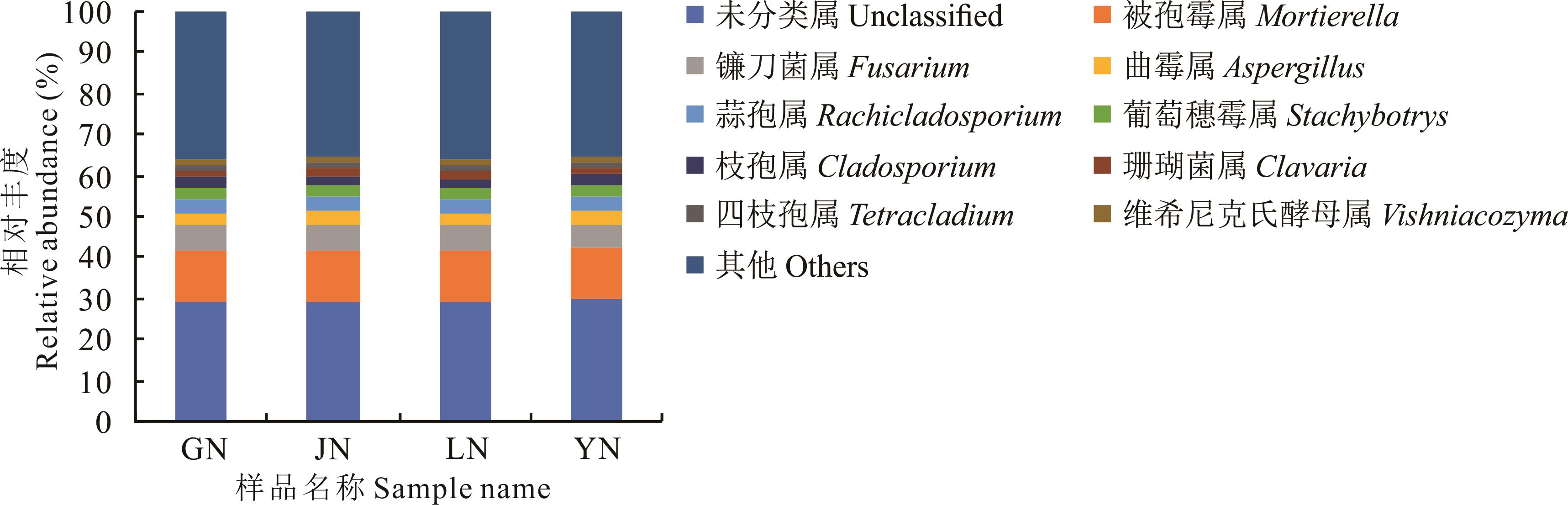
图10 属分类水平下的真菌群落相对丰度
Fig.10 Relative abundance of fungal communities at the genus level
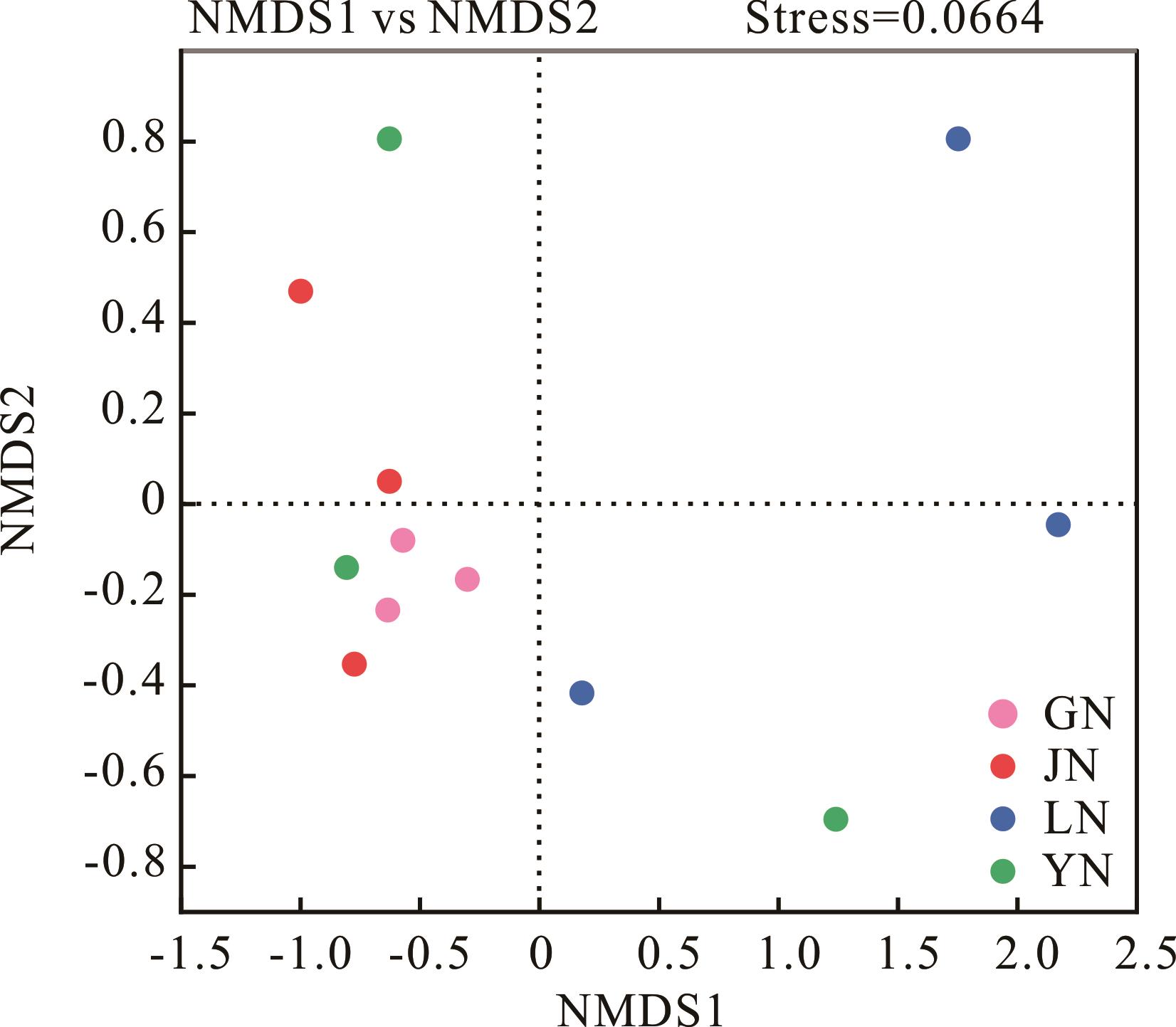
图11 不同器官组织细菌群落结构的非度量多维尺度分析当Stress 小于0.1 时,可认为是一个好的排序;当Stress 小于0.05 时,则具有很好的代表性;当Stress小于0.2时,表明NMDS分析具有一定的可靠性。坐标图上距离越近的样品,相似性越高。下同。When Stress is less than 0.1, it can be considered as a good order. When Stress is less than 0.05, it has a good representation; when Stress is less than 0.2, it shows that NMDS analysis has certain reliability. The closer the sample on the coordinate diagram, the higher the similarity. The same below.
Fig.11 NMDS of bacterial community structure in different organs and tissues
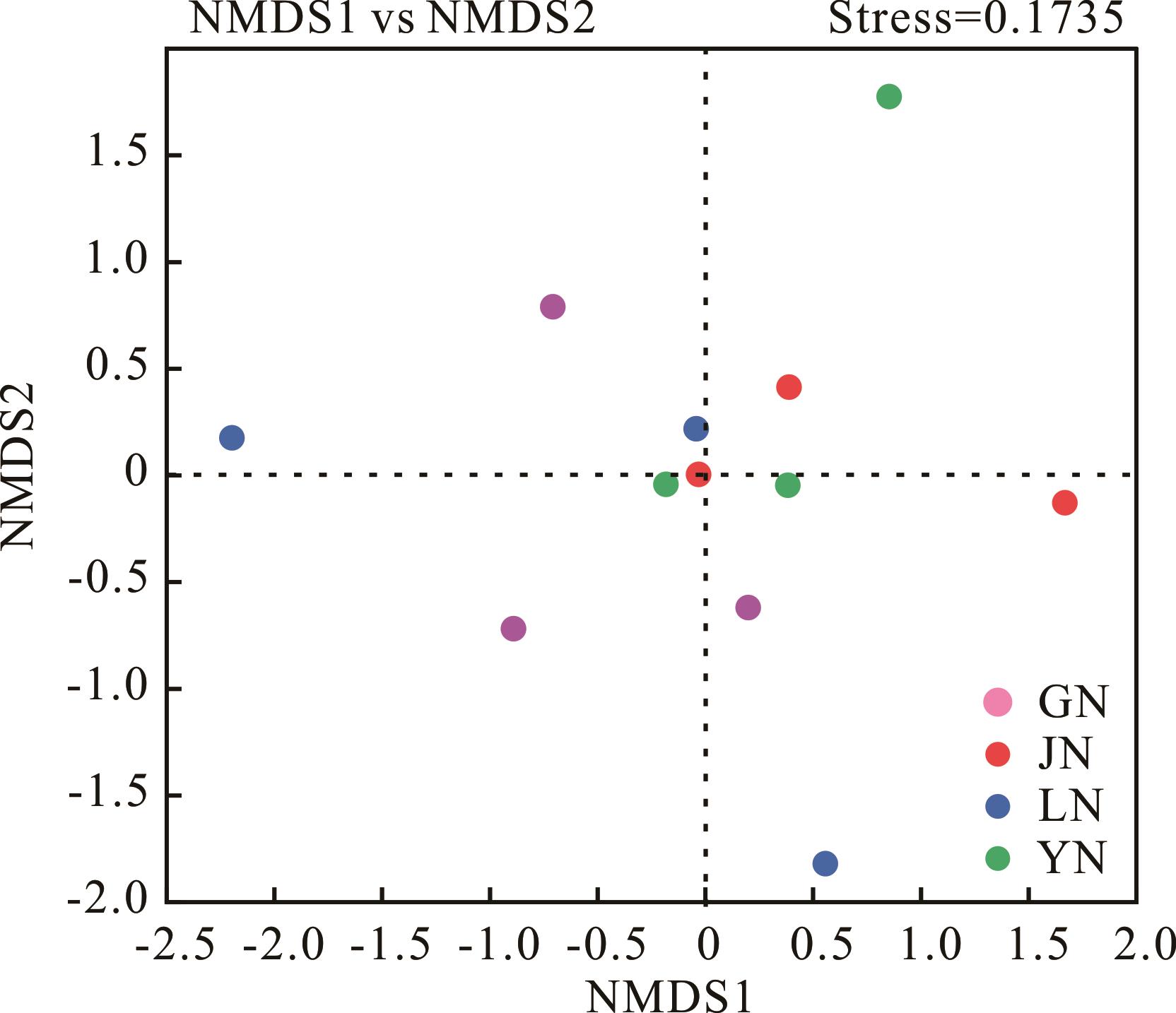
图12 器官组织真菌群落结构的非度量多维尺度分析
Fig.12 NMDS of fungal community structure in different organs and tissues

图13 不同器官组织内生细菌的物种网络分析
Fig.13 Network analysis of bacterial endophytes in different organs and tissues
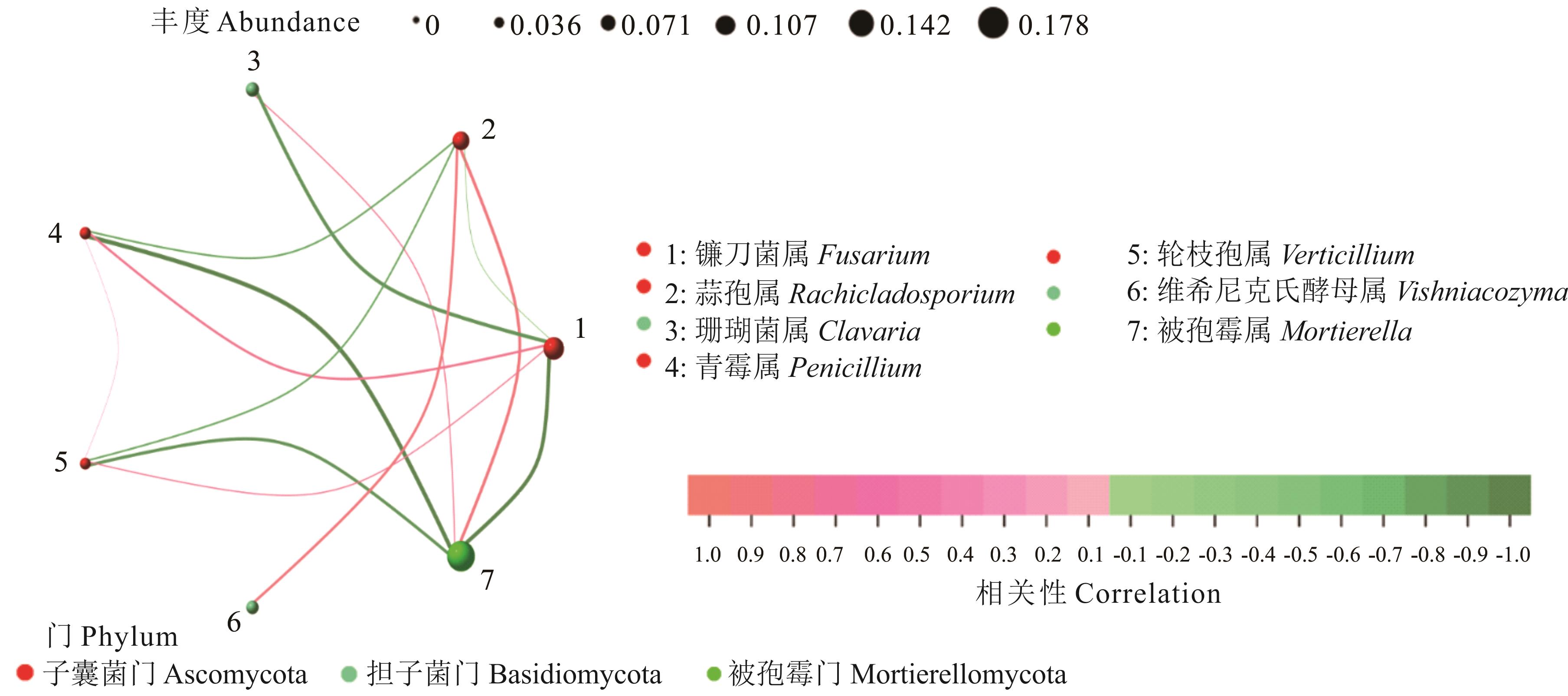
图14 不同器官组织内生真菌的物种网络分析
Fig.14 Network analysis of fungal endophytes in different organs and tissues
| 1 | Ma R L, Xu S R, Zhang J J. Community composition and differential analysis of endophytic in different dormancy states of Notopterygium incisum Ting ex H. T. Chang seeds. Natural Product Research and Development, 2024, 36(5): 805-814. |
| 马瑞丽, 胥生荣, 张金晶. 羌活种子不同休眠状态内生菌群落结构组成和差异性分析. 天然产物研究与开发, 2024, 36(5): 805-814. | |
| 2 | Fatima F, Ahmad M M, Verma S R, et al. Relevance of phosphate solubilizing microbes in sustainable crop production: A review. International Journal of Environmental Science and Technology, 2021, 19(9): 9283-9296. |
| 3 | Harman G E, Doni F, Khadka R B, et al. Endophytic strains of Trichoderma increase plants’ photosynthetic capability. Journal of Applied Microbiology, 2021, 130(2): 529-546. |
| 4 | Wang Y L, Lin Q Q, Li Y, et al. Application potential of siderophore-producing rhizobacteria in phytoremediation of heavy metals-contaminated soil: A review. Chinese Journal of Applied Ecology, 2013, 24(7): 2081-2088. |
| 王英丽, 林庆祺, 李宇, 等. 产铁载体根际菌在植物修复重金属污染土壤中的应用潜力. 应用生态学报, 2013, 24(7): 2081-2088. | |
| 5 | Song X, Fu C H, Li J H, et al. Research progress on molecular mechanism of endophytes improving the drought resistance and salt tolerance of plant. Acta Agrestia Sinica, 2024, 32(1): 13-24. |
| 宋雪, 付楚涵, 李家红, 等. 内生菌提高植物抗旱性和耐盐性分子机制研究进展. 草地学报, 2024, 32(1): 13-24. | |
| 6 | Cao J Z, Du X W, Li Q, et al. Research progress in effects of endophytes from medicinal plants on promoting biosynthesis of medicinal components. Central and South Pharmacy, 2024, 22(2): 445-452. |
| 曹际钊, 都晓伟, 李倩, 等. 药用植物内生菌促药效成分生物合成的研究进展. 中南药学, 2024, 22(2): 445-452. | |
| 7 | Zhai K H, Zhang Y Y, Gao X Q. Research progress on mechanisms of growth promotion and disease resistance of seed endophytes. Journal of Agricultural Biotechnology, 2023, 31(9): 1965-1979. |
| 翟凯辉, 张影影, 高夕全. 种子内生菌促生机制和抗病机理研究进展. 农业生物技术学报, 2023, 31(9): 1965-1979. | |
| 8 | Hu Y, Mo Q, Zhang Y, et al. Research progress on endophytes in maize and their application of microorganism inoculants. Molecular Plant Breeding, 2023, 21(23): 7977-7987. |
| 胡玥, 莫芹, 章寅, 等. 玉米内生菌及其内生菌剂开发研究进展. 分子植物育种, 2023, 21(23): 7977-7987. | |
| 9 | Li P, Bai Y X, Zhang R S, et al. A brief discussion on the current status and direction of corn breeding development in my country. Seed Science and Technology, 2019, 37(2): 18-19. |
| 李鹏, 白永新, 张润生, 等. 浅议我国玉米育种发展现状与方向. 种子科技, 2019, 37(2): 18-19. | |
| 10 | Liu J. Screening, identification and functional analysis of endophytes in fresh maize. Guangzhou: Zhongkai University of Agriculture and Engineering, 2018. |
| 刘娟. 鲜食玉米内生菌的分离、鉴定及功能分析. 广州: 仲恺农业工程学院, 2018. | |
| 11 | Sun Y X, Men X Y, Li C, et al. Screening of corn endophyte strains against Rhopalosiphum maidis. Chinese Journal of Biological Control, 2019, 35(4): 570-575. |
| 孙艺昕, 门兴元, 李超, 等. 抗玉米蚜玉米内生菌的筛选. 中国生物防治学报, 2019, 35(4): 570-575. | |
| 12 | Lv F Y. Study of isolation and diversity of rhizospheric and endophytic nitrogen-fixing bacteria from different parts of maize. Beijing: Chinese Academy of Agricultural Sciences, 2017. |
| 吕翻洋. 玉米根际及不同部位内生固氮菌分离及其多样性研究. 北京: 中国农业科学院, 2017. | |
| 13 | Fisher P J, Petrini O, Scott H M L. The distribution of some fungal and bacterial endophytes in maize (Zea mays L.). New Phytologist, 1992, 122(2): 299-305. |
| 14 | Chen S D, Gong H Q, Yin G L, et al. Nutritional quality and bacterial community diversity of silage corn during aerobic exposure. Acta Agrestia Sinica, 2023, 31 (2): 388-395. |
| 陈三冬, 巩海强, 尹国丽, 等. 青贮玉米有氧暴露过程中营养品质及细菌群落多样性. 草地学报, 2023, 31(2): 388-395. | |
| 15 | Shu Y X, Luo M, Chen X Y, et al. Analysis of endophytic fungi diversity of Exocarpium citri Grandis in Guangdong province. Journal of Zhongkai University of Agriculture and Engineering, 2021, 34(1): 8-11. |
| 舒永馨, 罗梅, 陈欣瑜, 等. 广东化橘红内生真菌多样性分析. 仲恺农业工程学院学报, 2021, 34(1): 8-11. | |
| 16 | Liu Y C, Wang H M, Qian X Y, et al. Isolation, identification and antagonistic activity of maize endophyte L10. Journal of Plant Protection, 2021, 48(3): 630-637. |
| 刘彦策, 王会敏, 钱欣雨, 等. 玉米内生菌L10的分离、鉴定及拮抗活性. 植物保护学报, 2021, 48(3): 630-637. | |
| 17 | Fang T J, Bai L C. Community structure and diversity analysis of endophytic fungi in the needles of Picea crassifolia kom. Molecular Plant Breeding, 2022, 20(15): 5198-5204. |
| 方泰军, 白露超. 青海云杉针叶内生真菌群落结构及多样性分析. 分子植物育种, 2022, 20(15): 5198-5204. | |
| 18 | Fang T J, Bai L C. Community structure and diversity analysis of endophytic fungi in needles of Juniperus przewalskii. Journal of Arid Land Resources and Environment, 2023, 37(4): 170-177. |
| 方泰军, 白露超. 不同生长状态祁连圆柏针叶内生真菌群落结构与多样性分析. 干旱区资源与环境, 2023, 37(4): 170-177. | |
| 19 | Tu Y T, Huang J C, Peng Z P, et al. Effects of biochar on tomato growth and soil microecology under phenolic acid stress. Guangdong Agricultural Sciences, 2021, 48(1): 94-103. |
| 涂玉婷, 黄继川, 彭智平, 等. 生物炭对酚酸胁迫下番茄生长和土壤微生态的影响. 广东农业科学, 2021, 48(1): 94-103. | |
| 20 | Shi Q J, Jiang D, Zhou N, et al. Diversity and antibacterial activity of endophytic fungi from different parts of Asarum heterotropoides var. manschuricum. Journal of Microbiology, 2022, 42(5): 31-39. |
| 史启今, 姜丹, 周娜, 等. 北细辛不同部位内生真菌的多样性与抑菌活性. 微生物学杂志, 2022, 42(5): 31-39. | |
| 21 | Lü P, Wang X H, Liu X Y, et al. Bacterial diversity and communities in different parts of the medicinal plant Capparis spinosa L. Acta Microbiologica Sinica, 2023, 63(10): 3939-3954. |
| 吕佩, 王新绘, 刘晓颖, 等. 药用植物刺山柑不同部位细菌群落结构及其多样性. 微生物学报, 2023, 63(10): 3939-3954. | |
| 22 | Li Q Q, Xie Y L, Lin W, et al. Distribution and diversity of endophytic bacteria in tomato plants from Guangxi. Biodiversity, 2006(6): 534-540. |
| 黎起秦, 谢义灵, 林纬, 等. 广西番茄内生细菌的多样性和数量动态. 生物多样性, 2006(6): 534-540. | |
| 23 | Wang S S, Liu J M, Sun J, et al. Diversity and antibacterial activity of endophytic bacteria in roots and stems of Dendrobium officinale with different cultivation patterns. Acta Microbiologica Sinica, 2021, 61(12): 4006-4025. |
| 王珊珊, 刘佳萌, 孙晶, 等. 不同栽培方式的铁皮石斛根、茎中内生细菌多样性及其抑菌活性研究. 微生物学报, 2021, 61(12): 4006-4025. | |
| 24 | Xiao X, Chen W M, Zong L, et al. Two cultivated legume plants reveal the enrichment process of the microbiome in the rhizocompartments. Molecular Ecology, 2017, 26(6): 1641-1651. |
| 25 | Edwards J, Johnson C, Santos-Medellin C, et al. Structure, variation, and assembly of the root associated microbiomes of rice. Proceedings of the National Academy of Sciences of the United States of America, 2015, 112(8): E911-E920. |
| 26 | Maida I, Chiellini C, Mengoni A, et al. Antagonistic interactions between endophytic cultivable bacterial communities isolated from the medicinal plant Echinacea purpurea. Environmental Microbiology, 2016, 18(8): 2357-2365. |
| 27 | Fierer N, Bradford M A, Jackson R B. Toward an ecological classification of soil bacteria. Ecology, 2007, 88(6): 1354-1364. |
| 28 | Wei Y Q, Chen J X, Zheng Y L, et al. Diversity and adaptability of endophytic microorganisms in coralloid roots of different species of Cycas. Acta Microbiologica Sinica, 2022, 62(7): 2835-2849. |
| 魏玉倩, 陈健鑫, 郑艳玲, 等. 不同种苏铁珊瑚状根内生微生物多样性及适应性研究. 微生物学报, 2022, 62(7): 2835-2849. | |
| 29 | Tang Y N. Rhizosphere microecological mechanism of selenium enhancing phosphorus uptake in citrus. Wuhan: Huazhong Agricultural University, 2023. |
| 汤艳妮. 硒增强柑橘磷吸收的根际微生态机制. 武汉: 华中农业大学, 2023. | |
| 30 | Cheng Y, Liu Z D, Shen Q B, et al. The impact of straw biochar on corn rhizospheric and non-rhizospheric soil microbial community structure. Journal of Ecology and Environment, 2018, 27(10): 1870-1877. |
| 程扬, 刘子丹, 沈启斌, 等. 秸秆生物炭施用对玉米根际和非根际土壤微生物群落结构的影响. 生态环境学报, 2018, 27(10): 1870-1877. | |
| 31 | Bashir S, Iqbal A, Hasnain S. Comparative analysis of endophytic bacterial diversity between two varieties of sunflower Helianthus annuus with their PGP evaluation. Saudi Journal of Biological Sciences, 2020, 27(2): 720-726. |
| 32 | Chen Z B, Huang L, Xia Z Y, et al. Species diversity characteristics of endophytic bacteria in tobacco at different regions of Yunnan province. Journal of Southwest Agriculture, 2015, 28(2): 857-861. |
| 陈泽斌, 黄丽, 夏振远, 等. 云南不同地区烟草内生细菌多样性特征. 西南农业学报, 2015, 28(2): 857-861. | |
| 33 | Lupatini M, Suleiman A K A, Jacques R J S, et al. Network topology reveals high connectance levels and few key microbial genera within soils. Front Environmental Science, 2014, 2(10): 1-10. |
| 34 | Ma B, Wang H Z, Dsouza M, et al. Geographic patterns of co-occurrence network topological features for soil microbiota at continental scale in Eastern China. The ISME Journal, 2016, 10(8): 1-11. |
| 35 | Krzmarzick M J, Crary B B, Harding J J, et al. Natural niche for organohalide-respiring Chloroflexi. Applied and Environmental Microbiology, 2012, 78(2): 393-401. |
| 36 | Castro H F, Classen A T, Austin E E, et al. Soil microbial community responses to multiple experimental climate change drivers. Applied and Environmental Microbiology, 2010, 76(4): 999-1007. |
| 37 | Qian J, Wu Z Y, Zhu Y Z, et al. Correlation between microecology and antibiotic resistance at the pig-soil interface in Chongming District, Shanghai, China. Chinese Journal of Microecology, 2024, 36(2): 135-146. |
| 钱璟, 吴哲元, 朱泳璋, 等. 上海市崇明区猪-土壤界面微生态与抗生素耐药性相关性分析. 中国微生态学杂志, 2024, 36(2): 135-146. | |
| 38 | Tao Y, Xing P. Progress in candidate phyla radiation (CPR) research. Acta Microbiologica Sinica, 2020, 60(6): 1284-1303. |
| 陶晔, 邢鹏. 候选门级辐射类群(CPR)细菌研究进展. 微生物学报, 2020, 60(6): 1284-1303. | |
| 39 | Zhang L M, Shen J P, He J Z. Metabolism and functional diversity of the wonderful archaea-Thaumarchaeota. Scientific Observation, 2015, 10(6): 63-66. |
| 张丽梅, 沈菊培, 贺纪正. 奇妙的古菌-奇古菌(Thaumarchaeota)的代谢和功能多样性. 科学观察, 2015, 10(6): 63-66. | |
| 40 | Liu D Y, Liu Y, Men X H, et al. Isolation and characterization of Thermopirellula anaerolimosa gen. nov., sp. nov., an obligate anaerobic hydrogen-producing bacterium of the phylum Planctomycetes. Acta Microbiologica Sinica, 2012, 52(8): 994-1001. |
| 刘冬英, 刘奕, 门学慧, 等. 浮霉菌门严格厌氧产氢细菌(Thermopirellula anaerolimosa)的分离及其生理特性. 微生物学报, 2012, 52(8): 994-1001. | |
| 41 | Huang S B, Xiong S, Liu Z P, et al. Progress in impact of interaction between Treponema pallidum and maternal-fetal interface cells on pregnancy outcomes. Chinese Journal of Pathophysiology, 2024, 40(2): 351-357. |
| 黄少彬, 熊顺, 刘兆平, 等. 梅毒螺旋体与母胎界面细胞相互作用影响妊娠结局的机制研究进展. 中国病理生理杂志, 2024, 40(2): 351-357. | |
| 42 | Wang Z W, Tian L T, Liu L L, et al. Effects of adding different types and proportions of complex probiotics to the diet on the rumen microbe of Hu sheep (Ovis aries). Journal of Agricultural Biotechnology, 2024, 32(3): 568-577. |
| 王智伟, 田林涛, 刘林丽, 等. 日粮添加不同种类和比例复合益生菌对湖羊瘤胃微生物群落的影响. 农业生物技术学报, 2024, 32(3): 568-577. | |
| 43 | Liu L, Zhan Q C, Peng W Z. Advances in biogeography of rhizobia. Acta Microbiologica Sinica, 2018, 58(2): 202-208. |
| 刘璐, 詹庆才, 彭伟正. 根瘤菌生物地理学的研究进展. 微生物学报, 2018, 58(2): 202-208. | |
| 44 | Taghavi S, Lelie D, Hoffman A, et al. Genome sequence of the plant growth promoting endophytic bacterium Enterobacter sp. 638. PLoS Genetics, 2010, 6(5): 808-811. |
| 45 | Gou M, Qu Y Y, Yang H, et al. Sphingomonas sp.: A novel microbial resource for biodegradation of aromatic compounds. Journal of Applied and Environmental Biology, 2008, 14(2): 276-282. |
| 苟敏, 曲媛媛, 杨桦, 等. 鞘氨醇单胞菌: 降解芳香化合物的新型微生物资源. 应用与环境生物学报, 2008, 14(2): 276-282. | |
| 46 | Ma L C, Lü H, Wei H, et al. Advances in the research on biodegradation of bisphenols. Industrial Water Treatment, 2017, 37(12): 11-16. |
| 马力超, 吕红, 魏浩, 等. 双酚类化合物的生物降解研究进展. 工业水处理, 2017, 37(12): 11-16. | |
| 47 | Zhang Z F, Huang R, Li X Y, et al. Seed-borne bacterial diversity of oat and functional analysis based on Illumina MiSeq high-throughput sequencing. Acta Prataculturae Sinica, 2023, 32(7): 96-108. |
| 张振粉, 黄荣, 李向阳, 等. 基于Illumina MiSeq高通量测序的燕麦种带细菌多样性及功能分析. 草业学报, 2023, 32(7): 96-108. | |
| 48 | Ding Z T, Xu D M, Bai J, et al. Characterization and identification of ferulic acid esterase-producing Lactobacillus species isolated from Elymus nutans silage and their application in ensiled alfalfa. Journal of Applied Microbiology, 2019, 127(4): 985-995. |
| 49 | Reziguli K, Cui W D, Long X Q, et al. Research progress on effect of lactic acid bacteria on fermentation quality of silage. Feed Research, 2023, 46(19): 155-158. |
| 热孜姑丽·库尔班, 崔卫东, 龙宣杞, 等. 乳酸菌对青贮饲料发酵品质影响的研究进展. 饲料研究, 2023, 46(19): 155-158. | |
| 50 | Shan K, Wang C L, Fang Z J, et al. Effects of “starane” on the diversity of bacterial communities in different micro-environment of maize roots. Acta Microbiologica Sinica, 2019, 59(3): 510-522. |
| 单凯, 王春蕾, 方志军, 等. “使它隆”对玉米根部不同微生环境细菌群落多样性的影响. 微生物学报, 2019, 59(3): 510-522. | |
| 51 | Yu J F, Kang K L, Tu J H, et al. Diversity analysis of endophytes in Cinnamomum septentrionale based on high-throughput sequencing. Hebei Agricultural Sciences, 2024, 28(1): 74-80. |
| 余劲夫, 康凯丽, 涂继红, 等. 基于高通量测序的银木内生细菌多样性分析. 河北农业科学, 2024, 28(1): 74-80. | |
| 52 | Li N N, Liu Y, Zhao R, et al. Diversity of endophytic bacteria in Beijing high-quality hybrid maize (Zea mays) seed. Journal of Food Science and Technology, 2016, 34(5): 55-63. |
| 李南南, 刘洋, 赵燃, 等. 北京优质杂交玉米种子内生细菌种类多样性. 食品科学技术学报, 2016, 34(5): 55-63. | |
| 53 | Zhou X F. Study on the distribution of endophytic bacteria in Dendrobium officinale. Hangzhou: Zhejiang Science-Technology University, 2014. |
| 周小风. 铁皮石斛内生细菌分布规律的研究. 杭州: 浙江理工大学, 2014. | |
| 54 | Tian B Y, Yang J T, Zhang K Q. Bacteria used in the biological control of plant-parasitic nematodes: populations, mechanisms of action, and future prospects. Fems Microbiology Ecology, 2007, 61(2): 197-213. |
| 55 | Wu G Q, Yu Z L, Wei M. The mechanism of PGPR regulating plant response to abiotic stress. Acta Prataculturae Sinica, 2024, 33(6): 203-218. |
| 伍国强, 于祖隆, 魏明. PGPR调控植物响应逆境胁迫的作用机制. 草业学报, 2024, 33(6): 203-218. | |
| 56 | Cruywagen E M, Crous P W, Roux J, et al. Fungi associated with black mould on baobab trees in southern Africa. Antonie Van Leeuwenhoek, 2015, 108(1): 85-95. |
| 57 | Li F H, Li M, Liu J Q, et al. Effects of biochar on fungal abundance of rhizosphere soil and cucumber root growth in greenhouse. Journal of Agricultural Machinery, 2017, 48(4): 265-270, 341. |
| 李发虎, 李明, 刘金泉, 等. 生物炭对温室黄瓜根际土壤真菌丰度和根系生长的影响. 农业机械学报, 2017, 48(4): 265-270, 341. | |
| 58 | Shanthiyaa V, Saravanakumar D, Rajendran L, et al. Use of Chaetomium globosum for biocontrol of potato late blight disease. Crop Protection, 2013, 25(3): 33-38. |
| 59 | Song H Y, Li L L, Li C, et al. Analysis of community structure and diversity of endophytic fungi in different parts of cotton. China Cotton, 2019, 46(1): 20-25. |
| 宋海燕, 李丽莉, 李超, 等. 棉花不同部位内生真菌群落结构及多样性分析. 中国棉花, 2019, 46(1): 20-25. | |
| 60 | Mei C, Fan S S, Ai X M, et al. Genome sequencing and mycoparasitism mechanism of a Cladosporium sp. strain. Bulletin of Microbiology, 2022, 49(8): 3310-3323. |
| 梅超, 范世昌, 艾小满, 等. 一株重寄生枝孢菌的基因组测序及重寄生机制分析. 微生物学通报, 2022, 49(8): 3310-3323. | |
| 61 | Jin Y Y, Chen Z J, Wang T, et al. Effects of endophytic fungi and field management practices on the abundance and diversity of soil fungal communities. Acta Prataculturae Sinica, 2023, 32(4): 142-152. |
| 金媛媛, 陈振江, 王添, 等. 内生真菌和田间管理措施对土壤真菌群落丰度和多样性的影响. 草业学报, 2023, 32(4): 142-152. | |
| 62 | Jiang X, Deng C C, Wang D J, et al. Effects of plant functional groups removal on soil fungal community structure and diversity in an alpine meadow on the Qinghai-Tibet Plateau. Journal of Plant Sciences, 2023, 41(4): 425-436. |
| 姜雪, 邓超超, 王党军, 等. 青藏高原高寒草甸植物功能群移除对土壤真菌群落结构和多样性的影响. 植物科学学报, 2023, 41(4): 425-436. | |
| 63 | Cheng H, Zhang D H, Zhang J Z, et al. Endophytic microbial community analysis and function prediction in different tissue parts of apple rootstock T337. Jiangsu Agricultural Sciences, 2022, 50(14): 144-154. |
| 程欢, 张东华, 张俊忠, 等. 苹果砧木T337不同组织内生菌群落及其功能预测. 江苏农业科学, 2022, 50(14): 144-154. |
| [1] | 李雪萍, 许世洋, 李建军, 漆永红. 青稞根腐病根际土壤细菌多样性及群落结构变化规律[J]. 草业学报, 2025, 34(5): 118-129. |
| [2] | 王守兴, 周华坤, 欧立鹏, 李成先, 王雁鹤, 宁晓春, 谷强, 魏代军, 杨明新. 三江源不同草地类型植被及土壤微生物多样性与土壤因子特征的研究[J]. 草业学报, 2025, 34(4): 16-26. |
| [3] | 陈鑫珠, 林平冬, 岳稳, 杨雅妮, 邱水玲, 郑向丽. 不同添加剂对蚕豆秸秆青贮品质及微生物多样性的影响[J]. 草业学报, 2025, 34(4): 164-174. |
| [4] | 蒋鹏, 李磊, 解昊郡, 徐得甲, 王锐, 虎强, 孙权. 净化沼液滴灌对砂壤土质量、青贮玉米生产力的影响及安全消纳容量分析[J]. 草业学报, 2025, 34(4): 64-81. |
| [5] | 梁宇成, 张晓雯, 邵涛, 王文博, 原现军. 乳酸菌对全株玉米青贮发酵品质和霉菌毒素含量的影响[J]. 草业学报, 2025, 34(3): 123-133. |
| [6] | 樊有鹤, 岳思妤, 南志标, 范玉兵. 我国玉米种业与产业政策演进及其对草地农业发展的启示[J]. 草业学报, 2025, 34(3): 189-203. |
| [7] | 姜安静, 董乙强, 周时杰, 聂婷婷, 吴悦, 柳泽宇, 单兴芸, 雷雅欣, 吴凯, 安沙舟. 草地植物多样性沿海拔梯度分布特征及其驱动因素——以天山北坡东段为例[J]. 草业学报, 2025, 34(3): 29-40. |
| [8] | 刘淑琪, 崔东, 刘文新, 杨海军, 杨延成, 江智诚, 闫江超, 刘江慧. 短期氮、水添加和刈割对苦豆子型退化草地植物群落特征与土壤理化性质的影响[J]. 草业学报, 2025, 34(3): 41-55. |
| [9] | 龚昕, 霍新茹, 李雯, 杨彦东, 刘超, 秦伟春, 沈艳, 王国会, 马红彬. 宁夏罗山山地草原植被群落特征及其空间分异[J]. 草业学报, 2025, 34(2): 1-15. |
| [10] | 吕娜, 高吉喜, 李政海, 尤春赫, 刘晓曼, 张彪, 莫宇, 朱萨宁, 彭阳, 杨雪. 植物生长中期施肥对草甸草原群落特征与物种多样性的影响[J]. 草业学报, 2025, 34(2): 109-122. |
| [11] | 李媛, 孟思宇, 冯晓云, 鲍根生. 内生真菌对根寄生逆境下紫花针茅根系形态的影响[J]. 草业学报, 2025, 34(1): 135-150. |
| [12] | 郭璟, 王越, 祁存英, 李静. 内生真菌浸种对燕麦生长和根部内生真菌群落的影响[J]. 草业学报, 2025, 34(1): 151-160. |
| [13] | 王文虎, 王世林, 梁国玲, 李文, 曹文侠. 坡向和坡位对祁连山高寒灌丛植物群落多样性的影响[J]. 草业学报, 2025, 34(1): 17-28. |
| [14] | 王新友, 王小兰, 张万昌, 李颖, 马永玲, 王晓寅, 王建刚, 王海青, 岳贝凡, 刘永福, 王永宏, 刘珊, 白美婷. 陇东南部林缘山区青贮玉米品种筛选及其高效栽培研究[J]. 草业学报, 2025, 34(1): 191-202. |
| [15] | 阿斯太肯·居力海提null, 孙宗玖, 于冰洁, 迪达尔·比苏力旦null, 李美莎, 敬一胜. 封育对蒿类荒漠草地土壤微生物碳源利用特征的影响[J]. 草业学报, 2025, 34(1): 29-40. |
| 阅读次数 | ||||||
|
全文 |
|
|||||
|
摘要 |
|
|||||
