

ISSN 1004-5759 CN 62-1105/S
草业学报 ›› 2025, Vol. 34 ›› Issue (4): 164-174.DOI: 10.11686/cyxb2024241
• 研究论文 • 上一篇
陈鑫珠1( ), 林平冬1(), 岳稳1, 杨雅妮1,2, 邱水玲1,2, 郑向丽3
收稿日期:2024-04-30
修回日期:2024-07-29
出版日期:2025-04-20
发布日期:2025-02-19
作者简介:陈鑫珠(1985-),女,福建龙岩人,副研究员,博士。E-mail: 010622051@163.com基金资助:
Xin-zhu CHEN1(), Ping-dong LIN1(), Wen YUE1, Ya-ni YANG1,2, Shui-ling QIU1,2, Xiang-li ZHENG3
Received:2024-04-30
Revised:2024-07-29
Online:2025-04-20
Published:2025-02-19
摘要:
为研究不同添加剂对蚕豆秸秆青贮品质和微生物多样性的影响,设3%蔗糖(T1组)、乳酸菌(T2组)、乳酸菌+3%蔗糖(T3组)、乳酸菌+0.2%柠檬酸(T4组)、0.2%柠檬酸(T5组)、0.03% NaCl(T6组)、0.1%维生素C(T7组)7个添加剂处理组和无添加剂对照组(CK组),每个处理3个重复。青贮30 d后开封取样,进行青贮料的感官质量、青贮品质及微生物多样性分析。结果表明,1)在感官质量上,7个添加剂处理组均为1级,优于CK组;2)在青贮品质上,与对照组相比,T1组的乙酸(AA)含量显著提高(P<0.05);T2组乳酸(LA)含量显著提高,pH值显著降低(P<0.05);T3组可溶性碳水化合物(WSC)、LA和AA含量显著提高(P<0.05),酸性洗涤纤维含量和pH值显著降低(P<0.05);T4组WSC和LA含量显著提高(P<0.05),pH值和氨态氮含量显著降低(P<0.05);T5和T7组的LA和AA含量均显著提高(P<0.05),粗蛋白(CP)含量显著降低(P<0.05);T6组WSC、LA和AA含量显著提高(P<0.05),CP含量显著降低(P<0.05);3)在微生物多样性上,各组在属水平上的优势菌群均为肠杆菌属(占比19.3%~41.3%)和乳植杆菌属(占比12.0%~40.0%);与对照组相比,T3、T5、T7组的乳植杆菌属、片球菌属和魏斯氏菌属相对丰度显著提高(P<0.05),其中T3组的Alpha多样性和Beta多样性差异显著(P<0.05)。由此可见,添加剂处理能够改善蚕豆秸秆青贮料的感官和青贮品质,调整青贮发酵微生物群落结构,其中乳酸菌联合3%蔗糖处理的青贮发酵效果最佳。
陈鑫珠, 林平冬, 岳稳, 杨雅妮, 邱水玲, 郑向丽. 不同添加剂对蚕豆秸秆青贮品质及微生物多样性的影响[J]. 草业学报, 2025, 34(4): 164-174.
Xin-zhu CHEN, Ping-dong LIN, Wen YUE, Ya-ni YANG, Shui-ling QIU, Xiang-li ZHENG. Effects of various additives on the quality and microbial diversity of broad bean straw silage[J]. Acta Prataculturae Sinica, 2025, 34(4): 164-174.
组别 Group | 色泽Color | 气味Smell | 结构Texture | 综合评价Comprehensive evaluation | ||||
|---|---|---|---|---|---|---|---|---|
描述 Description | 得分 Score | 描述 Description | 得分 Score | 描述 Description | 得分 Score | 总分 Total score | 等级 Grade | |
| CK | 黄绿色Yellow-green | 1 | 酸味稍刺鼻SHAS | 10 | 叶子结构保持较差PMLS | 2 | 13 | 2 |
| T1 | 黄绿色Yellow-green | 1 | 酸香味CAS | 14 | 茎叶结构保持良好GSLS | 4 | 19 | 1 |
| T2 | 绿色Green | 2 | 酸香味CAS | 14 | 茎叶结构保持良好GSLS | 4 | 20 | 1 |
| T3 | 绿色Green | 2 | 酸香味CAS | 14 | 茎叶结构保持良好GSLS | 4 | 20 | 1 |
| T4 | 绿色Green | 2 | 酸香味CAS | 14 | 茎叶结构保持良好GSLS | 4 | 20 | 1 |
| T5 | 绿色Green | 2 | 酸香味CAS | 14 | 茎叶结构保持良好GSLS | 4 | 20 | 1 |
| T6 | 黄绿色Yellow-green | 1 | 酸香味CAS | 14 | 茎叶结构保持良好GSLS | 4 | 19 | 1 |
| T7 | 绿色Green | 2 | 酸香味CAS | 14 | 叶子结构保持较差PMLS | 2 | 18 | 1 |
表1 各组青贮料的感官质量评价
Table 1 Sensory quality evaluation of silage in various groups
组别 Group | 色泽Color | 气味Smell | 结构Texture | 综合评价Comprehensive evaluation | ||||
|---|---|---|---|---|---|---|---|---|
描述 Description | 得分 Score | 描述 Description | 得分 Score | 描述 Description | 得分 Score | 总分 Total score | 等级 Grade | |
| CK | 黄绿色Yellow-green | 1 | 酸味稍刺鼻SHAS | 10 | 叶子结构保持较差PMLS | 2 | 13 | 2 |
| T1 | 黄绿色Yellow-green | 1 | 酸香味CAS | 14 | 茎叶结构保持良好GSLS | 4 | 19 | 1 |
| T2 | 绿色Green | 2 | 酸香味CAS | 14 | 茎叶结构保持良好GSLS | 4 | 20 | 1 |
| T3 | 绿色Green | 2 | 酸香味CAS | 14 | 茎叶结构保持良好GSLS | 4 | 20 | 1 |
| T4 | 绿色Green | 2 | 酸香味CAS | 14 | 茎叶结构保持良好GSLS | 4 | 20 | 1 |
| T5 | 绿色Green | 2 | 酸香味CAS | 14 | 茎叶结构保持良好GSLS | 4 | 20 | 1 |
| T6 | 黄绿色Yellow-green | 1 | 酸香味CAS | 14 | 茎叶结构保持良好GSLS | 4 | 19 | 1 |
| T7 | 绿色Green | 2 | 酸香味CAS | 14 | 叶子结构保持较差PMLS | 2 | 18 | 1 |
组别 Group | 干物质 DM (%FM) | 粗蛋白 CP (%DM) | 中性洗涤纤维 NDF (%DM) | 酸性洗涤纤维 ADF (%DM) | 半纤维素 HC (%DM) | 可溶性碳水化合物 WSC (g·kg-1DM) |
|---|---|---|---|---|---|---|
| CK | 29.85±0.79a | 9.70±0.15a | 36.23±1.48a | 12.83±0.81a | 23.40±0.85a | 6.49±0.28cd |
| T1 | 30.66±0.53a | 9.08±0.35abc | 34.42±0.84a | 12.44±0.33a | 21.98±0.68a | 6.46±0.19cd |
| T2 | 29.30±5.48a | 9.53±0.32ab | 35.64±0.94a | 12.67±0.20a | 22.97±0.96a | 7.13±0.38bc |
| T3 | 31.80±1.16a | 9.34±0.42abc | 34.55±1.09a | 9.74±2.99b | 24.82±4.07a | 7.99±0.46a |
| T4 | 30.71±0.35a | 9.55±0.18ab | 34.70±2.92a | 11.78±1.34ab | 22.92±1.70a | 7.26±0.69b |
| T5 | 27.90±0.59a | 9.03±0.45bc | 35.17±1.29a | 12.81±0.46a | 22.37±0.82a | 6.31±0.23d |
| T6 | 30.31±0.98a | 8.75±0.04c | 35.84±0.69a | 13.05±0.10a | 22.79±0.63a | 7.39±0.22ab |
| T7 | 29.50±0.55a | 8.81±0.47c | 36.60±0.69a | 13.17±0.24a | 23.42±0.54a | 6.26±0.42d |
表2 各组青贮料的营养成分
Table 2 Nutrient composition of silage in various groups
组别 Group | 干物质 DM (%FM) | 粗蛋白 CP (%DM) | 中性洗涤纤维 NDF (%DM) | 酸性洗涤纤维 ADF (%DM) | 半纤维素 HC (%DM) | 可溶性碳水化合物 WSC (g·kg-1DM) |
|---|---|---|---|---|---|---|
| CK | 29.85±0.79a | 9.70±0.15a | 36.23±1.48a | 12.83±0.81a | 23.40±0.85a | 6.49±0.28cd |
| T1 | 30.66±0.53a | 9.08±0.35abc | 34.42±0.84a | 12.44±0.33a | 21.98±0.68a | 6.46±0.19cd |
| T2 | 29.30±5.48a | 9.53±0.32ab | 35.64±0.94a | 12.67±0.20a | 22.97±0.96a | 7.13±0.38bc |
| T3 | 31.80±1.16a | 9.34±0.42abc | 34.55±1.09a | 9.74±2.99b | 24.82±4.07a | 7.99±0.46a |
| T4 | 30.71±0.35a | 9.55±0.18ab | 34.70±2.92a | 11.78±1.34ab | 22.92±1.70a | 7.26±0.69b |
| T5 | 27.90±0.59a | 9.03±0.45bc | 35.17±1.29a | 12.81±0.46a | 22.37±0.82a | 6.31±0.23d |
| T6 | 30.31±0.98a | 8.75±0.04c | 35.84±0.69a | 13.05±0.10a | 22.79±0.63a | 7.39±0.22ab |
| T7 | 29.50±0.55a | 8.81±0.47c | 36.60±0.69a | 13.17±0.24a | 23.42±0.54a | 6.26±0.42d |
| 组别Group | pH | 乳酸LA (g·kg-1DM) | 乙酸AA (g·kg-1DM) | 丙酸PA (%DM) | 丁酸BA (%DM) | 氨态氮NH3-N (g·kg-1DM) |
|---|---|---|---|---|---|---|
| CK | 4.57±0.06a | 34.65±6.46d | 0.17±0.05e | 0.31±0.11a | 0.12±0.00b | 0.17±0.01a |
| T1 | 4.57±0.06a | 37.99±6.26cd | 0.41±0.09a | 0.31±0.08a | 0.16±0.06ab | 0.15±0.01a |
| T2 | 4.43±0.06bc | 52.15±0.54ab | 0.18±0.03de | 0.34±0.07a | 0.16±0.06ab | 0.15±0.03a |
| T3 | 4.37±0.06c | 55.71±5.89a | 0.25±0.03cd | 0.37±0.04a | 0.09±0.02b | 0.13±0.01ab |
| T4 | 4.40±0.00c | 45.46±5.86bc | 0.20±0.03cde | 0.32±0.05a | 0.09±0.01b | 0.08±0.03b |
| T5 | 4.50±0.00ab | 48.26±3.69ab | 0.34±0.02ab | 0.33±0.10a | 0.18±0.04ab | 0.15±0.03a |
| T6 | 4.53±0.06a | 49.61±0.62ab | 0.25±0.03cd | 0.41±0.01a | 0.18±0.04ab | 0.16±0.07a |
| T7 | 4.50±0.00ab | 47.04±0.94b | 0.27±0.01bc | 0.27±0.11a | 0.18±0.03a | 0.17±0.00a |
表3 各组青贮料的发酵品质
Table 3 Fermentation quality of silage in various groups
| 组别Group | pH | 乳酸LA (g·kg-1DM) | 乙酸AA (g·kg-1DM) | 丙酸PA (%DM) | 丁酸BA (%DM) | 氨态氮NH3-N (g·kg-1DM) |
|---|---|---|---|---|---|---|
| CK | 4.57±0.06a | 34.65±6.46d | 0.17±0.05e | 0.31±0.11a | 0.12±0.00b | 0.17±0.01a |
| T1 | 4.57±0.06a | 37.99±6.26cd | 0.41±0.09a | 0.31±0.08a | 0.16±0.06ab | 0.15±0.01a |
| T2 | 4.43±0.06bc | 52.15±0.54ab | 0.18±0.03de | 0.34±0.07a | 0.16±0.06ab | 0.15±0.03a |
| T3 | 4.37±0.06c | 55.71±5.89a | 0.25±0.03cd | 0.37±0.04a | 0.09±0.02b | 0.13±0.01ab |
| T4 | 4.40±0.00c | 45.46±5.86bc | 0.20±0.03cde | 0.32±0.05a | 0.09±0.01b | 0.08±0.03b |
| T5 | 4.50±0.00ab | 48.26±3.69ab | 0.34±0.02ab | 0.33±0.10a | 0.18±0.04ab | 0.15±0.03a |
| T6 | 4.53±0.06a | 49.61±0.62ab | 0.25±0.03cd | 0.41±0.01a | 0.18±0.04ab | 0.16±0.07a |
| T7 | 4.50±0.00ab | 47.04±0.94b | 0.27±0.01bc | 0.27±0.11a | 0.18±0.03a | 0.17±0.00a |

图1 蚕豆秸秆青贮菌群属水平(A)和种水平(B)上的物种相对丰度(前10)
Fig.1 Species relative abundance of microbial communities at genus level (A) and species level (B) in broad bean straw silage (top 10)

图2 蚕豆秸秆青贮菌群在属水平上的比较分析
Fig.2 Comparative analysis of microbial community at genus level in broad bean straw silage
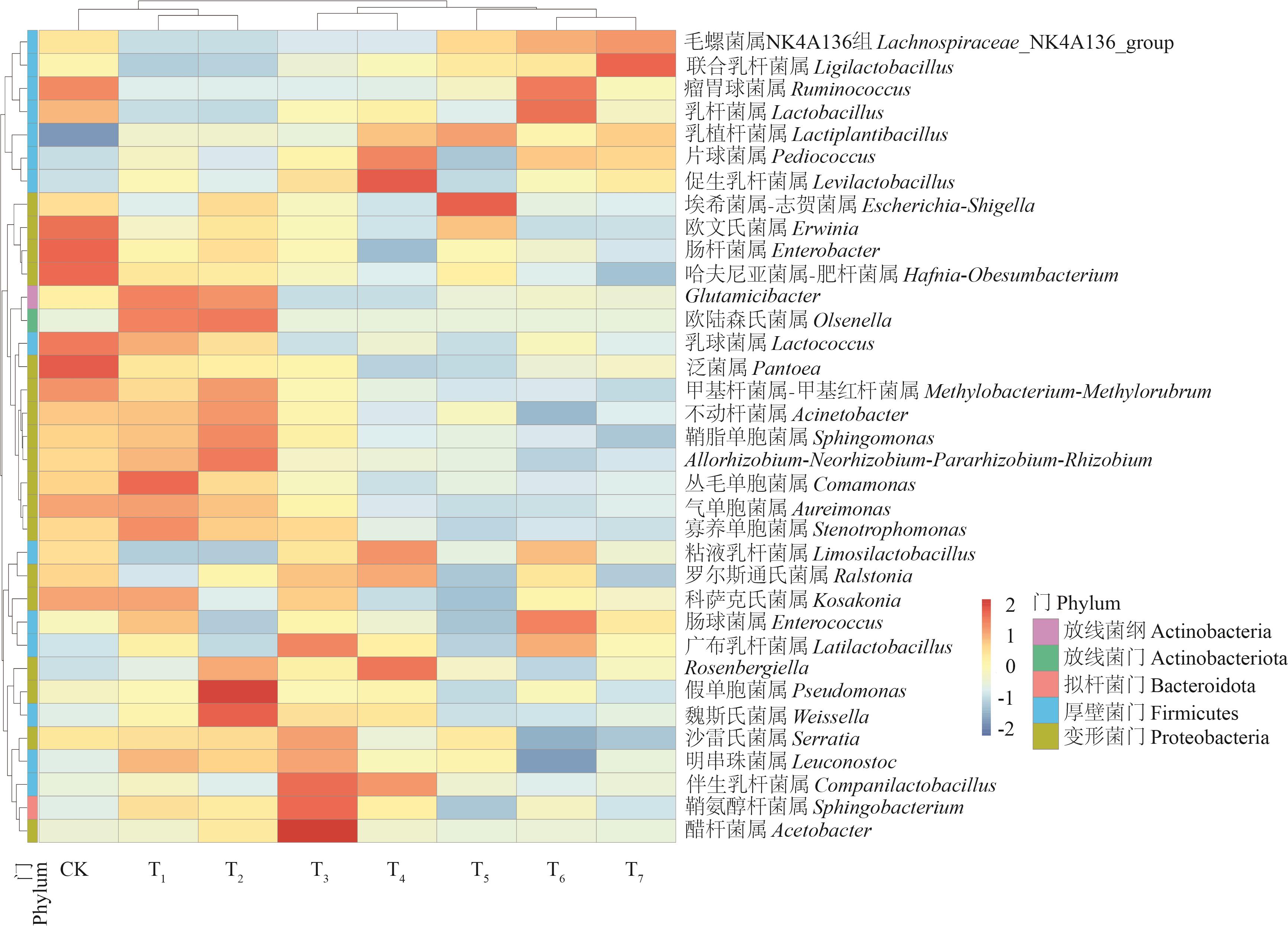
图3 蚕豆秸秆青贮微生物在属水平上的物种聚类热图
Fig.3 Species clustering heat map of microbial communities at genus level in broad bean straw silage

图4 蚕豆秸秆青贮菌群的Alpha多样性指数差异*: P<0.05; **: P<0.01.
Fig.4 Alpha diversity index difference of microbial communities in broad bean straw silage

图5 蚕豆秸秆青贮菌群群落的PCoA图
Fig.5 PCoA plot of microbial communities in broad bean straw silage
| 1 | Xu X Y, Li A P, Wu L Y, et al. Advances on the utilization of straws fromVicia faba. Fujian Journal of Agricultural Sciences, 2015, 30(2): 204-207. |
| 徐晓俞, 李爱萍, 吴凌云, 等. 蚕豆秸秆综合利用研究进展. 福建农业学报, 2015, 30(2): 204-207. | |
| 2 | Qu L L, Liu F, Wang C, et al. Research progress on effect of silage additives on natural forage silage. Feed Research, 2024, 47(4): 158-161. |
| 屈璐璐, 刘芳, 王超, 等. 青贮添加剂对天然牧草青贮影响的研究进展. 饲料研究, 2024, 47(4): 158-161. | |
| 3 | Bao W H, Bu D P, Zhou L Y, et al. Research progress on application of silage additives. China Animal Husbandry & Veterinary Medicine, 2012, 39(8): 124-128. |
| 包万华, 卜登攀, 周凌云, 等. 青贮饲料添加剂应用的研究进展. 中国畜牧兽医, 2012, 39(8): 124-128. | |
| 4 | Xu H W, Sun L, Na N, et al. Dynamics of bacterial community and fermentation quality in Leymus chinensis silage treated with lactic acid bacteria and/or water. Frontiers Microbiology, 2021, 12: 717120. |
| 5 | Zhang J W, Liu Y C, Wang Z J, et al. Effects of different types of LAB on dynamic fermentation quality and microbial community of native grass silage during anaerobic fermentation and aerobic exposure. Microorganisms, 2023, 11(2): 513. |
| 6 | Wu B Y, Hu Z F, Wei M L, et al. Effects of inoculation of Lactiplantibacillus plantarum and Lentilactobacillus buchneri on fermentation quality, aerobic stability, and microbial community dynamics of wilted Leymus chinensis silage. Frontiers Microbiology, 2022, 13: 928731. |
| 7 | Hu Z F, Ma D Y, Niu H X, et al. Enzyme additives influence bacterial communities of Medicago sativa silage as determined by Illumina sequencing. AMB Express, 2021, 11(1): 5. |
| 8 | Wang W, Zhou T R, Xiao Y Z, et al. Effects of additives on quality of natural grass silage. Chinese Journal of Grassland, 2023, 45(6): 143-148. |
| 王伟, 周天荣, 肖燕子, 等. 添加剂对天然牧草青贮品质的影响. 中国草地学报, 2023, 45(6): 143-148. | |
| 9 | Xue Z L, Song L M, Huang B Z. Effects of adding urea or salt on silage quality of Sorghum vulgare×S. sudanense. Chinese Journal of Grassland, 2014, 36(1): 75-78. |
| 薛祝林, 宋丽梅, 黄必志. 添加尿素或食盐对高丹草青贮品质的影响. 中国草地学报, 2014, 36(1): 75-78. | |
| 10 | Guo H M, Xia T C, Zhu W, et al. Effect of additives on the quality and aerobic stability of rice straw silage. Acta Prataculturae Sinica, 2017, 26(2): 190-196. |
| 郭海明, 夏天婵, 朱雯, 等. 青贮添加剂对稻草青贮品质和有氧稳定性的影响. 草业学报, 2017, 26(2): 190-196. | |
| 11 | Jiang Y, Shen W R, Han L P, et al. Application research of organic acids and salts in vegetable and fruit color fixativing and avoid the browning. Applied Chemical Industry, 2007(6): 534-536. |
| 江莹, 沈卫荣, 韩丽萍, 等. 有机酸及相关盐类在果蔬护色、防褐变中的应用研究. 应用化工, 2007(6): 534-536. | |
| 12 | Han X L, Shi W J, Zhang J, et al. Effects of citric acid addition on nutritional quality and fermentation characteristics of Chamaecrista rotundifolia silage. Pratacultural Science, 2021, 38(9): 1762-1770. |
| 韩雪林, 史文娇, 张娟, 等. 柠檬酸添加剂对圆叶决明青贮饲料营养品质与发酵特性的影响. 草业科学, 2021, 38(9): 1762-1770. | |
| 13 | Yan W M, Chen Y K, Yang P B, et al. Research progress on quality assessment methods of silage. China Animal Husbandry & Veterinary Medicine, 2024, 51(1): 135-144. |
| 闫威明, 陈雅坤, 杨鹏标, 等. 青贮饲料质量评定方法研究进展. 中国畜牧兽医, 2024, 51(1): 135-144. | |
| 14 | Van Soest P J, Robertson J B, Lewis B A. Methods for dietary fiber, neutral detergent fiber, and nonstarch polysaccharides in relation to animal nutrition. Journal of Dairy Science, 1991, 74(10): 3583-3597. |
| 15 | Chen X Z, Dong Z X, Zhang J G. Silage carbon sources preferred by epiphytic lactic acid bacteria. Fujian Journal of Agricultural Sciences, 2024, 39(5): 512-521. |
| 陈鑫珠, 董朝霞, 张建国. 饲草附生乳酸菌对碳源的选择性. 福建农业学报, 2024, 39(5): 512-521. | |
| 16 | Broderick G A, Kang J H. Automated simultaneous determination of ammonia and total amino acids in ruminal fluid and in vitro media. Journal of Dairy Science, 1980, 63(1): 64-75. |
| 17 | Han K, Collins M, Vanzant E S, et al. Bale density and moisture effects on alfalfa round bale silage. Crop Science, 2004, 44(3): 914-919. |
| 18 | Liao J R, Liu S N, Huo J L, et al. Isolation, identification of a lactic acid bacteria strain and its effect on fermentation of broad bean straw silage. Journal of Yunnan Agricultural University (Natural Science), 2023, 38(6): 966-972. |
| 廖隽锐, 刘韶娜, 霍金龙, 等. 青贮巨菌草乳酸菌的分离鉴定及其对蚕豆秸秆青贮发酵的效果. 云南农业大学学报(自然科学版), 2023, 38(6): 966-972. | |
| 19 | Yang F H, Liu S N, Liao J R, et al. Screening and identification of Bacillus YF-15 and its effect on nutritional quality of faba bean straw. Feed Research, 2023, 46(9): 121-125. |
| 杨福华, 刘韶娜, 廖隽锐, 等. 芽孢杆菌YF-15的筛选、鉴定及对蚕豆秸秆青贮营养品质的影响. 饲料研究, 2023, 46(9): 121-125. | |
| 20 | Oladosu Y, Rafii M Y, Abdullah N, et al. Fermentation quality and additives: a case of rice straw silage. Biomed Research International, 2016, 7985167. |
| 21 | Jin H Z, Zhao Y P, Chen A H. Effects of different microbial agents on the fermentation quality and nutrient contents of corn straw silage. China Feed, 2018(6): 16-20. |
| 靳会珍, 赵月萍, 陈爱华. 不同微生物菌剂对青贮玉米秸秆发酵品质和营养成分的影响. 中国饲料, 2018(6): 16-20. | |
| 22 | Kang J H, Tang S X, Zhong R Z, et al. Alfalfa silage treated with sucrose has an improved feed quality and more beneficial bacterial communities. Frontiers in Microbiology, 2021, 12: 670165. |
| 23 | Huisden C M, Adesogan A T, Kim S C, et al. Effect of applying molasses or inoculants containing homofermentative or heterofermentative bacteria at two rates on the fermentation and aerobic stability of corn silage. Journal of Dairy Science, 2009, 92(2): 690-697. |
| 24 | Li M, Zi X J, Zhou H L, et al. Effect of lactic acid bacteria, molasses, and their combination on the fermentation quality and bacterial community of cassava foliage silage. Animal Science Journal, 2021, 92(1): e13635. |
| 25 | Li Y, Du S, Sun L, et al. Effects of lactic acid bacteria and molasses additives on dynamic fermentation quality and microbial community of native grass silage. Frontiers Microbiology, 2022, 13: 830121. |
| 26 | Huang X W, Fan X, Tang M H, et al. Research progress of effects of additives on the quality of forage grass silage. Feed Industry, 2023, 44(17): 81-85. |
| 黄秀文, 范雪, 唐明欢, 等. 青贮添加剂对牧草青贮品质影响的研究进展. 饲料工业, 2023, 44(17): 81-85. | |
| 27 | Liu Y, Zi X J, Chen T, et al. Research progress and countermeasure on microbial diversity of forage silage. Chinese Journal of Animal Nutrition, 2021, 33(11): 6084-6092. |
| 刘悦, 字学娟, 陈婷, 等. 饲草青贮微生物多样性研究进展及对策. 动物营养学报, 2021, 33(11): 6084-6092. | |
| 28 | Nazar M, Ullah M W, Wang S, et al. Exploring the epiphytic microbial community structure of forage crops: their adaptation and contribution to the fermentation quality of forage sorghum during ensiling. Bioengineering, 2022, 9(9): 428. |
| 29 | Zhou Y, Drouin P, Lafreniere C. Effect of temperature (5-25 ℃) on epiphytic lactic acid bacteria populations and fermentation of whole-plant corn silage. Journal of Applied Microbiology, 2016, 121(3): 657-671. |
| 30 | Chen M Y, Bai J, Ke W C, et al. Research advances in silage microbial communities and functions. Biotechnology Bulletin, 2021, 37(9): 11-23. |
| 陈梦言, 白洁, 柯文灿, 等. 青贮饲料微生物群落组成与功能研究进展. 生物技术通报, 2021, 37(9): 11-23. | |
| 31 | Li X Y, Dong Y, You H Y, et al. Effects of different types of additives on quality of corn straw silage. Feed Research, 2024, 47(5): 99-103. |
| 李旭业, 董扬, 尤海洋, 等. 不同类型添加剂对玉米秸秆青贮品质的影响. 饲料研究, 2024, 47(5): 99-103. | |
| 32 | Mu L C, Zhan X, Hu L X, et al. Lactobacillus plantarum and molasses alter dynamic chemical composition, microbial community, and aerobic stability of mixed (amaranth and rice straw) silage. The Journal of the Science of Food and Agriculture, 2021, 101(12): 5225-5235. |
| [1] | 申迪, 曾子铭, 庞凯悦, 柴沙驼, 聂洪辛, 李毓敏, 廖扬, 王迅, 黄伟华, 刘书杰, 杨英魁, 王书祥. 低精料日粮和高精料日粮对牦牛生长性能和瘤胃菌群结构的影响[J]. 草业学报, 2024, 33(5): 155-165. |
| [2] | 黄佩珊, 臧美琪, 张炜灵, 陈俊戬, 刘立轩, 张庆. 黄梁木叶多酚提取工艺优化及其对柱花草青贮品质的影响[J]. 草业学报, 2024, 33(10): 159-170. |
| [3] | 郭田心, 阮诗诗, 郭香, 詹佳琦, 梁秋雨, 陈晓阳, 周玮, 张庆. 不同复合菌酶添加对中药渣青贮饲料的营养价值及发酵品质的影响[J]. 草业学报, 2024, 33(10): 194-202. |
| [4] | 党浩千, 覃娟清, 郭宇康, 张富, 王迎港, 刘庆华. 不同添加剂发酵笋壳对湖羊生产性能及瘤胃发酵的影响[J]. 草业学报, 2023, 32(7): 135-148. |
| [5] | 梁梦琪, 武齐丰, 邵涛, 吴艾丽, 刘秦华. 添加剂对多花黑麦草青贮发酵品质、α-生育酚和β-胡萝卜素含量的影响[J]. 草业学报, 2023, 32(5): 180-189. |
| [6] | 覃娟清, 党浩千, 金华云, 郭宇康, 张富, 刘庆华. 不同添加剂处理笋壳对其发酵品质及湖羊瘤胃微生物的影响[J]. 草业学报, 2023, 32(11): 155-167. |
| [7] | 戈建珍, 傅文慧, 张露, 蔺宝珺, 赵帅, 白玛噶翁, 寇建村. 多菌灵在果园白三叶青贮中的降解及其对微生物群落的影响[J]. 草业学报, 2022, 31(7): 64-75. |
| [8] | 周迪, 杨帅, 张欣欣, 袁婧, 高艳霞, 李建国, 汪波, 周广生, 傅廷栋, 叶俊, 杨利国, 滑国华. 添加剂种类和组合对晾晒后全株油菜青贮效果的影响[J]. 草业学报, 2022, 31(4): 124-135. |
| [9] | 张欢, 牟怡晓, 张桂杰. 添加枸杞副产物对紫花苜蓿青贮发酵品质及微生物多样性的影响[J]. 草业学报, 2022, 31(4): 136-144. |
| [10] | 郑娟善, 丁考仁青, 李新圃, 梁泽毅, 张剑搏, 杜梅, 丁学智. 瘤胃微生物在木质纤维素价值化利用的研究进展[J]. 草业学报, 2021, 30(9): 182-192. |
| [11] | 郭香, 陈德奎, 陈娜, 李云, 陈晓阳, 张庆. 含水量和添加剂对黄梁木叶青贮发酵品质的影响[J]. 草业学报, 2021, 30(8): 199-205. |
| [12] | 邹诗雨, 陈思葵, 唐启源, 陈东, 陈元伟, 邓攀, 黄胥莱, 李付强. 青贮剂对再生稻头季全株青贮品质和体外瘤胃发酵特性的影响[J]. 草业学报, 2021, 30(7): 122-132. |
| [13] | 袁洁, 马冉冉, 张文洁, 许能祥, 赵冉冉, 顾洪如, 丁成龙. 自然青贮多花黑麦草优良乳酸菌的筛选及对多花黑麦草青贮品质的影响[J]. 草业学报, 2021, 30(11): 132-143. |
| [14] | 李雄雄, 焦婷, 赵生国, 秦伟娜, 高雪梅, 王正文, 吴建平, 雷赵民. 牛至精油与有机钴协同对青贮玉米秸秆降解及绵羊瘤胃发酵特性的影响[J]. 草业学报, 2021, 30(11): 191-202. |
| [15] | 吴长荣, 代胜, 梁龙飞, 孙文涛, 彭超, 陈超, 郝俊. 不同添加剂对构树青贮饲料发酵品质和蛋白质降解的影响[J]. 草业学报, 2021, 30(10): 169-179. |
| 阅读次数 | ||||||
|
全文 |
|
|||||
|
摘要 |
|
|||||
