

ISSN 1004-5759 CN 62-1105/S
草业学报 ›› 2025, Vol. 34 ›› Issue (7): 28-40.DOI: 10.11686/cyxb2024342
原韶雨1,2( ), 韩诗卉1,2, 夏天1,2, 何宁波1,2, 张建杰1,2()
收稿日期:2024-09-03
修回日期:2024-11-11
出版日期:2025-07-20
发布日期:2025-05-12
通讯作者:
张建杰
作者简介:E-mail: zhangjianjie@yeah.net基金资助:
Shao-yu YUAN1,2(), Shi-hui HAN1,2, Tian XIA1,2, Ning-bo HE1,2, Jian-jie ZHANG1,2()
Received:2024-09-03
Revised:2024-11-11
Online:2025-07-20
Published:2025-05-12
Contact:
Jian-jie ZHANG
摘要:
土壤pH是影响草地生态系统植物生长和土壤养分有效性的关键因素之一,施肥作为修复退化草地的重要措施,可能会对土壤pH造成影响。为了研究不同施肥措施对中国北方天然草地土壤pH的影响,进一步为修复退化草地的措施优化提供科学依据,本研究收集了2000-2024年公开发表的63篇文献,共包括461组数据,采用整合分析(Meta-analysis)方法,对施用化学氮肥、氮磷配施和有机肥对土壤pH的影响进行了定量分析,并使用随机森林方法明确了不同施肥措施对土壤pH影响的主控因素。结果表明:总体上,施用化学氮肥对土壤pH的降幅最大,为5.31%,并且随施肥强度及施肥年限的增加而增大;氮磷配施的降幅为2.92%;施用有机肥在整体上对土壤pH没有显著影响。土壤pH对不同施肥措施的响应在不同草地类型、气候条件和酸碱度土壤中存在显著差异;随机森林分析结果显示,施肥量、施肥年限、土壤初始pH和年均降水量是土壤pH对不同施肥措施响应的重要因素。其中,施肥量是施用化学氮肥影响土壤pH的主控因素,均方误差的增加百分比为52.40%;土壤初始pH是氮磷配施和有机肥影响土壤pH的主控因素,均方误差的增加百分比分别为22.80%与22.20%。本研究还发现,施用有机肥对土壤pH的总体影响不显著,但显著增加了酸性及中性土壤的pH,降低了碱性土壤的pH。因此,在今后可以通过施用有机肥、有机无机肥配施等措施来调控土壤pH,从而保证草地生态系统的稳定性。
原韶雨, 韩诗卉, 夏天, 何宁波, 张建杰. 中国北方天然草地土壤pH对不同施肥措施的响应[J]. 草业学报, 2025, 34(7): 28-40.
Shao-yu YUAN, Shi-hui HAN, Tian XIA, Ning-bo HE, Jian-jie ZHANG. Responses of soil pH to different fertilization practices in natural grasslands of northern China[J]. Acta Prataculturae Sinica, 2025, 34(7): 28-40.
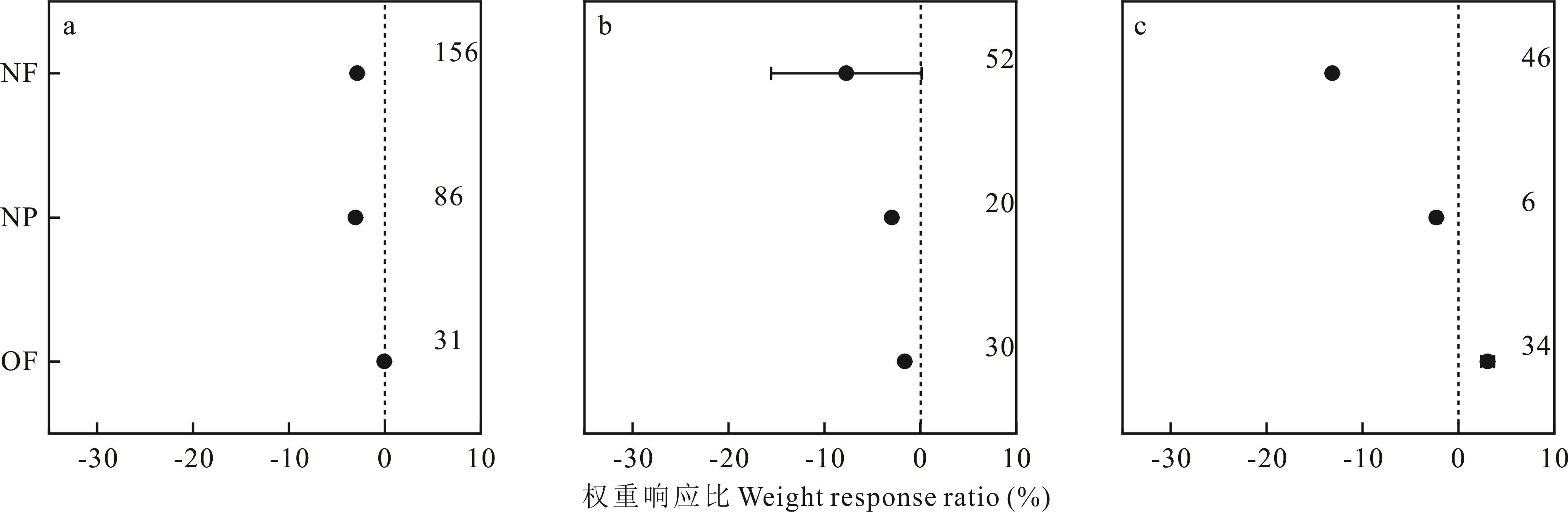
图1 不同施肥强度下施肥方式对土壤pH的影响NF表示施用化学氮肥;NP表示氮磷配施;OF表示施用有机肥。a: ≤100 kg N·hm-2;b: 100~200 kg N·hm-2;c: >200 kg N·hm-2。点和误差线分别代表增加的百分数及其95%的置信区间,如果95%的置信区间没有包含横坐标零点,表示处理与对照差异显著。右侧数值代表样本数。下同。NF represents the application of chemical nitrogen fertilizer; NP represents the combined application of nitrogen and phosphorus; OF represents the application of organic fertilizer. a: ≤100 kg N·ha-1; b: 100-200 kg N·ha-1; c: >200 kg N·ha-1. The dots and error bars represent the percentage increase and its 95% confidence interval, respectively. If the 95% confidence interval does not include the zero point on the x-axis, it indicates a significant difference between the treatment and the control. The numerical value on the right represents the number of samples. The same below.
Fig.1 The effects of various fertilization regimes on soil pH under different fertilization rates

图2 不同条件下施肥方式对土壤pH的影响n.a.代表缺少相应样本数 n.a. indicates the corresponding samples are missing.
Fig.2 The effects of various fertilization regimes on soil pH under various conditions

图3 各影响因素对土壤pH在不同施肥方式下响应的相对重要性排序“**”代表影响极显著,“*”代表影响显著。“**” stands for extremely significant effect, “*” stands for significant effect.
Fig.3 The relative importance ranking of various factors influencing the soil pH response to various fertilization regimes

图4 土壤pH对施用化学氮肥的响应与各影响因素的相关性
Fig.4 The correlation between soil pH response to chemical nitrogen fertilizer application and various influencing factors

图5 土壤pH对氮磷配施的响应与各影响因素的相关性
Fig.5 The correlation between soil pH response to combined application of nitrogen and phosphorus and various influencing factors

图6 土壤pH对施用有机肥的响应与各影响因素的相关性
Fig.6 The correlation between soil pH response to organic fertilizer application and various influencing factors
| 1 | Yan Z J, Sun H. Ecological status, protection and construction countermeasures of grassland in Northern China. Journal of Sichuan Grassland, 2005(7): 31-33, 42. |
| 闫志坚, 孙红. 中国北方草地生态现状、保护及建设对策. 四川草原, 2005(7): 31-33, 42. | |
| 2 | Ren H Y, Wen Z M, Liu Y Y, et al. Spatial-temporal dynamics of grassland net primary productivity and its relationship with hydrothermic factors in Northern China. Acta Agrestia Sinica, 2021, 29(8): 1779-1792. |
| 任涵玉, 温仲明, 刘洋洋, 等. 我国北方草地净初级生产力时空动态特征及其与水热因子的关系. 草地学报, 2021, 29(8): 1779-1792. | |
| 3 | Wang H Q, Fan G H, Huang Y X, et al. Advances in research on grassland productivity in Northern China. Ecological Science, 2022, 41(5): 219-229. |
| 王鹤琪, 范高华, 黄迎新, 等. 中国北方草地生产力研究进展. 生态科学, 2022, 41(5): 219-229. | |
| 4 | Bai Y F, Zhao Y J, Wang Y, et al. Assessment of ecosystem services and ecological regionalization of grasslands support establishment of ecological security barriers in Northern China. Bulletin of Chinese Academy of Sciences, 2020, 35(6): 675-689. |
| 白永飞, 赵玉金, 王扬, 等. 中国北方草地生态系统服务评估和功能区划助力生态安全屏障建设. 中国科学院院刊, 2020, 35(6): 675-689. | |
| 5 | Sun X, Yu Y, Liang J Y. Effects of grazing on nutritional quality of natural grassland communities in Northern China: a Meta-analysis. Acta Agrestia Sinica, 2023, 31(9): 2843-2852. |
| 孙逊, 俞玥, 梁俊毅. 放牧对中国北方天然草地群落营养品质影响的Meta分析. 草地学报, 2023, 31(9): 2843-2852. | |
| 6 | Gu C, Jia Z Q, Du B B, et al. Reviews and prospects of ecological restoration measures for degraded grasslands of China. Ecology and Environmental Sciences, 2022, 31(7): 1465-1475. |
| 古琛, 贾志清, 杜波波, 等. 中国退化草地生态修复措施综述与展望. 生态环境学报, 2022, 31(7): 1465-1475. | |
| 7 | Dai J Z, Wei Z J, Yan R R, et al. Effects of nitrogen and phosphorus addition on soil properties and aboveground biomass of Leymus chinensis mowing meadow. Chinese Journal of Grassland, 2016, 38(2): 52-58. |
| 代景忠, 卫智军, 闫瑞瑞, 等. N、P添加对羊草割草场土壤养分及地上生物量的影响. 中国草地学报, 2016, 38(2): 52-58. | |
| 8 | Zhang Y R, An H, Liu B R, et al. Effects of short-term nitrogen and phosphorus addition on soil labile organic carbon in desert grassland. Acta Prataculturae Sinica, 2019, 28(10): 12-24. |
| 张雅柔, 安慧, 刘秉儒, 等. 短期氮磷添加对荒漠草原土壤活性有机碳的影响. 草业学报, 2019, 28(10): 12-24. | |
| 9 | Qiao J, Zhao J N, Wang H, et al. Research progress on the effect of nitrogen fertilizer on grassland ecosystem. Grassland and Prataculture, 2013, 25(2): 22-28. |
| 乔江, 赵建宁, 王慧, 等. 施氮肥对草原生态系统影响的研究进展. 草原与草业, 2013, 25(2): 22-28. | |
| 10 | Fang Y F, Cao Z W, Sun H S, et al. Effects of fertilization and mixed sowing on soil nutrients and pasture yield of degraded grassland in Songnen Plain. Bulletin of Soil and Water Conservation, 2023, 43(1): 16-23. |
| 方玉凤, 曹志伟, 孙洪升, 等. 施肥和混播对松嫩平原退化草地土壤和牧草产量的影响. 水土保持通报, 2023, 43(1): 16-23. | |
| 11 | Wang L, Shi J J, Shi H L, et al. Effects of nitrogen and phosphorus addition on forage and soil nutrients in alpine grasslands around Qinghai Lake. Pratacultural Science, 2019, 36(12): 3065-3075. |
| 王玲, 施建军, 史慧兰, 等. 氮磷添加对环青海湖高寒草原牧草营养成分和土壤养分的影响. 草业科学, 2019, 36(12): 3065-3075. | |
| 12 | Zhang C Z, Bai X M, Yan Y B, et al. Effects of organic fertilizer on soil nutrients in degraded alpine meadow in Tianzhu. Grassland and Turf, 2024, 32(10): 3272-3279. |
| 张才忠, 白小明, 闫玉邦, 等. 有机肥对天祝高寒退化草甸土壤养分的影响. 草原与草坪, 2024, 32(10): 3272-3279. | |
| 13 | Zhang C, Wang M, Dai J Z, et al. Effect of organic fertilizer on plant communities and species diversity in meadow steppe. Chinese Journal of Agricultural Resources and Regional Planning, 2023, 44(3): 26-39. |
| 张楚, 王淼, 代景忠, 等. 有机肥对草甸草原植物群落及物种多样性的影响. 中国农业资源与区划, 2023, 44(3): 26-39. | |
| 14 | Shi T S, Collins S L, Yu K, et al. A global meta-analysis on the effects of organic and inorganic fertilization on grasslands and croplands. Nature Communications, 2024, 15(1): 3411. |
| 15 | Yun L. Effects of organic fertilizer on soil physical and chemical properties. Agriculture & Technology, 2010, 30(3): 65-66. |
| 云玲. 有机肥对土壤理化性质的影响. 农业与技术, 2010, 30(3): 65-66. | |
| 16 | Zhou M R, Sun Z J, Shen X Q. Research and application of earthworm excrement. Journal of Shanxi Agricultural Sciences, 2012, 40(8): 921-924. |
| 周美荣, 孙振江, 申晓强. 蚯蚓粪的研究及应用. 山西农业科学, 2012, 40(8): 921-924. | |
| 17 | Zuo L N, Chen J, Zhang H, et al. Patterns and drivers of soil pH on the Xinjiang temperate steppe. Pratacultural Science, 2022, 39(7): 1341-1353. |
| 左李娜, 陈静, 张慧, 等. 新疆温性草原土壤pH特征及影响因素. 草业科学, 2022, 39(7): 1341-1353. | |
| 18 | Zhang J J, Liu Z C, Yan C, et al. Effects of soil pH on soil carbon, nitrogen, and phosphorus ecological stoichiometry in three types of steppe. Acta Prataculturae Sinica, 2021, 30(2): 69-81. |
| 张静静, 刘尊驰, 鄢创, 等. 土壤pH值变化对3种草原类型土壤碳氮磷生态化学计量特征的影响. 草业学报, 2021, 30(2): 69-81. | |
| 19 | Tian D, Niu S. A global analysis of soil acidification caused by nitrogen addition. Environmental Research Letters, 2015, 10(2): 024019. |
| 20 | Yang Y, Ji C, Ma W, et al. Significant soil acidification across northern China’s grasslands during 1980s-2000s. Global Change Biology, 2012, 18(7): 2292-2300. |
| 21 | Wei J M, Jiang Y, Fu M M, et al. Effects of water and fertilizer addition on soil carbon, nitrogen, phosphorus and pH in typical steppe of Inner Mongolia. Chinese Journal of Ecology, 2011, 30(8): 1642-1646. |
| 魏金明, 姜勇, 符明明, 等. 水、肥添加对内蒙古典型草原土壤碳、氮、磷及pH的影响. 生态学杂志, 2011, 30(8): 1642-1646. | |
| 22 | Liu H Y, He P, Cai J P, et al. Effects of simulated nitrogen deposition on soil pH and electric conductivity in a typical grassland of Inner Mongolia. Chinese Journal of Soil Science, 2016, 47(1): 85-91. |
| 刘贺永, 何鹏, 蔡江平, 等. 模拟氮沉降对内蒙古典型草地土壤pH和电导率的影响. 土壤通报, 2016, 47(1): 85-91. | |
| 23 | Kidd J, Manning P, Simkin J, et al. Impacts of 120 years of fertilizer addition on a temperate grassland ecosystem. PLoS One, 2017, 12(3): e0174632. |
| 24 | Standardization Administration of China. Agriculture in arid areas-Terminology and zoning: GB/T 41684-2022. Beijing: Standards Press of China, 2023. |
| 国家标准化管理委员会. 旱区农业术语与分区: GB/T 41684-2022. 北京: 中国标准出版社, 2023. | |
| 25 | Yang F, Jia W, Yang N, et al. Spatio-temporal variation of surface soil pH of farmland in different regions of China in the past 30 years. Journal of Plant Nutrition and Fertilizers, 2023, 29(7): 1213-1227. |
| 杨帆, 贾伟, 杨宁, 等. 近30年我国不同地区农田耕层土壤的pH变化特征. 植物营养与肥料学报, 2023, 29(7): 1213-1227. | |
| 26 | Du Y, Zhai P H, Jia Z N, et al. Meta analysis of the response of natural grassland soil chemical properties to nitrogen and phosphorus addition. Grassland and Turf, 2021, 41(1): 76-82. |
| 杜艺, 翟鹏辉, 贾镇宁, 等. 天然草地土壤化学性质对氮磷添加响应的Meta分析. 草原与草坪, 2021, 41(1): 76-82. | |
| 27 | Gao J, Xu M G, Li R, et al. Effects of biochar application on soil pH: a Meta-analysis. Journal of Agricultural Science and Technology, 2023, 25(9): 186-196. |
| 高静, 徐明岗, 李然, 等. 整合分析生物炭施用对土壤pH的影响. 中国农业科技导报, 2023, 25(9): 186-196. | |
| 28 | Luo Y, Hui D, Zhang D. Elevated CO2 stimulates net accumulations of carbon and nitrogen in land ecosystems: A Meta-analysis. Ecology, 2006, 87(1): 53-63. |
| 29 | Guo H T, Gao J, Zhang Q, et al. Differences and reasons for the effects of organic fertilizer on the pH of acidic and alkaline soils in China. Chinese Journal of Applied and Environmental Biology, 2024, 30(3): 496-503. |
| 郭慧婷, 高静, 张强, 等. 有机肥对我国酸性和碱性土壤pH的影响差异及原因. 应用与环境生物学报, 2024, 30(3): 496-503. | |
| 30 | Tian M Y, Yu C J, Wang J K, et al. Effect of nitrogen additions on soil pH, phosphorus contents and phosphatase activities in grassland. Chinese Journal of Applied Ecology, 2020, 31(9): 2985-2992. |
| 田沐雨, 于春甲, 汪景宽, 等. 氮添加对草地生态系统土壤pH、磷含量和磷酸酶活性的影响. 应用生态学报, 2020, 31(9): 2985-2992. | |
| 31 | Xu J, Wang Y, Zhang Y, et al. Effect of nitrogen addition on soil net nitrogen mineralization in topsoil and subsoil regulated by soil microbial properties and mineral protection: evidence from a long-term grassland experiment. Science of the Total Environment, 2024, 947(2024): 174686. |
| 32 | Tong D L, Xu R K. Effects of urea, (NH4)2SO4 and NH4HCO3 on nitrification and acidification of a red soil. Journal of Plant Nutrition and Fertilizers, 2012, 18(4): 853-859. |
| 佟德利, 徐仁扣. 三种氮肥对红壤硝化作用及酸化过程影响的研究. 植物营养与肥料学报, 2012, 18(4): 853-859. | |
| 33 | Wang Q Y, Zhang J B, Zhao B Z, et al. Effects of long-term fertilization on calcium and magnesium morphological transformation and environmental behavior in typical fluvo-aquic soil. Soils, 2020, 52(3): 476-481. |
| 王擎运, 张佳宝, 赵炳梓, 等. 长期施肥对典型潮土钙、镁形态转化及其环境行为的影响. 土壤, 2020, 52(3): 476-481. | |
| 34 | Zhang P H, Yao J, Wang X R, et al. Effects of short-term nitrogen addition on soil inorganic carbon and soil acid buffering capacity in desert grasslands. Acta Agrestia Sinica, 2024, 32(7): 2081-2088. |
| 张普河, 姚佳, 王雪韧, 等. 短期氮添加对荒漠草原土壤无机碳及土壤酸缓冲能力的影响. 草地学报, 2024, 32(7): 2081-2088. | |
| 35 | Guo J Y, Wang Y X, Li J L. Effects of nitrogen addition on plant-soil carbon dynamics in terrestrial ecosystems of China. Acta Ecologica Sinica, 2022, 42(12): 4823-4833. |
| 郭洁芸, 王雅歆, 李建龙. 氮添加对中国陆地生态系统植物-土壤碳动态的影响. 生态学报, 2022, 42(12): 4823-4833. | |
| 36 | Zheng C, Guo Z X, Yuan Y Z, et al. Spatial and temporal changes of farmland soil acidification and their influencing factors in different regions of Guangdong Province, China. Chinese Journal of Applied Ecology, 2019, 30(2): 593. |
| 郑超, 郭治兴, 袁宇志, 等. 广东省不同区域农田土壤酸化时空变化及其影响因素. 应用生态学报, 2019, 30(2): 593. | |
| 37 | Dong Q, Sun F C, Li Y F, et al. Soil nutrient characteristics dataset of different types of grasslands in Inner Mongolia in 2021. Journal of Agricultural Big Data, 2024, 6(1): 103-109. |
| 董琦, 孙峰成, 栗艳芳, 等. 2021年内蒙古不同类型草原的土壤养分特征数据集. 农业大数据学报, 2024, 6(1): 103-109. | |
| 38 | Sun W, Li S W, Zhang G Y, et al. Effects of climate change and anthropogenic activities on soil pH in grassland regions on the Tibetan Plateau. Global Ecology and Conservation, 2023, 45(2023): e02532. |
| 39 | Xu Y F, Sun F Y, Guo Y X, et al. NH4 + adsorption characteristics of different saline soils. Journal of Agro-Environment Science, 2020, 39(10): 2345-2353. |
| 徐祎璠, 孙方园, 郭亚馨, 等. 不同盐碱化土壤对NH4 +吸附特性研究. 农业环境科学学报, 2020, 39(10): 2345-2353. | |
| 40 | Chuan L M, Zhao T K, An Z Z, et al. Research advancement in nitrate leaching and nitrogen use in soils. Chinese Agricultural Science Bulletin, 2010, 26(11): 200-205. |
| 串丽敏, 赵同科, 安志装, 等. 土壤硝态氮淋溶及氮素利用研究进展. 中国农学通报, 2010, 26(11): 200-205. | |
| 41 | Dai Q L, Bai Y P, Liu J L, et al. Influence of 40-year precipitation on temporal and spatial variation of arable soil pH in the Sichuan Basin. Southwest China Journal of Agricultural Sciences, 2023, 36(5): 1019-1026. |
| 代钎里, 白银萍, 刘建亮, 等. 四川盆地近40年降雨量对耕层土壤pH时空变化的影响. 西南农业学报, 2023, 36(5): 1019-1026. | |
| 42 | Han T F, Liu K L, Huang J, et al. Spatio-temporal evolution of soil pH and its driving factors in the main Chinese farmland during past 30 years. Journal of Plant Nutrition and Fertilizers, 2020, 26(12): 2137-2149. |
| 韩天富, 柳开楼, 黄晶, 等. 近30年中国主要农田土壤pH时空演变及其驱动因素. 植物营养与肥料学报, 2020, 26(12): 2137-2149. | |
| 43 | Zong H L, Zheng W K, Li J H, et al. Effects of long-term application of controlled-release urea on the acid-base buffering system and soil fertility in fluvo-aquic soils. Journal of Soil and Water Conservation, 2024, 38(4): 354-361. |
| 宗浩霖, 郑文魁, 李江华, 等. 长期施用控释尿素对潮土土壤酸碱缓冲体系与土壤肥力的影响. 水土保持学报, 2024, 38(4): 354-361. | |
| 44 | Chen J H, Li Y P, Xiong X, et al. Effect of nitrogen and phosphorus addition on soil acidity and stoichiometry characteristics in a typical temperate grassland in Inner Mongolia. Pratacultural Science, 2017, 11(5): 943-949. |
| 陈继辉, 李炎朋, 熊雪, 等. 氮磷添加对草地土壤酸度和化学计量学特征的影响. 草业科学, 2017, 11(5): 943-949. | |
| 45 | Yang X X, Ren F, Zhou H K, et al. Responses of plant community biomass to nitrogen and phosphorus additions in an alpine meadow on the Qinghai-Xizang Plateau. Chinese Journal of Plant Ecology, 2014, 38(2): 159-166. |
| 杨晓霞, 任飞, 周华坤, 等. 青藏高原高寒草甸植物群落生物量对氮、磷添加的响应. 植物生态学报, 2014, 38(2): 159-166. | |
| 46 | Zhai J Y. Effects of nitrogen and phosphorus addition on soil microbes and stoichiometric characteristic of alpine meadow in Qinghai-Tibet Plateau. Beijing: University of Chinese Academy of Sciences, 2020. |
| 翟珈莹.氮磷添加对青藏高原高寒草地土壤微生物及化学计量特征的影响. 北京: 中国科学院大学, 2020. | |
| 47 | Zhang J. Effect of N, P addition on decomposition of soil organic carbon in alpine meadows on the Qinghai-Tibetan Plateau. Lanzhou: Lanzhou University, 2018. |
| 张骥. 氮磷添加对青藏高原高寒草甸土壤有机碳降解的影响. 兰州: 兰州大学, 2018. | |
| 48 | Xu R K. Research progresses in soil acidification and its control. Soils, 2015, 47(2): 238-244. |
| 徐仁扣. 土壤酸化及其调控研究进展. 土壤, 2015, 47(2): 238-244. | |
| 49 | Li Y L, Guo C, Guo Y, et al. Effects of nitrogen fertilizer on the acidity and acid-base buffering of chernozem with different acidity. Ecological Science, 2023, 42(3): 75-82. |
| 李宜联, 郭策, 郭媛, 等. 氮肥添加对黑钙土酸度变化及酸碱缓冲性能的影响. 生态科学, 2023, 42(3): 75-82. | |
| 50 | Gao H C, Mu R, Jiao T, et al. Effects of nitrogen application on rhizosphere and non-rhizosphere soil fertility of alpine Elymus nutans grassland. Journal of Soil and Water Conservation, 2023, 37(6): 276-282. |
| 高浩诚, 牧仁, 焦婷, 等. 施氮对高寒垂穗披碱草草地根际、非根际土壤肥力的影响. 水土保持学报, 2023, 37(6): 276-282. | |
| 51 | Shang L R. Effects of organic fertilizer on plants and soil properties of Leymus chinensis steppe in Inner Mongolia. Beijing: Chinese Academy of Agricultural Sciences, 2021. |
| 商丽荣. 有机肥对内蒙古羊草草原植被和土壤的影响. 北京: 中国农业科学院, 2021. | |
| 52 | Shang L R, Wan L Q, Li X L. Effects of organic fertilizer on soil bacterial community diversity in Leymus chinensis steppe. Scientia Agricultura Sinica, 2020, 53(13): 2614-2624. |
| 商丽荣, 万里强, 李向林. 有机肥对羊草草原土壤细菌群落多样性的影响. 中国农业科学, 2020, 53(13): 2614-2624. | |
| 53 | Guo Y J, Xue R, Wang X Z, et al. Responding of plant community and soil nutrient in fenced mowing Qinghai-Tibetan meadow to fertilization. Journal of Southwest Minzu University (Natural Science Edition), 2016, 42(4): 383-392. |
| 郭雅婧, 薛冉, 王先之, 等. 青藏高原围封刈割草地植物群落及土壤养分对施肥的响应. 西南民族大学学报(自然科学版), 2016, 42(4): 383-392. | |
| 54 | Qiu S H, Lin S Y, Wang W Q. Characteristics of soil organic carbon pool at different altitude gradients in eastern China and its influencing factors: A review. Science of Soil and Water Conservation, 2022, 20(3): 142-150. |
| 邱思慧, 林少颖, 王维奇. 中国东部地区不同海拔梯度土壤有机碳库特征及其影响因素综述. 中国水土保持科学, 2022, 20(3): 142-150. | |
| 55 | Liu Y X, Chen Y L, Zhang P Q, et al. Research progress on soil acidification and its regulation in tea plantations. Acta Agriculturae Zhejiangensis, (2024-06-07)[2024-09-03]. http://kns.cnki.net/kcms/detail/33.1151.S.20240606.1554.002.html. |
| 刘悦萱, 陈延玲, 张培强, 等. 茶园土壤酸化及其调控研究进展. 浙江农业学报, (2024-06-07)[2024-09-03]. http://kns.cnki.net/kcms/detail/33.1151.S.20240606.1554.002.html. | |
| 56 | Shi M X, Wang H J, Tu X Y, et al. Effects of the application of organic fertilizer on the alkaline soil properties and crop growth. Journal of Yunnan Normal University (Natural Sciences Edition), 2022, 42(1): 50-57, 63. |
| 施梦馨, 王豪吉, 土馨雨, 等. 施用有机肥对碱性土壤理化特征与作物生长的影响. 云南师范大学学报(自然科学版), 2022, 42(1): 50-57, 63. | |
| 57 | Li Y H, Deng X H, Zhang Z W, et al. Characteristics and driving factors of acid-base buffer of typical tobacco-planting soils in western Hunan Province. Chinese Journal of Eco-Agriculture, 2019, 27(1): 109-118. |
| 李源环, 邓小华, 张仲文, 等. 湘西典型植烟土壤酸碱缓冲特性及影响因素. 中国生态农业学报, 2019, 27(1): 109-118. |
| [1] | 刘耀博, 裴渌, 刘琛琢, 李晓霞, 邹博坤. 基于Meta分析中国老芒麦种子产量和产量组分对施肥的响应[J]. 草业学报, 2025, 34(6): 85-98. |
| [2] | 郭楠, 杜鹉辰, 纪守坤, 刘建, 崔素倩, 袁辉, 韩旭, 刘计双, 高立杰. 施肥和补播对山地草甸牧草营养及瘤胃发酵的影响[J]. 草业学报, 2025, 34(4): 150-163. |
| [3] | 姚博, 朱瑞芬, 徐远东, 孙万斌, 刘畅, 陈积山. 基于Meta评估生防菌剂对饲草作物真菌病害防效及其影响因素[J]. 草业学报, 2025, 34(4): 189-200. |
| [4] | 刘蕊, 常单娜, 周国朋, 高嵩涓, 柴强, 曹卫东. 农田氧化亚氮减排技术及其与绿肥协同应用分析[J]. 草业学报, 2025, 34(2): 196-210. |
| [5] | 欧翔, 连海, 陈荣强, 邱静芸, 吴丽娟, 操贤洪, 张强, 雷小文. 不同施肥处理种植王草后对稀土尾矿土壤理化性质和酶活性的影响[J]. 草业学报, 2025, 34(2): 94-108. |
| [6] | 马远飞, 宋彦涛, 乌云娜, 方乘风. 施肥和刈割5年对呼伦贝尔草甸草原土壤微生物特征的影响[J]. 草业学报, 2024, 33(9): 242-251. |
| [7] | 徐寿霞. 基于meta分析的丛枝菌根对小麦产量和品质的影响[J]. 草业学报, 2024, 33(7): 192-204. |
| [8] | 秦瑞敏, 程思佳, 马丽, 张中华, 魏晶晶, 苏洪烨, 史正晨, 常涛, 胡雪, 阿的哈则, 袁访, 李珊, 周华坤. 围封和施肥对高寒草甸群落特征和植被碳氮库的影响[J]. 草业学报, 2024, 33(4): 1-11. |
| [9] | 马路平, 石兆勇, 韦文敬, 杨爽. 基于Meta分析菌根菌对植物叶片生理的影响[J]. 草业学报, 2024, 33(4): 99-109. |
| [10] | 苏尧, 叶苏梅, 鲁梦醒, 马跃, 王玉宝, 王珊珊, 柴如山, 叶新新, 张震, 马超. 整合分析秸秆还田对农田杂草多度和多样性的影响[J]. 草业学报, 2024, 33(3): 150-160. |
| [11] | 约仁萨·阿卜迪力木, 赵伟, 王晓伟, 黄岩, 张爱勤. 新牧4号紫花苜蓿受精前后胚珠发育及种子形成动态[J]. 草业学报, 2024, 33(12): 111-121. |
| [12] | 石正海, 刘文辉, 张永超, 秦燕, 米文博, 罗峰, 刘曼, 起惠芳. 季节性氮磷配施提升环湖寒生羊茅生产性能[J]. 草业学报, 2024, 33(1): 149-158. |
| [13] | 韩其飞, 尹龙, 李超凡, 张润钢, 王文彪, 崔正南. 天山北坡典型草地施肥阈值及不确定性分析[J]. 草业学报, 2024, 33(1): 19-32. |
| [14] | 韦文敬, 石兆勇, 张梦歌, 杨爽, 杨文雅. 基于数据库的菌根与施肥对草地植物叶片性状影响的分析[J]. 草业学报, 2023, 32(10): 104-114. |
| [15] | 周娟娟, 魏巍. 施肥和刈割协同对藏北高原禾草混播群落动态和超产的影响[J]. 草业学报, 2023, 32(10): 28-39. |
| 阅读次数 | ||||||
|
全文 |
|
|||||
|
摘要 |
|
|||||
