

ISSN 1004-5759 CN 62-1105/S
草业学报 ›› 2025, Vol. 34 ›› Issue (8): 30-42.DOI: 10.11686/cyxb2024447
毛海龙1,2( ), 邰继承2,3, 杨恒山1,2(), 张玉芹1,2, 张瑞富1,2, 王真真1,2
收稿日期:2024-11-06
修回日期:2025-01-12
出版日期:2025-08-20
发布日期:2025-06-16
通讯作者:
杨恒山
作者简介:E-mail: yanghengshan@imun.sdu.cn基金资助:
Hai-long MAO1,2(), Ji-cheng TAI2,3, Heng-shan YANG1,2(), Yu-qin ZHANG1,2, Rui-fu ZHANG1,2, Zhen-zhen WANG1,2
Received:2024-11-06
Revised:2025-01-12
Online:2025-08-20
Published:2025-06-16
Contact:
Heng-shan YANG
摘要:
以玉米金岭17和大豆东豆9为材料,采用二因素裂区试验设计,米豆间距设50、60、70 cm三个水平、行比配置设2∶2、2∶4、4∶4、4∶6四个水平,研究不同带型配置对以青贮利用为目的的米豆复合种植体相邻行的冠层特性、干物质积累、产量和品质的影响。结果表明,60 cm米豆间距和4∶4行比配置可改善米豆复合种植体的地上部冠层光合环境,共同影响光能的分布利用,进而促进米豆复合种植体相邻行玉米的光合物质积累,有利于叶面积指数和SPAD值的提高,促进冠层叶片光合能力的增加,进而增加玉米生物产量。在整体带型配置中,大豆生物量随着米豆间距及行数的增加而提高,在60 cm米豆间距、4∶4行比配置模式下玉米生物产量最高,大豆生物产量虽略低,但在该带型配置下米豆复合体生物产量及单位面积粗蛋白质产出量最高。综上所述,60 cm米豆间距、4∶4行比配置模式可推荐为西辽河平原灌区以青贮利用为目的较为适宜的米豆复合种植模式。
毛海龙, 邰继承, 杨恒山, 张玉芹, 张瑞富, 王真真. 带型配置对青贮玉米-大豆复合种植体冠层特性、产量和品质的影响[J]. 草业学报, 2025, 34(8): 30-42.
Hai-long MAO, Ji-cheng TAI, Heng-shan YANG, Yu-qin ZHANG, Rui-fu ZHANG, Zhen-zhen WANG. Effect of strip configuration on canopy characteristics, yield, and the quality of silage produced from co-cultivated corn and soybean[J]. Acta Prataculturae Sinica, 2025, 34(8): 30-42.
项目 Item | 月份Month | |||||
|---|---|---|---|---|---|---|
| 4 | 5 | 6 | 7 | 8 | 9 | |
| 平均气温Average temperature (℃) | 10.08 | 18.18 | 23.82 | 25.16 | 23.44 | 19.70 |
| 降水量Precipitation (mm) | 1.81 | 45.72 | 10.17 | 47.29 | 2.88 | 8.14 |
表1 试验地区生长季气象条件
Table 1 Meteorological conditions during the growing season in the test area
项目 Item | 月份Month | |||||
|---|---|---|---|---|---|---|
| 4 | 5 | 6 | 7 | 8 | 9 | |
| 平均气温Average temperature (℃) | 10.08 | 18.18 | 23.82 | 25.16 | 23.44 | 19.70 |
| 降水量Precipitation (mm) | 1.81 | 45.72 | 10.17 | 47.29 | 2.88 | 8.14 |
米豆间距 Corn-soybean spacing | 玉米 Corn | 大豆 Soybean | 株距Plant spacing (cm) | |||
|---|---|---|---|---|---|---|
| 行数Number of rows | 行距Row spacing (cm) | 行数Number of rows | 行距Row spacing (cm) | 玉米Corn | 大豆Soybean | |
| 50 cm | 2 | 40 | 2 | 40 | 14.8 | 6.2 |
| 2 | 40 | 4 | 40 | 10.3 | 8.5 | |
| 4 | 40+80 | 4 | 40 | 14.0 | 5.8 | |
| 4 | 40+80 | 6 | 40 | 11.6 | 7.2 | |
| 60 cm | 2 | 40 | 2 | 40 | 13.3 | 5.6 |
| 2 | 40 | 4 | 40 | 9.5 | 7.9 | |
| 4 | 40+80 | 4 | 40 | 13.3 | 5.5 | |
| 4 | 40+80 | 6 | 40 | 11.1 | 6.9 | |
| 70 cm | 2 | 40 | 2 | 40 | 12.1 | 5.1 |
| 2 | 40 | 4 | 40 | 8.9 | 7.4 | |
| 4 | 40+80 | 4 | 40 | 12.7 | 5.3 | |
| 4 | 40+80 | 6 | 40 | 10.7 | 6.7 | |
表2 青贮用玉米大豆复合体带型配置
Table 2 Belt configuration of corn and soybean composite
米豆间距 Corn-soybean spacing | 玉米 Corn | 大豆 Soybean | 株距Plant spacing (cm) | |||
|---|---|---|---|---|---|---|
| 行数Number of rows | 行距Row spacing (cm) | 行数Number of rows | 行距Row spacing (cm) | 玉米Corn | 大豆Soybean | |
| 50 cm | 2 | 40 | 2 | 40 | 14.8 | 6.2 |
| 2 | 40 | 4 | 40 | 10.3 | 8.5 | |
| 4 | 40+80 | 4 | 40 | 14.0 | 5.8 | |
| 4 | 40+80 | 6 | 40 | 11.6 | 7.2 | |
| 60 cm | 2 | 40 | 2 | 40 | 13.3 | 5.6 |
| 2 | 40 | 4 | 40 | 9.5 | 7.9 | |
| 4 | 40+80 | 4 | 40 | 13.3 | 5.5 | |
| 4 | 40+80 | 6 | 40 | 11.1 | 6.9 | |
| 70 cm | 2 | 40 | 2 | 40 | 12.1 | 5.1 |
| 2 | 40 | 4 | 40 | 8.9 | 7.4 | |
| 4 | 40+80 | 4 | 40 | 12.7 | 5.3 | |
| 4 | 40+80 | 6 | 40 | 10.7 | 6.7 | |
行比配置 Row ratio configuration | 米豆间距 Corn-soybean spacing | 玉米Corn | 大豆 Soybean | ||
|---|---|---|---|---|---|
| 穗位上On the ear | 穗位叶Ear leaf | 穗位下Below the ear | |||
| 2∶2 | 50 cm | 56.72±3.67bc | 55.79±4.53de | 54.52±4.63def | 37.72±3.67e |
| 60 cm | 58.85±5.78ab | 61.71±5.40ab | 60.82±5.53ab | 38.43±2.78e | |
| 70 cm | 50.55±5.87e | 56.03±6.59cde | 55.26±4.94cde | 40.11±3.56e | |
| 2∶4 | 50 cm | 50.75±6.24e | 55.67±7.63ef | 51.44±5.49f | 43.34±5.18d |
| 60 cm | 55.75±6.57bcd | 60.99±3.72ab | 57.11±4.81cd | 44.16±7.21cd | |
| 70 cm | 53.30±6.88de | 55.98±7.04cde | 54.54±6.20def | 46.26±1.32cd | |
| 4∶4 | 50 cm | 54.85±5.70cd | 57.21±5.58cde | 55.87±4.87cde | 44.81±2.13cd |
| 60 cm | 60.14±5.24a | 63.03±5.58a | 61.53±5.11a | 45.31±1.64cd | |
| 70 cm | 57.58±6.74abc | 58.97±6.68bcd | 57.94±7.39bc | 47.28±5.34c | |
| 4∶6 | 50 cm | 52.99±4.74de | 52.38±5.43f | 53.01±5.68ef | 50.59±2.17b |
| 60 cm | 54.57±6.06cd | 59.14±5.05bc | 55.57±5.55cde | 52.53±3.15ab | |
| 70 cm | 52.67±6.90de | 55.42±5.83ef | 53.07±5.16ef | 54.82±5.31a | |
| 米豆间距Corn-soybean spacing (C) | 7.605** | 17.146** | 13.373** | 3.983* | |
| 行比配置Row ratio configuration (R) | 5.098* | 3.690* | 6.883** | 41.498** | |
| C×R | 2.128ns | 0.215ns | 0.557ns | 0.086ns | |
表3 带型配置对米豆相邻行玉米、大豆叶片SPAD值的影响
Table 3 Effect of band configuration on SPAD values of corn and soybean leaves in adjacent rows of corn-soybean
行比配置 Row ratio configuration | 米豆间距 Corn-soybean spacing | 玉米Corn | 大豆 Soybean | ||
|---|---|---|---|---|---|
| 穗位上On the ear | 穗位叶Ear leaf | 穗位下Below the ear | |||
| 2∶2 | 50 cm | 56.72±3.67bc | 55.79±4.53de | 54.52±4.63def | 37.72±3.67e |
| 60 cm | 58.85±5.78ab | 61.71±5.40ab | 60.82±5.53ab | 38.43±2.78e | |
| 70 cm | 50.55±5.87e | 56.03±6.59cde | 55.26±4.94cde | 40.11±3.56e | |
| 2∶4 | 50 cm | 50.75±6.24e | 55.67±7.63ef | 51.44±5.49f | 43.34±5.18d |
| 60 cm | 55.75±6.57bcd | 60.99±3.72ab | 57.11±4.81cd | 44.16±7.21cd | |
| 70 cm | 53.30±6.88de | 55.98±7.04cde | 54.54±6.20def | 46.26±1.32cd | |
| 4∶4 | 50 cm | 54.85±5.70cd | 57.21±5.58cde | 55.87±4.87cde | 44.81±2.13cd |
| 60 cm | 60.14±5.24a | 63.03±5.58a | 61.53±5.11a | 45.31±1.64cd | |
| 70 cm | 57.58±6.74abc | 58.97±6.68bcd | 57.94±7.39bc | 47.28±5.34c | |
| 4∶6 | 50 cm | 52.99±4.74de | 52.38±5.43f | 53.01±5.68ef | 50.59±2.17b |
| 60 cm | 54.57±6.06cd | 59.14±5.05bc | 55.57±5.55cde | 52.53±3.15ab | |
| 70 cm | 52.67±6.90de | 55.42±5.83ef | 53.07±5.16ef | 54.82±5.31a | |
| 米豆间距Corn-soybean spacing (C) | 7.605** | 17.146** | 13.373** | 3.983* | |
| 行比配置Row ratio configuration (R) | 5.098* | 3.690* | 6.883** | 41.498** | |
| C×R | 2.128ns | 0.215ns | 0.557ns | 0.086ns | |
行比配置 Row ratio configuration | 米豆间距 Corn-soybean spacing | 玉米Corn | 大豆 Soybean | ||
|---|---|---|---|---|---|
| 穗位上On the ear | 穗位叶Ear leaf | 穗位下Below the ear | |||
| 2∶2 | 50 cm | 1.47±0.15def | 1.70±0.26e | 2.77±0.29cd | 4.10±0.10f |
| 60 cm | 1.70±0.17ab | 2.10±0.20ab | 3.53±0.12ab | 4.27±0.06f | |
| 70 cm | 1.50±0.20cde | 1.80±0.26cde | 3.33±0.84abc | 4.57±0.06e | |
| 2∶4 | 50 cm | 1.30±0.20f | 1.67±0.31e | 2.57±0.64d | 5.20±0.10d |
| 60 cm | 1.63±0.15bcd | 1.87±0.06cde | 3.23±0.50abcd | 5.33±0.21d | |
| 70 cm | 1.47±0.21def | 1.73±0.21de | 3.03±0.46abcd | 5.63±0.21c | |
| 4∶4 | 50 cm | 1.70±0.17ab | 1.97±0.15bc | 2.87±0.29bcd | 5.10±0.10d |
| 60 cm | 1.83±0.06a | 2.20±0.20a | 3.77±0.06a | 5.23±0.21d | |
| 70 cm | 1.57±0.15bcd | 1.87±0.15cde | 3.40±0.61abc | 5.63±0.06c | |
| 4∶6 | 50 cm | 1.37±0.21ef | 1.67±0.38e | 2.67±0.06cd | 5.97±0.15b |
| 60 cm | 1.67±0.15abc | 1.93±0.15bcd | 3.27±0.12abcd | 6.07±0.25ab | |
| 70 cm | 1.47±0.06def | 1.77±0.15cde | 3.10±0.20abcd | 6.33±0.40a | |
| 米豆间距Corn-soybean spacing (C) | 7.908* | 5.302* | 9.216* | 18.317** | |
| 行比配置Row ratio configuration (R) | 3.510* | 2.339ns | 1.660ns | 142.421** | |
| C×R | 0.817ns | 0.226ns | 0.079ns | 0.127ns | |
表4 带型配置对米豆相邻行玉米、大豆叶面积指数的影响
Table 4 Effect of band configuration on leaf area index of corn and soybean in adjacent rows of corn-soybean
行比配置 Row ratio configuration | 米豆间距 Corn-soybean spacing | 玉米Corn | 大豆 Soybean | ||
|---|---|---|---|---|---|
| 穗位上On the ear | 穗位叶Ear leaf | 穗位下Below the ear | |||
| 2∶2 | 50 cm | 1.47±0.15def | 1.70±0.26e | 2.77±0.29cd | 4.10±0.10f |
| 60 cm | 1.70±0.17ab | 2.10±0.20ab | 3.53±0.12ab | 4.27±0.06f | |
| 70 cm | 1.50±0.20cde | 1.80±0.26cde | 3.33±0.84abc | 4.57±0.06e | |
| 2∶4 | 50 cm | 1.30±0.20f | 1.67±0.31e | 2.57±0.64d | 5.20±0.10d |
| 60 cm | 1.63±0.15bcd | 1.87±0.06cde | 3.23±0.50abcd | 5.33±0.21d | |
| 70 cm | 1.47±0.21def | 1.73±0.21de | 3.03±0.46abcd | 5.63±0.21c | |
| 4∶4 | 50 cm | 1.70±0.17ab | 1.97±0.15bc | 2.87±0.29bcd | 5.10±0.10d |
| 60 cm | 1.83±0.06a | 2.20±0.20a | 3.77±0.06a | 5.23±0.21d | |
| 70 cm | 1.57±0.15bcd | 1.87±0.15cde | 3.40±0.61abc | 5.63±0.06c | |
| 4∶6 | 50 cm | 1.37±0.21ef | 1.67±0.38e | 2.67±0.06cd | 5.97±0.15b |
| 60 cm | 1.67±0.15abc | 1.93±0.15bcd | 3.27±0.12abcd | 6.07±0.25ab | |
| 70 cm | 1.47±0.06def | 1.77±0.15cde | 3.10±0.20abcd | 6.33±0.40a | |
| 米豆间距Corn-soybean spacing (C) | 7.908* | 5.302* | 9.216* | 18.317** | |
| 行比配置Row ratio configuration (R) | 3.510* | 2.339ns | 1.660ns | 142.421** | |
| C×R | 0.817ns | 0.226ns | 0.079ns | 0.127ns | |
项目 Item | 玉米Corn | 大豆Soybean | ||||||
|---|---|---|---|---|---|---|---|---|
| Pn | Gs | Ci | Tr | Pn | Gs | Ci | Tr | |
| C | 7.004** | 10.004** | 3.973* | 28.960** | 19.197** | 251.434** | 57.263** | 188.700** |
| R | 2.024ns | 2.707* | 4.539* | 80.007** | 176.827** | 0.130ns | 346.937** | 4.791* |
| C×R | 0.537ns | 0.313ns | 0.041ns | 1.046ns | 0.300ns | 0.035ns | 3.881* | 0.432ns |
表5 带型配置对米豆相邻行玉米、大豆光合参数的方差分析
Table 5 Variance analysis of band configuration on photosynthetic parameters of corn and soybean in adjacent rows of corn-soybean
项目 Item | 玉米Corn | 大豆Soybean | ||||||
|---|---|---|---|---|---|---|---|---|
| Pn | Gs | Ci | Tr | Pn | Gs | Ci | Tr | |
| C | 7.004** | 10.004** | 3.973* | 28.960** | 19.197** | 251.434** | 57.263** | 188.700** |
| R | 2.024ns | 2.707* | 4.539* | 80.007** | 176.827** | 0.130ns | 346.937** | 4.791* |
| C×R | 0.537ns | 0.313ns | 0.041ns | 1.046ns | 0.300ns | 0.035ns | 3.881* | 0.432ns |

图1 带型配置对米豆相邻行玉米光合参数的影响不同小写字母代表在不同米豆间距及行比配置下差异显著(P<0.05),下同。Different lowercase letters represent the significant differences under different corn-soybean spacing and row ratio configuration (P<0.05), the same below.
Fig.1 Effect of band configuration on photosynthetic parameters of corn in adjacent rows of corn-soybean
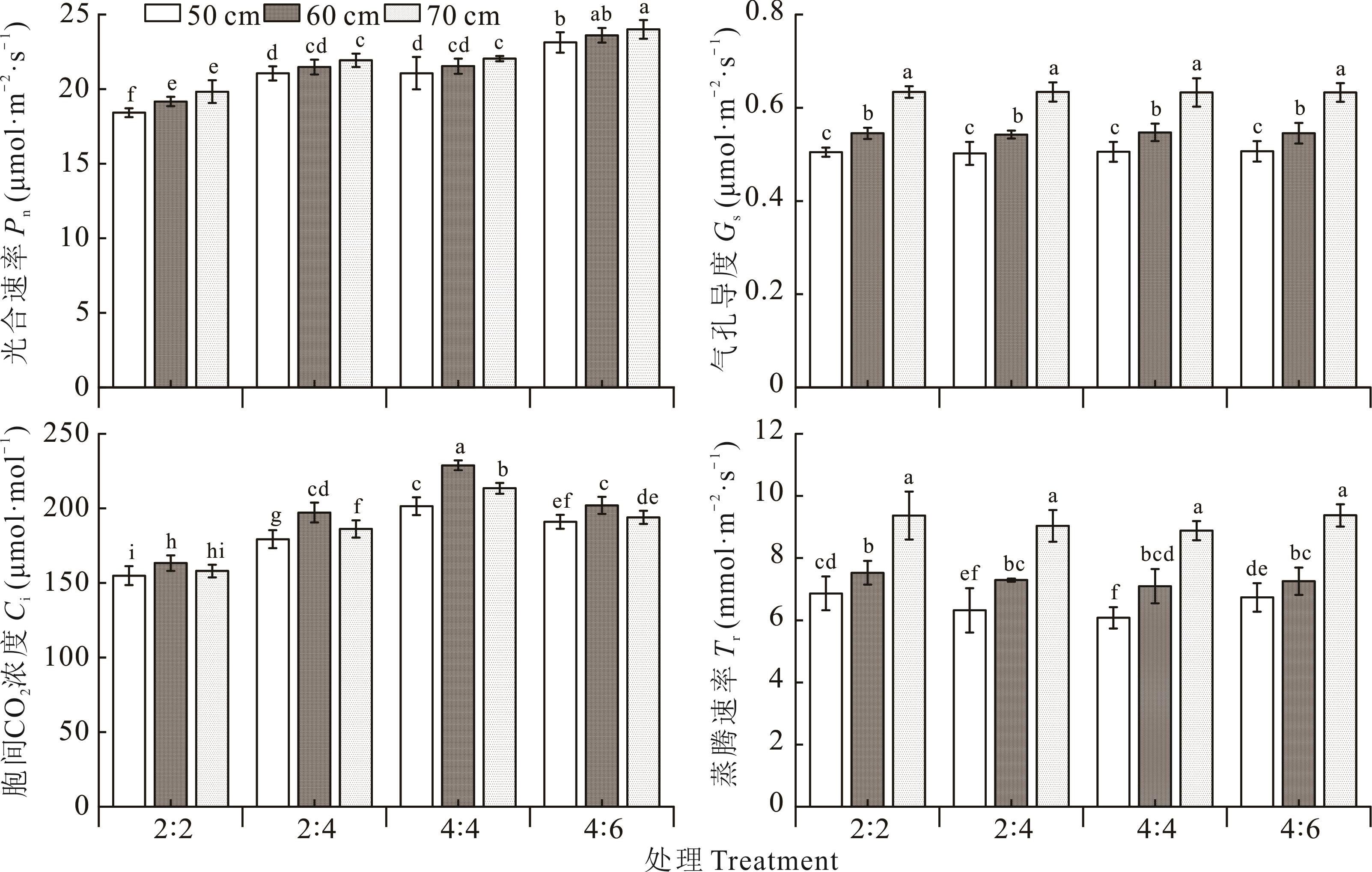
图2 带型配置对米豆相邻行大豆光合参数的影响
Fig.2 Effect of band configuration on photosynthetic parameters of soybean in adjacent rows of corn-soybean
| 项目Item | 玉米Corn | 大豆Soybean |
|---|---|---|
| C | 30.396** | 37.688** |
| R | 7.548** | 314.307** |
| C×R | 0.248ns | 0.100ns |
表6 带型配置对米豆相邻行玉米、大豆冠层光合能力的方差分析
Table 6 Variance analysis of configuration on photosynthetic capacity of corn and soybean canopies in adjacent rows of corn-soybean
| 项目Item | 玉米Corn | 大豆Soybean |
|---|---|---|
| C | 30.396** | 37.688** |
| R | 7.548** | 314.307** |
| C×R | 0.248ns | 0.100ns |
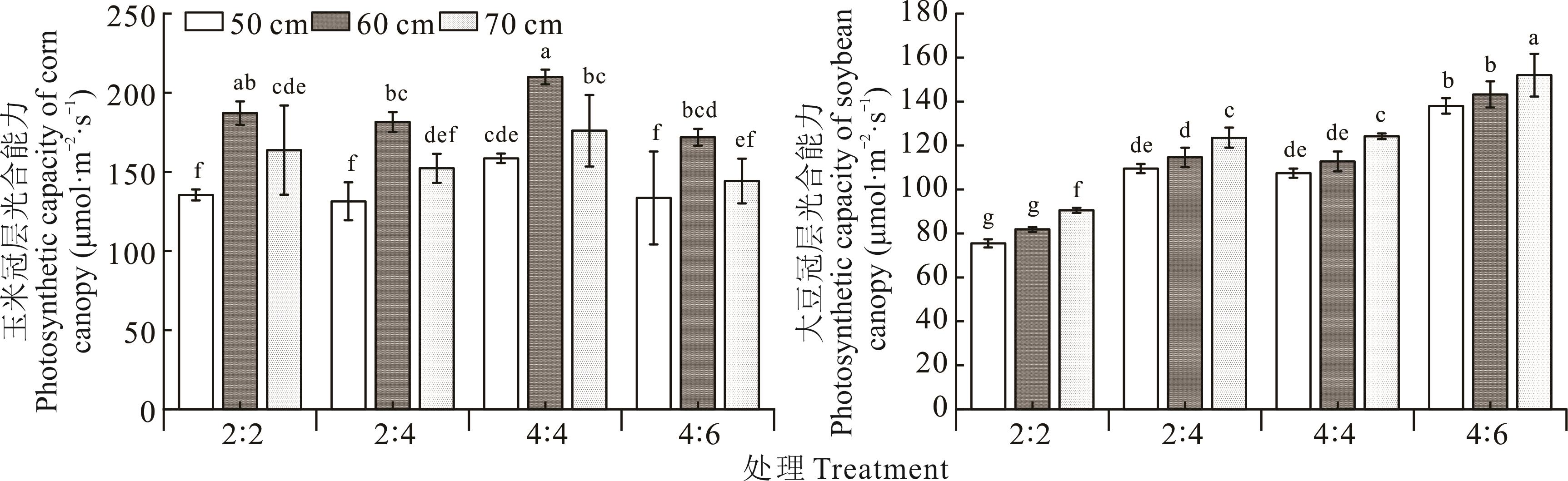
图3 带型配置对米豆相邻行玉米、大豆冠层光合能力的影响
Fig.3 Effect of band configuration on photosynthetic capacity of corn and soybean canopies in adjacent rows of corn-soybean
项目 Item | 玉米Corn | 大豆Soybean | ||
|---|---|---|---|---|
吐丝期 The process of silk production | 乳熟期 Milky stage | 盛花期 Prime bloom period | 鼓粒期 Tympanic period | |
| C | 35.614** | 42.743** | 49.913** | 28.385** |
| R | 618.582** | 88.853** | 516.580** | 235.898** |
| C×R | 1.828ns | 2.024ns | 1.174ns | 0.243ns |
表7 不同带型配置下玉米、大豆地上干物质量的方差分析
Table 7 Variance analysis of corn and soybean dry matter mass in different belt configurations
项目 Item | 玉米Corn | 大豆Soybean | ||
|---|---|---|---|---|
吐丝期 The process of silk production | 乳熟期 Milky stage | 盛花期 Prime bloom period | 鼓粒期 Tympanic period | |
| C | 35.614** | 42.743** | 49.913** | 28.385** |
| R | 618.582** | 88.853** | 516.580** | 235.898** |
| C×R | 1.828ns | 2.024ns | 1.174ns | 0.243ns |
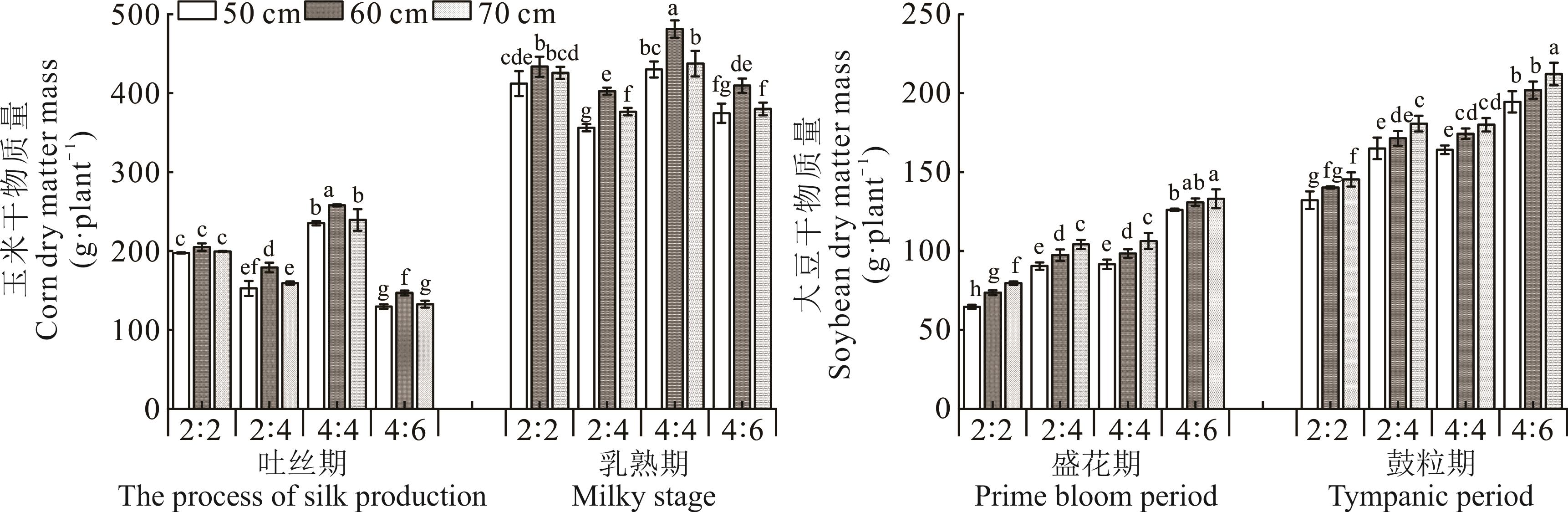
图4 不同带型配置下玉米和大豆地上干物质量
Fig.4 Corn and soybean dry matter mass in different belt configurations
行比配置 Row ratio configuration | 米豆间距 Corn-soybean spacing | 米豆复合体产量 Corn-soybean complex yield (t·hm-2) | 占复合体产量比例 Proportion of complex production (%) | |||
|---|---|---|---|---|---|---|
| 玉米Corn | 大豆Soybean | 复合体Complexes | 玉米Corn | 大豆Soybean | ||
| 2∶2 | 50 cm | 126.50±5.31de | 21.33±1.38d | 73.91±2.02d | 85.58 | 14.42 |
| 60 cm | 147.31±10.00ab | 22.38±1.15cd | 84.84±4.64b | 86.81 | 13.19 | |
| 70 cm | 138.61±0.48bc | 23.38±0.33c | 80.99±0.24bc | 85.57 | 14.43 | |
| 2∶4 | 50 cm | 118.70±8.97ef | 25.58±0.52b | 56.31±3.26g | 69.56 | 30.44 |
| 60 cm | 137.97±8.71bc | 26.00±1.52b | 62.95±3.83e | 72.33 | 27.67 | |
| 70 cm | 119.22±6.36ef | 26.33±1.42b | 56.99±2.66fg | 69.03 | 30.97 | |
| 4∶4 | 50 cm | 132.66±4.93cd | 25.54±0.72b | 78.95±2.11c | 84.02 | 15.98 |
| 60 cm | 153.50±4.70a | 26.33±0.72b | 89.92±2.56a | 85.35 | 14.65 | |
| 70 cm | 143.00±7.41abc | 27.08±0.56b | 85.04±3.76b | 84.08 | 15.92 | |
| 4∶6 | 50 cm | 109.20±6.99f | 29.79±1.00b | 61.55±2.94ef | 70.97 | 29.03 |
| 60 cm | 133.28±4.88cd | 30.38±1.19a | 71.54±1.30d | 74.52 | 25.48 | |
| 70 cm | 118.39±3.47ef | 31.58±1.94a | 66.31±0.23e | 71.41 | 28.59 | |
| 米豆间距Corn-soybean spacing (C) | 32.634** | 5.457* | 35.717** | 15.729** | 15.671** | |
| 行比配置Row ratio configuration (R) | 23.312** | 78.941** | 164.675** | 427.118** | 449.743** | |
| C×R | 0.604ns | 0.204ns | 0.827ns | 1.028ns | 1.014ns | |
表8 带型配置对米豆复合体生物产量的影响
Table 8 The effect of belt configuration on the biological yield of corn-soybean complex
行比配置 Row ratio configuration | 米豆间距 Corn-soybean spacing | 米豆复合体产量 Corn-soybean complex yield (t·hm-2) | 占复合体产量比例 Proportion of complex production (%) | |||
|---|---|---|---|---|---|---|
| 玉米Corn | 大豆Soybean | 复合体Complexes | 玉米Corn | 大豆Soybean | ||
| 2∶2 | 50 cm | 126.50±5.31de | 21.33±1.38d | 73.91±2.02d | 85.58 | 14.42 |
| 60 cm | 147.31±10.00ab | 22.38±1.15cd | 84.84±4.64b | 86.81 | 13.19 | |
| 70 cm | 138.61±0.48bc | 23.38±0.33c | 80.99±0.24bc | 85.57 | 14.43 | |
| 2∶4 | 50 cm | 118.70±8.97ef | 25.58±0.52b | 56.31±3.26g | 69.56 | 30.44 |
| 60 cm | 137.97±8.71bc | 26.00±1.52b | 62.95±3.83e | 72.33 | 27.67 | |
| 70 cm | 119.22±6.36ef | 26.33±1.42b | 56.99±2.66fg | 69.03 | 30.97 | |
| 4∶4 | 50 cm | 132.66±4.93cd | 25.54±0.72b | 78.95±2.11c | 84.02 | 15.98 |
| 60 cm | 153.50±4.70a | 26.33±0.72b | 89.92±2.56a | 85.35 | 14.65 | |
| 70 cm | 143.00±7.41abc | 27.08±0.56b | 85.04±3.76b | 84.08 | 15.92 | |
| 4∶6 | 50 cm | 109.20±6.99f | 29.79±1.00b | 61.55±2.94ef | 70.97 | 29.03 |
| 60 cm | 133.28±4.88cd | 30.38±1.19a | 71.54±1.30d | 74.52 | 25.48 | |
| 70 cm | 118.39±3.47ef | 31.58±1.94a | 66.31±0.23e | 71.41 | 28.59 | |
| 米豆间距Corn-soybean spacing (C) | 32.634** | 5.457* | 35.717** | 15.729** | 15.671** | |
| 行比配置Row ratio configuration (R) | 23.312** | 78.941** | 164.675** | 427.118** | 449.743** | |
| C×R | 0.604ns | 0.204ns | 0.827ns | 1.028ns | 1.014ns | |
项目 Item | 粗蛋白质Crude protein | |
|---|---|---|
| 含量Content | 产出量Output | |
| C | 48.614** | 37.670** |
| R | 7599.369** | 60.274** |
| C×R | 0.810ns | 0.692ns |
表9 不同带型配置下米豆复合体粗蛋白质含量及单位面积产出量的方差分析
Table 9 Variance analysis of crude protein content and crude protein yield per unit area of corn-soybean complex in different band configurations
项目 Item | 粗蛋白质Crude protein | |
|---|---|---|
| 含量Content | 产出量Output | |
| C | 48.614** | 37.670** |
| R | 7599.369** | 60.274** |
| C×R | 0.810ns | 0.692ns |
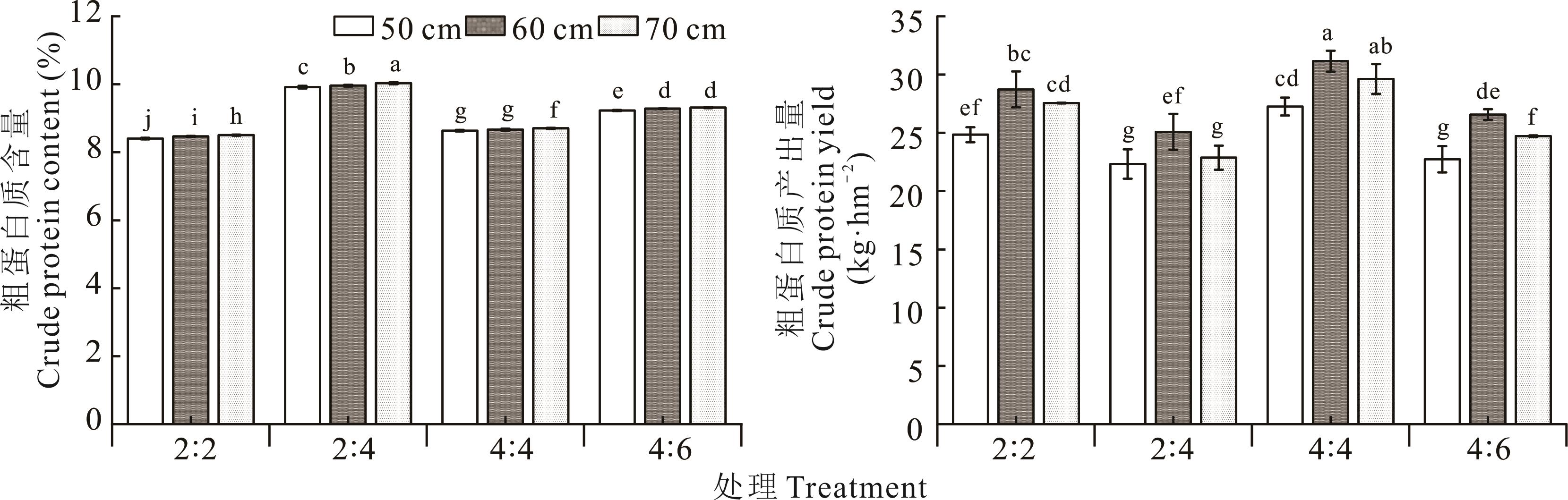
图5 不同带型配置下米豆复合体粗蛋白质含量和产出量
Fig.5 Crude protein content and yield per unit of corn-soybean complex in different band configurations
| 1 | Wang X R, Huang C, Yang Y H, et al. Experimental study on belt type of soybean maize compound planting in Jalaid Banner, Inner Mongolia. Chinese Agricultural Science Bulletin, 2023, 39(31): 1-6. |
| 王昕然, 黄超, 杨玉辉, 等. 内蒙古扎赉特旗大豆玉米带状复合种植带型试验研究. 中国农学通报, 2023, 39(31): 1-6. | |
| 2 | Wang X C, Ma X X, Yang T H, et al. Effects of different mixing ratios on the quality of corn-soybean whole plant mixed silage. Soybean Science, 2024, 43(3): 376-381. |
| 王晓春, 马晓霞, 杨天辉, 等. 青贮玉米与全株大豆混合比例对青贮品质的影响. 大豆科学, 2024, 43(3): 376-381. | |
| 3 | Yang W Y, Yang F. Developing maize-soybean strip intercropping for demand security of national food. Scientia Agricultura Sinica, 2019, 52(21): 3748-3750. |
| 杨文钰, 杨峰. 发展玉豆带状复合种植,保障国家粮食安全. 中国农业科学, 2019, 52(21): 3748-3750. | |
| 4 | Zhao X J. Quality evaluation and key points analysis of whole plant corn silage in large-scale pasture of Heilongjiang Province. Harbin: Northeast Agricultural University, 2019. |
| 赵雪娇. 黑龙江地区规模化牧场全株玉米青贮品质评价及制作关键点分析. 哈尔滨: 东北农业大学, 2019. | |
| 5 | Zheng M, Li J, Sun F C, et al. Research progress on the effects of different varieties and silage methods on the quality of corn silage. Journal of Northern Agriculture, 2020, 48(5): 43-48. |
| 郑美, 李娟, 孙峰成, 等. 不同品种和青贮方式对玉米青贮品质影响的研究进展. 北方农业学报, 2020, 48(5): 43-48. | |
| 6 | Zhang H J, Wang S J, Tian C J, et al. Effects of maize straw and its biochar on the dissolved organic matter characteristics of black soil in northeastern China. Journal of Soil and Water Conservation, 2021, 35(2): 243-250. |
| 张海晶, 王少杰, 田春杰, 等. 玉米秸秆及其生物炭对东北黑土溶解有机质特性的影响. 水土保持学报, 2021, 35(2): 243-250. | |
| 7 | Gan L, Li H P, Wang H, et al. Effects of growth phase and mixed sowing ration on silage quality of forage oat/common vetch mixed fermentation in winter fallow field of Sichuan. Acta Agrestia Sinica, 2023, 31(6): 1867-1877. |
| 甘丽, 李海萍, 汪辉, 等. 生育期和混播比例对四川冬闲田燕麦/箭筈豌豆混合青贮品质的影响. 草地学报, 2023, 31(6): 1867-1877. | |
| 8 | Huang X H. Sophora alopecuroides and corn straw mixed silaging and quality evaluation of silage. Lanzhou: Lanzhou University, 2014. |
| 黄晓辉. 苦豆子和玉米秸秆的混合青贮及其品质评价. 兰州: 兰州大学, 2014. | |
| 9 | Liang W W, Zhang H H, Zhang X Z, et al. Comprehensive evaluation of 23 silage maize varieties in the Changji, Xinjiang. Pratacultural Science, 2022, 39(10): 2180-2190. |
| 梁维维, 张荟荟, 张学洲, 等. 新疆昌吉地区23份青贮玉米品种综合评价. 草业科学, 2022, 39(10): 2180-2190. | |
| 10 | Batista V V, Adami P F, Moraes P, et al. Row arrangements of maize and soybean intercrop on silage quality and grain yield. Journal of Agricultural Science, 2019, 11(2): 286-300. |
| 11 | Lian J P, Zhao Z G, Luo R P, et al. Effect of forage soybean and silage corn compound planting on yield and quality of mixed feed. Feed Research, 2022, 45(8): 90-94. |
| 连金番, 赵志刚, 罗瑞萍, 等. 饲草大豆与青贮玉米复合种植对混合饲料产量和品质的影响. 饲料研究, 2022, 45(8): 90-94. | |
| 12 | Wen X J, Yang J Z, Xiao Q Y, et al. Effect of mixed silage ratio of whole plant corn and soybean on silage quality in Northwest Sichuan plateau. Chinese Journal of Grassland, 2022, 44(8): 115-120. |
| 文兴金, 杨继芝, 肖启银, 等. 川西北高原全株玉米和大豆混贮比例对青贮品质的影响. 中国草地学报, 2022, 44(8): 115-120. | |
| 13 | Shen L, Wang X Y, Teng Y X, et al. Study on the influence of maize||soybean on crop growth and yield in arid area. Journal of Shihezi University (Natural Science Edition), 2022, 40(1): 13-20. |
| 申磊, 王秀媛, 滕元旭, 等. 干旱区玉米大豆单间作生长及产量影响的研究. 石河子大学学报(自然科学版), 2022, 40(1): 13-20. | |
| 14 | Zhaobayinnamula, Dehaishan, Hongmei, et al. Effects of maize/soybean intercropping pattern on dynamic changes of cropland soil macrofauna community. Soil and Fertilizer Sciences in China, 2022(7): 132-140. |
| 赵巴音那木拉, 德海山, 红梅, 等. 玉米/大豆间作种植对农田大型土壤动物群落动态变化的影响. 中国土壤与肥料, 2022(7): 132-140. | |
| 15 | Li J W, Gao L H, Guo S S, et al. Prospects for the application of mixed corn-soybean silage. Hebei Agriculture, 2024(1): 89-90. |
| 李军伟, 高丽惠, 郭士松, 等. 玉米大豆混合青贮的应用前景. 河北农业, 2024(1): 89-90. | |
| 16 | Yang F, Lou Y, Liao D P, et al. Effects of row spacing on crop biomass, root morphology and yield in maize-soybean relay strip intercropping system. Acta Agronomica Sinica, 2015, 41(4): 642-650. |
| 杨峰, 娄莹, 廖敦平, 等. 玉米-大豆带状套作行距配置对作物生物量、根系形态及产量的影响. 作物学报, 2015, 41(4): 642-650. | |
| 17 | Liu S S, Pang T, Yuan X T, et al. Effects of row spacing on root nodule growth and nitrogen fixation potential of different nodulation characteristics soybeans in intercropping. Acta Agronomica Sinica, 2023, 49(3): 833-844. |
| 刘姗姗, 庞婷, 袁晓婷, 等. 种间距对不同结瘤特性套作大豆根瘤生长及固氮潜力的影响. 作物学报, 2023, 49(3): 833-844. | |
| 18 | Liu Z M, Xu J L. Effect of maize and lentil mixed silage on silage yield and quality. Contemporary Animal Husbandry, 2011, 2(11): 34-35. |
| 刘昭明, 许金玲. 玉米与扁豆混播混贮对青贮饲料产量和质量的影响. 当代畜牧, 2011, 2(11): 34-35. | |
| 19 | Feng L, Huang G Q, Yang W T, et al. Yields and interspecific relationship of the maize-soybean intercropping system in the upland red soil of Jiangxi Province. Chinese Journal of Eco-Agriculture, 2021, 29(7): 1127-1137. |
| 封亮, 黄国勤, 杨文亭, 等. 江西红壤旱地玉米||大豆间作模式对作物产量及种间关系的影响. 中国生态农业学报(中英文), 2021, 29(7): 1127-1137. | |
| 20 | Zhu X T, Tan C Y, Chen J Q, et al. Effect of intercropping row spacing between maize and soybean on growth and quality of soybean. Guizhou Agricultural Sciences, 2016, 44(6): 22-25, 52. |
| 朱星陶, 谭春燕, 陈佳琴, 等. 玉米-大豆间作行距对大豆生长及品质的影响. 贵州农业科学, 2016, 44(6): 22-25, 52. | |
| 21 | Shu Z B. Effects of bandwidth and density on population yield in fresh maize-fresh soybean strip intercropping system. Chengdu: Sichuan Agricultural University, 2023. |
| 舒泽兵. 北疆灌区青贮玉米-大豆带状间作群体产量与混合青贮品质对密度的响应. 成都: 四川农业大学, 2023. | |
| 22 | Cai Q, Sun Z X, Zheng J M, et al. Dry matter accumulation, allocation, yield and productivity of maize-soybean intercropping systems in the semi-arid region of western Liaoning Province. Scientia Agricultura Sinica, 2021, 54(5): 909-920. |
| 蔡倩, 孙占祥, 郑家明, 等. 辽西半干旱区玉米大豆间作模式对作物干物质积累分配、产量及土地生产力的影响. 中国农业科学, 2021, 54(5): 909-920. | |
| 23 | Chen Y K. Effects of field configuration on soybean light utilization, intraspecific competition, and yield benefits under maize-soybean relay strip intercropping system. Chengdu: Sichuan Agricultural University, 2021. |
| 陈元凯. 田间配置对玉豆带状套作下大豆光能利用、种内竞争和产量效益的影响. 成都: 四川农业大学, 2021. | |
| 24 | Li Q. Study on the interspecific effect of potato intercropping with maize. Yinchuan: Ningxia University, 2019. |
| 李倩. 马铃薯玉米间作的种间作用效应研究. 银川: 宁夏大学, 2019. | |
| 25 | Xiao J X, Tang L, Zheng Y. Effects of N fertilization on yield and nutrient absorption in rape and faba bean intercropping system. Journal of Plant Nutrition and Fertilizers, 2011, 17(6): 1468-1473. |
| 肖靖秀, 汤利, 郑毅. 氮肥用量对油菜||蚕豆间作系统作物产量及养分吸收的影响. 植物营养与肥料学报, 2011, 17(6): 1468-1473. | |
| 26 | Xu T J, Lyu T F, Zhao J R, et al. Photosynthetic characteristics, dry matter accumulation and translocation, grain filling parameter of three main maize varieties in production. Acta Agronomica Sinica, 2018, 44(3): 414-422. |
| 徐田军, 吕天放, 赵久然, 等. 玉米生产上3个主推品种光合特性、干物质积累转运及灌浆特性. 作物学报, 2018, 44(3): 414-422. | |
| 27 | Pei W D, Zhang R H, Wang G X, et al. Responses of canopy structure and population photosynthetic traits on increased planting density of different maize cultivars. Journal of Maize Sciences, 2020, 28(3): 92-98. |
| 裴文东, 张仁和, 王国兴, 等. 玉米冠层结构和群体光合特性对增密的响应. 玉米科学, 2020, 28(3): 92-98. | |
| 28 | Yang S. Feed analysis and quality detection technology. Beijing: Agricultural University Press, 1999: 58-63. |
| 杨胜. 饲料分析与质量检测技术. 北京: 农业大学出版社, 1999: 58-63. | |
| 29 | Gaju O, Desilva J, Carvalho P, et al. Leaf photosynthesis and associations with grain yield, biomass and nitrogen-use efficiency in landraces, synthetic-derived lines and cultivars in wheat. Field Crops Research, 2016, 193: 1-15. |
| 30 | Valladares F, Niinemets Ü. Shade tolerance, a key plant feature of complex nature and consequences. Annual Review of Ecology, Evolution, and Systematics, 2008, 39: 237-257. |
| 31 | Huang D, Wu L, Chen R J, et al. Morphological plasticity, photosynthesis and chlorophyll fluorescence of Athyrium pachyphlebium at different shade levels. Photosynthetica, 2011, 49(4): 611-618. |
| 32 | Tang H Q, Li Z Y, Dong W B, et al. Effects of different intercropping modes of green manure replacing chemical fertilizer on cassava (Manihot esculenta Crantz) traits and yield. Crops, 2021(4): 184-190. |
| 唐红琴, 李忠义, 董文斌, 等. 不同间作绿肥替代化肥模式对木薯性状和产量的影响. 作物杂志, 2021(4): 184-190. | |
| 33 | Yuan J L. Study on physiological basis and suitability of different intercropping models of maize and soybean. Hohhot: Inner Mongolia Agricultural University, 2021. |
| 袁嘉磊. 玉米大豆不同间作模式群体生理基础及适宜性研究. 呼和浩特: 内蒙古农业大学, 2021. | |
| 34 | Li Y H, Shi D Y, Li G H, et al. Maize/peanut intercropping increases photosynthetic characteristics, 13C-photosynthate distribution, and grain yield of summer maize. Journal of Integrative Agriculture, 2019, 18(10): 2219-2229. |
| 35 | Chen P, Du Q, Pang T, et al. Effects of root interaction intensity on crop roots distribution above-ground growth in a maize/soybean relay intercropping system. Journal of Sichuan Agricultural University, 2018, 36(1): 28-37, 59. |
| 陈平, 杜青, 庞婷, 等. 根系互作强度对玉米/大豆套作系统下作物根系分布及地上部生长的影响. 四川农业大学学报, 2018, 36(1): 28-37, 59. | |
| 36 | Zhou H L, Yao X D, Zhao Q, et al. Rapid effect of nitrogen supply for soybean at the beginning flowering stage on biomass and sucrose metabolism. Scientific Reports, 2019, 9(1): 15530. |
| 37 | Zhao D Q, Li T, Hou Y T, et al. Benefits and marginal effect of dry matter accumulation and yield in maize and soybean intercropping patterns. Scientia Agricultura Sinica, 2020, 53(10): 1971-1985. |
| 赵德强, 李彤, 侯玉婷, 等. 玉米大豆间作模式下干物质积累和产量的边际效应及其系统效益. 中国农业科学, 2020, 53(10): 1971-1985. | |
| 38 | Yang L D, Ren J B, Peng X Y, et al. Crop growth characteristics and its effects on yield formation through nitrogen application and interspecific distance in soybean/maize strip relay intercropping. Acta Agronomica Sinica, 2024, 50(1): 251-264. |
| 杨立达, 任俊波, 彭新月, 等. 施氮与种间距离下大豆/玉米带状套作作物生长特性及其对产量形成的影响. 作物学报, 2024, 50(1): 251-264. | |
| 39 | Pang T, Chen P, Yuan X T, et al. Effects of row spacing on dry matter accumulation, grain filling and yield formation of different nodulation characteristic soybeans in intercropping. Scientia Agricultura Sinica, 2019, 52(21): 3751-3762. |
| 庞婷, 陈平, 袁晓婷, 等. 种间距对不同结瘤特性套作大豆物质积累、鼓粒及产量形成的影响. 中国农业科学, 2019, 52(21): 3751-3762. | |
| 40 | Feng L, Raza A M, Shi J, et al. Delayed maize leaf senescence increases the land equivalent ratio of maize soybean relay intercropping system. European Journal of Agronomy, 2020, DOI: 10.1016/j.eja.2020.126092. |
| 41 | Qi S H, He G H, Sun Z Y, et al. Effect of several tillage practices on dry matter accumulation in summer maize. Journal of Henan Institute of Science and Technology (Natural Science Edition), 2010, 38(1): 18-21. |
| 齐尚红, 何桂花, 孙志勇, 等. 几种耕作方式对夏玉米干物质积累的影响. 河南科技学院学报(自然科学版), 2010, 38(1): 18-21. | |
| 42 | Zhan X M, Han X R, Yang J F, et al. Dynamics changes of dry matter accumulation of maize as affected by different quantity of nitrogen and phosphorus and potassium. Chinese Journal of Soil Science, 2007, 38(3): 495-499. |
| 战秀梅, 韩晓日, 杨劲峰, 等. 不同氮、磷、钾肥用量对玉米源、库干物质积累动态变化的影响.土壤通报, 2007, 38(3): 495-499. | |
| 43 | Liu Y, Sun Z X, Bai W, et al. Effect of maize and soybean interplanting on crops growth and yield in western Liaoning Province. Soybean Science, 2011, 30(2): 224-228. |
| 刘洋, 孙占祥, 白伟, 等. 玉米大豆间作对辽西地区作物生长和产量的影响. 大豆科学, 2011, 30(2): 224-228. | |
| 44 | Ding Y Q. Effects of different configuration modes on yield and quality of silage maize||soybean complex. Tongliao: Inner Mongolia Minzu University, 2024. |
| 丁月强. 不同配置模式对青贮型玉米||大豆复合体产量和品质的影响. 通辽: 内蒙古民族大学, 2024. | |
| 45 | Weng Q Y, Huang X J, Xu H L, et al. Effect of corn/soybean intercropping model on yield, quality, soil nutrition and rhizosphere microorganisms of silage corn. Journal of Nuclear Agricultural Sciences, 2021, 35(2): 462-470. |
| 瓮巧云, 黄新军, 许翰林, 等. 玉米/大豆间作模式对青贮玉米产量、品质及土壤营养、根际微生物的影响. 核农学报, 2021, 35(2): 462-470. | |
| 46 | Liu Q, Fu P, Su M, et al. Studies on the production performance of silage maize mixed with lablab beans. Journal of Grassland and Forage Science, 2015, 6(5): 22-24. |
| 柳茜, 傅平, 苏茂, 等. 青贮玉米与拉巴豆混播生产性能研究. 草业与畜牧, 2015, 6(5): 22-24. | |
| 47 | Duan J X, Zang Q J, Xue S M, et al. Effect on forage yield and silage quality of silage maize and amaranth intercropping in subtropical districts. Pratacultural Science, 2024, 41(6): 1471-1482. |
| 段佳鑫, 臧庆吉, 薛世明, 等. 亚热带区玉米和籽粒苋间作对饲草产量和品质的影响. 草业科学, 2024, 41(6): 1471-1482. | |
| 48 | Carpici B E. Nutritive values of soybean silages ensiled with maize at different rates. Legume Research-An International Journal, 2016, 39(5): 810-813. |
| 49 | Luo Y, Chen T F, Li J L, et al. Study on the nutritional quality of Italian ryegrass and soybean straw mixed silages. Acta Agrestia Sinica, 2015, 23(1): 200-204. |
| 罗燕, 陈天峰, 李君临, 等. 多花黑麦草与大豆秸秆混合青贮品质的研究. 草地学报, 2015, 23(1): 200-204. | |
| 50 | Sun H, Lu J D, Shi Y H, et al. Application and prospect of whole crop wheat silage in animal production. Pratacultural Science, 2022, 39(11): 2453-2465. |
| 孙浩, 卢家顶, 史莹华, 等. 全株小麦青贮在动物生产中的应用及前景. 草业科学, 2022, 39(11): 2453-2465. |
| [1] | 张邦彦, 谢小伟, 张朝辉, 武晋民, 王彬, 许兴. 有机-无机改良物料对盐碱地土壤质量及湖南稷子产量的影响[J]. 草业学报, 2025, 34(8): 15-29. |
| [2] | 蒋学乾, 杨青川, 康俊梅. 紫花苜蓿在干旱胁迫下的产量损失与抗旱性遗传研究进展[J]. 草业学报, 2025, 34(7): 219-234. |
| [3] | 姜沛沛, 郭锦花, 肖慧淑, 彭彦珉, 张军, 田文仲, 吕军杰, 吴金芝, 王贺正, 付国占, 黄明, 李友军. 轮耕模式对旱地玉-麦两熟体系作物产量和品质的影响[J]. 草业学报, 2025, 34(6): 181-192. |
| [4] | 刘启林, 王小军, 王金兰, 刘文辉, 马巧玲, 李建辉, 张生原, 曹文侠, 李文. 氮磷配施对高寒区老芒麦饲草产量的影响[J]. 草业学报, 2025, 34(6): 193-202. |
| [5] | 匡宗洋, 穆麟, 魏岚, 郭阳, 胥贵, 陈瑶, 石雪云, 魏仲珊, 张志飞. 不同混合比例和乳酸菌添加对全株玉米和大豆混合青贮品质及有氧稳定性的影响[J]. 草业学报, 2025, 34(6): 227-238. |
| [6] | 秦文利, 张静, 肖广敏, 崔素倩, 叶建勋, 智健飞, 张立锋, 谢楠, 冯伟, 刘振宇, 潘璇, 代云霞, 刘忠宽. 绿肥部分替代化肥氮对土壤物理性状的影响[J]. 草业学报, 2025, 34(6): 27-45. |
| [7] | 刘耀博, 裴渌, 刘琛琢, 李晓霞, 邹博坤. 基于Meta分析中国老芒麦种子产量和产量组分对施肥的响应[J]. 草业学报, 2025, 34(6): 85-98. |
| [8] | 冯雅琪, 陈嘉慧, 张静妮, 隋超, 陈基伟, 刘志鹏, 周强, 刘文献. 基于重测序紫花苜蓿高蛋白、高产关联InDel分子标记开发[J]. 草业学报, 2025, 34(4): 137-149. |
| [9] | 王腾飞, 马霞, 刘金龙, 王斌, 张译尹, 李佳旺, 马江萍, 王小兵, 兰剑. 引黄灌区复种饲用燕麦种植模式产量、品质及经济效益分析[J]. 草业学报, 2025, 34(4): 27-37. |
| [10] | 蒋鹏, 李磊, 解昊郡, 徐得甲, 王锐, 虎强, 孙权. 净化沼液滴灌对砂壤土质量、青贮玉米生产力的影响及安全消纳容量分析[J]. 草业学报, 2025, 34(4): 64-81. |
| [11] | 王新友, 王小兰, 张万昌, 李颖, 马永玲, 王晓寅, 王建刚, 王海青, 岳贝凡, 刘永福, 王永宏, 刘珊, 白美婷. 陇东南部林缘山区青贮玉米品种筛选及其高效栽培研究[J]. 草业学报, 2025, 34(1): 191-202. |
| [12] | 徐寿霞. 基于meta分析的丛枝菌根对小麦产量和品质的影响[J]. 草业学报, 2024, 33(7): 192-204. |
| [13] | 张永亮, 滕泽, 郝凤, 于铁峰, 张玉霞. 苜蓿混播方式及比例对混播草地生产力和稳定性的影响[J]. 草业学报, 2024, 33(2): 185-197. |
| [14] | 白宇飞, 尹航, 杨海波, 冯振华, 李斐. 无人机多光谱和RGB影像融合的苜蓿产量估测[J]. 草业学报, 2024, 33(12): 45-58. |
| [15] | 曹秭琦, 赵小庆, 张向前, 伍建辉, 张帆, 刘丹, 路战远, 任永峰. 施钾水平对北方风沙区油莎豆生长、块茎品质及产量的影响[J]. 草业学报, 2024, 33(12): 73-83. |
| 阅读次数 | ||||||
|
全文 |
|
|||||
|
摘要 |
|
|||||
