

ISSN 1004-5759 CN 62-1105/S
草业学报 ›› 2026, Vol. 35 ›› Issue (9): 47-62.DOI: 10.11686/cyxb2025303
霍倩倩1,2( ), 宋洋洋1,2, 吴远荣1,2, 屈媛媛1,2, 席琳乔1,2()
收稿日期:2025-07-22
修回日期:2025-11-17
出版日期:2026-09-20
发布日期:2026-07-27
通讯作者:
席琳乔
作者简介:Corresponding author. E-mail: gsxlq666@163.com基金资助:
Qian-qian HUO1,2(), Yang-yang SONG1,2, Yuan-rong WU1,2, Yuan-yuan QU1,2, Lin-qiao XI1,2()
Received:2025-07-22
Revised:2025-11-17
Online:2026-09-20
Published:2026-07-27
Contact:
Lin-qiao XI
摘要:
南疆地区土壤盐碱化程度加剧,对高粱、高丹草、田菁、玉米和棉花在盐碱地种植后土壤理化性质及细菌群落的变化尚未明晰。因此本研究设置单播高粱(S)、高丹草(SS)、田菁(Sb)、玉米(Zm)和棉花(Gs)5个处理,通过测定盐碱土样地种植不同耐盐碱作物处理下,表层0~20 cm土壤pH、电导率、土壤离子含量、碳/氮组分、酶活性和细菌群落,并进行综合分析,探究几种耐盐碱作物对于盐碱地土壤理化性质和细菌群落的影响。结果表明:S、SS和Sb处理土壤pH与各盐基离子含量较Zm、Gs处理更低;土壤颗粒有机碳(POC)、轻组有机碳(LFOC)、可溶性有机碳(DOC)、微生物生物量有机碳(MBC)、易氧化态碳(EOC)含量表现为SS>Sb>S>Zm>Gs;SS处理土壤的速效磷(AP)、速效钾(AK)含量和蔗糖酶(INV)、脲酶(UE)、过氧化氢酶(CAT)活性显著高于其他处理(P<0.05),Sb处理土壤的有机质(SOM)和全氮(TN)含量显著高于其他处理(P<0.05),较种植前增长83.37%和42.11%;S处理土壤的NO3--N含量最高,SS处理土壤的轻组有机氮(LFON)和颗粒有机氮(PON)含量最高,Sb处理土壤的可溶性有机氮(DON)含量最高;SS处理土壤的细菌群落多样性高且分布均匀,土壤变形菌门(38.65%~43.53%)和假单胞菌属(0.43%~6.92%)为优势菌门/属;土壤细菌变形菌门、拟杆菌门、甲烷氧化细菌门等与土壤理化性质相关性较显著。综上所述,在南疆盐碱地区种植高丹草和田菁对土壤理化性质改良效果较为理想。
霍倩倩, 宋洋洋, 吴远荣, 屈媛媛, 席琳乔. 耐盐碱作物对南疆土壤理化性质和细菌群落组成的影响[J]. 草业学报, 2026, 35(9): 47-62.
Qian-qian HUO, Yang-yang SONG, Yuan-rong WU, Yuan-yuan QU, Lin-qiao XI. Effects of salt-tolerant crops on the soil physicochemical properties and bacterial community composition in Southern Xinjiang[J]. Acta Prataculturae Sinica, 2026, 35(9): 47-62.
处理 Treatment | pH | 电导率Electrical conductivity (EC, mS·cm-1) | Na+ (mg·kg-1) | K+ (mg·kg-1) | Ca2+ (mg·kg-1) |
|---|---|---|---|---|---|
| S | 7.67±0.02cd | 3.96±0.02c | 248.80±5.60d | 85.71±0.81c | 222.76±21.78b |
| SS | 7.75±0.01c | 3.69±0.01d | 303.31±5.82c | 93.89±0.85b | 212.82±20.23b |
| Sb | 7.66±0.03d | 3.03±0.01e | 209.93±4.62d | 92.13±0.88b | 219.44±17.25b |
| Zm | 8.01±0.02b | 4.07±0.01b | 452.52±29.35b | 101.21±0.97a | 325.88±14.49a |
| Gs | 8.15±0.02a | 4.12±0.02a | 689.77±3.27a | 104.13±1.29a | 379.85±53.36a |
处理 Treatment | Mg2+ (mg·kg-1) | HCO3- (mg·kg-1) | Cl- (mg·kg-1) | SO42- (mg·kg-1) | CO32- (mg·kg-1) |
| S | 97.37±7.03d | 95.71±0.61bc | 369.70±16.40e | 0.76±0.00c | - |
| SS | 96.86±6.35d | 91.65±0.93c | 613.62±7.25d | 0.88±0.00b | - |
| Sb | 139.96±3.51c | 107.74±2.53b | 810.58±8.62c | 0.46±0.01d | - |
| Zm | 407.10±2.74b | 126.91±6.07a | 1129.64±31.09b | 0.27±0.01e | - |
| Gs | 519.87±13.66a | 121.16±6.40a | 2978.12±43.53a | 1.34±0.00a | - |
表1 种植耐盐碱作物的土壤pH、电导率和离子含量
Table 1 Soil pH, electrical conductivity and ion contents for growing salt-tolerant crops
处理 Treatment | pH | 电导率Electrical conductivity (EC, mS·cm-1) | Na+ (mg·kg-1) | K+ (mg·kg-1) | Ca2+ (mg·kg-1) |
|---|---|---|---|---|---|
| S | 7.67±0.02cd | 3.96±0.02c | 248.80±5.60d | 85.71±0.81c | 222.76±21.78b |
| SS | 7.75±0.01c | 3.69±0.01d | 303.31±5.82c | 93.89±0.85b | 212.82±20.23b |
| Sb | 7.66±0.03d | 3.03±0.01e | 209.93±4.62d | 92.13±0.88b | 219.44±17.25b |
| Zm | 8.01±0.02b | 4.07±0.01b | 452.52±29.35b | 101.21±0.97a | 325.88±14.49a |
| Gs | 8.15±0.02a | 4.12±0.02a | 689.77±3.27a | 104.13±1.29a | 379.85±53.36a |
处理 Treatment | Mg2+ (mg·kg-1) | HCO3- (mg·kg-1) | Cl- (mg·kg-1) | SO42- (mg·kg-1) | CO32- (mg·kg-1) |
| S | 97.37±7.03d | 95.71±0.61bc | 369.70±16.40e | 0.76±0.00c | - |
| SS | 96.86±6.35d | 91.65±0.93c | 613.62±7.25d | 0.88±0.00b | - |
| Sb | 139.96±3.51c | 107.74±2.53b | 810.58±8.62c | 0.46±0.01d | - |
| Zm | 407.10±2.74b | 126.91±6.07a | 1129.64±31.09b | 0.27±0.01e | - |
| Gs | 519.87±13.66a | 121.16±6.40a | 2978.12±43.53a | 1.34±0.00a | - |
| 指标Index | S | SS | Sb | Zm | Gs |
|---|---|---|---|---|---|
| 颗粒有机碳Particulate organic carbon (POC, g·kg-1) | 1.62±0.00c | 1.72±0.01a | 1.68±0.00b | 1.58±0.00d | 1.52±0.00e |
| 轻组有机碳Light fraction organic carbon (LFOC, g·kg-1) | 1.30±0.01c | 1.47±0.01a | 1.37±0.01b | 1.15±0.00d | 1.08±0.02e |
| 可溶性有机碳Dissolved organic carbon (DOC, mg·kg-1) | 359.89±0.76c | 371.49±0.30a | 368.72±1.10b | 340.35±0.92d | 320.19±0.11e |
| 微生物生物量碳Microbial biomass carbon (MBC, mg·kg-1) | 172.05±0.05c | 185.01±0.07a | 180.27±0.37b | 162.92±0.39d | 156.98±0.89e |
| 易氧化态碳Easily oxidizable carbon (EOC, g·kg-1) | 1.44±0.00c | 1.57±0.01a | 1.48±0.01b | 1.40±0.01d | 1.33±0.01e |
| 土壤有机质Soil organic matter (SOM, g·kg-1) | 12.83±1.17bc | 14.51±0.29b | 18.96±1.25a | 11.67±0.58bc | 9.58±1.36c |
| 全氮Total nitrogen (TN, g·kg-1) | 0.42±0.00c | 0.47±0.02b | 0.54±0.01a | 0.41±0.00c | 0.41±0.01c |
| 速效磷Available phosphorus (AP, mg·kg-1) | 41.33±0.88b | 48.00±0.58a | 36.00±1.00c | 35.33±1.20c | 27.00±1.00d |
| 速效钾Available potassium (AK, mg·kg-1) | 84.67±2.73c | 139.33±2.60a | 96.67±0.88b | 70.00±1.53d | 62.33±0.67e |
表2 种植耐盐碱作物的土壤有机碳和养分含量
Table 2 Soil organic carbon and nutrient contents for growing salt-tolerant crops
| 指标Index | S | SS | Sb | Zm | Gs |
|---|---|---|---|---|---|
| 颗粒有机碳Particulate organic carbon (POC, g·kg-1) | 1.62±0.00c | 1.72±0.01a | 1.68±0.00b | 1.58±0.00d | 1.52±0.00e |
| 轻组有机碳Light fraction organic carbon (LFOC, g·kg-1) | 1.30±0.01c | 1.47±0.01a | 1.37±0.01b | 1.15±0.00d | 1.08±0.02e |
| 可溶性有机碳Dissolved organic carbon (DOC, mg·kg-1) | 359.89±0.76c | 371.49±0.30a | 368.72±1.10b | 340.35±0.92d | 320.19±0.11e |
| 微生物生物量碳Microbial biomass carbon (MBC, mg·kg-1) | 172.05±0.05c | 185.01±0.07a | 180.27±0.37b | 162.92±0.39d | 156.98±0.89e |
| 易氧化态碳Easily oxidizable carbon (EOC, g·kg-1) | 1.44±0.00c | 1.57±0.01a | 1.48±0.01b | 1.40±0.01d | 1.33±0.01e |
| 土壤有机质Soil organic matter (SOM, g·kg-1) | 12.83±1.17bc | 14.51±0.29b | 18.96±1.25a | 11.67±0.58bc | 9.58±1.36c |
| 全氮Total nitrogen (TN, g·kg-1) | 0.42±0.00c | 0.47±0.02b | 0.54±0.01a | 0.41±0.00c | 0.41±0.01c |
| 速效磷Available phosphorus (AP, mg·kg-1) | 41.33±0.88b | 48.00±0.58a | 36.00±1.00c | 35.33±1.20c | 27.00±1.00d |
| 速效钾Available potassium (AK, mg·kg-1) | 84.67±2.73c | 139.33±2.60a | 96.67±0.88b | 70.00±1.53d | 62.33±0.67e |
处理 Treatment | 蔗糖酶 Invertase (INV, mg·g-1) | 脲酶 Urease (UE, mg·g-1) | 过氧化氢酶 Catalase (CAT, mg·g-1) | 硝态氮Nitrate nitrogen (NO3--N, mg·kg-1) |
|---|---|---|---|---|
| S | 3.94±0.02b | 16.06±0.03c | 0.62±0.00a | 26.34±0.05a |
| SS | 4.21±0.02a | 16.70±0.09a | 0.63±0.00a | 25.48±0.02c |
| Sb | 4.03±0.01b | 16.22±0.01b | 0.59±0.00b | 23.07±0.08e |
| Zm | 3.48±0.03c | 15.43±0.04d | 0.54±0.01c | 25.80±0.03b |
| Gs | 3.15±0.04d | 15.22±0.04e | 0.52±0.01d | 24.24±0.04d |
处理 Treatment | 微生物生物量氮Microbial biomass nitrogen (MBN, mg·kg-1) | 轻组有机氮Light fraction organic nitrogen (LFON, g·kg-1) | 颗粒有机氮Particulate organic nitrogen (PON, g·kg-1) | 可溶性有机氮Dissolved organic nitrogen (DON, mg·kg-1) |
| S | 28.49±0.07c | 0.75±0.00b | 0.32±0.00c | 23.47±0.02c |
| SS | 29.29±0.09b | 0.82±0.01a | 0.37±0.00a | 24.14±0.01b |
| Sb | 29.99±0.01a | 0.81±0.00a | 0.35±0.00b | 24.25±0.04a |
| Zm | 27.38±0.03d | 0.71±0.01c | 0.28±0.00d | 22.10±0.01d |
| Gs | 26.77±0.06e | 0.64±0.00d | 0.25±0.00e | 21.06±0.03e |
表3 种植耐盐碱作物的土壤酶活性和氮组分
Table 3 Soil enzyme activities and nitrogen fractions for growing salt-tolerant crops
处理 Treatment | 蔗糖酶 Invertase (INV, mg·g-1) | 脲酶 Urease (UE, mg·g-1) | 过氧化氢酶 Catalase (CAT, mg·g-1) | 硝态氮Nitrate nitrogen (NO3--N, mg·kg-1) |
|---|---|---|---|---|
| S | 3.94±0.02b | 16.06±0.03c | 0.62±0.00a | 26.34±0.05a |
| SS | 4.21±0.02a | 16.70±0.09a | 0.63±0.00a | 25.48±0.02c |
| Sb | 4.03±0.01b | 16.22±0.01b | 0.59±0.00b | 23.07±0.08e |
| Zm | 3.48±0.03c | 15.43±0.04d | 0.54±0.01c | 25.80±0.03b |
| Gs | 3.15±0.04d | 15.22±0.04e | 0.52±0.01d | 24.24±0.04d |
处理 Treatment | 微生物生物量氮Microbial biomass nitrogen (MBN, mg·kg-1) | 轻组有机氮Light fraction organic nitrogen (LFON, g·kg-1) | 颗粒有机氮Particulate organic nitrogen (PON, g·kg-1) | 可溶性有机氮Dissolved organic nitrogen (DON, mg·kg-1) |
| S | 28.49±0.07c | 0.75±0.00b | 0.32±0.00c | 23.47±0.02c |
| SS | 29.29±0.09b | 0.82±0.01a | 0.37±0.00a | 24.14±0.01b |
| Sb | 29.99±0.01a | 0.81±0.00a | 0.35±0.00b | 24.25±0.04a |
| Zm | 27.38±0.03d | 0.71±0.01c | 0.28±0.00d | 22.10±0.01d |
| Gs | 26.77±0.06e | 0.64±0.00d | 0.25±0.00e | 21.06±0.03e |
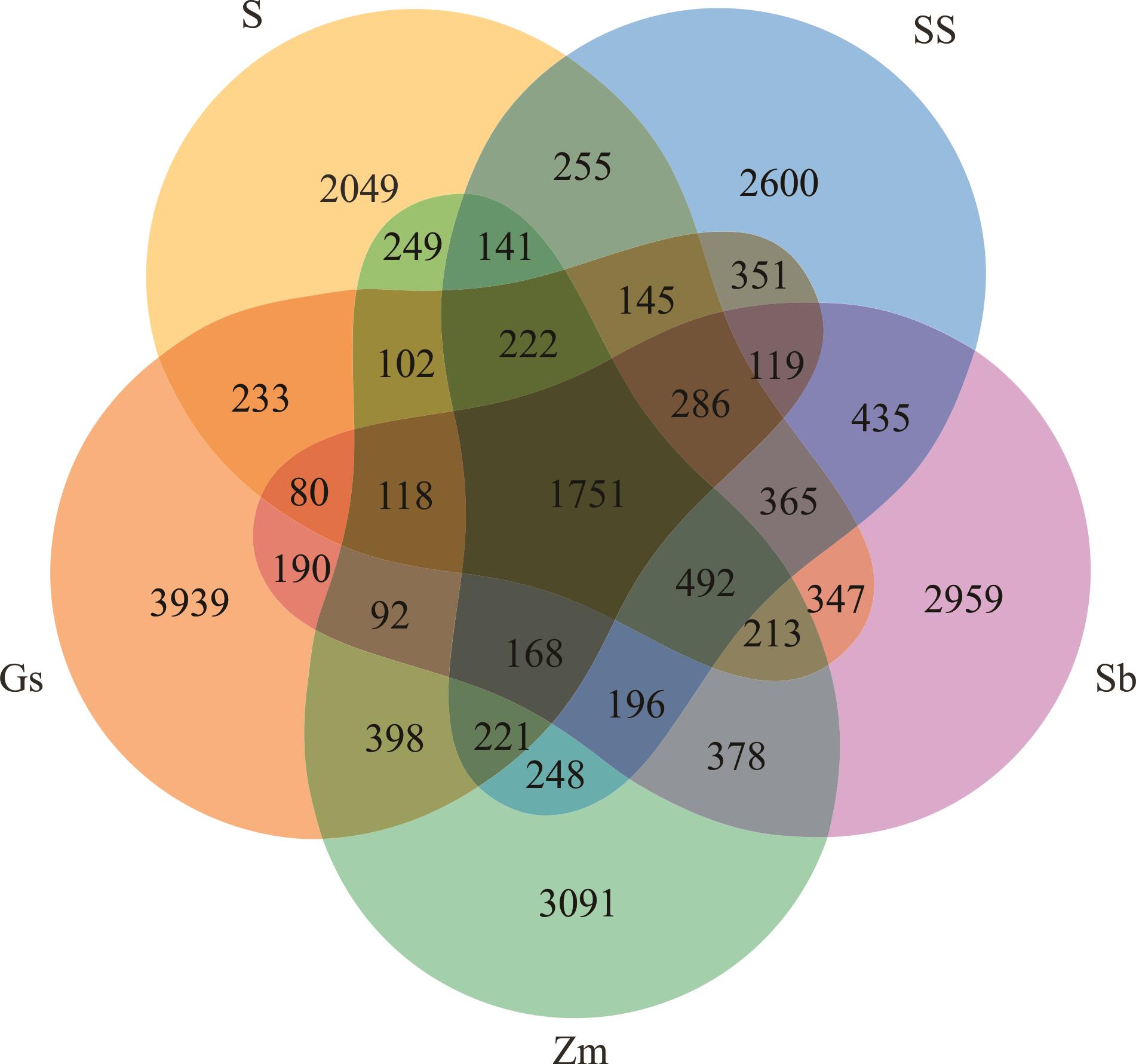
图1 种植耐盐碱作物的土壤细菌OTUs韦恩图S: 高粱S. bicolor; SS: 高丹草S. bicolor×S. sudanense; Sb: 田菁S. cannabina; Zm: 棉花G. herbaceum; Gs: 玉米Z. mays. 下同The same below.
Fig.1 Venn diagram of soil bacteria OTUs for growing salt-tolerant crops
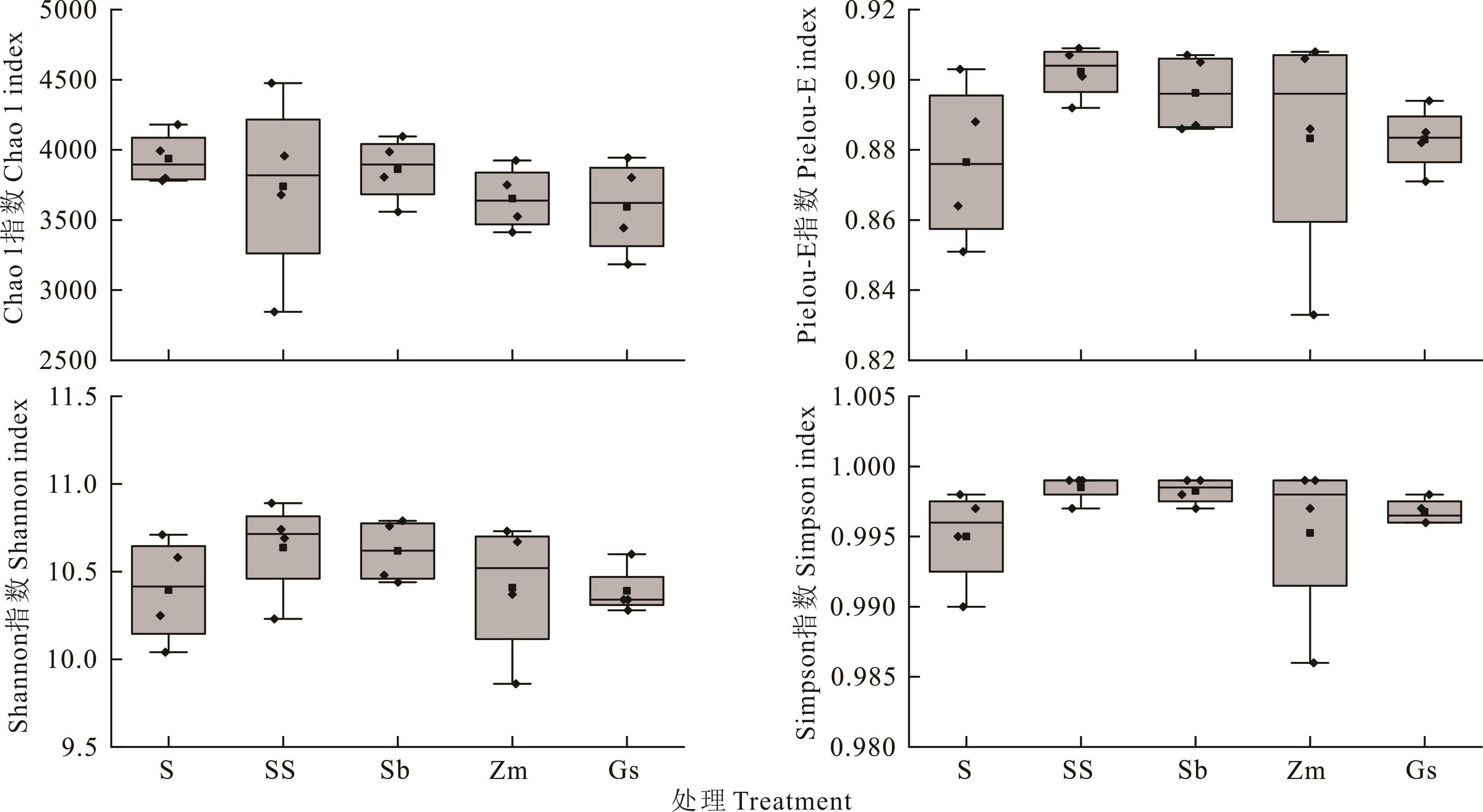
图2 种植耐盐碱作物的土壤细菌多样性
Fig.2 Soil bacterial diversity for growing salt-tolerant crops
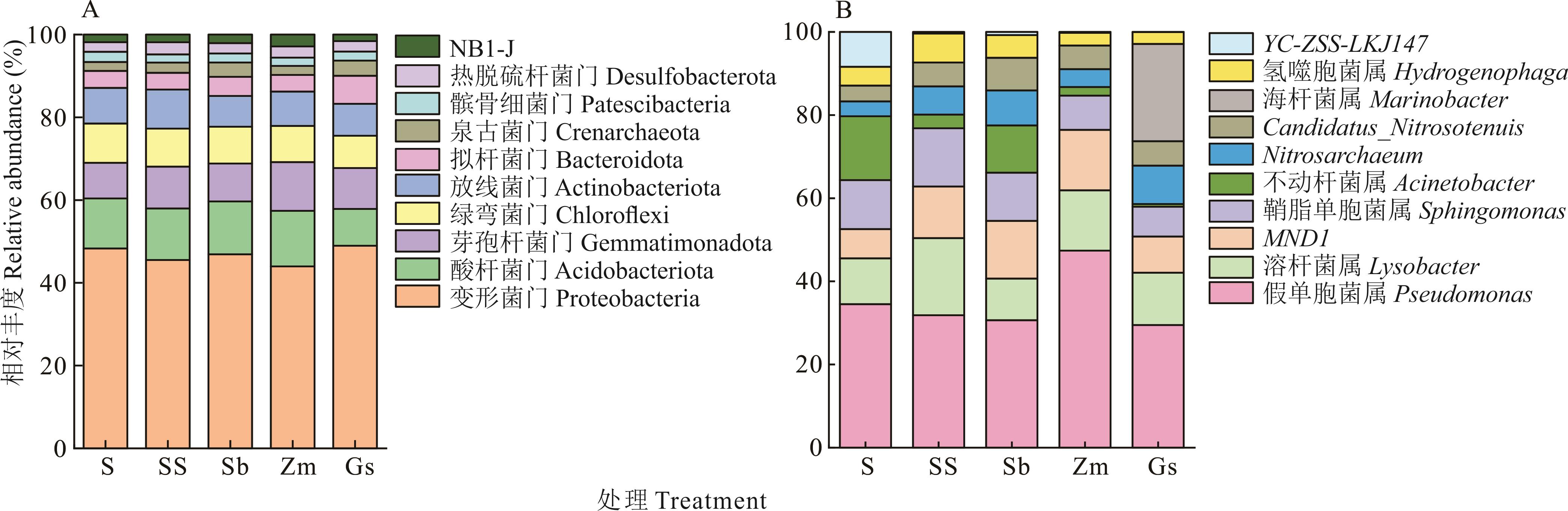
图3 种植耐盐碱作物土壤细菌群落门、属水平相对丰度
Fig.3 Relative abundance of soil bacterial communities at phylum and genus levels for growing salt-tolerant crops
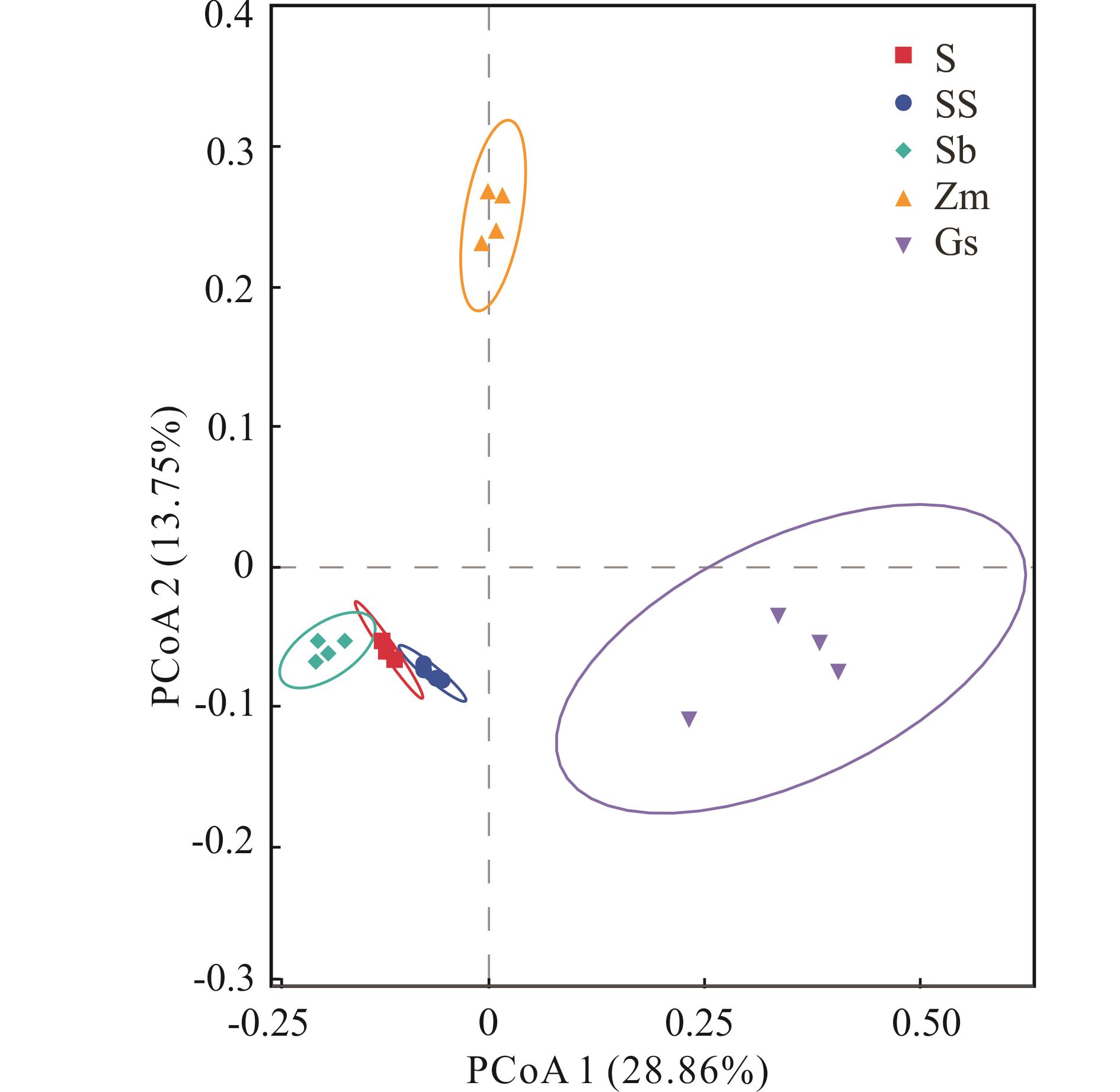
图4 种植耐盐碱作物土壤细菌群落结构主成分分析(PCoA)
Fig.4 Principal coordinate analysis (PCoA) of soil bacterial community structure for growing salt-tolerant crops

图5 种植耐盐碱作物的土壤细菌群落指示微生物
Fig.5 Indicator microorganisms of soil bacterial communities for growing salt-tolerant crops
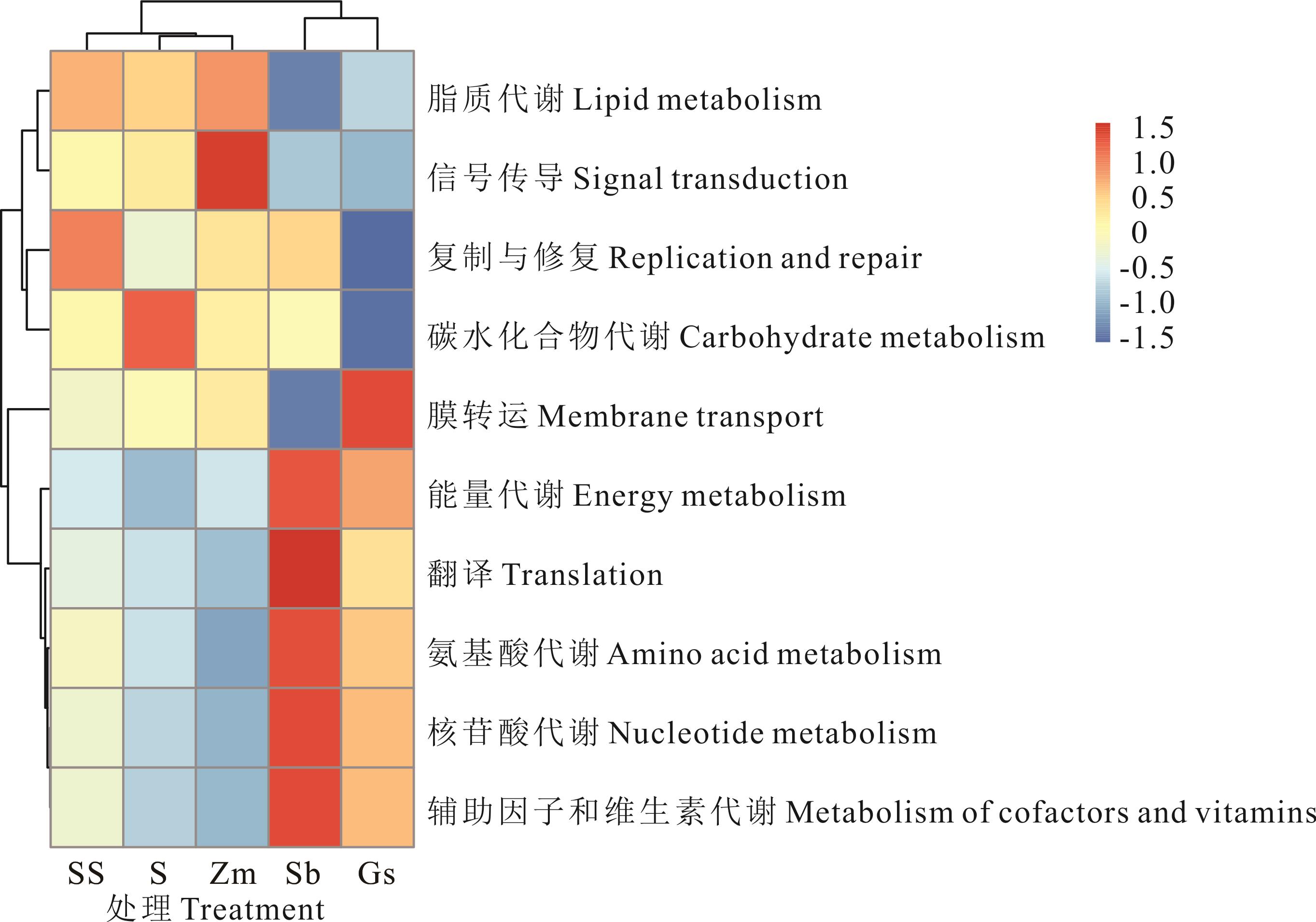
图6 种植耐盐碱作物土壤的细菌功能代谢二级通路
Fig.6 Level-2 functional metabolic pathways of soil bacterial communities for growing salt-tolerant crops
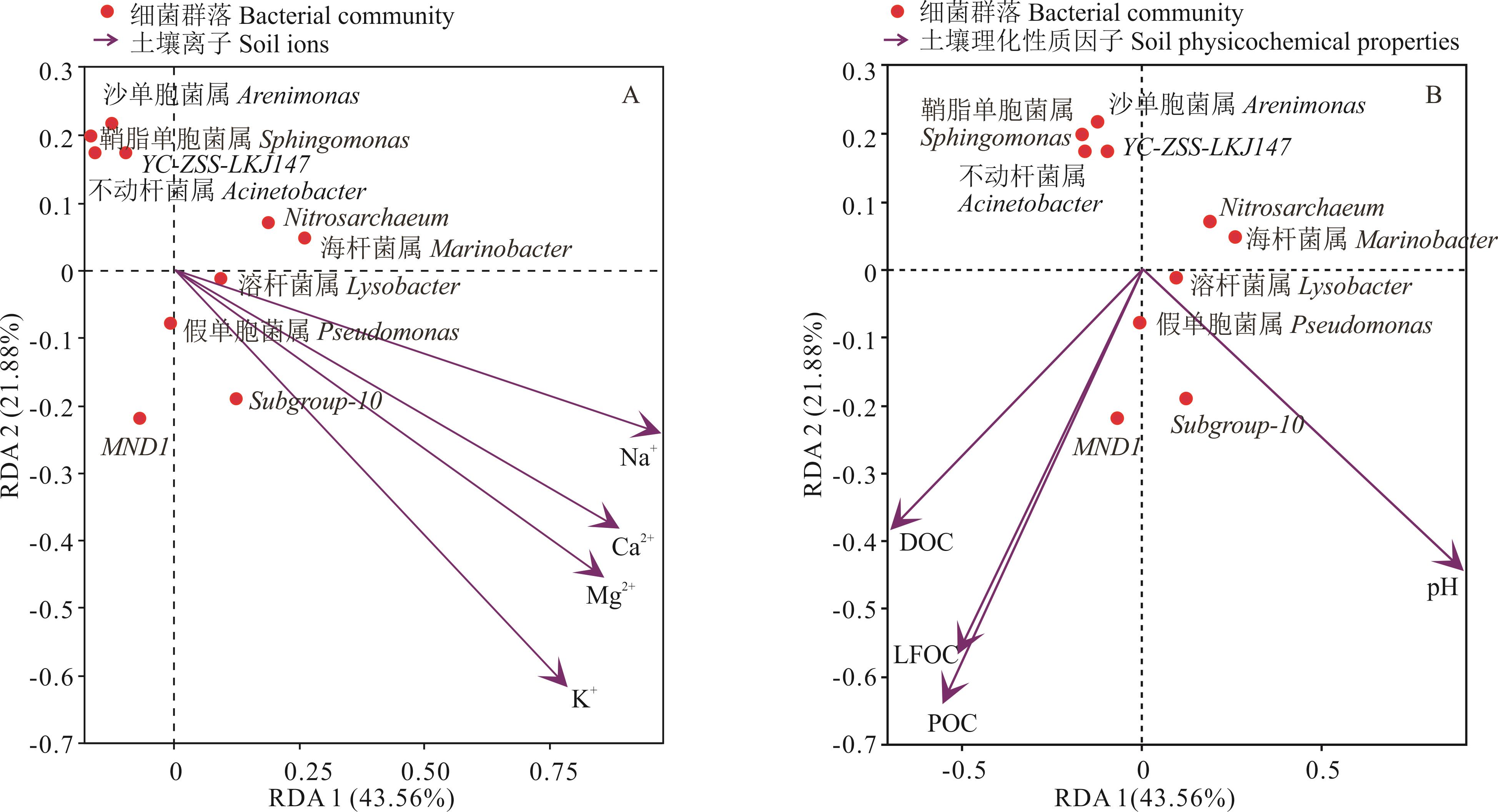
图7 种植耐盐碱作物的土壤理化性质与细菌群落冗余分析POC: 颗粒有机碳Particulate organic carbon; DOC: 可溶性有机碳Dissolved organic carbon; LFOC: 轻组有机碳Light fraction organic carbon. 下同The same below.
Fig.7 Redundancy analysis (RDA) of soil physicochemical properties and bacterial communities under growing salt-tolerant crops
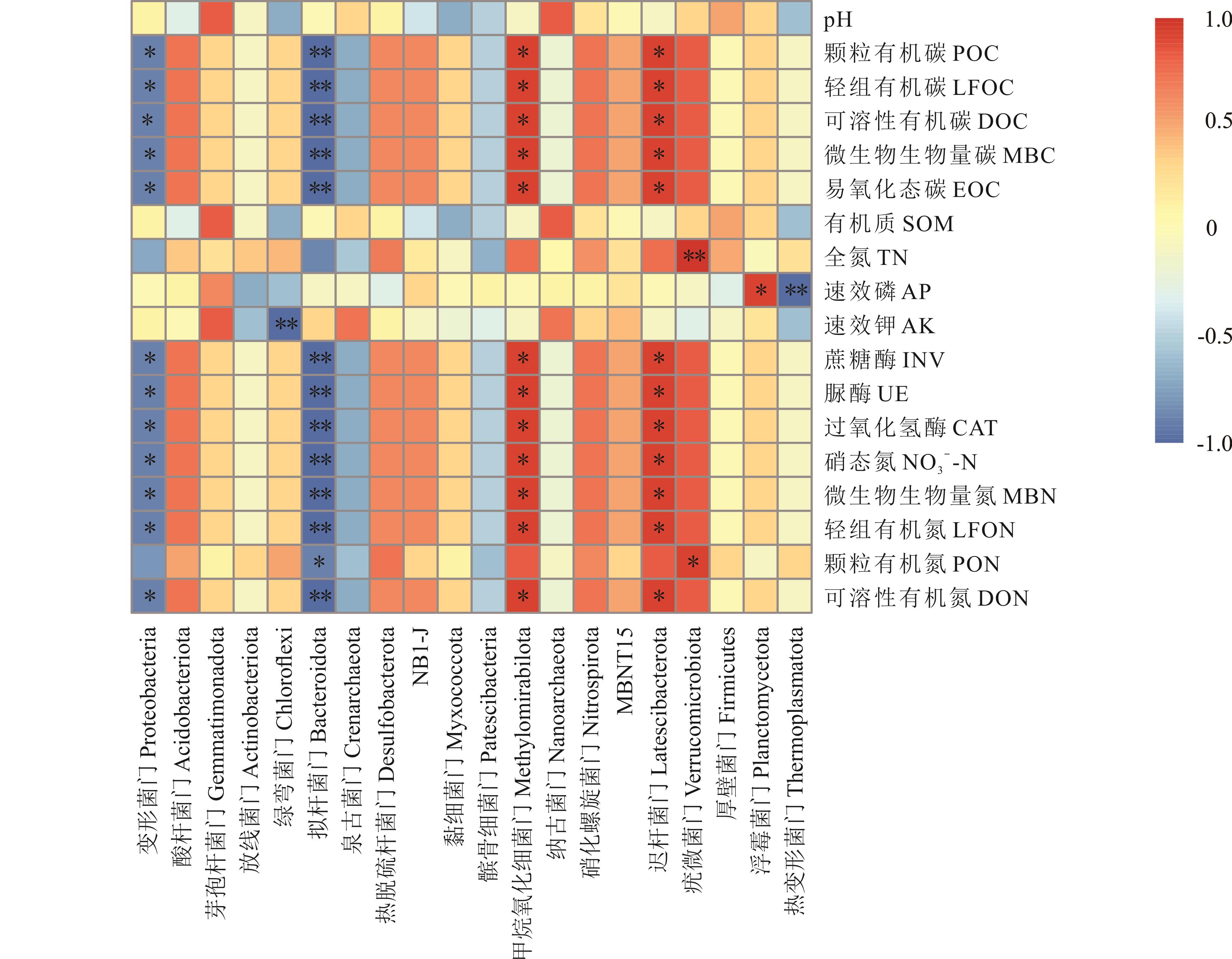
图8 土壤理化性质与细菌群落的相关性分析MBC: 微生物生物量碳Microbial biomass carbon; EOC: 易氧化态碳Easily oxidizable carbon; SOM: 土壤有机质Soil organic matter; TN: 全氮Total nitrogen; AP: 速效磷Available phosphorus; AK: 速效钾Available potassium; MBN: 微生物生物量氮Microbial biomass nitrogen; LFON: 轻组有机氮Light fraction organic nitrogen; PON: 颗粒有机氮Particulate organic nitrogen; DON: 可溶性有机氮Dissolved organic nitrogen; NO3--N: 硝态氮Nitrate nitrogen; INV: 蔗糖酶Invertase; UE: 脲酶Urease; CAT: 过氧化氢酶Catalase. *: P<0.05; **: P<0.01.
Fig.8 Correlation analysis between soil physicochemical properties and bacterial communities
| [1] | Zhao W, Zhou Q, Tian Z Z, et al. Apply biochar to ameliorate soda saline-alkali land, improve soil function and increase corn nutrient availability in the Songnen Plain. Science of the Total Environment, 2020, 722(6): 137428. |
| [2] | Shrivastava P, Kumar R. Soil salinity: a serious environmental issue and plant growth promoting bacteria as one of the tools for its alleviation. Saudi Journal of Biological Science, 2015, 22(2): 123-131. |
| [3] | Xia J B, Ren J Y, Zhang S Y, et al. Forest and grass composite patterns improve the soil quality in the coastal saline-alkali land of the Yellow River Delta, China. Geoderma, 2019, 349(9): 25-35. |
| [4] | AbuQamar S F, El-Saadony M T, Saad A M, et al. Halotolerant plant growth-promoting rhizobacteria improve soil fertility and plant salinity tolerance for sustainable agriculture-a review. Plant Stress, 2024, 12(6): 100482. |
| [5] | Zhu S B, Wuerguli T, Tang G M, et al. Research progress on saline-alkali land changes and its treatment measures in Xinjiang. Shandong Agricultural Sciences, 2023, 55(3): 158-165. |
| 朱生堡, 乌尔古丽·托尔逊, 唐光木, 等. 新疆盐碱地变化及其治理措施研究进展. 山东农业科学, 2023, 55(3): 158-165. | |
| [6] | Jie F L, Yang K, Li S, et al. Spatiotemporal differentiation characteristics of precipitation and reference evapotranspiration in Xinjiang, China. Journal of Drainage and Irrigation Machinery Engineering. (2025-06-20)[2026-03-27].https://link.cnki.net/urlid/32.1814.TH.20250620.1531.002. |
| 介飞龙, 杨坤, 李升, 等. 新疆降水-参考蒸散时空分异特征. 排灌机械工程学报. (2025-06-20)[2026-03-27].https://link.cnki.net/urlid/32.1814.TH.20250620.1531.002. | |
| [7] | Kursakova V S. The effect of perennial herbs on the physical properties of saline soils. Eurasian Soil Science, 2006, 39(7): 748-752. |
| [8] | Liang J P, Shi W J. Cotton/halophytes intercropping decreases salt accumulation and improves soil physicochemical properties and crop productivity in saline-alkali soils under mulched drip irrigation: a three-year field experiment. Field Crop Research, 2020, 262(11): 108027. |
| [9] | Han L P, Steinberger Y, Zhao Y L, et al. Accumulation and partitioning of nitrogen, phosphorus and potassium in different varieties of sweet sorghum. Field Crop Research, 2011, 120(2): 230-240. |
| [10] | Wang S C, Fu T G, Gao H, et al. Assessment of yield, agronomic traits and nutritive value of sorghum varieties grown on highly saline-alkali soil. Pakistan of Journal Botany, 2023, 55(1): 45-53. |
| [11] | Mansour M M F, Emam M M, Salama K H A, et al. Sorghum under saline conditions: responses, tolerance mechanisms, and management strategies. Planta, 2021, 254(7): 24. |
| [12] | Lewis K, Foster J L, Hons F M. Lipid-extracted algae as a soil amendment can increase soil salinization and reduce forage growth. Sustainability, 2019, 11(7): 1946. |
| [13] | Wu Z, Meng R, Feng W, et al. Soil-improving effect of sesbania-sorghum rotation in a heavily saline-alkaline coastal region. Agronomy, 2024, 14(9): 2139. |
| [14] | Amangu·Aimaieraili, Naibi·Abulaiti, Aibibula·Yimamu, et al. Effects of planting sweet sorghum on soil improvement and production performance in saline-alkali land of southern Xinjiang. Acta Agriculturae Boreali-Sinica, 2024, 39(S1): 159-166. |
| 阿曼姑·艾麦尔艾力, 乃比·阿不来提, 艾比布拉·伊马木, 等. 南疆盐碱地种植饲用甜高粱对土壤改良效果和生产性能的影响. 华北农学报, 2024, 39(S1): 159-166. | |
| [15] | Liu Y H, Wang X P, Liu G M, et al. Ions absorption and accumulation in four typical salt-tolerant plants in coastal saline soil region. Soils, 2017, 49(4): 782-788. |
| 刘雅辉, 王秀萍, 刘广明, 等. 滨海盐土区4种典型耐盐植物盐分离子的积累特征. 土壤, 2017, 49(4): 782-788. | |
| [16] | Shi L, Xu Z Y, Lv N. Effects of different irrigation rates on the growth and soil salinity of gaultheria in wind-sand saline soils in the southern frontier. Xinjiang Farm Research of Science and Technology, 2024, 47(2): 59-62. |
| 石磊, 徐朝阳, 吕宁. 不同灌溉量对南疆风沙盐碱土高丹草生长及土壤盐分的影响. 新疆农垦科技, 2024, 47(2): 59-62. | |
| [17] | Shi Y, Fang Y Y, Liu S C, et al. Effects of sorghum-sudangrass hybrid and Astragalus membranaceus intercropping on rhizosphere soil microbial community diversity. Chinese Journal of Grassland, 2023, 45(12): 130-137. |
| 石悦, 房永雨, 刘拴成, 等. 高丹草/黄芪间作对高丹草根际土壤微生物多样性的影响. 中国草地学报, 2023, 45(12): 130-137. | |
| [18] | Mahamat B O, Younes S, Otchom B B, et al. A review on medicinal and ethnomedicinal uses, biological features, and phytochemical constituents of Sesbania sesban L. Merr., a nitrogen-fixing plant native to the Republic of Chad. The Scientific World Journal, 2024, 1225999: 1-24. |
| [19] | Sun J, Xia J B, Zhao X M, et al. Enrichment of soil nutrients and salt ions with different salinities under Tamarix chinensis shrubs in the Yellow River Delta. Catena, 2023, 232: 107433. |
| [20] | An X C, Sun M L, Ren K Y, et al. Effect and mechanism of the improvement of coastal silt soil by application of organic fertilizer and gravel combined with Sesbania cannabina cultivation. Frontiers in Plant Science, 2022, 13(1): 1092089. |
| [21] | Irin I J, Biswas P K, Ullah M J, et al. Influence of green manuring crops on dry matter production and soil health improvement. Bangladesh Agronomy Journal, 2019, 22(1): 39-45. |
| [22] | Yu C X, Wang G M, Liu X L, et al. Effect of Sesbania and Triticale rotation on plant characteristics and soil quality in coastal saline-alkaline land: A two-year field experiment. BioResources, 2023, 18(4): 7109. |
| [23] | Chinnusamy V, Jagendorf A, Zhu J K. Understanding and improving salt tolerance in plants. Crop Science, 2005, 45(2): 437-448. |
| [24] | Jiang Y R, Lv Y J, Zhu S J. Advance in studies of the mechanism of salt tolerance and controlling of salt damage in upland cotton. Cotton Science, 2006, 18(4): 248-254. |
| 蒋玉蓉, 吕有军, 祝水金. 棉花耐盐机理与盐害控制研究进展. 棉花学报, 2006, 18(4): 248-254. | |
| [25] | Sun S S. Analysis of the effect of cotton continuous cropping on soil physicochemical properties and its yield. Hebei Agricultural Machinery, 2025(2): 118-120. |
| 孙树山. 棉花连作对土壤理化性质及其产量的影响分析. 河北农机, 2025(2): 118-120. | |
| [26] | Bao S D. Soil agrochemical analysis (the third edition). Beijing: China Agriculture Press, 2000. |
| 鲍士旦. 土壤农化分析(第3版). 北京: 中国农业出版社, 2000. | |
| [27] | Guan S Y. Soil enzymes and their research methods. Beijing: Agriculture Press, 1986. |
| 关松荫. 土壤酶及其研究方法. 北京: 农业出版社, 1986. | |
| [28] | Cambardella C A, Elliott E T. Particulate soil organic-matter changes across a grassland cultivation sequence. Soil Science Society of America Journal, 1992, 56(3): 777-783. |
| [29] | Zhang J B, Song C C, Wang S M. Dynamics of soil organic carbon and its fractions after abandonment of cultivated wetlands in northeast China. Soil and Tillage Research, 2007, 96(1/2): 350-360. |
| [30] | Blair G J, Lefroy R D B, Lisle L. Soil carbon fractions based on their degree of oxidation,and the development of a carbon management index for agricultural systems. Australian Journal of Agricultural Research, 1995, 46(7): 1459-1466. |
| [31] | Lu R K. Soil agrochemical analytical methods. Beijing: China Agricultural Science and Technology Press, 2000. |
| 鲁如坤. 土壤农业化学分析方法. 北京: 中国农业科技出版社, 2000. | |
| [32] | Lan H Q, Meng T T, Zhang X Q, et al. Effect of nitrogen levels on soil organic nitrogen fractions and nitrogen utilization rates. Acta Agriculturae Boreali-Sinica, 2025, 40(1): 166-176. |
| 兰慧青, 孟天天, 张向前, 等. 施氮水平对土壤有机氮组分及氮素利用效率的影响. 华北农学报, 2025, 40(1):166-176. | |
| [33] | Liu L. Constitute and distribution character of salinity in soil in Xinjiang. Arid Environmental Monitoring, 2009, 23(4): 227-229. |
| 刘蕾. 新疆土壤盐分的组成和分布特征. 干旱环境监测, 2009, 23(4): 227-229. | |
| [34] | Du G S, Wang Z Y, Jiang H H. The research on saline and alkaline land greening technology-Beilun of Ningbo as an example. Chinese Landscape Architecture, 2012, 28(11): 105-109. |
| 杜贵尚, 王兆燚, 姜海华. 盐碱地绿化技术研究——以宁波北仑区为例. 中国园林, 2012, 28(11): 105-109. | |
| [35] | Xu X H. Determination of eight major ions of soil soluble salts. Xingjiang Youse Jinshu, 2022, 45(1): 93-94. |
| 许晓慧. 土壤可溶盐八大离子的测定. 新疆有色金属, 2022, 45(1): 93-94. | |
| [36] | Liu J. Study on the suitability of plant ecological improvement in coastal saline soil of Hebei province. Baoding: Hebei Agricultural University, 2022. |
| 刘静. 河北省滨海盐渍土植物生态改良适宜性研究. 保定: 河北农业大学, 2022. | |
| [37] | Meng X W, Niu Y, Hai L, et al. Effects of different vegetation on soil microorganisms number and enzyme activities in alkaline saline soil. Grassland and Turf, 2020, 40(3): 99-104. |
| 孟小伟, 牛赟, 海龙, 等. 不同植被对盐碱地土壤微生物数量及酶活性的影响. 草原与草坪, 2020, 40(3): 99-104. | |
| [38] | Liu Y H, Ma S W, Yue X L, et al. Low molecular weight organic acids in soils and its environmental effects. Journal of Huazhong Agricultural University, 2014, 33(2): 133-138. |
| 刘永红, 马舒威, 岳霞丽, 等. 土壤环境中的小分子有机酸及其环境效应. 华中农业大学学报, 2014, 33(2): 133-138. | |
| [39] | Liu X Q, Nan L L, Guo Q E, et al. Effects of planting different green manures on soil physical and chemical properties in semi-arid region of Loess Plateau. Journal of Gansu Agricultural University, 2020, 55(1): 145-152. |
| 刘雪强, 南丽丽, 郭全恩, 等. 黄土高原半干旱区种植不同绿肥作物对土壤理化性质的影响. 甘肃农业大学学报, 2020, 55(1): 145-152. | |
| [40] | Liu Y N. Mechanism of acetylation regulation and symbiotic salt tolerance in rhizobium of coastal salt-tolerant plant Sesbania rostrata. Yantai: University of Chinese Academy of Sciences, 2023. |
| 刘亚楠. 滨海耐盐植物田菁根瘤菌乙酰化调控及共生耐盐机制. 烟台: 中国科学院大学, 2023. | |
| [41] | Hou H H. Study of improvement effects by biological measures in the Yellow River Delta saline-alkali soil. Taian: Shandong Agricultural University, 2014. |
| 侯贺贺. 黄河三角洲盐碱地生物措施改良效果研究. 泰安: 山东农业大学, 2014. | |
| [42] | Yao H, Cheng Y D, Kong Q X, et al. Variation in microbial communities and network ecological clusters driven by soil organic carbon in an inshore saline soil amended with hydrochar in Yellow River Delta, China. Environmental Research, 2025, 264(2): 120369. |
| [43] | Wang Y X. Screening of plant growth promoting rhizobacteria in Sesbania cannabina and its effect on promoting growth and salt tolerance. Yantai: University of Chinese Academy of Sciences, 2020. |
| 王艳霞. 田菁根际促生菌的筛选及其促生耐盐作用. 烟台: 中国科学院大学, 2020. | |
| [44] | Lucas M, Gil J, Robertson G P, et al. Changes in soil pore structure generated by the root systems of maize, sorghum and switchgrass affect in situ N2O emissions and bacterial denitrification. Biology and Fertility of Soils, 2025, 61(8): 367-383. |
| [45] | Li Z Y, Xu Z M, Li Y, et al. Effects of short-term continuous cropping of alfalfa on the growth and soil microenvironment of subsequent sorghum-sudan grass hybrid crops in the Jianghuai area. Acta Prataculturae Sinica, 2024, 33(9): 155-168. |
| 李争艳, 徐智明, 李岩, 等. 江淮地区苜蓿短期连作对后作高丹草生长及土壤微环境的影响. 草业学报, 2024, 33(9): 155-168. | |
| [46] | Yan R P. Effect of organic fertilization on nitrogen transformation and absorption in saline-alkali soil-sorghum-sudangrass research on microbiological mechanisms. Xi’an: Xi’an University of Technology, 2023. |
| 鄢入泮. 有机配肥对盐碱土-高丹草中氮素转化吸收的作用及微生物学机制研究. 西安: 西安理工大学, 2023. | |
| [47] | Qiu X L, Zong L G, Liu Y F, et al. Effects of different cultivation patterns on soil aggregates and organic carbon fractions. Environmental Science, 2015, 36(3): 1045-1052. |
| 邱晓蕾, 宗良纲, 刘一凡, 等. 不同种植模式对土壤团聚体及有机碳组分的影响. 环境科学, 2015, 36(3): 1045-1052. | |
| [48] | Little K R, Rose M T, Jackson W R, et al. Do lignite-derived organic amendments improve early-stage pasture growth and key soil biological and physicochemical properties? Crop & Pasture Science, 2014, 65(9): 899. |
| [49] | Dou X H, Li L H, Gai W J, et al. Dynamic monitoring and comprehensive evaluation of the effect of pasture cultivation on saline soil improvement in the Yellow River Delta. Journal of Soil and Water Conservation, 2022, 36(6): 394-401. |
| 窦晓慧, 李红丽, 盖文杰, 等. 牧草种植对黄河三角洲盐碱土壤改良效果的动态监测及综合评价. 水土保持学报, 2022, 36(6): 394-401. | |
| [50] | Lu H L. Effects of salinity on soil microbial activity and soil fertility in cotton field. Nanjing: Nanjing Agricultural University, 2011. |
| 路海玲. 土壤盐分对棉田土壤微生物活性和土壤肥力的影响. 南京: 南京农业大学, 2011. | |
| [51] | Li Z Y, Xu Z M, Shi S L, et al. Effects of four cultivars of photosensitive sorghum sudangrass hybrid on soil micro-ecological environment in Jiang-huai region. Acta Agrestia Sinica, 2019, 27(2): 326-335. |
| 李争艳, 徐智明, 师尚礼, 等. 江淮地区不同品种光敏型高丹草对土壤微生态环境的影响. 草地学报, 2019, 27(2): 326-335. | |
| [52] | Mitchell J S, Ruess R W. N2 fixing alder (Alnus virdis spp. fruticosa) effects on soil properties across a secondary successional chronosequence in interior Alaska. Biogeochemistry, 2009, 95(3): 215-229. |
| [53] | Liu L Z, Qin S J, Lv D G, et al. Isolation of dominant Actinomycetes from cherry orchard soil and their functions in bio-control and plant promotion. Scientia Agriculture Sinica, 2013, 46(6): 1221-1229. |
| 刘灵芝, 秦嗣军, 吕德国, 等. 樱桃园土壤优势放线菌的分离及其促长功能研究. 中国农业科学, 2013, 46(6): 1221-1229. | |
| [54] | Guo Y K, Chen J H, Ren G Z, et al. Changes in the root-associated bacteria of sorghum are driven by the combined effects of salt and sorghum development. Environmental Microbiome, 2021, 16(1): 14. |
| [55] | Cai M L, Zou J, Zhang X W, et al. Effects of different crop rotation combinations on bacterial community structure in tobacco-growing soil. Southwest China Journal of Agricultural Sciences, 2025, 38(3): 488-497. |
| 蔡茂兰, 邹静, 张新旺, 等. 不同作物轮作组合对植烟土壤细菌群落结构的影响. 西南农业学报, 2025, 38(3): 488-497. | |
| [56] | Lakshmanan V, Selvaraj G, Bais H P. Functional soil microbiome: belowground solutions to an aboveground problem. Plant Physiology, 2014, 166(2): 689-700. |
| [57] | Berendsen R L, Pieterse C M J, Bakker P A H M. The rhizosphere microbiome and plant health. Trends in Plant Science, 2012, 17(8): 478-486. |
| [58] | Zhang H, Ma L J, Hang X N, et al. Changes of soil bacterial and fungal diversity in paddy soils under different rotation patterns. Jiangsu Journal of Agricultural Sciences, 2018, 34(4): 804-810. |
| 张慧, 马连杰, 杭晓宁, 等. 不同轮作模式下稻田土壤细菌和真菌多样性变化. 江苏农业学报, 2018, 34(4): 804-810. | |
| [59] | Wang X G, Sun R B, Tian Y P, et al. Long-term phytoremediation of coastal saline soil reveals plant species-specific patterns of microbial community recruitment. mSystems, 2020, 5(2): 1-15. |
| [60] | Fontúrbel M T, Barreiro A, Vega J A, et al. Effects of an experimental fire and post-fire stabilization treatments on soil microbial communities. Geoderma, 2012, 12(191): 51-60. |
| [61] | Philippot L, Spor A, Hénault C, et al. Loss in microbial diversity affects nitrogen cycling in soil. The ISME Journal, 2013, 7(8): 1609-1619. |
| [62] | Chen G F. Effects of intercropping potatoes with corn and kidney beans on soil environmental factors and microbial diversity in the southern mountains of Ningxia. Yinchuan: Ningxia University, 2023. |
| 陈国峰. 马铃薯间作玉米、芸豆对宁南山区土壤理化性质及微生物多样性的影响. 银川: 宁夏大学, 2023. | |
| [63] | Xing J C, Hong L Z, Zhu X M, et al. Effects of overturning Sesbania cannabina under different nitrogen treatments on carbon, nitrogen and bacteria community structure in coastal saline soil. Soils, 2024, 56(1): 82-89. |
| 邢锦城, 洪立洲, 朱小梅, 等. 施氮对田菁翻压还田滩涂盐渍土碳氮及细菌群落结构的影响. 土壤, 2024, 56(1): 82-89. | |
| [64] | Li L N, Xi Y G, Chen E, et al. Effects of tillage and green manure crop on composition and diversity of soil microbial community. Journal of Ecology and Rural Environment, 2018, 34(4): 342-348. |
| 李丽娜, 席运官, 陈鄂, 等. 耕作方式与绿肥种植对土壤微生物组成和多样性的影响. 生态与农村环境学报, 2018, 34(4): 342-348. | |
| [65] | Lin T T, Zheng J, Zhu G F, et al. Effects of organic fertilization on bacterial community and maize productivity in dryland red soil. Environmental Science, 2023, 44(12): 6965-6972. |
| 林婷婷, 郑洁, 朱国繁, 等. 有机肥处理对旱地红壤细菌群落及玉米生产力的影响. 环境科学, 2023, 44(12): 6965-6972. |
| [1] | 张佳宝. 挖掘土壤生物功能潜力、为耕地增碳沃土赋能[J]. 草业学报, 2026, 35(9): 1-7. |
| [2] | 马江萍, 曹立娟, 张文文, 赵梦雨, 王腾飞, 张译尹, 王斌, 李佳旺, 王小兵, 兰剑. 补播与施磷对退化苜蓿草地生产力及土壤理化性质的影响[J]. 草业学报, 2026, 35(7): 92-104. |
| [3] | 刘媛媛, 杨俊锋, 崔棋雯, 李明源, 王继莲. 新疆喀什盐碱地田菁根瘤中菌株分离及其促生效应[J]. 草业学报, 2026, 35(6): 155-165. |
| [4] | 王奕涵, 史路萌, 李志坚, 周帮伟. 草种及生物炭添加对东北苏打盐碱地改良及牧草生长的影响[J]. 草业学报, 2026, 35(5): 139-150. |
| [5] | 李建男, 唐凯, 孟建宇, 冯福应, 赵秀娟, 李雪菲, 赵子怡, 陈向阳. 荒漠植物根际土壤核心细菌群落及其功能研究[J]. 草业学报, 2026, 35(4): 67-85. |
| [6] | 李磊, 马勇宽, 蒋鹏, 朱志明, 纪立东, 李龙, 许兴. “六位一体”模式对宁夏盐碱地土壤水盐动态、质量等级及青贮玉米产能的影响[J]. 草业学报, 2026, 35(3): 68-82. |
| [7] | 魏孔涛, 张春平, 俞旸, 张正社, 周泽, 张雪, 王鑫鑫, 岳思玉, 曹铨, 董全民. 环青海湖共和盆地不同燕麦品种的产量、营养价值及对土壤理化性质的影响[J]. 草业学报, 2026, 35(1): 107-118. |
| [8] | 张琨, 乔建霞, 李金升, 王育鹏, 刘克思. 不同修复材料对退化高寒草地土壤理化性质及微生物群落的影响[J]. 草业学报, 2025, 34(8): 132-148. |
| [9] | 汤珊珊, 胡敏. 禾本科植物根际土壤酶活性和细菌群落结构差异[J]. 草业学报, 2025, 34(8): 99-108. |
| [10] | 董晓慧, 师尚礼, 尹国丽, 陈三冬, 巩海强, 刘林波. 玉米器官组织内生细菌和真菌群落多样性[J]. 草业学报, 2025, 34(5): 130-145. |
| [11] | 毛开, 许艺, 王学梅, 柴欢, 黄帅, 王坚, 郇树乾, 玉柱, 王目森. 植物乳植杆菌与糖蜜对花生秧青贮饲料发酵品质、生物胺含量及细菌群落的影响[J]. 草业学报, 2025, 34(5): 146-158. |
| [12] | 魏孔钦, 张盈盈, 回金峰, 马春晖, 张前兵. 菌磷配施对紫花苜蓿根系非结构碳水化合物及碳氮磷化学计量特征的影响[J]. 草业学报, 2025, 34(5): 40-50. |
| [13] | 欧翔, 连海, 陈荣强, 邱静芸, 吴丽娟, 操贤洪, 张强, 雷小文. 不同施肥处理种植王草后对稀土尾矿土壤理化性质和酶活性的影响[J]. 草业学报, 2025, 34(2): 94-108. |
| [14] | 鲍平安, 文志林, 王炎, 陈彦虎, 季波, 王占军, 吴旭东, 蒋齐. 不同牧草补播模式对荒漠草原植物群落结构及土壤特性的影响[J]. 草业学报, 2025, 34(10): 62-73. |
| [15] | 张盈盈, 胡丹丹, 马春晖, 张前兵. 苜蓿叶片结构和光合特性对菌磷添加的响应[J]. 草业学报, 2024, 33(8): 133-144. |
| 阅读次数 | ||||||
|
全文 |
|
|||||
|
摘要 |
|
|||||
