

ISSN 1004-5759 CN 62-1105/S
草业学报 ›› 2026, Vol. 35 ›› Issue (8): 14-21.DOI: 10.11686/cyxb2025420
罗欢1( ), 蒋玉奇2, 牛得草2, 郭丁2, 李旭东2()
收稿日期:2025-10-18
修回日期:2025-11-12
出版日期:2026-08-20
发布日期:2026-06-22
通讯作者:
李旭东
作者简介:Corresponding author. E-mail: lixudong@lzu.edu.cn基金资助:
Huan LUO1(), Yu-qi JIANG2, De-cao NIU2, Ding GUO2, Xu-dong LI2()
Received:2025-10-18
Revised:2025-11-12
Online:2026-08-20
Published:2026-06-22
Contact:
Xu-dong LI
摘要:
凋落物分解是影响土壤有机碳(SOC)形成的重要过程,而土壤水分条件会对这一过程产生重要影响。研究土壤水分变化对草地凋落物分解及其对土壤有机碳形成的影响,有助于阐明气候变化背景下土壤碳库的动态变化及其稳定机制。本研究以黄土高原温性草原优势物种长芒草为对象,通过将其叶片(SL)和根系(SR)在不同水分条件下[W1:土壤年平均含水量(质量含水量为7.16%);W2:土壤田间持水量的50%(质量含水量为23.55%)]与土壤共同培养3年,分析不同水分条件下凋落物的分解特征以及土壤有机碳和团聚体有机碳的变化。结果表明:与W1相比,W2条件下SL和SR处理的土壤微生物量碳显著增加了25.2%和40.7%,进而显著提高了凋落物的分解速率,同时也显著增加了SOC含量(P<0.05)。另外,土壤水分的增加显著提高了<0.053 mm团聚体的新碳形成效率,SL和SR处理在W2条件下的新碳形成效率较W1分别显著增加6.5%和8.0%(P<0.05)。说明在半干旱区温性草原,土壤水分的增加可促进凋落物的分解,并使凋落物碳分解后更多地向<0.053 mm团聚体中分配,进而促进了矿质结合态有机碳的形成。
罗欢, 蒋玉奇, 牛得草, 郭丁, 李旭东. 土壤水分对黄土高原温性草原凋落物分解及土壤有机碳形成的影响[J]. 草业学报, 2026, 35(8): 14-21.
Huan LUO, Yu-qi JIANG, De-cao NIU, Ding GUO, Xu-dong LI. The impact of soil moisture on litter decomposition and soil organic carbon deposition in the temperate grasslands of the Loess Plateau[J]. Acta Prataculturae Sinica, 2026, 35(8): 14-21.
凋落物 Litter | 培养时间 Co-culture time (a) | 处理 Treatment | 可溶性成分 Soluble components | 半纤维素 Hemicellulose | 纤维素 Cellulose | 木质素 Lignin |
|---|---|---|---|---|---|---|
| 叶片Leave (SL) | 0 | W0 | 0.135±0.001b | 0.163±0.001a | 0.147±0.000a | 0.055±0.000b |
| 3 | W1 | 0.204±0.003a | 0.114±0.010b | 0.036±0.011b | 0.090±0.010a | |
| 3 | W2 | 0.210±0.006a | 0.113±0.009b | 0.026±0.007b | 0.108±0.017a | |
| 根Root (SR) | 0 | W0 | 0.101±0.000b | 0.126±0.001a | 0.165±0.001a | 0.061±0.000b |
| 3 | W1 | 0.148±0.025ab | 0.117±0.016a | 0.069±0.010b | 0.144±0.007a | |
| 3 | W2 | 0.195±0.042a | 0.109±0.006a | 0.050±0.009b | 0.166±0.020a |
表1 不同水分处理下凋落物化学组分的变化
Table 1 Changes in the chemical composition of litter under different moisture treatments (g·kg-1)
凋落物 Litter | 培养时间 Co-culture time (a) | 处理 Treatment | 可溶性成分 Soluble components | 半纤维素 Hemicellulose | 纤维素 Cellulose | 木质素 Lignin |
|---|---|---|---|---|---|---|
| 叶片Leave (SL) | 0 | W0 | 0.135±0.001b | 0.163±0.001a | 0.147±0.000a | 0.055±0.000b |
| 3 | W1 | 0.204±0.003a | 0.114±0.010b | 0.036±0.011b | 0.090±0.010a | |
| 3 | W2 | 0.210±0.006a | 0.113±0.009b | 0.026±0.007b | 0.108±0.017a | |
| 根Root (SR) | 0 | W0 | 0.101±0.000b | 0.126±0.001a | 0.165±0.001a | 0.061±0.000b |
| 3 | W1 | 0.148±0.025ab | 0.117±0.016a | 0.069±0.010b | 0.144±0.007a | |
| 3 | W2 | 0.195±0.042a | 0.109±0.006a | 0.050±0.009b | 0.166±0.020a |
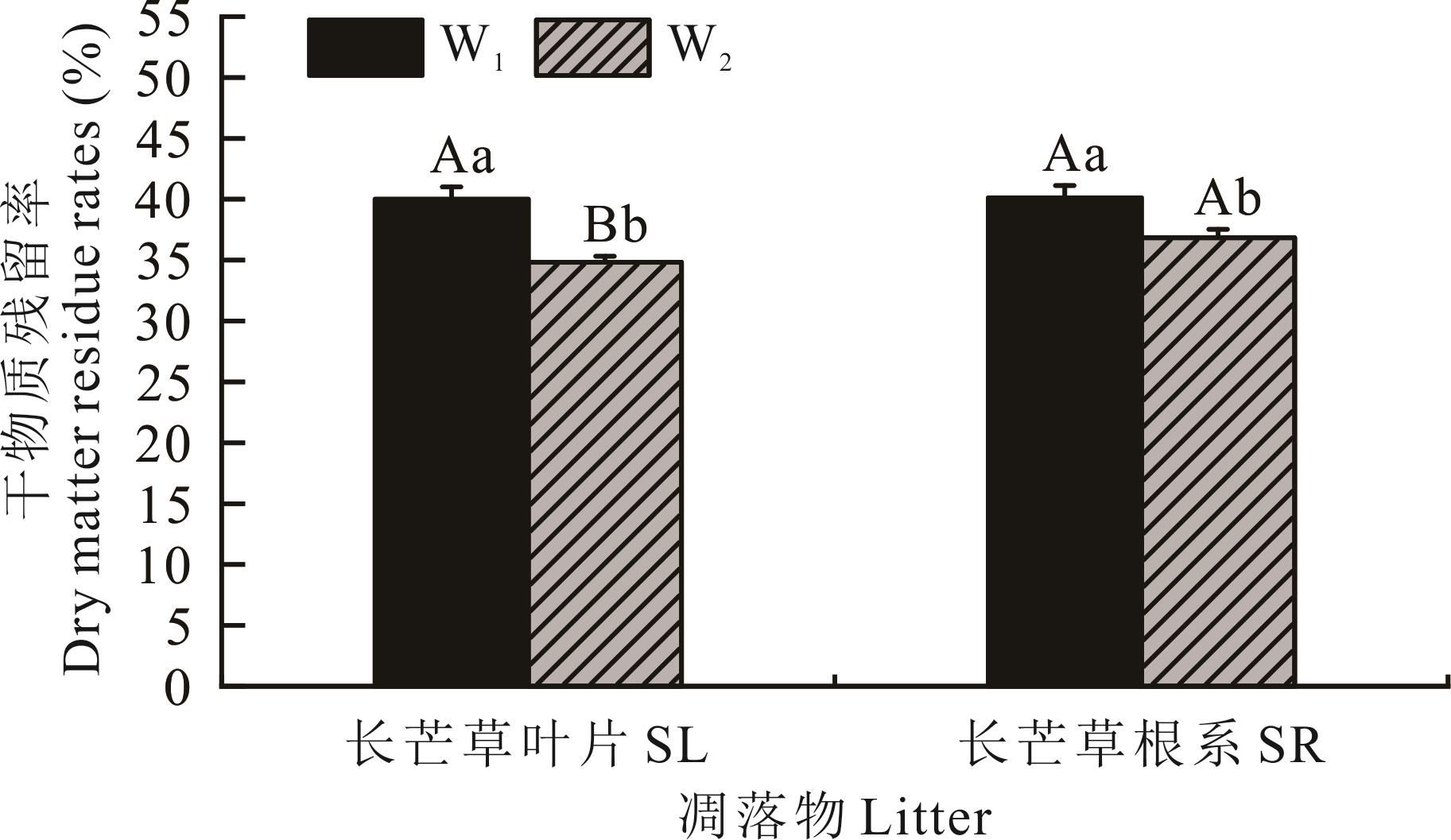
图1 不同水分处理下的凋落物干物质残留率不同大写字母表示不同凋落物处理间差异显著,不同小写字母表示不同水分处理间差异显著(平均值±标准误,P<0.05)。下同。Different capital letters indicate significant differences between different litter treatments, while different lowercase letters indicate significant differences between different moisture treatments [mean±standard error (SE), P<0.05]. The same below.
Fig.1 Dry matter residue rates of litters under different moisture treatments
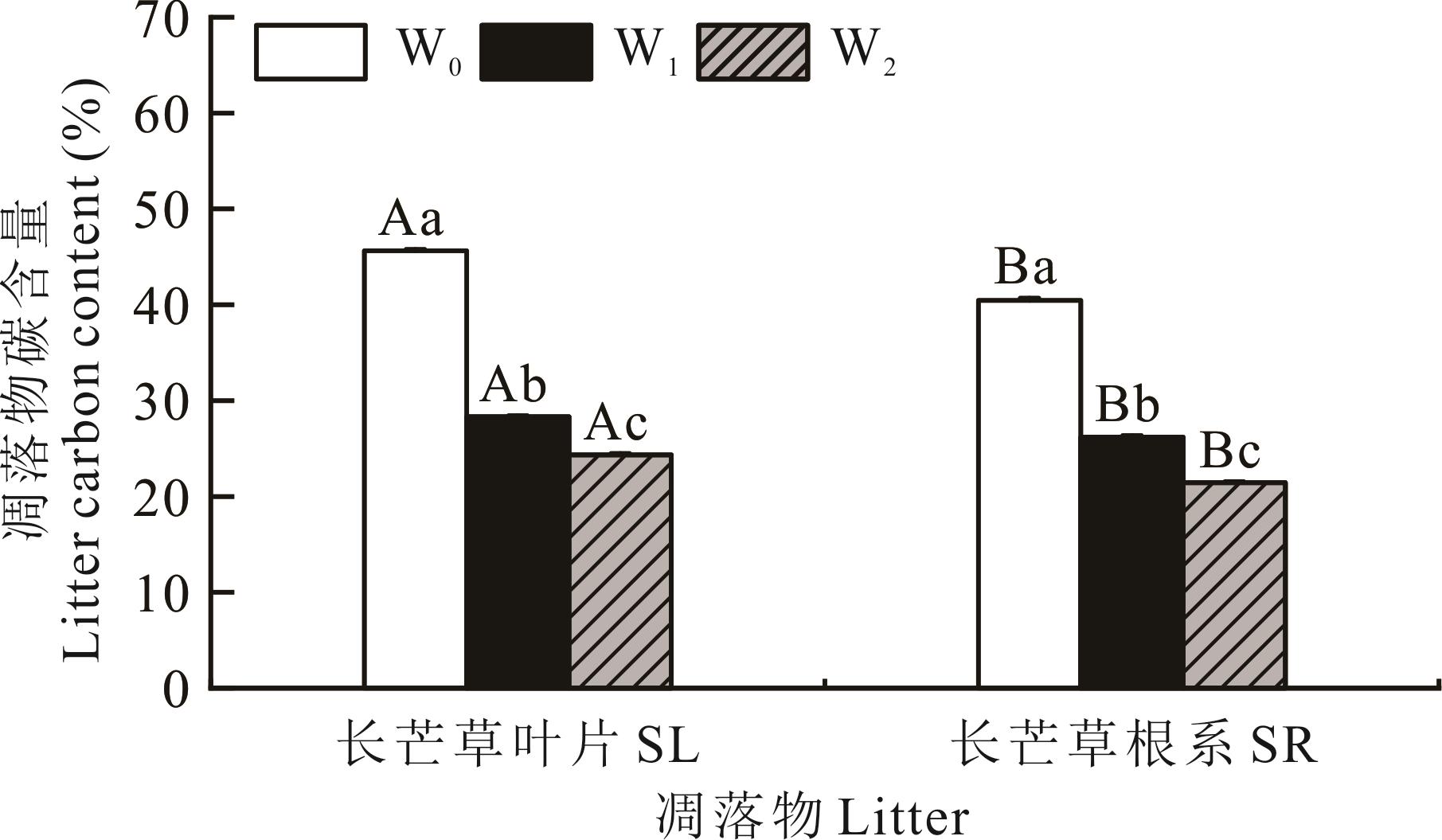
图2 不同水分处理下凋落物碳含量的变化
Fig.2 Changes in the litter carbon contents under different moisture treatments
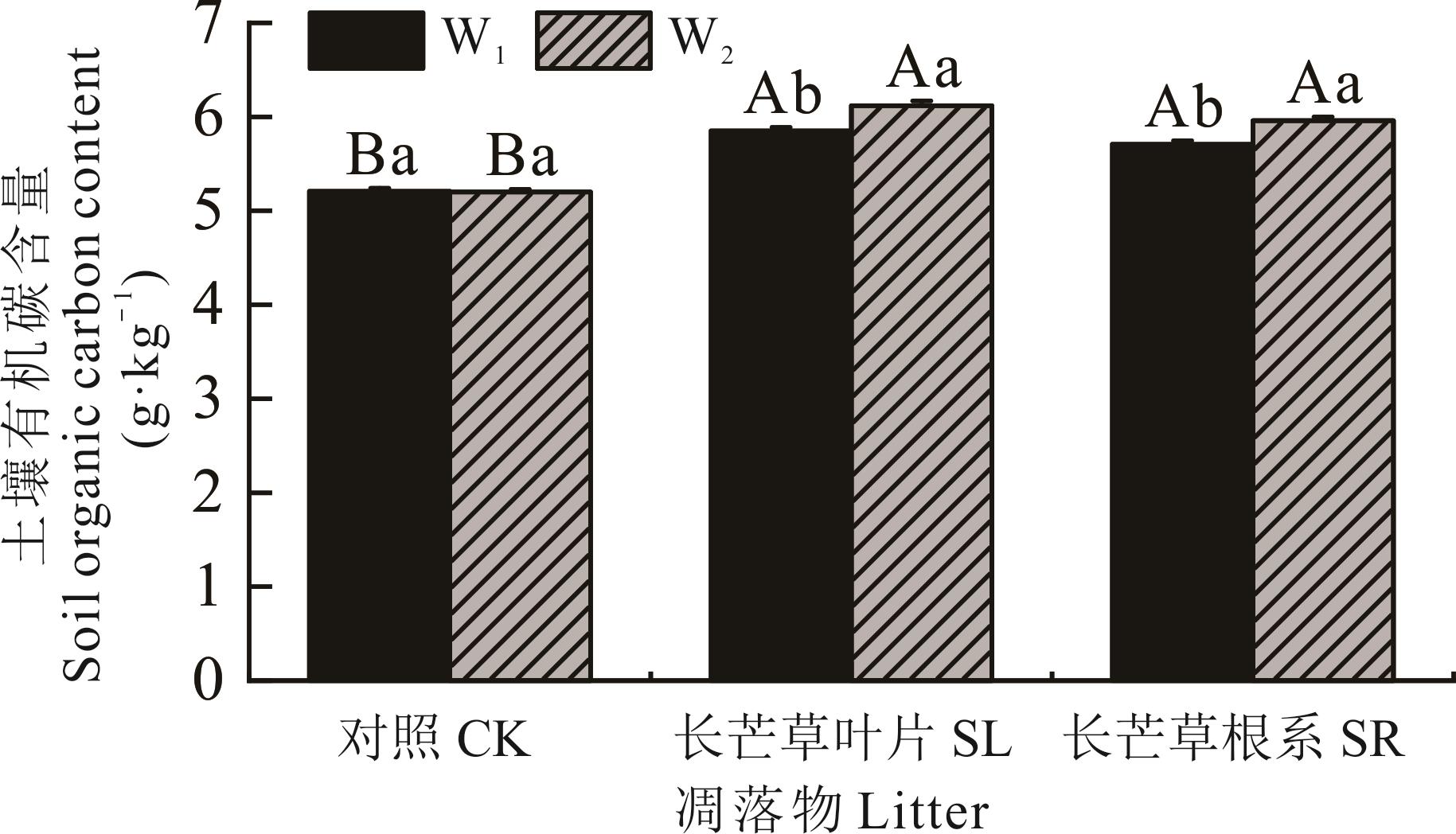
图3 不同水分处理下土壤有机碳含量的变化
Fig.3 Changes in the soil organic carbon content under different moisture treatments
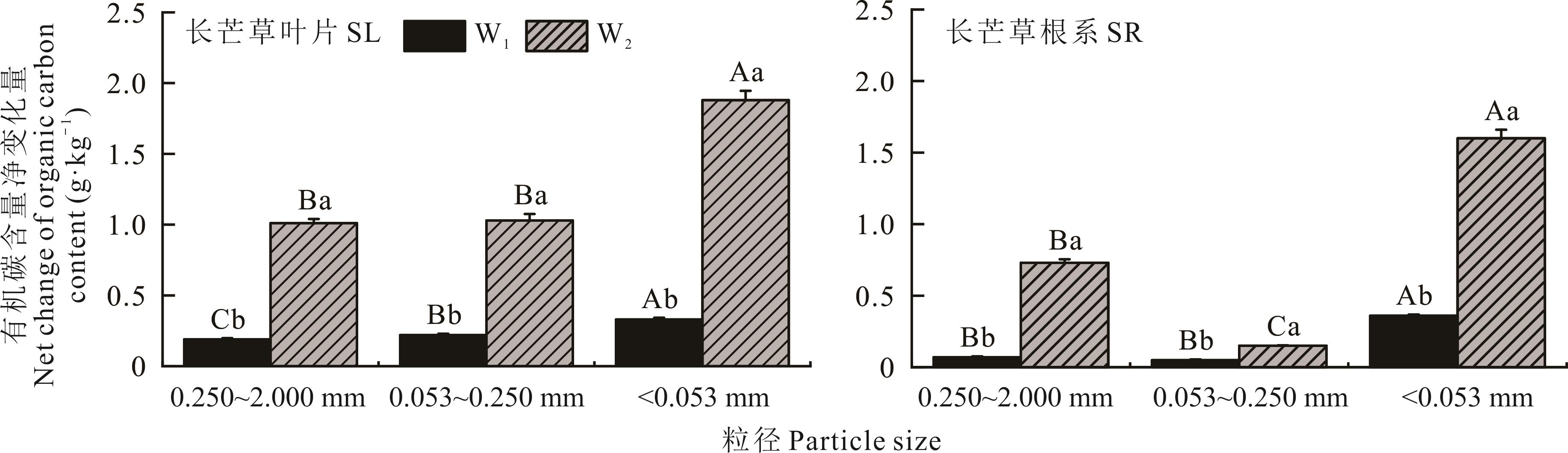
图4 不同水分处理下各粒径土壤团聚体有机碳含量净变化量不同大写字母表示不同粒径团聚体之间差异显著,不同小写字母表示不同水分处理间差异显著(平均值±标准误,P<0.05)。下同。Different capital letters indicate significant differences among aggregates of different particle sizes, while different lowercase letters indicate significant differences between different moisture treatments [mean±standard error(SE), P<0.05]. The same below.
Fig.4 Net changes in the organic carbon content of soil aggregates with different particle sizes under different moisture treatments
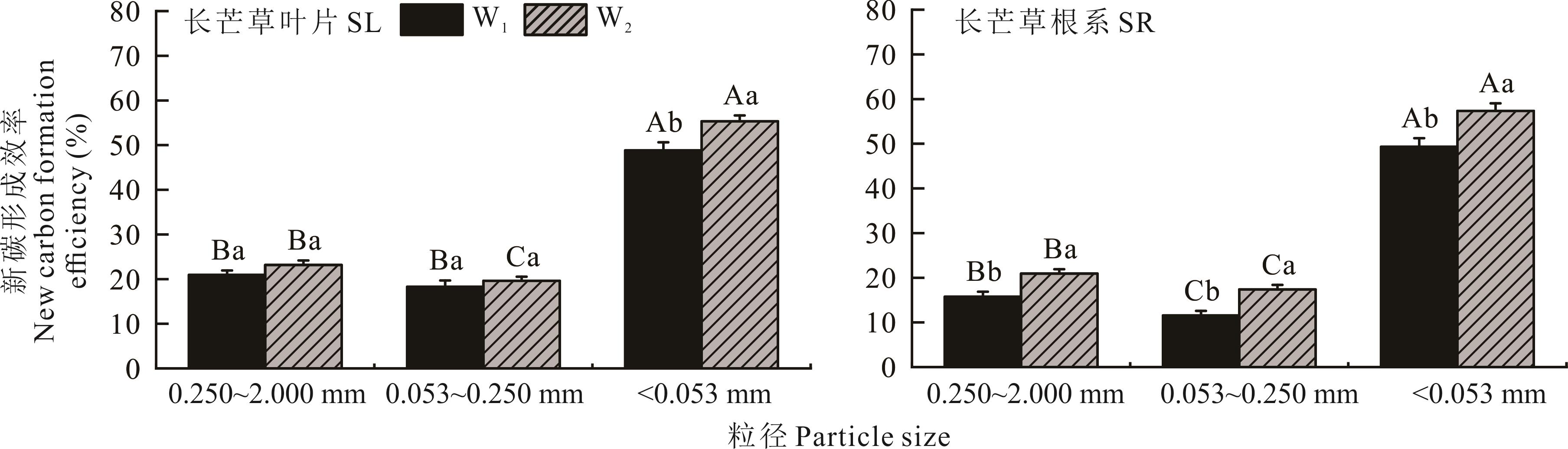
图5 不同水分处理下土壤各粒级团聚体的新碳形成效率
Fig.5 New carbon formation efficiency in soil aggregates of various particle sizes under different moisture treatments
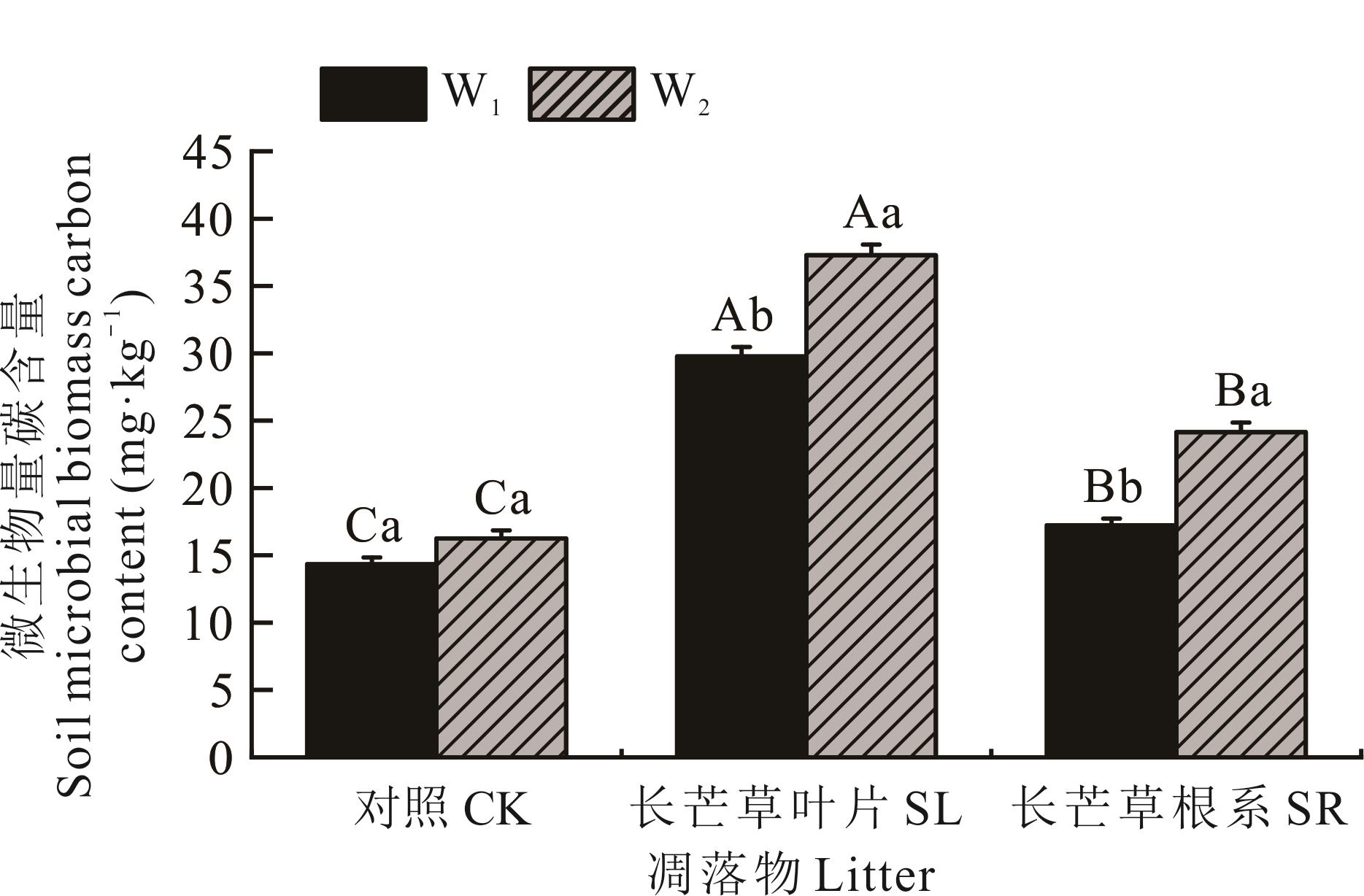
图6 不同水分处理下的土壤微生物量碳含量不同大写字母表示不同凋落物间差异显著,不同小写字母表示不同水分处理间差异显著(平均值±标准误,P<0.05)。 Different capital letters indicate significant differences among different litters, while different lowercase letters indicate significant differences between different moisture treatments(mean±SE, P<0.05).
Fig.6 Soil microbial biomass carbon content under different moisture treatments
| [1] | Bontti E E, Decant J P, Munson S M, et al. Litter decomposition in grasslands of central North America (US Great Plains). Global Change Biology, 2009, 15(5): 1356-1363. |
| [2] | Chen Y C, Ma S Q, Lu X Y. Litter decomposition and nutrient dynamics of typical plant species in an alpine steppe ecosystem in northern Tibet. Pratacultural Science, 2019, 36(4): 1066-1073. |
| 陈有超, 马书琴, 鲁旭阳. 藏北高寒草原典型物种凋落物分解与养分动态. 草业科学, 2019, 36(4): 1066-1073. | |
| [3] | Zhang G S, Huang G B. Soil organic carbon sequestration potential in cropland. Acta Ecologica Sinica, 2005, 25(2): 351-357. |
| 张国盛, 黄高宝. 农田土壤有机碳固定潜力研究进展. 生态学报, 2005, 25(2): 351-357. | |
| [4] | Jin X X, Wang J K, Sun L J, et al. Progress of carbon cycle in farmland and sequestration in soil aggregates revealed by stable 13C isotope. Soils, 2017, 49(2): 217-224. |
| 金鑫鑫, 汪景宽, 孙良杰, 等. 稳定13C同位素示踪技术在农田土壤碳循环和团聚体固碳研究中的应用进展. 土壤, 2017, 49(2): 217-224. | |
| [5] | Epstein H E, Burke I C, Lauenroth W K. Regional patterns of decomposition and primary production rates in the US Great Plains. Ecology, 2002, 83(2): 320-327. |
| [6] | Wang M M, Hou F J. Influence of main factors on grass litter decomposition. Pratacultural Science, 2012, 29(10): 1631-1637. |
| 王苗苗, 侯扶江. 草地凋落物分解的主要影响因素. 草业科学, 2012, 29(10): 1631-1637. | |
| [7] | Thakur M P, Milcu A, Manning P, et al. Plant diversity drives soil microbial biomass carbon in grasslands irrespective of global environmental change factors. Global Change Biology, 2015, 21(11): 4076-4085. |
| [8] | Gao C B, Chang Z Q. Effects of water input on litter decomposition and nitrogen dynamics of desert vegetation in the Liangucheng National Nature Reserve, Gansu, China. Journal of Desert Research, 2021, 41(2): 145-152. |
| 高承兵, 常宗强. 降水量对连古城自然保护区荒漠植被凋落物分解和氮状态的影响. 中国沙漠, 2021, 41(2): 145-152. | |
| [9] | Chen Q, Li G, Li H D, et al. Soil moisture determines the consistency of organic matter decomposition in field and lab test patterns. Catena, 2024, 246: 108485. |
| [10] | Wen H Y, Fu H, Guo D. Influence of nitrogen addition on Stipa bungeana and Heteropappus altaicus litter decomposition and nutrient release in a steppe located on the Loess Plateau. Acta Ecologica Sinica, 2017, 37(6): 2014-2022. |
| 文海燕, 傅华, 郭丁. 黄土高原典型草原优势植物凋落物分解及养分释放对氮添加的响应. 生态学报, 2017, 37(6): 2014-2022. | |
| [11] | Lu W J, Qi J Y, Wu C, et al. Effects of mixed litter with different degrees of decomposition on the decomposition characteristics of semi-arid grassland in northern Shanxi. Acta Prataculturae Sinica, 2023, 32(12): 47-57. |
| 路文杰, 齐晋云, 吴聪, 等. 晋北半干旱草地不同分解程度凋落物混合对分解特征的影响. 草业学报, 2023, 32(12): 47-57. | |
| [12] | Wang Q W, Yu D P, Dai L M, et al. Research progress in water use efficiency of plants under global climate change. Chinese Journal of Applied Ecology, 2010, 21(12): 3255-3265. |
| 王庆伟, 于大炮, 代力民, 等. 全球气候变化下植物水分利用效率研究进展. 应用生态学报, 2010, 21(12): 3255-3265. | |
| [13] | Soong J L, Parton W J, Calderon F, et al. A new conceptual model on the fate and controls of fresh and pyrolized plant litter decomposition. Biogeochemistry, 2015, 124: 27-44. |
| [14] | Haddix M L, Paul E A, Cotrufo M F. Dual, differential isotope labeling shows the preferential movement of labile plant constituents into mineral-bonded soil organic matter. Global Change Biology, 2016, 22(6): 2301-2312. |
| [15] | Chung H, Grove J H, Six J. Indications for soil carbon saturation in a temperate agroecosystem. Soil Science Society of America Journal, 2008, 72(4): 1132-1139. |
| [16] | Guo X, Luo H, Xu X M, et al. Effects of litter decomposition with different qualities on soil organic carbon content and its stability in grassland on the Loess Plateau. Acta Prataculturae Sinica, 2023, 32(5): 83-93. |
| 郭鑫, 罗欢, 许雪梅, 等.不同品质凋落物分解对黄土高原草地土壤有机碳及其稳定性的影响. 草业学报, 2023, 32(5): 83-93. | |
| [17] | Lavallee J M, Conant R T, Paul E A, et al. Incorporation of shoot versus root-derived 13C and 15N into mineral-associated organic matter fractions: Results of a soil slurry incubation with dual-labelled plant material. Biogeochemistry, 2018, 137(3): 379-393. |
| [18] | Swift M J, Heal O W, Anderson J M. Decomposition in terrestrial ecosystems. Berkeley: University of California Press, 1979. |
| [19] | Yang L L, Gong J R, Liu M, et al. Advances in the effect of nitrogen deposition on grassland litter decomposition. Chinese Journal of Plant Ecology, 2017, 41(8): 894-913. |
| 杨丽丽, 龚吉蕊, 刘敏, 等. 氮沉降对草地凋落物分解的影响研究进展. 植物生态学报, 2017, 41(8): 894-913. | |
| [20] | Yan Z Q, Qi Y C, Peng Q, et al. Advances in the effects of simulated precipitation and nitrogen deposition on grassland biomass. Acta Agrestia Sinica, 2017, 25(6): 1165-1170. |
| 闫钟清, 齐玉春, 彭琴, 等. 模拟降水和氮沉降增加对草地生物量影响的研究进展. 草地学报, 2017, 25(6): 1165-1170. | |
| [21] | Dirks I, Navon Y, Kanas D. Atmospheric water vapor as driver of litter decomposition in Mediterranean shrubland and grassland during rainless seasons. Global Change Biology, 2010, 16(10): 2799-2812. |
| [22] | Brandt L A, King J Y, Hobbie S E, et al. The role of photodegradation in surface litter decomposition across a grassland ecosystem precipitation gradient. Ecosystems, 2010, 13(5): 765-781. |
| [23] | Brown M E, Chang M C. Exploring bacterial lignin degradation. Current Opinion in Chemical Biology, 2014, 19(1): 1-7. |
| [24] | Abiven S, Menasseri S, Chenu C. The effects of organic inputs over time on soil aggregate stability-A literature analysis. Soil Biology and Biochemistry, 2009, 41(1): 1-12. |
| [25] | Cotrufo M F, Wallenstein M D, Boot C M, et al. The microbial efficiency-matrix stabilization (MEMS) framework integrates plant litter decomposition with soil organic matter stabilization: Do labile plant inputs form stable soil organic matter. Global Change Biology, 2013, 19(4): 988-995. |
| [26] | Castro H F, Classen A T, Austin E E, et al. Soil microbial community responses to multiple experimental climate change drivers. Applied & Environmental Microbiology, 2010, 76(4): 999-1007. |
| [27] | Wang B R, An S S, Liang C, et al. Microbial necromass as the source of soil organic carbon in global ecosystems. Soil Biology and Biochemistry, 2021, 162: 108422. |
| [28] | Sokol N W, Bradford M A. Microbial formation of stable soil carbon is more efficient from belowground than aboveground input. Nature Geoscience, 2019, 12(1): 46-53. |
| [29] | Georgiou K, Jackson R B, Vinduková O, et al. Global stocks and capacity of mineral-associated soil organic carbon. Nature Communications, 2022, 13: 3797. |
| [30] | Haddix M L, Gregorich E G, Helgason B L, et al. Climate, carbon content, and soil texture control the independent formation and persistence of particulate and mineral-associated organic matter in soil. Geoderma, 2020, 363: 114160. |
| [31] | Katherine S R, Michael B, John M B, et al. Thirty years of increased precipitation modifies soil organic matter fractions but not bulk soil carbon and nitrogen in a mesic grassland. Soil Biology and Biochemistry, 2023, 185: 109145. |
| [32] | Clarholm M, Skyllberg U, Rosling A. Organic acid induced release of nutrients from metal-stabilized soil organic matter-The unbutton model. Soil Biology and Biochemistry, 2015, 84: 168-176. |
| [33] | Laub M, Samuel S, Patma V, et al. Litter quality and microbes explain aggregation differences in a tropical sandy soil. Journal of Soil Science and Plant Nutrition, 2022, 22(1): 848-860. |
| [1] | 张晓曦, 梁倩怡, 张泽强, 罗媛媛, 李利平, 李若萱, 刘鑫, 胡博. 黄土丘陵区撂荒草地新鲜和半分解层凋落物混合对彼此早期分解的影响[J]. 草业学报, 2026, 35(7): 58-67. |
| [2] | 邓文辉, 赵小娜, 雍嘉仪, 管思雨, 胡国强, 王腾飞, 胡海英. 行比和燕麦密度对苜蓿种子产量及其构成因素的影响[J]. 草业学报, 2026, 35(4): 100-111. |
| [3] | 蒋玉奇, 郭鑫, 姜佳昌, 刘兴明, 梁春燕, 文海燕, 牛得草, 李旭东. 土壤碳饱和度对黄土高原温性草原凋落物分解及土壤碳固存的影响[J]. 草业学报, 2026, 35(3): 43-51. |
| [4] | 骆欣怡, 邱开阳, 金涛, 鲍平安, 黄业芸, 何毅, 谢应忠. 碳、氮、钾添加对荒漠草原凋落物分解特征的影响[J]. 草业学报, 2025, 34(2): 41-53. |
| [5] | 滕远, 马兵, 吴贤忠, 汪星, 吕雯, 任鸿武, 汪治同. 黄土区深厚土壤严重干化后再植苜蓿地的土壤水分入渗特征[J]. 草业学报, 2025, 34(1): 66-79. |
| [6] | 候腾思, 沈艳, 马红彬, 方鹏, 曹颖. 柠条平茬对荒漠草原土壤水分特征及水量平衡的影响[J]. 草业学报, 2024, 33(8): 15-24. |
| [7] | 赵亚楠, 王红梅, 李志丽, 张振杰, 陈彦硕, 苏荣霞. 荒漠草原灌丛转变过程土壤水分亏缺空间特征及影响因素[J]. 草业学报, 2024, 33(4): 22-34. |
| [8] | 田晴华, 刘丹, 廖小琴, 宋小艳, 胡雷, 王长庭. 施氮对高寒草地土壤团聚体生物胶结物质及稳定性的影响[J]. 草业学报, 2024, 33(11): 46-57. |
| [9] | 李林芝, 张德罡, 马源, 罗珠珠, 林栋, 海龙, 白兰鸽. 不同退化程度高寒草甸土壤团聚体养分及生态化学计量特征研究[J]. 草业学报, 2023, 32(8): 48-60. |
| [10] | 郭鑫, 罗欢, 许雪梅, 马爱霞, 尚振艳, 韩天虎, 牛得草, 文海燕, 李旭东. 不同品质凋落物分解对黄土高原草地土壤有机碳及其稳定性的影响[J]. 草业学报, 2023, 32(5): 83-93. |
| [11] | 江奥, 敬路淮, 泽让东科, 田黎明. 放牧影响草地凋落物分解研究进展[J]. 草业学报, 2023, 32(4): 208-220. |
| [12] | 杜鹏冲, 潘昱臻, 侯双利, 王智慧, 王洪义. 氮磷添加对呼伦贝尔草地凋落物分解的影响[J]. 草业学报, 2023, 32(2): 44-53. |
| [13] | 黄业芸, 邱开阳, 朱亚超, 谢应忠, 刘王锁, 杨壹, 王思瑶, 崔璐瑶, 鲍平安. 贺兰山不同海拔植被生物量与土壤分形特征和土壤水分的相关关系[J]. 草业学报, 2023, 32(12): 24-35. |
| [14] | 路文杰, 齐晋云, 吴聪, 景亚泓. 晋北半干旱草地不同分解程度凋落物混合对分解特征的影响[J]. 草业学报, 2023, 32(12): 47-57. |
| [15] | 李惟婕, 王立, 马景永, 王自奎. 黄土旱塬区苹果园生草覆盖对深层土壤水分和根系分布特征的影响[J]. 草业学报, 2023, 32(1): 63-74. |
| 阅读次数 | ||||||
|
全文 |
|
|||||
|
摘要 |
|
|||||
