

ISSN 1004-5759 CN 62-1105/S
草业学报 ›› 2026, Vol. 35 ›› Issue (10): 144-155.DOI: 10.11686/cyxb2025436
• 研究论文 • 上一篇
王艺华1( ), 任慈1, 张盼玉1, 刘翠玲1, 何亮亮1, 李洁仪1, 刘超1, 陈曙1,2,3()
收稿日期:2025-10-21
修回日期:2025-12-05
出版日期:2026-10-20
发布日期:2026-09-09
通讯作者:
陈曙
作者简介:E-mail: shuchen@scau.edu.cn基金资助:
Yi-hua WANG1(), Ci REN1, Pan-yu ZHANG1, Cui-ling LIU1, Liang-liang HE1, Jie-yi LI1, Chao LIU1, Shu CHEN1,2,3()
Received:2025-10-21
Revised:2025-12-05
Online:2026-10-20
Published:2026-09-09
Contact:
Shu CHEN
摘要:
在热带和亚热带地区,柱花草属是极具经济价值的豆科牧草,被誉为“热带苜蓿”,在饲草生产、水土保持、果园覆盖等领域发挥重要作用。随着全球盐碱地面积逐年扩大,盐胁迫导致柱花草生长受阻、产量下降,已成为限制其栽植推广的关键障碍,亟需挖掘耐盐关键基因并解析其功能。NAC转录因子是植物耐盐调控的核心家族,而柱花草SgNAC1的耐盐特性尚未明确。本研究通过实时荧光定量PCR分析SgNAC1基因在细茎柱花草株系‘YN02’叶片及茎中的表达模式。结果表明,盐胁迫(150 mmol·L-1 NaCl)处理后,叶片中SgNAC1基因表达量在2 h时降至最低,茎中表达量在6 h达到峰值;脱落酸(ABA)处理后,叶片和茎中SgNAC1基因表达量均在处理1 h达到最高,在ABA+NaCl复合处理后,叶片中SgNAC1基因表达量在处理0.5 h后达到峰值,茎中表达量在1 h出现第一个峰值,12 h出现第二个峰值。上述结果表明,茎中SgNAC1基因在12 h左右响应盐胁迫,在1 h左右响应ABA和ABA+NaCl胁迫;盐胁迫下叶片中SgNAC1基因表达量在2 h显著下降,推测可能受其他因素调控;ABA+NaCl 复合处理下茎中SgNAC1基因的双表达峰,可能是NaCl与ABA协同作用的结果。通过根癌农杆菌介导的叶盘法转化野生型烟草,成功获得SgNAC1过表达的转基因烟草株系(SgNAC1-OE)。对野生型和SgNAC1-OE烟草同时进行盐胁迫(300 mmol·L-1 NaCl)处理,测定处理前后叶片的各项生理指标发现,SgNAC1过表达显著提升了脯氨酸水平,增强了烟草耐盐能力。本研究明确了SgNAC1基因在柱花草不同组织中的表达特征,并通过转基因烟草验证了其耐盐功能,为柱花草耐盐机制解析及耐盐育种提供理论依据和基因资源。
王艺华, 任慈, 张盼玉, 刘翠玲, 何亮亮, 李洁仪, 刘超, 陈曙. 柱花草SgNAC1基因的耐盐功能研究[J]. 草业学报, 2026, 35(10): 144-155.
Yi-hua WANG, Ci REN, Pan-yu ZHANG, Cui-ling LIU, Liang-liang HE, Jie-yi LI, Chao LIU, Shu CHEN. A functional study of the role of SgNAC1 in salt tolerance in Stylosanthes[J]. Acta Prataculturae Sinica, 2026, 35(10): 144-155.
| 引物名称Name of the primer | 正向引物序列Forward primer sequence (5'→3') | 反向引物序列Reverse primer sequence (5'→3') |
|---|---|---|
| SgNAC1 | TCTAGAATGGCAGCTGAACTTCAATTGC | GGATCCTCAGAACGGTTTCTGCAGGTTC |
| SgNAC1-qPCR | TTCCGATCATAGCCGAAATC | TGCCTTCCAGTACCCAGTTC |
| SgActin-qPCR | TCGATTGGATCTTGCAGGGC | TGGACAACGGAATCTCTCAGC |
表1 本研究所用引物
Table 1 Primers used in this study
| 引物名称Name of the primer | 正向引物序列Forward primer sequence (5'→3') | 反向引物序列Reverse primer sequence (5'→3') |
|---|---|---|
| SgNAC1 | TCTAGAATGGCAGCTGAACTTCAATTGC | GGATCCTCAGAACGGTTTCTGCAGGTTC |
| SgNAC1-qPCR | TTCCGATCATAGCCGAAATC | TGCCTTCCAGTACCCAGTTC |
| SgActin-qPCR | TCGATTGGATCTTGCAGGGC | TGGACAACGGAATCTCTCAGC |
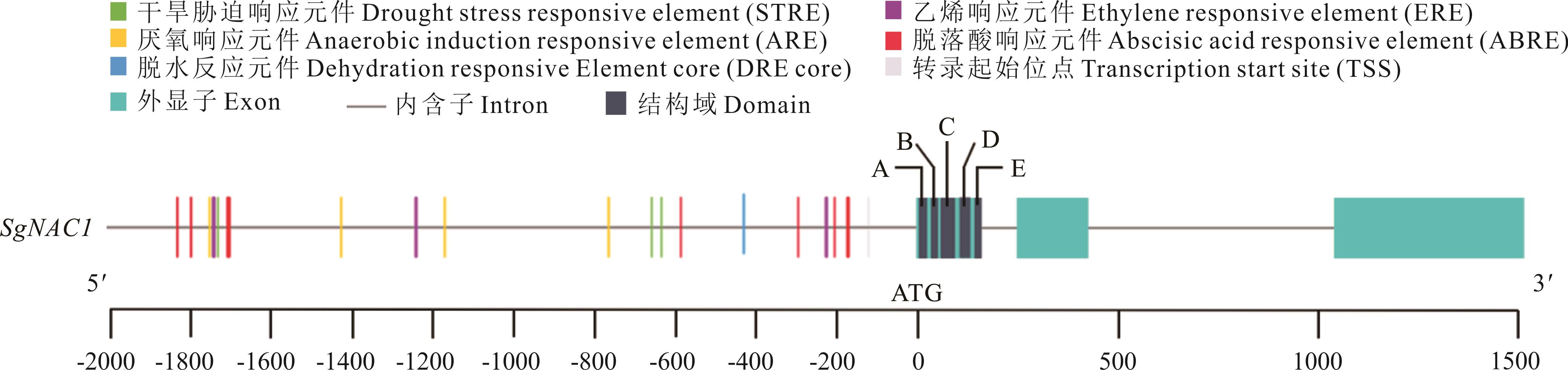
图1 SgNAC1基因启动子顺式作用元件及其基因结构分析A~E分别代表5个保守亚结构域。A-E represent the 5 conserved subdomains.
Fig.1 Analysis of cis-acting elements in the promoter of SgNAC1 gene and its gene structure
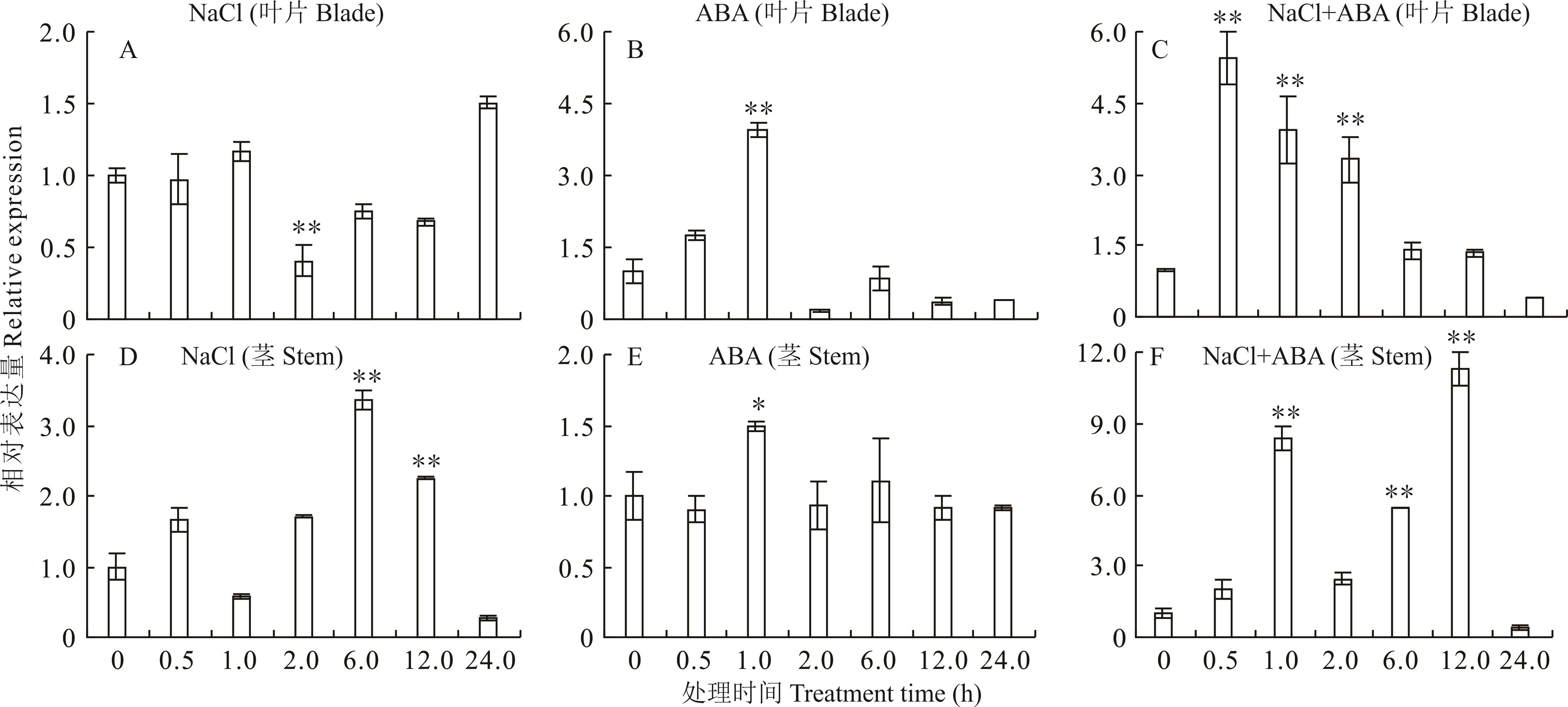
图2 不同处理下柱花草‘YN02’叶片及茎中SgNAC1基因的相对表达量变化NaCl:盐胁迫Salt stress;ABA:脱落酸Abscisic acid. A:盐胁迫下叶片中SgNAC1表达量的变化;B:ABA处理下叶片中SgNAC1表达量的变化;C:ABA和NaCl处理下叶片中SgNAC1表达量的变化;D:盐胁迫下茎中SgNAC1表达量的变化;E:ABA处理下茎中SgNAC1表达量的变化;F:ABA和NaCl处理下茎中SgNAC1表达量的变化;* 和 **分别表示在P<0.05和P<0.01水平存在显著差异。A: Changes in SgNAC1 expression levels in leaves under salt stress; B: Changes in SgNAC1 expression levels in leaves treated with ABA; C: Changes in SgNAC1 expression levels in leaves treated with NaCl and ABA; D: Changes in SgNAC1 expression levels in stems under salt stress; E: Changes in SgNAC1 expression levels in stems treated with ABA; F: Changes in SgNAC1 expression levels in stems treated with NaCl and ABA. * and ** indicate significant differences at P<0.05 and P<0.01 levels, respectively.
Fig.2 Changes in the relative expression levels of the SgNAC1 gene in leaves and stems of Stylosanthes ‘YN02’ under different treatments
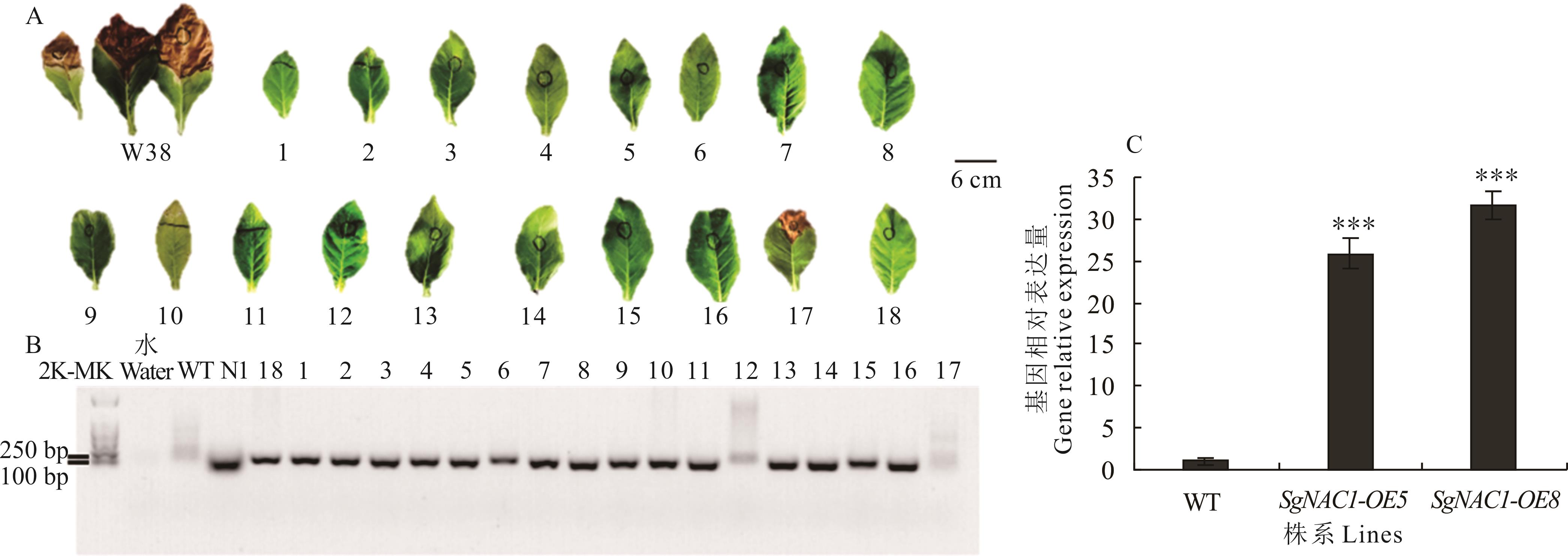
图3 SgNAC1-OE转基因烟草的Basta抗性鉴定及SgNAC1基因的PCR鉴定和qRT-PCR分析A:转基因植株的草铵膦抗性鉴定,W38为野生型烟草株系。1~18均为转基因SgNAC1-OE同一株系的不同单株,黑色标记为草铵膦涂抹处;B:野生型及转基因烟草中SgNAC1基因的PCR鉴定。C: 野生型及转基因烟草中SgNAC1基因的qRT-PCR分析。2K-MK为DNA marker DL 2000,N1为农杆菌菌液阳性对照,WT为野生型烟草W38, 1~18均为转基因株系;***表示在P<0.001水平存在显著差异。A: Basta resistance identification of transgenic plants, with W38 as the wild type N. tabacum. 1-18 are different individual plants from the same transgenic SgNAC1-OE strain, with black marks indicating Basta application sites; B: PCR identification of the SgNAC1 gene in wild-type and transgenic tobacco. C: qRT-PCR analysis of the SgNAC1 gene in wild-type and transgenic tobaccos. 2K-MK is the DNA marker DL 2000, N1 is the Agrobacterium culture positive control, WT is the wild type N. tabacum W38, and 1-18 are transgenic lines. *** indicates significant differences at the P<0.001 levels.
Fig.3 Identification of Basta resistance in SgNAC1-OE transgenic tobacco, PCR identification and qRT-PCR analysis of the SgNAC1 gene
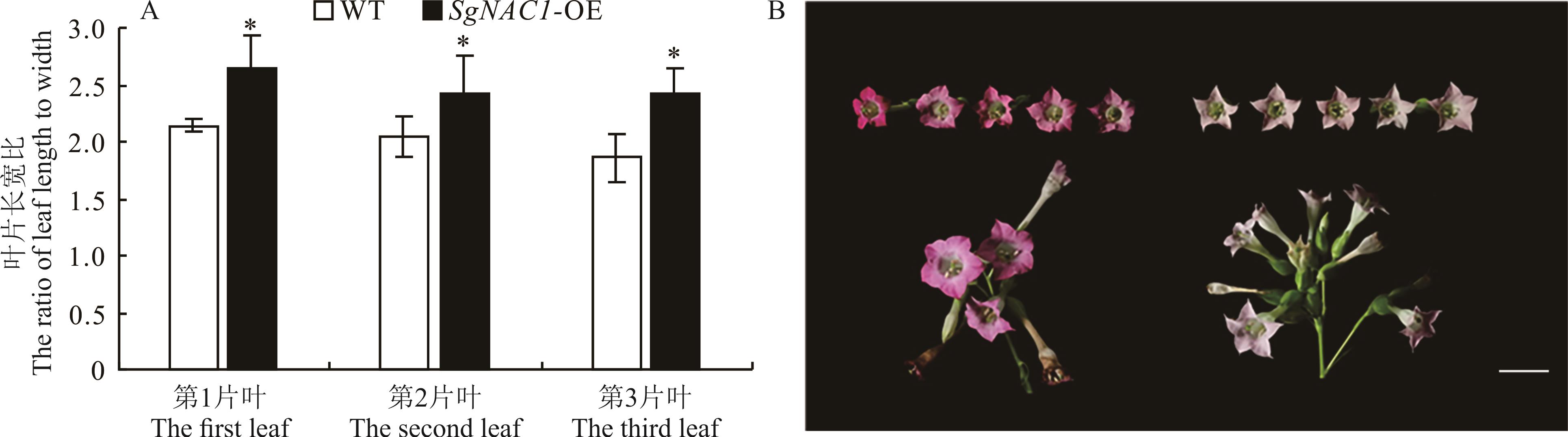
图4 转基因与野生型烟草叶片长宽比与花色差异*表示与 WT 相比有显著差异(P<0.05), SgNAC1-OE为转基因烟草,WT为野生型烟草W38。下同。标尺=10 cm。* indicates a significant difference compared to WT (P<0.05). SgNAC1-OE refers to transgenic N. tabacum, and WT refers to wild-type tobacco W38. The same below. Bar=10 cm.
Fig.4 Differences in the length-to-width ratio and flower color between genetically modified and wild N. tabacum leaves
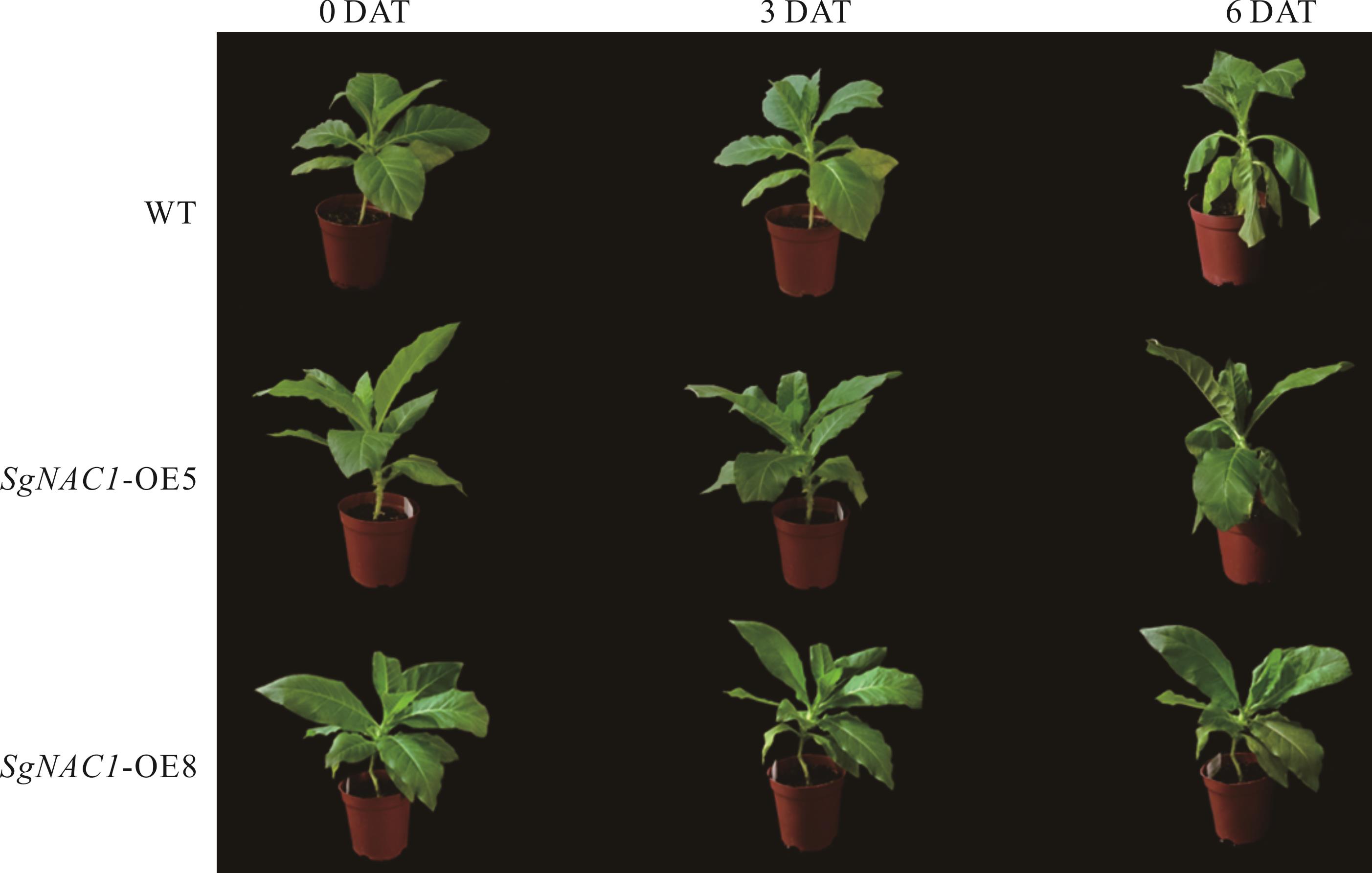
图5 盐胁迫下烟草的表型变化
Fig.5 Phenotypic changes in tobacco under salt stress
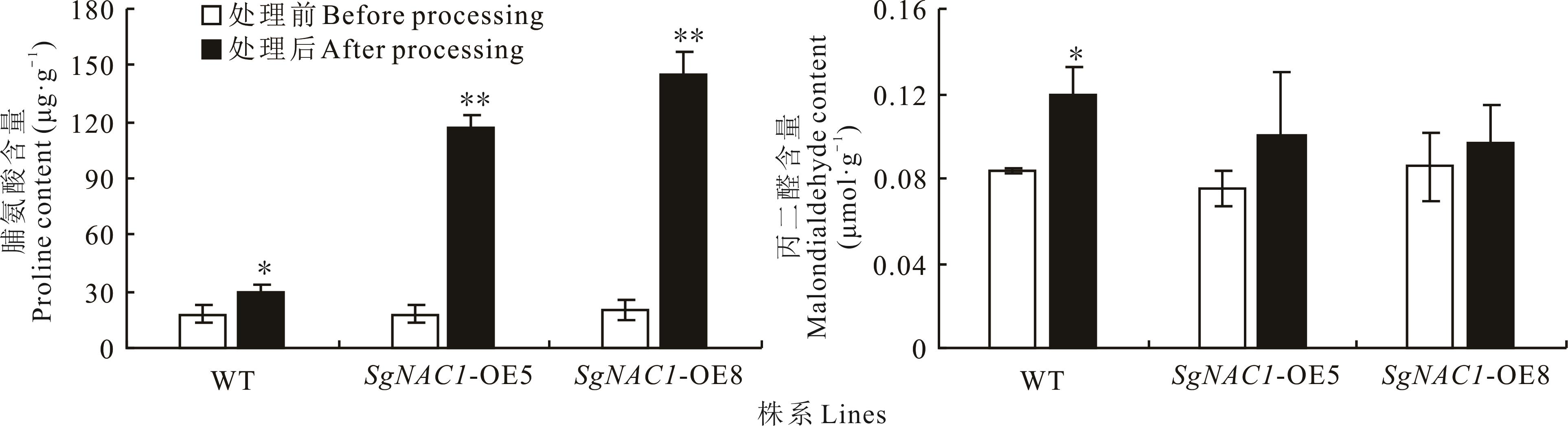
图6 盐胁迫下野生型与过表达SgNAC1烟草生理指标变化*表示与处理前相比有显著差异(P<0.05),**表示与处理前相比有极显著差异(P<0.01)。* indicates a significant difference compared to before processing (P<0.05). ** indicates an extremely significant difference compared to before treatment (P<0.01).
Fig.6 Changes in physiological indicators of wild-type and SgNAC1-overexpressing tobacco under salt stress
| [1] | Wang W D. Transcriptome analysis of Camellia sinensis under heat and drought stress and functional characterization of Histone H1 gene. Nanjing: Nanjing Agricultural University, 2016. |
| 王伟东. 高温和干旱胁迫下茶树转录组分析及Histone H1基因的功能鉴定. 南京: 南京农业大学, 2016. | |
| [2] | Tak H, Negi S, Ganapathi T R. Banana NAC transcription factor MusaNAC042 is positively associated with drought and salinity tolerance. Protoplasma, 2016, 254(2): 803-816. |
| [3] | Thirumalaikumar V P, Devkar V, Mehterov N, et al. NAC transcription factor JUNGBRUNNEN1 enhances drought tolerance in tomato. Plant Biotechnology Journal, 2017, 16(2): 354-366. |
| [4] | Boyer J S. Plant productivity and environment. Science, 1982, 218(4571): 443-448. |
| [5] | Zhang X K, Lu G Y, Long W H, et al. Recent progress in drought and salt tolerance studies in Brassica crops. Breeding Science, 2014, 64(1): 60-73. |
| [6] | Li T, Sun J K, Liu J T. Role of different transcription factor families in the regulatory networks of drought and salinity tolerance in plants. Chinese Bulletin of Life Sciences, 2015, 27(2): 217-227. |
| 李田, 孙景宽, 刘京涛. 植物转录因子家族在耐盐抗旱调控网络中的作用. 生命科学, 2015, 27(2): 217-227. | |
| [7] | Yao W J. Functinal analysis of poplar transcription factor ERF76 gene on salt-stress tolerance. Harbin: Northeast Forestry University, 2016. |
| 姚文静. 杨树转录因子ERF76基因耐盐功能研究. 哈尔滨: 东北林业大学, 2016. | |
| [8] | Ooka H, Satoh K, Doi K, et al. Comprehensive analysis of NAC family genes in Oryza sativa and Arabidopsis thaliana. DNA Research, 2003, 10(6): 239-247. |
| [9] | Kim S G, Kim S Y, Park C M. A membrane-associated NAC transcription factor regulates salt-responsive flowering via FLOWERING LOCUS T in Arabidopsis. Planta, 2007, 226(3): 647-654. |
| [10] | Jae-Heung K, Seung Hwan Y, Park A H, et al. ANAC012, a member of the plant-specific NAC transcription factor family, negatively regulates xylary fiber development in Arabidopsis thaliana. Plant Journal for Cell & Molecular Biology, 2010, 50(6): 1035-1048. |
| [11] | Christianson J A, Dennis E S, Llewellyn D J, et al. ATAF NAC transcription factors: regulators of plant stress signaling. Plant Signaling & Behavior, 2010, 5(4): 428-432. |
| [12] | Zhong R, Lee C, Ye Z H. Global analysis of direct targets of secondary wall NAC master switches in Arabidopsis. Molecular Plant, 2010, 3(6): 1087-1103. |
| [13] | Trine K, Jensen M K, Christiansen M W, et al. Senescence-associated barley NAC (NAM, ATAF1,2, CUC) transcription factor interacts with radical-induced cell death 1 through a disordered regulatory domain. Journal of Biological Chemistry, 2011, 286(41): 35418-35429. |
| [14] | So-Dam Y, Pil Joon S, Hye-Kyung Y, et al. The Arabidopsis NAC transcription factor VNI2 integrates abscisic acid signals into leaf senescence via the COR/RD genes. Plant Signaling & Behavior, 2011, 23(6): 2155-2168. |
| [15] | Nakashima K, Takasaki H, Mizoi J, et al. NAC transcription factors in plant abiotic stress responses. Biochimica et Biophysica Acta (BBA)-Gene Regulatory Mechanisms, 2012, 1819(2): 97-103. |
| [16] | Jiang Y, Deyholos M K. Comprehensive transcriptional profiling of NaCl-stressed Arabidopsis roots reveals novel classes of responsive genes. BMC Plant Biology, 2006, 6(1): 25. |
| [17] | Fang Y J, You J, Xie K B, et al. Systematic sequence analysis and identification of tissue-specific or stress-responsive genes of NAC transcription factor family in rice. Molecular Genetics & Genomics, 2008, 280(6): 547-563. |
| [18] | Le D T, Nishiyama R, Watanabe Y, et al. Genome-wide survey and expression analysis of the plant-specific NAC transcription factor family in soybean during development and dehydration stress. DNA Research, 2011, 18(4): 263-276. |
| [19] | Huang H, Wang Y, Wang S L, et al. Transcriptome-wide survey and expression analysis of stress-responsive NAC genes in Chrysanthemum lavandulifolium. Plant Science, 2012, 193/194(3): 18-27. |
| [20] | Nogueira F T S, Schlögl P S, Camargo S R, et al. SsNAC23, a member of the NAC domain protein family, is associated with cold, herbivory and water stress in sugarcane. Plant Science, 2005, 169(1): 93-106. |
| [21] | Li X L, Yang X, Hu Y X, et al. A novel NAC transcription factor from Suaeda liaotungensis K. enhanced transgenic Arabidopsis drought, salt, and cold stress tolerance. Plant Cell Reports, 2014, 33(5): 767-778. |
| [22] | Shan W, Kuang J F, Lu W J, et al. Banana fruit NAC transcription factor MaNAC1 is a direct target of MaICE1 and involved in cold stress through interacting with MaCBF1. Plant Cell & Environment, 2014, 37(9): 2116-2127. |
| [23] | Shao H B, Wang H Y, Tang X L. NAC transcription factors in plant multiple abiotic stress responses: progress and prospects. Frontiers in Plant Science, 2015, 6: 902. |
| [24] | Yu X W, Liu Y M, Wang S, et al. CarNAC4, a NAC-type chickpea transcription factor conferring enhanced drought and salt stress tolerances in Arabidopsis. Plant Cell Reports, 2015, 35(3): 1-15. |
| [25] | Hong Y B, Zhang H J, Huang L, et al. Overexpression of a stress-responsive NAC transcription factor gene ONAC022 improves drought and salt tolerance in rice. Frontiers in Plant Science, 2016, 7: 4. |
| [26] | Peng H, Yu X W, Cheng H Y, et al. Erratum to: cloning and characterization of a novel NAC family gene CarNAC1 from chickpea (Cicer arietinum.). Molecular Biotechnology, 2016, 58(3): 220-221. |
| [27] | Qu Y T, Duan M, Zhang Z Q, et al. Overexpression of the Medicago falcata NAC transcription factor MfNAC3 enhances cold tolerance in Medicago truncatula. Environmental & Experimental Botany, 2016, 129(9): 67-76. |
| [28] | Tang X B, Zhao H W, Lin Z P. Progress of genetic engineering of drought stress in plants. Journal of Capital Normal University (Natural Sciences Edition), 2002(3): 47-51. |
| 唐先兵, 赵恢武, 林忠平. 植物耐旱基因工程研究进展. 首都师范大学学报(自然科学版), 2002(3): 47-51. | |
| [29] | Riechmann J L, Ratcliffe O J. A genomic perspective on plant transcription factors. Current Opinion in Plant Biology, 2000, 3(5): 423-434. |
| [30] | Que F, Huang Y, Wang F, et al. Cloning and expression analysis of a transcription factor gene DcDofD1 related to abiotic stress reaction in carrot. Journal of Plant Genetic Resources, 2015, 16(5): 1073-1079. |
| 却枫, 黄莹, 王枫, 等. 胡萝卜中DcDofD1转录因子的克隆及其对非生物逆境胁迫的响应分析. 植物遗传资源学报, 2015, 16(5): 1073-1079. | |
| [31] | Sun J W, Peng X J, Fan W H, et al. Functional analysis of BpDREB2 gene involved in salt and drought response from a woody plant Broussonetia papyrifera. Gene, 2014, 535(2): 140-149. |
| [32] | Wang C, Yang Y G, Lv W T, et al. Cloning, expression, and functional analysis of an A subfamily bZIP transcription factor gene ZmbZIP81 in maize. Acta Agronomica Sinica, 2014, 40(9): 1549-1556. |
| 王策, 杨艳歌, 吕维涛, 等. 玉米A亚族bZIP转录因子基因ZmbZIP81的克隆、表达与功能分析. 作物学报, 2014, 40(9): 1549-1556. | |
| [33] | Cai H, Zhu Y M, Bai X, et al. Isolation and tolerance analysis of GsbZIP33 gene linked to response on stress in Glycine soja. Molecular Plant Breeding, 2011, 9(4): 397-401. |
| 才华, 朱延明, 柏锡, 等. 野生大豆GsbZIP33基因的分离及胁迫耐性分析. 分子植物育种, 2011, 9(4): 397-401. | |
| [34] | Xiao D C, Zhang Z J, Xu Y W, et al. Cloning and functional analysis of Phyllostachys edulis MYB transcription factor PeMYB2. Hereditas, 2013, 35(10): 1217-1225. |
| 肖冬长, 张智俊, 徐英武, 等. 毛竹MYB转录因子PeMYB2的克隆与功能分析. 遗传, 2013, 35(10): 1217-1225. | |
| [35] | Hu H H, Dai M Q, Yao J L, et al. Overexpressing a NAM, ATAF, and CUC (NAC) transcription factor enhances drought resistance and salt tolerance in rice. Proceedings of the National Academy of Sciences, 2006, 103(35): 12987-12992. |
| [36] | Xie L N, Chen M, Min D H, et al. The NAC-like transcription factor Si NAC110 in foxtail millet (Setaria italica) confers tolerance to drought and high salt stress through an ABA independent signaling pathway. Journal of Integrative Agriculture, 2017, 16(3): 559-571. |
| [37] | Xu Z Y, Kim S Y, Hyeon D Y, et al. The Arabidopsis NAC transcription factor ANAC096 cooperates with bZIP-type transcription factors in dehydration and osmotic stress responses. Plant Cell, 2013, 25(11): 4708-4724. |
| [38] | Lam-Son Phan T, Kazuo N, Yoh S, et al. Isolation and functional analysis of Arabidopsis stress-inducible NAC transcription factors that bind to a drought-responsive cis-element in the early responsive to dehydration stress 1 promoter. Plant Cell, 2004, 16(9): 2481-2498. |
| [39] | Richard H, Claire H, Penfold C A, et al. A local regulatory network around three NAC transcription factors in stress responses and senescence in Arabidopsis leaves. Plant Journal for Cell & Molecular Biology, 2013, 75(1): 26-39. |
| [40] | Sakuraba Y, Kim Y S, Han S H, et al. The Arabidopsis transcriptionfactor NAC016 promotes drought stress responses by repressing AREB1 transcription through a trifurcate feed-forward regulatory loop involving NAP. Plant Cell, 2015, 27(6): 1771-1787. |
| [41] | Fang Y J, Liao K F, Du H, et al. A stress-responsive NAC transcription factor SNAC3 confers heat and drought tolerance through modulation of reactive oxygen species in rice. Journal of Experimental Botany, 2015, 66(21): 6803-6817. |
| [42] | Niu F F, Wang C, Yan J L, et al. Functional characterization of NAC55 transcription factor from oilseed rape (Brassica napus) as a novel transcriptional activator modulating reactive oxygen species accumulation and cell death. Plant Molecular Biology, 2016, 92(1/2): 89-104. |
| [43] | Chen Q Q, Niu F F, Yan J L, et al. Oilseed rape NAC56 transcription factor modulates reactive oxygen species accumulation and hypersensitive response-like cell death. Physiologia Plantarum, 2017, 160(2): 209-221. |
| [44] | Hao Y J, Wei W, Song Q X, et al. SoybeanNAC transcription factors promote abiotic stress tolerance and lateral root formation in transgenic plants. The Plant Journal, 2011, 68(2): 302-313. |
| [45] | Merum P, Rao G L, Sudhakarbabu O, et al. Overexpression of horsegram (Macrotyloma uniflorum Lam.Verdc.) NAC transcriptional factor (MuNAC4) in groundnut confers enhanced drought tolerance. Molecular Biotechnology, 2014, 56(8): 758-769. |
| [46] | Mao X G, Chen S S, Li A, et al. Novel NAC transcription factor TaNAC67 confers enhanced multi-abiotic stress tolerances in Arabidopsis. PLoS One, 2014, 9(1): e84359. |
| [47] | Kurowska M, Daszkowska-Golec A. Molecular mechanisms of SNAC1 (stress-responsive NAC1) in conferring the abiotic stress tolerance. Plant Science, 2023, 337: 111894. |
| [48] | Livak K, Schmittgen T. Analysis of relative gene expression data using real-time quantitative PCR and the 2-ΔΔCT method. Methods, 2001, 25(4): 402-408. |
| [49] | Yuan S Z, Li S Y, Qiao C. Effect of low temperature stress on content of free proline in spirulina. Modern Agricultural Science and Technology, 2010(18): 35-37. |
| 袁淑珍, 栗淑媛, 乔辰. 低温胁迫对螺旋藻细胞内游离脯氨酸含量的影响. 现代农业科技, 2010(18): 35-37. | |
| [50] | Li Z F, Wu X D. Experimental design scheme for the effect of drought stress on content of malondialdehyde of indoor ornamental plants. Tianjin Agricultural Sciences, 2016, 22(9): 49-51. |
| 李子芳, 吴锡冬. 植物丙二醛含量测定试验设计方案. 天津农业科学, 2016, 22(9): 49-51. | |
| [51] | Zhan P L, Ke S W, Zhang P Y, et al. Overexpression of two cold-responsive ATAF-like NAC transcription factors from fine-stem stylo (Stylosanthes guianensis var. intermedia) enhances cold tolerance in tobacco plants. Plant Cell, Tissue and Organ Culture, 2018, 135(3): 545-558. |
| [52] | Wang L L, Hu Z L, Zhu M K, et al. The abiotic stress-responsive NAC transcription factor SlNAC11 is involved in drought and salt response in tomato (Solanum lycopersicum). Plant Cell, Tissue and Organ Culture, 2017, 129(1): 161-174. |
| [53] | Fuertes-Aguilar J, Matilla A J. Transcriptional control of seed life: New insights into the role of the NAC family. Molecular Sciences, 2024, 25(10): 5369. |
| [54] | Huang W J, Lv H Y, Wang Y. Functional characterization of a novel R2R3-MYB transcription factor modulating the flavonoid biosynthetic pathway from Epimedium sagittatum. Frontiers in Plant Science, 2017, 8: 1274. |
| [55] | Mahmood K, Xu Z H, El-Kereamy A, et al. The Arabidopsis transcription factor ANAC032 represses anthocyanin biosynthesis in response to high sucrose and oxidative and abiotic stresses. Frontiers in Plant Science, 2016, 7: 1548. |
| [1] | 赵颖, 张聪聪, 宋雨婷, 张翀敏, 安悦, 杨宾宾, 马永, 王宝强. 2,4-表油菜素内酯对盐碱胁迫下藜麦幼苗生长的促进效应[J]. 草业学报, 2026, 35(9): 100-112. |
| [2] | 刘进娣, 陈仕勇, 李进, 蒋涛, 梁国玲, 周青平. 燕麦蔗糖转运蛋白基因家族的鉴定及其对干旱和盐碱胁迫的响应[J]. 草业学报, 2026, 35(8): 144-156. |
| [3] | 任孟雨, 王利群, 南丽丽, 郭佳雨. 紫花苜蓿新品系对盐胁迫的响应[J]. 草业学报, 2026, 35(6): 24-34. |
| [4] | 袁绍燕, 刘元坤, 蔡世杰, 雷婷馨, 周萍萍, 王俊珍, 颜红海. 多样性燕麦种质资源苗期耐盐性综合评价[J]. 草业学报, 2026, 35(6): 49-59. |
| [5] | 李铮, 胡海英, 兰剑, 丁莉, 魏文博, 李玉莲, 马巧利. 小黑麦种质资源萌芽期耐盐性评价与筛选[J]. 草业学报, 2026, 35(5): 225-238. |
| [6] | 第乙林, 刘思甜, 刘欣影, 杜泳, 李州. γ-氨基丁酸对镉胁迫下匍匐翦股颖耐受性及镉吸收转运的影响[J]. 草业学报, 2026, 35(2): 208-220. |
| [7] | 甘芮, 杨国斌, 隋晓青, 齐静, 靳瑰丽, 王玉祥, 彭建. 生物炭对盐碱胁迫下无芒雀麦幼苗生理和基因表达的影响[J]. 草业学报, 2026, 35(10): 117-128. |
| [8] | 祁浩乐, 王思宁, 李晓霞, 石凤翎. 野牛草种质耐盐性综合评价及评价模型的初步构建[J]. 草业学报, 2026, 35(1): 119-129. |
| [9] | 李永龙, 周生辉, 薛梦瑶, 高远, 巨乐, 陈奕冰, 付松林, 郝建昊, 李恒, 张昆, 左志芳. 结缕草ZjWRKY63基因的克隆及转基因拟南芥的耐盐性分析[J]. 草业学报, 2025, 34(12): 157-169. |
| [10] | 王芳, 张世子, 戴镕徽, 杨丽云, 罗丽娟, 蒋凌雁. 柱花草SgMPK6互作蛋白的筛选与验证[J]. 草业学报, 2024, 33(7): 84-93. |
| [11] | 宋淑珍, 朱才业, 刘立山, 宫旭胤, 雒瑞瑞. 断尾对兰州大尾羊脂肪细胞结构和脂肪代谢相关基因表达的影响[J]. 草业学报, 2024, 33(7): 94-104. |
| [12] | 李强, 康璠, 薛晴, 陈斌, 孙颖. 神农香菊R2R3-MYB转录因子CiMYB4在镉胁迫中的功能分析[J]. 草业学报, 2024, 33(5): 128-142. |
| [13] | 孔海明, 宋家兴, 杨静, 李倩, 杨培志, 曹玉曼. 紫花苜蓿CAMTA基因家族鉴定及其在非生物胁迫下的表达模式分析[J]. 草业学报, 2024, 33(5): 143-154. |
| [14] | 孟晨, 鲁雪莉, 宋亦汝, 张成省, 李义强, 项海芹, 徐宗昌. 11份益母草种质材料苗期耐盐性评价与鉴定[J]. 草业学报, 2024, 33(5): 196-203. |
| [15] | 王萌, 鲁雪莉, 王菊英, 张梦超, 宋奕汝, 孟晨, 张莉, 徐宗昌. 小黑麦种质萌发期苗期耐盐资源评价与筛选[J]. 草业学报, 2024, 33(5): 58-68. |
| 阅读次数 | ||||||
|
全文 |
|
|||||
|
摘要 |
|
|||||
