

ISSN 1004-5759 CN 62-1105/S
草业学报 ›› 2026, Vol. 35 ›› Issue (1): 79-92.DOI: 10.11686/cyxb2025071
杨寒星1( ), 刘宁戈1, 汤钰镂1, 李欢1, 朱一鸣1, 郭家萌1,2, 王浩1,2, 邵瑞鑫1,2, 王泳超1,2,3(), 杨青华1,2()
收稿日期:2025-03-05
修回日期:2025-04-29
出版日期:2026-01-20
发布日期:2025-11-13
通讯作者:
王泳超,杨青华
作者简介:wangyongchao723@163.com基金资助:
Han-xing YANG1(), Ning-ge LIU1, Yu-lou TANG1, Huan LI1, Yi-ming ZHU1, Jia-meng GUO1,2, Hao WANG1,2, Rui-xin SHAO1,2, Yong-chao WANG1,2,3(), Qing-hua YANG1,2()
Received:2025-03-05
Revised:2025-04-29
Online:2026-01-20
Published:2025-11-13
Contact:
Yong-chao WANG,Qing-hua YANG
摘要:
为了明确高温、干旱及其复合胁迫下水杨酸(SA)对玉米幼苗抗氧化系统和光合能力的调控效应,本研究以‘先玉335’为试验材料,于玉米三叶一心期,采用2.5 mmol·L-1的SA溶液叶片喷施,通过人工气候箱模拟高温(昼/夜温度40 ℃/28 ℃)及20%的PEG-6000诱导干旱(中度)建立复合胁迫模型。结果表明:1)SA可提高不同胁迫下超氧化物歧化酶(SOD)、过氧化物酶(POD)和过氧化氢酶(CAT)活性,减少丙二醛(MDA)和超氧阴离子(O2·-)的积累,与单一胁迫相比,复合胁迫下SA可提高抗氧化酶间的正相关性,SOD与POD、CAT的正相关系数均为0.93**,CAT与POD的正相关系数为0.99**。2)不同胁迫下,SA可提高玉米叶片和根系的可溶性糖(SS)及可溶性蛋白(SP)含量,提高细胞保水能力,增加植株水分含量。3)SA可提高不同胁迫下玉米叶片可变荧光(Fv)和最大荧光(Fm),降低初始荧光(F0),但对Fv/Fm无显著影响。SA可提高不同胁迫下玉米叶片净光合速率(Pn)、蒸腾速率(Tr)、气孔导度(Gs)和胞间二氧化碳浓度(Ci),胁迫后第5天,复合胁迫的Pn、Tr和Gs分别升高28.84%、28.43%和34.21%。4)SA可缓解不同胁迫对玉米幼苗生长的抑制作用,增加干物质积累,提高根冠比。本研究证实SA更好地促进复合胁迫下抗氧化酶间的协同作用,从而更高效地清除有害物质,缓解胁迫对光合作用的抑制,进而促进全株干物质的积累,提高玉米幼苗的根冠比。
杨寒星, 刘宁戈, 汤钰镂, 李欢, 朱一鸣, 郭家萌, 王浩, 邵瑞鑫, 王泳超, 杨青华. 水杨酸对高温、干旱及其复合胁迫下玉米抗氧化系统及光合能力的调控效应[J]. 草业学报, 2026, 35(1): 79-92.
Han-xing YANG, Ning-ge LIU, Yu-lou TANG, Huan LI, Yi-ming ZHU, Jia-meng GUO, Hao WANG, Rui-xin SHAO, Yong-chao WANG, Qing-hua YANG. Effects of salicylic acid on antioxidant and photosynthetic capacity of maize under high temperature, drought and their combined stress[J]. Acta Prataculturae Sinica, 2026, 35(1): 79-92.
处理 Treatment | 营养液 Nutrient solution | 温度(昼/夜) Temperature (Day/night) | 干旱处理 Drought treatment | SA溶液浓度 SA solution concentration (mmol·L-1) |
|---|---|---|---|---|
| 对照Control (CK) | 1/2 Hoagland | 28 ℃/25 ℃ | 无Nothing | 0.0 |
| SA处理SA treatment (CKS) | 1/2 Hoagland | 28 ℃/25 ℃ | 无Nothing | 2.5 |
| 高温High temperature (T) | 1/2 Hoagland | 40 ℃/28 ℃ | 无Nothing | 0.0 |
| 高温+SA处理High temperature+SA treatment (TS) | 1/2 Hoagland | 40 ℃/28 ℃ | 无Nothing | 2.5 |
| 干旱Drought (D) | 1/2 Hoagland | 28 ℃/25 ℃ | 20% PEG-6000 | 0.0 |
| 干旱+SA处理Drought+SA treatment (DS) | 1/2 Hoagland | 28 ℃/25 ℃ | 20% PEG-6000 | 2.5 |
| 高温干旱High temperature and drought (TD) | 1/2 Hoagland | 40 ℃/28 ℃ | 20% PEG-6000 | 0.0 |
| 高温干旱+SA处理High temperature and drought+SA treatment (TDS) | 1/2 Hoagland | 40 ℃/28 ℃ | 20% PEG-6000 | 2.5 |
表1 不同处理信息及编号
Table 1 Information and numbers of different treatments
处理 Treatment | 营养液 Nutrient solution | 温度(昼/夜) Temperature (Day/night) | 干旱处理 Drought treatment | SA溶液浓度 SA solution concentration (mmol·L-1) |
|---|---|---|---|---|
| 对照Control (CK) | 1/2 Hoagland | 28 ℃/25 ℃ | 无Nothing | 0.0 |
| SA处理SA treatment (CKS) | 1/2 Hoagland | 28 ℃/25 ℃ | 无Nothing | 2.5 |
| 高温High temperature (T) | 1/2 Hoagland | 40 ℃/28 ℃ | 无Nothing | 0.0 |
| 高温+SA处理High temperature+SA treatment (TS) | 1/2 Hoagland | 40 ℃/28 ℃ | 无Nothing | 2.5 |
| 干旱Drought (D) | 1/2 Hoagland | 28 ℃/25 ℃ | 20% PEG-6000 | 0.0 |
| 干旱+SA处理Drought+SA treatment (DS) | 1/2 Hoagland | 28 ℃/25 ℃ | 20% PEG-6000 | 2.5 |
| 高温干旱High temperature and drought (TD) | 1/2 Hoagland | 40 ℃/28 ℃ | 20% PEG-6000 | 0.0 |
| 高温干旱+SA处理High temperature and drought+SA treatment (TDS) | 1/2 Hoagland | 40 ℃/28 ℃ | 20% PEG-6000 | 2.5 |
处理 Treatment | 株高 Plant height (cm) | 叶面积 Leaf area (cm2·plant-1) | 茎叶干质量 Shoot dry weight (g·plant-1) | 根系干质量 Root dry weight (g·plant-1) | 根冠比 Root-shoot ratio |
|---|---|---|---|---|---|
| CK | 23.90±0.81a | 36.79±0.47a | 0.095±0.003a | 0.074±0.004a | 0.780±0.023a |
| CKS | 24.97±1.43a | 37.01±0.33a | 0.100±0.009a | 0.078±0.004a | 0.780±0.036a |
| T | 17.23±0.23bc | 28.54±1.55bc | 0.065±0.002bcd | 0.025±0.004de | 0.380±0.050d |
| TS | 18.47±0.78b | 31.41±0.40b | 0.081±0.001b | 0.035±0.002c | 0.430±0.031cd |
| D | 15.87±0.32c | 27.17±1.69c | 0.061±0.003cd | 0.033±0.003cd | 0.550±0.039bc |
| DS | 19.13±0.77b | 30.32±0.78b | 0.077±0.006bc | 0.051±0.003b | 0.660±0.075ab |
| TD | 11.60±0.40d | 18.66±0.75d | 0.057±0.002d | 0.024±0.003e | 0.420±0.055d |
| TDS | 13.10±0.40d | 21.18±0.68d | 0.071±0.003bc | 0.033±0.001cd | 0.470±0.003cd |
表2 水杨酸对玉米茎叶生长及全株干重的影响
Table 2 Effects of salicylic acid on growth of the stem and leaf and dry weight of whole plant of maize
处理 Treatment | 株高 Plant height (cm) | 叶面积 Leaf area (cm2·plant-1) | 茎叶干质量 Shoot dry weight (g·plant-1) | 根系干质量 Root dry weight (g·plant-1) | 根冠比 Root-shoot ratio |
|---|---|---|---|---|---|
| CK | 23.90±0.81a | 36.79±0.47a | 0.095±0.003a | 0.074±0.004a | 0.780±0.023a |
| CKS | 24.97±1.43a | 37.01±0.33a | 0.100±0.009a | 0.078±0.004a | 0.780±0.036a |
| T | 17.23±0.23bc | 28.54±1.55bc | 0.065±0.002bcd | 0.025±0.004de | 0.380±0.050d |
| TS | 18.47±0.78b | 31.41±0.40b | 0.081±0.001b | 0.035±0.002c | 0.430±0.031cd |
| D | 15.87±0.32c | 27.17±1.69c | 0.061±0.003cd | 0.033±0.003cd | 0.550±0.039bc |
| DS | 19.13±0.77b | 30.32±0.78b | 0.077±0.006bc | 0.051±0.003b | 0.660±0.075ab |
| TD | 11.60±0.40d | 18.66±0.75d | 0.057±0.002d | 0.024±0.003e | 0.420±0.055d |
| TDS | 13.10±0.40d | 21.18±0.68d | 0.071±0.003bc | 0.033±0.001cd | 0.470±0.003cd |
处理 Treatment | 根长 Root length (cm) | 根表面积 Root surface area (cm2·plant-1) | 根体积 Root volume (cm3·plant-1) | 根平均直径 Root mean diameter (mm) |
|---|---|---|---|---|
| CK | 216±20.3bc | 42.2±0.505ab | 0.546±0.0291a | 0.585±0.0118a |
| CKS | 218±20.0abc | 45.8±3.707a | 0.593±0.0463a | 0.509±0.0184bc |
| T | 141±8.0d | 26.0±1.042d | 0.382±0.0157c | 0.587±0.0176a |
| TS | 212±22.9c | 36.4±2.641bc | 0.497±0.0508ab | 0.550±0.0146ab |
| D | 229±13.6abc | 29.5±1.654cd | 0.399±0.0321bc | 0.479±0.0090cd |
| DS | 270±25.5a | 39.4±0.647ab | 0.591±0.0182a | 0.592±0.0340a |
| TD | 206±6.9c | 35.8±1.439bc | 0.383±0.0227c | 0.429±0.0044d |
| TDS | 266±13.9ab | 42.1±3.474ab | 0.435±0.0446bc | 0.466±0.0177cd |
表3 水杨酸对玉米根系生长的影响
Table 3 Effects of salicylic acid on growth of maize roots
处理 Treatment | 根长 Root length (cm) | 根表面积 Root surface area (cm2·plant-1) | 根体积 Root volume (cm3·plant-1) | 根平均直径 Root mean diameter (mm) |
|---|---|---|---|---|
| CK | 216±20.3bc | 42.2±0.505ab | 0.546±0.0291a | 0.585±0.0118a |
| CKS | 218±20.0abc | 45.8±3.707a | 0.593±0.0463a | 0.509±0.0184bc |
| T | 141±8.0d | 26.0±1.042d | 0.382±0.0157c | 0.587±0.0176a |
| TS | 212±22.9c | 36.4±2.641bc | 0.497±0.0508ab | 0.550±0.0146ab |
| D | 229±13.6abc | 29.5±1.654cd | 0.399±0.0321bc | 0.479±0.0090cd |
| DS | 270±25.5a | 39.4±0.647ab | 0.591±0.0182a | 0.592±0.0340a |
| TD | 206±6.9c | 35.8±1.439bc | 0.383±0.0227c | 0.429±0.0044d |
| TDS | 266±13.9ab | 42.1±3.474ab | 0.435±0.0446bc | 0.466±0.0177cd |
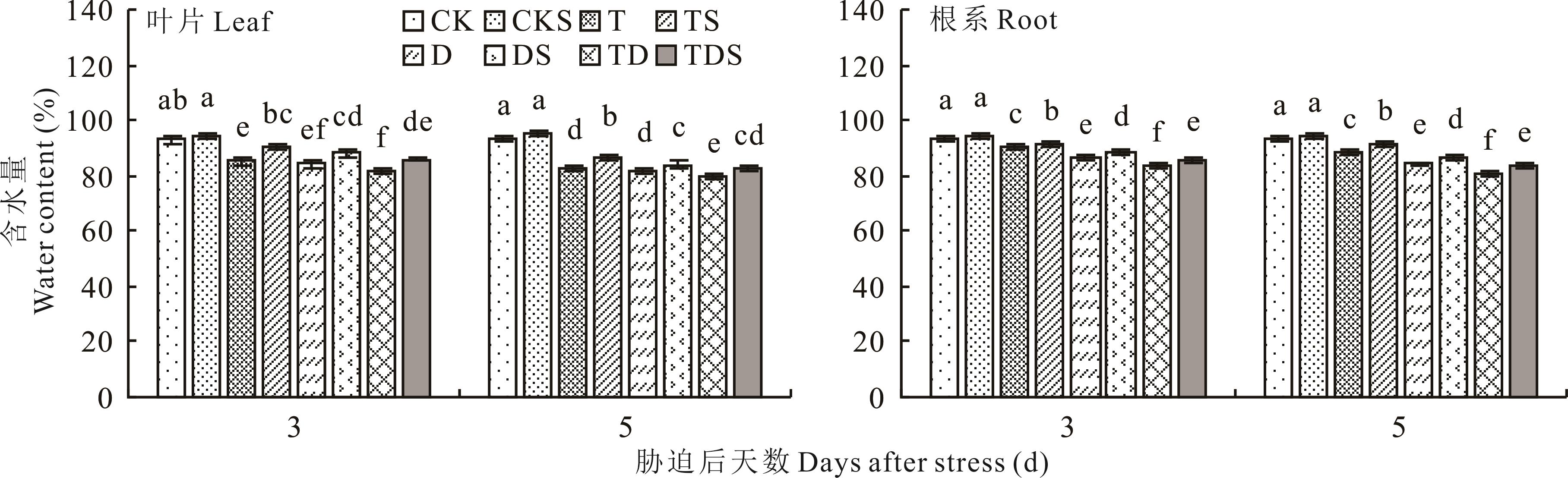
图1 水杨酸对不同胁迫下玉米含水量的影响不同小写字母表示同一胁迫时间不同处理间差异显著(P<0.05)。下同。Different lowercase letters indicate significant difference among different treatments for the same stress time (P<0.05). The same below.
Fig.1 Effects of salicylic acid on water content of maize under different stresses
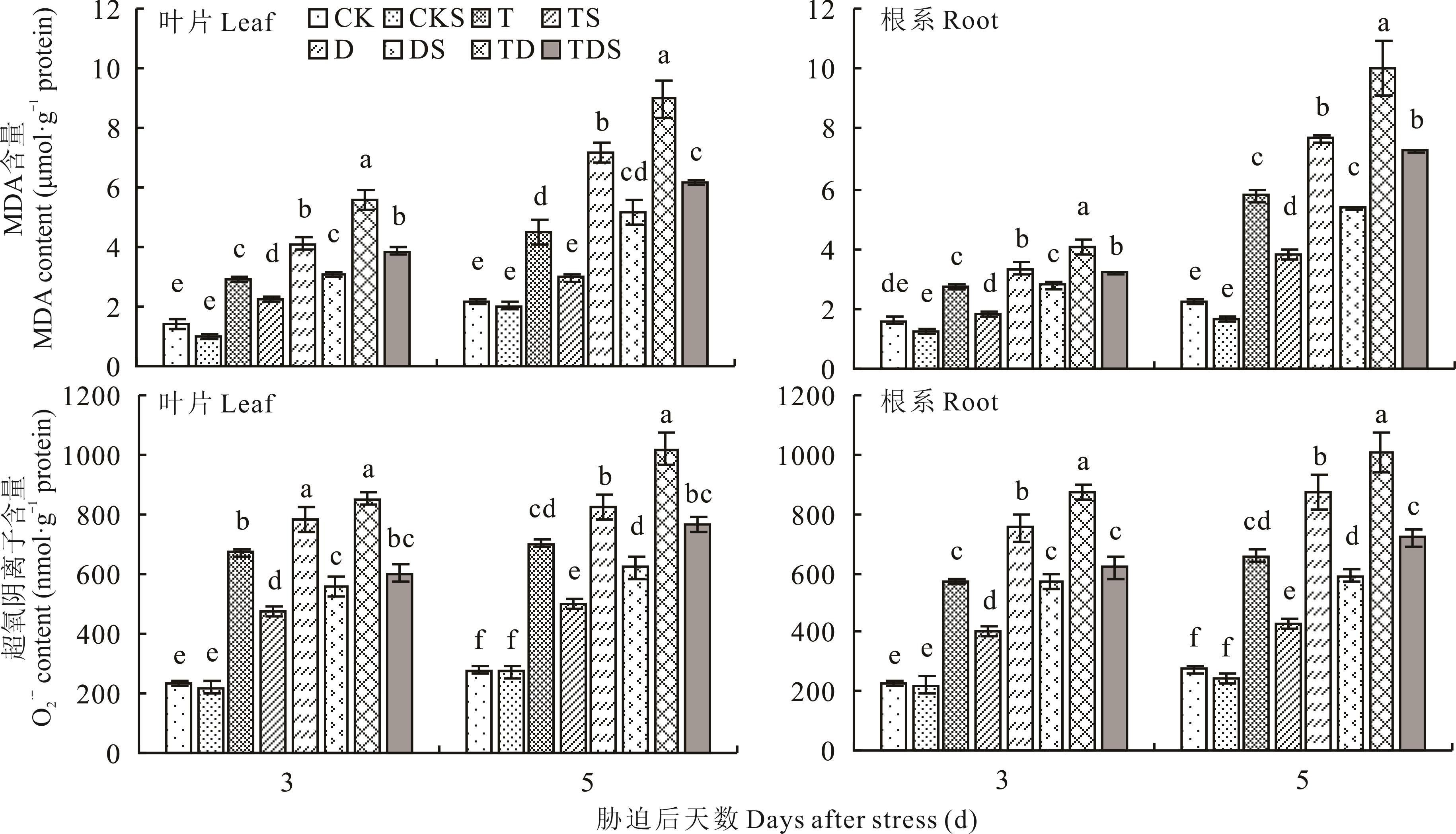
图2 水杨酸对不同胁迫下玉米氧化损伤指标的影响
Fig.2 Effects of salicylic acid on oxidative damage of maize under different stresses
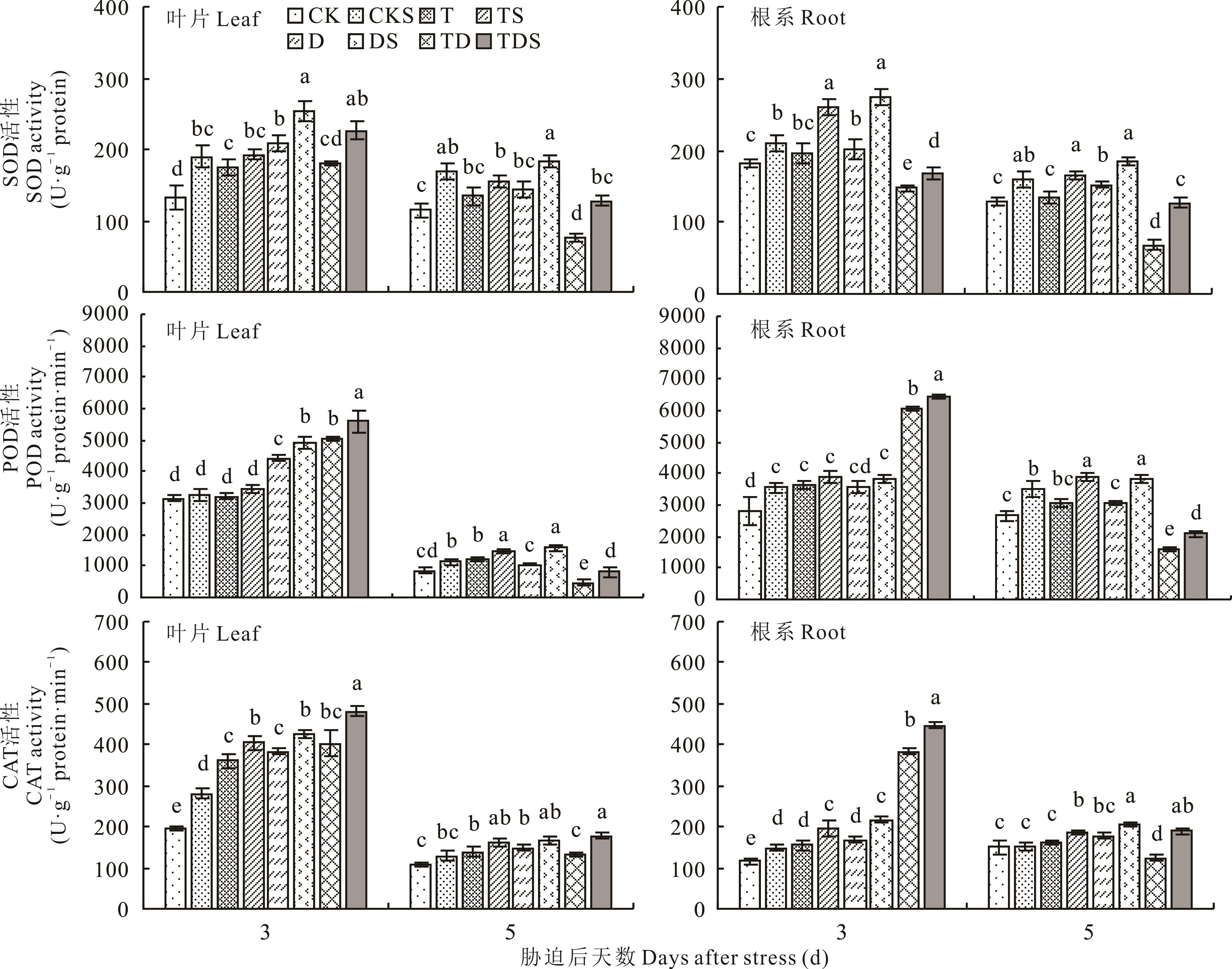
图3 水杨酸对不同胁迫下玉米抗氧化酶活性的影响
Fig.3 Effects of salicylic acid on antioxidant enzyme activity of maize under different stresses
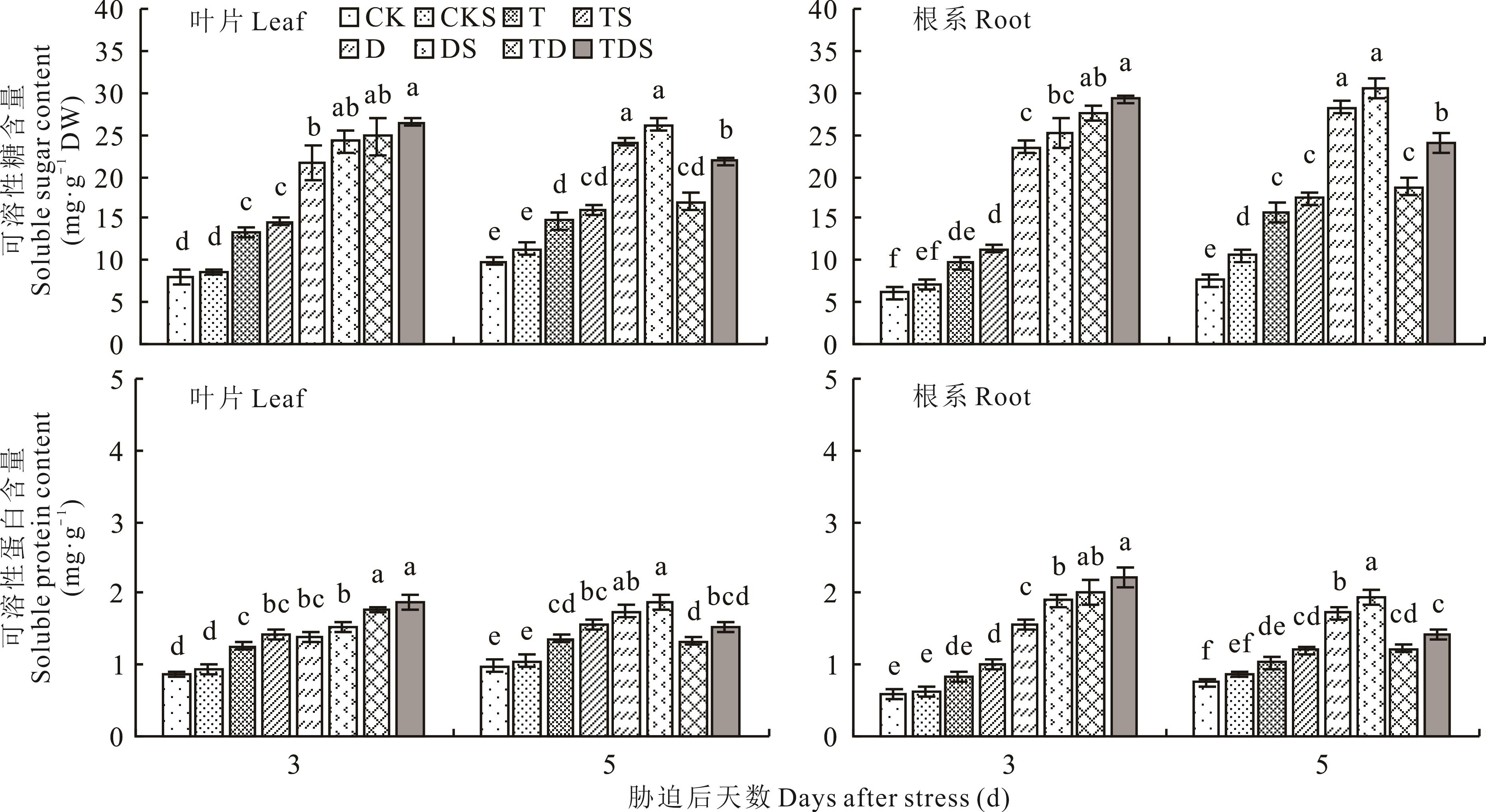
图4 水杨酸对不同胁迫下玉米可溶性糖和可溶性蛋白含量的影响
Fig.4 Effects of salicylic acid on soluble sugar and soluble protein content of maize under different stresses
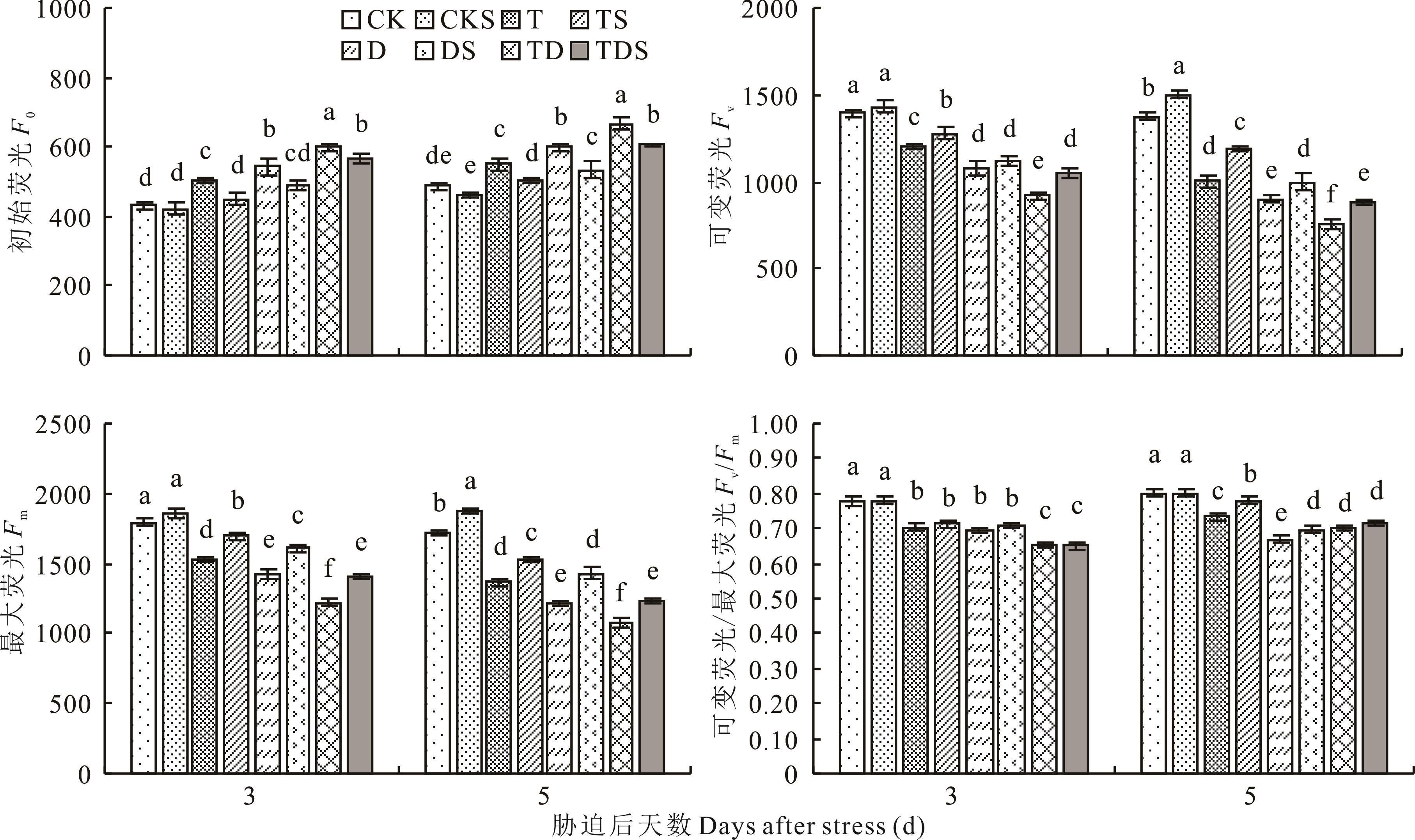
图5 水杨酸对不同胁迫下玉米叶片叶绿素荧光的影响F0、Fv、Fm和Fv/Fm分别代表初始荧光、可变荧光、最大荧光和可变荧光/最大荧光。F0, Fv, Fm and Fv/Fm represent the initial fluorescence, variable fluorescence, maximum fluorescence andvariable fluorescence/maximum fluorescence.
Fig.5 Effects of salicylic acid on chlorophyll fluorescence of maize leaves under different stresses

图6 水杨酸对不同胁迫下玉米叶片光合速率的影响Pn、Tr、Gs和Ci分别代表净光合速率、蒸腾速率、气孔导度和胞间二氧化碳浓度。Pn, Tr, Gs and Ci represent the net photosynthetic rate, transpiration rate, stomatal conductance and intercellular CO? concentration.
Fig.6 Effects of salicylic acid on photosynthetic rate of maize leaves under different stresses
| 指标Index | 处理Treatment | DWS | DWR | MDA | SOD | POD | CAT | SS |
|---|---|---|---|---|---|---|---|---|
| MDA | A | -0.94** | -0.85* | |||||
| B | -0.52 | -0.85* | ||||||
| C | -0.91** | -0.48 | ||||||
| SOD | A | 0.51 | 0.44 | -0.41 | ||||
| B | 0.52 | 0.77* | -0.80* | |||||
| C | 0.93** | 0.92** | -0.70 | |||||
| POD | A | 0.85* | 0.75* | -0.92** | 0.70 | |||
| B | 0.41 | 0.87* | -0.97** | 0.76* | ||||
| C | 0.85** | 0.84* | -0.81* | 0.93** | ||||
| CAT | A | 0.72 | 0.63 | -0.76 | 0.85* | 0.97** | ||
| B | 0.94** | 0.81* | -0.77 | 0.72 | 0.63 | |||
| C | 0.88** | 0.81* | -0.82* | 0.93** | 0.99** | |||
| SS | A | 0.84* | 0.78* | -0.92** | 0.66 | 0.99** | 0.93** | |
| B | 0.68 | 0.77* | -0.83* | 0.64 | 0.68 | 0.81* | ||
| C | 0.96** | 0.64 | -0.90** | 0.84** | 0.87* | 0.88** | ||
| SP | A | 0.76* | 0.60 | -0.83* | 0.51 | 0.88* | 0.77* | 0.90** |
| B | 0.73* | 0.90** | -0.92** | 0.85* | 0.88** | 0.90** | 0.80* | |
| C | 0.56 | 0.33 | -0.74 | 0.53 | 0.72 | 0.72 | 0.60 |
表4 不同胁迫处理下各指标的相关系数
Table 4 Correlation coefficients of various indexes under different stress treatments
| 指标Index | 处理Treatment | DWS | DWR | MDA | SOD | POD | CAT | SS |
|---|---|---|---|---|---|---|---|---|
| MDA | A | -0.94** | -0.85* | |||||
| B | -0.52 | -0.85* | ||||||
| C | -0.91** | -0.48 | ||||||
| SOD | A | 0.51 | 0.44 | -0.41 | ||||
| B | 0.52 | 0.77* | -0.80* | |||||
| C | 0.93** | 0.92** | -0.70 | |||||
| POD | A | 0.85* | 0.75* | -0.92** | 0.70 | |||
| B | 0.41 | 0.87* | -0.97** | 0.76* | ||||
| C | 0.85** | 0.84* | -0.81* | 0.93** | ||||
| CAT | A | 0.72 | 0.63 | -0.76 | 0.85* | 0.97** | ||
| B | 0.94** | 0.81* | -0.77 | 0.72 | 0.63 | |||
| C | 0.88** | 0.81* | -0.82* | 0.93** | 0.99** | |||
| SS | A | 0.84* | 0.78* | -0.92** | 0.66 | 0.99** | 0.93** | |
| B | 0.68 | 0.77* | -0.83* | 0.64 | 0.68 | 0.81* | ||
| C | 0.96** | 0.64 | -0.90** | 0.84** | 0.87* | 0.88** | ||
| SP | A | 0.76* | 0.60 | -0.83* | 0.51 | 0.88* | 0.77* | 0.90** |
| B | 0.73* | 0.90** | -0.92** | 0.85* | 0.88** | 0.90** | 0.80* | |
| C | 0.56 | 0.33 | -0.74 | 0.53 | 0.72 | 0.72 | 0.60 |
| [1] | Guo Y, Ren H, Wang H Z, et al. High temperature and drought combined stress inhibited photosystem Ⅱ performance and decreased grain yield of summer maize. Scientia Agricultura Sinica, 2024, 57(21): 4205-4220. |
| 郭娅, 任昊, 王洪章, 等. 高温干旱复合胁迫抑制夏玉米光系统Ⅱ性能降低籽粒产量. 中国农业科学, 2024, 57(21): 4205-4220. | |
| [2] | La M, Jemo M, Datla R, et al. Heat and drought stresses in crops and approaches for their mitigation. Frontiers in Chemistry, 2018, 6: 26. |
| [3] | Wang L, Xiong W, Wen X L, et al. Effect of climatic factors such as temperature, precipitation on maize production in China. Transactions of the Chinese Society of Agricultural Engineering, 2014, 30(21): 138-146. |
| 王柳, 熊伟, 温小乐, 等. 温度降水等气候因子变化对中国玉米产量的影响. 农业工程学报, 2014, 30(21): 138-146. | |
| [4] | Rizhsky L, Liang H J, Shuman J, et al. When defense pathways collide. The response of Arabidopsis to a combination of drought and heat stress. Plant Physiology, 2004, 134(4): 1683-1696. |
| [5] | Prasad P V V, Pisipati S R, Momcilovic I, et al. Independent and combined effects of high temperature and drought stress during grain filling on plant yield and chloroplast EF-Tu expression in spring wheat. Journal of Agronomy and Crop Science, 2011, 197: 430-441. |
| [6] | Zhao X Y. Effects of high temperature and drought on yield and growth of summer maize. Tai’an: Shandong Agricultural University, 2023. |
| 赵新宇. 高温干旱对夏玉米产量和生长发育的影响. 泰安: 山东农业大学, 2023. | |
| [7] | Wang P. The biosynthesis and roles of amino acid bioactive substances in regulating tomato growth and development under high temperature and drought stress. Hangzhou: Zhejiang University, 2023. |
| 王萍. 高温干旱逆境应答中番茄氨基酸类生物活性物质的合成响应及其对生长发育的调控作用研究. 杭州: 浙江大学, 2023. | |
| [8] | Apel K, Hirt H. Reactive oxygen species: Metabolism, oxidative stress, and signal transduction. Annual Review of Plant Biology, 2004, 55: 373-399. |
| [9] | Wang Y C, Zhang Y L, Yan D L, et al. Physiological role of γ-aminobutyric acid in protecting the photosynthetic system of maize seedlings under drought stress. Acta Prataculturae Sinica, 2020, 29(6): 191-203. |
| 王泳超, 张颖蕾, 闫东良, 等. 干旱胁迫下γ-氨基丁酸保护玉米幼苗光合系统的生理响应. 草业学报, 2020, 29(6): 191-203. | |
| [10] | Chen Y, Yue L J, Liu Y H, et al. Effects of continuous high temperature treatment during vegetative stages on maize leaf transcriptome and biochemical indicators. Journal of Maize Sciences, 2022, 30(4): 48-55, 61. |
| 陈岩, 岳丽杰, 刘永红, 等. 营养生长期持续高温处理对玉米叶片转录组及生化指标的影响. 玉米科学, 2022, 30(4): 48-55, 61. | |
| [11] | Wang Z T, Guo J, Luo W X, et al. Salicylic acid cooperates with lignin and sucrose signals to alleviate waxy maize leaf senescence under heat stress. Plant, Cell & Environment, 2025, 48(6): 4341-4355. |
| [12] | Wang F, Li Y S, Wang H N, et al. Effect of calcium on growth and physiological characteristics of maize seedling under lead stress. Journal of Soil and Water Conservation, 2016, 30(3): 202-207. |
| 王芳, 李永生, 王汉宁, 等. 钙对铅胁迫下玉米幼苗生长及生理特性的影响. 水土保持学报, 2016, 30(3): 202-207. | |
| [13] | Zhao S J. Experimental guidance of plant physiology. Beijing: China Agriculture Press, 2016. |
| 赵世杰. 植物生理学实验指导. 北京: 中国农业出版社, 2016. | |
| [14] | Xie Z X, Duan L S, Tian X L, et al. Coronatine alleviates salinity stress in cotton by improving the antioxidative defense system and radical-scavenging activity. Journal of Plant Physiology, 2008, 165(4): 375-384. |
| [15] | Bo X P, Wang M X, Cui L, et al. Evaluation on correlations of three kinds of osmoregulation substances in tea fresh leaves with low temperature during winter and spring respectively and their difference among cultivars. Scientia Agricultura Sinica, 2016, 49(19): 3807-3817. |
| 薄晓培, 王梦馨, 崔林, 等. 茶树3类渗透调节物质与冬春低温相关性及其品种间的差异评价. 中国农业科学, 2016, 49(19): 3807-3817. | |
| [16] | Monreal J A, Jimenez E T, Remesal E, et al. Proline content of sugar beet storage roots: Response to water deficit and nitrogen fertilization at field conditions. Environmental and Experimental Botany, 2007, 60: 257-267. |
| [17] | Rehman A, Farooq M, Asif M, et al. Supra-optimal growth temperature exacerbates adverse effects of low Zn supply in wheat. Journal of Plant Nutrition and Soil Science, 2019, 182: 656-666. |
| [18] | Yang X Y, Zhou G K, Wang F. Alleviative effect of exogenous melatonin on the root system of maize seedlings under drought stress. Journal of Maize Sciences, 2025, 33(1):56-65, 76. |
| 杨馨仪, 周广阔, 王芳. 外源褪黑素对干旱胁迫下玉米幼苗根系的缓解效应研究. 玉米科学, 2025, 33(1): 56-65, 76. | |
| [19] | Song Y L, Wang K Q, Wang S, et al. Physiological responses of three kinds of cool season turfgrasses under continuous drought stress, heat stress and their interaction. Acta Agrestia Sinica, 2018, 26(3): 705-717. |
| 宋娅丽, 王克勤, 王莎, 等. 3种冷季型草坪草对持续干旱、高温及其互作的生理生态响应. 草地学报, 2018, 26(3): 705-717. | |
| [20] | Kang S Y, Pang C H, Zhang Y Q, et al. Effects of spraying salicylic acid on drought-resistance and yield of quinoa. Journal of Arid Land Resources and Environment, 2022, 36(12): 151-157. |
| 康书瑜, 庞春花, 张永清, 等. 干旱胁迫下外源水杨酸对藜麦生理效应及产量的影响. 干旱区资源与环境, 2022, 36(12): 151-157. | |
| [21] | Yan S B, Cai J B, Wang Y, et al. Effects of exogenous salicylic acid on seed germination of perennial ryegrass under high temperature stress. Acta Agrestia Sinica, 2025, 33(3): 968-974. |
| 闫三博, 蔡家邦, 汪阳, 等. 外源水杨酸对高温胁迫下多年生黑麦草种子萌发的影响. 草地学报, 2025, 33(3): 968-974. | |
| [22] | Li L, Liu Y M, Wang M, et al. Physiological response mechanism of three kinds of Acer rubrum L. under continuous high temperature and drought stress. Acta Ecologica Sinica, 2014, 34(22): 6471-6480. |
| 李力, 刘玉民, 王敏, 等. 3种北美红枫对持续高温干旱胁迫的生理响应机制. 生态学报, 2014, 34(22): 6471-6480. | |
| [23] | Xiao X J, Huang Q, Luo C Y, et al. Effect of salicylic acid soaking on seed germination and seedling growth of corn under drought stress. Fujian Journal of Agricultural Sciences, 2017, 32(6): 583-586. |
| 肖小君, 黄倩, 罗陈勇, 等. 水杨酸浸种对干旱胁迫下玉米种子萌发及幼苗生长的影响. 福建农业学报, 2017, 32(6): 583-586. | |
| [24] | Yi X L, Li M Y, Chi H, et al. Influences of salicylic acid (SA) on the contents of endogenous hormones and osmotic adjustment substances in purple majesty under drought and/or high temperature. Journal of Southwest University (Natural Science Edition), 2014, 36(2): 62-67. |
| 易小林, 李名扬, 池浩, 等. 水杨酸缓解干旱、高温及双重胁迫下对紫御谷内源激素及渗透调节物质的影响. 西南大学学报(自然科学版), 2014, 36(2): 62-67. | |
| [25] | Wang L J, Liu Y F, Liu Q J, et al. Effects of salicylic acid and KCl2 on photosynthesis and chlorophyll fluorescence of citrus under heat and drought stress. Jiangxi Science, 2003(3): 201-205. |
| 王利军, 刘允芬, 刘琪璟, 等. 高温干旱胁迫下水杨酸和钾对温州蜜柑光合作用和叶绿素荧光的影响. 江西科学, 2003(3): 201-205. | |
| [26] | He J L, Zhou J T, Wan H X, et al. Rootstock-scion interaction affects cadmium accumulation and tolerance of malus. Frontiers in Plant Science, 2020, 11: 1264. |
| [27] | Su X, Fan X, Shao R, et al. Physiological and iTRAQ-based proteomic analyses reveal that melatonin alleviates oxidative damage in maize leaves exposed to drought stress. Plant Physiology and Biochemistry, 2019, 142: 263-274. |
| [28] | Zhang C M, Shi S L, Liu Z, et al. Drought tolerance in alfalfa (Medicago sativa L.) varieties is associated with enhanced antioxidative protection and declined lipid peroxidation. Journal of Plant Physiology, 2019, 232: 226-240. |
| [29] | Yancey P H. Organic osmolytes as compatible, metabolic and counteracting cytoprotectants in high osmolarity and other stresses. The Journal of Experimental Biology, 2005, 208(15): 2819-2830. |
| [30] | Luo C, Min W, Akhtasr M, et al. Melatonin enhances drought tolerance in rice seedlings by modulating antioxidant systems, osmoregulation, and corresponding gene expression. International Journal of Molecular Sciences, 2022, 23: 12075. |
| [31] | Huang B, Chen Y E, Zhao Y Q, et al. Exogenous melatonin alleviates oxidative damages and protects photosystem Ⅱ in maize seedlings under drought stress. Frontiers in Plant Science, 2019, 10: 677. |
| [32] | Sun X C, Huang W J, Li B. Effects of exogenous salicylic acid on physiological and biochemical indexes and related gene expression in Platycodon grandiflorus under drought stress. Journal of Agricultural Science and Technology, 2022, 24(1): 63-70. |
| 孙晓春, 黄文静, 李铂. 水杨酸对干旱胁迫下桔梗幼苗生理生化指标及相关基因表达的影响. 中国农业科技导报, 2022, 24(1): 63-70. | |
| [33] | Guha A, Senguta D, Reddy R A. Polyphasic chlorophyll a fluorescence kinetics and leaf protein analyses to track dynamics of photosynthetic performance in mulberry during progressive drought. Journal of Photochemistry Photobiology, B: Biology, 2013, 119: 71-83. |
| [34] | Li B, Zhang X, Morita S, et al. Are crop deep roots always beneficial for combating drought: A review of root structure and function, regulation and phenotyping. Agricultural Water Management, 2022, 271: 107781. |
| [35] | Wang F L, Huang Z F, Liang S Z, et al. Effects of exogenous salicylic acid on physiological characteristics of Euphorbia pulcherrima Willd. under drought stress. Journal of Southwest China Normal University (Natural Science Edition), 2016, 41(2): 53-57. |
| 王凤兰, 黄子锋, 梁淑贞, 等. 外源水杨酸对干旱胁迫下一品红生理特性的影响. 西南师范大学学报(自然科学版), 2016, 41(2): 53-57. | |
| [36] | Farquhar G D, Sharkey T D. Stomatal conductance and photosynthesis. Annual Review of Plant Physiology, 1982, 33: 317-345. |
| [37] | Cao S H, Li N Y. Effects of salicylic acid on heat resistance of Zinnia elegans seedlings under high temperature stress. Journal of Shenyang Agricultural University, 2014, 45(1): 91-94. |
| 曹淑红, 李宁毅. 水杨酸对高温胁迫下百日草幼苗耐热性的影响. 沈阳农业大学学报, 2014, 45(1): 91-94. | |
| [38] | Wang F, Sang X H, Gu W, et al. Effects of salicylic acid on photosynthetic characteristics and physiological indexes of Atractylodes lancea (Thunb.) DC. under drought stress. Molecular Plant Breeding, 2020, 18(9): 3060-3067. |
| 王帆, 桑晓华, 谷巍, 等. 外源水杨酸对干旱胁迫下茅苍术光合参数和抗氧化酶活性的影响. 分子植物育种, 2020, 18(9): 3060-3067. |
| [1] | 邓文辉, 宋珂辰, 张浩, 管思雨, 雍嘉仪, 谢铁娜, 胡海英. 降水变化对荒漠草原植物群落主要物种气孔形态和光合生理特性的影响[J]. 草业学报, 2026, 35(1): 65-78. |
| [2] | 刘媛媛, 王旭, 魏琪, 车丽娟, 袁梦, 王波. 梭梭14-3-3蛋白HaFT-9在高温-干旱胁迫信号交叉调控中的功能研究[J]. 草业学报, 2025, 34(9): 134-146. |
| [3] | 袁玖. 绿豆衣、大蒜皮、茄子皮与玉米秸秆青贮料、精料间饲料组合效应研究[J]. 草业学报, 2025, 34(9): 173-184. |
| [4] | 张兴隆, 单立山, 王红永, 解婷婷, 马静. 干旱胁迫对珍珠猪毛菜水力特征的影响[J]. 草业学报, 2025, 34(9): 87-96. |
| [5] | 李长青, 宋亚茹, 肖凡, 缪春语, 孙梦宇, 纪萌, 孙志梅. 耐瘠高产型玉米品种主要农艺性状特征分析[J]. 草业学报, 2025, 34(9): 97-110. |
| [6] | 毛海龙, 邰继承, 杨恒山, 张玉芹, 张瑞富, 王真真. 带型配置对青贮玉米-大豆复合种植体冠层特性、产量和品质的影响[J]. 草业学报, 2025, 34(8): 30-42. |
| [7] | 郭彬, 罗维成, 单立山, 安宁, 刘冰. 模拟增温对河西走廊典型荒漠灌木光合作用的影响[J]. 草业学报, 2025, 34(7): 145-157. |
| [8] | 雍嘉仪, 马霜, 马风华, 赵小娜, 张译尹, 胡海英. 干旱及复水对河北木蓝生物量分配与渗透调节特征的影响[J]. 草业学报, 2025, 34(7): 158-170. |
| [9] | 李慧玲, 朱永兴, 陈檬, 刘姝, 王娇, 刘奕清, 张雪梅, 马慧慧. 干旱胁迫与复水对菊芋幼苗的生长及生理特性的影响[J]. 草业学报, 2025, 34(7): 171-184. |
| [10] | 孔天赐, 马学青, 贺晨帮, 樊泰延, 芦光新, 祁鹤兴. 青贮玉米真菌性病害对青贮发酵微生物多样性的影响[J]. 草业学报, 2025, 34(7): 95-106. |
| [11] | 温小月, 赵颖, 王宝强, 王贤, 朱晓林, 王义真, 魏小红. 外源NO调控干旱胁迫下紫花苜蓿AP2/ERFs基因的表达分析[J]. 草业学报, 2025, 34(6): 154-167. |
| [12] | 匡宗洋, 穆麟, 魏岚, 郭阳, 胥贵, 陈瑶, 石雪云, 魏仲珊, 张志飞. 不同混合比例和乳酸菌添加对全株玉米和大豆混合青贮品质及有氧稳定性的影响[J]. 草业学报, 2025, 34(6): 227-238. |
| [13] | 秦文利, 张静, 肖广敏, 崔素倩, 叶建勋, 智健飞, 张立锋, 谢楠, 冯伟, 刘振宇, 潘璇, 代云霞, 刘忠宽. 绿肥部分替代化肥氮对土壤物理性状的影响[J]. 草业学报, 2025, 34(6): 27-45. |
| [14] | 曾燕霞, 陈志龙, 尚继红, 沙晓弟, 吴娟, 陈彩锦. 太空诱变对PEG-6000模拟干旱胁迫下紫花苜蓿材料苗期生长的影响[J]. 草业学报, 2025, 34(6): 59-69. |
| [15] | 董晓慧, 师尚礼, 尹国丽, 陈三冬, 巩海强, 刘林波. 玉米器官组织内生细菌和真菌群落多样性[J]. 草业学报, 2025, 34(5): 130-145. |
| 阅读次数 | ||||||
|
全文 |
|
|||||
|
摘要 |
|
|||||
