

ISSN 1004-5759 CN 62-1105/S
草业学报 ›› 2026, Vol. 35 ›› Issue (12): 90-102.DOI: 10.11686/cyxb2025507
张雯珺1( ), 赵康羽1, 徐艳霞2(), 付学鹏1(), 刘秋瑾2,3, 李丹妮2,3
收稿日期:2025-12-11
修回日期:2026-01-22
出版日期:2026-12-20
发布日期:2026-11-02
通讯作者:
徐艳霞,付学鹏
作者简介:E-mail: 409799196@qq.com基金资助:
Wen-jun ZHANG1(), Kang-yu ZHAO1, Yan-xia XU2(), Xue-Peng FU1(), Qiu-jin LIU2,3, Dan-ni LI2,3
Received:2025-12-11
Revised:2026-01-22
Online:2026-12-20
Published:2026-11-02
Contact:
Yan-xia XU,Xue-Peng FU
摘要:
为缓解苜蓿连作障碍中酚酸类自毒物质积累导致的生长抑制,本研究以3种典型酚酸(香豆素、阿魏酸、咖啡酸)为对象,通过种子萌发与幼苗胁迫试验,筛选出对苜蓿抑制最显著的关键物质——香豆素。随后,以香豆素为唯一碳源,从苜蓿-燕麦轮作系统的燕麦根际土壤中分离降解菌株。经16S rRNA基因序列分析,鉴定出一株蜡样芽孢杆菌DS-9。高效液相色谱定量检测,该菌株在300 mg·L?1香豆素为唯一碳源的培养基中培养72 h后,降解率达50.33%。盆栽回接试验进一步表明,接种DS-9可显著缓解香豆素胁迫对苜蓿生长的抑制,使幼苗鲜重和干重分别比香豆素胁迫组提高126.47%和69.56%。综上所述,蜡样芽孢杆菌DS-9对香豆素具有良好的降解能力,并能有效促进苜蓿生长,为苜蓿连作障碍的生物修复提供潜在的微生物资源。
张雯珺, 赵康羽, 徐艳霞, 付学鹏, 刘秋瑾, 李丹妮. 蜡样芽孢杆菌DS-9的分离鉴定及其缓解苜蓿连作障碍的潜力[J]. 草业学报, 2026, 35(12): 90-102.
Wen-jun ZHANG, Kang-yu ZHAO, Yan-xia XU, Xue-Peng FU, Qiu-jin LIU, Dan-ni LI. Isolation and identification of Bacillus cereus strain DS-9 and potential for alleviating alfalfa continuous cropping autotoxin accumulation[J]. Acta Prataculturae Sinica, 2026, 35(12): 90-102.
处理 Treatment | 浓度Concentration ( | 种子数Seed quantity (No.·petri dish-1) | 主根长Main root length (mm) | 发芽势Germination potential | 发芽率Germination rate | |
|---|---|---|---|---|---|---|
| 5 d | 7 d | |||||
| CK | - | 30 | 45.90±13.25a | 0.77±0.06a | 0.85±0.04a | 0.86±0.04a |
| 阿魏酸Ferulic acid | 0.5 | 30 | 38.84±7.03a | 0.76±0.07a | 0.81±0.07a | 0.85±0.05a |
| 阿魏酸Ferulic acid | 5.0 | 30 | 38.06±5.98a | 0.82±0.13a | 0.82±0.13a | 0.85±0.10a |
| 阿魏酸Ferulic acid | 50.0 | 30 | 31.91±7.84b | 0.74±0.02a | 0.78±0.04a | 0.79±0.06a |
| 咖啡酸Caffeic acid | 0.5 | 30 | 36.79±9.60a | 0.81±0.02a | 0.82±0.02a | 0.82±0.02a |
| 咖啡酸Caffeic acid | 5.0 | 30 | 36.03±10.51a | 0.80±0.04a | 0.83±0.07a | 0.83±0.07a |
| 咖啡酸Caffeic acid | 50.0 | 30 | 35.46±11.55a | 0.75±0.09a | 0.82±0.05a | 0.82±0.05a |
| 香豆素Coumarin | 0.5 | 30 | 34.28±4.49b | 0.75±0.02a | 0.83±0.03a | 0.83±0.03a |
| 香豆素Coumarin | 5.0 | 30 | 31.74±7.66b | 0.43±0.06b | 0.80±0.06a | 0.81±0.07a |
| 香豆素Coumarin | 50.0 | 30 | 4.93±1.93c | 0.01±0.02b | 0.20±0.14b | 0.29±0.19b |
表1 不同自毒物质处理对苜蓿种子萌发和幼苗主根生长的影响
Table 1 Effects of different phenolic acid treatments on alfalfa seed germination and seedling root growth
处理 Treatment | 浓度Concentration ( | 种子数Seed quantity (No.·petri dish-1) | 主根长Main root length (mm) | 发芽势Germination potential | 发芽率Germination rate | |
|---|---|---|---|---|---|---|
| 5 d | 7 d | |||||
| CK | - | 30 | 45.90±13.25a | 0.77±0.06a | 0.85±0.04a | 0.86±0.04a |
| 阿魏酸Ferulic acid | 0.5 | 30 | 38.84±7.03a | 0.76±0.07a | 0.81±0.07a | 0.85±0.05a |
| 阿魏酸Ferulic acid | 5.0 | 30 | 38.06±5.98a | 0.82±0.13a | 0.82±0.13a | 0.85±0.10a |
| 阿魏酸Ferulic acid | 50.0 | 30 | 31.91±7.84b | 0.74±0.02a | 0.78±0.04a | 0.79±0.06a |
| 咖啡酸Caffeic acid | 0.5 | 30 | 36.79±9.60a | 0.81±0.02a | 0.82±0.02a | 0.82±0.02a |
| 咖啡酸Caffeic acid | 5.0 | 30 | 36.03±10.51a | 0.80±0.04a | 0.83±0.07a | 0.83±0.07a |
| 咖啡酸Caffeic acid | 50.0 | 30 | 35.46±11.55a | 0.75±0.09a | 0.82±0.05a | 0.82±0.05a |
| 香豆素Coumarin | 0.5 | 30 | 34.28±4.49b | 0.75±0.02a | 0.83±0.03a | 0.83±0.03a |
| 香豆素Coumarin | 5.0 | 30 | 31.74±7.66b | 0.43±0.06b | 0.80±0.06a | 0.81±0.07a |
| 香豆素Coumarin | 50.0 | 30 | 4.93±1.93c | 0.01±0.02b | 0.20±0.14b | 0.29±0.19b |

图1 3种自毒物质处理下苜蓿种子萌发和根系形态变化CK为无菌水对照,A、B、C分别为50.0、5.0、0.5 mg·L-1香豆素处理,D、E、F分别为50.0、5.0、0.5 mg·L-1咖啡酸处理,G、H、I分别为50.0、5.0、0.5 mg·L-1阿魏酸处理,下同。CK, sterile-water control;A, B and C were treated with coumarin at concentrations of 50.0, 5.0 and 0.5 mg·L-1 respectively; D, E and F were treated with caffeic acid at concentrations of 50.0, 5.0 and 0.5 mg·L-1 respectively; G, H and I were treated with ferulic acid at concentrations of 50.0, 5.0 and 0.5 mg·L-1 respectively, the same below.
Fig.1 Changes in alfalfa seed germination and root morphology under treatment with three phenolic acids
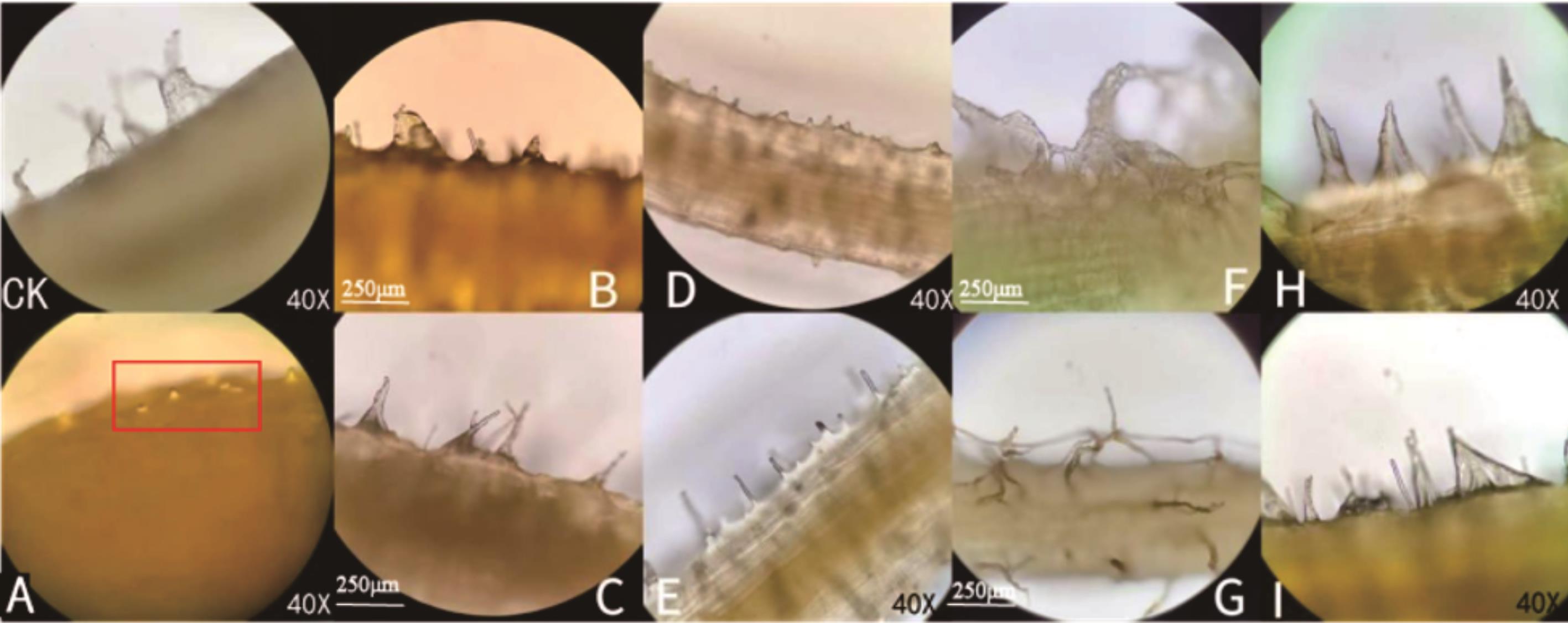
图2 3种自毒物质处理下苜蓿种子萌发后根毛形态变化
Fig.2 Morphological changes of root hairs in alfalfa seeds after germination under three phenolic acid treatments

图3 3种浓度阿魏酸处理下苜蓿幼苗的生长状况不同小写字母表示在P<0.05水平上不同处理间差异显著,下同Different lowercase letters indicate significant differences among treatments at the P<0.05 level, the same below.
Fig.3 Growth of alfalfa seedlings treated with different concentrations of ferulic acid

图4 3种浓度咖啡酸处理下苜蓿幼苗的生长状况
Fig.4 Growth of alfalfa seedlings treated with different concentrations of caffeic acid

图5 3种浓度香豆素处理下苜蓿幼苗的生长状况
Fig.5 Growth of alfalfa seedlings treated with different concentrations of coumarin
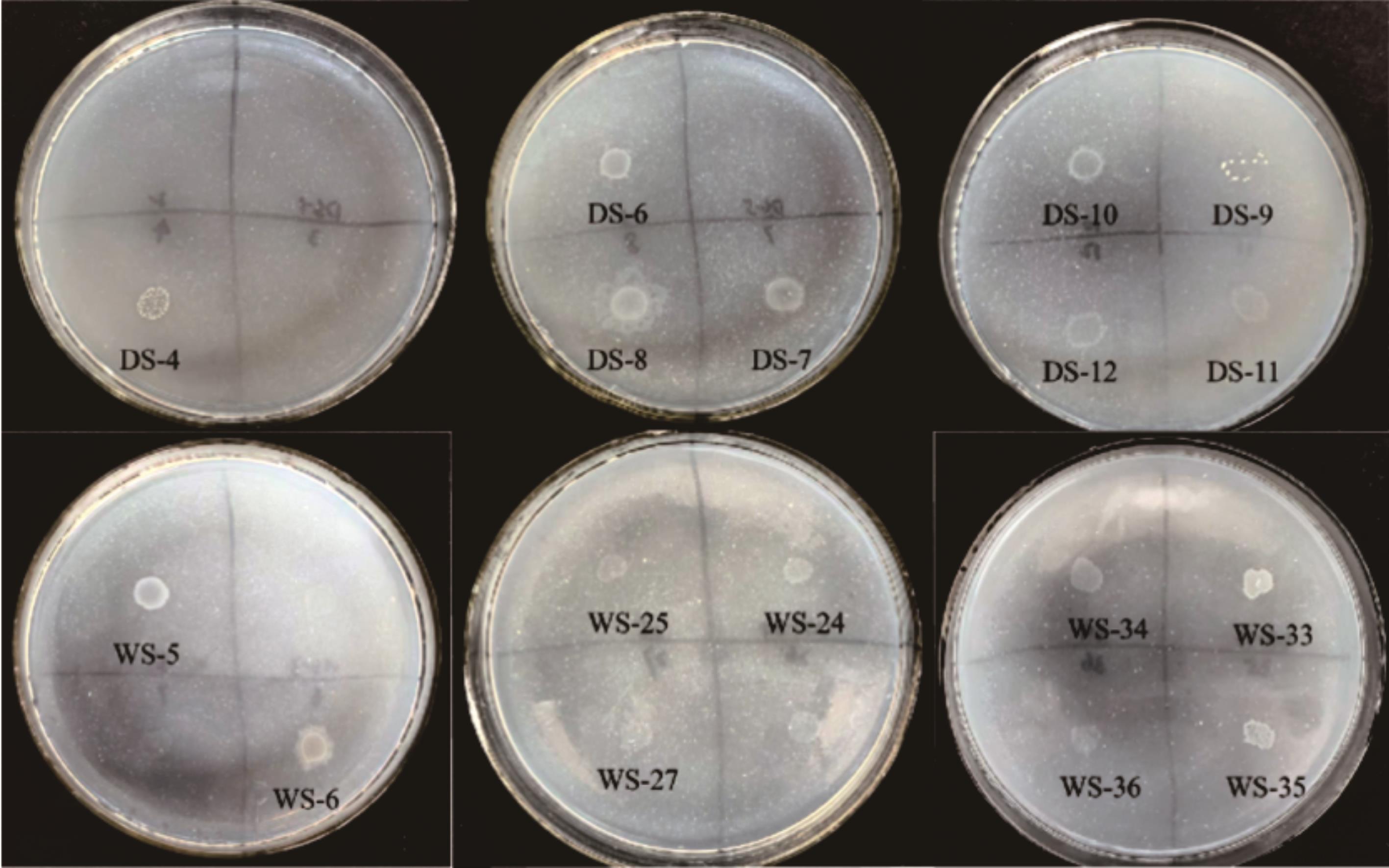
图6 菌株在香豆素培养基上的生长特征
Fig.6 Growth status of the strains in the coumarin medium

图7 菌株在香豆素无机盐培养基中的生长状况
Fig.7 Growth status of the strains in the coumarin inorganic salt medium
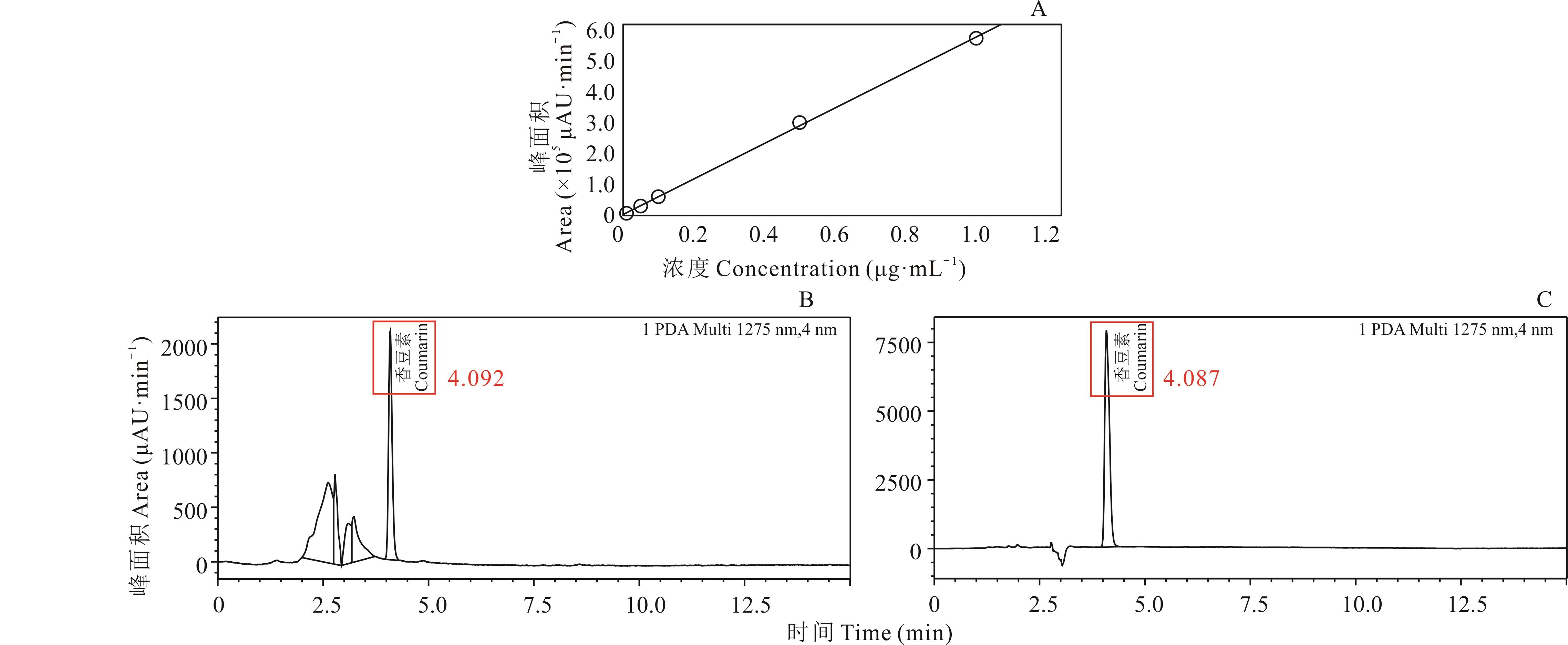
图8 300 mg·L-1香豆素高效液相色谱图A: 300 mg·L-1香豆素标准曲线 Standard curve of 300 mg·L-1 coumarin; B: 接种DS-9 72 h后定量检测色谱图Quantitative detection chromatogram after DS-9 inoculation; C: 300 mg·L-1香豆素标品色谱图Chromatogram of coumarin standard substance at 300 mg·L-1.
Fig.8 High-performance liquid chromatogram of 300 mg·L-1 coumarin
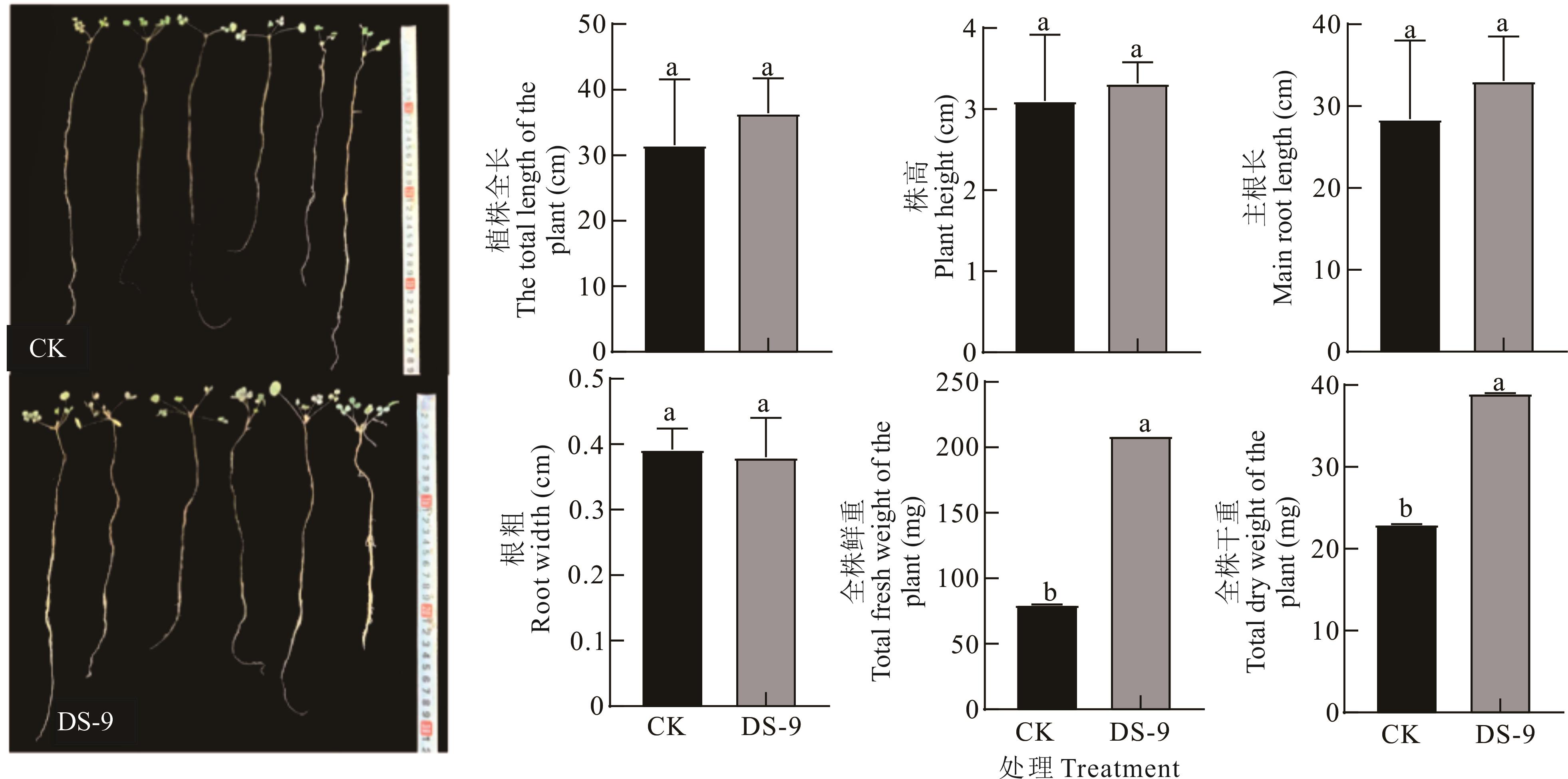
图9 接种蜡样芽孢杆菌DS-9后苜蓿在香豆素胁迫下的生长状况
Fig.9 Growth of alfalfa after Bacilluscereus DS-9 inoculation under coumarin stress

图10 DS-9(蜡样芽孢杆菌)的系统发育树及菌落形态系统发育树基于16S rRNA基因序列,采用 MEGA软件邻近法(NJ法)构建,利用进化模型(GTR+G+I)分析,进行1000次重复的Bootstrap分析来评估分支的置信度,比例尺代表每个位点估计的替换数为0.001,以大肠杆菌(ON799228.1)作为外群,红色*号标出。使用DNAMAN比对DS-9(蜡样芽孢杆菌)与KR709243.1 B. cereus的同源性。The phylogenetic tree was constructed based on the 16S rRNA gene sequence using the MEGA software proximity method (NJ method), analyzed using the evolutionary model (GTR+G+I), and a 1000-repetition Bootstrap analysis was conducted to evaluate the confidence level of the branches. The scale represents that the estimated replacement number for each point is 0.001. E. coli (ON799228.1) is used as the exgroup, marked with a red asterisk. The homology of DS-9 (B. cereus) and KR709243.1 B. cereus was compared using DNAMAN.
Fig.10 The phylogenetic tree and morphology of DS-9 (B. cereus )
| [1] | Sun Q Z, Liu Q, Tao Y, et al. Research on alfalfa planting in Han, Wei, Jin, Southern and Northern Dynasties. Acta Prataculturae Sinica, 2017, 26(11): 185-195. |
| 孙启忠, 柳茜, 陶雅, 等. 两汉魏晋南北朝时期苜蓿种植利用刍考. 草业学报, 2017, 26(11): 185-195. | |
| [2] | Yuan Q H. Advances in alfalfa diseases in China. Plant Protection, 2007, 33(1): 6-10. |
| 袁庆华. 我国苜蓿病害研究进展. 植物保护, 2007, 33(1): 6-10. | |
| [3] | Wang X J, Zhang S Z, Lin S S, et al. Advances in study on bio-energy utilization of stem cell wall components in alfalfa (Medicago sativa L.). Scientia Agricultura Sinica, 2013, 46(8): 1694-1705. |
| 王晓娟, 张树振, 林双双, 等. 紫花苜蓿(Medicago sativa L.)生物能源利用的研究进展. 中国农业科学, 2013, 46(8): 1694-1705. | |
| [4] | Zheng R, Shi S L, Ma S C. Effect of autotoxicity and allelopathy on alfalfa and wheat. Pratacultural Science, 2019, 36(3): 849-860. |
| 郑瑞, 师尚礼, 马史琛. 苜蓿、小麦自毒及他感作用机理. 草业科学, 2019, 36(3): 849-860. | |
| [5] | Zhang Z J, Liu Y J, Yuan L, et al. Effect of allelopathy on plant performance: A Meta-analysis. Ecology Letters, 2021, 24(2): 348-362. |
| [6] | Chung I M, Miller D A. Allelopathic influence of nine forage grass extracts on germination and seedling growth of alfalfa. Agronomy Journal, 1995, 87(4): 767-772. |
| [7] | Wang J J, Liu L P, Guo P F. Thinking and forestry meaning on the allelopathy. Journal of Gansu Forestry Science and Technology, 2014, 39(3): 11-17. |
| 王俊杰, 刘丽萍, 郭鹏飞. 他感作用及其林学意义与思考. 甘肃林业科技, 2014, 39(3): 11-17. | |
| [8] | Wang X, Shen Y Y, Gao C Y, et al. Autotoxicity effects of aqueous extracts of different aged alfalfa on seeds germination. Acta Agrestia Sinica, 2008, 16(6): 609-612. |
| 王希, 沈禹颖, 高崇岳, 等. 异龄苜蓿水浸液对其种子萌发的自毒效应. 草地学报, 2008, 16(6): 609-612. | |
| [9] | Panda S, Kazachkova Y, Aharoni A. Catch-22 in specialized metabolism: Balancing defense and growth. Journal of Experimental Botany, 2021, 72(17): 6027-6041. |
| [10] | Wu B, Shi S S, Zhang H H, et al. Study on the key autotoxic substances of alfalfa and their effects. Plants, 2023, 12(18): 3263. |
| [11] | Zhang X Y, Shi S L, Li X L, et al. Effects of autotoxicity on alfalfa (Medicago sativa): Seed germination, oxidative damage and lipid peroxidation of seedlings. Agronomy, 2021, 11(6): 1027. |
| [12] | Wang J, Liu W Z, Zhong L P, et al. Spatial variability of soil moisture and aboveground biomass of alfalfa under long term alfalfa continuous planting//Youth Work Committee of the Chinese Ecological Society. Proceedings of the Fifth Academic Symposium of Young Ecologists in China. Beijing: Science Press, 2008: 470-475. |
| 王俊, 刘文兆, 钟良平, 等. 长期苜蓿连作草地地上部分生物量与土壤水分的空间差异性//中国生态学会青年工作委员会.第五届中国青年生态学工作者学术研讨会论文集. 北京: 科学出版社, 2008: 470-475. | |
| [13] | Yin G L, Cai Z S, Tao R, et al. Effects of different crop rotations on soil nutrient, microorganism abundance and soil allelochemical levels in alfalfa. Acta Prataculturae Sinica, 2019, 28(3): 42-50. |
| 尹国丽, 蔡卓山, 陶茸, 等. 不同草田轮作方式对土壤肥力、微生物数量及自毒物质含量的影响. 草业学报, 2019, 28(3): 42-50. | |
| [14] | Fan Y W, Xin X L, Zhong X Y, et al. Effects of intercropping of maize and legume cover crops on enzyme activities and fungal community characteristics in fluvo-aquic soil. Acta Pedologica Sinica, 2021, 58(6): 1236-1243. |
| 范祎玮, 信秀丽, 钟新月, 等. 玉米豆科覆盖作物间作对潮土酶活性和真菌群落特征的影响. 土壤学报, 2021, 58(6): 1236-1243. | |
| [15] | Ayun. Characteristics of alfalfa and Poa pratensis rotation sequences on aboveground dry biomass, forage quality and soil nitrogen. Lanzhou: Gansu Agricultural University, 2019. |
| 阿芸. 紫花苜蓿与草地早熟禾轮作序列的地上干物质量、饲用品质及土壤氮素特征. 兰州: 甘肃农业大学, 2019. | |
| [16] | Li Z Y, Xu Z M, Shi S L, et al. Effects of different crop rotations on alfalfa yield and soil quality in the Jianghuai area. Acta Prataculturae Sinica, 2019, 28(8): 28-39. |
| 李争艳, 徐智明, 师尚礼, 等. 江淮地区不同轮茬作物对苜蓿产量及根际土壤质量的影响. 草业学报, 2019, 28(8): 28-39. | |
| [17] | Wu H J, Yang G F, Sun J, et al. The responses of soil structures and nutrients under different alfalfa-planting patterns. Acta Agriculturae Boreali-Sinica, 2015, 30(5): 189-196. |
| 武海杰, 杨国锋, 孙娟, 等. 苜蓿不同种植模式下土壤结构及养分的响应. 华北农学报, 2015, 30(5): 189-196. | |
| [18] | Taiz L, Zeiger E, Møller I M, et al. Secondary metabolism and plant defense//Murphy A. Plant physiology and development (6th ed). Sunderland: Sinauer Associates, 2018: 229-234. |
| [19] | Xu Y X, Liu J J, Liu X F, et al. Continuous cropping of alfalfa (Medicago sativa L.) reduces bacterial network complexity but increases stability in the black soil region of northeast China. Soil Ecology Letters, 2021, 3(4): 1-13. |
| [20] | Yao Q, Xu Y X, Liu X F, et al. Dynamics of soil properties and fungal community structure in continuous-cropped alfalfa fields in Northeast China. PeerJ, 2019, 7: e7127. |
| [21] | Xu Y X, Liu Z X, Shen Z B, et al. Alfalfa with forage crop rotation alleviates continuous alfalfa obstacles through regulating soil enzymes and bacterial community structures. Agronomy, 2024, 14(7): 1349. |
| [22] | Li C, Shi L, Wang K C, et al. Crop rotation differentially increases soil bacterial and fungal diversities in global croplands: A Meta-analysis. Nature Communications, 2025, 16: 11686. |
| [23] | Rong S C, Shi S L, Sun C C. Determination of coumarins and major phenolic acids in plant and rhizosphere soil of alfalfa (Medicago sativa L.). Soils, 2016, 48(5): 931-938. |
| 荣思川, 师尚礼, 孙灿灿. 苜蓿植株及根际土壤中主要酚酸和香豆素物质含量测定. 土壤, 2016, 48(5): 931-938. | |
| [24] | Abdul R A, Habib S A. Allelopathic effect of alfalfa (Medicago sativa L.) on blady grass (Imperata cylindrica). Journal of Chemical Ecology, 1989, 16(7): 2289-2300. |
| [25] | Wyman-Simpson C L, Waller G R, Jurzysta M, et al. Biological activity and chemical isolation of root saponins of six cultivars of alfalfa (Medicago sativa L.). Plant and Soil, 1991, 135(1): 83-94. |
| [26] | Tang L Z, Zhong S M, Chen D Y, et al. Research progress in plant autotoxicity and biodegradation. Acta Agriculturae Jiangxi, 2025, 37(6): 46-54, 121. |
| 唐龙珠, 钟淑敏, 陈德远, 等. 植物自毒作用及生物降解研究进展. 江西农业学报, 2025, 37(6): 46-54, 121. | |
| [27] | Tang S, Zhang Z, Liu X, et al. Study on screening and degradation effect of autotoxin-degrading bacteria in muskmelon. Agronomy, 2023, 13(5): 1334. |
| [28] | Zhang C Y, Liu S P, Guo Q Y, et al. Sphingobium sp. V4, a bacterium degrading multiple allelochemical phenolic acids. Annals of Microbiology, 2024, 74(1): 5. |
| [29] | Liu D L, Ge X, Pan D D, et al. Bacillus subtilis B55 degraded the ferulic acid and p-coumaric acid and changed the soil bacterial community in soils. Journal of Applied Microbiology, 2024, 135(9): 243. |
| [30] | Wang H W, Cai X Y, Xu M, et al. Enhanced biocontrol of cucumber Fusarium wilt by combined application of new antagonistic bacteria Bacillus amyloliquefaciens B2 and phenolic acid-degrading fungus Pleurotus ostreatus P5. Frontiers in Microbiology, 2021, 12: 713-725. |
| [31] | Ma W F. A novel strain of Bacillus cereus with a strong antagonistic effect specific to Sclerotinia and its genomic and transcriptomic analysis. Haikou: Hainan University, 2024. |
| 马万福.一株对核盘菌具有强拮抗作用的蜡样芽孢杆菌及其基因组学和转录组学分析. 海口: 海南大学, 2024. | |
| [32] | Dai Y, Peng J J, Zhang T Y, et al. Optimization of fermentation conditions and inhibition effect of a strain of Bacillus cereus producing inhibitory substances. Journal of Anhui Agricultural Sciences, 2024, 52(6): 6-9. |
| 戴悦, 彭金菊, 张腾月, 等. 一株蜡样芽孢杆菌产抑菌物质发酵条件优化及抑菌效果研究. 安徽农业科学, 2024, 52(6): 6-9. | |
| [33] | Qin G H, Yuan H B, Wang Z N, et al. Antagonistic activity of volatile organic compounds of Bacillus cereus strain G3-17 against apple ring rot. Acta Horticulturae Sinica, 2024, 51(6): 1403-1412. |
| 覃艮红, 袁洪波, 王卓妮, 等. 蜡样芽孢杆菌挥发物对苹果轮纹病菌的拮抗活性. 园艺学报, 2024, 51(6): 1403-1412. | |
| [34] | Liu R H, Zhang L, Guo S H, et al. Screening of Bacillus cereus for efficient degradation of ammonia nitrogen and experimental evaluation of ammonia nitrogen degradation effect in sewage. Tianjin Agricultural Sciences, 2025, 31(3): 79-85. |
| 刘荣徽, 张琳, 郭圣辉, 等. 氨氮高效降解蜡样芽孢杆菌的筛选与污水中氨氮降解效果试验评估. 天津农业科学, 2025, 31(3): 79-85. | |
| [35] | Yin M L, Lai J L, Yang X, et al. Analysis of TNT degradation and tolerance mechanism of Bacillus cereus strain T4. Asian Journal of Ecotoxicology, 2024, 19(5): 309-320. |
| 尹茂灵, 赖金龙, 杨旭, 等. 蜡样芽孢杆菌T4对TNT的降解及耐受机制. 生态毒理学报, 2024, 19(5): 309-320. | |
| [36] | Liu S J, Hu X M, Zhang C P, et al. Study on the degradation characteristics of DEHP by Bacillus cereu. Yunnan Chemical Technology, 2024, 51(7): 70-75. |
| 刘淑娟, 胡雪敏, 张翠萍, 等. 蜡样芽孢杆菌对邻苯二甲酸二(2-乙基己基)酯的降解特性研究. 云南化工, 2024, 51(7): 70-75. | |
| [37] | Xiang X Z, Xie Y, Tian D, et al. Microbial degradation mechanism and pathway of the insecticide thiamethoxam by isolated Bacillus cereus from activated sludge. Environmental Research, 2024, 246: 117929. |
| [1] | 余冬雯, 王晓彤, 马永龙, 吴轩, 杨金辉, 童玉花, 李淑霞. 2,4-表芸苔素内酯对干旱胁迫下紫花苜蓿生理特性的影响[J]. 草业学报, 2026, 35(9): 63-74. |
| [2] | 杨金辉, 王晓彤, 马永龙, 余冬雯, 童玉花, 李淑霞. 喷施纳米氧化铈对紫花苜蓿幼苗耐盐性的影响[J]. 草业学报, 2026, 35(8): 45-54. |
| [3] | 黄兆鹏, 何蓉, 南丽丽, 刘佳乐, 杨文科. 低磷胁迫下外源褪黑素对紫花苜蓿幼苗内源激素及有机酸的影响[J]. 草业学报, 2026, 35(8): 55-64. |
| [4] | 王霞, 颜梦雨, 王千禧, 魏臻武, 魏佳, 曹正锋, 吕燕燕, 张传杰, 闵学阳. 江淮地区不同秋眠性紫花苜蓿品种的生产性能比较研究[J]. 草业学报, 2026, 35(8): 65-83. |
| [5] | 陈奋奇, 张金青, 禹一箭, 李振宇. 紫花苜蓿AP2亚家族基因鉴定、生信分析及MsBBM基因克隆[J]. 草业学报, 2026, 35(7): 117-134. |
| [6] | 刘昊臻, 晁嘉潞, 赵士钦, 王成, 张景鈜, 孙守江. 紫花苜蓿BBR-BPC全基因组鉴定及响应种子老化的表达模式分析[J]. 草业学报, 2026, 35(7): 135-150. |
| [7] | 李武, 李佳静, 李洁冰, 李振舟, 郭明, 牛岩, 孙浩, 李德锋, 史莹华, 李振田, 刘伯帅, 崔亚垒, 王志昌, 李永涛, 朱晓艳. 苜蓿皂苷发酵和超声提取工艺条件优化研究[J]. 草业学报, 2026, 35(7): 201-216. |
| [8] | 马江萍, 曹立娟, 张文文, 赵梦雨, 王腾飞, 张译尹, 王斌, 李佳旺, 王小兵, 兰剑. 补播与施磷对退化苜蓿草地生产力及土壤理化性质的影响[J]. 草业学报, 2026, 35(7): 92-104. |
| [9] | 许江博, 梅昌伟, 陈东, 蒋润瑶, 郭松长, 吴秀鸿, 罗巨英, 黄海元, 刘芳. 苜蓿草粉对凉伞猪不同杂交组合生产性能、屠宰性能、肉品质和血清生化指标的影响[J]. 草业学报, 2026, 35(6): 202-215. |
| [10] | 任孟雨, 王利群, 南丽丽, 郭佳雨. 紫花苜蓿新品系对盐胁迫的响应[J]. 草业学报, 2026, 35(6): 24-34. |
| [11] | 李小聪, 闫聚辉, 王星, 胡鹏飞, 叶雨浓, 伏兵哲. 紫花苜蓿/无芒雀麦间作对草地生产性能和土壤理化特性的影响[J]. 草业学报, 2026, 35(5): 113-125. |
| [12] | 邓文辉, 赵小娜, 雍嘉仪, 管思雨, 胡国强, 王腾飞, 胡海英. 行比和燕麦密度对苜蓿种子产量及其构成因素的影响[J]. 草业学报, 2026, 35(4): 100-111. |
| [13] | 马苹, 刘志国, 沙煜舒, 刘亚玲, 妥小梅, 伏兵哲, 高雪芹. 紫花苜蓿苗期氮利用特性及氮高效品种的筛选[J]. 草业学报, 2026, 35(4): 112-123. |
| [14] | 张钿, 冷华娟, 崔婧, 何飞, 王雪, 李明娜, 杨青川, 康俊梅. 紫花苜蓿突触结合蛋白家族成员鉴定与非生物胁迫下的表达分析[J]. 草业学报, 2026, 35(4): 158-168. |
| [15] | 周晓彤, 罗永忠, 齐建伟, 邱应德, 马超. 新疆大叶苜蓿PYL-PP2C-SnRK2基因家族鉴定及对干旱胁迫的响应分析[J]. 草业学报, 2026, 35(4): 169-196. |
| 阅读次数 | ||||||
|
全文 |
|
|||||
|
摘要 |
|
|||||
