

ISSN 1004-5759 CN 62-1105/S
草业学报 ›› 2026, Vol. 35 ›› Issue (12): 41-53.DOI: 10.11686/cyxb2025512
赵旭恒1( ), 王义翔1, 侯国庆2, 张辉2, 孙颖超1, 郑晓凯1, 何虹稣1(), 张凡凡1()
收稿日期:2025-12-18
修回日期:2026-03-24
出版日期:2026-12-20
发布日期:2026-11-02
通讯作者:
何虹稣,张凡凡
作者简介:E-mail: zhangfanfan@shzu.edu.cn基金资助:
Xu-heng ZHAO1(), Yi-xiang WANG1, Guo-qing HOU2, Hui ZHANG2, Ying-chao SUN1, Xiao-kai ZHENG1, Hong-su HE1(), Fan-fan ZHANG1()
Received:2025-12-18
Revised:2026-03-24
Online:2026-12-20
Published:2026-11-02
Contact:
Hong-su HE,Fan-fan ZHANG
摘要:
通过探究新疆绿洲区杂交构树与鸭茅间作系统的生产优势,为提升当地饲草产量与土壤利用率提供依据。本试验设置单作杂交构树(DG)、单作鸭茅(低/高播种量鸭茅:DYL/DYH)以及间作(杂交构树间作低/高播种量鸭茅:GYL/GYH)共5个处理,每个处理重复3次,系统测定其作物光合参数、产量、营养品质及土壤理化与酶活性指标。结果表明,1)构树和鸭茅在间作处理中的光合特性(净光合速率、胞间二氧化碳浓度、气孔导度、蒸腾速率)、鲜草、干草产量均显著高于对应的单作处理(P<0.05);2)间作处理的粗蛋白、中性洗涤纤维、酸性洗涤纤维、可溶性碳水化合物含量均显著低于单作处理(P<0.05),而干物质含量无显著差异(P>0.05);3)间作提高了0~20 cm土层全氮、全磷及有机碳含量,增强了脲酶、过氧化氢酶和蔗糖酶活性,GYL处理效果最优。综上,间作显著提升了两种作物的光合特性、干物质积累和土地利用效率,改善了局部土壤理化环境,其中GYL间作综合优势最显著,可作为新疆绿洲区优选牧草种植模式。
赵旭恒, 王义翔, 侯国庆, 张辉, 孙颖超, 郑晓凯, 何虹稣, 张凡凡. 新疆绿洲区杂交构树/鸭茅间作模式下光合特性、生产性能及土壤理化性质研究[J]. 草业学报, 2026, 35(12): 41-53.
Xu-heng ZHAO, Yi-xiang WANG, Guo-qing HOU, Hui ZHANG, Ying-chao SUN, Xiao-kai ZHENG, Hong-su HE, Fan-fan ZHANG. Photosynthetic characteristics, yield performance, and soil physical and chemical properties under a Broussonetia papyrifera/Dactylis glomerata intercropping system in the oasis area of Xinjiang[J]. Acta Prataculturae Sinica, 2026, 35(12): 41-53.
土层 Soil layer (cm) | 土壤pH Soil pH | 全磷 Total phosphorus (g·kg-1) | 全氮 Total nitrogen (g·kg-1) | 全钾 Total potassium (g·kg-1) | 有机碳 Organic carbon (g·kg-1) |
|---|---|---|---|---|---|
| 0~20 | 8.07±0.01 | 1.28±0.10 | 3.08±0.07 | 16.60±1.54 | 30.29±3.45 |
| 20~40 | 8.07±0.01 | 1.37±0.06 | 3.16±0.11 | 16.19±1.32 | 33.33±2.87 |
表 1 供试土壤的基本理化性质
Table 1 Basic physical and chemical properties of the tested soil
土层 Soil layer (cm) | 土壤pH Soil pH | 全磷 Total phosphorus (g·kg-1) | 全氮 Total nitrogen (g·kg-1) | 全钾 Total potassium (g·kg-1) | 有机碳 Organic carbon (g·kg-1) |
|---|---|---|---|---|---|
| 0~20 | 8.07±0.01 | 1.28±0.10 | 3.08±0.07 | 16.60±1.54 | 30.29±3.45 |
| 20~40 | 8.07±0.01 | 1.37±0.06 | 3.16±0.11 | 16.19±1.32 | 33.33±2.87 |
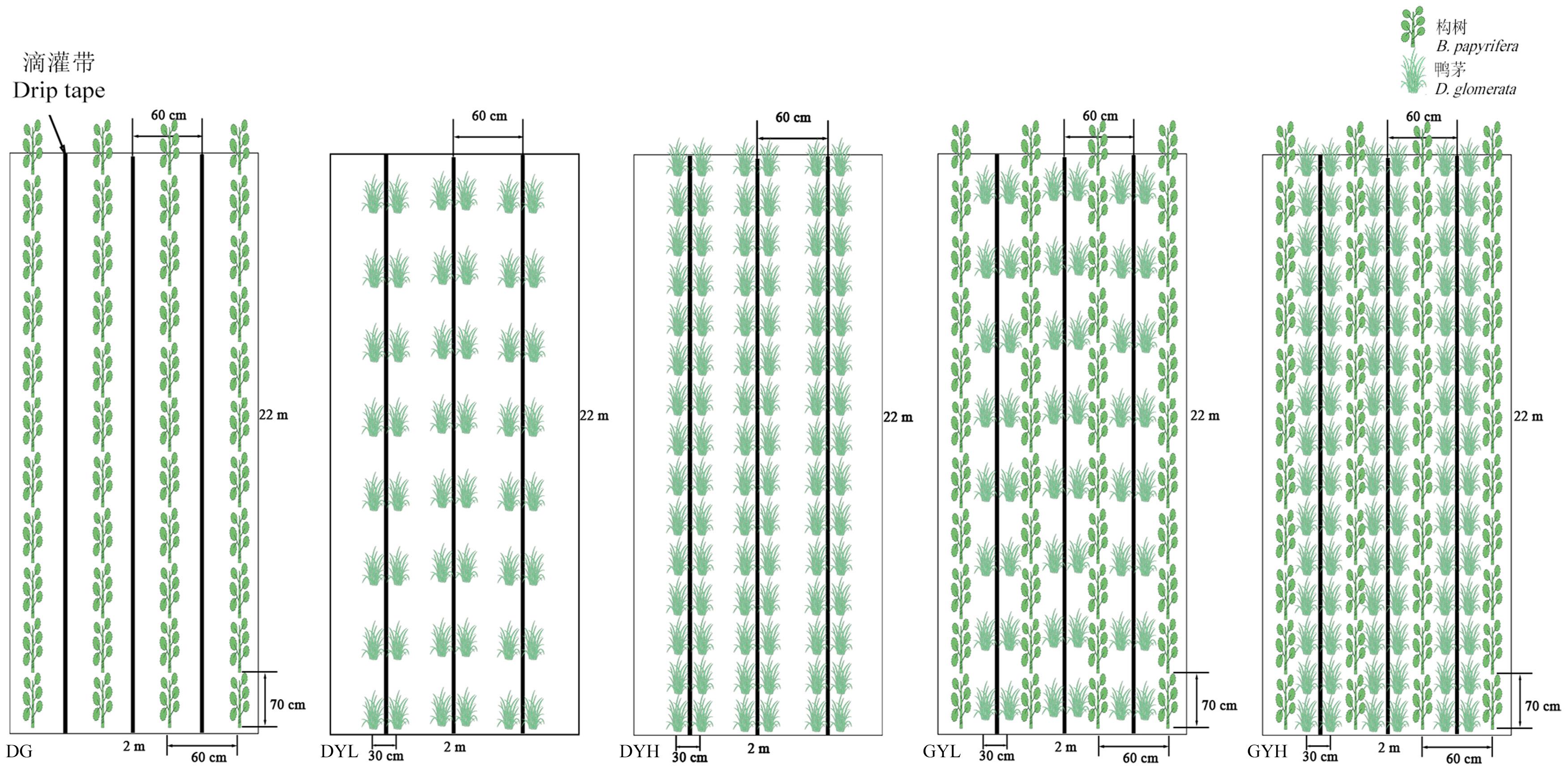
图1 杂交构树-鸭茅间作模式示意图DG: 单作杂交构树Monoculture of B. papyrifera; DYL: 单作低播种量鸭茅Monoculture of D. glomerata with low seeding rate; DYH: 单作高播种量鸭茅Monoculture of D. glomerata with high seeding rate; GYL: 杂交构树间作低播种量鸭茅Intercropping of B. papyrifera and D. glomerata with low seeding rate; GYH: 杂交构树间作高播种量鸭茅Intercropping of B. papyrifera and D. glomerata with high seeding rate; 下同The same below.
Fig.1 Schematic diagram of intercropping model of B. papyrifera-D. glomerata
茬次 Cut | 鸭茅D. glomerata | 杂交构树B. papyrifera | ||||
|---|---|---|---|---|---|---|
| 出苗期Seeding period | 分蘖期Tillering stage | 抽穗期Heading stage | 初花期Early flowering stage | 幼苗期Seedling stage | 生长期Growing period | |
| 1 | 05-10 | 05-22 | 06-18 | 06-25 | 05-10 | 06-25 |
| 2 | - | 07-05 | 07-25 | 08-17 | - | 08-17 |
| 3 | - | 08-15 | 09-13 | 10-07 | - | 10-07 |
表2 试验当年(2024)杂交构树与鸭茅的物候期
Table 2 Phenological periods of B. papyrifera and D. glomerata in the experimental year (2024)
茬次 Cut | 鸭茅D. glomerata | 杂交构树B. papyrifera | ||||
|---|---|---|---|---|---|---|
| 出苗期Seeding period | 分蘖期Tillering stage | 抽穗期Heading stage | 初花期Early flowering stage | 幼苗期Seedling stage | 生长期Growing period | |
| 1 | 05-10 | 05-22 | 06-18 | 06-25 | 05-10 | 06-25 |
| 2 | - | 07-05 | 07-25 | 08-17 | - | 08-17 |
| 3 | - | 08-15 | 09-13 | 10-07 | - | 10-07 |
作物 Plant | 处理 Treatment | 净光合速率 Net photosynthetic rate | 胞间二氧化碳浓度 Intercellular CO? concentration | 气孔导度 Stomatal conductance | 蒸腾速率 Transpiration rate |
|---|---|---|---|---|---|
杂交构树 B. papyrifera | DG | 27.73±0.34b | 36.57±0.10c | 81.56±0.72c | 3.42±0.05c |
| GYL | 36.32±0.19a | 41.50±0.47b | 112.61±2.71a | 4.38±0.02a | |
| GYH | 36.39±0.39a | 48.85±0.25a | 89.10±0.60b | 3.89±0.04b | |
鸭茅 D. glomerata | DYL | 28.15±0.48c | 29.16±0.20c | 47.69±2.34d | 2.65±0.65d |
| DYH | 27.44±0.51c | 27.43±0.06c | 53.38±4.66c | 3.05±0.56c | |
| GYL | 44.77±2.84b | 54.02±3.07b | 111.21±0.62a | 3.92±0.31a | |
| GYH | 47.82±2.11a | 56.31±3.11a | 109.00±0.45b | 3.75±0.22b |
表3 间作模式对杂交构树、鸭茅光合特性的影响
Table 3 Effect of intercropping patterns on photosynthetic characteristics of B. papyrifera and D. glomerata (μmol·m-2·s-1)
作物 Plant | 处理 Treatment | 净光合速率 Net photosynthetic rate | 胞间二氧化碳浓度 Intercellular CO? concentration | 气孔导度 Stomatal conductance | 蒸腾速率 Transpiration rate |
|---|---|---|---|---|---|
杂交构树 B. papyrifera | DG | 27.73±0.34b | 36.57±0.10c | 81.56±0.72c | 3.42±0.05c |
| GYL | 36.32±0.19a | 41.50±0.47b | 112.61±2.71a | 4.38±0.02a | |
| GYH | 36.39±0.39a | 48.85±0.25a | 89.10±0.60b | 3.89±0.04b | |
鸭茅 D. glomerata | DYL | 28.15±0.48c | 29.16±0.20c | 47.69±2.34d | 2.65±0.65d |
| DYH | 27.44±0.51c | 27.43±0.06c | 53.38±4.66c | 3.05±0.56c | |
| GYL | 44.77±2.84b | 54.02±3.07b | 111.21±0.62a | 3.92±0.31a | |
| GYH | 47.82±2.11a | 56.31±3.11a | 109.00±0.45b | 3.75±0.22b |
茬次 Cut | 处理 Treatment | 鲜草产量 Fresh yield (t·hm-2) | 干草产量 Hay yield (t·hm-2) | 株高Plant height (cm) | |
|---|---|---|---|---|---|
| 杂交构树B. papyrifera | 鸭茅D. glomerata | ||||
| 1 | DG | 20.15±0.23Cd | 5.55±0.53Bb | 98.40±4.17Aa | - |
| DYL | 19.90±0.48Bd | 5.06±0.16Bb | - | 78.03±1.52Ba | |
| DYH | 22.15±0.83Bc | 6.12±0.97Ab | - | 72.09±1.07Bb | |
| GYL | 46.05±0.65Ca | 13.34±2.14Aa | 92.18±4.20Ba | 54.48±1.15Cc | |
| GYH | 41.15±1.62Bb | 11.15±1.24Aa | 76.82±1.50Bb | 54.05±1.24Bc | |
| 2 | DG | 22.75±0.24Ad | 6.63±0.15Ac | 99.93±3.27Ab | - |
| DYL | 20.49±0.49ABd | 6.00±0.19Ac | - | 88.73±4.45Aa | |
| DYH | 22.82±0.84ABc | 7.24±1.18Ac | - | 76.75±1.44Ab | |
| GYL | 47.43±0.66Ba | 15.53±2.48Aa | 109.84±3.18Aa | 65.70±1.66Ac | |
| GYH | 42.45±1.66Ab | 12.96±1.44Ab | 96.24±1.05Ab | 61.18±1.40Ac | |
| 3 | DG | 21.27±0.31Bd | 5.98±0.52ABb | 97.33±4.50Aa | - |
| DYL | 21.09±0.51Ad | 5.82±0.18Ac | - | 70.17±2.00Ca | |
| DYH | 23.47±0.86Ac | 7.04±1.11Ac | - | 67.34±1.06Ca | |
| GYL | 48.80±0.69Aa | 15.19±1.14Aa | 104.05±3.36Aa | 58.56±1.75Bb | |
| GYH | 43.43±2.02Ab | 12.65±1.59Ab | 99.14±4.69Aa | 56.78±1.75Bb | |
表4 间作模式对作物农艺性状的影响
Table 4 Effect of intercropping patterns on agronomic traits of crops
茬次 Cut | 处理 Treatment | 鲜草产量 Fresh yield (t·hm-2) | 干草产量 Hay yield (t·hm-2) | 株高Plant height (cm) | |
|---|---|---|---|---|---|
| 杂交构树B. papyrifera | 鸭茅D. glomerata | ||||
| 1 | DG | 20.15±0.23Cd | 5.55±0.53Bb | 98.40±4.17Aa | - |
| DYL | 19.90±0.48Bd | 5.06±0.16Bb | - | 78.03±1.52Ba | |
| DYH | 22.15±0.83Bc | 6.12±0.97Ab | - | 72.09±1.07Bb | |
| GYL | 46.05±0.65Ca | 13.34±2.14Aa | 92.18±4.20Ba | 54.48±1.15Cc | |
| GYH | 41.15±1.62Bb | 11.15±1.24Aa | 76.82±1.50Bb | 54.05±1.24Bc | |
| 2 | DG | 22.75±0.24Ad | 6.63±0.15Ac | 99.93±3.27Ab | - |
| DYL | 20.49±0.49ABd | 6.00±0.19Ac | - | 88.73±4.45Aa | |
| DYH | 22.82±0.84ABc | 7.24±1.18Ac | - | 76.75±1.44Ab | |
| GYL | 47.43±0.66Ba | 15.53±2.48Aa | 109.84±3.18Aa | 65.70±1.66Ac | |
| GYH | 42.45±1.66Ab | 12.96±1.44Ab | 96.24±1.05Ab | 61.18±1.40Ac | |
| 3 | DG | 21.27±0.31Bd | 5.98±0.52ABb | 97.33±4.50Aa | - |
| DYL | 21.09±0.51Ad | 5.82±0.18Ac | - | 70.17±2.00Ca | |
| DYH | 23.47±0.86Ac | 7.04±1.11Ac | - | 67.34±1.06Ca | |
| GYL | 48.80±0.69Aa | 15.19±1.14Aa | 104.05±3.36Aa | 58.56±1.75Bb | |
| GYH | 43.43±2.02Ab | 12.65±1.59Ab | 99.14±4.69Aa | 56.78±1.75Bb | |
| 茬次Cut | 处理Treatment | LER1 | LER2 | LER |
|---|---|---|---|---|
| 1 | GYL | 1.28 | 0.83 | 2.11 |
| GYH | 0.96 | 0.81 | 1.77 | |
| 2 | GYL | 1.04 | 0.65 | 1.70 |
| GYH | 0.80 | 0.62 | 1.42 | |
| 3 | GYL | 1.22 | 1.03 | 2.25 |
| GYH | 1.03 | 0.84 | 1.87 |
表5 各间作模式土地当量比
Table 5 Land equivalent ratios of different intercropping patterns
| 茬次Cut | 处理Treatment | LER1 | LER2 | LER |
|---|---|---|---|---|
| 1 | GYL | 1.28 | 0.83 | 2.11 |
| GYH | 0.96 | 0.81 | 1.77 | |
| 2 | GYL | 1.04 | 0.65 | 1.70 |
| GYH | 0.80 | 0.62 | 1.42 | |
| 3 | GYL | 1.22 | 1.03 | 2.25 |
| GYH | 1.03 | 0.84 | 1.87 |
茬次 Cut | 处理 Treatment | 干物质 Dry matter | 粗蛋白 Crude protein | 中性洗涤纤维 Neutral detergent fiber | 酸性洗涤纤维 Acid detergent fiber | 可溶性碳水化合物 Water soluble carbohydrates | 粗脂肪 Ether extract |
|---|---|---|---|---|---|---|---|
| 1 | DG | 27.54±2.25Ba | 21.52±0.19Aa | 41.75±2.73Aa | 19.89±0.98Aa | 7.43±0.20Ca | 8.90±1.06Aa |
| GYL | 28.02±1.20Ba | 20.37±0.35Ab | 30.07±1.21Ab | 13.49±0.38Ab | 6.26±0.17Cb | 7.07±0.23Ab | |
| GYH | 28.97±4.61Aa | 19.41±0.42Ac | 32.42±0.65Ab | 13.63±0.46Ab | 6.42±0.31Bb | 7.84±0.24Aab | |
| 2 | DG | 28.12±2.29ABa | 20.29±0.20Ba | 39.37±2.62Aa | 18.38±0.76Aa | 8.34±0.23Ba | 8.13±0.86Aa |
| GYL | 29.40±1.24ABa | 18.52±0.19Bb | 28.37±2.62Ab | 12.68±0.76ABb | 6.78±0.29Bb | 7.53±0.82Aa | |
| GYH | 28.11±4.95Aa | 18.31±0.18Bb | 30.09±1.28Bb | 13.91±0.45Ab | 7.29±0.35Ab | 8.64±1.25Aa | |
| 3 | DG | 31.94±0.96Aa | 18.55±0.21Ca | 40.65±2.73Aa | 19.59±1.03Aa | 10.07±0.26Aa | 6.91±1.52Aa |
| GYL | 32.51±2.27Aa | 17.54±0.25Cb | 28.17±1.72Ab | 11.95±0.03Bc | 7.36±0.26Ab | 5.98±1.04Aa | |
| GYH | 32.67±5.20Aa | 16.82±0.14Cc | 31.44±0.97ABb | 13.79±0.67Ab | 7.47±0.39Ab | 7.68±0.73Aa |
表6 间作模式对杂交构树营养品质的影响
Table 6 Effect of intercropping patterns on nutritional quality of B. papyrifera (%)
茬次 Cut | 处理 Treatment | 干物质 Dry matter | 粗蛋白 Crude protein | 中性洗涤纤维 Neutral detergent fiber | 酸性洗涤纤维 Acid detergent fiber | 可溶性碳水化合物 Water soluble carbohydrates | 粗脂肪 Ether extract |
|---|---|---|---|---|---|---|---|
| 1 | DG | 27.54±2.25Ba | 21.52±0.19Aa | 41.75±2.73Aa | 19.89±0.98Aa | 7.43±0.20Ca | 8.90±1.06Aa |
| GYL | 28.02±1.20Ba | 20.37±0.35Ab | 30.07±1.21Ab | 13.49±0.38Ab | 6.26±0.17Cb | 7.07±0.23Ab | |
| GYH | 28.97±4.61Aa | 19.41±0.42Ac | 32.42±0.65Ab | 13.63±0.46Ab | 6.42±0.31Bb | 7.84±0.24Aab | |
| 2 | DG | 28.12±2.29ABa | 20.29±0.20Ba | 39.37±2.62Aa | 18.38±0.76Aa | 8.34±0.23Ba | 8.13±0.86Aa |
| GYL | 29.40±1.24ABa | 18.52±0.19Bb | 28.37±2.62Ab | 12.68±0.76ABb | 6.78±0.29Bb | 7.53±0.82Aa | |
| GYH | 28.11±4.95Aa | 18.31±0.18Bb | 30.09±1.28Bb | 13.91±0.45Ab | 7.29±0.35Ab | 8.64±1.25Aa | |
| 3 | DG | 31.94±0.96Aa | 18.55±0.21Ca | 40.65±2.73Aa | 19.59±1.03Aa | 10.07±0.26Aa | 6.91±1.52Aa |
| GYL | 32.51±2.27Aa | 17.54±0.25Cb | 28.17±1.72Ab | 11.95±0.03Bc | 7.36±0.26Ab | 5.98±1.04Aa | |
| GYH | 32.67±5.20Aa | 16.82±0.14Cc | 31.44±0.97ABb | 13.79±0.67Ab | 7.47±0.39Ab | 7.68±0.73Aa |
茬次 Cut | 处理 Treatment | 干物质 Dry matter | 粗蛋白 Crude protein | 中性洗涤纤维 Neutral detergent fiber | 酸性洗涤纤维 Acid detergent fiber | 可溶性碳水化合物 Water soluble carbohydrates | 粗脂肪 Ether extract |
|---|---|---|---|---|---|---|---|
| 1 | DYL | 25.44±0.94Ba | 20.57±0.11Aa | 59.21±0.54Aa | 33.55±0.82Aa | 8.87±0.45Aa | 8.35±0.35Aa |
| DYH | 27.61±3.96Aa | 17.29±0.03Ab | 50.65±3.07Bb | 30.48±0.94Ab | 7.38±0.29Ab | 8.14±0.12Aa | |
| GYL | 25.71±2.51Aa | 16.35±0.16Ac | 38.90±2.45Ac | 18.85±1.24Ac | 7.31±0.21Abc | 5.72±0.30Bb | |
| GYH | 26.56±3.85Aa | 15.12±0.13Bd | 40.68±5.68Ac | 19.39±2.34Ac | 6.67±0.42Ac | 4.04±0.43Bc | |
| 2 | DYL | 29.28±1.10ABa | 18.22±0.08Ca | 56.35±0.74Ba | 31.57±0.77Ba | 6.61±0.32Ca | 6.99±0.59Bb |
| DYH | 27.97±2.65Aa | 15.32±0.03Cb | 53.07±0.63ABb | 28.69±0.88Ab | 5.59±0.37Cb | 8.74±0.50Aa | |
| GYL | 28.87±3.56Aa | 14.94±0.15Bc | 36.91±2.54Ac | 17.03±2.52Ac | 4.82±0.24Cc | 6.94±0.79Ab | |
| GYH | 26.62±2.70Aa | 13.85±0.19Cd | 39.85±1.68Ac | 19.10±1.11Ac | 4.14±0.16Cd | 5.92±0.57Ab | |
| 3 | DYL | 31.68±4.75Aa | 19.59±0.09Ba | 58.10±0.78Aa | 32.93±0.80ABa | 7.82±0.40Ba | 9.11±0.55Aa |
| DYH | 29.27±1.08Aa | 16.47±0.03Bb | 54.73±0.65Aa | 29.90±0.92Aa | 6.50±0.25Bb | 7.85±0.58Ab | |
| GYL | 29.95±4.34Aa | 16.12±0.14Ac | 38.29±2.62Ab | 17.71±2.18Ab | 6.43±0.19Bbc | 6.57±0.53ABc | |
| GYH | 27.03±2.84Aa | 15.69±0.11Ad | 40.01±2.78Ab | 19.03±2.29Ab | 5.87±0.36Bc | 5.69±0.09Ac |
表7 间作模式对鸭茅营养品质的影响
Table 7 Effects of intercropping patterns on nutritional quality of D. glomerata (%)
茬次 Cut | 处理 Treatment | 干物质 Dry matter | 粗蛋白 Crude protein | 中性洗涤纤维 Neutral detergent fiber | 酸性洗涤纤维 Acid detergent fiber | 可溶性碳水化合物 Water soluble carbohydrates | 粗脂肪 Ether extract |
|---|---|---|---|---|---|---|---|
| 1 | DYL | 25.44±0.94Ba | 20.57±0.11Aa | 59.21±0.54Aa | 33.55±0.82Aa | 8.87±0.45Aa | 8.35±0.35Aa |
| DYH | 27.61±3.96Aa | 17.29±0.03Ab | 50.65±3.07Bb | 30.48±0.94Ab | 7.38±0.29Ab | 8.14±0.12Aa | |
| GYL | 25.71±2.51Aa | 16.35±0.16Ac | 38.90±2.45Ac | 18.85±1.24Ac | 7.31±0.21Abc | 5.72±0.30Bb | |
| GYH | 26.56±3.85Aa | 15.12±0.13Bd | 40.68±5.68Ac | 19.39±2.34Ac | 6.67±0.42Ac | 4.04±0.43Bc | |
| 2 | DYL | 29.28±1.10ABa | 18.22±0.08Ca | 56.35±0.74Ba | 31.57±0.77Ba | 6.61±0.32Ca | 6.99±0.59Bb |
| DYH | 27.97±2.65Aa | 15.32±0.03Cb | 53.07±0.63ABb | 28.69±0.88Ab | 5.59±0.37Cb | 8.74±0.50Aa | |
| GYL | 28.87±3.56Aa | 14.94±0.15Bc | 36.91±2.54Ac | 17.03±2.52Ac | 4.82±0.24Cc | 6.94±0.79Ab | |
| GYH | 26.62±2.70Aa | 13.85±0.19Cd | 39.85±1.68Ac | 19.10±1.11Ac | 4.14±0.16Cd | 5.92±0.57Ab | |
| 3 | DYL | 31.68±4.75Aa | 19.59±0.09Ba | 58.10±0.78Aa | 32.93±0.80ABa | 7.82±0.40Ba | 9.11±0.55Aa |
| DYH | 29.27±1.08Aa | 16.47±0.03Bb | 54.73±0.65Aa | 29.90±0.92Aa | 6.50±0.25Bb | 7.85±0.58Ab | |
| GYL | 29.95±4.34Aa | 16.12±0.14Ac | 38.29±2.62Ab | 17.71±2.18Ab | 6.43±0.19Bbc | 6.57±0.53ABc | |
| GYH | 27.03±2.84Aa | 15.69±0.11Ad | 40.01±2.78Ab | 19.03±2.29Ab | 5.87±0.36Bc | 5.69±0.09Ac |

图2 间作模式对杂交构树、鸭茅0~40 cm土壤的影响不同小写字母表示相同茬次下不同处理间差异显著(P<0.05),不同大写字母表示不同茬次下相同处理间差异显著(P<0.05)。Different lowercase letters indicate significant differences among different treatments within the same cropping cut (P<0.05), different uppercase letters indicate significant differences among different cropping cut in the same treatments (P<0.05).
Fig.2 Effects of intercropping patterns on soil (0-40 cm) of B. papyrifera and D. glomerata
茬次 Cut | 处理 Treatment | pH | 脲酶Urease (mg·g-1·d-1) | 碱性磷酸酶Alkaline phosphatase (mg·g-1·d-1) | 过氧化氢酶Catalase (mg·g-1·d-1) | 蔗糖酶Sucrase (mg·g-1·d-1) |
|---|---|---|---|---|---|---|
| 1 | DG | 7.98±0.09Ab | 3.89±0.03Ba | 0.54±0.02Ba | 1.14±0.05Ca | 10.19±0.28Bd |
| DYL | 7.98±0.06Ab | 3.81±0.13Ca | 0.46±0.01Bb | 0.98±0.05Cc | 10.21±0.42Cd | |
| DYH | 7.99±0.03Ab | 3.78±0.06Ca | 0.53±0.02Ba | 1.05±0.03Cbc | 12.95±2.24Bc | |
| GYL | 8.25±0.12Aa | 3.98±0.25Ca | 0.35±0.02Cc | 1.18±0.06Ca | 18.97±1.31Ba | |
| GYH | 8.21±0.06Aa | 3.89±0.06Ba | 0.33±0.01Cc | 1.13±0.04Cab | 16.53±0.54Bb | |
| 2 | DG | 8.00±0.03Ac | 5.29±0.04Aa | 0.57±0.02Ab | 1.28±0.05Ab | 15.16±1.81Ab |
| DYL | 7.98±0.01Acd | 5.41±0.18Aa | 0.52±0.01Ac | 1.33±0.06Ab | 22.80±0.93Aa | |
| DYH | 7.98±0.01Acd | 5.41±0.09Aa | 0.62±0.02Aa | 1.26±0.04Ab | 20.63±3.56Aa | |
| GYL | 8.26±0.01Aa | 5.81±0.36Aa | 0.40±0.05Bd | 1.48±0.07Aa | 22.10±0.73Aa | |
| GYH | 8.22±0.01Ab | 5.28±0.08Aa | 0.41±0.01Bd | 1.32±0.04Ab | 21.02±1.44Aa | |
| 3 | DG | 8.04±0.08Ab | 3.67±0.02Cc | 0.47±0.02Ca | 1.26±0.01Bbc | 13.28±0.91Ac |
| DYL | 8.01±0.05Ab | 4.03±0.14Ba | 0.38±0.01Cc | 1.21±0.02Bc | 12.66±0.52Bc | |
| DYH | 7.99±0.02Ab | 4.01±0.05Ba | 0.46±0.02Cab | 1.14±0.01Bd | 15.29±0.64Bb | |
| GYL | 8.37±0.05Aa | 4.05±0.25Ba | 0.41±0.06Abc | 1.39±0.04Ba | 16.98±0.13Ca | |
| GYH | 8.30±0.05Aa | 3.85±0.06Cb | 0.43±0.01Aabc | 1.29±0.04Bb | 14.70±0.54Bb |
表8 间作模式对0~20 cm土壤酶活性的影响
Table 8 Effect of intercropping patterns on soil enzyme activities in the 0-20 cm layer
茬次 Cut | 处理 Treatment | pH | 脲酶Urease (mg·g-1·d-1) | 碱性磷酸酶Alkaline phosphatase (mg·g-1·d-1) | 过氧化氢酶Catalase (mg·g-1·d-1) | 蔗糖酶Sucrase (mg·g-1·d-1) |
|---|---|---|---|---|---|---|
| 1 | DG | 7.98±0.09Ab | 3.89±0.03Ba | 0.54±0.02Ba | 1.14±0.05Ca | 10.19±0.28Bd |
| DYL | 7.98±0.06Ab | 3.81±0.13Ca | 0.46±0.01Bb | 0.98±0.05Cc | 10.21±0.42Cd | |
| DYH | 7.99±0.03Ab | 3.78±0.06Ca | 0.53±0.02Ba | 1.05±0.03Cbc | 12.95±2.24Bc | |
| GYL | 8.25±0.12Aa | 3.98±0.25Ca | 0.35±0.02Cc | 1.18±0.06Ca | 18.97±1.31Ba | |
| GYH | 8.21±0.06Aa | 3.89±0.06Ba | 0.33±0.01Cc | 1.13±0.04Cab | 16.53±0.54Bb | |
| 2 | DG | 8.00±0.03Ac | 5.29±0.04Aa | 0.57±0.02Ab | 1.28±0.05Ab | 15.16±1.81Ab |
| DYL | 7.98±0.01Acd | 5.41±0.18Aa | 0.52±0.01Ac | 1.33±0.06Ab | 22.80±0.93Aa | |
| DYH | 7.98±0.01Acd | 5.41±0.09Aa | 0.62±0.02Aa | 1.26±0.04Ab | 20.63±3.56Aa | |
| GYL | 8.26±0.01Aa | 5.81±0.36Aa | 0.40±0.05Bd | 1.48±0.07Aa | 22.10±0.73Aa | |
| GYH | 8.22±0.01Ab | 5.28±0.08Aa | 0.41±0.01Bd | 1.32±0.04Ab | 21.02±1.44Aa | |
| 3 | DG | 8.04±0.08Ab | 3.67±0.02Cc | 0.47±0.02Ca | 1.26±0.01Bbc | 13.28±0.91Ac |
| DYL | 8.01±0.05Ab | 4.03±0.14Ba | 0.38±0.01Cc | 1.21±0.02Bc | 12.66±0.52Bc | |
| DYH | 7.99±0.02Ab | 4.01±0.05Ba | 0.46±0.02Cab | 1.14±0.01Bd | 15.29±0.64Bb | |
| GYL | 8.37±0.05Aa | 4.05±0.25Ba | 0.41±0.06Abc | 1.39±0.04Ba | 16.98±0.13Ca | |
| GYH | 8.30±0.05Aa | 3.85±0.06Cb | 0.43±0.01Aabc | 1.29±0.04Bb | 14.70±0.54Bb |
茬次 Cut | 处理 Treatment | pH | 脲酶Urease (mg·g-1·d-1) | 碱性磷酸酶Alkaline Phosphatase (mg·g-1·d-1) | 过氧化氢酶Catalase (mg·g-1·d-1) | 蔗糖酶Sucrase (mg·g-1·d-1) |
|---|---|---|---|---|---|---|
| 1 | DG | 8.05±0.08Ab | 3.42±0.04Bc | 0.51±0.01Ba | 0.97±0.02Cb | 7.13±0.14Ad |
| DYL | 8.23±0.03Aa | 3.57±0.03Cb | 0.49±0.02Aab | 0.88±0.01Cc | 7.67±1.17Bcd | |
| DYH | 8.20±0.04Aa | 3.45±0.11Cbc | 0.46±0.02Bb | 0.91±0.02Cc | 8.82±0.29Cbc | |
| GYL | 8.21±0.07Aa | 3.94±0.09Ca | 0.31±0.01Bc | 1.07±0.03Ca | 14.18±1.42Ba | |
| GYH | 8.20±0.04Ba | 3.86±0.03Ba | 0.31±0.02Cc | 1.09±0.03Ca | 10.32±0.62Bb | |
| 2 | DG | 8.05±0.08Ab | 4.80±0.30Ab | 0.53±0.01Aa | 1.09±0.02Ac | 8.91±0.17Ac |
| DYL | 7.98±0.01Bc | 4.71±0.04Ab | 0.50±0.02Aa | 0.99±0.01Be | 15.62±2.37Aab | |
| DYH | 7.98±0.01Bc | 4.75±0.14Ab | 0.50±0.02Aa | 1.05±0.02Ad | 13.06±0.43Ab | |
| GYL | 8.22±0.02Aa | 5.12±0.12Aa | 0.37±0.04Ab | 1.15±0.01Bb | 17.31±1.73Aa | |
| GYH | 8.21±0.01Ba | 4.67±0.04Ab | 0.34±0.01Bc | 1.21±0.01Aa | 14.80±0.89Aab | |
| 3 | DG | 8.07±0.07Ab | 3.22±0.04Cc | 0.45±0.01Ca | 1.05±0.01Bc | 8.76±1.94Ab |
| DYL | 8.01±0.02Bbc | 3.78±0.04Bb | 0.38±0.02Bb | 1.01±0.01Ad | 8.97±1.37Bab | |
| DYH | 8.02±0.03Bbc | 3.68±0.12Bb | 0.39±0.01Cb | 1.02±0.01Bcd | 9.97±0.32Bab | |
| GYL | 8.28±0.06Aa | 4.02±0.09Ba | 0.38±0.03Ab | 1.27±0.01Aa | 11.18±0.90Ca | |
| GYH | 8.30±0.03Aa | 3.78±0.03Cb | 0.37±0.01Ab | 1.18±0.01Bb | 9.19±0.75Bab |
表9 间作模式对20~40 cm土壤酶活性的影响
Table 9 Effect of intercropping patterns on soil enzyme activities in the 20-40 cm layer
茬次 Cut | 处理 Treatment | pH | 脲酶Urease (mg·g-1·d-1) | 碱性磷酸酶Alkaline Phosphatase (mg·g-1·d-1) | 过氧化氢酶Catalase (mg·g-1·d-1) | 蔗糖酶Sucrase (mg·g-1·d-1) |
|---|---|---|---|---|---|---|
| 1 | DG | 8.05±0.08Ab | 3.42±0.04Bc | 0.51±0.01Ba | 0.97±0.02Cb | 7.13±0.14Ad |
| DYL | 8.23±0.03Aa | 3.57±0.03Cb | 0.49±0.02Aab | 0.88±0.01Cc | 7.67±1.17Bcd | |
| DYH | 8.20±0.04Aa | 3.45±0.11Cbc | 0.46±0.02Bb | 0.91±0.02Cc | 8.82±0.29Cbc | |
| GYL | 8.21±0.07Aa | 3.94±0.09Ca | 0.31±0.01Bc | 1.07±0.03Ca | 14.18±1.42Ba | |
| GYH | 8.20±0.04Ba | 3.86±0.03Ba | 0.31±0.02Cc | 1.09±0.03Ca | 10.32±0.62Bb | |
| 2 | DG | 8.05±0.08Ab | 4.80±0.30Ab | 0.53±0.01Aa | 1.09±0.02Ac | 8.91±0.17Ac |
| DYL | 7.98±0.01Bc | 4.71±0.04Ab | 0.50±0.02Aa | 0.99±0.01Be | 15.62±2.37Aab | |
| DYH | 7.98±0.01Bc | 4.75±0.14Ab | 0.50±0.02Aa | 1.05±0.02Ad | 13.06±0.43Ab | |
| GYL | 8.22±0.02Aa | 5.12±0.12Aa | 0.37±0.04Ab | 1.15±0.01Bb | 17.31±1.73Aa | |
| GYH | 8.21±0.01Ba | 4.67±0.04Ab | 0.34±0.01Bc | 1.21±0.01Aa | 14.80±0.89Aab | |
| 3 | DG | 8.07±0.07Ab | 3.22±0.04Cc | 0.45±0.01Ca | 1.05±0.01Bc | 8.76±1.94Ab |
| DYL | 8.01±0.02Bbc | 3.78±0.04Bb | 0.38±0.02Bb | 1.01±0.01Ad | 8.97±1.37Bab | |
| DYH | 8.02±0.03Bbc | 3.68±0.12Bb | 0.39±0.01Cb | 1.02±0.01Bcd | 9.97±0.32Bab | |
| GYL | 8.28±0.06Aa | 4.02±0.09Ba | 0.38±0.03Ab | 1.27±0.01Aa | 11.18±0.90Ca | |
| GYH | 8.30±0.03Aa | 3.78±0.03Cb | 0.37±0.01Ab | 1.18±0.01Bb | 9.19±0.75Bab |
| [1] | Yuan M L, Wang Y X, Zhang B, et al. Grassland ecological conservation and high-quality development of prataculture in Xinjiang. Pratacultural Science, 2023, 40(5): 1135-1139. |
| 袁明龙, 王玉祥, 张博, 等. 新疆草原生态保护与草业高质量发展. 草业科学, 2023, 40(5): 1135-1139. | |
| [2] | Chen W, Wang C, Pan C N, et al. Study on wild forage plant resources in the southern agricultural area of the Junggar Basin. Agricultural Research in the Arid Areas, 2023, 41(6): 1-7. |
| 陈威, 王超, 潘成南, 等. 准噶尔盆地南部农区野生饲用植物资源研究. 干旱地区农业研究, 2023, 41(6): 1-7. | |
| [3] | Mei P P, Gui L G, Wang P, et al. Maize/faba bean intercropping with rhizobia inoculation enhances productivity and recovery of fertilizer P in a reclaimed desert soil. Field Crops Research, 2012, 130: 19-27. |
| [4] | Xiang R, Yi W B, Zhao W, et al. Effects of intercropping on soil aggregate-associated organic carbon storage and nitrogen regulation. Journal of Soil and Water Conservation, 2019, 33(5): 303-308. |
| 向蕊, 伊文博, 赵薇, 等. 间作对土壤团聚体有机碳储量的影响及其氮调控效应. 水土保持学报, 2019, 33(5): 303-308. | |
| [5] | Zhao Q Y, Wang X G, Shan X H, et al. Screening of mixed sowing combinations and interspecific relationship between oat and annual leguminous forages in Horqin Region. Chinese Journal of Grassland, 2025, 47(10): 54-63. |
| 赵晴云, 王显国, 单新河, 等. 科尔沁地区燕麦与豆科饲草混播组合筛选和种间关系研究. 中国草地学报, 2025, 47(10): 54-63. | |
| [6] | Bao W Y, Wei J Y, Guo R, et al. Optimizing root interactions to regulate interspecific relationships and productivity in legume-grass mixtures during the establishment phase. Pratacultural Science, 2025, 42(9): 2322-2331. |
| 包乌云, 魏嘉遥, 郭蓉, 等. 优化根系互作调控豆-禾混播系统建植期种间关系与生产力. 草业科学, 2025, 42(9): 2322-2331. | |
| [7] | Lin F, Liu X J, Tong C C, et al. Effects of intercropping on light energy utilization characteristics and productivity of different feed crops. Chinese Journal of Applied Ecology, 2019, 30(10): 3452-3462. |
| 蔺芳, 刘晓静, 童长春, 等. 间作对不同类型饲料作物光能利用特征及生产能力的影响. 应用生态学报, 2019, 30(10): 3452-3462. | |
| [8] | Lü Q Q, He N, Zhang Y J, et al. Eco-physiological mechanism of crop yield formation regulated by intercropping and rotation through root-shoot interaction. Plant Physiology Journal, 2023, 59(7): 1277-1290. |
| 吕晴晴, 何宁, 张永江, 等. 间作和轮作通过根冠互作调控作物产量形成的生理生态机制. 植物生理学报, 2023, 59(7): 1277-1290. | |
| [9] | Eskandari H, Ghanbari-Bonjar A, Galavi M, et al. Forage quality of cow pea (Vigna sinensis) intercropped with corn (Zea mays) as affected by nutrient uptake and light interception. Notulae Botanicae Horti Agrobotanici Cluj-Napoca, 2009, 37(1): 171-174. |
| [10] | Liu C. The study on herbages yield effect and ecophysiological mechanism in Eucalyptus grandis+herbage inter-cropping system. Ya’an: Sichuan Agricultural University, 2008: 14-15. |
| 刘闯. 巨桉林+草间作模式中牧草产量效应及其生理生态学特征研究. 雅安: 四川农业大学, 2008: 14-15. | |
| [11] | Bai C J, Yu D G, Chen Z Q, et al. Study on soil microorganism and its activity of the soil of silvopastoral systems. Chinese Journal of Tropical Crops, 2015, 36(5): 841-846. |
| 白昌军, 虞道耿, 陈志权, 等. 林草间作系统土壤微生物及其活性研究. 热带作物学报, 2015, 36(5): 841-846. | |
| [12] | Liu J H, Niu Y N, Luo Z Z, et al. Soil water utilization characteristics of slope land in hedgerow and grain crop intercropping systems on the Loess Plateau. Acta Prataculturae Sinica, 2018, 27(6): 111-119. |
| 刘家鹤, 牛伊宁, 罗珠珠, 等. 黄土高原坡耕地植物篱-作物间作系统水分利用特征研究. 草业学报, 2018, 27(6): 111-119. | |
| [13] | Huang P, Zhang L Y, Ji S G, et al. Effects of forest-grass intercropping on soil nutrient and microbial populations in Karst rocky desertification areas. Pratacultural Science, 2024, 41(7): 1549-1557. |
| 黄沛, 张雷一, 纪署光, 等. 喀斯特石漠化区林草间作对土壤养分及微生物数量的影响. 草业科学, 2024, 41(7): 1549-1557. | |
| [14] | Li L. Intercropping enhances agroecosystem services and functioning: Current knowledge and perspectives. Chinese Journal of Eco-Agriculture, 2016, 24(4): 403-415. |
| 李隆. 间套作强化农田生态系统服务功能的研究进展与应用展望. 中国生态农业学报, 2016, 24(4): 403-415. | |
| [15] | Deng Q Y, Fu D Q, Huang R Z, et al. Effects of pine needle essential oil on the quality and aerobic stability of Broussonetia papyrifera silage. Acta Prataculturae Sinica, 2025, 34(10): 85-94. |
| 邓清源, 付东青, 黄嵘峥, 等. 松针精油对构树青贮品质及有氧稳定性的影响. 草业学报, 2025, 34(10): 85-94. | |
| [16] | Wu C R, Dai S, Liang L F, et al. Effects of different additives on fermentation quality and protein degradation of Broussonetia papyrifera silage. Acta Prataculturae Sinica, 2021, 30(10): 169-179. |
| 吴长荣, 代胜, 梁龙飞, 等. 不同添加剂对构树青贮饲料发酵品质和蛋白质降解的影响. 草业学报, 2021, 30(10): 169-179. | |
| [17] | Xie K Y, Cao K, Wan J C, et al. Change in productivity of swards of different forage legume and grass species monocultures and combinations in the semi-arid region of Xinjiang Province. Acta Prataculturae Sinica, 2020, 29(4): 29-40. |
| 谢开云, 曹凯, 万江春, 等. 新疆半干旱区不同豆科/禾本科牧草混播草地生产力的变化研究. 草业学报, 2020, 29(4): 29-40. | |
| [18] | Zhang X, Nie G, Huang L K, et al. Effect of plant growth regulator on seed yield of Dactylis glomerata. Acta Prataculturae Sinica, 2019, 28(6): 93-100. |
| 张旭, 聂刚, 黄琳凯, 等. 植物生长调节剂对鸭茅种子产量的影响. 草业学报, 2019, 28(6): 93-100. | |
| [19] | Xie K Y, Meng X, Xu Z Z, et al. Study on forage yield and nutritional value of mixed-culture grassland of different legume and grass forage in semi-arid area of Xinjiang. Acta Agrestia Sinica, 2021, 29(8): 1835-1842. |
| 谢开云, 孟翔, 徐珍珍, 等. 新疆半干旱地区不同种类混播草地的牧草产量和营养价值研究. 草地学报, 2021, 29(8): 1835-1842. | |
| [20] | Wu T, Song F C, Cao W X, et al. Effects of different interplanting row ratio on silage quality ofalfalfa/cornmixed silage. Acta Agrestia Sinica, 2025, 33(6): 1961-1971. |
| 武涛, 宋福超, 曹文侠, 等. 不同套种行数比对紫花苜蓿/玉米混合青贮品质的影响. 草地学报, 2025, 33(6): 1961-1971. | |
| [21] | Guo B, Luo W C, Shan L S, et al. Effects of simulated warming on photosynthesis of typical desert shrubs in the Hexi Corridor. Acta Prataculturae Sinica, 2025, 34(7): 145-157. |
| 郭彬, 罗维成, 单立山, 等. 模拟增温对河西走廊典型荒漠灌木光合作用的影响. 草业学报, 2025, 34(7): 145-157. | |
| [22] | Wang P L, Yan Z Z, Gao L J, et al. Analysis of genetic variation in agronomic traits of half-sib families of Melilotus albus in the second generation of recurrent selection. Acta Prataculturae Sinica, 2022, 31(1): 238-245. |
| 王朋磊, 剡转转, 高莉娟, 等. 白花草木樨第二次轮回选择半同胞家系农艺性状的遗传变异分析. 草业学报, 2022, 31(1): 238-245. | |
| [23] | Kang Y X, Jiang Y B, Qi G P, et al. Effects of Onobrychis viciifolia and Bromus inermis grass mixture sowing and deficit irrigation on grassland water use and production performance. Acta Prataculturae Sinica, 2023, 32(8): 115-128. |
| 康燕霞, 姜渊博, 齐广平, 等. 红豆草与无芒雀麦混播草地生产力提升的水分调控模式研究. 草业学报, 2023, 32(8): 115-128. | |
| [24] | Yang S. Feed analysis and feed quality inspection technology. Beijing: Beijing Agricultural University Press, 1993: 59-79. |
| 杨胜. 饲料分析及饲料质量检测技术. 北京: 北京农业大学出版社, 1993: 59-79. | |
| [25] | Ou X, Lian H, Chen R Q, et al. Effects of different fertilization treatments on soil physical and chemical properties and enzyme activity of rare earth mine tailings after planting king grass. Acta Prataculturae Sinica, 2025, 34(2): 94-108. |
| 欧翔, 连海, 陈荣强, 等. 不同施肥处理种植王草后对稀土尾矿土壤理化性质和酶活性的影响. 草业学报, 2025, 34(2): 94-108. | |
| [26] | Hou W L, Kang W J, Lu B F, et al. Effects of rhizobial strains with different symbiotic effects on the photosynthetic characteristics and respiratory metabolism of alfalfa. Acta Prataculturae Sinica, 2025, 34(11): 66-80. |
| 侯文璐, 康文娟, 陆保福, 等. 不同共生效应根瘤菌株对紫花苜蓿光合特性和呼吸代谢的影响. 草业学报, 2025, 34(11): 66-80. | |
| [27] | Cao M J, Wang J Y, Cui Y, et al. Effects of different maize and soybean intercropping ratios on photosynthetic characteristics and yield of soybean. Soybean Science, 2023, 42(1): 48-54. |
| 曹曼君, 王婧瑜, 崔悦, 等. 不同玉米大豆间作行比对大豆光合特性及产量的影响. 大豆科学, 2023, 42(1): 48-54. | |
| [28] | Gong X, Dang K, Liu L, et al. Intercropping combined with nitrogen input promotes proso millet (Panicum miliaceum) growth and resource use efficiency to increase grain yield on the Loess Plateau of China. Agricultural Water Management, 2021, 243: 106434. |
| [29] | Fu H C, Li C, Li H N, et al. Effects of different cereal-legume intercropping systems on crop yield, water usage, and nitrogen utilization. Agricultural Research in the Arid Areas, 2025, 43(3): 200-209. |
| 付浩川, 李成, 李贺男, 等. 不同禾豆间作模式对作物产量及水氮利用的影响. 干旱地区农业研究, 2025, 43(3): 200-209. | |
| [30] | Guan H, Xu D, Li H P, et al. A study of nutritional quality and rumen degradation characteristics of 17 oat varieties in high cold regions. Acta Prataculturae Sinica, 2024, 33(9): 185-198. |
| 关皓, 许多, 李海萍, 等. 高寒地区17个燕麦品种营养品质及瘤胃降解特性研究. 草业学报, 2024, 33(9): 185-198. | |
| [31] | Li J, Li W Z, Ji B. Effect of mixed-planting mode on silage maize yield and forage quality. Crops, 2010, 3: 100-103. |
| [32] | Muglia G R P, Orrico Junior M A P, Retore M, et al. Productivity and fermentative and nutritional quality of silages from biomass sorghum intercropped with tropical grasses. AgriEngineering, 2025, 7(10): 345. |
| [33] | Shi H C, Wang S Y, Liu M Y, et al. Identification of mulberry root exudates and effects of main active compounds on the growth of Ralstonia pseudosolanacearum. Plant Physiology Journal, 2024, 60(9): 1475-1485. |
| 史惠聪, 王思怡, 刘梦圆, 等. 桑树根系分泌物鉴定及其主要活性物质对桑树青枯菌生长的影响研究. 植物生理学报, 2024, 60(9): 1475-1485. | |
| [34] | Li M E, Lai Z T, Tian J H. Research progress and prospect on the regulation of intercropping on soil aggregate structure and function. Chinese Journal of Applied Ecology, 2025, 36(11): 3512-3522. |
| 李铭恩, 赖泽婷, 田纪辉. 间作调控土壤团聚体结构及功能的研究进展与展望. 应用生态学报, 2025, 36(11): 3512-3522. | |
| [35] | Xiao Y, Li L, Zhang F. Effect of root contact on interspecific competition and N transfer between wheat and fababean using direct and indirect 15N techniques. Plant and Soil, 2004, 262(1): 45-54. |
| [36] | Feng X, Zhong M, Zhao X, et al. Intercropping forage mulberry benefits nodulation and growth of soybeans. Agriculture, 2025, 15(8): 902-920. |
| [37] | Hu J W, Zhu W X, Zhang H H, et al. Effects of mulberry/soybean intercropping on the plant growth and rhizosphere soil microbial number and enzyme activities. Chinese Journal of Applied Ecology, 2013, 24(5): 1423-1427. |
| 胡举伟, 朱文旭, 张会慧, 等. 桑树/大豆间作对植物生长及根际土壤微生物数量和酶活性的影响. 应用生态学报, 2013, 24(5): 1423-1427. | |
| [38] | Tang X, Zhang Y, Jiang J, et al. Sugarcane/peanut intercropping system improves physicochemical properties by changing N and P cycling and organic matter turnover in root zone soil. PeerJ, 2021, 9: e10880. |
| [39] | Tang X M, Huang Z P, Wu H N, et al. Correlation and principal component analysis of the soil environmental factors in corn/peanut intercropping system. Ecology and Environmental Sciences, 2020, 29(2): 223-230. |
| 唐秀梅, 黄志鹏, 吴海宁, 等. 玉米/花生间作条件下土壤环境因子的相关性和主成分分析. 生态环境学报, 2020, 29(2): 223-230. | |
| [40] | Chen X, Jiang N, Condron L M, et al. Impact of long-term phosphorus fertilizer inputs on bacterial phoD gene community in a maize field, Northeast China. Science of the Total Environment, 2019, 669: 1011-1018. |
| [41] | Luo Y, Wang L G, Chen J, et al. Effects of different flex cropping modes on soil enzyme activities and soil nutrients in the cold area of middle part of Gansu. Journal of Nuclear Agricultural Sciences, 2017, 31(6): 1185-1191. |
| 罗影, 王立光, 陈军, 等. 不同种植模式对甘肃中部高寒区胡麻田土壤酶活性及土壤养分的影响. 核农学报, 2017, 31(6): 1185-1191. |
| [1] | 霍倩倩, 宋洋洋, 吴远荣, 屈媛媛, 席琳乔. 耐盐碱作物对南疆土壤理化性质和细菌群落组成的影响[J]. 草业学报, 2026, 35(9): 47-62. |
| [2] | 雍嘉仪, 雍佳熹, 张颖, 胡海英. 5种燕麦再生生长性能及饲草品质对留茬高度的响应[J]. 草业学报, 2026, 35(8): 97-111. |
| [3] | 孙静, 孙延亮, 夏东杰, 魏孔钦, 杨开鑫, 隋晓青, 张前兵. 氮磷水肥耦合对无芒雀麦光合特性、生产性能及土壤养分的影响[J]. 草业学报, 2026, 35(7): 105-116. |
| [4] | 翟勇全, 马尧, 宋丽华, 曹兵. 黑麦草间作密度对枣-草间作系统生产力、净效益和可持续性的影响[J]. 草业学报, 2026, 35(7): 68-79. |
| [5] | 马江萍, 曹立娟, 张文文, 赵梦雨, 王腾飞, 张译尹, 王斌, 李佳旺, 王小兵, 兰剑. 补播与施磷对退化苜蓿草地生产力及土壤理化性质的影响[J]. 草业学报, 2026, 35(7): 92-104. |
| [6] | 张辉, 李慧玲, 王庆森, 刘丰静, 李金玉, 李良德, 钟秋生, 王定锋. 茶园间作杂草野艾蒿对茶园土壤微生物结构及多样性的影响[J]. 草业学报, 2026, 35(6): 166-180. |
| [7] | 臧家艺, 徐明杰, 谢济骋, 沈禹颖, 来兴发. 有机肥等氮替代化肥对旱作区青贮玉米/饲用大豆间作系统饲草产量和水分利用效率的影响[J]. 草业学报, 2026, 35(3): 83-95. |
| [8] | 代欣哲, 任文, 张伟, 陈文青, 张志新. 黄土高原半干旱区紫花苜蓿/黑麦草间作系统空间配置优化对水光利用的调控效应[J]. 草业学报, 2026, 35(12): 1-15. |
| [9] | 屈亚飞, 王腾飞, 张译尹, 孙建伟, 尤越, 石斌红, 李喜斌, 王斌, 梁丹妮, 兰剑. 行比配置对宁夏引黄灌区青贮玉米/饲用高粱间作系统种间关系和光能利用效率的影响[J]. 草业学报, 2026, 35(11): 106-118. |
| [10] | 欧翔, 张强, 操贤洪, 陈荣强, 连海, 黄志文, 康美如, 刘峥, 雷小文. 不同外源硒对镉污染土地中王草生长、营养品质及镉、硒富集的影响[J]. 草业学报, 2026, 35(11): 184-200. |
| [11] | 魏孔涛, 张春平, 俞旸, 张正社, 周泽, 张雪, 王鑫鑫, 岳思玉, 曹铨, 董全民. 环青海湖共和盆地不同燕麦品种的产量、营养价值及对土壤理化性质的影响[J]. 草业学报, 2026, 35(1): 107-118. |
| [12] | 傅俊士, 南丽丽, 张泽龙, 吴世文. 21份猫尾草种质不同生育时期光合特性综合评价[J]. 草业学报, 2026, 35(1): 93-106. |
| [13] | 张琨, 乔建霞, 李金升, 王育鹏, 刘克思. 不同修复材料对退化高寒草地土壤理化性质及微生物群落的影响[J]. 草业学报, 2025, 34(8): 132-148. |
| [14] | 张译尹, 王斌, 王腾飞, 兰剑, 胡海英. 苜蓿种子田间作小黑麦对饲草产量、水分利用及苜蓿种子产量的影响[J]. 草业学报, 2025, 34(8): 43-53. |
| [15] | 张英豪, 刘楚波, 周坤, 郭家存, 刘世鹏, 孙娈姿. 果草系统中枣树对不同方位紫花苜蓿和鸭茅生长的影响[J]. 草业学报, 2025, 34(6): 203-212. |
| 阅读次数 | ||||||
|
全文 |
|
|||||
|
摘要 |
|
|||||
