

ISSN 1004-5759 CN 62-1105/S
草业学报 ›› 2026, Vol. 35 ›› Issue (12): 1-15.DOI: 10.11686/cyxb2026001
• 研究论文 •
代欣哲1( ), 任文2, 张伟1, 陈文青1(), 张志新1()
收稿日期:2026-01-06
修回日期:2026-03-16
出版日期:2026-12-20
发布日期:2026-11-02
通讯作者:
陈文青,张志新
作者简介:E-mail: zhixin@nwafu.edu.cn基金资助:
Xin-zhe DAI1(), Wen REN2, Wei ZHANG1, Wen-qing CHEN1(), Zhi-xin ZHANG1()
Received:2026-01-06
Revised:2026-03-16
Online:2026-12-20
Published:2026-11-02
Contact:
Wen-qing CHEN,Zhi-xin ZHANG
摘要:
黄土高原水热时空分布不均是限制牧草生产与资源利用的现实因素,优化空间配置以提升间作系统水光协同效应对于发挥牧草生产潜力具有重要意义。本研究以紫花苜蓿和多年生黑麦草为对象,旨在探索一种基于空间配置优化的豆禾复合种植模式,通过揭示水光利用机制来提升间作系统的生产力。设置常规间作(I)、交叉间作(C)、宽窄行交叉间作(C-bn)、区块间作(Sb)和区块内混合间作(Ss)5种复合种植模式,系统测定并分析了不同模式下的牧草产量、土地利用率、边界效应和水分与光能的利用效率。结果表明,随建植年限增加,不同种植模式在产量与资源利用方面的表现差异显著。C-bn、Sb和Ss处理的牧草产量在2024年初花期达到最大值,较I处理分别提高23.40%、10.34%和10.84%。各复合种植模式的紫花苜蓿土地当量比显著高于I处理,2023和2024年分别提升4.11%和13.20%,其中C、C-bn和Sb处理较I处理显著增强了边界效应。此外,空间配置优化促进了水光的高效利用。在维持0~60 cm土层较高含水率的基础上,C-bn和Ss处理的水分利用效率较I处理分别提升了29.03%和7.22%;同时,这两种模式下紫花苜蓿的光能利用效率也相应提升了27.43%和18.29%,有效提升了光、水资源的协同利用效率。综上,C-bn模式通过优化空间配置有效缓解了种间竞争,并通过改善土壤水分环境提升了光能利用效率,实现了水光资源协同利用与牧草高产。该模式展现出较优的资源耦合效应与生产潜力,适合在黄土高原半干旱地区推广应用,为半干旱地区间作水热高效利用提供了科学依据和技术途径。
代欣哲, 任文, 张伟, 陈文青, 张志新. 黄土高原半干旱区紫花苜蓿/黑麦草间作系统空间配置优化对水光利用的调控效应[J]. 草业学报, 2026, 35(12): 1-15.
Xin-zhe DAI, Wen REN, Wei ZHANG, Wen-qing CHEN, Zhi-xin ZHANG. Regulatory effects of spatial configuration optimization on water- and radiation-utilization of alfalfa/ryegrass intercropping systems in the semi-arid Loess Plateau[J]. Acta Prataculturae Sinica, 2026, 35(12): 1-15.
| 气候变量Climate variables | 年份Year | 4月Apr. | 5月May | 6月June | 7月July | 8月Aug. | 9月Sept. | 10月Oct. |
|---|---|---|---|---|---|---|---|---|
| 气温Temperature (℃) | 2023 | 10.6 | 15.9 | 20.5 | 22.8 | 21.9 | 17.5 | 10.4 |
| 2024 | 14.6 | 18.8 | 21.8 | 24.9 | 22.4 | 19.4 | 11.0 | |
| 2005-2024 | 12.2 | 16.8 | 20.8 | 22.5 | 21.3 | 16.1 | 9.7 | |
| 降水Precipitation (mm) | 2023 | 82.0 | 50.0 | 52.8 | 92.8 | 44.8 | 96.2 | 25.0 |
| 2024 | 19.8 | 16.8 | 21.8 | 40.4 | 161.2 | 74.6 | 51.4 | |
| 2005-2024 | 26.1 | 39.3 | 44.4 | 124.3 | 105.4 | 77.8 | 41.7 |
表1 试验区2023-2024年及近20年(2005-2024年)生长季逐月平均气温与降水量
Table 1 Monthly mean temperature and precipitation during the growing season at the experimental site in 2023, 2024, and the 20-year average (2005-2024)
| 气候变量Climate variables | 年份Year | 4月Apr. | 5月May | 6月June | 7月July | 8月Aug. | 9月Sept. | 10月Oct. |
|---|---|---|---|---|---|---|---|---|
| 气温Temperature (℃) | 2023 | 10.6 | 15.9 | 20.5 | 22.8 | 21.9 | 17.5 | 10.4 |
| 2024 | 14.6 | 18.8 | 21.8 | 24.9 | 22.4 | 19.4 | 11.0 | |
| 2005-2024 | 12.2 | 16.8 | 20.8 | 22.5 | 21.3 | 16.1 | 9.7 | |
| 降水Precipitation (mm) | 2023 | 82.0 | 50.0 | 52.8 | 92.8 | 44.8 | 96.2 | 25.0 |
| 2024 | 19.8 | 16.8 | 21.8 | 40.4 | 161.2 | 74.6 | 51.4 | |
| 2005-2024 | 26.1 | 39.3 | 44.4 | 124.3 | 105.4 | 77.8 | 41.7 |

图1 不同复合种植系统示意图I: 紫花苜蓿和黑麦草的常规间作Conventional intercropping of alfalfa and ryegrass; C: 紫花苜蓿和黑麦草垂直相交的间作Crossing intercropping of alfalfa and ryegrass; C-bn: 紫花苜蓿和黑麦草改变行距时的垂直相交的间作Crossing intercropping with modified row spacing of alfalfa and ryegrass; Sb: 紫花苜蓿和黑麦草各自成50 cm×50 cm的区块的种植模式Single-species block pattern with a 50 cm×50 cm block of alfalfa and ryegrass; Ss: 紫花苜蓿和黑麦草各以50%的比例组成一个50 cm×50 cm区块的复合种植模式Mixed planting pattern with a 1∶1 ratio of alfalfa to ryegrass in 50 cm×50 cm blocks; 下同The same below.
Fig.1 Schematic diagram of different intercropping patterns

图2 不同复合种植模式的牧草产量不同小写字母表示同种牧草的产量在不同处理间差异显著(P<0.05),不同大写字母表示两种牧草产量的总和在不同处理间差异显著(P<0.05);EY为预期产量。下同。Different lowercase letters indicate significant differences in yield of the same forage species among treatments (P<0.05), and different uppercase letters indicate significant differences in the sum of the two forage yields among treatments (P<0.05). EY: Expected yield. The same below.
Fig.2 Forage yield under different intercropping patterns

图3 不同复合种植模式紫花苜蓿、黑麦草的土地当量比和实际产量损失不同小写字母表示不同处理间差异显著(P<0.05)。Different lowercase letters indicate significant differences among treatments (P<0.05); 下同The same below.
Fig.3 Land equivalent ratio (LER) and actual yield loss (AYL) of alfalfa and ryegrass under different intercropping patterns
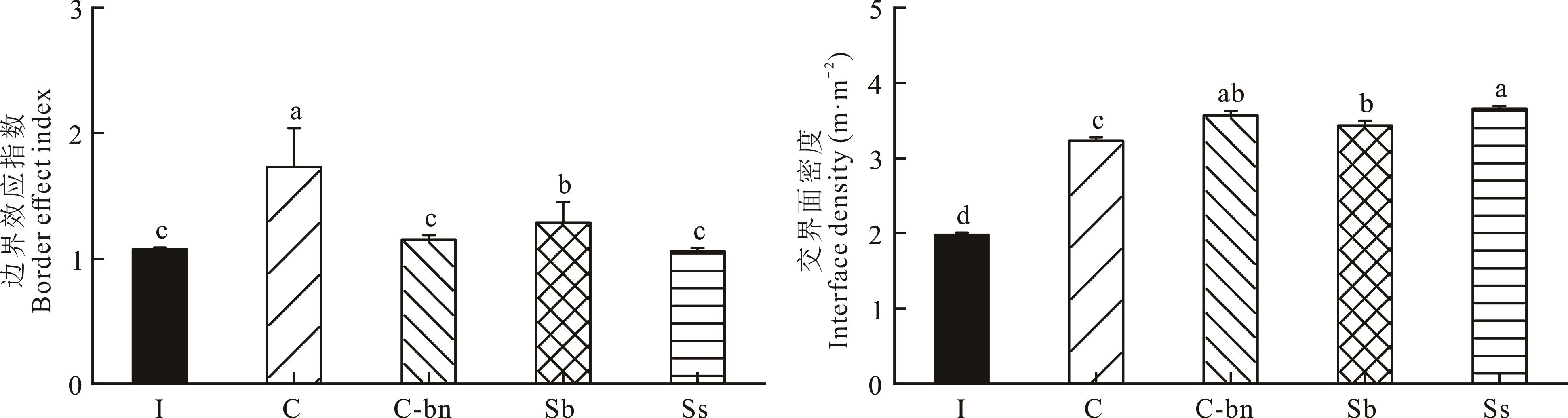
图4 不同复合种植模式的边界效应指数与交界面密度
Fig.4 Border effect index and interface density under different intercropping patterns
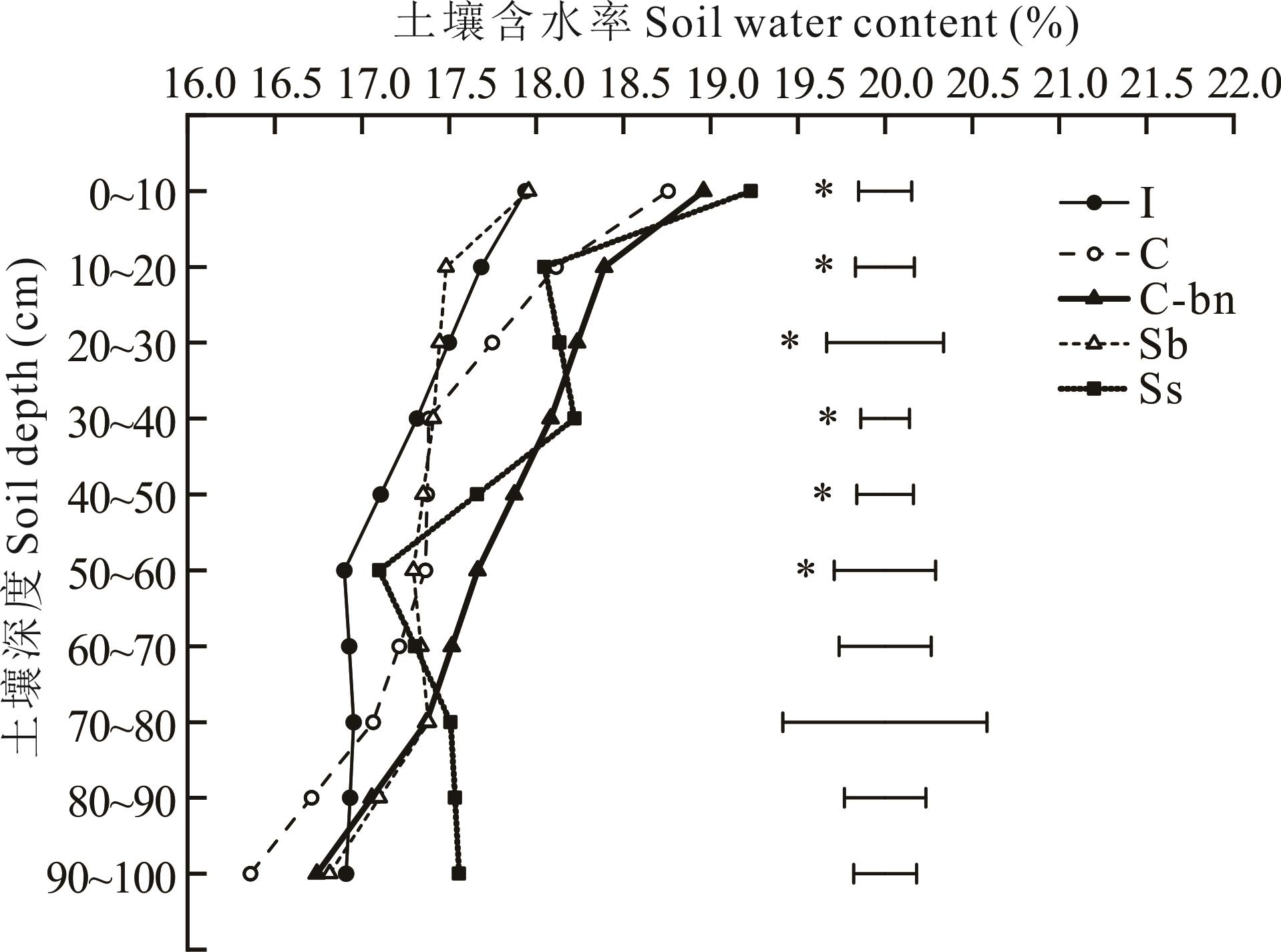
图5 不同复合种植模式0~100 cm土层土壤含水率*: 根据LSD检验,同一深度下土壤含水率较常规间作(I)存在显著差异(P<0.05)A significant difference in soil water content at the same depth compared to conventional intercropping (I), as determined by the least significant difference (LSD) test at the 0.05 level.
Fig.5 Soil water content in the 0-100 cm soil depth under different intercropping patterns

图6 不同复合种植模式的水分利用效率
Fig.6 Water use efficiency under different intercropping patterns

图7 不同复合种植模式下不同冠层高度的光截获率*:根据LSD检验,复合种植模式与I处理的平均光截获率之间存在显著差异(P<0.05) A significant difference in mean light interception ratio between the intercropping patterns and treatment I, as determined by the least significant difference (LSD) test at the 0.05 level.
Fig.7 Light interception ratio at different canopy heights under different intercropping patterns
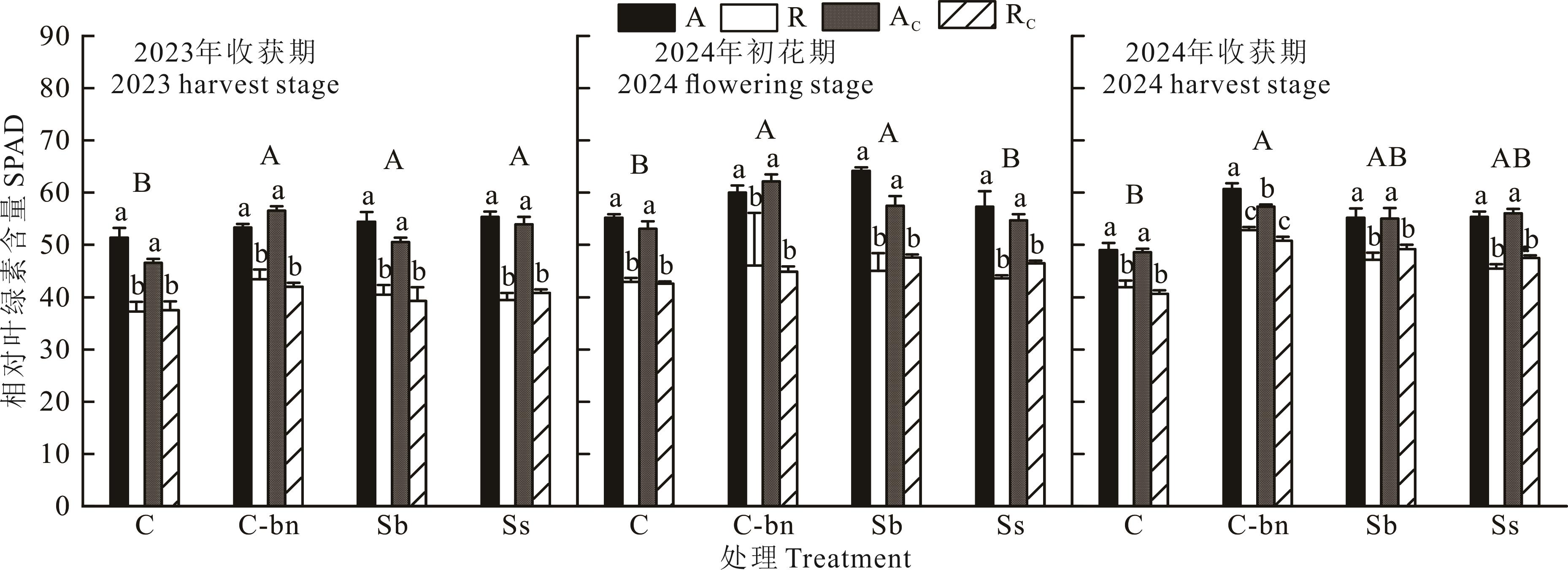
图8 不同复合种植模式下不同采样点的叶片SPAD图中4个位点分别为A(表示间作系统内紫花苜蓿非交界处采样点)、R(表示间作系统内黑麦草非交界处采样点)、AC(表示C、C-bn中与黑麦草条带相交叉的苜蓿采样点或Sb、Ss中与黑麦草区块相接的苜蓿采样点)和RC(表示C、C-bn中与苜蓿条带相交叉的黑麦草采样点或Sb、Ss中与苜蓿区块相接的黑麦草采样点)。不同小写字母表示同一处理内不同位点叶片SPAD值存在显著差异(P<0.05),不同大写字母表示各位点平均叶片SPAD值在不同处理间存在显著差异(P<0.05)。The Figure illustrates four sampling points: A represents the alfalfa sampling point in the non-interface area within the intercropping system; R represents the ryegrass sampling point in the non-interface area within the intercropping system; AC denotes the alfalfa sampling point intersecting with ryegrass strips (in treatments C and C-bn) or adjacent to ryegrass blocks (in treatments Sb and Ss); and RC denotes the ryegrass sampling point intersecting with alfalfa strips (in treatments C and C-bn) or adjacent to alfalfa blocks (in treatments Sb and Ss). Different lowercase letters indicate significant differences in leaf SPAD values among different positions within the same treatment (P<0.05), while different uppercase letters indicate significant differences in mean leaf SPAD values among different treatments (P<0.05).
Fig.8 Leaf SPAD values at different spatial positions under different intercropping patterns

图9 不同复合种植模式的光能利用效率
Fig.9 Radiation use efficiency under different intercropping patterns
| [1] | Lin S, Wang Y R. Spatial-temporal evolution of precipitation in China Loess Plateau. Journal of Desert Research, 2007(3): 502-508. |
| 林纾, 王毅荣. 中国黄土高原地区降水时空演变. 中国沙漠, 2007(3): 502-508. | |
| [2] | Kang S Z, Hao X M, Du T S, et al. Improving agricultural water productivity to ensure food security in China under changing environment: From research to practice. Agricultural Water Management, 2017, 179: 5-17. |
| [3] | Zhou H L. Response process and mechanism of water use in maize leaves to progressive drought. Beijing: Chinese Academy of Meteorological Sciences, 2020. |
| 周怀林. 玉米叶片水分利用的干旱响应过程与机制研究. 北京: 中国气象科学研究院, 2020. | |
| [4] | Yu X, Xiao S H, Li S J, et al. Review on crop yield and nitrogen utilization in cereal-legume intercropping system. Chinese Journal of Ecology, 2021, 40(8): 2601-2609. |
| 俞霞, 肖世豪, 李淑娟, 等. 禾本科-豆科间作模式中作物产量和氮素利用的研究进展. 生态学杂志, 2021, 40(8): 2601-2609. | |
| [5] | Xu H B, Hu J M, Luo G W, et al. Intercropping-driven maize yield gain depending on regional environments, planting conditions, and production managements: A global-scale evidence. European Journal of Agronomy, 2025, 168: 127622. |
| [6] | Yang H, Zhou Y, Chen P, et al. Effects of nutrient uptake and utilization on yield of maize-legume strip intercropping system. Acta Agronomica Sinica, 2022, 48(6): 1476-1487. |
| 杨欢, 周颖, 陈平, 等. 玉米-豆科作物带状间套作对养分吸收利用及产量优势的影响. 作物学报, 2022, 48(6): 1476-1487. | |
| [7] | Zhou Y, Lambrides C J, Fukai S. Associations between drought resistance, regrowth and quality in a perennial C4 grass. European Journal of Agronomy, 2015, 65: 1-9. |
| [8] | Li L, Tilman D, Lambers H, et al. Plant diversity and overyielding: Insights from belowground facilitation of intercropping in agriculture. New Phytologist, 2014, 203(1): 63-69. |
| [9] | Zhang H F, Pang G B, Fu Y R, et al. Effects of water stress at different growth stages on chlorophyll fluorescence parameters and yield of grape. Water Saving Irrigation, 2024(7): 1-7. |
| 张海峰, 庞桂斌, 付玉荣, 等. 不同生育期水分胁迫对葡萄叶绿素荧光参数指标和产量的影响. 节水灌溉, 2024(7): 1-7. | |
| [10] | Patra S, Parihar C M, Mahala D M, et al. Influence of long-term tillage and diversified cropping systems on hydro-physical properties in a sandy loam soil of north-western India. Soil and Tillage Research, 2023, 229: 105655. |
| [11] | Fan Z, Qiang B, Zhang X, et al. Optimizing light and nitrogen distribution in maize-soybean intercropping systems to enhance crop yield. European Journal of Agronomy, 2026, 172: 127853. |
| [12] | Zhang F, Li L. Using competitive and facilitative interactions in intercropping systems enhances crop productivity and nutrient-use efficiency. Plant and Soil, 2003, 248: 305-312. |
| [13] | Wu L B, Wang L L, Wang J W, et al. Effects of different carbon returning methods on grain yield, quality and water use efficiency of maize in dryland of the Loess Plateau. Scientia Agricultura Sinica, 2025, 58(14): 2751-2765. |
| 武凌彬, 王林林, 王江文, 等. 不同增碳方式对黄土高原旱地玉米产量、品质及水分利用效率的影响. 中国农业科学, 2025, 58(14): 2751-2765. | |
| [14] | Cui L, Yang W Y, Huang N, et al. Effects of maize plant types on dry matter accumulation characteristics and yield of soybean in maize-soybean intercropping systems. The Journal of Applied Ecology, 2015, 26(8): 2414-2420. |
| [15] | Wang F, Guo B B, Sun Z G, et al. Effects of elevated temperature and CO2 concentration on growth and yield of maize under intercropping with peanut. Acta Agronomica Sinica, 2021, 47(11): 2220-2231. |
| [16] | Guo H, Hou S, Zhang Y, et al. Incorporation alfalfa with annual forage enhances even water use and maintains forage yield resilience in a semiarid region. Agricultural Water Management, 2025, 320: 109838. |
| [17] | Weih M, Karley A J, Newton A C, et al. Grain yield stability of cereal-legume intercrops is greater than sole crops in more productive conditions. Agriculture, 2021, 11: 255. |
| [18] | Du G J, Bai W, Cai Q, et al. Effects of maize-alfalfa intercropping system on crop yields and productivity. Chinese Journal of Agrometeorology, 2025, 46(3): 398-408. |
| 杜桂娟, 白伟, 蔡倩, 等. 玉米-紫花苜蓿间作模式对作物产量及土地生产力的影响. 中国农业气象, 2025, 46(3): 398-408. | |
| [19] | Ren Y Y, Wang Z L, Wang X L, et al. The effect and mechanism of intercropping pattern on yield and economic benefit on the Loess Plateau. Acta Ecologica Sinica, 2015, 35(12): 4168-4177. |
| 任媛媛, 王志梁, 王小林, 等. 黄土塬区玉米大豆不同间作方式对产量和经济收益的影响及其机制. 生态学报, 2015, 35(12): 4168-4177. | |
| [20] | Vander Meer J H. The ecology of intercropping. London: Cambridge University Press, 2012: 176-188. |
| [21] | Li L, Sun J H, Zhang F S, et al. Wheat/maize or wheat/soybean strip intercropping: I. Yield advantage and interspecific interactions on nutrients. Field Crops Research, 2001, 71(2): 123-137. |
| [22] | Guo X X, Ma Z H, Zhang X Q, et al. Effects of different strip intercropping of soybean on soil hydrothermal dynamics and soybean yield. Journal of China Agricultural University, 2025, 30(12): 175-186. |
| 郭星星, 马子惠, 张向前, 等. 玉豆带状间作模式对土壤水热动态变化及大豆产量的影响. 中国农业大学学报, 2025, 30(12): 175-186. | |
| [23] | Lei Z D, Yang S X, Xie S C. Soil hydrodynamics. Beijing: Tsinghua University Press, 1988. |
| 雷志栋, 杨诗秀, 谢森传. 土壤水动力学. 北京: 清华大学出版社, 1988. | |
| [24] | Wang J X, Hu J Y, Zhang W, et al. Effects of different mulching methods on the production of photosynthetic substances and water use efficiency of intercropped maize. Scientia Agricultura Sinica, 2025, 58(3): 460-477. |
| 王佳芯, 胡静一, 张巍, 等. 覆膜方式对间作玉米光合物质生产及水分利用效率的影响. 中国农业科学, 2025, 58(3): 460-477. | |
| [25] | Morris R A, Garrity D P. Resource capture and utilization in intercropping: Water. Field Crops Research, 1993, 34: 303-317. |
| [26] | Grigera G, Oesterheld M. Variability of radiation use efficiency in mixed pastures under varying resource availability, defoliation and time scale. Grassland Science, 2021, 67(2): 156-166. |
| [27] | Sun J, Yang G, Zhang W, et al. Effects of heterogeneous salinity on growth, water uptake, and tissue ion concentrations of alfalfa. Plant and Soil, 2016, 408(1): 415-429. |
| [28] | Raza M A, Gul H, Wang J, et al. Land productivity and water use efficiency of maize-soybean strip intercropping systems in semi-arid areas: A case study in Punjab Province, Pakistan. Journal of Cleaner Production, 2021, 308: 127254. |
| [29] | Wang Y, Zhang Q, Ju M, et al. Alfalfa photosynthesis under partial root-zone drying: Diurnal patterns and its non-stomatal limitations. Plants, 2025, 14(11): 1573. |
| [30] | Bedoussac L, Journet E P, Hauggaard-Nielsen H, et al. Ecological principles underlying the increase of productivity achieved by cereal-grain legume intercrops in organic farming: A review. Agronomy for Sustainable Development, 2015, 35: 911-935. |
| [31] | Wedderburn M, Crush J, Pengelly W, et al. Root growth patterns of perennial ryegrass under well-watered and drought conditions. New Zealand Journal of Agricultural Research, 2010, 53(4): 377-388. |
| [32] | Katova A, Marinov-Serafimov P, Golubinova I, et al. Can we increase the drought tolerance of perennial ryegrass (Lolium perenne L.) to preserve grassland ecosystem services? A case study with three Bulgarian varieties. Plants, 2025, 14: 3704. |
| [33] | Wang Y F, Liu H Q, Zhao X N, et al. Effects of water and root separation on nitrogen uptake, utilization and transfer in a gramineae-legume intercropping system. Journal of Soil and Water Conservation, 2024, 38(4): 279-287. |
| 王一帆, 刘华清, 赵西宁, 等. 禾豆间作系统水分和根系分隔对牧草氮素吸收利用及转移的影响. 水土保持学报, 2024, 38(4): 279-287. | |
| [34] | Luo F, Liu W, Mi W, et al. Legume-grass mixtures increase forage yield by improving soil quality in different ecological regions of the Qinghai-Tibet Plateau. Frontiers in Plant Science, 2023, 14: 1280771. |
| [35] | Brooker R W, Maestre F T, Callaway R M, et al. Facilitation in plant communities: The past, the present, and the future. Journal of Ecology, 2008, 96: 18-34. |
| [36] | Wang R, Evers J B, Liu Y, et al. Border-row proportion determines strength of interspecific interactions and crop yields in maize/peanut strip intercropping. Field Crops Research, 2020, 253: 107819. |
| [37] | Cheng B, Wang L, Liu R, et al. Shade-tolerant soybean reduces yield loss by regulating its canopy structure and stem characteristics in the maize-soybean strip intercropping system. Frontiers in Plant Science, 2022, 13: 848893. |
| [38] | Feng L, Raza M A, Chen Y, et al. Narrow-wide row planting pattern improves the light environment and seed yields of intercrop species in relay intercropping system. PLoS One, 2019, 14(2): e0212885. |
| [39] | Chen P, Du Q, Liu X, et al. Effects of reduced nitrogen application rates on yield and nitrogen use efficiency in a maize–soybean relay strip intercropping system. Journal of Plant Nutrition and Soil Science, 2021, 184(2): 293-302. |
| [40] | Zhang W P, Liu G C, Sun J H, et al. Temporal dynamics of nutrient uptake by neighbouring plant species: Evidence from intercropping. Functional Ecology, 2017, 31(2): 469-479. |
| [41] | Hauggaard-Nielsen H, Gooding M, Ambus P, et al. Pea-barley intercropping for efficient symbiotic N2-fixation, soil N acquisition and use of other nutrients in European organic cropping systems. Field Crops Research, 2009, 113(1): 64-71. |
| [42] | Li Y S, Huang X, Luo J H, et al. Effects of different bandwidth and row ratios on yield and nitrogen efficiency of maize/soybean by relay strip intercropping. Chinese Journal of Oil Crop Sciences, 2024, 46(4): 863-871. |
| 李银水, 黄翔, 罗金华, 等. 不同带宽行比对玉米/大豆带状间套作群体产量和氮素效率的影响. 中国油料作物学报, 2024, 46(4): 863-871. | |
| [43] | Liang J, He Z, Shi W. Cotton/mung bean intercropping improves crop productivity, water use efficiency, nitrogen uptake, and economic benefits in the arid area of Northwest China. Agricultural Water Management, 2020, 240: 106277. |
| [44] | Rahman T, Ye L, Liu X, et al. Water use efficiency and water distribution response to different planting patterns in maize-soybean relay strip intercropping systems. Experimental Agriculture, 2017, 53(4): 543-561. |
| [45] | Homulle Z, George T S, Karley A J. Root traits with team benefits: Understanding belowground interactions in intercropping systems. Plant and Soil, 2022, 471: 1-26. |
| [46] | Li L, Sun J, Zhang F, et al. Root distribution and interactions between intercropped species. Oecologia, 2006, 147(2): 280-290. |
| [47] | Zhou Y Y, Xie Z W, Zhong P G, et al. Quantification of row orientation effects on radiation distribution in maize-soybean intercropping based on functional-structural plant model. Scientia Agricultura Sinica, 2024, 57(10): 1882-1899. |
| 周也莹, 谢子文, 钟培阁, 等. 基于功能-结构模型的玉米大豆间作不同行向辐射分布研究. 中国农业科学, 2024, 57(10): 1882-1899. | |
| [48] | Liu X, Rahman T, Song C, et al. Relationships among light distribution, radiation use efficiency and land equivalent ratio in maize-soybean strip intercropping. Field Crops Research, 2018, 224: 91-101. |
| [49] | Fan Y, Chen J, Cheng Y, et al. Effect of shading and light recovery on the growth, leaf structure, and photosynthetic performance of soybean in a maize-soybean relay-strip intercropping system. PLoS One, 2018, 13(5): e0198159. |
| [50] | Gong X W. Responses of light, water and fertilizer and the mechanism of reducing nitrogen and increasing efficiency in proso millet/mung bean intercropping system. Shaanxi: Northwest A&F University, 2021. |
| 宫香伟. 糜子/绿豆间作模式下糜子群体对光、水、肥资源的响应及减氮增效机制研究. 陕西: 西北农林科技大学, 2021. | |
| [51] | Wang L, Zhou T, Cheng B, et al. Variable light condition improves root distribution shallowness and P uptake of soybean in maize/soybean relay strip intercropping system. Plants, 2020, 9(9): 1204. |
| [52] | Shen L Q, Hu F L, Tuo M W, et al. Effects of intercropping belt type and mulching method on yield and water use efficiency in maize-pea systems. Acta Agriculturae Boreali-occidentalis Sinica, 2025, 34(10): 1781-1790. |
| 申龙强, 胡发龙, 拓明文, 等. 带型及覆盖方式对玉米||豌豆产量及水分利用效率的影响. 西北农业学报, 2025, 34(10): 1781-1790. | |
| [53] | Yao Z, Yu S M, Wang Q, et al. Water physiology and anatomical structure of Medicago sativa leaves in response to water stress. Acta Agrestia Sinica, 2025, 33(3): 823-830. |
| 姚泽, 于思敏, 王祺, 等. 紫花苜蓿叶片水分生理及其解剖结构的水分胁迫响应. 草地学报, 2025, 33(3): 823-830. | |
| [54] | Chen P, Xian G, Pu T, et al. Soybean-maize intercropping combined with water management enhances leaf traits to obtain yield benefits in semi-arid regions. Field Crops Research, 2025, 327: 109869. |
| [55] | Wang X C, Yang W Y. Review on relationship of source-sink and crop yield under shading stress in intercropping systems. Chinese Journal of Oil Crop Sciences, 2019, 41(2): 292-299. |
| 王兴才, 杨文钰. 基于间套作弱光胁迫下作物源库协调与产量研究进展. 中国油料作物学报, 2019, 41(2): 292-299. | |
| [56] | Bakhshy J, Zehtab-Salmasi S, Ghassemi-Golezani K, et al. The interactive effects of water and shade stresses on field performance of soybean. International Journal of Agronomy and Plant Production, 2013, 4: 2330-2334. |
| [1] | 余冬雯, 王晓彤, 马永龙, 吴轩, 杨金辉, 童玉花, 李淑霞. 2,4-表芸苔素内酯对干旱胁迫下紫花苜蓿生理特性的影响[J]. 草业学报, 2026, 35(9): 63-74. |
| [2] | 杨金辉, 王晓彤, 马永龙, 余冬雯, 童玉花, 李淑霞. 喷施纳米氧化铈对紫花苜蓿幼苗耐盐性的影响[J]. 草业学报, 2026, 35(8): 45-54. |
| [3] | 黄兆鹏, 何蓉, 南丽丽, 刘佳乐, 杨文科. 低磷胁迫下外源褪黑素对紫花苜蓿幼苗内源激素及有机酸的影响[J]. 草业学报, 2026, 35(8): 55-64. |
| [4] | 陈奋奇, 张金青, 禹一箭, 李振宇. 紫花苜蓿AP2亚家族基因鉴定、生信分析及MsBBM基因克隆[J]. 草业学报, 2026, 35(7): 117-134. |
| [5] | 刘昊臻, 晁嘉潞, 赵士钦, 王成, 张景鈜, 孙守江. 紫花苜蓿BBR-BPC全基因组鉴定及响应种子老化的表达模式分析[J]. 草业学报, 2026, 35(7): 135-150. |
| [6] | 翟勇全, 马尧, 宋丽华, 曹兵. 黑麦草间作密度对枣-草间作系统生产力、净效益和可持续性的影响[J]. 草业学报, 2026, 35(7): 68-79. |
| [7] | 任孟雨, 王利群, 南丽丽, 郭佳雨. 紫花苜蓿新品系对盐胁迫的响应[J]. 草业学报, 2026, 35(6): 24-34. |
| [8] | 李小聪, 闫聚辉, 王星, 胡鹏飞, 叶雨浓, 伏兵哲. 紫花苜蓿/无芒雀麦间作对草地生产性能和土壤理化特性的影响[J]. 草业学报, 2026, 35(5): 113-125. |
| [9] | 马苹, 刘志国, 沙煜舒, 刘亚玲, 妥小梅, 伏兵哲, 高雪芹. 紫花苜蓿苗期氮利用特性及氮高效品种的筛选[J]. 草业学报, 2026, 35(4): 112-123. |
| [10] | 张钿, 冷华娟, 崔婧, 何飞, 王雪, 李明娜, 杨青川, 康俊梅. 紫花苜蓿突触结合蛋白家族成员鉴定与非生物胁迫下的表达分析[J]. 草业学报, 2026, 35(4): 158-168. |
| [11] | 张世超, 崔国文, 张德鹏, 韩福迎, 丁叮, 吕向丽, 林硕, 陈乐然, 李吉儒, 才华. 紫花苜蓿非组培遗传转化体系创建及在耐盐基因功能鉴定与基因编辑中的应用[J]. 草业学报, 2026, 35(3): 223-234. |
| [12] | 童玉花, 王晓彤, 马永龙, 杨金辉, 余冬雯, 李淑霞. 壳聚糖浸种对盐碱胁迫下紫花苜蓿种子萌发的影响[J]. 草业学报, 2026, 35(3): 245-256. |
| [13] | 陈丽娟, 高荣, 王建喜, 马晖玲. 紫花苜蓿与红豆草在不同生长时期缩合单宁合成差异的比较研究[J]. 草业学报, 2026, 35(2): 221-236. |
| [14] | 李瑒琨, 本转林, 张筠钰, 杨惠敏. 不同气候和土壤条件下施肥类型影响紫花苜蓿种子产量的整合分析[J]. 草业学报, 2026, 35(2): 54-67. |
| [15] | 张继元, 安海全, 潘靖一, 刘畅, 龙思思, 赵丽丽. 7个紫花苜蓿品种种子萌发及幼苗生长的抗旱性评价[J]. 草业学报, 2026, 35(2): 68-82. |
| 阅读次数 | ||||||
|
全文 |
|
|||||
|
摘要 |
|
|||||
