

ISSN 1004-5759 CN 62-1105/S
草业学报 ›› 2026, Vol. 35 ›› Issue (12): 183-196.DOI: 10.11686/cyxb2026028
• 研究论文 • 上一篇
田甜1,2,3,4( ), 王灵洁1,2,3,4, 王志军1,2,3,4, 张银霞1,2,3,4, 杜文华1,2,3,4()
收稿日期:2026-01-20
修回日期:2026-03-30
出版日期:2026-12-20
发布日期:2026-11-02
通讯作者:
杜文华
作者简介:E-mail: duwh@gsau.edu.cn基金资助:
Tian TIAN1,2,3,4(), Ling-jie WANG1,2,3,4, Zhi-jun WANG1,2,3,4, Yin-xia ZHANG1,2,3,4, Wen-hua DU1,2,3,4()
Received:2026-01-20
Revised:2026-03-30
Online:2026-12-20
Published:2026-11-02
Contact:
Wen-hua DU
摘要:
小黑麦(×Triticosecale)是小麦属(Triticum)与黑麦属(Secale)人工杂交形成的多倍体饲草作物,兼具高产与抗逆优势。叶绿体基因组相对保守,是研究杂交作物的理想工具,以NCBI公共数据库中的六倍体小黑麦(登录号:ON422331.1)为研究对象,通过生物信息学方法系统解析了其叶绿体基因组结构、反向重复序列(IR)边界动态变化及与近缘属的比较基因组学特征。结果显示,该基因组全长135899 bp,呈典型四分体结构,共注释了112个独特基因(其中19个基因含内含子)。共鉴定了114个叶绿体简单序列重复(SSR)和47个长重复序列,发现IR区存在849 bp特异性扩张,伴随大单拷贝区344 bp相应收缩。比较基因组分析表明编码区高度保守,非编码区呈序列分化;系统发育分析显示,小黑麦以100%bootstrap支持率聚类于小麦属分支,与硬粒小麦亲缘关系最近。研究解析了小黑麦叶绿体基因组,为后续细胞器基因功能及分子标记开发提供了基础。
田甜, 王灵洁, 王志军, 张银霞, 杜文华. 小黑麦叶绿体基因组生物信息学解析及分子标记位点挖掘[J]. 草业学报, 2026, 35(12): 183-196.
Tian TIAN, Ling-jie WANG, Zhi-jun WANG, Yin-xia ZHANG, Wen-hua DU. Bioinformatic analysis of the triticale chloroplast genome and identification of molecular marker loci[J]. Acta Prataculturae Sinica, 2026, 35(12): 183-196.

图1 小黑麦起源概要(译自Simmonds[6])
Fig.1 Summary chart of the origins of different types of triticale (Source: Simmonds[6])
项目 Item | 碱基占比Percentage of bases (%) | 长度 Length (bp) | |||
|---|---|---|---|---|---|
| GC | GC1 | GC2 | GC3 | ||
| 全长Full length | 38.32 | 38.26 | 38.54 | 38.15 | 135899 |
| 大单拷贝区Large single copy (LSC) | 36.28 | 35.85 | 36.37 | 36.63 | 80004 |
| 小单拷贝区Small single copy (SSC) | 32.18 | 33.19 | 32.89 | 30.47 | 12791 |
| 重复拷贝区域A Inverted repeat A (IRA) | 43.91 | 44.06 | 44.43 | 43.25 | 21552 |
| 重复拷贝区域B Inverted repeat B (IRB) | 43.91 | 43.25 | 44.43 | 44.06 | 21552 |
表1 小黑麦叶绿体基因组中密码子的碱基组成特征
Table 1 Base composition characteristics of codons in chloroplast genome of triticale
项目 Item | 碱基占比Percentage of bases (%) | 长度 Length (bp) | |||
|---|---|---|---|---|---|
| GC | GC1 | GC2 | GC3 | ||
| 全长Full length | 38.32 | 38.26 | 38.54 | 38.15 | 135899 |
| 大单拷贝区Large single copy (LSC) | 36.28 | 35.85 | 36.37 | 36.63 | 80004 |
| 小单拷贝区Small single copy (SSC) | 32.18 | 33.19 | 32.89 | 30.47 | 12791 |
| 重复拷贝区域A Inverted repeat A (IRA) | 43.91 | 44.06 | 44.43 | 43.25 | 21552 |
| 重复拷贝区域B Inverted repeat B (IRB) | 43.91 | 43.25 | 44.43 | 44.06 | 21552 |

图2 小黑麦叶绿体基因组
Fig.2 The complete chloroplast genome of triticale
| 功能Function | 基因类别Gene group | 基因名称Gene name |
|---|---|---|
光合作用 Photosynthesis | 光系统Ⅰ的亚基Subunits of photosystemⅠ | psaA,psaB,psaC,psaI,psaJ |
| 光系统Ⅱ的亚基Subunits of photosystem Ⅱ | psbA,psbB,psbC,psbD,psbE,psbF,psbH,psbI,psbJ,psbK,psbL,psbM,psbN,psbT,psbZ | |
| NADH脱氢酶的亚基Subunits of NADH dehydrogenase | ndhA*,ndhB*(2),ndhC,ndhD,ndhE,ndhF,ndhG,ndhH,ndhI,ndhJ,ndhK | |
| 细胞色素b/f复合物的亚基Subunits of cytochrome b/f complex | petA,petB*,petD*,petG,petL,petN | |
| ATP合酶的亚基Subunits of ATP synthase | atpA,atpB,atpE,atpF*,atpH,atpI | |
| Rubisco的大亚基Large subunit of Rubisco | rbcL | |
| 光叶绿素酸酯还原酶的亚基Subunits of photochlorophyllide reductase | - | |
自我复制 Self-replication | 大核糖体亚基的蛋白质Proteins of large ribosomal subunit | rpl14,rpl16*,rpl2*(2),rpl20,rpl22,rpl23(2),rpl32,rpl33,rpl36 |
| 小核糖体亚基的蛋白质Proteins of small ribosomal subunit | rps11,rps12**(2),rps14,rps15(2),rps16*,rps18,rps19(2),rps2,rps3,rps4,rps7(2),rps8 | |
| RNA聚合酶的亚基Subunits of RNA polymerase | rpoA,rpoB,rpoC1,rpoC2 | |
| 核糖体RNA Ribosomal RNAs | rrn16(2),rrn23(2),rrn4.5(2),rrn5(2) | |
| 转运RNA Transfer RNAs | trnA-UGC*(2),trnC-GCA,trnD-GUC,trnE-UUC,trnF-GAA,trnG-GCC,trnG-UCC*,trnH-GUG(2),trnI-CAU(2),trnI-GAU*(2),trnK-UUU*,trnL-CAA(2),trnL-UAA*,trnL-UAG,trnM-CAU,trnN-GUU(2),trnP-UGG,trnQ-UUG,trnR-ACG(2),trnR-UCU,trnS-GCU,trnS-GGA,trnS-UGA,trnT-GGU,trnT-UGU,trnV-GAC(2),trnV-UAC*,trnW-CCA,trnY-GUA,trnfM-CAU | |
其他基因 Other genes | 成熟酶Maturase | matK |
| 蛋白酶Protease | clpP | |
| 包膜蛋白Envelope membrane protein | cemA | |
| 乙酰辅酶A羧化酶Acetyl-CoA carboxylase | - | |
| c型细胞色素合成基因c-type cytochrome synthesis gene | ccsA | |
| 翻译起始因子Translation initiation factor | infA | |
| 其他Other | - | |
未知功能基因 Genes of unknown function | 保守的假设叶绿体开放阅读框Conserved hypothetical chloroplast open reading frame | ycf2(2),ycf3**,ycf4,ycf68(2) |
表 2 小黑麦叶绿体基因功能分类
Table 2 Functional classification of chloroplast genes in triticale
| 功能Function | 基因类别Gene group | 基因名称Gene name |
|---|---|---|
光合作用 Photosynthesis | 光系统Ⅰ的亚基Subunits of photosystemⅠ | psaA,psaB,psaC,psaI,psaJ |
| 光系统Ⅱ的亚基Subunits of photosystem Ⅱ | psbA,psbB,psbC,psbD,psbE,psbF,psbH,psbI,psbJ,psbK,psbL,psbM,psbN,psbT,psbZ | |
| NADH脱氢酶的亚基Subunits of NADH dehydrogenase | ndhA*,ndhB*(2),ndhC,ndhD,ndhE,ndhF,ndhG,ndhH,ndhI,ndhJ,ndhK | |
| 细胞色素b/f复合物的亚基Subunits of cytochrome b/f complex | petA,petB*,petD*,petG,petL,petN | |
| ATP合酶的亚基Subunits of ATP synthase | atpA,atpB,atpE,atpF*,atpH,atpI | |
| Rubisco的大亚基Large subunit of Rubisco | rbcL | |
| 光叶绿素酸酯还原酶的亚基Subunits of photochlorophyllide reductase | - | |
自我复制 Self-replication | 大核糖体亚基的蛋白质Proteins of large ribosomal subunit | rpl14,rpl16*,rpl2*(2),rpl20,rpl22,rpl23(2),rpl32,rpl33,rpl36 |
| 小核糖体亚基的蛋白质Proteins of small ribosomal subunit | rps11,rps12**(2),rps14,rps15(2),rps16*,rps18,rps19(2),rps2,rps3,rps4,rps7(2),rps8 | |
| RNA聚合酶的亚基Subunits of RNA polymerase | rpoA,rpoB,rpoC1,rpoC2 | |
| 核糖体RNA Ribosomal RNAs | rrn16(2),rrn23(2),rrn4.5(2),rrn5(2) | |
| 转运RNA Transfer RNAs | trnA-UGC*(2),trnC-GCA,trnD-GUC,trnE-UUC,trnF-GAA,trnG-GCC,trnG-UCC*,trnH-GUG(2),trnI-CAU(2),trnI-GAU*(2),trnK-UUU*,trnL-CAA(2),trnL-UAA*,trnL-UAG,trnM-CAU,trnN-GUU(2),trnP-UGG,trnQ-UUG,trnR-ACG(2),trnR-UCU,trnS-GCU,trnS-GGA,trnS-UGA,trnT-GGU,trnT-UGU,trnV-GAC(2),trnV-UAC*,trnW-CCA,trnY-GUA,trnfM-CAU | |
其他基因 Other genes | 成熟酶Maturase | matK |
| 蛋白酶Protease | clpP | |
| 包膜蛋白Envelope membrane protein | cemA | |
| 乙酰辅酶A羧化酶Acetyl-CoA carboxylase | - | |
| c型细胞色素合成基因c-type cytochrome synthesis gene | ccsA | |
| 翻译起始因子Translation initiation factor | infA | |
| 其他Other | - | |
未知功能基因 Genes of unknown function | 保守的假设叶绿体开放阅读框Conserved hypothetical chloroplast open reading frame | ycf2(2),ycf3**,ycf4,ycf68(2) |
基因 Gene | 外显子1 Exon I | 内含子1 Intron I | 外显子2 Exon Ⅱ | 内含子2 Intron Ⅱ | 外显子3 Exon Ⅲ | 基因 Gene | 外显子1 Exon I | 内含子1 Intron I | 外显子2 Exon Ⅱ | 内含子2 Intron Ⅱ | 外显子3 Exon Ⅲ |
|---|---|---|---|---|---|---|---|---|---|---|---|
| trnK-UUU | 38 | 2484 | 36 | rpl2 | 388 | 663 | 431 | ||||
| rps16 | 40 | 789 | 218 | ndhB | 775 | 712 | 758 | ||||
| trnS-CGA | 31 | 658 | 62 | trnT-CGU | 32 | 787 | 59 | ||||
| atpF | 145 | 826 | 407 | trnA-UGC | 37 | 805 | 36 | ||||
| ycf3 | 124 | 756 | 230 | 731 | 159 | ndhA | 550 | 1036 | 539 | ||
| trnL-UAA | 36 | 588 | 51 | trnA-UGC | 37 | 805 | 36 | ||||
| trnV-UAC | 38 | 581 | 53 | trnT-CGU | 32 | 787 | 59 | ||||
| petB | 6 | 748 | 642 | ndhB | 775 | 712 | 758 | ||||
| petD | 8 | 749 | 475 | rpl2 | 388 | 663 | 431 | ||||
| rpl16 | 9 | 1043 | 402 |
表3 小黑麦叶绿体基因组中含内含子基因的外显子与内含子长度
Table 3 The length of exons and introns in genes with introns in triticale chloroplast genome (bp)
基因 Gene | 外显子1 Exon I | 内含子1 Intron I | 外显子2 Exon Ⅱ | 内含子2 Intron Ⅱ | 外显子3 Exon Ⅲ | 基因 Gene | 外显子1 Exon I | 内含子1 Intron I | 外显子2 Exon Ⅱ | 内含子2 Intron Ⅱ | 外显子3 Exon Ⅲ |
|---|---|---|---|---|---|---|---|---|---|---|---|
| trnK-UUU | 38 | 2484 | 36 | rpl2 | 388 | 663 | 431 | ||||
| rps16 | 40 | 789 | 218 | ndhB | 775 | 712 | 758 | ||||
| trnS-CGA | 31 | 658 | 62 | trnT-CGU | 32 | 787 | 59 | ||||
| atpF | 145 | 826 | 407 | trnA-UGC | 37 | 805 | 36 | ||||
| ycf3 | 124 | 756 | 230 | 731 | 159 | ndhA | 550 | 1036 | 539 | ||
| trnL-UAA | 36 | 588 | 51 | trnA-UGC | 37 | 805 | 36 | ||||
| trnV-UAC | 38 | 581 | 53 | trnT-CGU | 32 | 787 | 59 | ||||
| petB | 6 | 748 | 642 | ndhB | 775 | 712 | 758 | ||||
| petD | 8 | 749 | 475 | rpl2 | 388 | 663 | 431 | ||||
| rpl16 | 9 | 1043 | 402 |
基因 Gene | 长度1 Length 1 (bp) | 起始1 Start 1 (bp) | 类型 Type | 长度2 Length 2 (bp) | 起始2 Start 2 (bp) | Hamming值 Hamming | E值 E-value | 区域 Region |
|---|---|---|---|---|---|---|---|---|
| - | 21552 | 80004 | P | 21552 | 114347 | 0 | 0 | LSC-IRb; SSC-IRa |
| IGS; rpl23 | 286 | 56298 | P | 286 | 82092 | -1 | 2.88×10-160 | LSC; IRb |
| IGS; rpl23 | 286 | 56298 | D | 286 | 133525 | -1 | 2.88×10-160 | LSC; IRa |
| IGS; rpl23 | 111 | 56473 | P | 111 | 82092 | 0 | 7.71×10-58 | LSC; IRb |
| IGS; rpl23-2 | 111 | 56473 | D | 111 | 133700 | 0 | 7.71×10-58 | LSC; IRa |
| IGS; IGS | 60 | 100722 | P | 60 | 100722 | -2 | 6.23×10⁻²³ | IRb; IRb |
| IGS; IGS | 60 | 100722 | D | 60 | 115121 | -2 | 6.23×10⁻²³ | IRb; IRa |
| IGS; IGS | 60 | 115121 | P | 60 | 115121 | -2 | 6.23×10⁻²³ | IRa; IRa |
| IGS; rps12 | 49 | 14368 | D | 49 | 88910 | -3 | 8.15×10⁻¹⁵ | LSC; IRb |
| IGS; rps12 | 49 | 14368 | P | 49 | 126944 | -3 | 8.15×10⁻¹⁵ | LSC; IRa |
| IGS; IGS | 43 | 12606 | D | 43 | 12774 | -3 | 2.24×10⁻¹¹ | LSC; LSC |
| rps18; rps18 | 40 | 65224 | D | 40 | 65266 | -2 | 3.02×10⁻¹¹ | LSC; LSC |
| trnfM-CAU; IGS | 41 | 12682 | D | 41 | 36224 | -3 | 3.09×10⁻¹⁰ | LSC; LSC |
| psaB; psaA | 38 | 38253 | D | 38 | 40477 | -2 | 4.35×10⁻¹⁰ | LSC; LSC |
| IGS; IGS | 38 | 41450 | D | 38 | 41464 | -2 | 4.35×10⁻¹⁰ | LSC; LSC |
| ycf3; IGS | 39 | 43222 | D | 39 | 89574 | -3 | 4.24×10⁻⁹ | LSC; IRb |
| ycf3; IGS | 39 | 43222 | P | 39 | 126290 | -3 | 4.24×10⁻⁹ | LSC; IRa |
| ndhB; ndhB | 30 | 86577 | P | 30 | 86577 | 0 | 4.51×10⁻⁹ | IRb; IRb |
| ndhB; ndhB | 30 | 86577 | D | 30 | 129296 | 0 | 4.51×10⁻⁹ | IRb; IRa |
| ndhB; ndhB | 30 | 129296 | P | 30 | 129296 | 0 | 4.51×10⁻⁹ | IRa; IRa |
| trnS-GCU; trnS-GGA | 36 | 7527 | P | 36 | 44746 | -2 | 6.24×10⁻⁹ | LSC; LSC |
| IGS; IGS | 33 | 60479 | P | 33 | 60479 | -1 | 6.97×10⁻⁹ | LSC; LSC |
| IGS; IGS | 38 | 12577 | D | 38 | 36289 | -3 | 1.57×10⁻⁸ | LSC; LSC |
| infA; infA | 38 | 75735 | D | 38 | 75753 | -3 | 1.57×10⁻⁸ | LSC; LSC |
| rps18; rps18 | 37 | 65244 | D | 37 | 65286 | -3 | 5.77×10⁻⁸ | LSC; LSC |
| IGS; IGS | 31 | 100753 | D | 31 | 115152 | -1 | 1.05×10⁻⁷ | IRb; IRa |
| IGS; IGS | 36 | 12785 | D | 36 | 36330 | -3 | 2.12×10⁻⁷ | LSC; LSC |
| rpoC2; rpoC2 | 36 | 27000 | D | 36 | 27051 | -3 | 2.12×10⁻⁷ | LSC; LSC |
| trnfM-CAU; IGS | 35 | 12666 | D | 35 | 36208 | -3 | 7.77×10⁻⁷ | LSC; LSC |
| rpoC2; rpoC2 | 34 | 27081 | D | 34 | 27102 | -3 | 2.84×10⁻⁶ | LSC; LSC |
| rpoC2; rpoC2 | 34 | 27143 | D | 34 | 27218 | -3 | 2.84×10⁻⁶ | LSC; LSC |
| rpoC2; rpoC2 | 34 | 27206 | D | 34 | 27272 | -3 | 2.84×10⁻⁶ | LSC; LSC |
| rps18; rps18 | 34 | 65266 | D | 34 | 65287 | -3 | 2.84×10⁻⁶ | LSC; LSC |
| rps3; rps3 | 34 | 79232 | D | 34 | 79277 | -3 | 2.84×10⁻⁶ | LSC; LSC |
| rps18; rps18 | 31 | 65282 | D | 31 | 65303 | -2 | 4.71×10⁻⁶ | LSC; LSC |
| trnG-UCC; IGS | 33 | 12814 | D | 33 | 36191 | -3 | 1.04×10⁻⁵ | LSC; LSC |
| psbM; psbM | 30 | 16660 | P | 30 | 16660 | -2 | 1.76×10⁻⁵ | LSC; LSC |
| rps18; rps18 | 30 | 65680 | P | 30 | 65680 | -2 | 1.76×10⁻⁵ | LSC; LSC |
| trnS-UGA; trnS-GGA | 32 | 11223 | P | 32 | 44753 | -3 | 3.77×10⁻⁵ | LSC; LSC |
| trnT-GGU; trnT-UGU | 32 | 14733 | P | 32 | 45996 | -3 | 3.77×10⁻⁵ | LSC; LSC |
| rpoC2; rpoC2 | 32 | 26962 | D | 32 | 27061 | -3 | 3.77×10⁻⁵ | LSC; LSC |
| rpoC2; rpoC2 | 32 | 27109 | D | 32 | 27163 | -3 | 3.77×10⁻⁵ | LSC; LSC |
| rpoC2; rpoC2 | 31 | 26954 | D | 31 | 27149 | -3 | 1.37×10⁻⁴ | LSC; LSC |
| rpoC2; rpoC2 | 31 | 27131 | D | 31 | 27272 | -3 | 1.37×10⁻⁴ | LSC; LSC |
| rps18; rps18 | 30 | 65213 | D | 30 | 65318 | -3 | 4.94×10⁻⁴ | LSC; LSC |
| rps18; rps18 | 30 | 65266 | D | 30 | 65308 | -3 | 4.94×10⁻⁴ | LSC; LSC |
| rps18; rps18 | 30 | 65301 | D | 30 | 65322 | -3 | 4.94×10⁻⁴ | LSC; LSC |
表4 小黑麦叶绿体基因组中的重复序列
Table 4 Repeat sequences in triticale chloroplast genome
基因 Gene | 长度1 Length 1 (bp) | 起始1 Start 1 (bp) | 类型 Type | 长度2 Length 2 (bp) | 起始2 Start 2 (bp) | Hamming值 Hamming | E值 E-value | 区域 Region |
|---|---|---|---|---|---|---|---|---|
| - | 21552 | 80004 | P | 21552 | 114347 | 0 | 0 | LSC-IRb; SSC-IRa |
| IGS; rpl23 | 286 | 56298 | P | 286 | 82092 | -1 | 2.88×10-160 | LSC; IRb |
| IGS; rpl23 | 286 | 56298 | D | 286 | 133525 | -1 | 2.88×10-160 | LSC; IRa |
| IGS; rpl23 | 111 | 56473 | P | 111 | 82092 | 0 | 7.71×10-58 | LSC; IRb |
| IGS; rpl23-2 | 111 | 56473 | D | 111 | 133700 | 0 | 7.71×10-58 | LSC; IRa |
| IGS; IGS | 60 | 100722 | P | 60 | 100722 | -2 | 6.23×10⁻²³ | IRb; IRb |
| IGS; IGS | 60 | 100722 | D | 60 | 115121 | -2 | 6.23×10⁻²³ | IRb; IRa |
| IGS; IGS | 60 | 115121 | P | 60 | 115121 | -2 | 6.23×10⁻²³ | IRa; IRa |
| IGS; rps12 | 49 | 14368 | D | 49 | 88910 | -3 | 8.15×10⁻¹⁵ | LSC; IRb |
| IGS; rps12 | 49 | 14368 | P | 49 | 126944 | -3 | 8.15×10⁻¹⁵ | LSC; IRa |
| IGS; IGS | 43 | 12606 | D | 43 | 12774 | -3 | 2.24×10⁻¹¹ | LSC; LSC |
| rps18; rps18 | 40 | 65224 | D | 40 | 65266 | -2 | 3.02×10⁻¹¹ | LSC; LSC |
| trnfM-CAU; IGS | 41 | 12682 | D | 41 | 36224 | -3 | 3.09×10⁻¹⁰ | LSC; LSC |
| psaB; psaA | 38 | 38253 | D | 38 | 40477 | -2 | 4.35×10⁻¹⁰ | LSC; LSC |
| IGS; IGS | 38 | 41450 | D | 38 | 41464 | -2 | 4.35×10⁻¹⁰ | LSC; LSC |
| ycf3; IGS | 39 | 43222 | D | 39 | 89574 | -3 | 4.24×10⁻⁹ | LSC; IRb |
| ycf3; IGS | 39 | 43222 | P | 39 | 126290 | -3 | 4.24×10⁻⁹ | LSC; IRa |
| ndhB; ndhB | 30 | 86577 | P | 30 | 86577 | 0 | 4.51×10⁻⁹ | IRb; IRb |
| ndhB; ndhB | 30 | 86577 | D | 30 | 129296 | 0 | 4.51×10⁻⁹ | IRb; IRa |
| ndhB; ndhB | 30 | 129296 | P | 30 | 129296 | 0 | 4.51×10⁻⁹ | IRa; IRa |
| trnS-GCU; trnS-GGA | 36 | 7527 | P | 36 | 44746 | -2 | 6.24×10⁻⁹ | LSC; LSC |
| IGS; IGS | 33 | 60479 | P | 33 | 60479 | -1 | 6.97×10⁻⁹ | LSC; LSC |
| IGS; IGS | 38 | 12577 | D | 38 | 36289 | -3 | 1.57×10⁻⁸ | LSC; LSC |
| infA; infA | 38 | 75735 | D | 38 | 75753 | -3 | 1.57×10⁻⁸ | LSC; LSC |
| rps18; rps18 | 37 | 65244 | D | 37 | 65286 | -3 | 5.77×10⁻⁸ | LSC; LSC |
| IGS; IGS | 31 | 100753 | D | 31 | 115152 | -1 | 1.05×10⁻⁷ | IRb; IRa |
| IGS; IGS | 36 | 12785 | D | 36 | 36330 | -3 | 2.12×10⁻⁷ | LSC; LSC |
| rpoC2; rpoC2 | 36 | 27000 | D | 36 | 27051 | -3 | 2.12×10⁻⁷ | LSC; LSC |
| trnfM-CAU; IGS | 35 | 12666 | D | 35 | 36208 | -3 | 7.77×10⁻⁷ | LSC; LSC |
| rpoC2; rpoC2 | 34 | 27081 | D | 34 | 27102 | -3 | 2.84×10⁻⁶ | LSC; LSC |
| rpoC2; rpoC2 | 34 | 27143 | D | 34 | 27218 | -3 | 2.84×10⁻⁶ | LSC; LSC |
| rpoC2; rpoC2 | 34 | 27206 | D | 34 | 27272 | -3 | 2.84×10⁻⁶ | LSC; LSC |
| rps18; rps18 | 34 | 65266 | D | 34 | 65287 | -3 | 2.84×10⁻⁶ | LSC; LSC |
| rps3; rps3 | 34 | 79232 | D | 34 | 79277 | -3 | 2.84×10⁻⁶ | LSC; LSC |
| rps18; rps18 | 31 | 65282 | D | 31 | 65303 | -2 | 4.71×10⁻⁶ | LSC; LSC |
| trnG-UCC; IGS | 33 | 12814 | D | 33 | 36191 | -3 | 1.04×10⁻⁵ | LSC; LSC |
| psbM; psbM | 30 | 16660 | P | 30 | 16660 | -2 | 1.76×10⁻⁵ | LSC; LSC |
| rps18; rps18 | 30 | 65680 | P | 30 | 65680 | -2 | 1.76×10⁻⁵ | LSC; LSC |
| trnS-UGA; trnS-GGA | 32 | 11223 | P | 32 | 44753 | -3 | 3.77×10⁻⁵ | LSC; LSC |
| trnT-GGU; trnT-UGU | 32 | 14733 | P | 32 | 45996 | -3 | 3.77×10⁻⁵ | LSC; LSC |
| rpoC2; rpoC2 | 32 | 26962 | D | 32 | 27061 | -3 | 3.77×10⁻⁵ | LSC; LSC |
| rpoC2; rpoC2 | 32 | 27109 | D | 32 | 27163 | -3 | 3.77×10⁻⁵ | LSC; LSC |
| rpoC2; rpoC2 | 31 | 26954 | D | 31 | 27149 | -3 | 1.37×10⁻⁴ | LSC; LSC |
| rpoC2; rpoC2 | 31 | 27131 | D | 31 | 27272 | -3 | 1.37×10⁻⁴ | LSC; LSC |
| rps18; rps18 | 30 | 65213 | D | 30 | 65318 | -3 | 4.94×10⁻⁴ | LSC; LSC |
| rps18; rps18 | 30 | 65266 | D | 30 | 65308 | -3 | 4.94×10⁻⁴ | LSC; LSC |
| rps18; rps18 | 30 | 65301 | D | 30 | 65322 | -3 | 4.94×10⁻⁴ | LSC; LSC |

图3 小黑麦叶绿体基因组中重复序列长度、重复序列及区域
Fig.3 Length of repeat, repeate sequences and region in the triticale chloroplast genome

图4 小麦属、黑麦属与小黑麦的叶绿体基因组比较
Fig.4 Comparison of chloroplast genomes in the genus Triticum, Secale and triticale

图5 小麦属、黑麦属及小黑麦的LSC、SSC及IR区域边界比较
Fig.5 Comparison of the borders of the LSC, SSC, and IR regions of the genus Triticum, Secale and triticale

图6 小麦属、黑麦属及小黑麦的叶绿体基因组序列分析比对结果上方的灰色箭头和粗黑线表示基因方向Above the alignment result, gray arrows and thick black lines indicate gene orientation; 紫色条带Purple band: 外显子Exons; 蓝色条带Blue band: 非翻译区Untranslated regions; 粉色条带Pink band: 保守非编码序列Conserved non-coding sequences; Y轴刻度表示相似度百分比(显示范围:50%~100%)The Y-axis scale indicates the percentage of similarity (display range: 50%-100%).
Fig.6 Sequence analysis of chloroplast genome with the genus Triticum, Secale and triticale
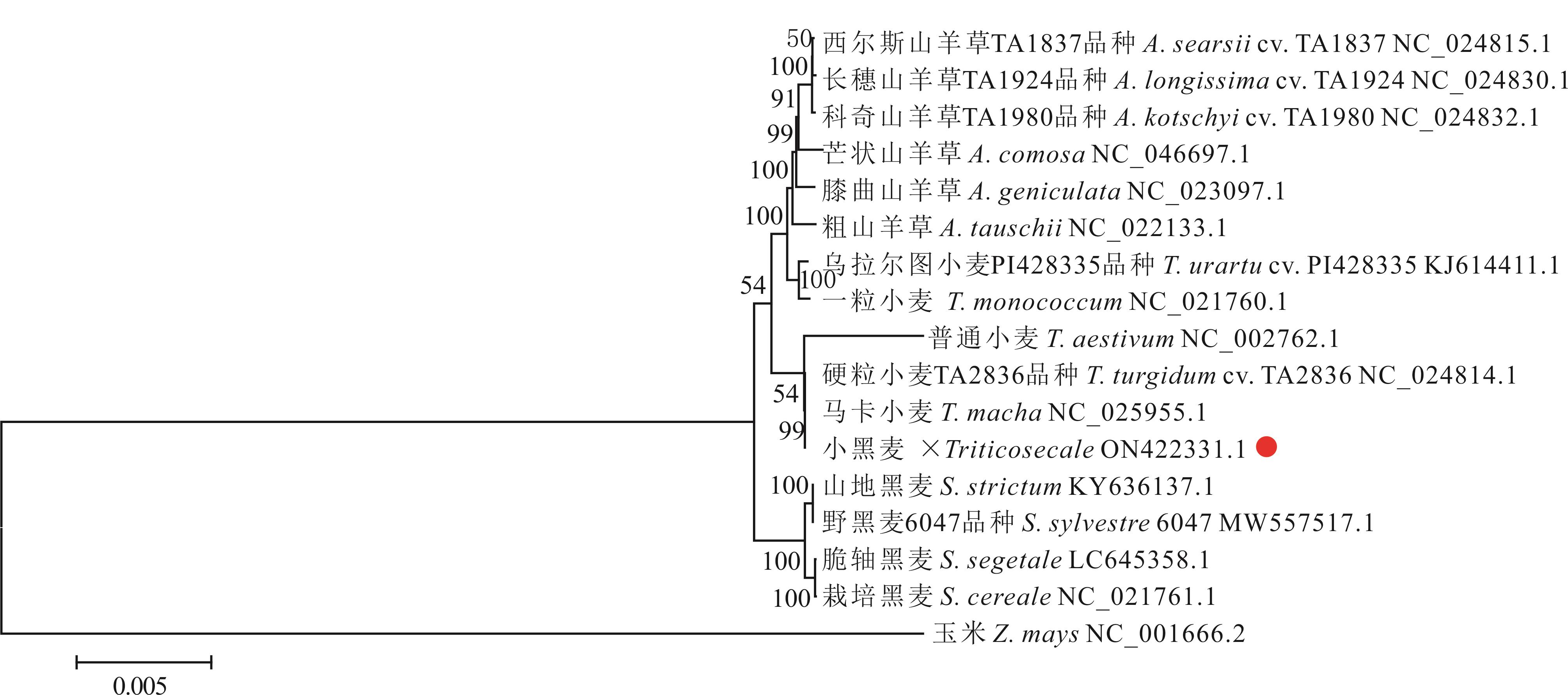
图7 17个禾本科植物叶绿体基因组的系统发育树
Fig.7 Phylogenetic tree of chloroplast genomes from 17 Poaceae species
| [1] | Mergoum M, Singh P K, Peña R J, et al. Triticale: A “new” crop with old challenges//Handbook of plant breeding. New York: Springer US, 2009: 267-287. |
| [2] | Zhu F. Triticale: Nutritional composition and food uses. Food Chemistry, 2018, 241: 468-479. |
| [3] | Mcgoverin C M, Snyders F, Muller N, et al. A review of triticale uses and the effect of growth environment on grain quality. Journal of the Science of Food and Agriculture, 2011, 91(7): 1155-1165. |
| [4] | Wang W Q, Liu J, Tian X H, et al. Evaluations on the adaptability of ×Triticosecale Wittmack ‘Gannong No.4’ in different regions of Qinghai Province. Acta Agrestia Sinica, 2020, 28(6): 1626-1634. |
| 王伟强, 刘晶, 田新会, 等. ‘甘农4号’小黑麦品种在青海省不同区域的适应性评价. 草地学报, 2020, 28(6): 1626-1634. | |
| [5] | Mergoum M, Sapkota S, ElDoliefy A E F A, et al. Triticale (×Triticosecale Wittmack) breeding//Advances in plant breeding strategies: Cereals. Cham: Springer International Publishing, 2019: 405-451. |
| [6] | Simmonds N W. Evolution of crop plants. London: Longman Group Ltd., 1976. |
| [7] | Hammouda D, Baaziz N, Khalfallah N. Genetic characterization of octoploid (AABBDDRR) and hexaploid (AABBRR) triticales. European Scientific Journal, 2015, 11(9): 284-297. |
| [8] | Wang B L, Chen Q F, Men W Q, et al. Analysis of chromosome composition of hexaploid triticale of different plant heights. Journal of Henan Agricultural University, 2021, 55(4): 631-638. |
| 王贝麟, 陈麒帆, 门文强, 等. 六倍体小黑麦株高分离的染色体构成分析. 河南农业大学学报, 2021, 55(4): 631-638. | |
| [9] | Yang T, Chen X Z, Sui J S, et al. Chromosomic analysis of hexaploid triticale by fluorescence in situ hybridization. Journal of Southwest University (Natural Science Edition), 2019, 41(4): 42-48. |
| 杨婷, 陈星灼, 隋建枢, 等. 六倍体小黑麦染色体的荧光原位杂交分析. 西南大学学报(自然科学版), 2019, 41(4): 42-48. | |
| [10] | Wang S X. A “contest” with saline-alkali land with triticale. Lanzhou: Gansu Daily Publishing House, 2025. |
| 王思璇. “以麦治碱”一场与盐碱地的“较量”. 兰州: 甘肃日报出版社, 2025. | |
| [11] | Moore M J, Soltis P S, Bell C D, et al. Phylogenetic analysis of 83 plastid genes further resolves the early diversification of eudicots. Proceedings of the National Academy of Sciences of the United States of America, 2010, 107(10): 4623-4628. |
| [12] | Tian T, Zhang Y X, Du W H, et al. Comparative genomics of Triticum, Secale, and triticale: Codon usage bias in chloroplast genomes and its implications for evolution and genetic engineering. International Journal of Molecular Sciences, 2025, 26(21): 10266. |
| [13] | Zhang Y Z. Evolutionary patterns analysis of the main morphology and karyotypic ancestral characteristics of the triticeae. Ya’an: Sichuan Agricultural University, 2023. |
| 张瑜卓. 小麦族植物主要形态及核型祖先特征的演化式样分析. 雅安: 四川农业大学, 2023. | |
| [14] | Tian T, Wang H X. Characterization analysis of microsatellite in chloroplast of Syringa reticulata subsp. amurensis. Molecular Plant Breeding, 2024, 22(8): 2501-2507. |
| 田甜, 王宏霞. 暴马丁香的叶绿体微卫星特征分析. 分子植物育种, 2024, 22(8): 2501-2507. | |
| [15] | Cao D. Triticale chloroplast genome. GenBank, ON422331.1, 2022. |
| [16] | Greiner S, Lehwark P, Bock R. Organellar Genome DRAW (OGDRAW) version 1.3.1: Expanded toolkit for the graphical visualization of organellar genomes. Nucleic Acids Research, 2019, 47(W1): W59-W64. |
| [17] | Kurtz S, Choudhuri J V, Ohlebusch E, et al. REPuter: The manifold applications of repeat analysis on a genomic scale. Nucleic Acids Research, 2001, 29(22): 4633-4642. |
| [18] | Beier S, Thiel T, MÜnch T, et al. MISA-web: A web server for microsatellite prediction. Bioinformatics, 2017, 33(16): 2583-2585. |
| [19] | Raubeson L A, Peery R, Chumley T W, et al. Comparative chloroplast genomics: Analyses including new sequences from the angiosperms Nuphar advena and Ranunculus macranthus. BMC Genomics, 2007, 8(1): 174. |
| [20] | Amiryousefi A, Hyvönen J, Poczai P. IRscope: An online program to visualize the junction sites of chloroplast genomes. Bioinformatics, 2018, 34(17): 3030-3031. |
| [21] | Katoh K, Standley D M. MAFFT multiple sequence alignment software version 7: Improvements in performance and usability. Molecular Biology and Evolution, 2013, 30(4): 772-780. |
| [22] | Nguyen L T, Schmidt H A, Von Haeseler A, et al. IQ-TREE: A fast and effective stochastic algorithm for estimating maximum-likelihood phylogenies. Molecular Biology and Evolution, 2015, 32(1): 268-274. |
| [23] | Ebert D, Peakall R O D. Chloroplast simple sequence repeats (cpSSRs): Technical resources and recommendations for expanding cpSSR discovery and applications to a wide array of plant species. Molecular Ecology Resources, 2009, 9(3): 673-690. |
| [24] | Lee J, Kang Y, Shin S C, et al. Combined analysis of the chloroplast genome and transcriptome of the Antarctic vascular plant Deschampsia antarctica Desv. PLoS One, 2014, 9(3): e92501. |
| [25] | Du W H, Tian X H, Liu H C, et al. Industrialization demonstration of high efficient double cropping pattern of Gannong No. 2 triticale in alpine pastoral area and agro-pastoral ecotone of Gansu Province. Lanzhou: Gansu Agricultural University, 2023. |
| 杜文华, 田新会, 刘汉成, 等. 甘肃省高寒牧区和农牧交错区甘农2号小黑麦一年两作高效种植模式产业化示范. 兰州: 甘肃农业大学, 2023. | |
| [26] | Wicke S, Schneeweiss G M, Depamphilis C W, et al. The evolution of the plastid chromosome in land plants: Gene content, gene order, gene function. Plant Molecular Biology, 2011, 76(3): 273-297. |
| [27] | Naver H, Boudreau E, Rochaix J D. Functional studies of Ycf3: Its role in assembly of photosystemⅠand interactions with some of its subunits. The Plant Cell, 2001, 13(12): 2731-2745. |
| [28] | Boudreau E, Takahashi Y, Lemieux C, et al. The chloroplast ycf3 and ycf4 open reading frames of Chlamydomonas reinhardtii are required for the accumulation of the photosystemⅠcomplex. The EMBO Journal, 1997, 16(20): 6095-6104. |
| [29] | Irimia M, Roy S W. Spliceosomal introns as tools for genomic and evolutionary analysis. Nucleic Acids Research, 2008, 36(5): 1703-1712. |
| [30] | Guo S, Guo L L, Zhao W, et al. Complete chloroplast genome sequence and phylogenetic analysis of Paeonia ostii. Molecules, 2018, 23(2): 246. |
| [31] | Goldbecker E S, de Vries J. Systems biology of streptophyte cell evolution. Annual Review of Plant Biology, 2025, 76(1): 493-522. |
| [1] | 李铮, 胡海英, 兰剑, 丁莉, 魏文博, 李玉莲, 马巧利. 小黑麦种质资源萌芽期耐盐性评价与筛选[J]. 草业学报, 2026, 35(5): 225-238. |
| [2] | 张译尹, 王斌, 王腾飞, 兰剑, 胡海英. 苜蓿种子田间作小黑麦对饲草产量、水分利用及苜蓿种子产量的影响[J]. 草业学报, 2025, 34(8): 43-53. |
| [3] | 郭常英, 杜文华. 小黑麦及其近缘种花序及穗部特征差异[J]. 草业学报, 2025, 34(11): 205-216. |
| [4] | 王萌, 鲁雪莉, 王菊英, 张梦超, 宋奕汝, 孟晨, 张莉, 徐宗昌. 小黑麦种质萌发期苗期耐盐资源评价与筛选[J]. 草业学报, 2024, 33(5): 58-68. |
| [5] | 张译尹, 李雪颖, 王斌, 宋珂辰, 兰剑, 胡海英. 盐胁迫对不同种质小黑麦幼苗水分利用效率和渗透调节的影响[J]. 草业学报, 2024, 33(4): 87-98. |
| [6] | 黄祥, 何梦瑶, 王子煊, 楚光明, 江萍. 紫叶风箱果叶绿体基因组特征及绣线菊亚科系统发育分析[J]. 草业学报, 2024, 33(3): 161-173. |
| [7] | 于晓东, 余浩洋, 杨旭, 赵东旭, 张林刚. 内蒙古两种生态型羊草叶绿体基因组序列差异分析[J]. 草业学报, 2023, 32(7): 72-84. |
| [8] | 高守舆, 李钰莹, 杨志青, 董宽虎, 夏方山. 白羊草叶绿体基因组密码子使用偏好性分析[J]. 草业学报, 2023, 32(7): 85-95. |
| [9] | 孟晨, 鲁雪莉, 王菊英, 魏云冲, 张成省, 李义强, 徐宗昌. 不同类型盐胁迫对小黑麦种子萌发的影响[J]. 草业学报, 2023, 32(12): 171-180. |
| [10] | 王珊珊, 谷海涛, 谢慧芳, 何绍冬, 甘长波, 卫小勇, 孔广超. 113份饲草型六倍体小黑麦种质饲草产量与品质性状的评价[J]. 草业学报, 2023, 32(1): 192-202. |
| [11] | 常丹丹, 王旭, 田新会, 杜文华. 甘肃中部地区秋播小黑麦套作式复种甜高粱的效应及品质研究[J]. 草业学报, 2021, 30(11): 212-220. |
| [12] | 游永亮, 李源, 赵海明, 武瑞鑫, 刘贵波. 海河平原区施氮磷肥对饲用小黑麦生产性能及营养品质的影响[J]. 草业学报, 2020, 29(3): 137-146. |
| [13] | 任昱鑫, 代寒凌, 田新会, 杜文华. 添加剂对甘肃省高寒牧区不同刈割期小黑麦青贮饲料营养品质和青贮品质的影响[J]. 草业学报, 2020, 29(3): 197-206. |
| [14] | 赵方媛, 刘晶, 杜文华, 田新会. 不同饲草型小黑麦基因型的光合生理差异[J]. 草业学报, 2020, 29(1): 63-73. |
| [15] | 代寒凌, 田新会, 杜文华, 吴建平. 不同添加剂处理对小黑麦和黑麦青贮营养品质和发酵品质的影响[J]. 草业学报, 2019, 28(12): 211-219. |
| 阅读次数 | ||||||
|
全文 |
|
|||||
|
摘要 |
|
|||||
