

ISSN 1004-5759 CN 62-1105/S
草业学报 ›› 2026, Vol. 35 ›› Issue (11): 38-51.DOI: 10.11686/cyxb2025457
韩奥( ), 刘阳, 倪蕴菡, 肖红(), 徐长林, 马凯, 王昀
收稿日期:2025-11-10
修回日期:2025-12-16
出版日期:2026-11-20
发布日期:2026-10-12
通讯作者:
肖红
作者简介:Corresponding author. E-mail: xiaoh@gsau.edu.cn基金资助:
Ao HAN(), Yang LIU, Yun-han NI, Hong XIAO(), Chang-lin XU, Kai MA, Yun WANG
Received:2025-11-10
Revised:2025-12-16
Online:2026-11-20
Published:2026-10-12
Contact:
Hong XIAO
摘要:
为探究东祁连山高寒草甸灌丛化过程中土壤酶活性以及微生物代谢限制的变化特征,本研究以东祁连山不同灌丛化程度(轻度、中度、重度)的高寒草甸为对象,通过土壤酶化学计量与矢量分析,揭示了灌丛化进程中微生物养分限制的响应规律。结果表明,随灌丛化加剧,灌丛斑块0~15 cm土层土壤有机碳、全氮含量及氮磷比显著降低,而15~30 cm土层土壤含水量显著上升(P<0.05)。土壤β-葡萄糖苷酶、纤维素二糖苷酶和N-乙酰氨基葡萄糖苷酶活性在0~15 cm土层土壤中随灌丛化加剧而显著下降(P<0.05),而磷酸酶活性无显著变化(P>0.05)。酶化学计量特征显示,灌丛斑块各土层土壤酶碳氮比均随灌丛化程度加剧而显著降低(P<0.05)。矢量分析表明,灌丛扩张缓解了表层土壤微生物的碳限制,但加剧了其氮限制。冗余分析与Mantel检验进一步证实,灌丛斑块中各土层的全磷、硝态氮含量和氮磷比是驱动微生物代谢限制变化的关键环境因子。本研究从微生物代谢角度揭示了高寒草甸灌木扩张通过重塑土壤养分格局和调控微生物代谢策略驱动地下生态过程转型的关键过程,为高寒草甸生态评估与恢复管理提供了重要的理论依据。
韩奥, 刘阳, 倪蕴菡, 肖红, 徐长林, 马凯, 王昀. 东祁连山高寒草甸灌丛化对土壤酶活性和微生物代谢限制的影响[J]. 草业学报, 2026, 35(11): 38-51.
Ao HAN, Yang LIU, Yun-han NI, Hong XIAO, Chang-lin XU, Kai MA, Yun WANG. Effects of shrub encroachment on soil enzyme activities and microbial metabolic limitations in alpine meadows of the Eastern Qilian Mountains[J]. Acta Prataculturae Sinica, 2026, 35(11): 38-51.

图 1 取样位置和山生柳灌木扩张的景观图a: 草地斑块Grass patch; b: 取土位置Soil sampling plots; c: 灌丛斑块Shrub patch; d: 轻度灌丛化Light shrub encroachment; e: 中度灌丛化Moderate shrub encroachment; f: 重度灌丛化Heavy shrub encroachment.
Fig.1 Sampling locations and landscape view of S. oritrepha shrub encroachment
胞外酶 Extracellular enzyme | 底物 Substrate | 简称 Abbreviation |
|---|---|---|
β-1,4-葡糖苷酶 β-1,4-glucosidase | 4-甲基伞形酮-β-D-吡喃葡萄糖苷 4-methylumbelliferyl-β-D-glucopyranoside | BG |
纤维素二糖苷酶 Cellobiaosidase | 4-甲基伞形酮-β-D-纤维素二糖苷 4-methylumbelliferyl-β-D-cellobioside | CB |
| β-1,4-N-乙酰氨基葡萄糖苷酶 β-1,4-N-acetylglucosaminidase | 4-甲基伞形酮-N-乙酰-β-D-氨基葡萄糖苷 4-methylumbelliferyl-N-acetyl-β-D-glucosaminide | NAG |
亮氨酸氨基肽酶 Leucine aminopeptidase | L-亮氨酸-7-氨基-4-甲基香豆素盐酸盐 L-leucine-7-amido-4-methylcoumarin hydrochloride | LAP |
磷酸酶 Phosphatase | 4-甲基伞形酮-磷酸盐 4-methylumbelliferyl-phosphate | PHOS |
表 1 酶的名称、底物、简称
Table 1 Name, substrate, and abbreviation of enzymes
胞外酶 Extracellular enzyme | 底物 Substrate | 简称 Abbreviation |
|---|---|---|
β-1,4-葡糖苷酶 β-1,4-glucosidase | 4-甲基伞形酮-β-D-吡喃葡萄糖苷 4-methylumbelliferyl-β-D-glucopyranoside | BG |
纤维素二糖苷酶 Cellobiaosidase | 4-甲基伞形酮-β-D-纤维素二糖苷 4-methylumbelliferyl-β-D-cellobioside | CB |
| β-1,4-N-乙酰氨基葡萄糖苷酶 β-1,4-N-acetylglucosaminidase | 4-甲基伞形酮-N-乙酰-β-D-氨基葡萄糖苷 4-methylumbelliferyl-N-acetyl-β-D-glucosaminide | NAG |
亮氨酸氨基肽酶 Leucine aminopeptidase | L-亮氨酸-7-氨基-4-甲基香豆素盐酸盐 L-leucine-7-amido-4-methylcoumarin hydrochloride | LAP |
磷酸酶 Phosphatase | 4-甲基伞形酮-磷酸盐 4-methylumbelliferyl-phosphate | PHOS |
指标 Indicators | 土层 Soil layer (cm) | 轻度灌丛化 Light shrub encroachment | 中度灌丛化 Moderate shrub encroachment | 重度灌丛化 Heavy shrub encroachment | |||
|---|---|---|---|---|---|---|---|
灌丛斑块 Shrub patch | 草地斑块 Grass patch | 灌丛斑块 Shrub patch | 草地斑块 Grass patch | 灌丛斑块 Shrub patch | 草地斑块 Grass patch | ||
| SWC | 0~15 15~30 | 0.75±0.02Aa 0.52±0.09Ab | 0.72±0.02Aa 0.57±0.01Ab | 0.72±0.01Aa 0.61±0.01Aa | 0.75±0.06Aa 0.62±0.02Aab | 0.78±0.08Aa 0.67±0.03Aa | 0.70±0.02Aa 0.67±0.03Aa |
| pH | 0~15 15~30 | 7.12±0.14Aa 7.60±0.06Aa | 7.25±0.13Aa 7.80±0.11Aa | 7.40±0.01Aa 7.63±0.03Aa | 7.25±0.09Aa 7.74±0.02Aa | 6.99±0.04Aa 7.28±0.09Ab | 6.96±0.07Aa 7.22±0.13Ab |
| SOC (g·kg-1) | 0~15 15~30 | 108.86±3.18Aa 80.36±2.61Aa | 97.52±4.94Aa 72.95±4.11Aa | 96.89±1.58Ab 70.30±1.01Ab | 97.53±8.10Aa 68.39±1.97Aa | 97.20±2.45Ab 79.22±3.74Aab | 98.03±4.11Aa 84.35±7.98Aa |
| TN (g·kg-1) | 0~15 15~30 | 9.28±0.30Aa 7.28±0.41Aa | 9.43±0.13Aa 6.70±0.19Aa | 8.14±0.29Ab 6.61±0.23Aa | 8.60±0.48Aab 6.48±0.39Ba | 7.71±0.34Ab 6.34±0.37Aa | 7.73±0.29Ab 6.60±0.39Aa |
| TP (g·kg-1) | 0~15 15~30 | 0.85±0.04Aa 0.69±0.01Ab | 0.77±0.01Bb 0.84±0.06Aa | 0.88±0.02Aa 0.73±0.01Ab | 0.79±0.04Bab 0.86±0.04Aa | 0.93±0.06Aa 0.88±0.03Aa | 0.96±0.08Aa 0.83±0.05Aa |
| DOC (mg·kg-1) | 0~15 15~30 | 765.18±9.91Aa 615.34±64.25Aa | 766.70±17.96Aa 572.46±48.89Aa | 704.38±36.80Ba 607.07±16.54Aa | 717.05±71.93Aa 370.59±33.39Ab | 589.67±79.59Aa 516.03±42.94Aa | 520.62±24.87Ab 475.70±28.81Aab |
| NH4+-N (mg·kg-1) | 0~15 15~30 | 42.10±4.76Aa 22.12±2.49Aa | 67.56±3.54Aa 23.21±3.41Aa | 53.51±5.71Aa 22.34±1.15Aa | 50.32±8.17Aab 21.33±1.81Aa | 42.16±9.48Aa 19.10±1.38Aa | 35.60±6.03Ab 19.08±2.47Aa |
| NO3--N (mg·kg-1) | 0~15 15~30 | 7.87±2.44Ab 13.58±0.88Ab | 16.24±0.80Ab 11.46±0.53Ac | 12.44±1.57Ab 13.38±0.29Ab | 19.85±2.15Aab 14.78±0.24Ab | 19.08±0.79Aa 18.97±0.85Aa | 21.71±1.08Aa 20.33±0.81Aa |
| AP (mg·kg-1) | 0~15 15~30 | 24.43±1.29Aa 15.03±2.15Aa | 26.70±2.24Aa 15.15±1.01Aa | 26.54±1.01Aa 16.74±1.32Aa | 24.19±1.88Aa 12.16±1.35Aa | 24.38±2.58Aa 19.30±2.34Aa | 21.57±1.59Aa 16.49±1.38Aa |
| C∶N | 0~15 15~30 | 11.69±1.59Aa 11.11±0.69Ab | 10.35±0.64Ab 10.86±0.32Aa | 11.93±0.72Aa 16.45±2.42Aa | 11.33±0.69Aab 10.67±0.98Aa | 13.69±0.66Aa 12.51±0.35Aab | 12.69±0.26Aa 12.72±0.48Aa |
| N∶P | 0~15 15~30 | 10.96±0.92Ba 10.60±0.63Aa | 12.32±0.36Aa 8.12±0.80Aa | 9.27±0.45Aab 9.02±0.36Ab | 10.95±0.48Aa 7.57±0.58Aa | 8.22±0.47Ab 7.23±0.26Ac | 8.11±0.54Ab 8.02±0.46Aa |
表 2 不同灌丛化程度对土壤理化性质的影响
Table 2 Effects of different intensities of shrub encroachment on the soil physicochemical properties
指标 Indicators | 土层 Soil layer (cm) | 轻度灌丛化 Light shrub encroachment | 中度灌丛化 Moderate shrub encroachment | 重度灌丛化 Heavy shrub encroachment | |||
|---|---|---|---|---|---|---|---|
灌丛斑块 Shrub patch | 草地斑块 Grass patch | 灌丛斑块 Shrub patch | 草地斑块 Grass patch | 灌丛斑块 Shrub patch | 草地斑块 Grass patch | ||
| SWC | 0~15 15~30 | 0.75±0.02Aa 0.52±0.09Ab | 0.72±0.02Aa 0.57±0.01Ab | 0.72±0.01Aa 0.61±0.01Aa | 0.75±0.06Aa 0.62±0.02Aab | 0.78±0.08Aa 0.67±0.03Aa | 0.70±0.02Aa 0.67±0.03Aa |
| pH | 0~15 15~30 | 7.12±0.14Aa 7.60±0.06Aa | 7.25±0.13Aa 7.80±0.11Aa | 7.40±0.01Aa 7.63±0.03Aa | 7.25±0.09Aa 7.74±0.02Aa | 6.99±0.04Aa 7.28±0.09Ab | 6.96±0.07Aa 7.22±0.13Ab |
| SOC (g·kg-1) | 0~15 15~30 | 108.86±3.18Aa 80.36±2.61Aa | 97.52±4.94Aa 72.95±4.11Aa | 96.89±1.58Ab 70.30±1.01Ab | 97.53±8.10Aa 68.39±1.97Aa | 97.20±2.45Ab 79.22±3.74Aab | 98.03±4.11Aa 84.35±7.98Aa |
| TN (g·kg-1) | 0~15 15~30 | 9.28±0.30Aa 7.28±0.41Aa | 9.43±0.13Aa 6.70±0.19Aa | 8.14±0.29Ab 6.61±0.23Aa | 8.60±0.48Aab 6.48±0.39Ba | 7.71±0.34Ab 6.34±0.37Aa | 7.73±0.29Ab 6.60±0.39Aa |
| TP (g·kg-1) | 0~15 15~30 | 0.85±0.04Aa 0.69±0.01Ab | 0.77±0.01Bb 0.84±0.06Aa | 0.88±0.02Aa 0.73±0.01Ab | 0.79±0.04Bab 0.86±0.04Aa | 0.93±0.06Aa 0.88±0.03Aa | 0.96±0.08Aa 0.83±0.05Aa |
| DOC (mg·kg-1) | 0~15 15~30 | 765.18±9.91Aa 615.34±64.25Aa | 766.70±17.96Aa 572.46±48.89Aa | 704.38±36.80Ba 607.07±16.54Aa | 717.05±71.93Aa 370.59±33.39Ab | 589.67±79.59Aa 516.03±42.94Aa | 520.62±24.87Ab 475.70±28.81Aab |
| NH4+-N (mg·kg-1) | 0~15 15~30 | 42.10±4.76Aa 22.12±2.49Aa | 67.56±3.54Aa 23.21±3.41Aa | 53.51±5.71Aa 22.34±1.15Aa | 50.32±8.17Aab 21.33±1.81Aa | 42.16±9.48Aa 19.10±1.38Aa | 35.60±6.03Ab 19.08±2.47Aa |
| NO3--N (mg·kg-1) | 0~15 15~30 | 7.87±2.44Ab 13.58±0.88Ab | 16.24±0.80Ab 11.46±0.53Ac | 12.44±1.57Ab 13.38±0.29Ab | 19.85±2.15Aab 14.78±0.24Ab | 19.08±0.79Aa 18.97±0.85Aa | 21.71±1.08Aa 20.33±0.81Aa |
| AP (mg·kg-1) | 0~15 15~30 | 24.43±1.29Aa 15.03±2.15Aa | 26.70±2.24Aa 15.15±1.01Aa | 26.54±1.01Aa 16.74±1.32Aa | 24.19±1.88Aa 12.16±1.35Aa | 24.38±2.58Aa 19.30±2.34Aa | 21.57±1.59Aa 16.49±1.38Aa |
| C∶N | 0~15 15~30 | 11.69±1.59Aa 11.11±0.69Ab | 10.35±0.64Ab 10.86±0.32Aa | 11.93±0.72Aa 16.45±2.42Aa | 11.33±0.69Aab 10.67±0.98Aa | 13.69±0.66Aa 12.51±0.35Aab | 12.69±0.26Aa 12.72±0.48Aa |
| N∶P | 0~15 15~30 | 10.96±0.92Ba 10.60±0.63Aa | 12.32±0.36Aa 8.12±0.80Aa | 9.27±0.45Aab 9.02±0.36Ab | 10.95±0.48Aa 7.57±0.58Aa | 8.22±0.47Ab 7.23±0.26Ac | 8.11±0.54Ab 8.02±0.46Aa |
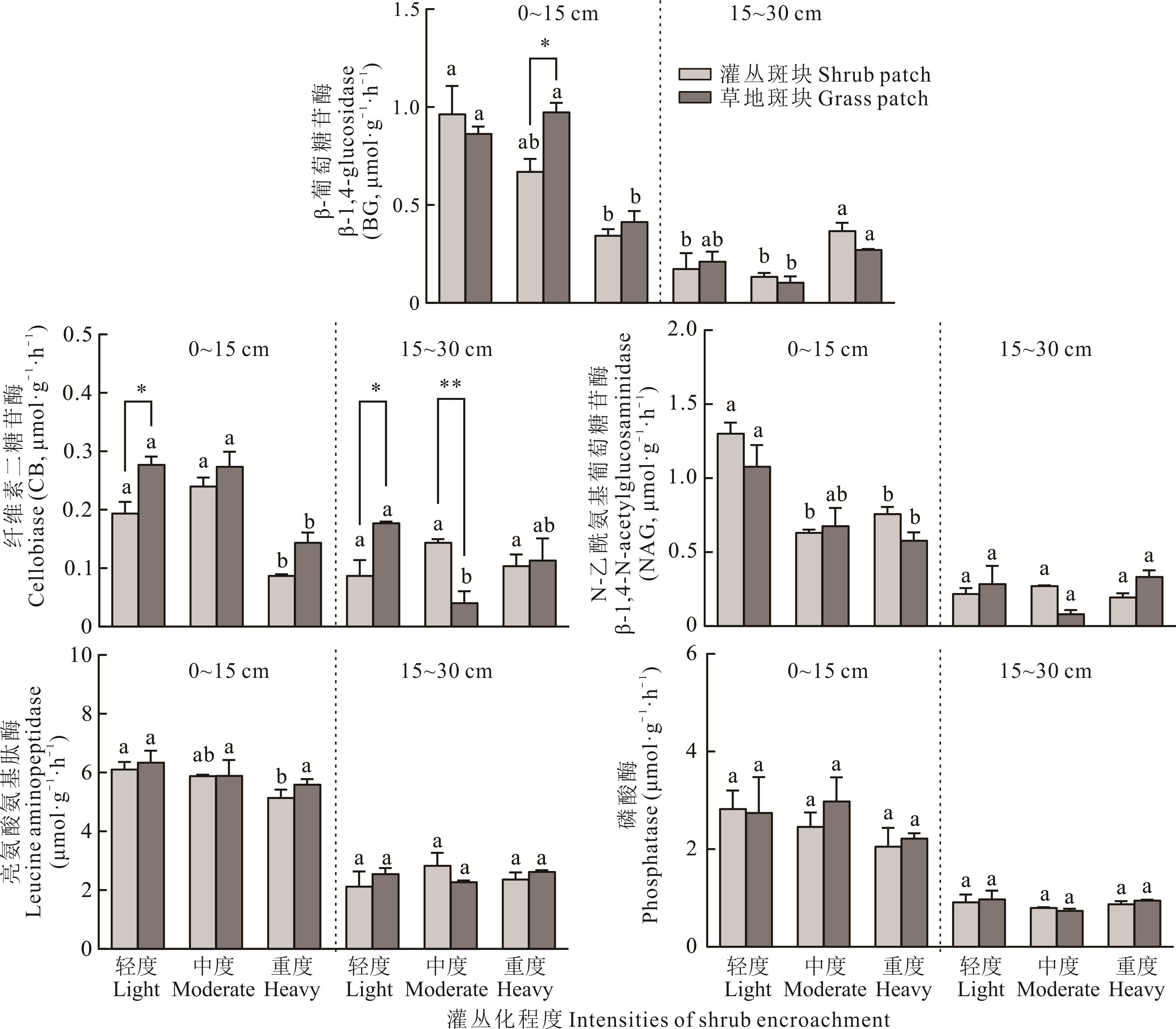
图 2 不同灌丛化程度对土壤酶活性的影响图中数据均为平均值±标准误差。不同小写字母代表同一斑块内不同灌丛化程度间存在显著差异(P<0.05),*代表同一灌丛化程度下灌丛斑块和草地斑块间存在显著差异, *: P<0.05, **: P<0.01,下同。All data in the figure are presented as mean±standard error. Different lowercase letters indicate significant differences among the intensity of shrub encroachment within the same patches (P<0.05). * indicate significant difference between shrub patches and grass patches at the same shrub encroachment level, *: P<0.05, **:P<0.01, the same below.
Fig.2 Effects of different intensities of shrub encroachment on soil enzyme activities
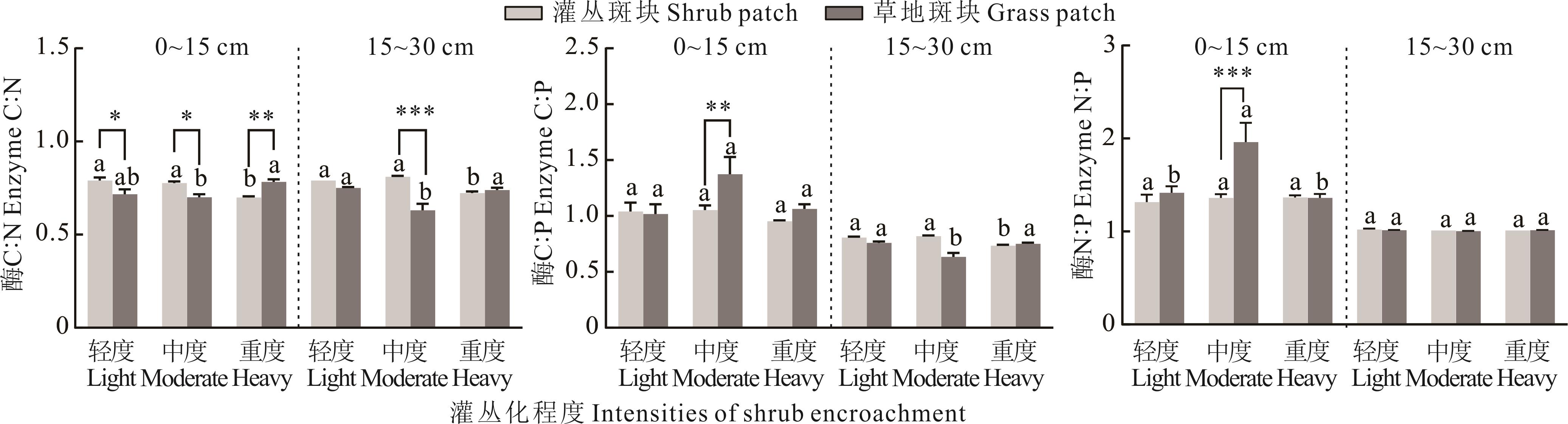
图 3 不同灌丛化程度对土壤碳、氮、磷获得酶化学计量比的影响***: P<0.001. 下同The same below.
Fig.3 Effects of different intensities of shrub encroachment on the stoichiometric ratio of soil C, N and P extracellular enzymes
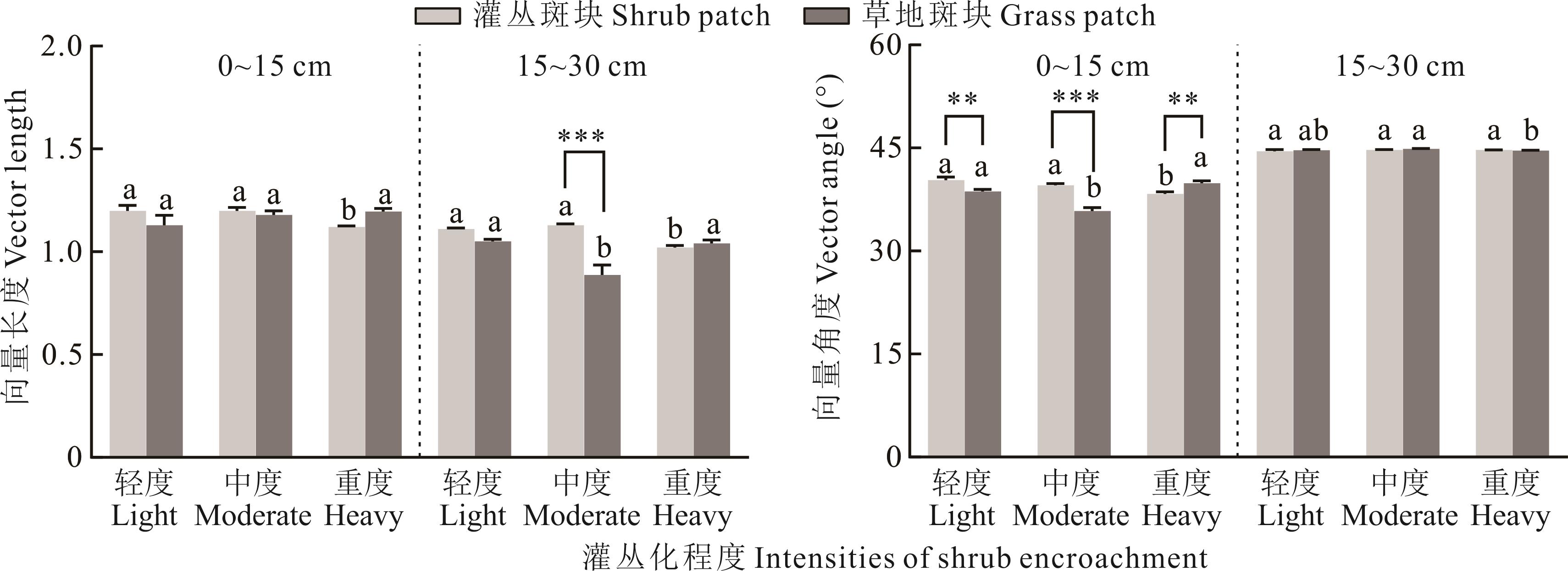
图 4 矢量分析不同灌丛化程度对土壤微生物代谢限制的影响
Fig.4 Vector analysis of the effects of soil microbial metabolic limitation under different intensities of shrub encroachment

图 5 土壤理化性质与酶活性及计量比之间的关系EC∶N: 酶碳氮比Enzyme C∶N; EC∶P: 酶碳磷比Enzyme C∶P; EN∶P: 酶氮磷比Enzyme N∶P.
Fig.5 Relationships between soil physicochemical properties and enzyme activities and stoichiometric ratios
取样位置 Sampling plot | 土层 Soil layer (cm) | 变量 Variable | 贡献度 Contribution (%) | F值 F-value | P值 P-value | 取样位置 Sampling plot | 土层 Soil layer (cm) | 变量 Variable | 贡献度 Contribution (%) | F值 F-value | P值 P-value |
|---|---|---|---|---|---|---|---|---|---|---|---|
灌丛斑块 Shrub patch | 0~15 | TN | 28.3 | 2.8 | 0.038 | 草地斑块 Grass patch | 0~15 | TP | 19.6 | 1.7 | 0.154 |
| N∶P | 22.6 | 2.8 | 0.064 | NO3--N | 13.2 | 1.2 | 0.356 | ||||
| C∶N | 10.4 | 1.7 | 0.146 | pH | 14.9 | 1.4 | 0.268 | ||||
| NO3--N | 5.6 | 0.9 | 0.260 | C∶N | 13.7 | 1.4 | 0.278 | ||||
| 15~30 | SWC | 29.1 | 2.9 | 0.038 | 15~30 | AP | 33.9 | 3.6 | 0.074 | ||
| NO3--N | 20.5 | 2.4 | 0.056 | TP | 31.3 | 5.4 | 0.018 | ||||
| C∶N | 17.3 | 2.6 | 0.074 | NH4+-N | 10.1 | 2.1 | 0.174 | ||||
| TN | 9.8 | 1.3 | 0.152 | NO3--N | 14.8 | 6.0 | 0.058 |
表 3 土壤酶活性及计量比和土壤理化因子冗余分析排序相关系数
Table 3 Correlation coefficients between soil enzyme activities and stoichiometric ratios and redundancy analysis ordering of soil physicochemical factors
取样位置 Sampling plot | 土层 Soil layer (cm) | 变量 Variable | 贡献度 Contribution (%) | F值 F-value | P值 P-value | 取样位置 Sampling plot | 土层 Soil layer (cm) | 变量 Variable | 贡献度 Contribution (%) | F值 F-value | P值 P-value |
|---|---|---|---|---|---|---|---|---|---|---|---|
灌丛斑块 Shrub patch | 0~15 | TN | 28.3 | 2.8 | 0.038 | 草地斑块 Grass patch | 0~15 | TP | 19.6 | 1.7 | 0.154 |
| N∶P | 22.6 | 2.8 | 0.064 | NO3--N | 13.2 | 1.2 | 0.356 | ||||
| C∶N | 10.4 | 1.7 | 0.146 | pH | 14.9 | 1.4 | 0.268 | ||||
| NO3--N | 5.6 | 0.9 | 0.260 | C∶N | 13.7 | 1.4 | 0.278 | ||||
| 15~30 | SWC | 29.1 | 2.9 | 0.038 | 15~30 | AP | 33.9 | 3.6 | 0.074 | ||
| NO3--N | 20.5 | 2.4 | 0.056 | TP | 31.3 | 5.4 | 0.018 | ||||
| C∶N | 17.3 | 2.6 | 0.074 | NH4+-N | 10.1 | 2.1 | 0.174 | ||||
| TN | 9.8 | 1.3 | 0.152 | NO3--N | 14.8 | 6.0 | 0.058 |

图 6 土壤理化性质与微生物代谢限制之间的关系VL: 向量长度Vector length; VA: 向量角度Vector angle.
Fig.6 Relationship between soil physico-chemical properties and microbial metabolism limitations
| [1] | Wu W H. Strengthen the basic research of grassland sciences to promote the construction of ecological civilization and the sustainable development. Bulletin of National Natural Science Foundation of China, 2023, 37(4): 527. |
| 武维华. 加强草学基础理论研究服务国家生态文明建设. 中国科学基金, 2023, 37(4): 527. | |
| [2] | Orwin K H, Ostle N, Wilby A, et al. Effects of species evenness and dominant species identity on multiple ecosystem functions in model grassland communities. Oecologia, 2014, 174(3): 979-992. |
| [3] | Eldridge D J, Bowker M A, Maestre F T, et al. Impacts of shrub encroachment on ecosystem structure and functioning: towards a global synthesis. Ecology Letters, 2011, 14(7): 709-722. |
| [4] | Yang W, Qu G P, Kelly A R, et al. Positive effects of leguminous shrub encroachment on multiple ecosystem functions of alpine meadows and steppes greatly depended on increasing soil nutrient. Catena, 2023, 236: 107745. |
| [5] | Zhao J X, Yang W, Ji S A, et al. Shrub encroachment increases soil carbon and nitrogen stocks in alpine grassland ecosystems of the central Tibetan Plateau. Geoderma, 2023, 433: 116468. |
| [6] | Hou H Y, Zhou J W, Liu H J, et al. Advances in the study of shrub-herbs interaction of shrub encroachment in grassland. Chinese Journal of Grassland, 2024, 46(5): 132-141. |
| 侯慧扬, 周建伟, 刘慧娟, 等. 草原灌丛化过程灌木-草本植物相互作用研究进展. 中国草地学报, 2024, 46(5): 132-141. | |
| [7] | Cameron W, Franz S B, Franco W, et al. Soil biodiversity and soil community composition determine ecosystem multifunctionality. Proceedings of the National Academy of Sciences of the United States of America, 2014, 111(14): 5266-5270. |
| [8] | Zuo Y P, Zhang X Y, Zeng H, et al. Spatiotemporal dynamics of soil extracellular enzyme activity and its influence on potential mineralization rate of soil organic carbon in forests of Daxing’an Mountain range. Acta Scientiarum Naturalium Universitatis Pekinensis, 2018, 54(6): 1311-1324. |
| 左宜平, 张馨月, 曾辉, 等. 大兴安岭森林土壤胞外酶活力的时空动态及其对潜在碳矿化的影响. 北京大学学报(自然科学版), 2018, 54(6): 1311-1324. | |
| [9] | Zhang T, Ma W M, Tian Y, et al. The mitigation of microbial carbon and nitrogen limitations by shrub encroachment: extracellular enzyme stoichiometry of the alpine grassland on the Qinghai-Tibetan Plateau. Biogeochemistry, 2023, 165(2): 205-225. |
| [10] | Ding Y, Liu X W, Guo L, et al. Effects of shrub encroachment on soil organic carbon, nitrogen and phosphorus nutrients, and enzyme activity in Loess Plateau. Bulletin of Soil and Water Conservation, 2024, 44(5): 243-250, 261. |
| 丁颖, 刘小伟, 郭梁, 等. 黄土高原草地灌丛化对土壤有机碳、氮磷养分及酶活性的影响. 水土保持通报, 2024, 44(5): 243-250, 261. | |
| [11] | Ma W M, Liu C W, Zhou Q P, et al. Effects of shrub encroachment on soil aggregate ecological stoichiometry and enzyme activity in alpine grassland. Acta Prataculturae Sinica, 2022, 31(1): 57-68. |
| 马文明, 刘超文, 周青平, 等. 高寒草地灌丛化对土壤团聚体生态化学计量学及酶活性的影响. 草业学报, 2022, 31(1): 57-68. | |
| [12] | Sinsabaugh R L, Hill B H, Shah J J F. Ecoenzymatic stoichiometry of microbial organic nutrient acquisition in soil and sediment. Nature, 2009, 462(7274): 795-798. |
| [13] | Sinsabaugh R L, Lauber C, Weintraub M N, et al. Stoichiometry of soil enzyme activity at global scale. Ecology Letters, 2008, 11(11): 1252-1264. |
| [14] | Moorhead D L, Sinsabaugh R L, Hill B H, et al. Vector analysis of ecoenzyme activities reveal constraints on coupled C, N and P dynamics. Soil Biology and Biochemistry, 2016, 93: 1-7. |
| [15] | Jia B, Jia L, Mou X M, et al. Shrubification decreases soil organic carbon mineralization and its temperature sensitivity in alpine meadow soils. Soil Biology and Biochemistry, 2022, 168: 108651. |
| [16] | Zhang Q, Feng K, Chang Z H, et al. Effects of shrub encroachment on plant and soil microbial in the forest-grassland ecotone. Chinese Journal of Plant Ecology, 2023, 47(6): 770-781. |
| 张琦, 冯可, 常智慧, 等. 灌丛化对林草交错带植物和土壤微生物的影响. 植物生态学报, 2023, 47(6): 770-781. | |
| [17] | Bao S D. Soil agrochemical analysis (The Third Edition). Beijing: China Agriculture Press, 2000. |
| 鲍士旦. 土壤农化分析(第3版). 北京: 中国农业出版社, 2000. | |
| [18] | Saiya-Cork K R, Sinsabaugh R L, Zak D R. The effects of long-term nitrogen deposition on extracellular enzyme activity in an Acer saccharum forest soil. Soil Biology and Biochemistry, 2002, 34(9): 1309-1315. |
| [19] | Moorhead D L, Rinkes Z L, Sinsabaugh R L, et al. Dynamic relationships between microbial biomass, respiration, inorganic nutrients and enzyme activities: informing enzyme-based decomposition models. Frontiers in Microbiology, 2013, 4: 223. |
| [20] | Liu X, Zhuang Q L, Lai L M, et al. Soil water use sources and patterns in shrub encroachment in semiarid grasslands of Inner Mongolia. Agricultural and Forest Meteorology, 2021, 308: 108579. |
| [21] | Ding L L, Wang P C, Zhang W, et al. Shrub encroachment shapes soil nutrient concentration, stoichiometry and carbon storage in an abandoned subalpine grassland. Sustainability, 2019, 11(6): 1732. |
| [22] | Long J X, Chen L, Pang D B, et al. Effects of shrub encroachment on grassland vegetation communities in desert grasslands of eastern Ningxia. Acta Ecologica Sinica, 2025, 45(11): 5568-5581. |
| 龙进潇, 陈林, 庞丹波, 等. 灌丛化对宁夏东部荒漠草原草地植被群落的影响. 生态学报, 2025, 45(11): 5568-5581. | |
| [23] | Knapp A K, Briggs J M, Collins S L, et al. Shrub encroachment in North American grasslands: shifts in growth form dominance rapidly alters control of ecosystem carbon inputs. Global Change Biology, 2008, 14(3): 615-623. |
| [24] | Bao D H, Sun X M, Zhang Z M, et al. Effects of shrub encroachment of alpine meadows on vegetation community structure and soil physicochemical properties. Acta Ecologica Sinica, 2024, 44(14): 6208-6218. |
| 包段红, 孙小妹, 张志明, 等. 祁连山东缘高寒草甸灌丛化对植被群落与土壤理化特性的影响. 生态学报, 2024, 44(14): 6208-6218. | |
| [25] | Liu L, Zhao G, Yao D J, et al. Precipitation regulates soil organic carbon affected by shrub encroachment along the altitude gradient. Catena, 2025, 249: 108616. |
| [26] | Hungate B A, Dukes J S, Shaw M R, et al. Nitrogen and climate change. Atmospheric Science, 2003, 302(5650): 1512-1513. |
| [27] | Zhang D, Liu J Q, Ma W M, et al. Effects of shrub encroachment on soil organic carbon components in Qinghai-Xizang alpine grassland. Acta Pedologica Sinica, 2023, 60(6): 1810-1821. |
| 张东, 刘金秋, 马文明, 等. 灌丛化对高寒草地土壤有机碳组分的分异研究. 土壤学报, 2023, 60(6): 1810-1821. | |
| [28] | Shu X Y, Hu Y F, He J, et al. Effect of Salix cupularis shrubs on soil nitrogen in the alpine sandy land of Northwest Sichuan. Acta Prataculturae Sinica, 2017, 26(7): 55-61. |
| 舒向阳, 胡玉福, 何佳, 等. 川西北高寒沙地不同大小高山柳对土壤氮素的影响. 草业学报, 2017, 26(7): 55-61. | |
| [29] | Cao L Y, Zhang L, Jiang X J, et al. Distribution of soil nitrification within soil aggregates and the effects of tillage on it. Journal of Southwest University (Natural Science Edition), 2009, 31(5): 141-147. |
| 曹良元, 张磊, 蒋先军, 等. 土壤硝化作用在团聚体中的分布以及耕作的影响. 西南大学学报(自然科学版), 2009, 31(5): 141-147. | |
| [30] | Bagyaraj D J. Soil microbiology and biochemistry. Applied Biological Research, 2010, 12(2): 81-82. |
| [31] | Liu Y F, Fang H, Shi J J, et al. Climate change-induced shrub encroachment changes soil hydraulic properties and inhibits herbaceous growth in alpine meadows. Agricultural and Forest Meteorology, 2023, 340: 109629. |
| [32] | Xu W W, Zhao Y Q, Wang N, et al. Effects of artificial cyanobacterial crusts on enzyme activities and recovery rate of surface soil in sandy areas. Acta Ecologica Sinica, 2023, 43(7): 2856-2864. |
| 许文文, 赵燕翘, 王楠, 等. 人工蓝藻结皮对沙区表层土壤酶活性及其恢复速率的影响. 生态学报, 2023, 43(7): 2856-2864. | |
| [33] | Chen H, Ma W M, Wang C T, et al. Effects of shrub-encroached grassland on the stability of soil aggregates and cementing materials in alpine grassland of Qinghai-Tibet plateau. Acta Pedologica Sinica, 2023, 60(1): 151-163. |
| 陈红, 马文明, 王长庭, 等. 高寒草地灌丛化对土壤团聚体稳定性及其胶结物质的影响. 土壤学报, 2023, 60(1): 151-163. | |
| [34] | Liao J D, Boutton T W. Soil microbial biomass response to woody plant invasion of grassland. Soil Biology and Biochemistry, 2007, 40(5): 1207-1216. |
| [35] | Zhang D, Hou C, Ma W M, et al. Study on soil enzyme activities under shrub encroachment gradients in alpine grassland. Acta Prataculturae Sinica, 2023, 32(9): 79-92. |
| 张东, 侯晨, 马文明, 等. 高寒草地不同灌丛化梯度下土壤酶活性研究. 草业学报, 2023, 32(9): 79-92. | |
| [36] | Gu J X, Guo T D, Wang H M, et al. Responses of soil microbes across an anthropogenic transition from desert steppe grassland to shrubland in eastern Ningxia. Acta Prataculturae Sinica, 2021, 30(4): 46-57. |
| 顾继雄, 郭天斗, 王红梅, 等. 宁夏东部荒漠草原向灌丛地转变过程土壤微生物响应. 草业学报, 2021, 30(4): 46-57. | |
| [37] | Li Y, Niu S L, Yu G R. Aggravated phosphorus limitation on biomass production under increasing nitrogen loading: a meta-analysis. Global Change Biology, 2016, 22(2): 934-943. |
| [38] | Ren Z W, Li Q, Chu C J, et al. Effects of resource additions on species richness and ANPP in an alpine meadow community. Journal of Plant Ecology, 2010, 3(1): 25-31. |
| [39] | Pekin B K, Boer M M, Wittkuhn R S, et al. Plant diversity is linked to nutrient limitation of dominant species in a world biodiversity hotspot. Journal of Vegetation Science, 2012, 23(4): 745-754. |
| [40] | Olander L P, Vitousek P M. Regulation of soil phosphatase and chitinase activity by N and P availability. Biogeochemistry, 2000, 49(2): 175-190. |
| [41] | Zhu L, Zhang M Y, Gao Y H. Response of soil organic carbon mineralization to water and nitrogen addition in alpine steppe. Bulletin of Soil and Water Conservation, 2020, 40(1): 30-37. |
| 朱灵, 张梦瑶, 高永恒. 高寒草原土壤有机碳矿化对水氮添加的响应. 水土保持通报, 2020, 40(1): 30-37. | |
| [42] | Jiang L, Kou L, Li S G. Decomposition of leaf mixtures and absorptive-root mixtures synchronously changes with deposition of nitrogen and phosphorus. Soil Biology and Biochemistry, 2019, 138: 107602. |
| [43] | Bowles T M, Acosta-Martínez V, Calderón F, et al. Soil enzyme activities, microbial communities, and carbon and nitrogen availability in organic agroecosystems across an intensively-managed agricultural landscape. Soil Biology and Biochemistry, 2014, 68: 252-262. |
| [44] | Xiao H, Jing Y Y, Xu C L, et al. The effects of spring rest-grazing on soil extracellular enzyme activities and microbial metabolic limitation in alpine meadows of the Eastern Qilian Mountains. Acta Ecologica Sinica, 2025, 45(17): 8614-8626. |
| 肖红, 景媛媛, 徐长林, 等. 春季休牧对东祁连山高寒草甸土壤胞外酶活性和微生物代谢限制的影响. 生态学报, 2025, 45(17): 8614-8626. | |
| [45] | Brandt J S, Haynes M A, Kuemmerle T, et al. Regime shift on the roof of the world: Alpine meadows converting to shrublands in the southern Himalayas. Biological Conservation, 2013, 158: 116-127. |
| [46] | Jiao F, Xia X, Wu J J, et al. Inhibited enzyme activities in soil macroaggregates contribute to enhanced soil carbon sequestration under afforestation in central China. Science of the Total Environment, 2018, 640(1): 653-661. |
| [47] | Wang R, Chen S Y, Chen Z Q, et al. Effects of root exudates on key processes of soil nitrogen cycling: A review. Crops, 2021(6): 1-8. |
| 王锐, 陈士勇, 陈志青, 等. 根系分泌物对根际土壤关键氮转化过程的影响. 作物杂志, 2021(6): 1-8. | |
| [48] | Wu Y, Chen W J, Li Q, et al. Ecoenzymatic stoichiometry and nutrient limitation under a natural secondary succession of vegetation on the Loess Plateau, China. Land Degradation & Development, 2021, 32(1): 399-409. |
| [49] | Yvonne U, Judith N, Jiang Y F, et al. Soil C, N and P bioavailability and cycling following amendment with shrub willow chips. Canadian Journal of Soil Science, 2023, 103(3): 428-445. |
| [1] | 马婧娟, 李希来, 尹通江, 鲍玉英, 张玉芳, 丁北桥, 袁颖. 高寒草甸退化斑块恢复演替对土壤持水能力的影响[J]. 草业学报, 2026, 35(4): 14-28. |
| [2] | 刘畅, 陈积山, 朱瑞芬, 孙万斌, 姚博, 董世魁. 有机肥和生物炭添加对亚热带人工草地土壤微生物碳、磷限制的缓解作用[J]. 草业学报, 2026, 35(4): 54-66. |
| [3] | 刘阳, 肖红, 徐长林, 邓明月, 魏文强, 韩奥, 马凯, 王昀. 东祁连山高寒草甸山生柳灌木扩张对草本植物群落特征的影响[J]. 草业学报, 2026, 35(3): 13-25. |
| [4] | 张颖, 贺善睦, 何傲蕾, 李昌宁, 姚拓. 微生物菌剂与有机钙蛋白配施对紫花苜蓿生长和土壤酶活性的影响[J]. 草业学报, 2026, 35(1): 25-39. |
| [5] | 汤珊珊, 胡敏. 禾本科植物根际土壤酶活性和细菌群落结构差异[J]. 草业学报, 2025, 34(8): 99-108. |
| [6] | 严双, 夏菲, 魏巍, 王敬龙, 吴皓阳, 冉林灵, 薛云尹, 石昊, 郑晒坤, 王军强, 贺俊东. 高寒草甸不同侵蚀样地植物多样性的差异及其关键影响因子[J]. 草业学报, 2025, 34(6): 1-13. |
| [7] | 王瑞兵, 陈欢, 潘珍珍, 赵维, 蚌绍豪, 周小龙, 任正炜. 基于资源类型和数目的高寒草甸物种丧失机制研究[J]. 草业学报, 2025, 34(5): 1-11. |
| [8] | 马学喜, 高英志. 灌丛化对草地土壤水文过程影响的研究进展[J]. 草业学报, 2025, 34(4): 212-222. |
| [9] | 霍佳娟, 宋明华. 青藏高原高寒草甸不同退化阶段植物氮利用速率变化[J]. 草业学报, 2025, 34(2): 16-26. |
| [10] | 涂晓东, 崔俊芳, 况福虹, 李春培, 杜玖珍, 王红兰, 唐翔宇. 川西北高寒草甸转为耕地对土壤微生物群落的影响[J]. 草业学报, 2025, 34(2): 54-66. |
| [11] | 欧翔, 连海, 陈荣强, 邱静芸, 吴丽娟, 操贤洪, 张强, 雷小文. 不同施肥处理种植王草后对稀土尾矿土壤理化性质和酶活性的影响[J]. 草业学报, 2025, 34(2): 94-108. |
| [12] | 景煜都, 刘小伟, 梁可, 封俊豪, 于强, 郭梁. 灌丛化对黄土高原草地土壤有机碳组分与稳定性的影响及其微生物调控机制[J]. 草业学报, 2025, 34(12): 1-15. |
| [13] | 刘泽华, 陈林, 张雅琪, 龙进潇, 李学斌, 庞丹波. 灌丛化对荒漠草原猪毛蒿群落物种生态位和种间联结性的影响[J]. 草业学报, 2025, 34(10): 1-15. |
| [14] | 赵文军, 梁婷, 王剑松, 刘魁, 冯瑜, 王正旭, 徐梓荷, 朱云聪, 孙蒙猛, 李湘伟, 付利波, 尹梅, 周国朋, 陈华, 曹卫东. 种植翻压光叶紫花苕配合氮肥减施提高烤烟产量和土壤质量[J]. 草业学报, 2025, 34(10): 74-84. |
| [15] | 姚佳妮, 刘爽, 张钧杰, 胡明珠, 代金霞. 宁夏荒漠草原典型灌丛根际土壤酶活性及微生物代谢多样性[J]. 草业学报, 2024, 33(9): 1-14. |
| 阅读次数 | ||||||
|
全文 |
|
|||||
|
摘要 |
|
|||||
