

ISSN 1004-5759 CN 62-1105/S
草业学报 ›› 2026, Vol. 35 ›› Issue (12): 197-209.DOI: 10.11686/cyxb2025490
• 研究论文 • 上一篇
柯丹霞( ), 周兆源, 张可馨, 林佳诺, 宋晓莉
收稿日期:2025-12-02
修回日期:2026-03-16
出版日期:2026-12-20
发布日期:2026-11-02
通讯作者:
柯丹霞
作者简介:柯丹霞(1983-),女,湖北十堰人,博士 E-mail: kdx_029@163.com。基金资助:
Dan-xia KE(), Zhao-yuan ZHOU, Ke-xin ZHANG, Jia-nuo LIN, Xiao-li SONG
Received:2025-12-02
Revised:2026-03-16
Online:2026-12-20
Published:2026-11-02
Contact:
Dan-xia KE
摘要:
SWEET家族是一类参与糖类转运的膜蛋白,在植物韧皮部装载、生殖发育及逆境响应等关键生理过程中发挥重要功能。本研究从百脉根中克隆了一个编码糖转运蛋白的基因LjSWEET10,其开放阅读框编码一个由271个氨基酸残基组成的蛋白。生物信息学分析表明,LjSWEET10蛋白的二级结构由44.65%的无规卷曲、40.59%的α-螺旋和14.76%的延伸链构成;该蛋白包含SWEET家族特有的两个保守MtN3/saliva结构域,并具有7个典型的跨膜区。通过将LjSWEET10与来自拟南芥、大豆等11个不同物种的同源蛋白进行多序列比对,发现其氨基酸序列相似性为45.96%~72.69%。系统发育分析表明,LjSWEET10与菜豆PvSWEET10的亲缘关系最近。亚细胞定位试验证实该蛋白定位于拟南芥原生质体细胞质膜。表达模式分析显示,在盐胁迫条件下,LjSWEET10基因表达持续上调,胁迫后12 h达到峰值,约为胁迫前水平的7.6倍,至24 h回落至初始水平的4.2倍。利用酵母异源表达体系进行功能验证,结果表明LjSWEET10具备果糖转运活性。在拟南芥中过表达LjSWEET10基因可显著增强植株的耐盐性。随着盐处理浓度升高,叶片丙二醛含量呈上升趋势,但转基因株系的增幅显著低于野生型;叶绿素含量则随盐浓度升高而下降,但转基因株系的降幅显著低于野生型。此外,在盐胁迫条件下,LjSWEET10的过表达可显著上调多个胁迫响应相关基因(包括AtSOS1、AtMYC2、AtABI5和AtDREB1A)的表达水平。综上所述,LjSWEET10在植物盐胁迫响应过程中发挥正调控作用。本研究不仅深化了对SWEET蛋白在非生物胁迫中功能机制的认识,也为百脉根耐盐性的分子育种提供了重要的候选基因和理论依据,对盐碱地治理及牧草产业发展具有积极意义。
柯丹霞, 周兆源, 张可馨, 林佳诺, 宋晓莉. 百脉根糖转运蛋白LjSWEET10的克隆及抗盐功能分析[J]. 草业学报, 2026, 35(12): 197-209.
Dan-xia KE, Zhao-yuan ZHOU, Ke-xin ZHANG, Jia-nuo LIN, Xiao-li SONG. Cloning and salt tolerance functional analysis of the sugar transporter gene LjSWEET10 from Lotus japonicus[J]. Acta Prataculturae Sinica, 2026, 35(12): 197-209.
| 引物Primer | 引物序列 Sequence of primer (5′-3′) | 引物Primer | 引物序列 Sequence of primer (5′-3′) |
|---|---|---|---|
| LjSWEET10-F | ATGGCCATTAGTCATGATTC | Q-AtABI5-R | GTTCGGGTTTGGATTAGGTTTAGG |
| LjSWEET10-R | TTACCCTTTGGTTTCTTG | Q-AtDREB1A-F | AGGAGACGTTGGTGGAGGCT |
| LjSWEET10-GFP-F | GG | Q-AtDREB1A-R | ACGTCGTCATCATCGCCGTC |
| LjSWEET10-GFP-R | GC | Q-AtMYC2-F | GCGTTGATGGATTTGGAGTT |
| LjSWEET10-pDR196-F | TCC | Q-AtMYC2-R | TTGCTCTGAGCTGTTCTTGC |
| LjSWEET10-pDR196-R | AA | Q-AtSOS1-F | TCGTTTCAGCCAAATCAGAAAGT |
| Q-LjSWEET10-F | CACTTTGCTAAGTGGGG | Q-AtSOS1-R | TTTGCCTTGTGCTGCTTTCC |
| Q-LjSWEET10-R | CACTGAGAGAAGAGAAT | Q-AtACT-F | GGTAACATTGTGCTCAGTGGTGG |
| Q-AtABI5-F | AGAGGGATAGCGAACGAGTCTAGTC | Q-AtACT-R | AACGACCTTAATCTTCATGCTGC |
表1 本研究中所使用的引物
Table 1 The primers used in this study
| 引物Primer | 引物序列 Sequence of primer (5′-3′) | 引物Primer | 引物序列 Sequence of primer (5′-3′) |
|---|---|---|---|
| LjSWEET10-F | ATGGCCATTAGTCATGATTC | Q-AtABI5-R | GTTCGGGTTTGGATTAGGTTTAGG |
| LjSWEET10-R | TTACCCTTTGGTTTCTTG | Q-AtDREB1A-F | AGGAGACGTTGGTGGAGGCT |
| LjSWEET10-GFP-F | GG | Q-AtDREB1A-R | ACGTCGTCATCATCGCCGTC |
| LjSWEET10-GFP-R | GC | Q-AtMYC2-F | GCGTTGATGGATTTGGAGTT |
| LjSWEET10-pDR196-F | TCC | Q-AtMYC2-R | TTGCTCTGAGCTGTTCTTGC |
| LjSWEET10-pDR196-R | AA | Q-AtSOS1-F | TCGTTTCAGCCAAATCAGAAAGT |
| Q-LjSWEET10-F | CACTTTGCTAAGTGGGG | Q-AtSOS1-R | TTTGCCTTGTGCTGCTTTCC |
| Q-LjSWEET10-R | CACTGAGAGAAGAGAAT | Q-AtACT-F | GGTAACATTGTGCTCAGTGGTGG |
| Q-AtABI5-F | AGAGGGATAGCGAACGAGTCTAGTC | Q-AtACT-R | AACGACCTTAATCTTCATGCTGC |

图 1 LjSWEET10基因的克隆及蛋白结构的预测A: LjSWEET10目的片段的PCR扩增PCR amplification ofthe LjSWEET10 target fragment; M: DL 2000 DNA 分子标记 DL2000 DNA marker; 1: LjSWEET10目的片段 The LjSWEET10 target fragment; B: 蛋白的二级结构预测Prediction of the protein’s secondary structure; C: 蛋白的跨膜结构域预测Prediction of the protein’s transmembrane domains; D: 蛋白的三级结构预测Prediction of the protein’s tertiary structure.
Fig.1 Cloning of the LjSWEET10 gene and prediction of its protein structure

图 2 LjSWEET10与同系物的序列比对及进化树分析红色虚线框标示出两个保守的MtN3/saliva结构域The red dashed boxes indicate the two conserved MtN3/saliva domains; 标尺代表遗传距离,反映物种间的亲缘关系远近The scale represents genetic distance,indicating the proximity relationships among species.
Fig.2 Sequence alignment and phylogenetic analysis of LjSWEET10 and its homologs
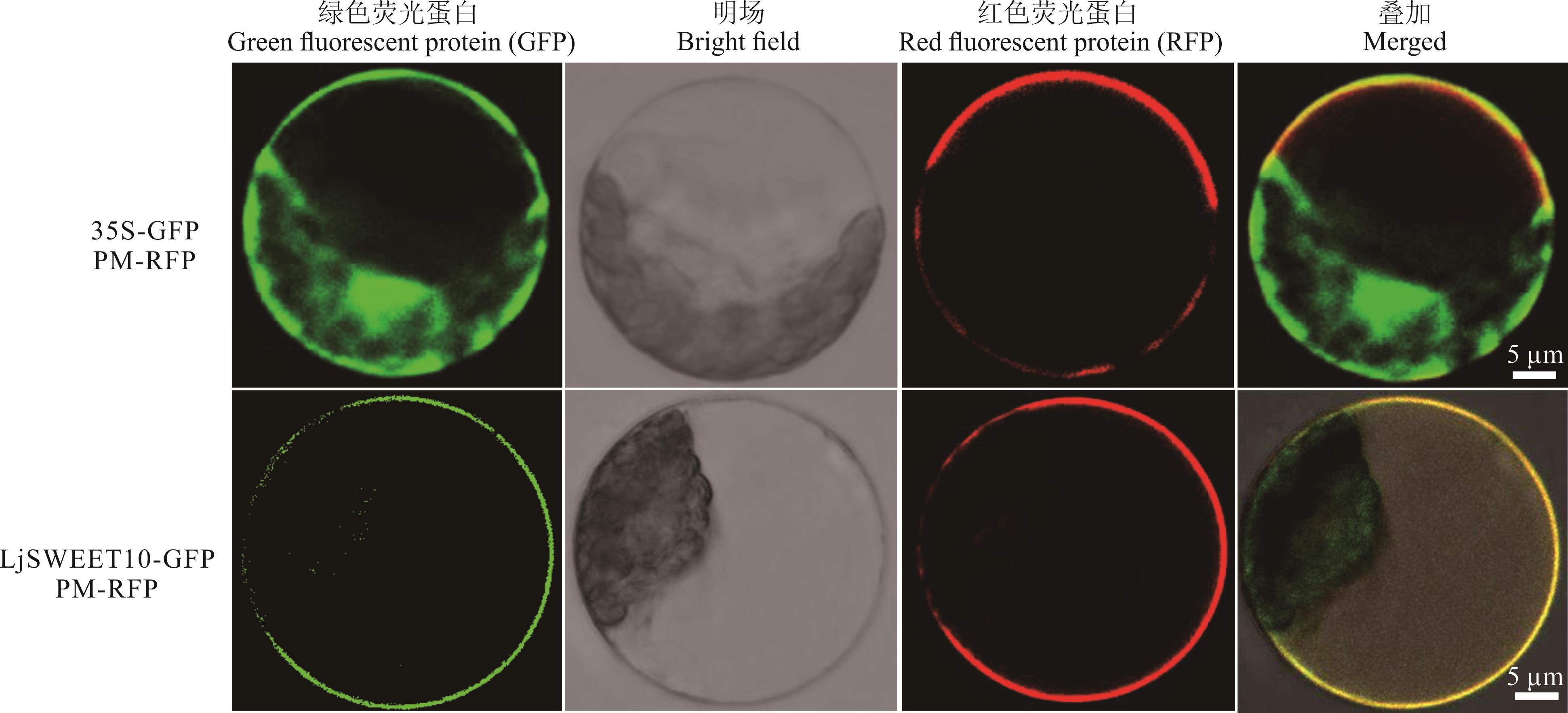
图3 LjSWEET10蛋白的亚细胞定位
Fig.3 Subcellular localization of LjSWEET10
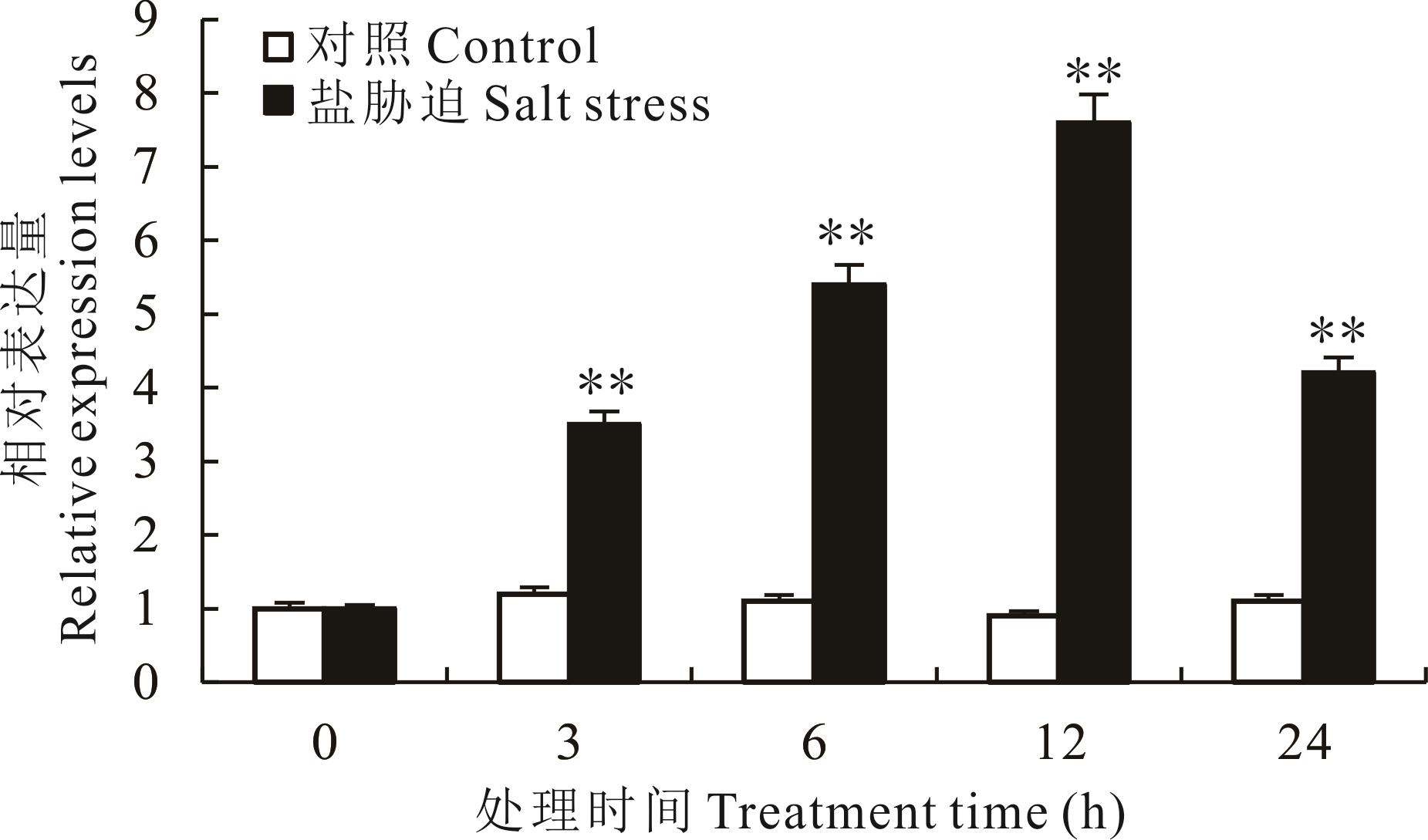
图4 百脉根LjSWEET10基因在盐胁迫下的表达分析**: 同一时间点不同处理间差异极显著(P<0.01)。Extremely significant differences between treatments at the same time point (P<0.01).
Fig.4 Expression analysis of LjSWEET10 gene in L. japonicus under salt stress
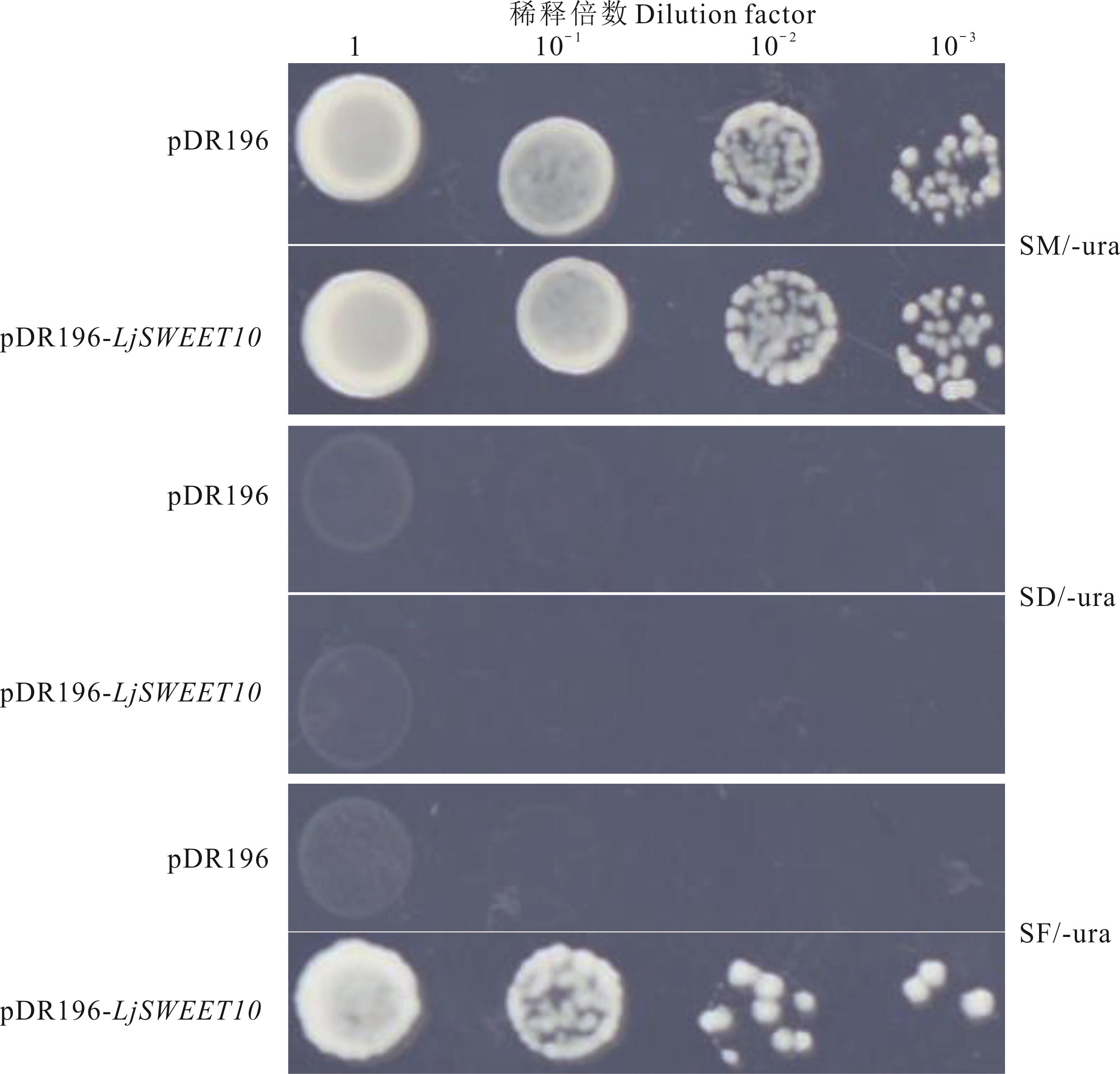
图5 通过酵母分析 LjSWEET10的己糖转运类型SM: 含麦芽糖的培养基The medium containing maltose; SD: 含葡萄糖的培养基The medium containing glucose; SF: 含果糖的培养基The medium containing fructose; -ura: 培养基中缺少尿嘧啶The medium lacks of uracil; pDR196: 阴性对照The negative control.
Fig. 5 Analysis of hexose transport types by LjSWEET10 in yeast
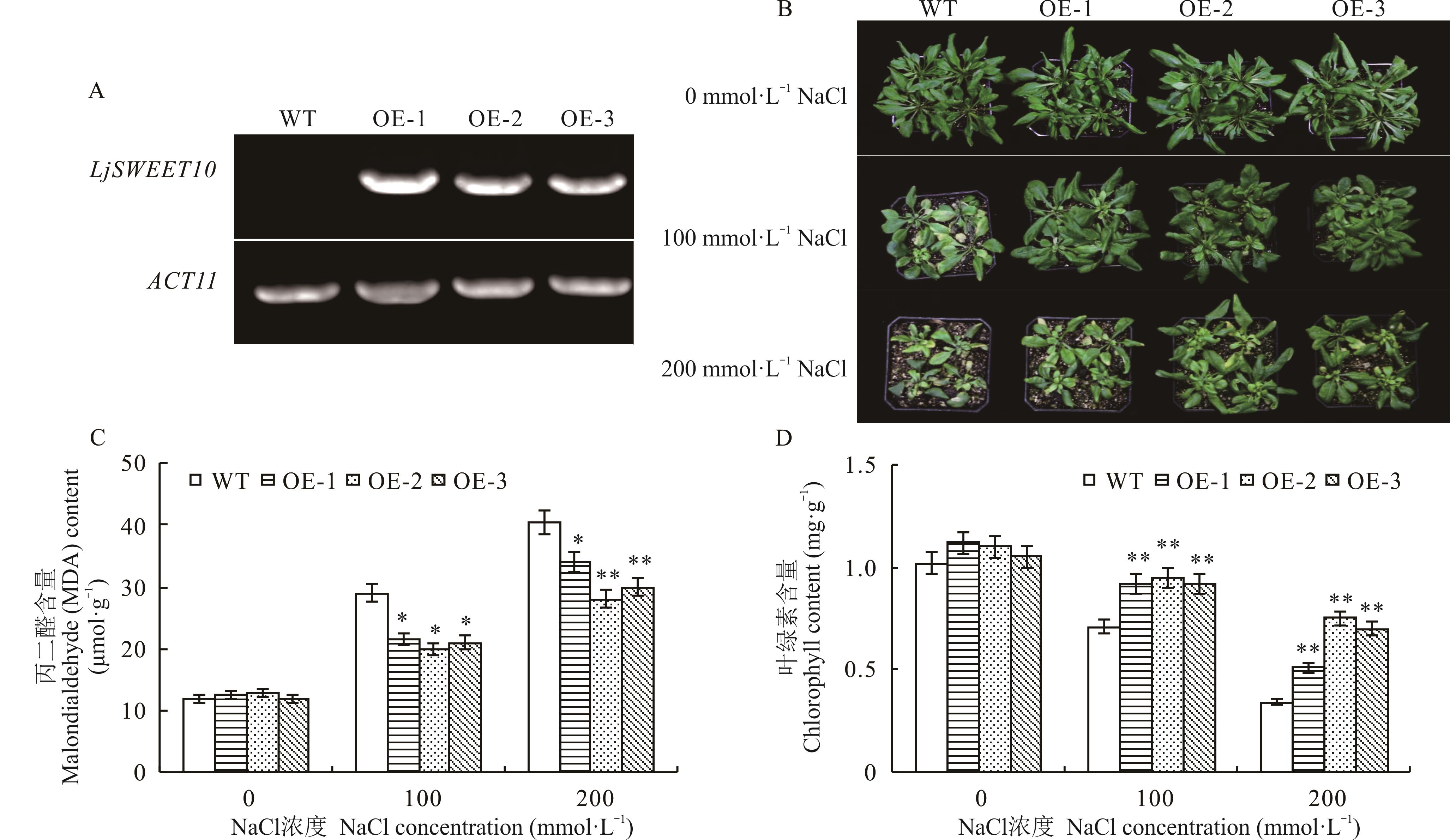
图6 过表达LjSWEET10转基因拟南芥的抗盐表型分析及生理指标检测A: 过表达转基因拟南芥株系中LjSWEET10基因表达水平的半定量RT-PCR分析Semi-quantitative RT-PCR analysis of LjSWEET10 expression levels in transgenic A. thaliana lines. ACT11代表内参基因肌动蛋白-11 ACT11 represents the reference gene Actin-11. B: 野生型和3个转基因拟南芥株系盐处理一周后的抗盐表型Response of the wild type and three transgenic A. thaliana lines to saline conditions. WT为野生型植株,OE-1,OE-2和OE-3分别为转基因拟南芥的不同株系,下同 WT represents the wild-type plants, while OE-1, OE-2 and OE-3 are different lines of transgenic A. thaliana. The same below. C: 盐胁迫7 d后野生型和转基因拟南芥植株的丙二醛(malondialdehyde,MDA)含量测定MDA content of the wild type and transgenic A. thaliana plants were measured 7 days after salt treatment. D: 盐胁迫7 d后野生型和转基因拟南芥植株的叶绿素含量测定; Chlorophyll content of the wild type and transgenic A. thaliana plants were measured 7 days after salt treatment. 所有值均以3个独立重复的平均值表示(n=15) All values are presented as means of three independent replicates (n=15). *: 在同一NaCl浓度下各株系间差异显著(P<0.05) Significant differences (P<0.05) among different lines at the same NaCl concentration. **: 在同一NaCl浓度下各株系间差异极显著(P<0.01) Extremely significant differences (P<0.01) among different lines at the same NaCl concentration.
Fig.6 Salt stress phenotype analysis and physiological index detection of transgenic A. thaliana overexpressing LjSWEET10
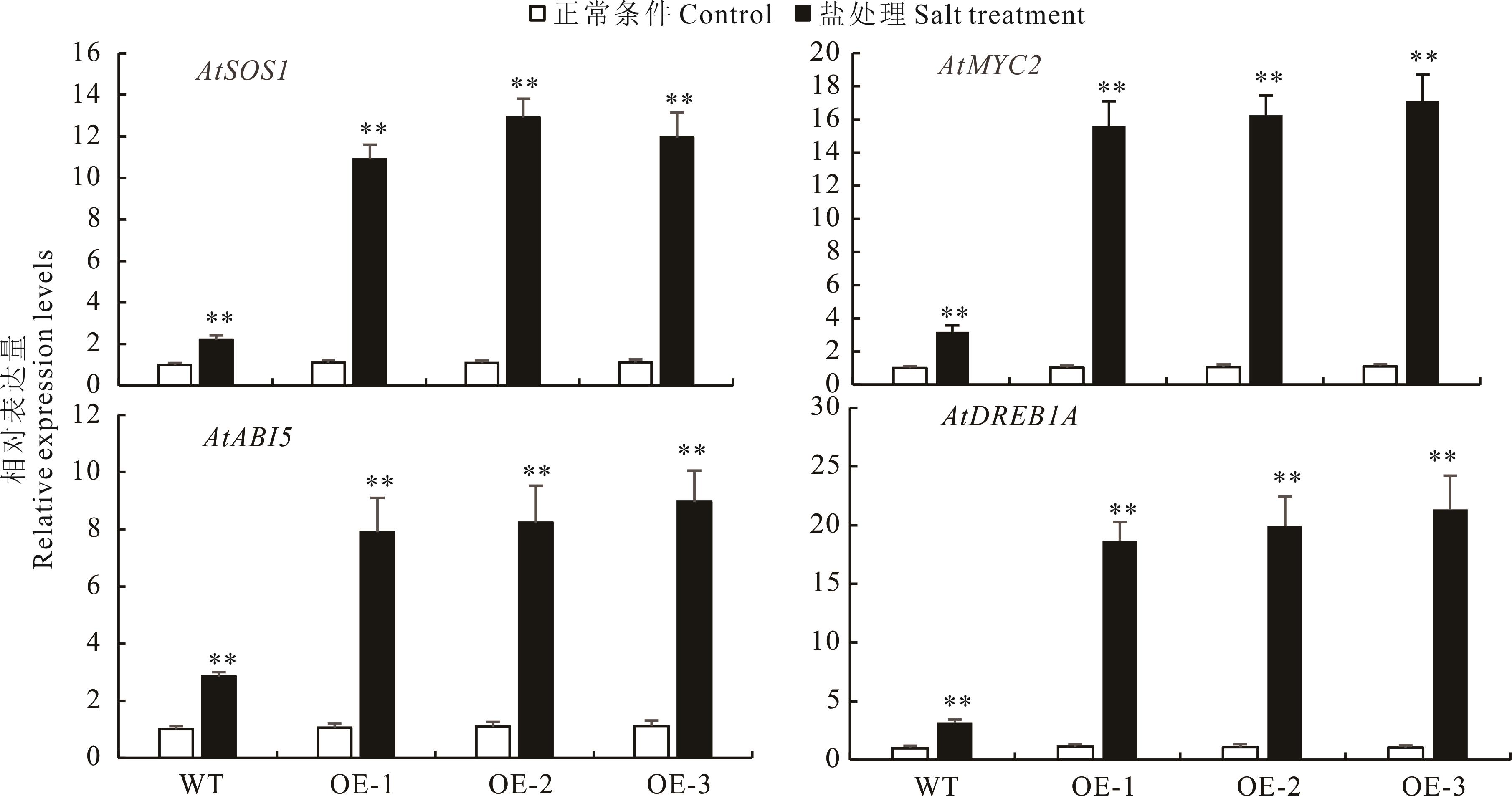
图7 200 mmol·L-1 NaCl处理下转基因拟南芥胁迫相关基因的表达水平检测数据为3次重复的平均值±标准差Data are expressed as the mean±standard deviation (SD) of three replicates; **表示同一株系正常条件与盐处理之间存在显著差异(P<0.01)。** indicate a significant difference between control and salt treatment within the same plant line (P<0.01).
Fig.7 Expression of stress-related genes in transgenic A. thaliana treated with 200 mmol·L-1 NaCl
| [1] | Qadir M, Quillérou E, Nangia V, et al. Economics of salt-induced land degradation and restoration. Natural Resources Forum, 2014, 38(4): 282-295. |
| [2] | Liu Y F, Peng H, Wang W W, et al. Research progress on the physiological and molecular mechanisms of salt tolerance for plants. Jiangsu Agricultural Sciences, 2019, 47(12): 30-36. |
| 刘云芬, 彭华, 王薇薇, 等. 植物耐盐性生理与分子机制研究进展. 江苏农业科学, 2019, 47(12): 30-36. | |
| [3] | Ziska L H, Bunce J A, Shimono H, et al. Food security and climate change: On the potential to adapt global crop production by active selection to rising atmospheric carbon dioxide. Proceedings, Biological Sciences, 2012, 279: 4097-4105. |
| [4] | Park H J, Kim W, Yun D. A new insight of salt stress signaling in plant. Molecules and Cells, 2016, 39(6): 447-459. |
| [5] | Ding Z Y. Evaluation of salt tolerance and seed mutagenesis screening of Lotus corniculatus. Nanjing: Nanjing Agricultural University, 2022. |
| 丁振宇. 百脉根耐盐性评价及种子诱变筛选. 南京: 南京农业大学, 2022. | |
| [6] | Chen L Q, Hou B H, Lalonde S, et al. Sugar transporters for intercellular exchange and nutrition of pathogens. Nature, 2010, 468: 527-532. |
| [7] | Eom J S, Chen L Q, Sosso D, et al. SWEETs, transporters for intracellular and intercellular sugar translocation. Current Opinion in Plant Biology, 2015, 25: 53-62. |
| [8] | Tao Y, Cheung L S, Li S, et al. Structure of a eukaryotic SWEET transporter in a homotrimeric complex. Nature, 2015, 527: 259-263. |
| [9] | Chen L Q, Qu X Q, Hou B H, et al. Sucrose efflux mediated by SWEET proteins as a key step for phloem transport. Science, 2012, 335(6065): 207-211. |
| [10] | Lin I W, Sosso D, Chen L Q, et al. Nectar secretion requires sucrose phosphate synthases and the sugar transporter SWEET9.Nature, 2014, 508(7497): 546-549. |
| [11] | Sun M X, Huang X Y, Yang J, et al. Arabidopsis RPG1 is important for primexine deposition and functions redundantly with RPG2 for plant fertility at the late reproductive stage. Plant Reproduction, 2013, 26(2): 83-91. |
| [12] | Chen L Q, Lin I W, Qu X Q, et al. A cascade of sequentially expressed sucrose transporters in the seed coat and endosperm provides nutrition for the Arabidopsis embryo. The Plant Cell, 2015, 27(3): 607-619. |
| [13] | Sosso D, Luo D, Li Q N, et al. Seed filling in domesticated maize and rice depends on SWEET-mediated hexose transport. Nature Genetics,2015, 47(12): 1489-1493. |
| [14] | La H V, Chu H D, Tran C D, et al. Insights into the gene and protein structures of the CaSWEET family members in chickpea (Cicer arietinum), and their gene expression patterns in different organs under various stress and abscisic acid treatments. Gene, 2022, 819: 146210. |
| [15] | Wang L, Yao L N, Hao X Y, et al. Tea plant SWEET transporters: expression profiling, sugar transport, and the involvement of CsSWEET16 in modifying cold tolerance in Arabidopsis. Plant Molecular Biology, 2018, 96(6): 577-592. |
| [16] | Yuan M, Wang S P. Rice MtN3/saliva/SWEET family genes and their homologs in cellular organisms. Molecular Plant, 2013, 6(3): 665-674. |
| [17] | Xuan Y H, Hu Y B, Chen L Q, et al. Functional role of oligomerization for bacterial and plant SWEET sugar transporter family. Proceedings of the National Academy of Sciences of the United States of America, 2013, 110(39): 3685-3694. |
| [18] | Durand M, Porcheron B, Hennion N, et al. Water deficit enhances C export to the roots in Arabidopsis thaliana plants with contribution of sucrose transporters in both shoot and roots. Plant Physiology, 2016, 170(3): 1460-1479. |
| [19] | Chen Q C, Hu T, Li X H, et al. Phosphorylation of SWEET sucrose transporters regulates plant root∶shoot ratio under drought. Nature Plants, 2022, 8(1): 68-77. |
| [20] | Valifard M, Le H R, Muller J, et al. Vacuolar fructose transporter SWEET17 is critical for root development and drought tolerance. Plant Physiology, 2021, 187(4): 2716-2730. |
| [21] | Mathan J, Singh A, Ranjan A. Sucrose transport in response to drought and salt stress involves ABA mediated induction of OsSWEET13 and OsSWEET15 in rice. Physiologia Plantarum, 2021, 171(4): 620-637. |
| [22] | Wang H, Yan S J, Xin H J, et al. A subsidiary celllocalized glucose transporter promotes stomatal conductance and photosynthesis. The Plant Cell, 2019, 31(6): 1328-1343. |
| [23] | Liu M T, Liu T Y, Lu J Y, et al. Characterization and functional analysis of ZmSWEET15a in maize. DNA and Cell Biology, 2022, 41(6): 564-574. |
| [24] | Gautam T, Dutta M, Jaiswal V, et al. Emerging roles of SWEET sugar transporters in plant development and abiotic stress responses. Cells, 2022, 11(8): 1303. |
| [25] | Chen G, Hu J, Dong L L, et al. The tolerance of salinity in rice requires the presence of a functional copy of FLN2. Biomolecules, 2019, 10(1): 17. |
| [26] | Seo P J, Park J M, Kang S K, et al. An Arabidopsis senescence-associated protein SAG29 regulates cell viability under high salinity. Planta, 2011, 233(1): 189-200. |
| [27] | Ke D X, Hou S B, Zhou Z Y. GmIFS interacts with GmNFR1α and plays a positive role in soybean legume-rhizobia symbiosis. Plant Science, 2026, 365: 113011. |
| [28] | Wang X Y, Wang Z M, Tang X Y, et al. The SlDOF9-SlSWEET17 module: A switch for controlling sugar distribution between nematode induced galls and roots in tomato. Advanced Science, 2025, 12(28): e2501771. |
| [29] | Ke D X, He Y L, Fan L X, et al. The soybean TGA transcription factor GmTGA13 plays important roles in the response to salinity stress. Plant Biology, 2022, 24(2): 313-322. |
| [30] | Livak K, Schmittgen T. Analysis of relative gene expression data using real-time quantitative PCR and the 2-ΔΔCT method. Methods, 2001, 25(4): 402-408. |
| [31] | Horie T, Karahara I, Katsuhara M. Salinity tolerance mechanisms in glycophytes: An overview with the central focus on rice plants. Rice, 2012, 5(1): 11. |
| [32] | Shu S, TangY Y, Zhou X P, et al. Physiological mechanism of transglutaminase-mediated improvement in salt tolerance of cucumber seedlings. Plant Physiology and Biochemistry, 2020, 156: 333-344. |
| [33] | Cheng X, Wang Y W, Bao A K, et al. Overexpression of AVP1 enhanced salt and drought tolerance of transgenic Lotus corniculatus L. Plant Physiology Communications, 2010, 46(8): 808-816. |
| 程星, 王燕雯, 包爱科, 等. 超表达AVP1基因提高转基因百脉根的耐盐性和抗旱性. 植物生理学通讯, 2010, 46(8): 808-816. | |
| [34] | Liu F, Chen C, Zhang K X, et al. Cloning and identification of drought tolerance function of the LjbHLH34 gene in Lotus japonicus. Acta Prataculturae Sinica, 2023, 32(1): 178-191. |
| 刘福, 陈诚, 张凯旋, 等. 日本百脉根 LjbHLH34 基因克隆及耐旱功能鉴定. 草业学报, 2023, 32(1): 178-191. | |
| [35] | Wang Y W. Studies on co-expression of ZxVP1-1 and ZxNHX gene in Lotus corniculatus L. and identification the salt and drought tolerance of the transgenic plants. Lanzhou: Lanzhou University, 2011. |
| 王燕雯. 共表达霸王ZxNHX及ZxVP1-1基因提高百脉根的耐盐性和抗旱性研究. 兰州: 兰州大学, 2011. | |
| [36] | Ke D X, Peng K P, Xia Y J, et al. Cloning of salt-stressed responsive gene GmWRKY6 and salt resistance analysis of transgenic Lotus japonicus. Acta Prataculturae Sinica, 2018, 27(8): 95-106. |
| 柯丹霞, 彭昆鹏, 夏远君, 等. 盐胁迫应答基因 GmWRKY6 的克隆及转基因百脉根的抗盐分析. 草业学报, 2018, 27(8): 95-106. | |
| [37] | Liu J, Liu L, Tian L, et al. Overexpression of LjPLT3 enhances salt tolerance in Lotus japonicus. International Journal of Molecular Sciences, 2023, 24(6): 5149. |
| [38] | Wang D, Gong Y, Li Y, et al. Genome-wide analysis of the homeodomain-leucine zipper family in Lotus japonicus and the overexpression of LjHDZ7 in Arabidopsis for salt tolerance. Frontiers in Plant Science, 2022, 13: 955199. |
| [39] | Song C H, Yang Z J, Luo Z Y, et al. Research progress in plant sugar transporter SWEETs. Journal of Capital Normal University (Natural Science Edition), 2024, 45(4): 58-67. |
| 宋春晖, 杨梓健, 罗志勇, 等. 植物糖转运蛋白 SWEETs 研究进展. 首都师范大学学报(自然科学版), 2024, 45(4): 58-67. | |
| [40] | Li Y L, Zhou S H, Xue M Y, et al. Cloning of the gene ZjWRKY63 from Zoysia japonica and its salt resistance analysis in transgenic Arabidopsis. Acta Prataculturae Sinica, 2025, 34(12): 157-169. |
| 李永龙, 周生辉, 薛梦瑶, 等. 结缕草 ZjWRKY63基因的克隆及转基因拟南芥的耐盐性分析. 草业学报, 2025, 34(12): 157-169. | |
| [41] | Wang J, Wu Y D, Yang Y J, et al. SWEET family sugar transporters and their upstream regulatory factors in plant. Plant Physiology Journal, 2024, 60(4): 597-605. |
| 王洁, 吴叶蝶, 杨亚军, 等. 植物SWEET家族糖转运蛋白及其上游调控因子. 植物生理学报, 2024, 60(4): 597-605. |
| [1] | 刘进娣, 陈仕勇, 李进, 蒋涛, 梁国玲, 周青平. 燕麦蔗糖转运蛋白基因家族的鉴定及其对干旱和盐碱胁迫的响应[J]. 草业学报, 2026, 35(8): 144-156. |
| [2] | 任孟雨, 王利群, 南丽丽, 郭佳雨. 紫花苜蓿新品系对盐胁迫的响应[J]. 草业学报, 2026, 35(6): 24-34. |
| [3] | 袁绍燕, 刘元坤, 蔡世杰, 雷婷馨, 周萍萍, 王俊珍, 颜红海. 多样性燕麦种质资源苗期耐盐性综合评价[J]. 草业学报, 2026, 35(6): 49-59. |
| [4] | 李铮, 胡海英, 兰剑, 丁莉, 魏文博, 李玉莲, 马巧利. 小黑麦种质资源萌芽期耐盐性评价与筛选[J]. 草业学报, 2026, 35(5): 225-238. |
| [5] | 王艺华, 任慈, 张盼玉, 刘翠玲, 何亮亮, 李洁仪, 刘超, 陈曙. 柱花草SgNAC1基因的耐盐功能研究[J]. 草业学报, 2026, 35(10): 144-155. |
| [6] | 祁浩乐, 王思宁, 李晓霞, 石凤翎. 野牛草种质耐盐性综合评价及评价模型的初步构建[J]. 草业学报, 2026, 35(1): 119-129. |
| [7] | 李永龙, 周生辉, 薛梦瑶, 高远, 巨乐, 陈奕冰, 付松林, 郝建昊, 李恒, 张昆, 左志芳. 结缕草ZjWRKY63基因的克隆及转基因拟南芥的耐盐性分析[J]. 草业学报, 2025, 34(12): 157-169. |
| [8] | 柯丹霞, 侯仕博, 周兆源, 马云浩, 陈志杰, 宋晓莉, 林佳诺. 大豆GmPP2C28基因对百脉根结瘤固氮的功能研究[J]. 草业学报, 2025, 34(10): 164-173. |
| [9] | 孟晨, 鲁雪莉, 宋亦汝, 张成省, 李义强, 项海芹, 徐宗昌. 11份益母草种质材料苗期耐盐性评价与鉴定[J]. 草业学报, 2024, 33(5): 196-203. |
| [10] | 王萌, 鲁雪莉, 王菊英, 张梦超, 宋奕汝, 孟晨, 张莉, 徐宗昌. 小黑麦种质萌发期苗期耐盐资源评价与筛选[J]. 草业学报, 2024, 33(5): 58-68. |
| [11] | 张译尹, 李雪颖, 王斌, 宋珂辰, 兰剑, 胡海英. 盐胁迫对不同种质小黑麦幼苗水分利用效率和渗透调节的影响[J]. 草业学报, 2024, 33(4): 87-98. |
| [12] | 周昕越, 蒋庆雪, 贾会丽, 马琳, 樊璐, 王学敏. 紫花苜蓿MsBBX20基因克隆及耐盐功能分析[J]. 草业学报, 2024, 33(10): 55-73. |
| [13] | 杨小涵, 伍国强, 魏明, 王北辰. HKT在植物离子稳态和响应非生物逆境胁迫中的作用[J]. 草业学报, 2023, 32(5): 190-202. |
| [14] | 王园, 王晶, 李淑霞. 紫花苜蓿MsBBX24基因的克隆及耐盐性分析[J]. 草业学报, 2023, 32(3): 107-117. |
| [15] | 苗涵, 魏莱, 杨燕萍, 车永和. 海水胁迫下冰草幼苗期耐盐性指标筛选[J]. 草业学报, 2023, 32(3): 200-211. |
| 阅读次数 | ||||||
|
全文 |
|
|||||
|
摘要 |
|
|||||
