

ISSN 1004-5759 CN 62-1105/S
草业学报 ›› 2026, Vol. 35 ›› Issue (2): 15-27.DOI: 10.11686/cyxb2025079
王静1,2( ), 李旭东1, 韩天虎1,4, 牛得草1, 白春利3, 郭丁1()
收稿日期:2025-03-11
修回日期:2025-05-06
出版日期:2026-02-20
发布日期:2025-12-24
通讯作者:
郭丁
作者简介:Corresponding author. E-mail: guod@lzu.edu.cn基金资助:
Jing WANG1,2(), Xu-dong LI1, Tian-hu HAN1,4, De-cao NIU1, Chun-li BAI3, Ding GUO1()
Received:2025-03-11
Revised:2025-05-06
Online:2026-02-20
Published:2025-12-24
Contact:
Ding GUO
摘要:
草地微斑块化是逆行演替中一个重要的过程,土壤团聚体受到草地植被斑块的影响产生变化,进而影响土壤有机碳矿化。本研究通过湿筛法将土壤团聚体分为大团聚体(>250 μm)、微团聚体(53~250 μm)和粘粉粒团聚体(<53 μm)3个粒径,同时采用室内培养法测定了土壤有机碳累积矿化量,分析了青藏高原草地植被斑块中土壤团聚体的分布特征和稳定性,以及土壤团聚体对土壤有机碳矿化的影响。结果表明:各植被微斑块中均为大团聚体占比最高,为55.31%~74.01%,与原生植被相比,其他植被微斑块大团聚体含量、团聚体稳定性均有不同程度的降低,但仅裸地变化显著(P<0.05),降低了25.27%。原生植被(CK)、金露梅(PF)和珠芽蓼(PV)微斑块各粒径土壤有机碳含量均显著高于黄帚橐吾(LV)和裸地(BA)。LV斑块土壤有机碳累积矿化量最高,为12.38 g·kg-1;BA斑块最低,为8.26 g·kg-1;而土壤有机碳累积矿化率LV和BA斑块显著高于其他斑块(P<0.05)。土壤有机碳累积矿化量与大团聚体含量和团聚体的稳定性呈显著正相关(P<0.05),累积矿化率与团聚体稳定性和团聚体碳氮比均成极显著负相关(P<0.01)。因此,研究斑块化过程中团聚体的组成、稳定性及其矿化速率可以为青藏高原草地生态系统的可持续发展和气候变化的准确预测提供科学依据。
王静, 李旭东, 韩天虎, 牛得草, 白春利, 郭丁. 高寒草甸不同草地微斑块土壤团聚体分布及其与有机碳矿化的关系[J]. 草业学报, 2026, 35(2): 15-27.
Jing WANG, Xu-dong LI, Tian-hu HAN, De-cao NIU, Chun-li BAI, Ding GUO. Distribution of soil aggregates in different vegetation micro-patches in alpine meadows and the relationship with organic carbon mineralization[J]. Acta Prataculturae Sinica, 2026, 35(2): 15-27.

图1 草地植被微斑块样地
Fig.1 Micro-vegetation patchification in grassland
样地 Site | 地下生物量 Underground biomass | 地上生物量 Aboveground biomass |
|---|---|---|
| 原生植被Native vegetation (CK) | 2841.68±498.94ab | 401.80±13.61b |
| 金露梅P. fruticosa (PF) | 3422.30±214.85a | 10085.97±469.62a |
| 珠芽蓼P. viviparum (PV) | 2394.29±379.01b | 650.36±159.00b |
| 黄帚橐吾L. virgaurea (LV) | 2312.15±499.89b | 465.53±26.65b |
| 裸地Bare area (BA) | 563.36±31.36c |
表1 各草地微斑块植被生物量
Table 1 Vegetation biomass of each grassland micro-patches (g·m-2)
样地 Site | 地下生物量 Underground biomass | 地上生物量 Aboveground biomass |
|---|---|---|
| 原生植被Native vegetation (CK) | 2841.68±498.94ab | 401.80±13.61b |
| 金露梅P. fruticosa (PF) | 3422.30±214.85a | 10085.97±469.62a |
| 珠芽蓼P. viviparum (PV) | 2394.29±379.01b | 650.36±159.00b |
| 黄帚橐吾L. virgaurea (LV) | 2312.15±499.89b | 465.53±26.65b |
| 裸地Bare area (BA) | 563.36±31.36c |
样地 Site | 土壤含水量 Soil water content (SWC,%) | 砂粒含量 Sand content (%) | 粉粒含量 Silt content (%) | 粘粒含量 Clay content (%) | pH | 土壤有机碳 Soil organic carbon (SOC,g·kg-1) | 土壤全氮 Total nitrogen (TN,g·kg-1) | 碳氮比 C∶N |
|---|---|---|---|---|---|---|---|---|
| CK | 83.36±2.53a | 20.92±2.15c | 69.56±2.44a | 9.52±0.48a | 6.87±0.18ab | 142.20±10.34a | 9.42±0.43a | 15.09±0.77a |
| PF | 76.82±2.18a | 24.05±2.86c | 67.17±2.76a | 8.78±0.22ab | 6.60±0.13b | 141.75±8.70a | 9.54±0.03a | 14.86±0.92a |
| PV | 84.41±5.75a | 19.41±0.70c | 71.57±0.65a | 9.02±0.13a | 6.80±0.38ab | 124.16±4.09b | 9.08±0.83a | 13.73±0.99a |
| LV | 56.66±8.66b | 33.75±0.86b | 58.11±1.29b | 8.14±0.51bc | 6.67±0.48b | 81.39±6.21c | 7.41±1.19b | 11.30±2.65b |
| BA | 60.44±4.61b | 43.39±3.85a | 49.24±4.10c | 7.37±0.33c | 7.44±0.16a | 56.75±3.26d | 7.11±0.62b | 8.04±1.05c |
表2 草地微斑块的土壤理化性状
Table 2 Soil physicochemical traits of grass micro-patches
样地 Site | 土壤含水量 Soil water content (SWC,%) | 砂粒含量 Sand content (%) | 粉粒含量 Silt content (%) | 粘粒含量 Clay content (%) | pH | 土壤有机碳 Soil organic carbon (SOC,g·kg-1) | 土壤全氮 Total nitrogen (TN,g·kg-1) | 碳氮比 C∶N |
|---|---|---|---|---|---|---|---|---|
| CK | 83.36±2.53a | 20.92±2.15c | 69.56±2.44a | 9.52±0.48a | 6.87±0.18ab | 142.20±10.34a | 9.42±0.43a | 15.09±0.77a |
| PF | 76.82±2.18a | 24.05±2.86c | 67.17±2.76a | 8.78±0.22ab | 6.60±0.13b | 141.75±8.70a | 9.54±0.03a | 14.86±0.92a |
| PV | 84.41±5.75a | 19.41±0.70c | 71.57±0.65a | 9.02±0.13a | 6.80±0.38ab | 124.16±4.09b | 9.08±0.83a | 13.73±0.99a |
| LV | 56.66±8.66b | 33.75±0.86b | 58.11±1.29b | 8.14±0.51bc | 6.67±0.48b | 81.39±6.21c | 7.41±1.19b | 11.30±2.65b |
| BA | 60.44±4.61b | 43.39±3.85a | 49.24±4.10c | 7.37±0.33c | 7.44±0.16a | 56.75±3.26d | 7.11±0.62b | 8.04±1.05c |
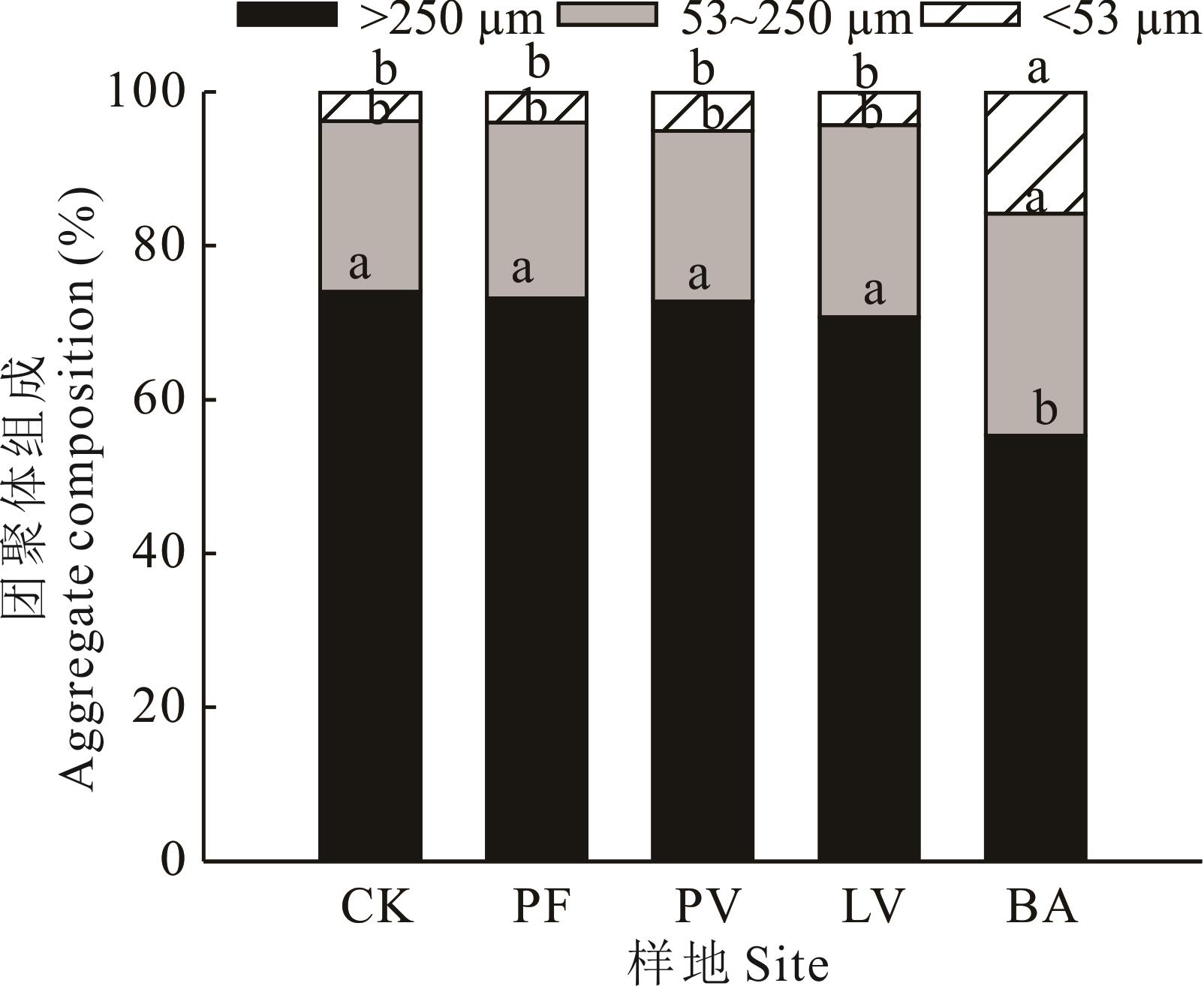
图2 草地微斑块土壤团聚体组成不同字母表示各样地间差异显著(P<0.05)。下同。Different letters indicate significant differences among the five sites (P<0.05). The same below.
Fig. 2 Soil aggregate composition of grass micro-patches
样地 Site | 平均重量直径Mean weight diameter, MWD | 几何平均直径Geometric mean diameter,GMD |
|---|---|---|
| CK | 0.87±0.00a | 0.82±0.01a |
| PF | 0.86±0.01a | 0.81±0.01a |
| PV | 0.85±0.01a | 0.80±0.00a |
| LV | 0.83±0.01a | 0.79±0.01a |
| BA | 0.67±0.05b | 0.63±0.03b |
表3 草地微斑块土壤团聚体稳定性
Table 3 Soil aggregates stability of grassland micro-patches (mm)
样地 Site | 平均重量直径Mean weight diameter, MWD | 几何平均直径Geometric mean diameter,GMD |
|---|---|---|
| CK | 0.87±0.00a | 0.82±0.01a |
| PF | 0.86±0.01a | 0.81±0.01a |
| PV | 0.85±0.01a | 0.80±0.00a |
| LV | 0.83±0.01a | 0.79±0.01a |
| BA | 0.67±0.05b | 0.63±0.03b |

图3 草地微斑块各粒径土壤团聚体有机碳和全氮含量
Fig. 3 Soil organic carbon and total nitrogen content in different aggregate size of grassland micro-patches
样地 Site | 团聚体碳贡献率Percentage of soil C in each aggregate size (%) | 碳氮比 C∶N | ||||
|---|---|---|---|---|---|---|
| >250 μm | 53~250 μm | <53 μm | >250 μm | 53~250 μm | <53 μm | |
| CK | 66.84±3.42a | 16.31±1.44bc | 3.37±0.65b | 17.21±2.36b | 14.95±2.02a | 12.24±1.30a |
| PF | 66.61±3.58a | 13.30±1.49bc | 2.63±0.50b | 21.50±0.80a | 12.36±1.26ab | 9.26±0.25b |
| PV | 70.22±7.23a | 12.00±0.56c | 3.36±0.38b | 17.52±1.36b | 9.82±0.42bc | 8.29±0.74bc |
| LV | 66.19±10.98a | 16.74±3.15b | 3.14±0.55b | 12.58±2.79c | 9.14±1.45c | 8.02±1.86bc |
| BA | 51.48±4.45b | 24.47±2.66a | 13.12±1.33a | 9.10±0.77c | 9.01±0.86c | 6.19±0.67c |
表4 草地微斑块土壤团聚体有机碳贡献率和团聚体碳氮比
Table 4 Percentage of soil C and C∶N in each aggregate size of grassland micro-patches
样地 Site | 团聚体碳贡献率Percentage of soil C in each aggregate size (%) | 碳氮比 C∶N | ||||
|---|---|---|---|---|---|---|
| >250 μm | 53~250 μm | <53 μm | >250 μm | 53~250 μm | <53 μm | |
| CK | 66.84±3.42a | 16.31±1.44bc | 3.37±0.65b | 17.21±2.36b | 14.95±2.02a | 12.24±1.30a |
| PF | 66.61±3.58a | 13.30±1.49bc | 2.63±0.50b | 21.50±0.80a | 12.36±1.26ab | 9.26±0.25b |
| PV | 70.22±7.23a | 12.00±0.56c | 3.36±0.38b | 17.52±1.36b | 9.82±0.42bc | 8.29±0.74bc |
| LV | 66.19±10.98a | 16.74±3.15b | 3.14±0.55b | 12.58±2.79c | 9.14±1.45c | 8.02±1.86bc |
| BA | 51.48±4.45b | 24.47±2.66a | 13.12±1.33a | 9.10±0.77c | 9.01±0.86c | 6.19±0.67c |
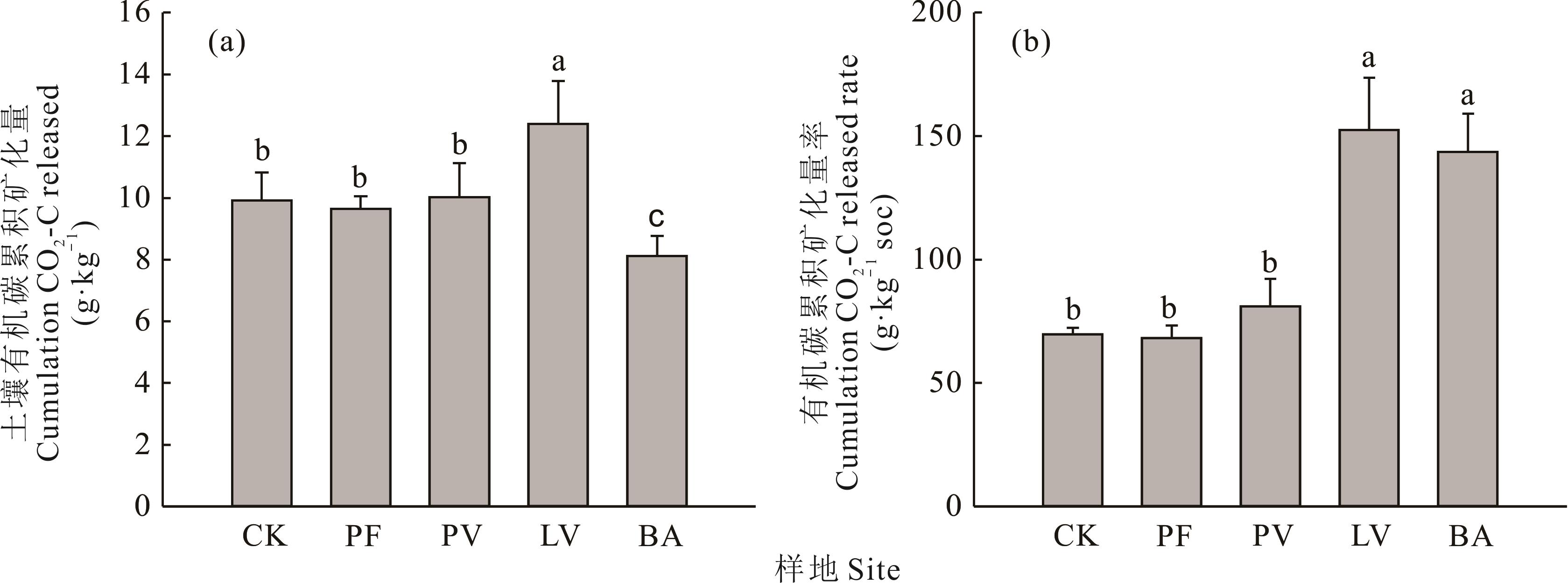
图4 草地微斑块土壤有机碳累积矿化量和累积矿化量率
Fig. 4 Cumulative CO2-C released and their ratios to SOC in grassland micro-patches
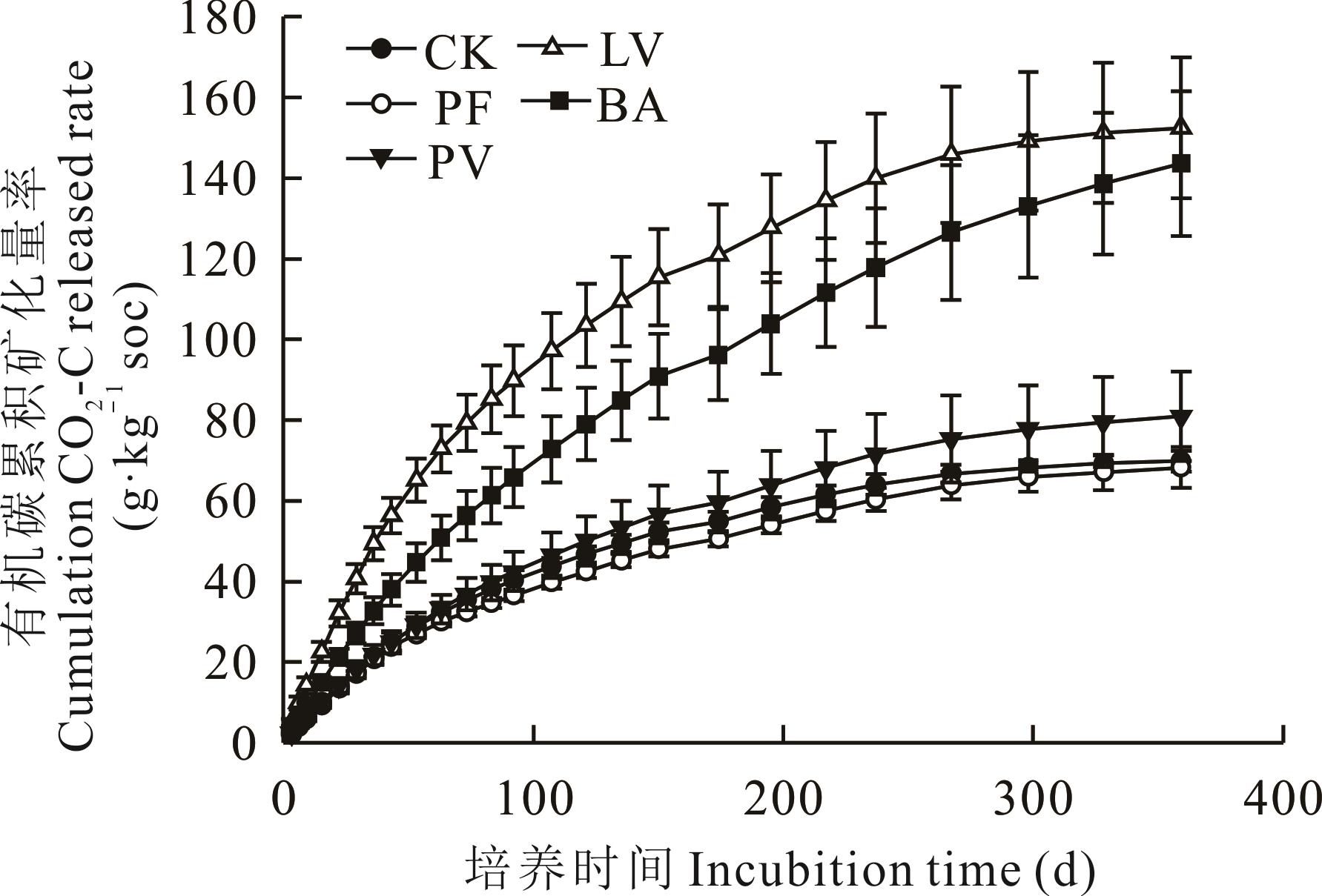
图5 草地微斑块土壤有机碳的时间动态累积矿化量率
Fig. 5 Temporal dynamics of cumulative CO2-C released ratios to SOC of grassland micro-patches
项目 Item | 有机碳累积矿化量 Cumulation CO2-C released | 有机碳累积矿化量率 Cumulation CO2-C released rate |
|---|---|---|
| 大团聚体含量Macro content | 0.509* | -0.564** |
| 微团聚体含量Micro content | -0.325 | 0.480* |
| 粘粉粒团聚体含量S&C content | -0.563** | 0.536* |
| 平均重量直径Mean weight diameter (MWD) | 0.516* | -0.565** |
| 几何平均直径Geometric mean diameter (GMD) | 0.527* | -0.577** |
| 大团聚体碳含量Carbon content in macro | 0.137 | -0.873** |
| 微团聚体碳含量Carbon content in micro | -0.143 | -0.703** |
| 粘粉粒团聚体碳含量Carbon content in S&C | -0.679** | 0.171 |
| 大团聚体碳贡献率Percentage of soil C in macro | 0.394 | -0.345 |
| 微团聚体碳贡献率Percentage of soil C in micro | -0.404 | 0.605** |
| 粘粉粒团聚体碳贡献率Percentage of soil C in S&C | -0.549* | 0.554* |
| 大团聚体碳氮比C∶N with macro | 0.036 | -0.799** |
| 微团聚体碳氮比C∶N with micro | -0.047 | -0.606** |
| 粘粉粒团聚体碳氮比C∶N with S&C | 0.195 | -0.599** |
| 有机碳含量Soil organic carbon content | 0.083 | -0.916** |
表5 草地植物微斑块团聚体与有机碳累积矿化量和累积矿化率的相关性分析
Table 5 Correlation analysis of grassland micro-patches aggregates with cumulative mineralization and its rate
项目 Item | 有机碳累积矿化量 Cumulation CO2-C released | 有机碳累积矿化量率 Cumulation CO2-C released rate |
|---|---|---|
| 大团聚体含量Macro content | 0.509* | -0.564** |
| 微团聚体含量Micro content | -0.325 | 0.480* |
| 粘粉粒团聚体含量S&C content | -0.563** | 0.536* |
| 平均重量直径Mean weight diameter (MWD) | 0.516* | -0.565** |
| 几何平均直径Geometric mean diameter (GMD) | 0.527* | -0.577** |
| 大团聚体碳含量Carbon content in macro | 0.137 | -0.873** |
| 微团聚体碳含量Carbon content in micro | -0.143 | -0.703** |
| 粘粉粒团聚体碳含量Carbon content in S&C | -0.679** | 0.171 |
| 大团聚体碳贡献率Percentage of soil C in macro | 0.394 | -0.345 |
| 微团聚体碳贡献率Percentage of soil C in micro | -0.404 | 0.605** |
| 粘粉粒团聚体碳贡献率Percentage of soil C in S&C | -0.549* | 0.554* |
| 大团聚体碳氮比C∶N with macro | 0.036 | -0.799** |
| 微团聚体碳氮比C∶N with micro | -0.047 | -0.606** |
| 粘粉粒团聚体碳氮比C∶N with S&C | 0.195 | -0.599** |
| 有机碳含量Soil organic carbon content | 0.083 | -0.916** |
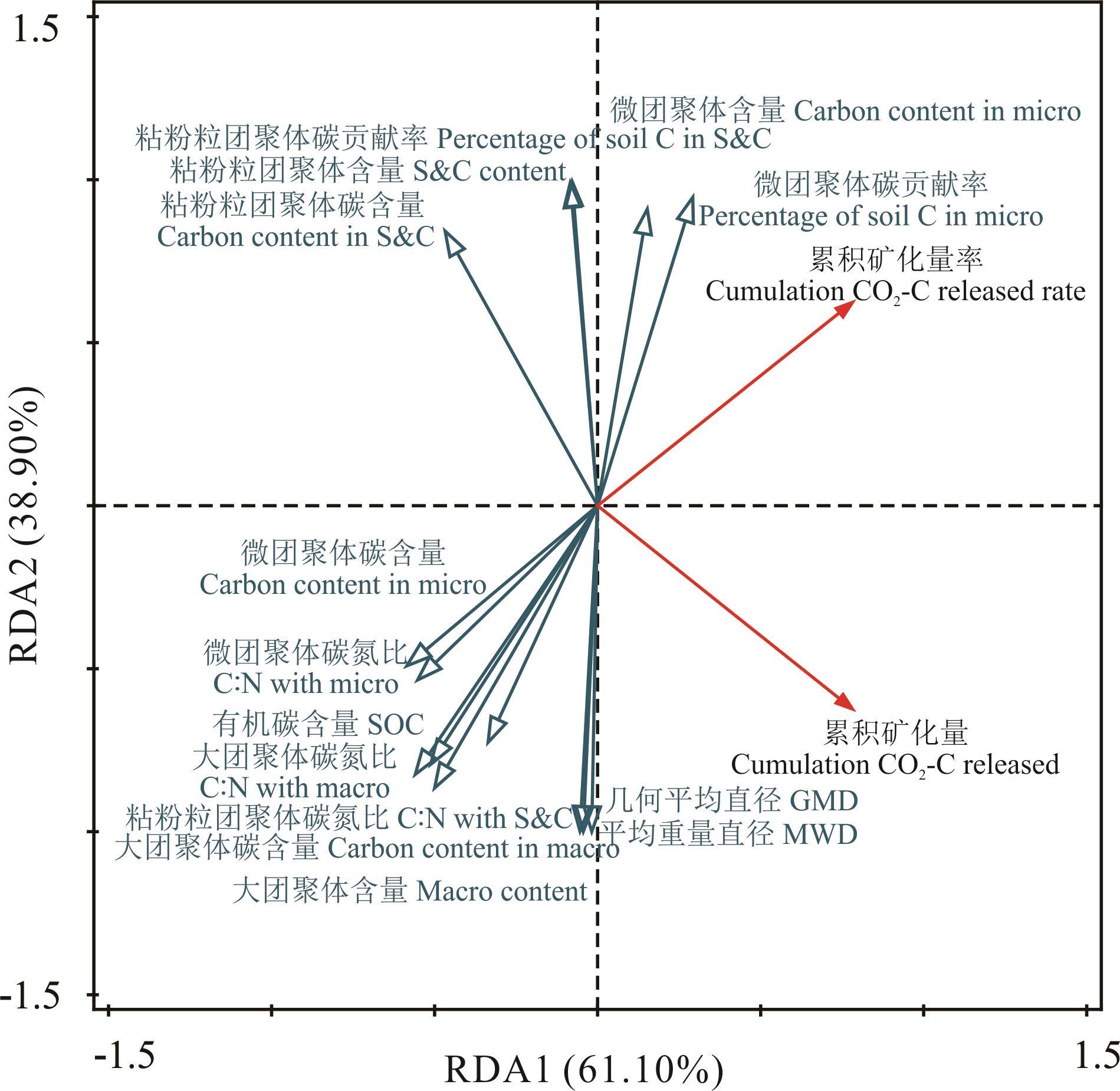
图6 草地植物微斑块团聚体与有机碳累积矿化量和累积矿化率的RDA分析
Fig.6 RDA analysis of grassland micro-patches aggregates with cumulative mineralization and its rate
| [1] | Smith P. Soils as carbon sinks: The global context. Soil Use and Management, 2004, 20(2): 25-36. |
| [2] | Schlesinger W H, Andrews J A. Soil respiration and the global carbon cycle. Biogeochemistry, 2000, 48(1): 7-20. |
| [3] | He Y, Trumbore S E, Torn M S, et al. Radiocarbon constraints imply reduced carbon uptake by soils during the 21st century. Science, 2016, 353(6306): 1419-1424. |
| [4] | Jia J, Yu D P, Zhou W M, et al. Variations of soil aggregates and soil organic carbon mineralization across forest types on the northern slope of Changbai Mountain. Acta Ecologica Sinica, 2015, 35(2): 15-23. |
| [5] | Christensen B T. Physical fractionation of soil and structural and functional complexity in organic matter turnover. European Journal of Soil Science, 2001, 52(3): 345-353. |
| [6] | Rivera J I, Bonilla C A. Predicting soil aggregate stability using readily available soil properties and machine learning techniques. Catena, 2020, 187(2): 104-111. |
| [7] | Jiang L M, Bai G F, Lv G H, et al. Effects of different management modes on soil aggregate stability and physicochemical properties of grassland in arid area. Journal of Agricultural Research in Arid Areas, 2018, 36(4): 15-21, 39. |
| 蒋腊梅, 白桂芬, 吕光辉, 等. 不同管理模式对干旱区草原土壤团聚体稳定性及其理化性质的影响. 干旱地区农业研究, 2018, 36(4): 15-21, 39. | |
| [8] | Wang J Y, Zhang F H. Distribution of soil aggregates and aggregate-associated organic carbon from typical halophyte community in arid region. Acta Ecologica Sinica, 2016, 36(3): 600-607. |
| 王静娅, 张凤华. 干旱区典型盐生植物群落土壤团聚体组成及有机碳分布. 生态学报, 2016, 36(3): 600-607. | |
| [9] | Six J, Bossuyt H, Degryze S, et al. A history of research on the link between (micro) aggregates, soil biota, and soil organic matter dynamics. Soil & Tillage Research, 2004, 79(1): 7-31. |
| [10] | Li J Y, Yuan X L, Ge L, et al. Rhizosphere effects promote soil aggregate stability and associated organic carbon sequestration in rocky areas of desertification. Agriculture, Ecosystems and Environment, 2020, 304(5): 28-36. |
| [11] | Puget P, Chenu C, Balesdent J. Dynamics of soil organic matter associated with particle-size fractions of water-stable aggregates. European Journal of Soil Science, 2000, 51(4): 595-605. |
| [12] | Jastrow J D, Boutton T W, Miller R M. Carbon dynamics of aggregate-associated organic matter estimated by carbon-13 natural abundance. Soil Science Society of America Journal, 1996, 60(3): 801-807. |
| [13] | Song L P, Luo Z Z, Li L L, et al. Effect of lucerne-crop rotations on soil physical properties in the semi-arid Loess Plateau of Central Gansu. Acta Prataculturae Sinica, 2015, 24(7): 12-20. |
| 宋丽萍, 罗珠珠, 李玲玲, 等. 陇中黄土高原半干旱区苜蓿-作物轮作对土壤物理性质的影响. 草业学报, 2015, 24(7): 12-20. | |
| [14] | Wang R Z, Chen Y, Li T, et al. Root distribution characteristics of Vetiveria zizanioides and Digitaria sanguinalis and their effects on the anti-erodibility of purple soil in slopelands. Acta Prataculturae Sinica, 2017, 26(7): 45-54. |
| 王润泽, 谌芸, 李铁, 等. 香根草和马唐的根系特征及对坡地紫色土抗侵蚀性的影响. 草业学报, 2017, 26(7): 45-54. | |
| [15] | Luo N, Shu Y G, Chen M J, et al. Soil structure and fractal characteristics of different land categories in a karst rocky desertification area. Acta Prataculturae Sinica, 2020, 29(7): 11-22. |
| 罗楠, 舒英格, 陈梦军, 等. 喀斯特山区不同草地土壤结构及分形特征. 草业学报, 2020, 29(7): 11-22. | |
| [16] | Luo Y J, Zhao G, Gao M, et al. Organic carbon distribution in aggregates and soil organic carbon mineralization in different vegetation covering. Journal of Soil and Water Conservation, 2010, 24(6): 117-122. |
| 罗友进, 赵光, 高明, 等. 不同植被覆盖对土壤有机碳矿化及团聚体碳分布的影响. 水土保持学报, 2010, 24(6): 117-122. | |
| [17] | Amelung W, Zech W. Organic species in ped surface and core fractions along a climosequence in the prairie, North America. Geoderma, 1996, 74(3/4): 193-206. |
| [18] | Song R, Liu L, Ma L Y, et al. Effect of crop root exudates on the size and stability of soil aggregate. Journal of Nanjing Agricultural University, 2009, 32(3): 93-97. |
| 宋日, 刘利, 马丽艳, 等. 作物根系分泌物对土壤团聚体大小及其稳定性的影响. 南京农业大学学报, 2009, 32(3): 93-97. | |
| [19] | Fattet M, Fu Y, Ghestem M, et al. Effects of vegetation type on soil resistance to erosion: Relationship between aggregate stability and shear strength. Catena, 2011, 87(1): 60-69. |
| [20] | Gould I J, Quinton J N, Weigelt A, et al. Plant diversity and root traits benefit physical properties key to soil function in grasslands. Ecology Letters, 2016, 19(9): 1140-1149. |
| [21] | Kumar A, Dorodnikov M, Splettstosser T, et al. Effects of maize roots on aggregate stability and enzyme activities in soil. Geoderma, 2017, 306(3): 50-57. |
| [22] | Wang Y. Study on quantity characteristics and species composition of three vegetation patches in alpine meadow on the Northeast Range of Tibet Plateau. Lanzhou: Lanzhou University, 2017. |
| 王莹. 青藏高原东北缘高寒草甸三种植被斑块数量特征及物种构成研究. 兰州: 兰州大学, 2017. | |
| [23] | Zhang W G, Huang W B, Yang Z Y. The study on the relationship between mini-patch and degradation of pasture. Acta Prataculturae Sinica, 2003, 5(3): 44-50. |
| 张卫国, 黄文冰, 杨振宇. 草地微斑块与草地退化关系的研究. 草业学报, 2003, 5(3): 44-50. | |
| [24] | Lin L, Cao G M, Fan B, et al. Effects of grazing on mini-patch and their component characteristics in alpine grassland. Grassland and Turf, 2021, 41(4): 143-153. |
| 林丽, 曹广民, 樊博, 等. 放牧对高寒草地微尺度斑块及其构件特征的影响. 草原与草坪, 2021, 41(4): 143-153. | |
| [25] | Huo J J, Zhu J F, Song M H, et al. Characteristics of vegetation patches in the process of degradation succession in an alpine meadow on Tibet Plateau. Acta Agrestia Sinica, 2022, 30(11): 3113-3118. |
| 霍佳娟, 朱珏妃, 宋明华, 等. 青藏高原高寒草甸退化演替进程中植被斑块特征. 草地学报, 2022, 30(11): 3113-3118. | |
| [26] | Du Y X, Kang Y M, Niu Y B, et al. Soil microflora characteristics under different vegetation patches in a desert steppe of Ningxia, Northwest China. Chinese Journal of Applied Ecology, 2019, 30(9): 3057-3065. |
| 杜雅仙, 康扬眉, 牛玉斌, 等. 宁夏荒漠草原不同植物群落微斑块内土壤微生物区系特征. 应用生态学报, 2019, 30(9): 3057-3065. | |
| [27] | Wu Y N, Luo W T, Huo G W, et al. Micro-scale spatial heterogeneity of vegetation community and soil organic matter under different grazing intensities. Journal of Desert Research, 2012, 32(4): 972-979. |
| 乌云娜, 雒文涛, 霍光伟, 等. 微生境尺度上放牧退化草原群落特征与土壤有机质的空间分异性. 中国沙漠, 2012, 32(4): 972-979. | |
| [28] | Shi M M, Zhang Y C, Zhang D Y, et al. Plant traits and soil properties in pasture mini-patches in an alpine meadow. Acta Prataculturae Sinica, 2015, 24(9): 197-205. |
| 石明明, 张永超, 张典业, 等. 高寒草甸草地微斑块植物特征及其土壤性质的研究. 草业学报, 2015, 24(9): 197-205. | |
| [29] | Wang Y, Niu D, Yuan X B, et al. Dominant plant species alter stoichiometric imbalances between soil microbes and their resources in an alpine grassland: Implications for soil microbial respiration. Geoderma, 2023, 431(3): 116336-116350. |
| [30] | Xu X, Shi Z, Li D J, et al. Soil properties control decomposition of soil organic carbon: Results from data-assimilation analysis. Geoderma, 2016, 262: 235-242. |
| [31] | Cui Y T, Wang C Y, Yao J H, et al. Effects of different screening methods on soil aggregates and soil microbial communities. Chinese Journal of Soil and Fertilizer, 2024, 5(1): 37-42. |
| 崔炎田, 王呈玉, 姚俊红, 等. 不同筛分方式对土壤团聚体及土壤微生物群落的影响. 中国土壤与肥料, 2024, 5(1): 37-42. | |
| [32] | Liu X, Wu H Y, Yang S, et al. Formation of soil aggregates and distribution of soil nutrients in rhizosphere of salt-tolerant trees in coastal polder reclamation. Acta Pedologica Sinica, 2020, 57(5): 1270-1279. |
| 刘星, 吴华勇, 杨升, 等. 海涂围垦区不同耐盐树种根际土壤团聚体形成及养分分布特征. 土壤学报, 2020, 57(5): 1270-1279. | |
| [33] | Wang X Y, Gao X F, Liu H P, et al. Review of analytical methods for aggregate size distribution and water-stability of soil macro-aggregates. Chinese Journal of Water and Soil Conservation, 2011, 9(3): 106-113. |
| 王秀颖, 高晓飞, 刘和平, 等. 土壤水稳性大团聚体测定方法综述. 中国水土保持科学, 2011, 9(3): 106-113. | |
| [34] | Nelson D W, Sommers L E, Sparks D L, et al. Total carbon, organic carbon, and organic matter. Methods of Soil Analysis, 1996, 9: 961-1010. |
| [35] | Bremer D J, Ham J M, Owensby C E, et al. Responses of soil respiration to clipping and grazing in a tallgrass prairie. Journal of Environmental Quality, 1998, 27(6): 1539-1548. |
| [36] | Li Y H, Shahbaz M, Zhu Z K, et al. Oxygen availability determines key regulators in soil organic carbon mineralisation in paddy soils. Soil Biology and Biochemistry, 2021, 153(5): 108-117. |
| [37] | Muhammad N A, Gao J, Wu L, et al. Soil microbial biomass and extracellular enzyme-mediated mineralization potentials of carbon and nitrogen under long-term fertilization (>30 years) in a rice-rice cropping system. Springer Nature Link, 2021, 21(13): 3789-3800. |
| [38] | Beare M H, Hendrix P F, Coleman D C. Water-stable aggregates and organic-matter fractions in conventional-tillage and no-tillage soils. Soil Science Society of America Journal, 1994, 58(3): 777-786. |
| [39] | Dexter A R. Advances in characterization of soil structure. Soil & Tillage Research, 1988, 11(3/4): 199-238. |
| [40] | Yang X M, Wander M M. Temporal changes in dry aggregate size and stability: tillage and crop effects on a silty loam Mollisol in Illinois. Soil & Tillage Research, 1998, 49(3): 173-183. |
| [41] | Qiu L P, Zhang X C, Zhang J A. Distribution of nutrients and enzymes in Loess Plateau soil aggregates after long-term fertilization. Acta Ecologica Sinica, 2006, 26(2): 364-372. |
| 邱莉萍, 张兴昌, 张晋爱. 黄土高原长期培肥土壤团聚体中养分和酶的分布. 生态学报, 2006, 26(2): 364-372. | |
| [42] | Ma R P, An S S, Dang T H, et al. Soil organic carbon and enzymatic activity in aggregates of soil under different plant communities in Hilly-Gully regions of Loess Plateau. Acta Pedologica Sinica, 2014, 51(1): 104-113. |
| 马瑞萍, 安韶山, 党廷辉, 等. 黄土高原不同植物群落土壤团聚体中有机碳和酶活性研究. 土壤学报, 2014, 51(1): 104-113. | |
| [43] | Luo Y J, Wei C F, Li Y, et al. Effects of land use on distribution and protection of organic carbon in soil aggregates in karst rocky desertification area. Acta Ecologica Sinica, 2011, 31(1): 257-266. |
| 罗友进, 魏朝富, 李渝, 等. 土地利用对石漠化地区土壤团聚体有机碳分布及保护的影响. 生态学报, 2011, 31(1): 257-266. | |
| [44] | Su Y Z, Chang X X, He Z B, et al. Changes in vegetative patches and characteristics in soil properties in the valleys of Qilian Mountains. Acta Ecologica Sinica, 2008(1): 212-219. |
| 苏永中, 常学向, 何志斌, 等. 祁连山典型流域谷地植被斑块演变与土壤性状. 生态学报, 2008(1): 212-219. | |
| [45] | Wang Y Q. Study on relationship between the patch density of Ligularia virgaurea and vegetation and soil in alpine meadow. Xining: Qinghai University, 2023. |
| 王玉琴. 黄帚橐吾斑块密度与高寒草甸植被和土壤的关系研究. 西宁: 青海大学, 2023. | |
| [46] | Mao Y L, Yang Y S, Zou S Q, et al. Effects of land use on soil organic carbon in aggregates of Hilly Red soil in Subtropical China. Journal of Mountain Science, 2007, 25(6): 706-713. |
| 毛艳玲, 杨玉盛, 邹双全, 等. 土地利用变化对亚热带山地红壤团聚体有机碳的影响. 山地学报, 2007, 25(6): 706-713. | |
| [47] | Hu N, Ma Z M, Lan J C, et al. Nitrogen fraction distributions and impacts on soil nitrogen mineralization in different vegetation restorations of karst rocky desertification. Environmental Science, 2015, 36(9): 3411-3421. |
| 胡宁, 马志敏, 蓝家程, 等. 石漠化山地植被恢复过程土壤团聚体氮分布及与氮素矿化关系研究. 环境科学, 2015, 36(9): 3411-3421. | |
| [48] | Ma X J, Guo Y J, Zhang J Y, et al. Size distribution of soil aggregates in different grassland desertification categories in Yanchi County, Ningxia. Acta Prataculturae Sinica, 2020, 29(3): 27-37. |
| 马晓静, 郭艳菊, 张嘉玉, 等. 宁夏盐池县沙化草地土壤团聚体分异特征. 草业学报, 2020, 29(3): 27-37. | |
| [49] | Su J, Zhao S W. Comparison of the analysis methods for soil aggregate stability. Journal of Soil and Water Conservation, 2009, 29(5): 114-117. |
| 苏静, 赵世伟. 土壤团聚体稳定性评价方法比较. 水土保持通报, 2009, 29(5): 114-117. | |
| [50] | Huang Z, Tian F P, Liu Y, et al. Effects of different grassland types on particle size distribution and stability of water stable aggregate on the Loess Plateau. Acta Prataculturae Sinica, 2017, 26(11): 216-221. |
| 黄泽, 田福平, 刘玉, 等. 黄土高原不同草地类型对水稳性团聚体粒径分布及稳定性的影响. 草业学报, 2017, 26(11): 216-221. | |
| [51] | Zhang X R, Zhang W Q. Research progress of soil aggregates. Northern Horticulture, 2020, 2(21): 131-137. |
| 张旭冉, 张卫青. 土壤团聚体研究进展. 北方园艺, 2020, 2(21): 131-137. | |
| [52] | Chen S, Sun T. Research of soil aggregate stability in different degradation stages of Songnen grassland. Pratacultural Science, 2017, 34(2): 217-223. |
| 陈帅, 孙涛. 松嫩草地不同退化阶段的土壤团聚体稳定性. 草业科学, 2017, 34(2): 217-223. | |
| [53] | Jiang L M, Yang X D, Yang J J, et al. Effects of different management strategies on soil organic carbon and nitrogen pools in arid areas and their influencing factors. Acta Prataculturae Sinica, 2018, 27(12): 22-33. |
| 蒋腊梅, 杨晓东, 杨建军, 等. 不同管理模式对干旱区草地土壤有机碳氮库的影响及其影响因素探究. 草业学报, 2018, 27(12): 22-33. | |
| [54] | Xu D M, Xu X Z, Wang G H, et al. Variations in soil organic carbon content and distribution during natural restoration succession on the desert steppe in Ningxia. Acta Prataculturae Sinica, 2017, 26(8): 35-42. |
| 许冬梅, 许新忠, 王国会, 等. 宁夏荒漠草原自然恢复演替过程中土壤有机碳及其分布的变化. 草业学报, 2017, 26(8): 35-42. | |
| [55] | Zhang S, Wang L C, Du J, et al. Effects of different crops and straw mulching on soil aggregate and carbon sequestration potential in the dryland, triple cropping systems of Southwest China. Acta Prataculturae Sinica, 2016, 25(1): 98-107. |
| 张赛, 王龙昌, 杜娟, 等. 西南“旱三熟”区不同作物和秸秆覆盖对土壤团聚体及固碳潜力的影响. 草业学报, 2016, 25(1): 98-107. | |
| [56] | Xie J S, Yang Y S, Chen G S, et al. Effects of vegetation restoration on water stability and organic carbon distribution in aggregates of degraded red soil in subtropics of China. Acta Ecologica Sinica, 2008, 28(2): 702-709. |
| 谢锦升, 杨玉盛, 陈光水, 等. 植被恢复对退化红壤团聚体稳定性及碳分布的影响. 生态学报, 2008, 28(2): 702-709. | |
| [57] | Li N, Zhang Y H, Han X Z, et al. Effects of long-term vegetation cover changes on the organic carbon fractions in soil aggregates of mollisols. Chinese Journal of Plant Ecology, 2019, 43(7): 624-634. |
| 李娜, 张一鹤, 韩晓增, 等. 长期不同植被覆盖对黑土团聚体内有机碳组分的影响. 植物生态学报, 2019, 43(7): 624-634. | |
| [58] | Peng C J, Song M H, Zhou C L, et al. Relationship between leaf functional traits of herbaceous plants and soil factors in different coverage gradients of potentilla fruticosa shrub under grazing. Acta Botanica Boreali-Occidentalia Sinica, 2020, 40(5): 870-881. |
| 朋措吉, 宋明华, 周春丽, 等. 放牧影响下不同盖度金露梅灌丛草本植物叶功能性状与土壤因子的关系. 西北植物学报, 2020, 40(5): 870-881. | |
| [59] | Liu Q, Li Y H, Li Z, et al. Characteristics of paddy soil organic carbon mineralization and influencing factors under different water conditions and microbial biomass levels. Environmental Science, 2021, 42(5): 2440-2448. |
| 刘琪, 李宇虹, 李哲, 等. 不同水分条件和微生物生物量水平下水稻土有机碳矿化及其影响因子特征. 环境科学, 2021, 42(5): 2440-2448. | |
| [60] | Wang C T, Long R J, Ding L M. Characteristics of clonal growth of Ligularia virgaurea to different elevation gradient on alpine meadow. Acta Botanica Boreali-Occidentalia Sinica, 2004, 5(10): 1805-1809. |
| 王长庭, 龙瑞军, 丁路明. 高寒草甸不同海拔梯度下多年生黄帚橐吾的克隆生长特征. 西北植物学报, 2004, 5(10): 1805-1809. | |
| [61] | Qi Z C, Chang P J, Li Y S, et al. Effects of grazing intensity on soil aggregates composition, stability, nutrients and C/N in desert shrubland. Arid Zone Research, 2021, 38(1): 87-94. |
| 祁正超, 常佩静, 李永善, 等. 放牧对荒漠灌丛草地土壤团聚体组成及其稳定性的影响. 干旱区研究, 2021, 38(1): 87-94. | |
| [62] | Miao S J, Zhou L R, Qiao Y F, et al. Organic carbon mineralization and carbon contribution in aggregate as affected by long-term fertilization. Acta Pedologica Sinica, 2009, 46(6): 1068-1075. |
| 苗淑杰, 周连仁, 乔云发, 等. 长期施肥对黑土有机碳矿化和团聚体碳分布的影响. 土壤学报, 2009, 46(6): 1068-1075. | |
| [63] | Chen J, Zhou X, Wang J, et al. Grazing exclusion reduced soil respiration but increased its temperature sensitivity in a meadow grassland on the Tibetan Plateau. Ecology and Evolution, 2016, 6(3): 675-687. |
| [1] | 冉健民, 宋小艳, 王丹, 王长庭. 退化高寒草甸土壤有机碳组分变化与增汇潜力研究[J]. 草业学报, 2025, 34(9): 38-52. |
| [2] | 陈俊玲, 王莎莎, 叶菁, 林怡, 王义祥. 长期不同果园生草覆盖下土壤碳矿化及其温度敏感性研究[J]. 草业学报, 2025, 34(9): 53-64. |
| [3] | 王玉霞, 杜灵通, 易志远, 罗霄, 苏丽, 乔成龙, 薛斌. 宁夏贺兰山东麓葡萄产区土壤有机碳库空间变异及影响因素[J]. 草业学报, 2025, 34(7): 41-53. |
| [4] | 秦文利, 张静, 肖广敏, 崔素倩, 叶建勋, 智健飞, 张立锋, 谢楠, 冯伟, 刘振宇, 潘璇, 代云霞, 刘忠宽. 绿肥部分替代化肥氮对土壤物理性状的影响[J]. 草业学报, 2025, 34(6): 27-45. |
| [5] | 闫储淇, 黄建强. 基于YOLOv5和改进DeeplabV3+的青藏高原植被提取算法[J]. 草业学报, 2025, 34(1): 41-54. |
| [6] | 谭湘蛟, 董逵才, 张华, 唐川川, 杨燕. 积雪增加对青藏高原高寒草甸土壤磷有效性的影响[J]. 草业学报, 2024, 33(7): 205-214. |
| [7] | 魏孔钦, 赵俊威, 张前兵. 施磷对紫花苜蓿土壤呼吸速率及活性有机碳组分的影响[J]. 草业学报, 2024, 33(2): 80-92. |
| [8] | 白世俊, 李军乔, 刘欣, 吕博文. 青藏高原蕨麻的分子谱系地理学研究[J]. 草业学报, 2024, 33(11): 84-105. |
| [9] | 张东, 侯晨, 马文明, 王长庭, 邓增卓玛, 张婷. 高寒草地不同灌丛化梯度下土壤酶活性研究[J]. 草业学报, 2023, 32(9): 79-92. |
| [10] | 杨欣怡, 杨富强, 周旭姣, 王明军, 黄海霞, 鲁松松, 张晓玮, 杜伟波, 王旭虎, 田青, 赵安, 贺万鹏, 周晓雷. 青藏高原东北边缘云杉-巴山冷杉林火烧迹地草本植物群落构建机理[J]. 草业学报, 2023, 32(8): 40-47. |
| [11] | 周晓雷, 杨富强, 王明军, 黄海霞, 田青, 周旭姣, 赵安, 贺万鹏, 赵艳丽, 姜礼红. 青藏高原东北边缘云杉-巴山冷杉林火烧迹地草本植物群落主要种生态位特征[J]. 草业学报, 2023, 32(7): 23-37. |
| [12] | 李思媛, 崔雨萱, 孙宗玖, 刘慧霞, 冶华薇. 封育对蒿类荒漠草地土壤有机碳及土壤微生物生物量生态化学计量特征的影响[J]. 草业学报, 2023, 32(6): 58-70. |
| [13] | 郭鑫, 罗欢, 许雪梅, 马爱霞, 尚振艳, 韩天虎, 牛得草, 文海燕, 李旭东. 不同品质凋落物分解对黄土高原草地土壤有机碳及其稳定性的影响[J]. 草业学报, 2023, 32(5): 83-93. |
| [14] | 周娟娟, 刘云飞, 王敬龙, 魏巍. 短期养分添加对西藏沼泽化高寒草甸地上生物量、植物多样性和功能性状的影响[J]. 草业学报, 2023, 32(11): 17-29. |
| [15] | 王瑞泾, 冯琦胜, 金哲人, 刘洁, 赵玉婷, 葛静, 梁天刚. 青藏高原退化草地的恢复潜势研究[J]. 草业学报, 2022, 31(6): 11-22. |
| 阅读次数 | ||||||
|
全文 |
|
|||||
|
摘要 |
|
|||||
