

ISSN 1004-5759 CN 62-1105/S
草业学报 ›› 2026, Vol. 35 ›› Issue (5): 113-125.DOI: 10.11686/cyxb2025204
• 研究论文 • 上一篇
李小聪1,3( ), 闫聚辉1,3, 王星1,3, 胡鹏飞1,3, 叶雨浓1,3, 伏兵哲1,2,3()
收稿日期:2025-05-21
修回日期:2025-07-18
出版日期:2026-05-20
发布日期:2026-03-11
通讯作者:
伏兵哲
作者简介:Corresponding author. E-mail: fbzhe19@163.com基金资助:
Xiao-cong LI1,3(), Ju-hui YAN1,3, Xing WANG1,3, Peng-fei HU1,3, Yu-nong YE1,3, Bing-zhe FU1,2,3()
Received:2025-05-21
Revised:2025-07-18
Online:2026-05-20
Published:2026-03-11
Contact:
Bing-zhe FU
摘要:
为探究宁夏半干旱区紫花苜蓿与无芒雀麦间行种植的适宜比例,以单播紫花苜蓿(CKM)和无芒雀麦(CKB)为对照,设置紫花苜蓿(M)和无芒雀麦(B)5种种植比例(3∶1、2∶1、1∶1、1∶2、1∶3,分别为M3B1、M2B1、M1B1、M1B2、M1B3),测定与分析不同种植模式下紫花苜蓿与无芒雀麦的农艺性状、营养品质、土壤养分等指标。结果表明,间行种植比例(M2B1)在产量、品质和土壤养分积累方面表现最优。M2B1处理使紫花苜蓿分枝数较CKM提高18.36%,无芒雀麦株高和叶面积较CKB分别提高22.40%和37.03%,混合干草产量达17.70 t·hm-2,与CKM相当。M2B1处理下的粗蛋白含量较CKB提高33.83%,中性洗涤纤维降低5.12%。土壤养分积累方面,M2B1处理的有机质含量较CKM和CKB分别提高2.13%和3.90%,碱解氮含量分别提高16.53%和37.33%。冗余分析(RDA)结果表明,混合产量与土壤速效钾、碱解氮含量呈正相关关系。综合评价显示,紫花苜蓿与无芒雀麦按2∶1间行种植时,土地资源利用效率、生产力提升和土壤养分积累效果最优。
李小聪, 闫聚辉, 王星, 胡鹏飞, 叶雨浓, 伏兵哲. 紫花苜蓿/无芒雀麦间作对草地生产性能和土壤理化特性的影响[J]. 草业学报, 2026, 35(5): 113-125.
Xiao-cong LI, Ju-hui YAN, Xing WANG, Peng-fei HU, Yu-nong YE, Bing-zhe FU. Effects of different inter-row planting ratios of alfalfa and smooth brome on grass production performance and soil physicochemical properties[J]. Acta Prataculturae Sinica, 2026, 35(5): 113-125.

图1 种植模式
Fig.1 Planting pattern
物种 Species | 处理 Treatment | 株高 Plant height (cm) | 茎粗 Stem diameter (mm) | 叶面积 Leaf area (mm2) | 分枝数或分蘖数 Branch/tiller number | 茎叶比 Stem-leaf ratio | 干草产量 Hay yield (t?hm-2) |
|---|---|---|---|---|---|---|---|
紫花苜蓿 M. sativa | M1B1 | 92.78±1.08bc | 3.56±0.17a | 318.11±11.97ab | 210.00±7.93a | 1.71±0.07ab | 11.87±0.45c |
| M3B1 | 87.46±1.79d | 3.19±0.12a | 311.30±10.20b | 189.80±5.84ab | 1.75±0.05ab | 14.49±0.72b | |
| M1B2 | 94.74±1.04ab | 3.41±0.12a | 244.93±11.64c | 201.90±6.95ab | 1.67±0.06ab | 9.64±0.64d | |
| M2B1 | 87.89±1.57d | 3.34±0.14a | 237.09±11.72c | 181.80±7.62b | 1.59±0.04b | 15.19±0.86b | |
| M1B3 | 89.46±1.25cd | 3.37±0.12a | 246.71±10.74c | 210.30±8.77a | 1.57±0.06b | 7.38±0.31e | |
| CKM | 98.21±1.10a | 3.37±0.12a | 346.96±11.27a | 153.60±6.12c | 1.83±0.07a | 17.87±0.93a | |
无芒雀麦 B. inermis | M1B1 | 108.86±1.33a | 2.46±0.09a | 2068.86±109.87a | 269.08±15.76c | 0.98±0.08c | 4.07±0.20d |
| M3B1 | 102.56±1.59b | 2.61±0.13a | 2229.82±101.63a | 286.42±21.23bc | 0.96±0.07c | 1.97±0.12e | |
| M1B2 | 108.11±1.03a | 2.54±0.10a | 1582.82±60.10b | 283.92±15.37bc | 1.34±0.15ab | 7.03±0.41c | |
| M2B1 | 107.36±1.33a | 2.52±0.10a | 1689.89±104.57b | 255.58±11.27c | 1.52±0.15a | 2.51±0.14e | |
| M1B3 | 107.78±1.51a | 2.54±0.11a | 1437.11±74.77bc | 327.67±16.86ab | 1.51±0.11a | 8.51±0.43b | |
| CKB | 87.71±1.40c | 2.61±0.12a | 1233.21±59.19c | 343.75±10.75a | 1.14±0.07bc | 9.70±0.43a |
表1 不同间行种植比例对紫花苜蓿与无芒雀麦农艺性状的影响
Table 1 Effects of different inter-row planting ratios on agronomic traits of M. sativa and B. inermis
物种 Species | 处理 Treatment | 株高 Plant height (cm) | 茎粗 Stem diameter (mm) | 叶面积 Leaf area (mm2) | 分枝数或分蘖数 Branch/tiller number | 茎叶比 Stem-leaf ratio | 干草产量 Hay yield (t?hm-2) |
|---|---|---|---|---|---|---|---|
紫花苜蓿 M. sativa | M1B1 | 92.78±1.08bc | 3.56±0.17a | 318.11±11.97ab | 210.00±7.93a | 1.71±0.07ab | 11.87±0.45c |
| M3B1 | 87.46±1.79d | 3.19±0.12a | 311.30±10.20b | 189.80±5.84ab | 1.75±0.05ab | 14.49±0.72b | |
| M1B2 | 94.74±1.04ab | 3.41±0.12a | 244.93±11.64c | 201.90±6.95ab | 1.67±0.06ab | 9.64±0.64d | |
| M2B1 | 87.89±1.57d | 3.34±0.14a | 237.09±11.72c | 181.80±7.62b | 1.59±0.04b | 15.19±0.86b | |
| M1B3 | 89.46±1.25cd | 3.37±0.12a | 246.71±10.74c | 210.30±8.77a | 1.57±0.06b | 7.38±0.31e | |
| CKM | 98.21±1.10a | 3.37±0.12a | 346.96±11.27a | 153.60±6.12c | 1.83±0.07a | 17.87±0.93a | |
无芒雀麦 B. inermis | M1B1 | 108.86±1.33a | 2.46±0.09a | 2068.86±109.87a | 269.08±15.76c | 0.98±0.08c | 4.07±0.20d |
| M3B1 | 102.56±1.59b | 2.61±0.13a | 2229.82±101.63a | 286.42±21.23bc | 0.96±0.07c | 1.97±0.12e | |
| M1B2 | 108.11±1.03a | 2.54±0.10a | 1582.82±60.10b | 283.92±15.37bc | 1.34±0.15ab | 7.03±0.41c | |
| M2B1 | 107.36±1.33a | 2.52±0.10a | 1689.89±104.57b | 255.58±11.27c | 1.52±0.15a | 2.51±0.14e | |
| M1B3 | 107.78±1.51a | 2.54±0.11a | 1437.11±74.77bc | 327.67±16.86ab | 1.51±0.11a | 8.51±0.43b | |
| CKB | 87.71±1.40c | 2.61±0.12a | 1233.21±59.19c | 343.75±10.75a | 1.14±0.07bc | 9.70±0.43a |
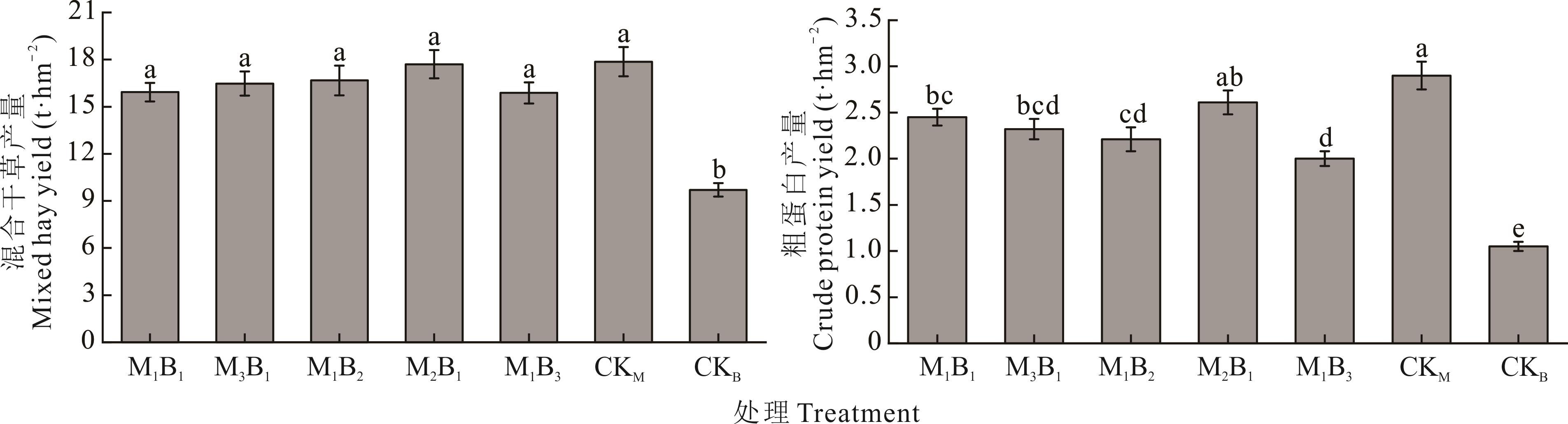
图2 紫花苜蓿/无芒雀麦不同间行种植比例下混合干草产量和粗蛋白产量不同小写字母表示不同处理间差异显著(P<0.05)。下同。Different lowercase letters indicate significant differences among treatments (P<0.05). The same below.
Fig.2 Mixed hay yield and crude protein yield under different inter-row planting ratios of M. sativa and B. inermis
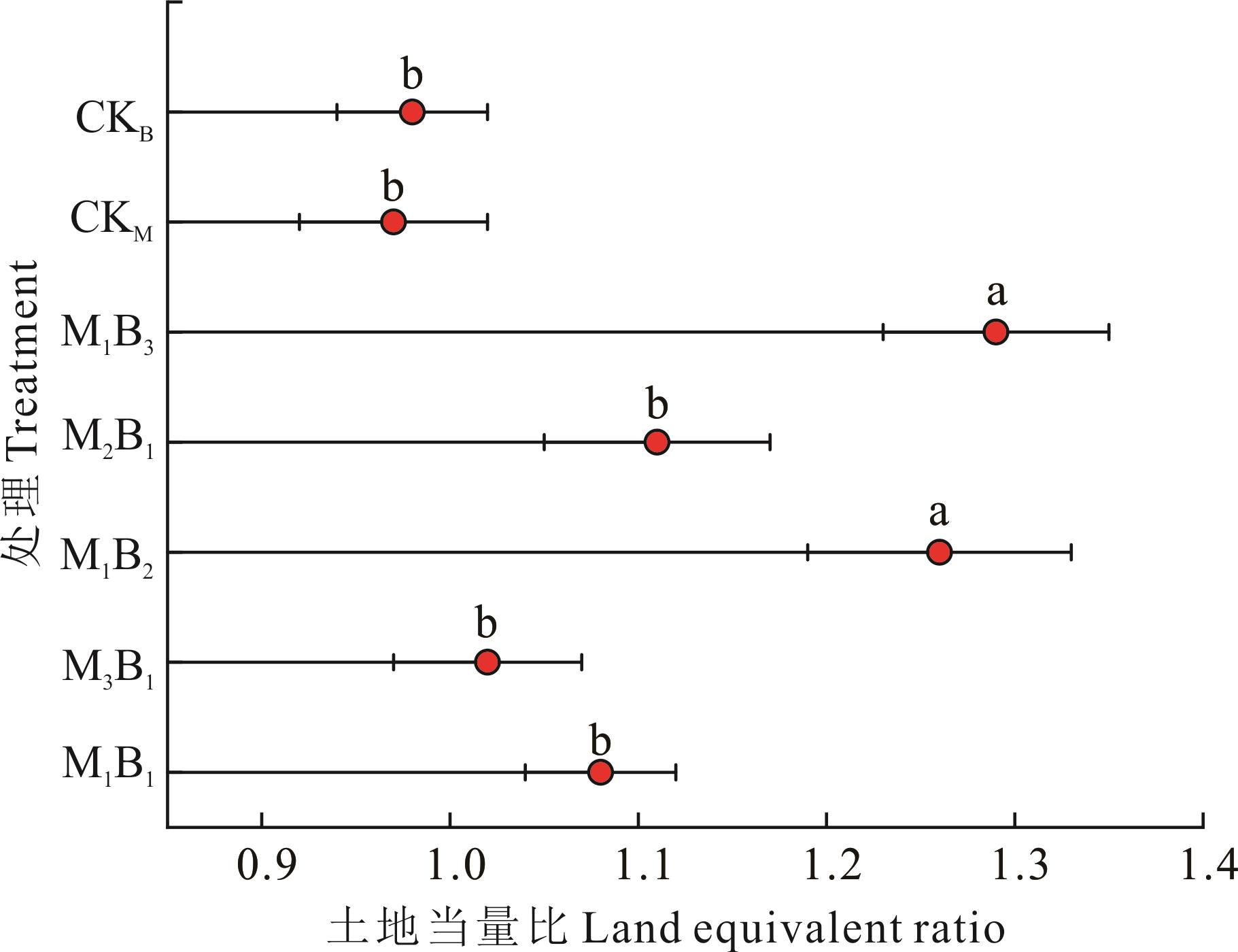
图3 不同间行种植比例的土地当量比
Fig.3 Land-equivalent ratios for different inter-row planting ratios
处理 Treatment | 粗蛋白 Crude protein (CP, %) | 中性洗涤纤维 Neutral detergent fiber (NDF, %) | 酸性洗涤纤维 Acid detergent fiber (ADF, %) | 相对饲喂价值 Relative feeding value (RFV) |
|---|---|---|---|---|
| M1B1 | 14.73±0.21b | 63.37±1.14b | 42.73±0.44b | 83.78±1.55b |
| M3B1 | 13.84±0.13c | 60.40±0.33c | 44.32±0.32a | 84.45±0.80b |
| M1B2 | 12.27±0.16d | 66.18±0.38a | 43.96±0.32a | 77.90±0.80c |
| M2B1 | 14.36±0.12b | 62.40±0.58b | 43.97±0.42a | 82.69±1.23b |
| M1B3 | 11.68±0.13e | 67.01±0.35a | 43.51±0.25ab | 78.75±0.76c |
| CKM | 16.21±0.18a | 55.23±0.62d | 40.22±0.46c | 97.29±1.81a |
| CKB | 10.73±0.25f | 65.77±0.22a | 39.11±0.32d | 82.61±0.48b |
表2 紫花苜蓿/无芒雀麦不同间行种植比例下的牧草营养品质
Table 2 Forage nutritional quality under different inter-row planting ratios of M. sativa and B. inermis
处理 Treatment | 粗蛋白 Crude protein (CP, %) | 中性洗涤纤维 Neutral detergent fiber (NDF, %) | 酸性洗涤纤维 Acid detergent fiber (ADF, %) | 相对饲喂价值 Relative feeding value (RFV) |
|---|---|---|---|---|
| M1B1 | 14.73±0.21b | 63.37±1.14b | 42.73±0.44b | 83.78±1.55b |
| M3B1 | 13.84±0.13c | 60.40±0.33c | 44.32±0.32a | 84.45±0.80b |
| M1B2 | 12.27±0.16d | 66.18±0.38a | 43.96±0.32a | 77.90±0.80c |
| M2B1 | 14.36±0.12b | 62.40±0.58b | 43.97±0.42a | 82.69±1.23b |
| M1B3 | 11.68±0.13e | 67.01±0.35a | 43.51±0.25ab | 78.75±0.76c |
| CKM | 16.21±0.18a | 55.23±0.62d | 40.22±0.46c | 97.29±1.81a |
| CKB | 10.73±0.25f | 65.77±0.22a | 39.11±0.32d | 82.61±0.48b |
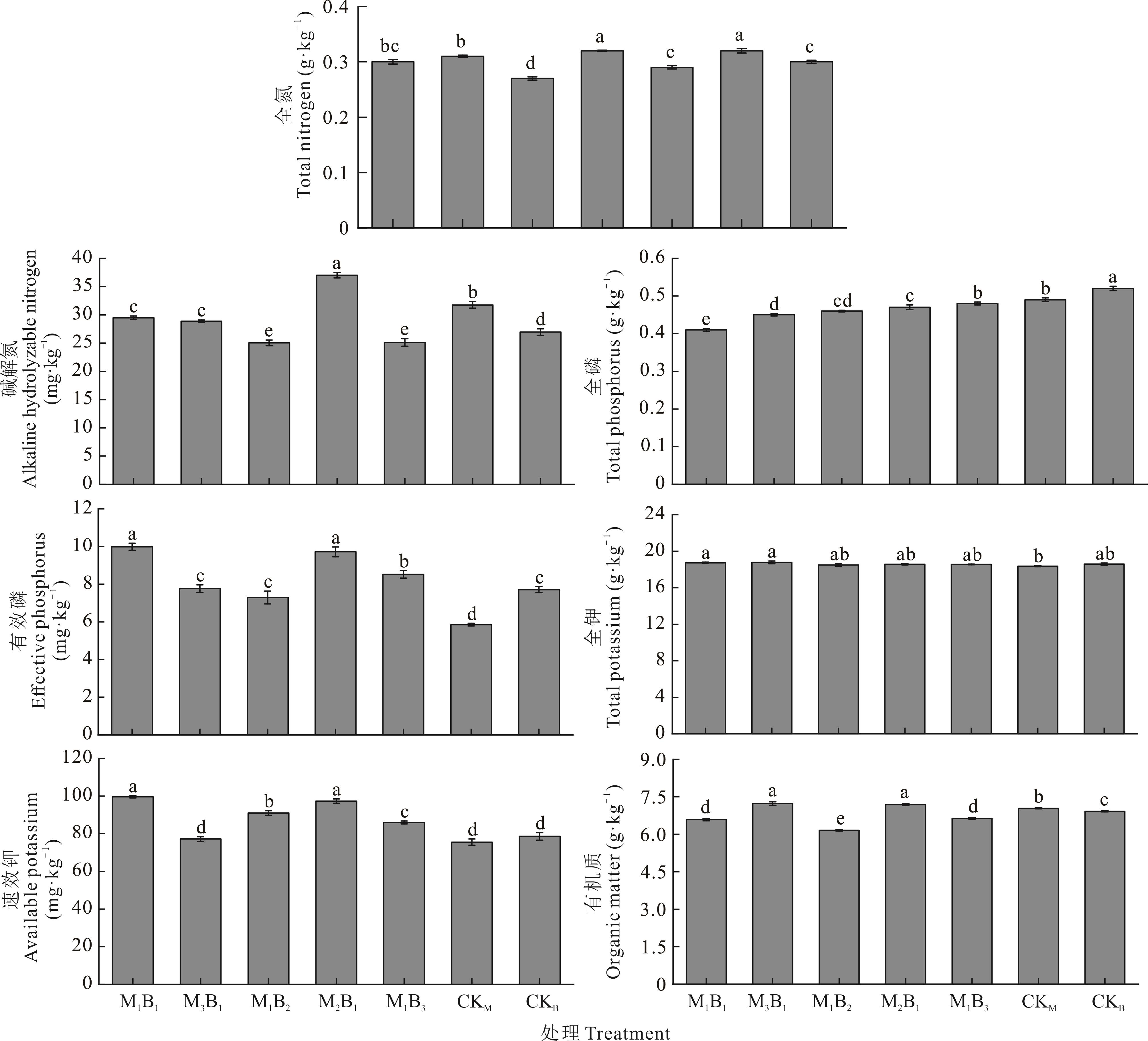
图4 紫花苜蓿/无芒雀麦不同间行种植比例下的土壤养分含量
Fig.4 Soil nutrient content under different inter-row planting ratios of M. sativa and B. inermis
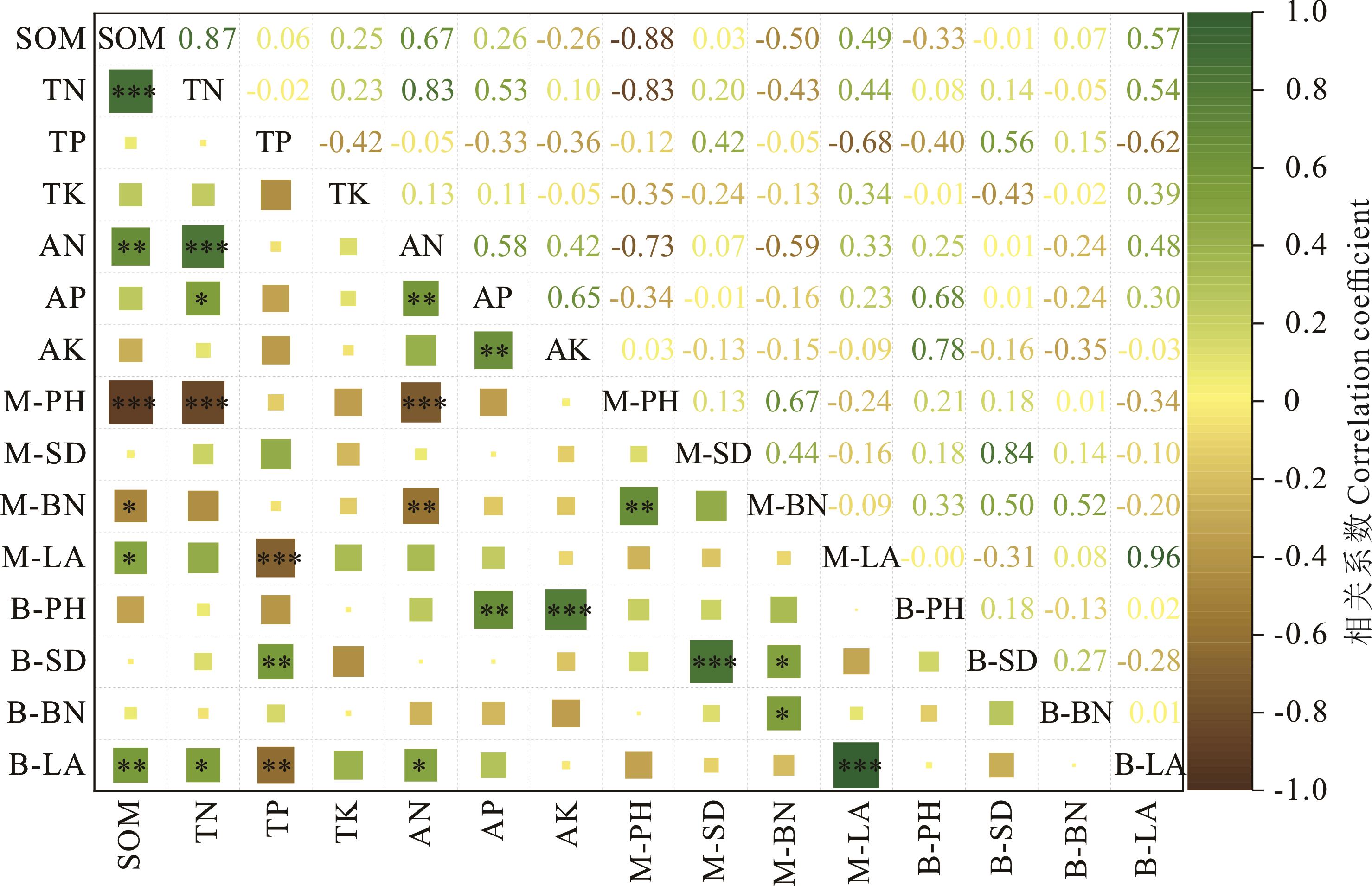
图5 紫花苜蓿/无芒雀麦的农艺性状指标与土壤理化性质的关系SOM: 土壤有机质Soil organic matter; TN: 全氮Total nitrogen; TP: 全磷Total phosphorus; TK: 全钾Total potassium; AN: 碱解氮Alkaline hydrolyzable nitrogen; AP: 有效磷Effective phosphorus; AK: 速效钾Available potassium; M-PH: 紫花苜蓿-株高M. sativa-plant height; M-SD: 紫花苜蓿-茎粗M. sativa-stem diameter; M-BN: 紫花苜蓿-分枝数M. sativa-number of branches; M-LA: 紫花苜蓿-叶面积M. sativa-leaf area; B-PH: 无芒雀麦-株高B. inermis-plant height; B-SD: 无芒雀麦-茎粗B. inermis-stem diameter; B-BN: 无芒雀麦-分蘖数B. inermis-number of tillers; B-LA: 无芒雀麦-叶面积B. inermis-leaf area. 下同The same below. *: P≤0.05; **: P≤0.01; ***: P≤0.001.
Fig.5 Relationship between agronomic trait indicators and soil physico-chemical properties of M. sativa and B. inermis
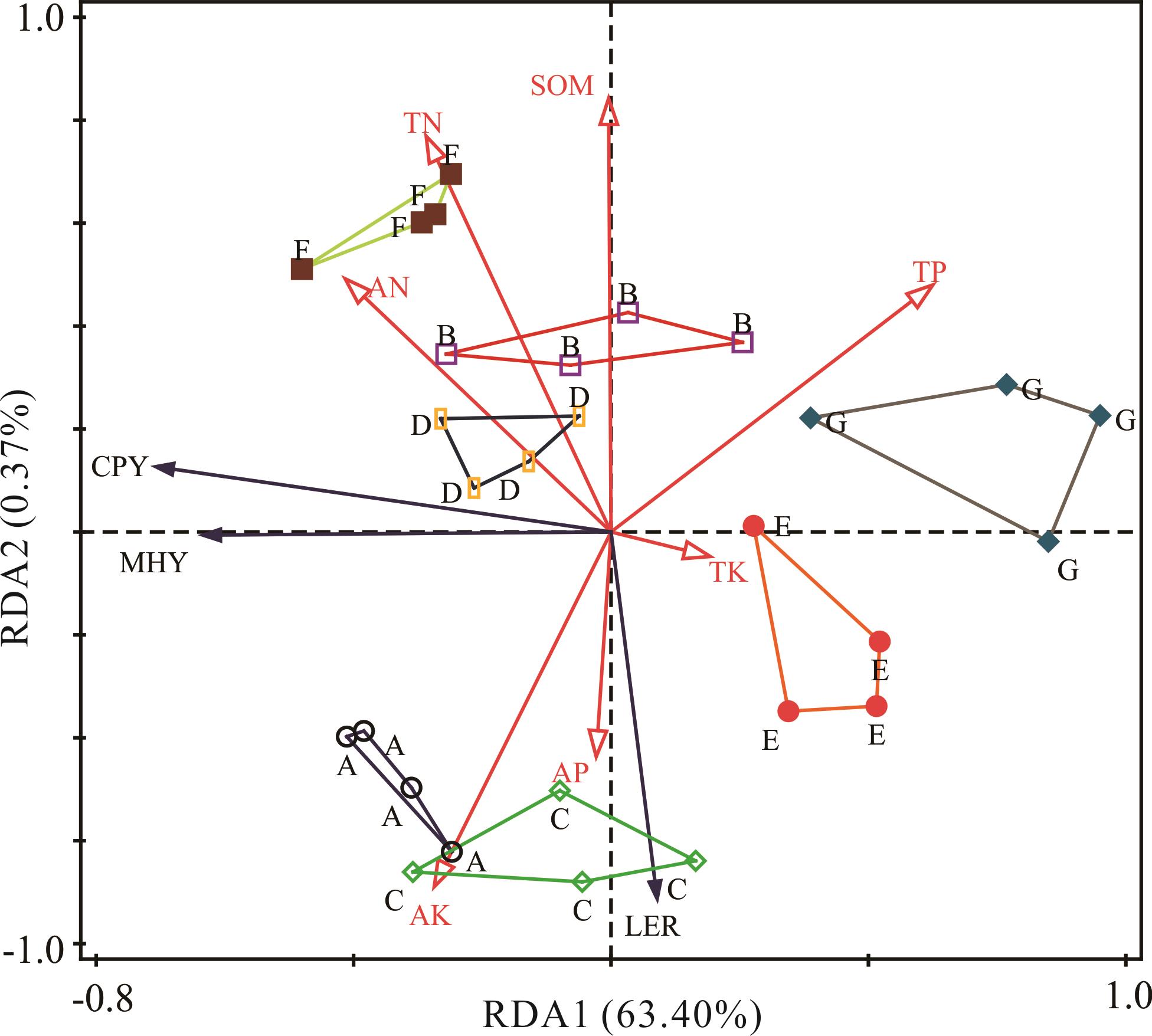
图6 不同间行种植比例下牧草产量、粗蛋白产量、土地当量比与土壤养分含量的冗余分析MHY: 混合干草产量Mixed hay yield. A: M1B1; B: M3B1; C: M1B2; D: M2B1; E: M1B3; F: CKM; G: CKB.
Fig.6 Redundancy analysis (RDA) of forage yield, crude protein yield (CPY), land equivalent ratio (LER) and soil nutrient content of different inter-row planting ratios
指标 Index | 主成分 Principal component (PC) | 指标 Index | 主成分 Principal component (PC) | ||||
|---|---|---|---|---|---|---|---|
| 1 | 2 | 3 | 1 | 2 | 3 | ||
| 粗蛋白含量Crude protein content | 0.171 | 0.079 | -0.072 | 酸性洗涤纤维Acid detergent fibre | -0.020 | 0.212 | -0.068 |
| 中性洗涤纤维Neutral detergent fibre | -0.180 | 0.042 | 0.041 | 全磷Total phosphorus | -0.013 | -0.225 | 0.044 |
| 粗蛋白产量Crude protein yield | 0.145 | 0.131 | -0.189 | 有效磷Effective phosphorus | -0.048 | 0.189 | 0.275 |
| 相对饲喂价值Relative feeding value | 0.164 | -0.099 | -0.048 | 全钾Total potassium | -0.050 | 0.118 | 0.314 |
| 全氮Total nitrogen | 0.157 | -0.026 | 0.264 | 有机质Organic matter | 0.121 | -0.053 | 0.330 |
| 碱解氮Alkaline hydrolyzable nitrogen | 0.141 | 0.067 | 0.201 | 特征值Eigenvalue | 5.326 | 3.892 | 2.002 |
| 混合干草产量Mixed hay yield | 0.111 | 0.153 | -0.233 | 贡献率Contribution rate (%) | 40.971 | 29.941 | 15.398 |
| 速效钾Available potassium | -0.039 | 0.213 | 0.028 | 累积贡献率 Cumulative contribution rate (%) | 40.971 | 70.913 | 86.310 |
表3 不同间行种植比例下各指标的特征值和累积贡献率
Table 3 Eigenvalues and cumulative contributions rate of indicators under different inter-row planting ratios
指标 Index | 主成分 Principal component (PC) | 指标 Index | 主成分 Principal component (PC) | ||||
|---|---|---|---|---|---|---|---|
| 1 | 2 | 3 | 1 | 2 | 3 | ||
| 粗蛋白含量Crude protein content | 0.171 | 0.079 | -0.072 | 酸性洗涤纤维Acid detergent fibre | -0.020 | 0.212 | -0.068 |
| 中性洗涤纤维Neutral detergent fibre | -0.180 | 0.042 | 0.041 | 全磷Total phosphorus | -0.013 | -0.225 | 0.044 |
| 粗蛋白产量Crude protein yield | 0.145 | 0.131 | -0.189 | 有效磷Effective phosphorus | -0.048 | 0.189 | 0.275 |
| 相对饲喂价值Relative feeding value | 0.164 | -0.099 | -0.048 | 全钾Total potassium | -0.050 | 0.118 | 0.314 |
| 全氮Total nitrogen | 0.157 | -0.026 | 0.264 | 有机质Organic matter | 0.121 | -0.053 | 0.330 |
| 碱解氮Alkaline hydrolyzable nitrogen | 0.141 | 0.067 | 0.201 | 特征值Eigenvalue | 5.326 | 3.892 | 2.002 |
| 混合干草产量Mixed hay yield | 0.111 | 0.153 | -0.233 | 贡献率Contribution rate (%) | 40.971 | 29.941 | 15.398 |
| 速效钾Available potassium | -0.039 | 0.213 | 0.028 | 累积贡献率 Cumulative contribution rate (%) | 40.971 | 70.913 | 86.310 |
处理 Treatment | 隶属函数值 Membership function value | 排名 Ranking |
|---|---|---|
| M1B1 | 0.632 | 2 |
| M3B1 | 0.604 | 3 |
| M1B2 | 0.236 | 6 |
| M2B1 | 0.764 | 1 |
| M1B3 | 0.310 | 5 |
| CKM | 0.589 | 4 |
| CKB | 0.184 | 7 |
表4 不同间行种植比例的隶属函数值及其排名
Table 4 Membership function values and their ranking for different inter-row planting ratios
处理 Treatment | 隶属函数值 Membership function value | 排名 Ranking |
|---|---|---|
| M1B1 | 0.632 | 2 |
| M3B1 | 0.604 | 3 |
| M1B2 | 0.236 | 6 |
| M2B1 | 0.764 | 1 |
| M1B3 | 0.310 | 5 |
| CKM | 0.589 | 4 |
| CKB | 0.184 | 7 |
| [1] | Xu Y Y, Hou Y R, Wang J, et al. Effects of intercropping mixture of legume and grass on grassland production performance and soil nutrients. Chinese Journal of Grassland, 2024, 46(10): 75-86. |
| 许莹月, 侯钰荣, 王静, 等. 豆禾间行混播对草地生产性能与土壤养分的影响. 中国草地学报, 2024, 46(10): 75-86. | |
| [2] | Wu X J, Yang M, Lu Y X, et al. Effects of mixing ratio and nitrogen fertilization on root characteristics in the common vetch/oat mixture. Acta Prataculturae Sinica, 2020, 29(9): 106-116. |
| 吴晓娟, 杨梅, 芦奕晓, 等. 混播比例和施氮肥对箭筈豌豆/燕麦草地根系特性的影响. 草业学报, 2020, 29(9): 106-116. | |
| [3] | Wang Y F, Liu H Q, Zhao X N, et al. Effects of water and root separation on nitrogen uptake, utilization and transfer in a gramineae-legume intercropping system. Journal of Soil and Water Conservation, 2024, 38(4): 279-287. |
| 王一帆, 刘华清, 赵西宁, 等. 禾豆间作系统水分和根系分隔对牧草氮素吸收利用及转移的影响. 水土保持学报, 2024, 38(4): 279-287. | |
| [4] | Xiao Y. Study on yield and efficiency increasing mechanism of the mixed planting mode of alfalfa and orchard grass in different row ratios. Taiyuan: Shanxi Agricultural University, 2021. |
| 肖毅. 苜蓿/鸭茅不同行比混播模式增产增效机制研究. 太原: 山西农业大学, 2021. | |
| [5] | Zhao L J, Kou X X, Wang T M. Response of the relationship between mixed sowing of alfalfa and Elymus nutans to water content. Chinese Journal of Grassland, 2025, 47(2): 80-90. |
| 赵力军, 寇潇雪, 王铁梅. 紫花苜蓿和垂穗披碱草混播种间关系对水分的响应. 中国草地学报, 2025, 47(2): 80-90. | |
| [6] | Effects of mixed sowing ratio on root properties of Medicago sativa and Agropyron cristatum. Pratacultural Science, 2025, 42(5): 1222-1234. |
| 侯钰荣, 许莹月, 兰吉勇, 等. 紫花苜蓿和冰草混播比例对根系属性的影响. 草业科学, 2025, 42(5): 1222-1234. | |
| [7] | Zhou D C. Study on forage productivity and soil physical and chemical properties of alfalfa-sainfoin mixed pasture in the Longzhong Loess Plateau. Lanzhou: Lanzhou University, 2019. |
| 周栋昌. 陇中黄土高原紫花苜蓿与红豆草混播草地生产性能和土壤理化性质研究. 兰州: 兰州大学, 2019. | |
| [8] | Zheng W, Zhu J Z, Jianaerguli, et al. Effects of different mixed sowing patterns on production performance of legume-grass mixture. Chinese Journal of Grassland, 2011, 33(5): 45-52. |
| 郑伟, 朱进忠, 加娜尔古丽, 等. 不同混播方式对豆禾混播草地生产性能的影响. 中国草地学报, 2011, 33(5): 45-52. | |
| [9] | Li J K, Sun T, Wangzha, et al. Effects on mixture sowing ratio on the yield and quality of both vetch and oat in Tibet. Acta Agrestia Sinica, 2011, 19(5): 830-833. |
| 李佶恺, 孙涛, 旺扎, 等. 西藏地区燕麦与箭筈豌豆不同混播比例对牧草产量和质量的影响. 草地学报, 2011, 19(5): 830-833. | |
| [10] | Liang S W, Zhou H N, Du G J, et al. Effects of maize/alfalfa intercropping on microbial communities in cinnamon soil. Chinese Journal of Ecology, 2025, https://link.cnki.net/urlid/21.1148.Q.20250626.1150.004. |
| 梁思维, 周桦楠, 杜桂娟, 等. 玉米/苜蓿间作对褐土微生物群落的影响. 生态学杂志, 2025, https://link.cnki.net/urlid/21.1148.Q.20250626.1150.004. | |
| [11] | Cao X Q, Lin Y, Zhao L J, et al. Effects of mixed sowing of forage oats and legumes on forage yield and stem-leaf ratio. Chinese Journal of Grassland, 2024, 46(11): 58-65. |
| 曹雪乔, 林悦, 赵丽娟, 等. 饲用燕麦与豆科牧草混播对饲草产量及茎叶比的影响. 中国草地学报, 2024, 46(11): 58-65. | |
| [12] | Chen Y L, Qi S, Xu R X, et al. Effects of planting row number and density on maize performance in Hexi Corridor corn-alfalfa intercropping system. Acta Agrestia Sinica, 2025, 33(6): 2013-2022. |
| 陈彦龙, 齐帅, 许瑞轩, 等. 河西走廊玉米-苜蓿间作体系行数与密度对玉米生产性能的影响. 草地学报, 2025, 33(6): 2013-2022. | |
| [13] | Huang N. Effect of nitrogen addition and grass root secretion on inter-rooted nitrogen deposition and nodule fixation in a legume-grass mixed grassland. Hohhot: Inner Mongolia University, 2023. |
| 黄楠. 氮添加和禾草根系分泌物对豆禾混播氮沉积及结瘤固氮的影响. 呼和浩特: 内蒙古大学, 2023. | |
| [14] | Zhou Y X, Yue X P, Wei Z W, et al. Development prospect of mixed planting of legume and gramineae forage in winter fallow field in the Yangtze-Huaihe region. Pratacultural Science, 2021, 38(2): 304-315. |
| 周雅欣, 乐祥鹏, 魏臻武, 等. 江淮地区冬闲田豆禾牧草混播生产模式的发展前景. 草业科学, 2021, 38(2): 304-315. | |
| [15] | Qi F, Li H G, Chen W W, et al. Effects of nitrogen and phosphorus fertilization on yield of Medicago sativa-Leymus chinensis mixed grassland. Chinese Journal of Grassland, 2024, 46(6): 49-56. |
| 齐非, 李海港, 陈薇薇, 等. 氮磷添加对紫花苜蓿-羊草混播草地生产力的影响. 中国草地学报, 2024, 46(6): 49-56. | |
| [16] | Wu L T, Chen S, Hu M J, et al. Effect of different mixing ratio of alfalfa and Bromus inermis on silage quality. Feed Research, 2024, 47(13): 118-123. |
| 乌力塔, 陈肃, 胡梦洁, 等. 紫花苜蓿与无芒雀麦不同混合比例对其青贮品质的影响. 饲料研究, 2024, 47(13): 118-123. | |
| [17] | Zhang Y L, Teng Z, Zhang Y X. Effects of the pattern and proportion of mixed sowing alfalfa-smooth brome on the carbon and nitrogen metabolism in its leaves. Acta Agrestia Sinica, 2023, 31(12): 3744-3749. |
| 张永亮, 滕泽, 张玉霞. 苜蓿-无芒雀麦混播方式和比例对禾草叶片碳氮代谢的影响. 草地学报, 2023, 31(12): 3744-3749. | |
| [18] | Yu Z, Jia Y S, Li C F. Forage product inspection. Beijing: Science Press, 2013: 28-43. |
| 玉柱, 贾玉山, 李存福. 饲草产品检验. 北京: 科学出版社, 2013: 28-43. | |
| [19] | Bao S D. Soil agrochemical analysis (the third edition). Beijing: China Agricultural Press, 2000. |
| 鲍士旦. 土壤农化分析(第3版). 北京: 中国农业出版社, 2000. | |
| [20] | Sun G T, Bao G R, Tai J C, et al. Effect of maize and peanut intercropping on crop and soil characteristics. Chinese Agricultural Science Bulletin, 2025, 41(5): 7-12. |
| 孙广涛, 包桂荣, 邰继承, 等. 玉米花生间作对作物及土壤特性的影响. 中国农学通报, 2025, 41(5): 7-12. | |
| [21] | Chen X, Li S S, Wang N X, et al. Effects of different intercropping patterns on interspecific competition pattern and production performance of triticale and common vetch grassland. Grassland and Turf, 2023, 43(5): 5-14. |
| 陈雪, 黎松松, 王宁欣, 等. 不同间作方式对小黑麦+箭筈豌豆草地种间竞争格局和生产性能的影响. 草原与草坪, 2023, 43(5): 5-14. | |
| [22] | Xie K Y, Zhang Y J, Li X L, et al. Competition and coexistence of alfalfa (Medicago sativa L.) and smooth brome (Bromus inermis Layss.) in mixture. Scientia Agricultura Sinica, 2015, 48(18): 3767-3778. |
| 谢开云, 张英俊, 李向林, 等. 无芒雀麦和紫花苜蓿在(1∶1)混播中的竞争与共存. 中国农业科学, 2015, 48(18): 3767-3778. | |
| [23] | Zhang Y Y, Wang B, Wang T F, et al. Effects of intercropping triticale with alfalfa on system yield resource utilization and alfalfa seed yield. Acta Prataculturae Sinica, 2025, 34(8): 43-53. |
| 张译尹, 王斌, 王腾飞, 等. 苜蓿种子田间作小黑麦对饲草产量、水分利用及苜蓿种子产量的影响. 草业学报, 2025, 34(8): 43-53. | |
| [24] | Wang X. Study on the spatiotemporal characteristics of alfalfa/gramineous forage intercropping effects and root interactions. Lanzhou: Gansu Agricultural University, 2023: 74-79. |
| 汪雪. 紫花苜蓿/禾本科牧草间作效应及其根系互作关系的时空特征研究. 兰州: 甘肃农业大学, 2023: 74-79. | |
| [25] | Feng Q, He X L, Wang B, et al. A study of mixed sowing effects for oat and common vetch in the Ningxia Yellow River Irrigation Area. Acta Prataculturae Sinica, 2024, 33(3): 107-119. |
| 冯琴, 何小莉, 王斌, 等. 宁夏引黄灌区燕麦与箭筈豌豆的混播效果研究. 草业学报, 2024, 33(3): 107-119. | |
| [26] | Xu Q. Study on the mixture combination and mixed ratio of triticale and peas in the alpine pastoral area of Gansu. Lanzhou: Gansu Agricultural University, 2021. |
| 徐强. 甘肃高寒牧区小黑麦与豌豆的混播组合及混播比例研究. 兰州: 甘肃农业大学, 2021. | |
| [27] | Dou Z Y, Li S S, Tian X C, et al. Effects of different mixed sowing ratios on soil nitrogen substitution potential in mixed-sowing grassland with Vicia sativa+Avena sativa. Pratacultural Science, 2022, 39(11): 2424-2433. |
| 窦梓镱, 黎松松, 田新春, 等. 不同混播比例对箭筈豌豆+燕麦混播草地土壤氮素替代潜力的影响. 草业科学, 2022, 39(11): 2424-2433. | |
| [28] | Guan Z X, Naerkezi, Zhu Y Q, et al. Effect of different sowing patterns on production performance and soil nutrients in Avena sativa+Vicia sativa mixtures. Pratacultural Science, 2019, 36(3): 772-784. |
| 关正翾, 娜尔克孜, 朱亚琼, 等. 不同混播方式下燕麦+箭筈豌豆混播草地的生产性能及土壤养分特征. 草业科学, 2019, 36(3): 772-784. | |
| [29] | Wang J H. Effects of corn/alfalfa intercropping on soil nutrient, enzyme activity and plant growth. Guiyang: Guizhou University, 2019. |
| 王家豪. 玉米/苜蓿间作对土壤养分、酶活性及植物生长的影响. 贵阳: 贵州大学, 2019. | |
| [30] | Qian S Y, De K J, Feng T X, et al. Effect of annual grass-legume mixture on soil nutrients and forage nutrients in alpine region. Chinese Qinghai Journal of Animal and Veterinary Sciences, 2022, 52(4): 34-40. |
| 钱诗祎, 德科加, 冯廷旭, 等. 高寒地区一年生禾豆混播对土壤养分与牧草营养的影响. 青海畜牧兽医杂志, 2022, 52(4): 34-40. | |
| [31] | Yu T F, Hao F, Zhang Y L, et al. Response of soil enzyme and soil fertility of artificial grassland in sandy soil to different mixture ratio of alfalfa and smooth brome. Acta Agrestia Sinica, 2021, 29(6): 1217-1223. |
| 于铁峰, 郝凤, 张永亮, 等. 沙地豆禾混播草地土壤酶与土壤养分对混播比例的响应. 草地学报, 2021, 29(6): 1217-1223. | |
| [32] | Guo C, Zhao Y L, Li X J, et al. Effect of sowing ratio on interspecific relationships between species and grassland productivity in legume-grass mixtures. Pratacultural Science, 2022, 39(11): 2307-2316. |
| 郭川, 赵艳兰, 李香君, 等. 不同豆禾混播比例对植物种间关系及草地生产力的影响. 草业科学, 2022, 39(11): 2307-2316. | |
| [33] | Zhou J, Wang Z C, Yang F. Research progress about phytoremediation mechanisms in saline-sodic soils. Chinese Journal of Ecology, 2024, 43(5): 1453-1462. |
| 周杰, 王志春, 杨帆. 盐碱土壤植物修复机制研究进展. 生态学杂志, 2024, 43(5): 1453-1462. | |
| [34] | Duan C, Shi P L, Zong N, et al. Feeding solution: Crop-livestock integration via crop-forage rotation in the southern Tibetan Plateau. Agriculture, Ecosystems & Environment, 2019, 284: 106589. |
| [35] | Wang W H, Zheng H B, Wu Y P, et al. An assessment of background removal approaches for improved estimation of rice leaf nitrogen concentration with unmanned aerial vehicle multispectral imagery at various observation times. Field Crops Research, 2022, 283: 108543. |
| [36] | Shi L, Wang J, Chen Y, et al. Effects of combined application of bio-bacterial manure with reduced chemical fertilizer on pigment pepper growth. Xinjiang Agricultural Sciences, 2021, 58(5): 854-865. |
| 石磊, 王军, 陈云, 等. 化肥减量配施生物菌肥对色素辣椒生长的影响. 新疆农业科学, 2021, 58(5): 854-865. | |
| [37] | Zhang X J, Yang H, Song J C, et al. Effects of reduced chemical fertilizer use on oat yield and soil nutrients in the Sanjiangyuan region. Chinese Journal of Grassland, 2025, 47(1): 54-64. |
| 张小娟, 杨航, 宋建超, 等. 化肥减施对三江源区燕麦生产性能和土壤养分的影响. 中国草地学报, 2025, 47(1): 54-64. | |
| [38] | Guo N, Liu J, Wang Y L, et al. Effects of reseeding rates and fertilization levels on nutritional quality and yield of forage in a degraded grassland. Chinese Journal of Grassland, 2025, 47(2): 70-79. |
| 郭楠, 刘建, 王云玲, 等. 不同补播量和施肥量对退化草地牧草营养品质和产量的影响. 中国草地学报, 2025, 47(2): 70-79. | |
| [39] | Homulle Z, George T S, Karley A J. Root traits with team benefits: understanding belowground interactions in intercropping systems. Plant and Soil, 2022, 471(112): 1-26. |
| [1] | 马苹, 刘志国, 沙煜舒, 刘亚玲, 妥小梅, 伏兵哲, 高雪芹. 紫花苜蓿苗期氮利用特性及氮高效品种的筛选[J]. 草业学报, 2026, 35(4): 112-123. |
| [2] | 张钿, 冷华娟, 崔婧, 何飞, 王雪, 李明娜, 杨青川, 康俊梅. 紫花苜蓿突触结合蛋白家族成员鉴定与非生物胁迫下的表达分析[J]. 草业学报, 2026, 35(4): 158-168. |
| [3] | 李梦棋, 董全民, 孙彩彩, 吕卫东, 许蔚, 刘玉祯, 刘文亭, 杨晓霞. 环青海湖地区牦牛和藏羊粪便夏季分解对土壤养分的影响[J]. 草业学报, 2026, 35(4): 42-53. |
| [4] | 王一博, 明雪花, 张建勇, 袁琦, 杜建明, 王斌, 王腾飞, 张译尹, 兰剑, 牟乐. 宁夏干旱区燕麦新种质生产性能和种子产量综合评价研究[J]. 草业学报, 2026, 35(4): 86-99. |
| [5] | 贾浩滨, 江浩筠, 李爱华, 王海波, 林孙权, 潘月, 霍俊宏, 占今舜. 不同精粗比饲粮对广丰山羊生产性能、血清生化、瘤胃发酵的影响[J]. 草业学报, 2026, 35(3): 170-184. |
| [6] | 张世超, 崔国文, 张德鹏, 韩福迎, 丁叮, 吕向丽, 林硕, 陈乐然, 李吉儒, 才华. 紫花苜蓿非组培遗传转化体系创建及在耐盐基因功能鉴定与基因编辑中的应用[J]. 草业学报, 2026, 35(3): 223-234. |
| [7] | 童玉花, 王晓彤, 马永龙, 杨金辉, 余冬雯, 李淑霞. 壳聚糖浸种对盐碱胁迫下紫花苜蓿种子萌发的影响[J]. 草业学报, 2026, 35(3): 245-256. |
| [8] | 陈丽娟, 高荣, 王建喜, 马晖玲. 紫花苜蓿与红豆草在不同生长时期缩合单宁合成差异的比较研究[J]. 草业学报, 2026, 35(2): 221-236. |
| [9] | 刘冬娅, 杨燕, 刘静, 王博, 李志刚. 短期羊粪归还对荒漠草地土壤质量的影响[J]. 草业学报, 2026, 35(2): 28-39. |
| [10] | 李瑒琨, 本转林, 张筠钰, 杨惠敏. 不同气候和土壤条件下施肥类型影响紫花苜蓿种子产量的整合分析[J]. 草业学报, 2026, 35(2): 54-67. |
| [11] | 张继元, 安海全, 潘靖一, 刘畅, 龙思思, 赵丽丽. 7个紫花苜蓿品种种子萌发及幼苗生长的抗旱性评价[J]. 草业学报, 2026, 35(2): 68-82. |
| [12] | 张颖, 贺善睦, 何傲蕾, 李昌宁, 姚拓. 微生物菌剂与有机钙蛋白配施对紫花苜蓿生长和土壤酶活性的影响[J]. 草业学报, 2026, 35(1): 25-39. |
| [13] | 张译尹, 肖爱萍, 王斌, 王腾飞, 胡海英, 兰剑. 饲用高粱/拉巴豆混播模式下施氮量对草地生产力和能量利用效率的影响[J]. 草业学报, 2026, 35(1): 40-52. |
| [14] | 俞鸿千, 马雪鹏, 曾翰国, 单晓艳, 李曼莉, 王占军. 地下滴灌时期和水量对紫花苜蓿种子生产的影响[J]. 草业学报, 2026, 35(1): 53-64. |
| [15] | 邹苇鹏, 刘怡, 翟佳兴, 周思懿, 宫祉祎, 岑慧芳, 朱慧森, 许涛. 紫花苜蓿MsNAC053基因克隆及其对非生物胁迫的响应分析[J]. 草业学报, 2025, 34(9): 121-133. |
| 阅读次数 | ||||||
|
全文 |
|
|||||
|
摘要 |
|
|||||
