

ISSN 1004-5759 CN 62-1105/S
草业学报 ›› 2026, Vol. 35 ›› Issue (6): 155-165.DOI: 10.11686/cyxb2025254
• 研究论文 • 上一篇
刘媛媛1,2( ), 杨俊锋1,2, 崔棋雯1,2, 李明源1,2, 王继莲1,2()
收稿日期:2025-06-26
修回日期:2025-09-09
出版日期:2026-06-20
发布日期:2026-04-13
通讯作者:
王继莲
作者简介:Corresponding author. E-mail: wjilian0710@163.com基金资助:
Yuan-yuan LIU1,2(), Jun-feng YANG1,2, Qi-wen CUI1,2, Ming-yuan LI1,2, Ji-lian WANG1,2()
Received:2025-06-26
Revised:2025-09-09
Online:2026-06-20
Published:2026-04-13
Contact:
Ji-lian WANG
摘要:
为丰富微生物肥料菌种资源,研制适合于盐碱地田菁种植的根瘤菌剂,从新疆喀什盐碱地田菁试种区根瘤中分离菌株,基于16S rRNA基因扩增与系统发育分析对其进行鉴定,并通过单菌及多菌混合接种验证其对盐碱土中田菁生长的影响。结果共分离到17株菌,分属于剑菌属、肠杆菌属和布鲁氏菌属,以剑菌属占优势。剑菌B-3-1、剑菌C-3-2、肠杆菌A-5-1和布鲁氏菌C-4-1兼具解有机磷和无机磷能力,以此4株菌进行剑菌属单种及与其他菌株混合接种,对田菁生长有积极作用,株高、茎粗、地上干重、叶绿素含量和根干重分别提高了21.2%~56.2%、22.3%~67.8%、4.5%~43.5%、26.8%~149.5%和18.2%~100.0%,同时根系结瘤数量显著增加(P<0.05)。接种处理后的盐碱土壤特性也得到改善,pH、全盐、全磷和全钾含量分别降低了2.4%~4.1%、23.6%~39.1%、23.3%~69.4%和2.2%~21.2%,速效氮和速效磷含量增幅为63.5%~98.4%和0.1%~9.0%。除接种剑菌B-3-1后速效钾含量低于对照,其余处理提高了8.4%~99.7%,尤以混合菌系E(剑菌C-3-2、剑菌B-3-1和布鲁氏菌C-4-1)效果最佳。回接后分离的田菁根瘤菌株与初始接种菌株B-3-1和C-3-2高度同源,证明接种菌株在宿主根际成功定殖。所得根瘤菌株对开发适用于盐碱地复垦和生态修复的微生物肥料有一定应用潜力。
刘媛媛, 杨俊锋, 崔棋雯, 李明源, 王继莲. 新疆喀什盐碱地田菁根瘤中菌株分离及其促生效应[J]. 草业学报, 2026, 35(6): 155-165.
Yuan-yuan LIU, Jun-feng YANG, Qi-wen CUI, Ming-yuan LI, Ji-lian WANG. Isolation and growth-promoting effects of rhizobia from the Sesbania cannabina seed trial area in saline-alkali land in Kashi, Xinjiang[J]. Acta Prataculturae Sinica, 2026, 35(6): 155-165.
菌株编号 Strain number | NaCl含量Sodiumchloride content | pH | ||||||||||
|---|---|---|---|---|---|---|---|---|---|---|---|---|
| 4% | 5% | 6% | 7% | 8% | 5 | 6 | 7 | 8 | 9 | 10 | 11 | |
| C-4-1 | + + | + + | + + | + + | + | + + | + + | + + + | + + | + | + | + |
| B-2-1 | + + | + + | + | + | - | + | + | + + | + + | + | - | - |
| B-3-1 | + + | + + | + + | + | + | + + | + + | + + + | + + + | ++ | + | + |
| A-2-1 | + + | + + | + | + | - | + | + | + + | + + | + + | + | - |
| B-5-1 | + + | + + | + | + | + | + | + + | + + + | + + | + + | + | + |
| A-1-1 | + + | + + | + | + | - | + | + + | + + | + + | + + | + | - |
| A-5-1 | + + | + + | + + | + | + | + + | + + | + + + | + + + | + + | + | + |
| B-4-1 | + + | + + | + | + | + | + | + | + + | + + | + | - | - |
| C-6-1 | + + | + + | + | + | - | + + | + + | + + | + + | + | + | + |
| C-3-2 | + + | + + | + + | + + | + | + + | + + | + + + | + + + | + + | + + | + |
| C-1-1 | + + | + + | + | + | - | + | + | + + | + + | + | - | - |
| B-1-1 | + + | + + | + | + | - | + | + | + + | + + | + | - | - |
| A-4-1 | + + | + + | + + | + | - | + + | + + | + + + | + + | + + | + | - |
| B-6-1 | + + | + + | + | + | - | + | + | + + | + + | + | - | - |
| C-2-1 | + + | + + | + + | + | - | + + | + + | + + | + + | + | + | + |
| C-5-1 | + + | + + | + | + | - | + | + | + + | + + | + + | + | - |
| A-6-1 | + + | + + | + + | + | - | + | + | + + | + + | + | + | - |
表1 菌株耐盐和耐碱试验
Table 1 Salt and alkali resistance tests of the strains
菌株编号 Strain number | NaCl含量Sodiumchloride content | pH | ||||||||||
|---|---|---|---|---|---|---|---|---|---|---|---|---|
| 4% | 5% | 6% | 7% | 8% | 5 | 6 | 7 | 8 | 9 | 10 | 11 | |
| C-4-1 | + + | + + | + + | + + | + | + + | + + | + + + | + + | + | + | + |
| B-2-1 | + + | + + | + | + | - | + | + | + + | + + | + | - | - |
| B-3-1 | + + | + + | + + | + | + | + + | + + | + + + | + + + | ++ | + | + |
| A-2-1 | + + | + + | + | + | - | + | + | + + | + + | + + | + | - |
| B-5-1 | + + | + + | + | + | + | + | + + | + + + | + + | + + | + | + |
| A-1-1 | + + | + + | + | + | - | + | + + | + + | + + | + + | + | - |
| A-5-1 | + + | + + | + + | + | + | + + | + + | + + + | + + + | + + | + | + |
| B-4-1 | + + | + + | + | + | + | + | + | + + | + + | + | - | - |
| C-6-1 | + + | + + | + | + | - | + + | + + | + + | + + | + | + | + |
| C-3-2 | + + | + + | + + | + + | + | + + | + + | + + + | + + + | + + | + + | + |
| C-1-1 | + + | + + | + | + | - | + | + | + + | + + | + | - | - |
| B-1-1 | + + | + + | + | + | - | + | + | + + | + + | + | - | - |
| A-4-1 | + + | + + | + + | + | - | + + | + + | + + + | + + | + + | + | - |
| B-6-1 | + + | + + | + | + | - | + | + | + + | + + | + | - | - |
| C-2-1 | + + | + + | + + | + | - | + + | + + | + + | + + | + | + | + |
| C-5-1 | + + | + + | + | + | - | + | + | + + | + + | + + | + | - |
| A-6-1 | + + | + + | + + | + | - | + | + | + + | + + | + | + | - |
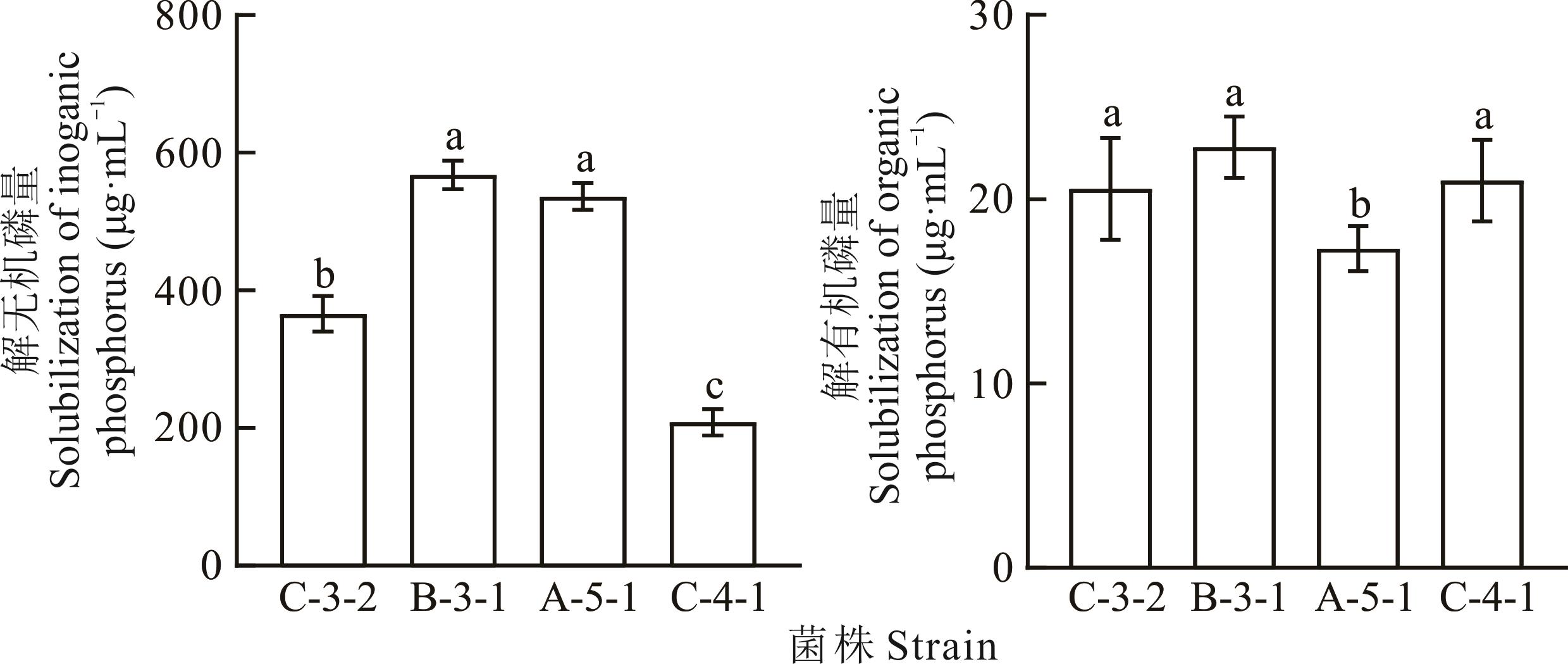
图1 菌株解磷能力测定不同小写字母表示差异显著(P<0.05),下同。Different small letters indicate significant differences among the treatments at P<0.05, the same below.
Fig.1 Determination of phosphate-solubilizing ability of strain
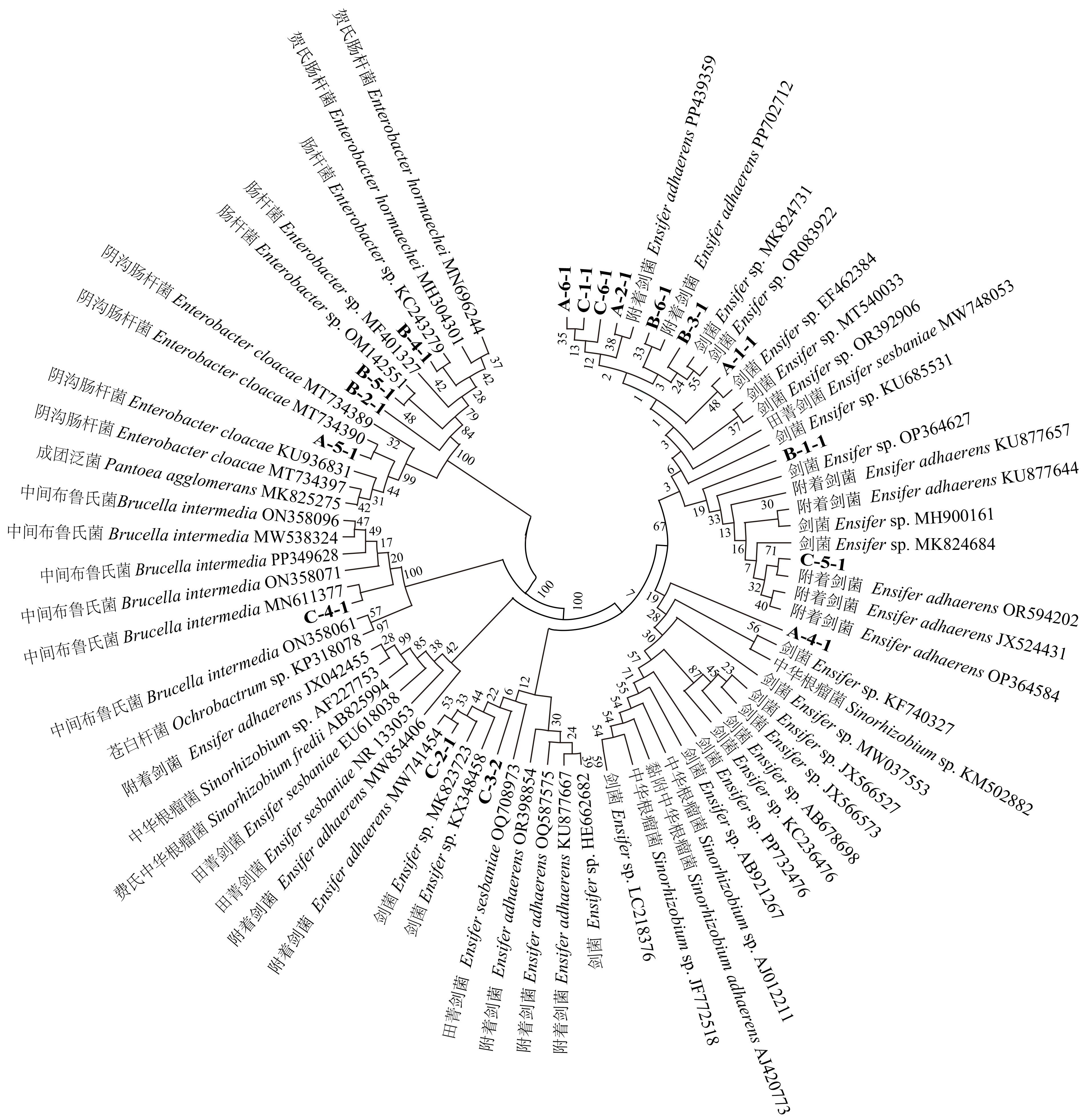
图2 基于分离菌株16S rRNA基因的系统发育树
Fig.2 Phylogenetic tree based on 16S rRNA gene of the isolated rhizobial strains
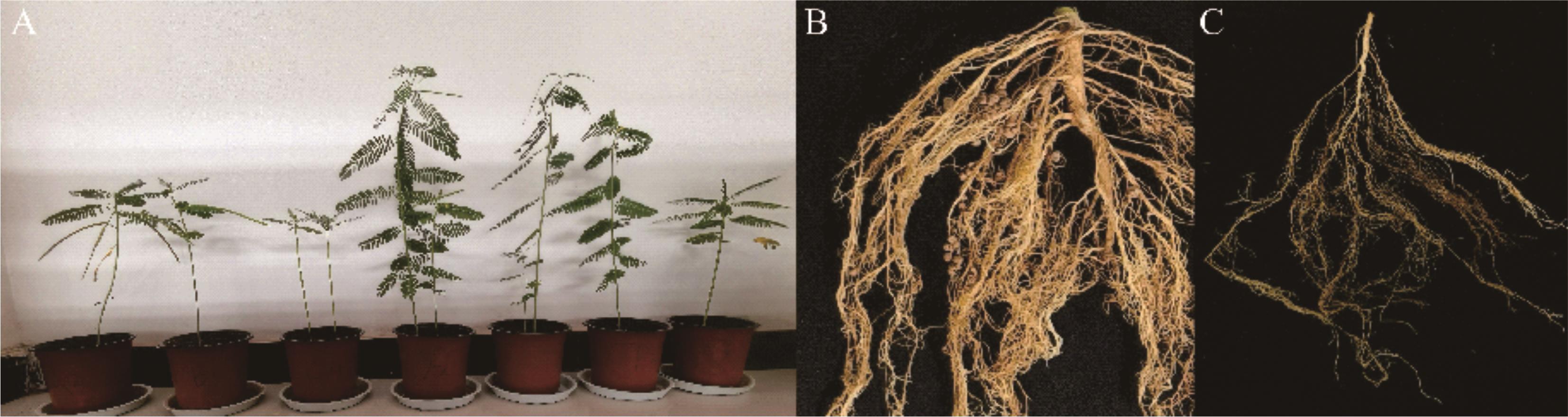
图3 根瘤菌回接对田菁植株生长的影响A图分别为A、B、C、D、E、F和对照组的田菁促生效果;B、C图分别为混合菌E组和对照组处理的根系结瘤情况。Figure A showed the growth-promoting effects of S. cannabina in A, B, C, D, E, F and the control group. Figure B and C showed the root nodulation treated with combination E and CK, respectively.
Fig. 3 Effects of rhizobium inoculation on the growth of S. cannabina
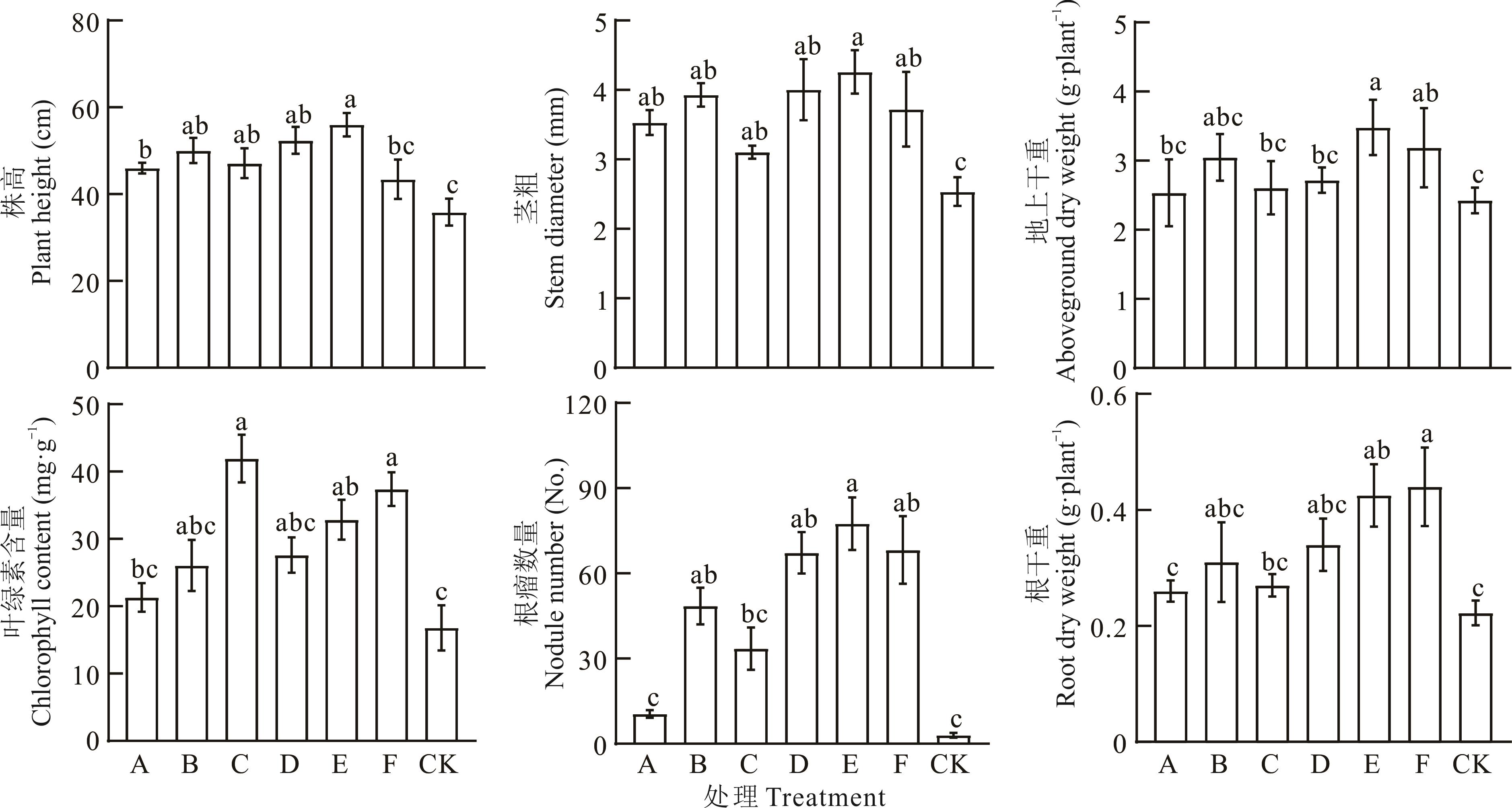
图4 不同处理对田菁植株的促生效果
Fig. 4 The growth-promoting effects of different treatments on S. cannabina
处理 Treatment | pH | 全盐 Soil salinity (g·kg-1) | 速效氮 Available nitrogen (mg·kg-1) | 全钾 Total potassium (g·kg-1) | 速效钾 Available potassium (mg·kg-1) | 全磷 Total phosphorus (g·kg-1) | 速效磷 Available phosphorus (mg·kg-1) |
|---|---|---|---|---|---|---|---|
| A | 8.05±0.02c | 1.02±0.04c | 37.30±0.85c | 12.20±0.81b | 288.50±42.19d | 2.14±0.29d | 14.95±0.73b |
| B | 8.11±0.03b | 1.02±0.14c | 42.83±1.32b | 11.90±0.61b | 210.75±29.39e | 1.10±0.12e | 15.56±0.63ab |
| C | 8.13±0.02b | 0.98±0.02c | 41.99±0.88b | 14.00±0.82a | 296.25±44.02d | 2.80±0.33b | 15.79±0.89ab |
| D | 7.99±0.02d | 1.10±0.06c | 42.15±1.02b | 15.55±1.18a | 379.00±59.23c | 2.76±0.43b | 16.29±1.11a |
| E | 8.03±0.03c | 1.07±0.06c | 45.26±2.71a | 14.55±1.71a | 429.00±48.46bc | 2.73±0.70bc | 15.73±0.31ab |
| F | 8.02±0.01c | 1.23±0.05b | 43.27±1.74b | 11.73±1.41b | 531.75±68.94a | 3.60±0.50a | 15.45±0.70ab |
| CK | 8.33±0.04a | 1.61±0.03a | 22.81±1.13d | 14.88±0.56a | 266.25±23.84de | 2.70±0.14bcd | 14.94±0.49b |
表2 根瘤菌回接对田菁栽培土壤性质的影响
Table 2 Effects of rhizobium inoculation on soil properties in S. cannabina cultivation
处理 Treatment | pH | 全盐 Soil salinity (g·kg-1) | 速效氮 Available nitrogen (mg·kg-1) | 全钾 Total potassium (g·kg-1) | 速效钾 Available potassium (mg·kg-1) | 全磷 Total phosphorus (g·kg-1) | 速效磷 Available phosphorus (mg·kg-1) |
|---|---|---|---|---|---|---|---|
| A | 8.05±0.02c | 1.02±0.04c | 37.30±0.85c | 12.20±0.81b | 288.50±42.19d | 2.14±0.29d | 14.95±0.73b |
| B | 8.11±0.03b | 1.02±0.14c | 42.83±1.32b | 11.90±0.61b | 210.75±29.39e | 1.10±0.12e | 15.56±0.63ab |
| C | 8.13±0.02b | 0.98±0.02c | 41.99±0.88b | 14.00±0.82a | 296.25±44.02d | 2.80±0.33b | 15.79±0.89ab |
| D | 7.99±0.02d | 1.10±0.06c | 42.15±1.02b | 15.55±1.18a | 379.00±59.23c | 2.76±0.43b | 16.29±1.11a |
| E | 8.03±0.03c | 1.07±0.06c | 45.26±2.71a | 14.55±1.71a | 429.00±48.46bc | 2.73±0.70bc | 15.73±0.31ab |
| F | 8.02±0.01c | 1.23±0.05b | 43.27±1.74b | 11.73±1.41b | 531.75±68.94a | 3.60±0.50a | 15.45±0.70ab |
| CK | 8.33±0.04a | 1.61±0.03a | 22.81±1.13d | 14.88±0.56a | 266.25±23.84de | 2.70±0.14bcd | 14.94±0.49b |
菌株 Strain | 最相似菌株 Most similar strain | 相似度 Similarity (%) |
|---|---|---|
| H1 | 附着剑菌 E. adhaerens Casida AT(JNAE01000171) | 99.74 |
| H2 | 田菁剑菌 E. sesbaniae CCBAU 65729T(JF834143) | 99.35 |
| H3 | 附着剑菌 E. adhaerens Casida AT(JNAE01000171) | 99.74 |
| H4 | 附着剑菌 E. adhaerens Casida AT(JNAE01000171) | 99.35 |
| H5 | 田菁剑菌 E. sesbaniae CCBAU 65729T(JF834143) | 99.35 |
表3 田菁根瘤中根瘤菌的再分离
Table 3 Re-isolation of rhizobia from S. cannabina root nodules
菌株 Strain | 最相似菌株 Most similar strain | 相似度 Similarity (%) |
|---|---|---|
| H1 | 附着剑菌 E. adhaerens Casida AT(JNAE01000171) | 99.74 |
| H2 | 田菁剑菌 E. sesbaniae CCBAU 65729T(JF834143) | 99.35 |
| H3 | 附着剑菌 E. adhaerens Casida AT(JNAE01000171) | 99.74 |
| H4 | 附着剑菌 E. adhaerens Casida AT(JNAE01000171) | 99.35 |
| H5 | 田菁剑菌 E. sesbaniae CCBAU 65729T(JF834143) | 99.35 |
| [1] | Basu A, Prasad P, Das S N, et al. Plant growth promoting rhizobacteria (PGPR) as green bioinoculants: Recent developments, constraints, and prospects. Sustainability, 2021, 13(3): 1140. |
| [2] | Egamberdieva D, Wirth S J, Bellingrath-Kimura S D, et al. Salt-tolerant plant growth promoting rhizobacteria for enhancing crop productivity of saline soils. Frontiers in Microbiology, 2019, 10: 2791. |
| [3] | Lv N, Shi L, Dai Y Y, et al. Reclamation of saline-alkali soils in Xinjiang: A review. Journal of Irrigation and Drainage, 2024, 43(12): 1-10. |
| 吕宁, 石磊, 戴昱余, 等. 新疆盐碱地治理利用研究回顾与启示. 灌溉排水学报, 2024, 43(12): 1-10. | |
| [4] | Zhang W X, Shen Z F, Shao Y H, et al. Soil biota and sustainable agriculture: A review. Acta Ecologica Sinica, 2020, 40(10): 3183-3206. |
| 张卫信, 申智锋, 邵元虎, 等. 土壤生物与可持续农业研究进展. 生态学报, 2020, 40(10): 3183-3206. | |
| [5] | Dai J X, Tian P Y, Shen C, et al. Screening of rhizosphere bacteria from salt tolerant plants and their growth promoting effects. Journal of Environmental Sciences, 2021, 30(5): 968-975. |
| 代金霞, 田平雅, 沈聪, 等. 耐盐植物根际促生菌筛选及促生效应研究. 生态环境学报, 2021, 30(5): 968-975. | |
| [6] | Liu J Y, Li X L, Jin Q. Research progress in saline-alkali remediation of agricultural soil. Soil Science, 2023, 11(3): 122-126. |
| 刘婧怡, 李雪玲, 金前. 农业土壤盐碱化修复治理研究进展. 土壤科学, 2023, 11(3): 122-126. | |
| [7] | Nemanja K, Camilla F, Alessio M, et al. Taxonomy of Rhizobiaceae revisited: Proposal of a new framework for genus delimitation. International Journal of Systematic and Evolutionary Microbiology, 2022, 72(3): 005243. |
| [8] | Duan H X, Shi Q, Kang S P, et al. Advances in research on the interactions among arbuscular mycorrhizal fungi, rhizobia, and plants. Acta Prataculturae Sinica, 2024, 33(5): 166-182. |
| 段海霞, 师茜, 康生萍, 等. 丛枝菌根真菌和根瘤菌与植物共生研究进展. 草业学报, 2024, 33(5): 166-182. | |
| [9] | Roy S, Liu W, Nandety R S, et al. Celebrating 20 years of genetic discoveries in Legume nodulation and symbiotic nitrogen fixation. Plant and Cell, 2020, 32(1): 15-41. |
| [10] | Zheng Y F, Liang J, Zhao D L, et al. The root nodule microbiome of cultivated and wild halophytic legumes showed similar diversity but distinct community structure in Yellow River Delta saline soils. Microorganisms, 2020, 8(2): 207. |
| [11] | Lv Z, Su A, Hu F Y, et al. Effects of sesbania on chlorimuron-ethyl removal and soil microbial community in farmland. Chinese Journal of Ecology, 2024, 43(9): 2750-2757. |
| 律泽, 苏澳, 胡芳雨, 等. 田菁对农田氯嘧磺隆去除及土壤微生物群落的影响. 生态学杂志, 2024, 43(9): 2750-2757. | |
| [12] | Chang D N, Ma X T, Zhou G P, et al. Symbiotic compatibility of different rhizobia strains with important Chinese milk vetch (Astragalus sinicus) cultivars. Acta Prataculturae Sinica, 2022, 31(12): 171-180. |
| 常单娜, 马晓彤, 周国朋, 等. 不同根瘤菌与紫云英主栽品种的共生匹配性. 草业学报, 2022, 31(12): 171-180. | |
| [13] | Lu J Y, Zhang H S, Tian H, et al. Research progress on effects of nitrogen deposition on soil nitrogen cycling in grassland ecosystems. Acta Prataculturae Sinica, 2022, 31(6): 221-234. |
| 陆姣云, 张鹤山, 田宏, 等. 氮沉降影响草地生态系统土壤氮循环过程的研究进展.草业学报, 2022, 31(6): 221-234. | |
| [14] | Jian S L, Li S X, Liu S Q, et al. Research advances of cover crops and their important roles. Acta Agronomica Sinica, 2022, 48(1): 1-14. |
| 蹇述莲, 李书鑫, 刘胜群, 等. 覆盖作物及其作用的研究进展. 作物学报, 2022, 48(1): 1-14. | |
| [15] | Ren M X, Li J, Ai J M, et al. Species diversity and plant growth-promoting effects of bacteria isolated from the root nodules of Sophora davidii. ActaMicrobiologica Sinica, 2024, 64(8): 2940-2954. |
| 任明霞, 李静, 艾加敏, 等. 白刺花根瘤中分离细菌的物种多样性及其促生效应. 微生物学报, 2024, 64(8): 2940-2954. | |
| [16] | Man J, Tang B, Deng B, et al. Isolation, screening and beneficial effects of plant growth-promoting rhizobacteria (PGPR) in the rhizosphere of Leymus chinensis. Acta Prataculturae Sinica, 2021, 30(1): 59-71. |
| 漫静, 唐波, 邓波, 等. 羊草根际促生菌的分离筛选及促生作用研究. 草业学报, 2021, 30(1): 59-71. | |
| [17] | Li C, Liu R, Yu Y K, et al. Screening of efficient phosphate-solubilizing bacteria capable of promoting maize growth from black soil. Microbiology China, 2025, 52(3): 1101-1117. |
| 李畅, 刘锐, 于运凯, 等. 黑土高效解磷菌的筛选及其对玉米的促生效果. 微生物学通报, 2025, 52(3): 1101-1117. | |
| [18] | Li J, Li M Y, Zhang T, et al. Screening of phosphate-solubilizing bacteria from halophytes and their growth-promoting effects. Journal of Nuclear Agricultural Sciences, 2023, 37(7): 1470-1479. |
| 李静, 李明源, 张甜, 等. 盐生植物解磷菌的筛选及促生效应研究. 核农学报, 2023, 37(7): 1470-1479. | |
| [19] | Liu X P, Zang S Y, Zhi G, et al. Isolation for plant-growth promoting halotolerant bacteria from alkali-saline soil. Chinese Journal of Soil Sinence, 2022, 53(3): 567-576. |
| 柳鑫鹏, 臧淑英, 智刚, 等. 盐碱土耐盐碱细菌筛选及其植物促生能力研究. 土壤通报, 2022, 53(3): 567-576. | |
| [20] | Liu K Y, Ning X B. Screening and enzymatic properties of salt-tolerant alkaline protease strain LK-3. Joumal of Food Science and Biotechnology, 2024, 43(3): 46-53. |
| 刘可玉, 宁喜斌. 耐盐碱性蛋白酶菌株LK-3的筛选及酶学性质. 食品与生物技术学报, 2024, 43(3): 46-53. | |
| [21] | Cheng X Y, Wang J L, Mairiyangu·Yasheng, et al. Isolation and growth-promoting characteristics of rhizobacteria producing indole-3-acetic acid from the rhizosphere soil of Kalidium foliatum. Acta Prataculturae Sinica, 2024, 33(4): 110-121. |
| 程鑫宇, 王继莲, 麦日艳古·亚生, 等. 盐爪爪根际土壤产IAA菌株分离及促生特性分析. 草业学报, 2024, 33(4): 110-121. | |
| [22] | Li T, Yu J, Qiao Y F, et al. Effect of short-term low temperature on seedling growth and nodule nitrogen fixation in soybean. Chinese Journal of Agrometeorology, 2024, 45(2): 159-169. |
| 李天, 余洁, 乔云发, 等. 短期低温对大豆苗期生长和结瘤固氮的影响. 中国农业气象, 2024, 45(2): 159-169. | |
| [23] | Wang X Y, Liu Y X, Sui X Q, et al. Effect of spray injection on leaf cells, agronomic traits and seed yield formation in alfalfa. Acta Agrestia Sinica, 2025, 33(6): 1972-1981. |
| 王鑫尧, 刘沂欣, 隋晓青, 等. 喷施缩节胺对紫花苜蓿叶片细胞、农艺性状及种子产量形成的影响. 草地学报, 2025, 33(6): 1972-1981. | |
| [24] | Bao S D. Soil agrochemical analysis (3rd edition). Beijing: China Agriculture Press, 2000: 42-116. |
| 鲍士旦. 土壤农化分析(第3版). 北京: 中国农业出版社, 2000: 42-116. | |
| [25] | Li X Y. Genetic diversity, screening and application of high efficient symbiotic rhizobia isolated from Sesbania cannabina in the Yellow River Dalta. Yantai: University of Chinese Academy of Sciences, 2015. |
| 李项岳. 黄河三角洲田菁根瘤菌遗传多样性、高效菌株筛选及应用. 烟台: 中国科学院大学, 2015. | |
| [26] | Hao Z W, Ren M X, Ai J M, et al. Research progress of non-rhizobia in leguminous root nolules. Acta Microbiologica Sinica, 1-19[2025-09-06]. https://doi.org/10.13343/j.cnki.wsxb.20250369. |
| 郝紫微, 任明霞, 艾加敏, 等. 豆科植物根瘤中的非根瘤菌研究进展. 微生物学报, 1-19[2025-09-06]. https://doi.org/10.13343/j.cnki.wsxb.20250369. | |
| [27] | Dilfuza J, Annapurna K, Kakhramon D, et al. Co-inoculation of rhizobacteria promotes growth, yield, and nutrient contents in soybean and improves soil enzymes and nutrients under drought conditions. Scientific Reports, 2021, 11(1): 22081. |
| [28] | Chang Y D. Screening of rhizobial combinations and nitrogen fixation mechanism of ‘F-wild Soybean Hybrid S007’. Hohhot: Inner Mongolia Agricultural University, 2024. |
| 常雅迪.‘蒙农S007饲用大豆’根瘤菌组合筛选与固氮机理研究. 呼和浩特: 内蒙古农业大学, 2024. | |
| [29] | Arafat R, Max M, Cassandra N, et al. Competitive interference among rhizobia reduces benefits to hosts. Current Biology, 2023, 33(14): 2988-3001. |
| [30] | Liu L S, Yu Y X, Guo L, et al. Utilization of different forms of phoshorus by Sinorhizobium meliloti. Acta Prataculturae Sinica, 2015, 24(7): 60-67. |
| 刘卢生, 玉永雄, 郭蕾, 等. 苜蓿根瘤菌对不同形态磷利用效率的研究. 草业学报, 2015, 24(7): 60-67. | |
| [31] | Liu X Y, Shi F L, Liu H, et al. Effects of rhizobium on the growth of alfalfa and the soil nutrient content. Chinese Journal of Grassland, 2016, 38(6): 45-52. |
| 刘旭艳, 石凤翎, 刘昊, 等. 接种根瘤菌对苜蓿生长及土壤养分的影响. 中国草地学报, 2016, 38(6): 45-52. | |
| [32] | Zeng C L, Liu L, Tian X T, et al. Effects of tillage management and rhizobia inoculation on soil fertility, pea yield and quality. Journal of Jianghan University (Natural Science Edition), 2021, 49(2): 66-75. |
| 曾长立, 刘丽, 田雪婷, 等. 耕作方式与接种根瘤菌对土壤肥力及豌豆产量与品质的影响. 江汉大学学报(自然科学版), 2021, 49(2): 66-75. | |
| [33] | Jiao J, Tian C F. Evolution of rhizobial nodulation and nitrogen fixation. Acta Microbiologica Sinica, 2019, 46(2): 388-397. |
| 焦健, 田长富. 根瘤菌共生固氮能力的进化模式. 微生物学通报, 2019, 46(2): 388-397. |
| [1] | 王奕涵, 史路萌, 李志坚, 周帮伟. 草种及生物炭添加对东北苏打盐碱地改良及牧草生长的影响[J]. 草业学报, 2026, 35(5): 139-150. |
| [2] | 李磊, 马勇宽, 蒋鹏, 朱志明, 纪立东, 李龙, 许兴. “六位一体”模式对宁夏盐碱地土壤水盐动态、质量等级及青贮玉米产能的影响[J]. 草业学报, 2026, 35(3): 68-82. |
| [3] | 张磊, 杜锦涛, 范倩玉, 李顺, 高嵩涓, 曹卫东. 紫云英生物固氮对土壤肥力及根瘤菌的响应特征[J]. 草业学报, 2025, 34(5): 51-63. |
| [4] | 马召, 李晓帆, 孙莉琼, 黄智, 许垒, 鲁霆, 唐晓清, 王康才. 三株丹参根内生细菌对宿主生长及药用品质的影响[J]. 草业学报, 2025, 34(4): 175-188. |
| [5] | 李雪梅, 姚拓, 李昌宁, 杨晓蕾, 王晚霞, 张怡忻. 甘南野生天蓝苜蓿高效共生、抗逆根瘤菌筛选鉴定[J]. 草业学报, 2025, 34(3): 134-143. |
| [6] | 杜媛媛, 康文娟, 师尚礼, 韩宜霖, 何富强. 外源激素对紫花苜蓿种子内生根瘤菌增殖及幼苗生长的影响[J]. 草业学报, 2025, 34(2): 81-93. |
| [7] | 侯文璐, 康文娟, 陆保福, 韩宜霖, 关键, 王晶晶. 不同共生效应根瘤菌株对紫花苜蓿光合特性和呼吸代谢的影响[J]. 草业学报, 2025, 34(11): 66-80. |
| [8] | 韩宜霖, 康文娟, 师尚礼, 杜媛媛, 何富强, 汪艳, 侯文璐, 谢西琳. 中华根瘤菌株QL2与不同紫花苜蓿品种共生效应的差异[J]. 草业学报, 2025, 34(10): 132-150. |
| [9] | 段海霞, 师茜, 康生萍, 苟海青, 罗崇亮, 熊友才. 丛枝菌根真菌和根瘤菌与植物共生研究进展[J]. 草业学报, 2024, 33(5): 166-182. |
| [10] | 陶雅, 徐丽君, 李峰, 李文龙, 孙启忠, 徐畅, 林克剑. 我国羊草产业亟待振兴[J]. 草业学报, 2023, 32(11): 188-198. |
| [11] | 杨志新, 郑旭, 陈来宝, 于泳鑫, 张凤华, 李鲁华, 王家平. 干旱区盐碱地食叶草根系形态分布适应策略研究[J]. 草业学报, 2022, 31(7): 15-27. |
| [12] | 李宏伟, 郑琪, 李滨, 赵茂林, 李振声. 一种耐盐碱牧草——长穗偃麦草研究进展[J]. 草业学报, 2022, 31(5): 190-199. |
| [13] | 撖冬荣, 姚拓, 李海云, 陈敏豪, 高亚敏, 李昌宁, 白洁, 苏明. 化肥减量配施微生物肥料对垂穗披碱草生长的影响[J]. 草业学报, 2022, 31(4): 53-61. |
| [14] | 撖冬荣, 姚拓, 李海云, 黄书超, 杨琰珊, 高亚敏, 李昌宁, 张银翠. 微生物肥料与化肥减量配施对多年生黑麦草生长的影响[J]. 草业学报, 2022, 31(3): 136-143. |
| [15] | 常单娜, 马晓彤, 周国朋, 高嵩涓, 刘蕊, 曹卫东. 不同根瘤菌与紫云英主栽品种的共生匹配性[J]. 草业学报, 2022, 31(12): 171-180. |
| 阅读次数 | ||||||
|
全文 |
|
|||||
|
摘要 |
|
|||||
