

ISSN 1004-5759 CN 62-1105/S
草业学报 ›› 2026, Vol. 35 ›› Issue (6): 145-154.DOI: 10.11686/cyxb2025255
• 研究论文 • 上一篇
余子欣( ), 沈为正(), 潘高, 王雯颖, 刘文胜()
收稿日期:2025-06-26
修回日期:2025-09-01
出版日期:2026-06-20
发布日期:2026-04-13
通讯作者:
刘文胜
作者简介:Corresponding author. E-mail: liuwsairr@163.com基金资助:
Zi-xin YU(), Wei-zheng SHEN(), Gao PAN, Wen-yin WANG, Wen-sheng LIU()
Received:2025-06-26
Revised:2025-09-01
Online:2026-06-20
Published:2026-04-13
Contact:
Wen-sheng LIU
摘要:
本研究以前期从湘潭锰矿植物种子获得的4种优势可培养种子内生真菌及大叶胡枝子、五节芒、青葙和藜这4种不同生活型的植物种子为材料,开展真菌锰耐受性试验以及接种内生菌对锰胁迫下种子发芽与幼苗生长影响的试验。研究结果显示,4种内生真菌相比较,链格孢霉在高锰胁迫下的菌落直径、生物量变化最小。该菌的最小抑菌浓度为50 mmol·L-1,Mn2+吸附率达75.6%,高于其他3株真菌,这说明链格孢霉锰耐受性最强。接种链格孢霉提高了锰胁迫下大叶胡枝子、五节芒、青葙和藜的种子发芽率与发芽势,促进了幼苗生长。高Mn2+浓度(20 mmol·L-1)时,大叶胡枝子、五节芒、青葙、藜的接菌组发芽率分别较非接菌组提高4.9%、12.9%、88.9%、93.3%,总生物量则分别较非接菌组提高4.0%、117.1%、31.5%、35.7%。这说明链格孢霉对胁迫下种子发芽与幼苗生长的促进作用具有广谱性。
余子欣, 沈为正, 潘高, 王雯颖, 刘文胜. 锰耐受性种子内生菌筛选及其促进锰胁迫下种子萌发与幼苗生长的研究[J]. 草业学报, 2026, 35(6): 145-154.
Zi-xin YU, Wei-zheng SHEN, Gao PAN, Wen-yin WANG, Wen-sheng LIU. Screening of manganese-tolerant endophytic fungi from seeds and their ability to promote seed germination and seedling growth under manganese stress[J]. Acta Prataculturae Sinica, 2026, 35(6): 145-154.
菌株 Strain | Mn2+浓度 Mn2+ concentration (mmol·L-1) | ||||
|---|---|---|---|---|---|
| 0 | 5 | 10 | 15 | 20 | |
| YM-1 | 7.20±0.10a | 7.03±0.06ab | 6.90±0.26ab | 6.77±0.32b | 5.83±0.15c |
| YM-2 | 7.63±0.06b | 8.17±0.15a | 6.80±0.26c | 4.20±0.10d | 3.83±0.06e |
| YM-3 | 7.53±0.06a | 7.03±0.25b | 7.20±0.20ab | 6.60±0.20c | 5.37±0.21d |
| YM-4 | 9.00±0.00a | 9.00±0.00a | 8.57±0.12b | 7.63±0.15c | 7.30±0.10d |
表1 4个种子内生菌菌株在不同Mn2+浓度下的菌落直径
Table 1 Colony diameter of four seed endophytic fungi under different Mn2+ concentrations (cm)
菌株 Strain | Mn2+浓度 Mn2+ concentration (mmol·L-1) | ||||
|---|---|---|---|---|---|
| 0 | 5 | 10 | 15 | 20 | |
| YM-1 | 7.20±0.10a | 7.03±0.06ab | 6.90±0.26ab | 6.77±0.32b | 5.83±0.15c |
| YM-2 | 7.63±0.06b | 8.17±0.15a | 6.80±0.26c | 4.20±0.10d | 3.83±0.06e |
| YM-3 | 7.53±0.06a | 7.03±0.25b | 7.20±0.20ab | 6.60±0.20c | 5.37±0.21d |
| YM-4 | 9.00±0.00a | 9.00±0.00a | 8.57±0.12b | 7.63±0.15c | 7.30±0.10d |
菌株 Strain | 锰离子吸附率 Mn2+ adsorption rate (%) | 最小抑菌浓度Minimum inhibitory concentration (MIC, mmol·L-1) |
|---|---|---|
| YM-1 | 57.0 | 40 |
| YM-2 | 62.8 | 30 |
| YM-3 | 72.6 | 40 |
| YM-4 | 75.6 | 50 |
表2 4个种子内生菌菌株的最小抑菌浓度及锰离子吸附率
Table 2 Minimum inhibitory concentration (MIC) and manganese ion adsorption rate of four endophytic fungi in seeds
菌株 Strain | 锰离子吸附率 Mn2+ adsorption rate (%) | 最小抑菌浓度Minimum inhibitory concentration (MIC, mmol·L-1) |
|---|---|---|
| YM-1 | 57.0 | 40 |
| YM-2 | 62.8 | 30 |
| YM-3 | 72.6 | 40 |
| YM-4 | 75.6 | 50 |
菌株 Strain | Mn2+浓度Mn2+ concentration (mmol·L-1) | ||||
|---|---|---|---|---|---|
| 0 | 5 | 10 | 15 | 20 | |
| YM-1 | 131.00±4.58a | 117.33±4.93b | 108.00±2.00b | 93.00±3.61c | 64.33±11.59d |
| YM-2 | 148.00±5.00b | 157.67±4.04a | 100.67±3.06c | 63.00±4.58d | 40.00±2.65e |
| YM-3 | 122.00±8.72a | 95.67±2.08b | 64.00±1.00c | 54.00±1.00d | 42.00±3.00e |
| YM-4 | 187.67±2.31a | 186.67±5.03a | 167.67±4.51b | 146.33±5.13c | 132.33±3.79d |
表3 不同锰浓度下4个种子内生真菌菌丝的生物量
Table 3 Biomass of four seed endophytic fungi under different manganese concentrations (mg)
菌株 Strain | Mn2+浓度Mn2+ concentration (mmol·L-1) | ||||
|---|---|---|---|---|---|
| 0 | 5 | 10 | 15 | 20 | |
| YM-1 | 131.00±4.58a | 117.33±4.93b | 108.00±2.00b | 93.00±3.61c | 64.33±11.59d |
| YM-2 | 148.00±5.00b | 157.67±4.04a | 100.67±3.06c | 63.00±4.58d | 40.00±2.65e |
| YM-3 | 122.00±8.72a | 95.67±2.08b | 64.00±1.00c | 54.00±1.00d | 42.00±3.00e |
| YM-4 | 187.67±2.31a | 186.67±5.03a | 167.67±4.51b | 146.33±5.13c | 132.33±3.79d |
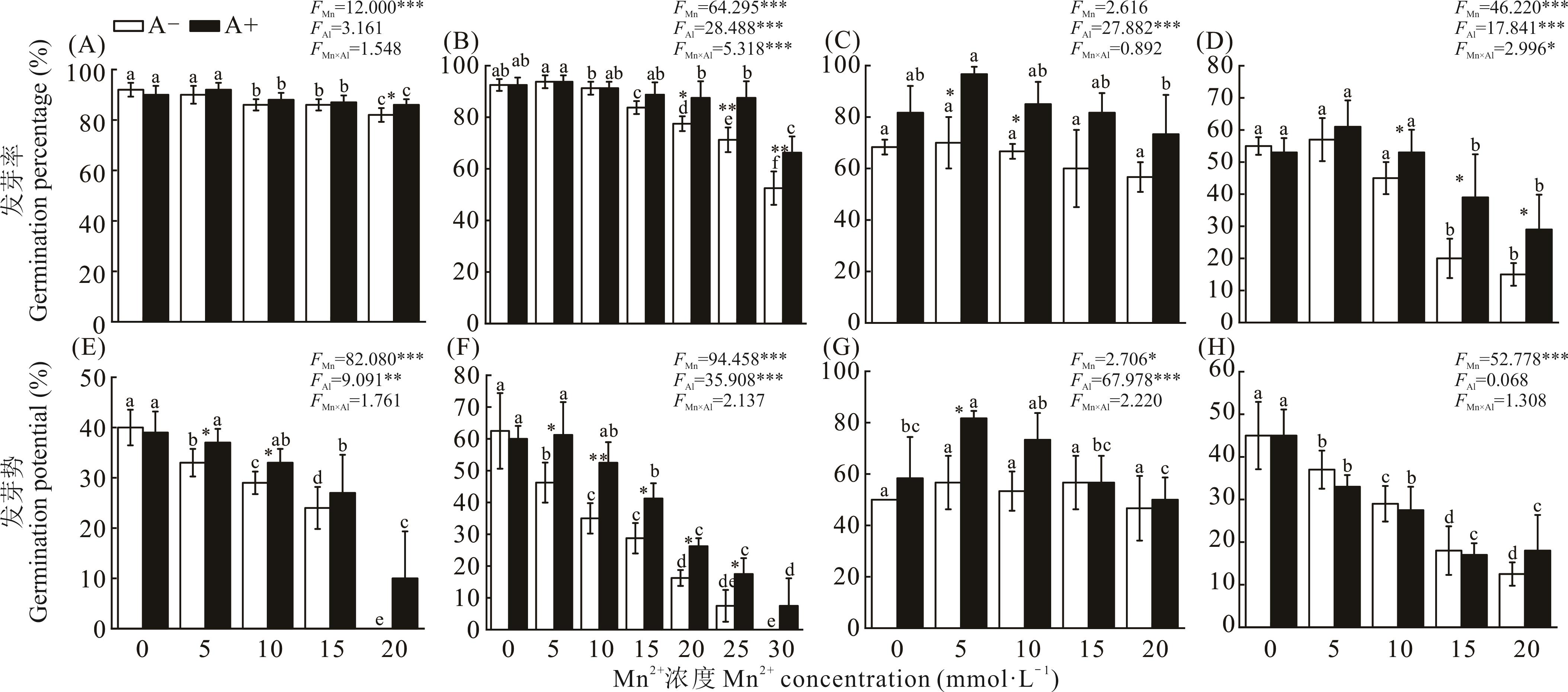
图1 锰胁迫和内生真菌侵染对4种植物种子发芽率与发芽势的影响A、E表示大叶胡枝子,B、F表示五节芒,C、G表示青葙,D、H表示藜;A+或 A-表示内生菌侵染或不侵染;不同小写字母表示不同锰胁迫下带菌或不带菌种子间差异显著(P<0.05);*表示同一Mn2+浓度下接菌组与非接菌组差异显著(P<0.05),**表示同一Mn2+浓度下接菌组与非接菌组差异极显著(P<0.01)。下同。A, E indicate L. davidii, B, F indicate M. floridulus, C, G indicate C. argentea and D, H indicate C. album. A+ or A- indicate Alternaria sp. infected seeds or Alternaria sp. free seeds. Different small letters indicate significant difference among different Mn concentrations of the inoculation seeds or the non-inoculation seeds (P<0.05). * indicates significant difference between the inoculation group and the non-inoculation group of the same Mn2+ concentration (P<0.05); ** indicates significant difference between the inoculation group and the non-inoculation group of the same Mn2+ concentration (P<0.05). The same below.
Fig.1 Effects of Mn stress and endophyte infection on seed germination rate and germination potential of four plants
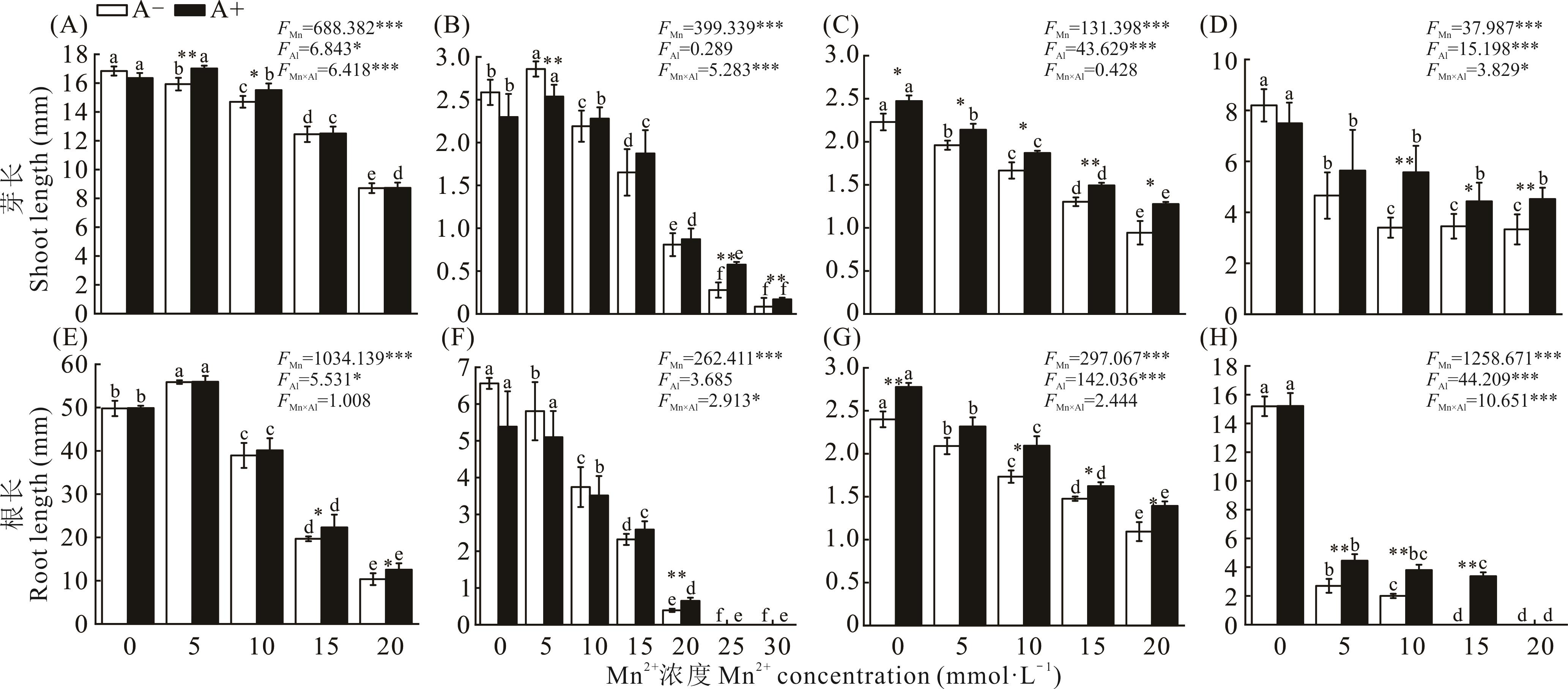
图2 锰胁迫和内生真菌侵染对4种植物幼苗芽长与根长的影响
Fig.2 Effects of Mn stress and endophyte infection on shoot length and root length of four plants
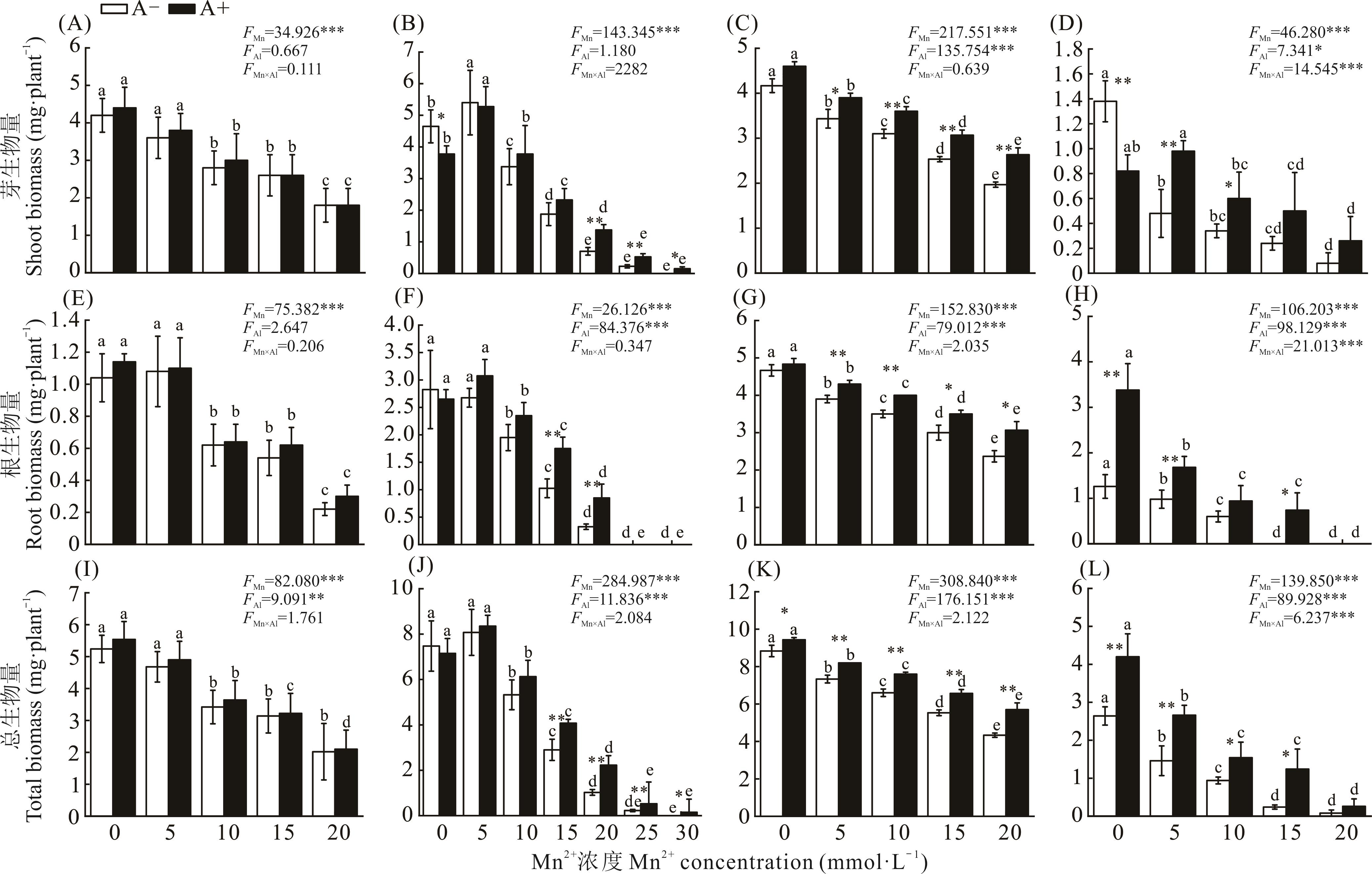
图3 锰胁迫和内生真菌侵染对4种植物芽生物量、根生物量与总生物量的影响A、E、I表示大叶胡枝子,B、F、J表示五节芒,C、G、K表示青葙,D、H、L表示藜。A, E, I indicate L. davidii, B, F, J indicate M. floridulus, C, G, K indicate C. argentea,and D, H, L indicate C. album.
Fig.3 Effects of Mn stress and endophyte infection on shoot biomass, root biomass and total individual biomass of four plants
| [1] | Hayes R C, Conyers M, Li G D, et al. Spatial and temporal variation in soil Mn2+ concentrations and the impact of manganese toxicity on lucerne and subterranean clover seedlings. Crop and Pasture Science, 2012, 63(9): 875-885. |
| [2] | Li C J, Lang M X, Chen Z J, et al. Effects of Epichloë endophytic fungi on the germination of grass seeds. Acta Prataculturae Sinica, 2022, 31(3): 192-206. |
| 李春杰, 郎鸣晓, 陈振江, 等. Epichloë 内生真菌对禾草种子萌发影响研究进展. 草业学报, 2022, 31(3): 192-206. | |
| [3] | Krishna K R, Neha P, Ram P M, et al. Biotechnological strategies for enhancing heavy metal tolerance in neglected and underutilized legume crops: A comprehensive review. Ecotoxicology and Environmental Safety, 2021, 208(2): e111705. |
| [4] | Chen J R, Liu D, Wu J S, et al. Seed germination and metal accumulation of Moso bamboo (Phyllostachys pubescens) under heavy metal exposure. Acta Ecologica Sinica, 2014, 34(22): 6501-6509. |
| 陈俊任, 柳丹, 吴家森, 等. 重金属胁迫对毛竹种子萌发及其富集效应的影响. 生态学报, 2014, 34(22): 6501-6509. | |
| [5] | Wang W M, Kuang X S, Hu J Y, et al. Effects of manganese stress on seed germination, seeding growth and physiological and biochemical characteristic of Rhus chinensis. Acta Ecologica Sinica, 2022, 42(9): 3706-3715. |
| 王悟敏, 匡雪韶, 胡佳瑶, 等. 锰胁迫对盐肤木种子萌发、幼苗生长及理化特性的影响. 生态学报, 2022, 42(9): 3706-3715. | |
| [6] | Li X T, Li L J, Zhang Y P, et al. Using exogenous endophytic fungi to improve seed germination and seedling development of oat under water stress. Journal of Irrigation and Drainage, 2023, 42(7): 10-17, 59. |
| 李晓婷, 李立军, 张永平, 等. 干旱胁迫下外源内生真菌对燕麦种子萌发及幼苗生长的影响. 灌溉排水学报, 2023, 42(7): 10-17, 59. | |
| [7] | Shahzad R, Waqas M, Khan A L, et al. Seed-borne endophytic Bacillus amyloliquefaciens RWL-1 produces gibberellins and regulates endogenous phytohormones of Oryza sativa. Plant Physiology and Biochemistry, 2016, 106(9): 236-243. |
| [8] | Wan Z W, Wang P, Zhang X X, et al. Effect of manganese and SA on germination of Achnatherum inebrians seed containing or free of endophyte. Acta Agrestia Sinica, 2016, 24(1): 107-113. |
| 万志文, 王萍, 张兴旭, 等. 锰、水杨酸与内生真菌互作对醉马草种子萌发的影响 . 草地学报, 2016, 24(1): 107-113. | |
| [9] | Li F Y, Zhang C L, Huang H, et al. Screening of plant growth-promoting endophytic bacteria from Amaranthus retroflexus L. and their effects on chromium accumulation in plant. Southwest China Journal of Agricultural Sciences, 2016, 29(7): 1694-1700. |
| 李方圆, 张超兰, 黄河, 等. 反枝苋内生菌筛选及其铬富集效果研究. 西南农业学报, 2016, 29(7): 1694-1700. | |
| [10] | Li K, Shi C, Wang W Q, et al. Seed germination and growth effects of endophyte infection on Melica transsilvanica under Pb stress. Journal of Agricultural Resources and Environment, 2020, 37(2): 280-286. |
| 李柯, 施宠, 王文全, 等. 重金属Pb 胁迫下内生真菌侵染对德兰臭草种子萌发及生长的影响. 农业资源与环境学报, 2020, 37(2): 280-286. | |
| [11] | Zhang P, Ren Q, Meng S Y, et al. Effects of Epichloë endophyte on seed germination and seedling growth of Stipa purpurea under salt stress. Acta Prataculturae Sinica, 2022, 31(10): 110-121. |
| 张鹏, 任茜, 孟思宇, 等. 内生真菌对盐胁迫下紫花针茅种子萌发和幼苗生长的研究. 草业学报, 2022, 31(10): 110-121. | |
| [12] | Zhang C B, Wang J, Ke S X, et al. Effects of natural inhabitation by Miscanthus floridulus on heavy metal speciations and function and diversity of microbial community in mine tailing sand. Chinese Journal of Plant Ecology, 2009, 33(4): 629-637. |
| 张崇邦, 王江, 柯世省, 等. 五节芒定居对尾矿砂重金属形态、微生物群落功能及多样性的影响.植物生态学报, 2009, 33(4): 629-637. | |
| [13] | Choo J, Wong C, Müller M. Protocol for screening endophytic fungi against heavy metals//Udayanga D, Bhatt P, Manamgoda D, et al. Mycoremediation protocols. Berlin: Springer, 2022. |
| [14] | Chu W H, Xie Q Z, Yang C, et al. The identification and study on Cd tolerance of Cl2, a fungus which shows high tolerance to Cd. Journal of Northwest Agriculture and Forestry University (Natural Science Edition), 2017, 45(9): 71-80. |
| 楚文卉, 谢清哲, 杨超, 等. 1 株镉耐受真菌C12 的鉴定及其镉耐受性研究.西北农林科技大学学报(自然科学版), 2017, 45(9): 71-80. | |
| [15] | Jia T, Wang R H, Cao M W. Isolation and identification of the Epichloë endophyte from Bothriochloa ischaemum and its heavy metal tolerance. Acta Ecologica Sinica, 2018, 38(18): 6623-6631. |
| 贾彤, 王瑞宏, 曹苗文. 白羊草 Epichloë属内生真菌的分离鉴定及其重金属耐受性. 生态学报, 2018, 38(18): 6623-6631. | |
| [16] | Colpaert J V, Vandenkoornhuyse P, Adriaensen K, et al. Genetic variation and heavy metal tolerance in the ectomycorrhizal basidiomycete Suillus luteus. New Phytologist, 2000, 147(2): 367-379. |
| [17] | Geisen S, ten Hooven F C, Kostenko O, et al. Fungal root endophytes influence plants in a species-specific manner that depends on plant’s growth stage. Journal of Ecology, 2021, 109(4): 1618-1632. |
| [18] | Tai X S, Yang R Q, Chang G H, et al. Research progress of endophyte resources in metal mining area. Chinese Wild Plant Resources, 2021, 40(4): 57-64. |
| 台喜生, 杨蕊琪, 常国华, 等. 金属矿区植物内生菌资源研究进展. 中国野生植物资源, 2021, 40(4): 57-64. | |
| [19] | Liu J S, Luo Y L, Xie X C, et al. Research on screening and growth-promotion ability of cadmium resistant endophytic fungi. Journal of Henan Agricultural Sciences, 2019, 48(3): 61-69. |
| 刘军生, 罗阳兰, 解修超, 等. 抗镉植物内生真菌的筛选及其促生能力研究. 河南农业科学, 2019, 48(3): 61-69. | |
| [20] | Giauque H, Connor E W, Hawkes C V. Endophyte traits relevant to stress tolerance, resource use and habitat of origin predict effects on host plants. New Phytologist, 2019, 221(4): 2239-2249. |
| [21] | Zhang P P, Hu L X, Fu J M. Effects of endophyte infection on seed germination, seedling growth and osmotic stress resistance of perennial ryegrass (Lolium perenne L.). Pratacultural Science, 2012, 29(7): 1094-1099. |
| 张萍萍, 胡龙兴, 傅金民. 内生真菌侵染对盐胁迫下黑麦草种子萌发的影响. 草业科学, 2012, 29(7): 1094-1099. | |
| [22] | Kuang Y, Nan Z B, Tian P. Effects of Epichloë endophyte and seed hydro-priming on the germination of Festuca sinensis under NaCl stress. Acta Prataculturae Sinca, 2016, 25(2): 160-168. |
| 旷宇, 南志标, 田沛. 内生真菌和水引发对NaCl胁迫条件下中华羊茅种子萌发的影响. 草业学报, 2016, 25(2): 160-168. | |
| [23] | Chen Z J, Liu J, Wei X K, et al. Effects of latosols extracts with different pH and endophytic fungi on growth and physiology of Lolium perenne seedling. Acta Botanica Boreali-Occidentalia Sinica, 2017, 37(7): 1348-1356. |
| 陈振江, 刘静, 魏学凯, 等. 不同pH砖红壤浸提液和内生真菌对黑麦草幼苗生长生理的影响. 西北植物学报, 2017, 37(7): 1348-1356. | |
| [24] | Li C J, Yao X, Nan Z B. Advances in research of Achnatherum inebrians-Epichloë endophyte symbionts. Chinese Journal of Plant Ecology, 2018, 42(8): 793-805. |
| 李春杰, 姚祥, 南志标. 醉马草内生真菌共生体研究进展. 植物生态学报, 2018, 42(8): 793-805. | |
| [25] | Chen Z H, Liu X F, Bao G S, et al. Effects of endophytic fungi on drought tolerance ability of tall fescue seed. Journal of Tarim University, 2016, 28(2): 12-17. |
| 陈志豪, 刘学锋, 鲍根生, 等. 内生真菌对高羊茅种子耐干旱能力的影响. 塔里木大学学报, 2016, 28(2): 12-17. | |
| [26] | Zhang W, Mace W J, Matthew C, et al. The impact of endophyte infection, seed aging, and imbibition on selected sugar metabolite concentrations in seed. Journal of Agricultural and Food Chemistry, 2019, 67(25): 6921-6929. |
| [27] | Qiang X J, Ding J J, Lin W, et al. Alleviation of the detrimental effect of water deficit on wheat (Triticum aestivum L.) growth by an indole acetic acid-producing endophytic fungus. Plant and Soil, 2019, 439(2): 373-391. |
| [28] | Eldredge S D, Geary B, Jensen S L. Seed isolates of Alternaria and Aspergillus fungi increase germination of Astragalus utahensls. Native Plants Journal, 2016, 17(2): 89-94. |
| [29] | Di J L, Jiang H Y, Cong L, et al. Effects of four antagonistic endophytic fungi on the growth on Picea mongolia. Journal of Northeast Forestry University, 2022, 50(6): 39-45. |
| 狄佳麟, 姜海燕, 丛林, 等. 4 株内生拮抗菌对沙地云杉的促生作用. 东北林业大学学报, 2022, 50(6): 39-45. | |
| [30] | Grime J P, Mason G, Curtis A V, et al. A comparative study of germination characteristics in a local flora. Journal of Ecology, 1981, 69(3): 1017-1059. |
| [31] | Liu H L, Song M F, Duan S M, et al. A comparative study of seed germination traits of 52 species from Gurbantunggut Desert and its peripheral zone. Acta Ecologica Sinica, 2011, 31(15): 4308-4317. |
| 刘会良, 宋明方, 段士民, 等. 古尔班通古特沙漠及周缘 52 种植物种子的萌发特性与生态意义. 生态学报, 2011, 31(15): 4308-4317. | |
| [32] | Bu H Y, Du G Z, Chen X L, et al. Community-wide germination strategies in an alpine meadow on the eastern Qinghai-Tibet Plateau: phylogenetic and life-history correlates. Plant Ecology, 2007, 195(1): 87-98. |
| [33] | Zhang Y Y, Zhang C H, Zhang L, et al. Germination response to light of 30 Poaceae species from the eastern Qinghai-Tibet plateau and correlates with their life history. Journal of Lanzhou University (Natural Sciences), 2011, 47(4): 49-54. |
| 张莹莹, 张春辉, 张蕾, 等. 青藏高原东缘 30 种禾本科植物种子萌发对光的响应及其与生活史的关联. 兰州大学学报(自然科学版), 2011, 47(4): 49-54. | |
| [34] | Tian F, Liao X F, Wang L H, et al. Isolation and identification of beneficial orchid mycorrhizal fungi in Paphiopedilum barbigerum (Orchidaceae). Plant Signaling and Behavior, 2022, 17(1): 2005882. |
| [35] | Wang J H, Chen W, Ruan Y T, et al. Isolation and identification of Cupriavidus sp. HXC-8 and its effects on growth of Mimosa pudica contaminated with copper. Journal of Northwest A & F University (Natural Science Edition), 2023, 51(8): 131-139. |
| 王桔红, 陈文, 阮玥婷, 等. 内生贪铜菌的分离鉴定及其对铜污染含羞草生长的影响. 西北农林科技大学学报(自然科学版), 2023, 51(8): 131-139. | |
| [36] | Chu W, Wang Y Y, Guo Y, et al. Screening of Casuarina equisetifolia rhizosphere promoting bacteria and their effects on seed germination and seedling growth. Chinese Journal of Applied Ecology, 2024, 35(8): 2159-2166. |
| 储薇, 王炎炎, 郭玥, 等. 木麻黄根际促生菌的筛选及对种子萌发和幼苗生长的影响. 应用生态学报, 2024, 35(8): 2159-2166. | |
| [37] | Chen K X, Tang W T, Li L N, et al. Functional mechanism of seed endophytes enhancing heavy metal resistance of host plants: a review. Microbiology China, 2021, 48(6): 2187-2194. |
| 陈柯璇, 汤雯婷, 李丽娜, 等. 种子内生菌增强宿主植物重金属抗性的功能机制研究进展. 微生物学通报, 2021, 48(6): 2187-2194. | |
| [38] | Mauricio-Castillo J A, Salas-Muñoz S, Reveles-Torres L R, et al. Could Alternaria solani IA300 be a plant growth-promoting fungus? European Journal of Plant Pathology, 2020, 157(2): 413-419. |
| [39] | Herrera M D, Salas-Muñoz S, Reveles-Torres L R, et al. Alternaria solani IA300 induces growth and development in two common bean cultivars. European Journal of Plant Pathology, 2024, 170(2): 451-462. |
| [1] | 童玉花, 王晓彤, 马永龙, 杨金辉, 余冬雯, 李淑霞. 壳聚糖浸种对盐碱胁迫下紫花苜蓿种子萌发的影响[J]. 草业学报, 2026, 35(3): 245-256. |
| [2] | 张继元, 安海全, 潘靖一, 刘畅, 龙思思, 赵丽丽. 7个紫花苜蓿品种种子萌发及幼苗生长的抗旱性评价[J]. 草业学报, 2026, 35(2): 68-82. |
| [3] | 白小红, 陈文燕, 李琴, 王奕璇, 张雪, 王磊, 曲文杰, 朱林. 不同种源乌拉尔甘草种子萌发及幼苗生长比较研究[J]. 草业学报, 2025, 34(7): 196-209. |
| [4] | 宁小静, 任秋洁, 王丽娟, 贾小琳, 石孝均, 王洁. 不同丸化种衣剂配方对酿酒高粱出苗及生长的影响[J]. 草业学报, 2025, 34(6): 70-84. |
| [5] | 郑玉琪, 严佳玥, 李博元, 魏岩. 新疆针茅传播体形态及埋深对种子萌发出苗的影响[J]. 草业学报, 2025, 34(5): 64-73. |
| [6] | 郝丽芬, 徐晓阳, 季玉, 王瑞, 吴德宝, 李宇宇, 林克剑. 长刺蒺藜草两异型种子形态和萌发过程的生理动态特征比较[J]. 草业学报, 2024, 33(9): 40-50. |
| [7] | 张婷婷, 刘宇乐, 陈红, 许凌欣, 陈祥伟, 王恩姮, 严俊鑫. 不同外源物质对盐、碱及干旱胁迫下草木樨种子萌发、幼苗生长及生理的影响[J]. 草业学报, 2024, 33(8): 122-132. |
| [8] | 何邦印, 裴婧宏, 野起瑞, 胡佳佳, 郑彩雪, 李江文. 不同人工经济林凋落叶浸提液对豆禾草种的化感效应研究[J]. 草业学报, 2024, 33(8): 199-208. |
| [9] | 阮坤非, 王天琪, 毕宁宁, 师劭彤, 李森, 刘忠华. 元宝枫凋落叶浸提液对3种中草药化感作用的研究[J]. 草业学报, 2024, 33(7): 151-159. |
| [10] | 高金柱, 赵东豪, 高乐, 苏喜浩, 何学青. 硝酸铈与脱落酸处理对紫花苜蓿种子萌发和幼苗生理特性的影响[J]. 草业学报, 2024, 33(6): 175-186. |
| [11] | 王钰煐, 种培芳, 张建喜, 刘行行, 包新光, 王雪莹. 红砂与珍珠猪毛菜水浸提液对其幼苗生长的化感作用[J]. 草业学报, 2024, 33(12): 99-110. |
| [12] | 马绍英, 陈桂平, 王娜, 马蕾, 连荣芳, 李胜, 张绪成. 豌豆土壤中潜在自毒物质的鉴定及自毒效应研究[J]. 草业学报, 2023, 32(6): 134-145. |
| [13] | 张士敏, 赵娇阳, 朱慧森, 卫凯, 王永新. 硒对不同品种紫花苜蓿发芽阶段物质转化和形态建成的影响[J]. 草业学报, 2023, 32(4): 79-90. |
| [14] | 田政, 杨正禹, 陆忠杰, 罗奔, 张茂, 董瑞. 44个紫花苜蓿品种的酸铝适应性与耐受性评价[J]. 草业学报, 2023, 32(3): 142-151. |
| [15] | 张涛, 牟英玉, 亓王盼, 张继友, 毛胜勇. 亚急性瘤胃酸中毒耐受性不同的奶牛瘤胃上皮形态及功能差异研究[J]. 草业学报, 2023, 32(2): 131-139. |
| 阅读次数 | ||||||
|
全文 |
|
|||||
|
摘要 |
|
|||||
