

ISSN 1004-5759 CN 62-1105/S
草业学报 ›› 2026, Vol. 35 ›› Issue (7): 165-174.DOI: 10.11686/cyxb2025373
• 研究论文 • 上一篇
陈娜1( ), 覃滢卜1, 彭德力1,2()
收稿日期:2025-09-15
修回日期:2025-10-16
出版日期:2026-07-20
发布日期:2026-05-21
通讯作者:
彭德力
作者简介:Corresponding author. E-mail: pengdeli@ynnu.edu.cn基金资助:
Na CHEN1(), Ying-bo QIN1, De-li PENG1,2()
Received:2025-09-15
Revised:2025-10-16
Online:2026-07-20
Published:2026-05-21
Contact:
De-li PENG
摘要:
以藏东南山地特有种杂色钟报春为试验对象,系统探究了其种子休眠与萌发特性。通过外源赤霉素(GA3)添加、干燥后熟和低温层积处理研究种子休眠解除方法,并分析了休眠解除过程中种子萌发对不同温度(恒温:1、5、10、15、20、25、30 ℃;变温:5 ℃/1 ℃、15 ℃/5 ℃、25 ℃/15 ℃)和光照条件(12 h光照/12 h黑暗和持续黑暗)的响应。结果表明:新成熟种子萌发需要较高温度(>20 ℃),在低温(1~15 ℃)下萌发率显著降低,且萌发对光照有明显需求,尤其在低温条件下,而且添加外源GA3能显著促进萌发。干燥后熟与低温层积均能有效打破种子初始休眠,但是低温层积效果更佳。随着休眠逐渐解除,种子萌发的温度范围变宽(5~30 ℃),基础萌发温度(Tb)逐渐降低,从-2.092 ℃(低温层积3个月)降至-4.035 ℃(低温层积6个月),而萌发最适温度(To)和最高温度(Tc)无明显变化。休眠解除后,种子萌发对光照的需求降低。本研究证实杂色钟报春种子在成熟散播时具有2型浅型生理休眠。初始萌发依赖于较高温度,环境条件不满足时表现为条件休眠。越冬过程逐渐解除休眠,使种子获得在较低温度下萌发的能力,从而能在春季融雪后快速萌发,延长幼苗生长季,提高存活率。这种萌发行为是高山植物对短生长季环境的关键适应策略。
陈娜, 覃滢卜, 彭德力. 藏东南山地特有种杂色钟报春种子萌发的生态适应策略[J]. 草业学报, 2026, 35(7): 165-174.
Na CHEN, Ying-bo QIN, De-li PENG. Ecological adaptation strategies of seed germination in Primula alpicola, an endemic alpine species in the southeastern Xizang Plateau[J]. Acta Prataculturae Sinica, 2026, 35(7): 165-174.
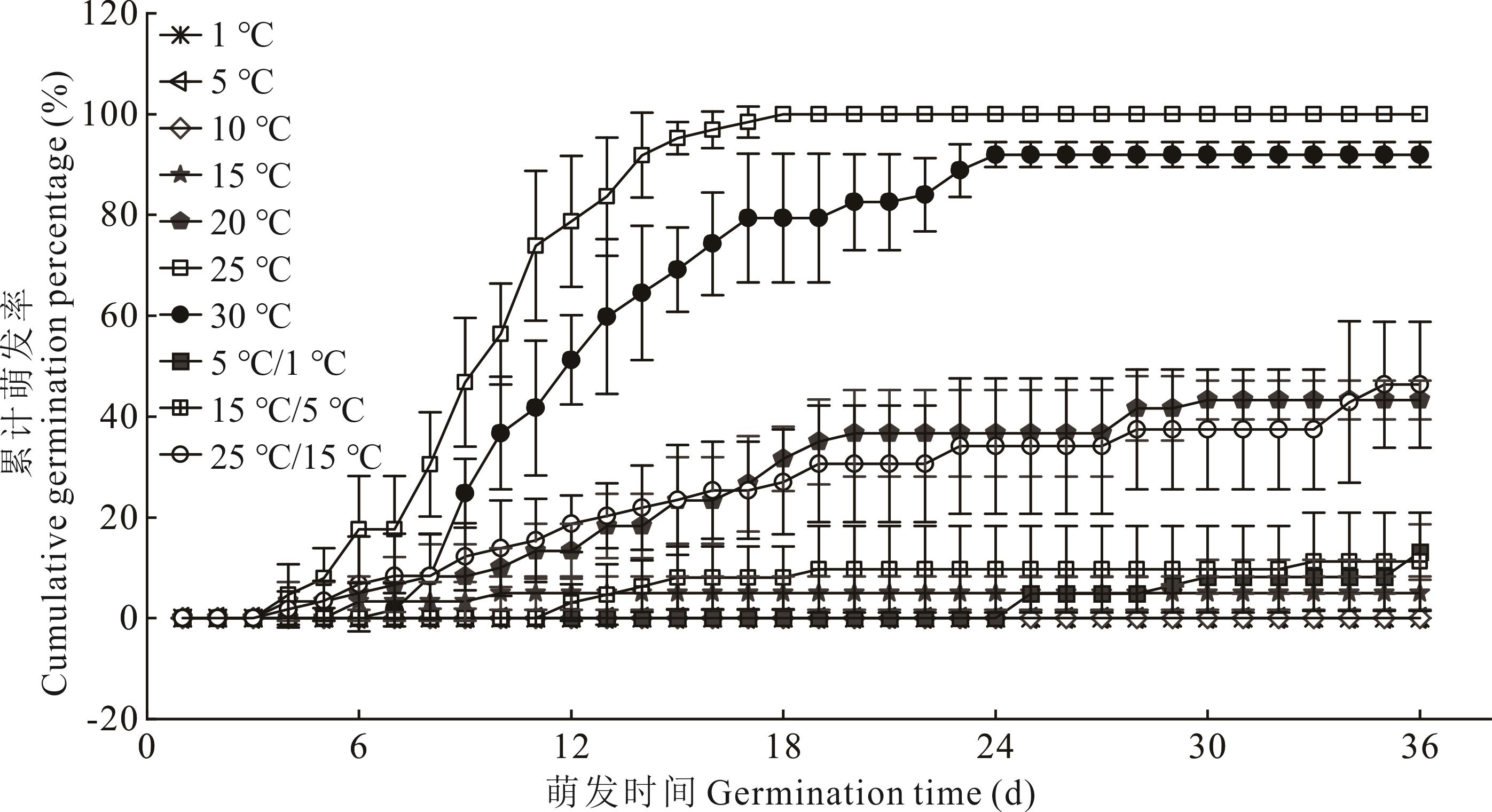
图1 光照条件下温度对杂色钟报春新鲜种子累积萌发率的影响
Fig.1 Effect of temperatures on cumulative germination percentage for fresh seeds of P. alpicola under light conditions
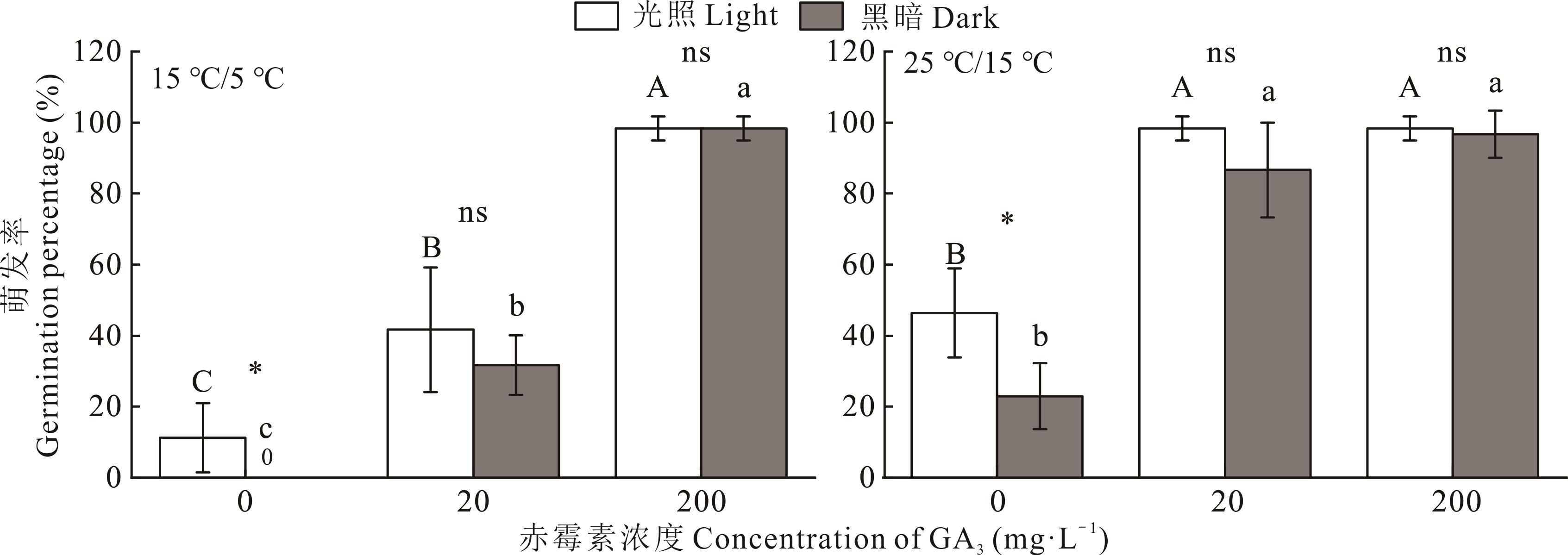
图2 赤霉素和光照条件对新鲜种子萌发率的影响不同大写字母表示光照条件下赤霉素浓度间差异显著(P<0.05),不同小写字母表示黑暗条件下赤霉素浓度间差异显著(P<0.05),相同赤霉素浓度条件下,*表示不同光照条件间差异显著(P<0.05),ns表示无显著性差异。 Different capital letters indicate significant differences among gibberellin concentrations (P<0.05) under the light conditions. Different lowercase letters indicate significant differences among gibberellin concentrations (P<0.05) under the dark conditions. For the same gibberellin concentration, significant differences between light conditions are indicated by * (P<0.05), while no significant difference is denoted as ns. 0表示该处理没有萌发,下同。0 indicates that the treatment did not germinate, the same below.
Fig.2 Effect of gibberellin (GA3) and light condition on final germination percentage of fresh seeds
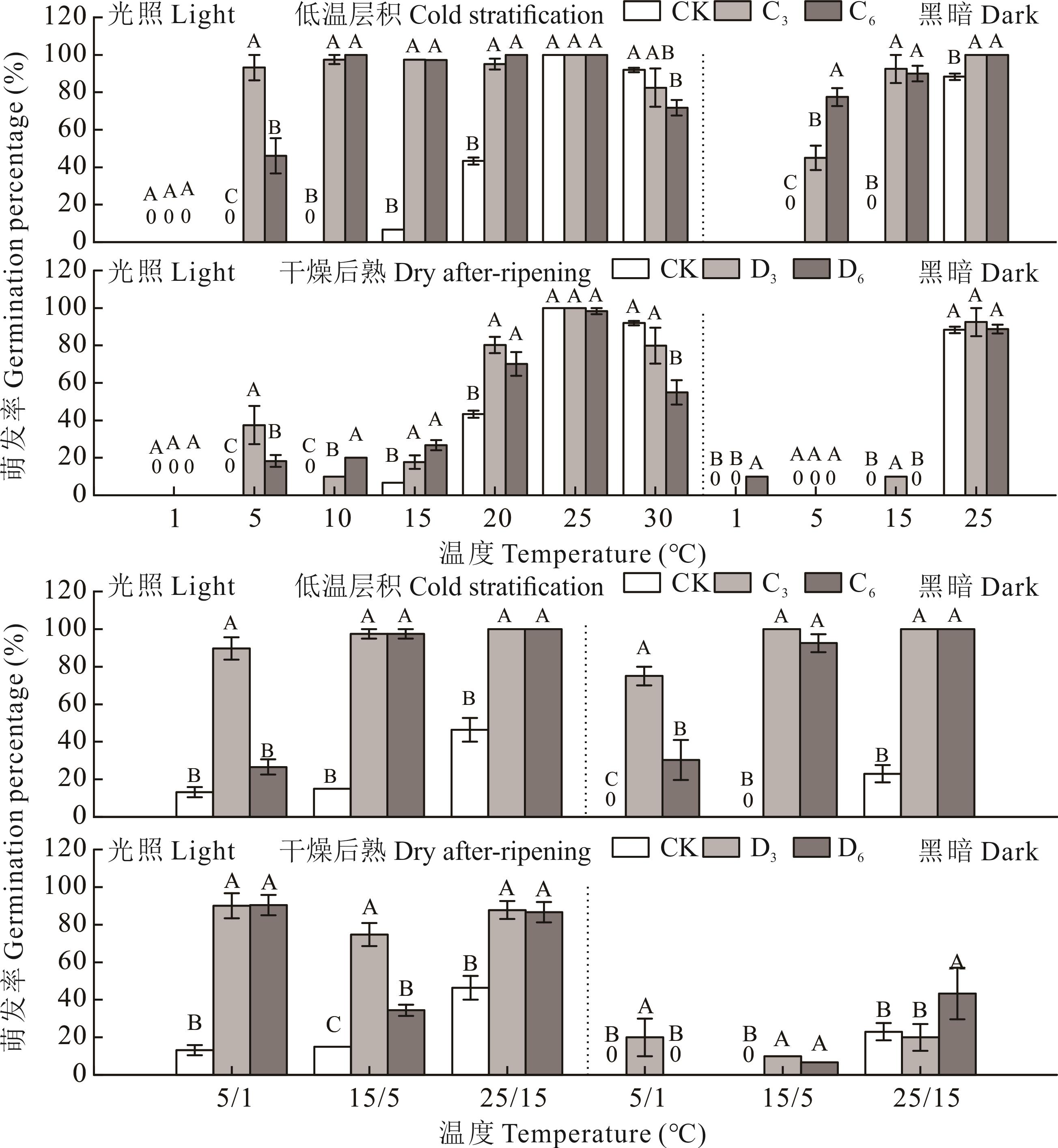
图3 恒温/变温条件下干燥后熟和冷层积处理在不同光照条件下对种子萌发率的影响CK: 新鲜种子对照组Fresh seeds (control group); C3, C6: 种子在1 ℃黑暗条件下分别冷层积3和6个月Seeds cold-stratified at 1 ℃ for 3 and 6 months under dark condition, respectively; D3, D6: 种子在室温条件下分别干燥后熟3和6个月Seeds dry after-ripened at room temperature for 3 and 6 months, respectively. 下同The same below. 不同大写字母表示相同温度下不同处理时期的萌发率差异显著(P<0.05)。Different capital letters indicate significant differences (P<0.05) in final germination percentage among different treatments at the same temperature.
Fig.3 Effects of dry after-ripening (DAR) and cold stratification (CS) on final germination percentage under constant/alternating temperatures and light/dark conditions
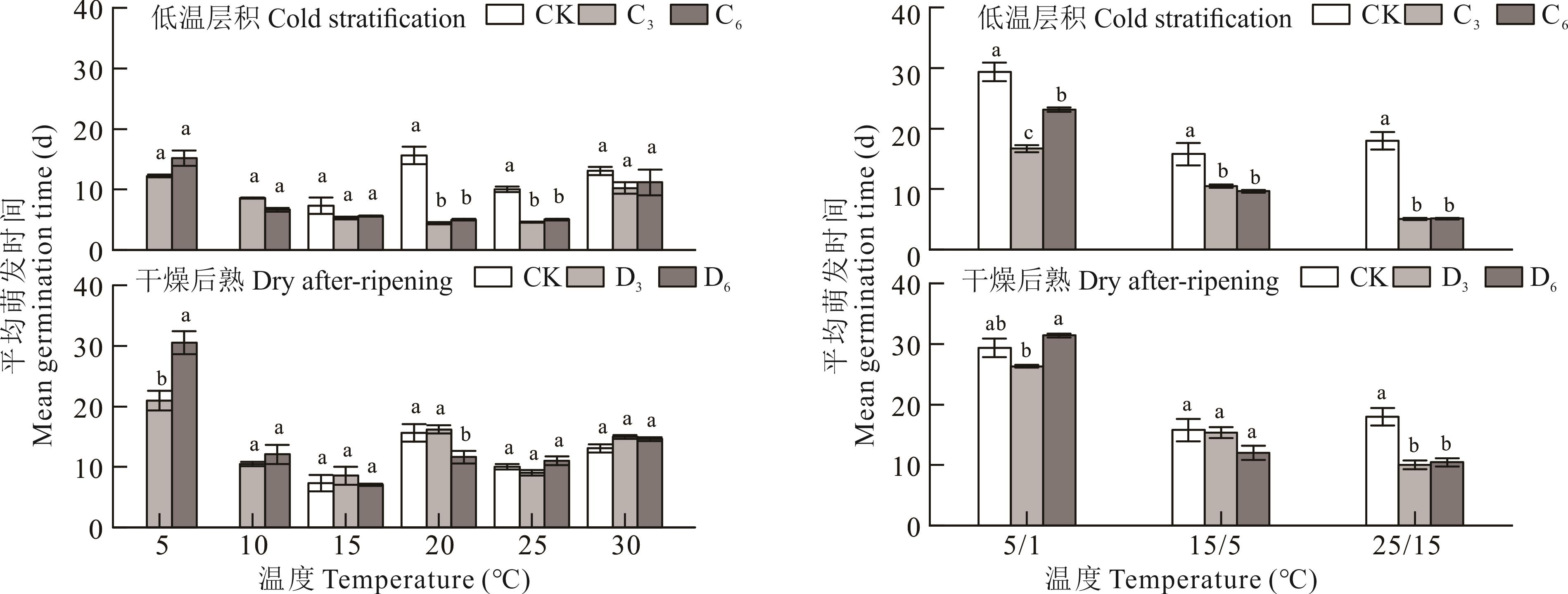
图4 恒温/变温条件下干燥后熟和冷层积处理对种子平均萌发时间的影响(光照条件下)不同小写字母表示在光照条件下,相同温度不同处理时期的平均萌发时间差异显著(P<0.05)。Different lowercase letters indicate significant differences (P<0.05) in mean germination time among different treatment periods at the same temperature under light conditions. 广义线性模型仅显示光照条件下的数据,因为黑暗处理的试验方案(保持持续黑暗直至萌发过程结束时统计萌发情况)无法收集计算广义线性模型所必需的每日萌发数据。其中5和10 ℃的新鲜种子萌发率为0,平均萌发时间无法计算。Generalized linear model data are shown only for light conditions, as the requirement for uninterrupted darkness until the final count precluded daily monitoring and calculation of MGT. For fresh seeds at 5 and 10 ℃, where germination was 0, MGT is not applicable.
Fig.4 Effects of dry after-ripening (DAR) and cold stratification (CS) on mean germination time (MGT) under constant/alternating temperatures (light conditions)
变异来源 Source of variation | 恒温Constant temperature | 变温Alternating temperature | ||
|---|---|---|---|---|
| df | P | df | P | |
| 光照条件Light condition | 1 | <0.000 | 1 | <0.000 |
| 低温层积Cold stratification | 2 | <0.000 | 2 | <0.000 |
| 干燥后熟Dry after-ripening | 2 | <0.000 | 2 | <0.000 |
| 光照条件×干燥后熟Light condition×dry after-ripening | 2 | 0.001 | 2 | <0.000 |
| 光照条件×低温层积Light condition×cold stratification | 2 | <0.000 | 2 | 0.001 |
表1 光照条件、休眠破除处理及其交互作用对杂色钟报春种子在恒温与变温环境下萌发率影响的广义线性模型分析
Table 1 Generalized linear model analysis of the effects of light condition, dormancy-breaking treatments, and their interactions on the final germination percentage of P. alpicola under constant and alternating temperature regimes
变异来源 Source of variation | 恒温Constant temperature | 变温Alternating temperature | ||
|---|---|---|---|---|
| df | P | df | P | |
| 光照条件Light condition | 1 | <0.000 | 1 | <0.000 |
| 低温层积Cold stratification | 2 | <0.000 | 2 | <0.000 |
| 干燥后熟Dry after-ripening | 2 | <0.000 | 2 | <0.000 |
| 光照条件×干燥后熟Light condition×dry after-ripening | 2 | 0.001 | 2 | <0.000 |
| 光照条件×低温层积Light condition×cold stratification | 2 | <0.000 | 2 | 0.001 |
变异来源 Source of variation | 恒温Constant temperature | 变温Alternating temperature | ||
|---|---|---|---|---|
| df | P | df | P | |
| 低温层积Cold stratification | 2 | <0.000 | 2 | <0.000 |
| 干燥后熟Dry after-ripening | 2 | 0.118 | 2 | <0.000 |
表2 干燥后熟和低温层积处理对杂色钟报春种子在恒温与变温环境下平均萌发时间影响的广义线性模型分析(光照条件下)
Table 2 Generalized linear model analysis of the effects of dry after-ripening and cold stratification on the mean germination time of P. alpicola under constant and alternating temperature regimes (in light)
变异来源 Source of variation | 恒温Constant temperature | 变温Alternating temperature | ||
|---|---|---|---|---|
| df | P | df | P | |
| 低温层积Cold stratification | 2 | <0.000 | 2 | <0.000 |
| 干燥后熟Dry after-ripening | 2 | 0.118 | 2 | <0.000 |
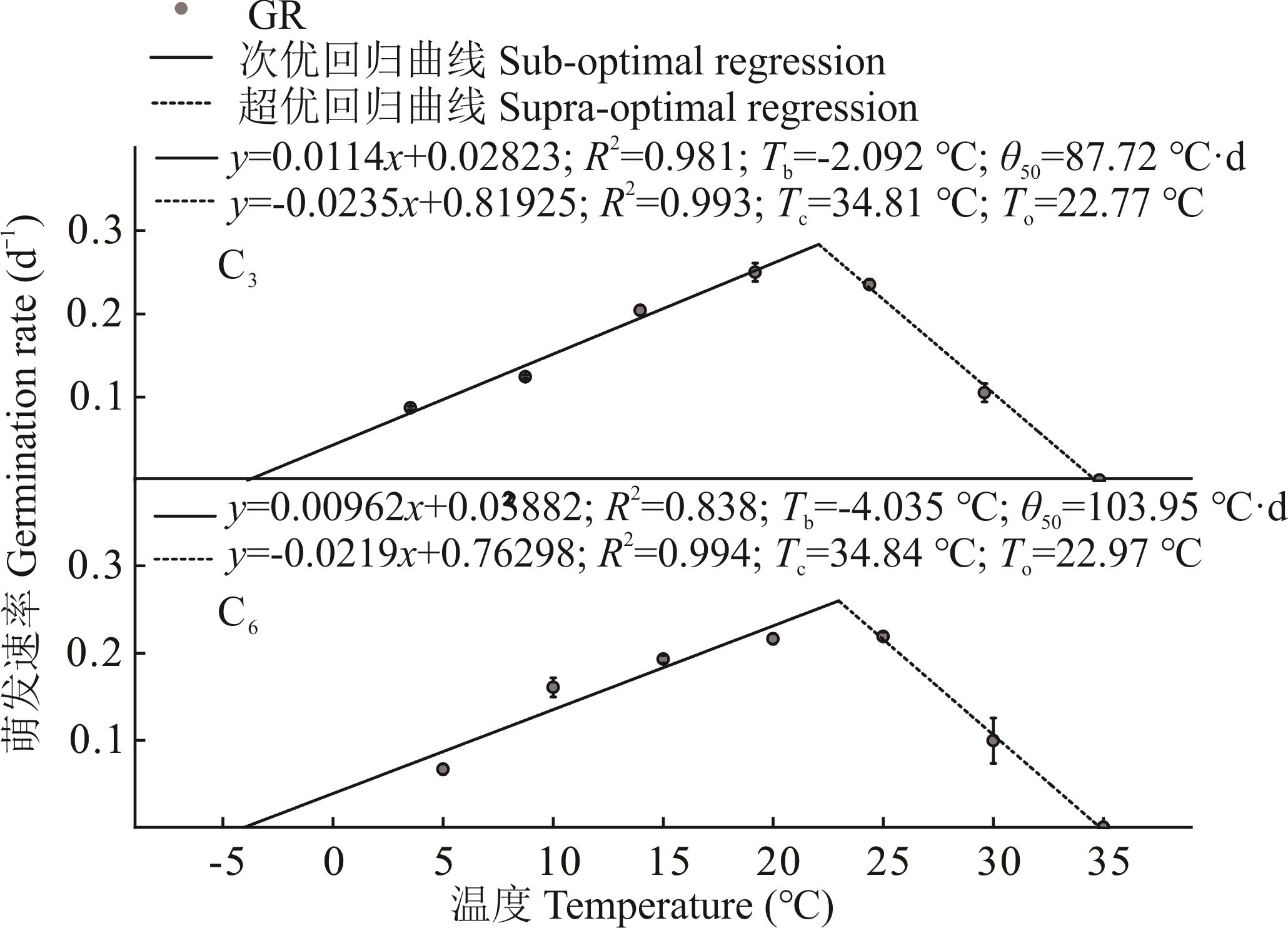
图5 杂色钟报春种子萌发温度与萌发速率的线性关系Tb: 萌发最低温度The base germination temperature; To: 萌发最适温度The optimal temperature; Tc: 萌发最高温度The ceiling temperature; θ50: 萌发所需的积温The thermal time required for germination.
Fig.5 Linear relationship between temperature and germination rate
| [1] | Tang A J, Yan G R, Zhang Q Z, et al. Research on introduction and domestication of subalpine wild ornamental Primula mallophylla Balf. f. Chinese Wild Plant Resources, 2023, 42(S1): 108-112. |
| 唐安军, 严光荣, 张琪梓, 等. 亚高山野生花卉川东灯台报春的引种驯化研究. 中国野生植物资源, 2023, 42(S1): 108-112. | |
| [2] | Baskin J M, Baskin C C. A classification system for seed dormancy. Seed Science Research, 2004, 14(1): 1-16. |
| [3] | Baskin C C, Baskin J M. Seeds: ecology, biogeography, and evolution of dormancy and germination (The Second Edition). San Diego: Elsevier Academic Press Incorporated, 2014. |
| [4] | Baskin C C, Baskin J M. Physiological dormancy in seeds of tropical montane woody species in Hawai`i. Plant Species Biology, 2020, 36(1): 60-71. |
| [5] | Schwienbacher E, Navarro-Cano J A, Neuner G, et al. Seed dormancy in alpine species. Flora, 2011, 206(10): 845-856. |
| [6] | Yang G L, Zhang J J, Mei L, et al. A dataset of the diversity and geographical distributions of wild Primula L. in China. China Scientific Data, 2023, 8(4): 394-402. |
| 杨桂丽, 张佳佳, 梅丽, 等. 中国野生报春花属物种多样性与地理分布数据集. 中国科学数据, 2023, 8(4): 394-402. | |
| [7] | Hu Q M. On the geographical distribution of the Primulaceae. Journal of Tropical and Subtropical Botany, 1994, 2(4): 1-14, 115-116. |
| 胡启明. 报春花科植物的地理分布. 热带亚热带植物学报, 1994, 2(4): 1-14, 115-116. | |
| [8] | Song J S, Lee J S. Dormancy and germination characteristics of seed and plant of Primula sieboldii. Horticulture Environment and Biotechnology, 2002, 43(1): 91-94. |
| [9] | Marin M, Blandino C, Laverack G, et al. Responses of Primula vulgaris to light quality in the maternal and germination environments. Plant Biology, 2018, 21(3): 439-448. |
| [10] | Peng D L, Hu X J, Sun H, et al. Dry after-ripening, light, cold stratification and temperature effects on seed germination of Primula poissonii from Yunnan, China. Seed Science and Technology, 2019, 47(3): 301-306. |
| [11] | Lu J J, Tan D Y, Baskin C C, et al. Effects of germination season on life history traits and on transgenerational plasticity in seed dormancy in a cold desert annual. Scientific Reports, 2016, 6(1): 25076. |
| [12] | Shimono A, Washitani I. Seedling emergence patterns and dormancy/germination physiology of Primula modesta in a subalpine region. Ecological Research, 2004, 19(5): 541-551. |
| [13] | Rayburn A P, Davidson J B, Schupp E W. Effect of storage time, site and floral morph on seed germination of the threatened distylous primrose Primula cusickiana var. maguirei. Plant Species Biology, 2013, 28(2): 101-108. |
| [14] | Tian M H, Tang A J. Effects of storage temperature and pre-treatments on seed germination of Primula mallophylla and P. sertulum (Primulaceae), two narrowly-distributed endemic species from southwest China. Seed Science and Technology, 2023, 51(3): 371-377. |
| [15] | Wang G Y, Baskin C C, Baskin J M, et al. Timing of seed germination in two alpine herbs on the southeastern Tibetan plateau: the role of seed dormancy and annual dormancy cycling in soil. Plant and Soil, 2017, 421(1/2): 465-476. |
| [16] | Mondoni A, Daws M I, Belotti J, et al. Germination requirements of the alpine endemic Silene elisabethae Jan: effects of cold stratification, light and GA3. Seed Science and Technology, 2009, 37(1): 79-87. |
| [17] | Cerabolini B, Andreis R D, Ceriani R M, et al. Seed germination and conservation of endangered species from the Italian Alps: Physoplexis comosa and Primula glaucescens. Biological Conservation, 2003, 117(3): 351-356. |
| [18] | Hitchmough J, Innes S, Mitschunas N. The effect of seed treatment and depth of sowing on seedling emergence in Primula species. Seed Science and Technology, 2011, 39(3): 539-551. |
| [19] | Qin Y B, Geng B Y, Yang L E, et al. Non-deep physiological dormancy and germination characteristics of Primula florindae (Primulaceae), a rare alpine plant in the Hengduan Mountains of southwest China. PeerJ, 2023, 11: e15234. |
| [20] | Peng D L, Yang L E, Yang J, et al. Seed dormancy and soil seed bank of the two alpine Primula species in the Hengduan Mountains of southwest China. Frontiers in Plant Science, 2021, 12: 582536. |
| [21] | Yang L E, Peng D L, Li Z M, et al. Cold stratification, temperature, light, GA3, and KNO3 effects on seed germination of Primula beesiana from Yunnan, China. Plant Diversity, 2020, 42: 168-173. |
| [22] | Editorial Committee of Flora of China. Flora of China. Beijing: Science Press, 1990. |
| 中国植物志编委会. 中国植物志. 北京: 科学出版社, 1990. | |
| [23] | Chen F H, Hu Q M. Systematic taxonomic study on the Primulaceae of China. Bulletin of Chinese Academy of Sciences, 1996, 11(6): 445-446. |
| 陈封怀, 胡启明. 中国报春花科植物系统分类研究. 中国科学院院刊, 1996, 11(6): 445-446. | |
| [24] | Qin Y B. Study on seed dormancy and germination strategies of three Primula species in the Hengduan Mountain area. Kunming: Yunnan Normal University, 2024. |
| 覃滢卜. 横断山区三种报春花属植物种子休眠与萌发策略研究. 昆明: 云南师范大学, 2024. | |
| [25] | Zhang J, Jiang X F, Chen L L, et al. Altitudinal variations of the reproductive strategies of Primula florindae. Acta Botanica Boreali-Occidentalia Sinica, 2017, 37(7): 1404-1413. |
| 张杰, 蒋显锋, 陈玲玲, 等. 巨伞钟报春繁殖策略随海拔梯度的变异. 西北植物学报, 2017, 37(7): 1404-1413. | |
| [26] | Wang G Y. Responses of environmental changes in early life stages of four alpine herbs on the southeastern Tibetan Plateau. Beijing: University of Chinese Academy of Sciences, 2018. |
| 王国严. 藏东南四种高山草本植物的生活史早期阶段对环境变化的响应. 北京: 中国科学院大学, 2018. | |
| [27] | Porceddu M, Mattana E, Pritchard H W, et al. Thermal niche for in situ seed germination by Mediterranean mountain streams: model prediction and validation for Rhamnus persicifolia seeds. Annals of Botany, 2013, 112(9): 1887-1897. |
| [28] | Brown R F, Mayer D G. Representing cumulative germination: 2. The use of the weibull function and other empirically derived curves. Annals of Botany, 1988, 61(2): 127-138. |
| [29] | Geng S B, Wei Y S, Liang Z S. The color of Salvia miltiorrhiza Bunge seed coat and requirements of moisture and heat for germination. Acta Agriculturae Boreali-Occidentalis Sinica, 2014, 23(10): 163-169. |
| 耿守保, 魏永胜, 梁宗锁. 丹参种子的种皮颜色与萌发的水分和热量需求. 西北农业学报, 2014, 23(10): 163-169. | |
| [30] | Hu X W, Wu Y P, Wang Y R, et al. Primary study of release method for Legume seed dormancy. Acta Botanica Boreali-Occidentalia Sinica, 2009, 29(3): 568-573. |
| 胡小文, 武艳培, 王彦荣, 等. 豆科种子休眠破除方法初探. 西北植物学报, 2009, 29(3): 568-573. | |
| [31] | Yao L J, Zhang K L, Xiong Z M, et al. Research advances in seed morphophysiological dormancy. Chinese Journal of Ecology, 2019, 38(1): 247-255. |
| 姚林君, 张克亮, 熊作明, 等. 种子形态生理休眠研究进展. 生态学杂志, 2019, 38(1): 247-255. | |
| [32] | Nishii K, Nagata T, Wang C N, et al. Light as environmental regulator for germination and macrocotyledon development in Streptocarpus rexii (Gesneriaceae). South African Journal of Botany, 2012, 81: 50-60. |
| [33] | Tang W, Guo H P, Baskin C C, et al. Effect of light intensity on morphology, photosynthesis and carbon metabolism of alfalfa (Medicago sativa) seedlings. Plant, 2022, 11(13): 1688. |
| [34] | Koutsovoulou K, Daws M I, Thanos C A. Campanulaceae: a family with small seeds that require light for germination. Annals of Botany, 2014, 113(1): 135-143. |
| [35] | Liu U, Cossu T A, Dickie J. Royal Botanic Gardens, Kew’s Seed Information Database (SID): A compilation of taxon-based biological seed characteristics or traits. Biodiversity Information Science and Standards, 2019, 3: e37030. |
| [36] | Milberg P, Andersson L, Thompson K A. Large-seeded spices are less dependent on light for germination than small-seeded ones. Seed Science Research, 2000, 10(1): 99-104. |
| [37] | Müller F, Masemola L, Britz E, et al. Seed germination and early seedling growth responses to drought stress in annual Medicago L. and Trifolium L. forages. Agronomy, 2022, 12(12): 2960. |
| [38] | Liao D Q, Chen Y L, Qi J J, et al. Temporal transcriptomics reveal the molecular mechanism of dormancy and germination regulated by temperature in Paris polyphylla seed. Horticultural Plant Journal, 2023, 9(4): 848-866. |
| [39] | Luo Y, Liu Q Y, Lv Y B, et al. Photothermal sensitivity of phytochrome mutants during seed germination in Arabidopsis thaliana. Chinese Bulletin of Botany, 2024, 59(5): 752-762. |
| 罗燕, 刘奇源, 吕元兵, 等. 拟南芥光敏色素突变体种子萌发的光温敏感性. 植物学报, 2024, 59(5): 752-762. | |
| [40] | Liu K, Baskin J M, Baskin C C, et al. Effect of storage conditions on germination of seed of 489 species from high elevation grasslands of the eastern Tibet Plateau and some implications for climate change. American Journal of Botany, 2011, 98(1): 12-19. |
| [41] | Shimono Y, Kudo G. Comparisons of germination traits of alpine plants between fellfield and snowbed habitats. Ecological Research, 2005, 20(2): 189-197. |
| [42] | Zhang T, Sun Y, Tian C Y, et al. Ecological and biological differences between spring and autumn plants of two desert ephemerals. Journal of Plant Ecology, 2007, 31(6): 1174-1180. |
| 张涛, 孙羽, 田长彦, 等. 两种短命植物春萌秋萌个体生态生物学特征比较. 植物生态学报, 2007, 31(6): 1174-1180. | |
| [43] | Tudela-Isanta M, Ladouceur E, Wijayasinghe M, et al. The seed germination niche limits the distribution of some plant species in calcareous or siliceous alpine bedrocks. Alpine Botany, 2018, 128(1): 83-95. |
| [44] | Mondoni A, Rossi G, Orsenigo S, et al. Climate warming could shift the timing of seed germination in alpine plants. Annals of Botany, 2012, 110(1): 155-164. |
| [45] | Hirst M J, Vázquez-Ramírez J, Rendall A R, et al. Thermal germination niche: implications for seed-based restoration in climate-sensitive alpine environments. Restoration Ecology, 2025, 33(4): e70031. |
| [1] | 余子欣, 沈为正, 潘高, 王雯颖, 刘文胜. 锰耐受性种子内生菌筛选及其促进锰胁迫下种子萌发与幼苗生长的研究[J]. 草业学报, 2026, 35(6): 145-154. |
| [2] | 童玉花, 王晓彤, 马永龙, 杨金辉, 余冬雯, 李淑霞. 壳聚糖浸种对盐碱胁迫下紫花苜蓿种子萌发的影响[J]. 草业学报, 2026, 35(3): 245-256. |
| [3] | 张继元, 安海全, 潘靖一, 刘畅, 龙思思, 赵丽丽. 7个紫花苜蓿品种种子萌发及幼苗生长的抗旱性评价[J]. 草业学报, 2026, 35(2): 68-82. |
| [4] | 白小红, 陈文燕, 李琴, 王奕璇, 张雪, 王磊, 曲文杰, 朱林. 不同种源乌拉尔甘草种子萌发及幼苗生长比较研究[J]. 草业学报, 2025, 34(7): 196-209. |
| [5] | 宁小静, 任秋洁, 王丽娟, 贾小琳, 石孝均, 王洁. 不同丸化种衣剂配方对酿酒高粱出苗及生长的影响[J]. 草业学报, 2025, 34(6): 70-84. |
| [6] | 郑玉琪, 严佳玥, 李博元, 魏岩. 新疆针茅传播体形态及埋深对种子萌发出苗的影响[J]. 草业学报, 2025, 34(5): 64-73. |
| [7] | 孙守江, 刘昊臻, 徐淑涵, 张景鈜, 李淑霞, 张金青, 高雪芹, 伏兵哲. 苜蓿种子发芽特性和萌发早期抗氧化系统对老化的生理和分子响应研究[J]. 草业学报, 2025, 34(11): 195-204. |
| [8] | 郝丽芬, 徐晓阳, 季玉, 王瑞, 吴德宝, 李宇宇, 林克剑. 长刺蒺藜草两异型种子形态和萌发过程的生理动态特征比较[J]. 草业学报, 2024, 33(9): 40-50. |
| [9] | 张婷婷, 刘宇乐, 陈红, 许凌欣, 陈祥伟, 王恩姮, 严俊鑫. 不同外源物质对盐、碱及干旱胁迫下草木樨种子萌发、幼苗生长及生理的影响[J]. 草业学报, 2024, 33(8): 122-132. |
| [10] | 何邦印, 裴婧宏, 野起瑞, 胡佳佳, 郑彩雪, 李江文. 不同人工经济林凋落叶浸提液对豆禾草种的化感效应研究[J]. 草业学报, 2024, 33(8): 199-208. |
| [11] | 阮坤非, 王天琪, 毕宁宁, 师劭彤, 李森, 刘忠华. 元宝枫凋落叶浸提液对3种中草药化感作用的研究[J]. 草业学报, 2024, 33(7): 151-159. |
| [12] | 高金柱, 赵东豪, 高乐, 苏喜浩, 何学青. 硝酸铈与脱落酸处理对紫花苜蓿种子萌发和幼苗生理特性的影响[J]. 草业学报, 2024, 33(6): 175-186. |
| [13] | 王萌, 鲁雪莉, 王菊英, 张梦超, 宋奕汝, 孟晨, 张莉, 徐宗昌. 小黑麦种质萌发期苗期耐盐资源评价与筛选[J]. 草业学报, 2024, 33(5): 58-68. |
| [14] | 马绍英, 陈桂平, 王娜, 马蕾, 连荣芳, 李胜, 张绪成. 豌豆土壤中潜在自毒物质的鉴定及自毒效应研究[J]. 草业学报, 2023, 32(6): 134-145. |
| [15] | 张士敏, 赵娇阳, 朱慧森, 卫凯, 王永新. 硒对不同品种紫花苜蓿发芽阶段物质转化和形态建成的影响[J]. 草业学报, 2023, 32(4): 79-90. |
| 阅读次数 | ||||||
|
全文 |
|
|||||
|
摘要 |
|
|||||
