

ISSN 1004-5759 CN 62-1105/S
草业学报 ›› 2025, Vol. 34 ›› Issue (5): 64-73.DOI: 10.11686/cyxb2024230
郑玉琪( ), 严佳玥, 李博元, 魏岩()
收稿日期:2024-06-17
修回日期:2024-07-22
出版日期:2025-05-20
发布日期:2025-03-20
通讯作者:
魏岩
作者简介:E-mail: weiyan1966@163.com基金资助:
Yu-qi ZHENG(), Jia-yue YAN, Bo-yuan LI, Yan WEI()
Received:2024-06-17
Revised:2024-07-22
Online:2025-05-20
Published:2025-03-20
Contact:
Yan WEI
摘要:
新疆针茅为禾本科多年生草本植物,是新疆荒漠草地广泛分布的重要建群种与优势种。以新疆针茅为研究对象,研究传播体形态、芒的功能及种子萌发出苗特性,分析传播体各部分形态与埋深之间的关系,比较不同埋深对种子萌发与幼苗出土的影响。结果表明:1)新疆针茅的传播体由外稃、内稃和颖果组成。外稃基部尖锐被毛具有锚固性,外稃伸长形成芒,芒有两回膝曲,芒的长度是种子长的15倍。2)芒具有吸湿性,芒吸湿带动传播体发生自埋现象,且自埋深度为(4.10±0.53) cm。3)埋深对新疆针茅种子萌发率、出苗率均有极显著影响(P<0.01)。种子能在深度0~12 cm的埋深中萌发,<6 cm的埋深中出苗。在1~2 cm的浅层埋深时种子萌发率和出苗率最高,埋深深度超过2 cm之后,种子萌发率和出苗率与埋深深度呈负相关。4)埋深对新疆针茅幼苗生长以及生物量的分配均有极显著影响(P<0.01)。新疆针茅幼苗在埋深情况下,幼苗会分配较多的生物量向上运输,优先用于芽部分的生长,其生物量分配模式的改变是新疆针茅对埋深环境的重要应对策略。新疆针茅独特的传播体结构不仅增强了种子入土的稳定性,也极大地提升了种子萌发成功率与幼苗建立能力,为新疆针茅种群的更新与繁衍奠定了坚实基础。
郑玉琪, 严佳玥, 李博元, 魏岩. 新疆针茅传播体形态及埋深对种子萌发出苗的影响[J]. 草业学报, 2025, 34(5): 64-73.
Yu-qi ZHENG, Jia-yue YAN, Bo-yuan LI, Yan WEI. Dispersal unit morphology, and effects of burial depth on seed germination and emergence of Stipa sareptana[J]. Acta Prataculturae Sinica, 2025, 34(5): 64-73.
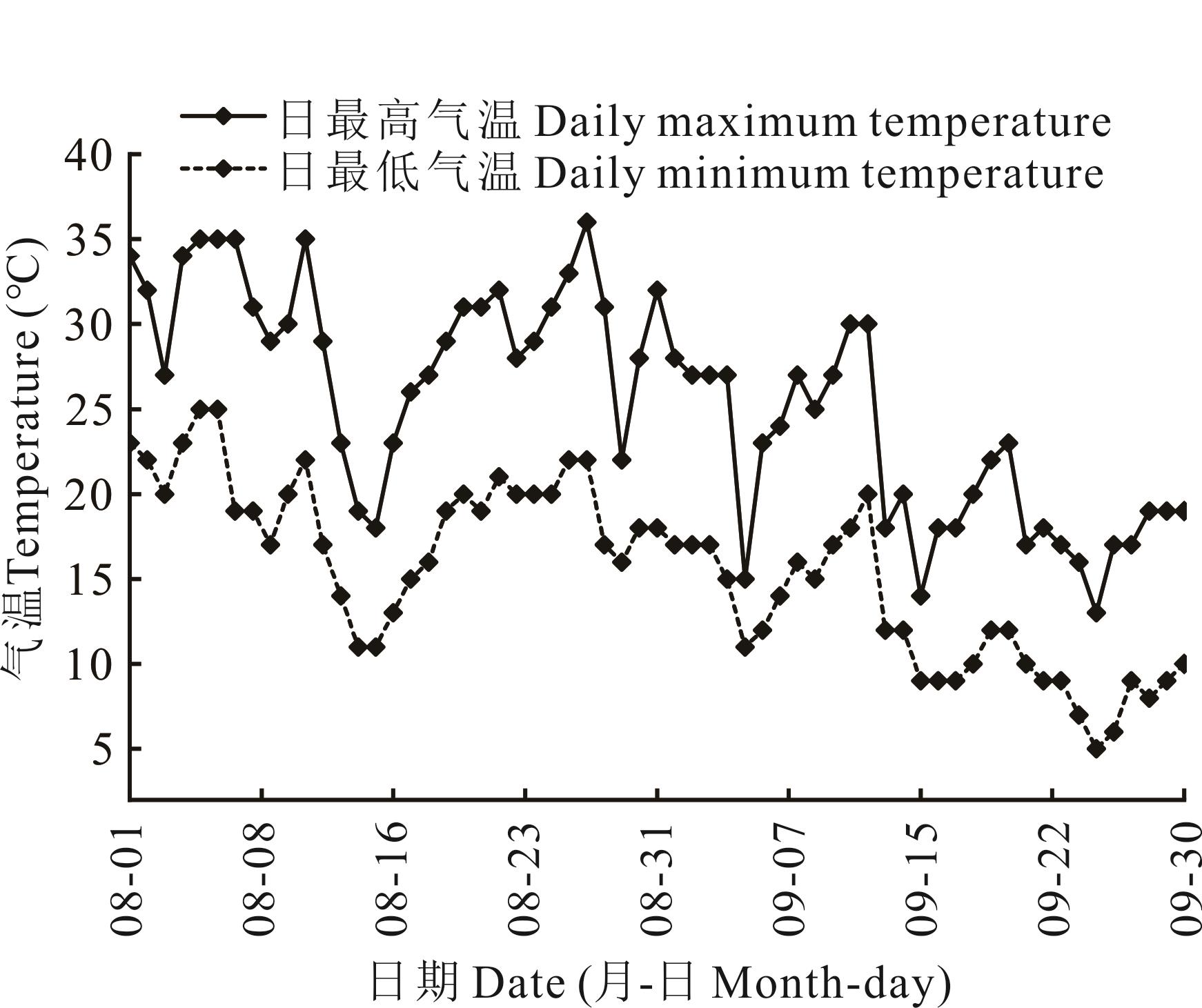
图1 2023年乌鲁木齐8-9月日最高和日最低气温
Fig.1 The maximum and minimum daily temperature in Urumqi from August to September in 2023
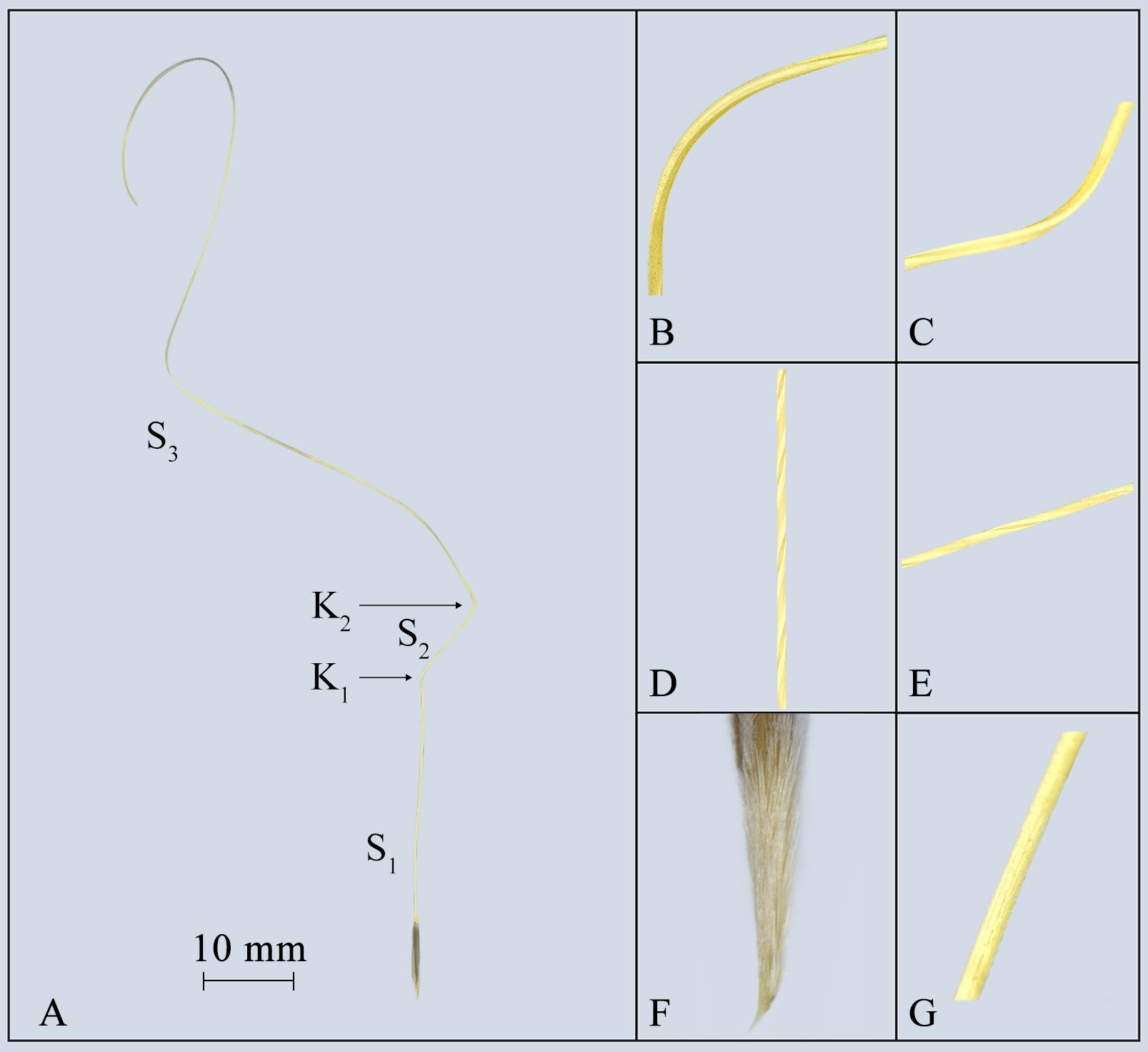
图2 新疆针茅传播体形态结构A: 传播体Dispersal unit; B: 芒K1点Awn K1; C: 芒K2点Awn K2; D: 芒S1段Awn S1; E: 芒S2段Awn S2; F: 外稃基部Base of seed appearance; G: 芒S3段Awn S3.
Fig.2 Morphological structure of dispersal unit of S. sareptana

图3 新疆针茅传播体各部分形态特征
Fig. 3 Morphological characteristics of all parts of S. sareptana
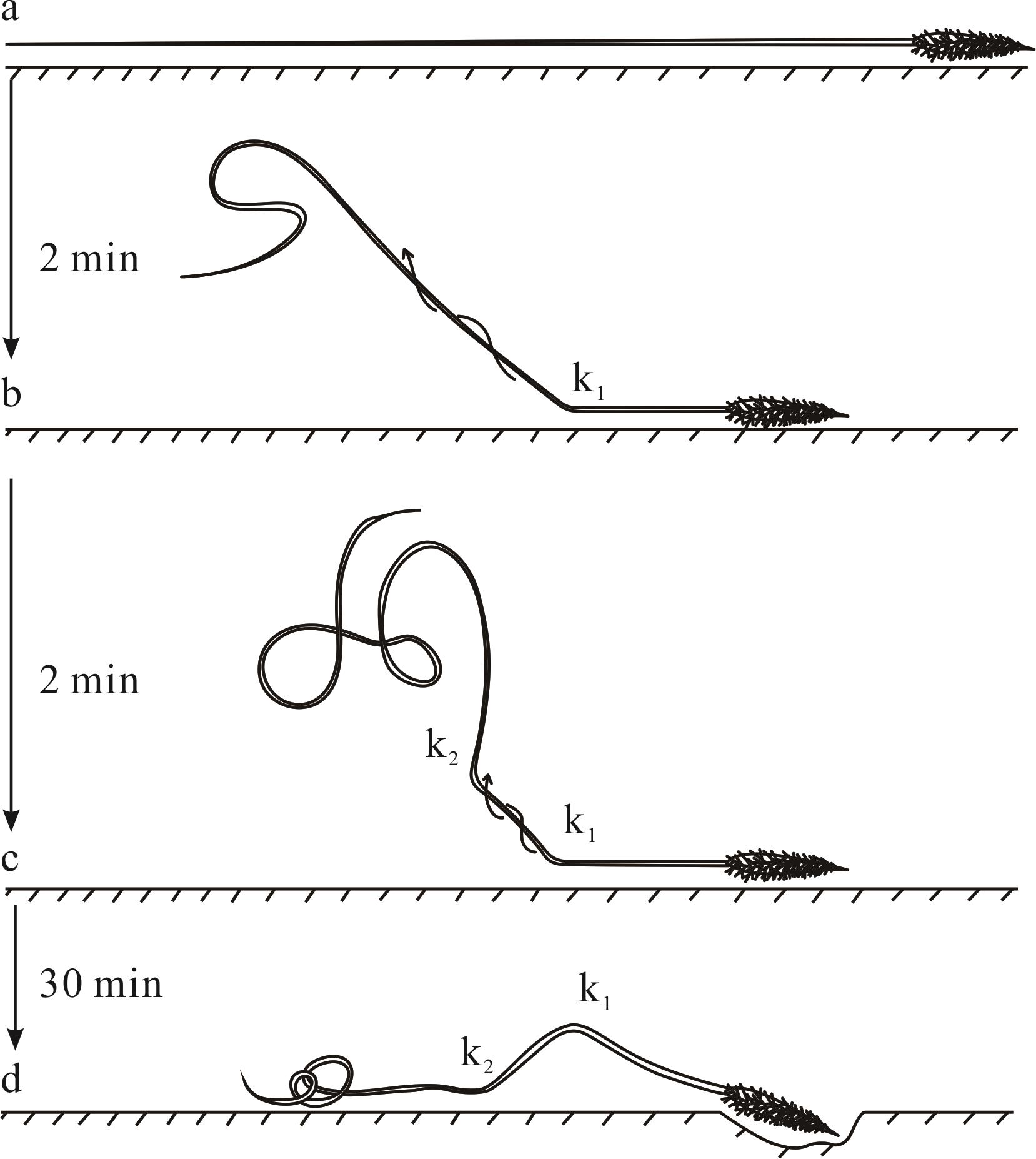
图4 新疆针茅吸湿性芒运动a: 潮湿状态Humid state; b~c: 干燥变干The awn dries up; d: 开始埋入土壤Diaspore starts burying itself into the soil.
Fig.4 The hygroscopic awn movements
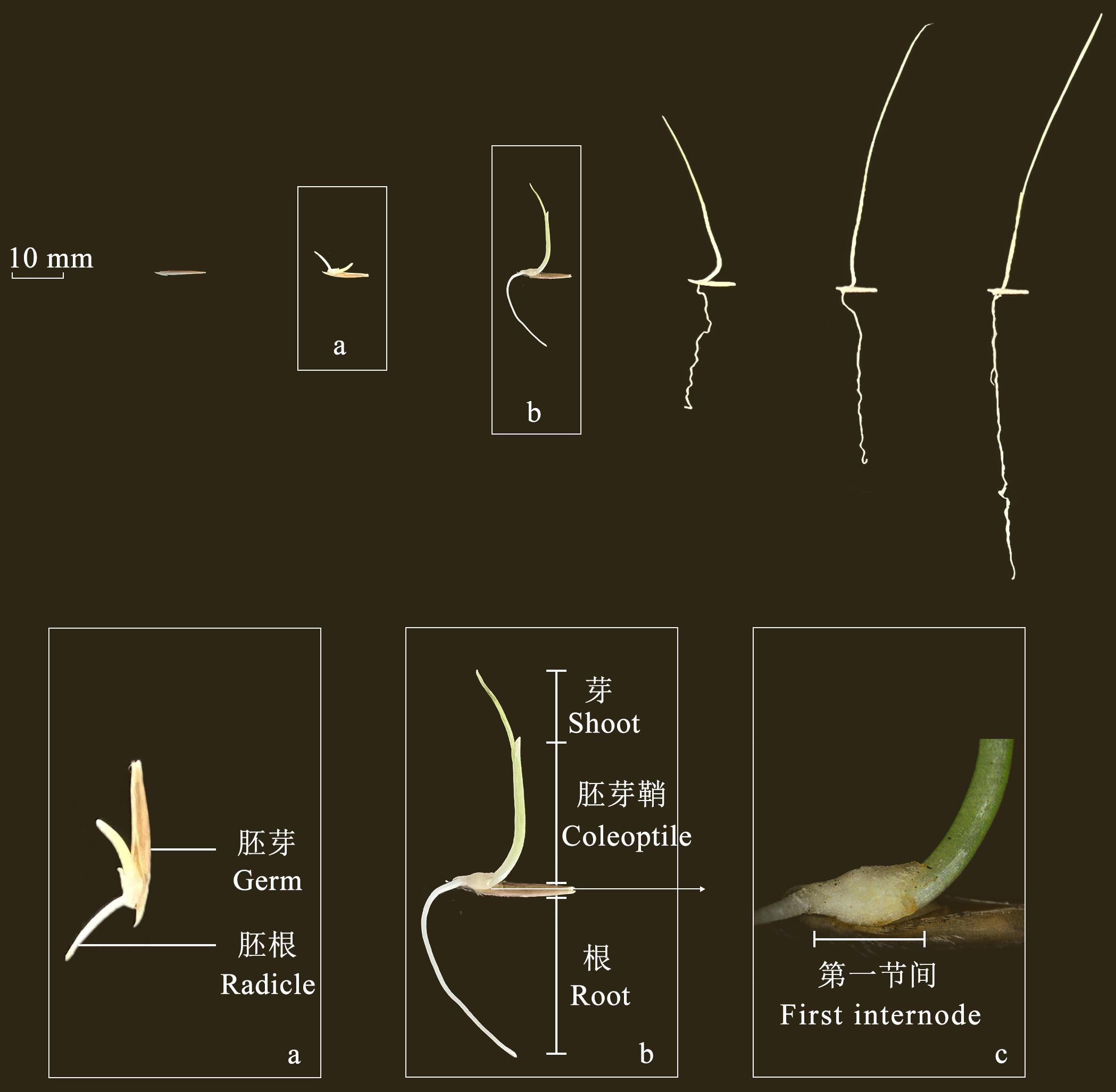
图5 同一埋深下新疆针茅的萌发过程a: 播种后第3天萌发形态Germination morphology 3 days after planting; b: 播种后第6天萌发形态Germination morphology 6 days after planting; c: 第一节间First internode.
Fig.5 The germination process of S. sareptana under the same buried depth
播种后天数 Days after sowing (d) | 幼苗不同部位长度The length of each part of the seedling (cm) | |||
|---|---|---|---|---|
| 根Root | 第一节间First internode | 胚芽鞘Coleoptile | 芽Shoot | |
| 3 | 0.91±0.21c | 0.11±0.08b | 0.30±0.14c | 0 |
| 6 | 1.63±0.15bc | 0.16±0.06a | 1.28±0.31b | 0.29±0.26d |
| 9 | 2.06±0.34b | 0.18±0.07a | 1.96±0.22a | 0.65±0.48c |
| 12 | 2.24±0.33b | 0.20±0.05a | 2.05±0.12a | 1.02±0.33b |
| 15 | 3.77±0.19a | 0.20±0.04a | 2.02±0.21a | 1.61±0.13a |
表1 新疆针茅幼苗不同部位的生长及形态
Table 1 Growth and morphology of different parts of the seedlings of S. sareptana
播种后天数 Days after sowing (d) | 幼苗不同部位长度The length of each part of the seedling (cm) | |||
|---|---|---|---|---|
| 根Root | 第一节间First internode | 胚芽鞘Coleoptile | 芽Shoot | |
| 3 | 0.91±0.21c | 0.11±0.08b | 0.30±0.14c | 0 |
| 6 | 1.63±0.15bc | 0.16±0.06a | 1.28±0.31b | 0.29±0.26d |
| 9 | 2.06±0.34b | 0.18±0.07a | 1.96±0.22a | 0.65±0.48c |
| 12 | 2.24±0.33b | 0.20±0.05a | 2.05±0.12a | 1.02±0.33b |
| 15 | 3.77±0.19a | 0.20±0.04a | 2.02±0.21a | 1.61±0.13a |
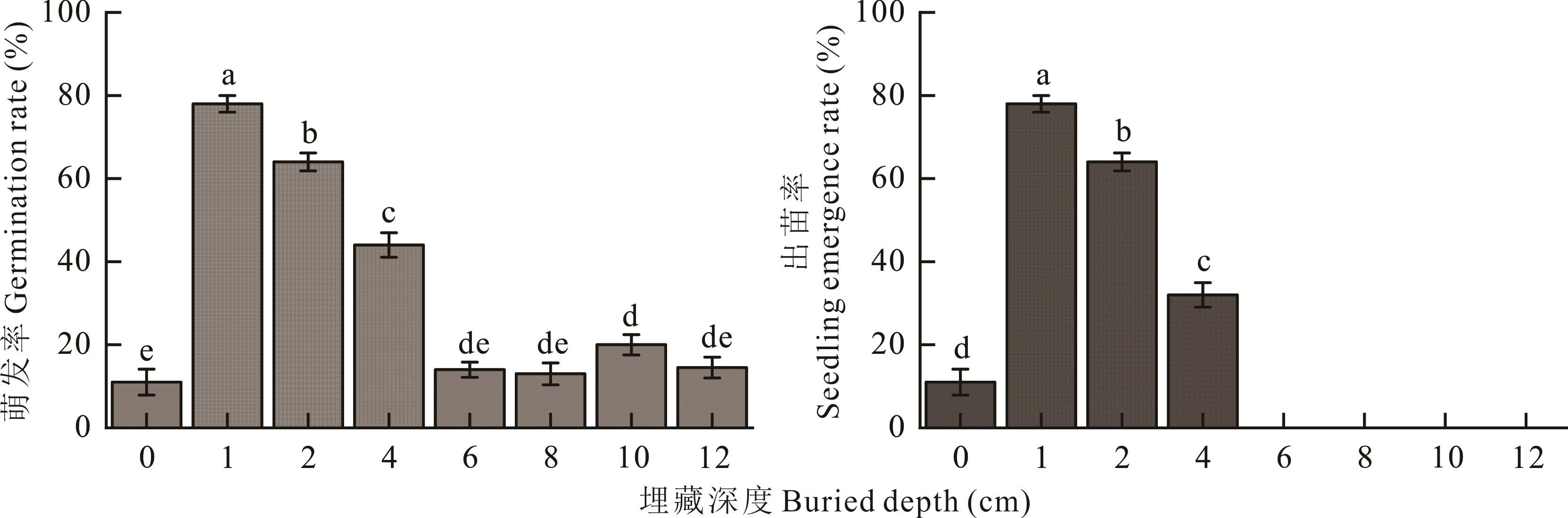
图6 不同埋深对新疆针茅种子萌发率与出苗率的影响不同字母表示在不同埋深处理间存在极显著差异(P<0.01)。Different letters indicate extremely significant differences among different depths (P<0.01);下同The same below.
Fig.6 Effect of different burial depth on seeds germination rate and seedling emergence rate of S. sareptana
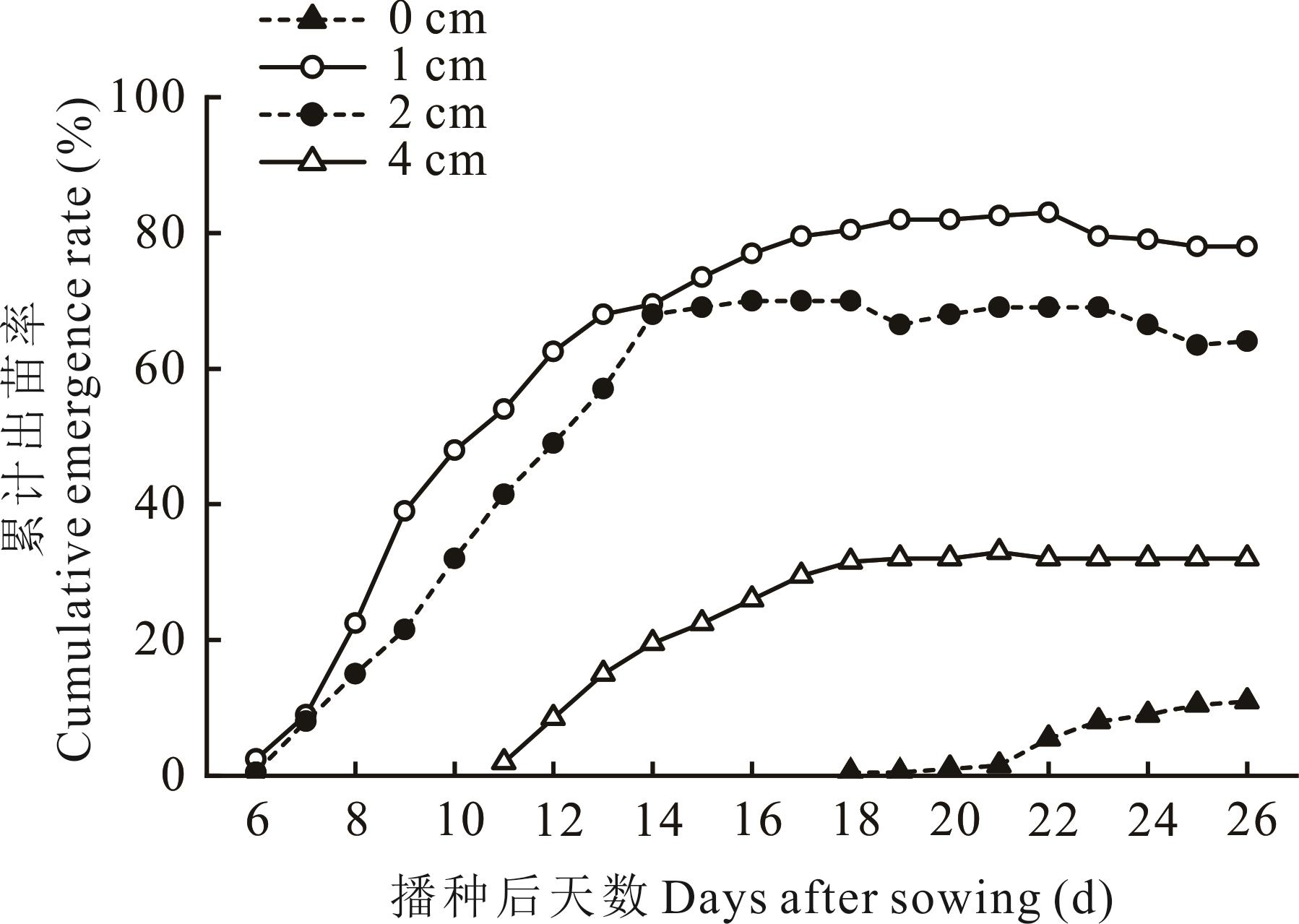
图7 不同埋深对新疆针茅种子累计出苗率的影响
Fig.7 Effect of different burial depths on the cumulative emergence rate of seeds of S. sareptana
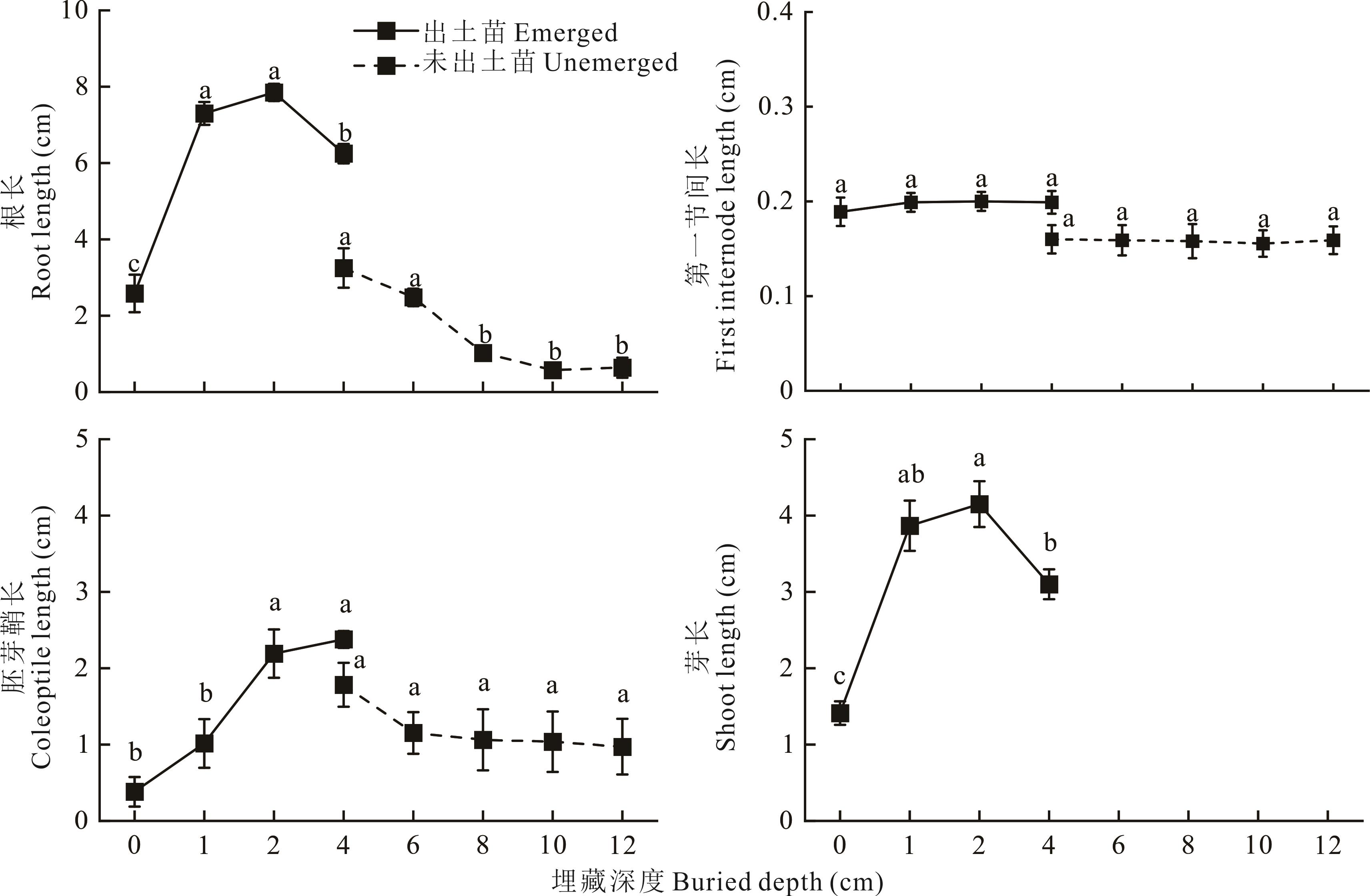
图8 不同埋深对新疆针茅幼苗根、第一节间、胚芽鞘、芽长度的影响
Fig.8 Effects of different burial depths on roots, first internode, coleoptile and shoot length of S. sareptana
| 1 | Pearson T R H, Burslem D F R P, Mullins C E, et al. Germination ecology of neotropical pioneers: Interacting effects of environmental conditions and seed size. Ecology, 2002, 83(10): 2798-2807. |
| 2 | Tekrony D M, Shande T, Rucker M, et al. Effect of seed shape on corn germination and vigour during warehouse and controlled environmental storage. Seed Science and Technology, 2005, 33(1): 185-197. |
| 3 | Baskin C C. Seeds: Ecology, biogeography, and evolution of dormancy and germination. San Diego: Academic Press, 1998. |
| 4 | Zheng Y R, Sun R, Chen Y X, et al.Spatial pattern of plant propagules along mountain river: A case of Dicun Stream, the source of Jiulong River. Chinese Journal of Ecology, 2021, 40(10): 3050-3059. |
| 郑雅容, 孙荣, 陈雅贤, 等. 典型山地河流植物繁殖体特征——以九龙江源头溪流地村溪为例. 生态学杂志, 2021, 40(10): 3050-3059. | |
| 5 | Elbaum R, Zaltzman L, Burgert I, et al. The role of wheat awns in the seed dispersal unit. Science, 2007, 316(5826): 884-886. |
| 6 | Yanez A, Desta I, Commins P, et al. Morphokinematics of the hygroactuation of feather grass awns. Advanced Biosystems, 2018, 2(7): 1800007. |
| 7 | Stamp N E. Production and effect of seed size in a grassland annual (Erodium brachycarpum, Geraniaceae). American Journal of Botany, 1990, 77(7): 874-882. |
| 8 | Zhou Z Q, Li T S, Wu Y P, et al. A study of optimum germination conditions of Stipa bungeana seeds. Pratacultural Science, 2013, 30(2): 218-222. |
| 周芝琴, 李廷山, 武艳培, 等. 长芒草种子适宜萌发条件. 草业科学, 2013, 30(2): 218-222. | |
| 9 | Maun M A. Adaptations of plants to burial in coastal sand dunes. Canadian Journal of Botany, 1998, 76(5): 713-738. |
| 10 | Xiong Y Q, Zhao C Y, Zhao X J. Effects of burial depth and planting density on seedling emergence and growth of Ambrosia artemisiifolia of different seed sizes. Acta Ecologica Sinica, 2021, 41(24): 9621-9629. |
| 熊韫琦, 赵彩云, 赵相健. 埋深和播种密度对豚草种子出苗及幼苗生长的影响. 生态学报, 2021, 41(24): 9621-9629. | |
| 11 | Ma H Y, Liang Z W, Yan C, et al.Effects of sand-burial depth on Leymus chinensis seedlings emergence and growth. Chinese Journal of Ecology, 2007, 26(12): 2003-2007. |
| 马红媛, 梁正伟, 闫超, 等. 四种沙埋深度对羊草种子出苗和幼苗生长的影响. 生态学杂志, 2007, 26(12): 2003-2007. | |
| 12 | Yan C, Liang Z W, Ma H Y, et al. Effects of sowing depth on seed germination and seedling growth of Leymus chinensis. Chinese Journal of Grassland, 2007, 29(5): 31-35. |
| 闫超, 梁正伟, 马红媛, 等. 不同播种深度对羊草出苗率和幼苗生长的影响. 中国草地学报, 2007, 29(5): 31-35. | |
| 13 | Li Y, Qi W W, Li S Y, et al. Seed germination and seedling growth of Medicago sativa in response to the variations of temperature, light, and burial depth. Chinese Journal of Ecology, 2021, 40(2): 332-339. |
| 李阳, 亓雯雯, 李绍阳, 等. 苜蓿种子萌发和幼苗生长对温度、光照和埋深的响应. 生态学杂志, 2021, 40(2): 332-339. | |
| 14 | Lloret F, Casanovas C, Peñuelas J. Seedling survival of Mediterranean shrubland species in relation to root∶shoot ratio, seed size and water and nitrogen use. Functional Ecology, 1999, 13(2): 210-216. |
| 15 | Hofmann M, Isselstein J. Effects of drought and competition by a ryegrass sward on the seedling growth of a range of grassland species. Journal of Agronomy and Crop Science, 2004, 190(4): 277-286. |
| 16 | Amini R, Hasanfard A, Ahmadian N, et al. Effect of environmental, seed burial depth, and straw mulch on germination and seedling emergence in Cichorium glandulosum. Weed Science, 2024, 72(2): 164-171. |
| 17 | Yang J J, Wan J J, Narkes W, et al. Seed morphology and effect of sheep rumen digestion on germinability of 28 grass of Tianshan. Acta Prataculturae Sinica, 2015, 24(2): 104-115. |
| 杨洁晶, 万娟娟, 娜丽克斯, 等. 28种植物种子形态学性状及其萌发对绵羊瘤胃消化的反应. 草业学报, 2015, 24(2): 104-115. | |
| 18 | Peart M H. Further experiments on the biological significance of the seed-dispersal units in grasses. The Journal of Ecology, 1981, 69(2): 425-436. |
| 19 | Ghermandi L. The effect of the awn on the burial and germination of Stipa speciosa (Poaceae). Acta Oecologica, 1995, 16(6): 719-728. |
| 20 | Zhang J N, Liu K. Mechanisms for plants detecting the optimum time and place to germinate. Acta Prataculturae Sinica, 2014, 23(1): 328-338. |
| 张佳宁, 刘坤. 植物调节萌发时间和萌发地点的机制. 草业学报, 2014, 23(1): 328-338. | |
| 21 | Peart M H. Experiments on the biological significance of the morphology of seed-dispersal units in grasses. The Journal of Ecology, 1979, 67: 843-863. |
| 22 | Harper J L. Population biology of plants. London: Academic Press, 1977. |
| 23 | Ren J, Tao L, Liu X M. Effect of sand burial depth on seed germination and seedling emergence of Calligonum L. species. Journal of Arid Environments, 2002, 51(4): 603-611. |
| 24 | Zhao J Z, Kong D S, Wang L, et al.Effects of low temperature stratification on emergence of Lycium ruthenicum under drought at different sowing depths. Acta Prataculturae Sinica, 2017, 26(12): 56-66. |
| 赵晶忠, 孔东升, 王立, 等. 低温层积处理对干旱和深埋胁迫下黑果枸杞出苗的影响研究. 草业学报, 2017, 26(12): 56-66. | |
| 25 | Bai M J. Ecological characteristics of seed germination and seedling emergence of ten desert plant species. Lanzhou: Lanzhou University, 2019. |
| 白梦杰. 十种荒漠植物种子萌发与出苗的生态特性研究. 兰州: 兰州大学, 2019. | |
| 26 | Forcella F, Benech A R L, Sanchez R, et al. Modeling seedling emergence. Field Crops Research, 2000, 67(2): 123-139. |
| 27 | Maun M A, Riach S. Morphology of caryopses, seedlings and seedling emergence of the grass Calamovilfa longifolia from various depths in sand. Oecologia, 1981, 49(1): 137-142. |
| 28 | Sheldon J C. The behaviour of seeds in soil: Ⅲ. The influence of seed morphology and behaviour of seedlings on the establishment of plants from surface lying seeds. Journal of Ecology, 1974, 62(1): 47-66. |
| 29 | Guo C X, Yao T, Li F M, et al. Effect of five different treatments on seed germination of Stipa glareosa. Acta Agrestia Sinica, 2016, 24(6): 87-93. |
| 郭春秀, 姚拓, 李发明, 等. 5种处理方法对沙生针茅种子萌发影响的研究. 草地学报, 2016, 24(6): 87-93. | |
| 30 | Wang J J, Yu L, Zhu G, et al. Effect of environmental factors on seed germination of Limonium aureum. Pratacultural Science, 2018, 35(7): 1661-1669. |
| 王靖靖, 余玲, 朱恭, 等. 几种环境因子对黄花矶松种子萌发的影响. 草业科学, 2018, 35(7): 1661-1669. | |
| 31 | Tang L, Li C, Luo K, et al. Effects of environmental factors on seed germination of Vicia villosa Roth var. glabresens Koch. Chinese Journal of Grassland, 2021, 43(9): 71-77. |
| 唐丽, 李淳, 骆凯, 等. 几种环境因子对光叶紫花苕种子萌发的影响. 中国草地学报, 2021, 43(9): 71-77. | |
| 32 | Huang Z Y, Dong M, Zhang S M. Strategies of seed germination on sand dune and seedling desiccation tolerance, of Psammochloa villosa (Poaceae). Acta Ecologica Sinica, 2005, 25(2): 298-303. |
| 黄振英, 董鸣, 张淑敏. 沙鞭(禾本科)种子在沙丘上的萌发策略及幼苗的耐干燥特性. 生态学报, 2005, 25(2): 298-303. | |
| 33 | Zhang J H, Maun M A. Effects of sand burial on seed germination, seeding emergence, survival, and growth of Agropyron psammophilum. Canadian Journal of Botany, 1990, 68(2): 304-310. |
| 34 | Gutterman Y. Seed germination in desert plants. Endeavour, 2014, 19(1): 47. |
| 35 | Keeley J E, Fotheringham C J. Trace gas emission and smoke-induced seed germination. Science, 1997, 276(5316): 1248-1250. |
| 36 | Yang H L, Cao Z P, Dong M, et al.Effects of sand burying on caryopsis germination and seedling growth of Bromus inermis Leyss. Chinese Journal of Applied Ecology, 2007, 18(11): 2438-2443. |
| 杨慧玲, 曹志平, 董鸣, 等. 沙埋对无芒雀麦种子萌发和幼苗生长的影响. 应用生态学报, 2007, 18(11): 2438-2443. | |
| 37 | Maqbool M M, Naz S, Ahmad T, et al. The impact of seed burial depths and post-emergence herbicides on seedling emergence and biomass production of wild oat (Avena fatua L.): Implications for management. PLoS One, 2020, 15(10): e0240944. |
| 38 | Yue Y H, Jin G L, Han W Q, et al. Effect of burial depth on seed germination and seedling growth of Achnatherum inebrians. Chinese Journal of Grassland, 2020, 42(2): 8-13. |
| 岳永寰, 靳瑰丽, 韩万强, 等. 埋藏深度对醉马草种子萌发与幼苗生长的影响. 中国草地学报, 2020, 42(2): 8-13. | |
| 39 | Wang W J, He D H, Tang X Q, et al. Effect of different temperature and sand burial depths on seed germination and seedling growth of Sophora moorcroftiana. Journal of Desert Research, 2011, 31(6): 1437-1442. |
| 王文娟, 贺达汉, 唐小琴, 等. 不同温度和沙埋深度对砂生槐种子萌发及幼苗生长的影响. 中国沙漠, 2011, 31(6): 1437-1442. | |
| 40 | Li B, Fang Z J, Zhang Y J, et al. Comprehensive analysis of mixed soda saline-alkali resistance of germplasm resources of Longmualfalfa. Acta Agrestia Sinica, 2019, 27(1): 141-147. |
| 李波, 方志坚, 张英俊, 等. 龙牧苜蓿种质资源耐混合苏打盐碱能力综合分析. 草地学报, 2019, 27(1): 141-147. | |
| 41 | Chen W, Wang J H, Zhang Y, et al. Effects of sand burial on seed germination and seedling growth of Hedysarum scoparium. Ecological Science, 2011, 30(1): 26-31. |
| 陈文, 王桔红, 张勇, 等. 沙埋对花棒种子萌发和幼苗生长的影响. 生态科学, 2011, 30(1): 26-31. |
| [1] | 王文虎, 梁国玲, 刘文辉, 王凤宇, 李文. 青藏高原区8份老芒麦资源农艺性状与生产性能综合评价[J]. 草业学报, 2025, 34(2): 123-132. |
| [2] | 郝丽芬, 徐晓阳, 季玉, 王瑞, 吴德宝, 李宇宇, 林克剑. 长刺蒺藜草两异型种子形态和萌发过程的生理动态特征比较[J]. 草业学报, 2024, 33(9): 40-50. |
| [3] | 张婷婷, 刘宇乐, 陈红, 许凌欣, 陈祥伟, 王恩姮, 严俊鑫. 不同外源物质对盐、碱及干旱胁迫下草木樨种子萌发、幼苗生长及生理的影响[J]. 草业学报, 2024, 33(8): 122-132. |
| [4] | 何邦印, 裴婧宏, 野起瑞, 胡佳佳, 郑彩雪, 李江文. 不同人工经济林凋落叶浸提液对豆禾草种的化感效应研究[J]. 草业学报, 2024, 33(8): 199-208. |
| [5] | 阮坤非, 王天琪, 毕宁宁, 师劭彤, 李森, 刘忠华. 元宝枫凋落叶浸提液对3种中草药化感作用的研究[J]. 草业学报, 2024, 33(7): 151-159. |
| [6] | 高金柱, 赵东豪, 高乐, 苏喜浩, 何学青. 硝酸铈与脱落酸处理对紫花苜蓿种子萌发和幼苗生理特性的影响[J]. 草业学报, 2024, 33(6): 175-186. |
| [7] | 宫珂, 靳瑰丽, 刘文昊, 马建, 刘智彪, 李嘉欣, 李莹. 模拟增温对无芒雀麦生长特性的影响[J]. 草业学报, 2023, 32(9): 93-103. |
| [8] | 柳文蔚, 刘鑫, 雷映霞, 周青平, 刘志峰, 王沛. 老芒麦种质资源抗寒性综合评价及冷胁迫下的生理反应[J]. 草业学报, 2023, 32(8): 152-163. |
| [9] | 马绍英, 陈桂平, 王娜, 马蕾, 连荣芳, 李胜, 张绪成. 豌豆土壤中潜在自毒物质的鉴定及自毒效应研究[J]. 草业学报, 2023, 32(6): 134-145. |
| [10] | 叶婷, 吴晓娟, 芦奕晓, 刘生娟, 姜卓慧, 杨惠敏. 混播比例对两种苜蓿混播草地产量和种群密度稳定性的影响[J]. 草业学报, 2023, 32(5): 127-137. |
| [11] | 张成霞, 瓦勒塔, 牟晓明, 常生华. 陇东黄土高原优势植物不同龄级株丛数量性状及养分特征[J]. 草业学报, 2023, 32(5): 61-70. |
| [12] | 张士敏, 赵娇阳, 朱慧森, 卫凯, 王永新. 硒对不同品种紫花苜蓿发芽阶段物质转化和形态建成的影响[J]. 草业学报, 2023, 32(4): 79-90. |
| [13] | 李春艳, 王艳, 李欣瑞, 李英主, 李明峰, 陈丽丽, 雷雄, 闫利军, 游明鸿, 季晓菲, 张昌兵, 吴婍, 苟文龙, 李达旭, 鄢家俊, 白史且. 中国野生老芒麦形态多样性研究与种质利用潜力分析[J]. 草业学报, 2023, 32(3): 67-79. |
| [14] | 曲文杰, 赵文智, 王磊, 屈建军, 杨新国. 两种旱生灌木种子萌发与幼苗复活对模拟干湿处理的响应[J]. 草业学报, 2023, 32(11): 179-187. |
| [15] | 李想, 张梦, 刘春增, 朱益飞, 叶晓馨. 等离子体处理对紫云英种子萌发和生理特性的影响[J]. 草业学报, 2023, 32(10): 129-140. |
| 阅读次数 | ||||||
|
全文 |
|
|||||
|
摘要 |
|
|||||
