

ISSN 1004-5759 CN 62-1105/S
草业学报 ›› 2025, Vol. 34 ›› Issue (10): 62-73.DOI: 10.11686/cyxb2024438
鲍平安1,2( ), 文志林3, 王炎4, 陈彦虎5,6, 季波1,2(), 王占军1,2, 吴旭东1,2, 蒋齐1,2
收稿日期:2024-11-07
修回日期:2024-12-16
出版日期:2025-10-20
发布日期:2025-07-11
通讯作者:
季波
作者简介:E-mail: nxjibo311@163.com基金资助:
Ping-an BAO1,2(), Zhi-lin WEN3, Yan WANG4, Yan-hu CHEN5,6, Bo JI1,2(), Zhan-jun WANG1,2, Xu-dong WU1,2, Qi JIANG1,2
Received:2024-11-07
Revised:2024-12-16
Online:2025-10-20
Published:2025-07-11
Contact:
Bo JI
摘要:
为揭示退化荒漠草原逆向演替的驱动因素,本研究探究了不同牧草补播配置模式(禾本科牧草混播P1、豆科牧草混播P2、禾本科+豆科牧草混播P3)下退化荒漠草原植物群落特征、土壤理化性质及二者相关性的变化规律,阐明牧草补播配置模式对宁夏退化荒漠草原植物群落结构与土壤养分含量的影响。研究结果表明:牧草补播提高了豆科植物在植物群落中的占比和植物群落盖度、Simpson、Shannon-Wiener和Margalef指数,地上生物量在禾本科+豆科牧草混播下得到提升。禾本科牧草混播显著降低了土壤容重;禾本科牧草与禾本科+豆科牧草混播模式显著降低了土壤电导率;牧草补播提高了0~10 cm和10~20 cm土层土壤全磷和全钾含量,提高了0~10 cm土层土壤有机碳和全氮含量以及10~20 cm土层土壤pH,降低了0~10 cm土层土壤pH和10~20 cm土壤有机碳含量。0~10 cm土层土壤有机碳和全氮含量均与植物群落物种Simpson、Shannon-Wiener和Margalef指数呈正相关。植被恢复过程中0~10 cm土层土壤有机碳和全磷含量以及10~20 cm土壤pH值与全磷含量是主要影响因子。综上所述,禾本科+豆科牧草混播对提高草地生产力,改善荒漠草原植物群落及其土壤养分具有促进作用,可作为退化荒漠草原恢复的优选配置模式。
鲍平安, 文志林, 王炎, 陈彦虎, 季波, 王占军, 吴旭东, 蒋齐. 不同牧草补播模式对荒漠草原植物群落结构及土壤特性的影响[J]. 草业学报, 2025, 34(10): 62-73.
Ping-an BAO, Zhi-lin WEN, Yan WANG, Yan-hu CHEN, Bo JI, Zhan-jun WANG, Xu-dong WU, Qi JIANG. Effects of different forage reseeding patterns on plant community structure and soil characteristics in desert steppe[J]. Acta Prataculturae Sinica, 2025, 34(10): 62-73.
| 科 Family | 种 Species | CK | P1 | P2 | P3 |
|---|---|---|---|---|---|
| 禾本科Gramineae | 蒙古冰草A. mongolicum | 0.15 | 0.30 | 0.13 | 0.24 |
| 短花针茅S. breviflora | 0.13 | 0.11 | 0.07 | 0.05 | |
| 糙隐子草Cleistogenes squarrosa | 0.03 | 0.02 | 0.04 | 0.02 | |
| 白草Pennisetum flaccidum | - | 0.04 | - | 0.04 | |
| 赖草Leymus secalinus | - | 0.01 | 0.11 | 0.11 | |
| 豆科Fabaceae | 牛枝子L. potanini | 0.12 | 0.14 | 0.19 | 0.16 |
| 沙打旺A. laxmannii | - | - | - | 0.01 | |
| 草木樨状黄芪A. melilotoides | 0.01 | - | 0.10 | 0.01 | |
| 砂珍棘豆Oxytropis racemosa | 0.07 | - | - | - | |
| 披针叶黄华Thermopsis lanceolata | - | 0.04 | - | - | |
| 苜蓿M. sativa | - | - | - | 0.02 | |
| 狭叶米口袋Gueldenstaedtia stenophylla | - | 0.01 | - | - | |
| 菊科Asteraceae | 猪毛蒿Artemisia scoparia | 0.26 | 0.17 | 0.15 | 0.23 |
| 阿尔泰狗娃花Aster altaicus | - | - | - | - | |
| 叉枝鸦葱Scorzonera divaricata | - | 0.05 | 0.02 | 0.02 | |
| 藜科Chenopodiaceae | 猪毛菜Kali collinum | 0.01 | 0.02 | 0.02 | 0.04 |
| 虫实Corispermum hyssopifolium | - | - | - | - | |
| 远志科Polygalaceae | 远志P. tenuifolia | 0.06 | 0.03 | 0.04 | 0.05 |
| 十字花科Brassicaceae | 蚓果芥Braya humilis | 0.01 | - | 0.03 | - |
| 旋花科Convolvulaceae | 银灰旋花Convolvulus ammannii | 0.01 | - | - | - |
| 蔷薇科Rosaceae | 二裂委陵菜Sibbaldianthe bifurca | 0.06 | - | - | - |
表1 补播地植物群落组成
Table 1 Composition of plant community in reseeding field
| 科 Family | 种 Species | CK | P1 | P2 | P3 |
|---|---|---|---|---|---|
| 禾本科Gramineae | 蒙古冰草A. mongolicum | 0.15 | 0.30 | 0.13 | 0.24 |
| 短花针茅S. breviflora | 0.13 | 0.11 | 0.07 | 0.05 | |
| 糙隐子草Cleistogenes squarrosa | 0.03 | 0.02 | 0.04 | 0.02 | |
| 白草Pennisetum flaccidum | - | 0.04 | - | 0.04 | |
| 赖草Leymus secalinus | - | 0.01 | 0.11 | 0.11 | |
| 豆科Fabaceae | 牛枝子L. potanini | 0.12 | 0.14 | 0.19 | 0.16 |
| 沙打旺A. laxmannii | - | - | - | 0.01 | |
| 草木樨状黄芪A. melilotoides | 0.01 | - | 0.10 | 0.01 | |
| 砂珍棘豆Oxytropis racemosa | 0.07 | - | - | - | |
| 披针叶黄华Thermopsis lanceolata | - | 0.04 | - | - | |
| 苜蓿M. sativa | - | - | - | 0.02 | |
| 狭叶米口袋Gueldenstaedtia stenophylla | - | 0.01 | - | - | |
| 菊科Asteraceae | 猪毛蒿Artemisia scoparia | 0.26 | 0.17 | 0.15 | 0.23 |
| 阿尔泰狗娃花Aster altaicus | - | - | - | - | |
| 叉枝鸦葱Scorzonera divaricata | - | 0.05 | 0.02 | 0.02 | |
| 藜科Chenopodiaceae | 猪毛菜Kali collinum | 0.01 | 0.02 | 0.02 | 0.04 |
| 虫实Corispermum hyssopifolium | - | - | - | - | |
| 远志科Polygalaceae | 远志P. tenuifolia | 0.06 | 0.03 | 0.04 | 0.05 |
| 十字花科Brassicaceae | 蚓果芥Braya humilis | 0.01 | - | 0.03 | - |
| 旋花科Convolvulaceae | 银灰旋花Convolvulus ammannii | 0.01 | - | - | - |
| 蔷薇科Rosaceae | 二裂委陵菜Sibbaldianthe bifurca | 0.06 | - | - | - |
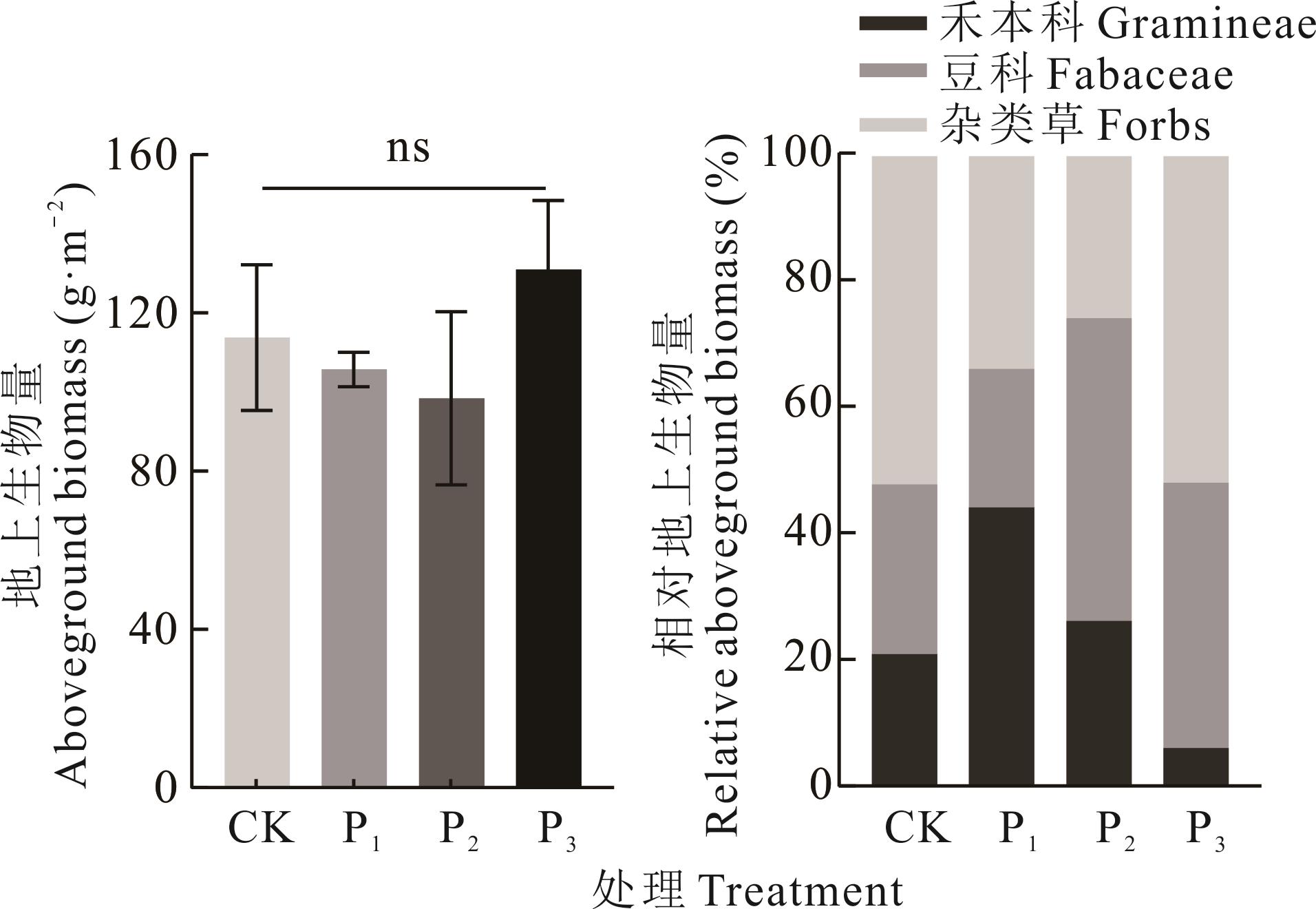
图1 补播地植物群落地上生物量“ns”表示各处理之间无显著差异(P>0.05)。“ns” indicates no significant differences among treatments (P>0.05).
Fig.1 Aboveground biomass of replanted plant communities
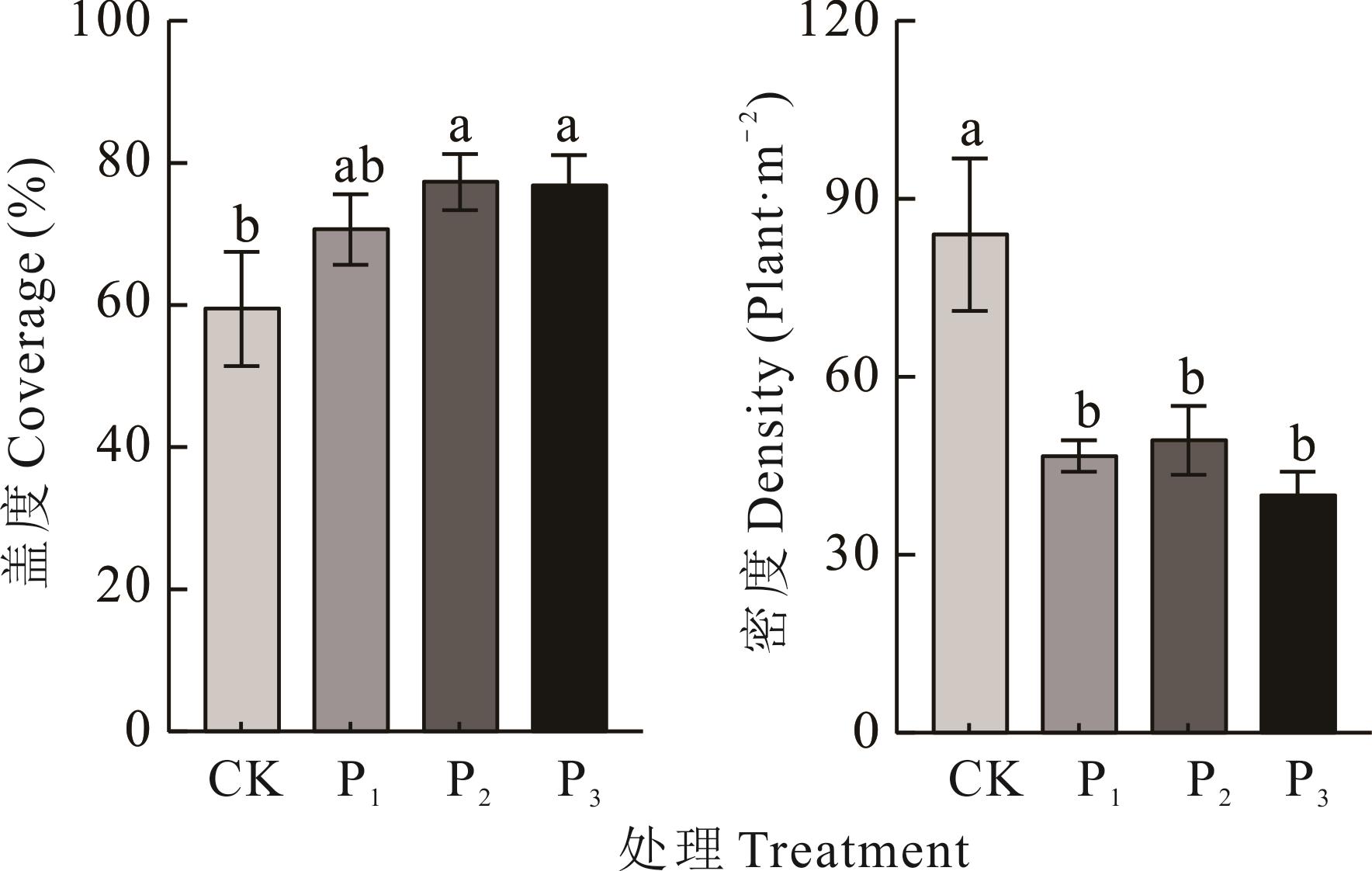
图2 植物群落特征不同小写字母表示不同配置模式间差异显著(P<0.05)。Different lowercase letters indicate significant differences among different configuration modes (P<0.05).
Fig.2 Characteristics of plant community
补播配置模式 Replay configuration mode | 优势度指数 Simpson index | 多样性指数 Shannon-Wiener index | 均匀度指数 Pielou index | 丰富度指数 Margalef index |
|---|---|---|---|---|
| CK | 0.77±0.02b | 1.62±0.07b | 0.86±0.05a | 1.89±0.19c |
| P1 | 0.81±0.03ab | 1.83±0.15ab | 0.87±0.03a | 2.99±0.38bc |
| P2 | 0.85±0.00a | 2.06±0.03a | 0.89±0.02a | 3.76±0.43ab |
| P3 | 0.83±0.02ab | 2.04±0.10a | 0.82±0.03a | 4.83±0.56a |
表2 植物群落物种多样性指数
Table 2 Species diversity index of plant community
补播配置模式 Replay configuration mode | 优势度指数 Simpson index | 多样性指数 Shannon-Wiener index | 均匀度指数 Pielou index | 丰富度指数 Margalef index |
|---|---|---|---|---|
| CK | 0.77±0.02b | 1.62±0.07b | 0.86±0.05a | 1.89±0.19c |
| P1 | 0.81±0.03ab | 1.83±0.15ab | 0.87±0.03a | 2.99±0.38bc |
| P2 | 0.85±0.00a | 2.06±0.03a | 0.89±0.02a | 3.76±0.43ab |
| P3 | 0.83±0.02ab | 2.04±0.10a | 0.82±0.03a | 4.83±0.56a |
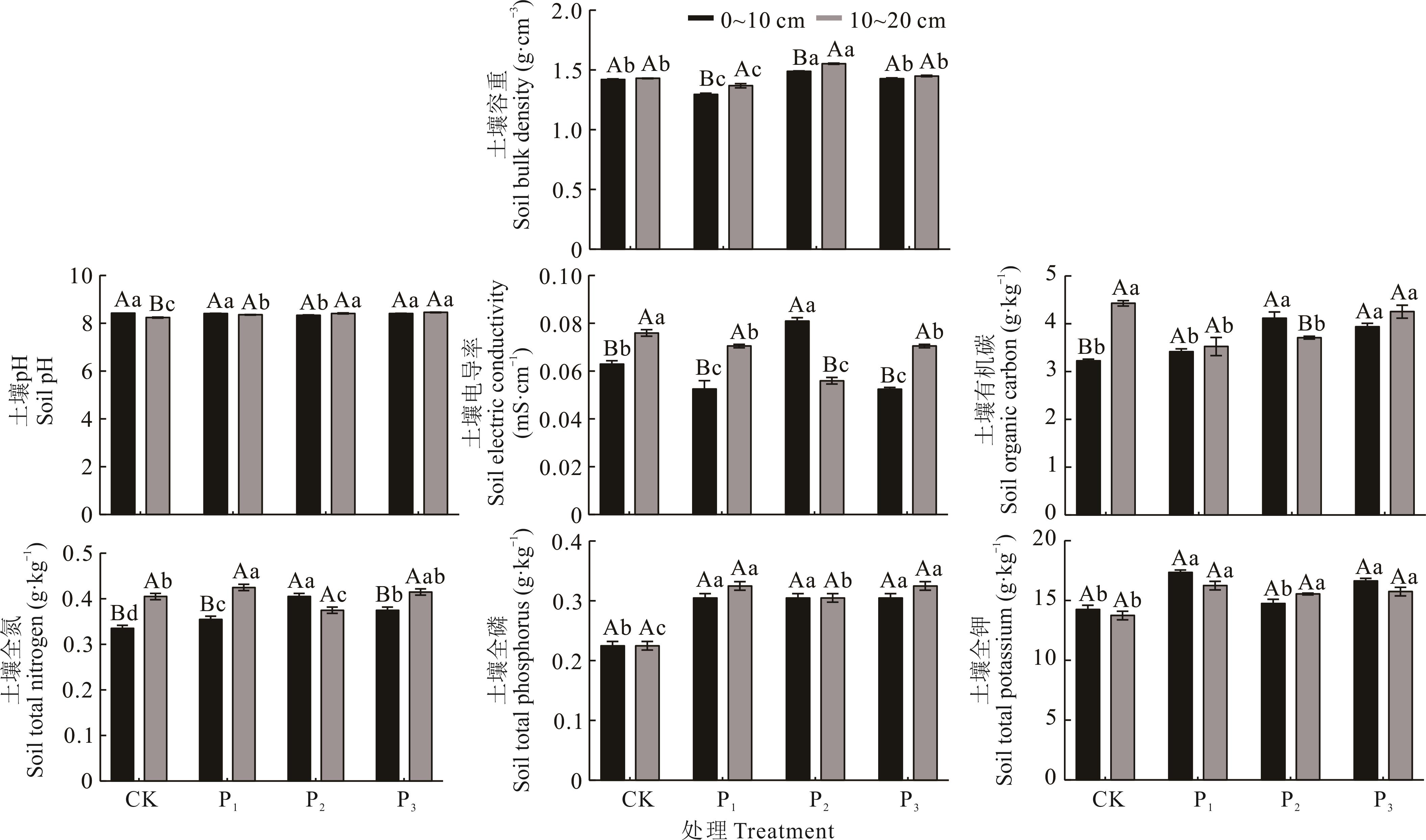
图3 土壤理化性质不同大写字母表示同一配置模式下不同土层之间差异显著,不同小写字母表示同一土层下不同配置模式之间差异显著(P<0.05)。Different capital letters indicate significant difference between different soil layers under the same configuration mode, different lowercase letters indicate significant differences among different configuration modes under the same soil layer (P<0.05).
Fig.3 Soil physical and chemical properties
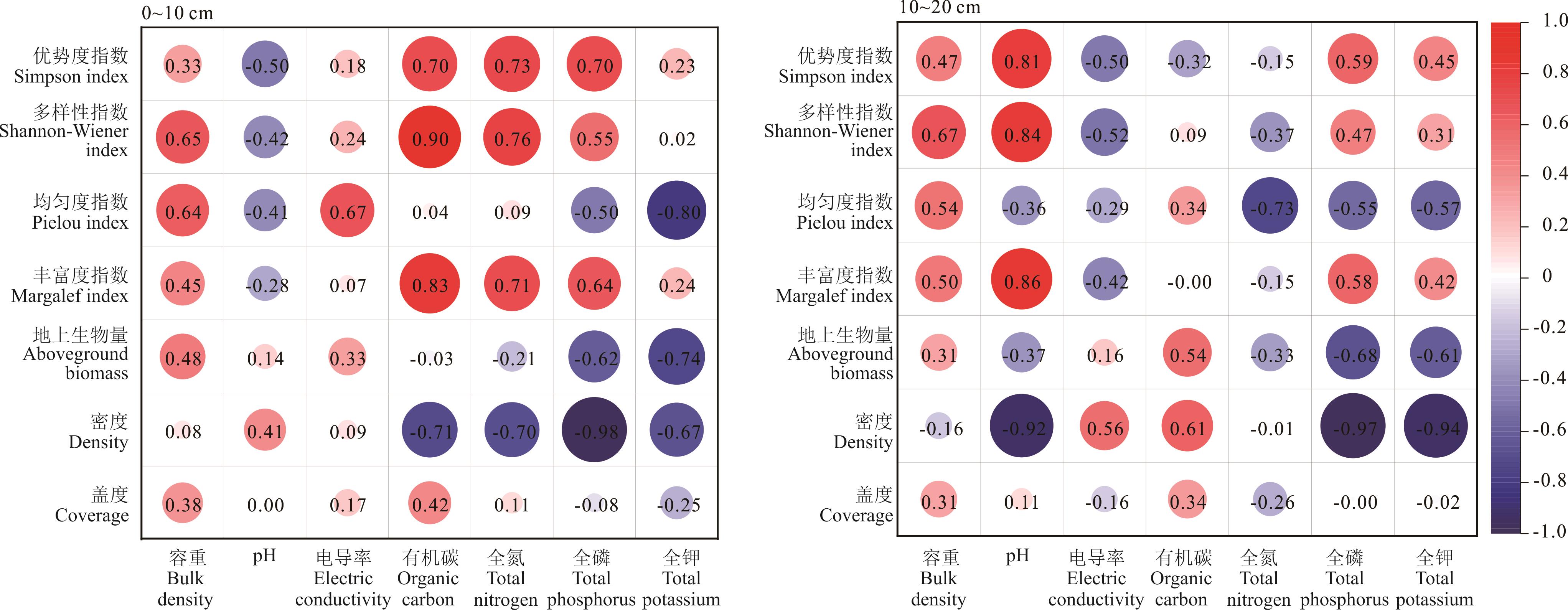
图4 补播草地植物群落特征与土壤理化性质之间的相关性分析图中数值均为相关系数。The values in the figure are all correlation coefficients.
Fig.4 Correlation analysis between plant community characteristics and soil physicochemical properties in replanted grasslands
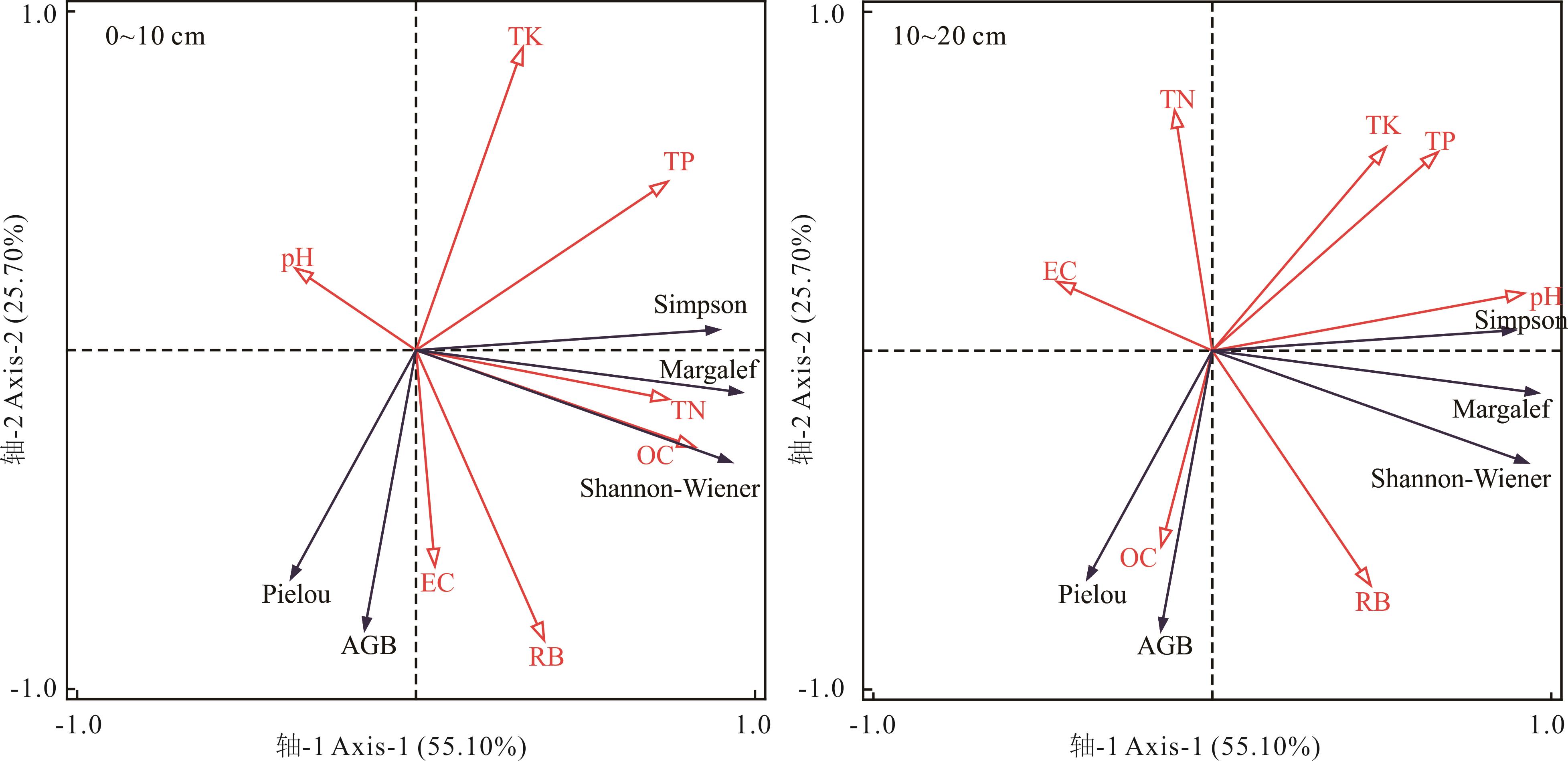
图5 牧草补播后土壤理化性质与植物群落特征主成分分析红色箭头表示解释变量,蓝色箭头表示响应变量。The red arrow represents the explanatory variable, and the blue arrow represents the response variable. Simpson: 优势度指数; Shannon-Wiener: 多样性指数; Pielou: 均匀度指数; Margalef: 丰富度指数; AGB: 地上生物量Aboveground biomass; OC: 土壤有机碳Soil organic carbon; TN: 土壤全氮Soil total nitrogen; TP: 土壤全磷Soil total phosphorus; TK: 土壤全钾Soil total potassium; RB: 土壤容重Soil bulk density; EC: 土壤电导率Soil electric conductivity.
Fig.5 Principal component analysis of soil physical and chemical properties and plant community characteristics after grass reseeding
土壤因子 Soil factors | 土层深度 Soil depth (cm) | 贡献率 Contribution (%) | F | P |
|---|---|---|---|---|
土壤有机碳 Soil organic carbon | 0~10 | 41.7 | 4.3 | 0.026* |
| 10~20 | 5.9 | 1.1 | 0.364 | |
土壤全磷 Soil total phosphorus | 0~10 | 26.4 | 4.1 | 0.008** |
| 10~20 | 22.0 | 3.7 | 0.010** | |
| pH | 0~10 | 9.3 | 1.7 | 0.224 |
| 10~20 | 48.5 | 5.7 | 0.002** | |
土壤全钾 Soil total potassium | 0~10 | 10.0 | 2.4 | 0.152 |
| 10~20 | 4.6 | 0.8 | 0.486 | |
土壤容重 Soil bulk density | 0~10 | 6.6 | 2.2 | 0.210 |
| 10~20 | 6.6 | 1.5 | 0.444 | |
土壤全氮 Soil total nitrogen | 0~10 | 3.5 | 1.4 | 0.394 |
| 10~20 | 7.9 | 1.5 | 0.246 | |
土壤电导率 Soil electric conductivity | 0~10 | 2.5 | <0.1 | 1.000 |
| 10~20 | 4.4 | <0.1 | 1.000 |
表3 土壤理化指标与植物群落特征主成分分析排序结果
Table 3 Principal component analysis ordination results of soil physical and chemical indicators and plant community characteristics
土壤因子 Soil factors | 土层深度 Soil depth (cm) | 贡献率 Contribution (%) | F | P |
|---|---|---|---|---|
土壤有机碳 Soil organic carbon | 0~10 | 41.7 | 4.3 | 0.026* |
| 10~20 | 5.9 | 1.1 | 0.364 | |
土壤全磷 Soil total phosphorus | 0~10 | 26.4 | 4.1 | 0.008** |
| 10~20 | 22.0 | 3.7 | 0.010** | |
| pH | 0~10 | 9.3 | 1.7 | 0.224 |
| 10~20 | 48.5 | 5.7 | 0.002** | |
土壤全钾 Soil total potassium | 0~10 | 10.0 | 2.4 | 0.152 |
| 10~20 | 4.6 | 0.8 | 0.486 | |
土壤容重 Soil bulk density | 0~10 | 6.6 | 2.2 | 0.210 |
| 10~20 | 6.6 | 1.5 | 0.444 | |
土壤全氮 Soil total nitrogen | 0~10 | 3.5 | 1.4 | 0.394 |
| 10~20 | 7.9 | 1.5 | 0.246 | |
土壤电导率 Soil electric conductivity | 0~10 | 2.5 | <0.1 | 1.000 |
| 10~20 | 4.4 | <0.1 | 1.000 |
| [1] | Stevens N, Bond W, Feurdean A, et al. Grassy ecosystems in the anthropocene. Annual Review of Environment and Resources, 2022, 47: 261-289. DOI: 10.1146/annurev-environ-112420-015211. |
| [2] | Tuo D F, Lu Q, Que X E, et al. Evaluation of grassland ecosystem services in northern China. Acta Ecologica Sinica, 2024, 44(2): 455-462. |
| 脱登峰, 卢琦, 却晓娥, 等. 中国北方草地生态系统服务评估. 生态学报, 2024, 44(2): 455-462. | |
| [3] | Liu G X, Zhang Y J, Hovstad K A, et al. Competition of Leymus chinensis and Bromus inermis in response to gap size and neighbouring root exclusion. Grass and Forage Science, 2014, 69(3): 479-487. |
| [4] | Liu J G, Diamond J. China’s environment in a globalizing world. Nature, 2005, 435(7046): 1179-1186. |
| [5] | Yue L N, Shi S L, Qi J, et al. Effects of no-tillage reseeding on productivity and nutritional quality of degraded grassland in northern China. Acta Agrestia Sinica, 2021, 29(11): 2583-2590. |
| 岳丽楠, 师尚礼, 祁娟, 等. 免耕补播对北方退化草地生产力及营养品质的影响. 草地学报, 2021, 29(11): 2583-2590. | |
| [6] | Luo D. Effects of different improved measures on vegetation and soil in the Stipa breviflora desert steppe. Hohhot: Inner Mongolia Agricultural University, 2016. |
| 罗冬. 不同改良措施对短花针茅荒漠草原植被和土壤的影响. 呼和浩特: 内蒙古农业大学, 2016. | |
| [7] | Suter M, Connolly J, Finn J A, et al. Nitrogen yield advantage from grass-legume mixtures is robust over a wide range of legume proportions and environmental conditions. Global Change Biology, 2015, 21(6): 2424-2438. |
| [8] | Yang C H, Zhang X Q. Study on the techniques of mixed sown grassland establishment. Pratacultural Science, 2003, 20(3): 42-46. |
| 杨春华, 张新全. 人工建植混播草地技术研究. 草业科学, 2003, 20(3): 42-46. | |
| [9] | Du J Y, Li X Y, Yang L, et al. Study on the changes of grassland productivity in the third year of mixed sowing in Bashang area of northwest of Hebei. Acta Agrestia Sinica, 2022, 30(7): 1855-1861. |
| 杜俊颖, 李鑫洋, 杨莉, 等. 冀西北坝上地区豆禾混播草地建植第三年草地生产力变化研究. 草地学报, 2022, 30(7): 1855-1861. | |
| [10] | Li W, Wei T H, Yongcuobazhan, et al. Effects of different mixed planting ratios on vegetation and soil characteristics of sown pasture in the Sanjiangyuan region. Acta Prataculturae Sinica, 2021, 30(12): 39-48. |
| 李文, 魏廷虎, 永措巴占, 等. 混播比例对三江源人工草地植被和土壤养分特征的影响. 草业学报, 2021, 30(12): 39-48. | |
| [11] | Wang B, Yang Y J, Dong X, et al. Effects of reseeding grass on production performance and forage quality of degraded alfalfa grassland. Acta Agrestia Sinica, 2021, 29(3): 618-624. |
| 王斌, 杨彦军, 董秀, 等. 补播禾草对退化苜蓿草地生产性能及牧草品质的影响. 草地学报, 2021, 29(3): 618-624. | |
| [12] | Shu S M, Yang C H, Chen L Z. Effects of overseeding legumes on the forage yield and quality of whipgrass. Pratacultural Science, 2011, 28(6): 1041-1043. |
| 舒思敏, 杨春华, 陈灵鸷. 补播豆科牧草对扁穗牛鞭草草地的影响. 草业科学, 2011, 28(6): 1041-1043. | |
| [13] | Ji B, He J L, Wang Z J, et al. Effects of tillage on soil carbon and nitrogen reserves in desert steppe of Ningxia. Chinese Journal of Grassland, 2022, 44(1): 30-38. |
| 季波, 何建龙, 王占军, 等. 翻耕补播措施对宁夏荒漠草原土壤碳氮储量的影响. 中国草地学报, 2022, 44(1): 30-38. | |
| [14] | Hou C X, Zhou L H, Wen Y, et al. Evaluation of social-ecological systems resilience in ecological policy: a case study in Yanchi, Ningxia, China. China Population, Resources and Environment, 2018, 28(8): 117-126. |
| 侯彩霞, 周立华, 文岩, 等. 生态政策下草原社会-生态系统恢复力评价-以宁夏盐池县为例. 中国人口·资源与环境, 2018, 28(8): 117-126. | |
| [15] | Ji B, He J L, Du J M, et al. Effects of different reseeding modes on soil organic carbon and nitrogen reserves in Ningxia desert steppe. Chinese Journal of Grassland, 2021, 43(3): 60-66. |
| 季波, 何建龙, 杜建明, 等. 不同补播配置模式对宁夏荒漠草原土壤有机碳和全氮储量的影响. 中国草地学报, 2021, 43(3): 60-66. | |
| [16] | Niu Y J, Yang S W, Wang G Z, et al. Study on the relationships between plant species richness, lifeform richness, and above-and belowground biomass under grazing disturbance in an alpine meadow. Acta Ecologica Sinica, 2018, 38(8): 2791-2801. |
| 牛钰杰, 杨思维, 王贵珍, 等. 放牧干扰下高寒草甸物种和生活型丰富度与地上及地下生物量的关系. 生态学报, 2018, 38(8): 2791-2801. | |
| [17] | Bao S D. Soil agro-chemical analysis (the third edition). Beijing: China Agriculture Press, 2008. |
| 鲍士旦. 土壤农化分析(第三版). 北京: 中国农业出版社, 2008. | |
| [18] | Wang J Y, Sun Z J, An S Z, et al. Primary studies on the resuming effect of reseeding on vegetational restoration of natural grassland. Xinjiang Agricultural Sciences, 2011, 48(4): 690-695. |
| 王吉云, 孙宗玖, 安沙舟, 等. 补播对天然割草场植被恢复效果的初步研究. 新疆农业科学, 2011, 48(4): 690-695. | |
| [19] | Sun S Q. The study of reseeding artificially on the sandy degraded grassland in Wuzhu Muqin. Hohhot: Inner Mongolia Agricultural University, 2011. |
| 孙树青. 乌珠穆沁沙质退化草地人工补播调查研究. 呼和浩特: 内蒙古农业大学, 2011. | |
| [20] | Yan Z M, Zhang Y J, Pan L, et al. Research progress of reseeding forage legumes into natural grassland. Chinese Agricultural Science Bulletin, 2014, 30(29): 1-7. |
| 阎子盟, 张玉娟, 潘利, 等. 天然草地补播豆科牧草的研究进展. 中国农学通报, 2014, 30(29): 1-7. | |
| [21] | Wang B, Lin X K, Feng Z R, et al. Effects of reseeded native forage species on soil water holding capacity and vegetation biomass in a desert steppe. Pratacultural Science, 2023, 40(9): 2247-2256. |
| 王博, 蔺雄奎, 冯占荣, 等. 补播乡土牧草对荒漠草地土壤持水性及植被生物量的影响. 草业科学, 2023, 40(9): 2247-2256. | |
| [22] | Li X Y, Du J Y, Yang L, et al. Effects of no-tillage reseeding on plant community characteristics in northwest of Hebei Province. Acta Agrestia Sinica, 2022, 30(9): 2249-2254. |
| 李鑫洋, 杜俊颖, 杨莉, 等. 免耕补播对冀西北坝上地区草原植被群落特征的影响. 草地学报, 2022, 30(9): 2249-2254. | |
| [23] | Zhu Y Q, Yu H, Zheng W, et al. Effects of different planting configurations on yield of Avena sativa and Vicia sativa mixed plantings with soybean in alpine pastures. Acta Prataculturae Sinica, 2020, 29(1): 74-85. |
| 朱亚琼, 于辉, 郑伟, 等. 燕麦+箭筈豌豆混播草地混播优势的测度与影响因素分析. 草业学报, 2020, 29(1): 74-85. | |
| [24] | Wu W P, Ma H B, Lu Q, et al. Effects of supplementary sowing on plant community and soil physical and chemical properties in Ningxia desert steppe. Pratacultural Science, 2020, 37(10): 1959-1969. |
| 吴宛萍, 马红彬, 陆琪, 等. 补播对宁夏荒漠草原植物群落及土壤理化性状的影响. 草业科学, 2020, 37(10): 1959-1969. | |
| [25] | Zhu B W, Zhou H K, Xu Y X, et al. Study on seasonal dynamics of biomass in meadow grassland of north shore of Qinghai Lake. Pratacultural Science, 2008, 25(12): 62-66. |
| 朱宝文, 周华坤, 徐有绪, 等. 青海湖北岸草甸草原牧草生物量季节动态研究. 草业科学, 2008, 25(12): 62-66. | |
| [26] | Zhang Y C, Niu D C, Han T, et al. Effects of reseeding on productivity and plant diversity on alpine meadows. Acta Prataculturae Sinica, 2012, 21(2): 305-309. |
| 张永超, 牛得草, 韩潼, 等. 补播对高寒草甸生产力和植物多样性的影响. 草业学报, 2012, 21(2): 305-309. | |
| [27] | Jiang X L, Yue J, Zhang W G, et al. Biodiversity, ecosystem functioning and spatio-temporal scales. Acta Prataculturae Sinica, 2010, 19(1): 219-225. |
| 江小雷, 岳静, 张卫国, 等. 生物多样性, 生态系统功能与时空尺度. 草业学报, 2010, 19(1): 219-225. | |
| [28] | Tilman D. Niche tradeoffs, neutrality, and community structure: A stochastic theory of resource competition, invasion, and community assembly. Proceedings of the National Academy of Sciences of the United States of America, 2004, 101(30): 10854-10861. |
| [29] | Kawata M. Invasion of vacant niches and subsequent sympatric speciation. Proceedings of the Royal Society B-Biological Sciences, 2002, 269(1486): 55-63. |
| [30] | Foster B L, Tilman D. Seed limitation and the regulation of community structure in oak savanna grassland. Journal of Ecology, 2003, 91(6): 999-1007. |
| [31] | Hao W F, Du F, Chen X Y, et al. Composition and diversity analysis of natural-community plants in the loess hilly region. Acta Agrestia Sinica, 2012, 20(4): 609-615. |
| 郝文芳, 杜峰, 陈小燕, 等. 黄土丘陵区天然群落的植物组成、植物多样性及其与环境因子的关系. 草地学报, 2012, 20(4): 609-615. | |
| [32] | Ji W Z, Wang Q H. Effects of over-seeding on plant community and soil physical and chemical properties of degraded grassland in Tianzhu County. Pratacultural Science, 2016, 33(5): 886-890. |
| 姬万忠, 王庆华. 补播对天祝高寒退化草地植被和土壤理化性质的影响. 草业科学, 2016, 33(5): 886-890. | |
| [33] | Peng M, Zi X X, Shang W, et al. Effect of different land use on soil physicochemical properties, enzyme activity and microorganism quantity in Daqing. Journal of Northeast Forestry University, 2015, 43(10): 79-84. |
| 彭木, 訾晓雪, 尚娲, 等. 不同土地利用方式对大庆地区土壤理化性质、酶活性与微生物数量的影响. 东北林业大学学报, 2015, 43(10): 79-84. | |
| [34] | Qiao Y M, Wang Z Q, Duan Z H. Effects of different land-use types on soil carbon and nitrogen contents in the northern region of Qinghai Lake. Acta Prataculturae Sinica, 2009, 18(6): 105-112. |
| 乔有明, 王振群, 段中华. 青海湖北岸土地利用方式对土壤碳氮含量的影响. 草业学报, 2009, 18(6): 105-112. | |
| [35] | Liu G F, Sun X, Xiao Z X, et al. Effects of reseeding and fertilizing on the chemical properties and enzyme activities of degraded meadow soil. Chinese Journal of Grassland, 2022, 44(11): 66-75. |
| 刘国富, 孙雪, 肖知新, 等. 补播和施肥对退化草甸土壤化学性质及酶活性的影响. 中国草地学报, 2022, 44(11): 66-75. | |
| [36] | Fan B. Effects of fertilization and reseeding on soil carbon, nitrogen, phosphorus and vegetation characteristics of degraded grassland in desert steppe. Hohhot: Inner Mongolia Agricultural University, 2023. |
| 范博. 施肥和补播对荒漠草原退化草地的土壤碳氮磷和植被特征的影响. 呼和浩特: 内蒙古农业大学, 2023. | |
| [37] | Wu J F, Liu J S, Li Z M, et al. Grassland soil phosphorus cycle and its response to global change. Chinese Journal of Grassland, 2021, 43(6): 102-111. |
| 吴金凤, 刘鞠善, 李梓萌, 等. 草地土壤磷循环及其对全球变化的响应. 中国草地学报, 2021, 43(6): 102-111. | |
| [38] | Zhang A M, Li N K, Zhao G Y, et al. Research progress on the phosphate-solubilizing and potassium-solubilizing microorganisms. Journal of Hebei University(Natural Science Edition), 2015, 35(4): 442-448. |
| 张爱民, 李乃康, 赵钢勇, 等. 土壤中解磷、解钾微生物研究进展. 河北大学学报(自然科学版), 2015, 35(4): 442-448. | |
| [39] | Verdoodt A, Mureithi S, Ye L, et al. Chronosequence analysis of two enclosure management strategies in degraded rangeland of semi-arid Kenya. Agriculture Ecosystems and Environment, 2009, 129(1/2/3): 332-339. |
| [40] | Li K H, Hu Y K, Wang X, et al. Relationships between aboveground biomass and environmental factors along an altitude gradient of alpine grassland. Chinese Journal of Applied Ecology, 2007, 18(9): 2019-2024. |
| 李凯辉, 胡玉昆, 王鑫, 等. 不同海拔梯度高寒草地地上生物量与环境因子关系. 应用生态学报, 2007, 18(9): 2019-2024. | |
| [41] | Sun Y F, Wan H W, Zhao Y J, et al. Spatial patterns and drivers of root turnover in grassland ecosystems in China. Chinese Journal of Plant Ecology, 2018, 42(3): 337-348. |
| 孙元丰, 万宏伟, 赵玉金, 等. 中国草地生态系统根系周转的空间格局和驱动因子. 植物生态学报, 2018, 42(3): 337-348. | |
| [42] | Bai Y F, Li L H, Wang Q B, et al. Changes in plant species diversity and productivity along gradients of precipitation and elevation in the Xilin river basin, Inner Mongolia. Chinese Journal of Plant Ecology, 2000, 24(6): 667-673. |
| 白永飞, 李凌浩, 王其兵, 等. 锡林河流域草原群落植物多样性和初级生产力沿水热梯度变化的样带研究. 植物生态学报, 2000, 24(6): 667-673. | |
| [43] | Zhao J X, Qu G P, Duojidunzhu, et al. Relationship between species diversity and soil factors of alpine grasslands in north Tibet. Journal of Arid Land Resources and Environment, 2011, 25(6): 105-108. |
| 赵景学, 曲广鹏, 多吉顿珠, 等. 藏北高寒植被群落物种多样性与土壤环境因子的关系. 干旱区资源与环境, 2011, 25(6): 105-108. | |
| [44] | Hai X Y, Dong L B, Wang X Z, et al. Effects of carbon, nitrogen and phosphorus ecological stoichiometry characteristics on plant diversity since returning farmland to grassland on the Loess Plateau. Acta Ecologica Sinica, 2020, 40(23): 8570-8581. |
| 海旭莹, 董凌勃, 汪晓珍, 等. 黄土高原退耕还草地C, N, P生态化学计量特征对植物多样性的影响. 生态学报, 2020, 40(23): 8570-8581. |
| [1] | 张琨, 乔建霞, 李金升, 王育鹏, 刘克思. 不同修复材料对退化高寒草地土壤理化性质及微生物群落的影响[J]. 草业学报, 2025, 34(8): 132-148. |
| [2] | 邓文辉, 宋珂辰, 张浩, 管思雨, 雍嘉仪, 胡海英. 降水变化条件下荒漠草原优势植物根际微生物群落结构和多样性特征研究[J]. 草业学报, 2025, 34(5): 12-26. |
| [3] | 骆欣怡, 邱开阳, 金涛, 鲍平安, 黄业芸, 何毅, 谢应忠. 碳、氮、钾添加对荒漠草原凋落物分解特征的影响[J]. 草业学报, 2025, 34(2): 41-53. |
| [4] | 欧翔, 连海, 陈荣强, 邱静芸, 吴丽娟, 操贤洪, 张强, 雷小文. 不同施肥处理种植王草后对稀土尾矿土壤理化性质和酶活性的影响[J]. 草业学报, 2025, 34(2): 94-108. |
| [5] | 张振豪, 贾子玉, 李鑫宇, 程云湘. 荒漠草原混牧牛羊的放牧行为特征[J]. 草业学报, 2025, 34(1): 226-237. |
| [6] | 贺世龙, 叶贺, 李静, 张雅玲, 德海山, 红梅. 不同时限氮沉降和降水变化对荒漠草原中小型土壤节肢动物群落结构与多样性的影响[J]. 草业学报, 2024, 33(9): 140-154. |
| [7] | 曹颖, 聂明鹤, 沈艳, 胡艳, 马登宝, 李东, 候腾思, 方鹏, 王学琴. 宁夏干旱风沙区荒漠草原不同退化阶段植被土壤变化特征及其相关性[J]. 草业学报, 2024, 33(8): 1-14. |
| [8] | 候腾思, 沈艳, 马红彬, 方鹏, 曹颖. 柠条平茬对荒漠草原土壤水分特征及水量平衡的影响[J]. 草业学报, 2024, 33(8): 15-24. |
| [9] | 杜文盼, 赵桂琴, 柴继宽, 杨莉, 张建贵, 史怡超, 张官禄. 根系分隔方式对燕麦/豌豆间作地上生物量、土壤养分及根系性状的影响[J]. 草业学报, 2024, 33(8): 25-36. |
| [10] | 佘洁, 沈爱红, 石云, 赵娜, 张风红, 何洪源, 吴涛, 李红霞, 马益婷, 朱晓雯. 基于无人机遥感影像和面向对象技术的荒漠草原植被分类[J]. 草业学报, 2024, 33(7): 1-14. |
| [11] | 姜海鑫, 周瑶, 胡科, 丁占胜, 马红彬. 不同放牧时间对荒漠草原土壤颗粒组成及分形维数的影响[J]. 草业学报, 2024, 33(6): 17-28. |
| [12] | 赵亚楠, 王红梅, 李志丽, 张振杰, 陈彦硕, 苏荣霞. 荒漠草原灌丛转变过程土壤水分亏缺空间特征及影响因素[J]. 草业学报, 2024, 33(4): 22-34. |
| [13] | 李俊瑶, 蒋星驰, 胡晋瑜, 魏栋光, 赵学勇, 王少昆. 生物有机肥施加对荒漠草原植被-土壤-微生物的影响[J]. 草业学报, 2024, 33(3): 34-45. |
| [14] | 鲍平安, 邱开阳, 黄业芸, 王思瑶, 崔璐瑶, 骆欣怡, 杨云涛, 谢应忠. 荒漠草原植物在氮磷添加下叶功能性状特征及其可塑性[J]. 草业学报, 2024, 33(3): 97-106. |
| [15] | 鲍平安, 季波, 孙果, 张娜, 吴旭东, 何建龙, 王占军, 田英. 光伏电站建设对植物群落与土壤特征的影响[J]. 草业学报, 2024, 33(12): 23-33. |
| 阅读次数 | ||||||
|
全文 |
|
|||||
|
摘要 |
|
|||||
