

ISSN 1004-5759 CN 62-1105/S
草业学报 ›› 2026, Vol. 35 ›› Issue (7): 228-239.DOI: 10.11686/cyxb2025257
• 综合评述 • 上一篇
龙德智( ), 刘增照, 周斐然()
收稿日期:2025-06-26
修回日期:2025-10-23
出版日期:2026-07-20
发布日期:2026-05-21
通讯作者:
周斐然
作者简介:Corresponding author. E-mail: 710298044@qq.com基金资助:
De-zhi LONG(), Zeng-zhao LIU, Fei-ran ZHOU()
Received:2025-06-26
Revised:2025-10-23
Online:2026-07-20
Published:2026-05-21
Contact:
Fei-ran ZHOU
摘要:
中国作为棉花生产与消费大国,每年产生大量棉副产品,但其含有的游离棉酚等抗营养因子严重限制了其在饲料中的高值化应用。传统物理化学脱毒方法存在成本高、效率低及潜在污染等问题。漆酶作为一种多铜氧化酶,凭借其广谱底物特异性和高效氧化能力,能够通过催化棉酚分子内环化反应,将毒性醛基转化为稳定的呋喃结构,实现棉酚的绿色降解。系统综述了棉酚的化学特性及其对动物肝毒性、生殖毒性与氧化应激的影响,深入解析了漆酶的三维结构、铜簇催化机制及介体辅助氧化途径,总结了pH、温度、酶浓度等关键因素对降解效率的调控规律。结果发现,漆酶处理可显著缓解棉酚引起的肝损伤与生殖功能障碍,恢复抗氧化酶活性。此外,通过天然菌株筛选、基因工程改造及极端环境微生物开发,漆酶的生产效率与稳定性持续提升,其在棉粕脱毒中的应用案例已验证其工业化潜力。未来,漆酶技术有望推动棉副产品资源化利用,降低饲料成本,并衍生高附加值产物,为实现棉产业可持续发展提供关键技术支撑。
龙德智, 刘增照, 周斐然. 漆酶在棉副产品饲料开发中的研究进展[J]. 草业学报, 2026, 35(7): 228-239.
De-zhi LONG, Zeng-zhao LIU, Fei-ran ZHOU. Progress in research on the use of laccase to produce feed from cotton by-products[J]. Acta Prataculturae Sinica, 2026, 35(7): 228-239.
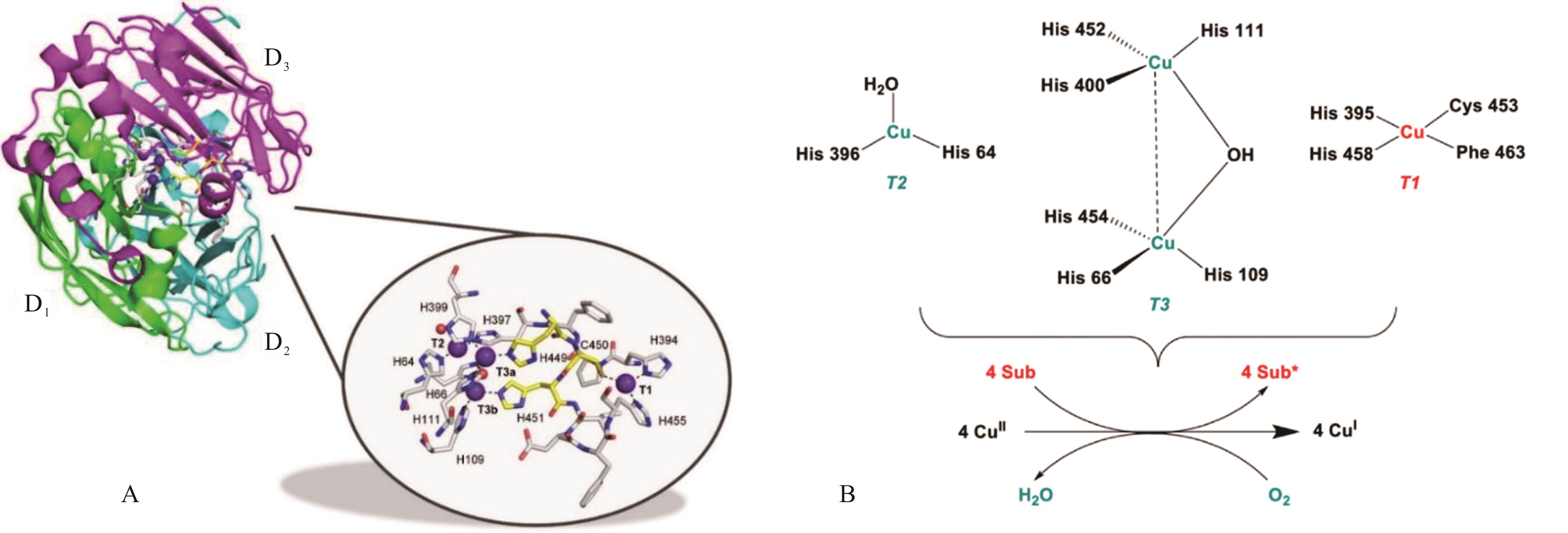
图1 漆酶结构及其催化方式[6,18]A: D1、D2和D3为结构域D1, D2 and D3 domains; B: 漆酶氧化过程Reactions catalyzed of laccase.
Fig.1 Structure and catalytic mode of laccase[6,18]
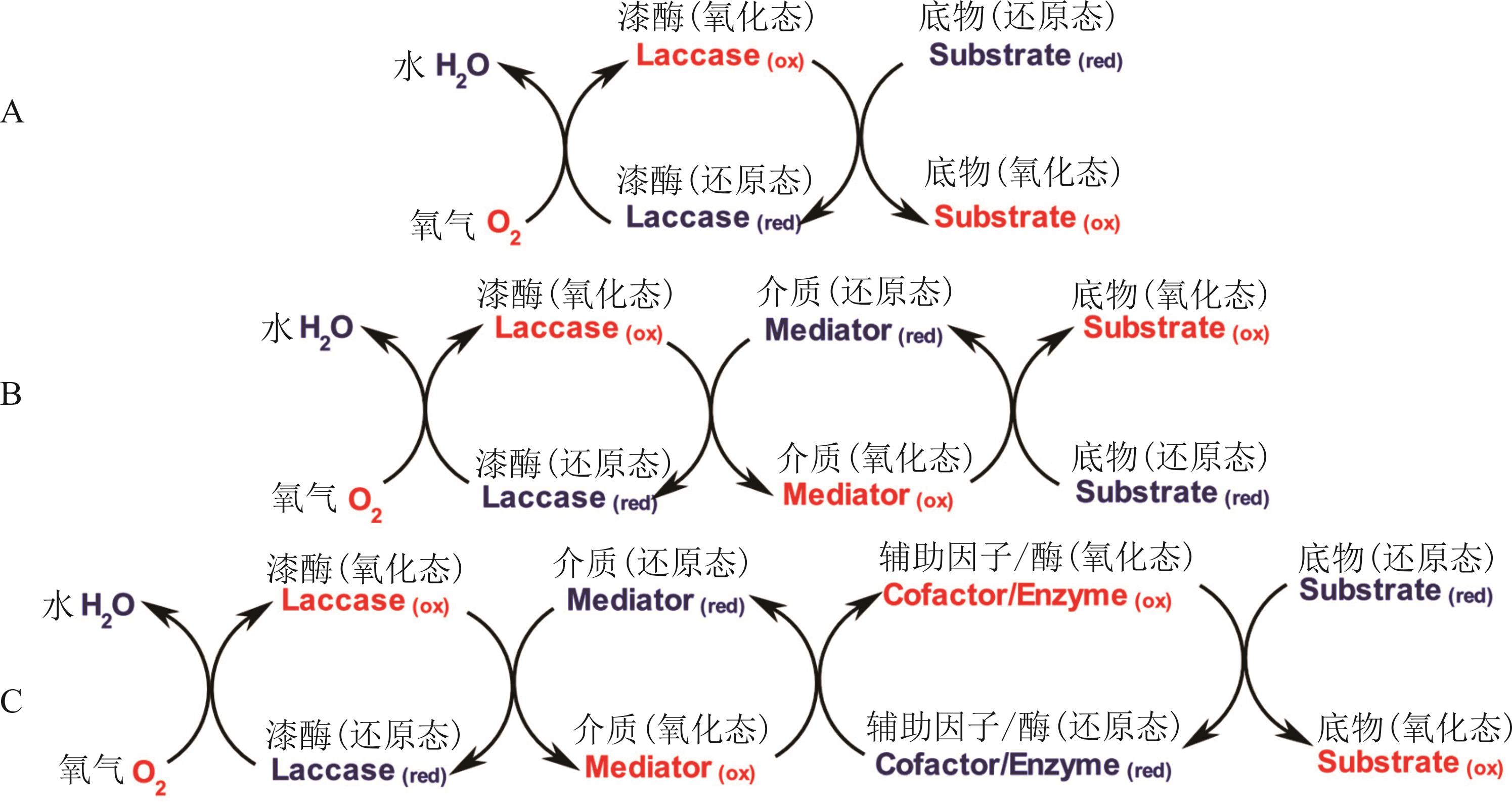
图2 基于底物漆酶的氧化循环[6]A: 直接底物氧化Direct oxidation of substrates; B: 化学催化底物氧化Chemically catalyzed substrate oxidation; C: 多酶偶联氧化Multienzymatic coupled oxidation. red(reduced)指失去电子过程,ox(oxidized)指得到电子过程。red (reduced) refers to the process of losing electrons; ox (oxidized) refers to the process of obtaining electrons.
Fig.2 Laccase-catalyzed redox cycles for substrate oxidation
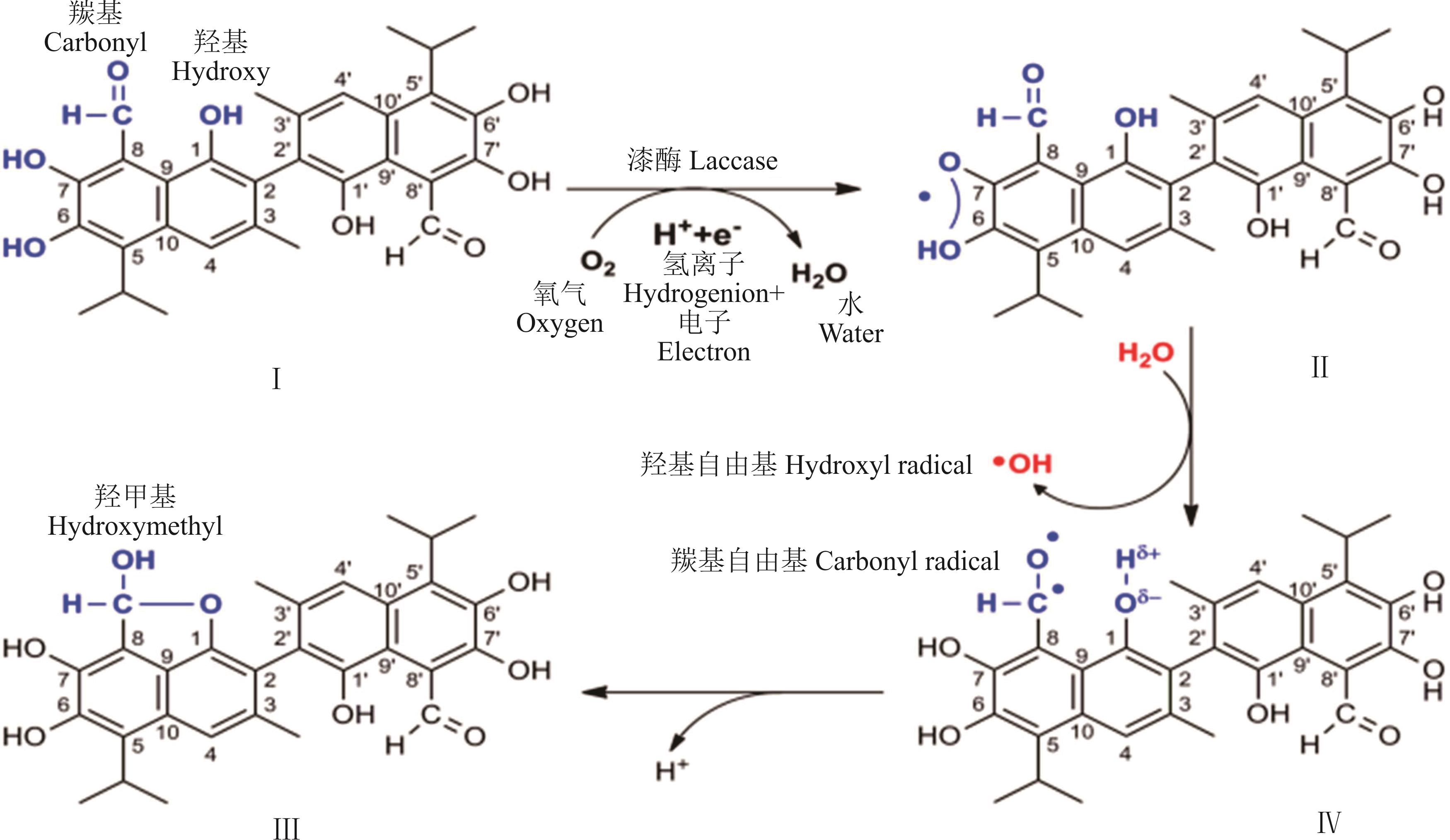
图3 核磁共振谱图推测漆酶降解棉酚的过程
Fig. 3 Nuclear magnetic resonance(NMR)spectra of gossypol degradation by laccase
| 酶源类型Enzyme source type | 代表酶Representative enzyme | pH值 pH value |
|---|---|---|
| 真菌漆酶Fungal laccase | 云芝漆酶Trametes versicolor laccase[ | 4.0~6.0 |
| 细菌漆酶Bacterial laccase | 植物乳杆菌漆酶Lactobacillus plantarum laccase[ | 4.0~7.0 |
| 微生物发酵Microbial fermentation | 芽孢杆菌漆酶Bacillus licheniformis laccase[ | 6.0~7.5 |
表1 不同来源漆酶催化pH
Table 1 pH catalyzed by laccases from different sources
| 酶源类型Enzyme source type | 代表酶Representative enzyme | pH值 pH value |
|---|---|---|
| 真菌漆酶Fungal laccase | 云芝漆酶Trametes versicolor laccase[ | 4.0~6.0 |
| 细菌漆酶Bacterial laccase | 植物乳杆菌漆酶Lactobacillus plantarum laccase[ | 4.0~7.0 |
| 微生物发酵Microbial fermentation | 芽孢杆菌漆酶Bacillus licheniformis laccase[ | 6.0~7.5 |
| 酶源类型Enzyme source type | 不同酶源代表物Representative enzymes from different sources | 适宜温度Suitable temperature |
|---|---|---|
| 真菌漆酶Fungal laccase | 变色栓菌同工酶T. versicolor isozymes[ | 60~70 ℃ |
| 杂色云芝同工酶Coriolus versicolor isozymes[ | 55~60 ℃ | |
| 细菌漆酶Bacteria laccase | 地衣芽孢杆菌B. licheniformis[ | 60 ℃左右About 60 ℃ |
| 龙舌兰芽孢杆菌B. tequilensis[ | 85 ℃左右About 85 ℃ | |
| 植物漆酶Plant laccase | 日本漆树Toxicodendron vernicifluum[ | 28 ℃左右About 28 ℃ |
| 基因工程漆酶Genetically engineered laccase | 重组漆酶Recombinant laccase[ | 55 ℃左右About 55 ℃ |
表2 不同来源漆酶催化适宜温度
Table 2 Suitable temperature for laccase catalysis from different sources
| 酶源类型Enzyme source type | 不同酶源代表物Representative enzymes from different sources | 适宜温度Suitable temperature |
|---|---|---|
| 真菌漆酶Fungal laccase | 变色栓菌同工酶T. versicolor isozymes[ | 60~70 ℃ |
| 杂色云芝同工酶Coriolus versicolor isozymes[ | 55~60 ℃ | |
| 细菌漆酶Bacteria laccase | 地衣芽孢杆菌B. licheniformis[ | 60 ℃左右About 60 ℃ |
| 龙舌兰芽孢杆菌B. tequilensis[ | 85 ℃左右About 85 ℃ | |
| 植物漆酶Plant laccase | 日本漆树Toxicodendron vernicifluum[ | 28 ℃左右About 28 ℃ |
| 基因工程漆酶Genetically engineered laccase | 重组漆酶Recombinant laccase[ | 55 ℃左右About 55 ℃ |
酶源 Enzyme source | 目标底物 Target substrate | 典型酶浓度 Typical enzyme concentration | 温度 Temperature (℃) | pH | 反应时间 Reaction time (h) | 棉酚降解率 Gossypol degradation rate (%) | 介体使用 Mediator usage |
|---|---|---|---|---|---|---|---|
| 解淀粉芽孢杆菌Bacillus amyloliquefaciens[ | 游离棉酚 Free gossypol | 101.56 U·mL-1 | 55 | 4 | 2 | 94.57 | - |
| 98.73 | 2,2'-联氮-双(3-乙基苯并噻唑啉-6-磺酸) 2,2'-azino-bis (3-ethylbenzothiazoline-6-sulfonic acid) (ABTS) | ||||||
| 细菌漆酶Spore coat protein A laccase (CotA laccase)[ | 脱脂棉籽粕中游离棉酚Free gossypol of defatted cottonseed meal | - | 37 | 7 | 1 | 100.00 | - |
真菌漆酶 Fungal laccase | 多酚类化合物Polyphenolic compounds | 广泛 Extensive | 50~60 | 酸性 Acidic (4.0~6.5) | 几十分钟至数小时不等Vary from tens of minutes to several hours | 因酶和条件而异Depends on the enzyme and conditions | - |
商业漆酶 Patented laccase[ | 棉籽蛋白中游离棉酚Free gossypol of cottonseed protein | 1000~40000 U·L-1 | 20~40 | - | 10~30 | 未明确量化 Not clearly specified | 烟酰胺腺嘌呤二核苷酸(NAD)或过氧化氢(H2O2) Nicotinamide adenine dinucleotide or hydrogen peroxide |
表3 不同来源漆酶降解棉酚酶浓度与反应时间及条件
Table 3 Enzyme concentration, reaction time, and conditions for gossypol degradation by laccases from different sources
酶源 Enzyme source | 目标底物 Target substrate | 典型酶浓度 Typical enzyme concentration | 温度 Temperature (℃) | pH | 反应时间 Reaction time (h) | 棉酚降解率 Gossypol degradation rate (%) | 介体使用 Mediator usage |
|---|---|---|---|---|---|---|---|
| 解淀粉芽孢杆菌Bacillus amyloliquefaciens[ | 游离棉酚 Free gossypol | 101.56 U·mL-1 | 55 | 4 | 2 | 94.57 | - |
| 98.73 | 2,2'-联氮-双(3-乙基苯并噻唑啉-6-磺酸) 2,2'-azino-bis (3-ethylbenzothiazoline-6-sulfonic acid) (ABTS) | ||||||
| 细菌漆酶Spore coat protein A laccase (CotA laccase)[ | 脱脂棉籽粕中游离棉酚Free gossypol of defatted cottonseed meal | - | 37 | 7 | 1 | 100.00 | - |
真菌漆酶 Fungal laccase | 多酚类化合物Polyphenolic compounds | 广泛 Extensive | 50~60 | 酸性 Acidic (4.0~6.5) | 几十分钟至数小时不等Vary from tens of minutes to several hours | 因酶和条件而异Depends on the enzyme and conditions | - |
商业漆酶 Patented laccase[ | 棉籽蛋白中游离棉酚Free gossypol of cottonseed protein | 1000~40000 U·L-1 | 20~40 | - | 10~30 | 未明确量化 Not clearly specified | 烟酰胺腺嘌呤二核苷酸(NAD)或过氧化氢(H2O2) Nicotinamide adenine dinucleotide or hydrogen peroxide |
酶源类型 Enzyme source type | 代表菌株 Representative strains | 产酶周期 Enzyme production cycle | 酶活性 Enzyme activity (U·mL-1) | 优势 Advantage | 局限性 Shortcoming |
|---|---|---|---|---|---|
| 天然真菌Natural fungal | 云芝T. versicolor[ | 7~14 d | 50~200 | 酶系丰富,底物广谱Rich enzyme system, broad substrate spectrum | 周期长,需要诱导剂Long cycle, need inducer |
| 基因工程细菌Genetically engineered bacterium | 枯草芽孢杆菌Bacillus subtilis[ | 24~48 h | 100~500 | 发酵快,耐高温/碱性Fast fermentation, high temperature/alkaline resistance | 需优化分泌表达Secretory expression needs to be optimized |
| 重组酵母Recombinant yeast | 毕赤酵母Pichia pastoris[ | 3~5 d | 200~800 | 糖基化修饰,稳定性高Glycosylation modification, high stability | 成本较高Expensive cost |
| 极端环境菌株Extreme environment strains | 嗜热芽孢杆菌Bacillus thermophilus[ | 48~72 h | 80~300 | 耐高温(>80 ℃),适合工业反应High temperature resistance (>80 ℃), suitable for industrial reactions | 底物特异性窄Narrow substrate specificity |
表4 不同酶源的性能比较
Table 4 Performance comparison of different enzyme sources
酶源类型 Enzyme source type | 代表菌株 Representative strains | 产酶周期 Enzyme production cycle | 酶活性 Enzyme activity (U·mL-1) | 优势 Advantage | 局限性 Shortcoming |
|---|---|---|---|---|---|
| 天然真菌Natural fungal | 云芝T. versicolor[ | 7~14 d | 50~200 | 酶系丰富,底物广谱Rich enzyme system, broad substrate spectrum | 周期长,需要诱导剂Long cycle, need inducer |
| 基因工程细菌Genetically engineered bacterium | 枯草芽孢杆菌Bacillus subtilis[ | 24~48 h | 100~500 | 发酵快,耐高温/碱性Fast fermentation, high temperature/alkaline resistance | 需优化分泌表达Secretory expression needs to be optimized |
| 重组酵母Recombinant yeast | 毕赤酵母Pichia pastoris[ | 3~5 d | 200~800 | 糖基化修饰,稳定性高Glycosylation modification, high stability | 成本较高Expensive cost |
| 极端环境菌株Extreme environment strains | 嗜热芽孢杆菌Bacillus thermophilus[ | 48~72 h | 80~300 | 耐高温(>80 ℃),适合工业反应High temperature resistance (>80 ℃), suitable for industrial reactions | 底物特异性窄Narrow substrate specificity |
| [1] | Pan J. The national cotton output increased by 9.7% year-on-year in 2024. Cotton Sciences, 2025, 47(1): 2. |
| 潘洁. 2024年全国棉花产量比上年增长9.7%. 棉花科学, 2025, 47(1): 2. | |
| [2] | Chu H Z, Liu J M, Yang G W, et al. Diagnosis and treatment gossypol poisoning of fattening cattle. China Cattle Science, 2019, 45(6): 83-85. |
| 褚洪忠, 刘建明, 杨光维, 等. 育肥牛棉酚中毒的诊断与治疗. 中国牛业科学, 2019, 45(6): 83-85. | |
| [3] | Wang W K, Yang H J, Xing Y L, et al. Gossyppl’s toxicity and its microbial detoxification mode in ruminants: a review. Chinese Journal of Animal Science, 2017, 53(6): 15-19. |
| 王炜康, 杨红建, 邢亚亮, 等. 棉酚对反刍动物的危害性及其瘤胃微生物学脱毒机理探讨. 中国畜牧杂志, 2017, 53(6): 15-19. | |
| [4] | Liu Y M, Guan S X, Wang W J, et al. Nutritional value, detoxification methods, and application research of cottonseed as animal feed. China Cotton, 2023, 50(9): 35-41. |
| 刘永明, 关淑仙, 王文静, 等. 棉籽作畜禽饲料的营养价值、脱毒方法及应用研究进展. 中国棉花, 2023, 50(9): 35-41. | |
| [5] | Liu C L M, Aorigele, Wang C J, et al. Current research status of the use of the whole cottonseed in ruminant production. China Animal Husbandry and Veterinary Medicine, 2025, 52(4): 1651-1659. |
| 刘朝乐门, 敖日格乐, 王纯洁, 等. 全棉籽在反刍动物生产中的应用研究现状. 中国畜牧兽医, 2025, 52(4): 1651-1659. | |
| [6] | Bassanini I, Ferrandi E E, Riva S, et al. Biocatalysis with laccases: an updated overview. Catalysts, 2021, 11(1): 26. |
| [7] | Patel N, Shahane S, Shivam, et al. Mode of action, properties, production, and application of laccase: a review. Recent Patents on Biotechnology, 2019, 13(1): 19-32. |
| [8] | Khatami S H, Vakili O, Movahedpour A, et al. Laccase: Various types and applications. Biotechnology and Applied Biochemistry, 2022, 69(6): 2658-2672. |
| [9] | Wang L, Chen M, Luo X C, et al. Intramolecular annulation of gossypol by laccase to produce safe cottonseed protein. Frontiers in Chemistry, 2020, 1(8): 583176. |
| [10] | Liu Y X, Wang L L, Zhao L, et al. Structure, properties of gossypol and its derivatives-from physiological activities to drug discovery and drug design. Natural Product Reports, 2022, 39(6): 1282-1304. |
| [11] | Xu W X, Hu Y L, Liu P, et al. Effect of hepatic antioxidant capacity in gossypol-induced male broilers.Modern Animal Husbandry Science & Technology, 2024, 106(3): 12-16. |
| 徐文秀, 胡雨露, 刘盼, 等. 棉酚对雄性肉仔鸡肝脏抗氧化能力的影响. 现代畜牧科技, 2024, 106(3): 12-16. | |
| [12] | Zhang M D, Liang J P, Zhang J, et al. Effects of gossypol acetate on serum aminotransferase, liver antioxidant enzyme activities and hepatocyte apoptosis of Cyprinus carpio following oral administration. Journal of Henan Agricultural Sciences, 2019, 48(7): 128-135. |
| 张孟丹, 梁俊平, 张静, 等. 口灌醋酸棉酚对鲤血清转氨酶、肝脏抗氧化酶活力及肝细胞凋亡的影响. 河南农业科学, 2019, 48(7): 128-135. | |
| [13] | Yu J, Yang H, Wang J, et al. Comprehensive analysis of histophysiology, transcriptomics and metabolomics in goslings exposed to gossypol acetate: unraveling hepatotoxic mechanisms. Frontiers in Veterinary Science, 2025, 21(12): 1527284. |
| [14] | Zhao S C, Wang H T, Liu K X, et al. Effects of gossypol on oxidative damage and expression of NF-κB, P53 and Caspase-3 in mice testis. Journal of Northeast Agricultural University, 2024, 55(2): 49-56. |
| 赵树臣, 王海涛, 刘克祥, 等. 棉酚对小鼠睾丸氧化损伤及NF-κB、P53和Caspase-3基因表达的影响. 东北农业大学学报, 2024, 55(2): 49-56. | |
| [15] | Zhou D R. Study on the regulatory effect of gossypol on the expression of connectin 43 in sertoli cells of testis. Shantou: Shantou University, 2009. |
| 周德荣. 棉酚对睾丸支持细胞间隙连接蛋白43表达的调节作用的研究. 汕头: 汕头大学, 2009. | |
| [16] | He X. Molecular mechanism of gossypol-induced apoptosis in goat spermatogonial stem cells. Yangling: Northwest A & F University, 2017. |
| 贺鑫. 棉酚诱导山羊精原干细胞凋亡的分子机理研究. 杨凌: 西北农林科技大学, 2017. | |
| [17] | Ma X C, Ma Z, Huang X W, et al. Research progress on detoxification technology of cottonseed meal. Zhongnan Agricultural Science and Technology, 2023, 44(11): 226-230. |
| 马晓翠, 马壮, 黄秀文, 等. 棉籽粕脱毒技术研究进展. 中南农业科技, 2023, 44(11): 226-230. | |
| [18] | Li J F. Study on bacterial composition, laccase gene screening and enzymatic properties of rumen lignin-degrading in buffalo.Wuhan: Huazhong Agricultural University, 2022. |
| 李经法. 水牛瘤胃木质素降解细菌组成、漆酶基因筛选及其酶学性质的研究. 武汉: 华中农业大学, 2022. | |
| [19] | Ji W Z. Study on preparation of fungal laccase, its catalytic polymerization characteristics and laccase gene’ cloning. Ji’nan: Shandong Polytechnic University, 2011. |
| 季万镇. 白腐菌漆酶的制备、催化聚合的研究及漆酶基因克隆的初探. 济南: 山东轻工业学院, 2011. | |
| [20] | Roberts S A, Weichsel A, Grass G, et al. Crystal structure and electron transfer kinetics of CueO, a multicopper oxidase required for copper homeostasis in Escherichia coli. Proceedings of the National Academy of Sciences of the United States of America, 2002, 99(5): 2766-2771. |
| [21] | Hakulinen N, Kiiskinen L L, Kruus K, et al. Crystal structure of a laccase from Melanocarpus albomyces with an intact trinuclear copper site. Nature Structural Biology, 2002, 9(8): 601-605. |
| [22] | Giardina P, Faraco V, Pezzella C, et al. Laccases: a never-ending story. Cellular and Molecular Life Sciences, 2010, 67(3): 369-385. |
| [23] | Marcus R A, Sutin N. Electron transfers in chemistry and biology. Biochimica et Biophysica Acta (BBA)-Reviews on Bioenergetics, 1985, 811(3): 265-322. |
| [24] | Pezzella C, Guarino L, Piscitelli A. How to enjoy laccases. Cellular and Molecular Life Sciences, 2015, 72(5): 923-940. |
| [25] | Ludig R, Magdalena O, Marcel Z, et al. Continuous enzymatic regeneration of electron acceptors used by flavoenzymes: cellobiose dehydrogenase-catalyzed production of lactobionic acid as an example. Biocatalysis and Biotransformation, 2004, 22(2): 97-104. |
| [26] | Ferrandi E E, Monti D, Patel I, et al. Exploitation of a laccase/meldola’s blue system for NAD+ regeneration in preparative scale hydroxysteroid dehydrogenase-catalyzed oxidations. Advanced Synthesis & Catalysis, 2012, 354(14/15): 2821-2828. |
| [27] | Wei T L, Miao H B, Wu Q, et al. Heterogeneous expression, characterization and degradation of gossypol by laccase BmLac. Biotechnology Bulletin, 2023, 39(12): 320-328. |
| 魏婷柳, 苗华彪, 吴倩, 等. 漆酶BmLac的异源表达、酶学特性及棉酚降解的研究.生物技术通报, 2023, 39(12): 320-328. | |
| [28] | Bollag J M, Leonowicz A. Comparative studies of extracellular fungal laccases. Applied and Environmental Microbiology, 1984, 48(4): 849-854. |
| [29] | Li Z, Jiang S, Xie Y, et al. Mechanism of the salt activation of laccase Lac15. Biochemical and Biophysical Research Communications, 2020, 521(4): 997-1002. |
| [30] | Sun Y, Zhang H L, Wang W B, et al. Advances in the function and properties of laccase and its microbial production. Advances in Microbiology, 2023, 12(4): 121-129. |
| 孙雨, 张海伦, 王文博, 等. 漆酶的功能特性与微生物生产研究进展. 微生物前沿, 2023, 12(4): 121-129. | |
| [31] | Shao Q, Yao Z Y, Guo W Y, et al. Study on physicochemical properties and kinetics of laccase from Coriolus versicolor. Journal of Henan Normal University (Natural Science Edition), 2005(3): 109-112. |
| 邵强, 姚朝阳, 郭伟云, 等. 云芝漆酶理化性质及动力学研究. 河南师范大学学报(自然科学版), 2005(3): 109-112. | |
| [32] | Chen X W, Luo W S, Ye X Y, et al. Identification of enzymes and their key action sites for histamine degradation in mulberry fruit wine by Lactiplantibacillus plantarum. Journal of Agricultural and Food Chemistry, 2024, 72(47): 26404-26415. |
| [33] | Li Q, Zhao D X, Liu S P, et al. Enzymatic characteristics of recombinant laccases from different sources. Journal of Nanjing Forestry University (Natural Science Edition), 2014, 38(3): 93-97. |
| 李琦, 赵东霞, 刘世萍, 等. 不同来源重组漆酶的酶学特性. 南京林业大学学报(自然科学版), 2014, 38(3): 93-97. | |
| [34] | Zhang L Y, Zheng H, Zhang X X, et al. Effective degradation of free gossypol in defatted cottonseed meal by bacterial laccases: performance and toxicity analysis. Foods, 2024, 13(4): 566-573. |
| [35] | Wang H T, Liang L, Zhao S C, et al. Effects of gossypol on SOD, GSH-Px and MDA in the liver of mice. Chinese Journal of Veterinary Medicine, 2016, 52(9): 96-98. |
| 王海涛, 梁璐, 赵树臣, 等. 棉酚对小鼠肝脏SOD GSH-Px和MDA的影响. 中国兽医杂志, 2016, 52(9): 96-98. | |
| [36] | Wang H T. Study on the effect of gossypol-induced testicular oxidative stress on NF-κB/P53 signaling pathway in mice. Harbin: Northeast Agricultural University, 2017. |
| 王海涛.棉酚诱导小鼠睾丸氧化应激对NF-κB/P53信号通路影响的研究. 哈尔滨: 东北农业大学, 2017. | |
| [37] | Kovacic P. Mechanism of drug and toxic actions of gossypol: focus on reactive oxygen species and electron transfer. Current Medicinal Chemistry, 2003, 10(24): 2711-2718. |
| [38] | Hu B Y, Wang S N, Chen Q J, et al. Isolation, identification, and cultivation of a white-rot fungus and its laccase production conditions. Chinese Journal of Applied and Environmental Biology, 2018, 24(2): 367-373. |
| 胡渤洋, 王寿南, 陈青君, 等. 一种白腐真菌的分离、鉴定、培养及产漆酶条件. 应用与环境生物学报, 2018, 24(2): 367-373. | |
| [39] | Liu W, Chao Y, Liu S, et al. Molecular cloning and characterization of a laccase gene from the basidiomycete Fome lignosus and expression in Pichia pastoris. Applied Microbiology and Biotechnology, 2003, 63(2): 174-181. |
| [40] | Sun J. Heterologous expression of Ganoderma lucidum laccase in Pichia pastoris, and study on its enzymatic characteristics and function. Yangzhou: Yangzhou University, 2011. |
| 孙静.毕赤酵母异源表达灵芝漆酶及酶学特性与功能的研究. 扬州: 扬州大学, 2011. | |
| [41] | Wang J, Yi Y, Xia J, et al. Isolation of thermophilic microorganisms and preliminary study on their enzyme-producing characteristics. The Food Industry, 2014, 35(11): 278-281. |
| 王佳, 易弋, 夏杰, 等. 嗜热微生物的分离及其产酶特性的初步研究. 食品工业, 2014, 35(11): 278-281. | |
| [42] | Rao Z M, Zou Y L, Xu M J. A method for producing heat-resistant β-amylase by Bacillus subtilis 6-7. Wuxi: Jiangnan University, 2013. |
| 饶志明, 邹艳玲, 徐美娟. 一种利用枯草芽孢杆菌6-7产耐热β-淀粉酶的方法. 无锡: 江南大学, 2013. | |
| [43] | Tian Y P. Fermentation preparation and application of Bacillus subtilis aminopeptidase. Wuxi: Jiangnan University, 2018. |
| 田亚平. 枯草芽孢杆菌氨肽酶的发酵制备及应用. 无锡: 江南大学, 2018. | |
| [44] | Zhang X L. Study on high-level expression of β-mannanase in Pichia pastoris. Ji’nan: Qilu University of Technology, 2015. |
| 张晓龙. 毕赤酵母高效表达β-甘露聚糖酶的研究. 济南: 齐鲁工业大学, 2015. | |
| [45] | Zheng Y H, Hou Y, Zhao S D, et al. Recombinant expression and yield optimization of lipase LipA from Thermomyces lanuginosus in Pichia pastoris. Chinese Journal of Animal Nutrition, 2025, 37(2): 1365-1375. |
| 郑毅恒, 侯颖, 赵仕达, 等. 疏棉状嗜热丝孢菌脂肪酶LipA在毕赤酵母中的重组表达及产量优化. 动物营养学报, 2025, 37(2): 1365-1375. | |
| [46] | Xie Y, Luo M J, Yang G Y. Fermentation method of lysozyme: China, CN109234256A. 2019-01-18. |
| 谢渊, 罗漫杰, 杨广宇. 一种溶菌酶的发酵方法: 中国, CN109234256A. 2019-01-18. | |
| [47] | Li L H, Han J Y, Wang Y, et al. Cloning and prokaryotic expression of laccase gene LAC-1 from Populus trichocarpa. Journal of Plant Studies, 2016, 5(2): 39-46. |
| 李丽红, 撖静宜, 王莹, 等. 毛果杨漆酶基因LAC-1的克隆与原核表达研究. 植物学研究, 2016, 5(2): 39-46. | |
| [48] | Caparrós-Ruzi D, Fornalé S, Civardi L, et al. Isolation and characterisation of a family of laccases in maize. Plant Science, 2006, 171(2): 217-225. |
| [49] | Hu B, Zheng W X, Gao W M, et al. Research progress of toxicology and detoxification technology of free gossypol. Grass-feeding Livestock, 2020(3): 1-7, 38. |
| 胡波, 郑文新, 高维明, 等. 游离棉酚毒理学与脱毒技术的研究进展. 草食家畜, 2020(3): 1-7, 38. | |
| [50] | Hautphenne C, Penninckx M, Debaste F. Product formation from phenolic compounds removal by laccases: a review. Environmental Technology & Innovation, 2016(5): 250-266. |
| [51] | Chen H L, Zhang Q Y, Sun K. Basic principles of laccase-mediated oxidative coupling of phenols in vivo and its application in green synthesis. Biotechnology Bulletin, 2020, 36(5): 193-204. |
| 陈慧玲, 张青云, 孙凯. 漆酶介导生物体内酚类氧化偶联的基本原理及其在绿色合成中的应用. 生物技术通报, 2020, 36(5): 193-204. | |
| [52] | Ge Y Z, Xin J Y, Liu S M, et al. Application of laccase in food molecular modification and food colloid system. China Condiment, 2024, 49(2): 209-215. |
| 葛怿泽, 辛嘉英, 刘思淼, 等. 漆酶在食品分子修饰和食品胶体体系中的应用. 中国调味品, 2024, 49(2): 209-215. |
| [1] | 王红林, 文斌, 左艳春, 张凯, 吴子周, 严旭, 袁正才, 邓榆川, 肖蔹, 陈慧, 寇晶, 傅祥超, 杜周和. 全株饲料桑添加量对川白獭兔幼兔肠道形态、血液生化指标、肌肉中氨基酸含量及经济效益的影响[J]. 草业学报, 2025, 34(8): 199-210. |
| [2] | 毛开, 许艺, 王学梅, 柴欢, 黄帅, 王坚, 郇树乾, 玉柱, 王目森. 植物乳植杆菌与糖蜜对花生秧青贮饲料发酵品质、生物胺含量及细菌群落的影响[J]. 草业学报, 2025, 34(5): 146-158. |
| [3] | 王思然, 刘蓓一, 田吉鹏, 程云辉, 许能祥, 张文洁, 王欣, 丁成龙. 复合乳酸菌添加剂对低温环境下意大利黑麦草青贮发酵品质的影响[J]. 草业学报, 2025, 34(5): 159-170. |
| [4] | 梁韵仪, 陈雅坤, 何可可, 杨嘉宇, 赵连生, 卜登攀. 饲草中性洗涤纤维48 h消化率预测模型的构建[J]. 草业学报, 2025, 34(11): 150-160. |
| [5] | 赵杰, 尹雪敬, 王思然, 董志浩, 李君风, 贾玉山, 邵涛. 贮藏时间对甜高粱青贮发酵品质、微生物群落组成和功能的影响[J]. 草业学报, 2023, 32(8): 164-175. |
| [6] | 郑娟善, 丁考仁青, 李新圃, 梁泽毅, 张剑搏, 杜梅, 丁学智. 瘤胃微生物在木质纤维素价值化利用的研究进展[J]. 草业学报, 2021, 30(9): 182-192. |
| [7] | 蓝婧婷, 任瑞, 周瑞, 戴洪伟, 舒文秀, 朱凯, 王略宇, 徐红伟, 臧荣鑫. 花椰菜尾菜发酵饲料对保育猪生长性能、血清生化指标、小肠组织形态及经济效益的影响[J]. 草业学报, 2021, 30(6): 180-189. |
| [8] | 余肖飞, 郭晓农, 张妍, 刘子威, 张喜闻, 徐可新, 吴治勇. 响应面法优化藜麦秸秆饲料发酵工艺的研究[J]. 草业学报, 2021, 30(5): 155-164. |
| [9] | 王红林, 左艳春, 严旭, 周晓康, 寇晶, 杨希智, 郭俊英, 蒲军, 张浩仁, 杜周和. 刈割高度与施氮量对饲料桑全株产量及营养品质的影响[J]. 草业学报, 2021, 30(11): 203-211. |
| [10] | 吴爽, 周玉香, 贾柔, 金亚东, 杨万宗. 纤维素酶处理荞麦秸秆对其纤维结构和滩羊肉品质的影响[J]. 草业学报, 2021, 30(1): 170-180. |
| [11] | 董春晓, 吕佳颖, 张智安, 李飞, 李发弟. 饲料来源对育肥湖羊生产性能、养分消化及瘤胃微生物组成的影响[J]. 草业学报, 2019, 28(4): 106-115. |
| [12] | 李顺, 穆麟, 曾宁波, 陈东, 张志飞, 叶志刚. 添加剂对籽粒苋与豆粕混合青贮品质的影响[J]. 草业学报, 2019, 28(12): 205-210. |
| [13] | 任晓利, 崔纪菡, 刘猛, 赵宇, 艾月鹏, 刘斐, 南春梅, 夏雪岩, 李顺国. 夏播饲用谷子农艺性状与品质评价[J]. 草业学报, 2019, 28(1): 15-26. |
| [14] | 李妍, 韩肖敏, 李建国, 李秋凤, 高艳霞, 曹玉凤, 李运起. 体外法评价玉米秸秆、谷草和玉米秸秆青贮饲料组合效应研究[J]. 草业学报, 2017, 26(5): 213-223. |
| [15] | 李媛, 刁其玉, 孔路欣, 张婷婷, 张博, 周朝龙, 屠焰. 辣木在奶牛瘤胃中的降解特性研究[J]. 草业学报, 2017, 26(10): 140-148. |
| 阅读次数 | ||||||
|
全文 |
|
|||||
|
摘要 |
|
|||||
