

ISSN 1004-5759 CN 62-1105/S
草业学报 ›› 2027, Vol. 36 ›› Issue (1): 26-43.DOI: 10.11686/cyxb2026012
杨陶阳1,2( ), 阿吉赛罕1,3, 乌日力格1,3, 苏日力格1,3, 杨殿林1, 张海芳1(), 赵建宁1,2()
收稿日期:2026-01-13
修回日期:2026-03-26
出版日期:2027-01-20
发布日期:2026-11-25
通讯作者:
张海芳,赵建宁
作者简介:zhaojianning@caas.cn基金资助:
Tao-yang YANG1,2(), Ajisaihan1,3, Wurilige1,3, Surilige1,3, Dian-lin YANG1, Hai-fang ZHANG1(), Jian-ning ZHAO1,2()
Received:2026-01-13
Revised:2026-03-26
Online:2027-01-20
Published:2026-11-25
Contact:
Hai-fang ZHANG,Jian-ning ZHAO
摘要:
狼毒大戟的扩张严重威胁呼伦贝尔草原的生态安全。化学防除虽是当前治理毒草的主要手段,但不同除草剂对草原土壤微生物群落的潜在风险及扰动机制尚不明确。在狼毒大戟重度危害区,以清水为空白对照(CK),选取7种常用茎叶处理除草剂开展试验,采用高通量测序技术,综合评估了除草剂的防除效果、土壤残留动态及其对土壤理化性质、微生物群落结构与构建过程的影响。结果表明:1)三氯吡氧乙酸和草甘膦对狼毒大戟防除效果最为显著,株防效与鲜重防效均达100%;施药30 d后仅三氯吡氧乙酸和氟磺胺草醚有少量残留,其余5种药剂均降至检出限以下;至360 d时所有处理组土壤中均未检出除草剂残留。2)施药30 d后,土壤理化性质未受显著影响,但草甘膦处理显著抑制了土壤脲酶和β-1,4-葡萄糖苷酶活性。3)不同除草剂处理下土壤微生物群落α和β多样性均无显著差异;细菌的优势菌门包括变形菌门、酸杆菌门和放线菌门,优势菌属为Candidatus_Udaeobacter属、鞘氨醇单胞菌属和RB41属;真菌优势菌门为子囊菌门,优势菌属包括腐质霉属、垫壳孢属和寡囊盘菌属。4)土壤微生物共现网络分析表明,草甘膦处理降低了细菌网络复杂性并加剧了真菌间的互斥关系;相比之下,三氯吡氧乙酸处理虽降低了真菌网络复杂性,却显著增强了细菌网络的连接紧密度;氟磺胺草醚则诱导形成了最为复杂的真菌互作网络。5)土壤微生物群落构建过程分析表明,CK处理土壤细菌群落构建过程由确定性过程和随机性过程共同主导,而三氯吡氧乙酸和氟磺胺草醚处理下确定性过程对细菌群落构建的影响更为显著。综上所述,尽管草甘膦防效优异且降解较快,但其对土壤酶活性及微生物网络稳定性的负面扰动较大;而三氯吡氧乙酸在实现高效控草的同时,通过维持细菌网络复杂性和土壤酶活性,展现出更优的生态兼容性,是呼伦贝尔草原狼毒大戟治理的推荐药剂。
杨陶阳, 阿吉赛罕, 乌日力格, 苏日力格, 杨殿林, 张海芳, 赵建宁. 化学防除狼毒大戟对草甸草原土壤微生物群落结构及构建过程的影响[J]. 草业学报, 2027, 36(1): 26-43.
Tao-yang YANG, Ajisaihan, Wurilige, Surilige, Dian-lin YANG, Hai-fang ZHANG, Jian-ning ZHAO. Effects of chemical control of Euphorbia fischeriana on soil microbial community structure and assembly processes in a meadow steppe[J]. Acta Prataculturae Sinica, 2027, 36(1): 26-43.
编号 Code | 除草剂 Herbicides | 有效成分及剂型 Active ingredient & formulation | 用量 Dosage | 生产厂家 Manufacturer |
|---|---|---|---|---|
| H1 | 三氯吡氧乙酸Triclopyr | 48%乳油48%EC | 4.20 L·hm-2 | 科迪华农业科技有限责任公司Corteva Agricultural Technology Co., Ltd. |
| H2 | 草甘膦Glyphosate | 41%水剂41% AS | 4.60 L·hm-2 | 侨昌现代农业有限公司Qiaochang Modern Agriculture Co., Ltd. |
| H3 | 苯磺隆Tribenuron-methyl | 75%水分散粒剂75% WDG | 16.00 g·hm-2 | 山东胜邦绿野化学有限公司Shandong Shengbang Green Chemical Co., Ltd. |
| H4 | 氯氨吡啶酸Aminopyralid | 21%水剂21% AS | 0.45 L·hm-2 | 科迪华农业科技有限责任公司Corteva Agricultural Technology Co., Ltd. |
| H5 | 氯氟吡氧乙酸Fluroxypyr | 20%乳油20% EC | 0.90 L·hm-2 | 天津市华宇农药有限公司Tianjin Huayu Pesticide Co., Ltd. |
| H6 | 氟磺胺草醚Fomesafen | 25%水剂25% AS | 1.00 L·hm-2 | 山东滨农科技有限公司Shandong Binnong Technology Co., Ltd. |
| H7 | 乙羧氟草醚Fluoroglycofen-ethyl | 10%微乳剂10% micro-emulsion (ME) | 75.00 g·hm-2 | 河南瀚斯作物保护有限公司Henan Hansi Crop Protection Co., Ltd. |
表1 供试除草剂及用量
Table 1 Herbicide type and dosage
编号 Code | 除草剂 Herbicides | 有效成分及剂型 Active ingredient & formulation | 用量 Dosage | 生产厂家 Manufacturer |
|---|---|---|---|---|
| H1 | 三氯吡氧乙酸Triclopyr | 48%乳油48%EC | 4.20 L·hm-2 | 科迪华农业科技有限责任公司Corteva Agricultural Technology Co., Ltd. |
| H2 | 草甘膦Glyphosate | 41%水剂41% AS | 4.60 L·hm-2 | 侨昌现代农业有限公司Qiaochang Modern Agriculture Co., Ltd. |
| H3 | 苯磺隆Tribenuron-methyl | 75%水分散粒剂75% WDG | 16.00 g·hm-2 | 山东胜邦绿野化学有限公司Shandong Shengbang Green Chemical Co., Ltd. |
| H4 | 氯氨吡啶酸Aminopyralid | 21%水剂21% AS | 0.45 L·hm-2 | 科迪华农业科技有限责任公司Corteva Agricultural Technology Co., Ltd. |
| H5 | 氯氟吡氧乙酸Fluroxypyr | 20%乳油20% EC | 0.90 L·hm-2 | 天津市华宇农药有限公司Tianjin Huayu Pesticide Co., Ltd. |
| H6 | 氟磺胺草醚Fomesafen | 25%水剂25% AS | 1.00 L·hm-2 | 山东滨农科技有限公司Shandong Binnong Technology Co., Ltd. |
| H7 | 乙羧氟草醚Fluoroglycofen-ethyl | 10%微乳剂10% micro-emulsion (ME) | 75.00 g·hm-2 | 河南瀚斯作物保护有限公司Henan Hansi Crop Protection Co., Ltd. |
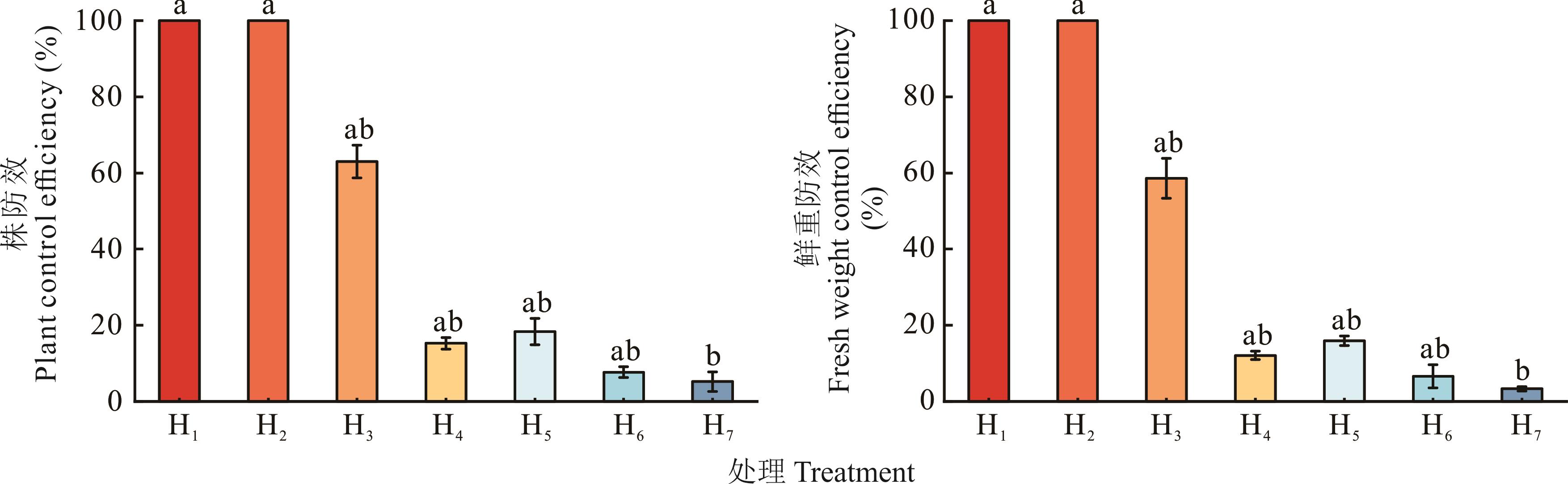
图1 不同除草剂处理对狼毒大戟的株防效和鲜重防效的影响数据为平均值±标准误差,不同小写字母表示不同除草剂间差异显著(P<0.05)The date represent the mean±standard error, different lowercase letters indicate significant differences among herbicides (P<0.05); H1: 三氯吡氧乙酸Triclopyr; H2: 草甘膦Glyphosate; H3: 苯磺隆Tribenuron-methyl; H4: 氯氨吡啶酸Aminopyralid; H5: 氯氟吡氧乙酸Fluroxypyr; H6: 氟磺胺草醚Fomesafen; H7: 乙羧氟草醚Fluoroglycofen-ethyl; 下同The same below.
Fig.1 Control efficiency of different herbicides treatment on plant number and fresh weight of E. fischeriana
| 处理Treatment | 30 d | 360 d |
|---|---|---|
| 三氯吡氧乙酸Triclopyr | 7.92±3.24 | ND |
| 草甘膦Glyphosate | ND | ND |
| 苯磺隆Tribenuron-methyl | ND | ND |
| 氯氨吡啶酸Aminopyralid | ND | ND |
| 氯氟吡氧乙酸Fluroxypyr | ND | ND |
| 氟磺胺草醚Fomesafen | 79.46±18.86 | ND |
| 乙羧氟草醚Fluoroglycofen-ethyl | ND | ND |
表2 施药30和360 d后土壤中7种除草剂的残留量
Table 2 Residues of 7 herbicides in soil at 30 and 360 days after application (ng·g-1)
| 处理Treatment | 30 d | 360 d |
|---|---|---|
| 三氯吡氧乙酸Triclopyr | 7.92±3.24 | ND |
| 草甘膦Glyphosate | ND | ND |
| 苯磺隆Tribenuron-methyl | ND | ND |
| 氯氨吡啶酸Aminopyralid | ND | ND |
| 氯氟吡氧乙酸Fluroxypyr | ND | ND |
| 氟磺胺草醚Fomesafen | 79.46±18.86 | ND |
| 乙羧氟草醚Fluoroglycofen-ethyl | ND | ND |
处理 Treatment | pH | 土壤含水量 Soil water content (%) | 有机质 Organic matter (g·kg-1) | 全氮 Total nitrogen (g·kg-1) | 铵态氮 Ammonium nitrogen (mg·kg-1) | 硝态氮 Nitrate nitrogen (mg·kg-1) | 全磷 Total phosphorus (g·kg-1) | 速效磷 Available phosphorus (g·kg-1) |
|---|---|---|---|---|---|---|---|---|
| CK | 6.31±0.05a | 14.35±1.44a | 54.83±0.78a | 4.13±0.39a | 5.78±0.43a | 13.08±1.61a | 0.46±0.02a | 11.13±1.76a |
| H1 | 6.24±0.05a | 15.15±1.81a | 54.39±0.69a | 3.46±0.33a | 6.29±0.89a | 13.61±0.89a | 0.48±0.02a | 10.16±0.98a |
| H2 | 6.29±0.02a | 16.44±0.89a | 54.98±0.18a | 3.37±0.18a | 6.54±0.25a | 14.92±1.01a | 0.50±0.03a | 12.79±1.75a |
| H3 | 6.24±0.01a | 14.93±2.08a | 54.06±1.11a | 3.52±0.47a | 6.00±0.57a | 11.28±1.80a | 0.45±0.04a | 11.71±1.49a |
| H4 | 6.23±0.05a | 13.69±1.64a | 52.58±0.63a | 3.49±0.43a | 5.58±0.40a | 11.90±1.44a | 0.44±0.02a | 9.76±1.70a |
| H5 | 6.18±0.06a | 14.32±1.19a | 53.43±0.65a | 3.66±0.29a | 5.72±0.34a | 13.49±1.05a | 0.45±0.04a | 11.17±1.42a |
| H6 | 6.16±0.08a | 14.15±0.79a | 54.21±1.01a | 3.32±0.31a | 5.56±0.39a | 13.49±0.89a | 0.44±0.03a | 12.05±1.25a |
| H7 | 6.16±0.04a | 14.44±1.22a | 54.62±0.57a | 3.39±0.42a | 5.53±0.36a | 14.17±1.65a | 0.46±0.03a | 9.95±0.92a |
表3 不同除草剂处理对土壤理化性质的影响
Table 3 Effects of 7 herbicides on soil physicochemical properties
处理 Treatment | pH | 土壤含水量 Soil water content (%) | 有机质 Organic matter (g·kg-1) | 全氮 Total nitrogen (g·kg-1) | 铵态氮 Ammonium nitrogen (mg·kg-1) | 硝态氮 Nitrate nitrogen (mg·kg-1) | 全磷 Total phosphorus (g·kg-1) | 速效磷 Available phosphorus (g·kg-1) |
|---|---|---|---|---|---|---|---|---|
| CK | 6.31±0.05a | 14.35±1.44a | 54.83±0.78a | 4.13±0.39a | 5.78±0.43a | 13.08±1.61a | 0.46±0.02a | 11.13±1.76a |
| H1 | 6.24±0.05a | 15.15±1.81a | 54.39±0.69a | 3.46±0.33a | 6.29±0.89a | 13.61±0.89a | 0.48±0.02a | 10.16±0.98a |
| H2 | 6.29±0.02a | 16.44±0.89a | 54.98±0.18a | 3.37±0.18a | 6.54±0.25a | 14.92±1.01a | 0.50±0.03a | 12.79±1.75a |
| H3 | 6.24±0.01a | 14.93±2.08a | 54.06±1.11a | 3.52±0.47a | 6.00±0.57a | 11.28±1.80a | 0.45±0.04a | 11.71±1.49a |
| H4 | 6.23±0.05a | 13.69±1.64a | 52.58±0.63a | 3.49±0.43a | 5.58±0.40a | 11.90±1.44a | 0.44±0.02a | 9.76±1.70a |
| H5 | 6.18±0.06a | 14.32±1.19a | 53.43±0.65a | 3.66±0.29a | 5.72±0.34a | 13.49±1.05a | 0.45±0.04a | 11.17±1.42a |
| H6 | 6.16±0.08a | 14.15±0.79a | 54.21±1.01a | 3.32±0.31a | 5.56±0.39a | 13.49±0.89a | 0.44±0.03a | 12.05±1.25a |
| H7 | 6.16±0.04a | 14.44±1.22a | 54.62±0.57a | 3.39±0.42a | 5.53±0.36a | 14.17±1.65a | 0.46±0.03a | 9.95±0.92a |
处理 Treatment | β-1,4-葡萄糖苷酶 β-1,4-glucosidase | 过氧化物酶 Peroxidase | 多酚氧化酶 Polyphenol oxidase | N-乙酰-β-D-葡萄糖苷酶 N-acetyl-β-D-glucosaminidase | 脲酶 Urease | 酸性磷酸酶 Acid phosphatase |
|---|---|---|---|---|---|---|
| CK | 1.09±0.06ab | 57.40±2.04a | 10.19±0.77a | 0.33±0.04a | 1.28±0.08ab | 4.24±0.19a |
| H1 | 1.05±0.04bc | 57.90±2.57a | 9.97±0.49a | 0.21±0.05a | 1.17±0.12ab | 3.95±0.20a |
| H2 | 0.85±0.09cd | 57.29±3.38a | 9.29±0.88a | 0.26±0.03a | 0.62±0.03c | 3.98±0.48a |
| H3 | 0.93±0.08bc | 54.48±3.89a | 10.20±1.10a | 0.23±0.07a | 1.53±0.19a | 4.07±0.40a |
| H4 | 1.01±0.11bc | 46.86±2.62a | 9.70±0.70a | 0.25±0.04a | 1.26±0.21ab | 4.19±0.45a |
| H5 | 1.04±0.04ab | 48.79±1.59a | 10.38±0.82a | 0.26±0.01a | 1.16±0.12ab | 4.24±0.39a |
| H6 | 0.72±0.06d | 52.08±5.87a | 11.08±0.49a | 0.21±0.02a | 1.04±0.08b | 3.87±0.37a |
| H7 | 1.28±0.05a | 54.73±3.00a | 9.30±1.01a | 0.25±0.04a | 1.20±0.15ab | 4.66±0.11a |
表4 不同除草剂处理对土壤酶活性的影响
Table 4 Effects of different herbicide treatments on soil enzyme activities (mg·d-1·g-1)
处理 Treatment | β-1,4-葡萄糖苷酶 β-1,4-glucosidase | 过氧化物酶 Peroxidase | 多酚氧化酶 Polyphenol oxidase | N-乙酰-β-D-葡萄糖苷酶 N-acetyl-β-D-glucosaminidase | 脲酶 Urease | 酸性磷酸酶 Acid phosphatase |
|---|---|---|---|---|---|---|
| CK | 1.09±0.06ab | 57.40±2.04a | 10.19±0.77a | 0.33±0.04a | 1.28±0.08ab | 4.24±0.19a |
| H1 | 1.05±0.04bc | 57.90±2.57a | 9.97±0.49a | 0.21±0.05a | 1.17±0.12ab | 3.95±0.20a |
| H2 | 0.85±0.09cd | 57.29±3.38a | 9.29±0.88a | 0.26±0.03a | 0.62±0.03c | 3.98±0.48a |
| H3 | 0.93±0.08bc | 54.48±3.89a | 10.20±1.10a | 0.23±0.07a | 1.53±0.19a | 4.07±0.40a |
| H4 | 1.01±0.11bc | 46.86±2.62a | 9.70±0.70a | 0.25±0.04a | 1.26±0.21ab | 4.19±0.45a |
| H5 | 1.04±0.04ab | 48.79±1.59a | 10.38±0.82a | 0.26±0.01a | 1.16±0.12ab | 4.24±0.39a |
| H6 | 0.72±0.06d | 52.08±5.87a | 11.08±0.49a | 0.21±0.02a | 1.04±0.08b | 3.87±0.37a |
| H7 | 1.28±0.05a | 54.73±3.00a | 9.30±1.01a | 0.25±0.04a | 1.20±0.15ab | 4.66±0.11a |

图2 不同除草剂处理下细菌和真菌群落在门和属水平上的相对丰度CK: 清水对照The clear water control; 下同The same below.
Fig.2 Relative abundance of bacterial and fungal communities at phylum and genus levels under different herbicide treatments

图3 不同除草剂处理下土壤细菌和真菌的α多样性
Fig.3 Alpha diversity of soil bacteria and fungi under different herbicide treatments
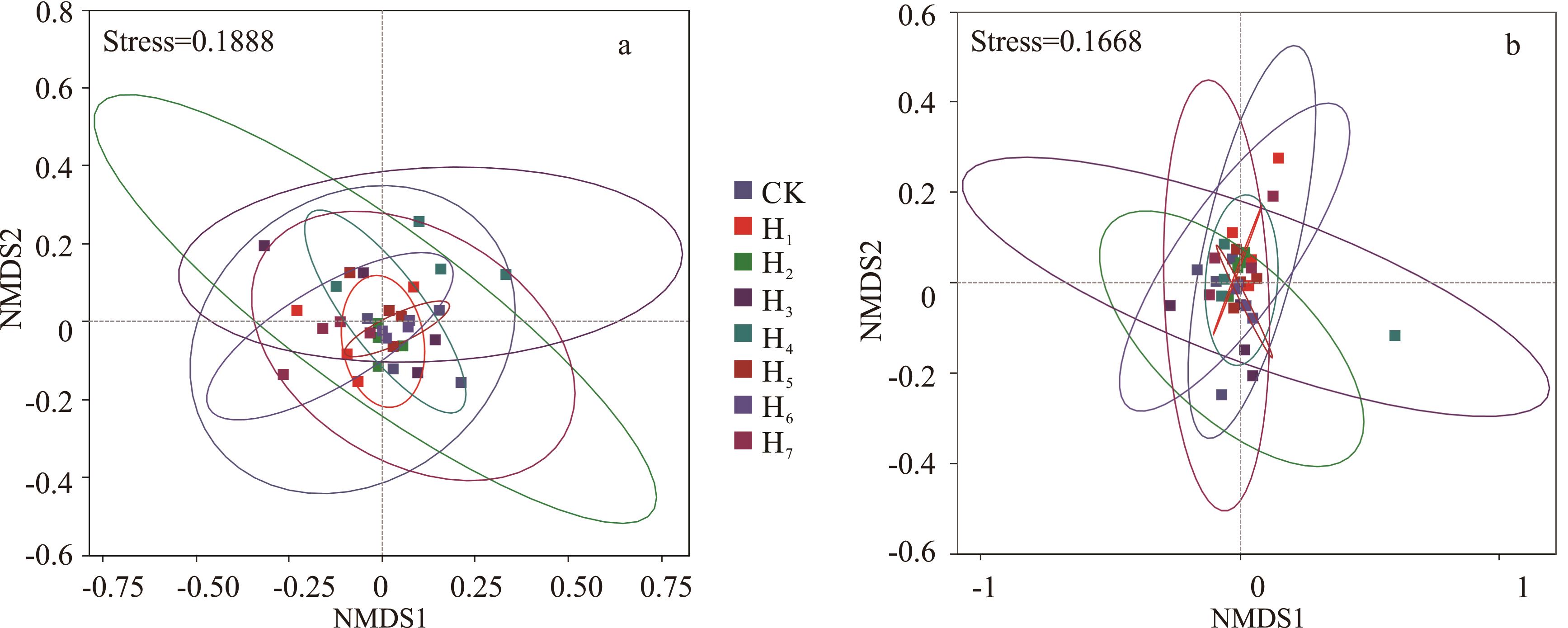
图4 不同除草剂处理下土壤细菌(a)和真菌(b)的β多样性
Fig.4 β-diversity of soil bacteria (a) and fungi (b) under different herbicide treatments

图5 不同除草剂处理下土壤细菌(a)和真菌(b)群落LEfSe分析p: 门Phylum; c: 纲Class; o: 目Order; f: 科Family; g: 属Genus; Ilumatobacteraceae: 发光杆菌科; Microtrichales: 微丝菌目; Gaiella: 盖氏菌属; Gaiellaceae: 盖氏菌科; Peribacillus: 近芽孢杆菌属; Bacillaceae: 芽孢杆菌科; Flavisolibacter: 黄溶杆菌属; Terrimonas: Terrimonas属; Phycisphaerae: 藻状菌纲; Planctomycetota: 浮霉菌门; Rhodoplanes: 红浮菌属; Unclassified_A21b: A21b属未分类; A21b: A21b科; Ellin6067: Ellin6067属; Unclassified_SC_I_84: SC-I-84属未分类; SC_I_84: SC-I-84科; Didymella: 亚隔孢壳属; Didymellaceae: 亚隔孢壳科; Sporormiella: 荚孢腔属; Pleosporales: 格孢腔菌目; Dothideomycetes: 座囊菌纲; Arachnomyces: Arachnomyces属; Arachnomycetaceae: Arachnomycetaceae科; Podosphaera: 单囊壳属; Erysiphaceae: 白粉菌科; Erysiphales: 白粉菌目; Lecythophora: 烧瓶状霉属; Coniochaetaceae: 毛孢壳科; Coniochaetales: 毛孢壳目; Metarhizium: 绿僵菌属; Clavicipitaceae: 麦角菌科; Dactylonectria: 指壳菌属; Llyonectria: 土赤壳属; Magnaporthaceae: 巨座壳科; Parachaetomium: Parachaetomium属; Chaetomiaceae: 毛壳菌科; Lasiosphaeriaceae: 毛球壳科; Sordariales: 粪壳菌目; Macrolepiota: 大环柄菇属; Clavariaceae: 珊瑚菌科; Rhizophlyctidales_gen_Incertae_sedis: 根泡菌目地位未定属; Rhizophlyctidales_fam_Incertae_sedis: 根泡菌目地位未定科; Gallinipes: Gallinipes属; Spizellomycetales_gen_Incertae_sedis: 小瓶菌目地位未定属; Spizellomycetales_fam_Incertae_sedis: 小瓶菌目地位未定科; Spizellomycetales: 小瓶菌目; Spizellomycetes: 小瓶菌纲; Chytridiomycota: 壶菌门.
Fig.5 LEfSe analysis of soil bacterial (a) and fungal (b) communities under different herbicide treatments

图6 不同除草剂处理下属水平优势物种与土壤因子的相关分析SWC: 土壤含水率 Soil water content; SOM: 有机质 Soil organic matter; TN: 全氮 Total nitrogen; NH4+-N: 铵态氮 Ammonium nitrogen; NO3--N: 硝态氮 Nitrate nitrogen; TP: 全磷 Total phosphorus; AP: 速效磷 Available phosphorus; BG: β-1,4-葡萄糖苷酶 β-1,4-glucosidase; PER: 过氧化物酶 Peroxidase; PPO: 多酚氧化酶 Polyphenol oxidase; NAG: N-乙酰-β-D-葡萄糖苷酶 N-acetyl-β-D-glucosaminidase; UE: 脲酶 Urease; ACP: 酸性磷酸酶 Acid phosphatase; *: P<0.05,**: P<0.01; 红色为正相关,蓝色为负相关,用颜色深浅来表示相关性强弱Red indicates a positive correlation, blue denotes a negative correlation, with the intensity of colour representing the strength of the relationship.
Fig.6 Correlation analysis between dominant species at the genus level and soil factors under different herbicide treatments
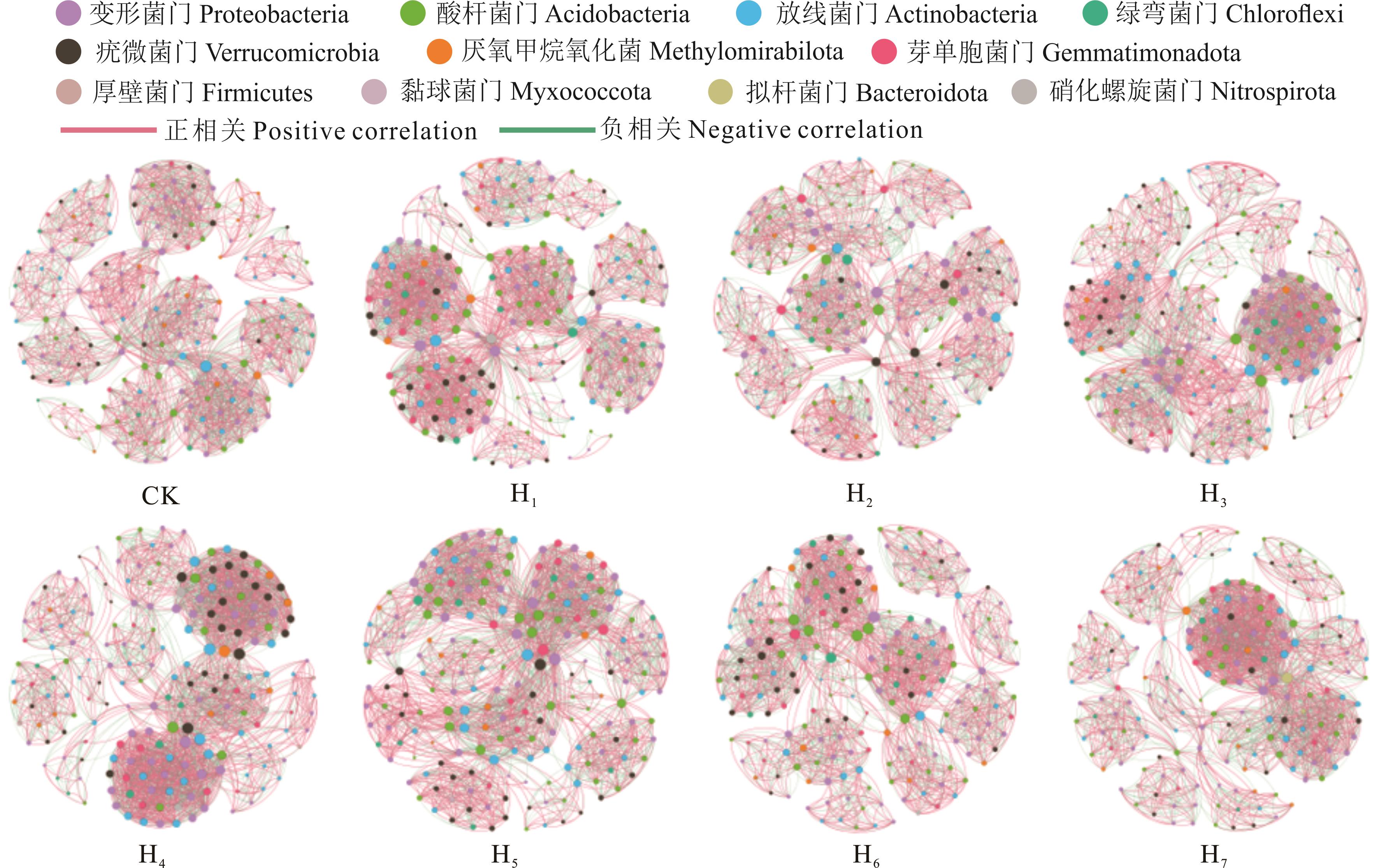
图7 不同除草剂处理下土壤细菌分类学(门)的共现性网络
Fig.7 Co-occurrence network of soil bacterial taxa at the phylum level under different herbicide treatments

图8 不同除草剂处理下土壤真菌分类学(门)的共现性网络
Fig.8 Co-occurrence network of soil fungal taxa at the phylum level under different herbicide treatments
| 拓扑参数Topological properties | CK | H1 | H2 | H3 | H4 | H5 | H6 | H7 |
|---|---|---|---|---|---|---|---|---|
| 节点数Total nodes | 200 | 200 | 200 | 200 | 200 | 200 | 200 | 200 |
| 边数Total edges | 2139 | 2399 | 2097 | 2318 | 2655 | 2445 | 2186 | 2325 |
| 正相关占比Proportion of positive edges (%) | 50.94 | 54.31 | 51.55 | 53.49 | 54.65 | 52.60 | 54.71 | 52.69 |
| 负相关占比Proportion of negative edges (%) | 48.06 | 45.69 | 48.45 | 46.51 | 45.35 | 47.40 | 45.29 | 47.31 |
| 网络直径Network diameter | 6 | 6 | 6 | 6 | 7 | 6 | 8 | 6 |
| 平均度Average degree | 21.39 | 23.99 | 20.97 | 23.18 | 26.55 | 24.45 | 21.86 | 23.25 |
| 平均路径长度Average path length | 3.01 | 2.84 | 3.04 | 2.78 | 3.07 | 2.87 | 3.54 | 2.99 |
| 平均聚类系数Average clustering coefficient | 0.95 | 0.96 | 0.94 | 0.94 | 0.94 | 0.93 | 0.94 | 0.95 |
表5 不同除草剂处理下土壤细菌网络拓扑结构
Table 5 Topological structure of soil bacterial network under different herbicide treatments
| 拓扑参数Topological properties | CK | H1 | H2 | H3 | H4 | H5 | H6 | H7 |
|---|---|---|---|---|---|---|---|---|
| 节点数Total nodes | 200 | 200 | 200 | 200 | 200 | 200 | 200 | 200 |
| 边数Total edges | 2139 | 2399 | 2097 | 2318 | 2655 | 2445 | 2186 | 2325 |
| 正相关占比Proportion of positive edges (%) | 50.94 | 54.31 | 51.55 | 53.49 | 54.65 | 52.60 | 54.71 | 52.69 |
| 负相关占比Proportion of negative edges (%) | 48.06 | 45.69 | 48.45 | 46.51 | 45.35 | 47.40 | 45.29 | 47.31 |
| 网络直径Network diameter | 6 | 6 | 6 | 6 | 7 | 6 | 8 | 6 |
| 平均度Average degree | 21.39 | 23.99 | 20.97 | 23.18 | 26.55 | 24.45 | 21.86 | 23.25 |
| 平均路径长度Average path length | 3.01 | 2.84 | 3.04 | 2.78 | 3.07 | 2.87 | 3.54 | 2.99 |
| 平均聚类系数Average clustering coefficient | 0.95 | 0.96 | 0.94 | 0.94 | 0.94 | 0.93 | 0.94 | 0.95 |
| 拓扑参数Topological properties | CK | H1 | H2 | H3 | H4 | H5 | H6 | H7 |
|---|---|---|---|---|---|---|---|---|
| 节点数Total nodes | 200 | 200 | 200 | 200 | 200 | 200 | 200 | 200 |
| 边数Total edges | 2388 | 2351 | 2420 | 2477 | 2697 | 2382 | 2956 | 2888 |
| 正相关占比Proportion of positive edges (%) | 67.46 | 68.61 | 62.27 | 75.70 | 69.00 | 71.24 | 67.12 | 72.23 |
| 负相关占比Proportion of negative edges (%) | 32.54 | 31.39 | 37.73 | 24.30 | 31.00 | 28.76 | 32.88 | 27.77 |
| 网络直径Network diameter | 5 | 5 | 5 | 5 | 5 | 5 | 5 | 5 |
| 平均度Average degree | 23.88 | 23.51 | 24.20 | 24.77 | 26.97 | 23.82 | 29.56 | 28.88 |
| 平均路径长度Average path length | 2.72 | 2.74 | 2.91 | 2.74 | 2.72 | 2.68 | 2.63 | 2.57 |
| 平均聚类系数Average clustering coefficient | 0.84 | 0.85 | 0.84 | 0.87 | 0.82 | 0.86 | 0.85 | 0.82 |
表6 不同除草剂处理下土壤真菌网络拓扑结构
Table 6 Topological structure of soil fungal network under different herbicide treatments
| 拓扑参数Topological properties | CK | H1 | H2 | H3 | H4 | H5 | H6 | H7 |
|---|---|---|---|---|---|---|---|---|
| 节点数Total nodes | 200 | 200 | 200 | 200 | 200 | 200 | 200 | 200 |
| 边数Total edges | 2388 | 2351 | 2420 | 2477 | 2697 | 2382 | 2956 | 2888 |
| 正相关占比Proportion of positive edges (%) | 67.46 | 68.61 | 62.27 | 75.70 | 69.00 | 71.24 | 67.12 | 72.23 |
| 负相关占比Proportion of negative edges (%) | 32.54 | 31.39 | 37.73 | 24.30 | 31.00 | 28.76 | 32.88 | 27.77 |
| 网络直径Network diameter | 5 | 5 | 5 | 5 | 5 | 5 | 5 | 5 |
| 平均度Average degree | 23.88 | 23.51 | 24.20 | 24.77 | 26.97 | 23.82 | 29.56 | 28.88 |
| 平均路径长度Average path length | 2.72 | 2.74 | 2.91 | 2.74 | 2.72 | 2.68 | 2.63 | 2.57 |
| 平均聚类系数Average clustering coefficient | 0.84 | 0.85 | 0.84 | 0.87 | 0.82 | 0.86 | 0.85 | 0.82 |

图9 不同除草剂处理下土壤细菌与真菌群落构建a: 细菌群落βNTI值βNTI values of bacterial communities; b: 细菌群落构建图Bacterial community assembly diagram; c: 真菌群落βNTI值βNTI values of fungal communities; d: 真菌群落构建图Fungal community assembly diagram.
Fig.9 Soil bacterial and fungal community assembly under different herbicide treatments
| [1] | Xie W X. The study on extraction, purification, identification, antitumor and antibacterial effects of terpenoids in Euphorbia fischeriana. Guangzhou: Guangdong University of Technology, 2015. |
| 谢文仙. 狼毒大戟三萜的提取纯化、鉴定与抑瘤抑菌等作用研究. 广州: 广东工业大学, 2015. | |
| [2] | Wang Y X, Wang Z F, Cheng Y X, et al. The roles of toxic and harmful grass in grassland agro-ecosystems. Pratacultural Science, 2014, 31(3): 381-387. |
| 王迎新, 王召锋, 程云湘, 等. 浅议毒害草在草地农业生态系统中的作用. 草业科学, 2014, 31(3): 381-387. | |
| [3] | Deng Y Y. Secondary metabolites of three plants and their biological functions. Shenyang: Shenyang Agricultural University, 2019. |
| 邓彦彦. 三种植物的次生代谢产物及生物功能研究. 沈阳: 沈阳农业大学, 2019. | |
| [4] | Peng F H. Study on the diversity and spatial distribution pattern of three common poisonous plants in meadow grassland of Dumont County. Daqing: Heilongjiang Bayi Agricultural University, 2019. |
| 彭芳华. 杜蒙县草甸草原三种常见有毒植物多样性及空间分布格局研究. 大庆: 黑龙江八一农垦大学, 2019. | |
| [5] | Wen L, Dong S K, Li Y Y, et al. The effects of biotic and abiotic factors on the spatial heterogeneity of alpine grassland vegetation at a small scale on the Qinghai-Tibet Plateau (QTP), China. Environmental Monitoring and Assessment, 2013, 185(10): 8051-8064. |
| [6] | Ao T G, Xiao Y Z, Sun L, et al. Present situation, problems and sustainable development measures of Hulunbuir forage industry. Acta Agrestia Sinica, 2024, 32(3): 661-666. |
| 敖特根, 肖燕子, 孙林, 等. 呼伦贝尔饲草产业发展现状、问题与可持续发展对策. 草地学报, 2024, 32(3): 661-666. | |
| [7] | Zhu B B, Wei J, Sun S H, et al. Distribution and prevention and control practice of common poisonous grasses in Hulunbuir grassland. Journal of Grassland and Forage Science, 2025, 46(3): 48-51. |
| 朱宾宾, 伟军, 孙双红, 等. 呼伦贝尔草原常见毒害草区域分布与防控实践. 草学, 2025, 46(3): 48-51. | |
| [8] | Shi Y X, He J, Zhang J, et al. Chemical constituents of Euphorbia fischeriana. Chinese Traditional and Herbal Drugs, 2020, 51(8): 2107-2111. |
| 史影雪, 赫军, 张佳, 等. 狼毒大戟化学成分研究. 中草药, 2020, 51(8): 2107-2111. | |
| [9] | Wei J C, Gao Y N, Huang H H, et al. Euphorfinoids A and B, a pair of ent-atisane diterpenoid epimers from the roots of Euphorbia fischeriana, and their bioactivities. Natural Product Research, 2023, 37(8): 1300-1309. |
| [10] | Chi X X, Ma C Y, Zou Z H, et al. Efficacy test of five types of chemical herbicides on Euphorbia fisheriana. Journal of Weed Science, 2017, 35(2): 55-60. |
| 迟晓雪, 马崇勇, 邹志和, 等. 5种化学除草剂防除狼毒大戟药效试验. 杂草学报, 2017, 35(2): 55-60. | |
| [11] | Guo T, Yu Z H, Xue Y, et al. Screening and safety evaluation of herbicides for weed control in tobacco fields in Guizhou. Journal of Henan Agricultural Sciences, 2024, 53(5): 112-122. |
| 郭涛, 余知和, 薛原, 等. 贵州烟田杂草防控除草剂筛选与安全性评价. 河南农业科学, 2024, 53(5): 112-122. | |
| [12] | Yu H Y, Li L X. Study on influence of applying herbicide to control Ligularia virgaurea on grassland vegetation. Qinghai Prataculture, 2018, 27(1): 7-10. |
| 于红妍, 李林霞. 防除草地黄帚橐吾药剂筛选试验研究. 青海草业, 2018, 27(1): 7-10. | |
| [13] | Chen C, Wang Q H, Mo C H, et al. Control efficiency of forefront on Oxytropis ochrocephala and its influence on rangeland vegetation. Grassland and Turf, 2015, 35(3): 72-77. |
| 陈超, 王庆海, 莫重辉, 等. 迈士通除草剂对天然草地毒草黄花棘豆的防除效果及其植被的影响. 草原与草坪, 2015, 35(3): 72-77. | |
| [14] | Pang N N, Cui Y, Hu J Y. Weather dependent dynamics of the herbicides florasulam, carfentrazone-ethyl, fluroxypyr-meptyl and fluroxypyr in wheat fields through field studies and computational simulation. Chemosphere, 2016, 165(1): 320-328. |
| [15] | Gao L, Ding Y. Progress in research and practice of restoration of degraded grassland around the world. Acta Prataculturae Sinica, 2022, 31(10): 189-205. |
| 高丽, 丁勇. 世界退化草地恢复研究和实践进展. 草业学报, 2022, 31(10): 189-205. | |
| [16] | Thiour-Mauprivez C, Martin-Laurent F, Calvayrac C, et al. Effects of herbicide on non-target microorganisms: Towards a new class of biomarkers? Science of the Total Environment, 2019, 684: 314-325. |
| [17] | Bulgarelli D, Garrido-Oter R, Münch P C, et al. Structure and function of the bacterial root microbiota in wild and domesticated barley. Cell Host & Microbe, 2015, 17(3): 392-403. |
| [18] | Ma Q Y, Li Q Q, Wang J, et al. Exposure to three herbicide mixtures influenced maize root-associated microbial community structure, function and the network complexity. Environmental Pollution, 2023, 336(11): 1-17. |
| [19] | Yang Y S. Application of biological weeding bacteria in Camellia oleiferaforest and effect on soil health. Changsha: Central South University of Forestry and Technology, 2025. |
| 杨昱晟. 生物除草菌在油茶林中的应用及其对土壤健康的影响. 长沙: 中南林业科技大学, 2025. | |
| [20] | Zhang H P, Zhang Z H, Song J J, et al. Reduced bacterial network complexity in agricultural soils after application of the neonicotinoid insecticide thiamethoxam. Environmental Pollution, 2021, 274(96): 157-164. |
| [21] | Tomco P L, Duddleston K N, Schultz E J, et al. Field degradation of aminopyralid and clopyralid and microbial community response to application in Alaskan soils. Environmental Toxicology and Chemistry, 2016, 35(2): 485-493. |
| [22] | Sibalekile A, Araya T, Hernandez J C, et al. Glyphosate-microbial interactions: Metagenomic insights and future directions. Frontiers in Microbiology, 2025, 16(16): 1570235. |
| [23] | Liu M M, Kang S, Yao C. Research progress of QuEChERS method in pesticide mult-residue analysis. Chinese Journal of Pesticide Science, 2013, 15(1): 8-22. |
| 刘满满, 康澍, 姚成. QuEChERS方法在农药多残留检测中的应用研究进展. 农药学学报, 2013, 15(1): 8-22. | |
| [24] | Bao S D. Soil analysis in agricultural chemistry. Beijing: China Agriculture Press, 2008. |
| 鲍士旦. 土壤农业化学分析(第三版). 北京: 中国农业出版社, 2008. | |
| [25] | Chen Y Z, Chang Y N, Sun J, et al. Effects of long-term nitrogen application on soil bacterial community structure, functional groups, and assembly processes in tea gardens. Environmental Science, 2025, 41(83): 1-20. |
| 陈玉真, 常云妮, 孙君, 等. 长期施氮对茶园土壤细菌群落结构、功能类群及群落构建的影响. 环境科学, 2025, 41(83): 1-20. | |
| [26] | Wu X, Wang J T, Liu Y X, et al. Effects of quinclorac on tobacco growth and bacterial community in rhizosphere soil. Southwest China Journal of Agricultural Sciences, 2025, 38(4): 809-819. |
| 吴曦, 王继婷, 刘艳霞, 等. 二氯喹啉酸对烟草生长与根际土壤细菌群落的影响. 西南农业学报, 2025, 38(4): 809-819. | |
| [27] | Wang L, Hamel C, Lu P A, et al. Using enzyme activities as an indicator of soil fertility in grassland-an academic dilemma. Frontiers in Plant Science, 2023, 14: 1175946. |
| [28] | Mei J Y, Gan D B, Zhu E Y, et al. Research progress on soil enzyme activity of Eucalyptus plantation. South China Forestry Science, 2021, 49(4): 42-46. |
| 梅嘉仪, 甘东波, 朱恩永, 等. 桉树人工林土壤酶活性研究进展. 南方林业科学, 2021, 49(4): 42-46. | |
| [29] | Zhou X G, Zuo X Q, Wen Y G, et al. Effects of herbicide on understory plant and soil microbial communities in Eucalyptus plantations. Acta Ecologica Sinica, 2021, 41(17): 6749-6763. |
| 周晓果, 左晓庆, 温远光, 等. 除草剂对桉树人工林下植物及土壤微生物群落的影响. 生态学报, 2021, 41(17): 6749-6763. | |
| [30] | Wang Z D, Liu G Y, Yu Y, et al. Effects of glyphosate herbicide on the activities of soil enzyme. Journal of Henan Institute of Science and Technology (Natural Science Edition), 2020, 48(6): 37-42. |
| 王振东, 刘根源, 余阳, 等. 草甘膦对土壤酶活性的影响. 河南科技学院学报(自然科学版), 2020, 48(6): 37-42. | |
| [31] | Zhang Q M, Zhu L, Wang J, et al. Effects of fomesafen on soil enzyme activity, microbial population, and bacterial community composition. Environmental Monitoring & Assessment, 2014, 186(5): 2801-2812. |
| [32] | Cheng F S, You L H, Yu J L, et al. Effects of cold-season green manure on soil biochemical properties and the microbial community in a Castanea henryi orchard, China. Acta Prataculturae Sinica, 2021, 30(11): 62-75. |
| 程分生, 尤龙辉, 余锦林, 等. 冷季型绿肥对锥栗园土壤生化性质及微生物群落的影响. 草业学报, 2021, 30(11): 62-75. | |
| [33] | Bais H P, Weir T L, Perry L G, et al. The role of root exudates in rhizosphere interations with plants and other organisms. Annual Review of Plant Biology, 2006, 57: 233-266. |
| [34] | Kuzyakov Y. Priming effects: Interactions between living and dead organic matter. Soil Biology & Biochemistry, 2010, 42(9): 1363-1371. |
| [35] | Chen W M, Xu L L, Wu J J, et al. Effect of two pyridine herbicides on Stelleropsis tianschanica community and evaluation on yield and selectivity to gramineous pastures. Journal of Weed Science, 2016, 34(1): 43-46, 48-49. |
| 陈卫民, 徐林林, 吴加军, 等. 2种吡啶类除草剂对天山假狼毒群落影响和禾本科牧草产草量及安全性评价. 杂草学报, 2016, 34(1): 43-46, 48-49. | |
| [36] | Burns R G, DeForest J L, Marxsen J, et al. Soil enzymes in a changing environment: Current knowledge and future directions. Soil Biology & Biochemistry, 2013, 58(63): 216-234. |
| [37] | Wang Y H, Du L W, Liu H J, et al. Halosulfuron methyl did not have a significant effect on diversity and community of sugarcane rhizosphere microflora. Journal of Hazardous Materials, 2020, 399(6): 123040. |
| [38] | She C C, Huang Y J, Xiao B, et al. Spatial differentiation characteristics of soil bacterial communities in the eastern Inner Mongolia grassland and their driving factors. Journal of Northeast Forestry University, 2025, 53(4): 126-134. |
| 佘长超, 黄月军, 肖兵, 等. 内蒙古东部草原土壤细菌群落空间分异特征及其驱动因子. 东北林业大学学报, 2025, 53(4): 126-134. | |
| [39] | Xu W H, Xu H M, Delgado-Baquerizo M, et al. Global meta-analysis reveals positive effects of biochar on soil microbial diversity. Geoderma, 2023, 436(70): 116528. |
| [40] | Chen L, Zhou S W, Yang L L, et al. Effects of different intercropping models on quality and soil environmental factors of Atractylodes lancea. Chinese Archives of Traditional Chinese Medicine, 2025, 58(24): 1-19. |
| 陈璐, 周省委, 杨林林, 等. 不同间作模式对茅苍术质量及土壤环境因子的影响. 中华中医药学刊, 2025, 58(24): 1-19. | |
| [41] | Lu N, Gao W Q, Wang H Y, et al. The latitudinal distribution characteristics of soil bacterial communities in Larixgmelinii var. principis-rupprechtii plantations and the influencing factors. Acta Ecologica Sinica, 2026, 33(6): 1-16. |
| 卢佞, 高文强, 王海燕, 等. 华北落叶松人工林土壤细菌群落的纬度分布特征及其影响因素. 生态学报, 2026, 33(6): 1-16. | |
| [42] | Brewer T E, Handley K M, Carini P, et al. Genome reduction in an abundant and ubiquitous soil bacterium ‘Candidatus Udaeobacter copiosus’. Nature Microbiology, 2017, 2(2): 16198. |
| [43] | Hu L. Effects of composite soil amendments on the improvement of shajiang black soil and wheat growth. Hefei: Hefei University, 2025. |
| 胡亮. 复合改良剂对砂姜黑土改良及小麦生长的影响. 合肥: 合肥大学, 2025. | |
| [44] | Stone B W, Li J H, Koch B J, et al. Nutrients cause consolidation of soil carbon flux to small proportion of bacterial community. Nature Communications, 2021, 12(1): 121-127. |
| [45] | Wei Z B. Study on the coordinated regulation mechanism of inhibitor combined with organic materials on brown soil microorganisms and maize yield. Shenyang: Shenyang Agricultural University, 2025. |
| 魏占波. 抑制剂配伍有机物料对棕壤微生物-玉米产量协同调控机制研究. 沈阳: 沈阳农业大学, 2025. | |
| [46] | Blackwood C B, Waldrop M P, Zak D R, et al. Molecular analysis of fungal communities and laccase genes in decomposing litter reveals differences among forest types but no impact of nitrogen deposition. Environmental Microbiology, 2007, 9(5): 1306-1316. |
| [47] | Zhang X Y. Effects of salinity stress on microbial carbon metabolism characteristics of constructed wetland substrate and its functional mechanism. Jinan: Shandong University, 2024. |
| 张昕怡. 盐度胁迫对人工湿地基质微生物碳代谢特征的影响及其作用机制研究. 济南: 山东大学, 2024. | |
| [48] | Li W X, Wang K B, Wang P L, et al. Impact of glyphosate on soil bacterial communities and degradation mechanisms in large-leaf tea plantations. Journal of Hazardous Materials, 2025, 483: 57-59. |
| [49] | Zhang Z L, Li X Q, Wang H, et al. Preliminary studies on synergism and mechanisms of six organosilicon additives on fomesafen. Chinese Journal of Pesticide Science, 2015, 17(1): 115-118. |
| 张忠亮, 李相全, 王欢, 等. 六种有机硅助剂对氟磺胺草醚的增效作用及其增效机理初探. 农药学学报, 2015, 17(1): 115-118. | |
| [50] | Mori A S, Isbell F, Seidl R. β-diversity, community assembly, and ecosystem functioning. Trends in Ecology & Evolution, 2018, 33(7): 549-564. |
| [1] | 杨陶阳, 苏日力格, 乌日力格, 姜娜, 杨殿林, 红梅, 张海芳, 赵建宁. 狼毒大戟的化学防除效果及对其他植物群落的影响[J]. 草业学报, 2026, 35(9): 129-141. |
| [2] | 王涛, 李静, 卢强, 柯文灿, 黄帅. 蒲公英黄酮和枯草芽孢杆菌对燕麦青贮品质、抗氧化活性及微生物群落结构的影响[J]. 草业学报, 2026, 35(6): 108-121. |
| [3] | 田吉鹏, 王欣, Mudasir Nazar, 刘蓓一, 王思然, 丁成龙, 程云辉, 李捷. 青贮前后水稻秸秆非结构性碳水化合物的变化及添加剂对发酵和微生物群落结构的影响[J]. 草业学报, 2026, 35(6): 131-144. |
| [4] | 刘瞳, 苏日力格null, 姜娜, 庞波, 乌日力格null, 杨陶阳, 张海芳, 赵建宁, 杨殿林. 狼毒大戟扩散对呼伦贝尔草原植物群落演替及土壤理化性质的影响[J]. 草业学报, 2026, 35(5): 72-84. |
| [5] | 石盼洋, 赵文勤, 董建瑞, 曹赛, 李予霞, 李桂芳. 土壤微生态因子对伊贝母药用品质的影响[J]. 草业学报, 2026, 35(3): 158-169. |
| [6] | 苏日力格, 杨陶阳, 乌日力格, 姜娜, 杨殿林, 张海芳, 苏日古嘎. 刈割对呼伦贝尔草原有毒植物狼毒大戟主要功能性状的影响[J]. 草业学报, 2026, 35(11): 119-131. |
| [7] | 罗叙, 马慧, 韩翠, 赵雅欣, 赵莹, 谢应忠, 李建平. 地上净初级生产力对植物物种丰富度的响应及影响因子分析[J]. 草业学报, 2025, 34(9): 26-37. |
| [8] | 张琨, 乔建霞, 李金升, 王育鹏, 刘克思. 不同修复材料对退化高寒草地土壤理化性质及微生物群落的影响[J]. 草业学报, 2025, 34(8): 132-148. |
| [9] | 李若璇, 李升郅粲, 陈奕彤, 孙雨豪, 杨培志, 崔彦农, 龙明秀, 何树斌. 保护播种下紫花苜蓿根际土壤氨氧化和反硝化微生物群落对糜子种植比例变化的响应[J]. 草业学报, 2025, 34(6): 110-121. |
| [10] | 邓文辉, 宋珂辰, 张浩, 管思雨, 雍嘉仪, 胡海英. 降水变化条件下荒漠草原优势植物根际微生物群落结构和多样性特征研究[J]. 草业学报, 2025, 34(5): 12-26. |
| [11] | 尚栋亮, 臧辉. 成坪高尔夫草坪上一年生早熟禾的化学防除研究进展[J]. 草业学报, 2025, 34(5): 223-236. |
| [12] | 涂晓东, 崔俊芳, 况福虹, 李春培, 杜玖珍, 王红兰, 唐翔宇. 川西北高寒草甸转为耕地对土壤微生物群落的影响[J]. 草业学报, 2025, 34(2): 54-66. |
| [13] | 李春艳, 王钱进, 周芯合, 曹文静, 赵梦丽, 虞方伯. Burkholderia sp. SX9菌剂对白三叶生长和改良土壤的影响[J]. 草业学报, 2025, 34(11): 53-65. |
| [14] | 李争艳, 徐智明, 李岩, 李杨. 江淮地区苜蓿短期连作对后作高丹草生长及土壤微环境的影响[J]. 草业学报, 2024, 33(9): 155-168. |
| [15] | 赵杰, 尹雪敬, 王思然, 董志浩, 李君风, 贾玉山, 邵涛. 贮藏时间对甜高粱青贮发酵品质、微生物群落组成和功能的影响[J]. 草业学报, 2023, 32(8): 164-175. |
| 阅读次数 | ||||||
|
全文 |
|
|||||
|
摘要 |
|
|||||
