
ISSN 1004-5759 CN 62-1105/S
Acta Prataculturae Sinica ›› 2025, Vol. 34 ›› Issue (5): 146-158.DOI: 10.11686/cyxb2024224
Kai MAO1( ), Yi XU1, Xue-mei WANG1, Huan CHAI1, Shuai HUANG1, Jian WANG1, Shu-qian HUAN1, Zhu YU2, Mu-sen WANG1()
Received:2024-06-11
Revised:2024-08-30
Online:2025-05-20
Published:2025-03-20
Contact:
Mu-sen WANG
Kai MAO, Yi XU, Xue-mei WANG, Huan CHAI, Shuai HUANG, Jian WANG, Shu-qian HUAN, Zhu YU, Mu-sen WANG. Effect of Lactiplantibacillus plantarum and molasses on the fermentation quality, biogenic amines contents and bacterial community of peanut vine silage[J]. Acta Prataculturae Sinica, 2025, 34(5): 146-158.
氨态氮/总氮 Ammonia-N/total nitrogen (%) | 乙酸+丙酸 Acetic acid and propionic acid | 丁酸及其他挥发性脂肪酸 Butyric acid and other volatile fatty acids | V-score评分 V-score scoring | |||
|---|---|---|---|---|---|---|
| XN | 计算式Formula (YN) | XA | 计算式Formula (YA) | XB | 计算式Formula (YB) | |
| ≤5 | YN=50 | ≤0.2 | YA=10 | 0~0.5 | YB=40-80XB | Y=YN+YA+YB |
| 5~10 | YN=60-2XN | 0.2~1.5 | YA=(150-100XA)/13 | >0.5 | 0 | |
| 10~20 | YN=80-4XN | >1.5 | YA=0 | |||
| >20 | YN=0 | |||||
Table 1 V-score scoring criteria
氨态氮/总氮 Ammonia-N/total nitrogen (%) | 乙酸+丙酸 Acetic acid and propionic acid | 丁酸及其他挥发性脂肪酸 Butyric acid and other volatile fatty acids | V-score评分 V-score scoring | |||
|---|---|---|---|---|---|---|
| XN | 计算式Formula (YN) | XA | 计算式Formula (YA) | XB | 计算式Formula (YB) | |
| ≤5 | YN=50 | ≤0.2 | YA=10 | 0~0.5 | YB=40-80XB | Y=YN+YA+YB |
| 5~10 | YN=60-2XN | 0.2~1.5 | YA=(150-100XA)/13 | >0.5 | 0 | |
| 10~20 | YN=80-4XN | >1.5 | YA=0 | |||
| >20 | YN=0 | |||||
| 项目Items | 含量Content |
|---|---|
| 干物质DM (g·kg-1 FM) | 292.83 |
| 粗蛋白CP (g·kg-1 DM) | 169.69 |
| 氨态氮Ammonia-N (g·kg-1 TN) | 7.02 |
| 游离氨基酸氮FAA-N (g·kg-1 TN) | 4.99 |
| 水溶性碳水化合物WSC (g·kg-1 DM) | 29.71 |
| pH | 5.90 |
| 中性洗涤纤维NDF (g·kg-1 DM) | 376.90 |
| 酸性洗涤纤维ADF (g·kg-1 DM) | 239.05 |
| 相对饲用价值RFV | 173.40 |
| 组胺Histamine (mg·kg-1 DM) | 0.00 |
| 腐胺Putrescine (mg·kg-1 DM) | 9.70 |
| 尸胺Cadaverine (mg·kg-1 DM) | 10.49 |
| 亚精胺Spermidine (mg·kg-1 DM) | 28.76 |
| 酪胺Tyramine (mg·kg-1 DM) | 2.87 |
| 精胺Spermine (mg·kg-1 DM) | 15.05 |
| 苯乙胺Phenethylamine (mg·kg-1 DM) | 4.88 |
| 色胺Tryptamine (mg·kg-1 DM) | 2.41 |
| 总生物胺Total biogenic amine (mg·kg-1 DM) | 74.16 |
Table 2 Chemical composition and biogenic amines contents of peanut vine before ensiling
| 项目Items | 含量Content |
|---|---|
| 干物质DM (g·kg-1 FM) | 292.83 |
| 粗蛋白CP (g·kg-1 DM) | 169.69 |
| 氨态氮Ammonia-N (g·kg-1 TN) | 7.02 |
| 游离氨基酸氮FAA-N (g·kg-1 TN) | 4.99 |
| 水溶性碳水化合物WSC (g·kg-1 DM) | 29.71 |
| pH | 5.90 |
| 中性洗涤纤维NDF (g·kg-1 DM) | 376.90 |
| 酸性洗涤纤维ADF (g·kg-1 DM) | 239.05 |
| 相对饲用价值RFV | 173.40 |
| 组胺Histamine (mg·kg-1 DM) | 0.00 |
| 腐胺Putrescine (mg·kg-1 DM) | 9.70 |
| 尸胺Cadaverine (mg·kg-1 DM) | 10.49 |
| 亚精胺Spermidine (mg·kg-1 DM) | 28.76 |
| 酪胺Tyramine (mg·kg-1 DM) | 2.87 |
| 精胺Spermine (mg·kg-1 DM) | 15.05 |
| 苯乙胺Phenethylamine (mg·kg-1 DM) | 4.88 |
| 色胺Tryptamine (mg·kg-1 DM) | 2.41 |
| 总生物胺Total biogenic amine (mg·kg-1 DM) | 74.16 |
项目 Items | 处理Treatments | 标准误 SEM | P值 P-value | |||
|---|---|---|---|---|---|---|
| CK | M | L | ML | |||
| pH | 5.45A | 4.93B | 5.55A | 4.88B | 0.048 | <0.001 |
| 乳酸Lactic acid (g·kg-1 DM) | 23.67B | 50.13A | 18.20C | 48.90A | 2.100 | <0.001 |
| 乙酸Acetic acid (g·kg-1 DM) | 17.83B | 22.43A | 24.97A | 21.00A | 1.750 | 0.010 |
| 乳乙比Lactic acid to acetic acid | 1.52B | 2.37A | 0.78C | 2.36A | 0.120 | <0.001 |
| 丙酸Propionic acid (g·kg-1 DM) | 16.39B | 22.12A | 20.70A | 20.08A | 1.390 | 0.011 |
| 丁酸Butyric acid (g·kg-1 DM) | 10.64B | 2.56C | 11.72A | 2.23C | 0.120 | <0.001 |
| 氨态氮Ammonia-N (g·kg-1 TN) | 92.78B | 79.88C | 107.12A | 66.87D | 4.420 | <0.001 |
| V-score评分V-score scoring | 63.12C | 81.87B | 56.14D | 84.29A | 0.920 | <0.001 |
| 干物质DM (g·kg-1 FM) | 271.87AB | 276.35A | 263.05B | 280.18A | 0.450 | 0.015 |
| 粗蛋白CP (g·kg-1 DM) | 158.37 | 161.18 | 152.05 | 157.03 | 3.740 | 0.147 |
| 游离氨基酸氮FAA-N (g·kg-1 TN) | 180.19B | 189.44B | 233.22A | 166.04B | 8.180 | <0.001 |
| 水溶性碳水化合物WSC (g·kg-1 DM) | 5.89D | 8.05B | 6.75C | 8.84A | 0.290 | <0.001 |
| 中性洗涤纤维NDF (g·kg-1 DM) | 388.36 | 352.76 | 363.30 | 363.88 | 20.300 | 0.129 |
| 酸性洗涤纤维ADF (g·kg-1 DM) | 248.85 | 226.13 | 243.65 | 242.28 | 9.820 | 0.053 |
| 相对饲用价值RFV | 168.02 | 188.43 | 179.11 | 180.44 | 11.300 | 0.387 |
Table 3 Fermentation characteristics of peanut vine silage
项目 Items | 处理Treatments | 标准误 SEM | P值 P-value | |||
|---|---|---|---|---|---|---|
| CK | M | L | ML | |||
| pH | 5.45A | 4.93B | 5.55A | 4.88B | 0.048 | <0.001 |
| 乳酸Lactic acid (g·kg-1 DM) | 23.67B | 50.13A | 18.20C | 48.90A | 2.100 | <0.001 |
| 乙酸Acetic acid (g·kg-1 DM) | 17.83B | 22.43A | 24.97A | 21.00A | 1.750 | 0.010 |
| 乳乙比Lactic acid to acetic acid | 1.52B | 2.37A | 0.78C | 2.36A | 0.120 | <0.001 |
| 丙酸Propionic acid (g·kg-1 DM) | 16.39B | 22.12A | 20.70A | 20.08A | 1.390 | 0.011 |
| 丁酸Butyric acid (g·kg-1 DM) | 10.64B | 2.56C | 11.72A | 2.23C | 0.120 | <0.001 |
| 氨态氮Ammonia-N (g·kg-1 TN) | 92.78B | 79.88C | 107.12A | 66.87D | 4.420 | <0.001 |
| V-score评分V-score scoring | 63.12C | 81.87B | 56.14D | 84.29A | 0.920 | <0.001 |
| 干物质DM (g·kg-1 FM) | 271.87AB | 276.35A | 263.05B | 280.18A | 0.450 | 0.015 |
| 粗蛋白CP (g·kg-1 DM) | 158.37 | 161.18 | 152.05 | 157.03 | 3.740 | 0.147 |
| 游离氨基酸氮FAA-N (g·kg-1 TN) | 180.19B | 189.44B | 233.22A | 166.04B | 8.180 | <0.001 |
| 水溶性碳水化合物WSC (g·kg-1 DM) | 5.89D | 8.05B | 6.75C | 8.84A | 0.290 | <0.001 |
| 中性洗涤纤维NDF (g·kg-1 DM) | 388.36 | 352.76 | 363.30 | 363.88 | 20.300 | 0.129 |
| 酸性洗涤纤维ADF (g·kg-1 DM) | 248.85 | 226.13 | 243.65 | 242.28 | 9.820 | 0.053 |
| 相对饲用价值RFV | 168.02 | 188.43 | 179.11 | 180.44 | 11.300 | 0.387 |
项目 Items | 处理Treatments | 标准误 SEM | P值 P-value | |||
|---|---|---|---|---|---|---|
| CK | M | L | ML | |||
| 酪胺Tyramine | 1338.36A | 561.57C | 968.54B | 274.68D | 92.63 | <0.001 |
| 尸胺Cadaverine | 417.58A | 164.17C | 289.00B | 58.45D | 30.47 | <0.001 |
| 组胺Histamine | 11.78B | 408.42A | 57.72B | 461.57A | 33.72 | <0.001 |
| 腐胺Putrescine | 68.94A | 50.05AB | 57.88A | 37.55B | 7.97 | 0.024 |
| 苯乙胺Phenethylamine | 62.90A | 10.35C | 17.03B | 6.36D | 2.44 | <0.001 |
| 亚精胺Spermidine | 29.18B | 33.45A | 22.28C | 24.93C | 1.69 | <0.001 |
| 精胺Spermine | 8.90B | 12.75A | 11.68A | 12.58A | 0.96 | 0.013 |
| 色胺Tryptamine | 19.28AB | 13.75B | 24.88A | 3.30C | 2.70 | <0.001 |
| 总生物胺Total biogenic amine | 1956.91A | 1254.50B | 1449.01B | 879.42C | 128.11 | <0.001 |
Table 4 Biogenic amines contents of peanut vine silage (mg·kg-1 DM)
项目 Items | 处理Treatments | 标准误 SEM | P值 P-value | |||
|---|---|---|---|---|---|---|
| CK | M | L | ML | |||
| 酪胺Tyramine | 1338.36A | 561.57C | 968.54B | 274.68D | 92.63 | <0.001 |
| 尸胺Cadaverine | 417.58A | 164.17C | 289.00B | 58.45D | 30.47 | <0.001 |
| 组胺Histamine | 11.78B | 408.42A | 57.72B | 461.57A | 33.72 | <0.001 |
| 腐胺Putrescine | 68.94A | 50.05AB | 57.88A | 37.55B | 7.97 | 0.024 |
| 苯乙胺Phenethylamine | 62.90A | 10.35C | 17.03B | 6.36D | 2.44 | <0.001 |
| 亚精胺Spermidine | 29.18B | 33.45A | 22.28C | 24.93C | 1.69 | <0.001 |
| 精胺Spermine | 8.90B | 12.75A | 11.68A | 12.58A | 0.96 | 0.013 |
| 色胺Tryptamine | 19.28AB | 13.75B | 24.88A | 3.30C | 2.70 | <0.001 |
| 总生物胺Total biogenic amine | 1956.91A | 1254.50B | 1449.01B | 879.42C | 128.11 | <0.001 |
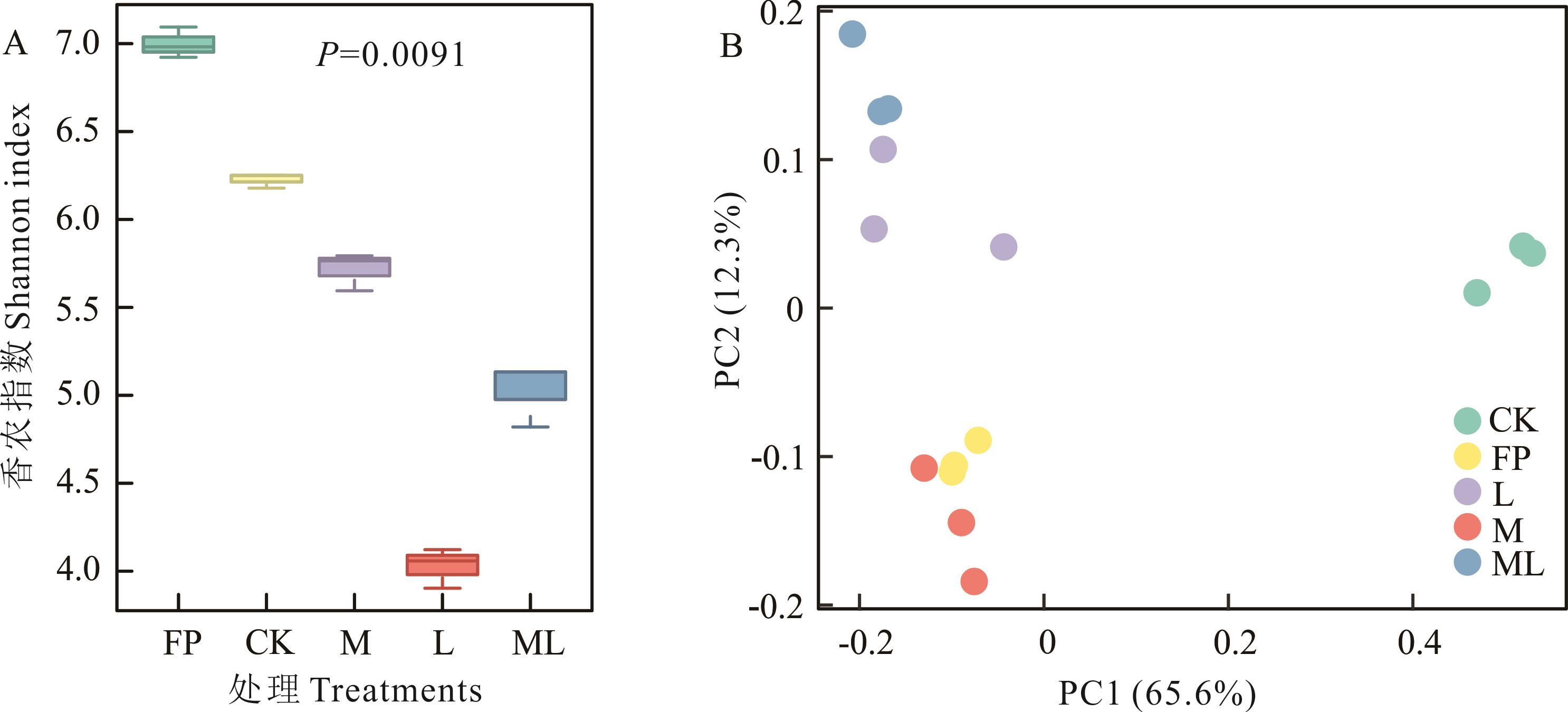
Fig.1 Shannon index and principal coordinate analysis of fresh and ensiled peanut vine

Fig.2 Bacterial community of fresh and ensiled peanut vine

Fig.3 Correlation analysis between fermentation characteristics and predominant bacteria with biogenic amines
| 1 | Tang M Q, Hou P J, Ding L, et al. Comparison of yield and nutritional value of different varieties of peanut. Acta Ecologiae Animalis Domastici, 2020, 41(12): 56-60. |
| 唐梦琪, 侯沛君, 丁丽, 等. 不同花生品种花生秧产量及营养价值的比较. 家畜生态学报, 2020, 41(12): 56-60. | |
| 2 | Liang F, Li B Z, Rolf D V, et al. Straw return exacerbates soil acidification in major Chinese croplands. Resources, Conservation and Recycling, 2023, 198: 107176. |
| 3 | Suo X J, Zhang N, Yang Q P, et al. Effects of peanut vine and alfalfa meal on weight gain performance, internal organ development, and blood indexes of Boer×Macheng crossbred goats. Acta Prataculturae Sinica, 2021, 30(5): 146-154. |
| 索效军, 张年, 杨前平, 等. 日粮添加花生秧和苜蓿草粉对波麻杂交羊增重性能、内脏器官发育及血液指标的影响. 草业学报, 2021, 30(5): 146-154. | |
| 4 | He L W, Wang Y M, Guo X, et al. Evaluating the effectiveness of screened lactic acid bacteria in improving crop residues silage: fermentation parameter, nitrogen fraction, and bacterial community. Frontiers in Microbiology, 2022, 13: 680988. |
| 5 | Li B B, Lu S L. The importance of amine-degrading enzymes on the biogenic amine degradation in ermented foods: A review. Process Biochemistry, 2020, 99: 331-339. |
| 6 | Scherer R, Gerlach K, Südekum K H. Biogenic amines and gamma-amino butyric acid in silages: Formation, occurrence and influence on dry matter intake and ruminant production. Animal Feed Science and Technology, 2015, 210: 1-16. |
| 7 | Olt A, Krt O, Kaldme H, et al. The effect of additive and dry matter content on silage protein degradability and biogenic amine content. Journal of Agricultural Science, 2005, 16(2): 110-116. |
| 8 | Steidlová Š, Kalač P. The effects of lactic acid bacteria inoculants and formic acid on the formation of biogenic amines in grass silages. Archives of Animal Nutrition, 2004, 58(3): 245-254. |
| 9 | Steidlová Š, Kalač P. The effects of using lactic acid bacteria inoculants in maize silage on the formation of biogenic amines. Archives of Animal Nutrition, 2003, 57(5): 359-368. |
| 10 | Nishino N, Hattori H, Wada H, et al. Biogenic amine production in grass, maize and total mixed ration silages inoculated with Lactobacillus casei or Lactobacillus buchneri. Journal of Applied Microbiology, 2007, 103(2): 325-332. |
| 11 | Van Os M, Van Wikselaar P G, Spoelstra S F. Formation of biogenic amines in well fermented grass silages. The Journal of Agricultural Science, 1996, 127(1): 97-107. |
| 12 | Krizsan S J, Randby A T. The effect of fermentation quality on the voluntary intake of grass silage by growing cattle fed silage as the sole feed. Journal of Animal Science, 2007, 85(4): 984-996. |
| 13 | Li R R, Zheng M L, Zheng M H, et al. Metagenomic analysis reveals the linkages between bacteria and the functional enzymes responsible for potential ammonia and biogenic amine production in alfalfa silage. Journal of Applied Microbiology, 2022, 132(4): 2594-2604. |
| 14 | Mao K, Franco M, Xu Y, et al. Fermentation parameters, amino acids profile, biogenic amines formation, and bacterial community of ensiled stylo treated with formic acid or sugar. Animals, 2024, 14(16): 2397. |
| 15 | Jia T T, Yun Y, Yu Z. Propionic acid and sodium benzoate affected biogenic amine formation, microbial community, and quality of oat silage. Frontiers in Microbiology, 2021, 12: 750920. |
| 16 | Zhang Y X, Ke W C, Bai J, et al. The effect of Pediococcus acidilactici J17 with high-antioxidant activity on antioxidant, α-tocopherol, β-carotene, fatty acids, and fermentation profiles of alfalfa silage ensiled at two different dry matter contents. Animal Feed Science and Technology, 2020, 268: 114614. |
| 17 | Broderick G A, Kang J H. Automated simultaneous determination of ammonia and total amino acids in ruminal fluid and in vitro media. Journal of Dairy Science, 1980, 63(1): 64-75. |
| 18 | Association of Official Analytical Chemists. Official methods of analysis the 15th edition. Arrington: Association of Official Analytical Chemists, 1990(2): 22. |
| 19 | Van Soest P J, Robertson J B, Lewis B A. Methods for dietary fiber, neutral detergent fiber, and non-starch polysaccharides in relation to animal nutrition. Journal of Dairy Science, 1991, 74(10): 3583-3597. |
| 20 | Owens V N, Albrecht K A, Muck R E, et al. Protein degradation and fermentation characteristics of red clover and alfalfa silage harvested with varying levels of total nonstructural carbohydrates. Crop Science, 1999, 39(6): 1873-1880. |
| 21 | Linn J G, Martin N P. Forage quality analyses and interpretation. Veterinary Clinics of North America: Food Animal Practice, 1991, 7(2): 509-523. |
| 22 | Guo X S, Ding W R, Yu Z. The evaluation system of fermentation quality of ensiled forage and its improvement. Chinese Journal of Grassland, 2008, 30(4): 100-106. |
| 郭旭生, 丁武蓉, 玉柱. 青贮饲料发酵品质评定体系及其新进展. 中国草地学报, 2008, 30(4): 100-106. | |
| 23 | Wang M S, Chen M Y, Bai J, et al. Ensiling characteristics, in vitro rumen fermentation profile, methane emission and archaeal and protozoal community of silage prepared with alfalfa, sainfoin and their mixture. Animal Feed Science and Technology, 2022, 284: 115154. |
| 24 | Ming H X, Fan J F, Liu J W, et al. Full-length 16S rRNA gene sequencing reveals spatiotemporal dynamics of bacterial community in a heavily polluted estuary, China. Environmental Pollution, 2021, 275: 116567. |
| 25 | Mosher J J, Bernberg E L, Shevchenko O, et al. Efficacy of a 3rd generation high-throughput sequencing platform for analyses of 16S rRNA genes from environmental samples. Journal of Microbiological Methods, 2013, 95(2): 175-181. |
| 26 | Ni K K, Wang F F, Zhu B G, et al. Effects of lactic acid bacteria and molasses additives on the microbial community and fermentation quality of soybean silage. Bioresource Technology, 2017, 238: 706-715. |
| 27 | Wang L B, Sun L N, Gao X J, et al. Peanut by product nutrition proprities and application in pasturage. Feed Review, 2011, 3(3): 30-32. |
| 王利宾, 孙利娜, 郜希君, 等. 花生副产品的营养特点及其在畜牧生产中的应用. 饲料博览, 2011, 3(3): 30-32. | |
| 28 | Flythe M D, Russell J B. The effect of pH and a bacteriocin (bovicin HC5) on Clostridium sporogenes MD1, a bacterium that has the ability to degrade amino acids in ensiled plant materials. FEMS Microbiology Ecology, 2004, 47(2): 215-222. |
| 29 | Jia T T, Yu Z. Effect of temperature and fermentation time on fermentation characteristics and biogenic amine formation of oat silage. Fermentation, 2022, 8(8): 352. |
| 30 | Wang S R, Guo G, Li J F, et al. Improvement of fermentation profile and structural carbohydrate compositions in mixed silages ensiled with fibrolytic enzymes, molasses and Lactobacillus plantarum MTD-1. Italian Journal of Animal Science, 2019, 18(1): 328-335. |
| 31 | Jahanzad E, Sadeghpour A, Hashemi M, et al. Silage fermentation profile, chemical composition and economic evaluation of millet and soya bean grown in monocultures and as intercrops. Grass and Forage Science, 2016, 71(4): 584-594. |
| 32 | Wang Q, Wang Z, Awasthi M K, et al. Evaluation of medical stone amendment for the reduction of nitrogen loss and bioavailability of heavy metals during pig manure composting. Bioresoure Technology, 2016, 220: 297-304. |
| 33 | Zhao J, Dong Z H, Li J F, et al. Evaluation of Lactobacillus plantarum MTD1 and waste molasses as fermentation modifier to increase silage quality and reduce ruminal greenhouse gas emissions of rice straw. Science of the Total Environment, 2019, 688: 143-152. |
| 34 | Wang F M, Zhang A Z, Jiang N, et al. GI and RFV determination and comparison study of common ruminant forage in Heilongjiang Province. Chinese Journal of Animal Science, 2014, 50(17): 33-39. |
| 王法明, 张爱忠, 姜宁, 等. 黑龙江省反刍动物常用粗饲料分级指数及饲料相对值的测定与比较研究. 中国畜牧杂志, 2014, 50(17): 33-39. | |
| 35 | Selwet M, Galbas M, Porzucek F, et al. Effects of the method of alfalfa ensiling on the content of biogenic amines and numbers of some strains of Lactobacillus spp. Medycyna Weterynaryjna, 2013, 69(6): 358-362. |
| 36 | Scherer R, Gerlach K, Taubert J, et al. Effect of forage species and ensiling conditions on silage composition and quality and the feed choice behaviour of goats. Grass and Forage Science, 2019, 74(2): 297-313. |
| 37 | Suzzi G, Gardini F. Biogenic amines in dry fermented sausages: a review. International Journal of Food Microbiology, 2003, 88(1): 41-54. |
| 38 | Min J S, Lee S O, Jang A, et al. Control of microorganisms and reduction of biogenic amines in chicken breast and thigh by irradiation and organic acids. Poultry Science, 2007, 86(9): 2034-2041. |
| 39 | Jin Y H, Lee J H, Park Y K, et al. The occurrence of biogenic amines and determination of biogenic amine-producing lactic acid bacteria in Kkakdugi and Chonggak kimchi. Foods, 2019, 8(2): 73. |
| 40 | Xu D M, Wang N, Rinne M, et al. The bacterial community and metabolome dynamics and their interactions modulate fermentation process of whole crop corn silage prepared with or without inoculants. Microbial Biotechnology, 2020, 14(2): 561-576. |
| 41 | Wang Y, He L W, Xing Y Q, et al. Bacterial diversity and fermentation quality of Moringa oleifera leaves silage prepared with lactic acid bacteria inoculants and stored at different temperatures. Bioresource Technology, 2019, 284: 349-358. |
| 42 | Zhao J, Yin X J, Wang S R, et al. Effects of storage time on the fermentation quality, bacterial community composition, and functional profile of sweet sorghum silage. Acta Prataculturae Sinica, 2023, 32(8): 164-175. |
| 赵杰, 尹雪敬, 王思然, 等. 贮藏时间对甜高粱青贮发酵品质、微生物群落组成和功能的影响. 草业学报, 2023, 32(8): 164-175. | |
| 43 | Zheng J S, Wittouck S, Salvetti E, et al. A taxonomic note on the genus Lactobacillus: description of 23 novel genera, emended description of the genus Lactobacillus beijerinck 1901, and union of Lactobacillaceae and Leuconostocaceae. International Journal of Systematic and Evolutionary Microbiology, 2020, 70(4): 2782-2858. |
| 44 | Zhang H, Wu J W, Zhao X L, et al. Improving aerobic stability and methane production of maize stover silage with lactic acid bacteria inoculants: focus on pentose-fermentation. Industrial Crops and Products, 2023, 201: 116861. |
| 45 | Hu G Y, Wang Y J, Chen J, et al. Synergistic fermentation with functional bacteria for production of salt-reduced soy sauce with enhanced aroma and saltiness. Food Bioscience, 2024, 57: 103459. |
| 46 | Ma J J, Zhang J J, Zhang L J, et al. Systematic analysis of key fermentation parameters influencing biogenic amines production in spontaneous fermentation of soy sauce. Food Bioscience, 2023, 52: 102484. |
| 47 | Sang X, Ma X X, Hao H S, et al. Evaluation of biogenic amines and microbial composition in the Chinese traditional fermented food grasshopper sub shrimp paste. LWT-Food Science and Technology, 2020, 134: 109979. |
| 48 | Qin S, Zeng X M, Jiang M, et al. Genomic and biogenic amine-reducing characterization of Lactiplantibacillus planatraum JB1 isolated from fermented dry sausage. Food Control, 2023, 154: 109971. |
| [1] | Xin-zhu CHEN, Ping-dong LIN, Wen YUE, Ya-ni YANG, Shui-ling QIU, Xiang-li ZHENG. Effects of various additives on the quality and microbial diversity of broad bean straw silage [J]. Acta Prataculturae Sinica, 2025, 34(4): 164-174. |
| [2] | Peng JIANG, Lei LI, Hao-jun XIE, De-jia XU, Rui WANG, Qiang HU, Quan SUN. Effect of purified biogas slurry drip irrigation on sandy loam soil quality, silage maize productivity and analysis of safe application rate [J]. Acta Prataculturae Sinica, 2025, 34(4): 64-81. |
| [3] | Yu-cheng LIANG, Xiao-wen ZHANG, Tao SHAO, Wen-bo WANG, Xian-jun YUAN. Effects of different lactic acid bacteria strains on fermentation quality and mycotoxin contents of whole-plant corn silage [J]. Acta Prataculturae Sinica, 2025, 34(3): 123-133. |
| [4] | Xin-you WANG, Xiao-lan WANG, Wan-chang ZHANG, Ying LI, Yong-ling MA, Xiao-yin WANG, Jian-gang WANG, Hai-qing WANG, Bei-fan YUE, Yong-fu LIU, Yong-hong WANG, Shan LIU, Mei-ting BAI. Selection of optimal varieties of silage maize and methods for cultivation in mountainous forest-margin areas of southeast Gansu Province [J]. Acta Prataculturae Sinica, 2025, 34(1): 191-202. |
| [5] | Yi-fan WANG, Xing-liang ZHUO, Lei WANG, Hong-rui ZHANG, Xue CHEN, Fang-cai JI, Zhu YU. Effect of harvest period and processing method on the quality and in vitro digestibility of native grass products [J]. Acta Prataculturae Sinica, 2024, 33(6): 145-154. |
| [6] | Sheng-ran HE, Xiao-jing LIU, Ya-jiao ZHAO, Xue WANG, Jing WANG. Effects of alfalfa/sweet sorghum intercropping on rhizosphere soil characteristics and microbial community characteristics [J]. Acta Prataculturae Sinica, 2024, 33(5): 92-105. |
| [7] | Hai-wang YUE, Jian-wei WEI, Guang-cai WANG, Peng-cheng LIU, Shu-ping CHEN, Jun-zhou BU. Comprehensive evaluation of silage maize hybrids in the Huanghuaihai plain based on mega-environments delineated using envirotyping techniques [J]. Acta Prataculturae Sinica, 2024, 33(3): 120-138. |
| [8] | Chao-nan MENG, Yu-jie ZHAO, Jia-xin CHEN, Yi-lu ZHANG, Yan-jia WANG, Li-rong FENG, Yu-gang SUN, Chang-hong GUO. Screening and identification of two strains of nitrogen-fixing bacteria from the silage maize rhizosphere and their roles in plant growth promotion [J]. Acta Prataculturae Sinica, 2024, 33(3): 174-185. |
| [9] | Ying TANG, Xiao-jing LIU, Ya-jiao ZHAO, Lin DONG. Characteristics and driving factors of lactic acid bacteria communities in silage made from alfalfa in different regions of Gansu Province [J]. Acta Prataculturae Sinica, 2024, 33(2): 112-124. |
| [10] | Zhong-juan ZHANG, Xi-yu HAO, Xue WANG, Feng LI, Wen-long LI. Selection and multi-trait evaluation of silage maize varieties suitable for cultivation in the Qiqihar area [J]. Acta Prataculturae Sinica, 2024, 33(11): 228-240. |
| [11] | Pei-shan HUANG, Mei-qi ZANG, Wei-ling ZHANG, Jun-jian CHEN, Li-xuan LIU, Qing ZHANG. Optimization of extraction process of Neolamarckia cadamba leaf polyphenols and its effect on Stylosanthes guianensis silage [J]. Acta Prataculturae Sinica, 2024, 33(10): 159-170. |
| [12] | Tian-xin GUO, Shi-shi RUAN, Xiang GUO, Jia-qi ZHAN, Qiu-yu LIANG, Xiao-yang CHEN, Wei ZHOU, Qing ZHANG. Effect of bacterial enzyme complexes on the quality of silage made from Chinese medicine crop residues [J]. Acta Prataculturae Sinica, 2024, 33(10): 194-202. |
| [13] | Jing TIAN, Cai-xia CAO, Li-ying HUANG, Juan-yan WU, Jian-guo ZHANG. Screening low-nutrient-tolerant lactic acid bacteria and their effects on the fermentation quality of silages from poor materials [J]. Acta Prataculturae Sinica, 2023, 32(9): 222-230. |
| [14] | Jie ZHAO, Xue-jing YIN, Si-ran WANG, Zhi-hao DONG, Jun-feng LI, Yu-shan JIA, Tao SHAO. Effects of storage time on the fermentation quality, bacterial community composition, and functional profile of sweet sorghum silage [J]. Acta Prataculturae Sinica, 2023, 32(8): 164-175. |
| [15] | Wen-qing LING, Lei ZHANG, Jue LI, Qi-xian FENG, Yan LI, Yi ZHOU, Yi-jia LIU, Fu-lin YANG, Jing ZHOU. Effects of Lentilactobacillus buchneri combined with different sugars on nutrient composition, fermentation quality, rumen degradation rate, and aerobic stability of alfalfa silage [J]. Acta Prataculturae Sinica, 2023, 32(7): 122-134. |
| Viewed | ||||||
|
Full text |
|
|||||
|
Abstract |
|
|||||
