
ISSN 1004-5759 CN 62-1105/S
Acta Prataculturae Sinica ›› 2025, Vol. 34 ›› Issue (5): 159-170.DOI: 10.11686/cyxb2024226
Si-ran WANG1,2( ), Bei-yi LIU1,2, Ji-peng TIAN1,2, Yun-hui CHENG1,2, Neng-xiang XU1,2, Wen-jie ZHANG1,2, Xin WANG1,2, Cheng-long DING1,2()
Received:2024-06-11
Revised:2024-09-12
Online:2025-05-20
Published:2025-03-20
Contact:
Cheng-long DING
Si-ran WANG, Bei-yi LIU, Ji-peng TIAN, Yun-hui CHENG, Neng-xiang XU, Wen-jie ZHANG, Xin WANG, Cheng-long DING. Improvement in the fermentation quality of Italian ryegrass silage by ensiling with combined lactic acid bacteria inoculants at low temperature[J]. Acta Prataculturae Sinica, 2025, 34(5): 159-170.
| 项目Items | LOG9 | LO7 | LM8 | M1 |
|---|---|---|---|---|
| 形状Shape | 球菌Cocci | 球菌Cocci | 杆菌Rod | 杆菌Rod |
| 发酵类型Fermentation type | 同型Homo | 同型Homo | 同型Homo | 同型Homo |
| 革兰氏染色Gram stain | + | + | + | + |
| 过氧化氢酶活性Catalase activity | - | - | - | - |
| 葡萄糖产气试验Gas from glucose | - | - | - | - |
| 温度Temperature (℃) | ||||
| 5 | + | + | + | + |
| 10 | + | + | + | + |
| 15 | + | + | + | + |
| 20 | + | + | + | + |
| pH | ||||
| 3.0 | W | - | - | W |
| 3.5 | + | + | + | + |
| 4.0 | + | + | + | + |
| 4.5 | + | + | + | + |
| 5.0 | + | + | + | + |
| 6.0 | + | + | + | + |
| 7.0 | + | + | + | + |
| 盐度NaCl (%) | ||||
| 3.0 | + | + | + | + |
| 6.5 | + | + | + | + |
Table 1 The physiological and biochemical characteristics of lactic acid bacteria strains
| 项目Items | LOG9 | LO7 | LM8 | M1 |
|---|---|---|---|---|
| 形状Shape | 球菌Cocci | 球菌Cocci | 杆菌Rod | 杆菌Rod |
| 发酵类型Fermentation type | 同型Homo | 同型Homo | 同型Homo | 同型Homo |
| 革兰氏染色Gram stain | + | + | + | + |
| 过氧化氢酶活性Catalase activity | - | - | - | - |
| 葡萄糖产气试验Gas from glucose | - | - | - | - |
| 温度Temperature (℃) | ||||
| 5 | + | + | + | + |
| 10 | + | + | + | + |
| 15 | + | + | + | + |
| 20 | + | + | + | + |
| pH | ||||
| 3.0 | W | - | - | W |
| 3.5 | + | + | + | + |
| 4.0 | + | + | + | + |
| 4.5 | + | + | + | + |
| 5.0 | + | + | + | + |
| 6.0 | + | + | + | + |
| 7.0 | + | + | + | + |
| 盐度NaCl (%) | ||||
| 3.0 | + | + | + | + |
| 6.5 | + | + | + | + |
| 项目Items | LOG9 | LO7 | LM8 | M1 | 项目Items | LOG9 | LO7 | LM8 | M1 |
|---|---|---|---|---|---|---|---|---|---|
| L-阿拉伯糖L-arabinose | ++ | ++ | - | ++ | 蜜二糖Melibiose | ++ | ++ | ++ | ++ |
| 核糖Ribose | ++ | ++ | - | ++ | 蔗糖Saccharose | ++ | ++ | - | ++ |
| 鼠李糖Rhamnose | + | - | - | - | 海藻糖Trehalose | ++ | ++ | - | ++ |
| 甘露醇Mannitol | ++ | - | ++ | ++ | 松三糖Melezitose | ++ | - | - | ++ |
| 山梨醇Sorbitol | ++ | - | ++ | ++ | D-棉籽糖D-raffinose | ++ | - | ++ | ++ |
α-甲基-D-甘露糖苷 α-methyl-D-mannoside | ++ | - | - | ++ | β-龙胆二糖β-gentiobiose | + | + | - | + |
| D-松二糖D-turanose | ++ | - | - | ++ | |||||
| 苦杏仁苷Amygdaline | ++ | ++ | - | ++ | L-岩藻糖L-fucose | - | - | + | - |
| 七叶灵Esculine | ++ | ++ | - | ++ | D-阿拉伯糖醇D-arabitol | W | - | - | W |
| 纤维二糖Cellobiose | ++ | ++ | - | ++ | 葡萄糖酸盐Gluconate | W | W | - | + |
| 乳糖Lactose | ++ | ++ | - | ++ |
Table 2 The carbohydrate fermentation experiment of lactic acid bacteria strains
| 项目Items | LOG9 | LO7 | LM8 | M1 | 项目Items | LOG9 | LO7 | LM8 | M1 |
|---|---|---|---|---|---|---|---|---|---|
| L-阿拉伯糖L-arabinose | ++ | ++ | - | ++ | 蜜二糖Melibiose | ++ | ++ | ++ | ++ |
| 核糖Ribose | ++ | ++ | - | ++ | 蔗糖Saccharose | ++ | ++ | - | ++ |
| 鼠李糖Rhamnose | + | - | - | - | 海藻糖Trehalose | ++ | ++ | - | ++ |
| 甘露醇Mannitol | ++ | - | ++ | ++ | 松三糖Melezitose | ++ | - | - | ++ |
| 山梨醇Sorbitol | ++ | - | ++ | ++ | D-棉籽糖D-raffinose | ++ | - | ++ | ++ |
α-甲基-D-甘露糖苷 α-methyl-D-mannoside | ++ | - | - | ++ | β-龙胆二糖β-gentiobiose | + | + | - | + |
| D-松二糖D-turanose | ++ | - | - | ++ | |||||
| 苦杏仁苷Amygdaline | ++ | ++ | - | ++ | L-岩藻糖L-fucose | - | - | + | - |
| 七叶灵Esculine | ++ | ++ | - | ++ | D-阿拉伯糖醇D-arabitol | W | - | - | W |
| 纤维二糖Cellobiose | ++ | ++ | - | ++ | 葡萄糖酸盐Gluconate | W | W | - | + |
| 乳糖Lactose | ++ | ++ | - | ++ |
菌株 Strain | 登录号 Accession number | 16S rRNA基因测序数据(近源种) 16S rRNA gene sequencing data (closest relative) | 相似度 Similarity (%) |
|---|---|---|---|
| LOG9 | KJ779095 | 乳酸片球菌DSM 20284 P. acidilactici DSM 20284 | 99 |
| LO7 | KJ779092 | 戊糖片球菌DSM 20336 P. pentosaceus DSM 20336 | 99 |
| LM8 | KJ779090 | 棒状乳杆菌亚种torquens 30 L. coryniformis subsp. torquens 30 | 99 |
| M1 | KJ779098 | 植物乳杆菌JCM 1149 L. plantarum JCM 1149 | 99 |
Table 3 16S rRNA gene sequencing results of lactic acid bacteria strains
菌株 Strain | 登录号 Accession number | 16S rRNA基因测序数据(近源种) 16S rRNA gene sequencing data (closest relative) | 相似度 Similarity (%) |
|---|---|---|---|
| LOG9 | KJ779095 | 乳酸片球菌DSM 20284 P. acidilactici DSM 20284 | 99 |
| LO7 | KJ779092 | 戊糖片球菌DSM 20336 P. pentosaceus DSM 20336 | 99 |
| LM8 | KJ779090 | 棒状乳杆菌亚种torquens 30 L. coryniformis subsp. torquens 30 | 99 |
| M1 | KJ779098 | 植物乳杆菌JCM 1149 L. plantarum JCM 1149 | 99 |
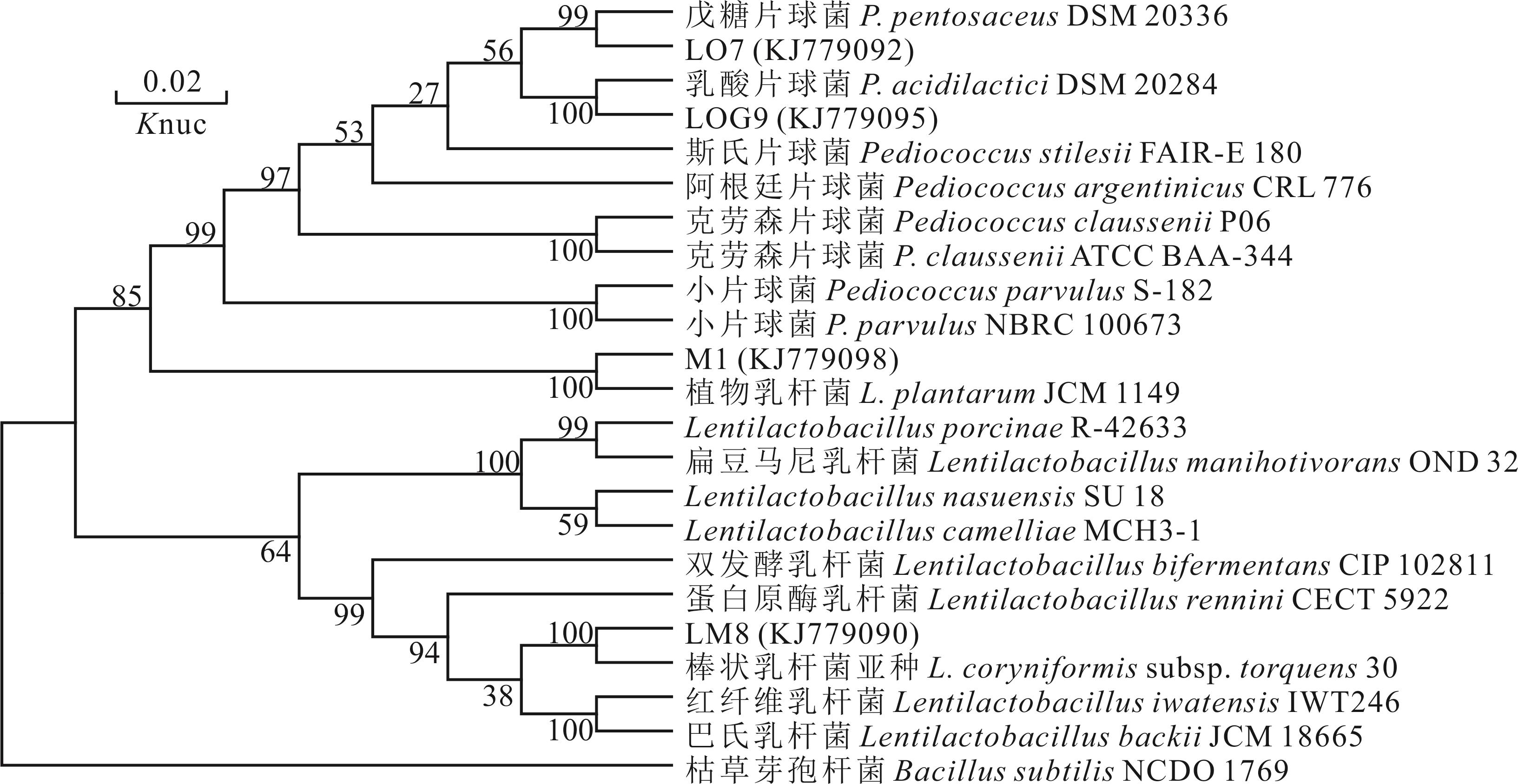
Fig.1 Phylogenetic tree of lactic acid bacteria strains LOG9, LO7, LM8 and M1 and related species based on 16S rDNA sequence alignment
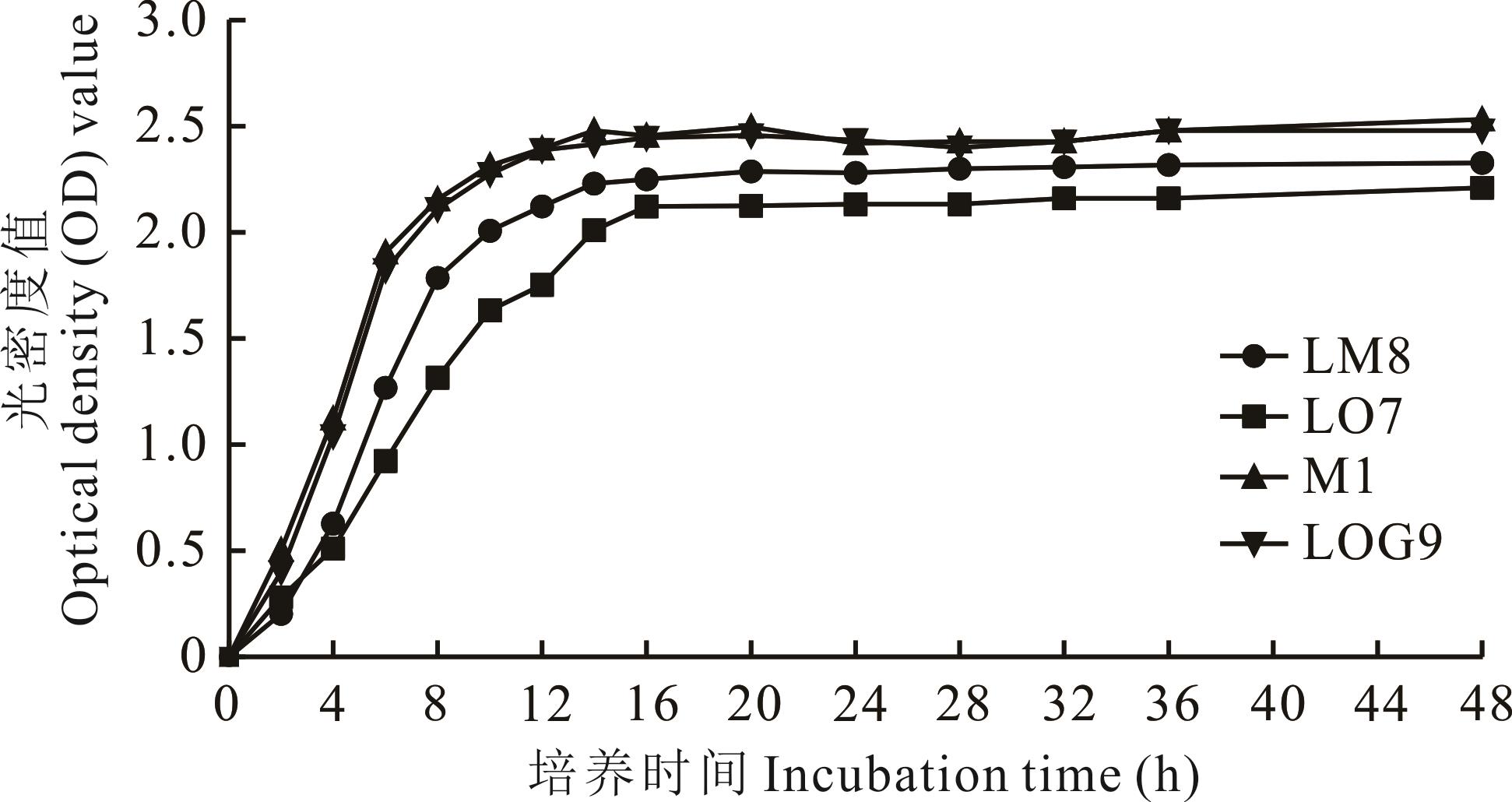
Fig.2 The optical density values at 600 nm of four lactic acid bacteria strains in de Man, Rogosa, Sharpe broth with the process of incubation
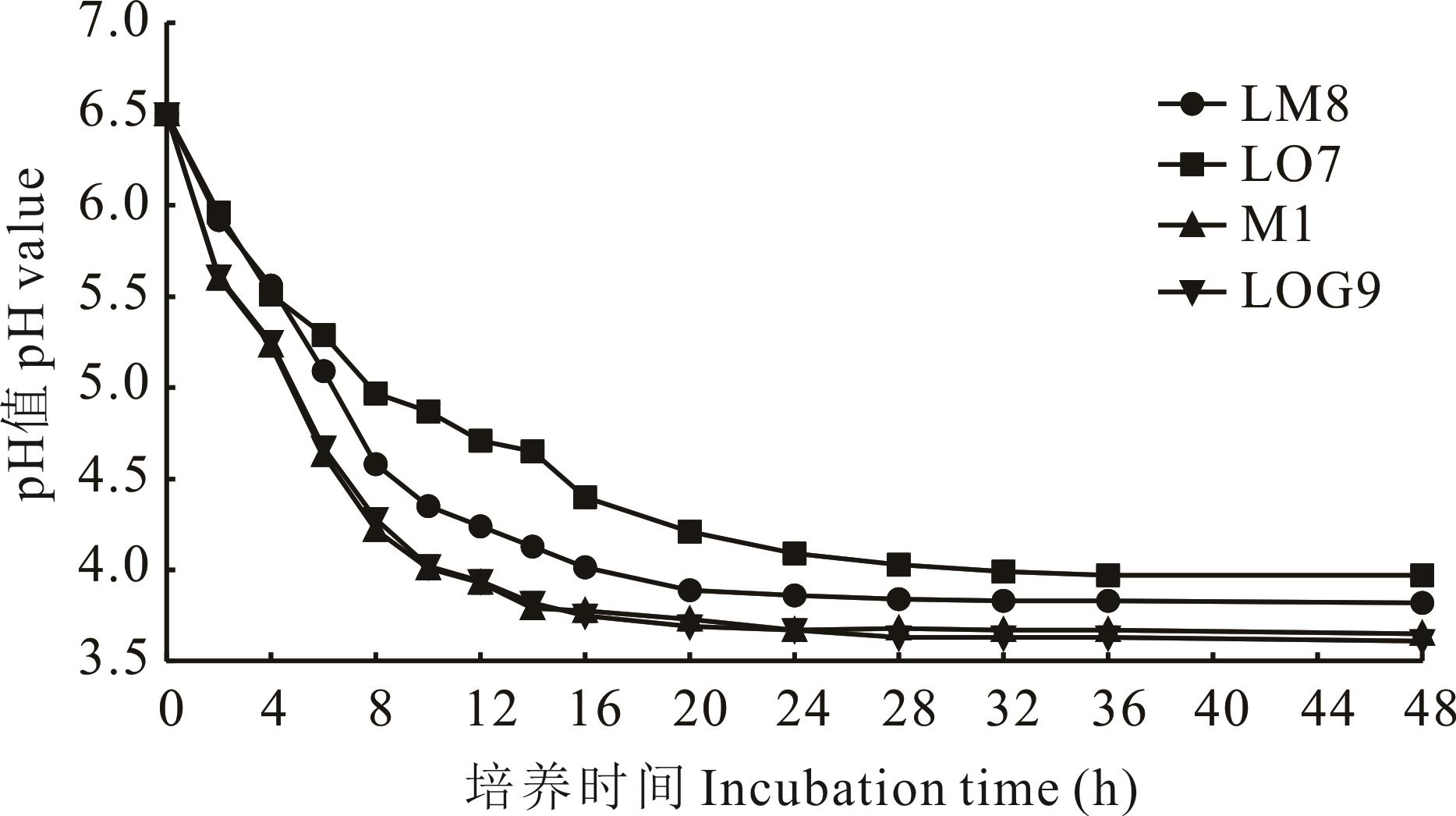
Fig.3 Changes of pH values of four lactic acid bacteria strains in de Man, Rogosa, Sharpe broth with the process of incubation
| 项目Items | 指标Index | 意大利黑麦草Italian ryegrass |
|---|---|---|
化学成分 Chemical compositions | 干物质Dry matter (g·kg-1 FW) | 247.0±3.13 |
| 粗蛋白Crude protein (g·kg-1 DM) | 67.1±1.34 | |
| 水溶性碳水化合物Water soluble carbohydrate (g·kg-1 DM) | 106.5±1.68 | |
| 缓冲能Buffering capacity (mEq·kg-1 DM) | 88.9±1.05 | |
微生物数量 Microbial populations (log cfu·g-1 FW) | 乳酸菌Lactic acid bacteria | 4.37±0.09 |
| 好氧菌Aerobic bacteria | 6.43±0.58 | |
| 酵母菌Yeasts | 4.61±0.13 | |
| 霉菌Molds | 4.03±0.12 |
Table 4 Chemical compositions and microbial populations of Italian ryegrass prior to ensiling
| 项目Items | 指标Index | 意大利黑麦草Italian ryegrass |
|---|---|---|
化学成分 Chemical compositions | 干物质Dry matter (g·kg-1 FW) | 247.0±3.13 |
| 粗蛋白Crude protein (g·kg-1 DM) | 67.1±1.34 | |
| 水溶性碳水化合物Water soluble carbohydrate (g·kg-1 DM) | 106.5±1.68 | |
| 缓冲能Buffering capacity (mEq·kg-1 DM) | 88.9±1.05 | |
微生物数量 Microbial populations (log cfu·g-1 FW) | 乳酸菌Lactic acid bacteria | 4.37±0.09 |
| 好氧菌Aerobic bacteria | 6.43±0.58 | |
| 酵母菌Yeasts | 4.61±0.13 | |
| 霉菌Molds | 4.03±0.12 |
项目 Items | pH | 干物质 Dry matter (g·kg-1 FW) | 乳酸 Lactic acid (LA, g·kg-1 DM) | 乙酸 Acetic acid (AA, g·kg-1 DM) | 乳酸/ 乙酸 LA/AA | 氨态氮 NH3-N (g·kg-1 TN) | 水溶性碳水化合物WSC (g·kg-1 DM) |
|---|---|---|---|---|---|---|---|
| 10 ℃ | |||||||
| 对照组Control | 5.87a | 230a | 42.0i | 39.6a | 1.06f | 135.0a | 8.2d |
| LO7+LM8 | 4.48c | 228a | 75.5g | 25.1c | 3.01e | 88.1c | 17.7b |
| LO7+M1 | 4.39c | 228a | 84.9f | 16.3d | 5.21e | 74.1e | 19.5b |
| LOG9+LM8 | 4.01de | 230a | 121.7c | 8.4e | 14.64abc | 32.3h | 30.5a |
| LOG9+M1 | 4.04de | 228a | 96.8e | 8.2e | 11.90cd | 45.2g | 16.3bc |
| 15 ℃ | |||||||
| 对照组Control | 4.82b | 230a | 63.9h | 34.5b | 1.85ef | 108.2b | 10.5cd |
| LO7+LM8 | 3.93efg | 233a | 97.8e | 10.4e | 9.47d | 75.5de | 19.8b |
| LO7+M1 | 3.94ef | 227a | 101.1e | 10.3e | 9.90d | 74.6e | 18.4b |
| LOG9+LM8 | 3.74h | 222a | 131.8b | 9.4e | 14.10abc | 41.8g | 26.8b |
| LOG9+M1 | 3.83fgh | 225a | 113.7d | 9.1e | 12.60bc | 54.1f | 19.9b |
| 25 ℃ | |||||||
| 对照组Control | 4.12d | 225a | 77.0g | 27.0c | 2.85ef | 83.3cd | 14.6cd |
| LO7+LM8 | 3.82gh | 231a | 140.4a | 8.8e | 15.97ab | 72.7e | 17.1b |
| LO7+M1 | 3.79h | 223a | 140.3a | 8.5e | 16.50a | 42.3g | 17.2b |
| LOG9+LM8 | 3.77h | 223a | 141.7a | 8.9e | 15.97ab | 43.2g | 17.3b |
| LOG9+M1 | 3.85fgh | 224a | 141.3a | 8.4e | 17.07a | 42.5g | 17.9b |
| SEM | 0.08 | 0.80 | 4.62 | 1.55 | 0.87 | 4.19 | 0.83 |
| 不同环境温度下平均值Mean values at different ambient temperatures | |||||||
| 10 ℃ | 4.56a | 229a | 84.2c | 19.5a | 7.17c | 74.9a | 18.4ab |
| 15 ℃ | 4.05b | 228a | 101.6b | 14.7b | 9.58b | 70.9b | 19.1a |
| 25 ℃ | 3.87c | 225a | 128.1a | 12.3c | 13.67a | 56.8c | 16.8b |
| 不同乳酸菌添加剂处理下平均值Mean values under different lactic acid bacteria additive treatments | |||||||
| 对照组Control | 4.94a | 228a | 61.0e | 33.7a | 1.92c | 108.8a | 11.1c |
| LO7+LM8 | 4.08b | 231a | 104.5d | 14.8b | 9.48b | 78.8b | 18.2b |
| LO7+M1 | 4.04b | 226a | 108.7c | 11.7c | 10.54b | 63.7c | 18.4b |
| LOG9+LM8 | 3.84d | 225a | 131.7a | 8.9c | 14.90a | 39.1e | 24.9a |
| LOG9+M1 | 3.91c | 226a | 117.3b | 8.6c | 13.86a | 47.3d | 18.0b |
| 显著性Significance | |||||||
| 环境温度Ambient temperature | <0.001 | 0.117 | <0.001 | <0.001 | <0.001 | <0.001 | 0.019 |
| 乳酸菌添加剂LAB inoculants | <0.001 | 0.106 | <0.001 | <0.001 | <0.001 | <0.001 | <0.001 |
| 环境温度与乳酸菌添加剂的交互作用Ambient temperature×LAB inoculants | <0.001 | 0.569 | <0.001 | <0.001 | <0.001 | <0.001 | <0.001 |
Table 5 Effects of combined lactic acid bacteria inoculants on the silage quality of Italian ryegrass at different temperatures
项目 Items | pH | 干物质 Dry matter (g·kg-1 FW) | 乳酸 Lactic acid (LA, g·kg-1 DM) | 乙酸 Acetic acid (AA, g·kg-1 DM) | 乳酸/ 乙酸 LA/AA | 氨态氮 NH3-N (g·kg-1 TN) | 水溶性碳水化合物WSC (g·kg-1 DM) |
|---|---|---|---|---|---|---|---|
| 10 ℃ | |||||||
| 对照组Control | 5.87a | 230a | 42.0i | 39.6a | 1.06f | 135.0a | 8.2d |
| LO7+LM8 | 4.48c | 228a | 75.5g | 25.1c | 3.01e | 88.1c | 17.7b |
| LO7+M1 | 4.39c | 228a | 84.9f | 16.3d | 5.21e | 74.1e | 19.5b |
| LOG9+LM8 | 4.01de | 230a | 121.7c | 8.4e | 14.64abc | 32.3h | 30.5a |
| LOG9+M1 | 4.04de | 228a | 96.8e | 8.2e | 11.90cd | 45.2g | 16.3bc |
| 15 ℃ | |||||||
| 对照组Control | 4.82b | 230a | 63.9h | 34.5b | 1.85ef | 108.2b | 10.5cd |
| LO7+LM8 | 3.93efg | 233a | 97.8e | 10.4e | 9.47d | 75.5de | 19.8b |
| LO7+M1 | 3.94ef | 227a | 101.1e | 10.3e | 9.90d | 74.6e | 18.4b |
| LOG9+LM8 | 3.74h | 222a | 131.8b | 9.4e | 14.10abc | 41.8g | 26.8b |
| LOG9+M1 | 3.83fgh | 225a | 113.7d | 9.1e | 12.60bc | 54.1f | 19.9b |
| 25 ℃ | |||||||
| 对照组Control | 4.12d | 225a | 77.0g | 27.0c | 2.85ef | 83.3cd | 14.6cd |
| LO7+LM8 | 3.82gh | 231a | 140.4a | 8.8e | 15.97ab | 72.7e | 17.1b |
| LO7+M1 | 3.79h | 223a | 140.3a | 8.5e | 16.50a | 42.3g | 17.2b |
| LOG9+LM8 | 3.77h | 223a | 141.7a | 8.9e | 15.97ab | 43.2g | 17.3b |
| LOG9+M1 | 3.85fgh | 224a | 141.3a | 8.4e | 17.07a | 42.5g | 17.9b |
| SEM | 0.08 | 0.80 | 4.62 | 1.55 | 0.87 | 4.19 | 0.83 |
| 不同环境温度下平均值Mean values at different ambient temperatures | |||||||
| 10 ℃ | 4.56a | 229a | 84.2c | 19.5a | 7.17c | 74.9a | 18.4ab |
| 15 ℃ | 4.05b | 228a | 101.6b | 14.7b | 9.58b | 70.9b | 19.1a |
| 25 ℃ | 3.87c | 225a | 128.1a | 12.3c | 13.67a | 56.8c | 16.8b |
| 不同乳酸菌添加剂处理下平均值Mean values under different lactic acid bacteria additive treatments | |||||||
| 对照组Control | 4.94a | 228a | 61.0e | 33.7a | 1.92c | 108.8a | 11.1c |
| LO7+LM8 | 4.08b | 231a | 104.5d | 14.8b | 9.48b | 78.8b | 18.2b |
| LO7+M1 | 4.04b | 226a | 108.7c | 11.7c | 10.54b | 63.7c | 18.4b |
| LOG9+LM8 | 3.84d | 225a | 131.7a | 8.9c | 14.90a | 39.1e | 24.9a |
| LOG9+M1 | 3.91c | 226a | 117.3b | 8.6c | 13.86a | 47.3d | 18.0b |
| 显著性Significance | |||||||
| 环境温度Ambient temperature | <0.001 | 0.117 | <0.001 | <0.001 | <0.001 | <0.001 | 0.019 |
| 乳酸菌添加剂LAB inoculants | <0.001 | 0.106 | <0.001 | <0.001 | <0.001 | <0.001 | <0.001 |
| 环境温度与乳酸菌添加剂的交互作用Ambient temperature×LAB inoculants | <0.001 | 0.569 | <0.001 | <0.001 | <0.001 | <0.001 | <0.001 |
| 项目Items | 乳酸菌LAB | 好氧菌Aerobic bacteria | 酵母菌Yeasts | 霉菌Molds |
|---|---|---|---|---|
| 10 ℃ | ||||
| 对照组Control | 5.42h | 7.69a | 4.78b | 5.29a |
| LO7+LM8 | 8.66cd | 5.27d | 3.54de | 3.51d |
| LO7+M1 | 8.55cde | 5.22d | 3.15ef | 3.35d |
| LOG9+LM8 | 8.93b | 3.53e | 2.74fg | 2.32e |
| LOG9+M1 | 8.70c | 3.57e | 2.71g | 2.31e |
| 15 ℃ | ||||
| 对照组Control | 6.81g | 7.17b | 5.74a | 5.60a |
| LO7+LM8 | 8.67cd | 5.17d | 4.54bc | 4.27bc |
| LO7+M1 | 8.45de | 5.15d | 4.43bc | 4.22c |
| LOG9+LM8 | 8.94b | 5.14d | 4.45bc | 4.24c |
| LOG9+M1 | 8.61cd | 5.10d | 4.33c | 4.12c |
| 25 ℃ | ||||
| 对照组Control | 7.18f | 6.69c | 5.83a | 4.63b |
| LO7+LM8 | 8.36e | 5.03d | 3.55de | 4.05c |
| LO7+M1 | 8.75bc | 5.07d | 3.62d | 4.08c |
| LOG9+LM8 | 10.92a | 5.06d | 3.56de | 4.07c |
| LOG9+M1 | 8.33e | 5.08d | 3.57d | 4.08c |
| SEM | 0.18 | 0.16 | 0.14 | 0.13 |
| 不同环境温度下平均值Mean values at different ambient temperatures | ||||
| 10 ℃ | 8.05c | 5.06c | 3.39c | 3.35c |
| 15 ℃ | 8.30b | 5.55a | 4.70a | 4.49a |
| 25 ℃ | 8.71a | 5.39b | 4.03b | 4.18b |
| 不同乳酸菌添加剂处理下平均值Mean values under different lactic acid bacteria additive treatments | ||||
| 对照组Control | 6.47c | 7.18a | 5.45a | 5.17a |
| LO7+LM8 | 8.56b | 5.15b | 3.88b | 3.94b |
| LO7+M1 | 8.58b | 5.15b | 3.73bc | 3.88b |
| LOG9+LM8 | 9.60a | 4.58c | 3.58cd | 3.54c |
| LOG9+M1 | 8.55b | 4.59c | 3.54d | 3.50c |
| 显著性Significance | ||||
| 环境温度Ambient temperature | <0.001 | <0.001 | <0.001 | <0.001 |
| 乳酸菌添加剂LAB inoculants | <0.001 | <0.001 | <0.001 | <0.001 |
| 环境温度与乳酸菌添加剂的交互作用Ambient temperature×LAB | <0.001 | <0.001 | <0.001 | <0.001 |
Table 6 Effects of combined lactic acid bacteria inoculants on the microbial populations of Italian ryegrass silage (log cfu·g-1 FW)
| 项目Items | 乳酸菌LAB | 好氧菌Aerobic bacteria | 酵母菌Yeasts | 霉菌Molds |
|---|---|---|---|---|
| 10 ℃ | ||||
| 对照组Control | 5.42h | 7.69a | 4.78b | 5.29a |
| LO7+LM8 | 8.66cd | 5.27d | 3.54de | 3.51d |
| LO7+M1 | 8.55cde | 5.22d | 3.15ef | 3.35d |
| LOG9+LM8 | 8.93b | 3.53e | 2.74fg | 2.32e |
| LOG9+M1 | 8.70c | 3.57e | 2.71g | 2.31e |
| 15 ℃ | ||||
| 对照组Control | 6.81g | 7.17b | 5.74a | 5.60a |
| LO7+LM8 | 8.67cd | 5.17d | 4.54bc | 4.27bc |
| LO7+M1 | 8.45de | 5.15d | 4.43bc | 4.22c |
| LOG9+LM8 | 8.94b | 5.14d | 4.45bc | 4.24c |
| LOG9+M1 | 8.61cd | 5.10d | 4.33c | 4.12c |
| 25 ℃ | ||||
| 对照组Control | 7.18f | 6.69c | 5.83a | 4.63b |
| LO7+LM8 | 8.36e | 5.03d | 3.55de | 4.05c |
| LO7+M1 | 8.75bc | 5.07d | 3.62d | 4.08c |
| LOG9+LM8 | 10.92a | 5.06d | 3.56de | 4.07c |
| LOG9+M1 | 8.33e | 5.08d | 3.57d | 4.08c |
| SEM | 0.18 | 0.16 | 0.14 | 0.13 |
| 不同环境温度下平均值Mean values at different ambient temperatures | ||||
| 10 ℃ | 8.05c | 5.06c | 3.39c | 3.35c |
| 15 ℃ | 8.30b | 5.55a | 4.70a | 4.49a |
| 25 ℃ | 8.71a | 5.39b | 4.03b | 4.18b |
| 不同乳酸菌添加剂处理下平均值Mean values under different lactic acid bacteria additive treatments | ||||
| 对照组Control | 6.47c | 7.18a | 5.45a | 5.17a |
| LO7+LM8 | 8.56b | 5.15b | 3.88b | 3.94b |
| LO7+M1 | 8.58b | 5.15b | 3.73bc | 3.88b |
| LOG9+LM8 | 9.60a | 4.58c | 3.58cd | 3.54c |
| LOG9+M1 | 8.55b | 4.59c | 3.54d | 3.50c |
| 显著性Significance | ||||
| 环境温度Ambient temperature | <0.001 | <0.001 | <0.001 | <0.001 |
| 乳酸菌添加剂LAB inoculants | <0.001 | <0.001 | <0.001 | <0.001 |
| 环境温度与乳酸菌添加剂的交互作用Ambient temperature×LAB | <0.001 | <0.001 | <0.001 | <0.001 |
| 1 | Cui Z M, Guo G, Yuan X J, et al. Characterization and identification of high quality lactic acid bacteria from hulless barley straw silage. Acta Agrestia Sinica, 2015, 23(3): 607-615. |
| 崔棹茗, 郭刚, 原现军, 等. 青稞秸秆青贮饲料中优良乳酸菌的筛选及鉴定. 草地学报, 2015, 23(3): 607-615. | |
| 2 | Pang H L, Tan Z, Qin G, et al. Phenotypic and phylogenetic analysis of lactic acid bacteria isolated from forage crops and grasses in the Tibetan Plateau.The Journal of Microbiology, 2012, 50(1): 63-71. |
| 3 | Zhang J, Guo G, Chen L, et al. Effect of applying lactic acid bacteria and propionic acid on fermentation quality and aerobic stability of oats-common vetch mixed silage on the Tibetan Plateau. Animal Science Journal, 2015, 86(6): 595-602. |
| 4 | Lin D D, Ju Z L, Chai J K, et al. Screening and identification of low temperature tolerant lactic acid bacterial epiphytes from oats on the Qinghai-Tibetan Plateau. Acta Prataculturae Sinica, 2022, 31(5): 103-114. |
| 蔺豆豆, 琚泽亮, 柴继宽, 等. 青藏高原燕麦附着耐低温乳酸菌的筛选与鉴定. 草业学报, 2022, 31(5): 103-114. | |
| 5 | Weinberg Z G, Szakacs G, Ashbell G Y. The effect of temperature on the ensiling process of corn and wheat. Journal of Applied Microbiology, 2001, 90(4): 561-566. |
| 6 | Ali M, Cone J W, Khan N A, et al. Effect of temperature and duration of ensiling on in vitro degradation of maize silages in rumen fluid. Journal of Animal Physiology and Animal Nutrition, 2015, 99(2): 251-257. |
| 7 | Kung L. Understanding the biology of silage preservation to maximize quality and protect the environment. (2010-12-01)[2024-06-10]. https://alfalfasymposium.ucdavis.edu/+symposium/proceedings/2010/10-41.pdf. |
| 8 | Zhou Y, Drouin P, Lafrenière C. Effect of temperature (5-25 ℃) on epiphytic lactic acid bacteria populations and fermentation of whole-plant corn silage. Journal of Applied Microbiology, 2016, 121(3): 657-671. |
| 9 | Kim K H, Uchida S. Comparative studies of ensiling characteristics between temperate and tropical species. 1. The effects of various ensiling conditions on the silage quality of Italian ryegrass (Lolium multiflorum Lam.) and rhodes grass (Chloris gayana Kunth.). Japanese Journal of Grassland Science, 1990, 36(3): 292-299. |
| 10 | Weinberg Z G, Muck R E. New trends in development and use of inoculants for silage. FEMS Microbiology Reviews, 1996, 19(1): 53-68. |
| 11 | Zielińska K J, Fabiszewska A U. Improvement of the quality of maize grain silage by a synergistic action of selected lactobacilli strains. World Journal of Microbiology and Biotechnology, 2018, 34(1): 9. |
| 12 | Parvin S, Nishino N. Succession of lactic acid bacteria in wilted rhodegrass silage assessed by plate culture and denaturing gradient gel electrophoresis. Grassland Science, 2010, 56(1): 51-55. |
| 13 | Oliveira A S, Weinberg Z G, Ogunade I M, et al. Meta-analysis of effects of inoculation with homofermentative and facultative heterofermentative lactic acid bacteria on silage fermentation, aerobic stability, and the performance of dairy cows. Journal of Dairy Science, 2017, 100(6): 4587-4603. |
| 14 | Cai Y M, Benno Y, Ogawa M, et al. Influence of Lactobacillus spp. from an inoculant and of Weissella and Leuconostoc spp. from forage, crops on silage fermentation. Applied and Environmental Microbiology, 1998, 64(8): 2982-2987. |
| 15 | Avila C L S, Carvalho B F, Pinto J C, et al. The use of Lactobacillus species as starter cultures for enhancing the quality of sugar cane silage. Journal of Dairy Science, 2014, 97(2): 940-951. |
| 16 | Cai Y M, Kumai S, Ogawa M, et al. Characterization and identification of Pediococcus species isolated from forage crops and their application for silage preparation. Applied and Environmental Microbiology, 1999, 65(7): 2901-2906. |
| 17 | Yang X D, Yuan X J, Guo G, et al. Isolation and identification of low temperature-tolerant lactic bacteria from legume silages in Tibet. Acta Prataculturae Sinica, 2015, 24(6): 99-107. |
| 杨晓丹, 原现军, 郭刚, 等. 西藏豆科牧草青贮饲料中耐低温优良乳酸菌的筛选. 草业学报, 2015, 24(6): 99-107. | |
| 18 | Boone D R, Garrity G M, Castenholz R W, et al. Bergey’s manual of systematic bacteriology: The Firmicutes. New York: Springer, 2001. |
| 19 | Zhang Q, Yu Z, Wang X. Isolating and evaluating lactic acid bacteria strains with or without sucrose for effectiveness of silage fermentation. Grassland Science, 2015, 61(3): 167-176. |
| 20 | Zhang H J, Yu Z, Wang L, et al. Isolation and identification of lactic acid bacteria from silage and filtering of excellent strains. Acta Agrestia Sinica, 2011, 19(1): 137-141. |
| 张慧杰, 玉柱, 王林, 等. 青贮饲料中乳酸菌的分离鉴定及优良菌株筛选. 草地学报, 2011, 19(1): 137-141. | |
| 21 | Zhang J M, Guan H, Li H P, et al. Effects of oat∶feed pea sowing ratio and lactic acid bacteria addition on crop silage fermentation and ruminal degradation characteristics of the resulting total mixed ration. Acta Prataculturae Sinica, 2024, 33(1): 169-181. |
| 张珈敏, 关皓, 李海萍, 等. 混播比例及乳酸菌剂对燕麦-饲用豌豆发酵TMR品质及瘤胃降解特性的影响. 草业学报, 2024, 33(1): 169-181. | |
| 22 | Owens V, Albrecht K, Muck R, et al. Protein degradation and fermentation characteristics of red clover and alfalfa silage harvested with varying levels of total nonstructural carbohydrates. Crop Science, 1999, 39(6): 1873-1880. |
| 23 | Jasaitis D K, Wohlt J E, Evans J L. Influence of feed ion content on buffering capacity of ruminant feedstuffs in vitro. Journal of Dairy Science, 1987, 70(7): 1391-1403. |
| 24 | Tian J P, Liu B Y, Gu H R, et al. Effects of lactic acid bacteria and calcium propionate on fermentation quality and mycotoxin contents of whole plant maize and oat silages. Acta Prataculturae Sinica, 2022, 31(8): 157-166. |
| 田吉鹏, 刘蓓一, 顾洪如, 等. 乳酸菌及丙酸钙对全株玉米和燕麦青贮饲料发酵品质和霉菌毒素含量的影响. 草业学报, 2022, 31(8): 157-166. | |
| 25 | Broderick G A, Kang J H. Automated simultaneous determination of ammonia and total amino acids in ruminal fluid and in vitro media. Journal of Dairy Science, 1980, 63(1): 64-75. |
| 26 | Pang H L, Qing Y, Tan Z F, et al. Natural populations of lactic acid bacteria associated with silage fermentation as determined by phenotype, 16S ribosomal RNA and recA gene analysis. Systematic and Applied Microbiology, 2011, 34(3): 235-241. |
| 27 | Nakanishi K, Tokuda H, Ando T, et al. Screening of lactic acid bacteria having the ability to produce reuterin: Screening of LAB to produce reuterin. Japanese Journal of Lactic Acid Bacteria, 2002, 13(1): 37-45. |
| 28 | Derzelle S, Hallet B, Francis K P, et al. Changes in cspL, cspP, and cspC mRNA abundance as a function of cold shock and growth phase in Lactobacillus plantarum. Journal of Bacteriology, 2000, 182(18): 5105-5113. |
| 29 | Song S, Bae D W, Lim K, et al. Cold stress improves the ability of Lactobacillus plantarum l67 to survive freezing. International Journal of Food Microbiology, 2014, 191(17): 135-143. |
| 30 | Huang L J, Sun R J, Gao W J, et al. Screening and identification of whole rice surface dominant lactic acid bacteria. Acta Prataculturae Sinica, 2024, 33(1): 117-125. |
| 黄丽娟, 孙镕基, 高文婧, 等. 全株水稻表面优势乳酸菌的筛选与鉴定. 草业学报, 2024, 33(1): 117-125. | |
| 31 | Wang S R, Li J F, Dong Z H, et al. Effect of microbial inoculants on the fermentation characteristics, nutritive value, and in vitro digestibility of various forages. Animal Science Journal, 2019, 90(2): 178-188. |
| 32 | Aguilar A, Ingemansson T, Magnien E. Extremophile microorganisms as cell factories: support from the European Union. Extremophiles, 1998, 2(3): 367-373. |
| 33 | McDonald P, Henderson A R, Heron S J E. The biochemistry of silage. London: Chalcombe Publications, 1991. |
| 34 | Saarisalo E, Skyttä E, Haikara A, et al. Screening and selection of lactic acid bacteria strains suitable for ensiling grass.Journal of Applied Microbiology, 2007, 102(2): 327-336. |
| 35 | Darwin C. On the origin of species by means of natural selection. American Anthropologist, 1963, 61(1): 176-177. |
| 36 | Wang S R, Shao T, Li J F, et al. Fermentative products and bacterial community structure of C4 forage silage in response to epiphytic microbiota from C3 forages. Animal Bioscience, 2022, 35(12): 1860-1870. |
| 37 | Wang S R, Dong Z H, Li J F, et al. Pediococcus acidilactici strains as silage inoculants for improving the fermentation quality, nutritive value and in vitro ruminal digestibility in different forages. Journal of Applied Microbiology, 2019, 126(2): 424-434. |
| [1] | Kai MAO, Yi XU, Xue-mei WANG, Huan CHAI, Shuai HUANG, Jian WANG, Shu-qian HUAN, Zhu YU, Mu-sen WANG. Effect of Lactiplantibacillus plantarum and molasses on the fermentation quality, biogenic amines contents and bacterial community of peanut vine silage [J]. Acta Prataculturae Sinica, 2025, 34(5): 146-158. |
| [2] | Xin-zhu CHEN, Ping-dong LIN, Wen YUE, Ya-ni YANG, Shui-ling QIU, Xiang-li ZHENG. Effects of various additives on the quality and microbial diversity of broad bean straw silage [J]. Acta Prataculturae Sinica, 2025, 34(4): 164-174. |
| [3] | Peng JIANG, Lei LI, Hao-jun XIE, De-jia XU, Rui WANG, Qiang HU, Quan SUN. Effect of purified biogas slurry drip irrigation on sandy loam soil quality, silage maize productivity and analysis of safe application rate [J]. Acta Prataculturae Sinica, 2025, 34(4): 64-81. |
| [4] | Yu-cheng LIANG, Xiao-wen ZHANG, Tao SHAO, Wen-bo WANG, Xian-jun YUAN. Effects of different lactic acid bacteria strains on fermentation quality and mycotoxin contents of whole-plant corn silage [J]. Acta Prataculturae Sinica, 2025, 34(3): 123-133. |
| [5] | Xin-you WANG, Xiao-lan WANG, Wan-chang ZHANG, Ying LI, Yong-ling MA, Xiao-yin WANG, Jian-gang WANG, Hai-qing WANG, Bei-fan YUE, Yong-fu LIU, Yong-hong WANG, Shan LIU, Mei-ting BAI. Selection of optimal varieties of silage maize and methods for cultivation in mountainous forest-margin areas of southeast Gansu Province [J]. Acta Prataculturae Sinica, 2025, 34(1): 191-202. |
| [6] | Yi-fan WANG, Xing-liang ZHUO, Lei WANG, Hong-rui ZHANG, Xue CHEN, Fang-cai JI, Zhu YU. Effect of harvest period and processing method on the quality and in vitro digestibility of native grass products [J]. Acta Prataculturae Sinica, 2024, 33(6): 145-154. |
| [7] | Min WANG, Li LI, Rong JIA, Ai-ke BAO. Evaluation of physiological characteristics and cold resistance of 10 alfalfa varieties under low temperature stress [J]. Acta Prataculturae Sinica, 2024, 33(6): 76-88. |
| [8] | Hai-wang YUE, Jian-wei WEI, Guang-cai WANG, Peng-cheng LIU, Shu-ping CHEN, Jun-zhou BU. Comprehensive evaluation of silage maize hybrids in the Huanghuaihai plain based on mega-environments delineated using envirotyping techniques [J]. Acta Prataculturae Sinica, 2024, 33(3): 120-138. |
| [9] | Chao-nan MENG, Yu-jie ZHAO, Jia-xin CHEN, Yi-lu ZHANG, Yan-jia WANG, Li-rong FENG, Yu-gang SUN, Chang-hong GUO. Screening and identification of two strains of nitrogen-fixing bacteria from the silage maize rhizosphere and their roles in plant growth promotion [J]. Acta Prataculturae Sinica, 2024, 33(3): 174-185. |
| [10] | Ying TANG, Xiao-jing LIU, Ya-jiao ZHAO, Lin DONG. Characteristics and driving factors of lactic acid bacteria communities in silage made from alfalfa in different regions of Gansu Province [J]. Acta Prataculturae Sinica, 2024, 33(2): 112-124. |
| [11] | Zhong-juan ZHANG, Xi-yu HAO, Xue WANG, Feng LI, Wen-long LI. Selection and multi-trait evaluation of silage maize varieties suitable for cultivation in the Qiqihar area [J]. Acta Prataculturae Sinica, 2024, 33(11): 228-240. |
| [12] | Pei-shan HUANG, Mei-qi ZANG, Wei-ling ZHANG, Jun-jian CHEN, Li-xuan LIU, Qing ZHANG. Optimization of extraction process of Neolamarckia cadamba leaf polyphenols and its effect on Stylosanthes guianensis silage [J]. Acta Prataculturae Sinica, 2024, 33(10): 159-170. |
| [13] | Tian-xin GUO, Shi-shi RUAN, Xiang GUO, Jia-qi ZHAN, Qiu-yu LIANG, Xiao-yang CHEN, Wei ZHOU, Qing ZHANG. Effect of bacterial enzyme complexes on the quality of silage made from Chinese medicine crop residues [J]. Acta Prataculturae Sinica, 2024, 33(10): 194-202. |
| [14] | Jing TIAN, Cai-xia CAO, Li-ying HUANG, Juan-yan WU, Jian-guo ZHANG. Screening low-nutrient-tolerant lactic acid bacteria and their effects on the fermentation quality of silages from poor materials [J]. Acta Prataculturae Sinica, 2023, 32(9): 222-230. |
| [15] | Jie ZHAO, Xue-jing YIN, Si-ran WANG, Zhi-hao DONG, Jun-feng LI, Yu-shan JIA, Tao SHAO. Effects of storage time on the fermentation quality, bacterial community composition, and functional profile of sweet sorghum silage [J]. Acta Prataculturae Sinica, 2023, 32(8): 164-175. |
| Viewed | ||||||
|
Full text |
|
|||||
|
Abstract |
|
|||||
