
ISSN 1004-5759 CN 62-1105/S
Acta Prataculturae Sinica ›› 2026, Vol. 35 ›› Issue (10): 222-236.DOI: 10.11686/cyxb2025429
Jie LI1( ), Xue-ting YU1(), Shu-ke ZHAO2, Qiu-ga YIXI3, Dong-zhou GAMA3, Hao WU1, Yu-lin SHAN1, He-ying YU1
Received:2025-10-18
Revised:2025-12-25
Online:2026-10-20
Published:2026-09-09
Contact:
Jie LI
Jie LI, Xue-ting YU, Shu-ke ZHAO, Qiu-ga YIXI, Dong-zhou GAMA, Hao WU, Yu-lin SHAN, He-ying YU. Progress in research on methods for estimating carbon stock in grassland ecosystems and factors influencing it[J]. Acta Prataculturae Sinica, 2026, 35(10): 222-236.
方法 Method | 估算方法 Estimation methods | 优点 Advantages | 缺点 Disadvantages |
|---|---|---|---|
传统方法 Traditional methods | 样地实测法(直接估算法) Field measurement method(direct estimation method) | 操作简便、成本低廉、小尺度高精度、强数据兼容性。Simple operation, low cost, high precision at small scales, and strong data compatibility. | 工作量大、小尺度适用、随尺度扩大误差显著增加。A high workload is applicable to small scales, with errors increasing significantly as the scale expands. |
生物量回归模型法(间接估算法) Biomass regression modeling method (indirect estimation method | 快速、低成本,适用于大区域研究。It is fast, low cost, and suitable for large-scale studies. | 依赖本地参数、跨区域需校准。It depends on local parameters, and cross-region calibration is required. | |
新兴方法 Emerging methods | 遥感技术Remote sensing technology | 适用于大范围快速监测、支持动态评估。It is suitable for large-scale rapid monitoring and supports dynamic assessments. | 依赖地面数据校准,易受云层、分辨率限制。It relies on ground-based data calibration, making it susceptible to cloud cover and resolution limitations. |
| 无人机技术Drone technology | 易获取高分辨率图像、轻便灵活、适用于小范围。High-resolution images are easily obtained, light weight, flexible, and suitable for small areas. | 覆盖范围有限、数据处理复杂、易受环境限制。These methods have limited coverage, complex data processing, and are susceptible to environmental constraints. | |
| 多源数据分析Multi-source data analysis | 克服单一数据局限性、提高精度、支持长期动态监测。Overcome the limitations of single data source, improve accuracy, and support long-term dynamic monitoring. | 数据异质性处理复杂、模型依赖性高、技术门槛高。Data heterogeneity poses complex challenges, exhibits high model dependency, and requires high technical expertise. |
Table 1 Methods for estimating above-ground carbon stocks in grassland vegetation and their advantages and disadvantages
方法 Method | 估算方法 Estimation methods | 优点 Advantages | 缺点 Disadvantages |
|---|---|---|---|
传统方法 Traditional methods | 样地实测法(直接估算法) Field measurement method(direct estimation method) | 操作简便、成本低廉、小尺度高精度、强数据兼容性。Simple operation, low cost, high precision at small scales, and strong data compatibility. | 工作量大、小尺度适用、随尺度扩大误差显著增加。A high workload is applicable to small scales, with errors increasing significantly as the scale expands. |
生物量回归模型法(间接估算法) Biomass regression modeling method (indirect estimation method | 快速、低成本,适用于大区域研究。It is fast, low cost, and suitable for large-scale studies. | 依赖本地参数、跨区域需校准。It depends on local parameters, and cross-region calibration is required. | |
新兴方法 Emerging methods | 遥感技术Remote sensing technology | 适用于大范围快速监测、支持动态评估。It is suitable for large-scale rapid monitoring and supports dynamic assessments. | 依赖地面数据校准,易受云层、分辨率限制。It relies on ground-based data calibration, making it susceptible to cloud cover and resolution limitations. |
| 无人机技术Drone technology | 易获取高分辨率图像、轻便灵活、适用于小范围。High-resolution images are easily obtained, light weight, flexible, and suitable for small areas. | 覆盖范围有限、数据处理复杂、易受环境限制。These methods have limited coverage, complex data processing, and are susceptible to environmental constraints. | |
| 多源数据分析Multi-source data analysis | 克服单一数据局限性、提高精度、支持长期动态监测。Overcome the limitations of single data source, improve accuracy, and support long-term dynamic monitoring. | 数据异质性处理复杂、模型依赖性高、技术门槛高。Data heterogeneity poses complex challenges, exhibits high model dependency, and requires high technical expertise. |
估算方法 Estimation methods | 优点 Advantages | 缺点 Disadvantages | |
|---|---|---|---|
根系采样法 Root sampling methods | 挖土块法Block excavation method | 应用范围广、操作简便、可获取大量重复数据。They have a wide range of applications, are easy to operate, and can obtain large amounts of duplicate data. | 耗时耗力、破坏性采样、动态监测易中断。Time-consuming and labor-intensive, destructive sampling and dynamic monitoring are prone to interruption. |
| 根钻法Root drilling method | 操作简便,对样地破坏性小,采样率高。It is simple to operate, minimally disruptive to sample plots, and has a high sampling rate. | 根系易缺失,且采样面积小而导致数据代表性较差。Root systems are prone to loss, and small sampling areas result in poor data representativeness. | |
| 内生长土芯法Internal growth soil core method | 根易采集,样地破坏小,可精准测定土壤初级生产力季节动态。Root systems are easy to collect, cause minimal disturbance to plots, and enable precise measurements of seasonal dynamics in soil primary productivity. | 易受到环境因素的干扰,产生误差。It is susceptible to interference from environmental factors, leading to errors. | |
微根区管法 Micro-root zone tube method | 省时省力,精确采样,样本代表性高,准确可靠。Time-saving and effort-saving, precise sampling, highly representative samples, accurate and reliable. | 成本高、测量范围小,不能全面反映植物根系的特征。The high cost and limited measurement range prevent it from fully reflecting the characteristics of plant root systems. | |
根冠比法 Root-shoot ratio method | 操作简便,简化生物量估算,对样地破坏小。Simple operation, streamlined biomass estimation, and minimal disturbance to the plot. | 样本代表性较差,物种类型差异显著,易受环境影响。The sample lacks representativeness, exhibits significant variations in species composition, and is highly susceptible to environmental influences. | |
相关关系法 Correlation method | 非线性优化、估算效率提高。Nonlinear optimization improves estimation efficiency. | 根系-地上部生长异步性显著,模型假设可靠性不足。The significant asynchrony between root and shoot growth indicates insufficient reliability of the model assumption. | |
Table 2 Methods for estimating below-ground carbon stocks in grassland vegetation and their advantages and disadvantages
估算方法 Estimation methods | 优点 Advantages | 缺点 Disadvantages | |
|---|---|---|---|
根系采样法 Root sampling methods | 挖土块法Block excavation method | 应用范围广、操作简便、可获取大量重复数据。They have a wide range of applications, are easy to operate, and can obtain large amounts of duplicate data. | 耗时耗力、破坏性采样、动态监测易中断。Time-consuming and labor-intensive, destructive sampling and dynamic monitoring are prone to interruption. |
| 根钻法Root drilling method | 操作简便,对样地破坏性小,采样率高。It is simple to operate, minimally disruptive to sample plots, and has a high sampling rate. | 根系易缺失,且采样面积小而导致数据代表性较差。Root systems are prone to loss, and small sampling areas result in poor data representativeness. | |
| 内生长土芯法Internal growth soil core method | 根易采集,样地破坏小,可精准测定土壤初级生产力季节动态。Root systems are easy to collect, cause minimal disturbance to plots, and enable precise measurements of seasonal dynamics in soil primary productivity. | 易受到环境因素的干扰,产生误差。It is susceptible to interference from environmental factors, leading to errors. | |
微根区管法 Micro-root zone tube method | 省时省力,精确采样,样本代表性高,准确可靠。Time-saving and effort-saving, precise sampling, highly representative samples, accurate and reliable. | 成本高、测量范围小,不能全面反映植物根系的特征。The high cost and limited measurement range prevent it from fully reflecting the characteristics of plant root systems. | |
根冠比法 Root-shoot ratio method | 操作简便,简化生物量估算,对样地破坏小。Simple operation, streamlined biomass estimation, and minimal disturbance to the plot. | 样本代表性较差,物种类型差异显著,易受环境影响。The sample lacks representativeness, exhibits significant variations in species composition, and is highly susceptible to environmental influences. | |
相关关系法 Correlation method | 非线性优化、估算效率提高。Nonlinear optimization improves estimation efficiency. | 根系-地上部生长异步性显著,模型假设可靠性不足。The significant asynchrony between root and shoot growth indicates insufficient reliability of the model assumption. | |
方法 Method | 估算方法 Estimation methods | 优点 Advantages | 缺点 Disadvantages |
|---|---|---|---|
传统方法 Traditional methods | 土壤类型法Soil classification method | 适用于大尺度范围监测、精准估算。It is suitable for large-scale monitoring and precise estimation. | 依赖高精度数据,但数据获取难度大。It relies on high-precision data, but obtaining such data is challenging. |
| 生命地带、生态系统类型法和植被类型法Life zones, ecosystem classification method, and vegetation classification method | 一定程度上可以反映植物与气候之间的关系,精度较高。To a certain extent, this can reflect the relationship between plants and climate with high accuracy. | 生态类型与面积统计误差大,模型无法捕捉土壤碳非线性变化。Large statistical errors exist in the ecosystem type and area data, preventing the model from capturing nonlinear changes in soil carbon. | |
| 相关关系统计法Correlation statistics method | 能揭示土壤有机质与其驱动因子间的关联性,精度较高。This can reveal the relationship between soil organic matter and its driving factors with high precision. | 模型局限性强,大尺度下少样点建模可信度不足。The model has strong limitations, with insufficient reliability for large-scale modeling owing to sparse data points. | |
新兴方法 Emerging methods | 模型模拟法Model simulation method | 可综合多因子影响,具有较好的系统性和完整性。It can integrate the influence of multiple factors, demonstrating good systematics and completeness. | 空间数据需要采集、数据量大,模型需要长期训练。Spatial data require collection and involve large volumes, whereas models require long-term training. |
| 地理信息系统估算法Geographic information system (GIS) estimation method | 适合大尺度研究,估算精度较高。It is suitable for large-scale studies with relatively high estimation accuracy. | 所需参数较多,且也需要地区的空间特性数据。A large number of parameters are required, and regional spatial characteristic data are also needed. | |
| 13C同位素示踪法13C isotope tracing method | 适用于微尺度研究,可精准分辨土壤碳转化路径,揭示微观碳储量动态[ | 仅适用于小规模定量核算,大尺度应用时数据准确性受限。Applicable only to small-scale quantitative calculations; data accuracy is limited when applied to large-scale applications. |
Table 3 Methods for estimating soil carbon stocks and their advantages and disadvantages
方法 Method | 估算方法 Estimation methods | 优点 Advantages | 缺点 Disadvantages |
|---|---|---|---|
传统方法 Traditional methods | 土壤类型法Soil classification method | 适用于大尺度范围监测、精准估算。It is suitable for large-scale monitoring and precise estimation. | 依赖高精度数据,但数据获取难度大。It relies on high-precision data, but obtaining such data is challenging. |
| 生命地带、生态系统类型法和植被类型法Life zones, ecosystem classification method, and vegetation classification method | 一定程度上可以反映植物与气候之间的关系,精度较高。To a certain extent, this can reflect the relationship between plants and climate with high accuracy. | 生态类型与面积统计误差大,模型无法捕捉土壤碳非线性变化。Large statistical errors exist in the ecosystem type and area data, preventing the model from capturing nonlinear changes in soil carbon. | |
| 相关关系统计法Correlation statistics method | 能揭示土壤有机质与其驱动因子间的关联性,精度较高。This can reveal the relationship between soil organic matter and its driving factors with high precision. | 模型局限性强,大尺度下少样点建模可信度不足。The model has strong limitations, with insufficient reliability for large-scale modeling owing to sparse data points. | |
新兴方法 Emerging methods | 模型模拟法Model simulation method | 可综合多因子影响,具有较好的系统性和完整性。It can integrate the influence of multiple factors, demonstrating good systematics and completeness. | 空间数据需要采集、数据量大,模型需要长期训练。Spatial data require collection and involve large volumes, whereas models require long-term training. |
| 地理信息系统估算法Geographic information system (GIS) estimation method | 适合大尺度研究,估算精度较高。It is suitable for large-scale studies with relatively high estimation accuracy. | 所需参数较多,且也需要地区的空间特性数据。A large number of parameters are required, and regional spatial characteristic data are also needed. | |
| 13C同位素示踪法13C isotope tracing method | 适用于微尺度研究,可精准分辨土壤碳转化路径,揭示微观碳储量动态[ | 仅适用于小规模定量核算,大尺度应用时数据准确性受限。Applicable only to small-scale quantitative calculations; data accuracy is limited when applied to large-scale applications. |
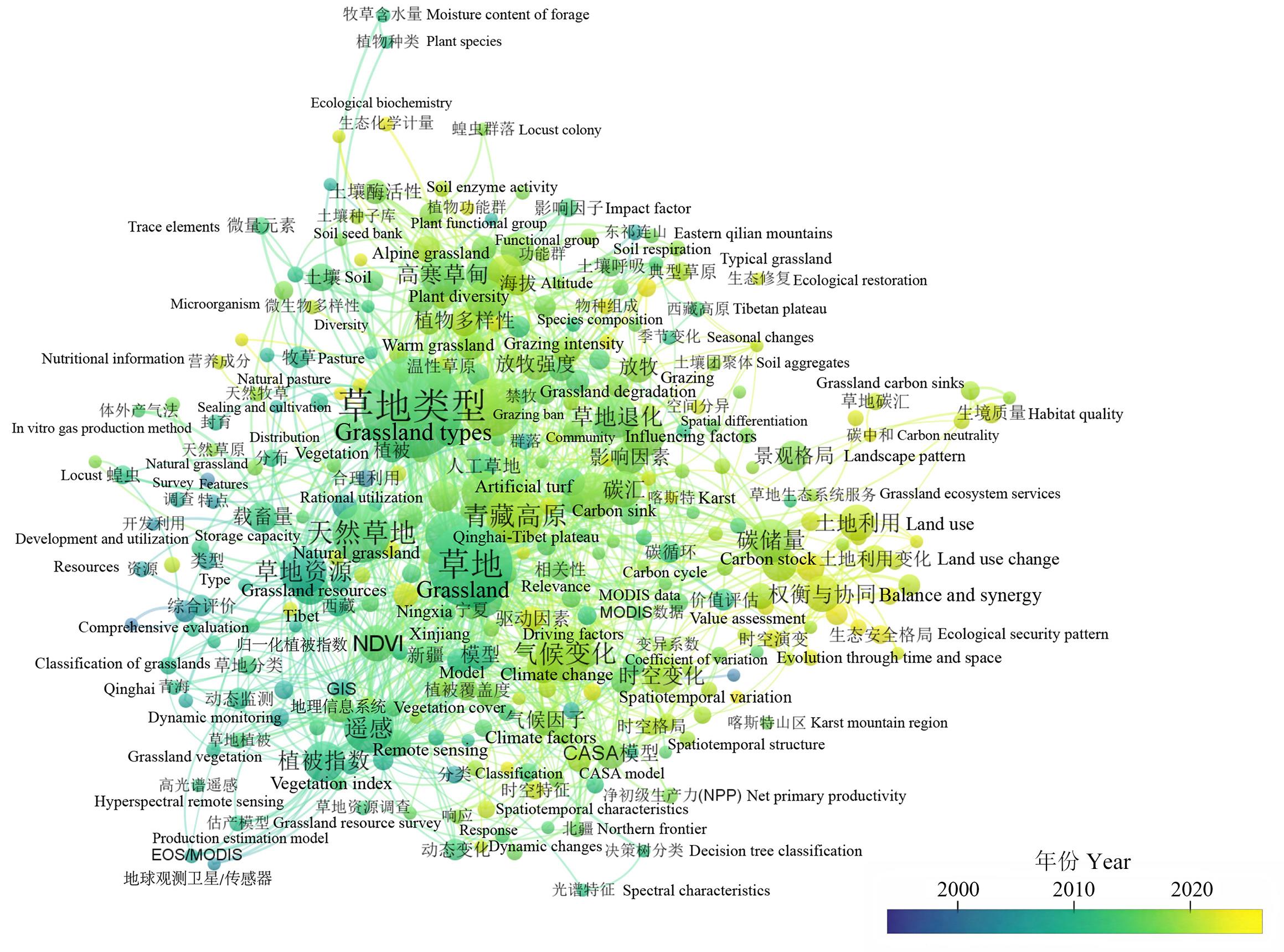
Fig.1 Keyword co-occurrence diagram
排名 Ranking | 按出现频次排名Ranked by frequency of occurrence | 按中介中心性排名Ranked by intermediary centrality | ||
|---|---|---|---|---|
| 关键词Keywords | 出现频次Occurrence frequency | 关键词Keywords | 中介中心性Intermediary centrality | |
| 1 | 草地类型Grassland types | 265 | 草地类型Grassland types | 0.52 |
| 2 | 草地Grassland | 179 | 草地Grassland | 0.44 |
| 3 | 气候变化Climate change | 82 | 天然草地Natural grassland | 0.12 |
| 4 | 天然草地Natural grassland | 80 | 草地资源Grassland resources | 0.12 |
| 5 | 青藏高原Qinghai-Tibet plateau | 80 | 气候变化Climate change | 0.08 |
| 6 | 高寒草地Alpine grasslands | 76 | 高寒草地Alpine grasslands | 0.08 |
| 7 | 遥感Remote sensing | 44 | 遥感Remote sensing | 0.08 |
| 8 | 碳储量Carbon stock | 44 | 青藏高原Qinghai-Tibet plateau | 0.07 |
| 9 | 草地资源Grassland resources | 38 | 产草量Forage yield | 0.06 |
| 10 | 生物量Biomass | 37 | 生物量Biomass | 0.04 |
Table 4 Top 10 keywords by frequency and intermediary centrality in the China national knowledge infrastructure (CNKI) database
排名 Ranking | 按出现频次排名Ranked by frequency of occurrence | 按中介中心性排名Ranked by intermediary centrality | ||
|---|---|---|---|---|
| 关键词Keywords | 出现频次Occurrence frequency | 关键词Keywords | 中介中心性Intermediary centrality | |
| 1 | 草地类型Grassland types | 265 | 草地类型Grassland types | 0.52 |
| 2 | 草地Grassland | 179 | 草地Grassland | 0.44 |
| 3 | 气候变化Climate change | 82 | 天然草地Natural grassland | 0.12 |
| 4 | 天然草地Natural grassland | 80 | 草地资源Grassland resources | 0.12 |
| 5 | 青藏高原Qinghai-Tibet plateau | 80 | 气候变化Climate change | 0.08 |
| 6 | 高寒草地Alpine grasslands | 76 | 高寒草地Alpine grasslands | 0.08 |
| 7 | 遥感Remote sensing | 44 | 遥感Remote sensing | 0.08 |
| 8 | 碳储量Carbon stock | 44 | 青藏高原Qinghai-Tibet plateau | 0.07 |
| 9 | 草地资源Grassland resources | 38 | 产草量Forage yield | 0.06 |
| 10 | 生物量Biomass | 37 | 生物量Biomass | 0.04 |
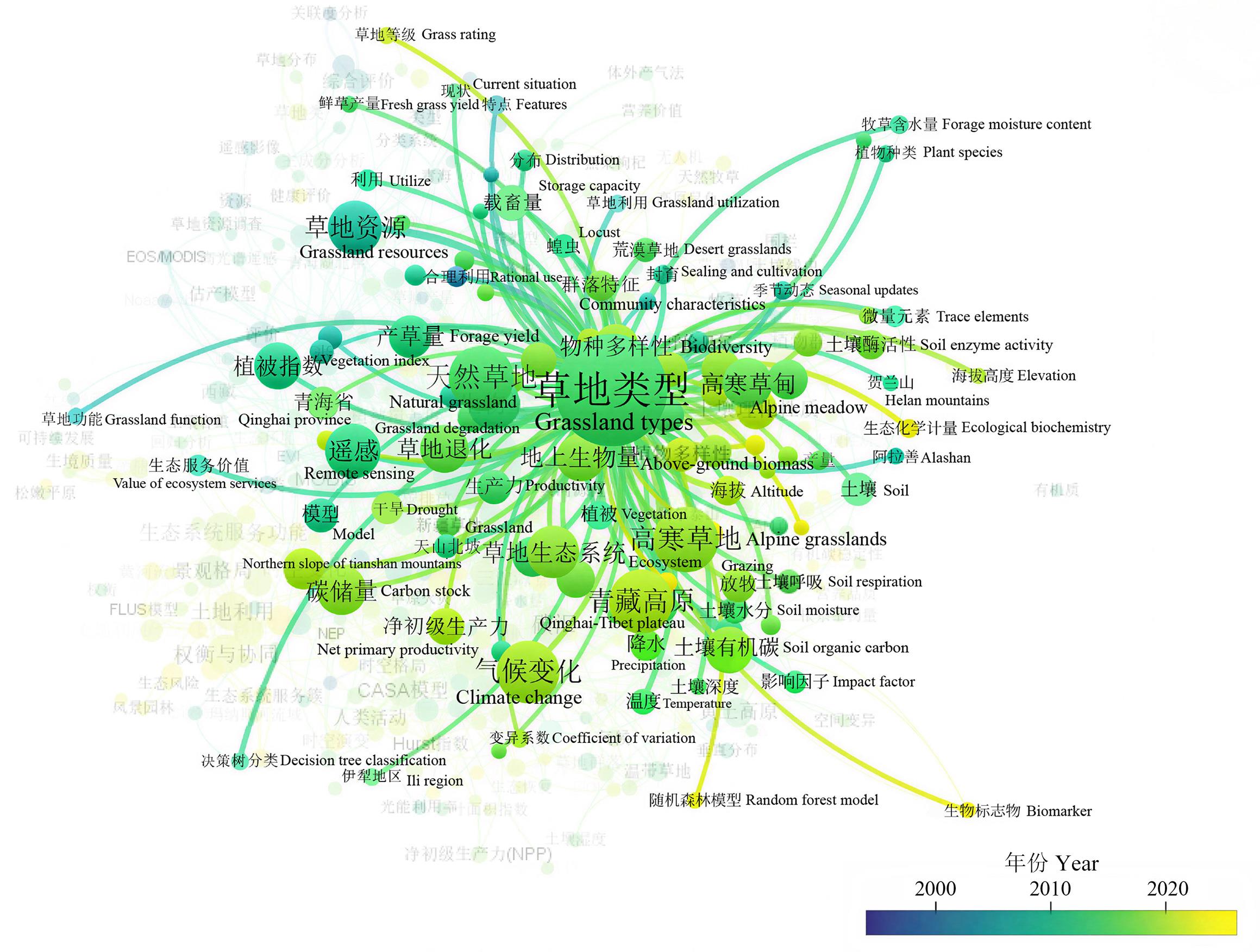
Fig.2 Grassland type relationship diagram
| [1] | Xie L J, Bai Z K, Yang B Y, et al. Carbon sequestration assessment methods at home and abroad for terrestrial ecosystems: Research progress in achieving carbon neutrality. Earth Science Frontiers, 2023, 30(2): 447-462. |
| 谢立军, 白中科, 杨博宇, 等. 碳中和背景下国内外陆地生态系统碳汇评估方法研究进展. 地学前缘, 2023, 30(2): 447-462. | |
| [2] | Intergovernmental Panel on Climate Change. AR6 synthesis report: Climate change 2023. (2023-03-20) [2025-07-20]. https://www.ipcc.ch/report/ar6/syr/. |
| [3] | Wang W, Fang J Y. Soil respiration and human effects on global grasslands. Global and Planetary Change, 2009, 67(1/2): 20-28. |
| [4] | Schuman G E, Janzen H H, Herrick J E. Soil carbon dynamics and potential carbon sequestration by rangelands. Environmental Pollution, 2002, 116(3): 391-396. |
| [5] | Ha Q. The carbon storage of different grassland patterns in Saihanwula National Nature Reserve. Huhhot: Inner Mongolia Agricultural University, 2012. |
| 哈琴. 赛罕乌拉国家级自然保护区不同草地类型碳储量研究. 呼和浩特: 内蒙古农业大学, 2012. | |
| [6] | Yan Y, Zhu J J, Zhang B, et al. A review of belowground biomass allocation and its response to global climatic change in grassland ecosystems. Chinese Journal of Plant Ecology, 2017, 41(5): 585-596. |
| 严月, 朱建军, 张彬, 等. 草原生态系统植物地下生物量分配及对全球变化的响应. 植物生态学报, 2017, 41(5): 585-596. | |
| [7] | Lozano-Garcia B, Parras-Alcantara L, Brevik E C. Impact of topographic aspect and vegetation (native and reforested areas) on soil organic carbon and nitrogen budgets in Mediterranean natural areas. Science of the Total Environment, 2016, 544(8): 963-970. |
| [8] | Hoffmann T, Glatzel S, Dikau R. A carbon storage perspective on alluvial sediment storage in the Rhine catchment. Geomorphology, 2009, 108(1): 127-137. |
| [9] | Fan X, Cai J, Liu J P, et al. Effects of grassland plant communities on ramet expansion ability and biomass allocation of Potentilla anserina. Pratacultural Science, 2017, 34(1): 119-128. |
| 樊星, 蔡捡, 刘金平, 等. 草地植物群落组成对鹅绒委陵菜无性系拓展能力及生物量配置的影响. 草业科学, 2017, 34(1): 119-128. | |
| [10] | Trissanti V N, Amalo L F, Handayani L D W, et al. The estimation of biomass and carbon stocks in mangrove forest ecosystem of Karawang Regency, West Java. IOP Conference Series: Earth and Environmental Science, 2022, 1109(1): 012099. |
| [11] | Ni J. Carbon storage in grasslands of China. Journal of Arid Environments, 2002, 50(2): 205-218. |
| [12] | Alimiri A J, Tang B J, Kong F X, et al. Study on convenient estimation technique of aboveground biomass of natural grassland in Xinjiang. Acta Agrestia Sinica, 2025, 33(4): 1308-1315. |
| 阿力米日·阿力木江, 唐邦洁, 孔繁晰, 等. 新疆天然草地地上生物量的便捷估测技术研究. 草地学报, 2025, 33(4): 1308-1315. | |
| [13] | Liu X, Ling C X, Chen Y F, et al. Additive biomass models and carbon content of thirteen typical shrubs in Erdos Region. Scientia Silvae Sinicae, 2025, 61(4): 117-128. |
| 刘霞, 凌成星, 陈永富, 等. 鄂尔多斯地区13种典型灌木的可加性生物量模型及含碳率. 林业科学, 2025, 61(4): 117-128. | |
| [14] | Wang S J, Liu W H, Jin G L, et al. Temporal and spatial changes of grassland aboveground biomass and its response to climate factors in Xinjiang. Acta Agrestia Sinica, 2025, 33(7): 2320-2332. |
| 王生菊, 刘文昊, 靳瑰丽, 等. 新疆草地地上生物量时空变化及对气候因子的响应. 草地学报, 2025, 33(7): 2320-2332. | |
| [15] | Liang B M, Liu X, Hao Y Y, et al. Extraction of desert vegetation information based on five vegetation indices. Arid Zone Research, 2023, 40(4): 647-654. |
| 梁博明, 刘新, 郝媛媛, 等. 基于5种植被指数的荒漠区植被生物量提取研究. 干旱区研究, 2023, 40(4): 647-654. | |
| [16] | Hou Z Q, Yan A, Xie K Y, et al. Estimation of aboveground biomass of Diarthron tianschanicum based on vegetation index fusion. Xinjiang Agricultural Sciences, 2024, 61(11): 2787-2796. |
| 侯正清, 颜安, 谢开云, 等. 基于植被指数融合天山假狼毒地上生物量的估测. 新疆农业科学, 2024, 61(11): 2787-2796. | |
| [17] | Liu Y Y, Feng T, Chen B J, et al. Estimation of multi-scale biomass and carbon storage in the coastal wetlands of Ningbo City through Field-UAV-Satellite synergy. National Remote Sensing Bulletin, 2025, 29(1): 147-166. |
| 刘杨毅, 冯添, 陈镔捷, 等. 星空地协同的多尺度宁波市滨海湿地生物量及碳储量估算. 遥感学报, 2025, 29(1): 147-166. | |
| [18] | Li S Z, Xu D W, Fan K K, et al. Research of grassland aboveground biomass inversion based on UAV and satellite remoting sensing. Remote Sensing Technology and Application, 2022, 37(1): 272-278. |
| 李淑贞, 徐大伟, 范凯凯, 等. 基于无人机与卫星遥感的草原地上生物量反演研究. 遥感技术与应用, 2022, 37(1): 272-278. | |
| [19] | Wang T, Zhou W, Xiao J Y, et al. Estimating the grassland aboveground biomass based on remote sensing data and machine learning algorithm. Journal of Glaciology and Geocryology, 2023, 45(2): 753-762. |
| 王婷, 周伟, 肖洁芸, 等. 基于遥感数据和机器学习算法的草地地上生物量估算研究. 冰川冻土, 2023, 45(2): 753-762. | |
| [20] | Xiu X M, Zhou S F, Chen Q, et al. Above-ground biomass estimation of provincial scattered grassland based on Google Earth Engine and machine learning. Bulletin of Surveying and Mapping, 2019(3): 46-52, 75. |
| 修晓敏, 周淑芳, 陈黔, 等. 基于Google Earth Engine与机器学习的省级尺度零散分布草地生物量估算. 测绘通报, 2019(3): 46-52, 75. | |
| [21] | Ren G B, Wang J B, Wu P Q, et al. Remote sensing-based estimation methods and future development directions for carbon storage in coastal wetland vegetation. Satellite Application, 2025, 16(5): 21-25. |
| 任广波, 王建步, 吴培强, 等. 滨海湿地植被碳储量遥感估算方法及发展方向. 卫星应用, 2025, 16(5): 21-25. | |
| [22] | Yang W Y, Sun L Y, Song F B, et al. Research advances in species diversity of arbuscular mycorrhizal fungi in terrestrial agro-ecosystem. Chinese Journal of Applied Ecology, 2019, 30(11): 3971-3979. |
| 杨文莹, 孙露莹, 宋凤斌, 等. 陆地农业生态系统丛枝菌根真菌物种多样性研究进展. 应用生态学报, 2019, 30(11): 3971-3979. | |
| [23] | Ni J. Carbon storage in terrestrial ecosystems of China: Estimates at different spatial resolutions and their responses to climate change. Climatic Change, 2001, 49(3): 339-358. |
| [24] | Ingram K T, Leers G A. Software for measuring root characters from digital images. Agronomy Journal, 2001, 93(4): 918-922. |
| [25] | Fan J W, Zhong H P, Harris W, et al. Carbon storage in the grasslands of China based on field measurements of above- and below-ground. Climatic Change, 2008, 86(3/4): 375-396. |
| [26] | Tan K, Ciais P, Piao S L, et al. Application of the ORCHIDEE global vegetation model to evaluate biomass and soil carbon stocks of Qinghai-Tibetan grasslands. Global Biogeochemical Cycles, 2010, 24(1): 425-427. |
| [27] | Piao S L, Fang J Y, Zhou L M, et al. Changes in biomass carbon stocks in China’s grasslands between 1982 and 1999. Global Biogeochemical Cycles, 2007, 21(2): B2001-B2002. |
| [28] | Fang J Y, Liu G H, Xu S L. China’s terrestrial ecosystem carbon pool. Beijing: China Environmental Science Press, 1996: 109-128. |
| 方精云, 刘国华, 徐嵩龄. 中国陆地生态系统的碳库. 北京: 中国环境科学出版社, 1996: 109-128. | |
| [29] | Mokany K, Raison R J, Prokushkin A S. Critical analysis of root: Shoot ratios in terrestrial biomes. Global Change Biology, 2006, 12(1): 84-96. |
| [30] | Yang J J, Li A Y, Yang Y F, et al. Soil organic carbon stability under natural and anthropogenic-induced perturbations. Earth-Science Reviews, 2020, 205: 103199. |
| [31] | Zheng J F, Chen S T. Soil organic matter and soil carbon sequestration. Science, 2021, 73(6): 13-17. |
| 郑聚锋, 陈硕桐. 土壤有机质与土壤固碳. 科学, 2021, 73(6): 13-17. | |
| [32] | Li C L, Wang X, Zhang W, et al. Topsoil organic carbon storage and its spatial and temporal variation in the western Loess Plateau. Geoscience, 2022, 36(2): 655-661. |
| 李春亮, 王翔, 张炜, 等. 黄土高原西段表层土壤有机碳储量及时空变化规律. 现代地质, 2022, 36(2): 655-661. | |
| [33] | Xu S Q, Kou W, Shi R X, et al. Soil organic carbon content and composition characteristics of different vegetation types in the northern Shaanxi Hongliulin coal mining area. Agricultural Research in the Arid Areas, 2025, 43(3): 220-232. |
| 许世奇, 寇威, 时若萱, 等. 陕北红柳林煤矿区不同植被类型土壤有机碳含量及组成特征. 干旱地区农业研究, 2025, 43(3): 220-232. | |
| [34] | Chen J Z, Shen C C, Fan Z H, et al. Influencing factors of soil organic carbon in citrus orchard in the Three Gorges Reservoir area. Resources and Environment in the Yangtze Basin, 2024, 33(11): 2440-2450. |
| 陈吉臻, 沈琛琛, 樊子豪, 等. 三峡库区柑橘园土壤有机碳关键影响因子分析. 长江流域资源与环境, 2024, 33(11): 2440-2450. | |
| [35] | Cao R H, Zhang M L, Li X J, et al. Simulation analysis of the spatial and temporal distribution of soil organic carbon storage in Gannan alpine meadow. Chinese Journal of Ecology, 2022, 41(11): 2145-2153. |
| 曹瑞红, 张美玲, 李晓娟, 等. 甘南高寒草甸土壤有机碳储量时空分布特征的模拟分析. 生态学杂志, 2022, 41(11): 2145-2153. | |
| [36] | Singhi P, Benbi D K. Modeling soil organic carbon with DNDC and RothC models in different wheat-based cropping systems in north-western India. Communications in Soil Science and Plant Analysis, 2020, 51(9): 1184-1203. |
| [37] | Man W D, Yu H, Li L, et al. Spatial expansion and soil organic carbon storage changes of croplands in the Sanjiang Plain, China. Sustainability, 2017, 9(4): 563. |
| [38] | Liu Z. Research on the application of stable carbon isotope tracing technology in the soil organic carbon cycle//Proceedings of the sub-forum on environmental engineering technology innovation and application, 2019 annual science and technology conference of the Chinese society for environmental sciences (I). Beijing: Chinese Society for Environmental Sciences, 2019: 288-291, 375. |
| 刘哲. 稳定碳同位素示踪技术在土壤有机碳循环中的应用研究//中国环境科学学会2019年科学技术年会-环境工程技术创新与应用分论坛论文集(一). 北京: 中国环境科学学会, 2019: 288-291, 375. | |
| [39] | Cai Y N, Ju Z S, Huang Q, et al. Analysis on the contents and methods of soil organic carbon dink. Acta Ecologica Sinica, 2024, 44(2): 602-611. |
| 蔡亚楠, 鞠正山, 黄勤, 等. 土壤有机碳汇内涵与核算方法辨析. 生态学报, 2024, 44(2): 602-611. | |
| [40] | Yang Y H, Shi Y, Sun W J, et al. Terrestrial carbon sinks in China and around the world and their contribution to carbon neutrality. Scientia Sinica Vitae, 2022, 52(4): 534-574. |
| 杨元合, 石岳, 孙文娟, 等. 中国及全球陆地生态系统碳源汇特征及其对碳中和的贡献. 中国科学: 生命科学, 2022, 52(4): 534-574. | |
| [41] | Peng Y F, Chang J F, Zhao X, et al. Grassland carbon sink in China and its promotion strategies. Bulletin of National Natural Science Foundation of China, 2023, 37(4): 587-602. |
| 彭云峰, 常锦峰, 赵霞, 等. 中国草地生态系统固碳能力及其提升途径. 中国科学基金, 2023, 37(4): 587-602. | |
| [42] | Huang L M, Zhao F, Hu G Z, et al. A study of differential vegetation responses to extreme climate events across grassland types in Northern China. Acta Ecologica Sinica, 2025, 45(24): 1-13. |
| 黄琳铭, 赵芬, 胡国铮, 等. 中国北方不同草地类型植被响应极端气候的差异研究. 生态学报, 2025, 45(24): 1-13. | |
| [43] | Liu Y Y, Zhang Z Y, Tong L J, et al. Spatiotemporal dynamics of China’s grassland NPP and its driving factors. Chinese Journal of Ecology, 2020, 39(2): 349-363. |
| 刘洋洋, 章钊颖, 同琳静, 等. 中国草地净初级生产力时空格局及其影响因素. 生态学杂志, 2020, 39(2): 349-363. | |
| [44] | Wu Q, Zhu A M, Ju X, et al. Advances in effects of climate change and grazing disturbance on soil organic carbon in grasslands. Journal of Inner Mongolia Agricultural University (Natural Science Edition), 2023, 44(5): 73-80. |
| 武倩, 朱爱民, 鞠馨, 等. 气候变化和放牧干扰对草地土壤有机碳的影响研究进展. 内蒙古农业大学学报(自然科学版), 2023, 44(5): 73-80. | |
| [45] | Wang S Q, Zhou C H, Luo C W. Studying carbon storage spatial distribution of terrestrial natural vegetation in China. Progress in Geography, 1999, 18(3): 238-244. |
| 王绍强, 周成虎, 罗承文. 中国陆地自然植被碳量空间分布特征探讨. 地理科学进展, 1999, 18(3): 238-244. | |
| [46] | Olson J S, Watts J A, Allison L J. Carbon in live vegetation of major world ecosystems. Washington D C: U.S. Department of Energy, 1983. |
| [47] | Fang J Y, Guo Z D, Piao S L, et al. Terrestrial vegetation carbon sinks in China, 1981-2000. Science in China (Series D), 2007, 50(9): 1341-1350. |
| 方精云, 郭兆迪, 朴世龙, 等. 1981-2000年间中国陆地植被碳汇. 中国科学D辑, 2007, 50(9): 1341-1350. | |
| [48] | Piao S L, Fang J Y, He J S, et al. Spatial distribution of grassland biomass in China. Chinese Journal of Plant Ecology, 2004, 28(4): 491-498. |
| 朴世龙, 方精云, 贺金生, 等. 中国草地植被生物量及其空间分布格局. 植物生态学报, 2004, 28(4): 491-498. | |
| [49] | Wang S Z, Fan J W, Liu S. A comprehensive analysis of difference in carbon stock estimation in the grasslands of China. Acta Agrestia Sinica, 2017, 25(5): 905-913. |
| 王穗子, 樊江文, 刘帅. 中国草地碳库估算差异性综合分析. 草地学报, 2017, 25(5): 905-913. | |
| [50] | Zhang C Y, Zhao X, Xin Y C, et al. Carbon storage and distribution of grassland ecosystems in Qinghai Province. Journal of Beijing Normal University (Natural Science), 2022, 58(2): 286-292. |
| 张琛悦, 赵霞, 辛玉春, 等. 青海省草地生态系统碳储量及其分布特征. 北京师范大学学报(自然科学版), 2022, 58(2): 286-292. | |
| [51] | Ma W H, Han M, Lin X, et al. Carbon storage in vegetation of grasslands in Inner Mongolia. Journal of Arid Land Resources and Environment, 2006, 20(3): 192-195. |
| 马文红, 韩梅, 林鑫, 等. 内蒙古温带草地植被的碳储量. 干旱区资源与环境, 2006, 20(3): 192-195. | |
| [52] | Yang Y H, Fang J Y, Ma W H, et al. Large-scale pattern of biomass partitioning across China’s grasslands. Global Ecology and Biogeography, 2010, 19(2): 268-277. |
| [53] | Zhang F. Inventory of Chinese grasslands carbon storage and greenhouse gases emission. Lanzhou: Lanzhou University, 2010. |
| 张峰. 中国草原碳库储量及温室气体排放量估算. 兰州: 兰州大学, 2010. | |
| [54] | Zhang Y Q, Tang Y H, Jiang J, et al. Characterizing the dynamics of soil organic carbon in grasslands on the Qinghai-Tibetan Plateau. Science in China (Series D), 2007, 50(1): 113-120. |
| 张永强, 唐艳红, 姜杰, 等. 青藏高原草原土壤有机碳动态表征. 中国科学D辑, 2007, 50(1): 113-120. | |
| [55] | Zhang L, Zhou G S, Ji Y H, et al. Spatiotemporal dynamic simulation of grassland carbon storage in China. Scientia Sinica (Terrae), 2016, 46(10): 1392-1405. |
| 张利, 周广胜, 汲玉河, 等. 中国草地碳储量时空动态模拟研究. 中国科学(地球科学), 2016, 46(10): 1392-1405. | |
| [56] | Yang Y H, Fang J Y, Tang Y H, et al. Storage, patterns and controls of soil organic carbon in the Tibetan grasslands. Global Change Biology, 2008, 14(7): 1592-1599. |
| [57] | Wang T, Wang X Y, Liu D, et al. The current and future of terrestrial carbon balance over the Tibetan Plateau. Scientia Sinica(Terrae), 2023, 53(7): 1506-1516. |
| 汪涛, 王晓昳, 刘丹, 等. 青藏高原碳汇现状及其未来趋势. 中国科学(地球科学), 2023, 53(7): 1506-1516. | |
| [58] | Xu H K, Lu H, Liu H, et al. Research trends and focus areas on the global grassland carbon sink-A bibliometric analysis for 1992-2022. Acta Agrestia Sinica, 2024, 32(7): 2169-2178. |
| 徐恒康, 逯辉, 刘灏, 等. 全球草地碳汇研究趋势与重点领域-基于1992-2022年文献计量分析. 草地学报, 2024, 32(7): 2169-2178. | |
| [59] | Wang L, Zeng H, Zhang Y J, et al. A review of research on soil carbon storage and its influencing factors in the Tibetan Plateau. Chinese Journal of Ecology, 2019, 38(11): 3506-3515. |
| 王荔, 曾辉, 张扬建, 等. 青藏高原土壤碳储量及其影响因素研究进展. 生态学杂志, 2019, 38(11): 3506-3515. | |
| [60] | Li J Z, Li W, Liu C, et al. Characteristics of soil carbon, nitrogen and C/N stoichiometry at different altitudes in warm mountain steppe in arid region. Pratacultural Science, 2025, 42(10): 2442-2454. |
| 李锦臻, 李雯, 刘超, 等. 干旱区温性山地草原不同海拔土壤碳氮及其C/N化学计量变化特征. 草业科学, 2025, 42(10): 2442-2454. | |
| [61] | Li Y Z, Wei Y, Liu K H, et al. Spatiotemporal variation characteristics and drivers of soil organic carbon at different elevations in an alpine grassland. Chinese Journal of Applied and Environmental Biology, 2025, 31(3): 357-372. |
| 李宇章, 魏瑶, 刘坤和, 等. 高寒草地不同海拔土壤有机碳时空变化特征及驱动因素. 应用与环境生物学报, 2025, 31(3): 357-372. | |
| [62] | Zhou H, Tian F P, Lu Y, et al. A review on influencing factors of grassland soil organic carbon storage. Chinese Agricultural Science Bulletin, 2015, 31(23): 153-157. |
| 周恒, 田福平, 路远, 等. 草地土壤有机碳储量影响因素研究进展. 中国农学通报, 2015, 31(23): 153-157. | |
| [63] | Han X S, Liu G Q, Xu H, et al. Spatial variation and scale effect of surface soil organic carbon content on typical slopes in the loess region, Ningxia. Scientia Silvae Sinicae, 2024, 60(1): 19-31. |
| 韩新生, 刘广全, 许浩, 等. 宁夏黄土区典型坡面表层土壤有机碳含量的空间变化特征及尺度效应. 林业科学, 2024, 60(1): 19-31. | |
| [64] | Chen C, Xu Y F. Temporal and spatial variation characteristics and driving forces of stable grassland net primary productivity in the northern slope of Tianshan Mountains economic zone. Pratacultural Science, 2023, 40(5): 1154-1167. |
| 陈宸, 许玉凤. 天山北坡经济带稳定草地净初级生产力时空变化特征及其驱动力. 草业科学, 2023, 40(5): 1154-1167. | |
| [65] | Guan Q Y, Yang L Q, Guan W Q, et al. Assessing vegetation response to climatic variations and human activities: spatiotemporal NDVI variations in the Hexi Corridor and surrounding areas from 2000 to 2010. Theoretical and Applied Climatology, 2019, 135(3/4): 1179-1193. |
| [66] | Wan S Q, Hui D F, Wallace L, et al. Direct and indirect effects of experimental warming on ecosystem carbon processes in a tallgrass prairie. Global Biogeochemical Cycles, 2005, 19(2): 1-13. |
| [67] | Wang H, Liu G H, Li Z S, et al. Impacts of climate change on net primary productivity in arid and semiarid regions of China. Chinese Geographical Science, 2016, 26(1): 35-47. |
| [68] | Liu Z T, Cui Y Y, Bai L, et al. Effects of simulated precipitation on aboveground and belowground biomass and their allocation proportion of plant community in desert steppe. Acta Agrestia Sinica, 2023, 31(6): 1632-1639. |
| 刘倬彤, 崔媛媛, 白柳, 等. 模拟降水变化对荒漠草原地上、地下生物量及其分配比例的影响. 草地学报, 2023, 31(6): 1632-1639. | |
| [69] | Zhang J T, Zhao F X, Chen J H, et al. Correlations of species diversity and biomass with environmental factors in alpine grasslands across the Qingzang Plateau. Pratacultural Science, 2023, 40(3): 616-626. |
| 张锦涛, 赵峰侠, 陈俊合, 等. 青藏高原不同类型高寒草地物种多样性与生物量的关系及影响要素. 草业科学, 2023, 40(3): 616-626. | |
| [70] | Chang S, Yu H B, Cao C M, et al. Distribution characteristics of soil organic carbon in Xilin Gol steppe and its influencing factors. Arid Zone Research, 2021, 38(5): 1355-1366. |
| 常帅, 于红博, 曹聪明, 等. 锡林郭勒草原土壤有机碳分布特征及其影响因素. 干旱区研究, 2021, 38(5): 1355-1366. | |
| [71] | Yao S T, Lu G X, Zhou H K, et al. Effect of simulated temperature increase on carbon and nitrogen changes in alpine meadow. Acta Agrestia Sinica, 2021, 29(S1): 218-224. |
| 姚世庭, 芦光新, 周华坤, 等. 模拟增温对高寒草甸土壤性质的影响. 草地学报, 2021, 29(S1): 218-224. | |
| [72] | Sotta D E, Meir P, Malhi Y, et al. Soil CO2 efflux in a tropical forest in the central Amazon. Global Change Biology, 2004, 10(5): 601-617. |
| [73] | Hontoria C, Rodriguez-Murillo J C, Saa A. Relationships between soil organic carbon and site characteristics in peninsular Spain. Soil Science Society of America Journal, 1999, 63(3): 614-621. |
| [74] | Nichols J D. Relation of organic carbon to soil properties and climate in the southern Great Plains. Soil Science Society of America Journal, 1984, 48(6): 1382-1384. |
| [75] | Zhao X Y, Han G Q, Zhang S W, et al. Effects of grazing on plant diversity and their carbon stocks in different types of grasslands. Environmental Science, 2024, 45(9): 5395-5405. |
| 赵星宇, 韩国强, 张圣微, 等. 放牧对不同类型草原植物多样性及其碳储量的影响. 环境科学, 2024, 45(9): 5395-5405. | |
| [76] | Wu S K, Hao J, Diao H J, et al. Response of grassland biomass to short-term grazing intensities in the agro-pastoral ecotone in Northern Shanxi. Acta Agrestia Sinica, 2023, 31(8): 2446-2454. |
| 武帅楷, 郝杰, 刁华杰, 等. 晋北农牧交错带草地生物量对短期放牧强度的响应. 草地学报, 2023, 31(8): 2446-2454. | |
| [77] | Li H, Jiang K W, Yang Y Q, et al. Response of vegetation characteristics and soil nutrients to grazing in mountain meadows on the north slope of the Tianshan Mountains. Pratacultural Science, 2023, 40(4): 874-884. |
| 李宏, 江康威, 杨永强, 等. 天山北坡山地草甸植被特征和土壤养分对放牧的响应. 草业科学, 2023, 40(4): 874-884. | |
| [78] | Chen S S, Wang M, Zhang C, et al. Effects of different grazing intensities on soil active organic carbon in Leymus chinensis meadow steppe in Hulunbuir. Soil and Fertilizer Sciences in China, 2023, 60(11): 16-24. |
| 陈思思, 王淼, 张楚, 等. 不同放牧强度对呼伦贝尔羊草草甸草原土壤活性有机碳的影响. 中国土壤与肥料, 2023, 60(11): 16-24. | |
| [79] | Zhang Y R, Liu Y L, Huang X C, et al. Organic carbon mineralization characteristics in rhizosphere and bulk soil of rice under organic fertilization modes in yellow paddy fields. Journal of Plant Nutrition and Fertilizers, 2023, 29(3): 449-458. |
| 张雅蓉, 刘彦伶, 黄兴成, 等. 不同有机肥施用模式下黄壤稻田根际和非根际土壤有机碳的矿化特征. 植物营养与肥料学报, 2023, 29(3): 449-458. | |
| [80] | Li W J, Huang Q H, Li D M, et al. Variation characteristics of organic carbon pools with different protection methods in upland red soil under long-term fertilization. Journal of Agricultural Resources and Environment, 2023, 40(1): 106-115. |
| 李文军, 黄庆海, 李大明, 等. 长期施肥下旱地红壤不同保护态有机碳库变化特征. 农业资源与环境学报, 2023, 40(1): 106-115. | |
| [81] | Hai X. Effects of fertilization on soil carbon and nitrogen and microbial communities in wheat-maize rotation farmland in north China. Beijing: Chinese Academy of Agricultural Sciences, 2024. |
| 海香. 施肥对华北小麦玉米轮作农田土壤碳氮及微生物群落的影响. 北京: 中国农业科学院, 2024. | |
| [82] | Wang S, Sheng Y, Fan S H, et al. Response of carbon storage changes to land use pattern in Kuye River Basin based on InVEST model. Research of Soil and Water Conservation, 2025, 32(3): 149-158. |
| 王硕, 盛艳, 范淑花, 等. 基于InVEST模型的窟野河流域碳储量变化对土地利用格局的响应. 水土保持研究, 2025, 32(3): 149-158. | |
| [83] | Lal R, Follett R F, Kimble J, et al. Managing U.S. cropland to sequester carbon in soil. Journal of Soil and Water Conservation, 1999, 54(1): 374-381. |
| [84] | Rhoades C C, Eckert G E, Coleman D C. Soil carbon differences among forest, agriculture, and secondary vegetation in lower montane Ecuador. Ecological Applications, 2000, 10(2): 497-505. |
| [85] | Zhao Q, Zou D J, Chai Z M, et al. Effects of land use change on the temporal and spatial dynamics of ecosystem carbon storage in the Wujiang River Basin, Guizhou. China Rural Water and Hydropower, 2025, 67(5): 9-16. |
| 赵乔, 邹东景, 柴周茂, 等. 贵州乌江流域土地利用变化对生态系统碳储量时空演变特征的影响. 中国农村水利水电, 2025, 67(5): 9-16. | |
| [86] | Zhao W, Li L, Wang Y J, et al. Carbon sequestration characteristics and regional differences of typical warm and tropical grasslands in Henan Province, China. Chinese Journal of Applied Ecology, 2018, 29(6): 1867-1875. |
| 赵威, 李琳, 王艳杰, 等. 河南典型暖(热)性草地固碳特征及区域差异. 应用生态学报, 2018, 29(6): 1867-1875. |
| [1] | Xue-xi MA, Ying-zhi GAO. Impact of shrub encroachment on soil hydrological processes in grassland [J]. Acta Prataculturae Sinica, 2025, 34(4): 212-222. |
| [2] | Yang CHENG, Chang-qing JING. Carbon and water fluxes of different grassland types in the growing season based on the Common Land Model [J]. Acta Prataculturae Sinica, 2025, 34(12): 33-49. |
| [3] | Xue-min LI, Tong-ning LI, Zhi-yu WU, Zhen-guo WU. Spatio-temporal evolution of grassland ecosystem service value in Inner Mongolia under multi scenario simulation [J]. Acta Prataculturae Sinica, 2023, 32(8): 14-27. |
| [4] | Hu-cheng XING, Xian-fang WANG, Qing ZHOU, Jing-cai YAN, Yu-cheng JIE. Types, grades, and utilization of grassland resources in 52 counties of Hunan Province [J]. Acta Prataculturae Sinica, 2023, 32(8): 91-103. |
| [5] | Ao JIANG, Lu-huai JING, Tserang-donko MIPAM, Li-ming TIAN. Progress in research on the effects of grazing on grassland litter decomposition [J]. Acta Prataculturae Sinica, 2023, 32(4): 208-220. |
| [6] | Hao CHEN, Fang GONG, Du-lan CHEN. Coupling and coordination relationship between grassland ecosystem service value and ecological well-being of pastoral residents, and its spatial heterogeneity [J]. Acta Prataculturae Sinica, 2023, 32(11): 1-16. |
| [7] | Jiao-yun LU, He-shan ZHANG, Hong TIAN, Jun-bo XIONG, Yang LIU. Research progress on effects of nitrogen deposition on soil nitrogen cycling in grassland ecosystems [J]. Acta Prataculturae Sinica, 2022, 31(6): 221-234. |
| [8] | Xiao-ning ZHANG, Xiao-dan LI, Li-li NIAN, Ying-bo YANG, Xue-lu LIU. A bibliometric evaluation of the status of the water conservation function of grassland ecosystems [J]. Acta Prataculturae Sinica, 2022, 31(6): 35-49. |
| [9] | Ying LI, Jing WU, Chun-bin LI, Ge-xia QIN. Temporal and spatial variation in grassland ground surface soil heat flux on the Qinghai-Tibetan Plateau from 2003 to 2018 [J]. Acta Prataculturae Sinica, 2022, 31(11): 1-14. |
| [10] | Xiao-yu HAN, Ning GUO, Dong-dong LI, Ming-yang XIE, Feng JIAO. Effects of nitrogen addition on soil carbon and nitrogen and biomass change in different grassland types in Inner Mongolia [J]. Acta Prataculturae Sinica, 2022, 31(1): 13-25. |
| [11] | Gang FU, Jun-hao WANG, Shao-wei LI, Ping HE. Responses of forage nutrient quality to grazing in the alpine grassland of Northern Tibet [J]. Acta Prataculturae Sinica, 2021, 30(9): 38-50. |
| [12] | Shu-qin LI, Zhen-jiang CHEN, Tai-xiang CHEN, Xiu-zhang LI, Biao-biao MU, Chun-jie LI. Bibliometric analysis of research on endophytic fungi in grasses and non-grasses based on the CNKI database [J]. Acta Prataculturae Sinica, 2021, 30(6): 121-132. |
| [13] | Guang-yi LV, Xue-bao XU, Cui-ping GAO, Zhi-hui YU, Xin-ya WANG, Cheng-jie WANG. Effects of grazing on total nitrogen and stable nitrogen isotopes of plants and soil in different types of grasslands in Inner Mongolia [J]. Acta Prataculturae Sinica, 2021, 30(3): 208-214. |
| [14] | Wen ZHAO, Ya-li YIN, Shi-xiong LI, Yan LIU, Jing-jing LIU, Yi-ling DONG, Shi-feng SU, Ling-he JI. The characteristics of bacterial communities in different vegetation types in the Qilian Mountains [J]. Acta Prataculturae Sinica, 2021, 30(12): 161-171. |
| [15] | Cong-cong LI, Ya-xing ZHOU, Qiang GU, Ming-xin YANG, Chuan-lu ZHU, Zi-yuan PENG, Kai XUE, Xin-quan ZHAO, Yan-fen WANG, Bao-ming JI, Jing ZHANG. The species diversity and community assembly of arbuscular mycorrhizal fungi in typical alpine grassland in Sanjiangyuan region [J]. Acta Prataculturae Sinica, 2021, 30(1): 46-58. |
| Viewed | ||||||
|
Full text |
|
|||||
|
Abstract |
|
|||||
