
ISSN 1004-5759 CN 62-1105/S
Acta Prataculturae Sinica ›› 2027, Vol. 36 ›› Issue (1): 180-189.DOI: 10.11686/cyxb2026014
Kai-lin XU1( ), Si-qi LIU1,2(), Xiao-qing ZHANG1,3(), Jin-mei ZHAO1
Received:2026-01-13
Revised:2026-03-23
Online:2027-01-20
Published:2026-11-25
Contact:
Xiao-qing ZHANG
Kai-lin XU, Si-qi LIU, Xiao-qing ZHANG, Jin-mei ZHAO. Integrated transcriptomic and metabolomic analyses reveal cold tolerance mechanisms of Urtica cannabina during cold acclimation in the field[J]. Acta Prataculturae Sinica, 2027, 36(1): 180-189.
项目 Item | 组别Group | 均值标准误 SEM | P值 P-value | |
|---|---|---|---|---|
| CU | CA | |||
| 丙二醛Malondialdehyde (nmol·g-1) | 22.80b | 27.01a | 0.54 | 0.016 |
| 脯氨酸Proline (μg·mL-1) | 359.55a | 362.04a | 2.14 | 0.434 |
| 超氧化物歧化酶SOD (U·g-1) | 390.12a | 194.07b | 8.55 | 0.027 |
| 过氧化物酶Peroxidase (U·g-1) | 419.50b | 494.25a | 1.50 | 0.013 |
| 过氧化氢酶Catalase (U·g-1) | 82.55a | 73.28b | 0.46 | 0.035 |
| 淀粉Starch (mg·g-1) | 29.61a | 25.22a | 3.59 | 0.346 |
| 可溶性糖Soluble sugar (mg·g-1) | 27.82b | 88.24a | 8.67 | 0.020 |
Table 1 Changes in physiological parameters of U. cannabina roots before and after cold acclimation
项目 Item | 组别Group | 均值标准误 SEM | P值 P-value | |
|---|---|---|---|---|
| CU | CA | |||
| 丙二醛Malondialdehyde (nmol·g-1) | 22.80b | 27.01a | 0.54 | 0.016 |
| 脯氨酸Proline (μg·mL-1) | 359.55a | 362.04a | 2.14 | 0.434 |
| 超氧化物歧化酶SOD (U·g-1) | 390.12a | 194.07b | 8.55 | 0.027 |
| 过氧化物酶Peroxidase (U·g-1) | 419.50b | 494.25a | 1.50 | 0.013 |
| 过氧化氢酶Catalase (U·g-1) | 82.55a | 73.28b | 0.46 | 0.035 |
| 淀粉Starch (mg·g-1) | 29.61a | 25.22a | 3.59 | 0.346 |
| 可溶性糖Soluble sugar (mg·g-1) | 27.82b | 88.24a | 8.67 | 0.020 |
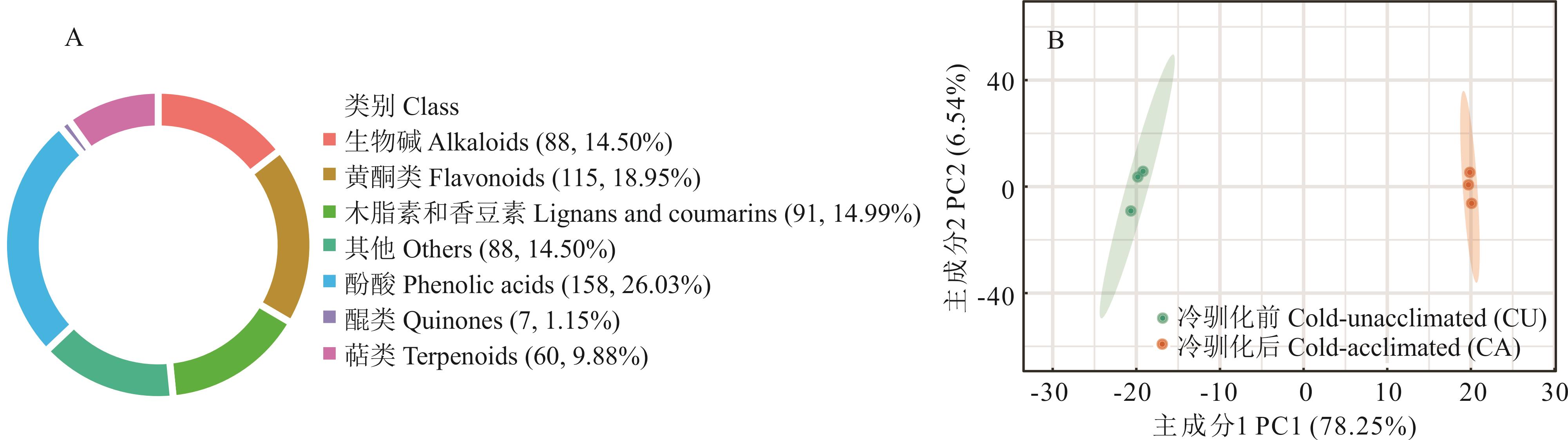
Fig.1 Comprehensive metabolomic analysis of U. cannabina roots under cold-unacclimated and cold-acclimated conditions

Fig. 2 Differential metabolomic analysis of U. cannabina roots between cold-unacclimated and cold-acclimated conditions
样本 Sample | 原始读段 Raw reads | 清洁读段 Clean reads | 清洁数据量 Clean base (Gb) | 错误率 Error rate (%) | Q20 (%) | Q30 (%) | GC (%) |
|---|---|---|---|---|---|---|---|
| CU1 | 43723154 | 42582708 | 6.39 | 0.03 | 97.57 | 93.21 | 49.90 |
| CU2 | 46148576 | 45204360 | 6.78 | 0.03 | 97.49 | 92.99 | 49.87 |
| CU3 | 49556178 | 48461206 | 7.27 | 0.03 | 97.58 | 93.23 | 49.89 |
| CA1 | 54187182 | 53025522 | 7.95 | 0.03 | 97.96 | 94.28 | 49.71 |
| CA2 | 52985420 | 51745922 | 7.76 | 0.02 | 98.00 | 94.37 | 49.74 |
| CA3 | 49317252 | 48320932 | 7.25 | 0.03 | 97.96 | 94.28 | 49.80 |
Table 2 Quality control statistics of sequencing data for each sample
样本 Sample | 原始读段 Raw reads | 清洁读段 Clean reads | 清洁数据量 Clean base (Gb) | 错误率 Error rate (%) | Q20 (%) | Q30 (%) | GC (%) |
|---|---|---|---|---|---|---|---|
| CU1 | 43723154 | 42582708 | 6.39 | 0.03 | 97.57 | 93.21 | 49.90 |
| CU2 | 46148576 | 45204360 | 6.78 | 0.03 | 97.49 | 92.99 | 49.87 |
| CU3 | 49556178 | 48461206 | 7.27 | 0.03 | 97.58 | 93.23 | 49.89 |
| CA1 | 54187182 | 53025522 | 7.95 | 0.03 | 97.96 | 94.28 | 49.71 |
| CA2 | 52985420 | 51745922 | 7.76 | 0.02 | 98.00 | 94.37 | 49.74 |
| CA3 | 49317252 | 48320932 | 7.25 | 0.03 | 97.96 | 94.28 | 49.80 |

Fig.3 Transcriptomic analysis of U. cannabina roots under cold-unacclimated and cold-acclimated conditions

Fig.4 The phenylpropanoid metabolic pathway with alterations in differential metabolites and differentially expressed genes
| [1] | Editorial Board of Flora of China, Chinese Academy of Sciences. Flora of China (Volume 23). Beijing: Science Press, 2006. |
| 中国科学院中国植物志编委会. 中国植物志(第二十三卷). 北京: 科学出版社, 2006. | |
| [2] | Zhang X Q, Jin Y M, Zhang Y J, et al. Silage quality and preservation of Urtica cannabina ensiled alone and with additive treatment. Grass and Forage Science, 2014, 69(3): 405-414. |
| [3] | Martz F, Kankaanpää S. Stinging nettle (Urtica dioica) roots: the power underground-a review. Plants, 2025, 14(2): 279. |
| [4] | Tarasevičienė Ž, Vitkauskaitė M, Paulauskienė A, et al. Wild stinging nettle (Urtica dioica L.) leaves and roots chemical composition and phenols extraction. Plants, 2023, 12(2): 309. |
| [5] | Bajpai V K, Alam M B, Quan K T, et al. Antioxidant efficacy and the upregulation of Nrf2-mediated HO-1 expression by (+)-lariciresinol, a lignan isolated from Rubia philippinensis, through the activation of p38. Scientific Reports, 2017,7: 46035. |
| [6] | Liu S Q, Zhang X X, Zhang G R, et al. The short-term effect of nitrogen and phosphorus fertilizers on cold resistance in Urtica cannabina based on transcriptomics and metabolomics analysis. Frontiers in Plant Science, 2025, 16: 1598628. |
| [7] | Zou Q. Plant physiology experiment guide. Beijing: China Agriculture Press, 2000. |
| 邹琦. 植物生理学实验指导. 北京: 中国农业出版社, 2000. | |
| [8] | Fan Y M, Wang K, Wang M S, et al. Production, functions and scavenging mechanisms of reactive oxygen species in plants under low-temperature stress. Maejo International Journal of Science and Technology, 2023, 17(3): 210-227. |
| [9] | Velikova V, Yordanov I, Edreva A. Oxidative stress and some antioxidant systems in acid rain-treated bean plants: Protective role of exogenous polyamines. Plant Science, 2000, 151(1): 59-66. |
| [10] | Jalili I, Ebadi A, Askari M A, et al. Foliar application of putrescine, salicylic acid, and ascorbic acid mitigates frost stress damage in Vitis vinifera cv. ‘Giziluzum’. BMC Plant Biology, 2023, 23(1): 135. |
| [11] | Niu R X, Zhao X M, Wang C B, et al. Physiochemical responses and ecological adaptations of peach to low-temperature stress: Assessing the cold resistance of local peach varieties from Gansu, China. Plants, 2023, 12(24): 4183. |
| [12] | Welling A, Palva E T. Molecular control of cold acclimation in trees. Physiologia Plantarum, 2006, 127(2): 167-181. |
| [13] | Uemura M, Steponkus P L. Cold acclimation in plants: Relationship between the lipid composition and the cryostability of the plasma membrane. Journal of Plant Research, 1999, 112(2): 245-254. |
| [14] | Ruelland E, Vaultier M N, Zachowski A, et al. Chapter 2 cold signalling and cold acclimation in plants. Advances in Botanical Research, 2009, 49: 35-150. |
| [15] | Yu M Z, Luobu Z X, Zhuoga D Q, et al. Advances in plant response to low-temperature stress. Plant Growth Regulation, 2025, 105(1): 167-185. |
| [16] | Jang W Y, Kim M Y, Cho J Y. Antioxidant, anti-inflammatory, anti-menopausal, and anti-cancer effects of lignans and their metabolites. International Journal of Molecular Sciences, 2022, 23(24): 15482. |
| [17] | Fürtauer L, Weiszmann J, Weckwerth W, et al. Dynamics of plant metabolism during cold acclimation. International Journal of Molecular Sciences, 2019, 20(21): 5411. |
| [18] | He J P, Yao L, Pecoraro L, et al. Cold stress regulates accumulation of flavonoids and terpenoids in plants by phytohormone, transcription process, functional enzyme, and epigenetics. Critical Reviews in Biotechnology, 2023, 43(5): 680-697. |
| [19] | Davin L B, Jourdes M, Patten A M, et al. Dissection of lignin macromolecular configuration and assembly: comparison to related biochemical processes in allyl/propenyl phenol and lignan biosynthesis. Natural Product Reports, 2008, 25(6): 1015-1090. |
| [20] | Wisniewski M, Gusta L, Neuner G. Adaptive mechanisms of freeze avoidance in plants: a brief update. Environmental and Experimental Botany, 2014, 99: 133-140. |
| [21] | Vogt T. Phenylpropanoid biosynthesis. Molecular Plant, 2010, 3(1): 2-20. |
| [22] | Lubbe F C, Klimešová J, Henry H A L. Winter belowground: changing winters and the perennating organs of herbaceous plants. Functional Ecology, 2021, 35(8): 1627-1639. |
| [23] | Morena A G, Tzanov T. Antibacterial lignin-based nanoparticles and their use in composite materials. Nanoscale Advances, 2022, 4(21): 4447-4469. |
| [24] | Savidge R A, Förster H. Coniferyl alcohol metabolism in conifers-Ⅱ. coniferyl alcohol and dihydroconiferyl alcohol biosynthesis. Phytochemistry, 2001, 57(7): 1095-1103. |
| [25] | Xiao J C, Sui X Y, Xu Z P, et al. CaNAC76 enhances lignin content and cold resistance in pepper by regulating CaCAD1. International Journal of Biological Macromolecules, 2025, 285: 138271. |
| [26] | Gholizadeh F, Szalai G, Janda T. Genome-wide analysis of the 4-coumarate-CoA ligase gene family in wheat: Expression patterns under salt stress and light-regulated cold acclimation. Plant Stress, 2025, 16: 100879. |
| [27] | Vanholme R, De Meester B, Ralph J, et al. Lignin biosynthesis and its integration into metabolism. Current Opinion in Biotechnology, 2019, 56: 230-239. |
| [28] | Zhao X Y, Li P P, Liu X W, et al. High temperature increased lignin contents of poplar (Populus spp.) stem via inducing the synthesis caffeate and coniferaldehyde. Frontiers in Genetics, 2022, 13: 1007513. |
| [29] | Xie Y Y, Wang W Y, Wang C X, et al. MdMYB93 activates MdHCT6 expression via transcriptional regulation to enhance chlorogenic acid biosynthesis in apple. Horticultural Plant Journal, 2025, 11(5): 1830-1846. |
| [1] | Xue-li LU, Gins-murat SABIROVICH, Syeda-wajeeha GILLANI, Jing FENG, Meng WANG, Xiao-bin LI, Kuo XU, Chen MENG, Yi-ru SONG, Yu BAI, Yi-qiang LI, Zong-chang XU. Transcriptome analysis and effects of salt stress on seed germination of Amaranthus hypochondriacus [J]. Acta Prataculturae Sinica, 2027, 36(1): 135-148. |
| [2] | Jing XIE, Xu-ming MENG, Zhen CANG, Yun-tao HUA, Xian-yi ZHOU, Da-gan MAO. Analysis of key genes in Hu wavy pattern lambskin based on transcriptome sequencing [J]. Acta Prataculturae Sinica, 2026, 35(7): 188-200. |
| [3] | Xin-yu LI, Xue-min WANG, Ming-na LI, Meng-mei ZHU, Ru-yue LI, Yan-ran XU, Wang DING, Xia-xiang ZHANG. Full-length transcriptome sequencing and comparative transcriptome analysis of leaves across different growth stages in Agropyron cristatum [J]. Acta Prataculturae Sinica, 2026, 35(12): 165-182. |
| [4] | Zhi-peng ZHANG, Qing-xue JIANG, Xin-yue ZHOU, Tong MIAO, Jun TANG, Deng-xia YI, Xue-min WANG, Lin MA. Screening of candidate genes for plant height in forage oat (Avena sativa) through combined transcriptome and proteome analysis [J]. Acta Prataculturae Sinica, 2025, 34(9): 147-161. |
| [5] | Gui FU, Yu-ping LIU, Xu SU, Rong-ju QU, Zha-xi CAIRANG. Analysis of SSR characterization in full-length transcriptome and development of SSR molecular markers for Littledalea racemosa [J]. Acta Prataculturae Sinica, 2025, 34(7): 107-119. |
| [6] | Qian XU, Shuai GUO, Liang-liang ZHANG, Zhan-jun WANG, Guo-sheng XIN. Effects of supplemental feeding on growth rate, and serum biochemical and metabolomic parameters of grazing Tan sheep [J]. Acta Prataculturae Sinica, 2025, 34(6): 122-138. |
| [7] | Ting MA, Fen-qi CHEN, Yong WANG, Xue HA, Ya-jun LI, Hui-ling MA. Differentially expressed genes and related pathways in root systems of Astragalus cicer under NaCl stress [J]. Acta Prataculturae Sinica, 2025, 34(4): 104-123. |
| [8] | Rong GUO, Hai-fei JING, Yi YANG, Guo-sheng XIN, Ting YANG. Effects of nano selenium on growth performance, blood biochemistry and metabolome of Tan sheep [J]. Acta Prataculturae Sinica, 2024, 33(9): 199-213. |
| [9] | Shuo LI, Pei-ying LI, Zong-jiu SUN, Wen LI. Transcriptome analysis-based bermudagrass root RNA sequencing data under drought stress [J]. Acta Prataculturae Sinica, 2024, 33(4): 186-198. |
| [10] | Bing ZENG, Pan-pan SHANG, Bing-na SHEN, Yin-chen WANG, Ming-hao QU, Yang YUAN, Lei BI, Xing-yun YANG, Wen-wen LI, Xiao-li ZHOU, Yu-qian ZHENG, Wen-qiang GUO, Yan-long FENG, Bing ZENG. Differentially expressed genes and related pathways in root systems of Dactylis glomerata under flooding stress [J]. Acta Prataculturae Sinica, 2024, 33(2): 93-111. |
| [11] | Bao-qiang WANG, Wen-jing MA, Xian WANG, Xiao-lin ZHU, Ying ZHAO, Xiao-hong WEI. Nitric oxide regulation of secondary metabolite accumulation in Medicago sativa seedlings under drought stress [J]. Acta Prataculturae Sinica, 2023, 32(8): 141-151. |
| [12] | Hao ZHANG, Hai-ying HU, Hui-xia LI, Hai-ming HE, Shuang MA, Feng-hua MA, Ke-chen SONG. Physiological response and transcriptome analysis of the desert steppe dominant plant Lespedeza potaninii to drought stress [J]. Acta Prataculturae Sinica, 2023, 32(7): 188-205. |
| [13] | Ting CUI, Yong WANG, Hui-ling MA. Analysis of the key exogenous IAA-induced gene expression levels and metabolic pathways involved in long-distance translocation of Cd in Poa pratensis [J]. Acta Prataculturae Sinica, 2023, 32(6): 146-156. |
| [14] | Lu-juan SUN, Jian-jun HE, Jun-cheng WANG, Li-rong YAO, Er-jing SI, Ke YANG, Bao-chun LI, Xiao-le MA, Xun-wu SHANG, Ya-xiong MENG, Hua-jun WANG. Development of SSR markers based on full-length transcriptome sequencing and genetic diversity analysis of Halogeton glomeratus [J]. Acta Prataculturae Sinica, 2022, 31(8): 199-210. |
| [15] | Na-na LI, Tong-ge LIU, Zhi-hui HUANG, Bao-jiang ZHENG, Yu-hong ZHANG. Physiological ecological and secondary metabolic responses of the herbaceous resource plant Thlaspi arvense to salt stress [J]. Acta Prataculturae Sinica, 2022, 31(11): 181-190. |
| Viewed | ||||||
|
Full text |
|
|||||
|
Abstract |
|
|||||
