

ISSN 1004-5759 CN 62-1105/S
草业学报 ›› 2025, Vol. 34 ›› Issue (5): 189-201.DOI: 10.11686/cyxb2024237
• 研究论文 • 上一篇
祁帅1( ), 张艳丽1, 万永杰1, 牛伟强2, 张积鑫2, 高雪3, 茆达干1()
收稿日期:2024-06-18
修回日期:2024-07-29
出版日期:2025-05-20
发布日期:2025-03-20
通讯作者:
茆达干
作者简介:E-mail: maodagan@njau.edu.cn基金资助:
Shuai QI1(), Yan-li ZHANG1, Yong-jie WAN1, Wei-qiang NIU2, Ji-xin ZHANG2, Xue GAO3, Da-gan MAO1()
Received:2024-06-18
Revised:2024-07-29
Online:2025-05-20
Published:2025-03-20
Contact:
Da-gan MAO
摘要:
本试验旨在探究菌酶协同发酵豆秸对湖羊生长性能、血清指标和瘤胃微生物的影响。48只4月龄健康湖羊公羔[(27.00±2.00) kg]随机分为4组(n=12),每组3个重复,每个重复(栏)4只羊,对照组饲喂基础日粮,试验组1、2、3分别以33%、66%、100%的发酵豆秸替代饲料中原有的豆秸,预饲期7 d,正式期60 d。结果表明:与对照组相比,1~30 d和1~60 d试验2组的平均日采食量和料重比均显著降低(P<0.05);试验3组的血清白蛋白、谷丙转氨酶、高密度脂蛋白和总胆固醇含量均显著提高(P<0.05);试验2和3组的球蛋白含量均显著升高(P<0.05);试验各组的总蛋白和谷草转氨酶活性均显著提高(P<0.05);试验3组的超氧化物歧化酶活性显著提高(P<0.05),试验各组的过氧化氢酶和谷胱甘肽过氧化物酶活性均显著提高(P<0.05);试验各组的免疫球蛋白A含量均显著提高(P<0.05),试验2和3组免疫球蛋白G和M含量均显著提高(P<0.05);试验2组粗蛋白、中性洗涤纤维和酸性洗涤纤维表观消化率均显著升高(P<0.05);试验2组的瘤胃异丁酸和氨态氮含量显著上升(P<0.05),戊酸含量显著下降(P<0.05);在门水平上,试验2组瘤胃拟杆菌门丰度显著提升(P<0.05),厚壁菌门丰度显著下降(P<0.05);在属水平上,试验2组普雷沃氏菌科UCG-001丰度显著提高(P<0.05)。菌酶协同发酵豆秸提高了湖羊抗氧化能力、免疫力和养分表观消化率,改善了湖羊瘤胃发酵和微生物结构组成,为发酵豆秸在湖羊生产中的应用提供了科学依据。
祁帅, 张艳丽, 万永杰, 牛伟强, 张积鑫, 高雪, 茆达干. 菌酶协同发酵豆秸对湖羊生长性能、血清指标和瘤胃微生物的影响[J]. 草业学报, 2025, 34(5): 189-201.
Shuai QI, Yan-li ZHANG, Yong-jie WAN, Wei-qiang NIU, Ji-xin ZHANG, Xue GAO, Da-gan MAO. Effects of soybean straw co-fermented with a bacterium-enzyme mixture on the growth performance, serum indexes, and rumen microorganisms of Hu sheep[J]. Acta Prataculturae Sinica, 2025, 34(5): 189-201.
项目 Items | 发酵豆秸替代比例Fermented soybean straw replacement ratio | |||
|---|---|---|---|---|
| 0 | 33% | 66% | 100% | |
| 玉米Corn (%) | 25.3 | 25.3 | 25.3 | 25.3 |
| 麸皮Bran (%) | 13.3 | 13.3 | 13.3 | 13.3 |
| 豆粕Soybean meal (%) | 14.5 | 14.5 | 14.5 | 14.5 |
| 青贮玉米秸Silage corn stalks (%) | 4.3 | 4.3 | 4.3 | 4.3 |
| 豆秸Soybean straw (%) | 18.6 | 12.4 | 6.2 | 0 |
| 发酵豆秸Fermented soybean straw (%) | 0 | 6.2 | 12.4 | 18.6 |
| 木薯粉Tapioca starch (%) | 19 | 19 | 19 | 19 |
| 预混料Premix (%) | 3 | 3 | 3 | 3 |
| 小苏打NaHCO3 (%) | 1.4 | 1.4 | 1.4 | 1.4 |
| 食盐NaCl (%) | 0.6 | 0.6 | 0.6 | 0.6 |
| 合计Total (%) | 100 | 100 | 100 | 100 |
| 营养水平Nutrient levels | ||||
| 消化能Digestible energy (DE, MJ·kg-1) | 11.69 | 11.80 | 11.90 | 12.10 |
| 粗蛋白Crude protein (CP, %) | 14.85 | 15.10 | 15.34 | 15.59 |
| 中性洗涤纤维Neutral detergent fiber (NDF, %) | 49.61 | 48.94 | 48.28 | 47.61 |
| 酸性洗涤纤维Acid detergent fiber (ADF, %) | 39.76 | 38.27 | 36.77 | 35.26 |
| 钙Ca (%) | 0.55 | 0.55 | 0.55 | 0.55 |
| 磷P (%) | 0.69 | 0.69 | 0.69 | 0.69 |
表1 基础饲粮组成及营养水平(风干物质基础)
Table 1 Basic ration composition and nutrient levels (air-dry basis)
项目 Items | 发酵豆秸替代比例Fermented soybean straw replacement ratio | |||
|---|---|---|---|---|
| 0 | 33% | 66% | 100% | |
| 玉米Corn (%) | 25.3 | 25.3 | 25.3 | 25.3 |
| 麸皮Bran (%) | 13.3 | 13.3 | 13.3 | 13.3 |
| 豆粕Soybean meal (%) | 14.5 | 14.5 | 14.5 | 14.5 |
| 青贮玉米秸Silage corn stalks (%) | 4.3 | 4.3 | 4.3 | 4.3 |
| 豆秸Soybean straw (%) | 18.6 | 12.4 | 6.2 | 0 |
| 发酵豆秸Fermented soybean straw (%) | 0 | 6.2 | 12.4 | 18.6 |
| 木薯粉Tapioca starch (%) | 19 | 19 | 19 | 19 |
| 预混料Premix (%) | 3 | 3 | 3 | 3 |
| 小苏打NaHCO3 (%) | 1.4 | 1.4 | 1.4 | 1.4 |
| 食盐NaCl (%) | 0.6 | 0.6 | 0.6 | 0.6 |
| 合计Total (%) | 100 | 100 | 100 | 100 |
| 营养水平Nutrient levels | ||||
| 消化能Digestible energy (DE, MJ·kg-1) | 11.69 | 11.80 | 11.90 | 12.10 |
| 粗蛋白Crude protein (CP, %) | 14.85 | 15.10 | 15.34 | 15.59 |
| 中性洗涤纤维Neutral detergent fiber (NDF, %) | 49.61 | 48.94 | 48.28 | 47.61 |
| 酸性洗涤纤维Acid detergent fiber (ADF, %) | 39.76 | 38.27 | 36.77 | 35.26 |
| 钙Ca (%) | 0.55 | 0.55 | 0.55 | 0.55 |
| 磷P (%) | 0.69 | 0.69 | 0.69 | 0.69 |
| 项目Items | 时间Time (d) | 对照组Group C | 试验1组Group 1 | 试验2组Group 2 | 试验3组Group 3 |
|---|---|---|---|---|---|
体重 BW (kg) | 1 | 27.66±1.35 | 27.66±1.32 | 28.33±1.31 | 28.06±1.28 |
| 30 | 36.36±1.44 | 36.08±1.93 | 36.95±1.97 | 36.27±1.43 | |
| 60 | 43.35±2.52 | 43.23±2.25 | 44.55±2.48 | 43.41±2.21 | |
平均日增重 ADG (g·d-1) | 1~30 | 290.00±41.77 | 280.56±83.55 | 287.65±91.03 | 273.61±47.27 |
| 31~60 | 233.06±70.02 | 238.41±77.80 | 253.33±79.56 | 238.06±57.10 | |
| 1~60 | 261.53±37.51 | 259.48±77.61 | 270.49±81.95 | 255.83±44.03 | |
平均日采食量 ADMI (g·d-1) | 1~30 | 1526.00±24.08ab | 1469.48±67.32bc | 1376.70±61.60c | 1525.88±54.32a |
| 31~60 | 1614.17±29.60 | 1582.33±84.00 | 1578.22±84.41 | 1610.87±14.81 | |
| 1~60 | 1570.09±20.90ab | 1525.90±24.43bc | 1477.46±70.05c | 1568.38±24.86a | |
料重比 F/G | 1~30 | 5.26±0.08b | 5.24±0.24b | 4.79±0.21c | 5.58±0.20a |
| 31~60 | 6.93±0.13a | 6.64±0.35ab | 6.23±0.33b | 6.77±0.06a | |
| 1~60 | 6.00±0.08ab | 5.88±0.09b | 5.46±0.26c | 6.13±0.10a |
表2 菌酶协同发酵豆秸对湖羊生长性能的影响
Table 2 Effects of soybean straw by bacterium-enzyme co-fermentation on growth performance of Hu sheep
| 项目Items | 时间Time (d) | 对照组Group C | 试验1组Group 1 | 试验2组Group 2 | 试验3组Group 3 |
|---|---|---|---|---|---|
体重 BW (kg) | 1 | 27.66±1.35 | 27.66±1.32 | 28.33±1.31 | 28.06±1.28 |
| 30 | 36.36±1.44 | 36.08±1.93 | 36.95±1.97 | 36.27±1.43 | |
| 60 | 43.35±2.52 | 43.23±2.25 | 44.55±2.48 | 43.41±2.21 | |
平均日增重 ADG (g·d-1) | 1~30 | 290.00±41.77 | 280.56±83.55 | 287.65±91.03 | 273.61±47.27 |
| 31~60 | 233.06±70.02 | 238.41±77.80 | 253.33±79.56 | 238.06±57.10 | |
| 1~60 | 261.53±37.51 | 259.48±77.61 | 270.49±81.95 | 255.83±44.03 | |
平均日采食量 ADMI (g·d-1) | 1~30 | 1526.00±24.08ab | 1469.48±67.32bc | 1376.70±61.60c | 1525.88±54.32a |
| 31~60 | 1614.17±29.60 | 1582.33±84.00 | 1578.22±84.41 | 1610.87±14.81 | |
| 1~60 | 1570.09±20.90ab | 1525.90±24.43bc | 1477.46±70.05c | 1568.38±24.86a | |
料重比 F/G | 1~30 | 5.26±0.08b | 5.24±0.24b | 4.79±0.21c | 5.58±0.20a |
| 31~60 | 6.93±0.13a | 6.64±0.35ab | 6.23±0.33b | 6.77±0.06a | |
| 1~60 | 6.00±0.08ab | 5.88±0.09b | 5.46±0.26c | 6.13±0.10a |
| 项目Items | 对照组Group C | 试验1组Group 1 | 试验2组Group 2 | 试验3组Group 3 |
|---|---|---|---|---|
| 总蛋白TP (g·L-1) | 71.40±16.33c | 84.26±10.64b | 86.64±9.25b | 95.31±13.95a |
| 白蛋白ALB (g·L-1) | 27.67±5.40b | 32.01±4.17ab | 32.01±3.05ab | 33.62±5.28a |
| 球蛋白GLB (g·L-1) | 43.73±11.33b | 52.24±7.47ab | 54.63±7.92a | 61.69±11.65a |
| 谷丙转氨酶GPT (U·L -1) | 15.24±6.99b | 20.80±4.09ab | 20.09±2.82ab | 23.28±8.66a |
| 谷草转氨酶GOT (U·L -1) | 119.42±30.62b | 154.57±30.30a | 157.17±36.58a | 160.34±44.26a |
| 碱性磷酸酶ALP (U·L -1) | 323.13±83.92 | 309.94±65.83 | 313.54±82.41 | 375.11±137.68 |
| 葡萄糖GLU (mmol·L-1) | 4.22±0.68 | 4.25±0.75 | 4.35±0.95 | 4.51±0.89 |
| 高密度脂蛋白HDL (mmol·L-1) | 0.75±0.20b | 0.92±0.09ab | 0.90±0.13ab | 1.04±0.25a |
| 低密度脂蛋白LDL (mmol·L-1) | 1.20±0.27 | 1.19±0.31 | 1.29±0.28 | 1.32±0.29 |
| 总胆固醇TCHOL (mmol·L-1) | 1.50±0.45b | 1.77±0.21ab | 1.85±0.38ab | 2.10±0.51a |
| 甘油三酯TG (mmol·L-1) | 0.70±0.26 | 0.70±0.24 | 0.74±0.22 | 0.72±0.26 |
表3 菌酶协同发酵豆秸对湖羊血清生化指标的影响
Table 3 Effects of soybean straw by bacterium-enzyme co-fermentation on serum biochemical indexes of Hu sheep
| 项目Items | 对照组Group C | 试验1组Group 1 | 试验2组Group 2 | 试验3组Group 3 |
|---|---|---|---|---|
| 总蛋白TP (g·L-1) | 71.40±16.33c | 84.26±10.64b | 86.64±9.25b | 95.31±13.95a |
| 白蛋白ALB (g·L-1) | 27.67±5.40b | 32.01±4.17ab | 32.01±3.05ab | 33.62±5.28a |
| 球蛋白GLB (g·L-1) | 43.73±11.33b | 52.24±7.47ab | 54.63±7.92a | 61.69±11.65a |
| 谷丙转氨酶GPT (U·L -1) | 15.24±6.99b | 20.80±4.09ab | 20.09±2.82ab | 23.28±8.66a |
| 谷草转氨酶GOT (U·L -1) | 119.42±30.62b | 154.57±30.30a | 157.17±36.58a | 160.34±44.26a |
| 碱性磷酸酶ALP (U·L -1) | 323.13±83.92 | 309.94±65.83 | 313.54±82.41 | 375.11±137.68 |
| 葡萄糖GLU (mmol·L-1) | 4.22±0.68 | 4.25±0.75 | 4.35±0.95 | 4.51±0.89 |
| 高密度脂蛋白HDL (mmol·L-1) | 0.75±0.20b | 0.92±0.09ab | 0.90±0.13ab | 1.04±0.25a |
| 低密度脂蛋白LDL (mmol·L-1) | 1.20±0.27 | 1.19±0.31 | 1.29±0.28 | 1.32±0.29 |
| 总胆固醇TCHOL (mmol·L-1) | 1.50±0.45b | 1.77±0.21ab | 1.85±0.38ab | 2.10±0.51a |
| 甘油三酯TG (mmol·L-1) | 0.70±0.26 | 0.70±0.24 | 0.74±0.22 | 0.72±0.26 |
| 项目Items | 对照组Group C | 试验1组Group 1 | 试验2组Group 2 | 试验3组Group 3 |
|---|---|---|---|---|
| 超氧化物歧化酶SOD | 21.44±1.29b | 23.59±2.15b | 24.57±4.03b | 28.24±4.77a |
| 过氧化氢酶CAT | 2.17±0.17c | 2.47±0.14b | 3.12±0.14a | 3.14±0.33a |
| 谷胱甘肽过氧化物酶GSH-PX | 173.74±36.14d | 202.81±25.34c | 234.11±24.36b | 264.61±6.25a |
表4 菌酶协同发酵豆秸对湖羊血清抗氧化指标的影响
Table 4 Effects of soybean straw by bacterium-enzyme co-fermentation on serum antioxidant indexes of Hu sheep (U·mL-1)
| 项目Items | 对照组Group C | 试验1组Group 1 | 试验2组Group 2 | 试验3组Group 3 |
|---|---|---|---|---|
| 超氧化物歧化酶SOD | 21.44±1.29b | 23.59±2.15b | 24.57±4.03b | 28.24±4.77a |
| 过氧化氢酶CAT | 2.17±0.17c | 2.47±0.14b | 3.12±0.14a | 3.14±0.33a |
| 谷胱甘肽过氧化物酶GSH-PX | 173.74±36.14d | 202.81±25.34c | 234.11±24.36b | 264.61±6.25a |
| 项目Items | 对照组Group C | 试验1组Group 1 | 试验2组Group 2 | 试验3组Group 3 |
|---|---|---|---|---|
| 免疫球蛋白A IgA | 15.25±0.78d | 17.28±0.55c | 18.63±0.71b | 19.64±1.37a |
| 免疫球蛋白G IgG | 127.47±10.26c | 131.90±8.99c | 147.88±6.71b | 162.80±8.17a |
| 免疫球蛋白M IgM | 5.87±0.62c | 5.68±0.62c | 7.20±0.62b | 8.31±1.10a |
表5 菌酶协同发酵豆秸对湖羊血清免疫指标的影响
Table 5 Effects of soybean straw by bacterium-enzyme co-fermentation on serum immune indexes of Hu sheep (μg·mL-1)
| 项目Items | 对照组Group C | 试验1组Group 1 | 试验2组Group 2 | 试验3组Group 3 |
|---|---|---|---|---|
| 免疫球蛋白A IgA | 15.25±0.78d | 17.28±0.55c | 18.63±0.71b | 19.64±1.37a |
| 免疫球蛋白G IgG | 127.47±10.26c | 131.90±8.99c | 147.88±6.71b | 162.80±8.17a |
| 免疫球蛋白M IgM | 5.87±0.62c | 5.68±0.62c | 7.20±0.62b | 8.31±1.10a |
| 项目Items | 对照组Group C | 试验2组Group 2 | P值P-value |
|---|---|---|---|
| 粗蛋白表观消化率ADCP | 54.00±0.17b | 62.52±0.76a | 0.039 |
| 中性洗涤纤维表观消化率ADNDF | 59.06±1.66b | 64.94±0.10a | 0.020 |
| 酸性洗涤纤维表观消化率ADADF | 51.34±4.00b | 61.02±1.07a | 0.049 |
表6 菌酶协同发酵豆秸对湖羊养分表观消化率的影响
Table 6 Effects of soybean straw by bacterium-enzyme co-fermentation on nutrient apparent digestibility of Hu sheep (%)
| 项目Items | 对照组Group C | 试验2组Group 2 | P值P-value |
|---|---|---|---|
| 粗蛋白表观消化率ADCP | 54.00±0.17b | 62.52±0.76a | 0.039 |
| 中性洗涤纤维表观消化率ADNDF | 59.06±1.66b | 64.94±0.10a | 0.020 |
| 酸性洗涤纤维表观消化率ADADF | 51.34±4.00b | 61.02±1.07a | 0.049 |
| 项目Items | 对照组Group C | 试验2组Group 2 | P值P-value |
|---|---|---|---|
| 乙酸Acetic acid (mmol·L-1) | 210.74±94.51 | 225.51±39.32 | 0.151 |
| 丙酸Propionic acid (mmol·L-1) | 67.12±33.36 | 79.42±16.44 | 0.287 |
| 异丁酸Isobutyric acid (mg·mL-1) | 12.58±6.50b | 12.82±1.46a | 0.008 |
| 丁酸Butyric acid (mmol·L-1) | 32.37±15.05 | 27.43±5.46 | 0.251 |
| 戊酸Valeric acid (mmol·L-1) | 4.97±2.41a | 4.48±0.72b | 0.008 |
| 总挥发性脂肪酸 (TVFA, mmol·L-1) | 348.11±156.16 | 368.91±62.40 | 0.177 |
| pH | 6.21±0.12 | 6.32±0.05 | 0.895 |
| 氨态氮NH3-N (mg·dL-1) | 10.55±0.64b | 14.31±1.12a | 0.041 |
表7 菌酶协同发酵豆秸对湖羊瘤胃发酵参数的影响
Table 7 Effects of soybean straw by bacterium-enzyme co-fermentation on rumen fermentation parameters of Hu sheep
| 项目Items | 对照组Group C | 试验2组Group 2 | P值P-value |
|---|---|---|---|
| 乙酸Acetic acid (mmol·L-1) | 210.74±94.51 | 225.51±39.32 | 0.151 |
| 丙酸Propionic acid (mmol·L-1) | 67.12±33.36 | 79.42±16.44 | 0.287 |
| 异丁酸Isobutyric acid (mg·mL-1) | 12.58±6.50b | 12.82±1.46a | 0.008 |
| 丁酸Butyric acid (mmol·L-1) | 32.37±15.05 | 27.43±5.46 | 0.251 |
| 戊酸Valeric acid (mmol·L-1) | 4.97±2.41a | 4.48±0.72b | 0.008 |
| 总挥发性脂肪酸 (TVFA, mmol·L-1) | 348.11±156.16 | 368.91±62.40 | 0.177 |
| pH | 6.21±0.12 | 6.32±0.05 | 0.895 |
| 氨态氮NH3-N (mg·dL-1) | 10.55±0.64b | 14.31±1.12a | 0.041 |
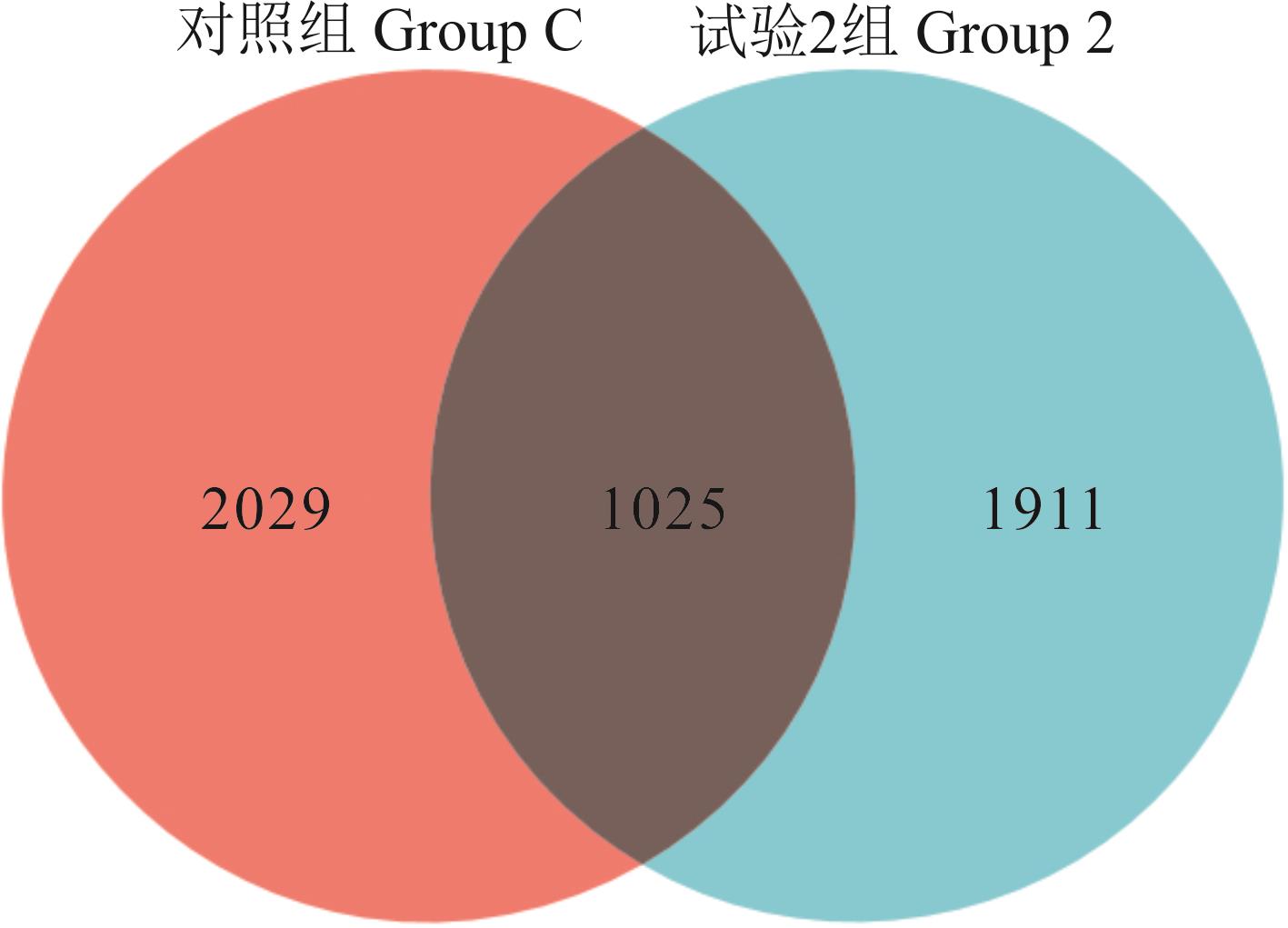
图1 湖羊瘤胃微生物Venn图
Fig.1 Venn diagram of rumen microorganisms in Hu sheep
| 项目Items | 对照组Group C | 试验2组Group 2 | P值P-value |
|---|---|---|---|
| Observed_otus指数Observed_otus index | 1098.75±107.19 | 1040.25±177.25 | 0.486 |
| Shannon指数Shannon index | 8.40±0.22 | 7.93±0.67 | 0.343 |
| Simpson指数Simpson index | 0.9913±0.0021 | 0.9750±0.0278 | 0.486 |
| Chao1指数Chao1 index | 1132.78±133.81 | 1090.50±231.75 | 0.686 |
| Goods_coverage指数Goods_coverage index | 0.9980±0.0014 | 0.9970±0.0022 | 0.686 |
表8 菌酶协同发酵豆秸对湖羊瘤胃微生物Alpha多样性的影响
Table 8 Effects of soybean straw by bacterium-enzyme co-fermentation on rumen microbial alpha diversity of Hu sheep
| 项目Items | 对照组Group C | 试验2组Group 2 | P值P-value |
|---|---|---|---|
| Observed_otus指数Observed_otus index | 1098.75±107.19 | 1040.25±177.25 | 0.486 |
| Shannon指数Shannon index | 8.40±0.22 | 7.93±0.67 | 0.343 |
| Simpson指数Simpson index | 0.9913±0.0021 | 0.9750±0.0278 | 0.486 |
| Chao1指数Chao1 index | 1132.78±133.81 | 1090.50±231.75 | 0.686 |
| Goods_coverage指数Goods_coverage index | 0.9980±0.0014 | 0.9970±0.0022 | 0.686 |
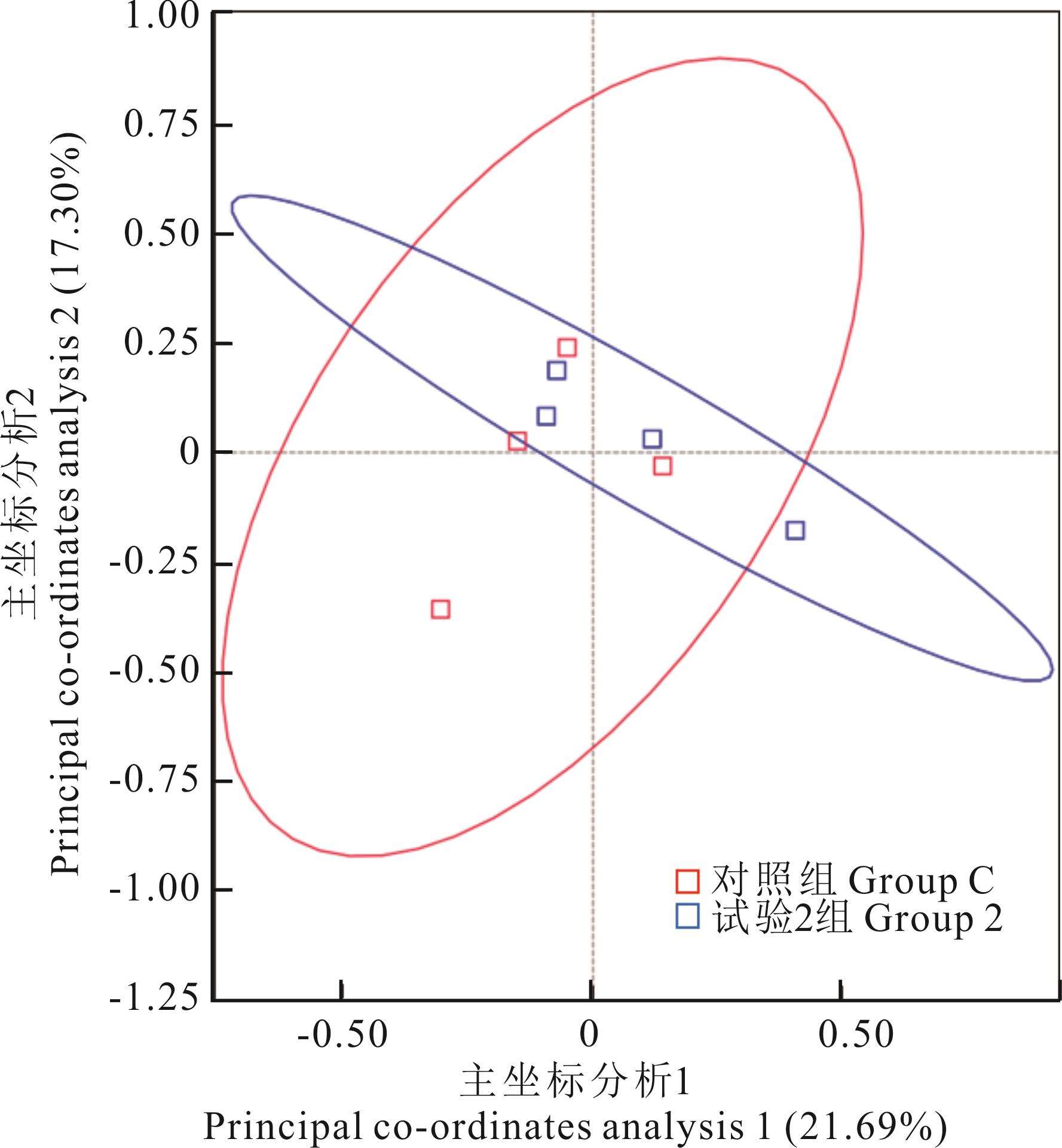
图2 基于非加权Unifrac距离的主坐标分析
Fig.2 Principal co-ordinates analysis based on unweighted Unifrac distance
| 项目Items | 对照组Group C | 试验2组Group 2 | P值P-value |
|---|---|---|---|
| 拟杆菌门Bacteroidota | 0.4551±0.1948b | 0.6279±0.0470a | 0.047 |
| 厚壁菌门Firmicutes | 0.4006±0.1553a | 0.2610±0.0158b | 0.029 |
| 螺旋体门Spirochaetota | 0.0039±0.0028 | 0.0041±0.0009 | 1.000 |
| 广古菌门Euryarchaeota | 0.0602±0.0401 | 0.0434±0.0232 | 0.686 |
| 弯曲杆菌门Campylobacterota | 0.0001±0.0001 | 0.0001±0.0001 | 1.000 |
| 疣微菌门Verrucomicrobiota | 0.0050±0.0051 | 0.0036±0.0022 | 1.000 |
| 变形菌门Proteobacteria | 0.0008±0.0003 | 0.0002±0.0002 | 0.057 |
| 纤维杆菌门Fibrobacterota | 0.0040±0.0043 | 0.0030±0.0009 | 0.886 |
| 蓝藻菌门Cyanobacteria | 0.0004±0.0005 | 0.0012±0.0011 | 0.200 |
| 其他Others | 0.0472±0.0067 | 0.0365±0.0115 | 0.343 |
| 未知菌Unidentified_bacteria | 0.0228±0.0156 | 0.0190±0.0227 | 0.686 |
表9 菌酶协同发酵豆秸对湖羊瘤胃微生物在门水平上的影响
Table 9 Effects of soybean straw by bacterium-enzyme co-fermentation on rumen microorganisms in Hu sheep at phylum level
| 项目Items | 对照组Group C | 试验2组Group 2 | P值P-value |
|---|---|---|---|
| 拟杆菌门Bacteroidota | 0.4551±0.1948b | 0.6279±0.0470a | 0.047 |
| 厚壁菌门Firmicutes | 0.4006±0.1553a | 0.2610±0.0158b | 0.029 |
| 螺旋体门Spirochaetota | 0.0039±0.0028 | 0.0041±0.0009 | 1.000 |
| 广古菌门Euryarchaeota | 0.0602±0.0401 | 0.0434±0.0232 | 0.686 |
| 弯曲杆菌门Campylobacterota | 0.0001±0.0001 | 0.0001±0.0001 | 1.000 |
| 疣微菌门Verrucomicrobiota | 0.0050±0.0051 | 0.0036±0.0022 | 1.000 |
| 变形菌门Proteobacteria | 0.0008±0.0003 | 0.0002±0.0002 | 0.057 |
| 纤维杆菌门Fibrobacterota | 0.0040±0.0043 | 0.0030±0.0009 | 0.886 |
| 蓝藻菌门Cyanobacteria | 0.0004±0.0005 | 0.0012±0.0011 | 0.200 |
| 其他Others | 0.0472±0.0067 | 0.0365±0.0115 | 0.343 |
| 未知菌Unidentified_bacteria | 0.0228±0.0156 | 0.0190±0.0227 | 0.686 |
| 项目Items | 对照组Group C | 试验2组Group 2 | P值P-value |
|---|---|---|---|
| 普雷沃氏菌属Prevotella | 0.1706±0.1320 | 0.2001±0.0846 | 1.000 |
| 理研菌科RC9肠群Rikenellaceae_RC9_gut_group | 0.1036±0.0391 | 0.1760±0.1062 | 0.200 |
| 甲烷短杆菌属Methanobrevibacter | 0.0598±0.0395 | 0.0431±0.0230 | 0.686 |
| 解琥珀酸属Succiniclasticum | 0.0464±0.0129 | 0.0541±0.0269 | 1.000 |
| 瘤胃菌科UCG-002 Ruminococcaceae_UCG-002 | 0.0384±0.0413 | 0.0090±0.0015 | 1.000 |
| 产乙酸糖发酵菌属Saccharofermentans | 0.0250±0.0238 | 0.0090±0.0029 | 0.200 |
| 克里斯滕森菌科R-7 Christensenellaceae_R-7_group | 0.0169±0.0209 | 0.0070±0.0022 | 1.000 |
| 丁酸弧菌属Butyrivibrio | 0.0145±0.0220 | 0.0013±0.0005 | 0.114 |
| 瘤胃菌科NK4A214 Ruminococcaceae_ NK4A214_group | 0.0147±0.0203 | 0.0036±0.0007 | 0.486 |
| 普雷沃氏菌科UCG-001 Prevotellaceae_UCG-001 | 0.0117±0.0070b | 0.0294±0.0080a | 0.029 |
| 其他Others | 0.4985±0.0303 | 0.4674±0.0829 | 0.343 |
表10 菌酶协同发酵豆秸对湖羊瘤胃微生物在属水平上的影响
Table 10 Effects of soybean straw by bacterium-enzyme co-fermentation on rumen microorganisms of Hu sheep at genus level
| 项目Items | 对照组Group C | 试验2组Group 2 | P值P-value |
|---|---|---|---|
| 普雷沃氏菌属Prevotella | 0.1706±0.1320 | 0.2001±0.0846 | 1.000 |
| 理研菌科RC9肠群Rikenellaceae_RC9_gut_group | 0.1036±0.0391 | 0.1760±0.1062 | 0.200 |
| 甲烷短杆菌属Methanobrevibacter | 0.0598±0.0395 | 0.0431±0.0230 | 0.686 |
| 解琥珀酸属Succiniclasticum | 0.0464±0.0129 | 0.0541±0.0269 | 1.000 |
| 瘤胃菌科UCG-002 Ruminococcaceae_UCG-002 | 0.0384±0.0413 | 0.0090±0.0015 | 1.000 |
| 产乙酸糖发酵菌属Saccharofermentans | 0.0250±0.0238 | 0.0090±0.0029 | 0.200 |
| 克里斯滕森菌科R-7 Christensenellaceae_R-7_group | 0.0169±0.0209 | 0.0070±0.0022 | 1.000 |
| 丁酸弧菌属Butyrivibrio | 0.0145±0.0220 | 0.0013±0.0005 | 0.114 |
| 瘤胃菌科NK4A214 Ruminococcaceae_ NK4A214_group | 0.0147±0.0203 | 0.0036±0.0007 | 0.486 |
| 普雷沃氏菌科UCG-001 Prevotellaceae_UCG-001 | 0.0117±0.0070b | 0.0294±0.0080a | 0.029 |
| 其他Others | 0.4985±0.0303 | 0.4674±0.0829 | 0.343 |
| 1 | Tao L, Feng W X, Wang Y R, et al. Effects of microecological agents on the fermentation quality, nutrition composition and in situ ruminal degradability of corn stalk silage. Acta Prataculturae Sinica, 2016, 25(9): 152-160. |
| 陶莲, 冯文晓, 王玉荣, 等. 微生态制剂对玉米秸秆青贮发酵品质、营养成分及瘤胃降解率的影响. 草业学报, 2016, 25(9): 152-160. | |
| 2 | Ke W C, Ding W R, Xu D M, et al. Effects of addition of malic or citric acids on fermentation quality and chemical characteristics of alfalfa silage. Journal of Dairy Science, 2017, 100(11): 8958-8966. |
| 3 | Zhang Y, Huang X Y, Chen X Z, et al. Effects of fermented Hypsizygus marmoreus mushroom residue on slaughter performance and mutton quality of goats. Acta Prataculturae Sinica, 2022, 31(9): 195-205. |
| 张耀, 黄小云, 陈鑫珠, 等. 海鲜菇菌糠发酵饲料对山羊屠宰性能及肉品质的影响. 草业学报, 2022, 31(9): 195-205. | |
| 4 | Guo J, Xie Y, Yu Z, et al. Effect of Lactobacillus plantarum expressing multifunctional glycoside hydrolases on the characteristics of alfalfa silage. Applied Microbiology and Biotechnology, 2019, 103(19): 7983-7995. |
| 5 | Jiang C Y, Wu Y H, Wang T Y, et al. The screening of symbiotic strain of producing energy feeds with potato residues by solid-state fermentation. Feed Industry, 2012, 33(11): 37-39. |
| 江成英, 吴耘红, 王拓一, 等. 固态发酵马铃薯渣生产能量饲料共生菌株的筛选. 饲料工业, 2012, 33(11): 37-39. | |
| 6 | Animal Husbandry. Nutrient requirenments of meat-type sheep and goat: NY/T 816-2021. Beijing: China Agriculture Press, 2022. |
| 全国畜牧业标准化技术委员会. 肉羊营养需要量: NY/T 816-2021. 北京: 中国农业出版社, 2022. | |
| 7 | Zhang L Y. Feed analysis and feed quality testing technology. Beijing: China Agricultural University Press, 2007. |
| 张丽英. 饲料分析及饲料质量检测技术. 北京: 中国农业大学出版社, 2007. | |
| 8 | Van Soest P J, Robe Rtson J B, Lewis B A. Methods for dietary fiber, neutral detergent fiber, and nonstarch polysaccharides in relation to animal nutrition. Journal of Dairy Science, 1991, 74(10): 3583-3597. |
| 9 | Zhang C, Li J, Wang Y P, et al. Comparison of determination of dietary nutrient digestibility by different endogenous indicator methods and total feces collection method for goat. Chinese Journal of Animal Nutrition, 2020, 32(7): 3274-3281. |
| 张晨, 李静, 王云鹏, 等. 全收粪法与不同内源指示剂法测定山羊饲粮中养分消化率的比较. 动物营养学报, 2020, 32(7): 3274-3281. | |
| 10 | Feng Z C, Gao M. Improvement of a colorimetric method for determination of ammonia nitrogen in rumen fluid. Animal Husbandry and Feed Science, 2010, 31(Z1): 37. |
| 冯宗慈, 高民. 通过比色测定瘤胃液氨氮含量方法的改进. 畜牧与饲料科学, 2010, 31(Z1): 37. | |
| 11 | Qin W L. Determination of rumen volatile fatty acids by means of gas chromatography. Journal of Nanjing Agricultural College, 1982(4): 110-116. |
| 秦为琳. 应用气相色谱测定瘤胃挥发性脂肪酸方法的研究改进. 南京农学院学报, 1982(4): 110-116. | |
| 12 | Zhao R J, Yan H Y, Tan Y P, et al. CTAB method for extracting animal DNA. Science and Technology of West China, 2011, 10(21): 7-8. |
| 赵瑞杰, 严海燕, 谭艳平, 等. CTAB法提取动物DNA. 中国西部科技, 2011, 10(21): 7-8. | |
| 13 | Kim T I, Mayakrishnan V, Lim D H, et al. Effect of fermented total mixed rations on the growth performance, carcass and meat quality characteristics of Hanwoo steers. Animal Science Journal, 2017, 89(3): 606-615. |
| 14 | Zhou C. Optimization of fermentation conditions in rape straw and its effects on growth performances and rumen fermentation. Nanjing: Nanjing Agricultural University, 2021. |
| 周闯. 油菜秸秆发酵条件优化及对山羊生长性能、瘤胃发酵的影响. 南京: 南京农业大学, 2021. | |
| 15 | Su X Y, Shen Y A, Wang Y P. Effects of compound probiotic fermented feed on growth performance, nutrient apparent digestibility, fecal microbial flora, and serum indexes of mutton sheep. Feed Research, 2024, 47(4): 13-17. |
| 苏晓月, 沈亚安, 王艳萍. 复合益生菌发酵饲料对肉羊生长性能、养分表观消化率、粪便微生物菌群和血清指标的影响. 饲料研究, 2024, 47(4): 13-17. | |
| 16 | Han Y J. Effects of microbial fermentation of straw on production performance and nutrients apparent digestibility for mutton sheep. Baoding: Hebei Agricultural University, 2015. |
| 韩颖洁. 微生物发酵秸秆对肉羊生产性能和营养物质表观消化率的影响. 保定: 河北农业大学, 2015. | |
| 17 | Ahuja V, Bhatt A K. Trichoderma viride (MTCC 800): a potential candidate for agri-horti waste utilization by solid state fermentation. International Journal of Environmental Science and Technology, 2018, 15(12): 2679-2684. |
| 18 | Yang Z K, Yin Y J, Xu W W, et al. Enzymatic properties of cellulase and its application in livestock and poultry production. Chinese Journal of Animal Science, 2024, 60(5): 88-93. |
| 阳治康, 殷运菊, 徐伟伟, 等. 纤维素酶的酶学特性及在畜禽生产中的应用研究进展. 中国畜牧杂志, 2024, 60(5): 88-93. | |
| 19 | Liu W, Yu F M, Ma Q P, et al. Application of xylanase in silage and ruminant diet. Acta Agrestia Sinica, 2024, 32(1): 331-339. |
| 刘伟, 于凤民, 马千鹏, 等. 木聚糖酶在青贮及反刍动物日粮中的应用. 草地学报, 2024, 32(1): 331-339. | |
| 20 | Kieliszek M, Kot A M, Bzducha-Wróbel A, et al. Biotechnological use of Candida yeasts in the food industry: A review. Fungal Biology Reviews, 2017, 31(4): 185-198. |
| 21 | Zhou H, Wang C, Ye J, et al. Effects of dietary supplementation of fermented Ginkgo biloba L. residues on growth performance, nutrient digestibility, serum biochemical parameters and immune function in weaned piglets. Animal Science Journal, 2015, 86(8): 790-799. |
| 22 | Huang J, Han Y Z, Pan S L, et al. Effects of different energy and protein levels on growth performance, serum biochemical indexes and economic benefits of porcupine. Animal Husbandry & Veterinary Medicine, 2021, 53(5): 31-36. |
| 黄晶, 韩云珍, 潘书磊, 等. 不同能量和蛋白质水平日粮对豪猪生长性能、血清生化指标及经济效益的影响. 畜牧与兽医, 2021, 53(5): 31-36. | |
| 23 | Guo Y X, Li H B, Lin Y T, et al. Effects of partial substitution of peanut vine by semi-dry ammoniated wheat straw silage on lactation performance, nutrient digestibility and serum indices of Laoshan dairy goats. Chinese Journal of Animal Nutrition, 2023, 35(5): 3154-3163. |
| 郭艺璇, 李海滨, 林英庭, 等. 半干氨贮麦秸替代部分花生秧对崂山奶山羊产奶性能、养分消化率以及血清指标的影响. 动物营养学报, 2023, 35(5): 3154-3163. | |
| 24 | Huo X, Wang A L, Yang J M. Antioxidant effects of sulfur-containing amino acids. Bulletin of Biology, 2006, 41(4): 3-4. |
| 霍湘, 王安利, 杨建梅. 含硫氨基酸的抗氧化作用. 生物学通报, 2006, 41(4): 3-4. | |
| 25 | Lu J, Zhang X, Liu Y, et al. Effect of fermented corn-soybean meal on serum immunity, the expression of genes related to gut immunity, gut microbiota, and bacterial metabolites in grower-finisher pigs. Frontiers in Microbiology, 2019, 10: 2620. |
| 26 | Bu Y, Zheng N, Wang J Q, et al. Research progress on immunoglobulin regulating gastrointestinal health and microbial function in animals. China Animal Husbandry & Veterinary Medicine, 2022, 49(10): 3800-3808. |
| 卜莹, 郑楠, 王加启, 等. 免疫球蛋白调控动物胃肠道健康及微生物功能的研究进展. 中国畜牧兽医, 2022, 49(10): 3800-3808. | |
| 27 | Vidarsson G, Dekkers G, Rispens T. IgG subclasses and allotypes: from structure to effector functions. Frontiers in Immunology, 2014, 5: 520. |
| 28 | Keyt B A, Baliga R, Sinclair A M, et al. Structure, function, and therapeutic use of IgM antibodies. Antibodies, 2020, 9(4): 53. |
| 29 | Chen K, Chen H, Liu D J. Effects of fermented feed on goat production performance. China Feed, 2018(2): 25-29. |
| 陈柯, 陈华, 刘大军. 微生物发酵秸秆对山羊生产性能的影响及其机理研究. 中国饲料, 2018(2): 25-29. | |
| 30 | Xiang S W, Zheng L, Zhu L B, et al. Fermentation process of Candida utilis for selenium-enriched and production of glutathione. Science and Technology of Food Industry, 2017, 38(1): 165-168, 174. |
| 项驷文, 郑蕾, 朱龙宝, 等. 产朊假丝酵母富硒及产谷胱甘肽的培养工艺. 食品工业科技, 2017, 38(1): 165-168, 174. | |
| 31 | Gong L, Wang B, Mei X, et al. Effects of three probiotic Bacillus on growth performance, digestive enzyme activities, antioxidative capacity, serum immunity, and biochemical parameters in broilers. Animal Science Journal, 2018, 89(11): 1561-1571. |
| 32 | Jang S, Lee D, Jang I S, et al. The culture of Pediococcus pentosaceus T1 inhibits Listeria proliferation in salmon fillets and controls maturation of kimchi. Food Technology Biotechnology, 2015, 53(1): 29-37. |
| 33 | Cao Z, Pan H, Tong H, et al. In vitro evaluation of probiotic potential of Pediococcus pentosaceus L1 isolated from paocai—a Chinese fermented vegetable. Annals of Microbiology, 2015, 66(3): 963-971. |
| 34 | Jiang S, Cai L, Lv L, et al. Pediococcus pentosaceus, a future additive or probiotic candidate. Microbial Cell Factories, 2021, 20(1): 45. |
| 35 | Xing B S, Han Y, Cao S, et al. Cosubstrate strategy for enhancing lignocellulose degradation during rumen fermentation in vitro: Characteristics and microorganism composition. Chemosphere, 2020, 250: 126104. |
| 36 | Jiang N, Li X W, Zhang N, et al. Effect of different dietary energy and protein levels on rumen fermentation parameters and rumen microflora in growing yaks. China Herbivore Science, 2024, 44(2): 18-26. |
| 姜南, 李学威, 张楠, 等. 日粮不同能量和蛋白质水平对生长期牦牛瘤胃发酵参数及瘤胃菌群的影响. 中国草食动物科学, 2024, 44(2): 18-26. | |
| 37 | Lee J E, Lee S, Sung J, et al. Analysis of human and animal fecal microbiota for microbial source tracking. The ISME Journal, 2011, 5(2): 362-365. |
| 38 | Li M, Zhou M, Adamowicz E, et al. Characterization of bovine ruminal epithelial bacterial communities using 16S rRNA sequencing, PCR-DGGE, and qRT-PCR analysis. Studies of Veterinary Microbiology, 2012, 155(1): 72-80. |
| 39 | Hook S E, Steele M A, Northwood K S, et al. Impact of subacute ruminal acidosis (SARA) adaptation and recovery on the density and diversity of bacteria in the rumen of dairy cows. Studies of FEMS Microbiology Ecology, 2011, 78(2): 275-284. |
| 40 | Guo W, Guo X J, Xu L N, et al. Effect of whole-plant corn silage treated with lignocellulose-degrading bacteria on growth performance, rumen fermentation, and rumen microflora in sheep. Animal, 2022, 16(7): 100576. |
| 41 | Ye Y Z, Xia Z Q, Lou Y W, et al. Effect of microbial fermentation feed on fattening performance, microflora communities of Huyang sheep. Acta Agriculture Universitatis Jiangxiensis, 2021, 43(4): 881-890. |
| 叶以哲, 夏宗群, 娄佑武, 等. 微生物发酵秸秆日粮对湖羊育肥性能及其肠道微生物群落结构的影响. 江西农业大学学报, 2021, 43(4): 881-890. | |
| 42 | Huang H L. Effects of microbial fermentation of peanut straw feed on intestinal microflora and preliminary application of meat goat. Nanchang: Jiangxi Agricultural University, 2020. |
| 黄海玲. 微生物发酵花生秸秆对肉山羊肠道微生物群落结构的影响及初步应用. 南昌: 江西农业大学, 2020. | |
| 43 | Avgustin G, Wallace R J, Flint H J. Phenotypic diversity among ruminal isolates of Prevotella ruminicola: proposal of Prevotella brevis sp. nov., Prevotella bryantii sp. nov., and Prevotella albensis sp. nov. and redefinition of Prevotella ruminicola. International Journal of Systematic Bacteriology, 1997, 47(2): 284-288. |
| 44 | Zhang X J, Wang L Z. Effects of dietary neutral detergent fibre level on structure and composition of rumen bacteria in goats. Chinese Journal of Animal Nutrition, 2018, 30(4): 1377-1386. |
| 张雪娇, 王立志. 饲粮中性洗涤纤维水平对山羊瘤胃细菌结构及组成的影响. 动物营养学报, 2018, 30(4): 1377-1386. | |
| 45 | Wang J, Zhang L Q, Wang W L, et al. Effects of caragana fermented feed on growth performance and rumen flora of Ningxia Tan sheep. Chinese Journal of Animal Nutrition, 2023, 35(2): 1035-1045. |
| 王锦, 张连全, 王文亮, 等. 柠条发酵饲料对宁夏滩羊生长性能及瘤胃微生物区系的影响. 动物营养学报, 2023, 35(2): 1035-1045. | |
| 46 | Xu Y X, Li Z P, Shen J S, et al. Microbe-mediated ruminal ammonia production in ruminants and its impacts on rumen function. Acta Microbiologica Sinica, 2019, 59(5): 781-788. |
| 徐诣轩, 李志鹏, 申军士, 等. 微生物介导反刍动物瘤胃氨生成及其对瘤胃功能的影响. 微生物学报, 2019, 59(5): 781-788. | |
| 47 | Wang H R, Qin T, Wang C. Effects of artemisinine on the rumen fermentation and microbial nitrogen recycling rate in goats. Scientia Agricultura Sinica, 2014, 47(24): 4904-4914. |
| 王洪荣, 秦韬, 王超. 青蒿素对山羊瘤胃发酵和微生物氮素微循环的影响. 中国农业科学, 2014, 47(24): 4904-4914. | |
| 48 | Yang C T, Diao Q Y, Si B W, et al. Absorption and regulation of volatile fatty acids in the ruminal epithelium. Chinese Journal of Animal Science, 2015, 51(7): 78-83. |
| 杨春涛, 刁其玉, 司丙文, 等. 挥发性脂肪酸在反刍动物瘤胃上皮吸收转运及调节作用. 中国畜牧杂志, 2015, 51(7): 78-83. | |
| 49 | Lai A Q, Jin Y D, Chen B L, et al. Effects of fermented sugarcane bagasse on growth performance, nutrient apparent digestibility, rumen fermentation characteristics and rumen microflora of beef cattle. Chinese Journal of Animal Nutrition, 2024, 36(3): 1685-1697. |
| 赖安强, 金亚东, 陈彬龙, 等. 发酵甘蔗渣对肉牛生长性能、养分表观消化率、瘤胃发酵特性和瘤胃菌群的影响. 动物营养学报, 2024, 36(3): 1685-1697. | |
| 50 | Wang X F, Gao Y, Tian F, et al. Effects of microbial fermented expanded straw feed on growth performance and gastrointestinal tract development of Dorper and Thin-tailed Han crossbred sheep. Animal Husbandry and Feed Science, 2022, 43(2): 28-34. |
| 王晓飞, 高源, 田丰, 等. 膨化秸秆微生物发酵饲料对杜寒杂交肉羊生长性能和胃肠道发育的影响. 畜牧与饲料科学, 2022, 43(2): 28-34. | |
| 51 | Jin H, Bai Y, Deng M Y, et al. Effects of fermented feed on production performance, nutrient apparent digestibility, rumen fermentation characteristics and meat quality of fattening Hu sheep. Journal of Nanjing Agricultural University, 2024, 47(1): 151-156. |
| 金宏, 柏杨, 邓孟云, 等. 发酵饲料对育肥湖羊生产性能、养分表观消化率、瘤胃发酵特性及肉品质的影响. 南京农业大学学报, 2024, 47(1): 151-156. | |
| 52 | Kyawt Y Y, Aung M, Xu Y, et al. Dynamic changes of rumen microbiota and serum metabolome revealed increases in meat quality and growth performances of sheep fed bio-fermented rice straw. Journal of Animal Science and Biotechnology, 2024, 15(1): 34. |
| [1] | 张敏, 杨锐, 黄逸州, 林芷昕, 郑贤跃, 刘庆华, 高玉云, 林冬梅, 林占熺, 金灵. 巨菌草对育肥从江香猪生长性能及肠道健康的影响[J]. 草业学报, 2025, 34(5): 171-188. |
| [2] | 杨攀平, 李惠侠, 胡亚美. 盐池滩羊肉品质特性及其潜在调控机理探讨[J]. 草业学报, 2025, 34(4): 223-232. |
| [3] | 靳生伟, 韩银仓, 孙永刚, 丁维芹, 刘亚倩, 祁增源, 周建强. 冷季不同饲养方式对牦牛生长性能及血液生理生化指标的影响[J]. 草业学报, 2025, 34(1): 215-225. |
| [4] | 顾明明, 姜幸慧, 马志毅, 邱水玲, 刘浩宇, 张洺瑞, 卢佳宁, 丘宇俊, 王本治, 甘乾福. 甘薯和芋头在闽东山羊瘤胃中的降解特性及表面附着微生物群落变化[J]. 草业学报, 2024, 33(9): 169-184. |
| [5] | 洪莉平, 李小冬, 于二汝, 裴成江, 尚以顺, 骆金红, 孙光, 周云昊, 李世歌, 杨航, 刘凤丹. 不同紫苏原料对贵州黑山羊血清抗氧化酶活性、瘤胃发酵参数、瘤胃微生物区系的影响[J]. 草业学报, 2024, 33(9): 214-226. |
| [6] | 苏东遥, 李永亮, 董晴, 赵心念, 李晓宇, 金晓东, 王亚男, 田树军, 高玉红, 孙新胜. 发酵床对哺乳期湖羔羊生长、消化以及血液理化特性的影响[J]. 草业学报, 2024, 33(8): 86-97. |
| [7] | 申迪, 曾子铭, 庞凯悦, 柴沙驼, 聂洪辛, 李毓敏, 廖扬, 王迅, 黄伟华, 刘书杰, 杨英魁, 王书祥. 低精料日粮和高精料日粮对牦牛生长性能和瘤胃菌群结构的影响[J]. 草业学报, 2024, 33(5): 155-165. |
| [8] | 张瑞, 安雪姣, 李建烨, 卢曾奎, 牛春娥, 徐振飞, 张金霞, 耿智广, 岳耀敬, 杨博辉. 湖羊及其不同杂交组合生长性能、产肉性能及肌肉品质比较分析[J]. 草业学报, 2024, 33(3): 186-197. |
| [9] | 党浩千, 覃娟清, 郭宇康, 张富, 王迎港, 刘庆华. 不同添加剂发酵笋壳对湖羊生产性能及瘤胃发酵的影响[J]. 草业学报, 2023, 32(7): 135-148. |
| [10] | 杨乾龙, 魏倩倩, 赵德辉, 郭肖兰, 张铁涛, 王晓旭, 鲍坤, 王凯英. 饲粮添加过瘤胃半胱氨酸对育成期梅花鹿生长性能、营养物质表观消化率和血清生化指标的影响[J]. 草业学报, 2023, 32(2): 148-159. |
| [11] | 覃娟清, 党浩千, 金华云, 郭宇康, 张富, 刘庆华. 不同添加剂处理笋壳对其发酵品质及湖羊瘤胃微生物的影响[J]. 草业学报, 2023, 32(11): 155-167. |
| [12] | 王钊, 刘静, 于昊, 李鹏, 牛伟强, 万永杰, 张艳丽, 茆达干. 日粮添加蚕豆皮对湖羊生长性能、屠宰性能、器官发育和肉品质的影响[J]. 草业学报, 2023, 32(10): 162-172. |
| [13] | 周承福, 汪水平, 张佰忠, 张秀敏, 王荣, 马志远, 王敏. 水热处理对黄豆秸秆体外发酵、甲烷生成及微生物的影响[J]. 草业学报, 2022, 31(2): 171-181. |
| [14] | 王循刚, 张晓玲, 徐田伟, 耿远月, 胡林勇, 赵娜, 刘宏金, 康生萍, 徐世晓. 饲粮蛋白质水平对藏系绵羊瘤胃真菌菌群结构及功能的影响[J]. 草业学报, 2022, 31(2): 182-191. |
| [15] | 范阳, 齐伟彪, 朱崇淼, 殷雨洋, 毛胜勇. 日粮中添加发酵豆渣对湖羊生长性能、养分表观消化率、肉品质及血清生化指标的影响[J]. 草业学报, 2022, 31(11): 86-93. |
| 阅读次数 | ||||||
|
全文 |
|
|||||
|
摘要 |
|
|||||
