

ISSN 1004-5759 CN 62-1105/S
草业学报 ›› 2026, Vol. 35 ›› Issue (6): 190-201.DOI: 10.11686/cyxb2025240
• 研究论文 • 上一篇
张剑搏1( ), 王磊1,2(), 张强龙1, 叶培麟3, 黄伟华1, 张福年4, 李荣4, 石勇5
收稿日期:2025-06-16
修回日期:2025-09-09
出版日期:2026-06-20
发布日期:2026-04-13
通讯作者:
王磊
作者简介:Corresponding author. E-mail: 277036818@qq.com基金资助:
Jian-bo ZHANG1(), Lei WANG1,2(), Qiang-long ZHANG1, Pei-lin YE3, Wei-hua HUANG1, Fu-nian ZHANG4, Rong LI4, Yong SHI5
Received:2025-06-16
Revised:2025-09-09
Online:2026-06-20
Published:2026-04-13
Contact:
Lei WANG
摘要:
为探究不同能量水平精补料对生长期舍饲牦牛生产性能、血液生化指标及其瘤胃微生物群落的影响,选初始体重相近的27头1周岁牦牛作为试验动物,随机分为3组,每组9头,分别饲喂低(LG)、中(MG)、高(HG)3个能量水平的精补料,其中试验预饲期7 d,正饲期110 d。结果表明:1)试验末期,LG、MG和HG组牦牛终末体重、平均日增重和平均日采食量均无显著差异(P>0.05),但与初始体重相比,终末体重分别提高了79.91%、82.27%和86.16%。2)随着精补料能量水平的升高,HG组牦牛血清中生长激素、胰岛素样生长因子1和胰岛素样生长因子2浓度显著高于LG组(P<0.05),但LG组牦牛血清总抗氧化能力显著高于HG组(P<0.05),其他血清生化指标有升高趋势但无显著差异(P>0.05)。3)各组间牦牛瘤胃微生物群落的Alpha和Beta多样性无显著差异,但奇异菌属、UCG-005菌属、毛螺旋菌科UCG-008菌属、真/优杆菌属等菌属在HG组牦牛瘤胃中显著富集(P<0.05),而梭菌纲UCG-014未定名菌属、普雷沃氏菌科UCG-001菌属的微生物群落在LG组牦牛瘤胃中显著富集(P<0.05)。4)Mantel检验进一步发现瘤胃解琥珀酸菌属与宿主血液中的总胆固醇(TC)和高密度脂蛋白胆固醇(HDL)浓度呈显著负相关(P<0.05),Xylanibacter与宿主血液中的游离脂肪酸(NEFA)浓度呈显著负相关(P<0.05)。综上,对生长期舍饲牦牛饲喂高能量水平的精补料可提高牦牛血液中与生长相关的激素水平,增加瘤胃微生物群落多样性,进而提升牦牛生产性能。
张剑搏, 王磊, 张强龙, 叶培麟, 黄伟华, 张福年, 李荣, 石勇. 不同能量水平精补料对生长期舍饲牦牛生产性能、血液生化指标及瘤胃微生物群落的影响[J]. 草业学报, 2026, 35(6): 190-201.
Jian-bo ZHANG, Lei WANG, Qiang-long ZHANG, Pei-lin YE, Wei-hua HUANG, Fu-nian ZHANG, Rong LI, Yong SHI. Effects of supplemental feeds with different energy contents on the productive performance, blood biochemical indices, and ruminal microbial community of growing yaks[J]. Acta Prataculturae Sinica, 2026, 35(6): 190-201.
项目 Items | 低能量组 LG group | 中能量组 MG group | 高能量组 HG group |
|---|---|---|---|
| 原料配比Ingredient ratio | |||
| 玉米 Corn (%) | 35.20 | 34.90 | 42.90 |
| 玉米胚芽粕 Corn germ meal (%) | 18.00 | 20.70 | 13.37 |
| 小麦次粉 Wheat middlings (%) | 15.80 | 10.87 | 13.00 |
| 玉米全干酒糟 Corn distillers dried grains with solubles (%) | 10.57 | 10.50 | 10.00 |
| 稻壳粉 Rice hull powder (%) | 6.00 | 8.00 | 5.50 |
| 大豆粕 Soybean meal (%) | 4.40 | 5.00 | 5.20 |
| 棉籽粕 Cottonseed meal (%) | 3.00 | 3.00 | 3.00 |
| 菜籽粕 Rapeseed meal (%) | 3.00 | 3.00 | 3.00 |
| 石粉 Mountain flour (%) | 1.38 | 1.38 | 1.38 |
| 硫酸钙 Calcium sulfate (%) | 1.00 | 1.00 | 1.00 |
| 食盐 Salt (%) | 1.00 | 1.00 | 1.00 |
| 蒙脱石 Montmorillonite (%) | 0.20 | 0.20 | 0.20 |
| 复合微量元素Complex trace elements 1) (%) | 0.20 | 0.20 | 0.20 |
| 防霉剂 Mold inhibitor (%) | 0.08 | 0.08 | 0.08 |
| 氯化胆碱 Choline chloride (%) | 0.06 | 0.06 | 0.06 |
| 复合酶制剂 Composite enzyme preparation (%) | 0.03 | 0.03 | 0.03 |
| 地衣芽孢杆菌 Bacillus licheniformis (%) | 0.03 | 0.03 | 0.03 |
| 抗氧化剂 Antioxidant (%) | 0.02 | 0.02 | 0.02 |
| 甜菜碱 Betaine (%) | 0.02 | 0.02 | 0.02 |
| 复合维生素Multivitamin 2) (%) | 0.02 | 0.02 | 0.02 |
| 枯草芽孢杆菌 Bacillus cereus (%) | 0.01 | 0.01 | 0.01 |
| 营养水平Nutritional level 3) | |||
| 干物质 Dry matter (%) | 89.86 | 89.05 | 88.36 |
| 粗蛋白 Crude protein (%) | 15.30 | 16.06 | 17.71 |
| 粗纤维 Crude fiber (%) | 20.74 | 14.68 | 8.28 |
| 粗脂肪 Ether extract (%) | 4.27 | 4.34 | 4.36 |
| 钙 Calcium (%) | 1.02 | 1.01 | 1.00 |
| 总磷 Phosphorus (%) | 0.46 | 0.45 | 0.48 |
| 消化能 Digestibility coefficient (MJ·kg?1) | 2.66 | 3.02 | 3.38 |
表1 不同能量水平精补料组成及营养水平(干物质基础)
Table 1 Composition and nutritional levels of concentrated feed at different energy levels (based on dry matter)
项目 Items | 低能量组 LG group | 中能量组 MG group | 高能量组 HG group |
|---|---|---|---|
| 原料配比Ingredient ratio | |||
| 玉米 Corn (%) | 35.20 | 34.90 | 42.90 |
| 玉米胚芽粕 Corn germ meal (%) | 18.00 | 20.70 | 13.37 |
| 小麦次粉 Wheat middlings (%) | 15.80 | 10.87 | 13.00 |
| 玉米全干酒糟 Corn distillers dried grains with solubles (%) | 10.57 | 10.50 | 10.00 |
| 稻壳粉 Rice hull powder (%) | 6.00 | 8.00 | 5.50 |
| 大豆粕 Soybean meal (%) | 4.40 | 5.00 | 5.20 |
| 棉籽粕 Cottonseed meal (%) | 3.00 | 3.00 | 3.00 |
| 菜籽粕 Rapeseed meal (%) | 3.00 | 3.00 | 3.00 |
| 石粉 Mountain flour (%) | 1.38 | 1.38 | 1.38 |
| 硫酸钙 Calcium sulfate (%) | 1.00 | 1.00 | 1.00 |
| 食盐 Salt (%) | 1.00 | 1.00 | 1.00 |
| 蒙脱石 Montmorillonite (%) | 0.20 | 0.20 | 0.20 |
| 复合微量元素Complex trace elements 1) (%) | 0.20 | 0.20 | 0.20 |
| 防霉剂 Mold inhibitor (%) | 0.08 | 0.08 | 0.08 |
| 氯化胆碱 Choline chloride (%) | 0.06 | 0.06 | 0.06 |
| 复合酶制剂 Composite enzyme preparation (%) | 0.03 | 0.03 | 0.03 |
| 地衣芽孢杆菌 Bacillus licheniformis (%) | 0.03 | 0.03 | 0.03 |
| 抗氧化剂 Antioxidant (%) | 0.02 | 0.02 | 0.02 |
| 甜菜碱 Betaine (%) | 0.02 | 0.02 | 0.02 |
| 复合维生素Multivitamin 2) (%) | 0.02 | 0.02 | 0.02 |
| 枯草芽孢杆菌 Bacillus cereus (%) | 0.01 | 0.01 | 0.01 |
| 营养水平Nutritional level 3) | |||
| 干物质 Dry matter (%) | 89.86 | 89.05 | 88.36 |
| 粗蛋白 Crude protein (%) | 15.30 | 16.06 | 17.71 |
| 粗纤维 Crude fiber (%) | 20.74 | 14.68 | 8.28 |
| 粗脂肪 Ether extract (%) | 4.27 | 4.34 | 4.36 |
| 钙 Calcium (%) | 1.02 | 1.01 | 1.00 |
| 总磷 Phosphorus (%) | 0.46 | 0.45 | 0.48 |
| 消化能 Digestibility coefficient (MJ·kg?1) | 2.66 | 3.02 | 3.38 |
项目 Items | 低能量组 LG group | 中能量组 MG group | 高能量组 HG group | 均值标准误SEM | P值 P-value |
|---|---|---|---|---|---|
| 生产性能指标 Index of production performance | |||||
| 初始体重 IBW (kg) | 93.72a | 93.94a | 93.56a | 2.35 | 0.998 |
| 终末体重 FBW (kg) | 168.61a | 171.22a | 174.17a | 3.17 | 0.787 |
| 平均日增重 ADG (kg·d-1) | 0.62a | 0.64a | 0.67a | 0.02 | 0.507 |
| 平均采食量 ADMI (kg·d-1) | 3.80a | 3.71a | 3.75a | 0.07 | 0.887 |
| 料重比 F/G | 6.20a | 5.79a | 5.64a | 0.15 | 0.310 |
| 血清生化指标 Biochemical indices of blood | |||||
| 血糖 GLU (mmol·L-1) | 2.54a | 2.48a | 2.74a | 0.14 | 0.763 |
| 甘油三酯 TG (mmol·L-1) | 0.36a | 0.37a | 0.35a | 0.02 | 0.948 |
| 总胆固醇 TC (mmol·L-1) | 1.33a | 1.26a | 1.34a | 0.09 | 0.922 |
| 高密度脂蛋白胆固醇 HDL (mmol·L-1) | 0.87a | 0.80a | 0.88a | 0.06 | 0.848 |
| 低密度脂蛋白胆固醇 LDL (mmol·L-1) | 0.33a | 0.35a | 0.34a | 0.02 | 0.928 |
| 游离脂肪酸 NEFA (mmol·L-1) | 0.052a | 0.097a | 0.073a | 0.02 | 0.580 |
| 总抗氧化能力 T-AOC (U·mL-1) | 3.40a | 2.40ab | 1.41b | 0.27 | 0.006** |
| 丙二醛 MDA (nmol·mL-1) | 1.96a | 1.70a | 1.50a | 0.19 | 0.615 |
| 谷胱甘肽过氧化酶 GSH-Px (U·mL-1) | 62.39a | 45.95a | 68.59a | 5.15 | 0.199 |
| 生长激素 GH (ng·mL-1) | 1.86b | 2.73a | 2.84a | 0.16 | 0.015* |
| 胰岛素 INS (mIU·L-1) | 2.77b | 4.17a | 3.02b | 0.20 | 0.006** |
| 胰岛素样生长因子1 IGF-1 (ng·mL-1) | 30.61b | 54.97a | 53.09a | 3.42 | 0.002** |
| 胰岛素样生长因子2 IGF-2 (ng·mL-1) | 5.29b | 7.22a | 7.60a | 0.39 | 0.027* |
表2 不同能量水平精补料对生长期牦牛生产性能及血液代谢物的影响
Table 2 Effects of different energy concentrate supplement on production performance and blood metabolites of growing yaks
项目 Items | 低能量组 LG group | 中能量组 MG group | 高能量组 HG group | 均值标准误SEM | P值 P-value |
|---|---|---|---|---|---|
| 生产性能指标 Index of production performance | |||||
| 初始体重 IBW (kg) | 93.72a | 93.94a | 93.56a | 2.35 | 0.998 |
| 终末体重 FBW (kg) | 168.61a | 171.22a | 174.17a | 3.17 | 0.787 |
| 平均日增重 ADG (kg·d-1) | 0.62a | 0.64a | 0.67a | 0.02 | 0.507 |
| 平均采食量 ADMI (kg·d-1) | 3.80a | 3.71a | 3.75a | 0.07 | 0.887 |
| 料重比 F/G | 6.20a | 5.79a | 5.64a | 0.15 | 0.310 |
| 血清生化指标 Biochemical indices of blood | |||||
| 血糖 GLU (mmol·L-1) | 2.54a | 2.48a | 2.74a | 0.14 | 0.763 |
| 甘油三酯 TG (mmol·L-1) | 0.36a | 0.37a | 0.35a | 0.02 | 0.948 |
| 总胆固醇 TC (mmol·L-1) | 1.33a | 1.26a | 1.34a | 0.09 | 0.922 |
| 高密度脂蛋白胆固醇 HDL (mmol·L-1) | 0.87a | 0.80a | 0.88a | 0.06 | 0.848 |
| 低密度脂蛋白胆固醇 LDL (mmol·L-1) | 0.33a | 0.35a | 0.34a | 0.02 | 0.928 |
| 游离脂肪酸 NEFA (mmol·L-1) | 0.052a | 0.097a | 0.073a | 0.02 | 0.580 |
| 总抗氧化能力 T-AOC (U·mL-1) | 3.40a | 2.40ab | 1.41b | 0.27 | 0.006** |
| 丙二醛 MDA (nmol·mL-1) | 1.96a | 1.70a | 1.50a | 0.19 | 0.615 |
| 谷胱甘肽过氧化酶 GSH-Px (U·mL-1) | 62.39a | 45.95a | 68.59a | 5.15 | 0.199 |
| 生长激素 GH (ng·mL-1) | 1.86b | 2.73a | 2.84a | 0.16 | 0.015* |
| 胰岛素 INS (mIU·L-1) | 2.77b | 4.17a | 3.02b | 0.20 | 0.006** |
| 胰岛素样生长因子1 IGF-1 (ng·mL-1) | 30.61b | 54.97a | 53.09a | 3.42 | 0.002** |
| 胰岛素样生长因子2 IGF-2 (ng·mL-1) | 5.29b | 7.22a | 7.60a | 0.39 | 0.027* |
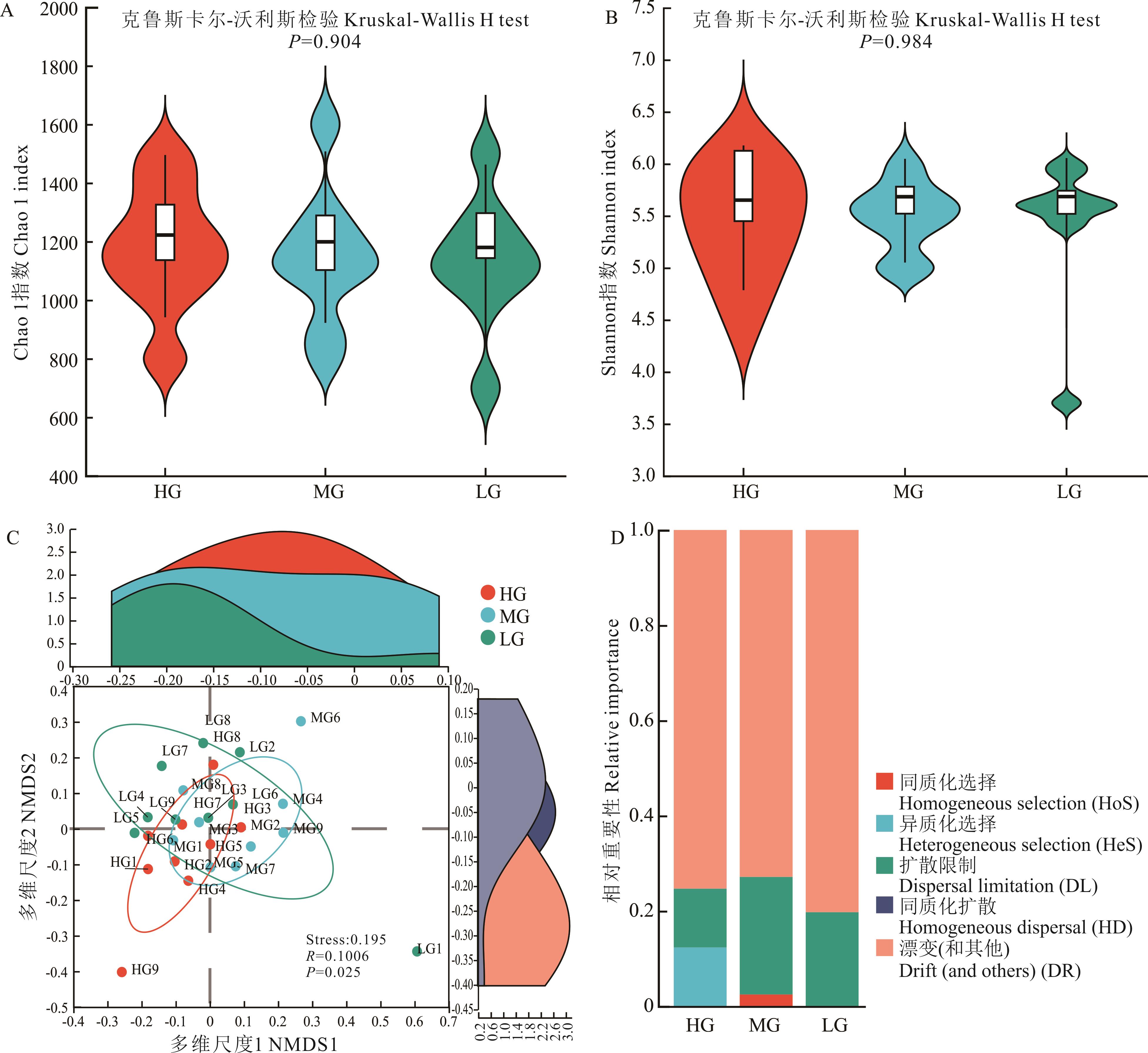
图1 不同能量水平精补料对生长期牦牛瘤胃微生物群落多样性的影响A、B分别为瘤胃微生物群落Alpha多样性的Chao 1指数和Shannon指数;C为瘤胃微生物群落Beta多样性的NMDS图;D为零和模型解释各组间牦牛瘤胃微生物群落组成的影响因素。LG:低能量组;MG:中能量组;HG:高能量组,下同。A and B represent the Chao 1 index and Shannon index of the rumen microbial community Alpha diversity, respectively; C is the NMDS plot of the rumen microbial community Beta diversity; D shows the influencing factors of the rumen microbial community composition in yaks among the groups. LG: Low energy group; MG: Medium energy group; HG: High energy group, the same below.
Fig.1 Effects of different energy supplements on rumen microbial community diversity in growing yaks
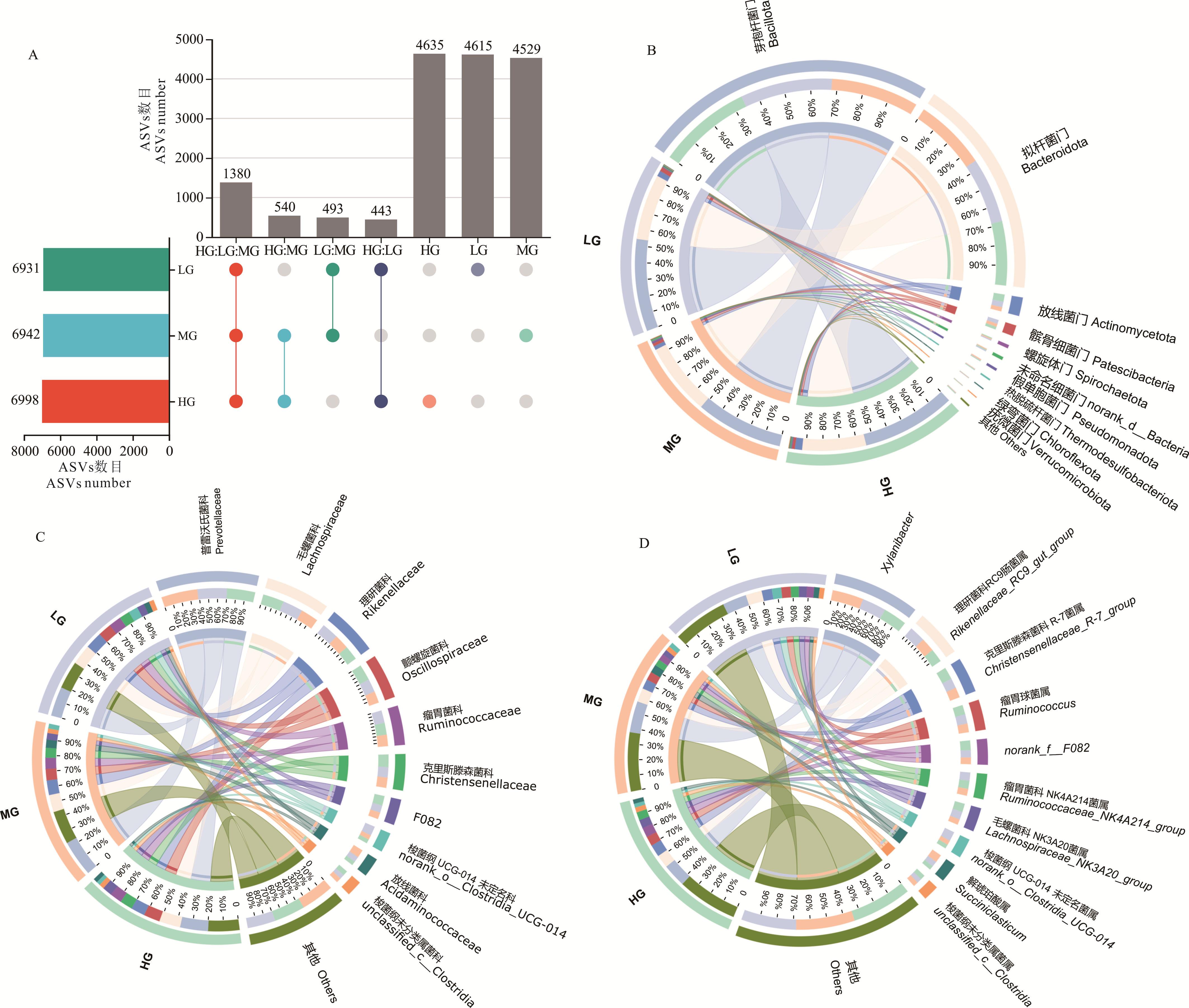
图2 不同能量水平精补料对生长期牦牛瘤胃微生物群落组成的影响A为不同组间牦牛瘤胃微生物的Upset分析;B为门水平瘤胃微生物群落组成;C为科水平瘤胃微生物群落组成;D为属水平瘤胃微生物群落组成。A represents the Upset analysis of rumen microbial communities among different groups; B represents the rumen microbial community composition at phylum level; C represents the rumen microbial community composition at family level; D represents the rumen microbial community composition at genus level.
Fig.2 The effect of different energy levels of supplementary feed on the composition of the rumen microbial community in growing yaks
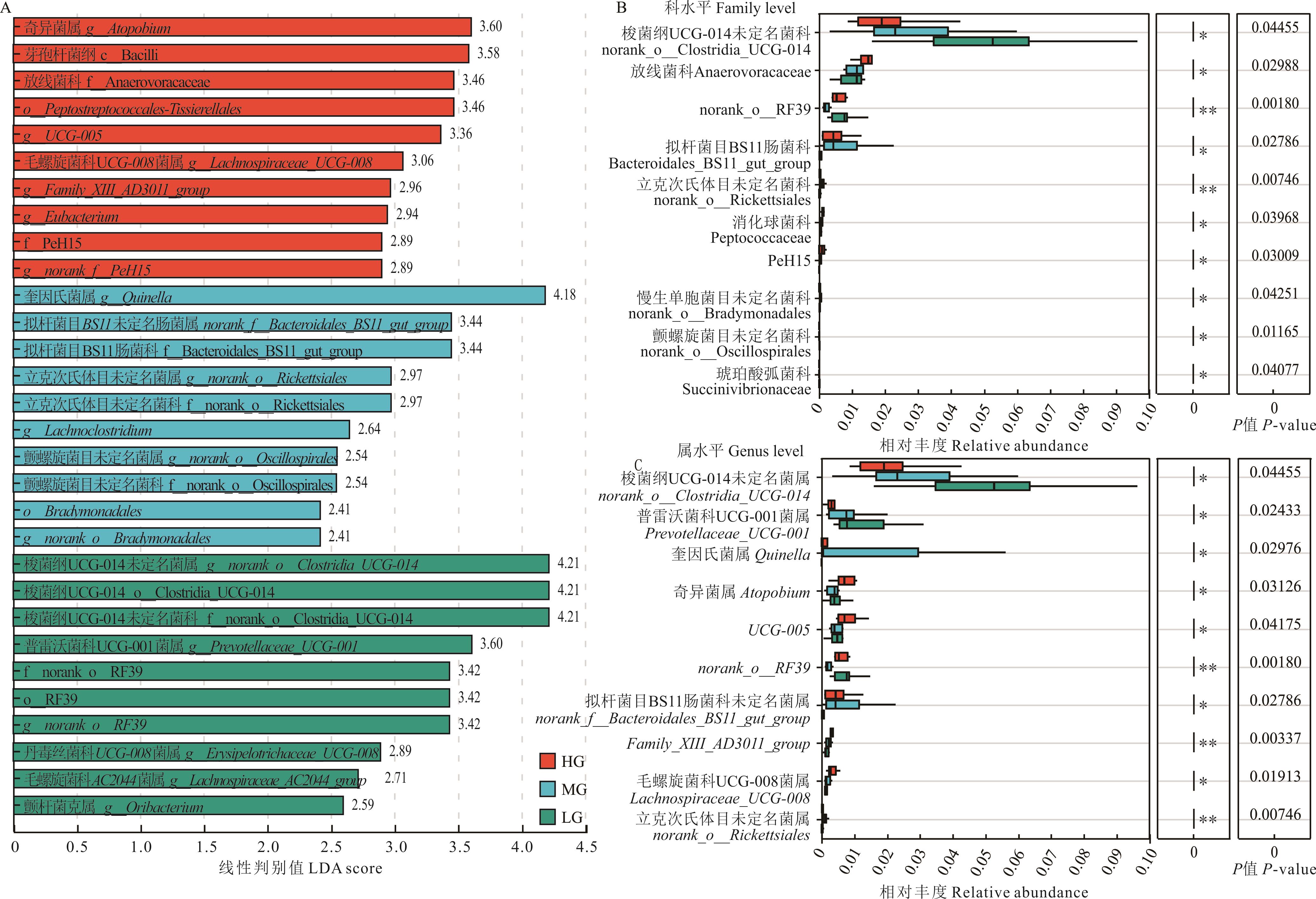
图3 不同能量水平精补料对生长期牦牛瘤胃微生物群落影响差异分析A:基于LEfSe分析不同组间牦牛瘤胃微生物群落组成差异;B:基于Kruskal-Willis秩和检验分析不同组间瘤胃微生物群落在科水平的差异;C:基于Kruskal-Willis秩和检验分析不同组间瘤胃微生物群落在属水平的差异。*代表P<0.05; **代表P<0.01。A: Based on LEfSe analysis, the differences in rumen microbial community composition among different groups were examined; B: Based on Kruskal-Willis rank sum test, the differences in rumen microbial communities at the family level among different groups were analyzed; C: Based on Kruskal-Willis rank sum test, the differences in rumen microbial communities at the genus level among different groups were analyzed. *: P<0.05; **: P<0.01.
Fig.3 Analysis of differences in rumen microbial communities of yaks during growth periods under different energy levels of supplementary feed
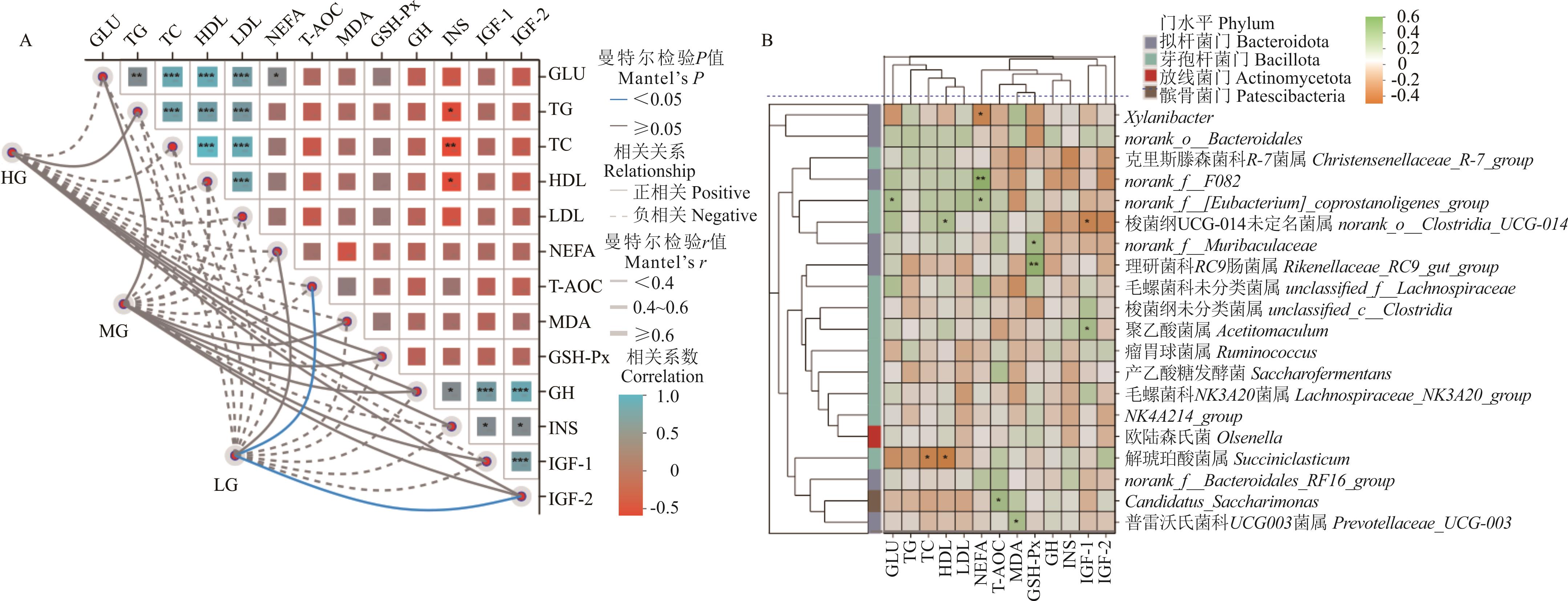
图4 影响生长期牦牛瘤胃微生物群落结构变化的因素分析A:不同组间牦牛瘤胃微生物在属水平上的群落组成与宿主血液生化指标间的相关性;B:瘤胃微生物群落在属水平物种相对丰度前20的物种与宿主血液生化指标间的Spearman相关性分析。GLU:血糖;TG:甘油三酯;TC:总胆固醇;LDL:低密度脂蛋白胆固醇;HDL:高密度脂蛋白胆固醇;NEFA:游离脂肪酸;MDA:丙二醛;T-AOC:总抗氧化能力;GSH-Px:谷胱甘肽过氧化酶;GH:生长激素;INS:胰岛素;IGF-1:胰岛素样生长因子1;IGF-2:胰岛素样生长因子2。A: The correlation between the community composition of yak rumen microbiota at the genus level and the host’s blood biochemical indicators among different groups; B: The Spearman correlation analysis between the top 20 species in the rumen microbiota at the genus level and the host’s blood biochemical indicators. GLU: glucose; TG: triacylglycerols; TC: total cholesterol; LDL: low density lipoprotein cholesterol; HDL: high density lipoprotein cholesterol; NEFA: non-esterified fatty acid; MDA: malondialdehyde; T-AOC: total antioxidant capacity; GSH-Px: glutathione peroxidase; GH: growth hormone; INS: insulin; IGF-1: insulin-like growth factor 1; IGF-2: insulin-like growth factor 2.
Fig.4 Analysis of factors influencing the changes in rumen microbial community structure of yaks during the growth period
| [1] | Long R J, Ding L M, Shang Z H, et al. The yak grazing system on the Qinghai-Tibetan Plateau and its status. The Rangeland Journal, 2008, 30(2): 241-246. |
| [2] | Gu Z L, Zhao X B, Li N, et al. Complete sequence of the yak (Bos grunniens) mitochondrial genome and its evolutionary relationship with other ruminants. Molecular Phylogenetics and Evolution, 2007, 42(1): 248-255. |
| [3] | Guo W, Zhou M, Ma T, et al. Survey of rumen microbiota of domestic grazing yak during different growth stages revealed novel maturation patterns of four key microbial groups and their dynamic interactions. Animal Microbiome, 2020, 2(1): 23. |
| [4] | Eisler M C, Lee M R, Tarlton J F, et al. Agriculture: Steps to sustainable livestock. Nature, 2014, 507(7490): 32-34. |
| [5] | Yeoman C J, White B A. Gastrointestinal tract microbiota and probiotics in production animals. Annual Review of Animal Biosciences, 2014, 2: 469-486. |
| [6] | Ding X Z, Long R J, Kreuzer M, et al. Methane emissions from yak (Bos grunniens) steers grazing or kept indoors and fed diets with varying forage:Concentrate ratio during the cold season on the Qinghai-Tibetan Plateau. Animal Feed Science & Technology, 2010, 162(3/4): 91-98. |
| [7] | Ma X M, Guo X, La Y F, et al. Integrative analysis of proteomics and transcriptomics of longissimus dorsi with different feeding systems in yaks. Foods, 2023, 12(2): 257. |
| [8] | Ahmad A A, Yang C, Zhang J B, et al. Effects of dietary energy levels on rumen fermentation, microbial diversity, and feed efficiency of yaks (Bos grunniens). Frontiers in Microbiology, 2020, 11: 625. |
| [9] | Shen D, Zeng Z M, Pang K Y, et al. Effects of low-concentrate and high-concentrate diets on yak growth performance and rumen microbiota structure. Acta Prataculturae Sinica, 2024, 33(5): 155-165. |
| 申迪, 曾子铭, 庞凯悦, 等. 低精料日粮和高精料日粮对牦牛生长性能和瘤胃菌群结构的影响. 草业学报, 2024, 33(5): 155-165. | |
| [10] | Ministry of Agriculture of the People’s Republic of China. Feeding standard of beef cattle: NY/T 815-2004. Beijing: China Agricultural Press, 2004. |
| 中华人民共和国农业部. 肉牛饲养标准: NY/T 815-2004. 北京: 中国农业出版社, 2004. | |
| [11] | Dexter F. Wilcoxon-Mann-Whitney test used for data that are not normally distributed. Anesthesia and Analgesia, 2013, 117(3): 537-538. |
| [12] | Krzywinski M, Schein J, Birol I, et al. Circos: An information aesthetic for comparative genomics. Genome Research, 2009, 19(9): 1639-1645. |
| [13] | Gao Y D, Zhuang W L, Wang X, et al. Meta-analysis of effects of concentrate supplementation in warm and cold seasons on growth performance and rumen fermentation of grazing yaks. Pratacultural Science, 2025, 42(4): 1067-1081. |
| 高一丹, 庄万兰, 王旭, 等. 冷暖季精料补饲对放牧牦牛生长性能和瘤胃发酵影响的Meta分析. 草业科学, 2025, 42(4): 1067-1081. | |
| [14] | Deng Y F, Wang J, Hou W F, et al. Comparison of growth performance and economic benefits between winter-spring stall feeding and grazing of Tibetan yaks. Chinese Journal of Animal Science, 2013, 49(17): 77-81. |
| 邓由飞, 王建, 侯文峰, 等. 斯布牦牛冬春季舍饲肥育与放牧饲养的生长性能和经济效益比较. 中国畜牧杂志, 2013, 49(17): 77-81. | |
| [15] | Jin S W, Han Y C, Sun Y G, et al. Effects of different feeding methods on growth performance and blood physiological and biochemical indexes of yaks. Acta Prataculturae Sinica, 2025, 34(1):215-225. |
| 靳生伟, 韩银仓, 孙永刚, et al. 冷季不同饲养方式对牦牛生长性能及血液生理生化指标的影响. 草业学报, 2025, 34(1): 215-225. | |
| [16] | Nemmar A. Passage of inhaled particles into the blood circulation in humans. Circulation, 2002, 105(4): 411-414. |
| [17] | Ayuk J, Sheppard M C. Growth hormone and its disorders. Postgraduate Medical Journal, 2006, 82(963): 24-30. |
| [18] | Renaville R, Hammadi M, Portetelle D. Role of the somatotropic axis in the mammalian metabolism. Domestic Animal Endocrinology, 2002, 23(1/2): 351-360. |
| [19] | Wang H Z. Effects of dietary energy concentration on performance, rumen fermentation and intramuscular fat metabolism in yaks fed indoors. Chengdu: Sichuan Agricultural University, 2015. |
| 王鸿泽. 日粮能量水平对舍饲育肥牦牛生产性能、瘤胃发酵及肌内脂肪代谢的影响. 成都: 四川农业大学, 2015. | |
| [20] | Zhang J X. Mechanism of the effects of seasonal supplementation on yak performance. Chengdu: Sichuan Agricultural University, 2013. |
| 张建勋. 不同季节牦牛补饲效果及其机理研究. 成都: 四川农业大学, 2013. | |
| [21] | Zhang H B, Zhang X F, Wang Z S, et al. Effects of dietary energy level on lipid metabolism-related gene expression in subcutaneous adipose tissue of Yellow breed×Simmental cattle. Animal Science Journal, 2015, 86(4): 392-400. |
| [22] | Yang C. The response of molecular mechanism of adipose metabolism in yak to different dietary energy levels. Lanzhou: Lanzhou University, 2018. |
| 杨超. 牦牛脂肪代谢对饲粮能量水平响应的分子机制研究. 兰州: 兰州大学, 2018. | |
| [23] | Dalile B, Van Oudenhove L, Vervliet B, et al. The role of short-chain fatty acids in microbiota-gut-brain communication. Nature Reviews Gastroenterology & Hepatology, 2019, 16(8): 461-478. |
| [24] | Dehority B A. Rumen microbiology. United Kingdom: Nottingham University Press, 2003. |
| [25] | Tannock G W. Modulating the gut microbiota of humans by dietary intervention with plant glycans. Applied and Environmental Microbiology, 2021, 26; 87(6): e02757-20. doi: 10.1128/AEM.02757-20. PMID: 33355114; PMCID: . |
| [26] | Nuriel-Ohayon M, Neuman H, Koren O. Microbial changes during pregnancy, birth, and infancy. Frontiers in Microbiology, 2016, 7: 1031. |
| [27] | Fernando S C, Purvis H T, Najar F Z, et al. Rumen microbial population dynamics during adaptation to a high-grain diet. Applied and Environmental Microbiology, 2010, 76(22): 7482-7490. |
| [28] | Hu X, Liu G, Shafer A B A, et al. Comparative analysis of the gut microbial communities in forest and alpine musk deer using high-throughput sequencing. Frontiers in Microbiology, 2017, 8: 572. |
| [29] | Oikonomou G, Teixeira A G, Foditsch C, et al. Fecal microbial diversity in pre-weaned dairy calves as described by pyrosequencing of metagenomic 16S rDNA. Associations of Faecalibacterium species with health and growth. PLoS One, 2013, 8(4): e63157. |
| [30] | Malmuthuge N, Griebel P J, Guan L L. Taxonomic identification of commensal bacteria associated with the mucosa and digesta throughout the gastrointestinal tracts of preweaned calves. Applied and Environmental Microbiology, 2014, 80(6): 2021-2028. |
| [31] | Yeoman C J, Ishaq S L, Bichi E, et al. Biogeographical differences in the influence of maternal microbial sources on the early successional development of the bovine neonatal gastrointestinal tract. Scientific Reports, 2018, 8(1): 3197. |
| [32] | Palevich N, Kelly W J, Ganesh S, et al. Butyrivibrio hungatei MB2003 competes effectively for soluble sugars released by Butyrivibrio proteoclasticus B316(T) during growth on xylan or pectin. Applied and Environmental Microbiology, 2019, 23; 85(3): e02056-18. doi: 10.1128/AEM.02056-18. PMID: 30478228; PMCID: . |
| [33] | Ogata T, Makino H, Ishizuka N, et al. Long-term high-grain diet altered the ruminal pH, fermentation, and composition and functions of the rumen bacterial community, leading to enhanced lactic acid production in Japanese black beef cattle during fattening. PLoS One, 2019, 14(11): e0225448. |
| [34] | Pitta D W, Pinchak E, Dowd S E, et al. Rumen bacterial diversity dynamics associated with changing from bermudagrass hay to grazed winter wheat diets. Microbial Ecology, 2010, 59(3): 511-522. |
| [35] | El Kaoutari A, Armougom F, Gordon J I, et al. The abundance and variety of carbohydrate-active enzymes in the human gut microbiota. Nature Reviews: Microbiology, 2013, 11(7): 497-504. |
| [36] | Korpela K. Diet, microbiota, and metabolic health: Trade-off between saccharolytic and proteolytic fermentation. Annual Review of Food Science and Technology, 2018, 9: 65-84. |
| [37] | Hildebrand F, Nguyen T L, Brinkman B, et al. Inflammation-associated enterotypes, host genotype, cage and inter-individual effects drive gut microbiota variation in common laboratory mice. Genome Biology, 2013, 14(1): R4. doi: 10.1186/gb-2013-14-1-r4. PMID: 23347395; PMCID: . |
| [38] | An D, Dong X, Dong Z. Prokaryote diversity in the rumen of yak (Bos grunniens) and Jinnan cattle (Bos taurus) estimated by 16S rDNA homology analyses. Anaerobe, 2005, 11(4): 207-215. |
| [39] | Zhao Y P, Xu H J, Wang M M, et al. Effects of rumen-protected amylase on performance, rumen fermentation parameters and flora composition of mid-lactating dairy cows. Chinese Joumal of Animal Nutrition, 2024, 36(10): 6409-6421. |
| 赵玉萍, 徐宏建, 王美美, et al. 过瘤胃淀粉酶对泌乳中期奶牛生产性能、瘤胃发酵参数和菌群组成的影响. 动物营养学报, 2024, 36(10): 6409-6421. | |
| [40] | Gylswyk N O V. Succiniclasticum ruminis gen. nov., sp. nov., a ruminal bacterium converting succinate to propionate as the sole energy-yielding mechanism. International Journal of Systematic Bacteriology, 1995, 45(2): 297-300. |
| [1] | 李小聪, 闫聚辉, 王星, 胡鹏飞, 叶雨浓, 伏兵哲. 紫花苜蓿/无芒雀麦间作对草地生产性能和土壤理化特性的影响[J]. 草业学报, 2026, 35(5): 113-125. |
| [2] | 王一博, 明雪花, 张建勇, 袁琦, 杜建明, 王斌, 王腾飞, 张译尹, 兰剑, 牟乐. 宁夏干旱区燕麦新种质生产性能和种子产量综合评价研究[J]. 草业学报, 2026, 35(4): 86-99. |
| [3] | 贾浩滨, 江浩筠, 李爱华, 王海波, 林孙权, 潘月, 霍俊宏, 占今舜. 不同精粗比饲粮对广丰山羊生产性能、血清生化、瘤胃发酵的影响[J]. 草业学报, 2026, 35(3): 170-184. |
| [4] | 张译尹, 肖爱萍, 王斌, 王腾飞, 胡海英, 兰剑. 饲用高粱/拉巴豆混播模式下施氮量对草地生产力和能量利用效率的影响[J]. 草业学报, 2026, 35(1): 40-52. |
| [5] | 任春燕, 郝志云, 邴睿, 霍应栋, 赵海碧, 尹鹏飞, 唐德富, 蔺淑琴, 王继卿. 开食料添加纤维素酶对羔羊生产性能、器官发育、肌肉脂肪酸组成及血清抗氧化指标的影响[J]. 草业学报, 2025, 34(7): 120-131. |
| [6] | 项凌飞, 张峰举, 麻冬梅, 刘金龙, 兰剑, 邓建强, 胡海英, 王斌, 蔡春江, 马巧利. 氮磷钾配施对盐碱地湖南稷子生产性能和营养品质的影响[J]. 草业学报, 2025, 34(7): 185-195. |
| [7] | 祁帅, 张艳丽, 万永杰, 牛伟强, 张积鑫, 高雪, 茆达干. 菌酶协同发酵豆秸对湖羊生长性能、血清指标和瘤胃微生物的影响[J]. 草业学报, 2025, 34(5): 189-201. |
| [8] | 韩航琪, 王梓凡, 丁赫, 陈玉荣, 王琦, 张晓庆. 燕麦干草与燕麦草块对绵羊瘤胃发酵及微生物组成影响的比较分析[J]. 草业学报, 2025, 34(5): 212-222. |
| [9] | 杨攀平, 李惠侠, 胡亚美. 盐池滩羊肉品质特性及其潜在调控机理探讨[J]. 草业学报, 2025, 34(4): 223-232. |
| [10] | 王斌, 史佳梅, 王腾飞, 张译尹, 马江萍, 李佳旺, 王小兵, 邓建强, 兰剑. 施氮对饲用高粱/拉巴豆混播草地生产性能和氮肥贡献率的影响[J]. 草业学报, 2025, 34(4): 53-63. |
| [11] | 马江萍, 张译尹, 王腾飞, 王斌, 兰剑. 饲用高粱与拉巴豆混播对种间关系及草地生产力的影响[J]. 草业学报, 2025, 34(3): 111-122. |
| [12] | 赵雅姣, 刘晓静, 蔺芳. 适宜于黄土高原半干旱区豆禾饲草间套作组合的筛选[J]. 草业学报, 2025, 34(3): 97-110. |
| [13] | 王文虎, 梁国玲, 刘文辉, 王凤宇, 李文. 青藏高原区8份老芒麦资源农艺性状与生产性能综合评价[J]. 草业学报, 2025, 34(2): 123-132. |
| [14] | 操鹏飞, 汪水平, 黄桥深, 周世龙, 罗专, 任莹, 刘勇, 李铁军, 汤少勋. 青贮饲料桑替代豆粕对肉羊血液指标、瘤胃发酵及瘤胃菌群的影响[J]. 草业学报, 2025, 34(10): 213-228. |
| [15] | 顾明明, 姜幸慧, 马志毅, 邱水玲, 刘浩宇, 张洺瑞, 卢佳宁, 丘宇俊, 王本治, 甘乾福. 甘薯和芋头在闽东山羊瘤胃中的降解特性及表面附着微生物群落变化[J]. 草业学报, 2024, 33(9): 169-184. |
| 阅读次数 | ||||||
|
全文 |
|
|||||
|
摘要 |
|
|||||
