

ISSN 1004-5759 CN 62-1105/S
草业学报 ›› 2026, Vol. 35 ›› Issue (10): 61-78.DOI: 10.11686/cyxb2025443
银敏华1( ), 常文静1, 银建新2, 段丫丫1, 李海燕1, 王彦彪1, 康燕霞1(), 马彦麟1, 王亚玉1, 齐广平1
收稿日期:2025-10-23
修回日期:2026-01-12
出版日期:2026-10-20
发布日期:2026-09-09
通讯作者:
康燕霞
作者简介:E-mail: yanxiakang@gsau.edu.cn基金资助:
Min-hua YIN1(), Wen-jing CHANG1, Jian-xin YIN2, Ya-ya DUAN1, Hai-yan LI1, Yan-biao WANG1, Yan-xia KANG1(), Yan-lin MA1, Ya-yu WANG1, Guang-ping QI1
Received:2025-10-23
Revised:2026-01-12
Online:2026-10-20
Published:2026-09-09
Contact:
Yan-xia KANG
摘要:
在全球温室气体排放总量中,农业生产是重要的贡献源。苜蓿作为全球种植面积最大的人工牧草,虽具备根瘤固氮能力,但在以高产优质为目标的集约化生产中常施用一定量的外源氮肥,其温室气体排放效应不容忽视。优化种植管理模式是减少苜蓿草地温室气体排放的有效途径。本研究通过设置3种种植模式[传统平作(FP)、垄覆生物降解地膜(BM)、垄覆普通地膜(PM)]、2种氮肥类型[(尿素(U)、控释氮肥(C)]和4种施氮水平(0、80、160、240 kg·hm-2),系统分析了种植模式与氮肥管理对苜蓿草地CO2、CH4和N2O排放的影响。结果表明,苜蓿草地为CO2、N2O净排放源和CH4吸收汇。与施用尿素相比,施用控释氮肥能显著降低CO2和N2O的累积排放量,并提高CH4的累积吸收量。苜蓿草地CO2、N2O累积排放量和CH4累积吸收量均随施氮水平提高呈增加趋势,且表现为PM>BM>FP。BM和PM的苜蓿产量较FP分别平均提高43.56%和30.07%,施用控释氮肥的苜蓿产量较施用尿素平均提高8.46%,施用160 kg·hm-2 控释氮肥结合垄覆生物降解地膜(BMC2)的苜蓿产量最高(24.83 t·hm-2),较不覆膜不施氮处理提高97.11%。施用控释氮肥的全球增温潜势(GWP)和温室气体排放强度(GHGI)分别较施用尿素平均降低12.26%和15.04%。BM的GWP较PM处理平均降低15.28%,较FP处理平均提高15.12%,GHGI较PM和FP平均分别降低11.84%和17.18%。综上,在本研究条件下,施用160 kg·hm?2 控释氮肥结合垄覆生物降解地膜(BMC2处理)是甘肃引黄灌区及类似生态区苜蓿草地增产减排的推荐种植管理模式。
银敏华, 常文静, 银建新, 段丫丫, 李海燕, 王彦彪, 康燕霞, 马彦麟, 王亚玉, 齐广平. 基于减排效应的苜蓿草地种植模式与氮肥管理优化研究[J]. 草业学报, 2026, 35(10): 61-78.
Min-hua YIN, Wen-jing CHANG, Jian-xin YIN, Ya-ya DUAN, Hai-yan LI, Yan-biao WANG, Yan-xia KANG, Yan-lin MA, Ya-yu WANG, Guang-ping QI. Optimization of alfalfa pasture planting patterns and nitrogen fertilizer management to reduce greenhouse gas emissions[J]. Acta Prataculturae Sinica, 2026, 35(10): 61-78.
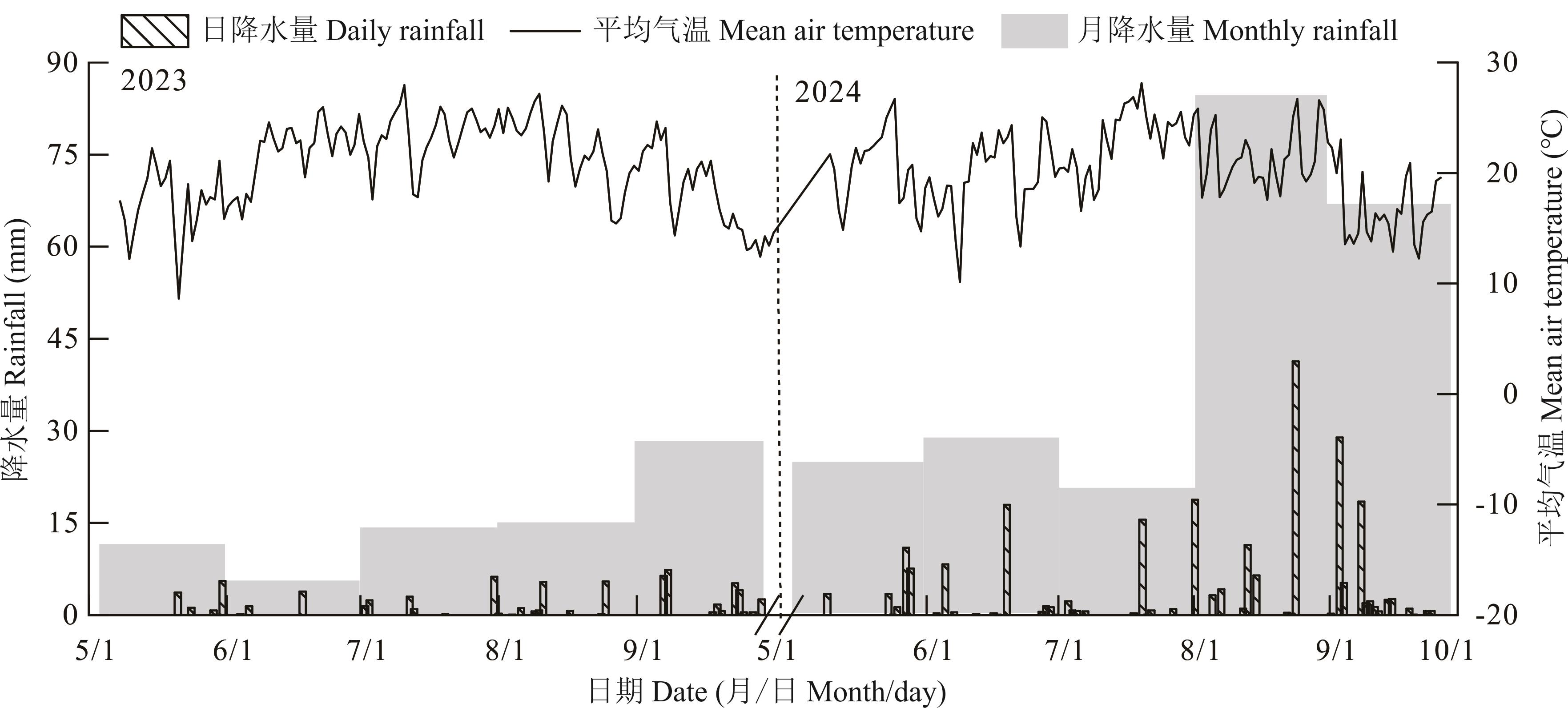
图1 苜蓿生长期间降水与气温分布
Fig.1 Rainfall and air temperature distributions during alfalfa growth period
种植模式 Cropping patterns | 氮肥运筹Nitrogen fertilizer management | ||
|---|---|---|---|
氮肥类型 Nitrogen fertilizer types | 施氮水平 Nitrogen application levels (kg·hm-2) | 三茬施用比例 Application rate among three crops | |
平作Flat planting (FP) | 尿素Urea (U) | 80 (U1) | 6∶2∶2 |
| 160 (U2) | 6∶2∶2 | ||
| 240 (U3) | 6∶2∶2 | ||
| 控释氮肥Controlled release nitrogen fertilizer (C) | 80 (C1) | 1∶0∶0 | |
| 160 (C2) | 1∶0∶0 | ||
| 240 (C3) | 1∶0∶0 | ||
| 不施氮肥 No nitrogen fertilization (N0) | 0 (N0) | - | |
| 垄覆生物降解地膜种植Ridge-furrow planting with biodegradable film mulching over ridge (BM) | 尿素Urea (U) | 80 (U1) | 6∶2∶2 |
| 160 (U2) | 6∶2∶2 | ||
| 240 (U3) | 6∶2∶2 | ||
| 控释氮肥Controlled release nitrogen fertilizer (C) | 80 (C1) | 1∶0∶0 | |
| 160 (C2) | 1∶0∶0 | ||
| 240 (C3) | 1∶0∶0 | ||
| 不施氮肥 No nitrogen fertilization (N0) | 0 (N0) | - | |
| 垄覆普通地膜Ridge-furrow planting with plastic film mulching over ridge (PM) | 尿素Urea (U) | 80 (U1) | 6∶2∶2 |
| 160 (U2) | 6∶2∶2 | ||
| 240 (U3) | 6∶2∶2 | ||
| 控释氮肥Controlled release nitrogen fertilizer (C) | 80 (C1) | 1∶0∶0 | |
| 160 (C2) | 1∶0∶0 | ||
| 240 (C3) | 1∶0∶0 | ||
| 不施氮肥No nitrogen fertilization (N0) | 0 (N0) | - | |
表1 试验设计
Table 1 Experimental design
种植模式 Cropping patterns | 氮肥运筹Nitrogen fertilizer management | ||
|---|---|---|---|
氮肥类型 Nitrogen fertilizer types | 施氮水平 Nitrogen application levels (kg·hm-2) | 三茬施用比例 Application rate among three crops | |
平作Flat planting (FP) | 尿素Urea (U) | 80 (U1) | 6∶2∶2 |
| 160 (U2) | 6∶2∶2 | ||
| 240 (U3) | 6∶2∶2 | ||
| 控释氮肥Controlled release nitrogen fertilizer (C) | 80 (C1) | 1∶0∶0 | |
| 160 (C2) | 1∶0∶0 | ||
| 240 (C3) | 1∶0∶0 | ||
| 不施氮肥 No nitrogen fertilization (N0) | 0 (N0) | - | |
| 垄覆生物降解地膜种植Ridge-furrow planting with biodegradable film mulching over ridge (BM) | 尿素Urea (U) | 80 (U1) | 6∶2∶2 |
| 160 (U2) | 6∶2∶2 | ||
| 240 (U3) | 6∶2∶2 | ||
| 控释氮肥Controlled release nitrogen fertilizer (C) | 80 (C1) | 1∶0∶0 | |
| 160 (C2) | 1∶0∶0 | ||
| 240 (C3) | 1∶0∶0 | ||
| 不施氮肥 No nitrogen fertilization (N0) | 0 (N0) | - | |
| 垄覆普通地膜Ridge-furrow planting with plastic film mulching over ridge (PM) | 尿素Urea (U) | 80 (U1) | 6∶2∶2 |
| 160 (U2) | 6∶2∶2 | ||
| 240 (U3) | 6∶2∶2 | ||
| 控释氮肥Controlled release nitrogen fertilizer (C) | 80 (C1) | 1∶0∶0 | |
| 160 (C2) | 1∶0∶0 | ||
| 240 (C3) | 1∶0∶0 | ||
| 不施氮肥No nitrogen fertilization (N0) | 0 (N0) | - | |
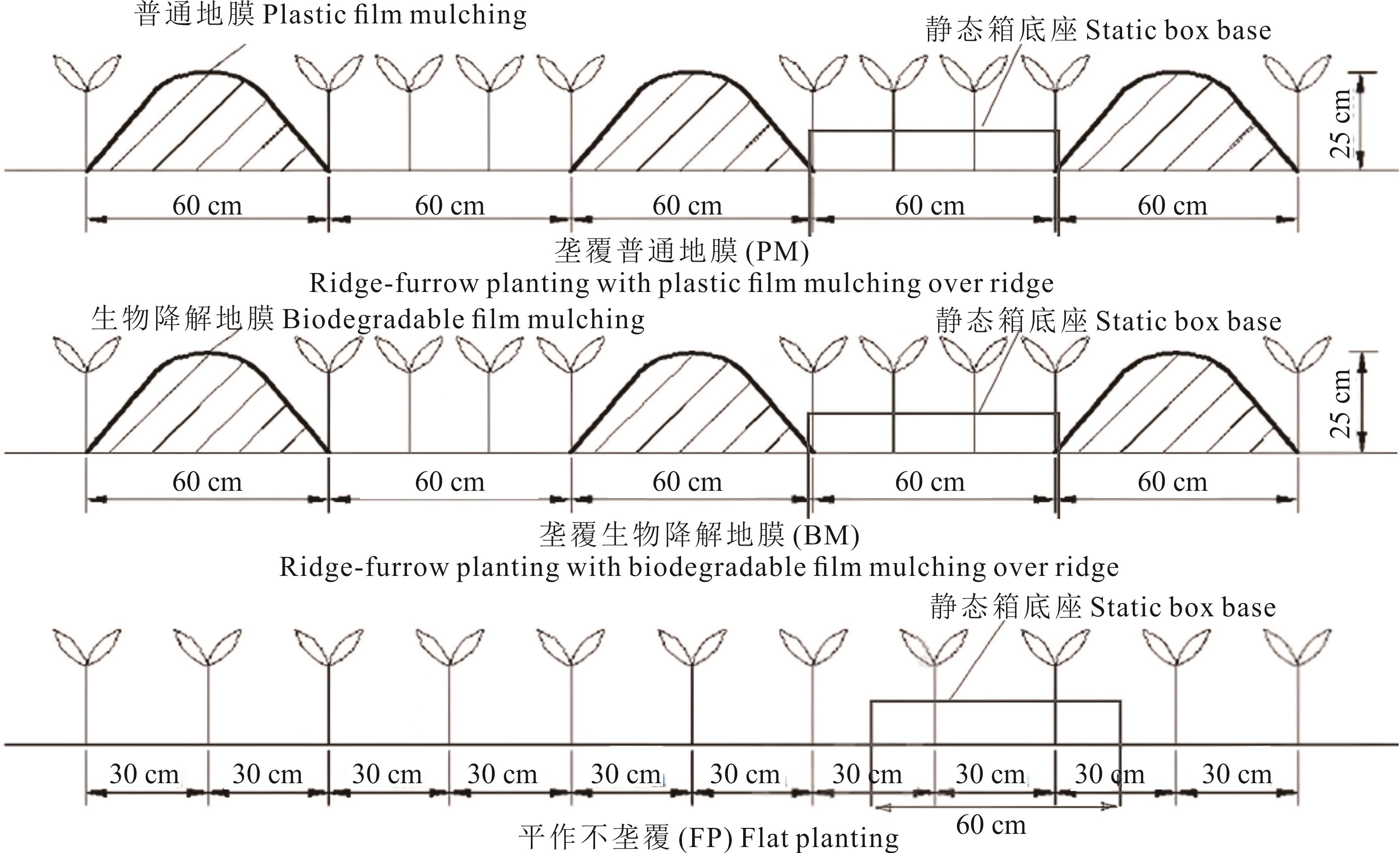
图2 苜蓿种植模式
Fig.2 Alfalfa cropping pattern

图3 土壤速效氮含量(a)代表两年各处理下土壤NO3--N含量平均值;(b)代表两年各处理下土壤NH??-N含量平均值;误差条表示95%置信区间。不同的小写字母表示处理组间存在显著差异(P<0.05),处理组为FPN0、FP1、FP2等之间,U代表施用尿素,C代表施用控释氮肥。下同。 (a) represents the average soil NO??-N content under each treatment over the two years; (b) represents the average soil NH??-N content under each treatment over the two years. Error bars indicate 95% confidence intervals. Different lowercase letters indicate significant differences among treatments (P<0.05). Processing groups include FPN0, FP1, FP2, etc. U represents the application of urea, C represents the application of controlled-release nitrogen fertilizer. The same below.
Fig.3 Soil available nitrogen content
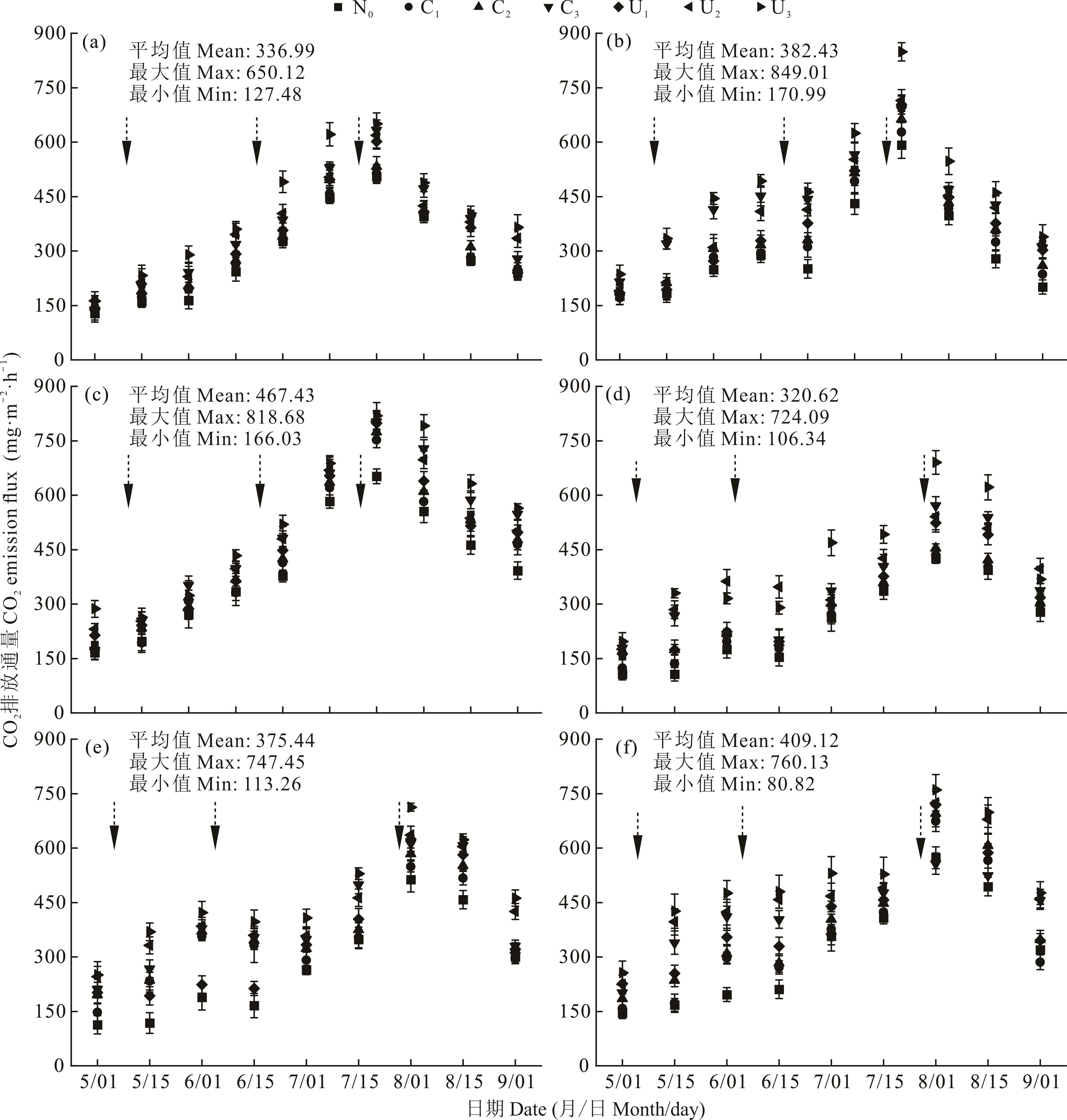
图4 种植模式与氮肥管理对苜蓿草地CO2排放通量的影响误差条和圆点分别表示95%置信区间和排放通量,虚线箭头表示施肥事件。(a)、(b)和(c)分别表示2023年传统平作、垄覆生物降解地膜和垄覆普通地膜;(d)、(e)和(f)分别表示2024年传统平作、垄覆生物降解地膜和垄覆普通地膜。下同。Error bars and dots represent 95% confidence intervals and emission fluxes, respectively, and the dashed arrow indicates the application of urea fertilizer. (a), (b) and (c) represent flat planting, ridge-furrow planting with biodegradable film mulching over ridge, and ridge-furrow planting with plastic film mulching over ridge, respectively, in 2023; (d), (e) and (f) represent flat planting, ridge-furrow planting with biodegradable film mulching over ridge, and ridge-furrow planting with plastic film mulching over ridge, respectively, in 2024. The same below.
Fig.4 Effects of planting pattern and nitrogen management on CO2 emission flux in alfalfa grassland
| 年份 Year | P | L | T | P×L | P×T | L×T | P×L×T |
|---|---|---|---|---|---|---|---|
| 2023 | 455.30** | 108.44** | 178.25** | 5.28* | 1.41* | 0.71ns | 0.18ns |
| 2024 | 232.63** | 377.10** | 238.99** | 2.59* | 13.61** | 28.50* | 0.58ns |
表2 不同种植模式与氮肥管理下苜蓿草地CO2累积排放量的方差分析
Table 2 Analysis of variance for cumulative CO2 emissions in alfalfa grasslands under different planting patterns and nitrogen managements
| 年份 Year | P | L | T | P×L | P×T | L×T | P×L×T |
|---|---|---|---|---|---|---|---|
| 2023 | 455.30** | 108.44** | 178.25** | 5.28* | 1.41* | 0.71ns | 0.18ns |
| 2024 | 232.63** | 377.10** | 238.99** | 2.59* | 13.61** | 28.50* | 0.58ns |

图5 种植模式与氮肥管理对苜蓿草地CO2年累积排放量的影响FM代表不覆膜处理,BM代表覆生物降解膜处理,PM代表覆普通地膜处理。下同。FM denotes non-film treatment, BM denotes treatment with biodegradable film, and PM denotes treatment with conventional plastic film. The same below.
Fig.5 Effects of planting pattern and nitrogen management on annual cumulative CO? emission in alfalfa grassland

图6 种植模式与氮肥管理对苜蓿草地CH4排放通量的影响负值代表CH4呈吸收态。Negative values indicate that CH? is in the absorbed state.
Fig.6 Effects of planting pattern and nitrogen management on CH4 emission flux in alfalfa grassland
| 年份 Year | P | L | T | P×L | P×T | L×T | P×L×T |
|---|---|---|---|---|---|---|---|
| 2023 | 222.38** | 207.56** | 8.60* | 57.26** | 52.76** | 37.24** | 1.72ns |
| 2024 | 65.79** | 65.82** | 31.27** | 6.49* | 1.05ns | 9.45** | 1.28ns |
表3 不同种植模式与氮肥管理下苜蓿草地CH4累积吸收量的方差分析
Table 3 Analysis of variance for cumulative CH4 absorption in alfalfa grasslands under different planting patterns and nitrogen managements
| 年份 Year | P | L | T | P×L | P×T | L×T | P×L×T |
|---|---|---|---|---|---|---|---|
| 2023 | 222.38** | 207.56** | 8.60* | 57.26** | 52.76** | 37.24** | 1.72ns |
| 2024 | 65.79** | 65.82** | 31.27** | 6.49* | 1.05ns | 9.45** | 1.28ns |
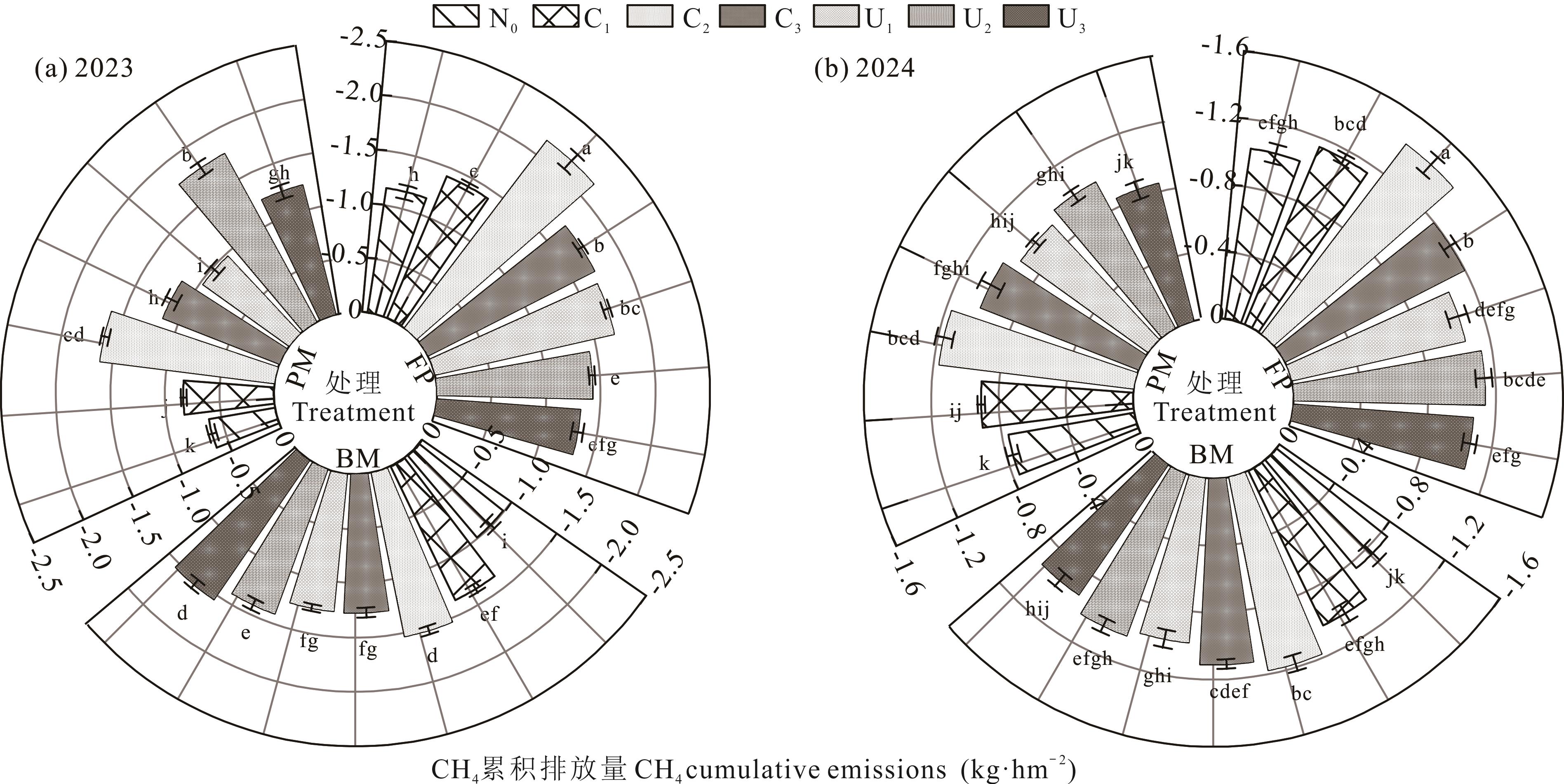
图7 种植模式与氮肥管理对苜蓿草地CH4年累积排放量的影响
Fig.7 Effects of planting pattern and nitrogen management on annual cumulative CH4 emission in alfalfa grassland

图8 种植模式与氮肥管理对苜蓿草地N2O排放通量的影响
Fig.8 Effects of planting pattern and nitrogen management on N2O emission flux in alfalfa grassland
| 年份 Year | P | L | T | P×L | P×T | L×T | P×L×T |
|---|---|---|---|---|---|---|---|
| 2023 | 33.61** | 131.28** | 44.03** | 0.04ns | 0.17ns | 10.92* | 0.51ns |
| 2024 | 82.33** | 229.04** | 84.36** | 4.48ns | 0.14ns | 17.24** | 0.15ns |
表4 不同种植模式与氮肥管理下苜蓿草地N2O累积排放量的方差分析
Table 4 Analysis of variance for cumulative N2O emissions in alfalfa grasslands under different planting patterns and nitrogen managements
| 年份 Year | P | L | T | P×L | P×T | L×T | P×L×T |
|---|---|---|---|---|---|---|---|
| 2023 | 33.61** | 131.28** | 44.03** | 0.04ns | 0.17ns | 10.92* | 0.51ns |
| 2024 | 82.33** | 229.04** | 84.36** | 4.48ns | 0.14ns | 17.24** | 0.15ns |

图9 种植模式与氮肥管理对苜蓿草地N2O年累积排放量的影响
Fig.9 Effects of planting pattern and nitrogen management on annual cumulative N2O emission in alfalfa grassland
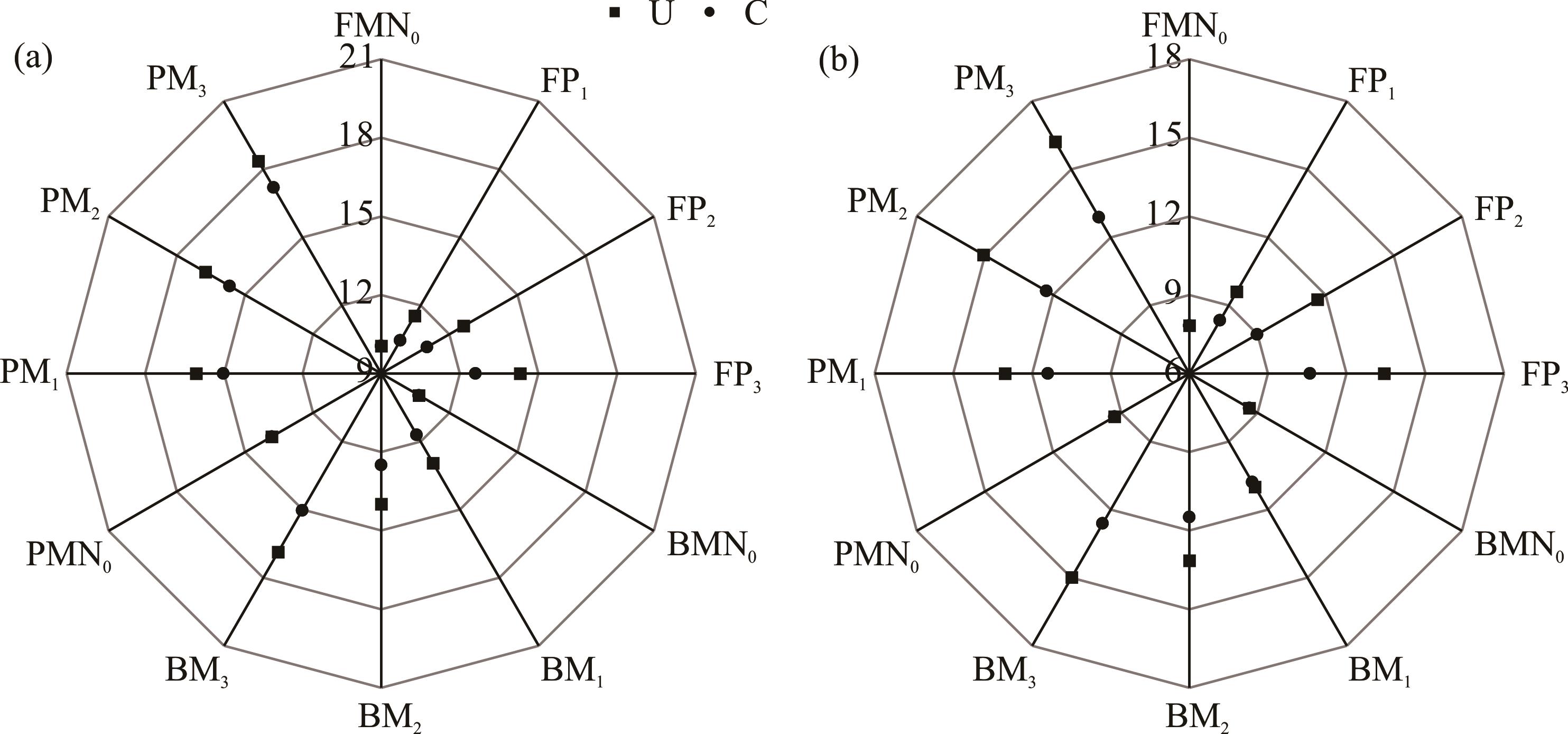
图10 种植模式与氮肥管理对苜蓿草地全球增温潜势的影响图中坐标轴为全球增温潜势(kg CO2-eq·hm-2)。(a)代表2023年种植模式与氮肥管理对苜蓿草地全球增温潜势的影响,(b)代表2024年种植模式与氮肥管理对苜蓿草地全球增温潜势的影响。The coordinate axes in the figure represent global warming potential (kg CO2-eq·ha-1). (a) represents the impact of cropping patterns and nitrogen fertilizer management on the global warming potential (GWP, kg CO2-eq·ha-1) of alfalfa grasslands in 2023. (b) represents the impact of cropping patterns and nitrogen fertilizer management on the global warming potential (GWP, kg CO2-eq·ha-1) of alfalfa grasslands in 2024.
Fig.10 Effects of planting pattern and nitrogen management on global warming potential in alfalfa grassland

图11 种植模式与氮肥管理对苜蓿产量的影响(a)和(c)分别代表2023和2024年施用控释氮肥的苜蓿产量;(b)和(d)分别代表2023和2024年施用尿素的苜蓿产量。 (a) and (c) represent alfalfa yields with controlled-release nitrogen fertilizer applied in 2023 and 2024, respectively; and (b) and (d) represent alfalfa yields with urea applied in 2023 and 2024.
Fig.11 Effects of planting pattern and nitrogen management on alfalfa yields
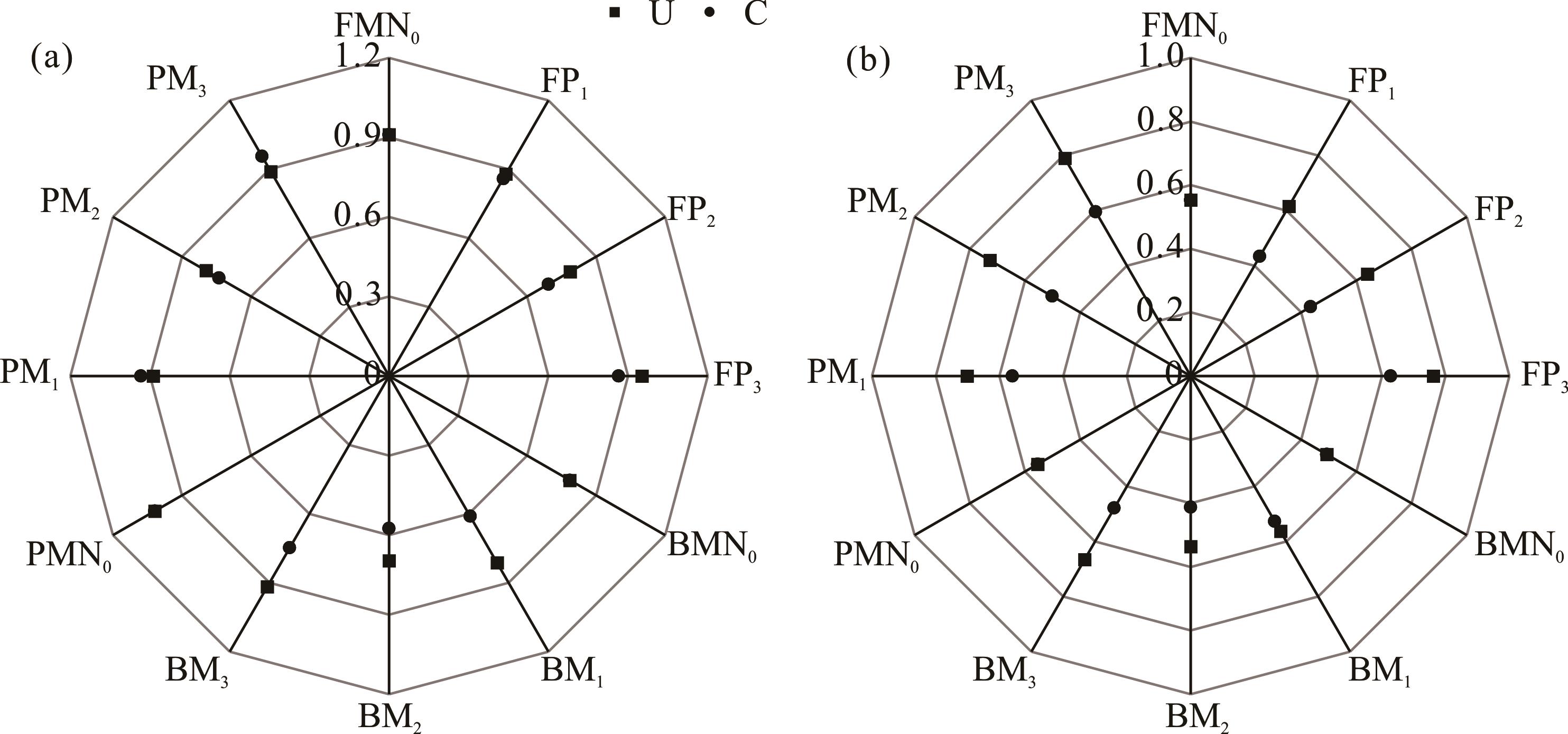
图12 种植模式与氮肥管理对苜蓿草地温室气体排放强度的影响图中坐标轴为温室气体排放强度[kg(CO2-eq·kg-1)]。(a)代表2023年种植模式与氮肥管理对苜蓿草地温室气体排放强度的影响,(b)代表2024年种植模式与氮肥管理对苜蓿草地温室气体排放强度的影响。The coordinate axes in the figure represent the greenhouse gas intensity (GHGI) [kg (CO2-eq·kg-1)]. (a) represents the impact of cropping patterns and nitrogen fertilizer management on the greenhouse gas intensity (GHGI) of alfalfa grasslands in 2023. (b) represents the impact of cropping patterns and nitrogen fertilizer management on the greenhouse gas intensity (GHGI) of alfalfa grasslands in 2024.
Fig.12 Effects of planting pattern and nitrogen management on greenhouse gas intensity in alfalfa grassland
| [1] | Lee H, Romero J. IPCC, 2023: Climate change 2023: synthesis report//Contribution of working groups I, II and III to the sixth assessment report of the intergovernmental panel on climate change. Geneva, Switzerland: Intergovernmental Panel on Climate Change (IPCC), 2023. |
| [2] | Hu T H, Xiong K N, Wang J. Intercropping peanut under forests can reduce soil N2O emissions in karst desertification control. Forests, 2023, 14(8): 1652. |
| [3] | Searchinger T, Waite R, Hanson C, et al. Creating a sustainable food future: A menu of solutions to feed nearly 10 billion people by 2050. Washington, DC: World Resources Institute, 2019. |
| [4] | Liu T Q, Li S H, Guo L J, et al. Advantages of nitrogen fertilizer deep placement in greenhouse gas emissions and net ecosystem economic benefits from no-tillage paddy fields. Journal of Cleaner Production, 2020, 263: 121322. |
| [5] | Sakuraba Y, Chaganzhana, Mabuchi A, et al. Enhanced NRT1.1/NPF6.3 expression in shoots improves growth under nitrogen deficiency stress in Arabidopsis. Communications Biology, 2021, 4: 256. |
| [6] | Bolo P, Muna M M, Kinyua M, et al. Nitrogen and phosphorus mineralization and their corresponding monetary values under long-term integrated soil fertility management practices. Journal of Sustainable Agriculture and Environment, 2024, 3(2): e12100. |
| [7] | Wu P, Fu L, Li H, et al. Suitable fertilizer application depth can increase nitrogen use efficiency and maize yield by reducing gaseous nitrogen losses. Science of the Total Environment, 2021, 781: 146787. |
| [8] | Verma K K, Song X P, Degu H D, et al. Recent advances in nitrogen and nano-nitrogen fertilizers for sustainable crop production: a mini-review. Chemical and Biological Technologies in Agriculture, 2023, 10: 111. |
| [9] | Dekyi D, Zeng K, Yin B, et al. Eliminaing NH3, NO and N2O emissions simultaneously in a wheat field by urea point placement. Soil and Fertilizer Sciences in China, 2024(6): 18-26. |
| 德吉卓玛, 曾科, 尹斌, 等. 尿素穴施削减麦田NH3挥发、NO和N2O排放. 中国土壤与肥料, 2024(6): 18-26. | |
| [10] | Saravanakumar S. Integrated nitrogen management in rice (Oryza sativa) under system rice intensification. Indian Journal of Agricultural Sciences, 2020, 90(5): 843-846. |
| [11] | Huang P, Zhang J B, Zhu A N, et al. Coupled water and nitrogen (N) management as a key strategy for the mitigation of gaseous N losses in the Huang-Huai-Hai Plain. Biology and Fertility of Soils, 2014, 51(3): 331-342. |
| [12] | Wei T B, Chai Q, Wang W M, et al. Effects of coupling of irrigation and nitrogen application as well as planting density on photosynthesis and dry matter accumulation characteristics of maize in oasis irrigated areas. Scientia Agricultura Sinica, 2019, 52(3): 428-444. |
| 魏廷邦, 柴强, 王伟民, 等. 水氮耦合及种植密度对绿洲灌区玉米光合作用和干物质积累特征的调控效应. 中国农业科学, 2019, 52(3): 428-444. | |
| [13] | Li X Y, Ding Z J, Yan J W, et al. Interaction effect and model of water and nitrogen under degradable film mulching in dripirrigated sandy farmland. Transactions of the Chinese Society for Agricultural Machinery, 2018, 49(7): 261-270. |
| 李仙岳, 丁宗江, 闫建文, 等.沙区降解膜覆盖下滴灌农田水氮交互效应与模型研究. 农业机械学报, 2018, 49(7): 261-270. | |
| [14] | Liu Z H, Cai L, Zhao X L, et al. Effect of decomposition of polyethylene residue film on soil water infiltration. China Environmental Science, 2022, 42(12): 5768-5774. |
| 刘子涵, 才璐, 赵小丽, 等. 聚乙烯残膜破碎过程对土壤水分入渗的影响. 中国环境科学, 2022, 42(12): 5768-5774. | |
| [15] | Belyaeva O, Ward G, Wijesinghe T, et al. Influence of soil organic matter, fertilizer formulation and season on fertilizer nitrogen use efficiency in temperate pastures. Nutrient Cycling in Agroecosystems, 2024, 129: 133-150. |
| [16] | Chen N Y, Li X Y, Shi H B, et al. Assessment and modeling of maize evapotranspiration and yield with plastic and biodegradable film mulch. Agricultural and Forest Meteorology, 2021, 307: 108474. |
| [17] | Hu G H, Wang J K, Wang Y L, et al. Effects of biodegradable film mulching on nitrogen use efficiency and yield of machine-transplanted rice. Ecology and Environmental Sciences, 2020, 29(5): 977-986. |
| 胡国辉, 王久坤, 王亚梁, 等. 生物可降解膜覆盖对机插水稻氮素利用及产量的影响. 生态环境学报, 2020, 29(5): 977-986. | |
| [18] | Huang Y L, Qin R Z, Wei H H, et al. Plastic film mulching application improves potato yields, reduces ammonia emissions, but boosts the greenhouse gas emissions in China. Journal of Environmental Management, 2024, 353: 120241. |
| [19] | Yin M H, Ma Y L, Kang Y X, et al. Effects of nitrogen application on alfalfa yield and quality in China-A Meta-analysis. Acta Prataculturae Sinica, 2022, 31(9): 36-49. |
| 银敏华, 马彦麟, 康燕霞, 等. 氮素添加对中国苜蓿产量与品质效应的Meta分析. 草业学报, 2022, 31(9): 36-49. | |
| [20] | Xia X, Gong Z P. Research advance on the relationship between nitrogen and Leguminous nitrogen fixation. Journal of Northeast Agricultural University, 2017, 48(1): 79-88. |
| 夏玄, 龚振平. 氮素与豆科作物固氮关系研究进展. 东北农业大学学报, 2017, 48(1): 79-88. | |
| [21] | Zhang Y L, Hu Z Z, Zhao H X, et al. Effect of the seeding-year clipping on the biomass and regrowth rate of grass-legume mixed grassland. Acta Agrestia Sinica, 2004(4): 308-312. |
| 张永亮, 胡自治, 赵海新, 等. 刈割对混播当年生物量及再生速率的影响. 草地学报, 2004(4): 308-312. | |
| [22] | Zhang Y Y, Wang B, Wang T F, et al. Effects of intercropping triticale with alfalfa on system yield, resource utilization, and alfalfa seed yield. Acta Prataculturae Sinica, 2025, 34(8): 43-53. |
| 张译尹, 王斌, 王腾飞, 等. 苜蓿种子田间作小黑麦对饲草产量、水分利用及苜蓿种子产量的影响. 草业学报, 2025, 34(8): 43-53. | |
| [23] | Tao X S, Yan Y E, Zhou X L. Study on the soil properties of desert grassland in the edge of Jingtai oasis. Pratacultural Science, 2009, 26(6): 29-34. |
| 陶雪松, 闫月娥, 周晓雷. 景泰绿洲边缘荒漠草地土壤特征研究. 草业科学, 2009, 26(6): 29-34. | |
| [24] | Huang Y X, Yang Y, Zhang P, et al. Review on soil microbes regulating ecosystem carbon sink function. Acta Ecologica Sinica, 2025, 45(17): 8297-8310. |
| 黄云鑫, 杨阳, 张鹏, 等. 土壤微生物调控生态系统碳汇功能研究进展. 生态学报, 2025, 45(17): 8297-8310. | |
| [25] | Zhang W W, Gu J, Zhang Y Z, et al. Effects of PBAT/PLA biodegradable film mulching on greenhouse gas emissions in rain-fed maize farmland of Northeast China. Science of the Total Environment, 2024, 957: 177725. |
| [26] | Zhao Z M, Shi F X, Guan F C. Effects of plastic mulching on soil CO2 efflux in a cotton field in northwestern China. Scientific Reports, 2022, 12: 4969. |
| [27] | Xu K, Wu X D, Xie Y Z, et al. Main factors controlling soil CO2 efflux from alfalfa fields of different standing ages in an arid area. Ecology and Environmental Sciences, 2013, 22(10): 1671-1677. |
| 徐坤, 吴旭东, 谢应忠, 等. 干旱区不同种植年限苜蓿人工草地土壤CO2排放的主要影响因素. 生态环境学报, 2013, 22(10): 1671-1677. | |
| [28] | Chi Y B, Yang P L, Ren S M, et al. Finding the optimal fertilizer type and rate to balance yield and soil GHG emissions under reclaimed water irrigation. Science of the Total Environment, 2020, 729: 138954. |
| [29] | Tian S Z, Liu Z, Wang B W, et al. Balancing the use of maize residues for soil amendment and forage. Plant, Soil and Environment, 2016, 62(11): 490-496. |
| [30] | Anderson C R, Peterson M E, Frampton R A, et al. Rapid increases in soil pH solubilise organic matter, dramatically increase denitrification potential and strongly stimulate microorganisms from the Firmicutes phylum. PeerJ, 2018, 6: e6090. |
| [31] | Deng X W, Yang J J, Chen H, et al. Advances in the research of methane oxidation in forest soils. Ecology and Environmental Sciences, 2012, 21(3): 577-583. |
| 邓湘雯, 杨晶晶, 陈槐, 等. 森林土壤氧化(吸收)甲烷研究进展. 生态环境学报, 2012, 21(3): 577-583. | |
| [32] | Liu J L, Chen X P, Zhan A, et al. Methane uptake in semiarid farmland subjected to different mulching and nitrogen fertilization regimes. Biology and Fertility of Soils, 2016, 52(7): 941-950. |
| [33] | Lan T, Zhang H, Han Y, et al. Regulating CH4, N2O, and NO emissions from an alkaline paddy field under rice-wheat rotation with controlled release N fertilizer. Environmental Science and Pollution Research, 2021, 28(14): 18246-18259. |
| [34] | Parthiban K O, Karthigeyan C, Saravanan N, et al. Influence of nutrients on oxidation of low-level methane by mixed methanotrophic consortia. Environmental Science and Pollution Research, 2016, 23(20): 4346-4357. |
| [35] | Li X S, Yue S C, Li S Q, et al. Effect of film mulching and nitrogen fertilizer on CH4 absorption of rainfed spring maize farmland. Agricultural Research in the Arid Areas, 2017, 35(4): 1-9, 53. |
| 李晓莎, 岳善超, 李世清, 等. 覆膜和氮肥用量对雨养春玉米农田甲烷吸收的影响. 干旱地区农业研究, 2017, 35(4): 1-9, 53. | |
| [36] | Shrestha P M, Frenzel P, Conrad R, et al. Effect of nitrogen fertilization on methane oxidation, abundance, community structure, and gene expression of methanotrophs in the rice rhizosphere. The ISME Journal, 2010, 4(12): 1545-1556. |
| [37] | Zhang L H, Yuan F H, Bai J H, et al. Phosphorus alleviation of nitrogen-suppressed methane sink in global grasslands. Ecology Letters, 2020, 23(5): 821-830. |
| [38] | Li Q, Peng C H, Zhang J B, et al. Nitrogen addition decreases methane uptake caused by methanotroph and methanogen imbalances in a Moso bamboo forest. Scientific Reports, 2021, 11(1): 5578. |
| [39] | Al-barakah F N, Mridha M A. Symbiotic nitrogen fixation in alfalfa (Medicago sativa L.) by Sinorhizobium meliloti at Al-qassim regions, Saudi Arabia. Pakistan Journal of Botany, 2016, 48(1): 345-348. |
| [40] | Wang X Y, Gao Y Z. Advances in the mechanism of cereal/legume intercropping promotion of symbiotic nitrogen fixation. Chinese Science Bulletin, 2020, 65(2): 142-149. |
| 王旭燕, 高永卓. 禾本科/豆科间作促进豆科共生固氮的机制研究进展. 科学通报, 2020, 65(2): 142-149. | |
| [41] | Yang R, Zheng J, Fan J L, et al. Effects of different film mulching methods on greenhouse gas emissions and yield of dryland summer maize. Agricultural Research in the Arid Areas, 2020, 38(4): 285-292, 302. |
| 杨睿, 郑静, 范军亮, 等. 覆膜方式对旱作夏玉米产量和温室气体排放的影响. 干旱地区农业研究, 2020, 38(4): 285-292, 302. | |
| [42] | Yu X J, Chai J L, Xu C L, et al. Effects of different planting methods on growth of alfalfa and weeds in Gannan alpine region. Scientia Agricultura Sinica, 2016, 49(4): 791-801. |
| 鱼小军, 柴锦隆, 徐长林, 等. 覆膜种植对甘南高寒区苜蓿生长和杂草数量的影响. 中国农业科学, 2016, 49(4): 791-801. | |
| [43] | Yoshiura C A, Venturini A M, Braga L P, et al. Responses of low-cost input combinations on the microbial structure of the maize rhizosphere for greenhouse gas mitigation and plant biomass production. Frontiers in Plant Science, 2021, 12: 683658. |
| [44] | Soares J R, Cantarella H, Vargas V P, et al. Enhanced-efficiency fertilizers in nitrous oxide emissions from urea applied to sugarcane. Journal of Environmental Quality, 2015, 44(2): 423-430. |
| [45] | Xie W Y, Zhou H P, Yang Z X, et al. Effects of different slow controlled-release fertilizers on grain yield and nitrogen fate in continuous spring maize production. Journal of Soil and Water Conservation, 2019, 33(3): 207-214. |
| 解文艳, 周怀平, 杨振兴, 等. 不同缓控释氮肥对连作春玉米产量及氮肥去向的影响. 水土保持学报, 2019, 33(3): 207-214. | |
| [46] | Yang J G, Zou G Y, Liu B C. Review and prospect for development of new-type fertilizers in China over past decade. Modern Chemical Industry, 2024, 44(11): 6-11. |
| 杨俊刚, 邹国元, 刘宝存. 我国新型肥料发展近十年回顾与展望. 现代化工, 2024, 44(11): 6-11. | |
| [47] | Wang X X, Cao B, Liang H S, et al. Combined appilcation of controlled-release nitrogen fertilizer and water-soluble fertilizer to reduce N2O emission in greenhouse soil. Journal of Plant Nutrition and Fertilizers, 2019, 25(12): 2084-2094. |
| 王学霞, 曹兵, 梁红胜, 等. 控释氮肥与水溶肥配施减少设施土壤N2O排放的机理. 植物营养与肥料学报, 2019, 25(12): 2084-2094. | |
| [48] | Chen Q, Hu N J, Zhang Q, et al. Effects of biodegradable plastic film mulching on the global warming potential, carbon footprint, and economic benefits of garlic production. Agronomy, 2024, 14(3): 504. |
| [49] | Li N, Qi W, Jiang C X, et al. Effects of plastic film mulching on soil respiration and its sensitivity to temperature and water content. Environmental Technology & Innovation, 2024, 36: 103780. |
| [50] | Guo K J, Hou Y F, Wang L W, et al. Study on the optimal nitrogen application rate with N₂O emission reducing and yield increasing under mulching in potato field based on DNDC model. Ecology and Environmental Sciences, 2018, 27(9): 1658-1664. |
| 郭康军, 侯玉芳, 王立为, 等. 基于DNDC模型覆膜马铃薯N2O减排增产的优化施氮量研究. 生态环境学报, 2018, 27(9): 1658-1664. | |
| [51] | Wu K K, Zhang Z, Feng L S, et al. Effects of corn stalks and urea on N2O production from corn field soil. Agronomy, 2021, 11(10): 2009. |
| [52] | Wang W, Guo L P, Li Y C, et al. Greenhouse gas intensity of three main crops and implications for low-carbon agriculture in China. Climatic Change, 2014, 128(12): 57-70. |
| [53] | Chen H, Liu J J, Zhang A F, et al. Effects of straw and plastic film mulching on greenhouse gas emissions in Loess Plateau, China: A field study of 2 consecutive wheat-maize rotation cycles. Science of the Total Environment, 2017, 579(2): 814-824. |
| [54] | Cheng Z P, Bai L F, Wang Z, et al. Strip-till farming: combining controlled-release blended fertilizer to enhance rainfed maize yield while reducing greenhouse gas emissions. Agronomy, 2024, 14(1): 136. |
| [55] | Wang X X, Cao B, Zhou Y P, et al. Effects of long-term controlled-release urea on soil greenhouse gas emissions in an open-field lettuce system. Plants, 2024, 13(8): 1071. |
| [56] | Xu L, Xue D, Sun J Y, et al. Effects of nitrogen addition on carbon components in the ombrotrophic peatland, southwestern Hubei, China. Chinese Journal of Applied and Environmental Biology, 2025, 31(3): 412-421. |
| 徐玲, 薛丹, 孙嘉悦, 等. 氮添加对鄂西南贫营养型泥炭地碳组分的影响. 应用与环境生物学报, 2025, 31(3): 412-421. | |
| [57] | Sun M Y, Liu J H, Zhao B P, et al. Effects of full-film mulching and ridging planting on the rainfed potato growth and soil characteristics. Journal of Soil and Water Conservation, 2018, 32(5): 262-276. |
| 孙梦媛, 刘景辉, 赵宝平, 等. 全覆膜垄作种植对旱作马铃薯生长和土壤特性的影响. 水土保持学报, 2018, 32(5): 262-276. |
| [1] | 余冬雯, 王晓彤, 马永龙, 吴轩, 杨金辉, 童玉花, 李淑霞. 2,4-表芸苔素内酯对干旱胁迫下紫花苜蓿生理特性的影响[J]. 草业学报, 2026, 35(9): 63-74. |
| [2] | 杨金辉, 王晓彤, 马永龙, 余冬雯, 童玉花, 李淑霞. 喷施纳米氧化铈对紫花苜蓿幼苗耐盐性的影响[J]. 草业学报, 2026, 35(8): 45-54. |
| [3] | 黄兆鹏, 何蓉, 南丽丽, 刘佳乐, 杨文科. 低磷胁迫下外源褪黑素对紫花苜蓿幼苗内源激素及有机酸的影响[J]. 草业学报, 2026, 35(8): 55-64. |
| [4] | 王霞, 颜梦雨, 王千禧, 魏臻武, 魏佳, 曹正锋, 吕燕燕, 张传杰, 闵学阳. 江淮地区不同秋眠性紫花苜蓿品种的生产性能比较研究[J]. 草业学报, 2026, 35(8): 65-83. |
| [5] | 陈奋奇, 张金青, 禹一箭, 李振宇. 紫花苜蓿AP2亚家族基因鉴定、生信分析及MsBBM基因克隆[J]. 草业学报, 2026, 35(7): 117-134. |
| [6] | 刘昊臻, 晁嘉潞, 赵士钦, 王成, 张景鈜, 孙守江. 紫花苜蓿BBR-BPC全基因组鉴定及响应种子老化的表达模式分析[J]. 草业学报, 2026, 35(7): 135-150. |
| [7] | 李武, 李佳静, 李洁冰, 李振舟, 郭明, 牛岩, 孙浩, 李德锋, 史莹华, 李振田, 刘伯帅, 崔亚垒, 王志昌, 李永涛, 朱晓艳. 苜蓿皂苷发酵和超声提取工艺条件优化研究[J]. 草业学报, 2026, 35(7): 201-216. |
| [8] | 马江萍, 曹立娟, 张文文, 赵梦雨, 王腾飞, 张译尹, 王斌, 李佳旺, 王小兵, 兰剑. 补播与施磷对退化苜蓿草地生产力及土壤理化性质的影响[J]. 草业学报, 2026, 35(7): 92-104. |
| [9] | 许江博, 梅昌伟, 陈东, 蒋润瑶, 郭松长, 吴秀鸿, 罗巨英, 黄海元, 刘芳. 苜蓿草粉对凉伞猪不同杂交组合生产性能、屠宰性能、肉品质和血清生化指标的影响[J]. 草业学报, 2026, 35(6): 202-215. |
| [10] | 任孟雨, 王利群, 南丽丽, 郭佳雨. 紫花苜蓿新品系对盐胁迫的响应[J]. 草业学报, 2026, 35(6): 24-34. |
| [11] | 李小聪, 闫聚辉, 王星, 胡鹏飞, 叶雨浓, 伏兵哲. 紫花苜蓿/无芒雀麦间作对草地生产性能和土壤理化特性的影响[J]. 草业学报, 2026, 35(5): 113-125. |
| [12] | 邓文辉, 赵小娜, 雍嘉仪, 管思雨, 胡国强, 王腾飞, 胡海英. 行比和燕麦密度对苜蓿种子产量及其构成因素的影响[J]. 草业学报, 2026, 35(4): 100-111. |
| [13] | 马苹, 刘志国, 沙煜舒, 刘亚玲, 妥小梅, 伏兵哲, 高雪芹. 紫花苜蓿苗期氮利用特性及氮高效品种的筛选[J]. 草业学报, 2026, 35(4): 112-123. |
| [14] | 张钿, 冷华娟, 崔婧, 何飞, 王雪, 李明娜, 杨青川, 康俊梅. 紫花苜蓿突触结合蛋白家族成员鉴定与非生物胁迫下的表达分析[J]. 草业学报, 2026, 35(4): 158-168. |
| [15] | 周晓彤, 罗永忠, 齐建伟, 邱应德, 马超. 新疆大叶苜蓿PYL-PP2C-SnRK2基因家族鉴定及对干旱胁迫的响应分析[J]. 草业学报, 2026, 35(4): 169-196. |
| 阅读次数 | ||||||
|
全文 |
|
|||||
|
摘要 |
|
|||||
