

ISSN 1004-5759 CN 62-1105/S
草业学报 ›› 2026, Vol. 35 ›› Issue (11): 64-75.DOI: 10.11686/cyxb2025453
赵晓倩( ), 董瑞, 张静, 李园园, 胡桂馨, 楚彬, 花立民()
收稿日期:2025-11-05
修回日期:2026-01-08
出版日期:2026-11-20
发布日期:2026-10-12
通讯作者:
花立民
作者简介:Corresponding author. E-mail: hualm@gsau.edu.cn基金资助:
Xiao-qian ZHAO(), Rui DONG, Jing ZHANG, Yuan-yuan LI, Gui-xin HU, Bin CHU, Li-min HUA()
Received:2025-11-05
Revised:2026-01-08
Online:2026-11-20
Published:2026-10-12
Contact:
Li-min HUA
摘要:
大型土壤动物是高寒草甸生态系统功能维持的关键类群,其多样性对外界干扰具有敏感响应。已知大型和小型食草动物干扰均可影响大型土壤动物多样性,但二者共同干扰对大型土壤动物多样性的影响尚不清楚。为此,以甘南高寒草甸为研究对象,探讨高原鼠兔与牦牛放牧对高寒草甸大型土壤无脊椎动物群落组成与α多样性及其关键驱动因子与作用路径的影响。在甘肃省甘南藏族自治州玛曲县尼玛镇高原鼠兔典型分布区域,设置无牦牛和鼠兔干扰、只有鼠兔干扰、只有牦牛干扰及牦牛和鼠兔同时干扰4种处理(各3个重复,50 m×50 m)。于2024年7月采用0.3 m×0.3 m样方采集0~20 cm大型土壤动物并调查植被群落及土壤理化性质,结合Pearson相关分析、随机森林(RF)与结构方程模型(PLS-SEM)开展综合分析。结果表明:1)本试验共捕获动物815只,隶属3门、5纲、9目、41科。2)高原鼠兔干扰会显著提高大型土壤动物的丰富度指数和Shannon-Wiener多样性指数(P<0.05),牦牛放牧则显著降低土壤动物的多样性(P<0.05),二者共同干扰会使其处于中间水平。3)Pearson相关分析表明,土壤温度、湿度、紧实度、容重、速效磷、速效钾及植物多样性、不同根系类型地上地下生物量是影响高寒草甸大型土壤动物α多样性的主要环境因子。4)随机森林和结构方程模型表明,鼠兔通过提升土壤含水量、全氮、速效磷含量并增加地上生物量,从而提高多样性;相反,放牧通过增强土壤紧实度,导致升温并降低土壤含水量与速效磷含量,从而降低多样性。相较于无干扰处理,高原鼠兔通过掘洞筑丘增加土壤异质性从而提升大型土壤动物的多样性,牦牛放牧因压实抑制根系而降低多样性,而共同干扰下鼠兔可部分缓解放牧的负效应。
赵晓倩, 董瑞, 张静, 李园园, 胡桂馨, 楚彬, 花立民. 高寒草甸大型土壤动物多样性对高原鼠兔及牦牛放牧干扰的响应[J]. 草业学报, 2026, 35(11): 64-75.
Xiao-qian ZHAO, Rui DONG, Jing ZHANG, Yuan-yuan LI, Gui-xin HU, Bin CHU, Li-min HUA. Responses of soil macrofaunal diversity in alpine meadows to plateau pika disturbance and yak grazing[J]. Acta Prataculturae Sinica, 2026, 35(11): 64-75.
处理 Treatment | 土壤温度 Soil temperature (℃) | 土壤湿度 Soil moisture (%) | 土壤紧实度 Soil compaction (kPa) | 土壤容重 Soil bulk density (g·cm-3) | 土壤全氮 Soil total nitrogen (g·kg-1) | 土壤全磷 Soil total phosphorus (g·kg-1) | 土壤全钾 Soil total potassium (g·kg-1) |
|---|---|---|---|---|---|---|---|
| -P-Y | 22.96±0.43b | 23.48±0.28ab | 1397.40±31.35b | 1.05±0.03bc | 5.02±0.08a | 0.91±0.05b | 8.70±0.07a |
| +P-Y | 21.67±0.47c | 24.14±0.26a | 1305.21±31.28c | 0.99±0.04c | 5.43±0.31a | 1.14±0.05a | 8.82±0.17a |
| -P+Y | 24.70±0.26a | 21.51±0.44c | 1559.59±28.10a | 1.17±0.02a | 5.19±0.33a | 0.83±0.03b | 8.95±0.17a |
| +P+Y | 24.33±0.24a | 22.96±0.32b | 1502.20±28.14a | 1.09±0.02ab | 5.16±0.30a | 0.92±0.06b | 8.88±0.18a |
表1 高原鼠兔和牦牛干扰下各处理区土壤物理性状和全效养分
Table 1 Soil physical properties and total nutrients of each treatment under plateau pika and yak disturbances
处理 Treatment | 土壤温度 Soil temperature (℃) | 土壤湿度 Soil moisture (%) | 土壤紧实度 Soil compaction (kPa) | 土壤容重 Soil bulk density (g·cm-3) | 土壤全氮 Soil total nitrogen (g·kg-1) | 土壤全磷 Soil total phosphorus (g·kg-1) | 土壤全钾 Soil total potassium (g·kg-1) |
|---|---|---|---|---|---|---|---|
| -P-Y | 22.96±0.43b | 23.48±0.28ab | 1397.40±31.35b | 1.05±0.03bc | 5.02±0.08a | 0.91±0.05b | 8.70±0.07a |
| +P-Y | 21.67±0.47c | 24.14±0.26a | 1305.21±31.28c | 0.99±0.04c | 5.43±0.31a | 1.14±0.05a | 8.82±0.17a |
| -P+Y | 24.70±0.26a | 21.51±0.44c | 1559.59±28.10a | 1.17±0.02a | 5.19±0.33a | 0.83±0.03b | 8.95±0.17a |
| +P+Y | 24.33±0.24a | 22.96±0.32b | 1502.20±28.14a | 1.09±0.02ab | 5.16±0.30a | 0.92±0.06b | 8.88±0.18a |
处理 Treatment | pH | 土壤有机质 Soil organic carbon (g·kg-1) | 土壤速效磷 Soil available phosphorus (mg·kg-1) | 土壤速效钾 Soil available potassium (mg·kg-1) | 香农-维纳指数 Shannon-Wiener index | Pielou指数 Pielou index | 丰富度指数 Richness index |
|---|---|---|---|---|---|---|---|
| -P-Y | 6.89±0.09a | 110.03±2.57c | 6.97±0.34ab | 264.77±9.62b | 3.06±0.02b | 0.88±0.01a | 23.89±0.61ab |
| +P-Y | 7.04±0.11a | 118.64±4.78b | 7.36±0.60a | 297.31±11.53a | 3.18±0.02a | 0.86±0.00a | 25.78±0.62a |
| -P+Y | 7.01±0.13a | 130.36±2.63a | 5.33±0.35c | 230.72±8.07c | 3.12±0.01ab | 0.84±0.02a | 23.56±0.90bc |
| +P+Y | 7.13±0.12a | 123.47±3.87ab | 5.93±0.38bc | 248.28±11.12bc | 3.14±0.03a | 0.86±0.01a | 21.89±0.42c |
表2 高原鼠兔和牦牛干扰下各处理区土壤养分和植物多样性
Table 2 Soil nutrients and plant diversity of each treatment under plateau pika and yak disturbances
处理 Treatment | pH | 土壤有机质 Soil organic carbon (g·kg-1) | 土壤速效磷 Soil available phosphorus (mg·kg-1) | 土壤速效钾 Soil available potassium (mg·kg-1) | 香农-维纳指数 Shannon-Wiener index | Pielou指数 Pielou index | 丰富度指数 Richness index |
|---|---|---|---|---|---|---|---|
| -P-Y | 6.89±0.09a | 110.03±2.57c | 6.97±0.34ab | 264.77±9.62b | 3.06±0.02b | 0.88±0.01a | 23.89±0.61ab |
| +P-Y | 7.04±0.11a | 118.64±4.78b | 7.36±0.60a | 297.31±11.53a | 3.18±0.02a | 0.86±0.00a | 25.78±0.62a |
| -P+Y | 7.01±0.13a | 130.36±2.63a | 5.33±0.35c | 230.72±8.07c | 3.12±0.01ab | 0.84±0.02a | 23.56±0.90bc |
| +P+Y | 7.13±0.12a | 123.47±3.87ab | 5.93±0.38bc | 248.28±11.12bc | 3.14±0.03a | 0.86±0.01a | 21.89±0.42c |
处理 Treatment | 轴根系植物地上生物量 Aboveground biomass of taprooted plants | 轴根系植物地下生物量 Belowground biomass of taprooted plants | 须根系植物地上生物量 Aboveground biomass of fibrous-rooted plants | 须根系植物地下生物量 Belowground biomass of fibrous-rooted plants |
|---|---|---|---|---|
| -P-Y | 144.70±5.12ab | 167.22±4.89ab | 330.11±17.66a | 700.00±23.86a |
| +P-Y | 160.30±10.84a | 176.67±4.35a | 300.00±24.08ab | 660.00±24.77ab |
| -P+Y | 123.40±4.70c | 143.89±5.10c | 260.00±28.68bc | 600.00±26.24bc |
| +P+Y | 129.09±4.56bc | 159.44±3.49b | 230.00±17.91c | 552.22±31.04c |
表3 高原鼠兔和牦牛干扰下各处理区不同植物根系类型生物量
Table 3 Biomass of different plant root types of each treatment under plateau pika and yak disturbances (g·m-2)
处理 Treatment | 轴根系植物地上生物量 Aboveground biomass of taprooted plants | 轴根系植物地下生物量 Belowground biomass of taprooted plants | 须根系植物地上生物量 Aboveground biomass of fibrous-rooted plants | 须根系植物地下生物量 Belowground biomass of fibrous-rooted plants |
|---|---|---|---|---|
| -P-Y | 144.70±5.12ab | 167.22±4.89ab | 330.11±17.66a | 700.00±23.86a |
| +P-Y | 160.30±10.84a | 176.67±4.35a | 300.00±24.08ab | 660.00±24.77ab |
| -P+Y | 123.40±4.70c | 143.89±5.10c | 260.00±28.68bc | 600.00±26.24bc |
| +P+Y | 129.09±4.56bc | 159.44±3.49b | 230.00±17.91c | 552.22±31.04c |
类群 Taxon | -P-Y | +P-Y | -P+Y | +P+Y | 总计 Total | 占比 Percent (%) | 总优势度 Total dominance | ||||
|---|---|---|---|---|---|---|---|---|---|---|---|
| 个数No. | D | 个数No. | D | 个数No. | D | 个数No. | D | ||||
| 叶甲科Chrysomelidae | 25 | +++ | 37 | +++ | 15 | +++ | 16 | ++ | 93 | 11.41 | +++ |
| 象甲科Curculionidae | 28 | +++ | 21 | ++ | 16 | +++ | 46 | +++ | 111 | 13.62 | +++ |
| 拟步甲科Tenebrionidae | 2 | ++ | 1 | + | 7 | ++ | 5 | ++ | 15 | 1.84 | ++ |
| 叩甲科Elateroidea | 2 | ++ | 4 | ++ | 5 | ++ | 11 | 1.35 | ++ | ||
| 鳃金龟科Melolonthidae | 10 | ++ | 2 | + | 4 | ++ | 16 | 1.96 | ++ | ||
| 花蝇科Cantharidae | 6 | ++ | 9 | ++ | 1 | ++ | 3 | ++ | 19 | 2.33 | ++ |
| 大蚊科Tipulidae | 3 | ++ | 1 | + | 3 | ++ | 1 | + | 8 | 0.98 | + |
| 实蝇科Trypetidae | 3 | + | 13 | +++ | 16 | 1.96 | ++ | ||||
| 蕈蚊科Mosquitidae | 1 | ++ | 2 | ++ | 3 | 0.37 | + | ||||
| 秆蝇科Chloropidae | 1 | + | 11 | ++ | 12 | 1.47 | ++ | ||||
| 潜蝇科Agromyzidae | 1 | ++ | 1 | 0.12 | + | ||||||
| 沫蝉科Cercopidae | 1 | + | 1 | + | 2 | 0.25 | + | ||||
| 蚜科Aphididae | 3 | + | 3 | 0.37 | + | ||||||
| 叶蝉科Cicadellidae | 2 | ++ | 1 | + | 3 | 0.37 | + | ||||
| 长蝽科Lygaeidae | 1 | + | 5 | ++ | 2 | ++ | 8 | 0.98 | + | ||
| 粉虱科Aleyrodidae | 1 | + | 1 | 0.12 | + | ||||||
| 球蚧科Coccidae | 11 | ++ | 2 | + | 13 | 1.60 | ++ | ||||
| 叶蜂科Tenthredinidae | 1 | + | 1 | ++ | 2 | 0.25 | + | ||||
| 羽蛾科Pterophoridae | 2 | + | 2 | 0.25 | + | ||||||
| 夜蛾科Noctuidae | 2 | + | 6 | ++ | 5 | ++ | 13 | 1.60 | ++ | ||
| 螟蛾科Pyralidae | 1 | + | 1 | 0.12 | + | ||||||
| 瓦娄蜗牛科Valloniidae | 1 | + | 1 | + | 1 | ++ | 1 | + | 4 | 0.49 | + |
| 鞘翅目幼虫Coleoptera larva | 8 | ++ | 8 | 0.98 | + | ||||||
| 鳞翅目幼虫Lepidoptera larva | 2 | ++ | 3 | + | 1 | + | 6 | 0.74 | + | ||
| 步甲科Carabidae | 11 | ++ | 14 | ++ | 4 | ++ | 9 | ++ | 38 | 4.66 | ++ |
| 隐翅甲科Staphylinidae | 4 | ++ | 7 | ++ | 1 | ++ | 12 | 1.47 | ++ | ||
| 寄蝇科Tachinidae | 1 | ++ | 1 | 0.12 | + | ||||||
| 食蚜蝇科Syrphidae | 1 | + | 1 | 0.12 | + | ||||||
| 食虫虻科Asilidae | 1 | + | 3 | + | 4 | 0.49 | + | ||||
| 虻科Tabanidae | 2 | ++ | 2 | 0.25 | + | ||||||
| 蜂虻科Bombyliidae | 20 | +++ | 20 | 2.45 | ++ | ||||||
| 茧蜂科Braconidae | 1 | + | 1 | 0.12 | + | ||||||
| 蜈蚣科Scolopendridae | 4 | ++ | 12 | ++ | 2 | ++ | 1 | + | 19 | 2.33 | ++ |
| 地蛛科Atypidae | 4 | ++ | 2 | + | 6 | 0.74 | + | ||||
| 金龟甲科Scarabaeidae | 25 | +++ | 62 | +++ | 3 | ++ | 7 | ++ | 97 | 11.90 | +++ |
| 粪金龟科Geotrupidae | 3 | + | 1 | ++ | 2 | ++ | 6 | 0.74 | + | ||
| 蜉金龟科Aphodiidae | 20 | ++ | 2 | ++ | 2 | ++ | 24 | 2.94 | ++ | ||
| 丽蝇科Calliphoridae | 7 | ++ | 7 | 0.86 | + | ||||||
| 麻蝇科Sarcophagidae | 11 | ++ | 7 | ++ | 7 | ++ | 25 | 3.07 | ++ | ||
| 正蚓科Lumbricidae | 11 | ++ | 24 | ++ | 13 | +++ | 4 | ++ | 52 | 6.38 | ++ |
| 双翅目幼虫Diptera larva | 2 | ++ | 30 | ++ | 2 | ++ | 34 | 4.17 | ++ | ||
| 蚁科Formicidae | 14 | ++ | 57 | +++ | 21 | +++ | 92 | 11.29 | +++ | ||
| 蝇科Muscidae | 1 | ++ | 1 | 0.12 | + | ||||||
| 长足虻科Dolichopodidae | 2 | ++ | 2 | 0.25 | + | ||||||
| 总计Total | 195 | 355 | 99 | 166 | 815 | ||||||
表4 高原鼠兔和牦牛干扰下高寒草甸大型土壤动物群落组成
Table 4 Compositions of soil macrofaunal communities in alpine meadow under disturbance of plateau pika and yak
类群 Taxon | -P-Y | +P-Y | -P+Y | +P+Y | 总计 Total | 占比 Percent (%) | 总优势度 Total dominance | ||||
|---|---|---|---|---|---|---|---|---|---|---|---|
| 个数No. | D | 个数No. | D | 个数No. | D | 个数No. | D | ||||
| 叶甲科Chrysomelidae | 25 | +++ | 37 | +++ | 15 | +++ | 16 | ++ | 93 | 11.41 | +++ |
| 象甲科Curculionidae | 28 | +++ | 21 | ++ | 16 | +++ | 46 | +++ | 111 | 13.62 | +++ |
| 拟步甲科Tenebrionidae | 2 | ++ | 1 | + | 7 | ++ | 5 | ++ | 15 | 1.84 | ++ |
| 叩甲科Elateroidea | 2 | ++ | 4 | ++ | 5 | ++ | 11 | 1.35 | ++ | ||
| 鳃金龟科Melolonthidae | 10 | ++ | 2 | + | 4 | ++ | 16 | 1.96 | ++ | ||
| 花蝇科Cantharidae | 6 | ++ | 9 | ++ | 1 | ++ | 3 | ++ | 19 | 2.33 | ++ |
| 大蚊科Tipulidae | 3 | ++ | 1 | + | 3 | ++ | 1 | + | 8 | 0.98 | + |
| 实蝇科Trypetidae | 3 | + | 13 | +++ | 16 | 1.96 | ++ | ||||
| 蕈蚊科Mosquitidae | 1 | ++ | 2 | ++ | 3 | 0.37 | + | ||||
| 秆蝇科Chloropidae | 1 | + | 11 | ++ | 12 | 1.47 | ++ | ||||
| 潜蝇科Agromyzidae | 1 | ++ | 1 | 0.12 | + | ||||||
| 沫蝉科Cercopidae | 1 | + | 1 | + | 2 | 0.25 | + | ||||
| 蚜科Aphididae | 3 | + | 3 | 0.37 | + | ||||||
| 叶蝉科Cicadellidae | 2 | ++ | 1 | + | 3 | 0.37 | + | ||||
| 长蝽科Lygaeidae | 1 | + | 5 | ++ | 2 | ++ | 8 | 0.98 | + | ||
| 粉虱科Aleyrodidae | 1 | + | 1 | 0.12 | + | ||||||
| 球蚧科Coccidae | 11 | ++ | 2 | + | 13 | 1.60 | ++ | ||||
| 叶蜂科Tenthredinidae | 1 | + | 1 | ++ | 2 | 0.25 | + | ||||
| 羽蛾科Pterophoridae | 2 | + | 2 | 0.25 | + | ||||||
| 夜蛾科Noctuidae | 2 | + | 6 | ++ | 5 | ++ | 13 | 1.60 | ++ | ||
| 螟蛾科Pyralidae | 1 | + | 1 | 0.12 | + | ||||||
| 瓦娄蜗牛科Valloniidae | 1 | + | 1 | + | 1 | ++ | 1 | + | 4 | 0.49 | + |
| 鞘翅目幼虫Coleoptera larva | 8 | ++ | 8 | 0.98 | + | ||||||
| 鳞翅目幼虫Lepidoptera larva | 2 | ++ | 3 | + | 1 | + | 6 | 0.74 | + | ||
| 步甲科Carabidae | 11 | ++ | 14 | ++ | 4 | ++ | 9 | ++ | 38 | 4.66 | ++ |
| 隐翅甲科Staphylinidae | 4 | ++ | 7 | ++ | 1 | ++ | 12 | 1.47 | ++ | ||
| 寄蝇科Tachinidae | 1 | ++ | 1 | 0.12 | + | ||||||
| 食蚜蝇科Syrphidae | 1 | + | 1 | 0.12 | + | ||||||
| 食虫虻科Asilidae | 1 | + | 3 | + | 4 | 0.49 | + | ||||
| 虻科Tabanidae | 2 | ++ | 2 | 0.25 | + | ||||||
| 蜂虻科Bombyliidae | 20 | +++ | 20 | 2.45 | ++ | ||||||
| 茧蜂科Braconidae | 1 | + | 1 | 0.12 | + | ||||||
| 蜈蚣科Scolopendridae | 4 | ++ | 12 | ++ | 2 | ++ | 1 | + | 19 | 2.33 | ++ |
| 地蛛科Atypidae | 4 | ++ | 2 | + | 6 | 0.74 | + | ||||
| 金龟甲科Scarabaeidae | 25 | +++ | 62 | +++ | 3 | ++ | 7 | ++ | 97 | 11.90 | +++ |
| 粪金龟科Geotrupidae | 3 | + | 1 | ++ | 2 | ++ | 6 | 0.74 | + | ||
| 蜉金龟科Aphodiidae | 20 | ++ | 2 | ++ | 2 | ++ | 24 | 2.94 | ++ | ||
| 丽蝇科Calliphoridae | 7 | ++ | 7 | 0.86 | + | ||||||
| 麻蝇科Sarcophagidae | 11 | ++ | 7 | ++ | 7 | ++ | 25 | 3.07 | ++ | ||
| 正蚓科Lumbricidae | 11 | ++ | 24 | ++ | 13 | +++ | 4 | ++ | 52 | 6.38 | ++ |
| 双翅目幼虫Diptera larva | 2 | ++ | 30 | ++ | 2 | ++ | 34 | 4.17 | ++ | ||
| 蚁科Formicidae | 14 | ++ | 57 | +++ | 21 | +++ | 92 | 11.29 | +++ | ||
| 蝇科Muscidae | 1 | ++ | 1 | 0.12 | + | ||||||
| 长足虻科Dolichopodidae | 2 | ++ | 2 | 0.25 | + | ||||||
| 总计Total | 195 | 355 | 99 | 166 | 815 | ||||||

图1 高原鼠兔和牦牛干扰下大型土壤动物群落的多样性比较不同小写字母表示处理间差异显著(P<0.05)。下同。Different lowercase letters indicate significant differences among treatments (P<0.05). The same below.
Fig.1 Comparison of soil macrofauna community diversity under pika and yak disturbance
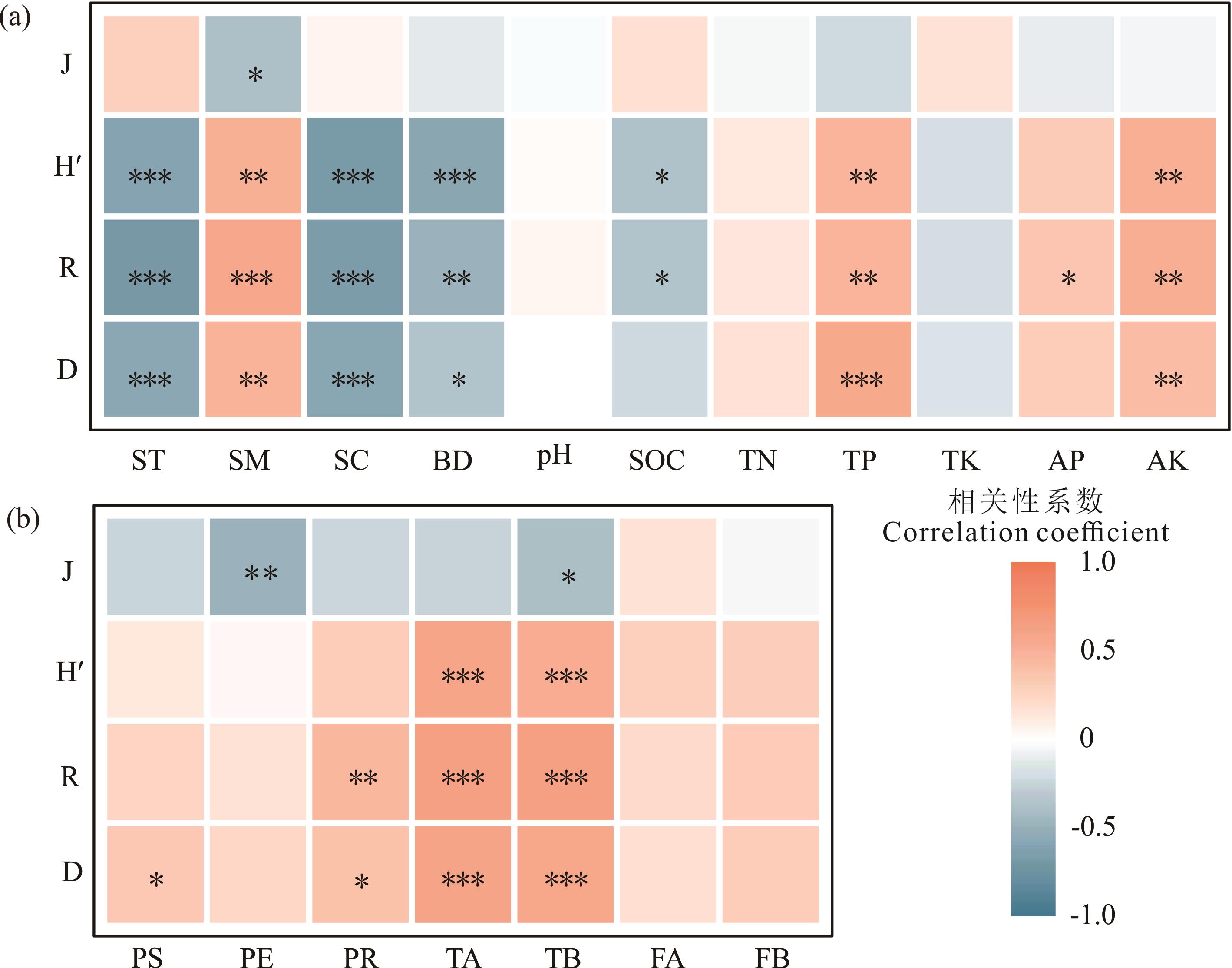
图2 大型土壤动物群落多样性与环境因子的相关性(a): 大型土壤动物群落多样性与土壤因子相关性Correlation between soil macrofaunal community diversity and soil factors; (b): 大型土壤动物群落多样性与植被因子相关性Correlation between soil macrofaunal community diversity and vegetation factors. *: P<0.05; **: P<0.01; ***: P<0.001. D: 密度Density; R: 丰富度Richness; H′: Shannon-Wiener多样性Shannon-Wiener diversity; J: 均匀度Evenness; ST: 土壤温度Soil temperature; SM: 土壤湿度Soil moisture; SC: 土壤紧实度Soil compaction; BD: 土壤容重Soil bulk density; pH: 酸碱度Soil pH; SOC: 土壤有机碳Soil organic carbon; TN: 全氮Soil total nitrogen; TP: 全磷Soil total phosphorus; TK: 全钾Soil total potassium; AP: 速效磷Soil available phosphorus; AK: 速效钾Soil available potassium; PS: 植物Shannon-Wiener多样性Plant Shannon-Wiener diversity; PE: 植物均匀度Plant evenness; PR: 植物丰富度Plant richness; TA: 轴根系地上生物量Aboveground biomass of taprooted plants; TB: 轴根系地下生物量Belowground biomass of taprooted plants; FA: 须根系地上生物量Aboveground biomass of fibrous-rooted plants; FB: 须根系地下生物量Belowground biomass of fibrous-rooted plants. 下同The same below.
Fig.2 Correlation between soil macrofauna community diversity and environmental factors
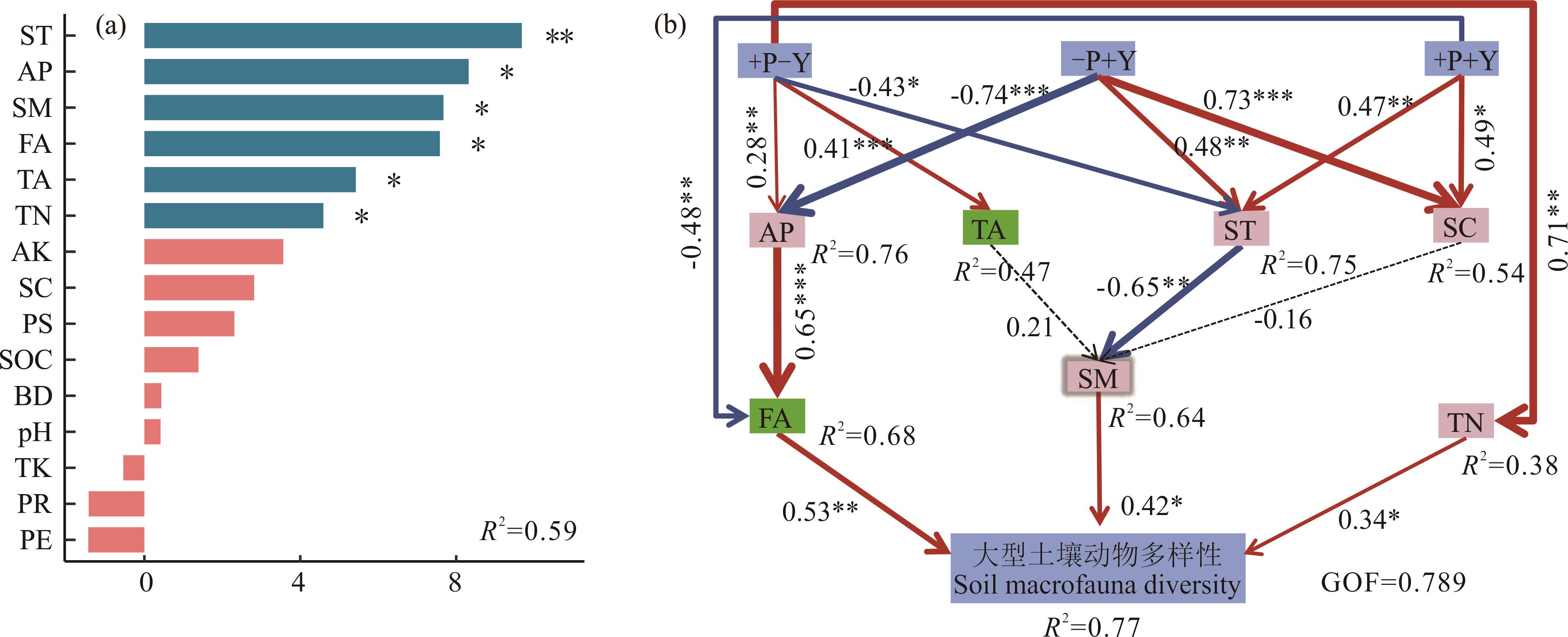
图3 影响大型土壤动物多样性的关键因子及作用路径(a): 随机森林(RF)识别的环境因子重要性排序(R2=0.59)Importance ranking of environmental factors identified by the random forest (RF) model (R2=0.59); (b): 偏最小二乘结构方程模型(PLS-SEM)揭示高原鼠兔与牦牛干扰通过土壤与植被因子调控大型土壤动物多样性的直接与间接路径(GOF=0.79)Partial least squares structural equation modeling (PLS-SEM) showing the direct and indirect pathways by which plateau pika and yak disturbances regulate soil macrofaunal diversity through soil and vegetation factors (GOF=0.79). 红色与蓝色箭头分别表示显著的正向与负向关系;实线表示显著关系,虚线表示不显著关系。箭头旁数字为标准化路径系数;R2表示模型对变异的解释率,GOF值为模型总体拟合优度。Red and blue arrows indicate significant positive and negative relationships, respectively; Solid lines indicate significant relationships, whereas dashed lines indicate non-significant relationships. Numbers adjacent to arrows represent standardized path coefficients. R2 denotes the proportion of variance explained by the model, and GOF represents the overall goodness-of-fit of the model.
Fig.3 Key drivers and pathways shaping soil macrofaunal diversity
| [1] | Wardle D A, Bardgett R D, Klironomos J N, et al. Ecological linkages between aboveground and belowground biota. Science, 2004, 304(5677): 1629-1633. |
| [2] | Copley J. Ecology goes underground. Nature, 2000, 406(6795): 452-454. |
| [3] | Fu S L. A review and perspective on soil biodiversity research. Biodiversity Science, 2007, 15(2): 109-115. |
| 傅声雷. 土壤生物多样性的研究概况与发展趋势. 生物多样性, 2007, 15(2): 109-115. | |
| [4] | Yu C. Effects of plateau pika disturbances on soil nutrient concentrations of alpine meadow at three spatial scales. Lanzhou: Lanzhou University, 2018. |
| 于成. 高原鼠兔干扰对高寒草甸土壤养分含量影响的空间多尺度分析. 兰州: 兰州大学, 2018. | |
| [5] | Cai X C, Wei C B, Chu B, et al. Assessing the effects of plateau pika (Ochotona curzoniae) disturbance on vegetation and soil in alpine meadow: insights from bibliometric and Meta-analytical approaches. Journal of Plant Protection, 2024, 51(5): 1045-1055. |
| 蔡新成, 魏才卜, 楚彬, 等. 基于文献计量学和Meta分析方法评估高原鼠兔干扰对高寒草甸植物与土壤的影响. 植物保护学报, 2024, 51(5): 1045-1055. | |
| [6] | Angst G, Potapov A, Joly F X, et al. Conceptualizing soil fauna effects on labile and stabilized soil organic matter. Nature Communications, 2024, 15(1): 5005. |
| [7] | Sun X, Li Q, Yao H F, et al. Soil fauna and soil health. Acta Pedologica Sinica, 2021, 58(5): 1073-1083. |
| 孙新, 李琪, 姚海凤, 等. 土壤动物与土壤健康. 土壤学报, 2021, 58(5): 1073-1083. | |
| [8] | Smith A T, Foggin J M. The plateau pika (Ochotona curzoniae) is a keystone species for biodiversity on the Tibetan Plateau. Animal Conservation, 1999, 2(4): 235-240. |
| [9] | Sun F D, Long R J, Guo Z G, et al. Effects of rodents activities on plant community and soil environment in alpine meadow. Pratacultural Science, 2011, 28(1): 146-151. |
| 孙飞达, 龙瑞军, 郭正刚, 等. 鼠类活动对高寒草甸植物群落及土壤环境的影响. 草业科学, 2011, 28(1): 146-151. | |
| [10] | Chen J J, Yi S H, Qin Y. The contribution of plateau pika disturbance and erosion on patchy alpine grassland soil on the Qinghai-Tibetan Plateau: Implications for grassland restoration. Geoderma, 2017, 297: 1-9. |
| [11] | Shi M M, Wang Z, Zhou B R, et al. Characteristics of grassland degradation and its relationship with climate factors on Qinghai-Tibetan Plateau, China. Chinese Journal of Applied Ecology, 2022, 33(12): 3271-3278. |
| 石明明, 王喆, 周秉荣, 等. 青藏高原草地退化特征及其与气候因子的关系. 应用生态学报, 2022, 33(12): 3271-3278. | |
| [12] | Hua L M, Chai S Q. Rodent pest control on grasslands in China: current state, problems and prospects. Journal of Plant Protection, 2022, 49(1): 415-423. |
| 花立民, 柴守权. 中国草原鼠害防治现状、问题及对策. 植物保护学报, 2022, 49(1): 415-423. | |
| [13] | Cui H Y, Wang Y B, Zhou X, et al. Positive role of plateau pika (Ochotona curzoniae) on environmental quality at low and moderate density on the Tibetan Plateau: Evidence from a Meta-analysis. Journal of Environmental Management, 2024, 361: 121239. |
| [14] | Duan Y Y, Zhang J, Wang L L, et al. Effects of plateau pika on the relationship between plant species diversity and functional diversity in alpine meadow. Acta Prataculturae Sinica, 2022, 31(11): 25-35. |
| 段媛媛, 张静, 王玲玲, 等. 高原鼠兔对高寒草甸植物物种多样性和功能多样性关系的影响. 草业学报, 2022, 31(11): 25-35. | |
| [15] | Shi H X, Yu J L. Influence of burrowing rodent density plots on the alpine Kobresia meadows structure and soil water content. Chinese Journal of Grassland, 2010, 32(4): 109-112, 116. |
| 石红霄, 于健龙. 高原鼠兔洞口密度对高寒嵩草草甸植被及土壤水分的影响. 中国草地学报, 2010, 32(4): 109-112, 116. | |
| [16] | Niu Y J, Yang S W, Wang G Z, et al. Effects of grazing disturbance on plant diversity, community structure and direction of succession in an alpine meadow on the Tibetan Plateau, China. Acta Ecologica Sinica, 2018, 38(3): 274-280. |
| [17] | Song Y Q. The effects and regulation mechanisms of grassland patchy degradation and herbivore grazing on plant diversity. Changchun: Northeast Normal University, 2023. |
| 宋月青. 草地斑块化退化和草食动物放牧对植物多样性的影响及调控机制. 长春: 东北师范大学, 2023. | |
| [18] | Ye G H, Chu B, Hu G X, et al. Response of soil macrofauna diversity to environmental factors under plateau zokor (Myospalax baileyi) disturbance in alpine meadow ecosystem. Acta Ecologica Sinica, 2021, 41(2): 792-802. |
| 叶国辉, 楚彬, 胡桂馨, 等. 高原鼢鼠干扰下高寒草甸大型土壤动物多样性对环境因子的响应. 生态学报, 2021, 41(2): 792-802. | |
| [19] | Wang Z Z, Liu Y, He K, et al. Community characteristics and niche of soil macrofauna in the Nianchu River Basin, Tibet. Chinese Journal of Ecology, 2021, 40(12): 3911-3921. |
| 王壮壮, 刘洋, 贺凯, 等. 西藏年楚河流域大型土壤动物群落特征与生态位. 生态学杂志, 2021, 40(12): 3911-3921. | |
| [20] | Yin W Y. Pictorial keys to soil animals of China. Beijing: Science Press, 1998. |
| 尹文英. 中国土壤动物检索图鉴. 北京: 科学出版社, 1998. | |
| [21] | Zhong J M. Larval taxonomy. Beijing: Agriculture Press, 1990. |
| 钟觉民. 幼虫分类学. 北京: 农业出版社, 1990. | |
| [22] | Liu C F, Duan Y Y, Wang L L, et al. Effects of plateau pika (Ochotona curzoniae) disturbance on the relationship between plant species diversity and soil ecological stoichiometry in alpine meadows. Acta Prataculturae Sinica, 2023, 32(6): 157-166. |
| 刘彩凤, 段媛媛, 王玲玲, 等. 高原鼠兔干扰对高寒草甸植物物种多样性与土壤生态化学计量比间关系的影响. 草业学报, 2023, 32(6): 157-166. | |
| [23] | Bao S D. Soil agrochemical analysis (The Third Edition). Beijing: China Agriculture Press, 2000. |
| 鲍士旦. 土壤农化分析(第3版). 北京: 中国农业出版社, 2000. | |
| [24] | Kardol P, Wardle D A. How understanding aboveground-belowground linkages can assist restoration ecology. Trends in Ecology & Evolution, 2010, 25(11): 670-679. |
| [25] | Su X X, Li X L, Sun H F, et al. Effects of plateau pika and mowing disturbances on plant community and soil physical and chemical properties in alpine meadow. Acta Ecologica Sinica, 2024, 44(22): 10189-10199. |
| 苏晓雪, 李希来, 孙华方, 等. 高原鼠兔和刈割扰动对高寒草甸植物群落和土壤特征的影响. 生态学报, 2024, 44(22): 10189-10199. | |
| [26] | Wang B, Wu L J, Chen D M, et al. Grazing simplifies soil micro-food webs and decouples their relationships with ecosystem functions in grasslands. Global Change Biology, 2020, 26(2): 960-970. |
| [27] | Ren Q, Ai Y, Hu J, et al. Effects of different yak grazing intensities on soil and plant biomass in an alpine meadow on the Qinghai-Tibetan Plateau. Acta Ecologica Sinica, 2021, 41(17): 6862-6870. |
| 任强, 艾鷖, 胡健, 等. 不同强度牦牛放牧对青藏高原高寒草地土壤和植物生物量的影响. 生态学报, 2021, 41(17): 6862-6870. | |
| [28] | Cole L, Buckland S M, Bardgett R D. Influence of disturbance and nitrogen addition on plant and soil animal diversity in grassland. Soil Biology and Biochemistry, 2008, 40(2): 505-514. |
| [29] | Scheunemann N, Digel C, Scheu S, et al. Roots rather than shoot residues drive soil arthropod communities of arable fields. Oecologia, 2015, 179(4): 1135-1145. |
| [30] | Wu Q, Wu P F, Wang Q, et al. Effects of grazing intensity on the community structure and diversity of different soil fauna in alpine meadow. Scientia Agricultura Sinica, 2016, 49(9): 1826-1834. |
| 武崎, 吴鹏飞, 王群, 等. 放牧强度对高寒草地不同类群土壤动物的群落结构和多样性的影响. 中国农业科学, 2016, 49(9): 1826-1834. | |
| [31] | Hua R, Ye G H, De Giuli M, et al. Decreased species richness along bare patch gradient in the degradation of Kobresia pasture on the Tibetan Plateau. Ecological Indicators, 2023, 157: 111195. |
| [32] | Pang X P. Responses of plant productivity and soil nutrients of alpine meadows to the disturbance by plateau pika. Lanzhou: Lanzhou University, 2021. |
| 庞晓攀. 高寒草甸植物生产力与土壤主要养分对高原鼠兔干扰响应的研究. 兰州: 兰州大学, 2021. | |
| [33] | Wang S P, Luo M Y, Feng Y H, et al. Theoretical advances in biodiversity research. Biodiversity Science, 2022, 30(10): 25-37. |
| 王少鹏, 罗明宇, 冯彦皓, 等. 生物多样性理论最新进展. 生物多样性, 2022, 30(10): 25-37. | |
| [34] | Yang X, Zang J Y, Feng J L, et al. High grazing intensity suppress soil microorganisms in grasslands in China: A Meta-analysis. Applied Soil Ecology, 2022, 177: 104502. |
| [35] | Zhao J X, Tian L H, Wei H X, et al. Impact of plateau pika (Ochotona curzoniae) burrowing-induced microtopography on ecosystem respiration of the alpine meadow and steppe on the Tibetan Plateau. Plant and Soil, 2021, 458(1): 217-230. |
| [36] | Radford B J, Wilson-Rummenie A C, Simpson G B, et al. Compacted soil affects soil macrofauna populations in a semi-arid environment in central Queensland. Soil Biology and Biochemistry, 2001, 33(12/13): 1869-1872. |
| [37] | Sun J C, Liu R T, Wang Z, et al. Effects of grazing on diversity of soil fauna in a grassland ecosystem based on the bibliometric analysis. Acta Ecologica Sinica, 2024, 44(14): 6405-6415. |
| 孙建财, 刘任涛, 王真, 等. 基于文献计量的放牧对草地土壤动物多样性的影响. 生态学报, 2024, 44(14): 6405-6415. | |
| [38] | Downey S S, Walker M, Moschler J, et al. An intermediate level of disturbance with customary agricultural practices increases species diversity in Maya community forests in Belize. Communications Earth & Environment, 2023, 4(1): 428. |
| [39] | Hua R. Research on key technologies of plateau pika damage monitoring and risk assessment in Qinghai-Tibet Plateau. Lanzhou: Gansu Agricultural University, 2023. |
| 花蕊. 青藏高原高原鼠兔危害监测预警与风险评估关键技术研究. 兰州: 甘肃农业大学, 2023. | |
| [40] | Hua L M. An environmentally friendly paradigm for grassland rodent pest management: theory foundation, technical framework, and practical application. Journal of Plant Protection, 2025, 52(6): 1353-1362. |
| 花立民. 环境友好型草原鼠害管理范式:理论基础、技术体系与实践应用. 植物保护学报, 2025, 52(6): 1353-1362. |
| [1] | 滕玉风, 马剑, 陈斌, 鲁延芳, 李静, 李星, 李宁, 李鸿儒. 祁连山北麓高山草甸高原鼠兔鼠丘退化区芽库特征研究[J]. 草业学报, 2026, 35(8): 182-192. |
| [2] | 马婧娟, 李希来, 尹通江, 鲍玉英, 张玉芳, 丁北桥, 袁颖. 高寒草甸退化斑块恢复演替对土壤持水能力的影响[J]. 草业学报, 2026, 35(4): 14-28. |
| [3] | 韩奥, 刘阳, 倪蕴菡, 肖红, 徐长林, 马凯, 王昀. 东祁连山高寒草甸灌丛化对土壤酶活性和微生物代谢限制的影响[J]. 草业学报, 2026, 35(11): 38-51. |
| [4] | 严双, 夏菲, 魏巍, 王敬龙, 吴皓阳, 冉林灵, 薛云尹, 石昊, 郑晒坤, 王军强, 贺俊东. 高寒草甸不同侵蚀样地植物多样性的差异及其关键影响因子[J]. 草业学报, 2025, 34(6): 1-13. |
| [5] | 王瑞兵, 陈欢, 潘珍珍, 赵维, 蚌绍豪, 周小龙, 任正炜. 基于资源类型和数目的高寒草甸物种丧失机制研究[J]. 草业学报, 2025, 34(5): 1-11. |
| [6] | 霍佳娟, 宋明华. 青藏高原高寒草甸不同退化阶段植物氮利用速率变化[J]. 草业学报, 2025, 34(2): 16-26. |
| [7] | 涂晓东, 崔俊芳, 况福虹, 李春培, 杜玖珍, 王红兰, 唐翔宇. 川西北高寒草甸转为耕地对土壤微生物群落的影响[J]. 草业学报, 2025, 34(2): 54-66. |
| [8] | 和阳一丹, 陈昌明, 黄晓霞, 施国美, 和克俭. 川西高寒草甸植物功能属性与环境因子的关系研究[J]. 草业学报, 2024, 33(9): 28-39. |
| [9] | 谭湘蛟, 董逵才, 张华, 唐川川, 杨燕. 积雪增加对青藏高原高寒草甸土壤磷有效性的影响[J]. 草业学报, 2024, 33(7): 205-214. |
| [10] | 秦瑞敏, 程思佳, 马丽, 张中华, 魏晶晶, 苏洪烨, 史正晨, 常涛, 胡雪, 阿的哈则, 袁访, 李珊, 周华坤. 围封和施肥对高寒草甸群落特征和植被碳氮库的影响[J]. 草业学报, 2024, 33(4): 1-11. |
| [11] | 油志远, 马淑娟, 王长庭, 丁路明, 宋小艳, 尹高飞, 毛军. 川滇高原高寒草甸生态系统不同功能群植物分布格局的MaxEnt模型预测[J]. 草业学报, 2024, 33(3): 1-12. |
| [12] | 马源, 王晓丽, 马玉寿, 张德罡. 高寒草甸退化程度对优势物种根际土壤真菌群落和生态网络的影响[J]. 草业学报, 2024, 33(2): 125-137. |
| [13] | 冯娅斯, 蒋文婷, 刘益宏, 王燕, 李渊, 陈有超, 蔡延江. 翻耕和植物残体覆盖对“黑土滩”型退化草地土壤氧化亚氮排放的影响[J]. 草业学报, 2024, 33(11): 15-29. |
| [14] | 李林芝, 张德罡, 马源, 罗珠珠, 林栋, 海龙, 白兰鸽. 不同退化程度高寒草甸土壤团聚体养分及生态化学计量特征研究[J]. 草业学报, 2023, 32(8): 48-60. |
| [15] | 廖小琴, 王长庭, 刘丹, 唐国, 毛军. 氮磷配施对高寒草甸植物根系特征的影响[J]. 草业学报, 2023, 32(7): 160-174. |
| 阅读次数 | ||||||
|
全文 |
|
|||||
|
摘要 |
|
|||||
