

ISSN 1004-5759 CN 62-1105/S
草业学报 ›› 2026, Vol. 35 ›› Issue (11): 132-144.DOI: 10.11686/cyxb2025458
• 研究论文 • 上一篇
刘怡曼1( ), 张红妹1, 邹怡雯1, 王军力1, 刘伯帅1,2,3, 孙浩1,2,3(), 李德锋1,2,3()
收稿日期:2025-11-10
修回日期:2026-01-05
出版日期:2026-11-20
发布日期:2026-10-12
通讯作者:
孙浩,李德锋
作者简介:Leadephone@126.com基金资助:
Yi-man LIU1(), Hong-mei ZHANG1, Yi-wen ZOU1, Jun-li WANG1, Bo-shuai LIU1,2,3, Hao SUN1,2,3(), De-feng LI1,2,3()
Received:2025-11-10
Revised:2026-01-05
Online:2026-11-20
Published:2026-10-12
Contact:
Hao SUN,De-feng LI
摘要:
为筛选适宜豫北地区秋播的饲用燕麦品种,选择市场上主推的20个饲用燕麦品种进行秋播,测定越冬率、分蘖数、气生根、倒伏程度、产量和品质等指标,分析了气生根数量与倒伏程度的关系。结果表明:1)各品种越冬率为88.0%~100.0%,其中19个品种的越冬率高于95.0%;越冬前分蘖数为2.9~5.0个·株-1,越冬后分蘖数增加至5.6~28.1个·株-1,其中麦迪逊的分蘖数最多,为28.1个·株-1,显著高于其他品种(P<0.05)。2)各品种于5月7日-24日达到乳熟期收获,生育期为191~208 d,株高为1.28~1.59 m,干草产量为9.68~15.61 t·hm-2,其中甜燕75产量最高,其次为甜燕3号和麦迪逊,均高于15 t·hm-2。3)第1茎节生出的有效气生根数为0.15~2.70条,无效气生根数为0.45~3.05条,气生根入土半径为0.00~8.04 mm;第2茎节生出的气生根较少;乳熟期各品种均无倒伏,蜡熟期出现倒伏,倒伏程度与第1层有效气生根数显著负相关(P<0.05),与第2茎节节长显著正相关(P<0.05)。4)各品种粗蛋白含量为9.49%~12.15%,中性洗涤纤维和酸性洗涤纤维含量分别为58.18%~61.33%、31.51%~36.28%,其中,牧丰、甜燕70、刀客等品种的营养品质主成分得分较高。5)聚类分析可将20个品种划分为5大类群,其中,第Ⅴ类群(麦迪逊)越冬后分蘖数最多,第Ⅱ类群(贝利、甜燕3号和锋利等)综合表现较好。综合认为,甜燕3号、锋利和贝利的越冬率和干草产量较高,抗倒伏性强,饲用品质较好,适宜在豫北地区秋播种植。
刘怡曼, 张红妹, 邹怡雯, 王军力, 刘伯帅, 孙浩, 李德锋. 豫北20个秋播饲用燕麦品种生产性能及气生根特性[J]. 草业学报, 2026, 35(11): 132-144.
Yi-man LIU, Hong-mei ZHANG, Yi-wen ZOU, Jun-li WANG, Bo-shuai LIU, Hao SUN, De-feng LI. Production performance and aerial root characteristics of 20 autumn-sown forage oat varieties in northern Henan[J]. Acta Prataculturae Sinica, 2026, 35(11): 132-144.
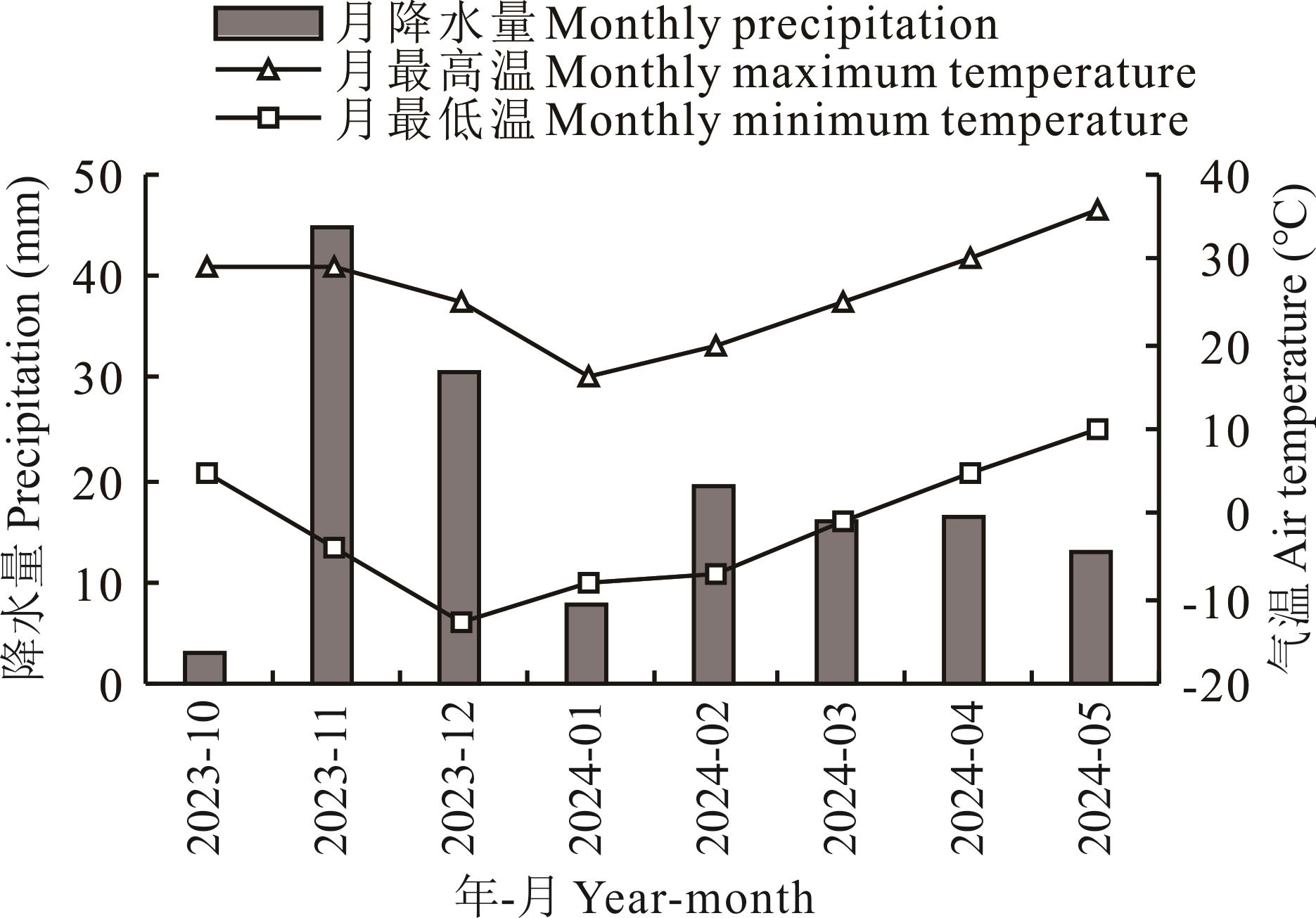
图1 试验地气温和降水量
Fig.1 Air temperature and precipitation in test location
品种 Varieties | 发芽率 Germination rate (%) | 净度 Purity (%) | 播种量Seeding rate (kg·hm-2) | 原产地 Origin | 品种 Varieties | 发芽率 Germination rate (%) | 净度 Purity (%) | 播种量Seeding rate (kg·hm-2) | 原产地 Origin |
|---|---|---|---|---|---|---|---|---|---|
| 甜燕2+ Tianyan 2+ | 99.00 | 95.60 | 95.09 | 加拿大Canada | 特牧Temu | 67.00 | 95.50 | 140.66 | 加拿大Canada |
| 甜燕3号 Tianyan 3 | 99.00 | 96.20 | 94.50 | 加拿大Canada | 三星Three stars | 99.00 | 94.30 | 96.40 | 加拿大Canada |
| 甜燕70 Tianyan 70 | 97.00 | 97.40 | 95.26 | 加拿大Canada | 牧丰Mufeng | 95.00 | 91.20 | 103.88 | 加拿大Canada |
| 甜燕75 Tianyan 75 | 99.00 | 98.50 | 92.29 | 加拿大Canada | 贝利Baler | 96.00 | 97.80 | 95.86 | 加拿大Canada |
| Mongan | 93.00 | 97.60 | 99.15 | 加拿大Canada | 爱沃Everleaf | 98.00 | 96.50 | 95.17 | 美国America |
| 禾王King cereals | 97.00 | 94.30 | 98.39 | 加拿大Canada | 俄罗斯Russia | 89.00 | 93.20 | 108.50 | 俄罗斯Russia |
| 锋利Sharp | 100.00 | 96.50 | 93.26 | 加拿大Canada | 坝燕4 Bayan 4 | 84.00 | 91.60 | 116.97 | 中国China |
| 刀客Daoke | 61.00 | 94.20 | 156.63 | 美国America | 坝燕14 Bayan 14 | 57.00 | 95.60 | 165.16 | 中国China |
| 格莱德Gelaide | 57.00 | 97.10 | 162.61 | 加拿大Canada | 坝燕18 Bayan 18 | 82.00 | 96.80 | 113.38 | 中国China |
| 青海444 Qinghai 444 | 82.00 | 93.20 | 117.76 | 澳大利亚Australia | 麦迪逊Madison | 91.00 | 98.80 | 100.10 | 加拿大Canada |
表1 不同燕麦品种发芽率、净度、播种量及原产地
Table 1 Germination percentage, purity, seeding rate and country of origin of different oat varieties
品种 Varieties | 发芽率 Germination rate (%) | 净度 Purity (%) | 播种量Seeding rate (kg·hm-2) | 原产地 Origin | 品种 Varieties | 发芽率 Germination rate (%) | 净度 Purity (%) | 播种量Seeding rate (kg·hm-2) | 原产地 Origin |
|---|---|---|---|---|---|---|---|---|---|
| 甜燕2+ Tianyan 2+ | 99.00 | 95.60 | 95.09 | 加拿大Canada | 特牧Temu | 67.00 | 95.50 | 140.66 | 加拿大Canada |
| 甜燕3号 Tianyan 3 | 99.00 | 96.20 | 94.50 | 加拿大Canada | 三星Three stars | 99.00 | 94.30 | 96.40 | 加拿大Canada |
| 甜燕70 Tianyan 70 | 97.00 | 97.40 | 95.26 | 加拿大Canada | 牧丰Mufeng | 95.00 | 91.20 | 103.88 | 加拿大Canada |
| 甜燕75 Tianyan 75 | 99.00 | 98.50 | 92.29 | 加拿大Canada | 贝利Baler | 96.00 | 97.80 | 95.86 | 加拿大Canada |
| Mongan | 93.00 | 97.60 | 99.15 | 加拿大Canada | 爱沃Everleaf | 98.00 | 96.50 | 95.17 | 美国America |
| 禾王King cereals | 97.00 | 94.30 | 98.39 | 加拿大Canada | 俄罗斯Russia | 89.00 | 93.20 | 108.50 | 俄罗斯Russia |
| 锋利Sharp | 100.00 | 96.50 | 93.26 | 加拿大Canada | 坝燕4 Bayan 4 | 84.00 | 91.60 | 116.97 | 中国China |
| 刀客Daoke | 61.00 | 94.20 | 156.63 | 美国America | 坝燕14 Bayan 14 | 57.00 | 95.60 | 165.16 | 中国China |
| 格莱德Gelaide | 57.00 | 97.10 | 162.61 | 加拿大Canada | 坝燕18 Bayan 18 | 82.00 | 96.80 | 113.38 | 中国China |
| 青海444 Qinghai 444 | 82.00 | 93.20 | 117.76 | 澳大利亚Australia | 麦迪逊Madison | 91.00 | 98.80 | 100.10 | 加拿大Canada |
品种 Variety | 分蘖数Tiller number | 越冬率 Winter survival rate (%) | 叶绿素值Soil and plant analyzer development (SPAD) | |||
|---|---|---|---|---|---|---|
越冬前 Before winter | 越冬后 After winter | 越冬前 Before winter | 返青期 Regreening stage | 拔节期 Jointing stage | ||
| 甜燕70 Tianyan 70 | 3.6±0.3bcde | 6.8±0.3ef | 100.0±0.00a | 26.33±3.58a | 29.30±1.70abc | 35.06±0.15bc |
| Mongan | 2.9±0.3e | 5.6±0.5f | 100.0±0.00a | 24.46±6.31a | 29.35±3.46abc | 33.17±4.81c |
| 格莱德Gelaide | 4.0±0.4abcde | 13.3±0.5b | 100.0±0.00a | 24.49±4.40a | 26.90±0.99abcd | 38.93±1.69abc |
| 特牧Temu | 3.9±0.5bcde | 8.5±0.5cde | 100.0±0.00a | 24.48±4.98a | 27.30±2.69abcd | 41.16±2.63ab |
| 坝燕14 Bayan 14 | 4.3±0.5abcd | 10.1±0.3c | 100.0±0.00a | 25.31±2.22a | 27.00±1.13abcd | 34.63±0.88bc |
| 麦迪逊Madison | 4.1±0.6abcd | 28.1±3.4a | 100.0±0.00a | 23.76±4.53a | 26.95±3.75abcd | 44.06±0.18a |
| 俄罗斯Russia | 3.4±0.3cde | 9.1±0.3cde | 95.3±2.74a | 27.05±0.75a | 29.20±4.38abcd | 39.45±1.08abc |
| 牧丰Mufeng | 4.5±0.6abc | 8.5±0.3cde | 97.9±4.17a | 23.84±3.11a | 25.05±2.19cd | 34.18±0.58bc |
| 爱沃Everleaf | 3.6±0.4bcde | 9.2±0.4cde | 98.0±2.37a | 21.46±2.18a | 31.35±1.34ab | 38.32±5.37abc |
| 甜燕2+ Tianyan 2+ | 5.0±0.4a | 6.9±0.2ef | 98.1±3.91a | 21.26±0.20a | 29.30±2.55abc | 35.93±1.54bc |
| 坝燕4 Bayan 4 | 3.3±0.3de | 5.8±0.2f | 98.4±1.82a | 27.41±3.30a | 29.35±0.49abc | 33.06±4.82c |
| 锋利Sharp | 4.6±0.2ab | 9.2±0.6cde | 98.8±1.59a | 23.87±2.16a | 26.55±1.20abcd | 35.52±4.88bc |
| 甜燕75 Tianyan 75 | 4.0±0.4abcd | 9.2±0.3cde | 98.8±0.80a | 24.21±4.23a | 25.85±1.06bcd | 39.49±0.04abc |
| 禾王King cereals | 3.4±0.5cde | 9.9±0.9cd | 98.8±1.50a | 21.93±0.04a | 30.40±1.98abc | 38.08±1.45abc |
| 三星Three stars | 4.3±0.1abcd | 7.7±0.1def | 99.2±0.90a | 24.72±4.95a | 29.90±2.97abc | 36.58±1.24bc |
| 坝燕18 Bayan 18 | 3.6±0.2bcde | 9.9±0.3cd | 99.5±1.06a | 20.89±2.42a | 23.80±0.71d | 38.86±6.87abc |
| 刀客Daoke | 3.8±0.3bcde | 10.1±0.2cd | 99.5±1.02a | 24.79±2.39a | 31.90±1.98a | 34.12±1.51bc |
| 贝利Baler | 4.0±0.3abcde | 9.8±0.1cd | 99.6±0.88a | 20.42±0.93a | 30.45±2.19abc | 38.92±0.31abc |
| 甜燕3号Tianyan 3 | 4.4±1.1abcd | 9.2±1.4cde | 99.6±0.78a | 24.32±5.57a | 28.45±1.34abcd | 39.84±3.45abc |
| 青海444 Qinghai 444 | 3.3±0.6de | 7.8±0.4def | 88.0±9.60b | 24.61±4.74a | 26.05±2.05bcd | 40.93±2.99ab |
表2 不同燕麦品种的分蘖数、越冬率和叶绿素值
Table 2 The number of tillers,winter survival rate and SPAD of different oat varieties
品种 Variety | 分蘖数Tiller number | 越冬率 Winter survival rate (%) | 叶绿素值Soil and plant analyzer development (SPAD) | |||
|---|---|---|---|---|---|---|
越冬前 Before winter | 越冬后 After winter | 越冬前 Before winter | 返青期 Regreening stage | 拔节期 Jointing stage | ||
| 甜燕70 Tianyan 70 | 3.6±0.3bcde | 6.8±0.3ef | 100.0±0.00a | 26.33±3.58a | 29.30±1.70abc | 35.06±0.15bc |
| Mongan | 2.9±0.3e | 5.6±0.5f | 100.0±0.00a | 24.46±6.31a | 29.35±3.46abc | 33.17±4.81c |
| 格莱德Gelaide | 4.0±0.4abcde | 13.3±0.5b | 100.0±0.00a | 24.49±4.40a | 26.90±0.99abcd | 38.93±1.69abc |
| 特牧Temu | 3.9±0.5bcde | 8.5±0.5cde | 100.0±0.00a | 24.48±4.98a | 27.30±2.69abcd | 41.16±2.63ab |
| 坝燕14 Bayan 14 | 4.3±0.5abcd | 10.1±0.3c | 100.0±0.00a | 25.31±2.22a | 27.00±1.13abcd | 34.63±0.88bc |
| 麦迪逊Madison | 4.1±0.6abcd | 28.1±3.4a | 100.0±0.00a | 23.76±4.53a | 26.95±3.75abcd | 44.06±0.18a |
| 俄罗斯Russia | 3.4±0.3cde | 9.1±0.3cde | 95.3±2.74a | 27.05±0.75a | 29.20±4.38abcd | 39.45±1.08abc |
| 牧丰Mufeng | 4.5±0.6abc | 8.5±0.3cde | 97.9±4.17a | 23.84±3.11a | 25.05±2.19cd | 34.18±0.58bc |
| 爱沃Everleaf | 3.6±0.4bcde | 9.2±0.4cde | 98.0±2.37a | 21.46±2.18a | 31.35±1.34ab | 38.32±5.37abc |
| 甜燕2+ Tianyan 2+ | 5.0±0.4a | 6.9±0.2ef | 98.1±3.91a | 21.26±0.20a | 29.30±2.55abc | 35.93±1.54bc |
| 坝燕4 Bayan 4 | 3.3±0.3de | 5.8±0.2f | 98.4±1.82a | 27.41±3.30a | 29.35±0.49abc | 33.06±4.82c |
| 锋利Sharp | 4.6±0.2ab | 9.2±0.6cde | 98.8±1.59a | 23.87±2.16a | 26.55±1.20abcd | 35.52±4.88bc |
| 甜燕75 Tianyan 75 | 4.0±0.4abcd | 9.2±0.3cde | 98.8±0.80a | 24.21±4.23a | 25.85±1.06bcd | 39.49±0.04abc |
| 禾王King cereals | 3.4±0.5cde | 9.9±0.9cd | 98.8±1.50a | 21.93±0.04a | 30.40±1.98abc | 38.08±1.45abc |
| 三星Three stars | 4.3±0.1abcd | 7.7±0.1def | 99.2±0.90a | 24.72±4.95a | 29.90±2.97abc | 36.58±1.24bc |
| 坝燕18 Bayan 18 | 3.6±0.2bcde | 9.9±0.3cd | 99.5±1.06a | 20.89±2.42a | 23.80±0.71d | 38.86±6.87abc |
| 刀客Daoke | 3.8±0.3bcde | 10.1±0.2cd | 99.5±1.02a | 24.79±2.39a | 31.90±1.98a | 34.12±1.51bc |
| 贝利Baler | 4.0±0.3abcde | 9.8±0.1cd | 99.6±0.88a | 20.42±0.93a | 30.45±2.19abc | 38.92±0.31abc |
| 甜燕3号Tianyan 3 | 4.4±1.1abcd | 9.2±1.4cde | 99.6±0.78a | 24.32±5.57a | 28.45±1.34abcd | 39.84±3.45abc |
| 青海444 Qinghai 444 | 3.3±0.6de | 7.8±0.4def | 88.0±9.60b | 24.61±4.74a | 26.05±2.05bcd | 40.93±2.99ab |
品种 Variety | 抽穗期 Heading date (月-日Month-day) | 收获期 Harvest date (月-日Month-day) | 生育期 Growth period (d) | 株高 Plant height (m) | 鲜草产量 Fresh grass yield (t·hm-2) | 干草产量 Hay grass yield (t·hm-2) | 干鲜比 Dry to fresh ratio |
|---|---|---|---|---|---|---|---|
| 甜燕75 Tianyan 75 | 5-07 | 5-22 | 206 | 1.42±0.03cde | 65.50±1.18ab | 15.61±0.28a | 0.24 |
| 甜燕3号Tianyan 3 | 5-03 | 5-22 | 206 | 1.48±0.02bc | 64.79±3.14ab | 15.43±0.75a | 0.24 |
| 麦迪逊Madison | 5-08 | 5-22 | 206 | 1.51±0.02bc | 65.69±1.36ab | 15.01±0.31a | 0.23 |
| 锋利Sharp | 5-03 | 5-22 | 206 | 1.49±0.04c | 62.35±1.72bc | 14.97±0.41a | 0.24 |
| 贝利Baler | 5-07 | 5-22 | 206 | 1.44±0.06cd | 61.91±2.49bc | 14.28±0.58a | 0.23 |
| 甜燕2+ Tianyan 2+ | 5-02 | 5-22 | 206 | 1.48±0.03cd | 59.06±3.23cd | 14.12±0.77a | 0.24 |
| 甜燕70 Tianyan 70 | 5-04 | 5-18 | 202 | 1.35±0.03efg | 60.76±1.10ab | 12.49±0.21b | 0.21 |
| 俄罗斯Russia | 4-30 | 5-18 | 202 | 1.54±0.04ab | 53.88±4.20e | 12.27±0.96b | 0.23 |
| 坝燕14 Bayan 14 | 4-16 | 5-07 | 191 | 1.35±0.03efg | 55.42±0.91de | 12.20±0.20b | 0.22 |
| 刀客Daoke | 4-27 | 5-18 | 202 | 1.49±0.05cd | 52.88±1.85e | 12.14±0.42b | 0.23 |
| 爱沃Everleaf | 5-11 | 5-24 | 208 | 1.31±0.04fg | 54.64±3.35de | 12.02±0.74b | 0.22 |
| 青海444 Qinghai 444 | 4-20 | 5-07 | 191 | 1.49±0.03bc | 57.89±1.17cd | 11.94±0.24bc | 0.21 |
| 特牧Temu | 4-24 | 5-11 | 195 | 1.53±0.03ab | 65.51±1.33ab | 11.83±0.24bc | 0.18 |
| 牧丰Mufeng | 5-05 | 5-18 | 202 | 1.55±0.02ab | 57.24±3.40de | 11.33±0.67bc | 0.20 |
| 禾王King cereals | 5-06 | 5-18 | 202 | 1.35±0.03efg | 67.15±1.27a | 11.10±0.21bcd | 0.17 |
| 三星Three stars | 4-29 | 5-18 | 202 | 1.41±0.06de | 58.87±2.53cd | 10.96±0.47bcd | 0.19 |
| Mongan | 4-26 | 5-11 | 195 | 1.32±0.03fg | 61.61±3.93bc | 10.42±0.66cd | 0.17 |
| 格莱德Gelaide | 5-05 | 5-18 | 202 | 1.59±0.07a | 56.17±1.20de | 10.39±0.22cd | 0.18 |
| 坝燕18 Bayan 18 | 4-19 | 5-07 | 191 | 1.37±0.05ef | 53.89±1.71e | 10.16±0.32d | 0.19 |
| 坝燕4 Bayan 4 | 4-26 | 5-11 | 195 | 1.28±0.02g | 54.72±0.29de | 9.68±0.05d | 0.18 |
表3 不同燕麦品种的抽穗期、收获期及生产性能
Table 3 Heading stage, harvest time and production performance of different oat varieties
品种 Variety | 抽穗期 Heading date (月-日Month-day) | 收获期 Harvest date (月-日Month-day) | 生育期 Growth period (d) | 株高 Plant height (m) | 鲜草产量 Fresh grass yield (t·hm-2) | 干草产量 Hay grass yield (t·hm-2) | 干鲜比 Dry to fresh ratio |
|---|---|---|---|---|---|---|---|
| 甜燕75 Tianyan 75 | 5-07 | 5-22 | 206 | 1.42±0.03cde | 65.50±1.18ab | 15.61±0.28a | 0.24 |
| 甜燕3号Tianyan 3 | 5-03 | 5-22 | 206 | 1.48±0.02bc | 64.79±3.14ab | 15.43±0.75a | 0.24 |
| 麦迪逊Madison | 5-08 | 5-22 | 206 | 1.51±0.02bc | 65.69±1.36ab | 15.01±0.31a | 0.23 |
| 锋利Sharp | 5-03 | 5-22 | 206 | 1.49±0.04c | 62.35±1.72bc | 14.97±0.41a | 0.24 |
| 贝利Baler | 5-07 | 5-22 | 206 | 1.44±0.06cd | 61.91±2.49bc | 14.28±0.58a | 0.23 |
| 甜燕2+ Tianyan 2+ | 5-02 | 5-22 | 206 | 1.48±0.03cd | 59.06±3.23cd | 14.12±0.77a | 0.24 |
| 甜燕70 Tianyan 70 | 5-04 | 5-18 | 202 | 1.35±0.03efg | 60.76±1.10ab | 12.49±0.21b | 0.21 |
| 俄罗斯Russia | 4-30 | 5-18 | 202 | 1.54±0.04ab | 53.88±4.20e | 12.27±0.96b | 0.23 |
| 坝燕14 Bayan 14 | 4-16 | 5-07 | 191 | 1.35±0.03efg | 55.42±0.91de | 12.20±0.20b | 0.22 |
| 刀客Daoke | 4-27 | 5-18 | 202 | 1.49±0.05cd | 52.88±1.85e | 12.14±0.42b | 0.23 |
| 爱沃Everleaf | 5-11 | 5-24 | 208 | 1.31±0.04fg | 54.64±3.35de | 12.02±0.74b | 0.22 |
| 青海444 Qinghai 444 | 4-20 | 5-07 | 191 | 1.49±0.03bc | 57.89±1.17cd | 11.94±0.24bc | 0.21 |
| 特牧Temu | 4-24 | 5-11 | 195 | 1.53±0.03ab | 65.51±1.33ab | 11.83±0.24bc | 0.18 |
| 牧丰Mufeng | 5-05 | 5-18 | 202 | 1.55±0.02ab | 57.24±3.40de | 11.33±0.67bc | 0.20 |
| 禾王King cereals | 5-06 | 5-18 | 202 | 1.35±0.03efg | 67.15±1.27a | 11.10±0.21bcd | 0.17 |
| 三星Three stars | 4-29 | 5-18 | 202 | 1.41±0.06de | 58.87±2.53cd | 10.96±0.47bcd | 0.19 |
| Mongan | 4-26 | 5-11 | 195 | 1.32±0.03fg | 61.61±3.93bc | 10.42±0.66cd | 0.17 |
| 格莱德Gelaide | 5-05 | 5-18 | 202 | 1.59±0.07a | 56.17±1.20de | 10.39±0.22cd | 0.18 |
| 坝燕18 Bayan 18 | 4-19 | 5-07 | 191 | 1.37±0.05ef | 53.89±1.71e | 10.16±0.32d | 0.19 |
| 坝燕4 Bayan 4 | 4-26 | 5-11 | 195 | 1.28±0.02g | 54.72±0.29de | 9.68±0.05d | 0.18 |
| 品种Variety | CP (%) | NDF (%) | ADF (%) | HC (%) | Ash (%) | RFV | RFQ | PCS | 分级Grade |
|---|---|---|---|---|---|---|---|---|---|
| 牧丰Mufeng | 9.87±0.80cd | 58.18±0.67b | 31.51±0.62c | 27.71±0.52a | 9.75±0.53d | 99.74±2.26a | 133.61±3.22a | -1.67 | 一级Grade1 |
| 甜燕70 Tianyan 70 | 11.31±0.90abc | 58.45±0.87b | 33.27±1.34b | 27.35±1.44a | 11.23±0.52abc | 98.82±1.06a | 128.44±3.29ab | -0.51 | 一级Grade1 |
| 刀客Daoke | 10.69±1.11abcd | 58.40±1.66b | 33.80±0.41b | 27.51±0.96a | 11.52±0.68ab | 98.27±1.88ab | 127.43±5.34ab | -0.46 | 一级Grade1 |
| 锋利Sharp | 10.65±0.93abcd | 60.08±1.30ab | 34.01±1.96ab | 28.29±1.88a | 10.95±0.78abcd | 97.28±2.36abc | 121.40±4.12bcde | -0.33 | 二级Grade2 |
| 贝利Baler | 10.52±0.98abcd | 58.93±1.27ab | 34.48±0.46ab | 27.41±0.74a | 11.49±0.55abc | 97.64±1.74abc | 123.99±4.36abc | -0.22 | 一级Grade1 |
| 坝燕14 Bayan 14 | 11.21±0.41abc | 59.32±1.92ab | 34.29±1.44ab | 27.39±1.04a | 10.86±0.48abcd | 98.05±4.19ab | 123.32±8.20abcd | -0.22 | 二级Grade2 |
| 爱沃Everleaf | 9.49±0.43d | 60.90±0.58ab | 34.74±0.72ab | 27.63±0.42a | 10.10±0.34cd | 93.17±0.88c | 117.19±3.27cde | -0.22 | 二级Grade2 |
| 俄罗斯Russia | 10.11±0.60bcd | 59.19±1.79ab | 34.42±2.03ab | 27.57±2.16a | 11.69±1.07ab | 96.53±2.90abc | 123.32±5.16abcd | -0.20 | 二级Grade2 |
| 甜燕2+ Tianyan 2+ | 10.40±1.16bcd | 59.64±2.02ab | 35.19±1.59ab | 27.76±1.02a | 10.74±0.63bcd | 97.38±3.07abc | 120.16±8.97bcde | -0.19 | 二级Grade2 |
| 甜燕3号Tianyan 3 | 10.65±1.24abcd | 58.36±2.69b | 34.66±1.58ab | 26.20±2.00a | 11.17±0.59abc | 97.18±4.71abc | 125.73±11.57abc | -0.18 | 一级Grade1 |
| 坝燕4 Bayan 4 | 10.64±0.79abcd | 58.30±0.36b | 34.76±0.94ab | 27.06±0.67a | 11.87±1.25ab | 97.53±1.98abc | 125.31±1.83abc | -0.10 | 一级Grade1 |
| 青海444 Qinghai 444 | 11.38±0.39abc | 58.76±1.44ab | 34.40±0.35ab | 26.68±1.26a | 11.26±0.38abc | 97.01±1.79abc | 124.76±5.16abc | -0.02 | 一级Grade1 |
| 格莱德Gelaide | 10.78±1.27abcd | 59.04±1.45ab | 34.30±1.02ab | 27.65±1.02a | 12.15±1.30ab | 95.92±2.38abc | 124.09±5.77abc | 0.03 | 二级Grade2 |
| 三星Three stars | 11.40±0.77abc | 58.31±2.70b | 34.93±0.22ab | 26.11±1.64a | 11.96±0.42ab | 98.38±3.74ab | 125.20±9.40abc | 0.19 | 一级Grade1 |
| 特牧Temu | 11.25±0.98abc | 60.26±1.99ab | 34.61±2.64ab | 27.36±1.42a | 11.02±1.25abcd | 94.95±4.60abc | 119.59±9.94bcde | 0.21 | 二级Grade2 |
| 麦迪逊Madison | 11.24±1.57abc | 60.42±1.59ab | 34.72±0.86ab | 27.90±1.37a | 12.23±0.93a | 95.27±1.51abc | 118.75±4.79bcde | 0.47 | 一级Grade1 |
| 坝燕18 Bayan 18 | 12.15±1.22a | 60.93±1.16ab | 35.47±0.56ab | 27.68±0.60a | 11.16±0.62abc | 95.47±2.36abc | 115.40±3.96cde | 0.69 | 二级Grade2 |
| Mongan | 11.86±0.87ab | 59.94±1.53ab | 35.50±0.42ab | 26.87±1.17a | 11.94±1.02ab | 94.79±1.26abc | 118.40±4.41bcde | 0.78 | 二级Grade2 |
| 甜燕75 Tianyan 75 | 10.78±1.67abcd | 61.32±1.03a | 36.28±0.71a | 27.90±0.85a | 12.13±0.97ab | 93.42±0.17c | 112.37±2.96e | 0.93 | 二级Grade2 |
| 禾王King cereals | 11.80±0.62ab | 61.33±1.09a | 36.10±1.81a | 27.86±1.45a | 11.73±0.74ab | 93.77±0.65bc | 112.75±5.15de | 1.02 | 二级Grade2 |
表4 不同燕麦品种的营养成分含量、主成分得分及分级情况
Table 4 Nutrient content, principal component scores and classification of different oat varieties
| 品种Variety | CP (%) | NDF (%) | ADF (%) | HC (%) | Ash (%) | RFV | RFQ | PCS | 分级Grade |
|---|---|---|---|---|---|---|---|---|---|
| 牧丰Mufeng | 9.87±0.80cd | 58.18±0.67b | 31.51±0.62c | 27.71±0.52a | 9.75±0.53d | 99.74±2.26a | 133.61±3.22a | -1.67 | 一级Grade1 |
| 甜燕70 Tianyan 70 | 11.31±0.90abc | 58.45±0.87b | 33.27±1.34b | 27.35±1.44a | 11.23±0.52abc | 98.82±1.06a | 128.44±3.29ab | -0.51 | 一级Grade1 |
| 刀客Daoke | 10.69±1.11abcd | 58.40±1.66b | 33.80±0.41b | 27.51±0.96a | 11.52±0.68ab | 98.27±1.88ab | 127.43±5.34ab | -0.46 | 一级Grade1 |
| 锋利Sharp | 10.65±0.93abcd | 60.08±1.30ab | 34.01±1.96ab | 28.29±1.88a | 10.95±0.78abcd | 97.28±2.36abc | 121.40±4.12bcde | -0.33 | 二级Grade2 |
| 贝利Baler | 10.52±0.98abcd | 58.93±1.27ab | 34.48±0.46ab | 27.41±0.74a | 11.49±0.55abc | 97.64±1.74abc | 123.99±4.36abc | -0.22 | 一级Grade1 |
| 坝燕14 Bayan 14 | 11.21±0.41abc | 59.32±1.92ab | 34.29±1.44ab | 27.39±1.04a | 10.86±0.48abcd | 98.05±4.19ab | 123.32±8.20abcd | -0.22 | 二级Grade2 |
| 爱沃Everleaf | 9.49±0.43d | 60.90±0.58ab | 34.74±0.72ab | 27.63±0.42a | 10.10±0.34cd | 93.17±0.88c | 117.19±3.27cde | -0.22 | 二级Grade2 |
| 俄罗斯Russia | 10.11±0.60bcd | 59.19±1.79ab | 34.42±2.03ab | 27.57±2.16a | 11.69±1.07ab | 96.53±2.90abc | 123.32±5.16abcd | -0.20 | 二级Grade2 |
| 甜燕2+ Tianyan 2+ | 10.40±1.16bcd | 59.64±2.02ab | 35.19±1.59ab | 27.76±1.02a | 10.74±0.63bcd | 97.38±3.07abc | 120.16±8.97bcde | -0.19 | 二级Grade2 |
| 甜燕3号Tianyan 3 | 10.65±1.24abcd | 58.36±2.69b | 34.66±1.58ab | 26.20±2.00a | 11.17±0.59abc | 97.18±4.71abc | 125.73±11.57abc | -0.18 | 一级Grade1 |
| 坝燕4 Bayan 4 | 10.64±0.79abcd | 58.30±0.36b | 34.76±0.94ab | 27.06±0.67a | 11.87±1.25ab | 97.53±1.98abc | 125.31±1.83abc | -0.10 | 一级Grade1 |
| 青海444 Qinghai 444 | 11.38±0.39abc | 58.76±1.44ab | 34.40±0.35ab | 26.68±1.26a | 11.26±0.38abc | 97.01±1.79abc | 124.76±5.16abc | -0.02 | 一级Grade1 |
| 格莱德Gelaide | 10.78±1.27abcd | 59.04±1.45ab | 34.30±1.02ab | 27.65±1.02a | 12.15±1.30ab | 95.92±2.38abc | 124.09±5.77abc | 0.03 | 二级Grade2 |
| 三星Three stars | 11.40±0.77abc | 58.31±2.70b | 34.93±0.22ab | 26.11±1.64a | 11.96±0.42ab | 98.38±3.74ab | 125.20±9.40abc | 0.19 | 一级Grade1 |
| 特牧Temu | 11.25±0.98abc | 60.26±1.99ab | 34.61±2.64ab | 27.36±1.42a | 11.02±1.25abcd | 94.95±4.60abc | 119.59±9.94bcde | 0.21 | 二级Grade2 |
| 麦迪逊Madison | 11.24±1.57abc | 60.42±1.59ab | 34.72±0.86ab | 27.90±1.37a | 12.23±0.93a | 95.27±1.51abc | 118.75±4.79bcde | 0.47 | 一级Grade1 |
| 坝燕18 Bayan 18 | 12.15±1.22a | 60.93±1.16ab | 35.47±0.56ab | 27.68±0.60a | 11.16±0.62abc | 95.47±2.36abc | 115.40±3.96cde | 0.69 | 二级Grade2 |
| Mongan | 11.86±0.87ab | 59.94±1.53ab | 35.50±0.42ab | 26.87±1.17a | 11.94±1.02ab | 94.79±1.26abc | 118.40±4.41bcde | 0.78 | 二级Grade2 |
| 甜燕75 Tianyan 75 | 10.78±1.67abcd | 61.32±1.03a | 36.28±0.71a | 27.90±0.85a | 12.13±0.97ab | 93.42±0.17c | 112.37±2.96e | 0.93 | 二级Grade2 |
| 禾王King cereals | 11.80±0.62ab | 61.33±1.09a | 36.10±1.81a | 27.86±1.45a | 11.73±0.74ab | 93.77±0.65bc | 112.75±5.15de | 1.02 | 二级Grade2 |
主成分 Principal component | 特征值 Eigenvalue | 累计贡献率 Cumulative contribution rate (%) |
|---|---|---|
| 1 | 3.826 | 54.66 |
| 2 | 1.745 | 79.59 |
表5 主成分特征值和累计方差贡献率
Table 5 Principal component eigenvalues and cumulative variance contribution rate
主成分 Principal component | 特征值 Eigenvalue | 累计贡献率 Cumulative contribution rate (%) |
|---|---|---|
| 1 | 3.826 | 54.66 |
| 2 | 1.745 | 79.59 |
项目 Items | 主成分Principal component | |
|---|---|---|
| F1 | F2 | |
| 中性洗涤纤维Neutral detergent fiber | 0.918 | 0.354 |
| 酸性洗涤纤维Acid detergent fiber | 0.874 | 0.326 |
| 粗蛋白Crude protein | 0.422 | 0.657 |
| 粗灰分Crude ash | 0.422 | 0.688 |
| 半纤维素Hemicellulose | 0.334 | -0.743 |
| 相对饲喂价值Relative feeding value | -0.883 | 0.223 |
| 相对牧草质量Relative forage quality | -0.986 | 0.084 |
表6 主成分在各营养指标上的载荷
Table 6 The loadings of principal components on each nutritional index
项目 Items | 主成分Principal component | |
|---|---|---|
| F1 | F2 | |
| 中性洗涤纤维Neutral detergent fiber | 0.918 | 0.354 |
| 酸性洗涤纤维Acid detergent fiber | 0.874 | 0.326 |
| 粗蛋白Crude protein | 0.422 | 0.657 |
| 粗灰分Crude ash | 0.422 | 0.688 |
| 半纤维素Hemicellulose | 0.334 | -0.743 |
| 相对饲喂价值Relative feeding value | -0.883 | 0.223 |
| 相对牧草质量Relative forage quality | -0.986 | 0.084 |
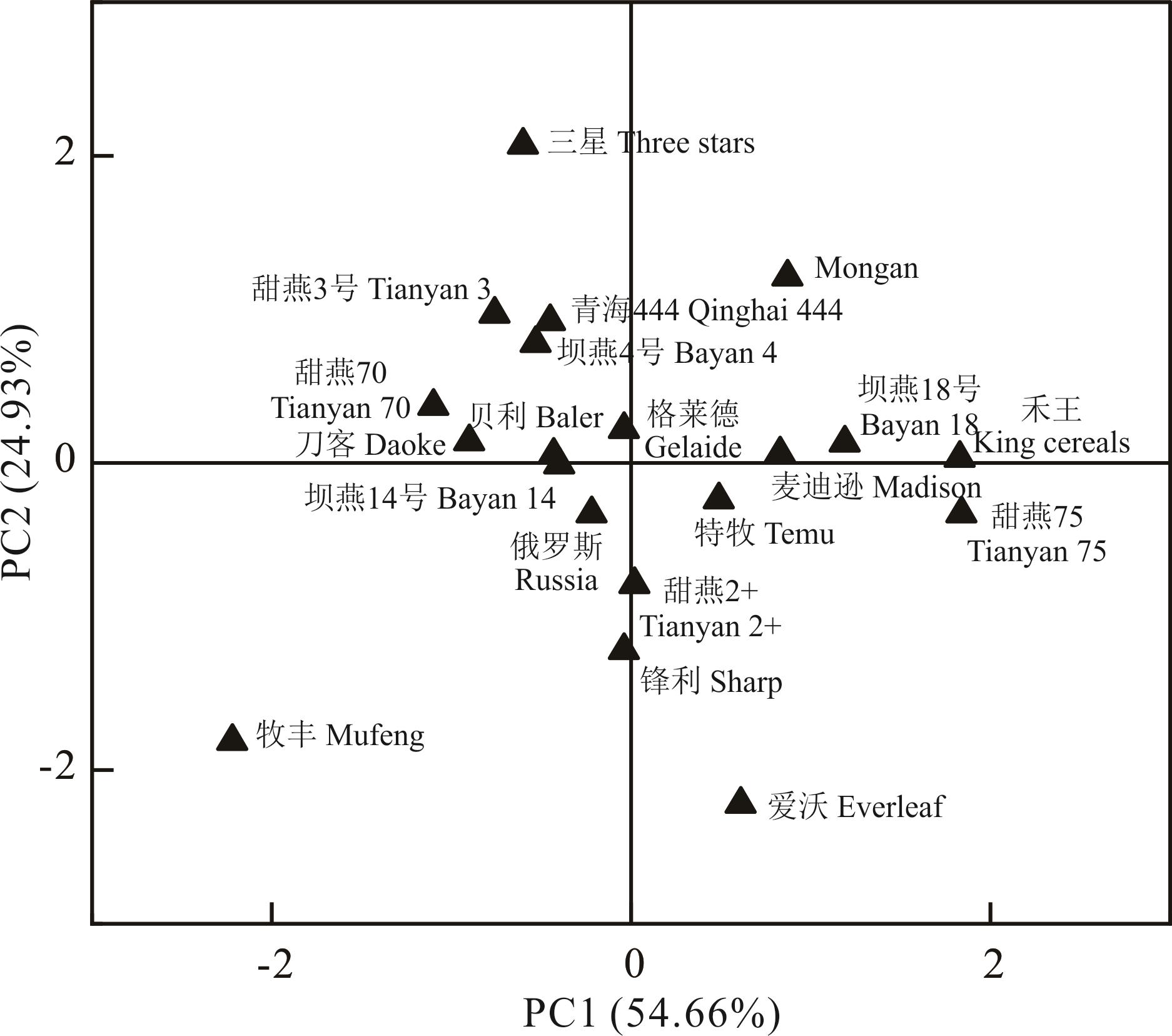
图2 不同燕麦品种的主成分分析
Fig.2 Principal component analysis of different oat varieties
品种 Variety | 第1层气生根The first layer aerial roots | 第2层气生根The second layer aerial roots | 节长Internode length (mm) | 倒伏程度 Lodging degree | |||||
|---|---|---|---|---|---|---|---|---|---|
有效 Effective | 无效 Ineffective | 入土半径 Soil-penetrating radius (mm) | 有效 Effective | 无效 Ineffective | 入土半径 Soil-penetrating radius (mm) | 第1节 First internode | 第2节 Second internode | ||
| 甜燕3号Tianyan 3 | 2.70±1.13a | 2.05±0.07abcd | 6.14±1.51ab | 0.05±0.71a | 0.25±0.07a | 0.05±0.07b | 37.2±5.5bcdef | 88.5±17.6efg | Ⅱ |
| 贝利Baler | 1.85±0.07ab | 2.45±0.78ab | 4.89±0.71bcd | 0.20±0.28a | 0.15±0.21a | 0.88±1.24a | 38.2±1.0bcdef | 94.4±2.2efg | Ⅱ |
| 三星Three stars | 1.63±0.38abc | 0.98±0.76cde | 0.96±1.37fgh | 0.00±0.00a | 0.00±0.00a | 0.00±0.00b | 40.5±5.3bcdef | 99.8±15.2defg | Ⅲ |
| 牧丰Mufeng | 1.60±0.28abc | 3.05±0.78a | 5.53±0.04abc | 0.00±0.00a | 0.20±0.14a | 0.00±0.00b | 33.1±4.0cdef | 102.5±1.7cdefg | Ⅲ |
| 麦迪逊Madison | 1.33±1.25bcd | 1.97±0.35abcd | 4.83±1.22bcd | 0.17±0.29a | 0.50±0.87a | 0.00±0.00b | 61.6±5.8a | 125.0±4.2abc | Ⅲ |
| 甜燕75 Tianyan 75 | 1.30±0.57bcd | 2.05±0.64abcd | 5.85±0.78ab | 0.00±0.00a | 0.10±0.14a | 0.00±0.00b | 37.9±7.9bcdef | 126.2±3.1abc | Ⅲ |
| 锋利Sharp | 1.25±0.21bcd | 2.35±0.07abc | 2.63±1.06cdefgh | 0.00±0.00a | 0.00±0.00a | 0.00±0.00b | 42.6±6.2bcde | 104.8±10.9bcdefg | Ⅱ |
| 禾王King cereals | 1.17±0.38bcd | 1.27±0.67bcde | 3.12±1.30bcdefg | 0.00±0.00a | 0.00±0.00a | 0.00±0.00b | 39.3±11.7bcdef | 109.7±6.7abcde | Ⅳ |
| 青海444 Qinghai 444 | 1.10±0.28bcd | 1.20±0.57bcde | 2.33±0.53defgh | 0.00±0.00a | 0.00±0.00a | 0.00±0.00b | 35.0±3.5bcdef | 105.4±3.0abcdefg | Ⅲ |
| 俄罗斯Russia | 1.05±0.21bcd | 1.35±0.35bcde | 4.69±0.87bcd | 0.00±0.00a | 0.00±0.00a | 0.00±0.00b | 24.0±0.7f | 84.5±7.9fg | Ⅲ |
| 格莱德Gelaide | 1.00±0.57bcd | 1.95±0.64abcd | 4.10±3.20bcde | 0.00±0.00a | 0.10±0.14a | 0.00±0.00b | 33.1±2.1cdef | 97.7±1.9efg | Ⅳ |
| 特牧 Temu | 0.95±0.21bcd | 1.15±0.21bcde | 8.04±1.43a | 0.00±0.00a | 0.05±0.07a | 0.00±0.00b | 29.2±0.3def | 112.1±4.6abcde | Ⅳ |
| 坝燕4 Bayan 4 | 0.85±0.91bcd | 0.90±0.99de | 2.71±2.14cdefgh | 0.00±0.00a | 0.00±0.00a | 0.00±0.00b | 35.4±3.5bcdef | 90.4±5.7efg | Ⅱ |
| 刀客Daoke | 0.75±0.21bcd | 2.35±0.07abc | 3.85±2.38bcdef | 0.10±0.14a | 0.05±0.07a | 0.00±0.00b | 51.5±8.3ab | 127.0±0.5ab | Ⅳ |
| 甜燕70 Tianyan 70 | 0.55±0.35bcd | 1.45±0.21bcde | 1.24±0.90efgh | 0.00±0.00a | 0.00±0.00a | 0.00±0.00b | 35.6±5.6bcdef | 123.2±5.2abcd | Ⅳ |
| 甜燕2+ Tianyan 2+ | 0.40±0.42cd | 1.25±0.49bcde | 0.34±0.06gh | 0.00±0.00a | 0.00±0.00a | 0.00±0.00b | 43.5±2.6bcd | 129.2±8.6a | Ⅳ |
| 爱沃Everleaf | 0.40±0.14cd | 2.15±0.35abcd | 2.47±0.23defgh | 0.00±0.00a | 0.00±0.00a | 0.00±0.00b | 47.6±8.5abc | 106.9±9.1abcde | Ⅳ |
| 坝燕18 Bayan 18 | 0.35±0.21cd | 1.45±1.34bcde | 1.15±0.49efgh | 0.00±0.00a | 0.05±0.07a | 0.00±0.00b | 26.1±18.6ef | 99.2±30.8efg | Ⅲ |
| 坝燕14 Bayan14 | 0.25±0.07d | 0.45±0.35e | 1.30±0.42efgh | 0.00±0.00a | 0.00±0.00a | 0.00±0.00b | 35.7±6.3bcdef | 82.4±3.8g | Ⅱ |
| Mongan | 0.15±0.15d | 0.75±0.49de | 0.00±0.00h | 0.00±0.00a | 0.00±0.00a | 0.00±0.00b | 41.6±8.3bcde | 95.7±5.6efg | Ⅳ |
表7 不同燕麦品种气生根特性和倒伏程度
Table 7 Aerial roots characteristics and lodging degree of different oat varieties
品种 Variety | 第1层气生根The first layer aerial roots | 第2层气生根The second layer aerial roots | 节长Internode length (mm) | 倒伏程度 Lodging degree | |||||
|---|---|---|---|---|---|---|---|---|---|
有效 Effective | 无效 Ineffective | 入土半径 Soil-penetrating radius (mm) | 有效 Effective | 无效 Ineffective | 入土半径 Soil-penetrating radius (mm) | 第1节 First internode | 第2节 Second internode | ||
| 甜燕3号Tianyan 3 | 2.70±1.13a | 2.05±0.07abcd | 6.14±1.51ab | 0.05±0.71a | 0.25±0.07a | 0.05±0.07b | 37.2±5.5bcdef | 88.5±17.6efg | Ⅱ |
| 贝利Baler | 1.85±0.07ab | 2.45±0.78ab | 4.89±0.71bcd | 0.20±0.28a | 0.15±0.21a | 0.88±1.24a | 38.2±1.0bcdef | 94.4±2.2efg | Ⅱ |
| 三星Three stars | 1.63±0.38abc | 0.98±0.76cde | 0.96±1.37fgh | 0.00±0.00a | 0.00±0.00a | 0.00±0.00b | 40.5±5.3bcdef | 99.8±15.2defg | Ⅲ |
| 牧丰Mufeng | 1.60±0.28abc | 3.05±0.78a | 5.53±0.04abc | 0.00±0.00a | 0.20±0.14a | 0.00±0.00b | 33.1±4.0cdef | 102.5±1.7cdefg | Ⅲ |
| 麦迪逊Madison | 1.33±1.25bcd | 1.97±0.35abcd | 4.83±1.22bcd | 0.17±0.29a | 0.50±0.87a | 0.00±0.00b | 61.6±5.8a | 125.0±4.2abc | Ⅲ |
| 甜燕75 Tianyan 75 | 1.30±0.57bcd | 2.05±0.64abcd | 5.85±0.78ab | 0.00±0.00a | 0.10±0.14a | 0.00±0.00b | 37.9±7.9bcdef | 126.2±3.1abc | Ⅲ |
| 锋利Sharp | 1.25±0.21bcd | 2.35±0.07abc | 2.63±1.06cdefgh | 0.00±0.00a | 0.00±0.00a | 0.00±0.00b | 42.6±6.2bcde | 104.8±10.9bcdefg | Ⅱ |
| 禾王King cereals | 1.17±0.38bcd | 1.27±0.67bcde | 3.12±1.30bcdefg | 0.00±0.00a | 0.00±0.00a | 0.00±0.00b | 39.3±11.7bcdef | 109.7±6.7abcde | Ⅳ |
| 青海444 Qinghai 444 | 1.10±0.28bcd | 1.20±0.57bcde | 2.33±0.53defgh | 0.00±0.00a | 0.00±0.00a | 0.00±0.00b | 35.0±3.5bcdef | 105.4±3.0abcdefg | Ⅲ |
| 俄罗斯Russia | 1.05±0.21bcd | 1.35±0.35bcde | 4.69±0.87bcd | 0.00±0.00a | 0.00±0.00a | 0.00±0.00b | 24.0±0.7f | 84.5±7.9fg | Ⅲ |
| 格莱德Gelaide | 1.00±0.57bcd | 1.95±0.64abcd | 4.10±3.20bcde | 0.00±0.00a | 0.10±0.14a | 0.00±0.00b | 33.1±2.1cdef | 97.7±1.9efg | Ⅳ |
| 特牧 Temu | 0.95±0.21bcd | 1.15±0.21bcde | 8.04±1.43a | 0.00±0.00a | 0.05±0.07a | 0.00±0.00b | 29.2±0.3def | 112.1±4.6abcde | Ⅳ |
| 坝燕4 Bayan 4 | 0.85±0.91bcd | 0.90±0.99de | 2.71±2.14cdefgh | 0.00±0.00a | 0.00±0.00a | 0.00±0.00b | 35.4±3.5bcdef | 90.4±5.7efg | Ⅱ |
| 刀客Daoke | 0.75±0.21bcd | 2.35±0.07abc | 3.85±2.38bcdef | 0.10±0.14a | 0.05±0.07a | 0.00±0.00b | 51.5±8.3ab | 127.0±0.5ab | Ⅳ |
| 甜燕70 Tianyan 70 | 0.55±0.35bcd | 1.45±0.21bcde | 1.24±0.90efgh | 0.00±0.00a | 0.00±0.00a | 0.00±0.00b | 35.6±5.6bcdef | 123.2±5.2abcd | Ⅳ |
| 甜燕2+ Tianyan 2+ | 0.40±0.42cd | 1.25±0.49bcde | 0.34±0.06gh | 0.00±0.00a | 0.00±0.00a | 0.00±0.00b | 43.5±2.6bcd | 129.2±8.6a | Ⅳ |
| 爱沃Everleaf | 0.40±0.14cd | 2.15±0.35abcd | 2.47±0.23defgh | 0.00±0.00a | 0.00±0.00a | 0.00±0.00b | 47.6±8.5abc | 106.9±9.1abcde | Ⅳ |
| 坝燕18 Bayan 18 | 0.35±0.21cd | 1.45±1.34bcde | 1.15±0.49efgh | 0.00±0.00a | 0.05±0.07a | 0.00±0.00b | 26.1±18.6ef | 99.2±30.8efg | Ⅲ |
| 坝燕14 Bayan14 | 0.25±0.07d | 0.45±0.35e | 1.30±0.42efgh | 0.00±0.00a | 0.00±0.00a | 0.00±0.00b | 35.7±6.3bcdef | 82.4±3.8g | Ⅱ |
| Mongan | 0.15±0.15d | 0.75±0.49de | 0.00±0.00h | 0.00±0.00a | 0.00±0.00a | 0.00±0.00b | 41.6±8.3bcde | 95.7±5.6efg | Ⅳ |
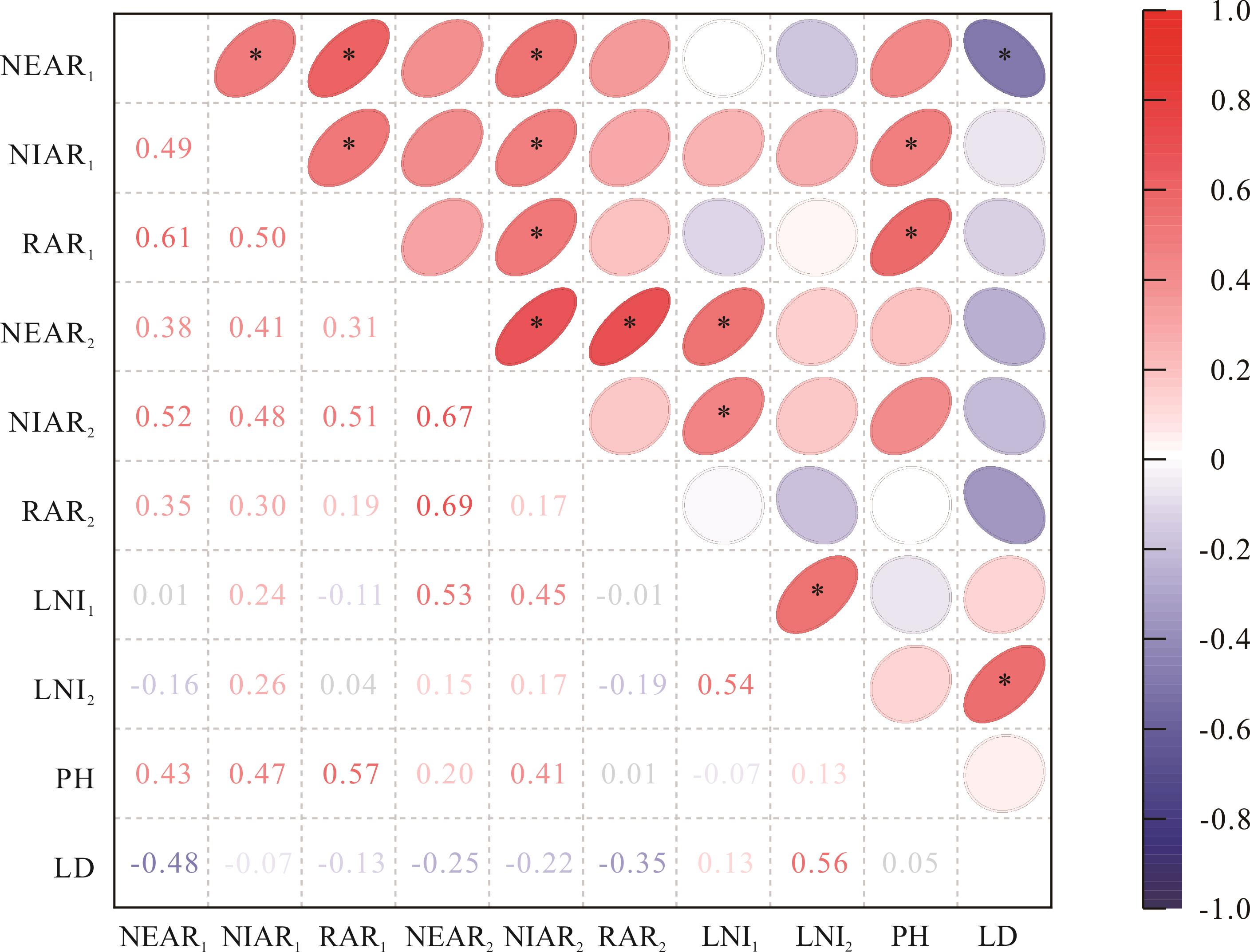
图3 不同燕麦品种气生根数、节长、株高与倒伏程度之间的关系NEAR1: 第1层有效气生根数Number of effective aerial roots in the first layer; NIAR1: 第1层无效气生根数Number of ineffective aerial roots in the first layer; RAR1: 第1层气生根入土半径Soil-penetrating radius of aerial roots in the first layer; NEAR2: 第2层有效气生根数Number of effective aerial roots in the second layer; NIAR2: 第2层无效气生根数Number of ineffective aerial roots in the second layer; RAR2: 第2层气生根入土半径Soil-penetrating radius of aerial roots in the second layer; LNI1: 第1茎节节长Length of the first internode; LNI2: 第2茎节节长Length of the second internode; PH: 株高Plant height; LD: 倒伏程度Lodging degree. *表示差异显著(P<0.05),下同。* indicates significant difference at 0.05 level, the same below.
Fig.3 Relationships between aerial roots number, internode length, plant height and lodging degree of different oat varieties
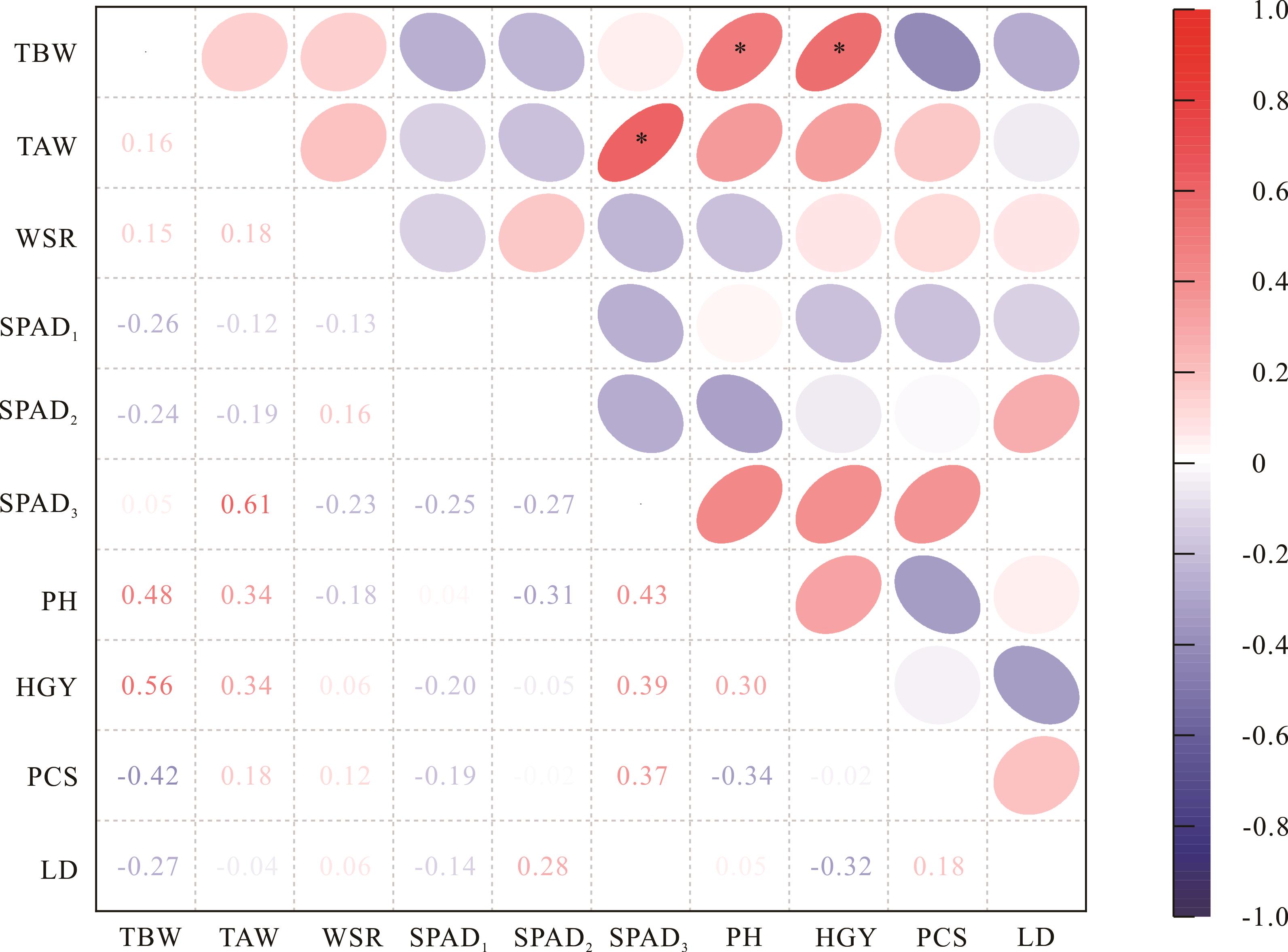
图4 越冬率、分蘖数、叶绿素值、株高、干草产量和倒伏程度等指标之间的相关性TBW: 越冬前分蘖数Tiller number before winter; TAW: 越冬后分蘖数Tiller number after winter; WSR: 越冬率Winter survival rate; SPAD1: 越冬前叶绿素值Soil and plant analyzer development value before winter; SPAD2: 返青期叶绿素值Soil and plant analyzer development value at regreening stage; SPAD3: 拔节期叶绿素值Soil and plant analyzer development value at jointing stage; HGY: 干草产量Hay grass yield; PCS: 主成分得分Principal component score.
Fig.4 Correlations between indicators such as winter survival rate, tiller number, soil and plant analyzer development value, plant height, hay yield, and lodging degree
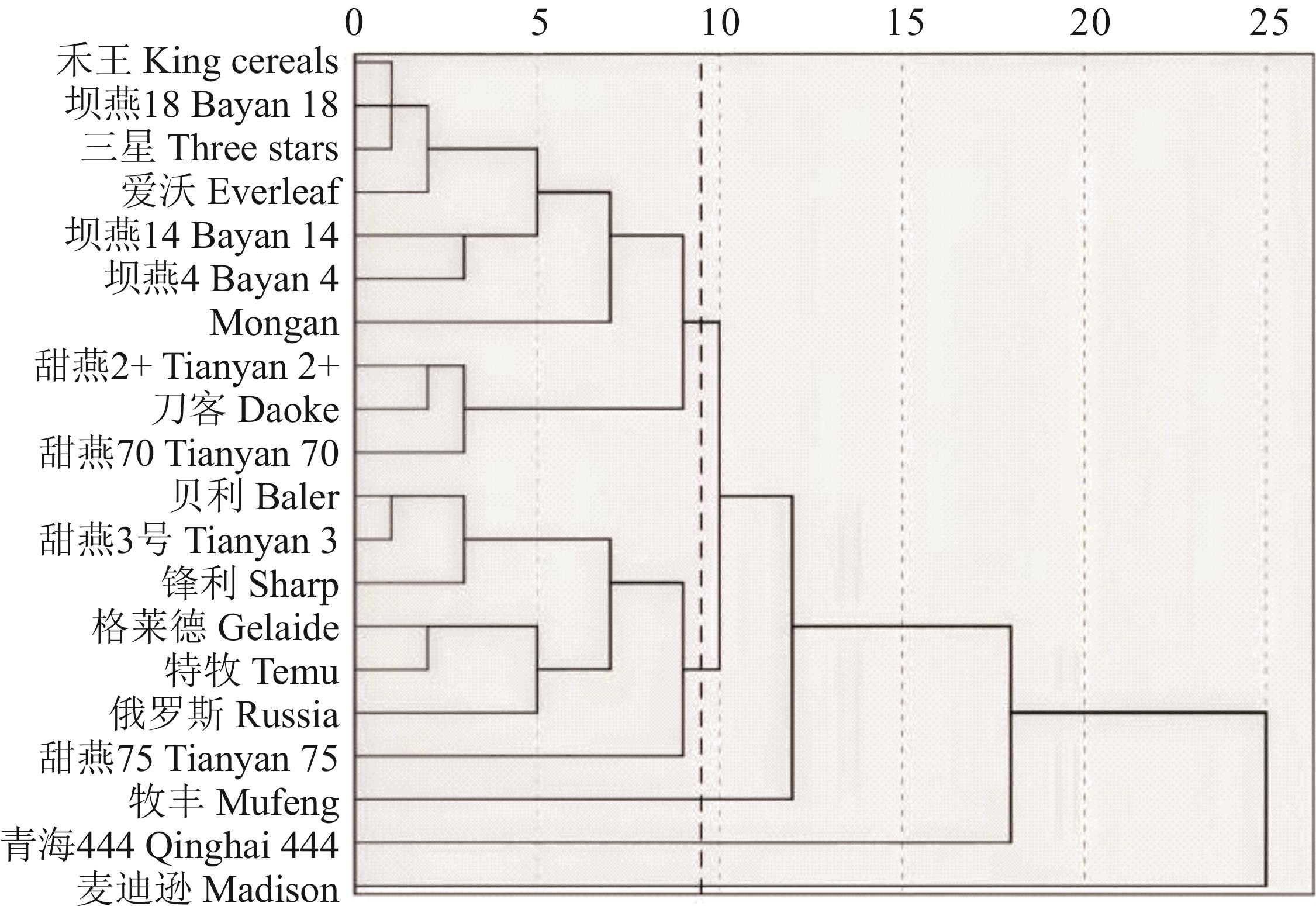
图5 不同燕麦品种的聚类分析
Fig.5 Cluster analysis of different oat varieties
品种 Variety | 越冬率 Winter survival rate | 越冬前分蘖数Tiller number before winter | 株高 Plant height | 干草产量 Hay grass yield | 主成分得分 Principal component score | 第1层有效气生根数Number of effective aerial roots in the first layer | 第2茎节节长 Length of the second internode | 倒伏程度 Lodging degree | 隶属值 Membership value | 隶属值排序 Membership value sorting |
|---|---|---|---|---|---|---|---|---|---|---|
| 甜燕3号Tianyan 3 | 0.97 | 0.71 | 0.65 | 0.97 | 0.45 | 1.00 | 0.87 | 1.00 | 0.83 | 1 |
| 锋利Sharp | 0.90 | 0.81 | 0.68 | 0.89 | 0.50 | 0.43 | 0.52 | 1.00 | 0.72 | 2 |
| 贝利Baler | 0.97 | 0.52 | 0.52 | 0.78 | 0.46 | 0.67 | 0.74 | 1.00 | 0.71 | 3 |
| 牧丰Mufeng | 0.83 | 0.76 | 0.87 | 0.28 | 1.00 | 0.57 | 0.57 | 0.50 | 0.67 | 4 |
| 坝燕14 Bayan14 | 1.00 | 0.67 | 0.23 | 0.42 | 0.46 | 0.04 | 1.00 | 1.00 | 0.60 | 5 |
| 麦迪逊Madison | 1.00 | 0.57 | 0.74 | 0.90 | 0.20 | 0.46 | 0.09 | 0.50 | 0.56 | 6 |
| 俄罗斯Russia | 0.61 | 0.24 | 0.84 | 0.44 | 0.45 | 0.35 | 0.95 | 0.50 | 0.55 | 7 |
| 三星Three stars | 0.93 | 0.67 | 0.42 | 0.22 | 0.31 | 0.58 | 0.63 | 0.50 | 0.53 | 8 |
| 格莱德Gelaide | 1.00 | 0.52 | 1.00 | 0.12 | 0.37 | 0.33 | 0.67 | 0.00 | 0.50 | 9 |
| 甜燕75 Tianyan 75 | 0.90 | 0.52 | 0.45 | 1.00 | 0.03 | 0.45 | 0.06 | 0.50 | 0.49 | 10 |
| 甜燕2+ Tianyan 2+ | 0.84 | 1.00 | 0.65 | 0.75 | 0.45 | 0.10 | 0.00 | 0.00 | 0.47 | 11 |
| 坝燕4 Bayan 4 | 0.87 | 0.19 | 0.00 | 0.00 | 0.42 | 0.27 | 0.83 | 1.00 | 0.45 | 12 |
| 特牧Temu | 1.00 | 0.48 | 0.81 | 0.36 | 0.30 | 0.31 | 0.36 | 0.00 | 0.45 | 12 |
| 刀客Daoke | 0.96 | 0.43 | 0.68 | 0.41 | 0.55 | 0.24 | 0.04 | 0.00 | 0.41 | 13 |
| 青海444 Qinghai 444 | 0.00 | 0.33 | 0.68 | 0.38 | 0.39 | 0.37 | 0.51 | 0.50 | 0.39 | 14 |
| 坝燕18 Bayan 18 | 0.96 | 0.33 | 0.29 | 0.08 | 0.12 | 0.08 | 0.64 | 0.50 | 0.38 | 15 |
| 甜燕70 Tianyan 70 | 1.00 | 0.33 | 0.23 | 0.47 | 0.57 | 0.16 | 0.12 | 0.00 | 0.36 | 16 |
| 爱沃Everleaf | 0.83 | 0.33 | 0.10 | 0.39 | 0.46 | 0.10 | 0.47 | 0.00 | 0.34 | 17 |
| 禾王King cereals | 0.90 | 0.24 | 0.23 | 0.24 | 0.00 | 0.40 | 0.41 | 0.00 | 0.30 | 18 |
| Mongan | 1.00 | 0.00 | 0.13 | 0.12 | 0.09 | 0.00 | 0.71 | 0.00 | 0.26 | 19 |
表8 不同燕麦品种的隶属函数值与综合评价
Table 8 Comprehensive evaluation and membership function values of different oat varieties
品种 Variety | 越冬率 Winter survival rate | 越冬前分蘖数Tiller number before winter | 株高 Plant height | 干草产量 Hay grass yield | 主成分得分 Principal component score | 第1层有效气生根数Number of effective aerial roots in the first layer | 第2茎节节长 Length of the second internode | 倒伏程度 Lodging degree | 隶属值 Membership value | 隶属值排序 Membership value sorting |
|---|---|---|---|---|---|---|---|---|---|---|
| 甜燕3号Tianyan 3 | 0.97 | 0.71 | 0.65 | 0.97 | 0.45 | 1.00 | 0.87 | 1.00 | 0.83 | 1 |
| 锋利Sharp | 0.90 | 0.81 | 0.68 | 0.89 | 0.50 | 0.43 | 0.52 | 1.00 | 0.72 | 2 |
| 贝利Baler | 0.97 | 0.52 | 0.52 | 0.78 | 0.46 | 0.67 | 0.74 | 1.00 | 0.71 | 3 |
| 牧丰Mufeng | 0.83 | 0.76 | 0.87 | 0.28 | 1.00 | 0.57 | 0.57 | 0.50 | 0.67 | 4 |
| 坝燕14 Bayan14 | 1.00 | 0.67 | 0.23 | 0.42 | 0.46 | 0.04 | 1.00 | 1.00 | 0.60 | 5 |
| 麦迪逊Madison | 1.00 | 0.57 | 0.74 | 0.90 | 0.20 | 0.46 | 0.09 | 0.50 | 0.56 | 6 |
| 俄罗斯Russia | 0.61 | 0.24 | 0.84 | 0.44 | 0.45 | 0.35 | 0.95 | 0.50 | 0.55 | 7 |
| 三星Three stars | 0.93 | 0.67 | 0.42 | 0.22 | 0.31 | 0.58 | 0.63 | 0.50 | 0.53 | 8 |
| 格莱德Gelaide | 1.00 | 0.52 | 1.00 | 0.12 | 0.37 | 0.33 | 0.67 | 0.00 | 0.50 | 9 |
| 甜燕75 Tianyan 75 | 0.90 | 0.52 | 0.45 | 1.00 | 0.03 | 0.45 | 0.06 | 0.50 | 0.49 | 10 |
| 甜燕2+ Tianyan 2+ | 0.84 | 1.00 | 0.65 | 0.75 | 0.45 | 0.10 | 0.00 | 0.00 | 0.47 | 11 |
| 坝燕4 Bayan 4 | 0.87 | 0.19 | 0.00 | 0.00 | 0.42 | 0.27 | 0.83 | 1.00 | 0.45 | 12 |
| 特牧Temu | 1.00 | 0.48 | 0.81 | 0.36 | 0.30 | 0.31 | 0.36 | 0.00 | 0.45 | 12 |
| 刀客Daoke | 0.96 | 0.43 | 0.68 | 0.41 | 0.55 | 0.24 | 0.04 | 0.00 | 0.41 | 13 |
| 青海444 Qinghai 444 | 0.00 | 0.33 | 0.68 | 0.38 | 0.39 | 0.37 | 0.51 | 0.50 | 0.39 | 14 |
| 坝燕18 Bayan 18 | 0.96 | 0.33 | 0.29 | 0.08 | 0.12 | 0.08 | 0.64 | 0.50 | 0.38 | 15 |
| 甜燕70 Tianyan 70 | 1.00 | 0.33 | 0.23 | 0.47 | 0.57 | 0.16 | 0.12 | 0.00 | 0.36 | 16 |
| 爱沃Everleaf | 0.83 | 0.33 | 0.10 | 0.39 | 0.46 | 0.10 | 0.47 | 0.00 | 0.34 | 17 |
| 禾王King cereals | 0.90 | 0.24 | 0.23 | 0.24 | 0.00 | 0.40 | 0.41 | 0.00 | 0.30 | 18 |
| Mongan | 1.00 | 0.00 | 0.13 | 0.12 | 0.09 | 0.00 | 0.71 | 0.00 | 0.26 | 19 |
| [1] | Li P F, Mo F, Li D F, et al. Exploring agronomic strategies to improve oat productivity and control weeds: leaf type, row spacing, and planting density. Canadian Journal of Plant Science, 2018, 98(5): 1084-1093. |
| [2] | He Z Y. Advantages and application of oat hay in dairy cattle production. China Dairy Cattle, 2015(17): 12-15. |
| 贺忠勇. 燕麦干草在奶牛生产中的优势及应用. 中国奶牛, 2015(17): 12-15. | |
| [3] | Yuan B, Chen G Z, Yang H Y, et al. Advances in lodging resistance of oats. Journal of Hebei North University (Natural Science Edition), 2024, 40(3): 1-4. |
| 袁搏, 陈冠州, 杨会勇, 等. 燕麦抗倒伏研究进展. 河北北方学院学报(自然科学版), 2024, 40(3): 1-4. | |
| [4] | Liang G L, Liu W H, Zhang Y C, et al. Effect of lodging on the grain filling process and non-structure carbohydrate of oats. Acta Agrestia Sinica, 2020, 28(4): 1024-1033. |
| 梁国玲, 刘文辉, 张永超, 等. 倒伏发生对燕麦籽粒灌浆进程及非结构性碳水化物的影响. 草地学报, 2020, 28(4): 1024-1033. | |
| [5] | Wang Y, Pan Y H, Zhao F L, et al. Changes in the lodging resistance of winter wheat from 1950s to the 2020s in Henan Province of China. BMC Plant Biology, 2023, 23(1): 442. |
| [6] | Nan M, Wang X R, Li J, et al. Differences in traits related to lodging resistance among oat genotypes. Acta Prataculturae Sinica, 2023, 32(11): 106-118. |
| 南铭, 王兴荣, 李晶, 等. 燕麦抗倒伏性状的基因型差异. 草业学报, 2023, 32(11): 106-118. | |
| [7] | Tian B H. The methods of lodging resistance assessment in cereal crops and their application in foxtail millet. Journal of Plant Genetic Resources, 2013, 14(2): 265-269. |
| 田伯红. 禾谷类作物抗倒伏性的研究方法与谷子抗倒性评价. 植物遗传资源学报, 2013, 14(2): 265-269. | |
| [8] | Yu D W, Zhu M, Yun H Y. Relationship between brace root traits and lodging resistance of maize. Journal of Northwest A&F University (Natural Science Edition), 2022, 50(1): 91-97. |
| 于大伟, 朱猛, 员海燕. 玉米气生根性状与抗倒性的关系. 西北农林科技大学学报(自然科学版), 2022, 50(1): 91-97. | |
| [9] | Gao J Y, Feng P J, Zhang J L, et al. Enhancing maize’s nitrogen-fixing potential through ZmSBT3, a gene suppressing mucilage secretion. Journal of Integrative Plant Biology, 2023, 65(12): 2645-2659. |
| [10] | Huang W H, Wang H, Mei D S. Research progress on lodging resistance of crops. Crops, 2018(4): 13-19. |
| 黄文辉, 王会, 梅德圣. 农作物抗倒性研究进展. 作物杂志, 2018(4): 13-19. | |
| [11] | Li Z Q. Oat hay quality evaluation. China Dairy Cattle, 2013, 31(19): 1-3. |
| 李志强. 燕麦干草质量评价. 中国奶牛, 2013, 31(19): 1-3. | |
| [12] | China Animal Agriculture Association. Oats hay quality grade: T/CAAA 002-2018. Animal Agriculture, 2019(1): 40-43. |
| 中国畜牧业协会. 燕麦干草质量分级: T/CAAA 002-2018. 畜牧产业, 2019(1): 40-43. | |
| [13] | Gong M. Screening methods and indexes of drought resistance in crops and comprehensive evaluation. Journal of Yunnan Agricultural University, 1989, 4(1): 73-81. |
| 龚明. 作物抗旱性鉴定方法与指标及其综合评价. 云南农业大学学报, 1989, 4(1): 73-81. | |
| [14] | Saika N, Shamshir H, Tawqeer N, et al. Bi-environmental evaluation of oat (Avena sativa L.) genotypes for yield and nutritional traits under cold stress conditions using multivariate analysis. Plant Genetic Resources: Characterisation & Utilisation, 2024, 22(5): 295-303. |
| [15] | Lou C H, Wang B, Li D F, et al. Comparison of production performance and nutritional value of 16 oat varieties in Yellow River beach area. Pratacultural Science, 2019, 36(7): 1843-1851. |
| 娄春华, 王博, 李德锋, 等. 黄河滩区16个春播燕麦品种的生产性能和营养品质. 草业科学, 2019, 36(7): 1843-1851. | |
| [16] | Wooten D R, Livingston D P I, Jellen E N, et al. An intergenomic reciprocal translocation associated with oat winter hardiness component traits. Crop Science, 2007, 47(5): 1832-1840. |
| [17] | Marshall H G. Breeding oat for resistance to environmental stress. New York, USA: John Wiley & Sons, Ltd, 2015. |
| [18] | Wang G L, Wu B, Zhang J H, et al. The comparison of productivity of different oat varieties in the Yellow River Delta. Chinese Journal of Grassland, 2020, 42(6): 141-148. |
| 王国良, 吴波, 张进红, 等. 黄河三角洲地区不同品种燕麦生产性能比较. 中国草地学报, 2020, 42(6): 141-148. | |
| [19] | Liang W P, Li S E, He C G, et al. Present situation of promotion and utilization status of alfalfa and oat in Qingyang city. China Cattle Science, 2021, 47(4): 82-83, 88. |
| 梁万鹏, 李世恩, 贺春贵, 等. 庆阳市紫花苜蓿和燕麦推广利用现状. 中国牛业科学, 2021, 47(4): 82-83, 88. | |
| [20] | Yao J, He Y, Lu J D, et al. Winter survival rate, tillering characteristics, and production performance of autumn-sown forage oats in Henan province. Acta Agrestia Sinica, 2023, 31(2): 528-539. |
| 姚晋, 何云, 卢家顶, 等. 河南省秋播饲用燕麦的越冬率、分蘖特性及其生产性能. 草地学报, 2023, 31(2): 528-539. | |
| [21] | Sang R J, Danjiuluobu, Zhang H M, et al. Comprehensive evaluation of winter survival rate and production performance of 23 forage oat varieties in autumn sowing in northern Henan province. Feed Research, 2025, 48(12): 135-141. |
| 桑瑞娟, 旦久罗布, 张红妹, 等. 23个饲用燕麦品种在豫北秋播的越冬性和生产性能综合评价. 饲料研究, 2025, 48(12): 135-141. | |
| [22] | Xu X L, Song Y T, Zhao J D, et al. Changes in forage quality and its relationship with plant diversity under fertilization and mowing in Hulun Buir meadow steppe. Acta Prataculturae Sinica, 2021, 30(7): 1-10. |
| 徐鑫磊, 宋彦涛, 赵京东, 等. 施肥和刈割对呼伦贝尔草甸草原牧草品质的影响及其与植物多样性的关系. 草业学报, 2021, 30(7): 1-10. | |
| [23] | Yang Y X, Wang S Y, He T R, et al. Study on plant biomass and its seasonal dynamics of typical wet land ecosystem in the Sanjiang plain. Grassland of China, 2002, 24(1): 2-8. |
| 杨永兴, 王世岩, 何太蓉, 等. 三江平原典型湿地生态系统生物量及其季节动态研究. 中国草地, 2002, 24(1): 2-8. | |
| [24] | Yan T F, Wei Z W, Wang A H, et al. Evaluation of production performance and feeding value of different oat materials in Jianghuai area. Chinese Journal of Grassland, 2020, 42(3): 111-118. |
| 闫天芳, 魏臻武, 王爱华, 等. 8份燕麦材料在江淮地区生产性能及饲用价值评价. 中国草地学报, 2020, 42(3): 111-118. | |
| [25] | Liu Q, Hao H, Tang B, et al. Comprehensive evaluation of production performance of 10 oat varieties in Panxi region. Feed Research, 2023, 46(18): 124-128. |
| 柳茜, 郝虎, 唐斌, 等. 10个燕麦品种在攀西地区生产性能综合评价. 饲料研究, 2023, 46(18): 124-128. | |
| [26] | Xue H F, Meng Q X. Recent nutritional advances of neutral detergent fiber in dairy cow. Chinese Journal of Animal Nutrition, 2007, 19(Z1): 454-458. |
| 薛红枫, 孟庆翔. 奶牛中性洗涤纤维营养研究进展. 动物营养学报, 2007, 19(Z1): 454-458. | |
| [27] | Wu Y, Zhang W H, Chen M H, et al. Productive performance comparison of different oat varieties in Yangzhou region. Pratacultural Science, 2018, 35(7): 1728-1733. |
| 吴亚, 张卫红, 陈鸣晖, 等. 不同品种燕麦在扬州地区的生产性能. 草业科学, 2018, 35(7): 1728-1733. | |
| [28] | Marshall H G, Kolb F L, Roth G W. Effects of nitrogen fertilizer rate, seeding rate, and row spacing on semidwarf and conventional height spring oat. Crop Science, 1987, 27(3): 572-575. |
| [29] | Sang R J, Cui C J, He Y, et al. Lodging resistance and production performance of 18 autumn-sown forage oat varieties in northen Henan Province. Acta Prataculturae Sinica, 2024, 33(8): 74-85. |
| 桑瑞娟, 崔超杰, 何云, 等. 豫北地区18个秋播饲用燕麦品种抗倒伏特性及生产性能评价. 草业学报, 2024, 33(8): 74-85. | |
| [30] | Yu D W. Study on the effect of brace root traits on lodging resistance and genetic research of brace root traits. Yangling: Northwest A & F University, 2014. |
| 于大伟. 玉米气生根性状与抗倒性的关系及其遗传研究. 杨凌: 西北农林科技大学, 2014. | |
| [31] | Wang Y X, Zhang Z H, Li Z H. Combining ability and path analysis of lodging resistance traits in maize. Journal of Henan Agricultural University, 2011, 45(1): 1-6. |
| 王永学, 张战辉, 刘宗华. 玉米抗倒伏性状的配合力效应及通径分析. 河南农业大学学报, 2011, 45(1): 1-6. |
| [1] | 庞凯悦, 冯彦龙, 刘合云, 苏少峰, 杜家华, 吴佳海, 曾兵. 发酵全混合日粮及其在反刍动物应用的研究进展[J]. 草业学报, 2026, 35(9): 211-235. |
| [2] | 王霞, 颜梦雨, 王千禧, 魏臻武, 魏佳, 曹正锋, 吕燕燕, 张传杰, 闵学阳. 江淮地区不同秋眠性紫花苜蓿品种的生产性能比较研究[J]. 草业学报, 2026, 35(8): 65-83. |
| [3] | 孙静, 孙延亮, 夏东杰, 魏孔钦, 杨开鑫, 隋晓青, 张前兵. 氮磷水肥耦合对无芒雀麦光合特性、生产性能及土壤养分的影响[J]. 草业学报, 2026, 35(7): 105-116. |
| [4] | 张剑搏, 王磊, 张强龙, 叶培麟, 黄伟华, 张福年, 李荣, 石勇. 不同能量水平精补料对生长期舍饲牦牛生产性能、血液生化指标及瘤胃微生物群落的影响[J]. 草业学报, 2026, 35(6): 190-201. |
| [5] | 牛浴林, 包明芳, 王文虎, 陈鑫, 刘凯强, 刘文辉, 秦燕. 三江源地区10份无芒雀麦资源农艺性状与生产性能综合评价[J]. 草业学报, 2026, 35(6): 83-92. |
| [6] | 李小聪, 闫聚辉, 王星, 胡鹏飞, 叶雨浓, 伏兵哲. 紫花苜蓿/无芒雀麦间作对草地生产性能和土壤理化特性的影响[J]. 草业学报, 2026, 35(5): 113-125. |
| [7] | 王一博, 明雪花, 张建勇, 袁琦, 杜建明, 王斌, 王腾飞, 张译尹, 兰剑, 牟乐. 宁夏干旱区燕麦新种质生产性能和种子产量综合评价研究[J]. 草业学报, 2026, 35(4): 86-99. |
| [8] | 贾浩滨, 江浩筠, 李爱华, 王海波, 林孙权, 潘月, 霍俊宏, 占今舜. 不同精粗比饲粮对广丰山羊生产性能、血清生化、瘤胃发酵的影响[J]. 草业学报, 2026, 35(3): 170-184. |
| [9] | 张译尹, 肖爱萍, 王斌, 王腾飞, 胡海英, 兰剑. 饲用高粱/拉巴豆混播模式下施氮量对草地生产力和能量利用效率的影响[J]. 草业学报, 2026, 35(1): 40-52. |
| [10] | 张志鹏, 蒋庆雪, 周昕越, 苗童, 唐俊, 仪登霞, 王学敏, 马琳. 转录组和蛋白组联合筛选饲用燕麦株高性状候选基因[J]. 草业学报, 2025, 34(9): 147-161. |
| [11] | 任春燕, 郝志云, 邴睿, 霍应栋, 赵海碧, 尹鹏飞, 唐德富, 蔺淑琴, 王继卿. 开食料添加纤维素酶对羔羊生产性能、器官发育、肌肉脂肪酸组成及血清抗氧化指标的影响[J]. 草业学报, 2025, 34(7): 120-131. |
| [12] | 项凌飞, 张峰举, 麻冬梅, 刘金龙, 兰剑, 邓建强, 胡海英, 王斌, 蔡春江, 马巧利. 氮磷钾配施对盐碱地湖南稷子生产性能和营养品质的影响[J]. 草业学报, 2025, 34(7): 185-195. |
| [13] | 王斌, 史佳梅, 王腾飞, 张译尹, 马江萍, 李佳旺, 王小兵, 邓建强, 兰剑. 施氮对饲用高粱/拉巴豆混播草地生产性能和氮肥贡献率的影响[J]. 草业学报, 2025, 34(4): 53-63. |
| [14] | 马江萍, 张译尹, 王腾飞, 王斌, 兰剑. 饲用高粱与拉巴豆混播对种间关系及草地生产力的影响[J]. 草业学报, 2025, 34(3): 111-122. |
| [15] | 赵雅姣, 刘晓静, 蔺芳. 适宜于黄土高原半干旱区豆禾饲草间套作组合的筛选[J]. 草业学报, 2025, 34(3): 97-110. |
| 阅读次数 | ||||||
|
全文 |
|
|||||
|
摘要 |
|
|||||
