
ISSN 1004-5759 CN 62-1105/S
草业学报 ›› 2026, Vol. 35 ›› Issue (11): 157-169.DOI: 10.11686/cyxb2025437
• 研究论文 • 上一篇
党志娟1,2( ), 王小玮1,2, 杨嘉宁1,2, 高亚峰1,2, 杜佛力1,2, 沈翰文1,2, 赵炘1,2, 郎正东1,2, 孙一川1,2, 杨志伟1,2, 汪军成1,2, 王化俊1,2, 姚立蓉1,2()
收稿日期:2025-10-21
修回日期:2026-02-04
出版日期:2026-11-20
发布日期:2026-10-12
通讯作者:
姚立蓉
作者简介:Corresponding author. E-mail: ylr0384@163.com基金资助:
Zhi-juan DANG1,2(), Xiao-wei WANG1,2, Jia-ning YANG1,2, Ya-feng GAO1,2, Fo-li DU1,2, Han-wen SHEN1,2, Xin ZHAO1,2, Zheng-dong LANG1,2, Yi-chuan SUN1,2, Zhi-wei YANG1,2, Jun-cheng WANG1,2, Hua-jun WANG1,2, Li-rong YAO1,2()
Received:2025-10-21
Revised:2026-02-04
Online:2026-11-20
Published:2026-10-12
Contact:
Li-rong YAO
摘要:
为阐明盐生草苗期对盐胁迫的生理响应机制并确定其耐盐阈值,采用盆栽试验方式,设置0(CK)、50、100、150、200、250、300、350 mmol·L-1共8个梯度的NaCl胁迫处理,系统测定株高、根长、地上生物量等13项指标,并基于主成分分析计算其耐盐阈值。结果显示,NaCl胁迫对盐生草地上部生长(株高和地上生物量)的抑制程度更显著,且地上部(茎和叶)对Na+、K+的响应也更为敏感。在NaCl胁迫时间和浓度交互作用下,各生理指标呈不同的动态变化模式:叶绿素含量总体呈下降趋势,在低浓度胁迫(NaCl≤150 mmol·L-1)下呈“先下降后升高”趋势,高浓度胁迫(NaCl≥200 mmol·L-1)下则表现为“先下降-后升高-再下降”的波动式下降;丙二醛(MDA)含量总体呈上升趋势,低浓度下呈“先升高-后下降-再升高”的趋势,高浓度下则呈“双峰”变化;可溶性糖含量总体表现为“先降低-后升高-再降低”的波动模式;过氧化物酶(POD)与超氧化物歧化酶(SOD)活性均呈“先升高后下降”的趋势。基于主成分分析筛选出的前3个关键指标(超氧化物歧化酶活性、过氧化物酶活性和地上生物量)进一步经回归分析验证,确定地上生物量为评价苗期耐盐阈值的最优指标,并据此得出盐生草的耐盐阈值为299.37 mmol·L-1。研究结果为苋科植物(特别是盐生草)的耐盐机制提供了理论依据,并为后续抗盐研究中关键胁迫参数的设定提供了数据支持。
党志娟, 王小玮, 杨嘉宁, 高亚峰, 杜佛力, 沈翰文, 赵炘, 郎正东, 孙一川, 杨志伟, 汪军成, 王化俊, 姚立蓉. 盐生草对盐胁迫的生理响应及其苗期耐盐阈值分析[J]. 草业学报, 2026, 35(11): 157-169.
Zhi-juan DANG, Xiao-wei WANG, Jia-ning YANG, Ya-feng GAO, Fo-li DU, Han-wen SHEN, Xin ZHAO, Zheng-dong LANG, Yi-chuan SUN, Zhi-wei YANG, Jun-cheng WANG, Hua-jun WANG, Li-rong YAO. Physiological responses of Halogeton glomeratus to salt stress and analysis of its salt tolerance threshold at the seedling stage[J]. Acta Prataculturae Sinica, 2026, 35(11): 157-169.
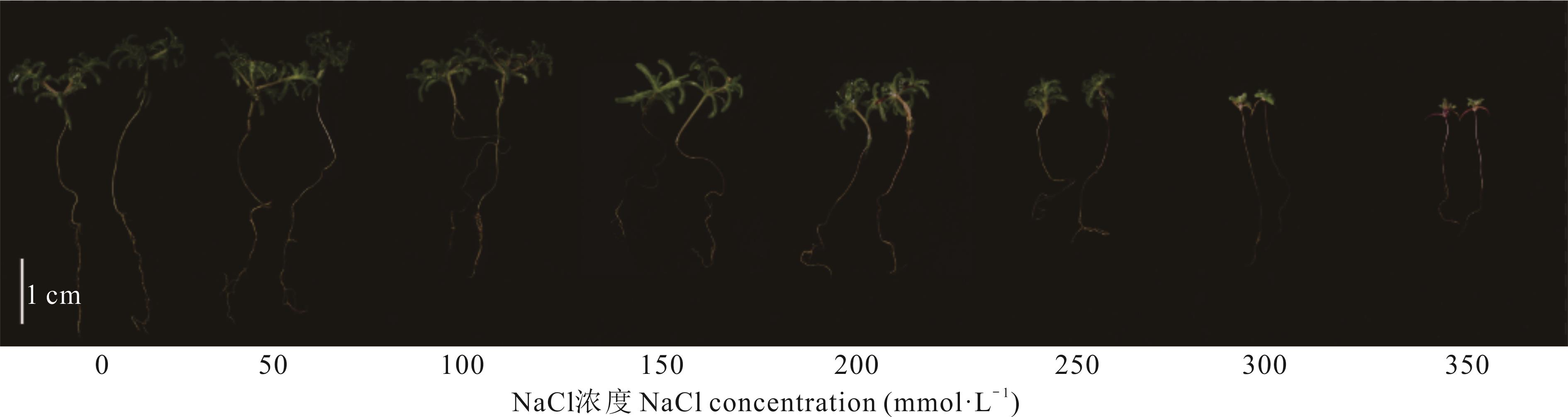
图1 NaCl胁迫30 d后盐生草表型变化
Fig.1 Phenotypic changes of H. glomeratus after 30 days of NaCl stress
NaCl浓度 NaCl concentration (mmol·L-1) | 株高 Plant height (cm) | 根长 Root length (cm) | 根冠比 Root-crown ratio |
|---|---|---|---|
| 0 (CK) | 17.07±1.42a | 21.63±3.11a | 0.40±0.02a |
| 50 | 14.50±2.00b | 13.03±1.53b | 0.17±0.02c |
| 100 | 12.73±0.81bc | 12.80±0.61b | 0.17±0.01c |
| 150 | 11.40±1.14cd | 11.97±1.08b | 0.20±0.07bc |
| 200 | 11.57±1.31cd | 12.57±0.75b | 0.20±0.05bc |
| 250 | 12.17±0.74cd | 11.30±0.44b | 0.24±0.02b |
| 300 | 10.03±0.47d | 10.33±1.62bc | 0.19±0.02bc |
| 350 | 7.80±0.56e | 8.40±0.75c | 0.15±0.03c |
表1 NaCl胁迫对盐生草生长的影响
Table 1 The effect of NaCl stress on the growth of H.glomeratus
NaCl浓度 NaCl concentration (mmol·L-1) | 株高 Plant height (cm) | 根长 Root length (cm) | 根冠比 Root-crown ratio |
|---|---|---|---|
| 0 (CK) | 17.07±1.42a | 21.63±3.11a | 0.40±0.02a |
| 50 | 14.50±2.00b | 13.03±1.53b | 0.17±0.02c |
| 100 | 12.73±0.81bc | 12.80±0.61b | 0.17±0.01c |
| 150 | 11.40±1.14cd | 11.97±1.08b | 0.20±0.07bc |
| 200 | 11.57±1.31cd | 12.57±0.75b | 0.20±0.05bc |
| 250 | 12.17±0.74cd | 11.30±0.44b | 0.24±0.02b |
| 300 | 10.03±0.47d | 10.33±1.62bc | 0.19±0.02bc |
| 350 | 7.80±0.56e | 8.40±0.75c | 0.15±0.03c |

图2 NaCl胁迫下盐生草生物量不同小写字母表示同一部位在不同盐浓度下差异显著(P<0.05),下同。 Different lowercase letters indicate significant differences in the same part under different salt concentrations (P<0.05), the same below.
Fig.2 Biomass of H.glomeratus under NaCl stress
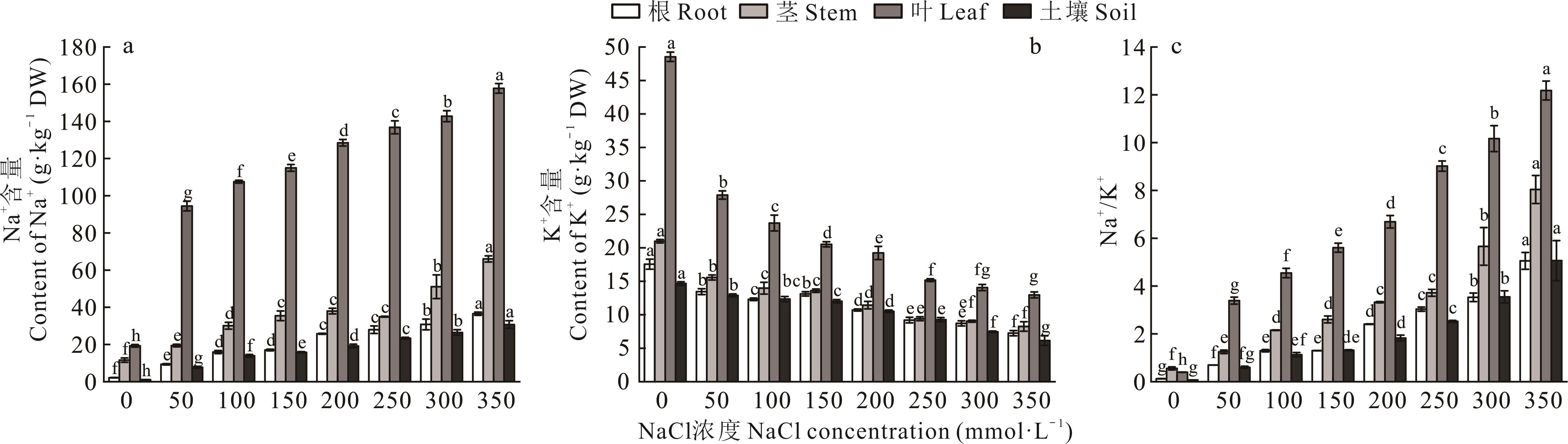
图 3 NaCl胁迫对盐生草根、茎、叶、土壤Na+、K+含量和Na+/K+的影响
Fig.3 The effect of NaCl stress on the roots, stems, leaves, soil Na+ and K+ contents, and Na+/K+ of H. glomeratus
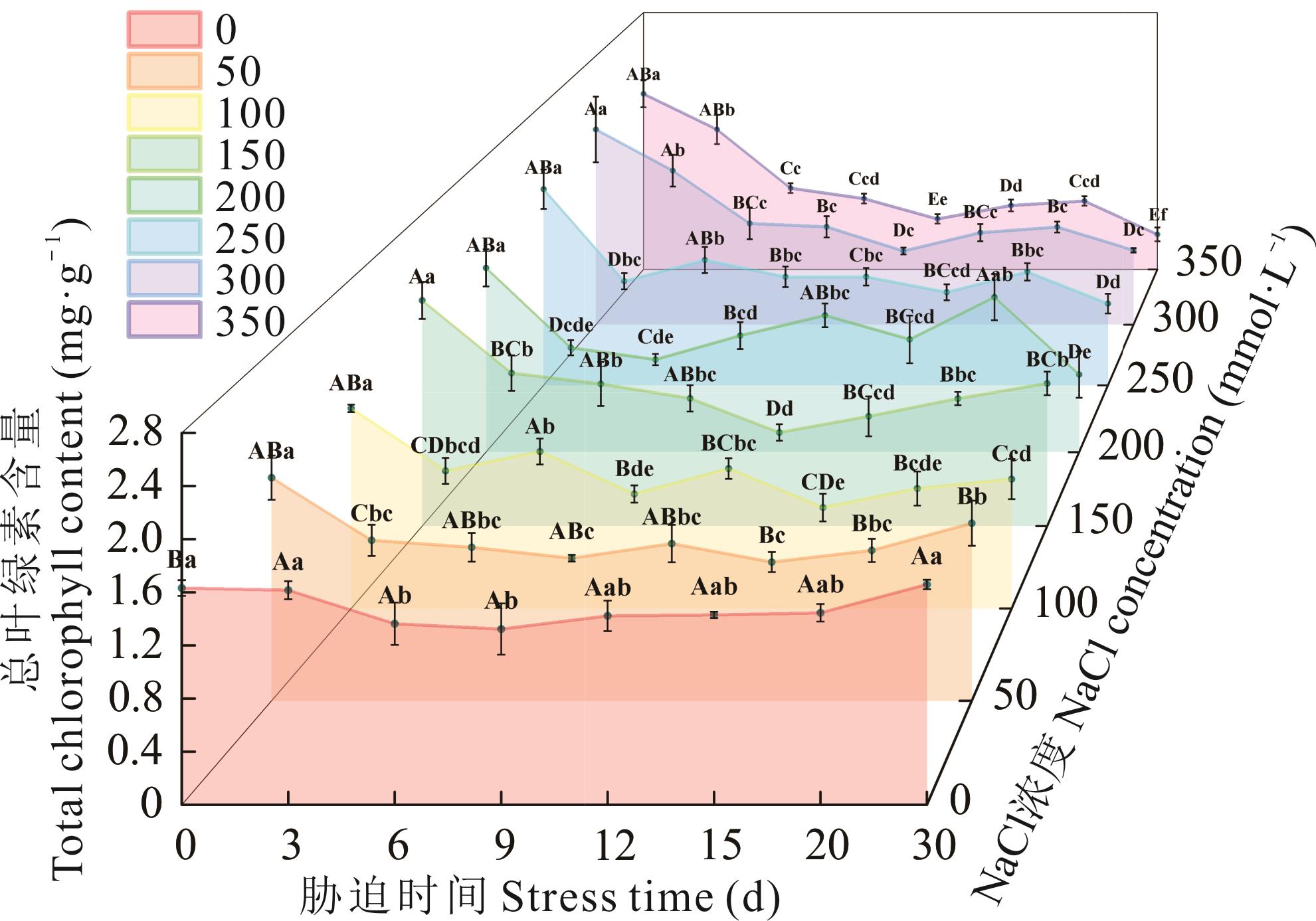
图4 NaCl胁迫对盐生草叶绿素含量的影响不同大写字母表示同一时间节点不同NaCl浓度处理间差异显著(P<0.05),不同小写字母表示同一浓度处理不同胁迫时间差异显著(P<0.05),下同。Different capital letters indicate significant differences among different NaCl concentration treatments at the same time point (P<0.05), and different lowercase letters indicate significant differences in the same concentration treatment at different stress times (P<0.05), the same below.
Fig.4 The effect of NaCl stress on the chlorophyll content of H. glomeratus

图5 NaCl胁迫对盐生草丙二醛和可溶性糖含量的影响
Fig.5 The effect of NaCl stress on malondialdehyde and soluble sugar contents of H. glomeratus
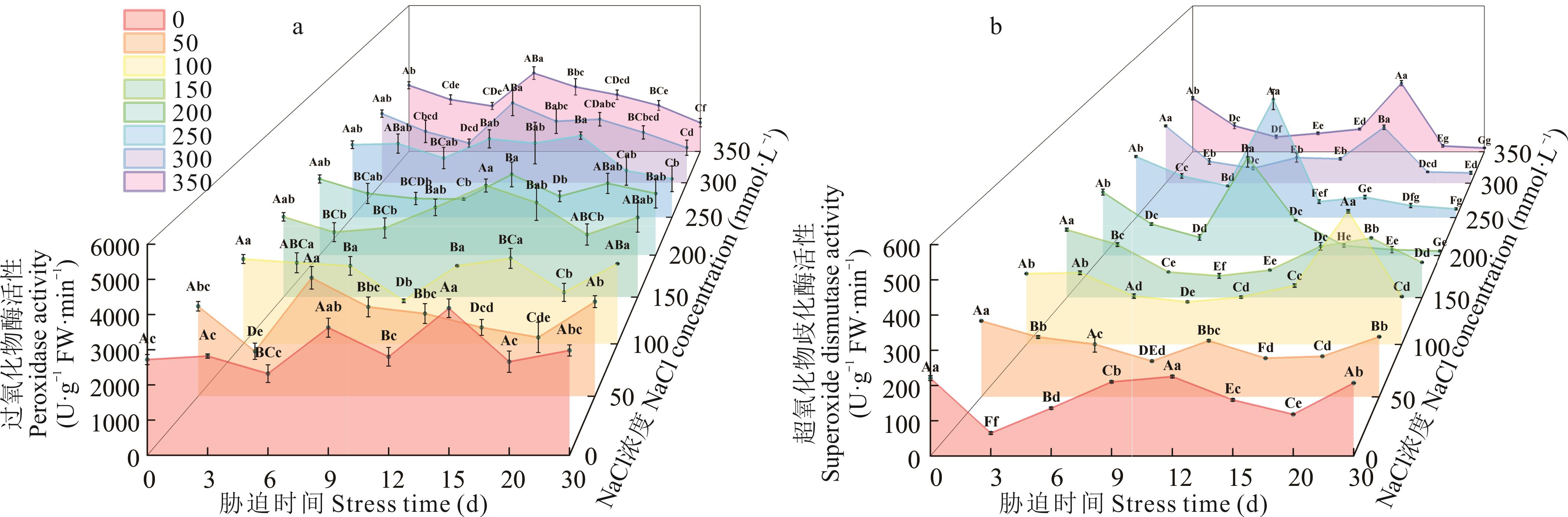
图6 NaCl胁迫对抗氧化酶活性的影响
Fig.6 The effect of NaCl stress on the activity of antioxidant enzymes

图7 NaCl胁迫下各指标主成分分析
Fig.7 Principal component analysis of each index under NaCl stress
指标 Parameter | 第一主成分Principal component 1 | 第二主成分Principal component 2 | 权重 Weight (%) | 影响顺序 Influence order | |||
|---|---|---|---|---|---|---|---|
载荷 Loading matri (x) | 特征向量 Eigenvectors | 载荷 Loading matri (x) | 特征向量 Eigenvectors | ||||
| 株高Plant height | 0.958 | 0.393 | -0.184 | -0.139 | 11.42 | 5 | |
| 根长Root length | 0.860 | 0.353 | -0.317 | -0.241 | 9.15 | 8 | |
| 地上生物量Aboveground biomass | 0.831 | 0.341 | 0.257 | 0.195 | 12.89 | 3 | |
| 地下生物量Underground biomass | 0.922 | 0.378 | -0.285 | -0.217 | 10.20 | 6 | |
| 丙二醛含量Malondialdehyde content | 0.263 | 0.108 | 0.848 | 0.644 | 9.59 | 7 | |
| 可溶性糖含量Soluble sugar content | 0.188 | 0.077 | 0.819 | 0.622 | 8.38 | 9 | |
| 叶绿素含量Chlorophyll content | 0.959 | 0.393 | -0.143 | -0.109 | 11.72 | 4 | |
| 过氧化物酶活性Peroxidase activity | 0.910 | 0.373 | 0.165 | 0.125 | 13.28 | 2 | |
| 超氧化物歧化酶活性Superoxide dismutase activity | 0.947 | 0.388 | 0.114 | 0.087 | 13.39 | 1 | |
表2 盐胁迫下盐生草叶片各指标的成分载荷矩阵、特征向量和权重分析
Table 2 Analysis of component loading matrices, eigenvectors and weights of various indicators in the leaves of H. glomeratus under salt stress
指标 Parameter | 第一主成分Principal component 1 | 第二主成分Principal component 2 | 权重 Weight (%) | 影响顺序 Influence order | |||
|---|---|---|---|---|---|---|---|
载荷 Loading matri (x) | 特征向量 Eigenvectors | 载荷 Loading matri (x) | 特征向量 Eigenvectors | ||||
| 株高Plant height | 0.958 | 0.393 | -0.184 | -0.139 | 11.42 | 5 | |
| 根长Root length | 0.860 | 0.353 | -0.317 | -0.241 | 9.15 | 8 | |
| 地上生物量Aboveground biomass | 0.831 | 0.341 | 0.257 | 0.195 | 12.89 | 3 | |
| 地下生物量Underground biomass | 0.922 | 0.378 | -0.285 | -0.217 | 10.20 | 6 | |
| 丙二醛含量Malondialdehyde content | 0.263 | 0.108 | 0.848 | 0.644 | 9.59 | 7 | |
| 可溶性糖含量Soluble sugar content | 0.188 | 0.077 | 0.819 | 0.622 | 8.38 | 9 | |
| 叶绿素含量Chlorophyll content | 0.959 | 0.393 | -0.143 | -0.109 | 11.72 | 4 | |
| 过氧化物酶活性Peroxidase activity | 0.910 | 0.373 | 0.165 | 0.125 | 13.28 | 2 | |
| 超氧化物歧化酶活性Superoxide dismutase activity | 0.947 | 0.388 | 0.114 | 0.087 | 13.39 | 1 | |
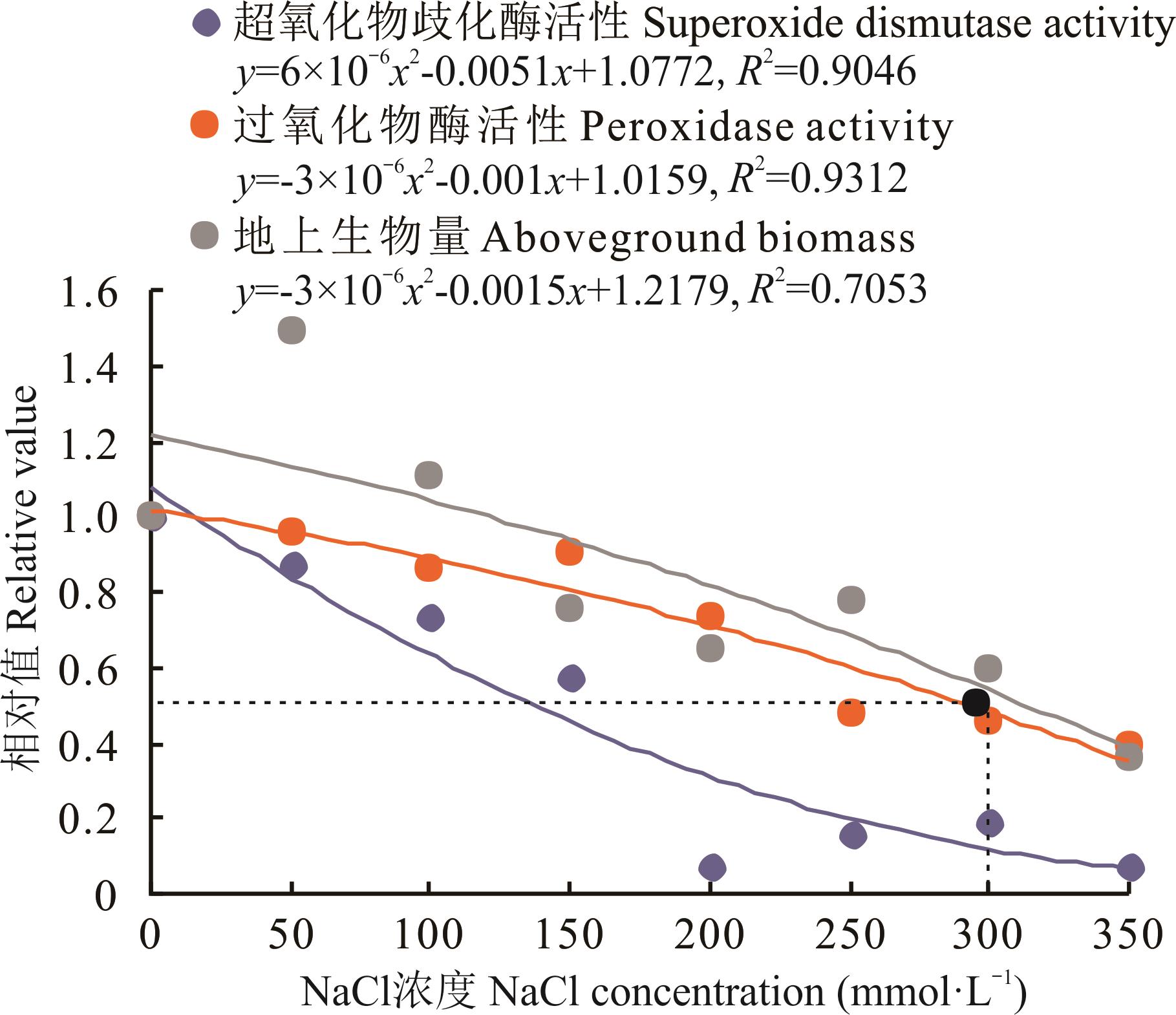
图8 盐生草耐盐阈值计算
Fig.8 Calculation of the salt tolerance threshold of H. glomeratus
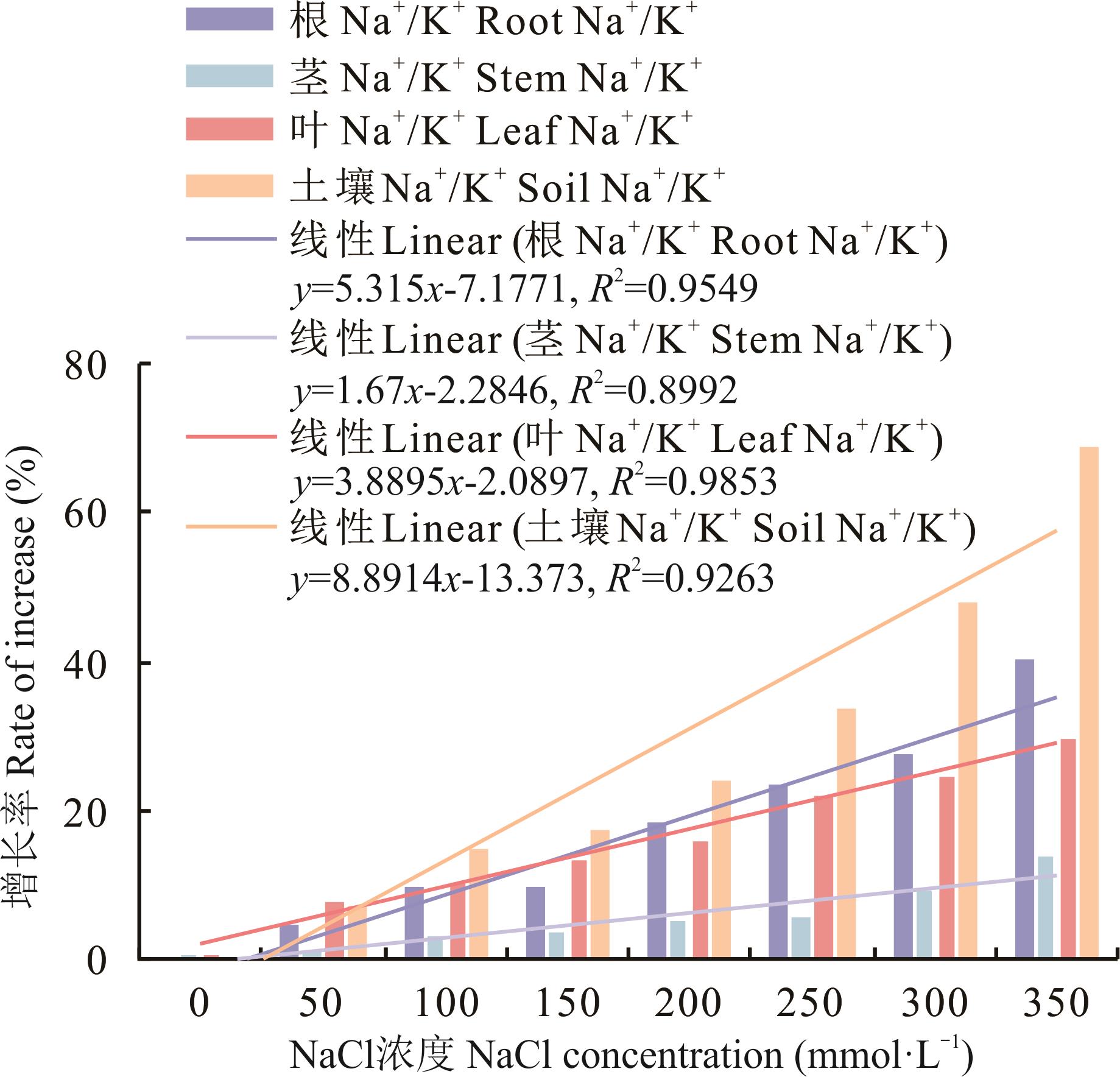
图9 NaCl胁迫对盐生草根、茎、叶、土壤Na+/K+增长率的影响
Fig.9 The effect of NaCl stress on the Na+/K+ growth rate of roots, stems, leaves and soil of H. glomeratus
| [1] | Yao D, Niu S Q, Zhao Q, et al. Induced salt tolerance of ryegrass by Bacillus subtilis strain WM13-24 from the rhizosphere of Haloxylon ammodendron. Acta Ecologica Sinica, 2020, 40(20): 7419-7429. |
| 姚丹, 牛舒琪, 赵祺, 等. 梭梭根际枯草芽孢杆菌WM13-24对多年生黑麦草耐盐性的影响. 生态学报, 2020, 40(20): 7419-7429. | |
| [2] | He J J, Yao L R, Wang J C, et al. Effects of drought and salt stress on seed germination characteristics of Halogeton glomeratus. Acta Prataculturae Sinica, 2020, 29(11): 129-140. |
| 何建军, 姚立蓉, 汪军成, 等. 干旱和盐胁迫对盐生植物盐生草种子萌发特性的影响. 草业学报, 2020, 29(11): 129-140. | |
| [3] | Wu C, Yin Y L, Yang X M, et al. A Markov-based model for predicting the development trend of soil microbial communities in saline-alkali land in Wudi County. Concurrency and Computation: Practice and Experience, 2019, 31(10): e4754. |
| [4] | Huang J, Kong Y L, Xu Q S, et al. Progresses for characteristics and amelioration measures of saline soil. Soils, 2022, 54(1): 18-23. |
| 黄晶, 孔亚丽, 徐青山, 等. 盐渍土壤特征及改良措施研究进展. 土壤, 2022, 54(1): 18-23. | |
| [5] | Gong Z Z, Xiong L M, Shi H Z, et al. Plant abiotic stress response and nutrient use efficiency. Science China Life Sciences, 2020, 63(5): 635-674. |
| [6] | Lu A Q, Zhang F J, Wang X Q, et al. Effects of NaCl and Na2SO4 stress on content and distribution of K+ and Na+ of Echinochloa frumentacea seedlings. Acta Agriculturae Zhejiangensis, 2021, 33(3): 396-403. |
| 陆安桥, 张峰举, 王学琴, 等. 盐胁迫对苗期湖南稷子K+、Na+含量与分布的影响. 浙江农业学报, 2021, 33(3): 396-403. | |
| [7] | Wang Y F, Xue Y W, Yang K J, et al. Effects of NaCl stress on ion contents in different organs of maize (Zea mays L.) seed-lings. Chinese Journal of Ecology, 2011, 30(8): 1654-1661. |
| 王玉凤, 薛盈文, 杨克军, 等. NaCl胁迫对玉米幼苗不同器官离子含量的影响. 生态学杂志, 2011, 30(8): 1654-1661. | |
| [8] | Liu H, Zhang F L, Tian H J, et al. Response of different maize varieties to salt stress and screening of salt tolerance. Journal of Maize Sciences, 2024, 32(4): 39-45, 54. |
| 刘鸿, 张富来, 田慧娟, 等. 不同玉米品种对盐胁迫的响应及耐盐性筛选. 玉米科学, 2024, 32(4): 39-45, 54. | |
| [9] | Zhang Z H, Yao L R, Wang J C, et al. Identification of AKR gene family members in Halogeton glomeratus and salt tolerance analysis of the root salt stress response gene HgAKR42639. Acta Prataculturae Sinica, 2024, 33(7): 68-83. |
| 张震欢, 姚立蓉, 汪军成, 等. 盐生草AKR基因家族成员的鉴定及根系盐胁迫响应基因HgAKR42639的耐盐分析. 草业学报, 2024, 33(7): 68-83. | |
| [10] | Huang Z L, Wang J C, Yao L R, et al. Research progress on salt tolerance mechanism of dilute salt halophytes. Journal of Gansu Agricultural University, 2022, 57(2): 1-10. |
| 黄志磊, 汪军成, 姚立蓉, 等. 稀盐盐生植物的耐盐机理研究进展. 甘肃农业大学学报, 2022, 57(2): 1-10. | |
| [11] | Li B C, Wang J C, Yao L R, et al. Halophyte Halogeton glomeratus, a promising candidate for phytoremediation of heavy metal-contaminated saline soils. Plant Soil, 2019, 442: 323-331. |
| [12] | Hu N, Li B C, Yao L R, et al. Effects of different heavy metals on the seed germination and establishment of Halogeton glomeratus. Acta Prataculturae Sinica, 2019, 28(6): 66-81. |
| 胡娜, 李葆春, 姚立蓉, 等. 不同重金属胁迫对盐生草种子萌发特性的影响. 草业学报, 2019, 28(6): 66-81. | |
| [13] | Zhang J, Mao C L, Khan A, et al. Enhanced methane production by using phytoremediated Halogeton glomeratus as substrate via anaerobic digestion. Renewable Energy, 2022, 194(1): 28-39. |
| [14] | Wang B S, Zhao K F. Comparison of extractive methods of Na and K in wheat leaves. Plant Physiology Communications, 1995, 31(1): 50-52. |
| 王宝山, 赵可夫. 小麦叶片中Na、K提取方法的比较. 植物生理学通讯, 1995, 31(1): 50-52. | |
| [15] | Li H S. Principle and technology of plant physiology and biochemical experiments. Beijing: Higher Education Press, 2000. |
| 李合生. 植物生理生化试验原理和技术. 北京: 高等教育出版社, 2000. | |
| [16] | Ren H, Fu L D, Wang Y, et al. Effects of silicon fertilizer and basic seedling distribution on growth, yield and quality of rice. Soil and Fertilizer Sciences in China, 2019(1): 108-116. |
| 任海, 付立东, 王宇, 等. 硅肥与基本苗配置对水稻生长发育、产量及品质的影响. 中国土壤与肥料, 2019(1): 108-116. | |
| [17] | Sun Z H, Ren H, Wang H Z, et al. Effects of foliar silicon sprays on leaf photosynthetic performance and grain yield of summer maize in coastal saline-alkali soil. Acta Agronomica Sinica, 2024, 50(9): 2383-2395. |
| 孙照华, 任昊, 王洪章, 等. 叶面喷施硅制剂对滨海盐碱地夏玉米叶片光合性能及籽粒产量的影响. 作物学报, 2024, 50(9): 2383-2395. | |
| [18] | Li J J, Xu X W, Zang Y, et al. Evaluation of major agronomic traits and nutritional quality of forage barley varieties in the Nanjing region. Acta Prataculturae Sinica, 2026, 35(3): 114-127. |
| 李建建, 徐夕雯, 张源, 等. 南京地区饲用大麦主要农艺性状与营养品质评价. 草业学报, 2026, 35(3): 114-127. | |
| [19] | Qian Y L, Wilhelm S J, Marcum K B. Comparative responses of two Kentucky bluegrass cultivars to salinity stress. Crop Science, 2001, 41(6): 1895-1900. |
| [20] | Suplick-Ploense M R, Qian Y L, Read J C. Relative NaCl tolerance of Kentucky bluegrass, Texas bluegrass, and their hybrids. Crop Science, 2002, 42(6): 2025-2030. |
| [21] | Zhao X T, Wang Y S, Duan J, et al. Effects of salt stress on growth and photosynthetic characteristics of Magnolia wufengensis grafted seedlings. Scientia Silvae Sincae, 2021, 57(4): 43-53. |
| 赵秀婷, 王延双, 段劼, 等. 盐胁迫对红花玉兰嫁接苗生长和光合特性的影响. 林业科学, 2021, 57(4): 43-53. | |
| [22] | Wu Y, Tian Y, Song Y T. The effects of different salt concentrations on the growth and ion accumulation of early-stage Medicago falcata. Chinese Journal of Grassland, 2019, 41(4): 39-44. |
| 武祎, 田雨, 宋彦涛. 不同盐分对黄花苜蓿早期幼苗生长及离子积累的影响. 中国草地学报, 2019, 41(4): 39-44. | |
| [23] | Krishnamurthy S L, Gautam R K, Sharma P C, et al. Effect of different salt stresses on agro-morphological traits and utilisation of salt stress indices for reproductive stage salt tolerance in rice. Field Crops Research, 2016, 190: 26-33. |
| [24] | Li Y B, Han D Y, Fu R Y, et al. Effects of NaCl stress on morphology and related physiological indexes of Carex subpediformis. Pratacultural Science, 2022, 39(3): 529-537. |
| 李英博, 韩戴宇, 付如裕, 等. NaCl胁迫对亚柄薹草形态和相关生理指标的影响. 草业科学, 2022, 39(3): 529-537. | |
| [25] | Wang M M, Zhao G Q, Liang G L, et al. Physiological response of different salt-tolerant oats to salt stress. Pratacultural Science, 2021, 38(11): 2200-2209. |
| 王苗苗, 赵桂琴, 梁国玲, 等. 不同耐盐性燕麦对盐胁迫的生理响应. 草业科学, 2021, 38(11): 2200-2209. | |
| [26] | Yuan Y H. Study on physiological response and adaptive mechanism of broomcorn millet (Panicum miliaceum L.) under salt stress. Yangling: Northwest A & F University, 2022. |
| 袁雨豪. 盐胁迫下糜子的生理响应及适应机制研究. 杨凌: 西北农林科技大学, 2022. | |
| [27] | Gao Y K, Yang P Y, Xiang X D, et al. Response of different salt tolerant sorghum varieties to salt stress in the whole growth period. Acta Agriculturae Boreali-Sinica, 2020, 35(6): 113-121. |
| 高玉坤, 杨溥原, 项晓冬, 等. 不同耐盐高粱品种全生育期对盐胁迫的响应. 华北农学报, 2020, 35(6): 113-121. | |
| [28] | Gao S Y, Liu W J, Li Y Y, et al. Physiological and biochemical responses of Bothriochloa ischaemum seedlings to salt stress at seedling stage and definition of salt tolerance threshold. Acta Prataculturae Sinica, 2025, 34(3): 164-174. |
| 高守舆, 刘文静, 李钰莹, 等. 苗期白羊草对盐胁迫的生理生化响应及其耐盐阈值的界定. 草业学报, 2025, 34(3): 164-174. | |
| [29] | Li R Q, Wang Y X, Sun Y L, et al. Effects of salt stress on the growth, physiology, and biochemistry of five Bromus inermis varieties. Acta Prataculturae Sinica, 2023, 32(1): 99-111. |
| 李瑞强, 王玉祥, 孙玉兰, 等. 盐胁迫对5份无芒雀麦苗期生长和生理生化的影响及综合性评价. 草业学报, 2023, 32(1): 99-111. | |
| [30] | Liu B S, Kang C L, Wang X, et al. Physiological and biochemical response characteristics of Leymus chinensis to saline-alkali stress. Transactions of the Chinese Society of Agricultural Engineering, 2014, 30(23): 166-173. |
| 刘滨硕, 康春莉, 王鑫, 等. 羊草对盐碱胁迫的生理生化响应特征. 农业工程学报, 2014, 30(23): 166-173. | |
| [31] | Wang Z D. Characterization of phenotype traits, salt tolerance and genetic composition of new triticale strains. Tai’an: Shandong Agricultural University, 2022. |
| 王紫铎. 小黑麦新品系农艺性状、耐盐特性分析及遗传组成鉴定. 泰安: 山东农业大学, 2022. | |
| [32] | Su X L, Shu X, Wang X Y, et al. Effects of exogenous melatonin on seed germination and seedling growth of Elymus sibiricus under NaCl stress. Pratacultural Science, 2023, 40(10): 2595-2606. |
| 苏晓丽, 舒欣, 王晓耘, 等. 外源褪黑素对NaCl胁迫下老芒麦种子萌发和幼苗生长的影响. 草业科学, 2023, 40(10): 2595-2606. | |
| [33] | Zhang M R, Ma J B, Yao Y A, et al. Responses of physiological traits of Salicornia european to NaCl stress. Journal of Desert Research, 2014, 34(2): 441-447. |
| 张梅茹, 马金彪, 姚银安, 等. 盐角草(Salicornia europaea)对NaCl处理的生理响应. 中国沙漠, 2014, 34(2): 441-447. | |
| [34] | Lyu S L, Jiang P, Chen X Y, et al. Multiple compartmentalization of sodium conferred salt tolerance in Salicornia europaea. Plant Physiology and Biochemistry, 2012, 51: 47-52. |
| [35] | Wang J C. Study on the salt tolerance mechanisms of ion compartmentation in halophyte Halogeton glomeratus. Lanzhou: Gansu Agricultural University, 2017. |
| 汪军成. 盐生草盐分区隔化耐盐机制研究. 兰州: 甘肃农业大学, 2017. | |
| [36] | Wang X T. Physiological response of Chenopodium album L. to different concentrations of NaHCO3 stress. Changchun: Northeast Normal University, 2020. |
| 王献田. 藜对不同浓度NaHCO3胁迫的生理反应. 长春: 东北师范大学, 2020. | |
| [37] | Hao H, Cao L, Chen W N, et al. Effects of salt stress on the ion balance and physiological-biochemical characteristics of Quercus dentata seedlings. Acta Ecologica Sinica, 2020, 40(19): 6897-6904. |
| 郝汉, 曹磊, 陈伟楠, 等. 盐胁迫对槲树(Quercus dentata)幼苗离子平衡及其生理生化特性的影响. 生态学报, 2020, 40(19): 6897-6904. | |
| [38] | Croft H, Chen J M, Luo X Z, et al. Leaf chlorophyll content as a proxy for leaf photosynthetic capacity. Global Change Biology,2017, 23(9): 3513-3524. |
| [39] | Jiang Y, Zhou M, Wu Y, et al. Evaluation of salt tolerance and its underlying physiological mechanisms in different oats. Pratacultural Science, 2018, 35(12): 2903-2914. |
| 姜瑛, 周萌, 吴越, 等. 不同燕麦品种耐盐性差异及其生理机制. 草业科学, 2018, 35(12): 2903-2914. | |
| [40] | Li S, Wang A Y, Jiao Z, et al. Physiological and chemical characteristics and transcriptome analysis of different type of wheat seedlings under salt stress. Journal of Agricultural Science and Technology, 2024, 26(2): 20-32. |
| 李双, 王爱英, 焦浈, 等. 盐胁迫下不同抗性小麦幼苗生理生化特性及转录组分析. 中国农业科技导报, 2024, 26(2): 20-32. | |
| [41] | Ashraf M, Harris P J C. Potential biochemical indicators of salinity tolerance in plant. Plant Science, 2004, 166(1): 3-16. |
| [42] | Yang Y J, Zheng W, Tian Y, et al. Effects of various mixed salt-alkaline stresses on growth, photosynthesis, and photosynthetic pigment concentrations of Medicago ruthenica seedlings. Photosynthetica, 2011, 49(2): 275-284. |
| [43] | Sofia L C, Karina G, Nacira M, et al. Oxidative damage and antioxidant defenses as potential indicators of salt-tolerant Cenchrus ciliaris L.genotypes. Flora, 2010, 205(9): 622-626. |
| [44] | Liu A R, Zhang Y B, Huang S C, et al. Comparison of stress effects of NaCl and Na2CO3 on seed germination and seedling growth of Festuca arundinacea Schreb. Chinese Journal of Tropical Crops, 2011, 32(6): 1064-1068. |
| 刘爱荣, 张远兵, 黄守程, 等. NaCl与Na2CO3对高羊茅种子萌发及幼苗生长胁迫效应比较. 热带作物学报, 2011, 32(6): 1064-1068. | |
| [45] | Wang Y, Wang Y T, Yang R F, et al. Effects of gibberellin priming on seedling emergence and transcripts involved in mesocotyl elongation in rice under deep direct-seeding conditions. Journal of Zhejiang University-Science (Biomedicine & Biotechnology), 2021, 22(12): 1002-1021. |
| [46] | Yuan H, Zhang X H, Han X Q, et al. Effects of salt and alkali stress on biomass and physiological characteristics of four Phleum pratense at seedling stage. Acta Agrestia Sinica, 2024, 32(4): 1184-1193. |
| 袁惠, 张鲜花, 韩禧卿, 等. 盐、碱胁迫对4份梯牧草苗期生物量及生理特性的影响. 草地学报, 2024, 32(4): 1184-1193. | |
| [47] | Li Y, Yu L J, Jin X X. Mechanism of heavy metal tolerance stress of plants. China Biotechnology, 2015, 35(9): 94-104. |
| 李洋, 于丽杰, 金晓霞. 植物重金属胁迫耐受机制. 中国生物工程杂志, 2015, 35(9): 94-104. | |
| [48] | Wang N. Biological response of different maize varieties at seedling to salt stress and mechanism of tolerance. Shenyang: Shenyang Agricultural University, 2009. |
| 王宁. 不同玉米品种苗期对盐胁迫的生物学响应及耐性机制研究. 沈阳: 沈阳农业大学, 2009. | |
| [49] | Meng C, Lu X L, Song Y R, et al. Evaluation and identification of salt tolerance of 11 Leonurus germplasm lines at the seedling stage. Acta Prataculturae Sinica, 2024, 33(5): 196-203. |
| 孟晨, 鲁雪莉, 宋亦汝, 等. 11份益母草种质材料苗期耐盐性评价与鉴定. 草业学报, 2024, 33(5): 196-203. | |
| [50] | Chen X H. Identification and tolerance mechanism of common millet (Panicum miliaceum L.) in neutral mixed salts. Jinzhong: Shanxi Agricultural University, 2022. |
| 陈小红. 糜子耐中性混合盐鉴定与耐盐机制研究. 晋中: 山西农业大学, 2022. | |
| [51] | Li X K, Wu C N, Wang W, et al. Screening and evaluation of salt-tolerant germplasm of synthetic hexaploid wheat. Journal of Triticeae Crops, 2021, 41(12): 1487-1495. |
| 李小康, 吴崇宁, 王维, 等. 人工合成六倍体小麦耐盐种质资源的筛选及评价. 麦类作物学报, 2021, 41(12): 1487-1495. | |
| [52] | Jia X P, Deng Y M, Sun X B, et al. Impacts of salt stress on the growth and physiological characteristics of Paspalum vaginatum. Acta Prataculturae Sinica, 2015, 24(12): 204-212. |
| 贾新平, 邓衍明, 孙晓波, 等. 盐胁迫对海滨雀稗生长和生理特性的影响. 草业学报, 2015, 24(12): 204-212. |
| [1] | 金敏, 李敏, 黑金霞, 张桂银, 张峰举, 陈淑娟, 毛桂莲. 不同浓度NaCl 处理对4种耐盐植物根系形态的影响及耐盐性评价[J]. 草业学报, 2026, 35(9): 75-86. |
| [2] | 娄凯欣, 种培芳, 包新光, 肖金亭, 杨佳丽. 桑树肠杆菌对盐胁迫下红砂幼苗的促生效应及根际机理[J]. 草业学报, 2026, 35(9): 87-99. |
| [3] | 李若鸿, 李长然, 傅佳怡, 胡新雨, 毛培胜. 纳米铁引发和生物炭结壳包衣对中华羊茅种子萌发和幼苗生长耐盐性的影响[J]. 草业学报, 2026, 35(8): 32-44. |
| [4] | 杨金辉, 王晓彤, 马永龙, 余冬雯, 童玉花, 李淑霞. 喷施纳米氧化铈对紫花苜蓿幼苗耐盐性的影响[J]. 草业学报, 2026, 35(8): 45-54. |
| [5] | 魏明, 吴欣蕊, 吴璇, 李昊, 伍国强, 张伟杰, 程子义. 甜菜碱醛脱氢酶基因BvBADH2的克隆及在植物盐胁迫中的作用[J]. 草业学报, 2026, 35(5): 185-195. |
| [6] | 王一博, 明雪花, 张建勇, 袁琦, 杜建明, 王斌, 王腾飞, 张译尹, 兰剑, 牟乐. 宁夏干旱区燕麦新种质生产性能和种子产量综合评价研究[J]. 草业学报, 2026, 35(4): 86-99. |
| [7] | 李建建, 徐夕雯, 张源, 王欢, 王浩然, 李晓慧, 沈会权, 沈绍斌, 宗俊勤, 郭海林. 南京地区饲用大麦主要农艺性状与营养品质评价[J]. 草业学报, 2026, 35(3): 114-127. |
| [8] | 马祥, 李中兴, 杨容尘, 琚泽亮, 贾志锋, 杨培志. 盐胁迫对不同耐盐性燕麦糖类及内源激素含量变化的影响[J]. 草业学报, 2026, 35(3): 235-244. |
| [9] | 祁浩乐, 王思宁, 李晓霞, 石凤翎. 野牛草种质耐盐性综合评价及评价模型的初步构建[J]. 草业学报, 2026, 35(1): 119-129. |
| [10] | 刘沂欣, 隋晓青, 王鑫尧, 郎梦卿, 孙凌子寅, 吉尔尔格. 外源褪黑素对盐胁迫下紫花苜蓿的缓解作用[J]. 草业学报, 2025, 34(9): 206-214. |
| [11] | 张晴晴, 马兴羽, 鲁艳, 赵广兴, 曾凡江, 黄彩变. 沙化盐渍土地不同生长时期油莎豆的耐盐性差异研究[J]. 草业学报, 2025, 34(6): 168-180. |
| [12] | 郭楠, 杜鹉辰, 纪守坤, 刘建, 崔素倩, 袁辉, 韩旭, 刘计双, 高立杰. 施肥和补播对山地草甸牧草营养及瘤胃发酵的影响[J]. 草业学报, 2025, 34(4): 150-163. |
| [13] | 高守舆, 刘文静, 李钰莹, 向清源, 许佳俊, 舒蕾淇, 李肇中. 苗期白羊草对盐胁迫的生理生化响应及其耐盐阈值的界定[J]. 草业学报, 2025, 34(3): 164-174. |
| [14] | 汪欣瑶, 彭亚萍, 姚立蓉, 汪军成, 司二静, 张宏, 杨轲, 马小乐, 孟亚雄, 王化俊, 李葆春. 盐生草HgS5基因的克隆与抗旱性鉴定[J]. 草业学报, 2025, 34(2): 184-195. |
| [15] | 郭常英, 杜文华. 小黑麦及其近缘种花序及穗部特征差异[J]. 草业学报, 2025, 34(11): 205-216. |
| 阅读次数 | ||||||
|
全文 |
|
|||||
|
摘要 |
|
|||||
