

ISSN 1004-5759 CN 62-1105/S
草业学报 ›› 2026, Vol. 35 ›› Issue (9): 87-99.DOI: 10.11686/cyxb2025392
娄凯欣( ), 种培芳(), 包新光, 肖金亭, 杨佳丽
收稿日期:2025-09-24
修回日期:2025-11-03
出版日期:2026-09-20
发布日期:2026-07-27
通讯作者:
种培芳
作者简介:Corresponding author. E-mail: zhongpf@gsau.edu.cn基金资助:
Kai-xin LOU(), Pei-fang CHONG(), Xin-guang BAO, Jin-ting XIAO, Jia-li YANG
Received:2025-09-24
Revised:2025-11-03
Online:2026-09-20
Published:2026-07-27
Contact:
Pei-fang CHONG
摘要:
为探究盐胁迫下植物根际促生菌(PGPR)对荒漠植物红砂幼苗的促生效应和根际机理,本研究以PGPR桑树肠杆菌菌株P4为对象,采用盆栽试验研究了接种P4对红砂幼苗生长、生理指标、磷元素功能基因丰度和土壤特性的影响。结果显示:1)在400 mmol·L-1 NaCl胁迫下,接种桑树肠杆菌P4后,红砂幼苗总根长和生物量均显著增加(P<0.05)。与盐处理组相比,接种P4后总根长显著增加了16.5%。同时,红砂幼苗的根干重、茎干重、叶干重分别较盐处理组显著提升了74.19%、160.71%、92.54%。2)接种桑树肠杆菌P4后红砂幼苗的可溶性糖和可溶性蛋白的含量较盐处理组分别显著增加64.30%、18.63%,丙二醛含量较盐处理组显著降低25.41%,脯氨酸含量下降了3.72%。3)接种桑树肠杆菌P4后蔗糖酶和磷酸酶活性较盐处理组分别显著增加了89.64%、51.06%,淀粉酶、脲酶、过氧化氢酶活性则分别显著降低27.90%、43.87%、3.03%。4)盐处理组显著抑制了红砂根际土壤磷循环功能基因(gcd、pqqC、ppx、phoD和phoX)的表达,而接种肠杆菌P4则能显著提高其功能基因丰度。总之,P4能够刺激土壤微生物的酶合成能力、维持酶活性、提升磷循环功能基因的表达水平,使红砂幼苗通过积累渗透调节物质维持细胞膨压,从而增强耐盐性。
娄凯欣, 种培芳, 包新光, 肖金亭, 杨佳丽. 桑树肠杆菌对盐胁迫下红砂幼苗的促生效应及根际机理[J]. 草业学报, 2026, 35(9): 87-99.
Kai-xin LOU, Pei-fang CHONG, Xin-guang BAO, Jin-ting XIAO, Jia-li YANG. Growth-promoting effect of Enterobacter mori on Reaumuria songarica seedlings under salt stress and its rhizosphere mechanism[J]. Acta Prataculturae Sinica, 2026, 35(9): 87-99.
处理 Treatment | 叶鲜重 Leaf fresh weight | 茎鲜重 Stem fresh weight | 根鲜重 Root fresh weight | 叶干重 Leaf dry weight | 茎干重 Stem dry weight | 根干重 Root dry weight |
|---|---|---|---|---|---|---|
| CK | 3.26±0.25c | 1.60±0.13b | 1.34±0.06bc | 1.09±0.24b | 0.72±0.06b | 0.25±0.02b |
| P4 | 6.26±0.11a | 2.07±0.07a | 2.22±0.28a | 1.95±0.08a | 0.93±0.03a | 0.59±0.03a |
| S | 1.44±0.19d | 0.57±0.13c | 0.76±0.19c | 0.67±0.08c | 0.28±0.06c | 0.31±0.05b |
| P4+S | 4.04±0.19b | 1.56±0.07b | 1.87±0.13ab | 1.29±0.13b | 0.73±0.02b | 0.54±0.04a |
表1 接种桑树肠杆菌P4对红砂幼苗生物量的影响
Table 1 Effect of inoculation of E. mori P4 on the biomass of R. songarica seedlings (g·plant-1)
处理 Treatment | 叶鲜重 Leaf fresh weight | 茎鲜重 Stem fresh weight | 根鲜重 Root fresh weight | 叶干重 Leaf dry weight | 茎干重 Stem dry weight | 根干重 Root dry weight |
|---|---|---|---|---|---|---|
| CK | 3.26±0.25c | 1.60±0.13b | 1.34±0.06bc | 1.09±0.24b | 0.72±0.06b | 0.25±0.02b |
| P4 | 6.26±0.11a | 2.07±0.07a | 2.22±0.28a | 1.95±0.08a | 0.93±0.03a | 0.59±0.03a |
| S | 1.44±0.19d | 0.57±0.13c | 0.76±0.19c | 0.67±0.08c | 0.28±0.06c | 0.31±0.05b |
| P4+S | 4.04±0.19b | 1.56±0.07b | 1.87±0.13ab | 1.29±0.13b | 0.73±0.02b | 0.54±0.04a |
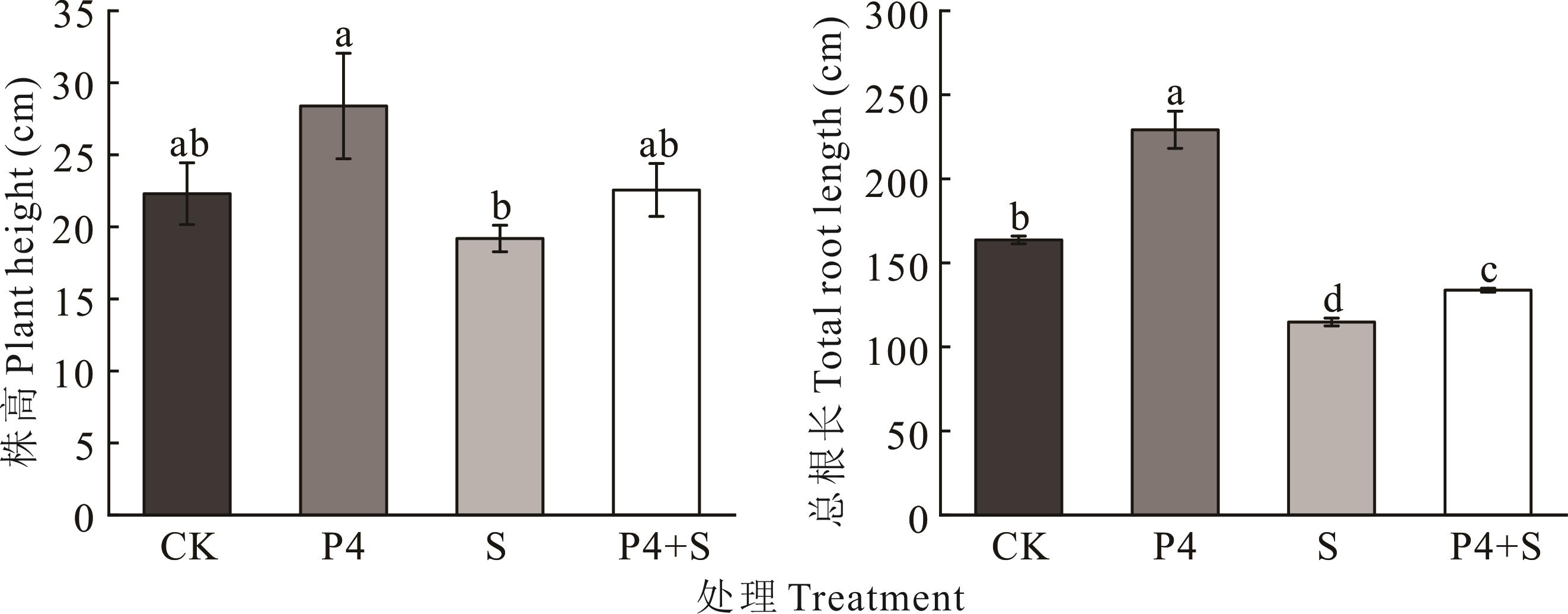
图1 接种桑树肠杆菌P4对红砂幼苗株高和总根长的影响不同小写字母代表不同处理间差异显著(P<0.05),下同。Different lowercase letters represent significant differences among different treatments (P<0.05), the same below.
Fig.1 Effect of inoculation of E. mori P4 on the plant height and total root length of R. songarica seedlings

图2 接种桑树肠杆菌P4对红砂幼苗根际土壤理化性质的影响
Fig.2 Effect of inoculation of E. mori P4 on the physical and chemical properties of rhizosphere soil of R. songarica seedlings

图3 接种桑树肠杆菌P4对红砂幼苗根际土壤酶活性的影响
Fig.3 Effect of inoculation of E. mori P4 on the enzyme activity of rhizosphere soil of R. songarica seedlings

图4 接种桑树肠杆菌P4对红砂幼苗叶片渗透调节物质和丙二醛含量的影响
Fig.4 Effect of inoculation of E. mori P4 on the osmotic regulatory substances and malondialdehyde content in leaves of R. songarica seedlings

图5 接种桑树肠杆菌P4对磷循环相关功能基因丰度的影响
Fig.5 Effect of inoculation of E.mori P4 on the abundance of phosphorus cycling related functional genes

图6 盐胁迫下接种桑树肠杆菌P4对红砂幼苗系统多指标关联性的影响PH: 株高Plant height; TRL: 总根长Total root length; LDW: 叶干重Leaf dry weight; SDW: 茎干重Stem dry weight; RDW: 根干重Root dry weight; STP: 土壤全磷Soil total phosphorous; STK: 土壤全钾Soil total potassium; AP: 速效磷Available phosphorous; AK: 速效钾Available potassium; EC: 电导率Electrical conductivity; SOM: 土壤有机质Soil organic matter; AA: 淀粉酶活性Amylase activity; SA: 蔗糖酶活性Sucrase activity; UA: 脲酶活性Urease activity; APA: 磷酸酶活性Phosphatase activity; CA: 过氧化氢酶活性Catalase activity; SS: 可溶性糖Soluble sugar; SP: 可溶性蛋白Soluble protein; Pro: 脯氨酸Proline; MDA: 丙二醛Molondialdehyde. *: P≤0.05; ***: P≤0.001.
Fig.6 Effect of inoculation of E. mori P4 under salt stress on the correlation of multiple indicators of R. songarica seedlings system
| [1] | Food and Agriculture Organization of the United Nations (FAO). Global map of salt-affected soils. (2021-10-21)[2025-09-20]. https://openknowledge.fao.org/handle/20.500.14283/cb7247en. |
| [2] | Yang J S, Yao R J, Wang X P, et al. Research on salt-affected soils in China: History, status quo and prospect. Acta Pedologica Sinica, 2022, 59(1): 10-27. |
| 杨劲松, 姚荣江, 王相平, 等. 中国盐渍土研究: 历程、现状与展望. 土壤学报, 2022, 59(1): 10-27. | |
| [3] | Wang Z Q, Liu F T. Saline soil in China. Beijing: Science Press, 1993. |
| 王遵亲, 刘福涛. 中国盐渍土. 北京: 科学出版社, 1993. | |
| [4] | Munns R, Tester M. Mechanisms of salinity tolerance. Annual Review of Plant Biology, 2008, 59: 651-681. |
| [5] | Yu Z R, Wang J W. Land salinization in China and the prevention countermeasures. Journal of Ecology and Rural Environment, 1997, 13(3): 1-5. |
| 宇振荣, 王建武. 中国土地盐碱化及其防治对策研究. 生态与农村环境学报, 1997, 13(3): 1-5. | |
| [6] | Qadir M, Quillérou E, Nangia V, et al. Economics of salt-induced land degradation and restoration. Natural Resources Forum, 2014, 38(4): 282-295. |
| [7] | Glick B R. Plant growth-promoting bacteria: mechanisms and applications. Scientifica, 2012(1): 963401. |
| [8] | Bianco C, Defez R. Medicago truncatula improves salt tolerance when nodulated by an indole-3-acetic acid-overproducing Sinorhizobium meliloti strain. Journal of Experimental Botany, 2009, 60(11): 3097-3107. |
| [9] | Vessey J K. Plant growth promoting rhizobacteria as biofertilizers. Plant and Soil, 2003, 255: 571-586. |
| [10] | Egamberdieva D, Kucharova Z. Selection for root colonising bacteria stimulating wheat growth in saline soils. Biology and Fertility of Soils, 2009, 45(6): 563-571. |
| [11] | Mukherjee S, Sen S K. Exploration of novel rhizospheric yeast isolate as fertilizing soil inoculant for improvement of maize cultivation. Journal of the Science of Food and Agriculture, 2015, 95(7): 1491-1499. |
| [12] | Amri M, Rjeibi M R, Gatrouni M, et al. Isolation, identification, and characterization of phosphate-solubilizing bacteria from Tunisian soils. Microorganisms, 2023, 11(3): 783. |
| [13] | Afzal A, Khan M Y, Zahir Z A, et al. Plant growth-promoting bacterial consortia improved the physiology and growth of maize by regulating osmolytes and antioxidants balance under salt-affected field conditions. Heliyon, 2023, 9(7): e17816. |
| [14] | Batool T, Ali S, Seleiman M F, et al. Plant growth promoting rhizobacteria alleviates drought stress in potato in response to suppressive oxidative stress and antioxidant enzymes activities. Scientific Reports, 2020, 10(1): 16975. |
| [15] | Neshat M, Abbasi A, Hosseinzadeh A, et al. Plant growth promoting bacteria (PGPR) induce antioxidant tolerance against salinity stress through biochemical and physiological mechanisms. Physiology and Molecular Biology of Plants, 2022, 28(2): 347-361. |
| [16] | Hidri R, Mahmoud O M B, Zorrig W, et al. Plant growth-promoting rhizobacteria alleviate high salinity impact on the halophyte Suaeda fruticosa by modulating antioxidant defense and soil biological activity. Frontiers in Plant Science, 2022, 13: 821475. |
| [17] | Ning Z, Lin K, Gao M, et al. Mitigation of salt stress in rice by the halotolerant plant growth-promoting bacterium Enterobacter asburiae D2. Journal of Xenobiotics, 2024, 14(1): 333-349. |
| [18] | Ma J Y, Chen T, Qiang W Y, et al. Correlations between foliar stable carbon isotope composition and environmental factors in desert plant Reaumuria soongorica (Pall.) Maxim. Journal of Integrative Plant Biology, 2005, 47(9): 1065-1073. |
| [19] | Yan Y, Guo Q, Dang X H, et al. Comparative study on sand-blocking ability of Tetraena mongolica and Reaumuria soongorica shrubs in the West Ordos area. Bulletin of Soil and Water Conservation, 2024, 44(2): 137-145, 154. |
| 闫宇, 郭强, 党晓宏, 等. 西鄂尔多斯地区四合木与红砂灌丛的阻沙能力对比研究. 水土保持通报, 2024, 44(2): 137-145, 154. | |
| [20] | Zhao X, Yang X J, Shi Y, et al. Ion absorption and distribution of symbiotic Reaumuria soongorica and Salsola passerina seedlings under NaCl stress. Acta Ecologica Sinica, 2014, 34(4): 963-972. |
| 赵昕, 杨小菊, 石勇, 等. 盐胁迫下荒漠共生植物红砂与珍珠的根茎叶中离子吸收与分配特征. 生态学报, 2014, 34(4): 963-972. | |
| [21] | Tan H J, Li X R, Zhao X, et al. Study on mechanisms of osmo regulation of Reaumuria soongorica callus in adapting to salt stress. Journal of Desert Research, 2011, 31(5): 1119-1123. |
| 谭会娟, 李新荣, 赵昕, 等. 红砂愈伤组织适应盐胁迫的渗透调节机制研究. 中国沙漠, 2011, 31(5): 1119-1123. | |
| [22] | Li N N, Du C, Ma B J, et al. Functional analysis of ion transport properties and salt tolerance mechanisms of RtHKT1 from the recretohalophyte Reaumuria trigyna. Plant and Cell Physiology, 2019, 60(1): 85-106. |
| [23] | Wang X Y, Bao X G, Zhang F, et al. Characteristics of bacterial community and soil enzyme activity in rhizosphere. Acta Agrestia Sinica, 2024, 32(12): 3764-3773. |
| 王雪莹, 包新光, 张峰, 等. 荒漠植物红砂根际土壤细菌群落特征及土壤酶活性研究. 草地学报, 2024, 32(12): 3764-3773. | |
| [24] | Zhang F, Chong P F, Bao X G, et al. Isolation and identification of four strains of Reaumuria soongorica root zone nitrogen fixing bacteria and their role in seedling growth promotion. Acta Prataculturae Sinica, 2025, 34(3): 144-153. |
| 张峰, 种培芳, 包新光, 等. 4株红砂根际固氮菌分离鉴定及对幼苗促生作用的研究. 草业学报, 2025, 34(3): 144-153. | |
| [25] | Chen J T, Aroca R, Romano D. Molecular aspects of plant salinity stress and tolerance. International Journal of Molecular Sciences, 2021, 22(9): 4918. |
| [26] | Yan S, Chong P F, Zhao M. Effect of salt stress on the photosynthetic characteristics and endogenous hormones, and: A comprehensive evaluation of salt tolerance in Reaumuria soongorica seedlings. Plant Signaling & Behavior, 2022, 17(1): 2031782. |
| [27] | Ma Q, Su S P, Li Y, et al. Effects of abscisic acid on Reaumuria soongorica seed germination under NaCl stress. Pratacultural Science, 2023, 40(4): 925-934. |
| 马强, 苏世平, 李毅, 等. 脱落酸对NaCl胁迫下红砂种子萌发的影响. 草业科学, 2023, 40(4): 925-934. | |
| [28] | Li H S. Principles and techniques of plant physiological biochemical experiment. Beijing: Higher Education Press, 2000. |
| 李合生. 植物生理生化实验原理和技术. 北京: 高等教育出版社, 2000. | |
| [29] | Bao S D. Soil and agricultural chemistry analysis. Beijing: China Agriculture Press, 2000: 30-76. |
| 鲍士旦. 土壤农化分析. 北京: 中国农业出版社, 2000: 30-76. | |
| [30] | Guan S Y. Soil enzymes and their research methods. Beijing: China Agriculture Press, 1986. |
| 关松荫. 土壤酶及其研究法. 北京: 中国农业出版社, 1986. | |
| [31] | Zheng B X, Zhu Y G, Sardans J, et al. QMEC: A tool for high-throughput quantitative assessment of microbial functional potential in C, N, P, and S biogeochemical cycling. Science China Life Sciences, 2018, 61(12): 1451-1462. |
| [32] | Livak K J, Schmittgen T D. Analysis of relative gene expression data using real-time quantitative PCR and the 2-ΔΔCT method. Methods, 2001, 25(4): 402-408. |
| [33] | Li J. Screening of plant growth promoting and salt tolerant bacteria from three desert halophytes. Kashi: Kashi University, 2023. |
| 李静. 三种荒漠盐生植物促生菌筛选及耐盐促生效果评价. 喀什: 喀什大学, 2023. | |
| [34] | Glick B R. Bacteria with ACC deaminase can promote plant growth and help to feed the world. Microbiological Research, 2014, 169(1): 30-39. |
| [35] | Peng M. Isolation of Enterobacter cancerogenus JY65 and its molecular mechanism of alleviating NaCl stress in rice. Harbin: Northeast Forestry University, 2021. |
| 彭木. 生癌肠杆菌JY65的分离及其缓解水稻NaCl胁迫的分子机制解析. 哈尔滨: 东北林业大学, 2021. | |
| [36] | Nascimento F X, Rossi M J, Glick B R. Ethylene and 1-aminocyclopropane-1-carboxylate (ACC) in plant-bacterial interactions. Frontiers in Plant Science, 2018, 9: 114. |
| [37] | Ali S, Charles T C, Glick B R, et al. ACC deaminase activity in Pseudomonas spp. improves tomato growth under salinity. Plant and Soil, 2014, 374(1/2): 45-56. |
| [38] | Zhu J K. Salt and drought stress signal transduction in plants. Annual Review of Plant Biology, 2002, 53: 247-273. |
| [39] | Chieb M, Gachomo E W. The role of plant growth promoting rhizobacteria in plant drought stress responses. BMC Plant Biology, 2023, 23(1): 407. |
| [40] | Szabados L, Savouré A. Proline: A multifunctional amino acid. Trends in Plant Science, 2010, 15(2): 89-97. |
| [41] | Liu Y F, Peng H, Wang W W, et al. Research progress on physiological and molecular mechanisms of plant salt tolerance. Jiangsu Agricultural Sciences, 2019, 47(12): 30-36. |
| 刘云芬, 彭华, 王薇薇, 等. 植物耐盐性生理与分子机制研究进展. 江苏农业科学, 2019, 47(12): 30-36. | |
| [42] | Gill S S, Tuteja N. Reactive oxygen species and antioxidant machinery in abiotic stress tolerance in crop plants. Plant Physiology and Biochemistry, 2010, 48(12): 909-930. |
| [43] | Foyer C H, Noctor G. Ascorbate and glutathione: The heart of the redox hub. Plant Physiology, 2011, 155(1): 2-18. |
| [44] | Zhao J, Xie H J, Zhang J. Microbial diversity and physicochemical properties of rhizosphere microenvironment in saline-alkali soils of the yellow river delta. Environmental Science, 2020, 41(3): 1449-1455. |
| 赵娇, 谢慧君, 张建. 黄河三角洲盐碱土根际微环境的微生物多样性及理化性质分析. 环境科学, 2020, 41(3): 1449-1455. | |
| [45] | Singh R P, Jha P N. The multifarious PGPR Serratia marcescens CDP-13 augments induced systemic resistance and enhanced salinity tolerance of wheat (Triticum aestivum L.). PLoS One, 2016, 11(6): e0155026. |
| [46] | Chen Y H, Lin H P, Xu S Q, et al. Screening of plant growth-promoting rhizobacterium with salt tolerance from rhizosphere. Acta Microbiologica Sinica, 2025, 65(1): 150-168. |
| 陈燕鸿, 蔺红苹, 徐苏琪, 等. 植物根际促生菌的筛选及其耐盐促生效果. 微生物学报, 2025, 65(1): 150-168. | |
| [47] | Qin J Z, Qin Z F, Ni G, et al. Advances in the separate functions or cross-kingdom interactions of AMF and PGPR in enhancing plant salt tolerance. Journal of Plant Nutrition and Fertilizers, 2024, 30(7): 1354-1366. |
| 秦敬泽, 秦泽峰, 倪刚, 等. AMF和PGPR单独或“跨界”互作促进植物耐盐性的研究进展. 植物营养与肥料学报, 2024, 30(7): 1354-1366. | |
| [48] | Sharma S, Kaur J, Bhardwaj R, et al. Enterobacter-mediated pH modulation enhances phosphorus availability in saline soils. Plant and Soil, 2020, 447: 89-103. |
| [49] | Li H, Qiu Y Z, Zhang X, et al. pH regulation in the rhizosphere by beneficial bacteria. Frontiers in Plant Science, 2022, 13: 893837. |
| [50] | Burns R G, De Forest J L, Marxsen J, et al. Soil enzymes in a changing environment: Current knowledge and future directions. Soil Biology and Biochemistry, 2013, 58: 216-234. |
| [51] | Dick R P. Soil enzyme activities as indicators of soil quality. SSSA Special Publication, 1994, 35: 107-124. |
| [52] | Nannipieri P, Trasar-Cepeda C, Dick R P. Soil enzyme activity: A brief history and biochemistry as a basis for appropriate interpretations. Soil Biology and Biochemistry, 2018, 118: 1-4. |
| [53] | Allison S D, Vitousek P M. Responses of extracellular enzymes to simple and complex nutrient inputs. Soil Biology and Biochemistry, 2005, 37(5): 937-944. |
| [54] | Richardson A E, Hocking P J, Simpson R J, et al. Plant mechanisms to optimise access to soil phosphorus. Crop and Pasture Science, 2009, 60(2): 124-143. |
| [55] | Ragot S A, Kertesz M A, Bünemann E K. phoD alkaline phosphatase gene diversity in soil. Applied and Environmental Microbiology, 2015, 81(20): 7281-7289. |
| [56] | Sharma S B, Sayyed R Z, Trivedi M H, et al. Phosphate solubilizing microbes: sustainable approach for managing phosphorus deficiency in agricultural soils. SpringerPlus, 2013, 2: 587. |
| [57] | Ogawa N, Tzeng Y L, Zhou W, et al. Polyphosphate metabolism in environmental bacteria: Roles in stress survival and phosphorus cycling. Microbial Biotechnology, 2021, 14(3): 756-769. |
| [58] | Yuan H M, Zhang X X, Chen X Y, et al. Salt stress reduces microbial phosphorus availability in coastal soils. Soil Biology and Biochemistry, 2020, 142: 107721. |
| [59] | Etesami H, Jeong B R, Glick B R. Contribution of arbuscular mycorrhizal fungi, phosphate-solubilizing bacteria, and silicon to P uptake by plant. Frontiers in Plant Science, 2021, 12: 699618. |
| [1] | 金敏, 李敏, 黑金霞, 张桂银, 张峰举, 陈淑娟, 毛桂莲. 不同浓度NaCl 处理对4种耐盐植物根系形态的影响及耐盐性评价[J]. 草业学报, 2026, 35(9): 75-86. |
| [2] | 李若鸿, 李长然, 傅佳怡, 胡新雨, 毛培胜. 纳米铁引发和生物炭结壳包衣对中华羊茅种子萌发和幼苗生长耐盐性的影响[J]. 草业学报, 2026, 35(8): 32-44. |
| [3] | 杨金辉, 王晓彤, 马永龙, 余冬雯, 童玉花, 李淑霞. 喷施纳米氧化铈对紫花苜蓿幼苗耐盐性的影响[J]. 草业学报, 2026, 35(8): 45-54. |
| [4] | 魏明, 吴欣蕊, 吴璇, 李昊, 伍国强, 张伟杰, 程子义. 甜菜碱醛脱氢酶基因BvBADH2的克隆及在植物盐胁迫中的作用[J]. 草业学报, 2026, 35(5): 185-195. |
| [5] | 马祥, 李中兴, 杨容尘, 琚泽亮, 贾志锋, 杨培志. 盐胁迫对不同耐盐性燕麦糖类及内源激素含量变化的影响[J]. 草业学报, 2026, 35(3): 235-244. |
| [6] | 宋一欣, 李明源, 麦日艳古·亚生, 王继莲. 新疆高寒草地3种植物根际土壤真菌群落结构及功能多样性[J]. 草业学报, 2026, 35(2): 167-178. |
| [7] | 刘沂欣, 隋晓青, 王鑫尧, 郎梦卿, 孙凌子寅, 吉尔尔格. 外源褪黑素对盐胁迫下紫花苜蓿的缓解作用[J]. 草业学报, 2025, 34(9): 206-214. |
| [8] | 马红钰, 周小国, 王宝, 宋渝川, 艾克热木·阿不拉提江null, 蒋邵丽, 闵九洲, 赵红梅, 程军回. 准噶尔荒漠梭梭和柽柳根际土壤微生物功能基因丰度变化特征[J]. 草业学报, 2025, 34(8): 109-122. |
| [9] | 汤珊珊, 胡敏. 禾本科植物根际土壤酶活性和细菌群落结构差异[J]. 草业学报, 2025, 34(8): 99-108. |
| [10] | 王颖, 李明源, 麦日艳古·亚生null, 王继莲. 新疆托木尔峰不同植物根际土壤真菌群落结构比较研究[J]. 草业学报, 2025, 34(7): 83-94. |
| [11] | 张晴晴, 马兴羽, 鲁艳, 赵广兴, 曾凡江, 黄彩变. 沙化盐渍土地不同生长时期油莎豆的耐盐性差异研究[J]. 草业学报, 2025, 34(6): 168-180. |
| [12] | 张峰, 种培芳, 包新光, 王雪莹. 4株红砂根际固氮菌分离鉴定及对幼苗促生作用的研究[J]. 草业学报, 2025, 34(3): 144-153. |
| [13] | 陶惠赟, 杨闰艳, 李延灿, 刘亚鹏, 祁鹤兴. 黄河源区矮嵩草根际土壤微生物多样性及对环境因子的响应[J]. 草业学报, 2025, 34(12): 16-32. |
| [14] | 田戈, 南丽丽, 王利群, 马香香, 何蓉, 郭佳雨. 盐胁迫下外源ABA对红豆草幼苗生长与生理特性的影响[J]. 草业学报, 2025, 34(10): 95-106. |
| [15] | 蔡文祺, 李淑霞, 王晓彤, 宋文学, 麻旭霞, 马小梅, 李小红, 代昕瑶. 外源褪黑素与乙烯交互对盐胁迫下紫花苜蓿幼苗生长和生理特性的影响[J]. 草业学报, 2025, 34(1): 80-93. |
| 阅读次数 | ||||||
|
全文 |
|
|||||
|
摘要 |
|
|||||
