

ISSN 1004-5759 CN 62-1105/S
草业学报 ›› 2026, Vol. 35 ›› Issue (12): 103-112.DOI: 10.11686/cyxb2025496
• 研究论文 • 上一篇
陈姝妍( ), 陶思印, 杜金舆, 李耀坤, 柳广斌, 孙宝丽, 郭勇庆, 刘德武, 邓铭()
收稿日期:2025-12-03
修回日期:2026-02-04
出版日期:2026-12-20
发布日期:2026-11-02
通讯作者:
邓铭
作者简介:E-mail: dengming@scau.edu.cn基金资助:
Shu-yan CHEN(), Si-yin TAO, Jin-yu DU, Yao-kun LI, Guang-bin LIU, Bao-li SUN, Yong-qing GUO, De-wu LIU, Ming DENG()
Received:2025-12-03
Revised:2026-02-04
Online:2026-12-20
Published:2026-11-02
Contact:
Ming DENG
摘要:
为研究不同微生物协同黑曲霉对木薯渣发酵品质及微生物多样性的影响,试验以新鲜木薯渣为原料,添加0.7%尿素、8%米糠和3×10⁶ CFU·g-1黑曲霉为对照组(CK),在此基础上分别添加布氏乳杆菌(LB组)、植物乳杆菌(LP组)、鼠李糖乳杆菌(LR组)、枯草芽孢杆菌(BS组)、酿酒酵母菌(SC组),共设计5个处理,每个处理3个重复,不同微生物添加量均为1.0×10⁸ CFU·g-1,密封发酵60 d后,开包进行感官评定、品质鉴定及微生物测定。结果显示:1)各处理组的感官评分均高于16分,且pH低于4.2,其中BS组综合评分最高,发酵效果优良。2)从品质鉴定来看,各处理组的粗蛋白(CP)含量与粗脂肪(EE)含量显著提高(P<0.05),中性洗涤纤维(NDF)、酸性洗涤纤维(ADF)与NH3-N含量均较CK组显著降低(P<0.05),其中LP组与BS组的CP含量显著高于CK组(P<0.05),且BS组CP含量最高,NDF与ADF含量最低。3)各处理组与CK组的优势菌门均为厚壁菌门(占比87%~90%)、变形菌门(占比6%~9%);与CK组相比,各处理组的乳杆菌属、乳球菌属等发酵有益菌属相对丰度有所增加(P>0.05)。综上所述,不同微生物协同黑曲霉处理均能够改善木薯渣发酵品质,其中以黑曲霉和枯草芽孢杆菌混合使用效果最佳。
陈姝妍, 陶思印, 杜金舆, 李耀坤, 柳广斌, 孙宝丽, 郭勇庆, 刘德武, 邓铭. 不同微生物协同黑曲霉对木薯渣发酵品质和微生物多样性的影响[J]. 草业学报, 2026, 35(12): 103-112.
Shu-yan CHEN, Si-yin TAO, Jin-yu DU, Yao-kun LI, Guang-bin LIU, Bao-li SUN, Yong-qing GUO, De-wu LIU, Ming DENG. Effects of different microorganisms in synergy with Aspergillus niger on the fermentation quality and microbial diversity of cassava residue[J]. Acta Prataculturae Sinica, 2026, 35(12): 103-112.
原料 Ingredient | 干物质 Dry matter (DM, %) | 粗蛋白 Crude protein (%DM) | 粗脂肪 Ether extract (%DM) | 中性洗涤纤维 Neutral detergent fiber (%DM) | 酸性洗涤纤维 Acid detergent fiber (%DM) |
|---|---|---|---|---|---|
| 木薯渣Cassava residue | 15.16±0.10 | 2.36±0.08 | 6.67±0.44 | 53.46±0.98 | 25.43±1.38 |
| 米糠Rice bran | 91.00±0.14 | 12.78±0.57 | 1.37±0.29 | 32.82±1.44 | 15.35±0.90 |
表1 木薯渣和米糠的营养成分
Table 1 Nutritional composition of cassava residue and rice bran
原料 Ingredient | 干物质 Dry matter (DM, %) | 粗蛋白 Crude protein (%DM) | 粗脂肪 Ether extract (%DM) | 中性洗涤纤维 Neutral detergent fiber (%DM) | 酸性洗涤纤维 Acid detergent fiber (%DM) |
|---|---|---|---|---|---|
| 木薯渣Cassava residue | 15.16±0.10 | 2.36±0.08 | 6.67±0.44 | 53.46±0.98 | 25.43±1.38 |
| 米糠Rice bran | 91.00±0.14 | 12.78±0.57 | 1.37±0.29 | 32.82±1.44 | 15.35±0.90 |
处理 Treatment | 气味 Scent | 结构 Structure | 色泽 Color | 综合评分 Score | 等级 Grade |
|---|---|---|---|---|---|
| CK | 13 | 2 | 1 | 16 | HQ |
| LB | 12 | 2 | 2 | 16 | HQ |
| LP | 13 | 3 | 1 | 17 | HQ |
| LR | 12 | 2 | 2 | 16 | HQ |
| BS | 13 | 3 | 2 | 18 | HQ |
| SC | 12 | 2 | 2 | 16 | HQ |
表2 不同微生物协同黑曲霉对发酵木薯渣感官评价的影响
Table 2 Effects of different microorganisms synergized with A. niger on sensory evaluation of fermented cassava residue
处理 Treatment | 气味 Scent | 结构 Structure | 色泽 Color | 综合评分 Score | 等级 Grade |
|---|---|---|---|---|---|
| CK | 13 | 2 | 1 | 16 | HQ |
| LB | 12 | 2 | 2 | 16 | HQ |
| LP | 13 | 3 | 1 | 17 | HQ |
| LR | 12 | 2 | 2 | 16 | HQ |
| BS | 13 | 3 | 2 | 18 | HQ |
| SC | 12 | 2 | 2 | 16 | HQ |
处理 Treatments | pH | 乳酸Lactic acid (g·kg-1 DM) | 乙酸Acetic acid (g·kg-1 DM) | 丙酸Propionic acid (g·kg-1 DM) | 丁酸Butyric acid (g·kg-1 DM) | 氨态氮NH3-N (g·kg-1 DM) |
|---|---|---|---|---|---|---|
| CK | 3.73±0.01a | 27.34±1.94a | 19.83±0.74a | 25.42±1.23a | 15.26±3.37a | 0.81±0.22a |
| LB | 3.48±0.03b | 31.63±0.95a | 17.34±0.33a | 16.73±2.79bc | 9.23±0.93c | 0.19±0.02b |
| LP | 3.57±0.08ab | 30.34±0.91a | 17.46±0.99a | 14.37±2.00bc | 9.16±1.21c | 0.24±0.02b |
| LR | 3.63±0.12ab | 31.34±0.32a | 20.56±0.71a | 17.78±0.40b | 13.41±1.14b | 0.66±0.12ab |
| BS | 3.60±0.05ab | 30.28±1.21a | 21.64±0.33a | 12.77±4.41c | 5.94±3.29c | 0.28±0.05b |
| SC | 3.52±0.08b | 31.36±1.30a | 15.82±0.17a | 16.58±1.04bc | 14.66±2.14b | 0.38±0.03b |
| P值 P-value | 0.013 | 0.289 | 0.743 | <0.001 | 0.001 | <0.001 |
表3 不同微生物协同黑曲霉对木薯渣发酵品质的影响
Table 3 Effects of different microorganisms synergized with A. niger on fermentation quality of cassava residue
处理 Treatments | pH | 乳酸Lactic acid (g·kg-1 DM) | 乙酸Acetic acid (g·kg-1 DM) | 丙酸Propionic acid (g·kg-1 DM) | 丁酸Butyric acid (g·kg-1 DM) | 氨态氮NH3-N (g·kg-1 DM) |
|---|---|---|---|---|---|---|
| CK | 3.73±0.01a | 27.34±1.94a | 19.83±0.74a | 25.42±1.23a | 15.26±3.37a | 0.81±0.22a |
| LB | 3.48±0.03b | 31.63±0.95a | 17.34±0.33a | 16.73±2.79bc | 9.23±0.93c | 0.19±0.02b |
| LP | 3.57±0.08ab | 30.34±0.91a | 17.46±0.99a | 14.37±2.00bc | 9.16±1.21c | 0.24±0.02b |
| LR | 3.63±0.12ab | 31.34±0.32a | 20.56±0.71a | 17.78±0.40b | 13.41±1.14b | 0.66±0.12ab |
| BS | 3.60±0.05ab | 30.28±1.21a | 21.64±0.33a | 12.77±4.41c | 5.94±3.29c | 0.28±0.05b |
| SC | 3.52±0.08b | 31.36±1.30a | 15.82±0.17a | 16.58±1.04bc | 14.66±2.14b | 0.38±0.03b |
| P值 P-value | 0.013 | 0.289 | 0.743 | <0.001 | 0.001 | <0.001 |
处理 Treatment | 干物质 Dry matter (DM,%) | 粗蛋白质 Crude protein (%DM) | 粗脂肪 Ether extract (%DM) | 粗灰分 Crude ash (%DM) | 中性洗涤纤维 Neutral detergent fiber (%DM) | 酸性洗涤纤维 Acid detergent fiber (%DM) |
|---|---|---|---|---|---|---|
| CK | 30.96±0.24a | 11.18±0.25c | 6.83±0.77bc | 0.24±0.19b | 51.47±0.54a | 20.83±0.87a |
| LB | 30.95±0.34a | 11.22±0.10bc | 8.45±0.41ab | 2.89±0.07a | 45.85±0.93c | 17.56±0.64b |
| LP | 31.21±0.28a | 11.58±0.22ab | 6.76±0.50bc | 2.84±0.05a | 45.72±0.73c | 17.61±0.15b |
| LR | 30.95±0.14a | 11.25±0.16bc | 8.74±1.21a | 2.88±0.05a | 46.28±0.25b | 16.46±0.49c |
| BS | 31.29±0.36a | 11.82±0.26a | 6.46±1.14c | 2.98±0.10a | 44.16±0.07c | 16.21±0.80bc |
| SC | 31.07±0.15a | 11.31±0.08bc | 7.46±1.12bc | 2.99±0.06a | 46.24±0.59b | 17.30±0.51bc |
| P值P-value | 0.473 | 0.009 | 0.044 | 0.001 | 0.001 | 0.001 |
表4 不同微生物协同黑曲霉对发酵木薯渣营养成分的影响
Table 4 Effects of different microorganisms synergized with A. niger on nutritional components of fermented cassava residue
处理 Treatment | 干物质 Dry matter (DM,%) | 粗蛋白质 Crude protein (%DM) | 粗脂肪 Ether extract (%DM) | 粗灰分 Crude ash (%DM) | 中性洗涤纤维 Neutral detergent fiber (%DM) | 酸性洗涤纤维 Acid detergent fiber (%DM) |
|---|---|---|---|---|---|---|
| CK | 30.96±0.24a | 11.18±0.25c | 6.83±0.77bc | 0.24±0.19b | 51.47±0.54a | 20.83±0.87a |
| LB | 30.95±0.34a | 11.22±0.10bc | 8.45±0.41ab | 2.89±0.07a | 45.85±0.93c | 17.56±0.64b |
| LP | 31.21±0.28a | 11.58±0.22ab | 6.76±0.50bc | 2.84±0.05a | 45.72±0.73c | 17.61±0.15b |
| LR | 30.95±0.14a | 11.25±0.16bc | 8.74±1.21a | 2.88±0.05a | 46.28±0.25b | 16.46±0.49c |
| BS | 31.29±0.36a | 11.82±0.26a | 6.46±1.14c | 2.98±0.10a | 44.16±0.07c | 16.21±0.80bc |
| SC | 31.07±0.15a | 11.31±0.08bc | 7.46±1.12bc | 2.99±0.06a | 46.24±0.59b | 17.30±0.51bc |
| P值P-value | 0.473 | 0.009 | 0.044 | 0.001 | 0.001 | 0.001 |
| 项目Item | CK | LB | LP | LR | BS | SC | SEM | P值P-value |
|---|---|---|---|---|---|---|---|---|
| 覆盖率Coverage | 1.00 | 1.00 | 1.00 | 1.00 | 1.00 | 1.00 | 0.00 | <0.010 |
| Chao1指数Chao1 index | 206.62 | 228.42 | 201.62 | 212.05 | 228.62 | 229.72 | 7.11 | 0.833 |
| 香农指数Shannon index | 4.85 | 4.82 | 4.67 | 4.68 | 4.79 | 4.76 | 0.03 | 0.647 |
| 辛普森指数Simpson index | 0.94 | 0.93 | 0.92 | 0.93 | 0.93 | 0.93 | 0.02 | 0.547 |
表5 不同微生物协同黑曲霉对发酵木薯渣微生物α多样性的影响
Table 5 Effects of different microorganisms synergized with A. niger on microbial alpha diversity of fermented cassava residue
| 项目Item | CK | LB | LP | LR | BS | SC | SEM | P值P-value |
|---|---|---|---|---|---|---|---|---|
| 覆盖率Coverage | 1.00 | 1.00 | 1.00 | 1.00 | 1.00 | 1.00 | 0.00 | <0.010 |
| Chao1指数Chao1 index | 206.62 | 228.42 | 201.62 | 212.05 | 228.62 | 229.72 | 7.11 | 0.833 |
| 香农指数Shannon index | 4.85 | 4.82 | 4.67 | 4.68 | 4.79 | 4.76 | 0.03 | 0.647 |
| 辛普森指数Simpson index | 0.94 | 0.93 | 0.92 | 0.93 | 0.93 | 0.93 | 0.02 | 0.547 |
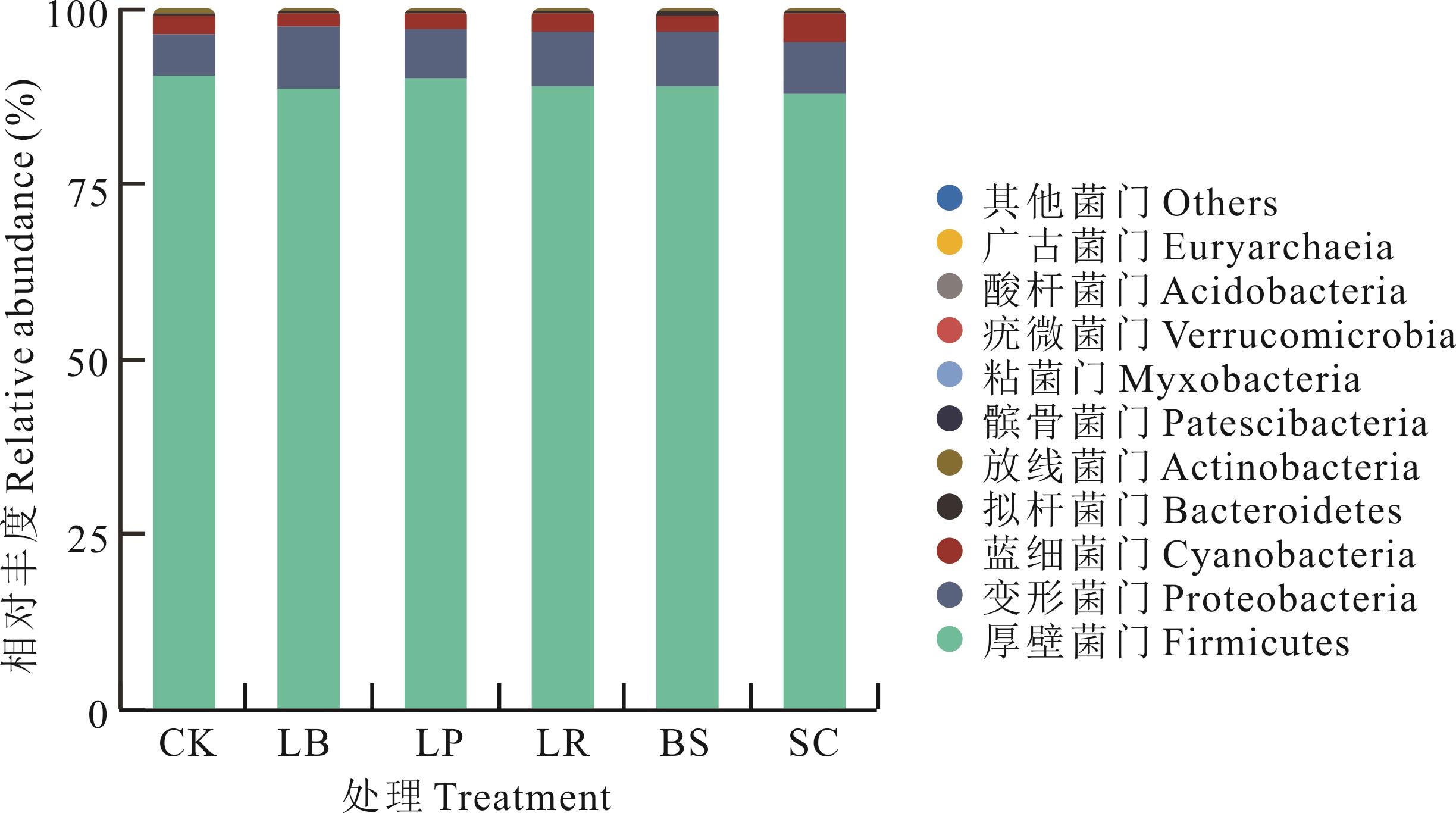
图1 基于门水平的微生物群落结构分析
Fig.1 Analysis of the microbial community structure based on phylum level
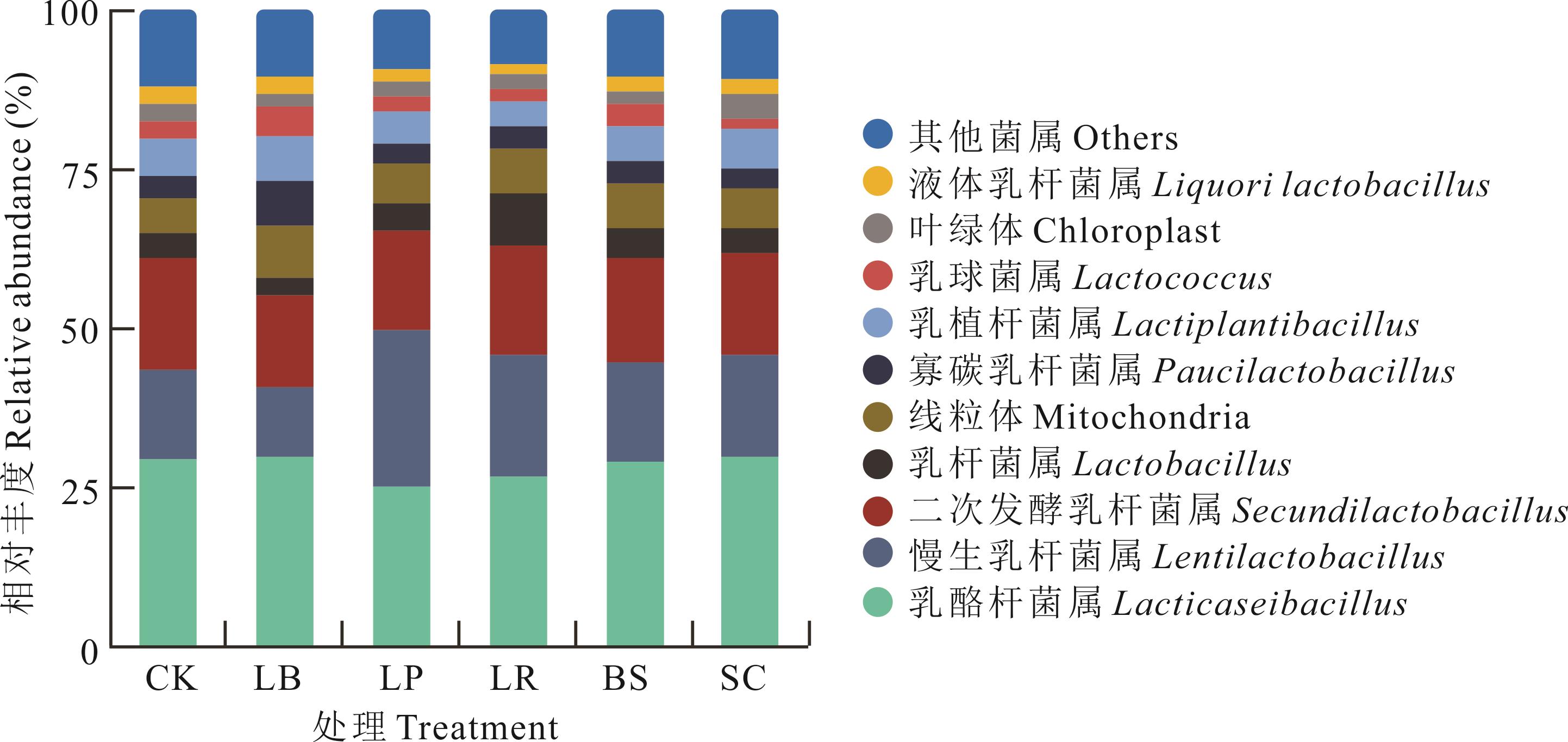
图2 基于属水平的微生物群落结构分析
Fig.2 Analysis of microbial community structure based on genus level
| 项目Item | CK | LB | LP | LR | BS | SC | P值P-value |
|---|---|---|---|---|---|---|---|
| 乳酪杆菌属Lacticaseibacillus | 0.291±0.007a | 0.295±0.020a | 0.250±0.012bc | 0.266±0.003ab | 0.296±0.007a | 0.295±0.011a | <0.010 |
| 慢生乳杆菌属Lentilactobacillus | 0.141±0.018cd | 0.111±0.007d | 0.246±0.019a | 0.191±0.001b | 0.155±0.022bcd | 0.160±0.021bc | <0.010 |
| 二次发酵乳杆菌属Secundilactobacillus | 0.177±0.023a | 0.143±0.016a | 0.157±0.009a | 0.169±0.001a | 0.161±0.006a | 0.160±0.009a | 0.106 |
| 寡碳乳杆菌属Paucilactobacillus | 0.036±0.011a | 0.038±0.007a | 0.029±0.007a | 0.033±0.001a | 0.034±0.005a | 0.028±0.002a | 0.508a |
| 乳杆菌属Lactobacillus | 0.039±0.015a | 0.028±0.007a | 0.043±0.000a | 0.060±0.007a | 0.048±0.017a | 0.041±0.009a | 0.080 |
| 乳植杆菌属Lactiplantibacillus | 0.057±0.010ab | 0.069±0.006a | 0.051±0.001ab | 0.039±0.002b | 0.054±0.009ab | 0.063±0.006a | 0.004 |
| 乳球菌属Lactococcus | 0.028±0.003ab | 0.034±0.007a | 0.022±0.006ab | 0.019±0.005b | 0.034±0.011a | 0.016±0.003b | 0.027 |
| 液体乳杆菌属Liquorilactobacillus | 0.028±0.014a | 0.011±0.000a | 0.015±0.002a | 0.012±0.001a | 0.019±0.007a | 0.021±0.010a | 0.177 |
表 6 发酵木薯渣菌群在属水平上的比较分析
Table 6 Comparative analysis of fermenting cassava residue microbiota at the genus level
| 项目Item | CK | LB | LP | LR | BS | SC | P值P-value |
|---|---|---|---|---|---|---|---|
| 乳酪杆菌属Lacticaseibacillus | 0.291±0.007a | 0.295±0.020a | 0.250±0.012bc | 0.266±0.003ab | 0.296±0.007a | 0.295±0.011a | <0.010 |
| 慢生乳杆菌属Lentilactobacillus | 0.141±0.018cd | 0.111±0.007d | 0.246±0.019a | 0.191±0.001b | 0.155±0.022bcd | 0.160±0.021bc | <0.010 |
| 二次发酵乳杆菌属Secundilactobacillus | 0.177±0.023a | 0.143±0.016a | 0.157±0.009a | 0.169±0.001a | 0.161±0.006a | 0.160±0.009a | 0.106 |
| 寡碳乳杆菌属Paucilactobacillus | 0.036±0.011a | 0.038±0.007a | 0.029±0.007a | 0.033±0.001a | 0.034±0.005a | 0.028±0.002a | 0.508a |
| 乳杆菌属Lactobacillus | 0.039±0.015a | 0.028±0.007a | 0.043±0.000a | 0.060±0.007a | 0.048±0.017a | 0.041±0.009a | 0.080 |
| 乳植杆菌属Lactiplantibacillus | 0.057±0.010ab | 0.069±0.006a | 0.051±0.001ab | 0.039±0.002b | 0.054±0.009ab | 0.063±0.006a | 0.004 |
| 乳球菌属Lactococcus | 0.028±0.003ab | 0.034±0.007a | 0.022±0.006ab | 0.019±0.005b | 0.034±0.011a | 0.016±0.003b | 0.027 |
| 液体乳杆菌属Liquorilactobacillus | 0.028±0.014a | 0.011±0.000a | 0.015±0.002a | 0.012±0.001a | 0.019±0.007a | 0.021±0.010a | 0.177 |
| [1] | Wei Y X, Su B M, Huang J, et al. Effects of potassium application on yield, quality and absorption of macro-, meso-, and micro-nutrients of cassava. Journal of Northwest A&F University (Natural Science Edition), 2017, 45(9): 46-54. |
| 魏云霞, 苏必孟, 黄洁, 等. 施钾对木薯产量和品质及大中微量元素吸收的影响. 西北农林科技大学学报(自然科学版), 2017, 45(9): 46-54. | |
| [2] | Zuo Q Q, Ma X D, Chen X L, et al. Research progress on feeding value of cassava and its application in livestock and poultry production. Feed Research, 2025(17): 149-154. |
| 左清清, 马旭东, 陈秀龙, 等. 木薯的饲用价值及其在畜禽生产中的应用研究进展. 饲料研究, 2025(17): 149-154. | |
| [3] | Guangxi Zhuang Autonomous Region Bureau of Statistics, Guangxi Survey Corps of the National Bureau of Statistics. Guangxi statistical yearbook (2022). Beijing: China Statistics Press, 2022. |
| 广西壮族自治区统计局, 国家统计局广西调查总队. 2022年广西统计年鉴. 北京: 中国统计出版社, 2022. | |
| [4] | Guangdong Provincial Bureau of Statistics. 2024 production situation of major crops in Guangdong. https://stats.gd.gov.cn/zynzwcl/content/post_4701411.html, 2025/9/21. |
| 广东省统计局. 2024年广东主要农作物生产情况. https://stats.gd.gov.cn/zynzwcl/content/post_4701411.html, 2025/9/21. | |
| [5] | Tang C M, Wang Z S, Wan J H, et al. The influence of cassava residue diet on the production performance and blood biochemical indicators of fattening cattle in summer. Chinese Journal of Animal Science, 2011, 47(21): 38-40. |
| 唐春梅, 王之盛, 万江虹, 等. 木薯渣日粮在夏季对育肥牛生产性能和血液生化指标的影响. 中国畜牧杂志, 2011, 47(21): 38-40. | |
| [6] | Ji F J, Wang D F, Hou G Y, et al. Nutrition value analysis of cassava residue. China Feed, 2016(6): 37-40. |
| 冀凤杰, 王定发, 侯冠彧, 等. 木薯渣饲用价值分析. 中国饲料, 2016(6): 37-40. | |
| [7] | Oke O L. Problems in the use of cassava as animal feed. Animal Feed Science and Technology, 1978, 3(4): 345-380. |
| [8] | He L Y, Nie A, Yao Y L. The safe use of residue feed. Hunan Agriculture, 2025(5): 23-24. |
| 何凌云, 聂昂, 姚亚铃. 糟渣类饲料的安全使用. 湖南农业, 2025(5): 23-24. | |
| [9] | Bai X M, Fan Y, Wang D Y, et al. Cassava residue fermented feed and its fermentation technology and application. Swine Industry Science, 2021, 38(5): 86-89. |
| 白秀梅, 范彧, 王丹玉, 等. 木薯渣发酵饲料及其发酵工艺与应用. 猪业科学, 2021, 38(5): 86-89. | |
| [10] | Tang Q F, Peng K P, Wei S J, et al. Effects of solid-state fermentation with different combinations of mixed strains on quality of cassava residue. Chinese Journal of Animal Nutrition, 2016, 28(6): 1965-1974. |
| 唐庆凤, 彭开屏, 韦升菊, 等. 不同微生物添加剂组合固态发酵对木薯渣品质的影响. 动物营养学报, 2016, 28(6): 1965-1974. | |
| [11] | Shinya T Y, Elsner V H P, de Lima Júnior D S, et al. Bioprocess development with special yeasts for cassava bagasse enrichment nutritional to use in animal feed. Animal Feed Science and Technology, 2022, 290: 115338. |
| [12] | Huang J H, Wang S Z, Liang Z M, et al. Comparison of nutritional value of feeds for different treatments of cassava dregs. Journal of Southern Agriculture, 2009, 40(6): 768-771. |
| 黄金华, 王士长, 梁珠民, 等. 不同处理对木薯渣饲料营养价值的比较. 广西农业科学, 2009, 40(6): 768-771. | |
| [13] | Xiao L. Research progress on the feed utilization of fermented cassava residue. Guizhou Journal of Animal Husbandry & Veterinary Medicine, 2024, 48(1): 17-20. |
| 肖林. 发酵木薯渣饲料化利用研究进展. 贵州畜牧兽医, 2024, 48(1): 17-20. | |
| [14] | Zhou R H, Yang X L, Wang G Y, et al. Laboratory animals, formula feeds with determination of routine nutrients. Beijing: China Standards Press, 2001. |
| 周瑞华, 杨晓莉, 王光亚, 等. 实验动物、配合饲料及常规营养成分的测定. 北京: 中国标准出版社, 2001. | |
| [15] | Guo X J, Guo W, Yang M, et al. Effect of Bacillus additives on fermentation quality and bacterial community during the ensiling process of whole-plant corn silage. Processes, 2022, 10(5): https://doi.org/10.3390/pr10050978. |
| [16] | Liang Q, Lu M B, Lu Z D, et al. Determination of lactic acid in fermentation broth by p-hydroxybiphenol colorimetry. Food Science, 2008, 29(6): 357-360. |
| 梁琼, 鲁明波, 卢正东, 等. 对羟基联苯法定量测定发酵液中的乳酸. 食品科学, 2008, 29(6): 357-360. | |
| [17] | Feng Z C, Gao M. Improvement of the method for determining ammonia nitrogen content in rumen fluid by colorimetry. Animal Husbandry and Feed Science, 2010, 31(6/7): 37. |
| 冯宗慈, 高民. 通过比色测定瘤胃液氨氮含量方法的改进. 畜牧与饲料科学, 2010, 31(6/7): 37. | |
| [18] | Li Y F, Wang X S, Zhu X F. Data analysis of deoxynivalenol in wheat stuff in 2021. Feed Review, 2022(2): 47-50. |
| 李艳芬, 王晓珊, 朱晓凤. 2021年小麦原料呕吐毒素数据分析. 饲料博览, 2022(2): 47-50. | |
| [19] | Benjamim Da Silva É, Costa D M, Santos E M, et al. The effects of Lactobacillus hilgardii 4785 and Lactobacillus buchneri 40788 on the microbiome, fermentation, and aerobic stability of corn silage ensiled for various times. Journal of Dairy Science, 2021, 104(10): 10678-10698. |
| [20] | Li G Y, Chen Y X, Lian H X, et al. Review on quality evaluating index system and measuring methods for alfalfa silage. Pratacultural Science, 2010, 27(8): 151-154. |
| 李改英, 陈玉霞, 廉红霞, 等. 苜蓿青贮品质评定指标体系及测定方法的概述. 草业科学, 2010, 27(8): 151-154. | |
| [21] | Ma N N, Zhang X Q, Yang C L, et al. Optimization and application evaluation of mixed bacteria in fermented feed. Shandong Agricultural Sciences, 2020, 52(12): 112-117, 125. |
| 马娜娜, 张心青, 杨传伦, 等. 发酵饲料的混菌复配优化及应用评价. 山东农业科学, 2020, 52(12): 112-117, 125. | |
| [22] | Zhang T, Cui Z J, Li J P, et al. The effect of different fermentation type of silage inoculants bacteria on the fermentation of silage. Acta Prataculturae Sinica, 2005, 14(3): 67-71. |
| 张涛, 崔宗均, 李建平, 等. 不同发酵类型青贮菌制剂对青贮发酵的影响. 草业学报, 2005, 14(3): 67-71. | |
| [23] | Liang Y C, Zhang X W, Shao T, et al. Effects of different lactic acid bacteria strains on fermentation quality and mycotoxin contents of whole-plant corn silage. Acta Prataculturae Sinica, 2025, 34(3): 123-133. |
| 梁宇成, 张晓雯, 邵涛, 等. 乳酸菌对全株玉米青贮发酵品质和霉菌毒素含量的影响. 草业学报, 2025, 34(3): 123-133. | |
| [24] | Wei L M, Liu Q W, Liu H L, et al. The influence of Bacillus complex butyric acid on the fermentation quality of cassava residue. Guangdong Feed, 2016, 25(11): 22-24. |
| 魏立民, 刘圈炜, 刘海隆, 等. 复合酪酸芽孢杆菌对木薯渣发酵品质的影响. 广东饲料, 2016, 25(11): 22-24. | |
| [25] | Zhao M Q E, Bao J, Wang Z J, et al. Effects of different lactic acid bacteria additives on silage quality of natural pasture grass silage. Chinese Journal of Animal Nutrition, 2024, 36(5): 3352-3362. |
| 赵牧其尔, 包健, 王志军, 等. 不同乳酸菌添加剂对天然草地牧草青贮饲料青贮品质的影响. 动物营养学报, 2024, 36(5): 3352-3362. | |
| [26] | Si B W, Xu W C, Zhang X L, et al. Influence of different additives on fermentation quality of hybrid paper mulberry silage. Chinese Journal of Animal Nutrition, 2018, 30(11): 4670-4675. |
| 司丙文, 徐文财, 张小利, 等. 不同添加剂对杂交构树青贮发酵品质的影响. 动物营养学报, 2018, 30(11): 4670-4675. | |
| [27] | Zhang Y X. Effect of different microorganisms on nutrient composition and in vitro digestibility of fermented cassava residue. Feed Research, 2022, 45(21): 113-117. |
| 张云翔. 不同微生物对发酵木薯渣营养成分及体外消化率的影响. 饲料研究, 2022, 45(21): 113-117. | |
| [28] | Wang S N, Wang J L, Wu P X, et al. Effect of different stubble height on quality of Yayu Silage No. 8. Feed Research, 2023, 46(2): 100-104. |
| 王胜男, 王嘉麟, 吴鹏鑫, 等. 不同留茬高度对雅玉青贮8号品质的影响. 饲料研究, 2023, 46(2): 100-104. | |
| [29] | Chen J Y, Tian H C, Liu J Y, et al. Effects of malic acid and citric acid on silage quality and microbial diversity of Neolamarckia cadamba leaves. Chinese Journal of Animal Nutrition, 2025, 37(2): 1312-1324. |
| 陈金钰, 田汉晨, 刘金洋, 等. 苹果酸和柠檬酸对黄梁木叶青贮品质及微生物多样性的影响. 动物营养学报, 2025, 37(2): 1312-1324. | |
| [30] | Qiao J T, Guo R B, Yuan X Z, et al. Phylogenetic analysis of methanogenic corn stalk degrading microbial communities. Environmental Science, 2013, 34(4): 1531-1539. |
| 乔江涛, 郭荣波, 袁宪正, 等. 玉米秸秆厌氧降解复合菌系的微生物群落结构. 环境科学, 2013, 34(4): 1531-1539. |
| [1] | 庞凯悦, 冯彦龙, 刘合云, 苏少峰, 杜家华, 吴佳海, 曾兵. 发酵全混合日粮及其在反刍动物应用的研究进展[J]. 草业学报, 2026, 35(9): 211-235. |
| [2] | 林平冬, 缪伏荣, 刘景, 岳稳, 陈鑫珠. 不同添加剂对茶渣青贮品质和微生物多样性的影响[J]. 草业学报, 2026, 35(8): 123-133. |
| [3] | 王涛, 李静, 卢强, 柯文灿, 黄帅. 蒲公英黄酮和枯草芽孢杆菌对燕麦青贮品质、抗氧化活性及微生物群落结构的影响[J]. 草业学报, 2026, 35(6): 108-121. |
| [4] | 刘志昊, 李文龙, 张晨, 刘美英, 陶雅. 养殖废水灌溉下青贮添加剂对全株玉米青贮饲料品质的影响[J]. 草业学报, 2026, 35(6): 60-72. |
| [5] | 马亚玲. 北方天然草地牧草青贮利用研究现状和发展趋势[J]. 草业学报, 2026, 35(11): 227-240. |
| [6] | 吴娟燕, 田静, 郭香, 黄莉莹, 张建国. 籽实青贮的研究与利用进展[J]. 草业学报, 2025, 34(8): 211-220. |
| [7] | 孔天赐, 马学青, 贺晨帮, 樊泰延, 芦光新, 祁鹤兴. 青贮玉米真菌性病害对青贮发酵微生物多样性的影响[J]. 草业学报, 2025, 34(7): 95-106. |
| [8] | 王思然, 丁成龙, 田吉鹏, 程云辉, 许能祥, 张文洁, 王欣, 刘蓓一. 乳酸菌和抗真菌添加剂对湿啤酒糟全混合日粮青贮发酵品质、体外消化率及有氧稳定性的影响[J]. 草业学报, 2025, 34(6): 213-226. |
| [9] | 毛开, 许艺, 王学梅, 柴欢, 黄帅, 王坚, 郇树乾, 玉柱, 王目森. 植物乳植杆菌与糖蜜对花生秧青贮饲料发酵品质、生物胺含量及细菌群落的影响[J]. 草业学报, 2025, 34(5): 146-158. |
| [10] | 王思然, 刘蓓一, 田吉鹏, 程云辉, 许能祥, 张文洁, 王欣, 丁成龙. 复合乳酸菌添加剂对低温环境下意大利黑麦草青贮发酵品质的影响[J]. 草业学报, 2025, 34(5): 159-170. |
| [11] | 陈鑫珠, 林平冬, 岳稳, 杨雅妮, 邱水玲, 郑向丽. 不同添加剂对蚕豆秸秆青贮品质及微生物多样性的影响[J]. 草业学报, 2025, 34(4): 164-174. |
| [12] | 梁宇成, 张晓雯, 邵涛, 王文博, 原现军. 乳酸菌对全株玉米青贮发酵品质和霉菌毒素含量的影响[J]. 草业学报, 2025, 34(3): 123-133. |
| [13] | 韦竣玲, 刘晓琪, 王宛青, 邓铭, 孙宝丽, 郭勇庆. 玉米秸秆与毛豆茎叶混合比例对青贮发酵品质和微生物群落的影响[J]. 草业学报, 2025, 34(12): 111-120. |
| [14] | 陶惠赟, 杨闰艳, 李延灿, 刘亚鹏, 祁鹤兴. 黄河源区矮嵩草根际土壤微生物多样性及对环境因子的响应[J]. 草业学报, 2025, 34(12): 16-32. |
| [15] | 邓清源, 付东青, 黄嵘峥, 张凡凡, 孙国君. 松针精油对构树青贮品质及有氧稳定性的影响[J]. 草业学报, 2025, 34(10): 85-94. |
| 阅读次数 | ||||||
|
全文 |
|
|||||
|
摘要 |
|
|||||
