

ISSN 1004-5759 CN 62-1105/S
草业学报 ›› 2026, Vol. 35 ›› Issue (3): 43-51.DOI: 10.11686/cyxb2025177
蒋玉奇1( ), 郭鑫2, 姜佳昌3, 刘兴明3, 梁春燕4, 文海燕1, 牛得草1, 李旭东1()
收稿日期:2025-05-07
修回日期:2025-07-10
出版日期:2026-03-20
发布日期:2026-01-19
通讯作者:
李旭东
作者简介:Corresponding author. E-mail: lixudong@lzu.edu.cn基金资助:
Yu-qi JIANG1(), Xin GUO2, Jia-chang JIANG3, Xing-ming LIU3, Chun-yan LIANG4, Hai-yan WEN1, De-cao NIU1, Xu-dong LI1()
Received:2025-05-07
Revised:2025-07-10
Online:2026-03-20
Published:2026-01-19
Contact:
Xu-dong LI
摘要:
植物凋落物是土壤有机碳(SOC)的重要来源,SOC的形成及其稳定性不仅与植物碳输入直接相关,同时也受到土壤碳饱和度的影响。本研究选取黄土高原温性草原优势物种长芒草的叶片和根系为凋落物材料,将其与不同碳饱和度的土壤(SOC含量分别为9.02,5.28和2.64 g·kg-1)在室内共同培养3年,通过分析不同碳饱和度条件下凋落物的分解速率以及全土和各粒径土壤团聚体中SOC的变化,以明确土壤碳饱和度对凋落物分解以及SOC固存的影响。结果表明:随着土壤碳饱和度的降低,土壤微生物量碳逐渐增加,凋落物分解速率显著升高,全土及各粒径团聚体中的新碳形成效率也逐渐升高,SOC含量显著增加。说明碳饱和度较低的土壤对外源有机碳具有更高的固存效率。在0.25~2.00 mm、0.053~0.250 mm和<0.053 mm这3个粒径土壤团聚体组分中,随着土壤碳饱和度的降低,凋落物碳分解后更多地向<0.053 mm的团聚体分配,进而有利于生成稳定性高的矿物结合态SOC。
蒋玉奇, 郭鑫, 姜佳昌, 刘兴明, 梁春燕, 文海燕, 牛得草, 李旭东. 土壤碳饱和度对黄土高原温性草原凋落物分解及土壤碳固存的影响[J]. 草业学报, 2026, 35(3): 43-51.
Yu-qi JIANG, Xin GUO, Jia-chang JIANG, Xing-ming LIU, Chun-yan LIANG, Hai-yan WEN, De-cao NIU, Xu-dong LI. Impact of grassland soil carbon saturation on litter decomposition and soil carbon sequestration[J]. Acta Prataculturae Sinica, 2026, 35(3): 43-51.
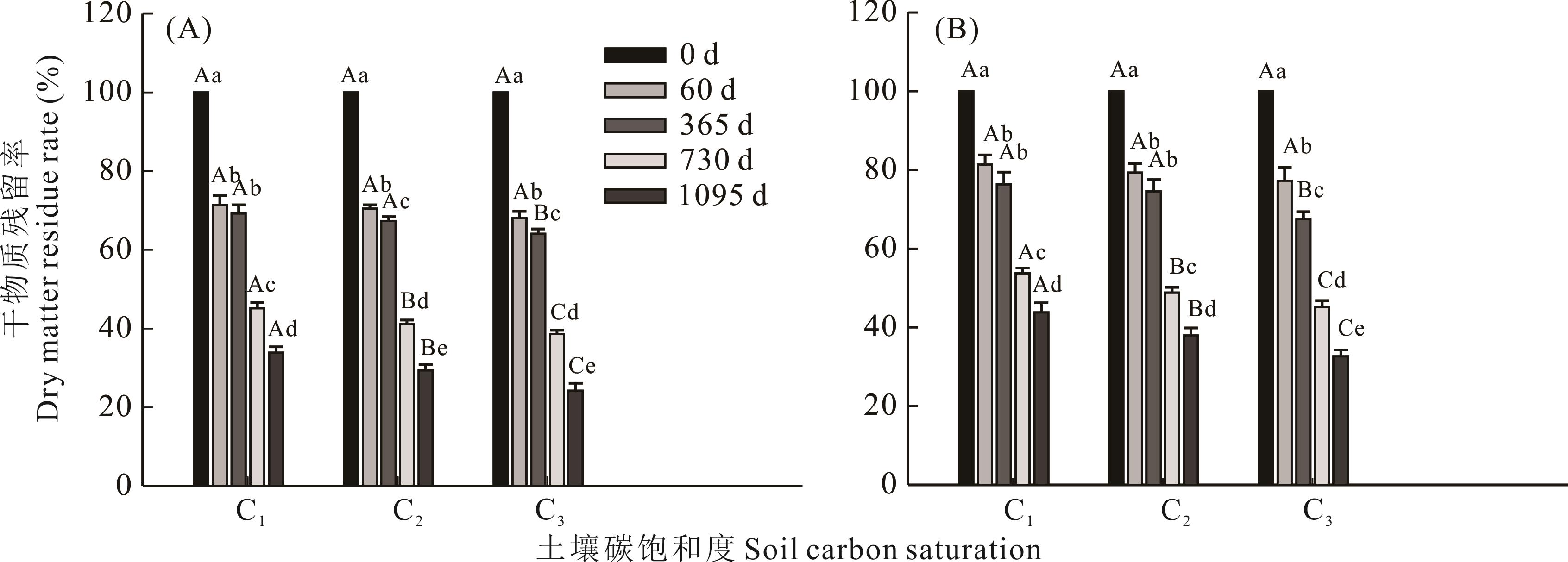
图1 凋落物干物质残留率图A和图B分别为长芒草叶片和根系在不同土壤碳饱和度下的干物质残留率。不同大写字母表示同一培养时间不同碳饱和度间差异显著,不同小写字母表示同一碳饱和度下不同培养时间之间差异显著(平均值±标准误,P<0.05)。Fig. A and Fig. B show the dry matter residue rates of S. bungeana leaves and S. bungeana roots under different soil carbon saturations, respectively. Different capital letters indicate significant differences among different carbon saturations at the same incubation time, and different lowercase letters indicate significant differences among different incubation times under the same carbon saturation level [mean±standard error (SE), P<0.05].
Fig.1 Dry matter residue rates of litter
分解时间 Decomposition time (d) | 凋落物 Litter | 土壤碳饱和度 Soil carbon saturation | Olson 拟合方程 Olson fitting equation | 分解系数 Decomposition coefficient (k) | P值 P value |
|---|---|---|---|---|---|
| 1095 | SL | C1 | y=4.5816e-0.0201t | 0.0201±0.004c | <0.05 |
| C2 | y=4.5816e-0.0287t | 0.0287±0.008b | <0.05 | ||
| C3 | y=4.5816e-0.0319t | 0.0319±0.002a | <0.05 | ||
| SR | C1 | y=4.0804e-0.0191t | 0.0191±0.003c | <0.05 | |
| C2 | y=4.0804e-0.0222t | 0.0222±0.005b | <0.05 | ||
| C3 | y=4.0804e-0.0270t | 0.0270±0.007a | <0.05 |
表1 凋落物分解系数
Table 1 Litter decomposition coefficient
分解时间 Decomposition time (d) | 凋落物 Litter | 土壤碳饱和度 Soil carbon saturation | Olson 拟合方程 Olson fitting equation | 分解系数 Decomposition coefficient (k) | P值 P value |
|---|---|---|---|---|---|
| 1095 | SL | C1 | y=4.5816e-0.0201t | 0.0201±0.004c | <0.05 |
| C2 | y=4.5816e-0.0287t | 0.0287±0.008b | <0.05 | ||
| C3 | y=4.5816e-0.0319t | 0.0319±0.002a | <0.05 | ||
| SR | C1 | y=4.0804e-0.0191t | 0.0191±0.003c | <0.05 | |
| C2 | y=4.0804e-0.0222t | 0.0222±0.005b | <0.05 | ||
| C3 | y=4.0804e-0.0270t | 0.0270±0.007a | <0.05 |

图2 不同碳饱和度处理下土壤有机碳和土壤全氮含量变化图A、图C和图E分别为C1、C2和C3处理下的土壤有机碳含量变化,图B、图D和图F分别为C1、C2和C3处理下的土壤全氮含量变化。不同大写字母表示同一培养时间不同凋落物处理间差异显著,不同小写字母表示同一凋落物处理下不同培养时间之间差异显著(平均值±标准误,P<0.05)。Fig. A, Fig. C and Fig. E show the changes in soil organic carbon content under the treatments of C1, C2, and C3, respectively, while Fig. B, Fig. D and Fig. F show the corresponding changes in soil total nitrogen content. Different capital letters indicate significant differences among litter treatments at the same incubation time, and different lowercase letters indicate significant differences among different incubation times at the same litter treatment [mean±standard error (SE), P<0.05].
Fig.2 Changes of soil organic carbon (SOC) and total nitrogen (TN) contents under different carbon saturation treatments
土壤碳饱和度 Soil carbon saturation | 凋落物 Litter | 分解时间 Decomposition time (d) | 0.25~2.00 mm | 0.053~0.250 mm | <0.053 mm | |||
|---|---|---|---|---|---|---|---|---|
团聚体质量 Mass of soil aggregates (g) | 土壤有机碳含量Soil organic carbon (g·kg-1) | 团聚体质量 Mass of soil aggregates (g) | 土壤有机碳含量 Soil organic carbon (g·kg-1) | 团聚体质量 Mass of soil aggregates (g) | 土壤有机碳含量 Soil organic carbon (g·kg-1) | |||
| C1 | BV | 0 | 13.62±0.07a | 9.06±0.10b | 20.42±0.21b | 9.03±0.03ab | 14.84±0.11b | 9.63±0.09a |
| SL | 1095 | 13.59±0.06a | 9.61±0.07a | 20.56±0.02b | 9.22±0.07a | 14.67±0.05b | 9.71±0.09a | |
| SR | 1095 | 13.40±0.08a | 9.52±0.27a | 20.33±0.15b | 8.92±0.20b | 15.98±0.47a | 9.74±0.05a | |
| CK | 1095 | 13.57±0.23a | 9.01±0.16b | 21.07±0.25a | 9.04±0.28ab | 15.33±0.24ab | 9.54±0.02a | |
| C2 | BV | 0 | 13.47±0.11a | 5.46±0.13d | 21.36±0.09a | 5.41±0.20c | 15.16±0.27b | 5.42±0.17d |
| SL | 1095 | 13.51±0.12a | 6.61±0.13c | 21.10±0.12a | 5.27±0.30c | 14.67±0.02b | 7.43±0.19b | |
| SR | 1095 | 12.85±0.22b | 6.32±0.25c | 21.24±0.02a | 5.72±0.27c | 15.77±0.10a | 6.77±0.11c | |
| CK | 1095 | 13.81±0.21a | 5.30±0.12d | 20.87±0.12b | 5.22±0.21c | 14.59±0.04b | 5.13±0.21d | |
| C3 | BV | 0 | 11.27±0.09c | 3.31±0.21f | 20.90±0.14b | 2.32±0.12f | 16.88±0.09a | 2.79±0.10e |
| SL | 1095 | 12.57±0.07a | 5.01±0.10e | 21.23±0.13ab | 3.61±0.07d | 15.22±0.09b | 5.35±0.12d | |
| SR | 1095 | 12.17±0.12b | 4.87±0.12e | 21.17±0.21ab | 3.12±0.31e | 15.92±0.15b | 5.01±0.12d | |
| CK | 1095 | 11.11±0.09c | 3.22±0.14f | 21.53±0.16a | 2.27±0.23f | 16.69±0.08a | 2.65±0.09e | |
表2 土壤团聚体质量及其SOC含量
Table 2 Mass and SOC content of soil aggregates
土壤碳饱和度 Soil carbon saturation | 凋落物 Litter | 分解时间 Decomposition time (d) | 0.25~2.00 mm | 0.053~0.250 mm | <0.053 mm | |||
|---|---|---|---|---|---|---|---|---|
团聚体质量 Mass of soil aggregates (g) | 土壤有机碳含量Soil organic carbon (g·kg-1) | 团聚体质量 Mass of soil aggregates (g) | 土壤有机碳含量 Soil organic carbon (g·kg-1) | 团聚体质量 Mass of soil aggregates (g) | 土壤有机碳含量 Soil organic carbon (g·kg-1) | |||
| C1 | BV | 0 | 13.62±0.07a | 9.06±0.10b | 20.42±0.21b | 9.03±0.03ab | 14.84±0.11b | 9.63±0.09a |
| SL | 1095 | 13.59±0.06a | 9.61±0.07a | 20.56±0.02b | 9.22±0.07a | 14.67±0.05b | 9.71±0.09a | |
| SR | 1095 | 13.40±0.08a | 9.52±0.27a | 20.33±0.15b | 8.92±0.20b | 15.98±0.47a | 9.74±0.05a | |
| CK | 1095 | 13.57±0.23a | 9.01±0.16b | 21.07±0.25a | 9.04±0.28ab | 15.33±0.24ab | 9.54±0.02a | |
| C2 | BV | 0 | 13.47±0.11a | 5.46±0.13d | 21.36±0.09a | 5.41±0.20c | 15.16±0.27b | 5.42±0.17d |
| SL | 1095 | 13.51±0.12a | 6.61±0.13c | 21.10±0.12a | 5.27±0.30c | 14.67±0.02b | 7.43±0.19b | |
| SR | 1095 | 12.85±0.22b | 6.32±0.25c | 21.24±0.02a | 5.72±0.27c | 15.77±0.10a | 6.77±0.11c | |
| CK | 1095 | 13.81±0.21a | 5.30±0.12d | 20.87±0.12b | 5.22±0.21c | 14.59±0.04b | 5.13±0.21d | |
| C3 | BV | 0 | 11.27±0.09c | 3.31±0.21f | 20.90±0.14b | 2.32±0.12f | 16.88±0.09a | 2.79±0.10e |
| SL | 1095 | 12.57±0.07a | 5.01±0.10e | 21.23±0.13ab | 3.61±0.07d | 15.22±0.09b | 5.35±0.12d | |
| SR | 1095 | 12.17±0.12b | 4.87±0.12e | 21.17±0.21ab | 3.12±0.31e | 15.92±0.15b | 5.01±0.12d | |
| CK | 1095 | 11.11±0.09c | 3.22±0.14f | 21.53±0.16a | 2.27±0.23f | 16.69±0.08a | 2.65±0.09e | |
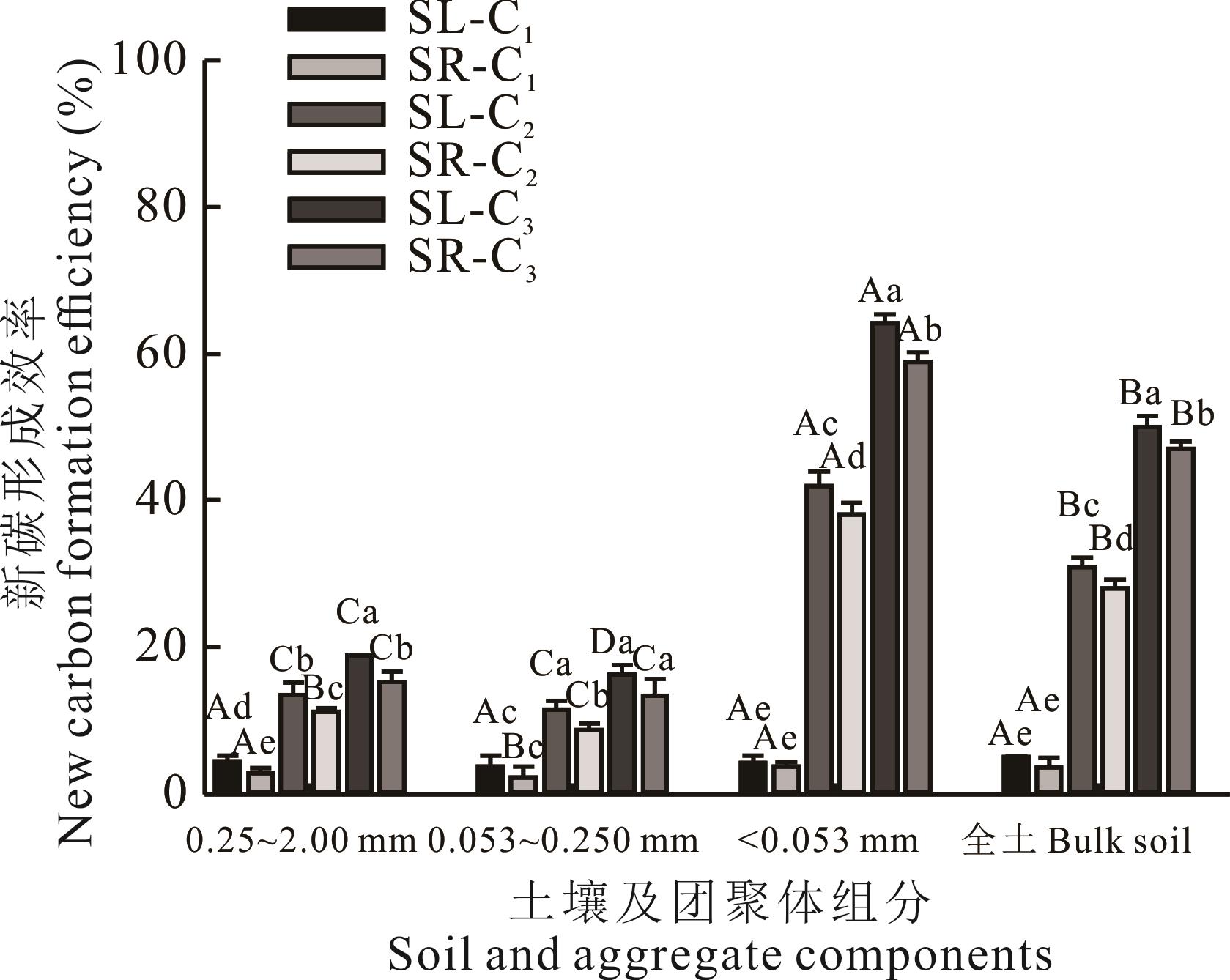
图3 土壤及各团聚体组分的新碳形成效率不同大写字母表示同一培养处理下不同粒径团聚体组分和全土间差异显著,不同小写字母表示同一粒径团聚体或全土不同处理间差异显著(平均值±标准误,P<0.05)。Different capital letters indicate significant differences among aggregate fractions of different particle sizes and the whole soil under the same treatments, and different lowercase letters indicate significant differences among different treatments under the same aggregate fractions of different particle sizes and the bulk soil [mean±standard error (SE), P<0.05].
Fig.3 New carbon formation efficiency (NCE) of soil and different soil aggregate components (1095 d)
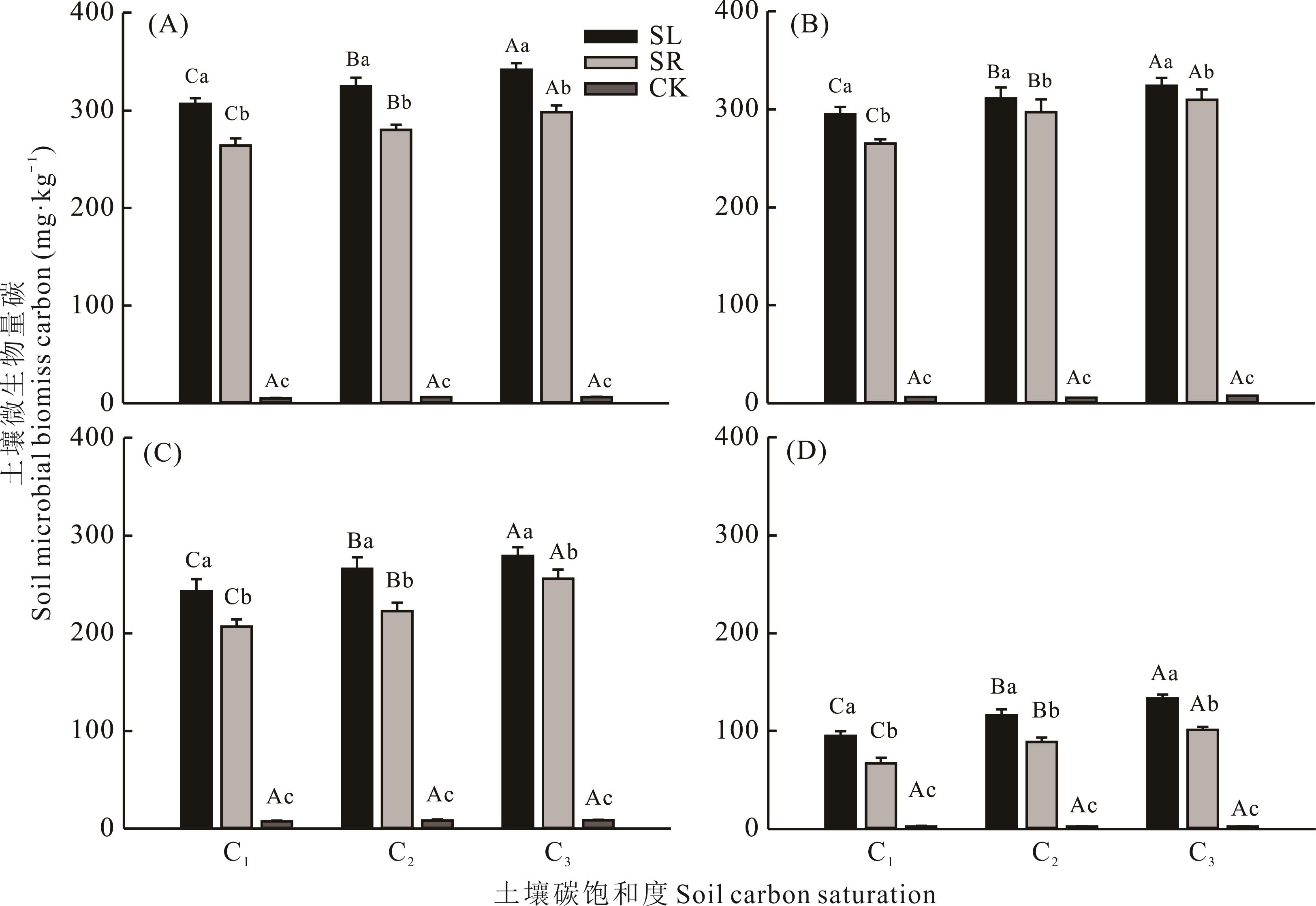
图4 土壤微生物量碳含量图A~D分别为培养60、365、730、1095 d时土壤微生物量碳含量。不同大写字母表示同一凋落物处理下不同碳饱和度间差异显著,不同小写字母表示同一碳饱和度处理下不同凋落物处理间差异显著(平均值±标准误,P<0.05)。Figures A-D show the soil microbial biomass carbon content at the cultivation times of 60, 365, 730, and 1095 days, respectively. Different capital letters indicate significant differences among different carbon saturation levels under the same litter treatments, and different lowercase letters indicate significant differences among different litter treatments under the same carbon saturation level [mean±standard error (SE), P<0.05].
Fig.4 Soil microbial biomass carbon content
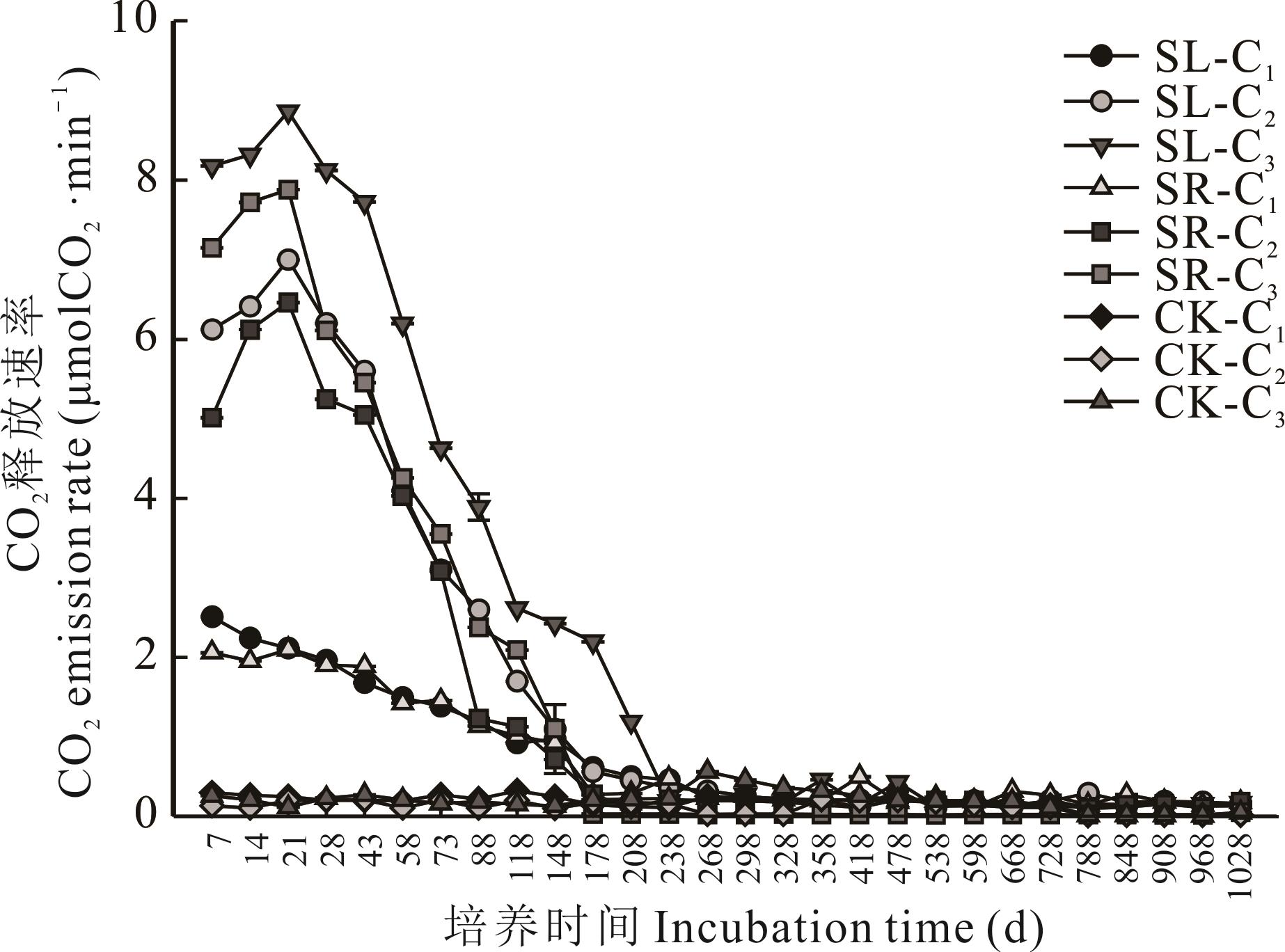
图5 不同处理下的CO2释放速率
Fig.5 CO2emission rates under different treatments
| [1] | Salifou T, Lamourdia T, Babou A B. Organic carbon fractional distribution and saturation in tropical soils of West African savannas with contrasting mineral composition. Catena, 2020, 190: 104550. |
| [2] | Cotrufo M F, Soong J L, Horton A J M, et al. Formation of soil organic matter via biochemical and physical pathways of litter mass loss. Nature Geoscience, 2015, 8(10): 776-779. |
| [3] | Yu W C, Zhao J N, Li G, et al. Litter decompositions of three dominant plants in the Stipa baicalensis grassland of Inner Mongolia. Acta Agrestia Sinica, 2014, 22(3): 502-510. |
| 于雯超, 赵建宁, 李刚, 等. 内蒙古贝加尔针茅草原3种主要植物凋落物分解特征. 草地学报, 2014, 22(3): 502-510. | |
| [4] | West T O, Six J. Considering the influence of sequestration duration and carbon saturation on estimates of soil carbon capacity. Climatic Change, 2007, 80(1/2): 25-41. |
| [5] | Yang Y, Tian L H, Tian H Q, et al. Effect of climate warming on decomposition of plant litter in alpine meadow pastures in Northwestern Sichuan. Acta Prataculturae Sinica, 2020, 29(10): 35-46. |
| 杨阳, 田莉华, 田浩琦, 等. 增温对川西北高寒草甸草场植物凋落物分解的影响. 草业学报, 2020, 29(10): 35-46. | |
| [6] | Li X Q, Dong W H, Song Y, et al. Soil mesofauna participating in driving home-field advantage differ between litter mass loss and nutrient release. Applied Soil Ecology, 2021, 163: 103909. |
| [7] | Liu D D, Ju W L, Jin X L, et al. Associated soil aggregate nutrients and controlling factors on aggregate stability in semiarid grassland under different grazing prohibition timeframes. Science of the Total Environment, 2021, 777: 146104. |
| [8] | Veloso M G, Angers D A, Chantigny M H, et al. Carbon accumulation and aggregation are mediated by fungi in a subtropical soil under conservation agriculture. Geoderma, 2020, 363: 114159. |
| [9] | Yu J, Miao S J, Qiao Y F. The stabilization mechanism of different types of soil aggregates. Chinese Agricultural Science Bulletin, 2022, 38(14): 89-95. |
| 余洁, 苗淑杰, 乔云发. 不同类型土壤团聚体稳定机制的研究. 中国农学通报, 2022, 38(14): 89-95. | |
| [10] | Six J, Feller C, Denef K. et al. Soil organic matter, biota and aggregation in temperate and tropical soils-effects of no-tillage. Agronomie, 2002, 22(7): 755-775. |
| [11] | Gulde S, Chung H, Amelung W, et al. Soil carbon saturation controls labile and stable carbon pool dynamics. Soil Science Society of America Journal, 2008, 72(3): 605-612. |
| [12] | Lucas A T R, Sandro J G, Jeferson D, et al. Carbon saturation deficit and litter quality drive the stabilization of litter-derived C in mineral-associated organic matter in long-term no-till soil. Catena, 2022, 219: 106590. |
| [13] | Li X D, Fu H, Li X D, et al. Effects of land-use regimes on carbon sequestration in the Loess Plateau, northern China. New Zealand Journal of Agricultural Research, 2008, 51(1): 45-52. |
| [14] | Haddix M L, Paul E A, Cotrufo M F, et al. Dual, differential isotope labeling shows the preferential movement of labile plant constituents into mineral-bonded soil organic matter. Global Change Biology, 2016, 22(6): 2301-2312. |
| [15] | Zhang X R, Zhang W Q, Sai X, et al. Grazing altered soil aggregates, nutrients and enzyme activities in a Stipa kirschnii steppe of Inner Mongolia. Soil and Tillage Research, 2022, 219: 105327. |
| [16] | Singh L, Thakur D, Sharma M K, et al. Dynamics of leaf litter decomposition in the timberline zone of western Himalaya. Acta Oecologica, 2021, 111: 103715. |
| [17] | Pan L, Peng S, Gao W S, et al. Aggregate stability and associated C and N in a silty loam soil as affected by organic material inputs. Journal of Integrative Agriculture, 2015, 14(4): 774-787. |
| [18] | Chung H, Grove J H, Six J. Indications for soil carbon saturation in a temperate agroecosystem. Soil Science Society of America Journal, 2008, 72(4): 1132-1139. |
| [19] | Di J Y, Xu M G, Zhang W J, et al. Combinations of soil properties, carbon inputs and climate control the saturation deficit dynamics of stable soil carbon over 17-year fertilization. Scientific Reports, 2018, 8(1): 12653. |
| [20] | Yue K X, Gong J R, Yu S Y, et al. Effects of litter quality and soil enzyme activity on litter decomposition rate in typical grassland subject to nitrogen addition. Acta Prataculturae Sinica, 2020, 29(6): 71-82. |
| 岳可欣, 龚吉蕊, 于上媛, 等. 氮添加下典型草原凋落物质量和土壤酶活性对凋落物分解速率的影响. 草业学报, 2020, 29(6): 71-82. | |
| [21] | Haddix M L, Gregorich E G, Helgason B L, et al. Climate, carbon content, and soil texture control the independent formation and persistence of particulate and mineral-associated organic matter in soil. Geoderma, 2020, 363: 114160. |
| [22] | Campbell C A, Zentner R P, Bowren K E, et al. Effect of crop rotations and fertilization on soil biochemical properties in a thick Black Chernozem. Canadian Journal of Soil Science, 1991, 71(3): 377-387. |
| [23] | Huang Z S, Yu L F, Fu Y H, et al. Characteristics of carbon sequestration during natural restoration of Maolan Karst forest ecosystems. Chinese Journal of Plant Ecology, 2015, 39(6): 554-564. |
| 黄宗胜, 喻理飞, 符裕红, 等. 茂兰退化喀斯特森林植被自然恢复中生态系统碳吸存特征. 植物生态学报, 2015, 39(6): 554-564. | |
| [24] | Paustian K, Collins H P, Paul E A. Management controls on soil carbon//Paul E A, Paustian K, Elliott E T, et al. Soil organic matter in temperate agroecosystems. Boca Raton, FL.: CRC Press, 1997: 15-49. |
| [25] | Stewart C E, Paustian K, Conant R T, et al. Soil carbon saturation: evaluation and corroboration by long-term incubations. Soil Biology & Biochemistry, 2008, 40: 1741-1750. |
| [26] | Feng W T, Plante A F, Six J. Improving estimates of maximal organic carbon stabilization by fine soil particles. Biogeochemistry, 2013, 112(1/3): 81-93. |
| [27] | Lucas A T, Jeferson D, Sandro G, et al. Carbon sequestration capacity in no-till soil decreases in the long-term due to saturation of fine silt plus clay-size fraction. Geoderma, 2022, 412: 115711. |
| [28] | Liu Y L, Wang P, Wang J K. Formation and stability mechanism of soil aggregates: progress and prospect. Acta Pedologica Sinica, 2023, 60(3): 627-643. |
| 刘亚龙, 王萍, 汪景宽. 土壤团聚体的形成和稳定机制: 研究进展与展望. 土壤学报, 2023, 60(3): 627-643. | |
| [29] | Castellano M J, Mueller K E, Olk D C, et al. Integrating plant litter quality, soil organic matter stabilization, and the carbon saturation concept. Global Change Biology, 2015, 21(9): 3200-3209. |
| [30] | Rodrigo S N, Charles W R, Telmo J C, et al. Carbon saturation and translocation in a no-till soil under organic amendments. Agriculture, Ecosystems and Environment, 2018, 264: 73-84. |
| [31] | Skjemstad J. Role of the soil matrix and minerals in protecting natural organic materials against biological attack. Organic Geochemistry, 2000, 31(7/8): 697-710. |
| [32] | Du Z L, Wu W L, Zhang Q Z, et al. Long-term manure amendments enhance soil aggregation and carbon saturation of stable pools in north China Plain. Journal of Integrative Agriculture, 2014, 13(10): 2276-2285. |
| [1] | 骆欣怡, 邱开阳, 金涛, 鲍平安, 黄业芸, 何毅, 谢应忠. 碳、氮、钾添加对荒漠草原凋落物分解特征的影响[J]. 草业学报, 2025, 34(2): 41-53. |
| [2] | 田晴华, 刘丹, 廖小琴, 宋小艳, 胡雷, 王长庭. 施氮对高寒草地土壤团聚体生物胶结物质及稳定性的影响[J]. 草业学报, 2024, 33(11): 46-57. |
| [3] | 李林芝, 张德罡, 马源, 罗珠珠, 林栋, 海龙, 白兰鸽. 不同退化程度高寒草甸土壤团聚体养分及生态化学计量特征研究[J]. 草业学报, 2023, 32(8): 48-60. |
| [4] | 郭鑫, 罗欢, 许雪梅, 马爱霞, 尚振艳, 韩天虎, 牛得草, 文海燕, 李旭东. 不同品质凋落物分解对黄土高原草地土壤有机碳及其稳定性的影响[J]. 草业学报, 2023, 32(5): 83-93. |
| [5] | 江奥, 敬路淮, 泽让东科, 田黎明. 放牧影响草地凋落物分解研究进展[J]. 草业学报, 2023, 32(4): 208-220. |
| [6] | 杜鹏冲, 潘昱臻, 侯双利, 王智慧, 王洪义. 氮磷添加对呼伦贝尔草地凋落物分解的影响[J]. 草业学报, 2023, 32(2): 44-53. |
| [7] | 路文杰, 齐晋云, 吴聪, 景亚泓. 晋北半干旱草地不同分解程度凋落物混合对分解特征的影响[J]. 草业学报, 2023, 32(12): 47-57. |
| [8] | 张勇, 王海娣, 高玉红, 吴兵, 剡斌, 王一帆, 崔政军, 文泽东. 多元胡麻轮作模式对土壤团聚体特征及氮素含量的影响[J]. 草业学报, 2023, 32(1): 75-88. |
| [9] | 马文明, 刘超文, 周青平, 邓增卓玛, 唐思洪, 迪力亚尔·莫合塔尔null, 侯晨. 高寒草地灌丛化对土壤团聚体生态化学计量学及酶活性的影响[J]. 草业学报, 2022, 31(1): 57-68. |
| [10] | 宋梅玲, 王玉琴, 王宏生, 鲍根生. 内生真菌对高寒草地紫花针茅凋落物分解的影响[J]. 草业学报, 2021, 30(9): 150-158. |
| [11] | 岳可欣, 龚吉蕊, 于上媛, 宝音陶格涛, 杨波, 王彪, 朱趁趁, 张子荷, 矢佳昱. 氮添加下典型草原凋落物质量和土壤酶活性对凋落物分解速率的影响[J]. 草业学报, 2020, 29(6): 71-82. |
| [12] | 杨阳, 田莉华, 田浩琦, 孙怀恩, 赵景学, 周青平. 增温对川西北高寒草甸草场植物凋落物分解的影响[J]. 草业学报, 2020, 29(10): 35-46. |
| [13] | 王鑫, 罗雪萍, 字洪标, 杨文高, 胡雷, 王长庭. 青海森林凋落物生态化学计量特征及其影响因子[J]. 草业学报, 2019, 28(8): 1-14. |
| [14] | 王晓芳, 马红彬, 沈艳, 许冬梅, 谢应忠, 李建平, 李小伟. 不同轮牧方式对荒漠草原植物群落特征的影响[J]. 草业学报, 2019, 28(4): 23-33. |
| [15] | 李明, 秦洁, 红雨, 杨殿林, 周广帆, 王宇, 王丽娟. 氮素添加对贝加尔针茅草原土壤团聚体碳、氮和磷生态化学计量学特征的影响[J]. 草业学报, 2019, 28(12): 29-40. |
| 阅读次数 | ||||||
|
全文 |
|
|||||
|
摘要 |
|
|||||
