

ISSN 1004-5759 CN 62-1105/S
草业学报 ›› 2026, Vol. 35 ›› Issue (6): 49-59.DOI: 10.11686/cyxb2025242
袁绍燕1( ), 刘元坤1, 蔡世杰1, 雷婷馨1, 周萍萍1,2, 王俊珍3(), 颜红海1()
收稿日期:2025-06-19
修回日期:2025-08-08
出版日期:2026-06-20
发布日期:2026-04-13
通讯作者:
王俊珍,颜红海
作者简介:wangjunzhen108@163.com基金资助:
Shao-yan YUAN1(), Yuan-kun LIU1, Shi-jie CAI1, Ting-xin LEI1, Ping-ping ZHOU1,2, Jun-zhen WANG3(), Hong-hai YAN1()
Received:2025-06-19
Revised:2025-08-08
Online:2026-06-20
Published:2026-04-13
Contact:
Jun-zhen WANG,Hong-hai YAN
摘要:
燕麦是世界重要的饲草作物,在解决我国北方牧场饲草短缺中发挥了重要作用,筛选耐盐种质资源,选育耐盐品种对利用盐碱地生产燕麦饲草,进而增加我国饲草供给具有重要意义。为了评价燕麦种质资源耐盐性及筛选耐盐燕麦种质,本研究利用150 mmol·L-1的NaCl溶液对来自52个国家的213份燕麦种质资源进行为期7 d的苗期胁迫处理,测定了根长、苗高、根鲜重、苗鲜重、根干重和苗干重6个指标,综合利用相关性分析、主成分分析、隶属函数分析和聚类分析对燕麦种质资源的苗期耐盐性进行综合评价。结果表明:盐胁迫显著降低了除苗干重外的其他指标(P<0.05)。各生长指标耐盐系数的变异系数为12.21%~30.74%,表明该群体具有丰富的耐盐遗传多样性。盐胁迫下各指标之间,及与耐盐指数D值之间均呈现出极显著的正相关性。通过主成分分析将6项测定指标转换成了3个主成分,累积方差贡献率为84.14%。根重和苗重可作为评价燕麦苗期耐盐性的优选指标。基于隶属函数分析与聚类分析将供试燕麦种质划分为5个耐盐等级,2份来自葡萄牙和土耳其的燕麦被鉴定为高度耐盐型的燕麦材料,可作为盐碱地后续利用和耐盐育种的优异资源。值得注意的是,栽培品种与地方品种的耐盐性无显著差异,表明当前燕麦育种尚未将耐盐性作为主要育种目标,尚需加强该性状的遗传改良。本研究建立了系统的燕麦耐盐种质筛选体系,为盐渍化地区燕麦遗传改良和栽培提供了重要材料与技术支撑。
袁绍燕, 刘元坤, 蔡世杰, 雷婷馨, 周萍萍, 王俊珍, 颜红海. 多样性燕麦种质资源苗期耐盐性综合评价[J]. 草业学报, 2026, 35(6): 49-59.
Shao-yan YUAN, Yuan-kun LIU, Shi-jie CAI, Ting-xin LEI, Ping-ping ZHOU, Jun-zhen WANG, Hong-hai YAN. Comprehensive evaluation of the salt tolerance of diverse oat germplasm at the seedling stage[J]. Acta Prataculturae Sinica, 2026, 35(6): 49-59.
来源地 Origin | 国家 Country | 种质数量Germplasm number | 选育状态 Breeding status | 来源地 Origin | 国家 Country | 种质数量Germplasm number | 选育状态 Breeding status | ||
|---|---|---|---|---|---|---|---|---|---|
育成品种 Cultivar | 地方品种 Landrace | 育成品种Cultivar | 地方品种Landrace | ||||||
东亚 East Asia | 中国China | 11 | 3 | 8 | 大洋洲Oceania | 澳大利亚Australia | 4 | 4 | |
| 蒙古国Mongolia | 10 | 10 | 东欧East Europe | 保加利亚Bulgaria | 7 | 5 | 2 | ||
| 朝鲜North Korea | 1 | 1 | 捷克Czech Republic | 3 | 3 | ||||
中亚 Central Asia | 阿富汗Afghanistan | 6 | 6 | 立陶宛Lithuania | 1 | 1 | |||
| 伊朗Iran | 3 | 1 | 2 | 摩尔多瓦Moldova | 1 | 1 | |||
| 哈萨克斯坦Kazakhstan | 1 | 1 | 波兰Poland | 2 | 2 | ||||
| 吉尔吉斯斯坦Kyrgyzstan | 1 | 1 | 俄罗斯Russia | 6 | 6 | ||||
南亚 South Asia | 印度India | 7 | 7 | 乌克兰Ukraine | 3 | 3 | |||
| 巴基斯坦Pakistan | 1 | 1 | 中欧Central Europe | 芬兰Finland | 1 | 1 | |||
西亚 West Asia | 亚美尼亚Armenia | 3 | 1 | 2 | 法国France | 2 | 1 | 1 | |
| 格鲁吉亚Georgia | 3 | 1 | 2 | 德国Germany | 2 | 2 | |||
| 以色列Israel | 1 | 1 | 西班牙Spain | 6 | 1 | 5 | |||
| 阿曼Oman | 3 | 3 | 瑞典Sweden | 3 | 3 | ||||
| 巴勒斯坦Palestine | 3 | 3 | 英国United Kingdom | 1 | 1 | ||||
| 叙利亚Syria | 3 | 1 | 2 | 地中海沿岸Mediterranean | 阿尔巴尼亚Albania | 3 | 3 | ||
| 土耳其Turkey | 16 | 1 | 15 | 阿尔及利亚Algeria | 4 | 4 | |||
| 阿塞拜疆Azerbaijan | 4 | 1 | 3 | 波黑Bosnia and Herzegovina | 13 | 2 | 11 | ||
非洲 Africa | 埃塞俄比亚Ethiopia | 8 | 1 | 7 | 克罗地亚Croatia | 4 | 4 | ||
| 南非South Africa | 2 | 2 | 塞浦路斯Cyprus | 5 | 2 | 3 | |||
| 乌干达Uganda | 1 | 1 | 埃及Egypt | 3 | 3 | ||||
| 津巴布韦Zimbabwe | 1 | 1 | 希腊Greece | 5 | 5 | ||||
| 北美洲North America | 加拿大Canada | 6 | 6 | 意大利Italy | 4 | 2 | 2 | ||
| 墨西哥Mexico | 5 | 5 | 马其顿Macedonia | 3 | 3 | ||||
| 美国United States | 14 | 12 | 2 | 摩洛哥Morocco | 5 | 2 | 3 | ||
| 南美洲South America | 玻利维亚Bolivia | 2 | 1 | 1 | 葡萄牙Portugal | 1 | 1 | ||
| 秘鲁Peru | 1 | 1 | 突尼斯Tunisia | 4 | 1 | 3 | |||
表1 213份供试燕麦材料地理来源及选育情况
Table 1 Geographical origin and breeding status of the 213 oat germplasms used in this study
来源地 Origin | 国家 Country | 种质数量Germplasm number | 选育状态 Breeding status | 来源地 Origin | 国家 Country | 种质数量Germplasm number | 选育状态 Breeding status | ||
|---|---|---|---|---|---|---|---|---|---|
育成品种 Cultivar | 地方品种 Landrace | 育成品种Cultivar | 地方品种Landrace | ||||||
东亚 East Asia | 中国China | 11 | 3 | 8 | 大洋洲Oceania | 澳大利亚Australia | 4 | 4 | |
| 蒙古国Mongolia | 10 | 10 | 东欧East Europe | 保加利亚Bulgaria | 7 | 5 | 2 | ||
| 朝鲜North Korea | 1 | 1 | 捷克Czech Republic | 3 | 3 | ||||
中亚 Central Asia | 阿富汗Afghanistan | 6 | 6 | 立陶宛Lithuania | 1 | 1 | |||
| 伊朗Iran | 3 | 1 | 2 | 摩尔多瓦Moldova | 1 | 1 | |||
| 哈萨克斯坦Kazakhstan | 1 | 1 | 波兰Poland | 2 | 2 | ||||
| 吉尔吉斯斯坦Kyrgyzstan | 1 | 1 | 俄罗斯Russia | 6 | 6 | ||||
南亚 South Asia | 印度India | 7 | 7 | 乌克兰Ukraine | 3 | 3 | |||
| 巴基斯坦Pakistan | 1 | 1 | 中欧Central Europe | 芬兰Finland | 1 | 1 | |||
西亚 West Asia | 亚美尼亚Armenia | 3 | 1 | 2 | 法国France | 2 | 1 | 1 | |
| 格鲁吉亚Georgia | 3 | 1 | 2 | 德国Germany | 2 | 2 | |||
| 以色列Israel | 1 | 1 | 西班牙Spain | 6 | 1 | 5 | |||
| 阿曼Oman | 3 | 3 | 瑞典Sweden | 3 | 3 | ||||
| 巴勒斯坦Palestine | 3 | 3 | 英国United Kingdom | 1 | 1 | ||||
| 叙利亚Syria | 3 | 1 | 2 | 地中海沿岸Mediterranean | 阿尔巴尼亚Albania | 3 | 3 | ||
| 土耳其Turkey | 16 | 1 | 15 | 阿尔及利亚Algeria | 4 | 4 | |||
| 阿塞拜疆Azerbaijan | 4 | 1 | 3 | 波黑Bosnia and Herzegovina | 13 | 2 | 11 | ||
非洲 Africa | 埃塞俄比亚Ethiopia | 8 | 1 | 7 | 克罗地亚Croatia | 4 | 4 | ||
| 南非South Africa | 2 | 2 | 塞浦路斯Cyprus | 5 | 2 | 3 | |||
| 乌干达Uganda | 1 | 1 | 埃及Egypt | 3 | 3 | ||||
| 津巴布韦Zimbabwe | 1 | 1 | 希腊Greece | 5 | 5 | ||||
| 北美洲North America | 加拿大Canada | 6 | 6 | 意大利Italy | 4 | 2 | 2 | ||
| 墨西哥Mexico | 5 | 5 | 马其顿Macedonia | 3 | 3 | ||||
| 美国United States | 14 | 12 | 2 | 摩洛哥Morocco | 5 | 2 | 3 | ||
| 南美洲South America | 玻利维亚Bolivia | 2 | 1 | 1 | 葡萄牙Portugal | 1 | 1 | ||
| 秘鲁Peru | 1 | 1 | 突尼斯Tunisia | 4 | 1 | 3 | |||
性状 Trait | 对照组 Control | 处理组 Treatment | 耐盐系数 Salt tolerance coefficient (STC) | STC变异系数 Coefficient of variation for STC (%) | 显著性 Significant | ||
|---|---|---|---|---|---|---|---|
范围 Range | 平均值±标准差 Mean±SD | 范围 Range | 平均值±标准差 Mean±SD | ||||
| RL (cm) | 6.25~23.70 | 14.08±3.32 | 6.80~20.20 | 12.70±2.87 | 0.90 | 19.91 | *** |
| SH (cm) | 18.60~38.70 | 28.20±3.97 | 16.50~35.30 | 25.00±3.84 | 0.89 | 12.21 | *** |
| RFW (g) | 0.007~0.069 | 0.032±0.010 | 0.009~0.056 | 0.028±0.011 | 0.88 | 30.74 | ** |
| SFW (g) | 0.081~0.340 | 0.190±0.056 | 0.053~0.280 | 0.160±0.048 | 0.84 | 24.03 | *** |
| RDW (g) | 0.0016~0.0084 | 0.0046±0.0013 | 0.0014~0.0074 | 0.0041±0.0013 | 0.89 | 28.85 | *** |
| SDW (g) | 0.0074~0.0330 | 0.0180±0.0054 | 0.0068~0.0310 | 0.0180±0.0053 | 1.00 | 23.68 | ns |
表2 213份燕麦在盐胁迫下6个生长性状及耐盐系数
Table 2 Salt tolerance coefficient and 6 growth traits of 213 oat germplasms under salt stress conditions
性状 Trait | 对照组 Control | 处理组 Treatment | 耐盐系数 Salt tolerance coefficient (STC) | STC变异系数 Coefficient of variation for STC (%) | 显著性 Significant | ||
|---|---|---|---|---|---|---|---|
范围 Range | 平均值±标准差 Mean±SD | 范围 Range | 平均值±标准差 Mean±SD | ||||
| RL (cm) | 6.25~23.70 | 14.08±3.32 | 6.80~20.20 | 12.70±2.87 | 0.90 | 19.91 | *** |
| SH (cm) | 18.60~38.70 | 28.20±3.97 | 16.50~35.30 | 25.00±3.84 | 0.89 | 12.21 | *** |
| RFW (g) | 0.007~0.069 | 0.032±0.010 | 0.009~0.056 | 0.028±0.011 | 0.88 | 30.74 | ** |
| SFW (g) | 0.081~0.340 | 0.190±0.056 | 0.053~0.280 | 0.160±0.048 | 0.84 | 24.03 | *** |
| RDW (g) | 0.0016~0.0084 | 0.0046±0.0013 | 0.0014~0.0074 | 0.0041±0.0013 | 0.89 | 28.85 | *** |
| SDW (g) | 0.0074~0.0330 | 0.0180±0.0054 | 0.0068~0.0310 | 0.0180±0.0053 | 1.00 | 23.68 | ns |
主成分 Principal component | 初始特征值Initial eigenvalue | 提取载荷平方和Extract square sum load | ||||
|---|---|---|---|---|---|---|
特征值 Eigenvalue | 方差贡献率Variance contribution (%) | 累积方差贡献率Cumulative variance contribution (%) | 特征值 Eigenvalue | 方差贡献率Variance contribution (%) | 累积方差贡献率Cumulative variance contribution (%) | |
| Ⅰ | 3.60 | 60.04 | 60.04 | 3.60 | 60.04 | 60.04 |
| Ⅱ | 0.88 | 14.71 | 74.75 | 0.88 | 14.71 | 74.75 |
| Ⅲ | 0.56 | 9.39 | 84.14 | |||
| Ⅳ | 0.44 | 7.41 | 91.55 | |||
| Ⅴ | 0.38 | 6.30 | 97.85 | |||
| Ⅵ | 0.13 | 2.14 | 100.00 | |||
表3 燕麦苗期各测定指标耐盐系数的主成分方差贡献率
Table 3 Variance contribution of the principal component derived from the salt tolerance indices of oat seedlings
主成分 Principal component | 初始特征值Initial eigenvalue | 提取载荷平方和Extract square sum load | ||||
|---|---|---|---|---|---|---|
特征值 Eigenvalue | 方差贡献率Variance contribution (%) | 累积方差贡献率Cumulative variance contribution (%) | 特征值 Eigenvalue | 方差贡献率Variance contribution (%) | 累积方差贡献率Cumulative variance contribution (%) | |
| Ⅰ | 3.60 | 60.04 | 60.04 | 3.60 | 60.04 | 60.04 |
| Ⅱ | 0.88 | 14.71 | 74.75 | 0.88 | 14.71 | 74.75 |
| Ⅲ | 0.56 | 9.39 | 84.14 | |||
| Ⅳ | 0.44 | 7.41 | 91.55 | |||
| Ⅴ | 0.38 | 6.30 | 97.85 | |||
| Ⅵ | 0.13 | 2.14 | 100.00 | |||
主成分 Principal component | 根长 Root length | 苗高 Seedling height | 根鲜重 Root fresh weight | 苗鲜重 Seedling fresh weight | 根干重 Root dry weight | 苗干重 Seedling dry weight |
|---|---|---|---|---|---|---|
| Ⅰ | 0.700 | 0.760 | 0.800 | 0.880 | -0.540 | 0.910 |
| Ⅱ | 0.410 | 0.330 | -0.100 | 0.007 | 0.770 | -0.052 |
| Ⅲ | -0.300 | 0.250 | -0.280 | 0.310 | 0.140 | 0.200 |
表4 6个生长性状的主成分载荷矩阵
Table 4 Loading matrix of the 6 growth traits on the principal components
主成分 Principal component | 根长 Root length | 苗高 Seedling height | 根鲜重 Root fresh weight | 苗鲜重 Seedling fresh weight | 根干重 Root dry weight | 苗干重 Seedling dry weight |
|---|---|---|---|---|---|---|
| Ⅰ | 0.700 | 0.760 | 0.800 | 0.880 | -0.540 | 0.910 |
| Ⅱ | 0.410 | 0.330 | -0.100 | 0.007 | 0.770 | -0.052 |
| Ⅲ | -0.300 | 0.250 | -0.280 | 0.310 | 0.140 | 0.200 |
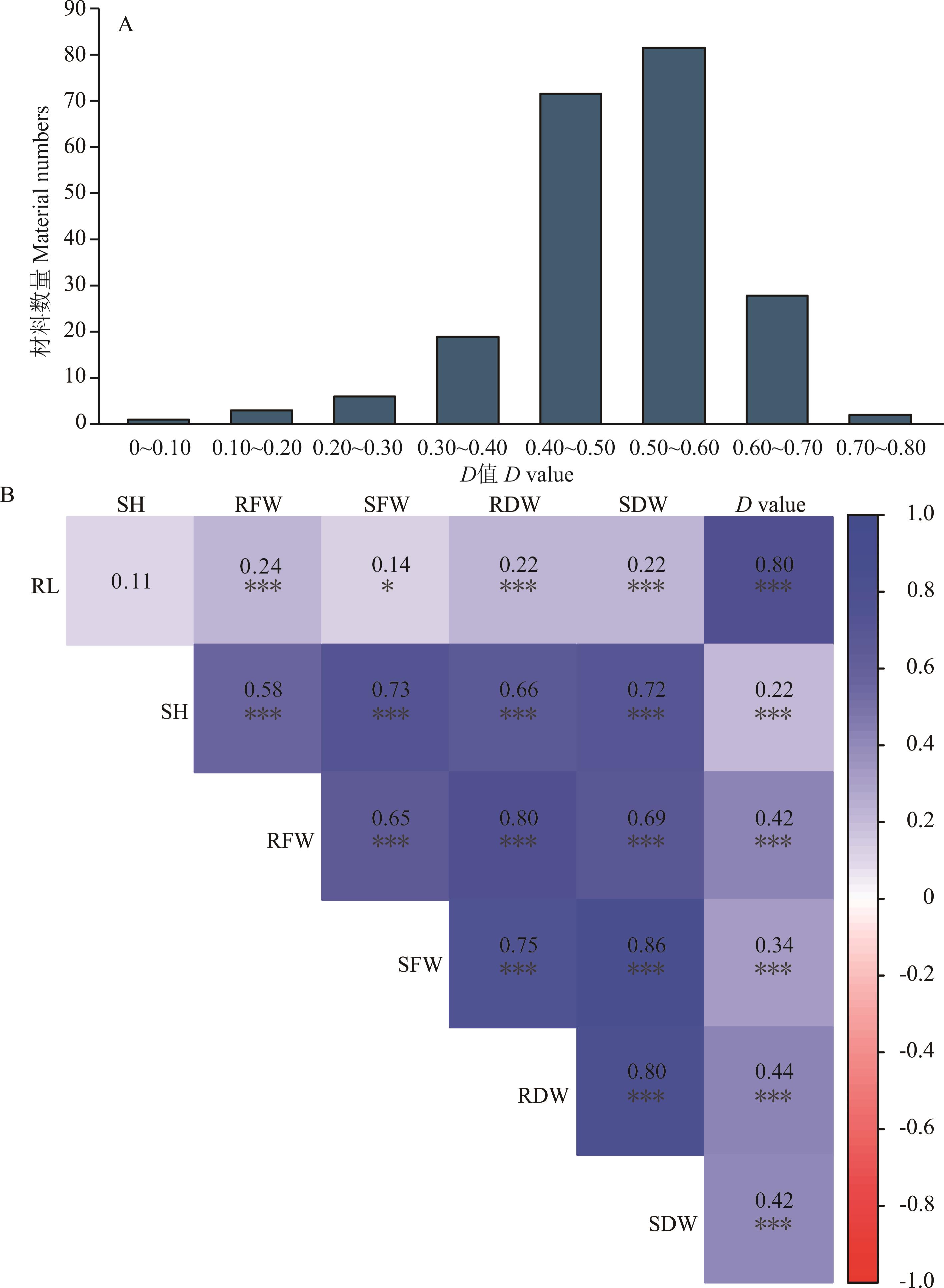
图1 燕麦6个生长性状隶属函数值及D值间相关关系RL,根长;SH,苗高;RFW,根鲜重;SFW,苗鲜重;RDW,根干重;SDW,苗干重;D value:D值。***表示在0.001水平下显著,**表示在0.01水平显著;ns表示在0.05水平不显著。RL, Root length; SH, Seedling height; RFW, Root fresh weight; SFW, Seedling fresh weight; RDW, Root dry weight; SDW, Seedling dry weight. *** represents significant difference at the 0.001 level, ** represents significant difference at the 0.01 level, ns represents non-significant difference at the 0.05 level.
Fig.1 Correlation between the membership function of 6 growth traits and D values in oat
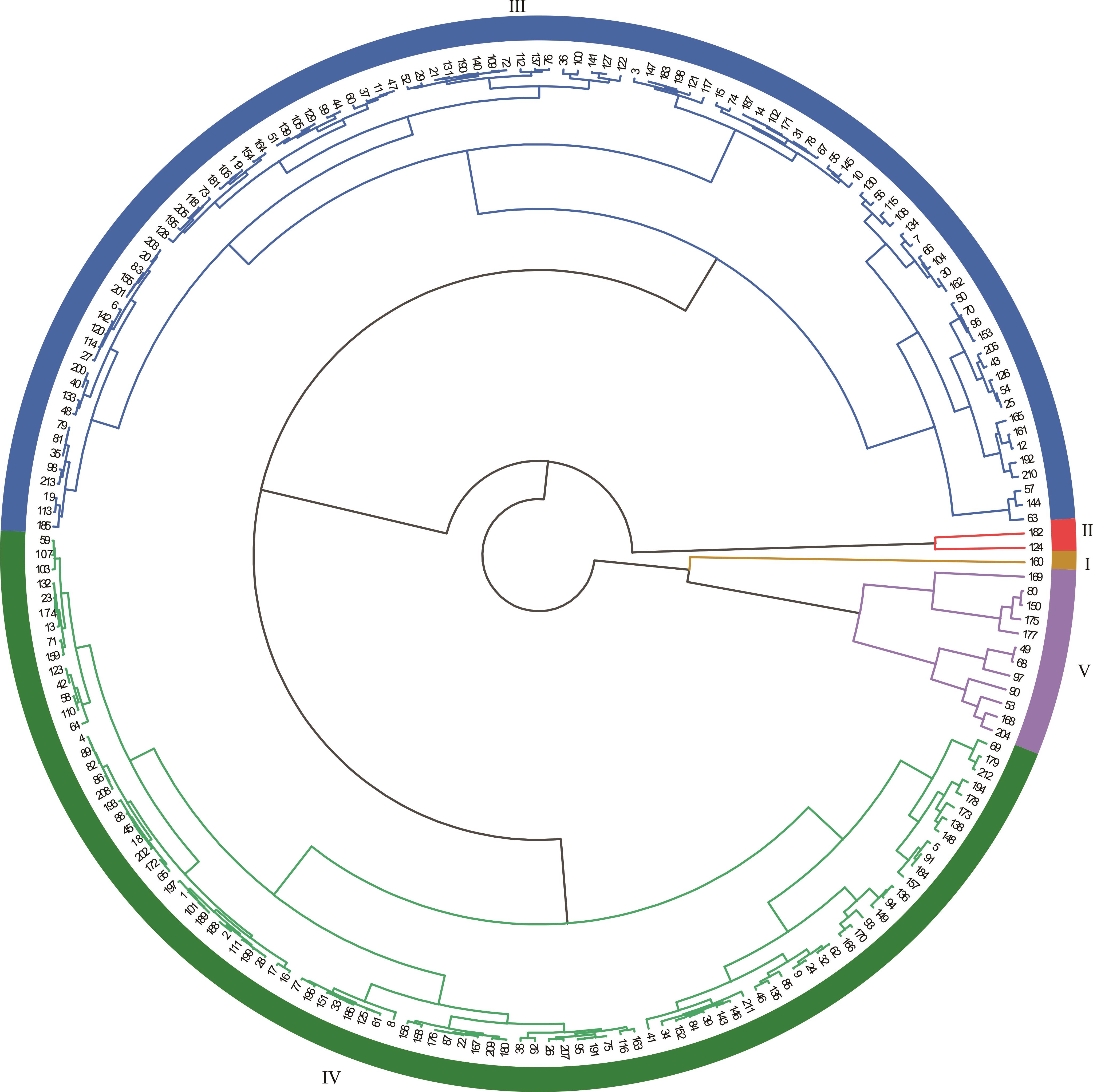
图2 基于综合评价D值的213份燕麦种质的耐盐性聚类分析I:高度耐盐型;II:耐盐型;III:中等耐盐型;IV:盐敏感型;V:极度盐敏感型。I: High salt-tolerant; II: Salt-tolerant; III: Moderate salt-tolerant; IV: Salt-sensitive; V: Hight salt-sensitive.
Fig. 2 Cluster analysis of salt tolerance of 213 oat germplasms based on the D values
变异来源 Source of variation | 自由度 Degrees of freedom | 平方和 Sum of squares | 均方 Mean square | F值 F value | P值 P value |
|---|---|---|---|---|---|
| 地理来源Geographic origin (O) | 10 | 0.0840 | 0.0084 | 0.72 | 0.71 |
| 选育状态Breeding status (B) | 1 | 0.0068 | 0.0068 | 0.58 | 0.45 |
| O×B | 11 | 0.0840 | 0.0076 | 0.65 | 0.78 |
| 误差Error | 201 | 2.3500 | 0.0120 |
表5 不同地理来源和选育状态燕麦耐盐性指数方差分析
Table 5 Analysis of variance for salt tolerance index of oats from different origins and with different breeding status
变异来源 Source of variation | 自由度 Degrees of freedom | 平方和 Sum of squares | 均方 Mean square | F值 F value | P值 P value |
|---|---|---|---|---|---|
| 地理来源Geographic origin (O) | 10 | 0.0840 | 0.0084 | 0.72 | 0.71 |
| 选育状态Breeding status (B) | 1 | 0.0068 | 0.0068 | 0.58 | 0.45 |
| O×B | 11 | 0.0840 | 0.0076 | 0.65 | 0.78 |
| 误差Error | 201 | 2.3500 | 0.0120 |
项目 Item | 范围 Range | 平均值 Mean | 标准差 Standard deviation | 变异系数 Coefficient of variation (%) | |
|---|---|---|---|---|---|
地理来源 Geographic origin | 东亚East Asia | 0.38~0.64 | 0.50 | 0.07 | 14.00 |
| 中亚Central Asia | 0.33~0.65 | 0.51 | 0.09 | 17.60 | |
| 南亚South Asia | 0.32~0.56 | 0.47 | 0.09 | 19.20 | |
| 西亚West Asia | 0.26~0.74 | 0.52 | 0.09 | 17.30 | |
| 中欧Central Europe | 0.20~0.65 | 0.50 | 0.12 | 24.00 | |
| 东欧East Europe | 0.03~0.68 | 0.48 | 0.16 | 33.30 | |
| 地中海沿岸Mediterranean | 0.20~0.80 | 0.50 | 0.11 | 22.00 | |
| 北美洲North America | 0.28~0.66 | 0.49 | 0.09 | 18.40 | |
| 南美洲South America | 0.51~0.66 | 0.59 | 0.08 | 13.60 | |
| 非洲Africa | 0.26~0.64 | 0.50 | 0.12 | 24.00 | |
| 大洋洲Oceania | 0.42~0.46 | 0.45 | 0.02 | 4.44 | |
选育状态 Breeding status | 地方品种Landrace | 0.20~0.80 | 0.50 | 0.10 | 20.50 |
| 育成品种Cultivar | 0.03~0.69 | 0.50 | 0.12 | 23.56 | |
表6 不同地区以及不同选育状态燕麦种质资源耐盐指数D值变异情况
Table 6 Variation in salt tolerance index (D value) of oats from different regions and with different breeding status
项目 Item | 范围 Range | 平均值 Mean | 标准差 Standard deviation | 变异系数 Coefficient of variation (%) | |
|---|---|---|---|---|---|
地理来源 Geographic origin | 东亚East Asia | 0.38~0.64 | 0.50 | 0.07 | 14.00 |
| 中亚Central Asia | 0.33~0.65 | 0.51 | 0.09 | 17.60 | |
| 南亚South Asia | 0.32~0.56 | 0.47 | 0.09 | 19.20 | |
| 西亚West Asia | 0.26~0.74 | 0.52 | 0.09 | 17.30 | |
| 中欧Central Europe | 0.20~0.65 | 0.50 | 0.12 | 24.00 | |
| 东欧East Europe | 0.03~0.68 | 0.48 | 0.16 | 33.30 | |
| 地中海沿岸Mediterranean | 0.20~0.80 | 0.50 | 0.11 | 22.00 | |
| 北美洲North America | 0.28~0.66 | 0.49 | 0.09 | 18.40 | |
| 南美洲South America | 0.51~0.66 | 0.59 | 0.08 | 13.60 | |
| 非洲Africa | 0.26~0.64 | 0.50 | 0.12 | 24.00 | |
| 大洋洲Oceania | 0.42~0.46 | 0.45 | 0.02 | 4.44 | |
选育状态 Breeding status | 地方品种Landrace | 0.20~0.80 | 0.50 | 0.10 | 20.50 |
| 育成品种Cultivar | 0.03~0.69 | 0.50 | 0.12 | 23.56 | |
| [1] | Hassani A, Azapagic A, Shokri N. Global predictions of primary soil salinization under changing climate in the 21st century. Nature Communications, 2021, 12(1): 6663. |
| [2] | Cao X F, Sun B, Chen H B, et al. Approaches and research progresses of marginal land productivity expansion and ecological benefit improvement in China. Bulletin of Chinese Academy of Sciences, 2021, 36(3): 336-348. |
| 曹晓风, 孙波, 陈化榜, 等. 我国边际土地产能扩增和生态效益提升的途径与研究进展. 中国科学院院刊, 2021, 36(3): 336-348. | |
| [3] | Ye X L, Gan Z, Wan Y, et al. Advances and perspectives in forage oat breeding. Acta Prataculturae Sinica, 2023, 32(2): 160-177. |
| 叶雪玲, 甘圳, 万燕, 等. 饲用燕麦育种研究进展与展望. 草业学报, 2023, 32(2): 160-177. | |
| [4] | Kaur H, Goyal M, Kaur A, et al. Nutritional and yield potential of oat (Avena sativa L.) genotypes in dual-purpose crop system. Cereal Research Communications, 2023, 51(4): 969-980. |
| [5] | Ren C Z, Cui L, He F, et al. Construction and development of China oat and buckwheat industrial technology system. Journal of Jilin Agricultural University, 2018, 40(4): 524-532. |
| 任长忠, 崔林, 何峰, 等. 我国燕麦荞麦产业技术体系建设与发展. 吉林农业大学学报, 2018, 40(4): 524-532. | |
| [6] | Zhang J, Gao W B, Yan L, et al. Identification and evaluation of salt-alkali tolerance and screening of salt-alkali tolerant germplasm of oat (Avena sativa L.). Acta Agronomica Sinica, 2023, 49(6): 1551-1561. |
| 张静, 高文博, 晏林, 等. 燕麦种质资源耐盐碱性鉴定评价及耐盐碱种质筛选. 作物学报, 2023, 49(6): 1551-1561. | |
| [7] | Luo Z N, Zhao G Q, Liu H. The comprehensive evaluation of salt tolerance for 24 oat cultivars. Grassland and Turf, 2012, 32(1): 34-38. |
| 罗志娜, 赵桂琴, 刘欢. 24个燕麦品种种子萌发耐盐性综合评价. 草原与草坪, 2012, 32(1): 34-38. | |
| [8] | Chen X, Zhang Z W, Wu B. Comprehensive evaluation of salt tolerance and screening for salt tolerant accessions of naked oat (Avena nuda L.) at germination stage. Scientia Agricultura Sinica, 2014, 47(10): 2038-2046. |
| 陈新, 张宗文, 吴斌. 裸燕麦萌发期耐盐性综合评价与耐盐种质筛选. 中国农业科学, 2014, 47(10): 2038-2046. | |
| [9] | Bai J H, Yan W K, Wang Y Q, et al. Screening oat genotypes for tolerance to salinity and alkalinity. Frontiers in Plant Science, 2018, 9: 1302. |
| [10] | Zhang M X, Bai R, Nan M, et al. Evaluation of salt tolerance of oat cultivars and the mechanism of adaptation to salinity. Journal of Plant Physiology, 2022, 273: 153708. |
| [11] | Shahid A, Richa P, Rajesh K S, et al. Salinity, alkalinity and their combined stress effects on germination and seedling growth attributes in oats (Avena sativa). Crop and Pasture Science, 2023, 74(11): 1094-1102. |
| [12] | Pecetti L, Tlahig S, Confalonieri M, et al. A comparison of procedures for evaluating and selecting alfalfa landrace germplasm for tolerance to salinity. Crop Science, 2024, 64(4): 2143-2157. |
| [13] | Diederichsen A. Assessments of genetic diversity within a world collection of cultivated hexaploid oat (Avena sativa L.) based on qualitative morphological characters. Genetic Resources and Crop Evolution, 2008, 55(3): 419-440. |
| [14] | Ma J, Lin Y, Tang S, et al. A genome-wide association study of coleoptile length in different Chinese wheat landraces. Frontiers in Plant Science, 2020, 11: 677. |
| [15] | Hao S H, Wang Y R, Yan Y X, et al. A review on plant responses to salt stress and their mechanisms of salt resistance. Horticulturae, 2021, 7(6): 132. |
| [16] | Atta K, Mondal S, Gorai S, et al. Impacts of salinity stress on crop plants: Improving salt tolerance through genetic and molecular dissection. Frontiers in Plant Science, 2023, 14: 1241736. |
| [17] | Zolla G, Heimer Y M, Barak S. Mild salinity stimulates a stress-induced morphogenic response in Arabidopsis thaliana roots. Journal of Experimental Botany, 2010, 61(1): 211-224. |
| [18] | Julkowska M M, Hoefsloot H C J, Mol S, et al. Capturing Arabidopsis root architecture dynamics with root-fit reveals diversity in responses to salinity. Plant Physiology, 2014, 166(3): 1387-1402. |
| [19] | Gao K O, Tian R M, Jia H N, et al. Identification of salt tolerance of 236 wheat germplasm at seedling stage and screening of salt tolerance indicators. Journal of Triticeae Crops, 2024, 44(9): 1115-1124. |
| 高珅奥, 田仁美, 贾惠宁, 等. 236份小麦种质苗期耐盐性鉴定及耐盐指标筛选. 麦类作物学报, 2024, 44(9): 1115-1124. | |
| [20] | Benito B, Haro R, Amtmann A, et al. The twins K+ and Na+ in plants. Journal of Plant Physiology, 2014, 171(9): 723-731. |
| [21] | Balasubramaniam T, Shen G, Esmaeili N, et al. Plants’ response mechanisms to salinity stress. Plants, 2023, 12(12): 2253. |
| [22] | Liu L Y, Han G D, Nagaoka T, et al. A comparative study of the growth and physiological parameters of two oat (Avena sativa L.) lines under salinity stress. Soil Science and Plant Nutrition, 2020, 66(6): 847-853. |
| [23] | Chen X J, Xu Z S, Zhao B P, et al. Physiological and proteomic analysis responsive mechanisms for salt stress in oat. Frontiers in Plant Science, 2022, 13: 891674. |
| [24] | Li Y Y, Chen B, Yao L R, et al. Evaluation of salt and alkali tolerance and germplasm screening of 283 wheat varieties (lines) during germination. Journal of Agricultural Science and Technology, 2021, 23(3): 25-33. |
| 李媛媛, 陈博, 姚立蓉, 等. 283份小麦品种(系)萌发期耐盐碱性评价及种质筛选. 中国农业科技导报, 2021, 23(3): 25-33. | |
| [25] | Xue T Y, Lu J C Z, He S X, et al. Comprehensive evaluation on saline-alkali tolerance of 286 Brassica napus germplasm at seedling stage. Journal of Plant Genetic Resources, 2024, 25(3): 356-372. |
| 薛天源, 鲁金春子, 何思晓, 等. 286份甘蓝型油菜种质苗期耐盐碱性综合评价. 植物遗传资源学报, 2024, 25(3): 356-372. | |
| [26] | Zou M, Tao T, Tian S B, et al. Evaluation of salt tolerance in the seedling stage of 139 eggplant germplasm resources for rootstock. Agricultural Research in the Arid Areas, 2025, 43(2): 23-29. |
| 邹敏, 陶涛, 田时炳, 等. 139份砧用茄子种质资源苗期耐盐性评价. 干旱地区农业研究, 2025, 43(2): 23-29. | |
| [27] | Huang G, Wang X F, Liu C L, et al. Genomic variation underpins genetic divergence and differing salt resilience in Sesbania bispinosa. Advanced Science, 2025, 12(32): e02600. |
| [28] | Guan R X, Qu Y, Guo Y, et al. Salinity tolerance in soybean is modulated by natural variation in GmSALT3. The Plant Journal, 2014, 80(6): 937-950. |
| [29] | Bailey-Serres J, Parker J E, Ainsworth E A, et al. Genetic strategies for improving crop yields. Nature, 2019, 575(7781): 109-118. |
| [30] | Fan M S, Shen J B, Yuan L X, et al. Improving crop productivity and resource use efficiency to ensure food security and environmental quality in China. Journal of Experimental Botany, 2012, 63(1): 13-24. |
| [31] | Li L, Peng Z, Mao X G, et al. Genetic insights into natural variation underlying salt tolerance in wheat. Journal of Experimental Botany, 2021, 72(4): 1135-1150. |
| [32] | Lian Q, Li S, Kan S L, et al. Association analysis provides insights into plant mitonuclear interactions. Molecular Biology and Evolution, 2024, 41(2): msae028. |
| [1] | 王涛, 李静, 卢强, 柯文灿, 黄帅. 蒲公英黄酮和枯草芽孢杆菌对燕麦青贮品质、抗氧化活性及微生物群落结构的影响[J]. 草业学报, 2026, 35(6): 108-121. |
| [2] | 任孟雨, 王利群, 南丽丽, 郭佳雨. 紫花苜蓿新品系对盐胁迫的响应[J]. 草业学报, 2026, 35(6): 24-34. |
| [3] | 李铮, 胡海英, 兰剑, 丁莉, 魏文博, 李玉莲, 马巧利. 小黑麦种质资源萌芽期耐盐性评价与筛选[J]. 草业学报, 2026, 35(5): 225-238. |
| [4] | 李菲, 张琳, 德科加, 冯廷旭, 林伟山, 向雪梅, 魏希杰. 三江源区燕麦与箭筈豌豆混播对根际土壤微生物多样性的影响[J]. 草业学报, 2026, 35(5): 99-112. |
| [5] | 邓文辉, 赵小娜, 雍嘉仪, 管思雨, 胡国强, 王腾飞, 胡海英. 行比和燕麦密度对苜蓿种子产量及其构成因素的影响[J]. 草业学报, 2026, 35(4): 100-111. |
| [6] | 刘朝荣, 陈永成, 陈莹, 张旭东, 胡天宇, 苏力合, 张凡凡, 王旭哲, 姚琨, 马春晖. 新疆盐碱化土壤下不同羊草的耐盐碱性差异研究[J]. 草业学报, 2026, 35(4): 29-41. |
| [7] | 王一博, 明雪花, 张建勇, 袁琦, 杜建明, 王斌, 王腾飞, 张译尹, 兰剑, 牟乐. 宁夏干旱区燕麦新种质生产性能和种子产量综合评价研究[J]. 草业学报, 2026, 35(4): 86-99. |
| [8] | 马祥, 李中兴, 杨容尘, 琚泽亮, 贾志锋, 杨培志. 盐胁迫对不同耐盐性燕麦糖类及内源激素含量变化的影响[J]. 草业学报, 2026, 35(3): 235-244. |
| [9] | 魏孔涛, 张春平, 俞旸, 张正社, 周泽, 张雪, 王鑫鑫, 岳思玉, 曹铨, 董全民. 环青海湖共和盆地不同燕麦品种的产量、营养价值及对土壤理化性质的影响[J]. 草业学报, 2026, 35(1): 107-118. |
| [10] | 祁浩乐, 王思宁, 李晓霞, 石凤翎. 野牛草种质耐盐性综合评价及评价模型的初步构建[J]. 草业学报, 2026, 35(1): 119-129. |
| [11] | 王若非, 李昕哲, 李祺策, 张嘉仪, 王焙钧, 谢文刚. 不同浓度的硅处理对老芒麦苗期抗寒性的影响[J]. 草业学报, 2026, 35(1): 130-139. |
| [12] | 张志鹏, 蒋庆雪, 周昕越, 苗童, 唐俊, 仪登霞, 王学敏, 马琳. 转录组和蛋白组联合筛选饲用燕麦株高性状候选基因[J]. 草业学报, 2025, 34(9): 147-161. |
| [13] | 刘沂欣, 隋晓青, 王鑫尧, 郎梦卿, 孙凌子寅, 吉尔尔格. 外源褪黑素对盐胁迫下紫花苜蓿的缓解作用[J]. 草业学报, 2025, 34(9): 206-214. |
| [14] | 项凌飞, 张峰举, 麻冬梅, 刘金龙, 兰剑, 邓建强, 胡海英, 王斌, 蔡春江, 马巧利. 氮磷钾配施对盐碱地湖南稷子生产性能和营养品质的影响[J]. 草业学报, 2025, 34(7): 185-195. |
| [15] | 白小红, 陈文燕, 李琴, 王奕璇, 张雪, 王磊, 曲文杰, 朱林. 不同种源乌拉尔甘草种子萌发及幼苗生长比较研究[J]. 草业学报, 2025, 34(7): 196-209. |
| 阅读次数 | ||||||
|
全文 |
|
|||||
|
摘要 |
|
|||||
