

ISSN 1004-5759 CN 62-1105/S
草业学报 ›› 2026, Vol. 35 ›› Issue (9): 100-112.DOI: 10.11686/cyxb2025397
• 研究论文 • 上一篇
赵颖( ), 张聪聪, 宋雨婷, 张翀敏, 安悦, 杨宾宾, 马永, 王宝强()
收稿日期:2025-09-29
修回日期:2025-11-10
出版日期:2026-09-20
发布日期:2026-07-27
通讯作者:
王宝强
作者简介:Corresponding author. E-mail: wangbq@gsau.edu.cn基金资助:
Ying ZHAO(), Cong-cong ZHANG, Yu-ting SONG, Chong-min ZHANG, Yue AN, Bin-bin YANG, Yong MA, Bao-qiang WANG()
Received:2025-09-29
Revised:2025-11-10
Online:2026-09-20
Published:2026-07-27
Contact:
Bao-qiang WANG
摘要:
为探究外源2,4-表油菜素内酯(EBR)调控藜麦幼苗耐盐碱胁迫的机理,以‘陇藜1号’为试验材料,研究盐、碱和混合盐碱胁迫下外源EBR对藜麦幼苗生长、叶绿素、渗透调节、抗氧化酶、油菜素内酯(BR)合成及信号转导基因的影响。结果表明,盐碱处理下藜麦幼苗叶片萎蔫发黄,株高、鲜重、叶绿素(Chl)含量显著降低,丙二醛(MDA)含量、相对电导率(RC)、脯氨酸(Pro)含量、可溶性糖(SS)含量显著上升(P<0.05)。胁迫下喷施EBR后,叶片萎蔫卷缩有所缓解,株高和鲜重分别平均增加了13.37%和71.36%,对混合盐碱胁迫的缓解效果最好。藜麦叶片Chl、Pro、SS含量分别平均增加了12.74%、7.68%和38.67%;超氧化物歧化酶(SOD)、过氧化物酶(POD)、过氧化氢酶(CAT)活性分别平均提升了121.90%、6.43%、27.56%, MDA含量及RC分别降低了22.30%和18.62%。BR信号转导基因CqBAK1及BR合成基因CYP90B1表达量增加。综上,EBR可通过盐碱胁迫下藜麦幼苗渗透调节、抗氧化系统及BR信号转导之间的协调作用,提高藜麦的耐盐碱性。本研究为利用EBR提高藜麦幼苗耐盐碱性提供了理论依据与技术支撑。
赵颖, 张聪聪, 宋雨婷, 张翀敏, 安悦, 杨宾宾, 马永, 王宝强. 2,4-表油菜素内酯对盐碱胁迫下藜麦幼苗生长的促进效应[J]. 草业学报, 2026, 35(9): 100-112.
Ying ZHAO, Cong-cong ZHANG, Yu-ting SONG, Chong-min ZHANG, Yue AN, Bin-bin YANG, Yong MA, Bao-qiang WANG. Promoting effect of 2,4-epibrassinolide on the growth of quinoa seedlings under saline-alkali stress[J]. Acta Prataculturae Sinica, 2026, 35(9): 100-112.
| 基因Gene | 正向引物Forward primer (5′-3′) | 反向引物Reverse primer (3′-5′) |
|---|---|---|
| CqBAK1-1 | ATGGATCTCTCGCGCCAAAA | TCTTCACTGCCACGAAACGA |
| CqBAK1-6 | ACTGCAACTGACCAACACCA | ACCGTGTGGCTGAAATCCAT |
| CqBAK1-14 | CACAATGCTACGGGGACCTT | ACAGCTGTATCAGTTGGCCC |
| CqBAK1-35 | CCCGACTAGCGGAAACACTT | CCTTTGGGGAACTCGACGAA |
| CqBAK1-46 | GGGTACCCACAGTCAATGCT | AGTGGGGCTGACCAAAGAAA |
| CqBAK1-66 | GGGTGTACCCCGTTGTTGAT | TGCTAATCCCAACTCAGGCG |
| CYP90B1 | GGGTGTACCCCGTTGTTGAT | CCCCAACTCAGGCGGTATTT |
| CYP85A | GGCAGAGCTTTGACCATCCT | GAGGTTTCCGTCAGGCATCA |
| TUB-9 | ATCGGCAGTTGCATCCTGGTATTG | GAGATGTTCCGTCGTGTGAGTGAG |
表1 qRT-PCR引物
Table 1 qRT-PCR primers
| 基因Gene | 正向引物Forward primer (5′-3′) | 反向引物Reverse primer (3′-5′) |
|---|---|---|
| CqBAK1-1 | ATGGATCTCTCGCGCCAAAA | TCTTCACTGCCACGAAACGA |
| CqBAK1-6 | ACTGCAACTGACCAACACCA | ACCGTGTGGCTGAAATCCAT |
| CqBAK1-14 | CACAATGCTACGGGGACCTT | ACAGCTGTATCAGTTGGCCC |
| CqBAK1-35 | CCCGACTAGCGGAAACACTT | CCTTTGGGGAACTCGACGAA |
| CqBAK1-46 | GGGTACCCACAGTCAATGCT | AGTGGGGCTGACCAAAGAAA |
| CqBAK1-66 | GGGTGTACCCCGTTGTTGAT | TGCTAATCCCAACTCAGGCG |
| CYP90B1 | GGGTGTACCCCGTTGTTGAT | CCCCAACTCAGGCGGTATTT |
| CYP85A | GGCAGAGCTTTGACCATCCT | GAGGTTTCCGTCAGGCATCA |
| TUB-9 | ATCGGCAGTTGCATCCTGGTATTG | GAGATGTTCCGTCGTGTGAGTGAG |
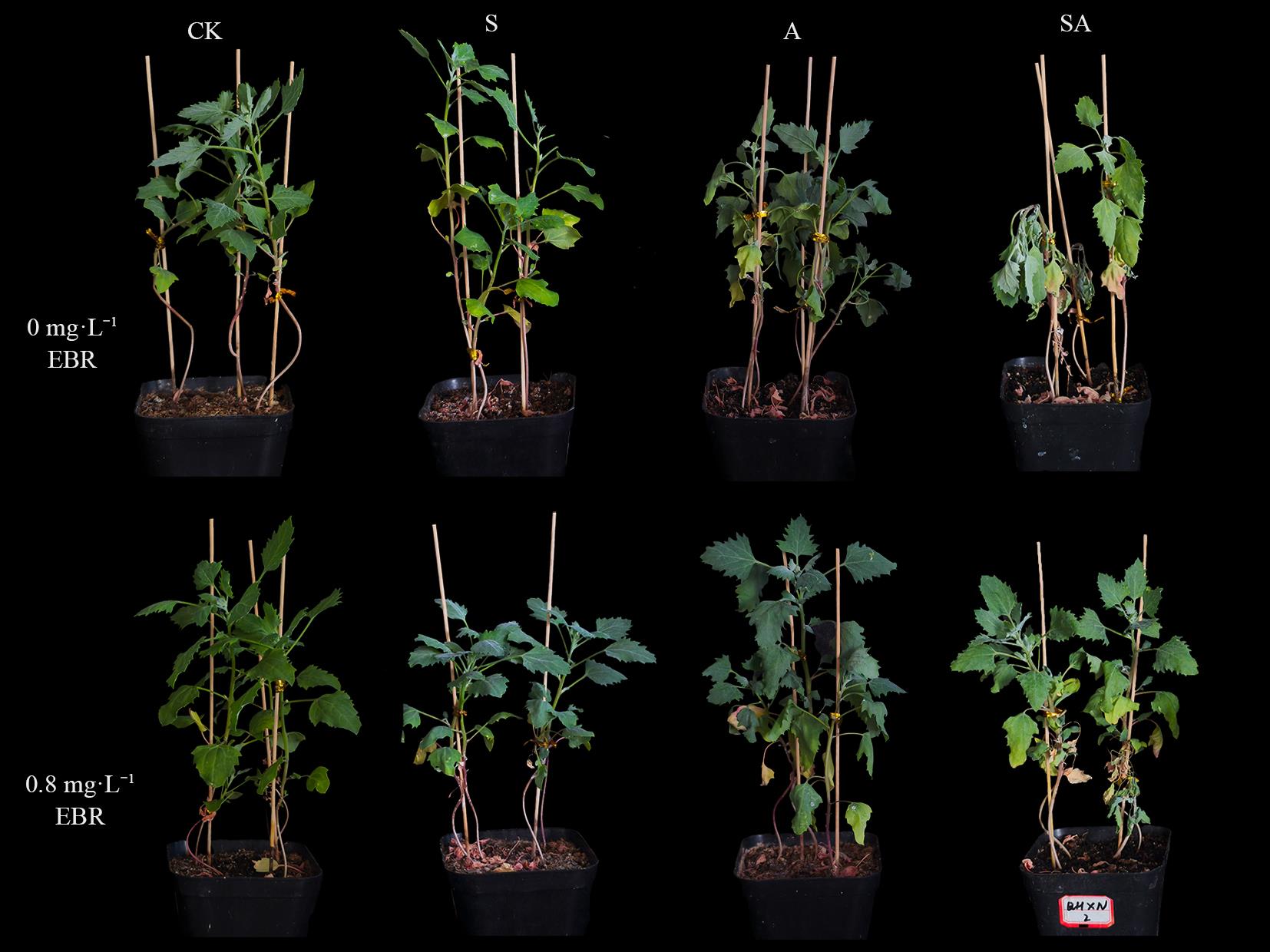
图1 EBR对盐碱胁迫下藜麦幼苗表型的影响CK: 蒸馏水Distillated water; S: NaCl∶Na2SO4=1∶1; A: NaHCO3∶Na2CO3=1∶1; SA: NaCl∶Na2SO4∶NaHCO3∶Na2CO3=1∶1∶1∶1. 下同The same below.
Fig.1 Effects of EBR on the phenotype of quinoa seedling under saline-alkali stress
生长指标 Growth index | EBR浓度 EBR concentration (mg·L-1) | 处理Treatment | |||
|---|---|---|---|---|---|
| CK | S | A | SA | ||
| 株高Plant height (cm) | 0 | 27.000±1.155ab | 26.500±1.732b | 25.750±2.500b | 19.250±2.630c |
| 0.8 | 30.000±1.414a | 27.500±0.577ab | 27.750±2.062ab | 24.750±2.630b | |
| 单株地上鲜重Single-plant aboveground fresh weight (g) | 0 | 3.752±0.380bcd | 3.257±0.204d | 2.223±0.282e | 1.794±0.439e |
| 0.8 | 5.074±0.170a | 3.995±0.383bc | 4.380±0.262b | 3.409±0.572cd | |
| 单株地下鲜重Single-plant underground fresh weight (g) | 0 | 0.261±0.017cd | 0.172±0.001e | 0.184±0.013e | 0.176±0.058e |
| 0.8 | 0.522±0.080a | 0.396±0.027b | 0.223±0.044de | 0.294±0.010c | |
| 单株地上干重Single-plant aboveground dry weight (g) | 0 | 0.413±0.057bc | 0.313±0.075c | 0.508±0.021b | 0.484±0.052b |
| 0.8 | 0.670±0.143a | 0.490±0.019b | 0.517±0.020b | 0.426±0.049bc | |
| 单株地下干重Single-plant underground dry weight (g) | 0 | 0.046±0.001c | 0.035±0.007c | 0.046±0.001c | 0.046±0.012c |
| 0.8 | 0.093±0.010a | 0.083±0.017b | 0.052±0.009c | 0.072±0.015b | |
| 根冠比Root-shoot ratio | 0 | 0.113±0.020c | 0.117±0.044bc | 0.091±0.004c | 0.096±0.031c |
| 0.8 | 0.141±0.024abc | 0.170±0.040a | 0.100±0.011c | 0.168±0.028ab | |
| 地上组织含水量Water content of aboveground tissues | 0 | 0.889±0.027a | 0.904±0.073a | 0.769±0.034b | 0.721±0.062b |
| 0.8 | 0.868±0.025a | 0.877±0.026a | 0.882±0.007a | 0.873±0.016a | |
表2 EBR对盐碱胁迫下藜麦的株高、鲜重、干重、根冠比与组织含水量的影响
Table 2 Effects of EBR on plant height, fresh weight, dry weight, root-shoot ratio, and water content of quinoa under saline-alkali stress
生长指标 Growth index | EBR浓度 EBR concentration (mg·L-1) | 处理Treatment | |||
|---|---|---|---|---|---|
| CK | S | A | SA | ||
| 株高Plant height (cm) | 0 | 27.000±1.155ab | 26.500±1.732b | 25.750±2.500b | 19.250±2.630c |
| 0.8 | 30.000±1.414a | 27.500±0.577ab | 27.750±2.062ab | 24.750±2.630b | |
| 单株地上鲜重Single-plant aboveground fresh weight (g) | 0 | 3.752±0.380bcd | 3.257±0.204d | 2.223±0.282e | 1.794±0.439e |
| 0.8 | 5.074±0.170a | 3.995±0.383bc | 4.380±0.262b | 3.409±0.572cd | |
| 单株地下鲜重Single-plant underground fresh weight (g) | 0 | 0.261±0.017cd | 0.172±0.001e | 0.184±0.013e | 0.176±0.058e |
| 0.8 | 0.522±0.080a | 0.396±0.027b | 0.223±0.044de | 0.294±0.010c | |
| 单株地上干重Single-plant aboveground dry weight (g) | 0 | 0.413±0.057bc | 0.313±0.075c | 0.508±0.021b | 0.484±0.052b |
| 0.8 | 0.670±0.143a | 0.490±0.019b | 0.517±0.020b | 0.426±0.049bc | |
| 单株地下干重Single-plant underground dry weight (g) | 0 | 0.046±0.001c | 0.035±0.007c | 0.046±0.001c | 0.046±0.012c |
| 0.8 | 0.093±0.010a | 0.083±0.017b | 0.052±0.009c | 0.072±0.015b | |
| 根冠比Root-shoot ratio | 0 | 0.113±0.020c | 0.117±0.044bc | 0.091±0.004c | 0.096±0.031c |
| 0.8 | 0.141±0.024abc | 0.170±0.040a | 0.100±0.011c | 0.168±0.028ab | |
| 地上组织含水量Water content of aboveground tissues | 0 | 0.889±0.027a | 0.904±0.073a | 0.769±0.034b | 0.721±0.062b |
| 0.8 | 0.868±0.025a | 0.877±0.026a | 0.882±0.007a | 0.873±0.016a | |
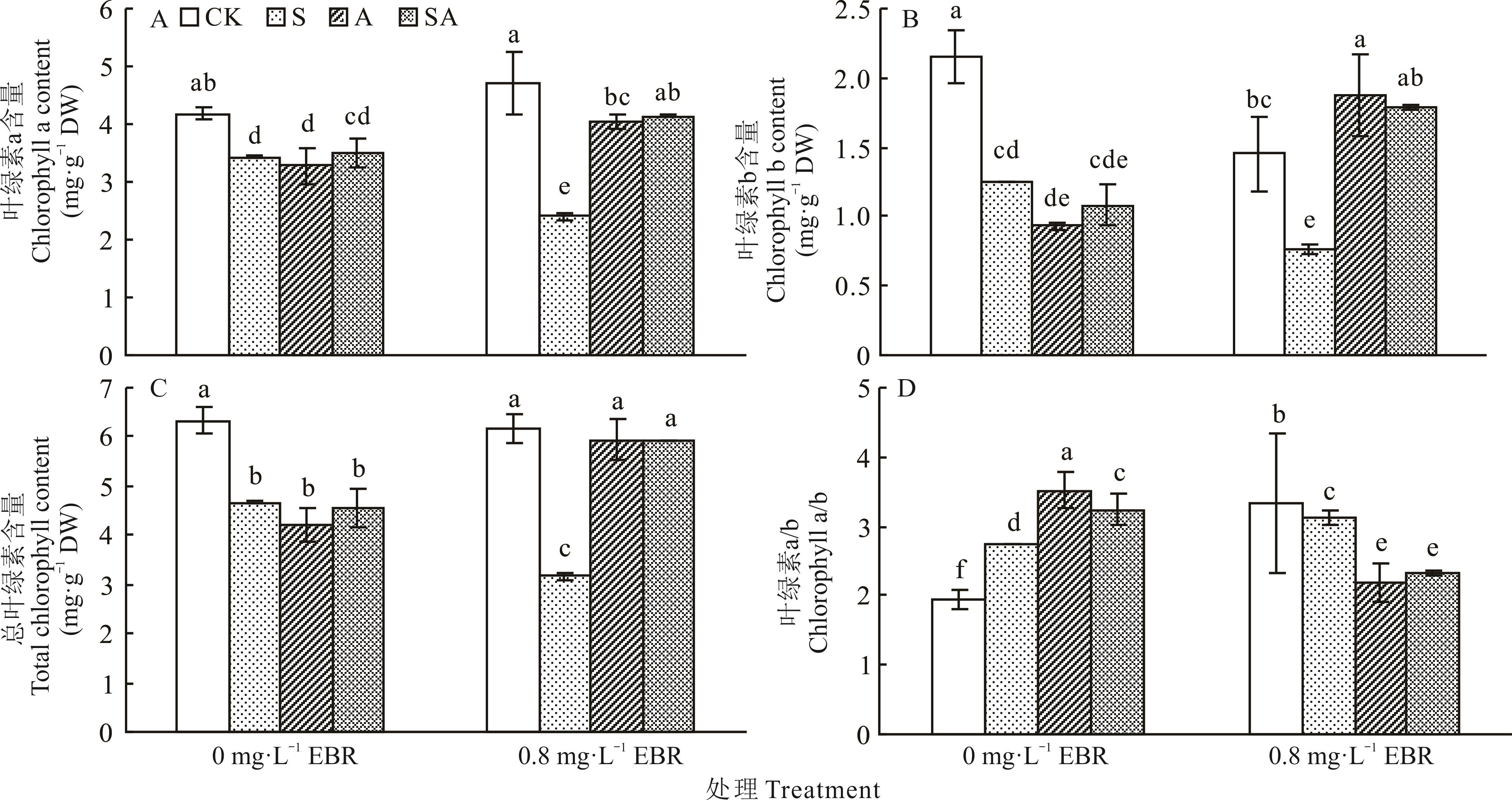
图2 EBR对盐碱胁迫下藜麦叶片光合色素含量的影响不同小写字母表示差异显著(P<0.05),下同。The different small letters mean the significant differences at P<0.05, the same below.
Fig.2 Effects of EBR on photosynthetic pigment content in quinoa leaves under saline-alkali stress
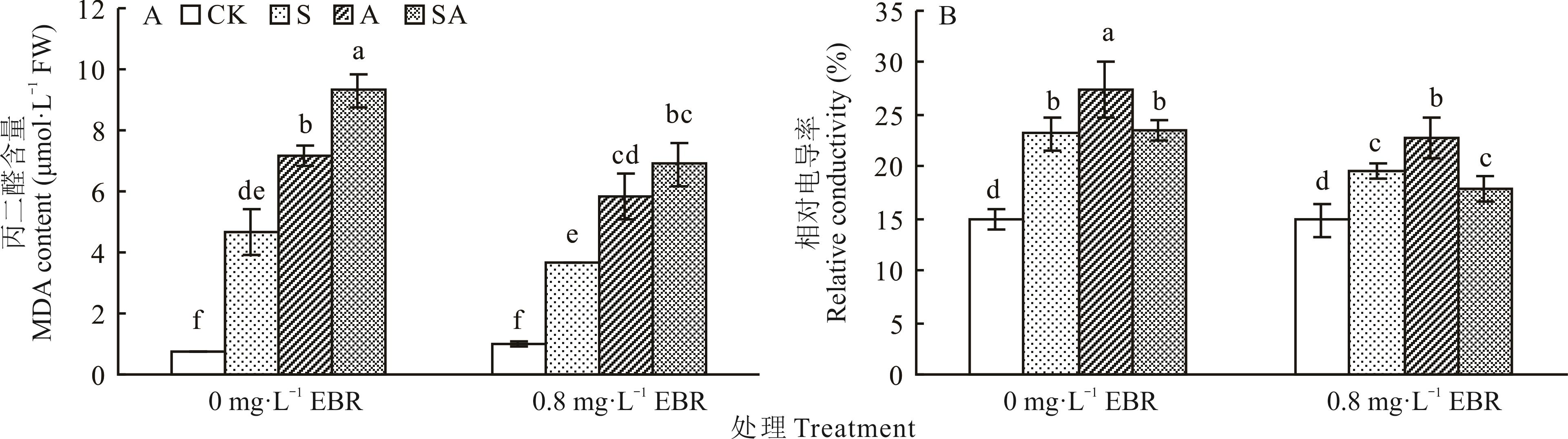
图3 EBR对盐碱胁迫下藜麦叶片丙二醛(MDA)含量和相对电导率的影响
Fig.3 Effects of EBR on the malondialdehyde (MDA) content and relative conductivity of quinoa leaves under saline-alkali stress

图4 EBR对盐碱胁迫下藜麦叶片脯氨酸和可溶性糖含量的影响
Fig.4 Effects of EBR on the proline and soluble sugar content of quinoa leaves under saline-alkali stress

图5 EBR对盐碱胁迫下藜麦叶片超氧化物歧化酶、过氧化物酶和过氧化氢酶活性的影响
Fig.5 Effects of EBR on the activities of superoxide dismutase (SOD), peroxidase (POD) and catalase (CAT) in quinoa leaves under saline-alkali stress

图6 EBR对盐碱胁迫下藜麦叶片BR合成与信号转导相关基因表达的影响
Fig.6 Effects of EBR on the expression of BR-synthesis and signal transduction related genes in quinoa leaves under saline-alkali stress
| [1] | Jat Baloch M Y, Zhang W J, Sultana T, et al. Utilization of sewage sludge to manage saline-alkali soil and increase crop production: Is it safe or not? Environmental Technology & Innovation, 2023, 32: 103266. |
| [2] | Qiao K, Wang M, Takano T, et al. Overexpression of Acyl-Coa-Binding Protein 1 (ChACBP1) from saline-alkali-tolerant Chlorella sp. enhances stress tolerance in Arabidopsis. Frontiers in Plant Science, 2018, 9: 1772. |
| [3] | Song T T, Xu H H, Sun N, et al. Metabolomic analysis of alfalfa (Medicago sativa L.) root-symbiotic rhizobia responses under alkali stress. Frontiers in Plant Science, 2017, 8: 1208. |
| [4] | Qiao K, Takano T, Liu S K. Discovery of two novel highly tolerant NaHCO3 Trebouxiophytes: Identification and characterization of microalgae from extreme saline-alkali soil. Algal Research, 2015, 9: 245-253. |
| [5] | Dong Y J, Wang W W, Hu G Q, et al. Role of exogenous 24-epibrassinolide in enhancing the salt tolerance of wheat seedlings. Journal of Soil Science and Plant Nutrition, 2017, 17(3): 554-569. |
| [6] | Niu K J, Xiao H, Wang Y, et al. A meta-analysis on plant growth and heavy metals uptake with the application of 2,4-epibrassinolide in contaminated soils. Ecotoxicology and Environmental Safety, 2025, 289: 117439. |
| [7] | Tanveer M, Shahzad B, Sharma A, et al. 24-epibrassinolide; an active brassinolide and its role in salt stress tolerance in plants: A review. Plant Physiology and Biochemistry, 2018, 130: 69-79. |
| [8] | Fu S Y. Effects of brassinolide on nutrient growth, development and physiological characteristics of riceunder salt stress. Changsha: Hunan Agricultural University, 2022. |
| 傅双宇. 油菜素内酯对盐胁迫水稻营养生长发育及生理特性的影响. 长沙: 湖南农业大学, 2022. | |
| [9] | Li M. Effects of exogenous brassinolide on root growth physiology, yield and soil environment of potato under alkaline salt stress. Lanzhou: Gansu Agricultural University, 2024. |
| 李明. 外源油菜素内酯对碱性盐胁迫下马铃薯根系生长生理、产量及土壤环境的影响. 兰州: 甘肃农业大学, 2024. | |
| [10] | Ali B, Hasan S A, Hayat S, et al. A role for brassinosteroids in the amelioration of aluminium stress through antioxidant system in mung bean (Vigna radiata L. Wilczek). Environmental and Experimental Botany, 2008, 62(2): 153-159. |
| [11] | Fariduddin Q, Ahmed M, Mir B A, et al. 24-epibrassinolide mitigates the adverse effects of manganese induced toxicity through improved antioxidant system and photosynthetic attributes in Brassica juncea. Environmental Science and Pollution Research International, 2015, 22(15): 11349-11359. |
| [12] | Song M, Ling H B, Huang S H, et al. Genome-wide survey of leucine-rich repeat receptor-like protein kinase genes and CRISPR/Cas9-targeted mutagenesis BnBRI1 in Brassica napus. Frontiers in Plant Science, 2022, 13: 865132. |
| [13] | Wei A C, Yang X S, Yao Y, et al. Progress in research on nutritional and functional components and bioactivity of quinoa (Chenopodium quinoa Willd.). Food Science, 2015, 36(15): 272-276. |
| 魏爱春, 杨修仕, 么杨, 等. 藜麦营养功能成分及生物活性研究进展. 食品科学, 2015, 36(15): 272-276. | |
| [14] | Drucker A G, Pradel W, Scott C, et al. High public good values for ecosystem service attributes of on-farm quinoa diversity conservation in Peru. Human Ecology, 2024, 52(1): 67-79. |
| [15] | Yang F R, Liu W Y, Huang J, et al. Physiological responses of different quinoavarieties to salt stress and evaluation of salt tolerance. Acta Prataculturae Sinica, 2017, 26(12): 77-88. |
| 杨发荣, 刘文瑜, 黄杰, 等. 不同藜麦品种对盐胁迫的生理响应及耐盐性评价. 草业学报, 2017, 26(12): 77-88. | |
| [16] | Zhao Y, Wei X H, He Y L, et al. Effects of complex saline-alkali stress on seed germination and seedling antioxidant characteristics of Chenopodium quinoa. Acta Prataculturae Sinica, 2019, 28(2): 156-167. |
| 赵颖, 魏小红, 赫亚龙, 等. 混合盐碱胁迫对藜麦种子萌发和幼苗抗氧化特性的影响. 草业学报, 2019, 28(2): 156-167. | |
| [17] | Kiani-pouya A, Rasouli F, Bazihizina N, et al. A large-scale screening of quinoa accessions reveals an important role of epidermal bladder cells and stomatal patterning in salinity tolerance. Environmental and Experimental Botany, 2019, 168: 103885. |
| [18] | Wang B Q, Zhao Y, Zhu X L, et al. Effects of saline-alkali stress on photosynthesis characteristics and antioxidant system in quinoa seedlings leaf. Acta Agrestia Sinica, 2021, 29(8): 1689-1696. |
| 王宝强, 赵颖, 朱晓林, 等.盐碱胁迫对藜麦幼苗叶片光合特性及抗氧化系统的影响. 草地学报, 2021, 29(8): 1689-1696. | |
| [19] | Hinojosa L, González J A, Barrios-Masias F H, et al. Quinoa abiotic stress responses: A review. Plants (Basel), 2018, 7(4): 106. |
| [20] | Xu H Y, Zhao Y, Ruan Q, et al. Resistance of quinoa seedlings under different salt-alkali stress levels. Acta Prataculturae Sinica, 2023, 32(1): 122-130. |
| 许浩宇, 赵颖, 阮倩, 等.不同混合盐碱下藜麦幼苗的抗性研究. 草业学报, 2023, 32(1): 122-130. | |
| [21] | Chen Y Q, Lin Y F, Zhang S B, et al. Genome-wide identification and characterization of the HAK gene family in quinoa (Chenopodium quinoa Willd.) and their expression profiles under saline and alkaline conditions. Plants (Basel), 2023, 12(21): 3747. |
| [22] | Chen J X, Wang X F. Experimental guidance for plant physiology. Guangzhou: South China University of Technology Press, 2006. |
| 陈建勋, 王晓峰. 植物生理学实验指导. 广州: 华南理工大学出版社, 2006. | |
| [23] | Zhang Z L, Li X F. Experimental guidance in plant physiology. Beijing: Higher Education Press, 2013. |
| 张志良, 李小芳. 植物生理学实验指导. 北京: 高等教育出版社, 2013. | |
| [24] | Shi H T. Experimental guidance in plant physiology. Beijing: Science Press, 2016. |
| 施海涛. 植物生理学实验指导. 北京: 科学出版社, 2016. | |
| [25] | Zhu X L, Wang B Q, Wang X, et al. Screening of stable internal reference gene of quinoa under hormone treatment and abiotic stress. Physiology and Molecular Biology of Plants, 2021, 27(11): 2459-2470. |
| [26] | Xu P Y, Wu Y X, He T M. Research progress on the adaptation mechanisms of plants to saline-alkali stress. Chinese Wild Plant Resources, 2020, 39(10): 41-49. |
| 许盼云, 吴玉霞, 何天明. 植物对盐碱胁迫的适应机理研究进展. 中国野生植物资源, 2020, 39(10): 41-49. | |
| [27] | Ma Y Y, Wang Z, Cao J P, et al. Effects of 2,4-epibrassinolide on the growth and physiological characteristics of Phaseolus vulgaris seedlings under saline and alkaline stresses. Acta Botanica Boreali-Occidentalia Sinica, 2024, 44(8): 1181-1189. |
| 马媛媛, 王智, 曹金萍, 等. 2,4-表油菜素内酯对盐碱胁迫下芸豆幼苗生长及生理特性的影响. 西北植物学报, 2024, 44(8): 1181-1189. | |
| [28] | Wang D, Liu Y X, Zhou Y, et al. Physiological regulation of brassinosteroids on seed germination and seedling growth in Lolium perenne in response to salt stress. Pratacultural Science, 2021, 38(6): 1110-1118. |
| 王丹, 刘亚西, 周扬, 等. 油菜素内酯对盐胁迫下黑麦草种子萌发及幼苗生长的生理调控作用. 草业科学, 2021, 38(6): 1110-1118. | |
| [29] | Wang W J, Ma D M, Zhao L J, et al. Effects of 2,4-table brassinolide on enzyme activity and root ion distribution and absorption in alfalfa seedlings. Acta Agrestia Sinica, 2021, 29(6): 1363-1368. |
| 王文静, 麻冬梅, 赵丽娟, 等. 2,4-表油菜素内酯对盐胁迫下紫花苜蓿生理指标及根系离子积累的影响. 草地学报, 2021, 29(6): 1363-1368. | |
| [30] | Muhammad Z, Hussain F. Effect of NaCl salinity on the germination and seedling growth of seven wheat genotypes. Pakistan Journal of Botany, 2012, 44(6): 1845-1850. |
| [31] | Boardman N K, Anderson J M. Isolation from spinach chloroplasts of particles containing different proportions of chlorophyll a and chlorophyll b and their possible role in the light reactions of photosynthesis. Nature, 1964, 203(4941): 166-167. |
| [32] | Wang Z H, Kong D J, Chen L L, et al. Effects of exogenous trehalose on chlorophyll metabolism and chloroplast development under low nitrogen condition. Journal of Southern Agriculture, 2019, 50(6): 1191-1196. |
| 王志红, 孔德钧, 陈丽莉, 等. 低氮下外源海藻糖对烤烟叶绿素代谢及叶绿体发育的影响. 南方农业学报, 2019, 50(6): 1191-1196. | |
| [33] | Kaya C, Aydemir S, Akram N A, et al. Epibrassinolide application regulates some key physio-biochemical attributes as well as oxidative defense system in maize plants grown under saline stress. Journal of Plant Growth Regulation, 2018, 37(4): 1244-1257. |
| [34] | Long A, Zhang J, Yang L T, et al. Effects of low pH on photosynthesis, related physiological parameters, and nutrient profiles of citrus. Frontiers in Plant Science, 2017, 8: 185. |
| [35] | Wang S Y, Cui X Y, Chen Z Y, et al. Effects of soil pH on photosynthesis characteristics and activity of protective enzymes in flue-cured tobacco leaves. Acta Agriculturae Boreali-Sinica, 2005(6): 11-14. |
| 王思远, 崔喜艳, 陈展宇, 等. 土壤pH值对烤烟叶片光合特性及体内保护酶活性的影响. 华北农学报, 2005(6): 11-14. | |
| [36] | Demidchik V, Straltsova D, Medvedev S S, et al. Stress-induced electrolyte leakage: The role of K+-permeable channels and involvement in programmed cell death and metabolic adjustment. Journal of Experimental Botany, 2014, 65(5): 1259-1270. |
| [37] | Gao H, Kang L N, Liu Q, et al. Effect of 24-epibrassinolide treatment on the metabolism of eggplant fruits in relation to development of pulp browning under chilling stress. Journal of Food Science and Technology, 2015, 52(6): 3394-3401. |
| [38] | Ali O I, Fghire R, Anaya F, et al. Physiological and morphological responses of two quinoa cultivars (Chenopodium quinoa Willd.) to drought stress. Journal of Crop Health, 2019, 71: 123-133. |
| [39] | Zhang L Y, Jiang G F, Wang X Q, et al. Identifying core genes related to low-temperature stress resistance in quinoa seedlings based on WGCNA. International Journal of Molecular Sciences, 2025, 25(13): 6885. |
| [40] | Xie H, Zhang P, Jiang C H, et al. Combined transcriptomic and metabolomic analyses of high temperature stress response of quinoa seedlings. BMC Plant Biology, 2023, 23: 292. |
| [41] | Zhou Y F, Yang Z, Sui X Q, et al. Effects of 2,4-epibrassinolide on the physiological properties of Bromus inermis under salt stress. Acta Agrestia Sinica, 2025, 33(11): 3732-3740. |
| 周一凡, 杨钊, 隋晓青, 等. 2,4-表油菜素内酯对盐胁迫下无芒雀麦生理特性的影响. 草地学报, 2025, 33(11): 3732-3740. | |
| [42] | Guan X L, Shen J. Research progress on physiological and molecular mechanisms of plant response to salt alkali stress. Jiangsu Agricultural Sciences, 2024, 52(21): 10-16. |
| 关秀玲, 申健. 植物响应盐碱胁迫的生理和分子机制研究进展. 江苏农业科学, 2024, 52(21): 10-16. | |
| [43] | Niu J H, Anjum S A, Wang R, et al. Exogenous application of brassinolide can alter morphological and physiological traits of Leymus chinensis (Trin.) Tzvelev under room and high temperatures. Chilean Journal of Agricultural Research, 2016, 76(1): 27-33. |
| [44] | Shahid M A, Pervez M A, Balal R M, et al. Brassinosteroid (24-epibrassinolide) enhances growth and alleviates the deleterious effects induced by salt stress in pea (Pisum sativum L.). Australian Journal of Crop Science, 2011, 5(5): 500-510. |
| [45] | Zhang Z J, Jin H Y, Hong K, et al. Effects of salicylic acid and brassinolide applications on salt tolerance in Cyclocarya paliurus: Amelioration of oxidative stress. Tree Physiology, 2025, 45(6): tpaf61. |
| [46] | Wang G T, Feng S W, Ding W H, et al. Response of physiological characteristics and anatomical structure to rhizosphere pH in wheat seedlings. Acta Agriculturae Boreali-occidentalis Sinica, 2021, 30(8): 1142-1147. |
| 王光涛, 冯素伟, 丁位华, 等. 小麦幼苗根系生理特性和解剖结构对根际pH的响应. 西北农业学报, 2021, 30(8): 1142-1147. | |
| [47] | Wang Y Z, Ding G D, Cui X R, et al. Effects of saline-alkali stress on the growth and photosynthetic characteristics of Cyperus esculentus and the responses of protective enzymes. Journal of Arid Land Resources and Environment, 2022, 36(5): 146-152. |
| 王艺臻, 丁国栋, 崔欣然, 等. 盐碱复合胁迫对油沙豆生长和光合特性的影响. 干旱区资源与环境, 2022, 36(5): 146-152. | |
| [48] | Wei L J. Studies of the S-nitrosylation of BR co-receptor BAK1 enhancing the salt tolerance of tomato seedlings. Lanzhou: Gansu Agricultural University, 2023. |
| 魏丽娟. BR共受体蛋白BAK1的S-亚硝基化增强番茄幼苗耐盐性的机理研究. 兰州: 甘肃农业大学, 2023. | |
| [49] | Zhang R, Liu C Z, Yuan F, et al. Ion balance mechanism and transcriptome analysis of Elytrigia elongata in response to NaHCO3 stress. Acta Prataculturae Sinica, 2025, 34(10): 174-186. |
| 张然, 刘琛琢, 苑峰, 等. 长穗偃麦草响应NaHCO3胁迫的离子平衡机制及转录组分析. 草业学报, 2025, 34(10): 174-186. | |
| [50] | Zeng L L. Regulatory mechanisms of brassinosteroid in salt tolerance of the mangrove plant Kandelia obovata. Xiamen: Xiamen University, 2022. |
| 曾琳岚. 油菜素内酯对红树植物秋茄耐盐性的调控作用研究. 厦门: 厦门大学, 2022. | |
| [51] | Nomura T, Kushiro T, Yokota T, et al. The last reaction producing brassinolide is catalyzed by cytochrome P-450s, CYP85A3 in tomato and CYP85A2 in Arabidopsis. Journal of Biological Chemistry, 2005, 280(18): 17873-17879. |
| [1] | 刘进娣, 陈仕勇, 李进, 蒋涛, 梁国玲, 周青平. 燕麦蔗糖转运蛋白基因家族的鉴定及其对干旱和盐碱胁迫的响应[J]. 草业学报, 2026, 35(8): 144-156. |
| [2] | 李凤, 郭绪虎, 曹慧芬, 孔祥睿, 杨冬雪, 张东旭, 张永芳. 藜麦NAC转录因子CqNAC66响应干旱和盐胁迫的功能研究[J]. 草业学报, 2026, 35(8): 170-181. |
| [3] | 李月琪, 马涛, 丁玉萍, 苏明, 李涛, 马小英, 马风兰, 万猛虎, 李清云, 张丹, 吴娜, 刘吉利. 基于生长-养分积累-产量协同调控的宁夏盐碱地玉米品种适应性研究[J]. 草业学报, 2026, 35(6): 93-107. |
| [4] | 刘朝荣, 陈永成, 陈莹, 张旭东, 胡天宇, 苏力合, 张凡凡, 王旭哲, 姚琨, 马春晖. 新疆盐碱化土壤下不同羊草的耐盐碱性差异研究[J]. 草业学报, 2026, 35(4): 29-41. |
| [5] | 童玉花, 王晓彤, 马永龙, 杨金辉, 余冬雯, 李淑霞. 壳聚糖浸种对盐碱胁迫下紫花苜蓿种子萌发的影响[J]. 草业学报, 2026, 35(3): 245-256. |
| [6] | 第乙林, 刘思甜, 刘欣影, 杜泳, 李州. γ-氨基丁酸对镉胁迫下匍匐翦股颖耐受性及镉吸收转运的影响[J]. 草业学报, 2026, 35(2): 208-220. |
| [7] | 窦苗苗, 姜晓东, 孙慧琼, 徐宏申, 王锡亮, 杨博慧, 柴文婷, 赵珊珊, 张春来. 藜麦CqSGT1基因克隆、表达模式与DNA变异分析[J]. 草业学报, 2026, 35(1): 223-240. |
| [8] | 王昶, 闵庚梅, 张丽娟, 陆建英, 牛早霞, 魏玉明, 杨发荣. 藜麦霜霉病及其综合防控研究进展[J]. 草业学报, 2025, 34(9): 194-205. |
| [9] | 陈宁, 包凤轩, 赵辉祥, 王楠, 姜汝玉, 李国良, 刘香萍, 曲善民, 杨伟光. 寒冷区苏打盐碱生境下紫花苜蓿越冬期根颈的生理特性[J]. 草业学报, 2025, 34(9): 78-86. |
| [10] | 秦楠, 曹瑞鹏, 高婧涵, 彭玉飞, 田淼, 吕红, 任璐, 殷辉, 赵晓军. 藜麦种子可培养内生真菌鉴定及分析[J]. 草业学报, 2025, 34(11): 98-113. |
| [11] | 卜祥琪, 李姗姗, 段莹娜, 王迎春, 郑琳琳. 一氧化氮对盐碱胁迫下盐地碱蓬抗逆性及饲用品质的影响[J]. 草业学报, 2024, 33(9): 60-69. |
| [12] | 陆姣云, 田宏, 熊军波, 吴新江, 刘洋, 张鹤山. 14份乡土狼尾草材料幼苗的耐冷性综合评价[J]. 草业学报, 2024, 33(8): 98-111. |
| [13] | 邓茂桦, 郑蓉, 王蓓晨, 王超, 刘荣贵, 张瀚文, 王政和, 王剑峰. 缺氮条件下内生真菌对醉马草生理特性的影响[J]. 草业学报, 2024, 33(7): 182-191. |
| [14] | 宋淑珍, 朱才业, 刘立山, 宫旭胤, 雒瑞瑞. 断尾对兰州大尾羊脂肪细胞结构和脂肪代谢相关基因表达的影响[J]. 草业学报, 2024, 33(7): 94-104. |
| [15] | 孔海明, 宋家兴, 杨静, 李倩, 杨培志, 曹玉曼. 紫花苜蓿CAMTA基因家族鉴定及其在非生物胁迫下的表达模式分析[J]. 草业学报, 2024, 33(5): 143-154. |
| 阅读次数 | ||||||
|
全文 |
|
|||||
|
摘要 |
|
|||||
