

ISSN 1004-5759 CN 62-1105/S
草业学报 ›› 2026, Vol. 35 ›› Issue (6): 83-92.DOI: 10.11686/cyxb2025278
牛浴林1,2( ), 包明芳1,2, 王文虎1,2, 陈鑫1,2, 刘凯强1,2, 刘文辉1,2, 秦燕1,2()
收稿日期:2025-07-03
修回日期:2025-09-03
出版日期:2026-06-20
发布日期:2026-04-13
通讯作者:
秦燕
作者简介:Corresponding author. E-mail: mule119@163.com基金资助:
Yu-lin NIU1,2(), Ming-fang BAO1,2, Wen-hu WANG1,2, Xin CHEN1,2, Kai-qiang LIU1,2, Wen-hui LIU1,2, Yan QIN1,2()
Received:2025-07-03
Revised:2025-09-03
Online:2026-06-20
Published:2026-04-13
Contact:
Yan QIN
摘要:
为了筛选出适宜在环青海湖地区种植的优异无芒雀麦资源,本研究以三江源地区10份野生无芒雀麦种质资源为对象,于青海省海北州分析和比较不同种质资源间农艺性状及饲草产量、种子产量等生产性能,通过构建结构方程模型(SEM)揭示影响产量的关键农艺性状,采用TOPSIS-多准则决策模型对供试无芒雀麦资源的各项指标进行综合评价,为环青海湖地区无芒雀麦种植提供理论依据。结果显示:1)2龄时,GN-2210的株高、茎粗、叶面积和单株种子产量较大,分别为137.20 cm、5.18 mm、30.69 cm2和114.29 g·株-1;3龄时,GN-2210株高、茎粗、叶面积和单株种子产量达到最大,分别为111.80 cm、4.33 mm、25.73 cm2和106.30 g·株-1;2)分段式结构方程(SEM)模型分析表明,叶面积和分蘖数是影响无芒雀麦饲草产量的关键因子,而影响无芒雀麦种子产量的驱动因子为叶面积和茎粗;3)TOPSIS-多准则决策模型表明,GN-221种质资源在生物量积累、单株结实量方面均显著优于其他资源,适宜在青藏高原东部种植与推广。
牛浴林, 包明芳, 王文虎, 陈鑫, 刘凯强, 刘文辉, 秦燕. 三江源地区10份无芒雀麦资源农艺性状与生产性能综合评价[J]. 草业学报, 2026, 35(6): 83-92.
Yu-lin NIU, Ming-fang BAO, Wen-hu WANG, Xin CHEN, Kai-qiang LIU, Wen-hui LIU, Yan QIN. A multivariate evaluation of agronomic traits, yield and seed production in ten accessions of Bromus inermis from the Three-River-Source Region[J]. Acta Prataculturae Sinica, 2026, 35(6): 83-92.
种质编号 Germplasm number | 种质名称 Variety name | 采集地点 Collection places | 小生境 Microhabitat |
|---|---|---|---|
| GN-221 | 无芒雀麦 B.inermis | 青海省贵南县茫曲镇Mangqu Town, Guinan County, Qinghai Province | 茫拉河河边Mangla river bank |
| GN-222 | 无芒雀麦 B.inermis | 青海省贵南县沙沟乡Shagou Village, Guinan County, Qinghai Province | 路边山坡Roadside slopes |
| GN-223 | 无芒雀麦 B.inermis | 青海省贵南县塔秀乡Taxiu Village, Guinan County, Qinghai Province | 退化草场Degraded grassland |
| GN-224 | 无芒雀麦 B.inermis | 青海省贵南县茫拉乡Mangla Village, Guinan County, Qinghai Province | 山坡阴坡Hillside shady slopes |
| GN-225 | 无芒雀麦 B.inermis | 青海省贵南县塔秀乡Taxiu Village, Guinan County, Qinghai Province | 河边Riverside |
| GN-226 | 无芒雀麦 B.inermis | 青海省贵南县森多乡Senduo Village, Guinan County, Qinghai Province | 路边灌丛Roadside scrub |
| GN-227 | 无芒雀麦 B.inermis | 青海省贵南县沙沟乡Shagou Village, Guinan County, Qinghai Province | 土路中间In the middle of the dirt road |
| GN-228 | 无芒雀麦 B.inermis | 青海省贵南县茫拉乡Mangla Village, Guinan County, Qinghai Province | 路边Roadside |
| GN-229 | 无芒雀麦 B.inermis | 青海省贵南县沙沟乡Shagou Village, Guinan County, Qinghai Province | 围栏旁Fenced area |
| GN-2210 | 无芒雀麦 B.inermis | 青海省贵南县森多乡Senduo Village, Guinan County, Qinghai Province | 围栏封育草场Fence off pastureland |
表1 试验材料的来源信息
Table 1 Sources of experimental materials
种质编号 Germplasm number | 种质名称 Variety name | 采集地点 Collection places | 小生境 Microhabitat |
|---|---|---|---|
| GN-221 | 无芒雀麦 B.inermis | 青海省贵南县茫曲镇Mangqu Town, Guinan County, Qinghai Province | 茫拉河河边Mangla river bank |
| GN-222 | 无芒雀麦 B.inermis | 青海省贵南县沙沟乡Shagou Village, Guinan County, Qinghai Province | 路边山坡Roadside slopes |
| GN-223 | 无芒雀麦 B.inermis | 青海省贵南县塔秀乡Taxiu Village, Guinan County, Qinghai Province | 退化草场Degraded grassland |
| GN-224 | 无芒雀麦 B.inermis | 青海省贵南县茫拉乡Mangla Village, Guinan County, Qinghai Province | 山坡阴坡Hillside shady slopes |
| GN-225 | 无芒雀麦 B.inermis | 青海省贵南县塔秀乡Taxiu Village, Guinan County, Qinghai Province | 河边Riverside |
| GN-226 | 无芒雀麦 B.inermis | 青海省贵南县森多乡Senduo Village, Guinan County, Qinghai Province | 路边灌丛Roadside scrub |
| GN-227 | 无芒雀麦 B.inermis | 青海省贵南县沙沟乡Shagou Village, Guinan County, Qinghai Province | 土路中间In the middle of the dirt road |
| GN-228 | 无芒雀麦 B.inermis | 青海省贵南县茫拉乡Mangla Village, Guinan County, Qinghai Province | 路边Roadside |
| GN-229 | 无芒雀麦 B.inermis | 青海省贵南县沙沟乡Shagou Village, Guinan County, Qinghai Province | 围栏旁Fenced area |
| GN-2210 | 无芒雀麦 B.inermis | 青海省贵南县森多乡Senduo Village, Guinan County, Qinghai Province | 围栏封育草场Fence off pastureland |
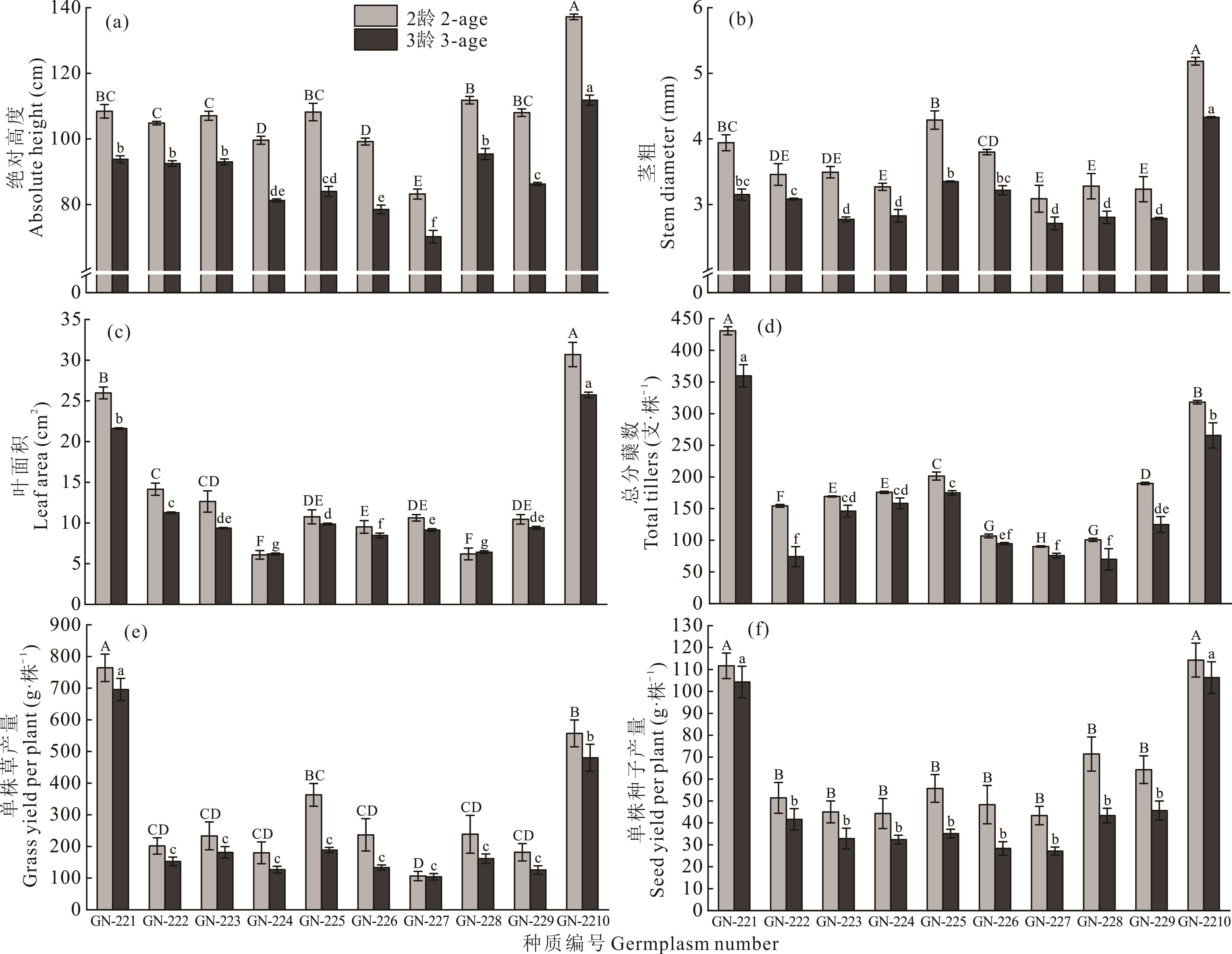
图1 无芒雀麦种质资源的农艺性状与产量大写字母表示2龄时各种质资源间差异显著(P<0.05),小写字母表示3龄时各种质资源间差异显著(P<0.05)。The capital letters indicate significant differences in 2 years old germplasm resources (P<0.05), the lowercase letters denote significant differences in 3 years old germplasm resources (P<0.05).
Fig.1 Agronomic traits and yield performance of B. inermis germplasm resources
| 项目Item | 处理Treatment | F | P |
|---|---|---|---|
株高 Plant height | 资源 Varieties | 120.488 | 0.001 |
| 龄级 Age group | 639.544 | 0.001 | |
| 资源×龄级 Varieties×age group | 5.413 | 0.001 | |
茎粗 Stem diameter | 资源 Varieties | 44.965 | 0.001 |
| 龄级 Age group | 119.853 | 0.001 | |
| 资源×龄级 Varieties×age group | 1.509 | 0.159 | |
叶面积 Leaf area | 资源 Varieties | 245.412 | 0.001 |
| 龄级 Age group | 48.712 | 0.001 | |
| 资源×龄级 Varieties×age group | 3.346 | 0.002 | |
总分蘖数 Total tillers | 资源 Varieties | 162.928 | 0.001 |
| 龄级 Age group | 71.772 | 0.001 | |
| 资源×龄级 Varieties×age group | 2.545 | 0.013 | |
单株草产量 Grass yield per plant | 资源 Varieties | 22.833 | 0.001 |
| 龄级 Age group | 0.803 | 0.373 | |
| 资源×龄级 Varieties×age group | 0.501 | 0.870 | |
| 单株种子产量Seed yield per plant | 资源 Varieties | 9.196 | 0.001 |
| 龄级 Age group | 12.578 | 0.001 | |
| 资源×龄级 Varieties×age group | 0.600 | 0.793 |
表2 种质资源和龄级对无芒雀麦表型性状和产量的双因素方差分析
Table 2 Two-way ANOVA of the effects of varieties and age groups on phenotypic traits and yield in B. inermis
| 项目Item | 处理Treatment | F | P |
|---|---|---|---|
株高 Plant height | 资源 Varieties | 120.488 | 0.001 |
| 龄级 Age group | 639.544 | 0.001 | |
| 资源×龄级 Varieties×age group | 5.413 | 0.001 | |
茎粗 Stem diameter | 资源 Varieties | 44.965 | 0.001 |
| 龄级 Age group | 119.853 | 0.001 | |
| 资源×龄级 Varieties×age group | 1.509 | 0.159 | |
叶面积 Leaf area | 资源 Varieties | 245.412 | 0.001 |
| 龄级 Age group | 48.712 | 0.001 | |
| 资源×龄级 Varieties×age group | 3.346 | 0.002 | |
总分蘖数 Total tillers | 资源 Varieties | 162.928 | 0.001 |
| 龄级 Age group | 71.772 | 0.001 | |
| 资源×龄级 Varieties×age group | 2.545 | 0.013 | |
单株草产量 Grass yield per plant | 资源 Varieties | 22.833 | 0.001 |
| 龄级 Age group | 0.803 | 0.373 | |
| 资源×龄级 Varieties×age group | 0.501 | 0.870 | |
| 单株种子产量Seed yield per plant | 资源 Varieties | 9.196 | 0.001 |
| 龄级 Age group | 12.578 | 0.001 | |
| 资源×龄级 Varieties×age group | 0.600 | 0.793 |
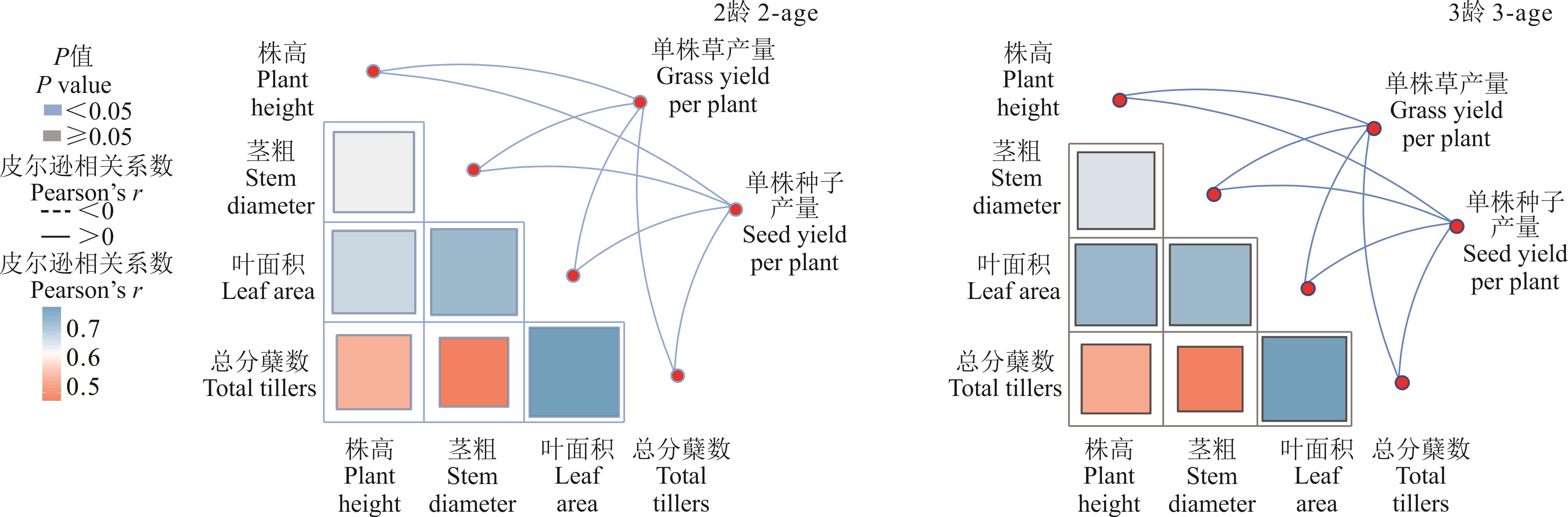
图2 无芒雀麦产量与农艺性状的Mantel相关性分析
Fig.2 Mantel correlation analysis between yield and agronomic traits in B. inermis
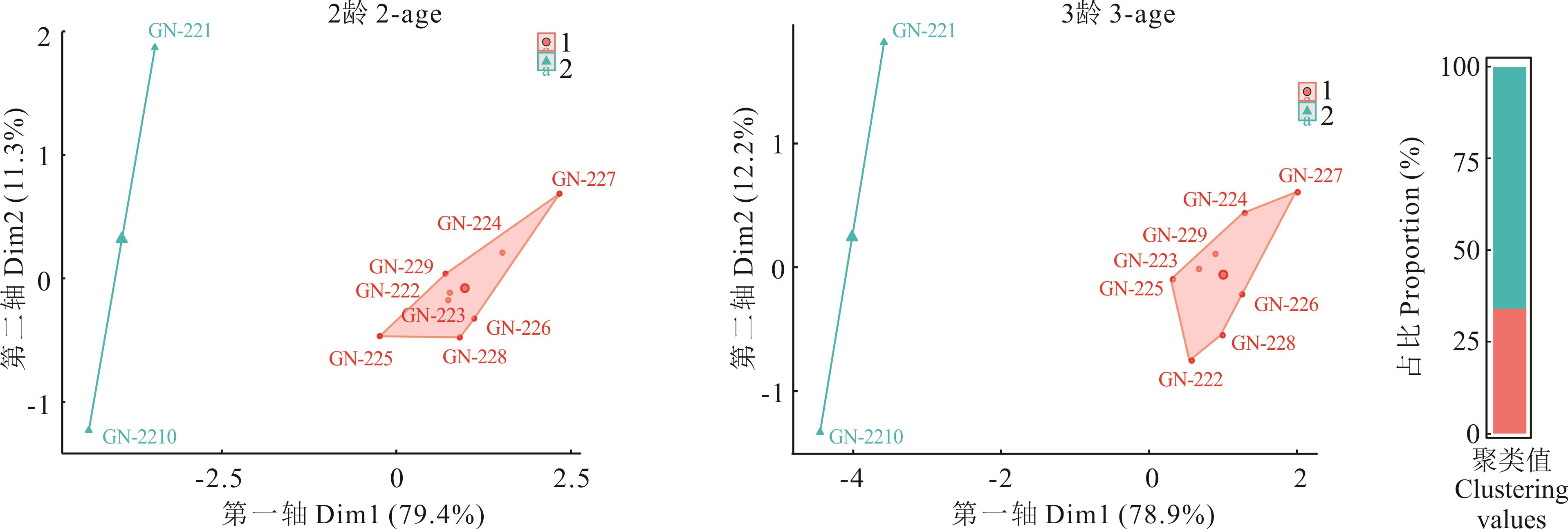
图3 无芒雀麦种质资源关键性状K均值聚类分析
Fig.3 K-means clustering analysis of key traits in B. inermis germplasm resources
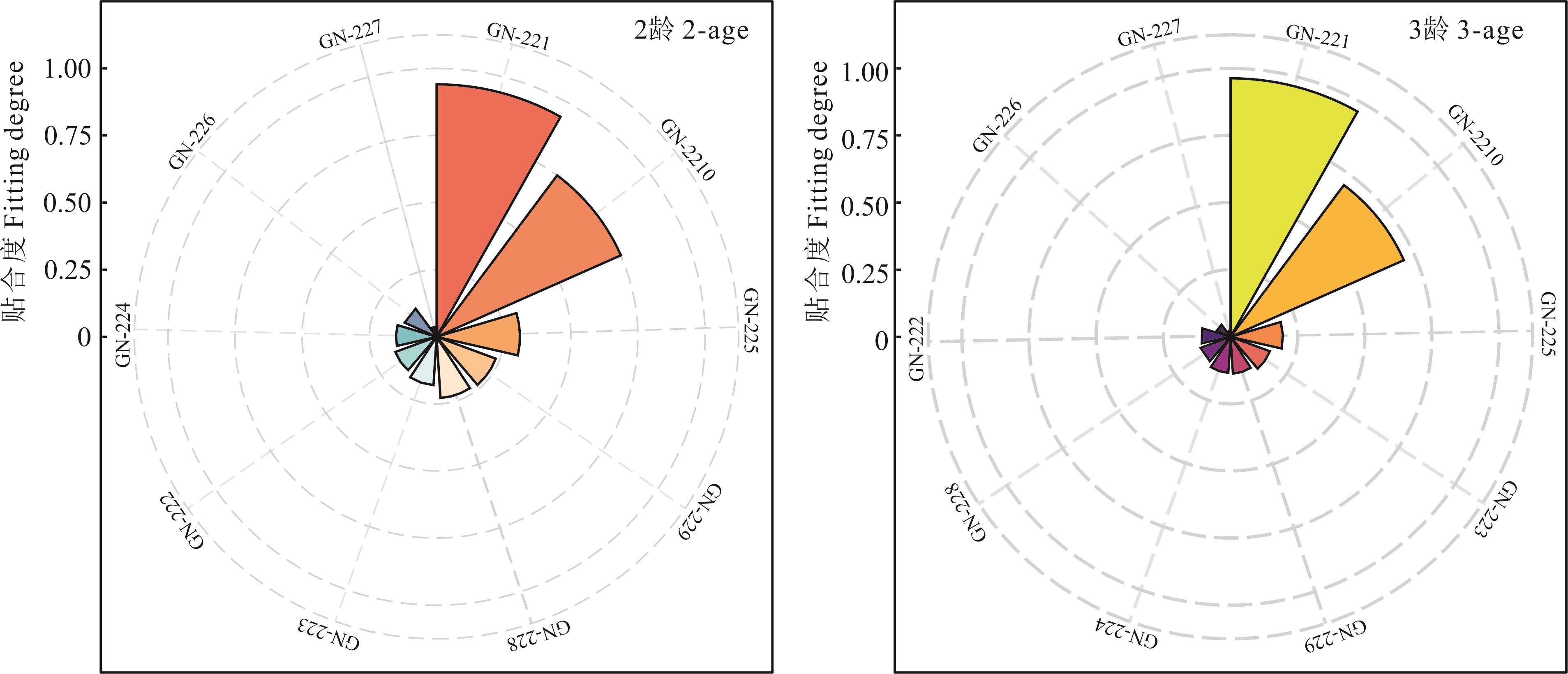
图4 无芒雀麦种质资源TOPSIS综合评价
Fig.4 TOPSIS comprehensive evaluation of B. inermis germplasm resources
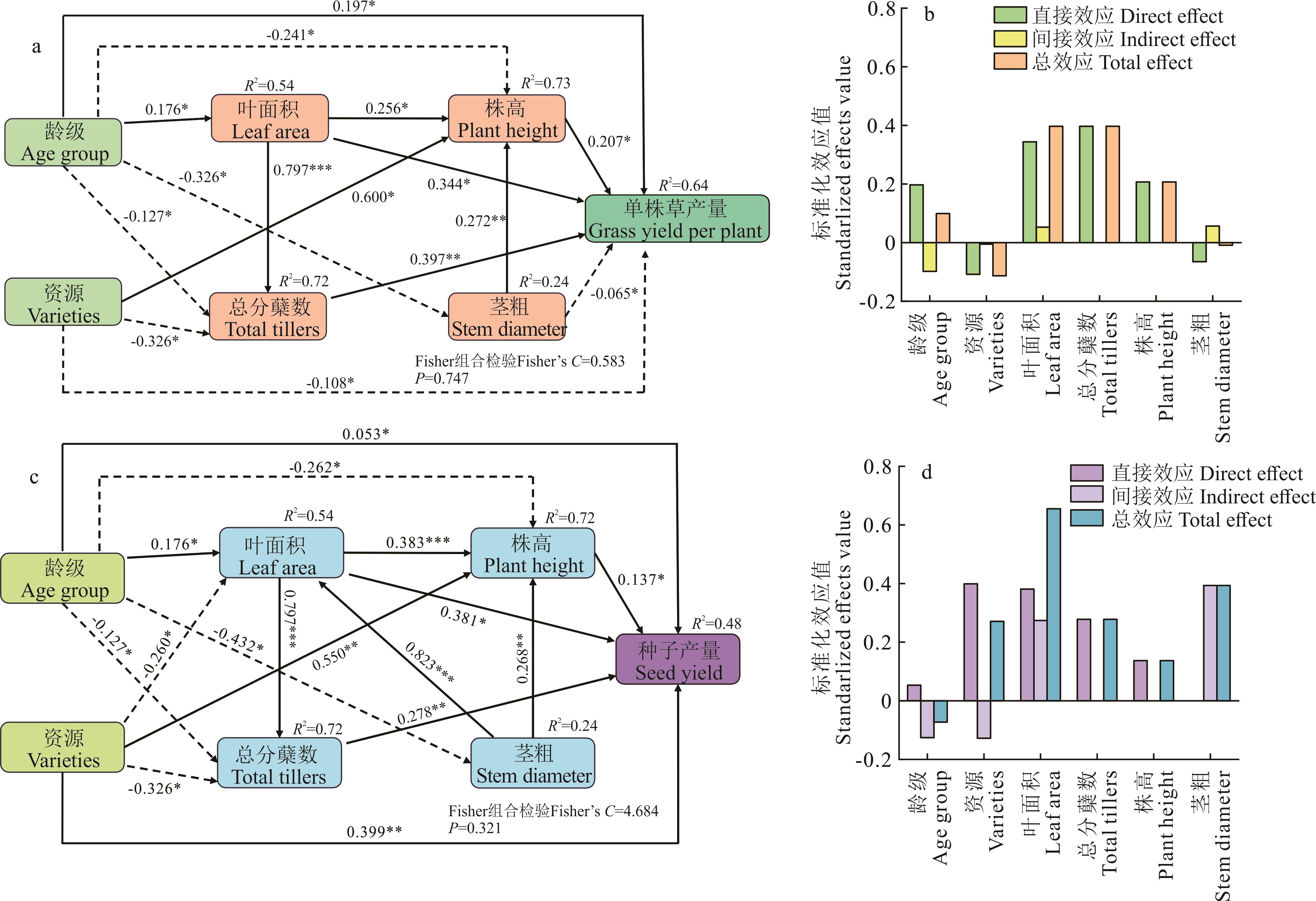
图5 结构方程模型分析龄级和资源对单株草产量和种子产量的影响路径及各因子的标准化效应值图中实/虚向量线分别表征显著的正向/负向效应关系,数值对应的是标准化路径系数。*表示在0.05水平上差异显著,**表示在0.01水平上差异显著,***表示在0.001水平上差异显著。Solid vectors indicate significant positive effect relationships, while dashed vectors represent significant negative effect relationships. Numerical labels correspond to standardized path coefficients. Asterisks denote significance levels: *: P<0.05, **: P<0.01, ***: P<0.001.
Fig.5 Structural equation modeling (SEM) analysis of the influence pathways of age groups and germplasm resources on individual plant forage yield, seed yield and standardized effect sizes of key factors
| [1] | Liu Y Q, Lv C H, Fu B J, et al. Terrestrial ecosystem classification and its spatiotemporal changes in China during last 20 years. Acta Ecologica Sinica, 2021, 41(10): 3975-3987. |
| 刘亚群, 吕昌河, 傅伯杰, 等. 中国陆地生态系统分类识别及其近20年的时空变化. 生态学报, 2021, 41(10): 3975-3987. | |
| [2] | Ouyang Z Y, Zhang G S, Ying L X. Overview of the impacts of climate change on ecosystem distribution and functions across the Tibetan Plateau. Climate Change Research, 2024, 20(6): 699-710. |
| 欧阳志云, 张观石, 应凌霄. 气候变化对青藏高原生态系统分布范围和生态功能的影响研究进展. 气候变化研究进展, 2024, 20(6): 699-710. | |
| [3] | Mo X G, Liu W, Meng C C, et al. Variations of forage yield and forage-livestock balance in grasslands over the Tibetan Pla-teau, China. Chinese Journal of Applied Ecology, 2021, 32(7): 2415-2425. |
| 莫兴国, 刘文, 孟铖铖, 等. 青藏高原草地产量与草畜平衡变化. 应用生态学报, 2021, 32(7): 2415-2425. | |
| [4] | Tian H, Xu R, Canadell J G, et al. A comprehensive quantification of global nitrous oxide sources and sinks. Nature, 2020, 586(7828): 248-256. |
| [5] | Cao J, Holden N M, Lv X T, et al. The effect of grazing management on plant species richness on the Qinghai-Tibetan Plateau. Grass and Forage Science, 2011, 66(3): 333-336. |
| [6] | Zhang Q, Ma L, Zhang Z H, et al. Ecological restoration of degraded grassland in Qinghai-Tibet alpine region: Degradation status, restoration measures, effects and prospects. Acta Ecologica Sinica, 2019, 39(20): 7441-7451. |
| 张骞, 马丽, 张中华, 等. 青藏高寒区退化草地生态恢复:退化现状、恢复措施、效应与展望. 生态学报, 2019, 39(20): 7441-7451. | |
| [7] | Shi W G, Li Z Y, Li H Y, et al. Comparative analysis of description characters of Bromus inermis gemplasm resources. Journal of Plant Genetic Resources, 2007, 8(4): 510-513. |
| 师文贵, 李志勇, 李鸿雁, 等. 无芒雀麦种质资源主要描述性状比较分析. 植物遗传资源学报, 2007, 8(4): 510-513. | |
| [8] | Antonova E V, Fuchs J, Roder M S. Influence of chronic man-made pollution on Bromus inermis genome size. Russian Journal of Ecology, 2020, 51(4): 337-344. |
| [9] | Gong K, Jin G L, Sui X Q, et al. Analysis on the distribution, breeding and utilization of Bromus inermis germplasm resources in China. Heilongjiang Animal Science and Veterinary Medicine, 2019(21): 29-32, 36. |
| 宫珂, 靳瑰丽, 隋晓青, 等. 我国无芒雀麦种质资源分布、育种及利用现状分析. 黑龙江畜牧兽医, 2019(21): 29-32, 36. | |
| [10] | Huang W, Chang W, Yu S Y, et al. Comprehensive evaluation of production performance and nutritional quality of 16 Bromus inermis germplasm resources. Pratacultural Science, 2021, 38(11): 2237-2246. |
| 黄薇, 常巍, 余淑艳, 等. 16份无芒雀麦种质资源生产性能与营养品质的综合评价. 草业科学, 2021, 38(11): 2237-2246. | |
| [11] | Zhang Y, Shi F L, Zhao H X. Study on the seed germination of the Bromus inermis L. seed mutation induced by EMS. Seed, 2018, 37(12): 70-72. |
| 张玥, 石凤翎, 赵海霞. EMS处理对无芒雀麦种子萌发的研究. 种子, 2018, 37(12): 70-72. | |
| [12] | Guo X Y, Gao S, Gao Y, et al. Genetic diversity analysis and comprehensive evaluation of agronomic traits in Bromus inermis germplasm resources. Seed, 2021, 40(10): 41-48. |
| 郭兴玉, 高山, 高阳, 等. 无芒雀麦种质资源农艺性状遗传多样性分析及综合评价. 种子, 2021, 40(10): 41-48. | |
| [13] | Hao Y H, Li Y, Tang F, et al. Genetic diversity of agronomic characteristics of 29 Bromus inermis germplasms. Pratacultural Science, 2020, 37(9): 1770-1778. |
| 郝裕辉, 李瑶, 唐凤, 等. 29份无芒雀麦种质资源农艺性状的遗传多样性. 草业科学, 2020, 37(9): 1770-1778. | |
| [14] | Chang W. Trait evaluation and genetic diversity analysis of Bromus inermis Leyss. germplasm resources. Yinchuan: Ningxia University, 2020. |
| 常巍. 无芒雀麦种质资源性状评价与遗传多样性分析. 银川: 宁夏大学, 2020. | |
| [15] | Wu Y H, Liu W H, Liu K Q, et al. Comprehensive evaluation and screening on the productive performance of 13 Bromus inermis Leyss. germplasm resources. Acta Agrestia Sinica, 2023, 31(11): 3472-3483. |
| 吴雨涵, 刘文辉, 刘凯强, 等. 13份无芒雀麦种质资源生产性能的综合评价及筛选. 草地学报, 2023, 31(11): 3472-3483. | |
| [16] | Liu M, Qin Y, Liu W H, et al. Seed yield comparison of Bromus inermis germplasm in the alpine Qinghai-Tibet Plateau. Chinese Journal of Grassland, 2024, 46(3): 70-80. |
| 刘慢, 秦燕, 刘文辉, 等. 青藏高原高寒区不同无芒雀麦种质资源种子产量评价. 中国草地学报, 2024, 46(3): 70-80. | |
| [17] | Wang W H, Liang G L, Liu W H, et al. Comprehensive evaluation of agronomic traits and yield of eight Elymus sibiricus varieties in the Qinghai-Tibet Plateau. Acta Prataculturae Sinica, 2025, 34(2): 123-132. |
| 王文虎, 梁国玲, 刘文辉, 等. 青藏高原区8份老芒麦资源农艺性状与生产性能综合评价. 草业学报, 2025, 34(2): 123-132. | |
| [18] | Su L L. Effects of nitrogen and phosphorus on the productivity, soil nutrients and microbial characteristics of grass-bean mixed grassland. Xining: Qinghai University, 2023. |
| 苏乐乐. 氮磷添加对禾豆混播草地生产力、土壤养分及微生物特性的影响. 西宁: 青海大学, 2023. | |
| [19] | Wang X P, Bai Y X, Yao X H, et al. Effect of mowing stubble height on forage and grain yield and forage quality characteristics of hulless barley. Journal of Triticeae Crops, 2023, 43(4): 513-523. |
| 王小萍, 白羿雄, 姚晓华, 等. 刈割留茬高度对青稞饲草与籽粒产量及饲用品质的影响. 麦类作物学报, 2023, 43(4): 513-523. | |
| [20] | Yu A P, Jiang A C, Zhang H H, et al. Comparison and comprehensive evaluation of agronomic traits and productivity of 14 Bromus inermis. Acta Agrestia Sinica, 2024, 32(10): 3205-3214. |
| 于爱萍, 蒋昂辰, 张浩浩, 等. 14份无芒雀麦种质农艺性状与生产性能的比较及综合评价. 草地学报, 2024, 32(10): 3205-3214. | |
| [21] | Wu Y H. Evaluation and screening of forage production performance and drought resistance Bromas inermis Leyss germplasm resources in alpine region. Xining: Qinghai University, 2023. |
| 吴雨涵. 高寒区无芒雀麦种质资源饲草生产性能评价筛选及抗旱性研究. 西宁: 青海大学, 2023. | |
| [22] | Wang R F, Hu Y S, Gao W R, et al. Functions of NAC transcription factors family in stress responses in plants. Plant Physiology Journal, 2014, 50(10): 1494-1500. |
| 王瑞芳, 胡银松, 高文蕊, 等. 植物NAC转录因子家族在抗逆响应中的功能. 植物生理学报, 2014, 50(10): 1494-1500. | |
| [23] | Ballhorn D J, Kautz S, Jensen M, et al. Genetic and environmental interactions determine plant defences against herbivores. Journal of Ecology, 2011, 99(1): 313-326. |
| [24] | Fan Y K, Yun L, Li Z, et al. Correlation analysis of agronomic traits related to forage yield of Psathyrostachys juncea. Chinese Journal of Grassland, 2020, 42(3): 119-125. |
| 范亚坤, 云岚, 李珍, 等. 新麦草饲草产量相关农艺性状的关联性分析. 中国草地学报, 2020, 42(3): 119-125. | |
| [25] | Sun W B, Ma H L, Hou X Y, et al. Comprehensive evaluation of production performance and nutritional value of 20 alfalfa cultivars in two ecological areas of Gansu Province. Acta Prataculturae Sinica, 2017, 26(3): 161-174. |
| 孙万斌, 马晖玲, 侯向阳, 等. 20个紫花苜蓿品种在甘肃两个地区的生产性能及营养价值综合评价. 草业学报, 2017, 26(3): 161-174. | |
| [26] | Yuan Y, Chen D M, Liu W, et al. Correlation analysis and comprehensive evaluation of production and reproductive of forage oats in northwest Sichuan Plateau. Journal of Sichuan Agricultural University, 2023, 41(6): 1116-1123. |
| 袁艺, 陈冬明, 刘伟, 等. 川西北高原饲用燕麦产量和生殖性状相关性分析及综合评价. 四川农业大学学报, 2023, 41(6): 1116-1123. | |
| [27] | Thuyra P F N, Maia B S L D, Jr F L O D G, et al. Population dynamics and structural characteristics of ‘Survenola’ digit grass subjected to intermittent defoliation strategies. Pesquisa Agropecuária Brasileira, 2020, 55(5): 241-249. |
| [28] | Islam A, Fakir M S A. Reproductive efficiency methods and their relationship with siliqua production in Mustard. Journal of the Bangladesh Agricultural University, 2012, 10(2): 223-228. |
| [29] | Aki M, Daisuke A, Kei T, et al. Seed production of wild soybean (Glycine soja Sieb. et Zucc.) under favorable, ruderal, and natural growing conditions. PLoS One, 2022, 17(9): 274-281. |
| [30] | Wang N, Fisher D B. Monitoring phloem unloading and post-phloem transport by microperfusion of attached wheat grains. Plant Physiology, 1994, 104(1): 7-16. |
| [1] | 甘芮, 吉尔尔格null, 隋晓青, 刘海军, 刘雨旋, 靳瑰丽, 穆耶赛尔·麦麦提null. 接种丛枝菌根真菌对无芒雀麦生长特性及糖含量的影响[J]. 草业学报, 2026, 35(6): 122-130. |
| [2] | 张剑搏, 王磊, 张强龙, 叶培麟, 黄伟华, 张福年, 李荣, 石勇. 不同能量水平精补料对生长期舍饲牦牛生产性能、血液生化指标及瘤胃微生物群落的影响[J]. 草业学报, 2026, 35(6): 190-201. |
| [3] | 袁绍燕, 刘元坤, 蔡世杰, 雷婷馨, 周萍萍, 王俊珍, 颜红海. 多样性燕麦种质资源苗期耐盐性综合评价[J]. 草业学报, 2026, 35(6): 49-59. |
| [4] | 喻嘉玲, 连鹤娜, 杨婉宁, 周子童, 陈振江, 李春杰. 坪用驱鸟型醉马草种质资源评价与筛选[J]. 草业学报, 2026, 35(6): 73-82. |
| [5] | 李小聪, 闫聚辉, 王星, 胡鹏飞, 叶雨浓, 伏兵哲. 紫花苜蓿/无芒雀麦间作对草地生产性能和土壤理化特性的影响[J]. 草业学报, 2026, 35(5): 113-125. |
| [6] | 刘朝荣, 陈永成, 陈莹, 张旭东, 胡天宇, 苏力合, 张凡凡, 王旭哲, 姚琨, 马春晖. 新疆盐碱化土壤下不同羊草的耐盐碱性差异研究[J]. 草业学报, 2026, 35(4): 29-41. |
| [7] | 王一博, 明雪花, 张建勇, 袁琦, 杜建明, 王斌, 王腾飞, 张译尹, 兰剑, 牟乐. 宁夏干旱区燕麦新种质生产性能和种子产量综合评价研究[J]. 草业学报, 2026, 35(4): 86-99. |
| [8] | 贾浩滨, 江浩筠, 李爱华, 王海波, 林孙权, 潘月, 霍俊宏, 占今舜. 不同精粗比饲粮对广丰山羊生产性能、血清生化、瘤胃发酵的影响[J]. 草业学报, 2026, 35(3): 170-184. |
| [9] | 张译尹, 肖爱萍, 王斌, 王腾飞, 胡海英, 兰剑. 饲用高粱/拉巴豆混播模式下施氮量对草地生产力和能量利用效率的影响[J]. 草业学报, 2026, 35(1): 40-52. |
| [10] | 刘沂欣, 隋晓青, 王鑫尧, 郎梦卿, 孙凌子寅, 吉尔尔格. 外源褪黑素对盐胁迫下紫花苜蓿的缓解作用[J]. 草业学报, 2025, 34(9): 206-214. |
| [11] | 任春燕, 郝志云, 邴睿, 霍应栋, 赵海碧, 尹鹏飞, 唐德富, 蔺淑琴, 王继卿. 开食料添加纤维素酶对羔羊生产性能、器官发育、肌肉脂肪酸组成及血清抗氧化指标的影响[J]. 草业学报, 2025, 34(7): 120-131. |
| [12] | 项凌飞, 张峰举, 麻冬梅, 刘金龙, 兰剑, 邓建强, 胡海英, 王斌, 蔡春江, 马巧利. 氮磷钾配施对盐碱地湖南稷子生产性能和营养品质的影响[J]. 草业学报, 2025, 34(7): 185-195. |
| [13] | 白小红, 陈文燕, 李琴, 王奕璇, 张雪, 王磊, 曲文杰, 朱林. 不同种源乌拉尔甘草种子萌发及幼苗生长比较研究[J]. 草业学报, 2025, 34(7): 196-209. |
| [14] | 王斌, 史佳梅, 王腾飞, 张译尹, 马江萍, 李佳旺, 王小兵, 邓建强, 兰剑. 施氮对饲用高粱/拉巴豆混播草地生产性能和氮肥贡献率的影响[J]. 草业学报, 2025, 34(4): 53-63. |
| [15] | 马江萍, 张译尹, 王腾飞, 王斌, 兰剑. 饲用高粱与拉巴豆混播对种间关系及草地生产力的影响[J]. 草业学报, 2025, 34(3): 111-122. |
| 阅读次数 | ||||||
|
全文 |
|
|||||
|
摘要 |
|
|||||
