

ISSN 1004-5759 CN 62-1105/S
草业学报 ›› 2026, Vol. 35 ›› Issue (12): 16-29.DOI: 10.11686/cyxb2025502
曹鑫鑫1,9( ), 邓军2, 陈梦菲1,3, 张康成1, 何堂庆1, 张艺1, 冯文颜4, 王益5, 邱开阳6, 杨德军7, 张珮8, 胡水金9, 任成宝2(), 仇云鹏9()
收稿日期:2025-12-10
修回日期:2026-01-27
出版日期:2026-12-20
发布日期:2026-11-02
通讯作者:
任成宝,仇云鹏
作者简介:E-mail: yunpeng_qiu@njau.edu.cn基金资助:
Xin-xin CAO1,9(), Jun DENG2, Meng-fei CHEN1,3, Kang-cheng ZHANG1, Tang-qing HE1, Yi ZHANG1, Wen-yan FENG4, Yi WANG5, Kai-yang QIU6, De-jun YANG7, Pei ZHANG8, Shui-jin HU9, Cheng-bao REN2(), Yun-peng QIU9()
Received:2025-12-10
Revised:2026-01-27
Online:2026-12-20
Published:2026-11-02
Contact:
Cheng-bao REN,Yun-peng QIU
摘要:
全球变化显著影响陆地生态系统中植物生长与养分循环过程,但增温与氮沉降交互作用如何调控半干旱草地土壤氮转化过程尚缺乏深入研究。依托宁夏云雾山黄土高原半干旱草地的野外控制试验(2015-2019年),设置增温、施氮、增温和施氮的交互处理以及空白对照,系统探讨了全球变化因子交互作用下土壤氮循环的响应特征及其微生物调控机制。结果表明,增温显著增加了土壤微生物生物量氮(MBN)含量和氨氧化细菌(AOB)丰度,但降低了土壤反硝化潜势(PDA),而对多数土壤理化性质、硝化潜势(PNR)、氧化亚氮(N2O)排放潜势及反硝化功能基因丰度无显著影响。施氮显著增加了土壤可溶性无机氮(DIN)含量、PNR和PDA,同时提高了AOB-amoA和nosZⅡ基因丰度,改变了AOB及部分反硝化基因(nirK和nirS)群落结构。增温和施氮的交互作用进一步提高了MBN含量,显著影响nirK群落结构及其优势片段的相对丰度,并对部分nirK和nirS片段产生交互效应,但对主要土壤性质、PNR、PDA、N2O排放潜势及N2O/(N2O+N2)均无显著影响。综上,研究结果揭示了未来气候变暖和氮沉降对半干旱草地土壤氮转化过程及其微生物驱动机制的复杂影响,为干旱半干旱区生态系统氮素管理与全球变化背景下的气候响应评估提供了重要科学依据。
曹鑫鑫, 邓军, 陈梦菲, 张康成, 何堂庆, 张艺, 冯文颜, 王益, 邱开阳, 杨德军, 张珮, 胡水金, 任成宝, 仇云鹏. 增温与氮沉降交互对黄土高原半干旱草地土壤氮转化过程及微生物的影响[J]. 草业学报, 2026, 35(12): 16-29.
Xin-xin CAO, Jun DENG, Meng-fei CHEN, Kang-cheng ZHANG, Tang-qing HE, Yi ZHANG, Wen-yan FENG, Yi WANG, Kai-yang QIU, De-jun YANG, Pei ZHANG, Shui-jin HU, Cheng-bao REN, Yun-peng QIU. An evaluation of interaction between warming and nitrogen deposition with respect to soil nitrogen transformation processes and microbial communities in a semi-arid grassland on the Loess Plateau[J]. Acta Prataculturae Sinica, 2026, 35(12): 16-29.
引物 Primer | 引物序列 Primer sequence (5′-3′) | 目标基因 Target gene | 反应条件 Thermal profile | 文献 Reference |
|---|---|---|---|---|
| amoA1F | GGGGHTTYTACTGGTGGT | AOB amoA | 95 ℃, 3 min; 95 ℃, 30 s, 56 ℃, 30 s, 35 cycles; 72 ℃, 10 min | [ |
| amoA2R | CCCCTCKGSAAAGCCTTCTTC | |||
| amo19F | ATGGTCTGGCTWAGACG | AOA amoA | 95 ℃, 3 min;95 ℃, 30 s, 60 ℃, 30 s, 35 cycles; 72 ℃, 10 min | [ |
| CrenamoA616r48x | GCCATCCABCKRTANGTCCA | |||
| nirK876 | ATYGGCGGVCAYGGCGA | nirK | 95 ℃, 3 min;95 ℃, 30 s, 58 ℃, 30 s, 40 cycles; 72 ℃, 10 min | [ |
| nirK1040 | GCCTCGATCAGRTTRTGG | |||
| nirSCd3aF | GTSAACGTSAAGGADACSGG | nirS | 95 ℃, 3 min;95 ℃, 30 s, 57 ℃, 30 s, 40 cycles; 72 ℃, 10 min | [ |
| nirSR3cd | GASTTCGGRTGSGTCTTSAYGAA | |||
| nosZ2F | CGCRACGGCAASAAGGTSMSSGT | nosZⅠ | 95 ℃, 10 min; 95 ℃, 30 s, 60~65 ℃, 30 s, 72 ℃, 30 s, 6 cycles; 98 ℃, 15 s, 60 ℃, 15 s, 40 cycles; 72 ℃, 10 min | [ |
| nosZ2R | CAKRTGCAKSGCRTGGCAGAA | |||
| nosZ-Ⅱ-F | CTIGGICCIYTKCAYAC | nosZⅡ | 95 ℃, 10 min; 95 ℃, 30 s, 54 ℃, 30 s; 72 ℃, 30 s, 80 ℃, 30 s, 40 cycles | [ |
| nosZ-Ⅱ-R | GCIGARCARAAITCBGTRC |
表1 荧光定量PCR引物及反应条件
Table 1 Primers and conditions used in the qPCR
引物 Primer | 引物序列 Primer sequence (5′-3′) | 目标基因 Target gene | 反应条件 Thermal profile | 文献 Reference |
|---|---|---|---|---|
| amoA1F | GGGGHTTYTACTGGTGGT | AOB amoA | 95 ℃, 3 min; 95 ℃, 30 s, 56 ℃, 30 s, 35 cycles; 72 ℃, 10 min | [ |
| amoA2R | CCCCTCKGSAAAGCCTTCTTC | |||
| amo19F | ATGGTCTGGCTWAGACG | AOA amoA | 95 ℃, 3 min;95 ℃, 30 s, 60 ℃, 30 s, 35 cycles; 72 ℃, 10 min | [ |
| CrenamoA616r48x | GCCATCCABCKRTANGTCCA | |||
| nirK876 | ATYGGCGGVCAYGGCGA | nirK | 95 ℃, 3 min;95 ℃, 30 s, 58 ℃, 30 s, 40 cycles; 72 ℃, 10 min | [ |
| nirK1040 | GCCTCGATCAGRTTRTGG | |||
| nirSCd3aF | GTSAACGTSAAGGADACSGG | nirS | 95 ℃, 3 min;95 ℃, 30 s, 57 ℃, 30 s, 40 cycles; 72 ℃, 10 min | [ |
| nirSR3cd | GASTTCGGRTGSGTCTTSAYGAA | |||
| nosZ2F | CGCRACGGCAASAAGGTSMSSGT | nosZⅠ | 95 ℃, 10 min; 95 ℃, 30 s, 60~65 ℃, 30 s, 72 ℃, 30 s, 6 cycles; 98 ℃, 15 s, 60 ℃, 15 s, 40 cycles; 72 ℃, 10 min | [ |
| nosZ2R | CAKRTGCAKSGCRTGGCAGAA | |||
| nosZ-Ⅱ-F | CTIGGICCIYTKCAYAC | nosZⅡ | 95 ℃, 10 min; 95 ℃, 30 s, 54 ℃, 30 s; 72 ℃, 30 s, 80 ℃, 30 s, 40 cycles | [ |
| nosZ-Ⅱ-R | GCIGARCARAAITCBGTRC |
物质 Component | 体积 Volume (μL) | 反应条件 Reaction condition |
|---|---|---|
| 缓冲液Buffer | 5 | 37 ℃反应6 h; 4 ℃保存Incubate at 37 ℃ for 6 h; store at 4 ℃ |
胶纯化回收PCR产物 Gel-purified PCR product | 10 | |
| ddH2O | 4 | |
| 内切酶Restriction enzyme | 1 |
表2 MboⅠ酶切体系与反应条件
Table 2 MboⅠ digestion reaction components and conditions
物质 Component | 体积 Volume (μL) | 反应条件 Reaction condition |
|---|---|---|
| 缓冲液Buffer | 5 | 37 ℃反应6 h; 4 ℃保存Incubate at 37 ℃ for 6 h; store at 4 ℃ |
胶纯化回收PCR产物 Gel-purified PCR product | 10 | |
| ddH2O | 4 | |
| 内切酶Restriction enzyme | 1 |
| 项目Item | 对照Control (Con) | 增温W | 施氮N | 增温施氮交互NW |
|---|---|---|---|---|
| pH | 8.25±0.06a | 8.27±0.05a | 8.22±0.03a | 8.25±0.02a |
| 可溶性有机碳DOC (mg·kg-1) | 138.75±9.11a | 139.05±17.32a | 151.35±16.62a | 151.50±20.61a |
| 可溶性无机碳DIN (mg·kg-1) | 5.76±0.72b | 7.00±0.88b | 12.93±0.43ab | 15.96±3.51a |
| 硝态氮NO3--N (mg·kg-1) | 3.41±0.57b | 4.82±0.97b | 10.38±0.28ab | 13.64±3.64a |
| 铵态氮NH4+-N (mg·kg-1) | 2.35±0.24a | 2.17±0.26a | 2.55±0.28a | 2.31±0.43a |
| 微生物生物量碳MBC (mg·kg-1) | 481.54±18.26a | 444.48±25.67a | 454.85±17.85a | 491.65±30.67a |
| 微生物生物量氮MBN (mg·kg-1) | 92.64±2.33a | 94.91±2.37a | 77.84±2.50b | 95.45±5.16a |
| MBC/MBN | 5.20±0.16a | 4.70±0.34a | 5.85±0.23a | 5.21±0.51a |
表3 增温(W)、施氮(N)及其交互作用对土壤理化性质与微生物生物量的影响
Table 3 Effects of warming (W), nitrogen addition (N), and their interaction (NW) on soil physicochemical properties and microbial biomass
| 项目Item | 对照Control (Con) | 增温W | 施氮N | 增温施氮交互NW |
|---|---|---|---|---|
| pH | 8.25±0.06a | 8.27±0.05a | 8.22±0.03a | 8.25±0.02a |
| 可溶性有机碳DOC (mg·kg-1) | 138.75±9.11a | 139.05±17.32a | 151.35±16.62a | 151.50±20.61a |
| 可溶性无机碳DIN (mg·kg-1) | 5.76±0.72b | 7.00±0.88b | 12.93±0.43ab | 15.96±3.51a |
| 硝态氮NO3--N (mg·kg-1) | 3.41±0.57b | 4.82±0.97b | 10.38±0.28ab | 13.64±3.64a |
| 铵态氮NH4+-N (mg·kg-1) | 2.35±0.24a | 2.17±0.26a | 2.55±0.28a | 2.31±0.43a |
| 微生物生物量碳MBC (mg·kg-1) | 481.54±18.26a | 444.48±25.67a | 454.85±17.85a | 491.65±30.67a |
| 微生物生物量氮MBN (mg·kg-1) | 92.64±2.33a | 94.91±2.37a | 77.84±2.50b | 95.45±5.16a |
| MBC/MBN | 5.20±0.16a | 4.70±0.34a | 5.85±0.23a | 5.21±0.51a |
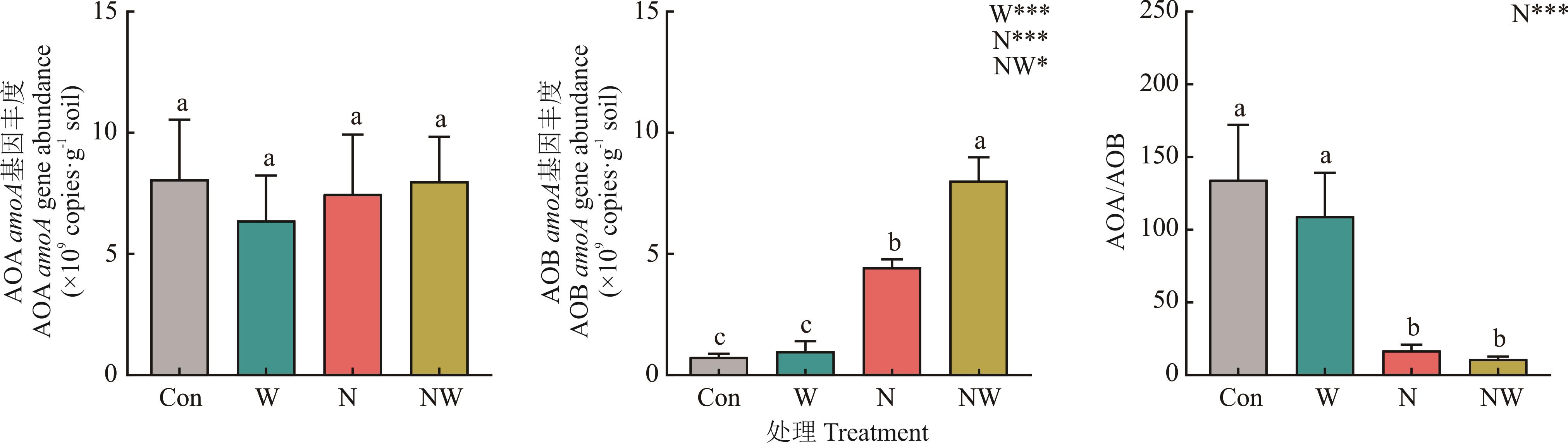
图1 增温、施氮及其交互作用对氨氧化古菌(AOA)、氨氧化细菌(AOB)amoA基因丰度以及AOA/AOB的影响数据为平均值±标准误(n=4)Values are means±standard error (n=4); 不同小写字母表示不同处理间差异显著(P<0.05)Different lowercase letters indicate significant differences among treatments (P<0.05); *: P<0.05; **: P<0.01; ***:P<0.001;下同The same below.
Fig.1 Effects of warming, nitrogen addition, and their interaction on amoA gene abundance of ammonia-oxidizing archaea (AOA), ammonia-oxidizing bacteria (AOB), and the AOA/AOB
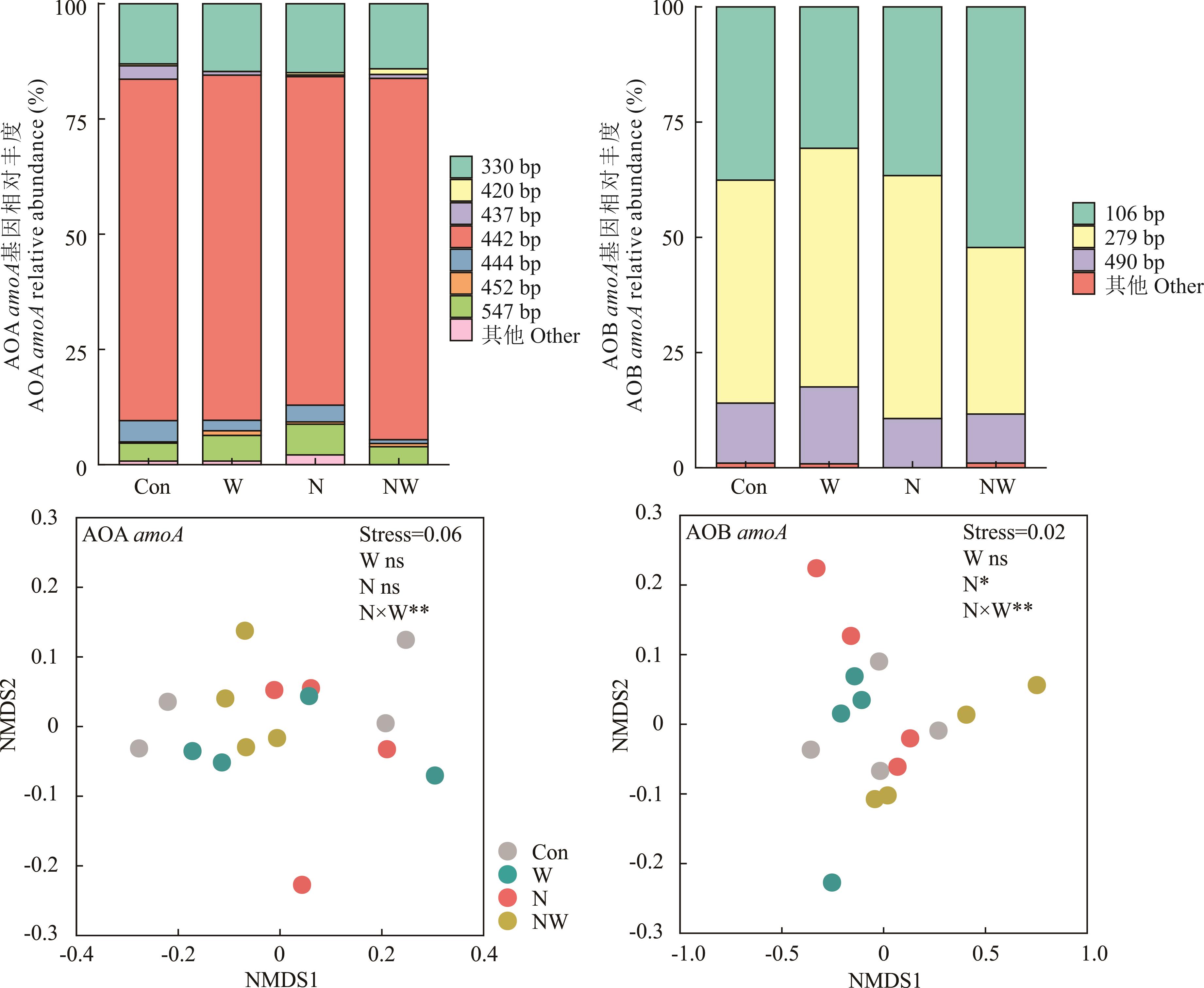
图2 增温、施氮及其交互作用对AOA和AOB相对丰度及群落结构的影响
Fig.2 Effects of warming, nitrogen addition, and their interaction on relative abundance and community composition of AOA and AOB
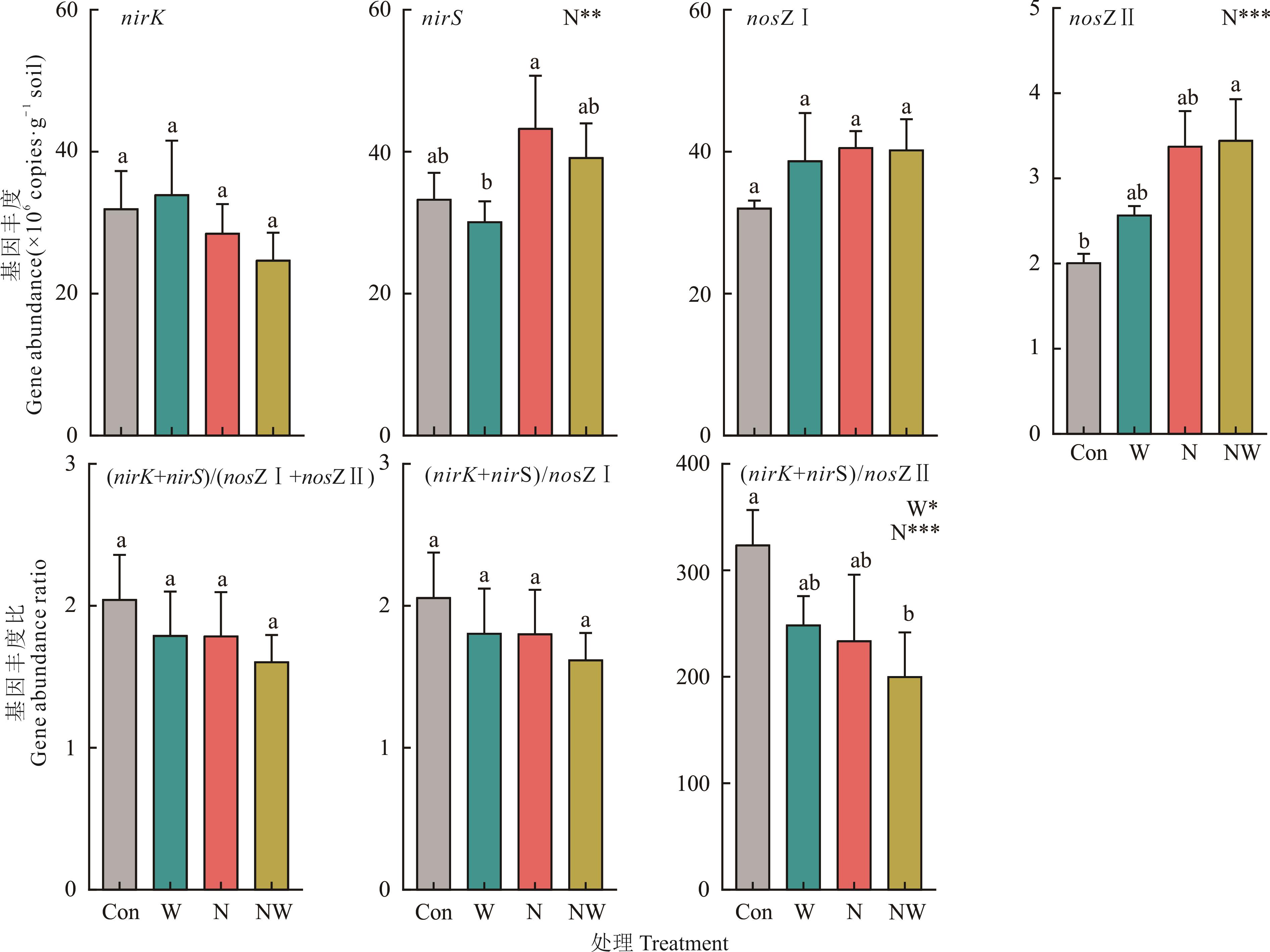
图3 增温、施氮及其交互作用对反硝化功能基因丰度以及基因丰度比的影响
Fig.3 Influence of warming, nitrogen fertilization, and their interaction on the abundance of four key denitrification genes and ratio of gene abundance

图4 增温、施氮及其交互作用对反硝化基因相对丰度及群落结构的影响
Fig.4 Effects of warming, nitrogen addition, and their interaction on relative abundance and community composition of denitrification genes
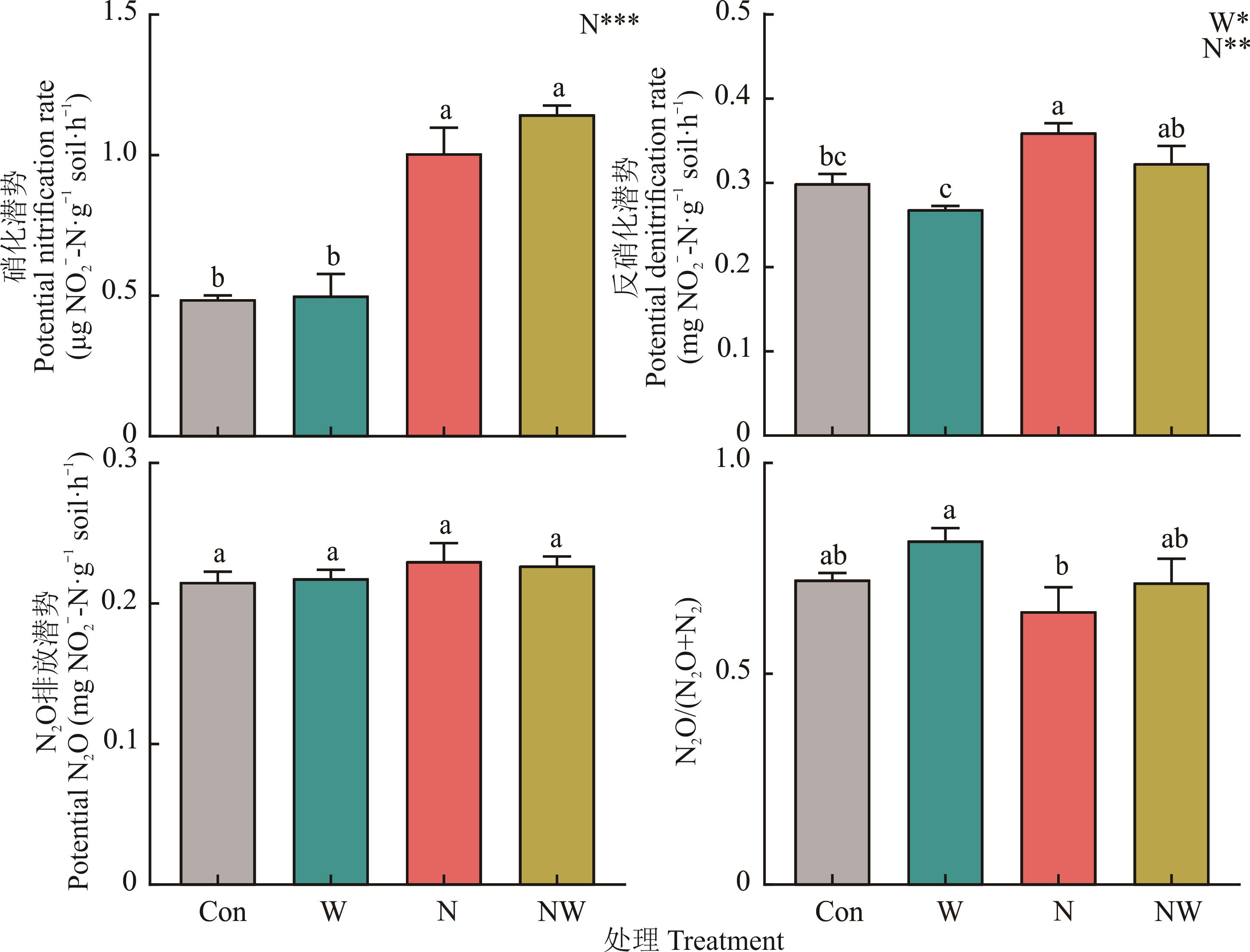
图5 土壤硝化潜势、反硝化潜势、N2O排放潜势和N2O占总反硝化产物比例对增温、施氮及其交互作用的响应
Fig.5 Soil potential nitrification rate, denitrification rate, potential N2O, and the proportion of N2O in total denitrification products as influenced by warming, nitrogen fertilization, and their interaction
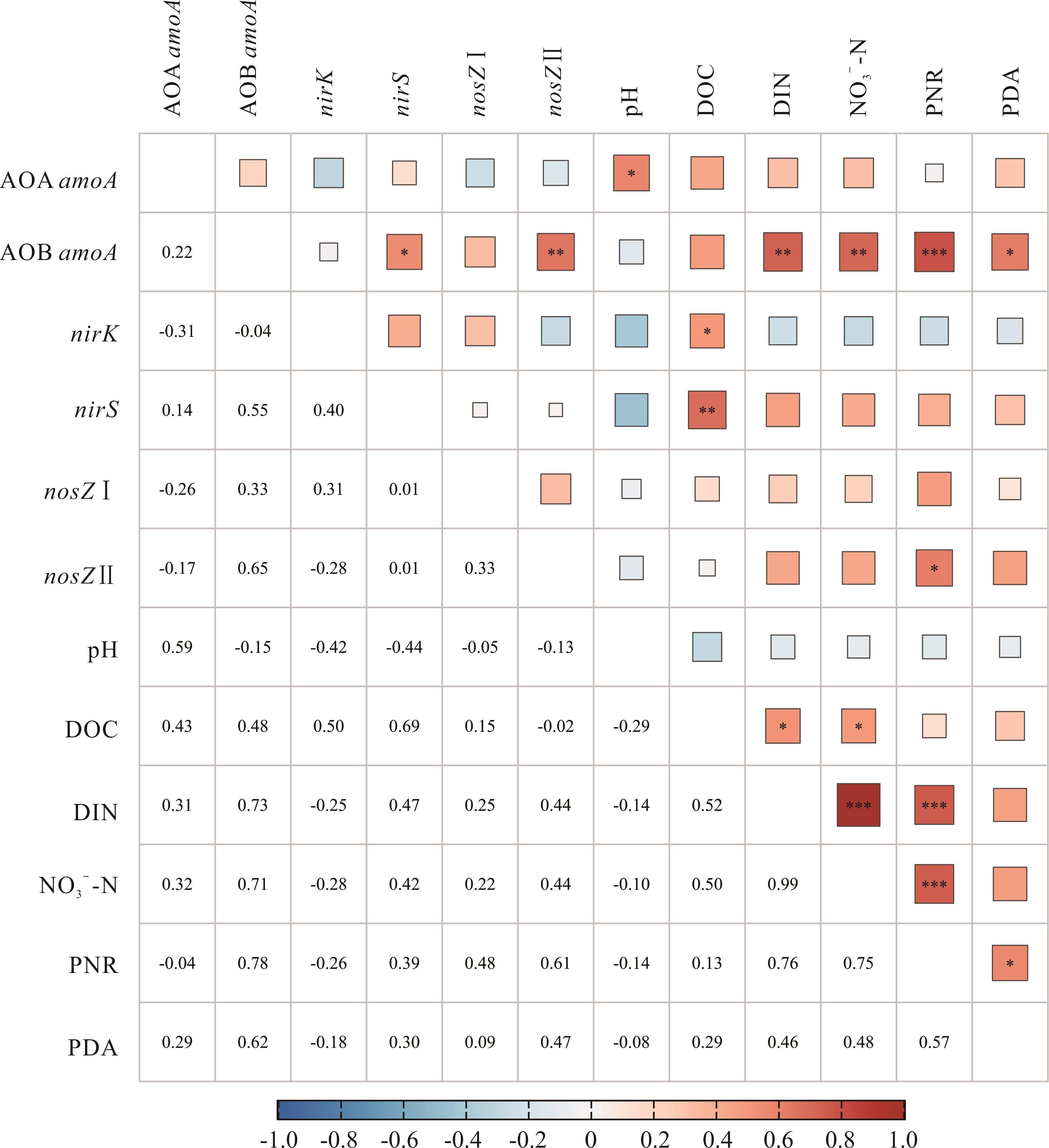
图6 土壤理化性质与氮循环关键功能基因丰度的Pearson相关性分析AOA amoA: 氨氧化古菌Ammonia-oxidizing archaea; AOB amoA: 氨氧化细菌Ammonia-oxidizing bacteria; nirK: 亚硝酸还原酶基因(含铜)Nitrite reductase gene (copper-containing); nirS: 亚硝酸还原酶基因(细胞色素cd1)Nitrite reductase gene (cytochrome cd1); nosZⅠ: N2O还原酶基因(Ⅰ型)Nitrous oxide reductase gene (CladeⅠ); nosZⅡ: N2O还原酶基因(Ⅱ型)Nitrous oxide reductase gene (Clade Ⅱ); pH: 土壤酸碱度Soil pH; DOC: 可溶性有机碳Dissolved organic carbon; DIN: 可溶性无机氮Dissolved inorganic nitrogen; NO3--N: 硝态氮Nitrate nitrogen; PNR: 潜在硝化速率Potential nitrification rate; PDA: 潜在反硝化速率Potential denitrification rate.
Fig.6 Pearson correlation analysis between soil physicochemical properties and the abundance of key functional genes involved in nitrogen cycling
| [1] | White R P, Murray S, Rohweder M. Introduction//Pilot analysis of global ecosystems: Grassland ecosystems. Washington, D.C.: World Resources Institute, 2000: 13. |
| [2] | Sala O E, Paruelo J M. Ecosystem services in grasslands//Daily G C, ed. Nature’s services: Societal dependence on natural ecosystems. Washington, D.C.: Island Press, 1997: 237-254. |
| [3] | Bai Y F, Huang J H, Zheng S X, et al. Drivers and regulating mechanisms of grassland and desert ecosystem services. Chinese Journal of Plant Ecology, 2014, 38(2): 93-102. |
| 白永飞, 黄建辉, 郑淑霞, 等. 草地和荒漠生态系统服务功能的形成与调控机制. 植物生态学报, 2014, 38(2): 93-102. | |
| [4] | Gao L, Ding Y. Progress in research and practice of restoration of degraded grassland around the world. Acta Prataculturae Sinica, 2022, 31(10): 189-205. |
| 高丽, 丁勇. 世界退化草地恢复研究和实践进展. 草业学报, 2022, 31(10): 189-205. | |
| [5] | Lu J L. Plant nutrition (Volume 1) (2nd ed). Beijing: China Agricultural University Press, 2003: 23-34. |
| 陆景陵. 植物营养学(上册) (第2版). 北京: 中国农业大学出版社, 2003: 23-34. | |
| [6] | Henneron L, Kardol P, Wardle D A, et al. Rhizosphere control of soil nitrogen cycling: A key component of plant economic strategies. New Phytologist, 2020, 228(4): 1269-1282. |
| [7] | Tian H Q, Xu R T, Canadell J G, et al. A comprehensive quantification of global nitrous oxide sources and sinks. Nature, 2020, 586: 248-256. |
| [8] | Montzka S A, Dlugokencky E J, Butler J H. Non-CO2 greenhouse gases and climate change. Nature, 2011, 476(7358): 43-50. |
| [9] | Weber J, Keeble J, Abraham N L, et al. Global agricultural N2O emission reduction strategies deliver climate benefits with minimal impact on stratospheric O3 recovery. npj Climate and Atmospheric Science, 2024, 7(1): 121. |
| [10] | IPCC. Climate Change 2023: Synthesis Report. Contribution of Working Groups I, Ⅱ and Ⅲ to the Sixth Assessment Report of the Intergovernmental Panel on Climate Change. Geneva, Switzerland: IPCC, 2023. |
| [11] | Ravishankara A R, Daniel J S, Portmann R W. Nitrous oxide (N2O): The dominant ozone-depleting substance emitted in the 21st century. Science, 2009, 326(5949): 123-125. |
| [12] | Prather M J, Hsu J, Deluca N M, et al. Measuring and modeling the lifetime of nitrous oxide including its variability. Journal of Geophysical Research: Atmospheres, 2015, 120(11): 5693-5705. |
| [13] | Hong S B, Li Z M, Tang M S, et al. Magnitude, distribution and temporal trend of nitrous oxide emissions from China’s natural soils over 1980-2022. Science China Earth Sciences, 2025, 34(1): 1-12. |
| [14] | Barnard R L, Leadley P, Hungate B. Global change, nitrification, and denitrification: A review. Global Biogeochemical Cycles, 2005, 19(1): GB1007. |
| [15] | Braker G, Conrad R. Diversity, structure, and size of N2O-producing microbial communities in soils-what matters for their functioning? Advances in Applied Microbiology, 2011, 75: 33-70. |
| [16] | Junier P, Molina V, Dorador C, et al. Phylogenetic and functional marker genes to study ammonia-oxidizing microorganisms (AOM) in the environment. Applied Microbiology and Biotechnology, 2010, 85(3): 425-440. |
| [17] | Taylor A E, Giguere A T, Zoebelein C M, et al. Modeling of soil nitrification responses to temperature reveals thermodynamic differences between ammonia-oxidizing activity of archaea and bacteria. The ISME Journal, 2017, 11(4): 896-908. |
| [18] | Kits K D, Sedlacek C J, Lebedeva E V, et al. Kinetic analysis of a complete nitrifier reveals an oligotrophic lifestyle. Nature, 2017, 549: 269-272. |
| [19] | Zumft W G. Cell biology and molecular basis of denitrification. Microbiology and Molecular Biology Reviews, 1997, 61(4): 533-616. |
| [20] | Richardson D, Felgate H, Watmough N, et al. Mitigating release of the potent greenhouse gas N2O from the nitrogen cycle-could enzymic regulation hold the key?Trends in Biotechnology, 2009, 27(7): 388-397. |
| [21] | Domeignoz-Horta L A, Putz M, Spor A, et al. Non-denitrifying nitrous oxide-reducing bacteria-An effective N2O sink in soil. Soil Biology and Biochemistry, 2016, 103: 376-379. |
| [22] | Sanford R A, Wagner D D, Wu Q, et al. Unexpected nondenitrifier nitrous oxide reductase gene diversity and abundance in soils. Proceedings of the National Academy of Sciences of the United States of America, 2012, 109(48): 19709-19714. |
| [23] | Jones C M, Graf D R H, Bru D, et al. The unaccounted yet abundant nitrous oxide-reducing microbial community: A potential nitrous oxide sink. The ISME Journal, 2013, 7(2): 417-426. |
| [24] | Jones C M, Spor A, Brennan F P, et al. Recently identified microbial guild mediates soil N2O sink capacity. Nature Climate Change, 2014, 4(9): 801-805. |
| [25] | Delgado-Baquerizo M, Grinyer J, Reich P B, et al. Relative importance of soil properties and microbial community for soil functionality: Insights from a microbial swap experiment. Functional Ecology, 2016, 30(11): 1862-1873. |
| [26] | Liu L L, Sayer E J, Deng M F, et al. The grassland carbon cycle: Mechanisms, responses to global changes, and potential contribution to carbon neutrality. Fundamental Research, 2023, 3(2): 209-218. |
| [27] | Ma X X, Gao Y Z. Impact of shrub encroachment on soil hydrological processes in grassland. Acta Prataculturae Sinica, 2025, 34(4): 212-222. |
| 马学喜, 高英志. 灌丛化对草地土壤水文过程影响的研究进展. 草业学报, 2025, 34(4): 212-222. | |
| [28] | Dijkstra F A, Blumenthal D, Morgan J A, et al. Contrasting effects of elevated CO2 and warming on nitrogen cycling in a semiarid grassland. New Phytologist, 2010, 187(2): 426-437. |
| [29] | Deng L, Peng C, Kim D G, et al. Drought effects on soil carbon and nitrogen dynamics in global natural ecosystems. Earth-Science Reviews, 2021, 214: 103501. |
| [30] | Weedon J T, Kowalchuk G A, Aerts R, et al. Summer warming accelerates sub-arctic peatland nitrogen cycling without changing enzyme pools or microbial community structure. Global Change Biology, 2012, 18(1): 138-150. |
| [31] | Qiu Y, Jiang Y, Guo L, et al. Shifts in the composition and activities of denitrifiers dominate CO2 stimulation of N2O emissions. Environmental Science & Technology, 2019, 53(19): 11204-11213. |
| [32] | Dai Z, Yu M, Chen H, et al. Elevated temperature shifts soil N cycling from microbial immobilization to enhanced mineralization, nitrification and denitrification across global terrestrial ecosystems. Global Change Biology, 2020, 26(9): 5267-5276. |
| [33] | Bai E, Li S, Xu W, et al. A Meta-analysis of experimental warming effects on terrestrial nitrogen pools and dynamics. New Phytologist, 2013, 199(2): 441-451. |
| [34] | Zhang M, Yu D, Yu Y, et al. Drought reduces nitrogen supply and N2O emission in coastal bays. Water Research, 2024, 266: 122362. |
| [35] | Clark C M, Tilman D. Loss of plant species after chronic low-level nitrogen deposition to prairie grasslands. Nature, 2008, 451(7179): 712-715. |
| [36] | Lan Z R, Bai Y F. Testing mechanisms of N-enrichment-induced species loss in a semiarid Inner Mongolia grassland: Critical thresholds and implications for long-term ecosystem responses. Philosophical Transactions of the Royal Society B: Biological Sciences, 2012, 367(1606): 3125-3134. |
| [37] | Qiu Y, Zhang Y, Zhang K, et al. Intermediate soil acidification induces highest nitrous oxide emissions. Nature Communications, 2024, 15(1): 2695. |
| [38] | Zong N, Shi P L. Effects of simulated warming on soil nitrogen supply potential in an alpine meadow on the Tibetan Plateau. Acta Ecologica Sinica, 2019, 39(12): 4356-4365. |
| 宗宁, 石培礼. 模拟增温对青藏高原高寒草甸土壤供氮潜力的影响. 生态学报, 2019, 39(12): 4356-4365. | |
| [39] | Zhang K, Qiu Y, Zhao Y, et al. Moderate precipitation reduction enhances nitrogen cycling and soil nitrous oxide emissions in a semi-arid grassland. Global Change Biology, 2023, 29(11): 3114-3129. |
| [40] | Leuzinger S, Luo Y Q, Beier C, et al. Do global change experiments overestimate impacts on terrestrial ecosystems? Trends in Ecology & Evolution, 2011, 26(5): 236-241. |
| [41] | Dieleman W I J, Vicca S, Dijkstra F A, et al. Simple additive effects are rare: A quantitative review of plant biomass and soil process responses to combined manipulations of CO2 and temperature. Global Change Biology, 2012, 18(9): 2681-2693. |
| [42] | Sun W, Mu X, Song X, et al. Changes in extreme temperature and precipitation events in the Loess Plateau (China) during 1960-2013 under global warming. Atmospheric Research, 2016, 168: 33-48. |
| [43] | Wang Q, Wang M, Fan X, et al. Trends of temperature and precipitation extremes in the Loess Plateau Region of China, 1961-2010. Theoretical and Applied Climatology, 2017, 129(3): 949-963. |
| [44] | Chen M F. Effects of warming, nitrogen addition and precipitation reduction on nitrifiers and denitrifiers in a semi-arid grassland on the Loess Plateau. Nanjing: Nanjing Agricultural University, 2021. |
| 陈梦菲. 增温、施氮及减雨对黄土高原半干旱草地硝化及反硝化微生物的影响. 南京: 南京农业大学, 2021. | |
| [45] | Cheng J M, Jing G H, Wei L, et al. Long-term grazing exclusion effects on vegetation characteristics, soil properties and bacterial communities in the semi-arid grasslands of China. Ecological Engineering, 2016, 97: 170-178. |
| [46] | Tao J J, Bai T S, Xiao R, et al. Vertical distribution of ammonia-oxidizing microorganisms across a soil profile of the Chinese Loess Plateau and their responses to nitrogen inputs. Science of the Total Environment, 2018, 635: 240-248. |
| [47] | Bai T S, Wang P, Hall S J, et al. Interactive global change factors mitigate soil aggregation and carbon change in a semi-arid grassland. Global Change Biology, 2020, 26(9): 5320-5332. |
| [48] | Wang F W. Effects of warming, nitrogen addition and precipitation reduction on nitrifiers and denitrifiers in a semi-arid grassland on the Loess Plateau. Nanjing: Nanjing Agricultural University, 2019. |
| 王伏伟. 黄土高原半干旱草地土壤微生物对全球变化因子的响应. 南京: 南京农业大学, 2019. | |
| [49] | Vance E D, Brookes P C, Jenkinson D S. An extraction method for measuring soil microbial biomass C. Soil Biology and Biochemistry, 1987, 19(6): 703-707. |
| [50] | Belser L W, Mays E L. Specific inhibition of nitrite oxidation by chlorate and its use in assessing nitrification in soils and sediments. Applied and Environmental Microbiology, 1980, 39(3): 505-510. |
| [51] | Smith M S, Tiedje J M. Phases of denitrification following oxygen depletion in soil. Soil Biology and Biochemistry, 1979, 11(3): 261-267. |
| [52] | Rotthauwe J H, Witzel K P, Liesack W. The ammonia monooxygenase structural gene amoA as a functional marker: Molecular fine-scale analysis of natural ammonia-oxidizing populations. Applied and Environmental Microbiology, 1997, 63(12): 4704-4712. |
| [53] | Leininger S, Urich T, Schloter M, et al. Archaea predominate among ammonia-oxidizing prokaryotes in soils. Nature, 2006, 442(7104): 806-809. |
| [54] | Bárta J, Melichová T, Vaneˇk D, et al. Effect of pH and dissolved organic matter on the abundance of nirK and nirS denitrifiers in spruce forest soil. Biogeochemistry, 2010, 101: 123-132. |
| [55] | Henry S, Bru D, Stres B, et al. Quantitative detection of the nosZ gene, encoding nitrous oxide reductase, and comparison of the abundances of 16S rRNA, narG, nirK, and nosZ genes in soils. Applied and Environmental Microbiology, 2006, 72(8): 5181-5189. |
| [56] | Yao H, Gao Y, Nicol G W, et al. Links between ammonia oxidizer community structure, abundance, and nitrification potential in acidic soils. Applied and Environmental Microbiology, 2011, 77(13): 4618-4625. |
| [57] | Li J, Wang G, Mayes M A, et al. Reduced carbon use efficiency and increased microbial turnover with soil warming. Global Change Biology, 2019, 25(3): 900-910. |
| [58] | Monson R K, Lipson D L, Burns S P, et al. Winter forest soil respiration controlled by climate and microbial community composition. Nature, 2006, 439: 711-714. |
| [59] | Shi C, Urbina-Malo C, Tian Y, et al. Does long-term soil warming affect microbial element limitation? A test by short-term assays of microbial growth responses to labile C, N and P additions. Global Change Biology, 2023, 29(8): 2188-2202. |
| [60] | Di H J, Cameron K C, Shen J P, et al. Ammonia-oxidizing bacteria and archaea grow under contrasting soil nitrogen conditions. FEMS Microbiology Ecology, 2010, 72(3): 386-394. |
| [61] | Hallin S, Philippot L, Löffler F E, et al. Genomics and ecology of novel N2O-reducing microorganisms. Trends in Microbiology, 2018, 26(1): 43-55. |
| [62] | Yuan Q, Liu P, Lu Y. Differential responses of nirK- and nirS-carrying bacteria to denitrifying conditions in the anoxic rice field soil. Environmental Microbiology Reports, 2012, 4(1): 113-122. |
| [63] | Firestone M K, Davidson E A. Microbiological basis of NO and N2O production and consumption in soil//Exchange of trace gases between terrestrial ecosystems and the atmosphere. New York: John Wiley, 1989: 7-21. |
| [64] | Bateman E J, Baggs E M. Contributions of nitrification and denitrification to N2O emissions from soils at different water-filled pore space. Biology and Fertility of Soils, 2005, 41(6): 379-388. |
| [65] | Rillig M C, Ryo M, Lehmann A, et al. The role of multiple global change factors in driving soil functions and microbial biodiversity. Science, 2019, 366(6467): 886-890. |
| [66] | Bi M H, Li H Y, Meidl P, et al. Number and dissimilarity of global change factors influences soil properties and functions. Nature Communications, 2024, 15(1): 8188. |
| [1] | 李慧婷, 李中利, 水清明, 蒋丛泽, 魏恺全, 杨宪龙. 混播比例和施氮模式对黄土高原紫花苜蓿-无芒雀麦混播草地产量和水氮利用效率的影响[J]. 草业学报, 2026, 35(9): 180-197. |
| [2] | 刘均阳, 周正朝, 苏雪萌. 黄土高原典型草本植物根系对土壤胶体表面电化学性质的影响[J]. 草业学报, 2026, 35(7): 80-91. |
| [3] | 孔繁晰, 唐邦洁, 阿力米日·阿力木江, 阿的各各, 袁茂国, 陈俊. 黄土高原丘陵沟壑区退耕恢复草地植物空间分布格局研究[J]. 草业学报, 2025, 34(9): 1-11. |
| [4] | 郭彬, 罗维成, 单立山, 安宁, 刘冰. 模拟增温对河西走廊典型荒漠灌木光合作用的影响[J]. 草业学报, 2025, 34(7): 145-157. |
| [5] | 刘蕊, 常单娜, 周国朋, 高嵩涓, 柴强, 曹卫东. 农田氧化亚氮减排技术及其与绿肥协同应用分析[J]. 草业学报, 2025, 34(2): 196-210. |
| [6] | 贾蕴欢, 胡雯颖, 邓健, 赵雪, 陈子玥, 王亚楠, 李江文, 张晓曦. 氮添加对黄土丘陵区草地土壤微生物养分限制特征的影响[J]. 草业学报, 2025, 34(2): 221-232. |
| [7] | 景煜都, 刘小伟, 梁可, 封俊豪, 于强, 郭梁. 灌丛化对黄土高原草地土壤有机碳组分与稳定性的影响及其微生物调控机制[J]. 草业学报, 2025, 34(12): 1-15. |
| [8] | 贺世龙, 叶贺, 李静, 张雅玲, 德海山, 红梅. 不同时限氮沉降和降水变化对荒漠草原中小型土壤节肢动物群落结构与多样性的影响[J]. 草业学报, 2024, 33(9): 140-154. |
| [9] | 冯娅斯, 蒋文婷, 刘益宏, 王燕, 李渊, 陈有超, 蔡延江. 翻耕和植物残体覆盖对“黑土滩”型退化草地土壤氧化亚氮排放的影响[J]. 草业学报, 2024, 33(11): 15-29. |
| [10] | 石昊, 杨彩红, 夏菲, 王军强, 魏巍, 王敬龙, 薛云尹, 郑晒坤, 吴皓阳, 冉林灵, 严双, 姜晓敏. 短期增温对修复过程中藏北高寒退化草地生产力的初期影响[J]. 草业学报, 2024, 33(11): 30-45. |
| [11] | 刘芳, 王佩佩, 曹玉莹, 刘俊娥, 周正朝. 黄土高原典型草本植物根系分布特征及其对土壤理化性质的影响研究[J]. 草业学报, 2024, 33(10): 1-13. |
| [12] | 刘立靖, 吴静, 李纯斌, 常秀红. 2001-2020年黄土高原植被生长季干旱的时空分布[J]. 草业学报, 2024, 33(10): 28-36. |
| [13] | 宫珂, 靳瑰丽, 刘文昊, 马建, 刘智彪, 李嘉欣, 李莹. 模拟增温对无芒雀麦生长特性的影响[J]. 草业学报, 2023, 32(9): 93-103. |
| [14] | 曹玉莹, 苏雪萌, 周正朝, 郑群威, 岳佳辉. 黄土高原典型草本植物根-土复合体抗剪性能的空间差异性及其影响因素研究[J]. 草业学报, 2023, 32(5): 94-105. |
| [15] | 沙玉宝, 干珠扎布, 胡国铮, 王学霞, 严俊, 何世丞, 高清竹. 藏北高寒草甸土壤线虫群落结构和多样性对增氮的响应[J]. 草业学报, 2023, 32(1): 154-164. |
| 阅读次数 | ||||||
|
全文 |
|
|||||
|
摘要 |
|
|||||
