

ISSN 1004-5759 CN 62-1105/S
草业学报 ›› 2025, Vol. 34 ›› Issue (11): 66-80.DOI: 10.11686/cyxb2024505
侯文璐( ), 康文娟(), 陆保福, 韩宜霖, 关键, 王晶晶
收稿日期:2024-12-23
修回日期:2025-02-17
出版日期:2025-11-20
发布日期:2025-10-09
通讯作者:
康文娟
作者简介:E-mail: kangwj@gsau.edu.cn基金资助:
Wen-lu HOU(), Wen-juan KANG(), Bao-fu LU, Yi-lin HAN, Jian GUAN, Jing-jing WANG
Received:2024-12-23
Revised:2025-02-17
Online:2025-11-20
Published:2025-10-09
Contact:
Wen-juan KANG
摘要:
为探究紫花苜蓿-根瘤菌共生系统结瘤固氮对紫花苜蓿的光合特性、呼吸代谢以及植株生物量积累的影响,以根瘤菌株LL2和QL5分别侵染‘甘农9号’紫花苜蓿,比较接种根瘤菌后紫花苜蓿的结瘤固氮能力、植株表型、光合特性和呼吸代谢等指标的差异。结果表明:1)接种根瘤菌株LL2后植株单株有效根瘤数(7个)、固氮酶活性(0.29 μmol·g-1·h-1)、豆血红蛋白含量(0.76 mg·g-1)显著高于接种根瘤菌株QL5处理,前者紫花苜蓿的地上干重、株高、叶面积均显著提升,说明根瘤菌株LL2是‘甘农9号’紫花苜蓿的高效匹配菌株,QL5是低效匹配菌株。2)接种高效根瘤菌株LL2后植株的气体交换参数、叶绿素含量、叶绿素荧光参数、光合产物显著高于接种低效根瘤菌株QL5处理。3)接种根瘤菌株LL2后植株的ATP含量、ATP合成酶、己糖激酶、异柠檬酸脱氢酶、6-磷酸葡萄糖脱氢酶、6-磷酸葡萄糖酸脱氢酶活性显著高于接种根瘤菌株QL5处理,呼吸速率显著小于QL5处理。4)地上干重与蒸腾速率(相关系数为0.72)、淀粉含量(0.83)、ATP合成酶活性(0.72)呈显著正相关(P<0.05),与呼吸速率呈负相关(0.66);结瘤固氮能力与净光合速率(0.83)、可溶性糖含量(0.79)呈极显著正相关(P<0.01),与叶绿素(a+b)含量(0.76)、6-磷酸葡萄糖脱氢酶活性(0.85)呈显著正相关(P<0.05),与呼吸速率呈负相关。5)接种高效匹配根瘤菌株LL2的植株单位光照时间下产生的单位干重(0.06 g·h-1)显著高于接种根瘤菌株QL5的处理(0.03 g·h-1)。综上,高效匹配根瘤菌株LL2可通过提高结瘤和固氮能力促进植株对氮素的固定,为植株光合和呼吸提供更多的氮素能源,进而增加光合产物,降低呼吸速率,促进植株代谢循环,最终积累更高的生物量。
侯文璐, 康文娟, 陆保福, 韩宜霖, 关键, 王晶晶. 不同共生效应根瘤菌株对紫花苜蓿光合特性和呼吸代谢的影响[J]. 草业学报, 2025, 34(11): 66-80.
Wen-lu HOU, Wen-juan KANG, Bao-fu LU, Yi-lin HAN, Jian GUAN, Jing-jing WANG. Effects of rhizobial strains with different symbiotic effects on the photosynthetic characteristics and respiratory metabolism of alfalfa[J]. Acta Prataculturae Sinica, 2025, 34(11): 66-80.

图1 根瘤菌对紫花苜蓿植株结瘤固氮能力的影响*: P<0.05; ns: 不显著Not significant.
Fig.1 Effects of rhizobium on nodulation and nitrogen fixation ability of alfalfa plants

图2 根瘤菌对紫花苜蓿植株生长性状的影响不同小写字母代表不同处理间差异显著(P<0.05),下同。Different lowercase letters represent significant differences among different treatments (P<0.05), the same below.
Fig.2 Effects of rhizobium on plant growth traits of alfalfa
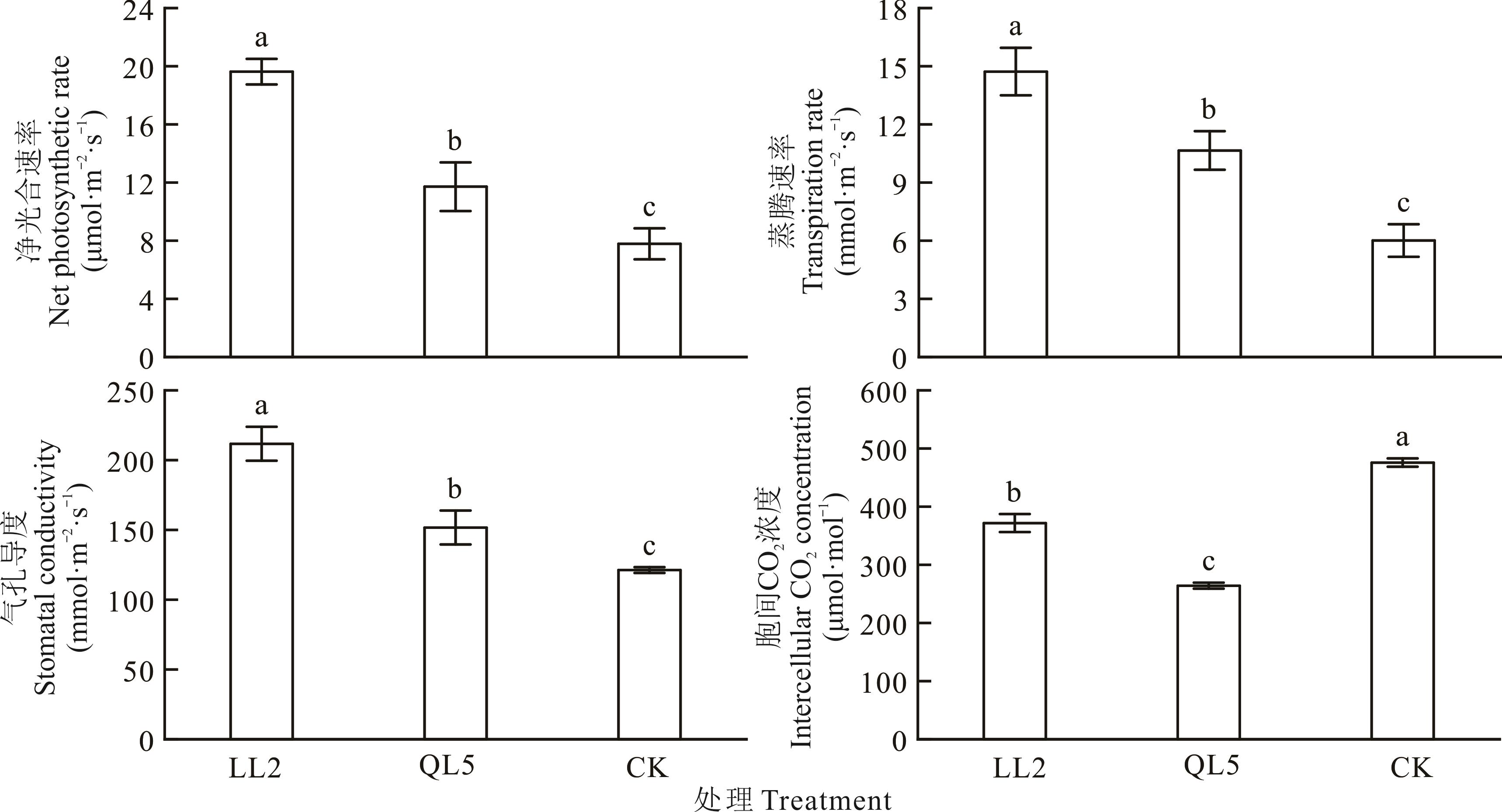
图3 根瘤菌对紫花苜蓿气体交换参数的影响
Fig.3 Effects of rhizobium on gas exchange parameters of alfalfa
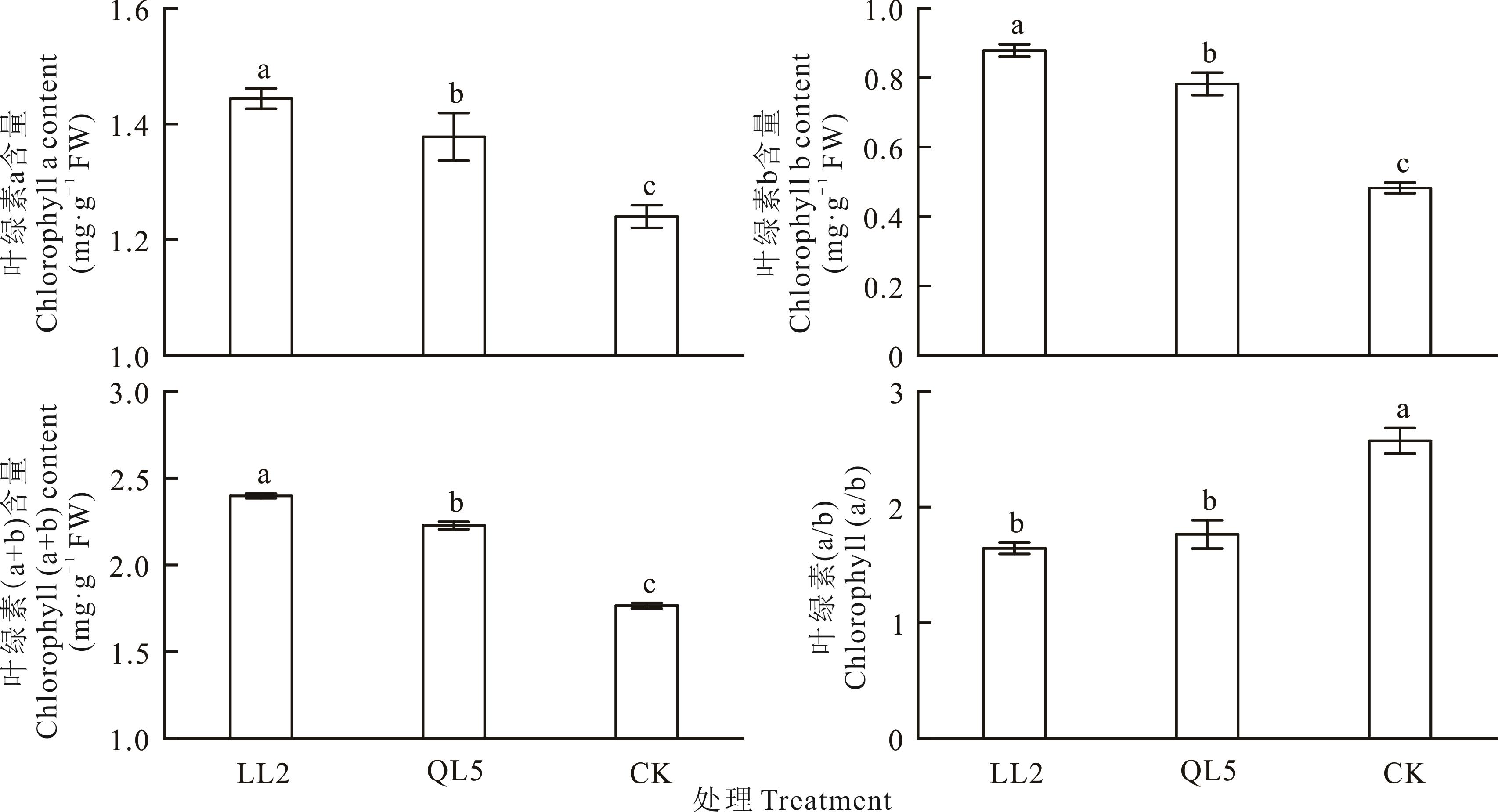
图4 根瘤菌对紫花苜蓿叶绿素含量的影响
Fig.4 Effect of rhizobium on chlorophyll content of alfalfa
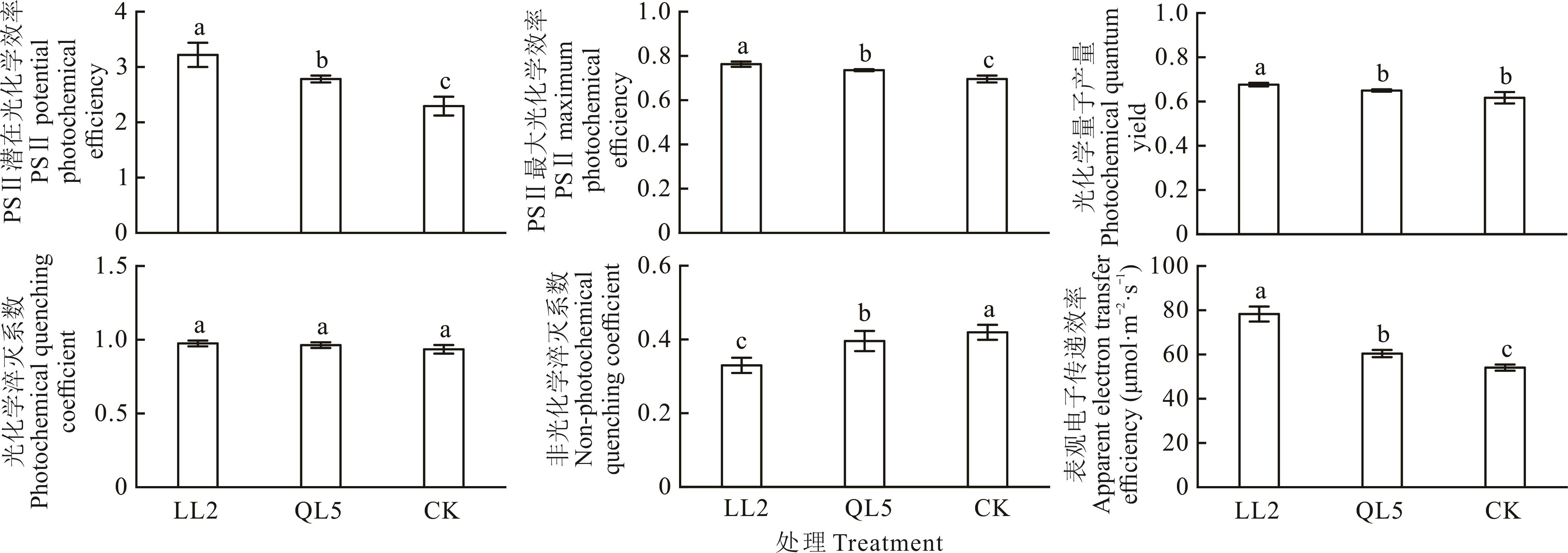
图5 根瘤菌对紫花苜蓿叶绿素荧光参数的影响
Fig.5 Effects of rhizobium on chlorophyll fluorescence parameters of alfalfa

图6 根瘤菌对紫花苜蓿光合产物的影响
Fig.6 Effects of rhizobium on photosynthetic products of alfalfa

图7 根瘤菌对紫花苜蓿呼吸速率和能量代谢的影响
Fig.7 Effects of rhizobium on respiration rate and energy metabolism of alfalfa
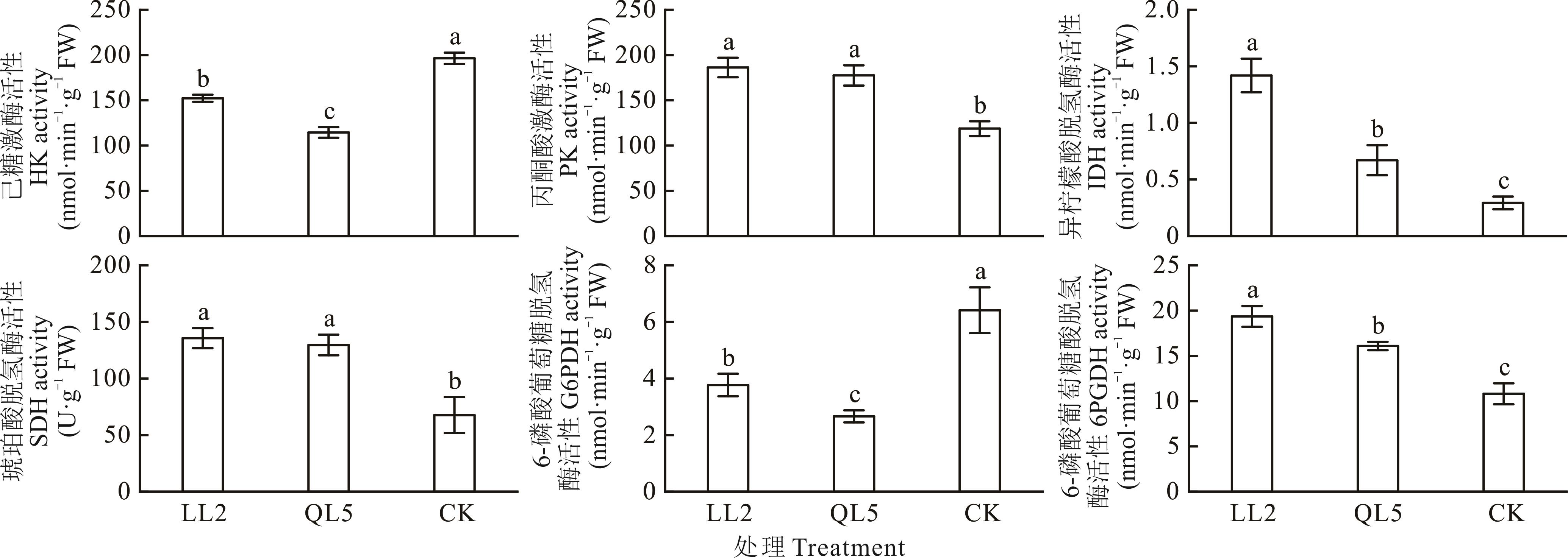
图8 根瘤菌对紫花苜蓿呼吸代谢途径关键酶活性的影响
Fig.8 Effects of rhizobium on key enzyme activities in the respiratory metabolic pathway of alfalfa

图9 紫花苜蓿生物量和结瘤固氮能力与光合和呼吸的相关性分析GDW: 地上干重Aboveground dry weight; N: 单株有效根瘤数、固氮酶活性和豆血红蛋白含量Effective nodule number per plant, nitrogenase activity and leghemoglobin content; Pn: 净光合速率Net photosynthetic rate; Tr: 蒸腾速率Transpiration rate; Gs: 气孔导度Stomatal conductance; Ci: 胞间CO2浓度Intercellular CO2 concentration; Chl a: 叶绿素a Chlorophyll a; Chl b: 叶绿素b Chlorophyll b; Chl (a+b): 叶绿素(a+b)Chlorophyll (a+b); Chl (a/b): 叶绿素(a/b) Chlorophyll (a/b); SS: 可溶性糖Soluble sugar; Suc: 蔗糖Sucrose; Sta: 淀粉Starch; Rd: 呼吸速率Respiration rate; ATP: 三磷酸腺苷Adenosine triphosphate; ATPase: 三磷酸腺苷合成酶Adenosine triphosphate synthase; HK: 己糖激酶Hexokinase; PK: 丙酮酸激酶Pyruvate kinase; IDH: 异柠檬酸脱氢酶Isocitric dehydrogenase; SDH: 琥珀酸脱氢酶Succinate dehydrogenase; G6PDH: 6-磷酸葡萄糖脱氢酶Glucose-6-phosphate dehydrogenase; 6PGDH: 6-磷酸葡萄糖酸脱氢酶6-phosphogluconate dehydrogenase. 下同The same below.
Fig.9 Correlation analysis of alfalfa biomass and nodulation nitrogen fixation capacity with photosynthesis and respiration
指标 Index | LL2 | QL5 | ||||
|---|---|---|---|---|---|---|
平均值 Average value | 标准差 Standard deviation | 变异系数 Coefficient of variation (%) | 平均值 Average value | 标准差 Standard deviation | 变异系数 Coefficient of variation (%) | |
| GDW | 0.50 | 0.09 | 18.37 | 0.45 | 0.04 | 9.60 |
| PH | 20.90 | 5.00 | 23.92 | 18.38 | 2.48 | 13.49 |
| LA | 1.46 | 0.42 | 28.87 | 1.29 | 0.25 | 19.79 |
| RLS | 0.85 | 0.01 | 1.04 | 0.84 | 0.01 | 0.52 |
| Pn | 13.71 | 5.92 | 43.18 | 9.75 | 1.96 | 20.14 |
| Tr | 10.37 | 4.36 | 42.01 | 8.33 | 2.32 | 27.84 |
| Gs | 166.47 | 45.23 | 27.17 | 136.48 | 15.23 | 11.16 |
| Ci | 423.80 | 51.99 | 12.27 | 369.97 | 105.83 | 28.60 |
| Chl a | 1.34 | 0.10 | 7.59 | 1.31 | 0.07 | 5.27 |
| Chl b | 0.68 | 0.20 | 29.12 | 0.63 | 0.15 | 23.73 |
| Chl (a+b) | 2.08 | 0.32 | 15.19 | 2.00 | 0.23 | 11.58 |
| Chl (a/b) | 2.11 | 0.46 | 22.04 | 2.17 | 0.40 | 18.65 |
| Fv/Fo | 2.76 | 0.46 | 16.81 | 2.54 | 0.25 | 9.66 |
| Fv/Fm | 0.73 | 0.03 | 4.58 | 0.72 | 0.02 | 2.78 |
| qN | 0.37 | 0.04 | 11.97 | 0.41 | 0.01 | 2.90 |
| qP | 0.95 | 0.02 | 2.08 | 0.95 | 0.01 | 1.49 |
| ΦPSⅡ | 0.65 | 0.03 | 4.59 | 0.63 | 0.02 | 2.58 |
| ETR | 66.18 | 12.12 | 18.31 | 57.23 | 3.17 | 5.53 |
| SS | 10.04 | 1.08 | 10.78 | 9.32 | 0.36 | 3.85 |
| Suc | 7.56 | 1.77 | 23.45 | 6.13 | 0.34 | 5.54 |
| Sta | 9.20 | 2.53 | 27.49 | 7.33 | 0.66 | 8.97 |
| Rd | 7.12 | 3.26 | 45.77 | 8.91 | 1.47 | 16.50 |
| ATP | 12.09 | 2.09 | 17.24 | 11.54 | 1.53 | 13.25 |
| ATPase | 10.78 | 2.29 | 21.23 | 9.65 | 1.16 | 11.98 |
| HK | 174.33 | 22.11 | 12.68 | 155.44 | 41.00 | 26.38 |
| PK | 148.07 | 29.36 | 22.14 | 152.46 | 33.75 | 19.83 |
| IDH | 0.86 | 0.56 | 65.78 | 0.48 | 0.19 | 39.19 |
| SDH | 98.64 | 30.97 | 33.45 | 101.69 | 34.02 | 31.40 |
| G6PDH | 5.09 | 1.32 | 25.94 | 4.54 | 1.88 | 41.33 |
| 6PGDH | 15.09 | 4.27 | 28.31 | 13.45 | 2.64 | 19.61 |
表1 不同根瘤菌接种处理生物量、光合和呼吸指标的变异系数
Table 1 Coefficient of variation of biomass, photosynthesis and respiration in different inoculation treatments
指标 Index | LL2 | QL5 | ||||
|---|---|---|---|---|---|---|
平均值 Average value | 标准差 Standard deviation | 变异系数 Coefficient of variation (%) | 平均值 Average value | 标准差 Standard deviation | 变异系数 Coefficient of variation (%) | |
| GDW | 0.50 | 0.09 | 18.37 | 0.45 | 0.04 | 9.60 |
| PH | 20.90 | 5.00 | 23.92 | 18.38 | 2.48 | 13.49 |
| LA | 1.46 | 0.42 | 28.87 | 1.29 | 0.25 | 19.79 |
| RLS | 0.85 | 0.01 | 1.04 | 0.84 | 0.01 | 0.52 |
| Pn | 13.71 | 5.92 | 43.18 | 9.75 | 1.96 | 20.14 |
| Tr | 10.37 | 4.36 | 42.01 | 8.33 | 2.32 | 27.84 |
| Gs | 166.47 | 45.23 | 27.17 | 136.48 | 15.23 | 11.16 |
| Ci | 423.80 | 51.99 | 12.27 | 369.97 | 105.83 | 28.60 |
| Chl a | 1.34 | 0.10 | 7.59 | 1.31 | 0.07 | 5.27 |
| Chl b | 0.68 | 0.20 | 29.12 | 0.63 | 0.15 | 23.73 |
| Chl (a+b) | 2.08 | 0.32 | 15.19 | 2.00 | 0.23 | 11.58 |
| Chl (a/b) | 2.11 | 0.46 | 22.04 | 2.17 | 0.40 | 18.65 |
| Fv/Fo | 2.76 | 0.46 | 16.81 | 2.54 | 0.25 | 9.66 |
| Fv/Fm | 0.73 | 0.03 | 4.58 | 0.72 | 0.02 | 2.78 |
| qN | 0.37 | 0.04 | 11.97 | 0.41 | 0.01 | 2.90 |
| qP | 0.95 | 0.02 | 2.08 | 0.95 | 0.01 | 1.49 |
| ΦPSⅡ | 0.65 | 0.03 | 4.59 | 0.63 | 0.02 | 2.58 |
| ETR | 66.18 | 12.12 | 18.31 | 57.23 | 3.17 | 5.53 |
| SS | 10.04 | 1.08 | 10.78 | 9.32 | 0.36 | 3.85 |
| Suc | 7.56 | 1.77 | 23.45 | 6.13 | 0.34 | 5.54 |
| Sta | 9.20 | 2.53 | 27.49 | 7.33 | 0.66 | 8.97 |
| Rd | 7.12 | 3.26 | 45.77 | 8.91 | 1.47 | 16.50 |
| ATP | 12.09 | 2.09 | 17.24 | 11.54 | 1.53 | 13.25 |
| ATPase | 10.78 | 2.29 | 21.23 | 9.65 | 1.16 | 11.98 |
| HK | 174.33 | 22.11 | 12.68 | 155.44 | 41.00 | 26.38 |
| PK | 148.07 | 29.36 | 22.14 | 152.46 | 33.75 | 19.83 |
| IDH | 0.86 | 0.56 | 65.78 | 0.48 | 0.19 | 39.19 |
| SDH | 98.64 | 30.97 | 33.45 | 101.69 | 34.02 | 31.40 |
| G6PDH | 5.09 | 1.32 | 25.94 | 4.54 | 1.88 | 41.33 |
| 6PGDH | 15.09 | 4.27 | 28.31 | 13.45 | 2.64 | 19.61 |
处理 Treatment | Ahv(PAR) (μmol·m-2·s-1) | S(DW) (cm2) | FW(DW) (g) | dDW/dt (g·h-1) |
|---|---|---|---|---|
| LL2 | 11.74 | 35.14 | 0.28 | 0.06±0.01a |
| QL5 | 9.58 | 27.86 | 0.24 | 0.03±0.01b |
| CK | 9.08 | 15.26 | 0.20 | 0.01±0.00c |
表2 单位光照时间下产生的单位干重
Table 2 Dry weight per unit light time
处理 Treatment | Ahv(PAR) (μmol·m-2·s-1) | S(DW) (cm2) | FW(DW) (g) | dDW/dt (g·h-1) |
|---|---|---|---|---|
| LL2 | 11.74 | 35.14 | 0.28 | 0.06±0.01a |
| QL5 | 9.58 | 27.86 | 0.24 | 0.03±0.01b |
| CK | 9.08 | 15.26 | 0.20 | 0.01±0.00c |
| [1] | Wang Z, Chang W, Li J C, et al. Effects of alfalfa green manure on the yield, nitrogen absorption, and nitrogen translocation of feed maize. Acta Prataculturae Sinica, 2024, 33(8): 63-73. |
| 王峥, 常伟, 李俊诚, 等. 紫花苜蓿还田对饲料玉米产量和氮素吸收转运的影响. 草业学报, 2024, 33(8): 63-73. | |
| [2] | Diao C, Wang W X. The trade pattern of alfalfa importation into China and its influencing factors. Pratacultural Science, 2023, 40(9): 2424-2434. |
| 刁婵, 王文信. 中国苜蓿草进口贸易格局及其影响因素. 草业科学, 2023, 40(9): 2424-2434. | |
| [3] | Wilkinson H, Coppock A, Richmond B L, et al. Plant-environment response pathway regulation uncovered by investigating non-typical legume symbiosis and nodulation. Plants, 2023, 12(10): 1964. |
| [4] | Wang D, Yang S, Tang F, et al. Symbiosis specificity in the legume: Rhizobial mutualism. Cellular Microbiology, 2012, 14(3): 334-342. |
| [5] | Lu B F, Kang W J, Shi S L, et al. Nitrogen fixation system of legume-rhizobia and its carbon-nitrogen interaction. Chinese Journal of Grassland, 2023, 45(11): 119-135, 144. |
| 陆保福, 康文娟, 师尚礼, 等. 豆科植物-根瘤菌固氮系统及其碳氮互作. 中国草地学报, 2023, 45(11): 119-135, 144. | |
| [6] | Han K, Sun Y, Zhang K, et al. Effect of different rhizobium on productivity of Medicago sativa L. Acta Agrestia Sinica, 2018, 26(3): 639-644. |
| 韩可, 孙彦, 张昆, 等. 接种不同根瘤菌对紫花苜蓿生产力的影响. 草地学报, 2018, 26(3): 639-644. | |
| [7] | Zhang Q X, Zhu A M, Zhang Y X, et al. Effects of different rhizobium inoculation on growth of Medicago and nodule in sandy land. Grassland and Turf, 2019, 39(1): 7-15. |
| 张庆昕, 朱爱民, 张玉霞, 等. 接种不同根瘤菌对沙地苜蓿结瘤及生长状况的影响. 草原与草坪, 2019, 39(1): 7-15. | |
| [8] | Li Y L, Chen P, Fu Z D, et al. Research progress on regulation of root nodule formation and development of legume by light signals and photosynthetic products. Chinese Journal of Eco-Agriculture, 2023, 31(1): 21-30. |
| 李易玲, 陈平, 付智丹, 等. 光信号和光合产物调控豆科植物根瘤形成发育的研究进展. 中国生态农业学报, 2023, 31(1): 21-30. | |
| [9] | Marie-Christine Morère-Le P, Clochard T, Limami A M. NPF and NRT2 from Pisum sativum potentially involved in nodule functioning: Lessons from Medicago truncatula and Lotus japonicus. Plants,2024, 13(2): 322. |
| [10] | Govindjee. Advances in photosynthesis and respiration: Focus on plant respiration. Photosynthesis Research, 2005, 85(2): 255-259. |
| [11] | Yurkevich M, Kurbatov A, Ikkonen E.Effect of secondary paper sludge on physiological traits of Lactuca sativa L. under heavy-metal stress. Plants, 2024, 13(8): 1098. |
| [12] | Kang W J. Biotype division and transcriptomic analysis of alfalfa rhizobia. Lanzhou: Gansu Agricultural University, 2019. |
| 康文娟. 紫花苜蓿根瘤菌生物型划分及其转录组学分析. 兰州: 甘肃农业大学, 2019. | |
| [13] | Lu B F, Kang W J, Shi S L, et al. The study on dynamics of nitrogen fixation efficiency of alfalfa-rhizobia symbiosis. Chinese Journal of Grassland, 2024, 46(6): 36-48. |
| 陆保福, 康文娟, 师尚礼, 等. 紫花苜蓿与根瘤菌共生过程中固氮效率的动态研究. 中国草地学报, 2024, 46(6): 36-48. | |
| [14] | Wang T, Wang Z J, Zhang Y H, et al. Study on relationship between soybean leghemoglobin content and yield. Soybean Science, 2020, 39(1): 45-51. |
| 王田, 王志杰, 张云鹤, 等. 大豆根瘤豆血红蛋白含量与产量关系研究. 大豆科学, 2020, 39(1): 45-51. | |
| [15] | Zou Q. Plant physiology experiment instruction. Beijing: China Agriculture Press, 2003: 110-114. |
| 邹琦. 植物生理学实验指导. 北京: 中国农业出版社, 2003: 110-114. | |
| [16] | Yudina L, Sukhova E, Gromova E, et al. Effect of duration of LED lighting on growth, photosynthesis and respiration in lettuce. Plants, 2023, 12(3): 442. |
| [17] | Zhang Y Y, Hu D D, Ma C H, et al. Leaf structure and photosynthetic properties of alfalfa in response to bacteria and phosphorus addition. Acta Prataculturae Sinica, 2024, 33(8): 133-144. |
| 张盈盈, 胡丹丹, 马春晖, 等. 苜蓿叶片结构和光合特性对菌磷添加的响应. 草业学报, 2024, 33(8): 133-144. | |
| [18] | Liu H F, Zhuang H M, Han H W, et al. Effects of different exogenous substances on photosynthetic characteristics and dry matter accumulation of tomato seedlings. Molecular Plant Breeding, (2024-11-18)[2024-12-23]. http://kns.cnki.net/kcms/detail/46.1068.S.20241115.1634.010.html. |
| 刘会芳, 庄红梅, 韩宏伟, 等. 不同外源物喷施对番茄穴盘苗光合特性及干物质积累的影响. 分子植物育种, (2024-11-18)[2024-12-23]. http://kns.cnki.net/kcms/detail/46.1068.S.20241115.1634.010.html. | |
| [19] | Liu S X, Wei G J, Jing R Y, et al. Effects of sinorhizobium SD101 inoculation and shading on nitrogen fixation and photosynthesis of Medicago sativa L. Crop Journal, 2018(5): 156-161. |
| 刘淑霞, 魏国江, 荆瑞勇, 等. 接种中华根瘤菌SD101和避光对紫花苜蓿固氮和光合作用的影响. 作物杂志, 2018(5): 156-161. | |
| [20] | Meng J, Ma H, Li H J, et al. Effects of rhizobia on photosynthetic characteristics and the growth of alfalfa (Medicago sativa L.). Journal of Xinjiang Agricultural University, 2021, 44(4): 241-247. |
| 孟捷, 马红, 李会军, 等. 2种根瘤菌对新牧1号苜蓿光合特征和生长的影响. 新疆农业大学学报, 2021, 44(4): 241-247. | |
| [21] | Zhou X J, Liang Y, Shen S H, et al. Effects of rhizobial inoculation and shading on nitrogen fixation and photosynthesis of soybean. Scientia Agricultura Sinica, 2007(3): 478-484. |
| 周相娟, 梁宇, 沈世华, 等. 接种根瘤菌和遮光对大豆固氮和光合作用的影响. 中国农业科学, 2007(3): 478-484. | |
| [22] | Li X Y, Wang S Y, Wang S R, et al. Effect of rhizobium combined with Pamibacillus mucilaginosus on soybean chlorophyll fluorescence characteristics, yield and quality. Soybean Science, 2014, 33(4): 541-544, 549. |
| 李馨园, 王守义, 王淑荣, 等. 根瘤菌配施胶质类芽孢杆菌对大豆叶绿素荧光特性、产量及品质的影响. 大豆科学, 2014, 33(4): 541-544, 549. | |
| [23] | Ma J B, Yu X B, Wu H Y, et al. Effects of inoculation of different rhizobium on photosynthetic characteristics and nitrogen fixation of soybean. Chinese Journal of Oil Crop Sciences, 2020, 42(1): 102-108. |
| 马家斌, 于晓波, 吴海英, 等. 接种根瘤菌对西南地区大豆光合性能和固氮能力的影响. 中国油料作物学报, 2020, 42(1): 102-108. | |
| [24] | Gao Y Z, Ren J. Advances and prospects in plant root nodule symbiotic nitrogen fixation. Scientia Sinica Vitae, 2025, 55(1): 131-145. |
| 高英志, 任健. 植物根瘤共生固氮研究进展与展望. 中国科学: 生命科学, 2025, 55(1): 131-145. | |
| [25] | Zhan J, Liu D W, Li L, et al. Responds of respiration related enzymes activity to waterlogging stress occurred at germination stages of peanut. Journal of Peanut Science, 2019, 48(4): 63-66, 74. |
| 湛瑊, 刘登望, 李林, 等. 花生种子发芽期呼吸酶活性对淹水的响应. 花生学报, 2019, 48(4): 63-66, 74. | |
| [26] | Yu C, Li G L, Sun Y Q, et al. Characteristics of respiratory metabolism in growth and development of sugar beet taproot. Acta Agronomica Sinica, 2023, 49(12): 3377-3386. |
| 于超, 李国龙, 孙亚卿, 等. 甜菜块根生长发育中呼吸代谢的特性研究. 作物学报, 2023, 49(12): 3377-3386. | |
| [27] | Falhof J, Pedersen J T, Fuglsang A T, et al. Plasma membrane H+-ATPase regulation in the center of plant physiology. Molecular Plant, 2016, 9(3): 323-337. |
| [28] | Zhou S J, Zhang M, Wang P. Response of plant plasma membrane H+-ATPase to environmental stress factors: A review. Chinese Journal of Applied & Environmental Biology, 2021, 27(2): 485-494. |
| 周思婕, 张敏, 王平. 植物质膜H+-ATP酶对环境胁迫因子的响应研究进展. 应用与环境生物学报, 2021, 27(2): 485-494. | |
| [29] | Wu Y F, Liu Q M, Liu W H, et al. Effects of inoculation of AMF and rhizobium on photosynthetic and respiratory metabolism and growth of intercropping glycine max. Journal of Guangxi Normal University (Natural Science Edition), 2022, 40(2): 231-241. |
| 吴艳芬, 刘秋鸣, 刘卫欢, 等. AMF与根瘤菌对间作大豆光合与呼吸代谢的影响. 广西师范大学学报(自然科学版), 2022, 40(2): 231-241. | |
| [30] | Chen X J, Xu Z S, Zhao B P, et al. Effects of salt stress on root respiratory metabolism, antioxidant enzyme activities, and yield of oats. Chinese Journal of Ecology, 2021, 40(9): 2773-2782. |
| 陈晓晶, 徐忠山, 赵宝平, 等. 盐胁迫对燕麦根系呼吸代谢、抗氧化酶活性及产量的影响. 生态学杂志, 2021, 40(9): 2773-2782. | |
| [31] | Fan Q S, Lou W J. Physiological and biochemical studies on symbiotic nitrogen fixation between rhizobium and leguminosae. Journal of Nanjing Agricultural University, 1984(3): 58-66. |
| 樊庆笙, 娄无忌. 根瘤菌-豆科植物共生固氮的生理生化研究. 南京农业大学学报, 1984(3): 58-66. | |
| [32] | Dehigaspitiya P, Milham P, Ash G J, et al. Exploring natural variation of photosynthesis in a site-specific manner: evolution, progress, and prospects. Planta, 2019, 250(4): 1033-1050. |
| [33] | Wang J K. Mechanism and regulation of high temperature at the early stage of grain filling on changes in carbon and nitrogen metabolism of japonica rice grains. Beijing: Chinese Academy of Agricultural Sciences, 2021. |
| 王军可. 灌浆初期高温影响粳稻籽粒碳氮代谢变化的机理及其调控. 北京: 中国农业科学院, 2021. | |
| [34] | Hwang S, Ray J D, Cregan P B, et al. Genetics and mapping of quantitative traits for nodule number, weight, and size in soybean (Glycine max L.[Merr.]). Euphytica,2014, 195(3): 419-434. |
| [35] | Lu B F, Kang W J, Shi S L, et al. Differences in fatty acid and central carbon metabolite distribution among different tissues of alfalfa-rhizobia symbiotic system. Agronomy,2024, 14(3): 511. |
| [36] | Ma C, Liu C, Yu Y, et al. GmTNRP1, associated with rhizobial type-III effector NopT, regulates nitrogenase activity in the nodules of soybean (Glycine max). Food and Energy Security,2023, DOI: 10.1002/fes3.466. |
| [37] | Hoya J A, Hargrove M S. The structure and function of planthemoglobins. Plant Physiology and Biochemistry, 2008, 1(46): 371-379. |
| [1] | 邹苇鹏, 刘怡, 翟佳兴, 周思懿, 宫祉祎, 岑慧芳, 朱慧森, 许涛. 紫花苜蓿MsNAC053基因克隆及其对非生物胁迫的响应分析[J]. 草业学报, 2025, 34(9): 121-133. |
| [2] | 鲜燃, 邓雨, 付秋月, 蒋晶霞, 陶佳丽, 许涛, 朱慧森, 岑慧芳. 紫花苜蓿MsMYB86基因克隆及其对非生物胁迫的响应分析[J]. 草业学报, 2025, 34(9): 162-172. |
| [3] | 刘沂欣, 隋晓青, 王鑫尧, 郎梦卿, 孙凌子寅, 吉尔尔格. 外源褪黑素对盐胁迫下紫花苜蓿的缓解作用[J]. 草业学报, 2025, 34(9): 206-214. |
| [4] | 李文秀, 姚拓, 李昌宁, 贾倩民, 何傲蕾, 周杨. “凹凸棒-有机基质”菌肥载体最佳配比的筛选及对紫花苜蓿的促生效果研究[J]. 草业学报, 2025, 34(8): 88-98. |
| [5] | 蒋学乾, 杨青川, 康俊梅. 紫花苜蓿在干旱胁迫下的产量损失与抗旱性遗传研究进展[J]. 草业学报, 2025, 34(7): 219-234. |
| [6] | 徐倩, 郭帅, 张亮亮, 王占军, 辛国省. 补饲对放牧滩羊生长性能、血清生化及代谢组的影响[J]. 草业学报, 2025, 34(6): 122-138. |
| [7] | 温小月, 赵颖, 王宝强, 王贤, 朱晓林, 王义真, 魏小红. 外源NO调控干旱胁迫下紫花苜蓿AP2/ERFs基因的表达分析[J]. 草业学报, 2025, 34(6): 154-167. |
| [8] | 张英豪, 刘楚波, 周坤, 郭家存, 刘世鹏, 孙娈姿. 果草系统中枣树对不同方位紫花苜蓿和鸭茅生长的影响[J]. 草业学报, 2025, 34(6): 203-212. |
| [9] | 崔灿, 王梦琦, 赵琬璐, 刘新颖, 鉴晶晶, 严俊鑫. 胺鲜酯浸种对NaCl胁迫下紫花苜蓿种子萌发及幼苗生长的影响[J]. 草业学报, 2025, 34(6): 46-58. |
| [10] | 曾燕霞, 陈志龙, 尚继红, 沙晓弟, 吴娟, 陈彩锦. 太空诱变对PEG-6000模拟干旱胁迫下紫花苜蓿材料苗期生长的影响[J]. 草业学报, 2025, 34(6): 59-69. |
| [11] | 魏孔钦, 张盈盈, 回金峰, 马春晖, 张前兵. 菌磷配施对紫花苜蓿根系非结构碳水化合物及碳氮磷化学计量特征的影响[J]. 草业学报, 2025, 34(5): 40-50. |
| [12] | 张磊, 杜锦涛, 范倩玉, 李顺, 高嵩涓, 曹卫东. 紫云英生物固氮对土壤肥力及根瘤菌的响应特征[J]. 草业学报, 2025, 34(5): 51-63. |
| [13] | 周昕越, 王丽萍, 蒋庆雪, 马晓冉, 仪登霞, 王学敏. 紫花苜蓿低温诱导蛋白MsLTI65的分离及其对不同逆境的响应[J]. 草业学报, 2025, 34(5): 89-104. |
| [14] | 罗天蓉, 马健芝, 杜明阳, 多杰措, 熊辉岩, 段瑞君. 紫花苜蓿LACS基因家族成员鉴定及表达分析[J]. 草业学报, 2025, 34(4): 124-136. |
| [15] | 冯雅琪, 陈嘉慧, 张静妮, 隋超, 陈基伟, 刘志鹏, 周强, 刘文献. 基于重测序紫花苜蓿高蛋白、高产关联InDel分子标记开发[J]. 草业学报, 2025, 34(4): 137-149. |
| 阅读次数 | ||||||
|
全文 |
|
|||||
|
摘要 |
|
|||||
