

ISSN 1004-5759 CN 62-1105/S
草业学报 ›› 2026, Vol. 35 ›› Issue (11): 24-37.DOI: 10.11686/cyxb2026010
邹弟洋1,2( ), 宋小艳1,2(), 高洋3, 李富梅1,2, 彭希1,2, 柳杨1,2, 胡雷1,2, 丁路明1,2, 王长庭1,2
收稿日期:2026-01-12
修回日期:2026-03-12
出版日期:2026-11-20
发布日期:2026-10-12
通讯作者:
宋小艳
作者简介:Corresponding author. E-mail: songxy@swun.edu.cn基金资助:
Di-yang ZOU1,2(), Xiao-yan SONG1,2(), Yang GAO3, Fu-mei LI1,2, Xi PENG1,2, Yang LIU1,2, Lei HU1,2, Lu-ming DING1,2, Chang-ting WANG1,2
Received:2026-01-12
Revised:2026-03-12
Online:2026-11-20
Published:2026-10-12
Contact:
Xiao-yan SONG
摘要:
阐明增温和降水变化对高寒草甸土壤微生物生物量和酶活性的影响及机制,是预测气候变化下高寒草甸土壤碳库与养分循环过程变化的重要基础。本研究依托2021年在青藏高原东缘建立的高寒草甸增温与降水变化双因素模拟试验平台[减水50%(0.5PW0)、对照(1.0PW0)、增水50%(1.5PW0)、减水50%+增温(0.5PW)、增温(1.0PW)和增水50%+增温(1.5PW)],分析了2024年表层土壤微生物生物量碳(MBC)、微生物生物量氮(MBN)与酶活性的响应规律及关键驱动因子。结果表明,增温处理显著降低土壤pH,增加土壤水解酶[β-葡萄糖苷酶(BG),纤维素二糖水解酶(CBH)和β-N-乙酰氨基葡萄糖苷酶(NAG)]活性,增幅为105.26%~188.03%。而对土壤氧化还原酶[多酚氧化酶(PPO)和过氧化物酶(PER)]无显著影响。降水变化显著影响NAG和PPO活性:自然温度下,增水提高土壤NAG活性,增幅为147.60%;减水降低土壤MBN含量,降幅为64.71%;增温条件下,增水和减水均提高土壤PPO的活性,增幅分别为36.31%和34.76%。增温和降水变化对土壤MBN、MBC/MBN及酶活性均存在交互效应,表现为增温与增水联合作用削弱了单增温或单增水处理对土壤MBN和水解酶活性的影响,但增强了对土壤氧化还原酶活性的影响。土壤pH是调控土壤酶活性的关键因子,解释率为40.78%。综上所述,单增温降低了高寒草甸土壤pH,增加了土壤水解酶活性;而青藏高原暖湿化过程将削弱增温对土壤水解酶的促进作用,但增强对土壤氧化还原酶的影响,从而可能促进土壤难分解碳的降解,加强有机氮的释放和矿化。
邹弟洋, 宋小艳, 高洋, 李富梅, 彭希, 柳杨, 胡雷, 丁路明, 王长庭. 增温和降水变化对高寒草甸土壤微生物生物量和酶活性的影响[J]. 草业学报, 2026, 35(11): 24-37.
Di-yang ZOU, Xiao-yan SONG, Yang GAO, Fu-mei LI, Xi PENG, Yang LIU, Lei HU, Lu-ming DING, Chang-ting WANG. Effects of warming and precipitation changes on soil microbial biomass and enzyme activities in alpine meadows[J]. Acta Prataculturae Sinica, 2026, 35(11): 24-37.
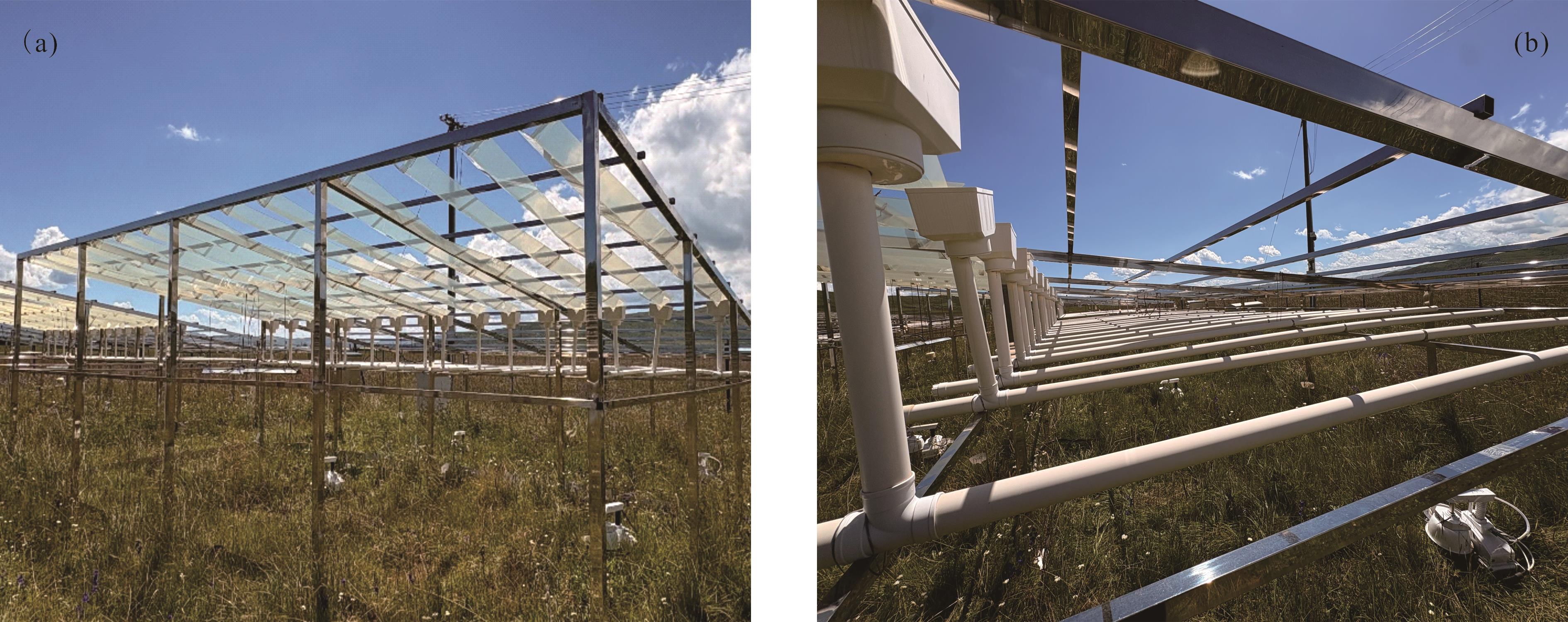
图1 试验装置示意(a): 减水50%(0.5PW0)处理装置The setup for the decreased precipitation by 50% treatment (0.5PW0); (b): 增水50%(1.5PW0)处理装置The setup for the increased precipitation by 50% treatment (1.5PW0).
Fig.1 Schematic diagram of the experimental setup

图2 增温和降水变化对土壤温度和湿度的影响(a)和(c)为5 cm深处土壤温度和湿度的时间动态变化;(b)和(d)为5-9月土壤温度和湿度的平均值。0.5PW0: 减水50%; 1.0PW0: 对照; 1.5PW0: 增水50%; 0.5PW: 减水50%+增温; 1.0PW: 增温; 1.5PW: 增水50%+增温。W0表示自然温度;W表示增温;0.5P、1.0P、1.5P分别表示减水50%、自然降水、增水50%。T、P和T×P分别表示双因素方差分析中的增温处理、降水处理以及增温和降水处理交互效应的P值。不同大写字母表示自然温度条件下降水变化之间的差异显著(P<0.05),不同小写字母表示增温条件下降水变化之间的差异显著(P<0.05);*、**和ns分别表示相同降水条件下增温的影响显著(P<0.05)、极显著(P<0.01)和不显著。下同。(a) and (c) show the temporal dynamics of soil temperature and soil moisture at 5 cm depth; (b) and (d) present the average of soil temperature and soil moisture from May to September. 0.5PW0: Decreased precipitation by 50%; 1.0PW0: Control; 1.5PW0: Increased precipitation by 50%; 0.5PW: Decreased precipitation by 50% and warming; 1.0PW: Warming; 1.5PW: Increased precipitation by 50% and warming. W0 represents natural temperature; W represents warming; 0.5P, 1.0P, and 1.5P represent precipitation decreased by 50%, natural precipitation, and precipitation increased by 50%, respectively. T, P, and T×P represent the P-values for the warming treatment effect, precipitation treatment effect, and the interaction effect between warming and precipitation treatments, respectively, in the two-way ANOVA. Different capital letters indicate significant differences among precipitation changes under natural temperature conditions (P<0.05), and different lowercase letters indicate significant differences among precipitation changes under warming conditions (P<0.05). *, ** and ns indicate that the effect of warming is significant (P<0.05), highly significant (P<0.01), and not significant, respectively, under the same precipitation conditions. The same below.
Fig.2 Effects of warming and precipitation changes on soil temperature and moisture
项目 Item | 处理Treatment | 双因素方差分析Two-way ANOVA | |||||||
|---|---|---|---|---|---|---|---|---|---|
| 0.5PW0 | 1.0PW0 | 1.5PW0 | 0.5PW | 1.0PW | 1.5PW | T | P | T×P | |
| 地上生物量Aboveground biomass (g·m-2) | 196.21±28.21a | 258.17±25.25a | 361.75±56.67a | 273.76±6.49a | 301.48±1.63a | 331.93±64.43a | * | ||
| 地下生物量Belowground biomass (g·m-2) | 762.60±247.38a | 322.37±87.41a | 685.47±236.67a | 1039.91±67.86a | 350.10±45.44a | 837.12±228.93a | * | ||
| 丰富度指数Richness index | 18.00±0.58a | 20.33±1.76a | 14.67±1.67a | 16.33±3.18a | 18.00±0.58a | 17.33±2.40a | |||
| 辛普森指数Simpson index | 0.88±0.01a | 0.89±0.01a | 0.80±0.09a | 0.84±0.03a | 0.88±0.00a | 0.89±0.02a | |||
| 香农-威纳指数Shannon-Wiener index | 2.39±0.06a | 2.54±0.05a | 2.11±0.32a | 2.18±0.20a | 2.40±0.05a | 2.43±0.16a | |||
| 均匀度指数Pielou index | 0.83±0.01a | 0.85±0.01a | 0.78±0.10a | 0.79±0.02a | 0.83±0.02a | 0.86±0.03a | |||
| pH | 6.07±0.08a | 6.16±0.07a | 6.00±0.01a | 5.97±0.05a | 6.04±0.03a | 5.93±0.03a | * | ||
| 容重 Bulk density (g·cm-3) | 1.31±0.03a | 1.22±0.12a | 1.25±0.07a | 1.33±0.05a | 1.18±0.07a | 1.19±0.09a | |||
| 土壤有机碳Soil organic carbon (SOC, g·kg-1) | 36.83±3.99a | 36.30±2.65a | 35.07±4.06a | 34.60±1.35a | 37.53±0.65a | 36.87±3.37a | |||
| 土壤全氮Soil total nitrogen (TN, g·kg-1) | 3.17±0.43a | 3.07±0.19a | 2.97±0.27a | 2.97±0.09a | 3.23±0.03a | 3.30±0.40a | |||
| 土壤碳氮比SOC/TN | 11.73±0.38a | 11.71±0.23a | 11.76±0.30a | 11.61±0.21a | 11.64±0.15a | 11.22±0.11a | |||
| 铵态氮 NH4+-N (mg·kg-1) | 12.16±2.15a | 14.04±2.30a | 15.59±1.23a | 10.92±0.41a | 15.25±2.26a | 15.56±1.37a | |||
| 硝态氮 NO3--N (mg·kg-1) | 5.72±0.77a | 5.53±0.91a | 6.40±0.45a | 5.69±0.34a | 5.47±0.61a | 5.57±0.59a | |||
表1 增温和降水变化下植被特征和土壤理化性质
Table 1 Vegetation characteristics and soil physicochemical properties under warming and precipitation changes
项目 Item | 处理Treatment | 双因素方差分析Two-way ANOVA | |||||||
|---|---|---|---|---|---|---|---|---|---|
| 0.5PW0 | 1.0PW0 | 1.5PW0 | 0.5PW | 1.0PW | 1.5PW | T | P | T×P | |
| 地上生物量Aboveground biomass (g·m-2) | 196.21±28.21a | 258.17±25.25a | 361.75±56.67a | 273.76±6.49a | 301.48±1.63a | 331.93±64.43a | * | ||
| 地下生物量Belowground biomass (g·m-2) | 762.60±247.38a | 322.37±87.41a | 685.47±236.67a | 1039.91±67.86a | 350.10±45.44a | 837.12±228.93a | * | ||
| 丰富度指数Richness index | 18.00±0.58a | 20.33±1.76a | 14.67±1.67a | 16.33±3.18a | 18.00±0.58a | 17.33±2.40a | |||
| 辛普森指数Simpson index | 0.88±0.01a | 0.89±0.01a | 0.80±0.09a | 0.84±0.03a | 0.88±0.00a | 0.89±0.02a | |||
| 香农-威纳指数Shannon-Wiener index | 2.39±0.06a | 2.54±0.05a | 2.11±0.32a | 2.18±0.20a | 2.40±0.05a | 2.43±0.16a | |||
| 均匀度指数Pielou index | 0.83±0.01a | 0.85±0.01a | 0.78±0.10a | 0.79±0.02a | 0.83±0.02a | 0.86±0.03a | |||
| pH | 6.07±0.08a | 6.16±0.07a | 6.00±0.01a | 5.97±0.05a | 6.04±0.03a | 5.93±0.03a | * | ||
| 容重 Bulk density (g·cm-3) | 1.31±0.03a | 1.22±0.12a | 1.25±0.07a | 1.33±0.05a | 1.18±0.07a | 1.19±0.09a | |||
| 土壤有机碳Soil organic carbon (SOC, g·kg-1) | 36.83±3.99a | 36.30±2.65a | 35.07±4.06a | 34.60±1.35a | 37.53±0.65a | 36.87±3.37a | |||
| 土壤全氮Soil total nitrogen (TN, g·kg-1) | 3.17±0.43a | 3.07±0.19a | 2.97±0.27a | 2.97±0.09a | 3.23±0.03a | 3.30±0.40a | |||
| 土壤碳氮比SOC/TN | 11.73±0.38a | 11.71±0.23a | 11.76±0.30a | 11.61±0.21a | 11.64±0.15a | 11.22±0.11a | |||
| 铵态氮 NH4+-N (mg·kg-1) | 12.16±2.15a | 14.04±2.30a | 15.59±1.23a | 10.92±0.41a | 15.25±2.26a | 15.56±1.37a | |||
| 硝态氮 NO3--N (mg·kg-1) | 5.72±0.77a | 5.53±0.91a | 6.40±0.45a | 5.69±0.34a | 5.47±0.61a | 5.57±0.59a | |||
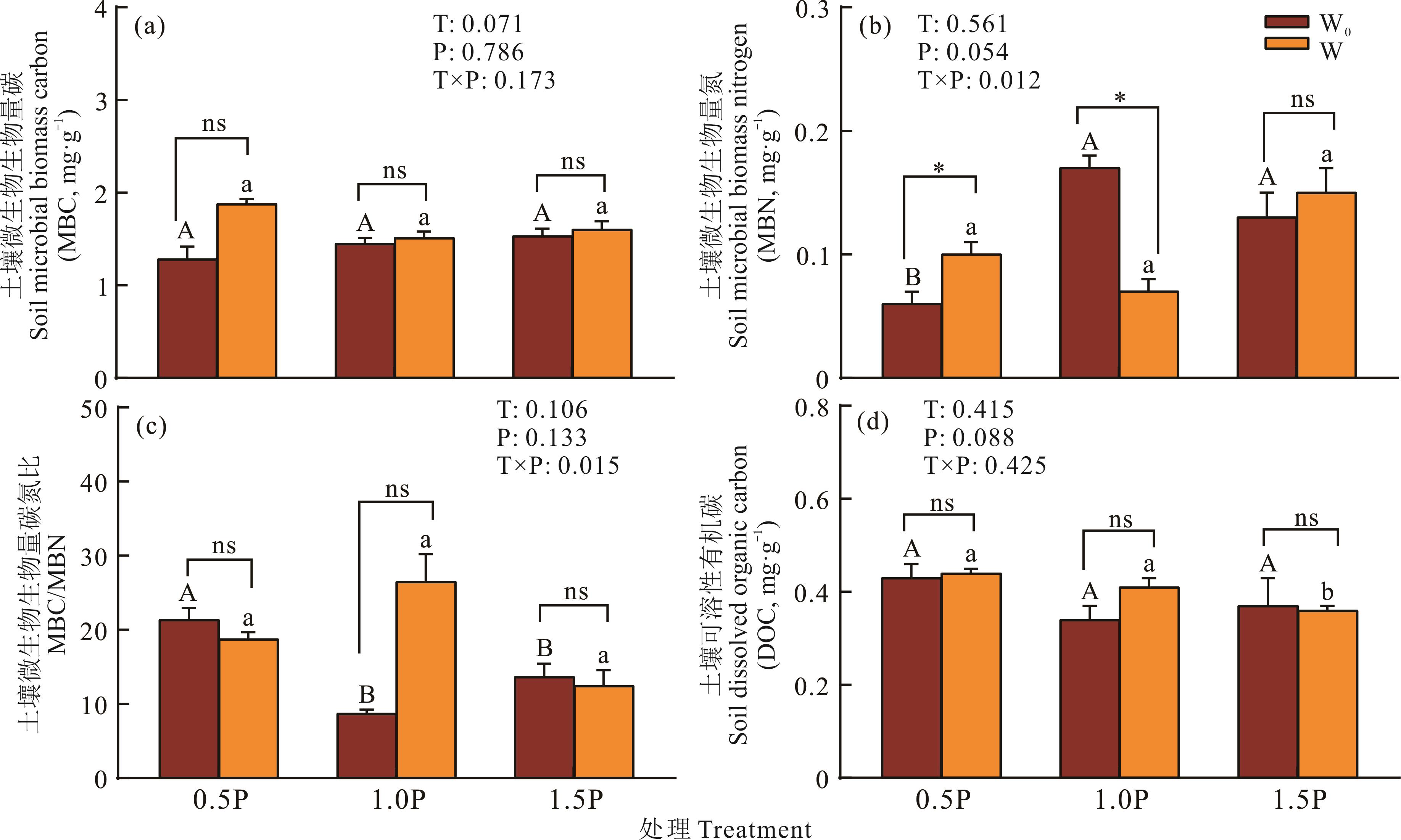
图3 增温和降水变化对土壤微生物生物量碳氮与可溶性有机碳的影响
Fig.3 Effects of warming and precipitation changes on soil microbial biomass carbon and nitrogen and dissolved organic carbon
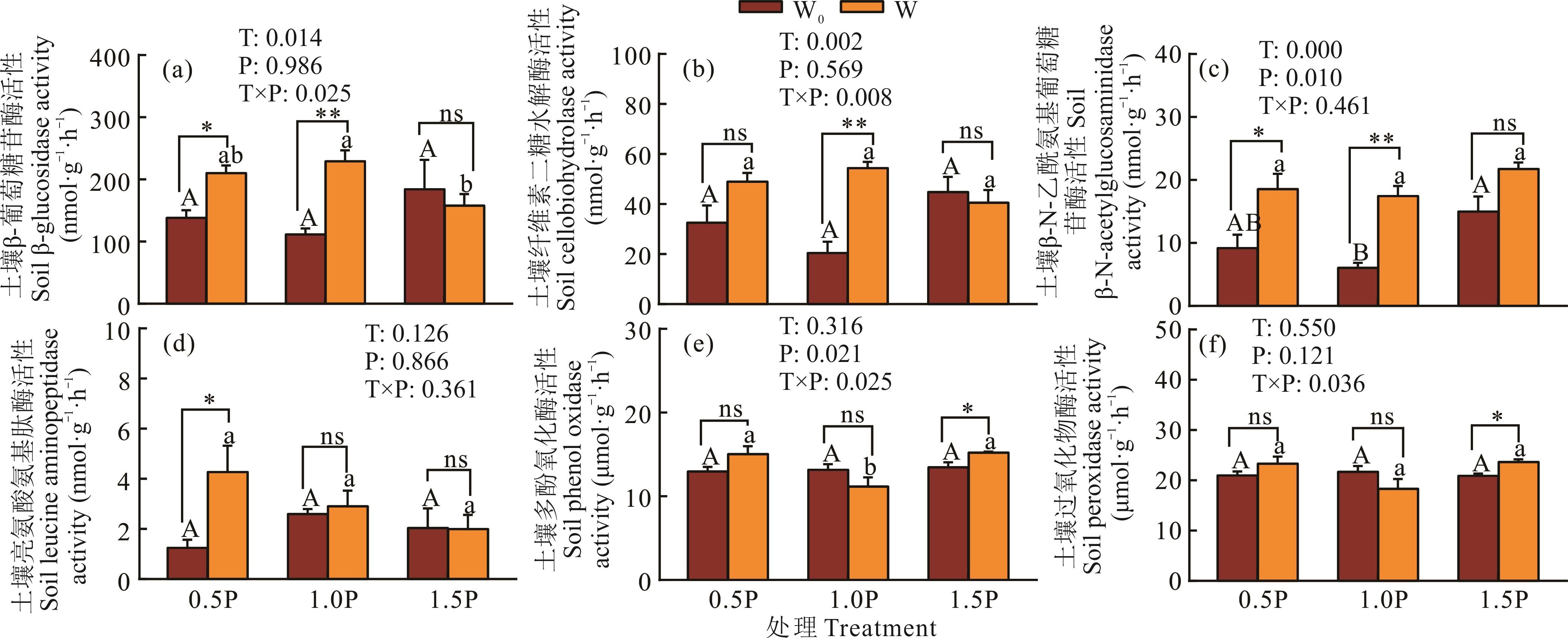
图4 增温和降水变化对土壤酶活性的影响
Fig.4 Effects of warming and precipitation changes on soil enzyme activities
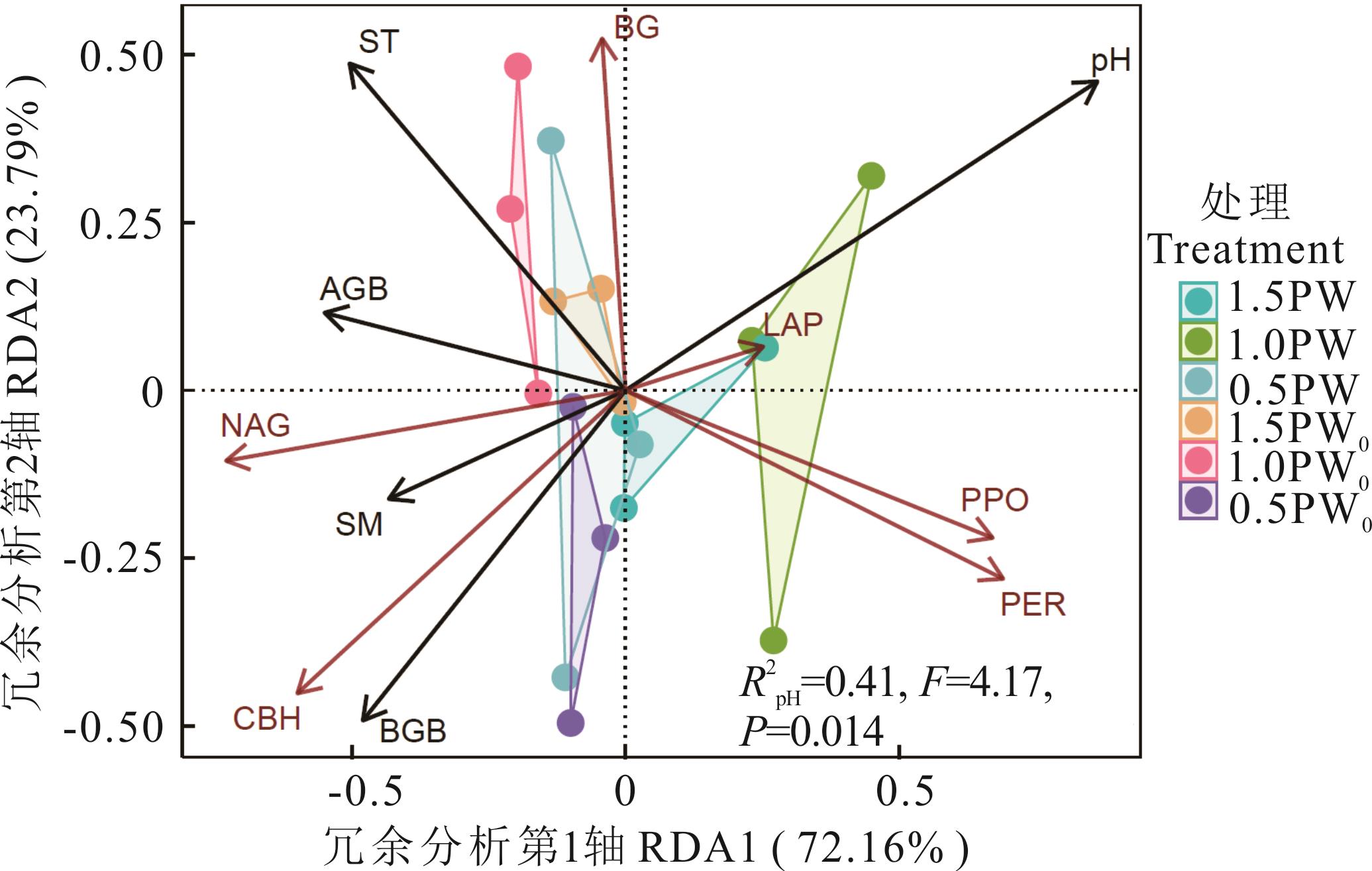
图5 土壤酶活性与主要因子的冗余分析红色箭头表示响应变量(土壤酶活性);黑色箭头表示解释变量(植被特征和土壤理化性质)。Red arrows represent the response variables (soil enzyme activities); black arrows represent the explanatory variables (vegetation characteristics and soil physical and chemical properties). AGB: 地上生物量Aboveground biomass; BGB: 地下生物量Belowground biomass; ST: 土壤温度Soil temperature; SM: 土壤湿度Soil moisture; pH: 土壤酸碱度Potential of hydrogen; BG: β-葡萄糖苷酶β-glucosidase; CBH: 纤维素二糖水解酶Cellobiohydrolase; PPO: 多酚氧化酶Phenol oxidase; PER: 过氧化物酶Peroxidase; NAG: β-N-乙酰氨基葡萄糖苷酶β-N-acetylglucosaminidase; LAP: 亮氨酸氨基肽酶Leucine aminopeptidase. 下同The same below.
Fig.5 Redundancy analysis of soil enzyme activities and key factors

图6 植被特征、土壤理化性质及土壤酶活性的相关性蓝色表示正相关,红色表示负相关;*和**分别表示在0.05和0.01水平上显著相关。Blue indicates positive correlation, red indicates negative correlation; * and ** represent significant correlation at 0.05 and 0.01 levels, respectively. Richness: 丰富度指数Richness index; Simpson: 辛普森指数Simpson index; Shannon-Wiener: 香农-威纳指数Shannon-Wiener index; Pielou: 均匀度指数Pielou index; BD: 土壤容重Bulk density; SOC: 土壤有机碳Soil organic carbon; TN: 土壤全氮Soil total nitrogen; NH4+-N: 铵态氮Ammonium nitrogen; NO3--N: 硝态氮Nitrate nitrogen; MBC: 微生物生物量碳Microbial biomass carbon; MBN: 微生物生物量氮Microbial biomass nitrogen; DOC: 可溶性有机碳Dissolved organic carbon.
Fig.6 Correlations among vegetation characteristics, soil physicochemical properties, and soil enzyme activities
| [1] | Qiu J. Double threat for Tibet. Nature, 2014, 512(7514): 240-241. |
| [2] | Yang Y X, Hu Z Y, Lu F Q, et al. Progress of recent 60 years’climate change and its environmental impacts on the Qinghai-Xizang Plateau. Plateau Meteorology, 2022, 41(1): 1-10. |
| 杨耀先, 胡泽勇, 路富全, 等. 青藏高原近60年来气候变化及其环境影响研究进展. 高原气象, 2022, 41(1): 1-10. | |
| [3] | Wang Y F, Lv W W, Xue K, et al. Grassland changes and adaptive management on the Qinghai-Tibetan Plateau. Nature Reviews Earth & Environment, 2022, 3(10): 668-683. |
| [4] | Sardans J, Peñuelas J, Estiarte M. Changes in soil enzymes related to C and N cycle and in soil C and N content under prolonged warming and drought in a Mediterranean shrubland. Applied Soil Ecology, 2008, 39(2): 223-235. |
| [5] | Jiang M H, Ni M Y, Zhou J C, et al. Effects of warming and precipitation reduction on soil enzyme activity in a young Cunninghamia lanceolata plantation.Chinese Journal of Ecology, 2018, 37(11): 3210-3219. |
| 江淼华, 倪梦颖, 周嘉聪, 等. 增温和降雨减少对杉木幼林土壤酶活性的影响. 生态学杂志, 2018, 37(11): 3210-3219. | |
| [6] | Blagodatskaya E, Kuzyakov Y. Active microorganisms in soil: critical review of estimation criteria and approaches. Soil Biology and Biochemistry, 2013, 67: 192-211. |
| [7] | Xu M P, Ren C J, Zhang W, et al. Responses mechanism of C∶N∶P stoichiometry of soil microbial biomass and soil enzymes to climate change. Chinese Journal of Applied Ecology, 2018, 29(7): 2445-2454. |
| 许淼平, 任成杰, 张伟, 等. 土壤微生物生物量碳氮磷与土壤酶化学计量对气候变化的响应机制. 应用生态学报, 2018, 29(7): 2445-2454. | |
| [8] | Xiao W, Chen X, Jing X, et al. A meta-analysis of soil extracellular enzyme activities in response to global change. Soil Biology and Biochemistry, 2018, 123: 21-32. |
| [9] | Wang H H, Huang W D, He Y Z, et al. Effects of short-term warming and precipitation reduction on soil microbial biomass carbon, nitrogen and enzyme activity in sandy grassland. Journal of Desert Research, 2022, 42(3): 274-281. |
| 王怀海, 黄文达, 何远政, 等. 短期增温和降水减少对沙质草地土壤微生物量碳氮和酶活性的影响. 中国沙漠, 2022, 42(3): 274-281. | |
| [10] | Steinweg J M, Dukes J S, Paul E A, et al. Microbial responses to multi-factor climate change: effects on soil enzymes. Frontiers in Microbiology, 2013, 4: 146. |
| [11] | Li J W. Responses and driving mechanisms of terrestrial nutrient stoichiometric characteristics under precipitation change. Beijing: University of Chinese Academy of Sciences, 2022. |
| 李继伟. 降水变化下植被生态系统养分计量特征的响应规律及其驱动机制. 北京: 中国科学院大学, 2022. | |
| [12] | Xu Z W, Yu G R, Zhang X Y, et al. Soil enzyme activity and stoichiometry in forest ecosystems along the North-South Transect in eastern China (NSTEC). Soil Biology and Biochemistry, 2017, 104: 152-163. |
| [13] | Liu X F, Tian Y, Heinzle J, et al. Long-term soil warming decreases soil microbial necromass carbon by adversely affecting its production and decomposition. Global Change Biology, 2024, 30(6): e17379. |
| [14] | Jing X, Wang Y H, Chung H, et al. No temperature acclimation of soil extracellular enzymes to experimental warming in an alpine grassland ecosystem on the Tibetan Plateau. Biogeochemistry, 2014, 117(1): 39-54. |
| [15] | Sinsabaugh R L. Phenol oxidase, peroxidase and organic matter dynamics of soil. Soil Biology and Biochemistry, 2010, 42(3): 391-404. |
| [16] | Liu M R, Liu S T, Ma C Y, et al. Research progress of the responses of grassland plants and soil to the variation of temperature and precipitation. Chinese Journal of Ecology, 2024, 43(12): 3787-3796. |
| 刘明蕊, 刘世婷, 马春燕, 等. 草地植物和土壤对温度和降水变化的响应研究进展. 生态学杂志, 2024, 43(12): 3787-3796. | |
| [17] | Dai J H, Wu P F, Tang S S, et al. Effects of altered precipitation on soil nematode communities in an alpine meadow. Acta Ecologica Sinica, 2023, 43(22): 9371-9383. |
| 代江慧, 吴鹏飞, 唐思思, 等. 降水变化对高寒草甸土壤线虫群落的影响. 生态学报, 2023, 43(22): 9371-9383. | |
| [18] | Li H Q, Zhang F W, Li J X, et al. Differential responses of CO2 and latent heat fluxes to climatic anomalies on two alpine grasslands on the northeastern Qinghai-Tibetan Plateau. Science of the Total Environment, 2023, 900: 165863. |
| [19] | Wang Y, Sun J, Ye C C, et al. Climatic factors drive the aboveground ecosystem functions of alpine grassland via soil microbial biomass nitrogen on the Qingzang Plateau. Chinese Journal of Plant Ecology, 2021, 45(5): 434-443. |
| 王毅, 孙建, 叶冲冲, 等. 气候因子通过土壤微生物生物量氮促进青藏高原高寒草地地上生态系统功能. 植物生态学报, 2021, 45(5): 434-443. | |
| [20] | Gang C C, Wang Z Q, Yang Y, et al. The NPP spatiotemporal variation of global grassland ecosystems in response to climate change over the past 100 years. Acta Prataculturae Sinica, 2016, 25(11): 1-14. |
| 刚成诚, 王钊齐, 杨悦, 等. 近百年全球草地生态系统净初级生产力时空动态对气候变化的响应. 草业学报, 2016, 25(11): 1-14. | |
| [21] | Yang Y H, Mohammat A, Feng J M, et al. Storage, patterns and environmental controls of soil organic carbon in China. Biogeochemistry, 2007, 84(2): 131-141. |
| [22] | Yang Y H, Fang J Y, Tang Y H, et al. Storage, patterns and controls of soil organic carbon in the Tibetan grasslands. Global Change Biology, 2008, 14(7): 1592-1599. |
| [23] | Wang X, Zhong Z K, Jian J N, et al. Effects of simulated warming and increased precipitation on soil extracellular enzyme activity and enzymatic stoichiometry of abandoned grassland. Environmental Science, 2022, 43(5): 2812-2821. |
| 王兴, 钟泽坤, 简俊楠, 等. 模拟增温和降雨增加对撂荒草地土壤胞外酶活性及计量特征的影响. 环境科学, 2022, 43(5): 2812-2821. | |
| [24] | Zhang F W, Li H Q, Song C G, et al. Responses and linkages of soil microbes, enzyme activities, and organic carbon pools to nitrogen addition and precipitation change of an alpine meadow. Scientia Sinica Vitae, 2025, 55(9): 1929-1942. |
| 张法伟, 李红琴, 宋成刚, 等. 高寒草甸土壤微生物与酶活性及有机碳库对氮添加和降水改变的关联响应. 中国科学: 生命科学, 2025, 55(9): 1929-1942. | |
| [25] | Chen Y H, Xie Z Q, Xue L P. Process optimization for measurements of soil and plant samples with carbon/nitrogen element analyzer. Modern Chemical Industry, 2016, 36(4): 185-187, 189. |
| 陈雅涵, 谢宗强, 薛丽萍. 碳氮元素分析仪测试土壤与植物样品的流程优化. 现代化工, 2016, 36(4): 185-187, 189. | |
| [26] | Bao S D. Agrochemical analysis of soil. Beijing: China Agriculture Press, 2000. |
| 鲍士旦. 土壤农化分析. 北京: 中国农业出版社, 2000. | |
| [27] | Duan A L, Han Z X, Huang Y, et al. Problems and solutions for determination of ammonium nitrogen in soil by the method of indophenol blue colorimetry. Contemporary Chemical Industry, 2021, 50(12): 2861-2864. |
| 端爱玲, 韩张雄, 黄艳, 等. 靛酚蓝比色法测定土壤中铵态氮注意事项. 当代化工, 2021, 50(12): 2861-2864. | |
| [28] | Song G, Sun B, Jiao J Y. Comparison between ultraviolet spectrophotometry and other methods in determination of soil nitrate-N. Acta Pedologica Sinica, 2007, 44(2): 288-293. |
| 宋歌, 孙波, 教剑英. 测定土壤硝态氮的紫外分光光度法与其他方法的比较. 土壤学报, 2007, 44(2): 288-293. | |
| [29] | Deng Z H, Chen Z J, Han S J, et al. The impact of nitrogen application on the stoichiometry of soil and microorganisms in secondary forests of Changbai Mountain. Journal of Forest and Environment, 2025, 45(1): 20-30. |
| 邓子豪, 陈志杰, 韩士杰, 等. 施氮对长白山次生林土壤与微生物化学计量比的影响. 森林与环境学报, 2025, 45(1): 20-30. | |
| [30] | Deforest J L. The influence of time, storage temperature, and substrate age on potential soil enzyme activity in acidic forest soils using MUB-linked substrates and L-DOPA. Soil Biology and Biochemistry, 2009, 41(6): 1180-1186. |
| [31] | Ma K P, Huang J H, Yu S L, et al. Plant community diversity in Dongling mountain, Beijing, China: Ⅱ. Species richness, evenness and species diversities. Acta Ecologica Sinica, 1995, 15(3): 268-277. |
| 马克平, 黄建辉, 于顺利, 等. 北京东灵山地区植物群落多样性的研究Ⅱ丰富度、均匀度和物种多样性指数. 生态学报, 1995, 15(3): 268-277. | |
| [32] | He M Y, Zhong Y Q W, Zhao F Z, et al. Research progress in the response of soil microbial traits to warming and their integration into carbon cycle models. Acta Agrestia Sinica, 2026, 34(3): 745-760. |
| 何梦月, 钟杨权威, 赵发珠, 等. 土壤微生物性状对增温的响应及其在碳循环模型中的应用研究进展. 草地学报, 2026, 34(3): 745-760. | |
| [33] | Xu W F, Yuan W P. Responses of microbial biomass carbon and nitrogen to experimental warming: A Meta-analysis. Soil Biology and Biochemistry, 2017, 115: 265-274. |
| [34] | Li S C, Tang S M, Chen H Y, et al. Soil nitrogen availability drives the response of soil microbial biomass to warming. Science of the Total Environment, 2024, 917: 170505. |
| [35] | Xu G, Long Z J, Ren P, et al. Differential responses of soil hydrolytic and oxidative enzyme activities to the natural forest conversion. Science of the Total Environment, 2020, 716: 136414. |
| [36] | Brockett B F T, Prescott C E, Grayston S J. Soil moisture is the major factor influencing microbial community structure and enzyme activities across seven biogeoclimatic zones in western Canada. Soil Biology and Biochemistry, 2012, 44(1): 9-20. |
| [37] | Chen J, Luo Y Q, García P P, et al. Differential responses of carbon-degrading enzyme activities to warming: Implications for soil respiration. Global Change Biology, 2018, 24(10): 4816-4826. |
| [38] | Kang S C, Xu Y W, You Q L, et al. Review of climate and cryospheric change in the Tibetan Plateau. Environmental Research Letters, 2010, 5(1): 1-5. |
| [39] | Gallo M, Amonette R, Lauber C, et al. Microbial community structure and oxidative enzyme activity in nitrogen-amended north temperate forest soils. Microbial Ecology, 2004, 48(2): 218-229. |
| [40] | Sinsabaugh R L, Carreiro M M, Repert D A. Allocation of extracellular enzymatic activity in relation to litter composition, N deposition, and mass loss. Biogeochemistry, 2002, 60(1): 1-24. |
| [41] | Liu X C, Zhang S T. Nitrogen addition shapes soil enzyme activity patterns by changing pH rather than the composition of the plant and microbial communities in an alpine meadow soil. Plant and Soil, 2019, 440(1/2): 11-24. |
| [42] | Zhalnina K, Dias R, de Quadros P D, et al. Soil pH determines microbial diversity and composition in the park grass experiment. Microbial Ecology, 2015, 69(2): 395-406. |
| [43] | Duan C W, Li X L, Li C Y, et al. Positive effects of fungal β diversity on soil multifunctionality mediated by pH in the natural restoration succession stages of alpine meadow patches. Ecological Indicators, 2023, 148: 110122. |
| [44] | Wang X D, Wu W N, Ao G K L, et al. Minor effects of warming on soil microbial diversity, richness and community structure. Global Change Biology, 2025, 31(3): e70104. |
| [45] | Wu Q C, Chen Y, Dou X H, et al. Microbial fertilizers improve soil quality and crop yield in coastal saline soils by regulating soil bacterial and fungal community structure. Science of the Total Environment, 2024, 949: 175127. |
| [46] | Shen X, Yang F, Xiao C W, et al. Increased contribution of root exudates to soil carbon input during grassland degradation. Soil Biology and Biochemistry, 2020, 146: 107817. |
| [1] | 王喆, 王镜, 颉耀文, 赵慧芳, 校瑞香, 宗萨才文求藏. 三江源地区草地地上生物量时空变化及其对气候变化的响应[J]. 草业学报, 2026, 35(1): 1-12. |
| [2] | 张宁, 王金牛, 罗栋梁, 张林, 徐波, 吴彦. 季节性雪被厚度对高山草甸4种优势晚花植物生物量分配的影响[J]. 草业学报, 2025, 34(2): 67-80. |
| [3] | 油志远, 马淑娟, 王长庭, 丁路明, 宋小艳, 尹高飞, 毛军. 川滇高原高寒草甸生态系统不同功能群植物分布格局的MaxEnt模型预测[J]. 草业学报, 2024, 33(3): 1-12. |
| [4] | 王鹏, 金正, 余婷, 秦康强, 桑新亚, 陶建平, 罗唯学. 预测姜黄属植物在中国当前和未来气候情景下的潜在分布区变化[J]. 草业学报, 2024, 33(10): 14-27. |
| [5] | 李紫晶, 高翠萍, 王忠武, 韩国栋. 中国草地固碳减排研究现状及其建议[J]. 草业学报, 2023, 32(2): 191-200. |
| [6] | 周泽东, 马晖玲, 韩煦, 李元恒, 李西良, 李坤娜. 温性典型草原羊草光合特性对模拟放牧因素分解的响应[J]. 草业学报, 2022, 31(8): 81-89. |
| [7] | 范晓敏, 井新, 肖博文, 马小亮, 贺金生. 气候和土地利用变化共同驱动青海海南、海北州生态系统服务的时空变化[J]. 草业学报, 2022, 31(12): 17-30. |
| [8] | 郭文慧, 顾润源, 丁锋. 蒲公英和车前草在山东境内的春季物候特征及对气候变化的响应[J]. 草业学报, 2021, 30(12): 27-38. |
| [9] | 林慧龙, 范迪, 冯琦胜, 梁天刚. 草地综合顺序分类法研究新热点:2008-2020年回顾与展望[J]. 草业学报, 2021, 30(10): 201-213. |
| [10] | 郭强, 王玉琴, 鲍根生, 王宏生. 气象因子对高原鼢鼠种群数量的影响[J]. 草业学报, 2020, 29(8): 188-194. |
| [11] | 马倩倩, 刘彤, 董合干, 王寒月, 赵文轩, 王瑞丽, 刘延, 陈乐. 气候变化下三裂叶豚草在新疆的潜在地理分布[J]. 草业学报, 2020, 29(12): 73-85. |
| [12] | 张智起, 张立旭, 徐炜, 汪浩, 王金洲, 王娓, 贺金生. 气候变暖背景下土壤呼吸研究的几个重要问题[J]. 草业学报, 2019, 28(9): 164-173. |
| [13] | 王多斌, 籍常婷, 林慧龙. 基于DNDC模型的高寒草甸土壤有机碳含量动态研究[J]. 草业学报, 2019, 28(12): 197-204. |
| [14] | 王迎新, 陈先江, 娄珊宁, 胡安, 任劲飞, 胡俊奇, 张静, 侯扶江. 草原灌丛化入侵:过程、机制和效应[J]. 草业学报, 2018, 27(5): 219-227. |
| [15] | 郭丁, 郭文斐, 赵建, 特木其勒图, 李旭东, 傅华, 骆亦其. 黄土高原草地和农田系统碳动态对降雨、温度和CO2浓度变化响应的模拟[J]. 草业学报, 2018, 27(2): 1-14. |
| 阅读次数 | ||||||
|
全文 |
|
|||||
|
摘要 |
|
|||||
