草业学报 ›› 2026, Vol. 35 ›› Issue (4): 158-168.DOI: 10.11686/cyxb2025151
• 研究论文 • 上一篇
张钿1,2(
), 冷华娟1, 崔婧1, 何飞1, 王雪1, 李明娜1, 杨青川1, 康俊梅1(
)
收稿日期:2025-04-24
修回日期:2025-08-09
出版日期:2026-04-20
发布日期:2026-02-07
通讯作者:
康俊梅
作者简介:Corresponding author. E-mail: kangjunmei@caas.cn基金资助:
Tian ZHANG1,2(
), Hua-juan LENG1, Jing CUI1, Fei HE1, Xue WANG1, Ming-na LI1, Qing-chuan YANG1, Jun-mei KANG1(
)
Received:2025-04-24
Revised:2025-08-09
Online:2026-04-20
Published:2026-02-07
Contact:
Jun-mei KANG
摘要:
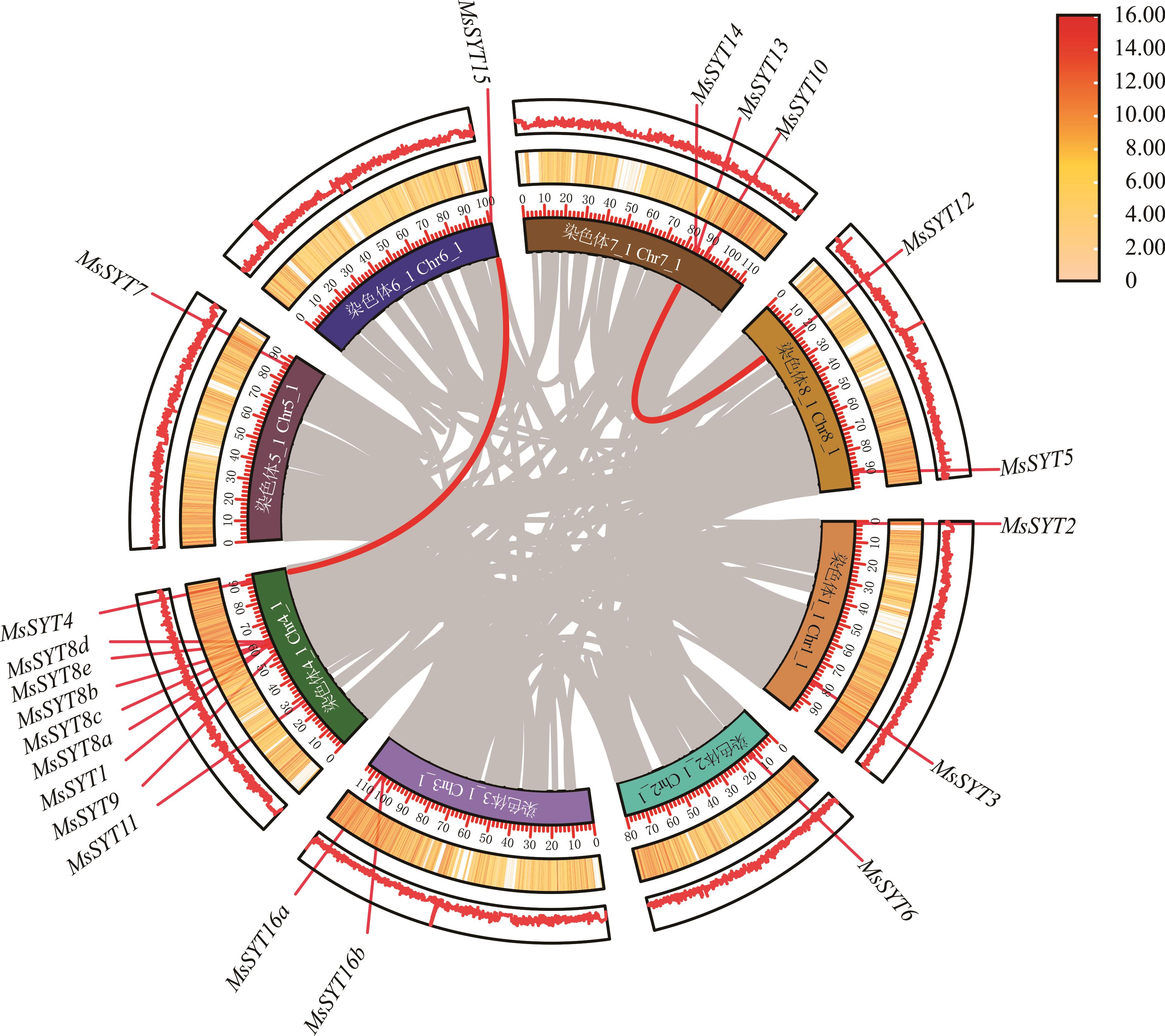
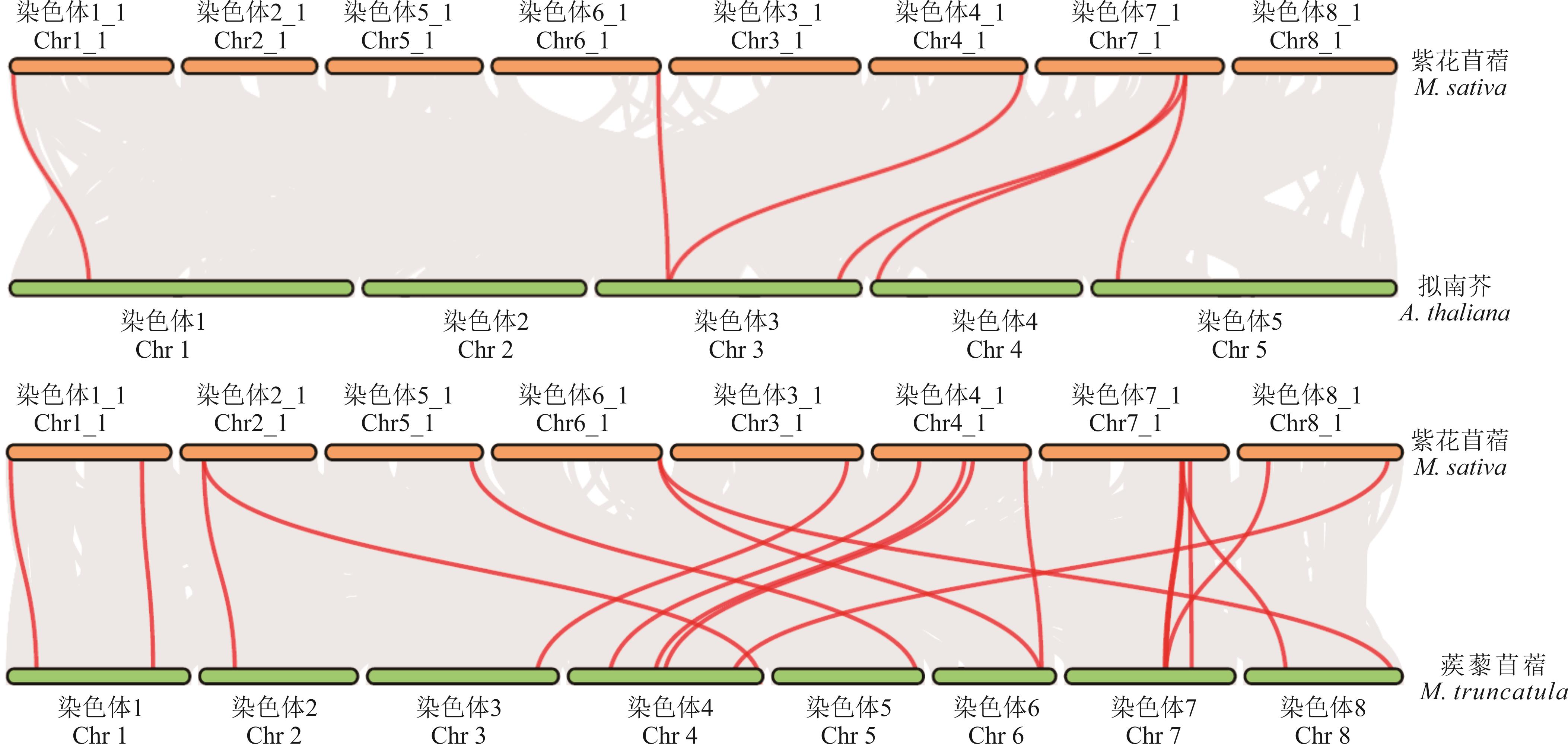
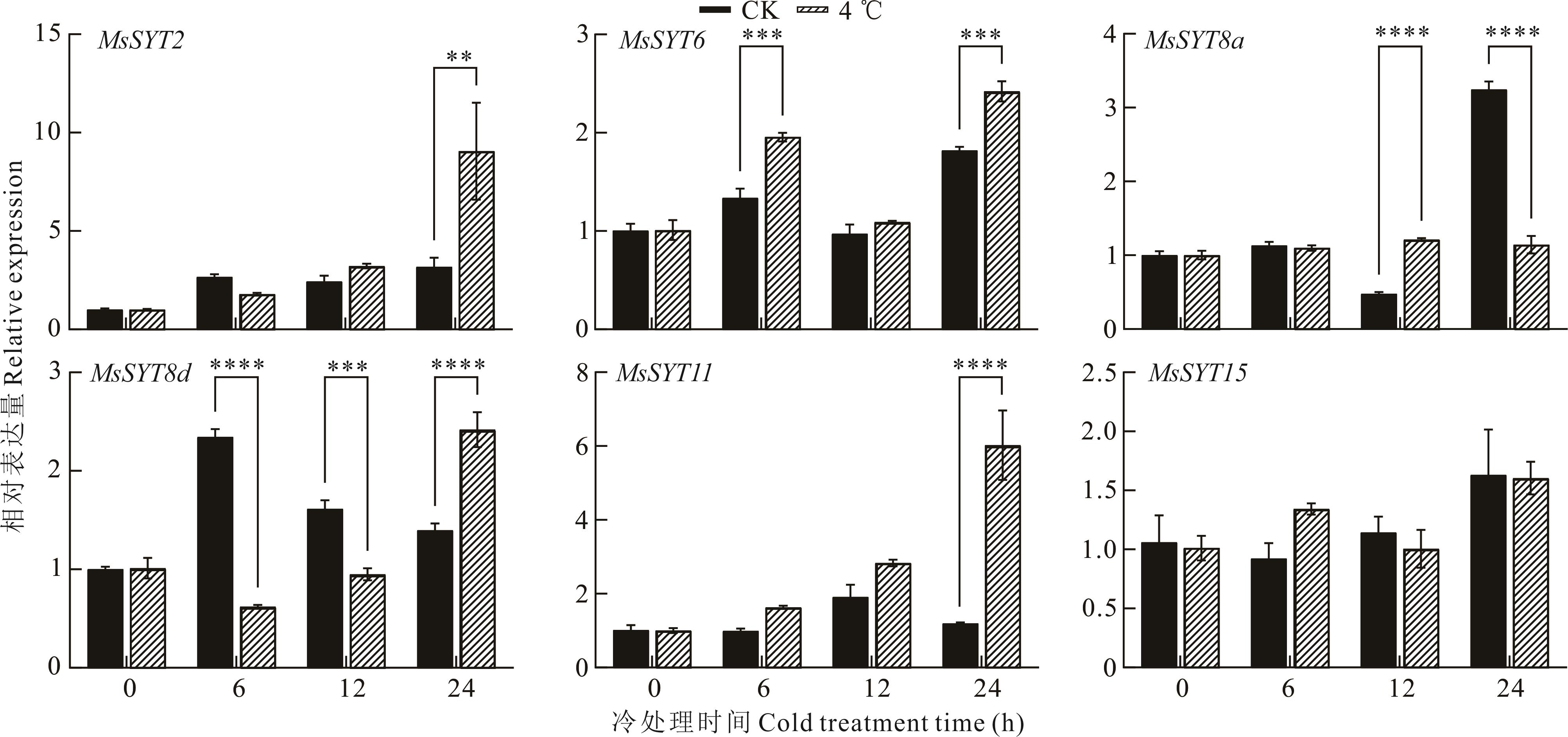
植物中的突触结合蛋白(SYT)属于钙结合蛋白家族,近年来在植物生物学研究领域备受关注。目前,仅在拟南芥中存在对SYT基因家族成员鉴定的相关报道,而豆科植物紫花苜蓿中该方面的研究仍属空白。本研究以拟南芥SYT基因家族成员为参照,运用生物信息学方法,在紫花苜蓿中成功筛选出21个SYT基因。通过对21个MsSYT、25个MtSYT和 9个AtSYT蛋白进行系统发育分析,明确了它们之间的同源性,MsSYT基因被分成4个亚家族。在对MsSYT基因的分析中发现,其家族成员的理化性质存在相对差异,但是基因结构和蛋白保守基序在各亚家族之间却高度保守。进一步对MsSYT基因的顺式作用元件进行分析,结果显示其中包含光响应元件、胁迫响应元件和激素响应元件,这表明该家族基因在植物调节生长发育和应对非生物胁迫过程中发挥重要作用。同时,染色体定位和共线性分析表明,MsSYT基因在染色体上呈不均匀分布,存在两组非串联重复片段以及两组串联重复片段。实时定量PCR(RT-qPCR)检测结果表明部分MsSYT基因对盐、冷和干旱胁迫有响应,其中MsSYT8d对这3种胁迫均表现出显著响应。本研究首次系统地对紫花苜蓿中的SYT基因进行了鉴定,并分析了其理化性质、进化特征和表达模式,为后续研究MsSYT基因在植物生长发育和非生物胁迫响应过程中的功能特性提供了坚实的理论依据。
张钿, 冷华娟, 崔婧, 何飞, 王雪, 李明娜, 杨青川, 康俊梅. 紫花苜蓿突触结合蛋白家族成员鉴定与非生物胁迫下的表达分析[J]. 草业学报, 2026, 35(4): 158-168.
Tian ZHANG, Hua-juan LENG, Jing CUI, Fei HE, Xue WANG, Ming-na LI, Qing-chuan YANG, Jun-mei KANG. Identification of synaptotagmin gene family members in alfalfa and their transcript profiles under abiotic stresses[J]. Acta Prataculturae Sinica, 2026, 35(4): 158-168.
基因登录号 Gene ID | 基因名称 Gene name | 蛋白长度 Protein length (aa) | 分子量 Molecular weight (kDa) | 等电点 Isoelectric point (pI) | 不稳定系数 Instability index | 总平均亲水性 Grand average of hydropathicity |
|---|---|---|---|---|---|---|
| Msa083526.t01 | MsSYT1 | 537 | 61.44 | 6.36 | 29.74 | -0.339 |
| Msa000097.t01 | MsSYT2 | 535 | 60.98 | 7.61 | 32.65 | -0.250 |
| Msa005119.t01 | MsSYT3 | 544 | 62.05 | 8.40 | 35.48 | -0.091 |
| Msa086529.t01 | MsSYT4 | 821 | 92.00 | 6.92 | 40.18 | -0.216 |
| Msa183305.t01 | MsSYT5 | 566 | 63.51 | 5.96 | 31.42 | -0.095 |
| Msa027845.t01 | MsSYT6 | 1023 | 114.98 | 5.77 | 48.58 | -0.267 |
| Msa112806.t01 | MsSYT7 | 764 | 87.85 | 6.67 | 43.22 | -0.045 |
| Msa083527.t01 | MsSYT8a | 945 | 107.72 | 6.10 | 38.93 | -0.400 |
| Msa083527.t02 | MsSYT8b | 645 | 74.41 | 5.86 | 39.96 | -0.351 |
| Msa083527.t03 | MsSYT8c | 717 | 82.48 | 6.34 | 39.31 | -0.348 |
| Msa083527.t04 | MsSYT8d | 645 | 74.41 | 5.86 | 39.96 | -0.351 |
| Msa083527.t05 | MsSYT8e | 717 | 82.48 | 6.34 | 39.31 | -0.348 |
| Msa038100.t01 | MsSYT9 | 561 | 63.29 | 5.78 | 34.12 | -0.099 |
| Msa157005.t01 | MsSYT10 | 775 | 89.45 | 9.20 | 45.43 | -0.261 |
| Msa081502.t01 | MsSYT11 | 770 | 88.96 | 9.29 | 42.32 | -0.262 |
| Msa179019.t01 | MsSYT12 | 1005 | 114.51 | 9.16 | 45.19 | -0.387 |
| Msa156608.t01 | MsSYT13 | 1323 | 151.85 | 8.93 | 41.08 | -0.403 |
| Msa156589.t01 | MsSYT14 | 1013 | 115.13 | 9.27 | 43.45 | -0.371 |
| Msa135465.t01 | MsSYT15 | 828 | 93.71 | 6.90 | 45.36 | -0.301 |
| Msa056918.t01 | MsSYT16a | 568 | 64.18 | 5.98 | 33.88 | -0.114 |
| Msa056918.t02 | MsSYT16b | 1045 | 120.18 | 8.97 | 43.06 | -0.473 |
表1 MsSYT基因家族基本性质分析
Table 1 Analysis of the basic properties of MsSYT gene family
基因登录号 Gene ID | 基因名称 Gene name | 蛋白长度 Protein length (aa) | 分子量 Molecular weight (kDa) | 等电点 Isoelectric point (pI) | 不稳定系数 Instability index | 总平均亲水性 Grand average of hydropathicity |
|---|---|---|---|---|---|---|
| Msa083526.t01 | MsSYT1 | 537 | 61.44 | 6.36 | 29.74 | -0.339 |
| Msa000097.t01 | MsSYT2 | 535 | 60.98 | 7.61 | 32.65 | -0.250 |
| Msa005119.t01 | MsSYT3 | 544 | 62.05 | 8.40 | 35.48 | -0.091 |
| Msa086529.t01 | MsSYT4 | 821 | 92.00 | 6.92 | 40.18 | -0.216 |
| Msa183305.t01 | MsSYT5 | 566 | 63.51 | 5.96 | 31.42 | -0.095 |
| Msa027845.t01 | MsSYT6 | 1023 | 114.98 | 5.77 | 48.58 | -0.267 |
| Msa112806.t01 | MsSYT7 | 764 | 87.85 | 6.67 | 43.22 | -0.045 |
| Msa083527.t01 | MsSYT8a | 945 | 107.72 | 6.10 | 38.93 | -0.400 |
| Msa083527.t02 | MsSYT8b | 645 | 74.41 | 5.86 | 39.96 | -0.351 |
| Msa083527.t03 | MsSYT8c | 717 | 82.48 | 6.34 | 39.31 | -0.348 |
| Msa083527.t04 | MsSYT8d | 645 | 74.41 | 5.86 | 39.96 | -0.351 |
| Msa083527.t05 | MsSYT8e | 717 | 82.48 | 6.34 | 39.31 | -0.348 |
| Msa038100.t01 | MsSYT9 | 561 | 63.29 | 5.78 | 34.12 | -0.099 |
| Msa157005.t01 | MsSYT10 | 775 | 89.45 | 9.20 | 45.43 | -0.261 |
| Msa081502.t01 | MsSYT11 | 770 | 88.96 | 9.29 | 42.32 | -0.262 |
| Msa179019.t01 | MsSYT12 | 1005 | 114.51 | 9.16 | 45.19 | -0.387 |
| Msa156608.t01 | MsSYT13 | 1323 | 151.85 | 8.93 | 41.08 | -0.403 |
| Msa156589.t01 | MsSYT14 | 1013 | 115.13 | 9.27 | 43.45 | -0.371 |
| Msa135465.t01 | MsSYT15 | 828 | 93.71 | 6.90 | 45.36 | -0.301 |
| Msa056918.t01 | MsSYT16a | 568 | 64.18 | 5.98 | 33.88 | -0.114 |
| Msa056918.t02 | MsSYT16b | 1045 | 120.18 | 8.97 | 43.06 | -0.473 |
图3 MsSYT基因进化关系、保守基序、保守结构域和结构分析UTR: Untranslated region; CDS: Coding sequence.
Fig.3 MsSYT genes phylogenetic relationship, conserved motifs, conserved domains, and gene structural analysis
图7 MsSYT基因在干旱胁迫下的表达模式*: P<0.05; **: P<0.01; ***: P<0.001; ****: P<0.0001; 下同The same below.
Fig.7 Expression pattern of MsSYT gene under drought stress
| [1] | Hinderliter A K, Almeida P F F, Biltonen R L,et al. Membrane domain formation by calcium-dependent, lipid-binding proteins: Insights from the C2 motif. Biochimica et Biophysica Acta (BBA)-Molecular Cell Research, 1998, 1448(2): 227-235. |
| [2] | Guerrero-Valero M, Marín-Vicente C, Gómez-Fernández J C, et al. The C2 domains of classical PKCs are specific ptdIns (4,5)P2-sensing domains with different affinities for membrane binding. Journal of Molecular Biology, 2007, 371(3): 608-621. |
| [3] | Xiao S P, Wu C C, Zuo D Y, et al. Systematic analysis and comparison of CaLB genes reveal the functions of GhCaLB42 and GhCaLB123 in fiber development and abiotic stress in cotton. Industrial Crops and Products, 2022, 184: 115030. |
| [4] | Nishizuka Y. The molecular heterogeneity of protein kinase C and its implications for cellular regulation. Nature, 1988, 334(6184): 661-665. |
| [5] | Gavrin A, Kulikova O, Bisseling T, et al. Interface symbiotic membrane formation in root nodules of Medicago truncatula: The role of synaptotagmins MtSyt1, MtSyt2 and MtSyt3. Frontiers in Plant Science, 2017, 8: 201. |
| [6] | Zhang D P, Aravind L. Identification of novel families and classification of the C2 domain superfamily elucidate the origin and evolution of membrane targeting activities in eukaryotes. Gene, 2010, 469(1): 18-30. |
| [7] | Benavente J L, Siliqi D, Infantes L, et al. The structure and flexibility analysis of the Arabidopsis synaptotagmin 1 reveal the basis of its regulation at membrane contact sites. Life Science Alliance, 2021, 4(10): e202101152. |
| [8] | Zhang H J, Zeng Y T, Seo J, et al. Global identification and characterization of C2 domain-containing proteins associated with abiotic stress response in rice (Oryza sativa L.). International Journal of Molecular Sciences, 2022, 23(4): 2221. |
| [9] | Schapire A L, Voigt B, Jasik J, et al. Arabidopsis synaptotagmin 1 is required for the maintenance of plasma membrane integrity and cell viability. The Plant Cell, 2008, 20(12): 3374-3388. |
| [10] | Krausko M, Kusá Z, Peterková D, et al. The absence of the AtSYT1 function elevates the adverse effect of salt stress on photosynthesis in Arabidopsis. International Journal of Molecular Sciences, 2022, 23(3): 1751. |
| [11] | Ruiz-Lopez N, Pérez-Sancho J, del Valle A E, et al. Synaptotagmins at the endoplasmic reticulum-plasma membrane contact sites maintain diacylglycerol homeostasis during abiotic stress. The Plant Cell, 2021, 33(7): 2431-2453. |
| [12] | García‐Hernández S, Rubio L, Rivera-Moreno M, et al. Functional and structural analysis reveals distinct biological roles of plant synaptotagmins in response to environmental stress. Plant, Cell & Environment, 2025, 48(1): 260-271. |
| [13] | Wang R Z. The functional ananlysis of CaSYT5 in pepper’s response to Relstionia solanacearum or high-temperature-high-humidity challenge. Fuzhou: Fujian Agriculture and Forestry University, 2017. |
| 王榕樟. CaSYT5在辣椒应答青枯病和高温高湿过程中的功能分析. 福州: 福建农林大学, 2017. | |
| [14] | Sun Q Z, Liu Q, Li F, et al. A brief review of the origin and dissemination of alfalfa. Acta Prataculturae Sinica, 2019, 28(6): 204-212. |
| 孙启忠, 柳茜, 李峰, 等. 苜蓿的起源与传播考述. 草业学报, 2019, 28(6): 204-212. | |
| [15] | Holub E B. The arms race is ancient history in Arabidopsis, the wildflower. Nature Reviews Genetics, 2001, 2(7): 516-527. |
| [16] | Tamura K, Stecher G, Kumar S.MEGA 11: Molecular evolutionary genetics analysis version 11. Molecular Biology and Evolution, 2021, 38(7): 3022-3027. |
| [17] | Bailey T L, Williams N, Misleh C, et al. MEME: Discovering and analyzing DNA and protein sequence motifs. Nucleic Acids Research, 2006, 34: W369-W373. |
| [18] | Lescot M, Déhais P, Thijs G, et al. PlantCARE, a database of plant cis-acting regulatory elements and a portal to tools for in silico analysis of promoter sequences. Nucleic Acids Research, 2002, 30(1): 325-327. |
| [19] | Wang Y, Tang H, DeBarry J D, et al. MCScanX: A toolkit for detection and evolutionary analysis of gene synteny and collinearity. Nucleic Acids Research, 2012, 40(7): e49. |
| [20] | Craxton M. Genomic analysis of synaptotagmin genes. Genomics, 2001, 77(1/2): 43-49. |
| [21] | Benitez-Fuente F, Botella M A. Biological roles of plant synaptotagmins. European Journal of Cell Biology, 2023, 102(3): 151335. |
| [22] | Ishikawa K, Tamura K, Fukao Y, et al. Structural and functional relationships between plasmodesmata and plant endoplasmic reticulum-plasma membrane contact sites consisting of three synaptotagmins. New Phytologist, 2020, 226(3): 798-808. |
| [23] | Lynch M, Conery J S. The evolutionary fate and consequences of duplicate genes. Science, 2000, 290(5494): 1151-1155. |
| [24] | Cannon S B, Mitra A, Baumgarten A, et al. The roles of segmental and tandem gene duplication in the evolution of large gene families in Arabidopsis thaliana. BMC Plant Biology, 2004, 4(1): 10. |
| [25] | Gao B. Response ot the Arabidopsis SYTA to salt stress. Jinan: Shandong Normal University, 2011. |
| 高彬. 拟南芥SYTA基因在盐胁迫响应中的功能研究. 济南: 山东师范大学, 2011. | |
| [26] | Hernandez-Garcia C, Finer J. Identification and validation of promoters and cis-acting regulatory elements. Plant Science, 2013, 217-218: 109-119. |
| [1] | 马苹, 刘志国, 沙煜舒, 刘亚玲, 妥小梅, 伏兵哲, 高雪芹. 紫花苜蓿苗期氮利用特性及氮高效品种的筛选[J]. 草业学报, 2026, 35(4): 112-123. |
| [2] | 田鹏宇, 张义茹, 李旭凯, 宋敏丽. 谷子SiCCoAOMT基因家族的鉴定及表达分析[J]. 草业学报, 2026, 35(3): 195-209. |
| [3] | 张世超, 崔国文, 张德鹏, 韩福迎, 丁叮, 吕向丽, 林硕, 陈乐然, 李吉儒, 才华. 紫花苜蓿非组培遗传转化体系创建及在耐盐基因功能鉴定与基因编辑中的应用[J]. 草业学报, 2026, 35(3): 223-234. |
| [4] | 童玉花, 王晓彤, 马永龙, 杨金辉, 余冬雯, 李淑霞. 壳聚糖浸种对盐碱胁迫下紫花苜蓿种子萌发的影响[J]. 草业学报, 2026, 35(3): 245-256. |
| [5] | 陈丽娟, 高荣, 王建喜, 马晖玲. 紫花苜蓿与红豆草在不同生长时期缩合单宁合成差异的比较研究[J]. 草业学报, 2026, 35(2): 221-236. |
| [6] | 李瑒琨, 本转林, 张筠钰, 杨惠敏. 不同气候和土壤条件下施肥类型影响紫花苜蓿种子产量的整合分析[J]. 草业学报, 2026, 35(2): 54-67. |
| [7] | 张继元, 安海全, 潘靖一, 刘畅, 龙思思, 赵丽丽. 7个紫花苜蓿品种种子萌发及幼苗生长的抗旱性评价[J]. 草业学报, 2026, 35(2): 68-82. |
| [8] | 柳家乐, 祁娟, 李文亮, 路欣, 袁琪, 李明洁, 张奥龙, 杜旺毅. 老芒麦EsJRL基因家族鉴定与表达分析[J]. 草业学报, 2026, 35(1): 206-222. |
| [9] | 张颖, 贺善睦, 何傲蕾, 李昌宁, 姚拓. 微生物菌剂与有机钙蛋白配施对紫花苜蓿生长和土壤酶活性的影响[J]. 草业学报, 2026, 35(1): 25-39. |
| [10] | 俞鸿千, 马雪鹏, 曾翰国, 单晓艳, 李曼莉, 王占军. 地下滴灌时期和水量对紫花苜蓿种子生产的影响[J]. 草业学报, 2026, 35(1): 53-64. |
| [11] | 邹苇鹏, 刘怡, 翟佳兴, 周思懿, 宫祉祎, 岑慧芳, 朱慧森, 许涛. 紫花苜蓿MsNAC053基因克隆及其对非生物胁迫的响应分析[J]. 草业学报, 2025, 34(9): 121-133. |
| [12] | 鲜燃, 邓雨, 付秋月, 蒋晶霞, 陶佳丽, 许涛, 朱慧森, 岑慧芳. 紫花苜蓿MsMYB86基因克隆及其对非生物胁迫的响应分析[J]. 草业学报, 2025, 34(9): 162-172. |
| [13] | 刘沂欣, 隋晓青, 王鑫尧, 郎梦卿, 孙凌子寅, 吉尔尔格. 外源褪黑素对盐胁迫下紫花苜蓿的缓解作用[J]. 草业学报, 2025, 34(9): 206-214. |
| [14] | 李文秀, 姚拓, 李昌宁, 贾倩民, 何傲蕾, 周杨. “凹凸棒-有机基质”菌肥载体最佳配比的筛选及对紫花苜蓿的促生效果研究[J]. 草业学报, 2025, 34(8): 88-98. |
| [15] | 蒋学乾, 杨青川, 康俊梅. 紫花苜蓿在干旱胁迫下的产量损失与抗旱性遗传研究进展[J]. 草业学报, 2025, 34(7): 219-234. |
| 阅读次数 | ||||||
|
全文 |
|
|||||
|
摘要 |
|
|||||