

ISSN 1004-5759 CN 62-1105/S
草业学报 ›› 2026, Vol. 35 ›› Issue (6): 108-121.DOI: 10.11686/cyxb2025300
• 研究论文 • 上一篇
王涛( ), 李静, 卢强, 柯文灿, 黄帅()
收稿日期:2025-07-17
修回日期:2025-09-15
出版日期:2026-06-20
发布日期:2026-04-13
通讯作者:
黄帅
作者简介:Corresponding author. E-mail: shuaihuang010@nxu.edu.cn基金资助:
Tao WANG(), Jing LI, Qiang LU, Wen-can KE, Shuai HUANG()
Received:2025-07-17
Revised:2025-09-15
Online:2026-06-20
Published:2026-04-13
Contact:
Shuai HUANG
摘要:
本试验旨在研究蒲公英黄酮(total flavonoids)和枯草芽孢杆菌(Bacillus subtilis)对燕麦青贮品质、抗氧化活性、有氧稳定性及微生物群落结构的影响。设置以下处理:1)对照组(CK);2)蒲公英黄酮添加组(FT);3)枯草芽孢杆菌添加组(BS);4)FT和BS联用组(FT+BS)。常温青贮60 d后测定燕麦青贮品质、抗氧化活性、有氧稳定性及微生物群落结构。结果表明:1)与对照组相比,添加剂组pH、丙酸(PA)含量、氨态氮/总氮(NH3-N/TN)、酵母菌(yeast)数量、中性洗涤纤维(NDF)含量与干物质(DM)损失均显著降低(P<0.05),其中FT+BS组pH与NH3-N/TN均显著低于BS组(P<0.05),且FT+BS组乳酸(LA)含量与乳酸菌(LAB)数量均显著高于CK组(P<0.05)。与对照组相比,FT组与FT+BS组类黄酮含量、总抗氧化能力(T-AOC)及抗氧化酶活性均显著升高(P<0.05)。FT+BS组有氧稳定性显著高于其他3组(P<0.05)。2)BS组与FT+BS组厚壁菌门(Firmicutes)绝对丰度均显著高于CK组和FT组(P<0.05);FT组肠球菌属(Enterococcus)绝对丰度显著高于BS组和FT+BS组(P<0.05),FT+BS组促生乳杆菌属(Levilactobacillus)绝对丰度显著高于FT组与BS组(P<0.05);添加剂组LAB绝对丰度之和均显著高于鲜样组与CK组(P<0.05)。综上,FT和BS有助于提高燕麦青贮品质、抗氧化活性和有氧稳定性,同时促进微生物群落结构向有利于青贮发酵的方向转变。综合考虑,FT和BS联用对燕麦青贮质量的改善效果最佳。
王涛, 李静, 卢强, 柯文灿, 黄帅. 蒲公英黄酮和枯草芽孢杆菌对燕麦青贮品质、抗氧化活性及微生物群落结构的影响[J]. 草业学报, 2026, 35(6): 108-121.
Tao WANG, Jing LI, Qiang LU, Wen-can KE, Shuai HUANG. Effects of flavonoids from Taraxacum mongolicum and of Bacillus subtilis addition on fermentation quality, antioxidant activity, and aerobic stability of Avena sativa silage[J]. Acta Prataculturae Sinica, 2026, 35(6): 108-121.
项目 Item | 处理Treatment | |||
|---|---|---|---|---|
| CK | FT | BS | FT+BS | |
| pH | 5.08±0.03a | 4.69±0.01c | 4.85±0.06b | 4.57±0.01c |
| 乳酸Lactic acid (LA, g·kg-1 FW) | 0.25±0.03c | 0.94±0.04b | 0.52±0.16c | 1.68±0.18a |
| 乙酸Acetic acid (AA, g·kg-1 FW) | 0.55±0.06ab | 0.26±0.01b | 0.78±0.08a | 0.62±0.16a |
| 丙酸Propionic acid (PA, g·kg-1 FW) | 0.41±0.05a | 0.20±0.03b | 0.17±0.04b | 0.21±0.03b |
| 丁酸Butyric acid (BA, g·kg-1 FW) | ND | ND | ND | ND |
| 氨态氮/总氮Ammonia nitrogen/total nitrogen (NH3-N/TN, %) | 5.94±0.13a | 4.98±0.14bc | 5.00±0.05b | 4.80±0.03c |
| 乳酸菌Lactic acid bacteria (lg cfu·g-1 FW) | 8.26±0.03b | 8.35±0.02ab | 8.37±0.03a | 8.42±0.03a |
| 酵母菌Yeast (lg cfu·g-1 FW) | 6.94±0.11a | 5.08±0.08c | 5.05±0.16c | 5.58±0.12b |
| 霉菌Mold (lg cfu·g-1 FW) | ND | ND | ND | ND |
表1 蒲公英黄酮和枯草芽孢杆菌对燕麦青贮发酵品质的影响
Table 1 Effect of total flavonoids from T. mongolicum and B. subtilis on fermentation and microbial quantities of A. sativa silage
项目 Item | 处理Treatment | |||
|---|---|---|---|---|
| CK | FT | BS | FT+BS | |
| pH | 5.08±0.03a | 4.69±0.01c | 4.85±0.06b | 4.57±0.01c |
| 乳酸Lactic acid (LA, g·kg-1 FW) | 0.25±0.03c | 0.94±0.04b | 0.52±0.16c | 1.68±0.18a |
| 乙酸Acetic acid (AA, g·kg-1 FW) | 0.55±0.06ab | 0.26±0.01b | 0.78±0.08a | 0.62±0.16a |
| 丙酸Propionic acid (PA, g·kg-1 FW) | 0.41±0.05a | 0.20±0.03b | 0.17±0.04b | 0.21±0.03b |
| 丁酸Butyric acid (BA, g·kg-1 FW) | ND | ND | ND | ND |
| 氨态氮/总氮Ammonia nitrogen/total nitrogen (NH3-N/TN, %) | 5.94±0.13a | 4.98±0.14bc | 5.00±0.05b | 4.80±0.03c |
| 乳酸菌Lactic acid bacteria (lg cfu·g-1 FW) | 8.26±0.03b | 8.35±0.02ab | 8.37±0.03a | 8.42±0.03a |
| 酵母菌Yeast (lg cfu·g-1 FW) | 6.94±0.11a | 5.08±0.08c | 5.05±0.16c | 5.58±0.12b |
| 霉菌Mold (lg cfu·g-1 FW) | ND | ND | ND | ND |
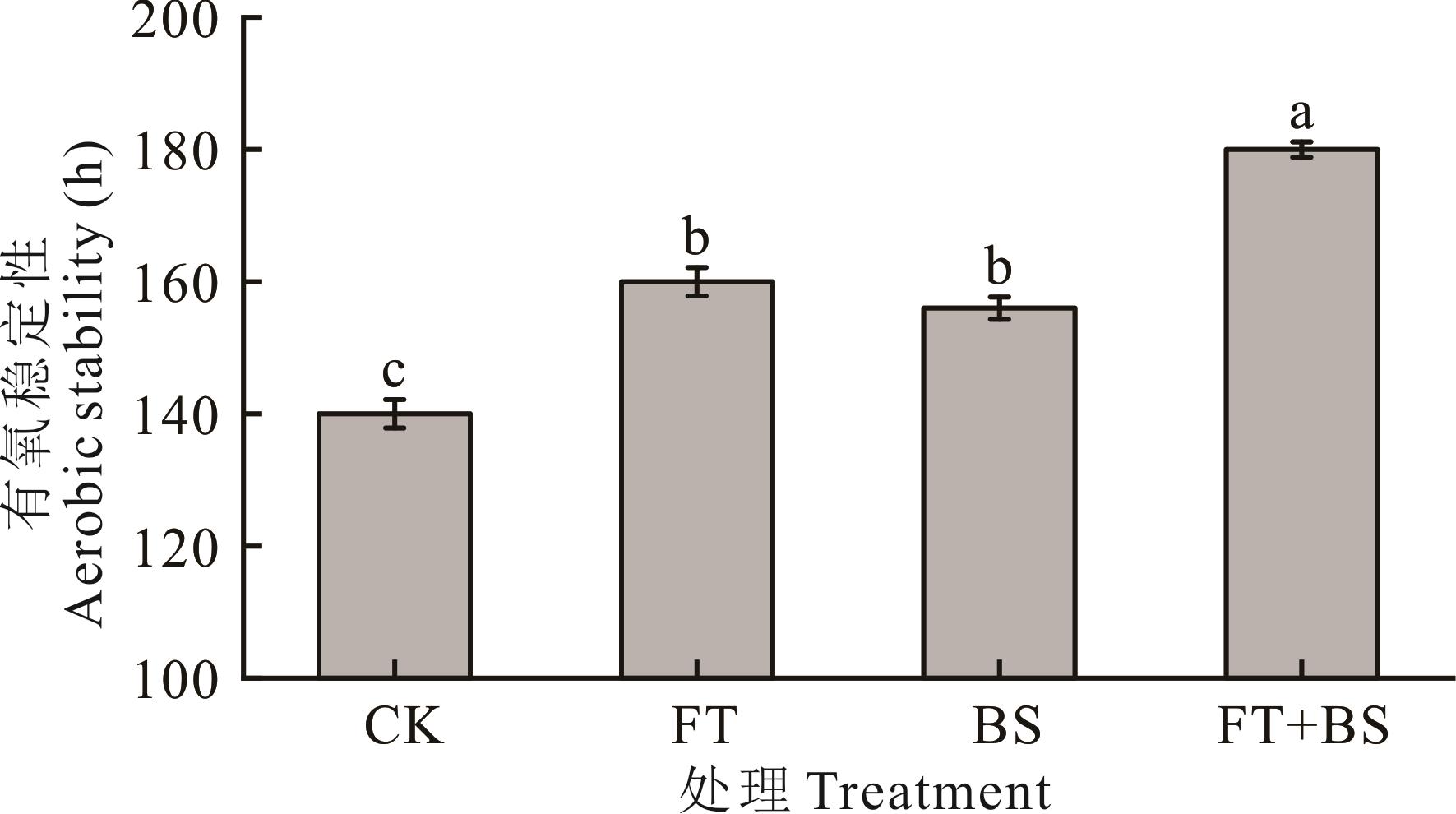
图1 蒲公英黄酮和枯草芽孢杆菌对燕麦青贮有氧稳定性的影响不同小写字母表示不同处理间差异显著(P<0.05)。Different lowercase letters indicate significant differences among different treatments at P<0.05 level. 下同The same below.
Fig.1 Effect of total flavonoids from T. mongolicum and B. subtilis on the aerobic stability of A. sativa silage
项目 Item | 处理Treatment | |||
|---|---|---|---|---|
| CK | FT | BS | FT+BS | |
| 干物质Dry matter (DM, %) | 22.29±0.23c | 25.80±0.45a | 25.74±0.72ab | 26.29±0.69a |
| 干物质损失Dry matter loss (DM loss, %) | 18.34±0.44a | 7.49±0.26b | 7.33±0.14b | 6.29±0.14b |
| 粗蛋白Crude protein (CP, %DM) | 15.89±0.22a | 15.98±0.30a | 16.23±0.19a | 16.07±0.23a |
| 粗脂肪Ether extract (EE, %DM) | 5.20±0.18bc | 6.36±0.33a | 5.74±0.46ab | 4.68±0.10c |
| 可溶性碳水化合物 Water-soluble carbohydrates (WSC, %DM) | 1.05±0.17c | 1.67±0.20b | 3.91±0.43a | 0.74±0.10d |
| 中性洗涤纤维 Neutral detergent fiber (NDF, %DM) | 44.28±0.79a | 42.81±1.17b | 43.56±0.45b | 40.26±0.52c |
| 酸性洗涤纤维 Acid detergent fiber (ADF, %DM) | 26.31±0.75a | 25.72±0.72ab | 23.87±0.67b | 22.30±0.34c |
表2 蒲公英黄酮和枯草芽孢杆菌对燕麦青贮营养品质的影响
Table 2 Effect of total flavonoids from T. mongolicum and B. subtilis on nutritional quality of A. sativa silage
项目 Item | 处理Treatment | |||
|---|---|---|---|---|
| CK | FT | BS | FT+BS | |
| 干物质Dry matter (DM, %) | 22.29±0.23c | 25.80±0.45a | 25.74±0.72ab | 26.29±0.69a |
| 干物质损失Dry matter loss (DM loss, %) | 18.34±0.44a | 7.49±0.26b | 7.33±0.14b | 6.29±0.14b |
| 粗蛋白Crude protein (CP, %DM) | 15.89±0.22a | 15.98±0.30a | 16.23±0.19a | 16.07±0.23a |
| 粗脂肪Ether extract (EE, %DM) | 5.20±0.18bc | 6.36±0.33a | 5.74±0.46ab | 4.68±0.10c |
| 可溶性碳水化合物 Water-soluble carbohydrates (WSC, %DM) | 1.05±0.17c | 1.67±0.20b | 3.91±0.43a | 0.74±0.10d |
| 中性洗涤纤维 Neutral detergent fiber (NDF, %DM) | 44.28±0.79a | 42.81±1.17b | 43.56±0.45b | 40.26±0.52c |
| 酸性洗涤纤维 Acid detergent fiber (ADF, %DM) | 26.31±0.75a | 25.72±0.72ab | 23.87±0.67b | 22.30±0.34c |
项目 Item | 处理Treatment | |||
|---|---|---|---|---|
| CK | FT | BS | FT+BS | |
| 类黄酮含量 Flavonoids content (%DM) | 2.87±0.12b | 3.14±0.09a | 2.91±0.06b | 3.22±0.11a |
| 总抗氧化能力Total antioxidant capacity (T-AOC, mmol·L-1) | 48.47±3.49c | 103.10±2.92a | 83.61±4.32b | 106.54±2.87a |
| 谷胱甘肽过氧化物酶活性Glutathione peroxidase activity (GSH-Px, U·mL-1) | 694.80±31.40d | 1338.84±38.94b | 1063.67±32.31c | 1555.85±22.96a |
| 超氧化物歧化酶活性 Superoxide dismutase activity (SOD, U·mL-1) | 240.97±14.88c | 366.47±13.84a | 280.14±7.34b | 378.01±14.56a |
表3 蒲公英黄酮和枯草芽孢杆菌对燕麦青贮抗氧化活性的影响
Table 3 Effect of total flavonoids from T. mongolicum and B. subtilis on antioxidant properties of A. sativa silage
项目 Item | 处理Treatment | |||
|---|---|---|---|---|
| CK | FT | BS | FT+BS | |
| 类黄酮含量 Flavonoids content (%DM) | 2.87±0.12b | 3.14±0.09a | 2.91±0.06b | 3.22±0.11a |
| 总抗氧化能力Total antioxidant capacity (T-AOC, mmol·L-1) | 48.47±3.49c | 103.10±2.92a | 83.61±4.32b | 106.54±2.87a |
| 谷胱甘肽过氧化物酶活性Glutathione peroxidase activity (GSH-Px, U·mL-1) | 694.80±31.40d | 1338.84±38.94b | 1063.67±32.31c | 1555.85±22.96a |
| 超氧化物歧化酶活性 Superoxide dismutase activity (SOD, U·mL-1) | 240.97±14.88c | 366.47±13.84a | 280.14±7.34b | 378.01±14.56a |
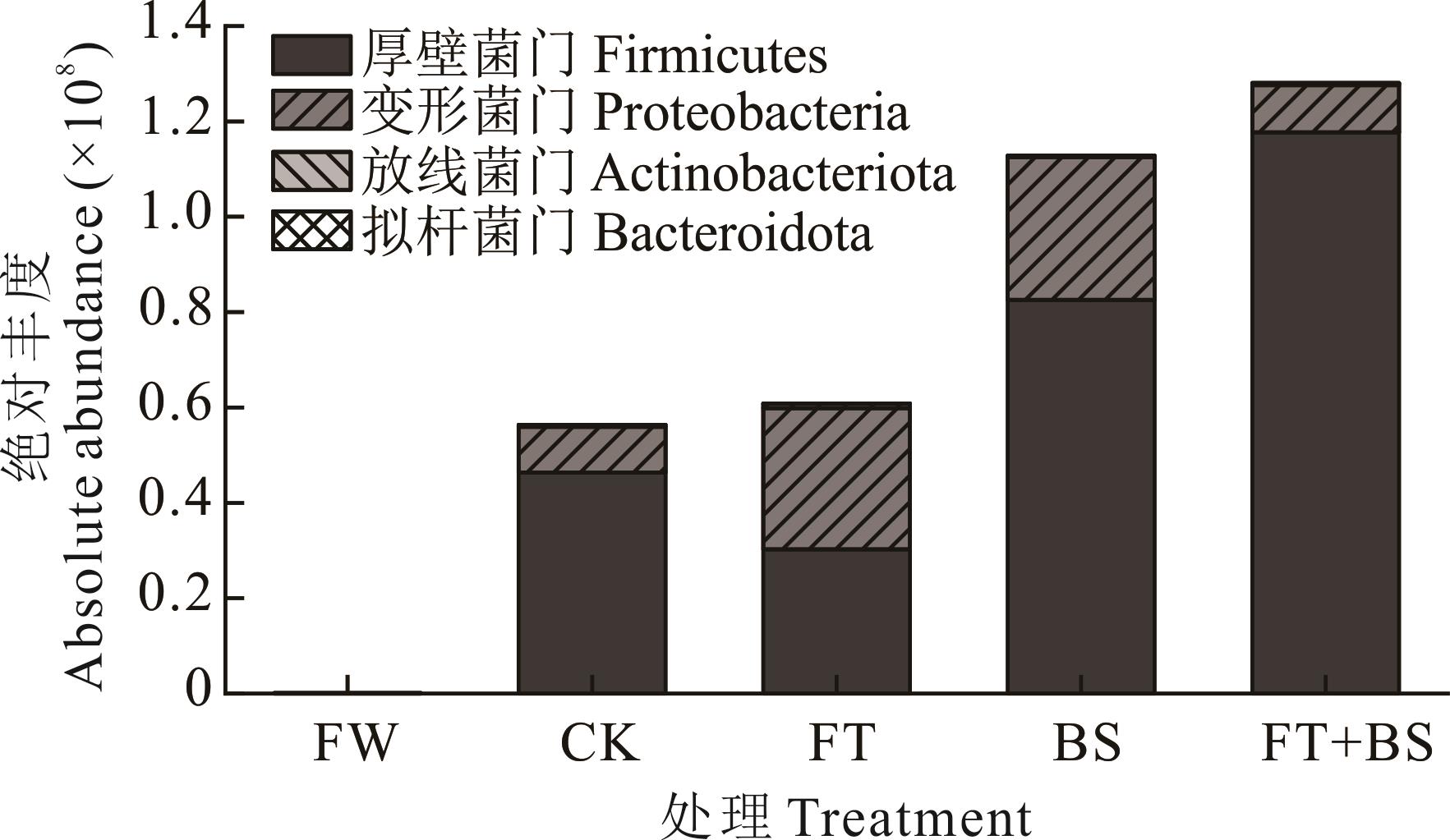
图2 燕麦青贮细菌微生物群落绝对丰度(门水平)FW:鲜样Fresh weighi.下同The same below.
Fig.2 The abundance of bacterial microorganisms in A. sativa silage at the phylum level
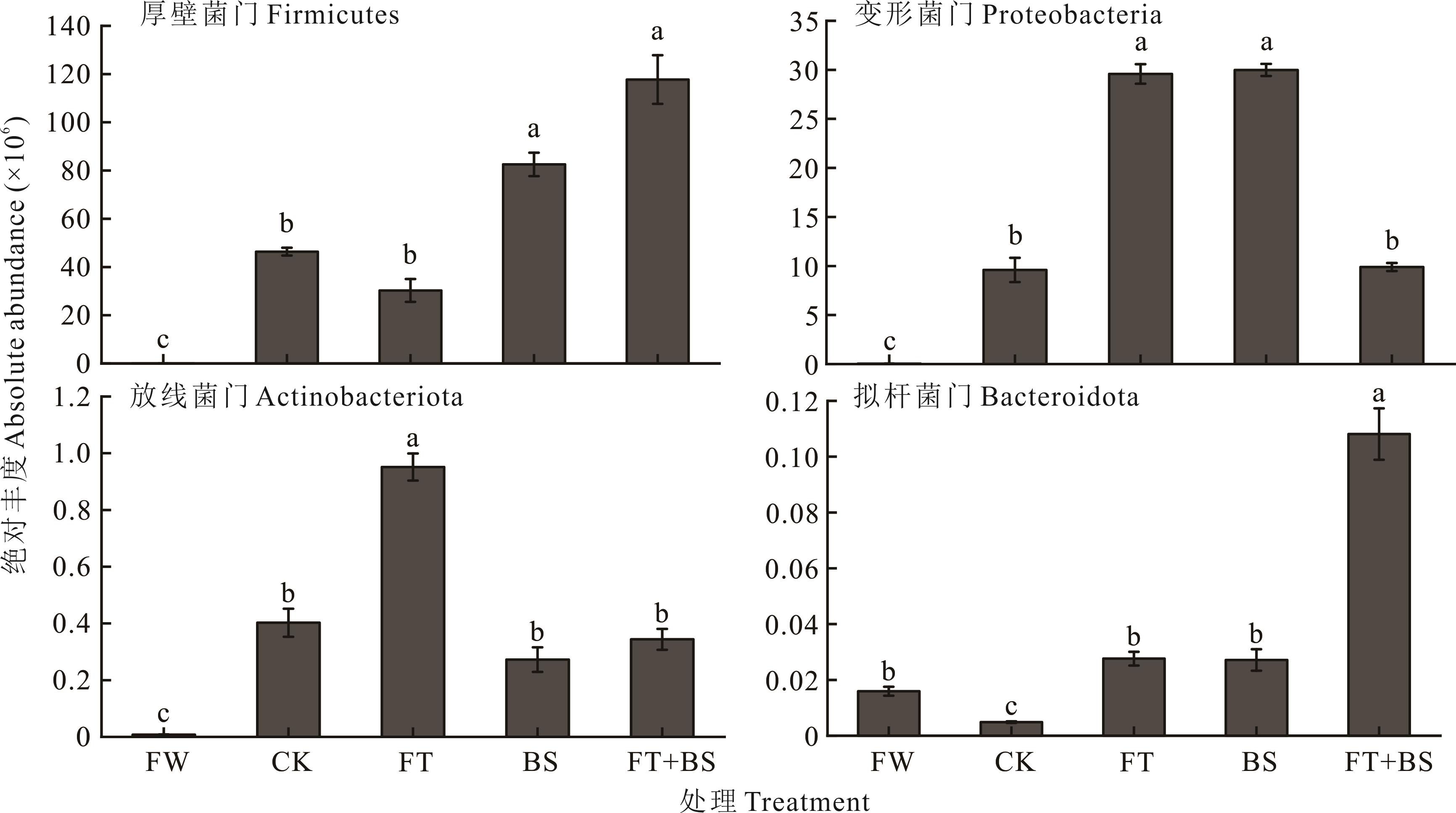
图3 蒲公英黄酮和枯草芽孢杆菌对燕麦青贮细菌微生物群落绝对丰度的影响(门水平)
Fig.3 Effects of total flavonoids from T. mongolicum and B. subtilis on the abundance of bacterial communities at the phylum level
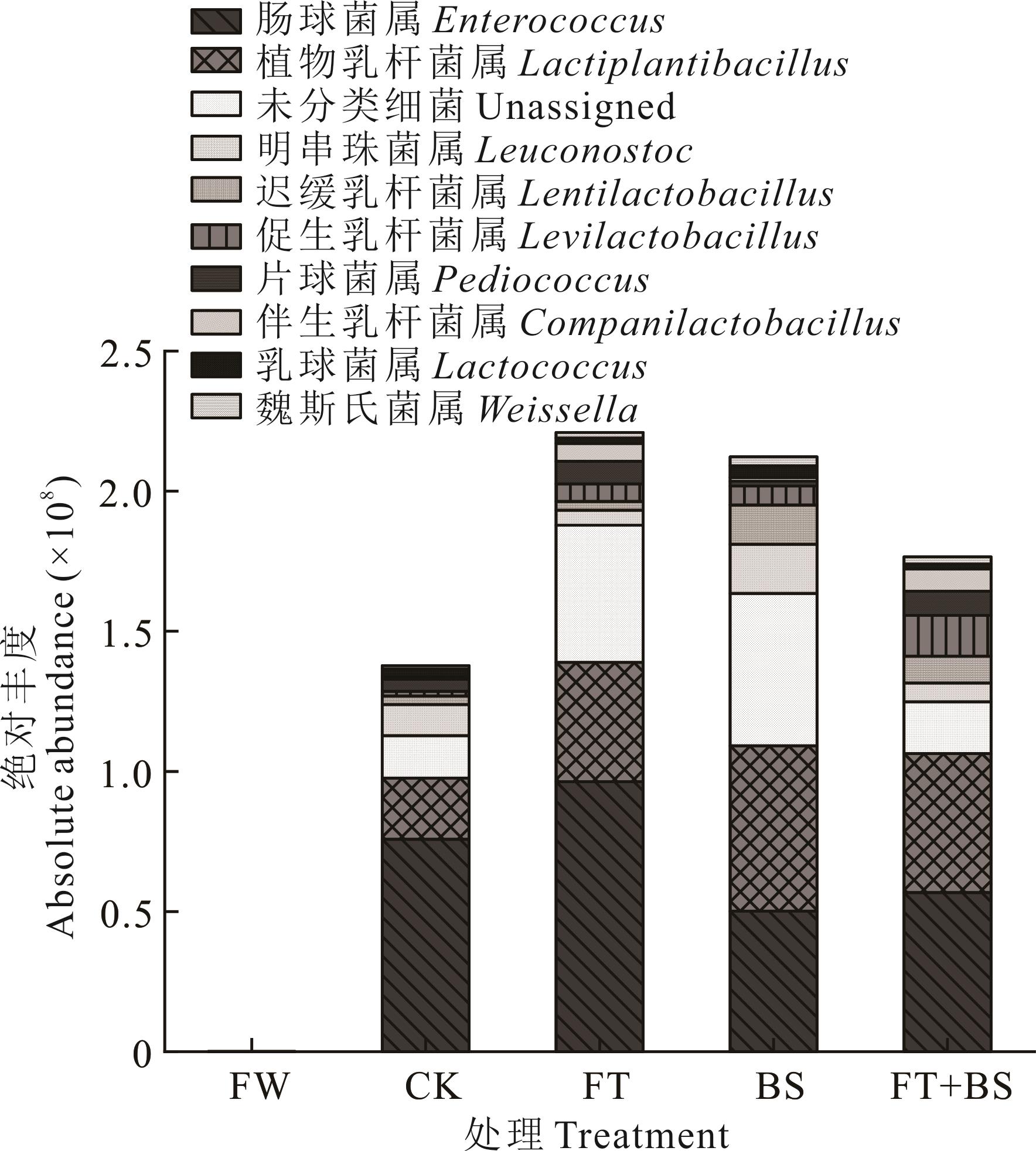
图4 燕麦青贮细菌微生物群落绝对丰度(属水平)
Fig.4 The abundance of bacterial microorganisms in A. sativa silage at the genus level
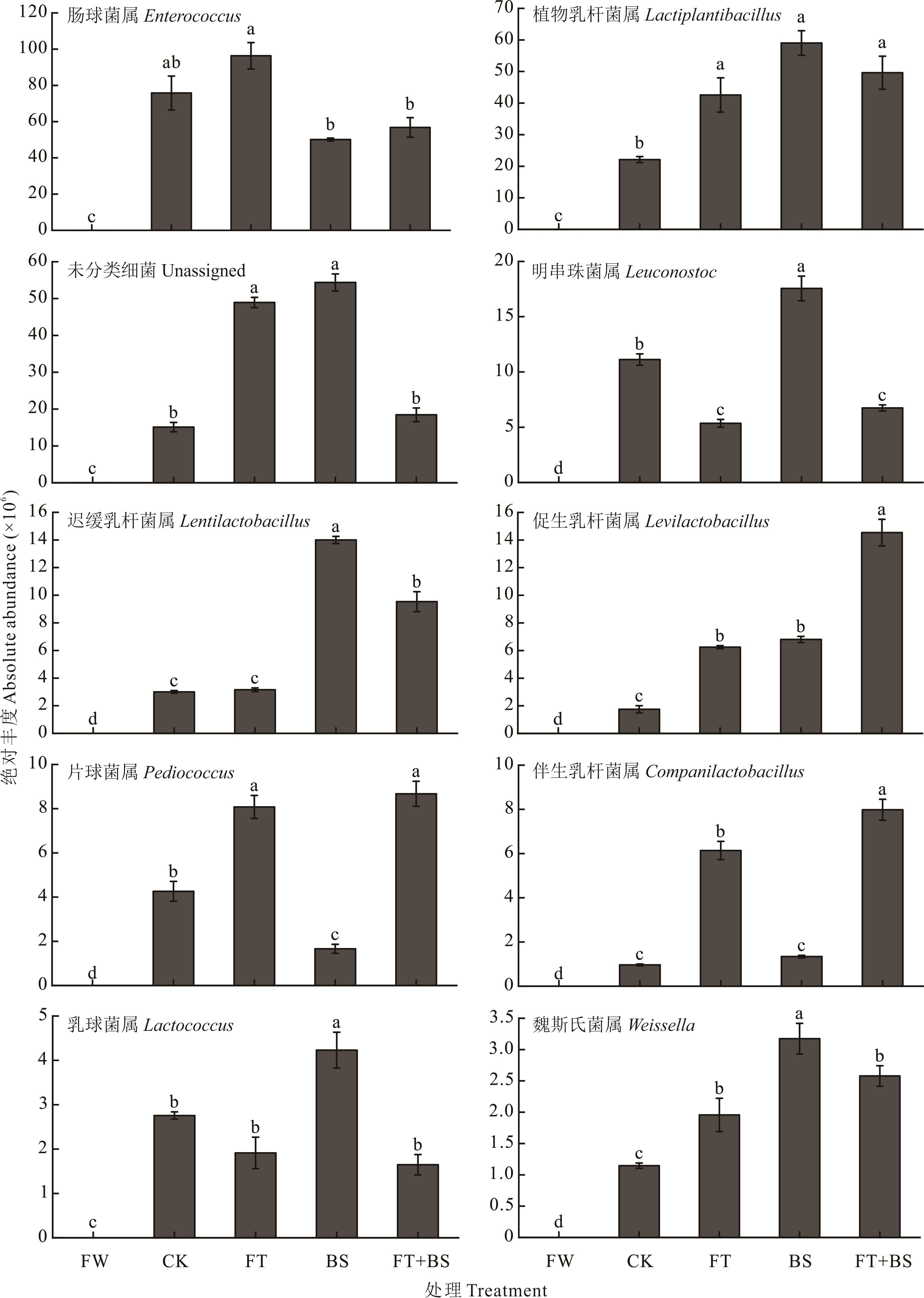
图5 蒲公英黄酮和枯草芽孢杆菌对燕麦青贮细菌微生物群落绝对丰度的影响(属水平)
Fig.5 Effects of total flavonoids from T. mongolicum and B. subtilis on the absolute abundance of bacterial communities in A. sativa at the genus level
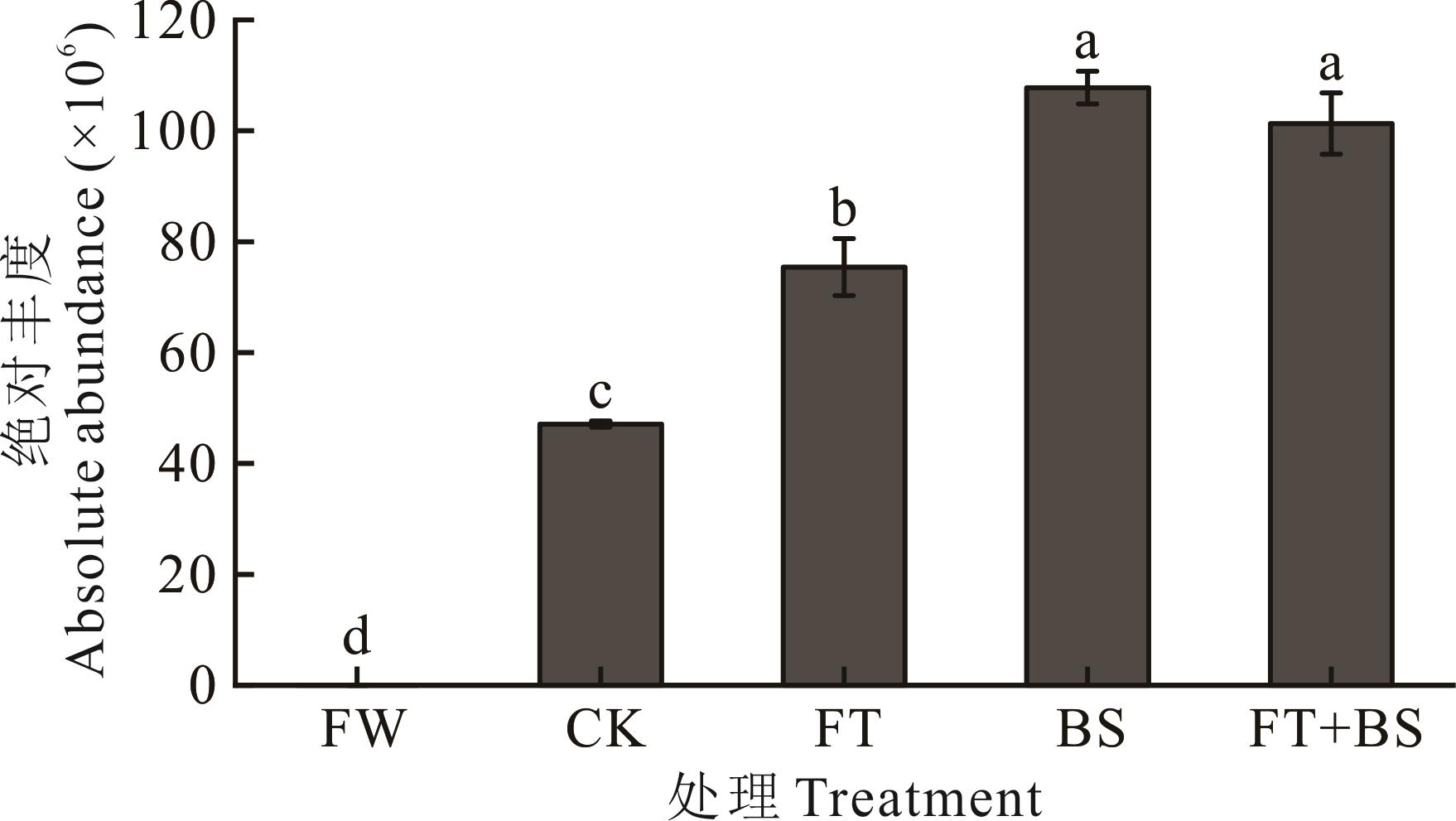
图6 蒲公英黄酮和枯草芽孢杆菌对燕麦青贮乳酸菌绝对丰度之和的影响(属水平)
Fig.6 Effects of total flavonoids from T. mongolicum and B. subtilis on the total absolute abundance of lactic acid bacteria (LAB) in A. sativa silage at genus level
| [1] | Du J M, Zhang R, Wang Z J, et al. Production status and high-quality development strategies of artificial forage grasses in Ningxia. Journal of Ningxia Agriculture and Forestry Science and Technology, 2020, 61(10): 45-47. |
| 杜建民, 张蓉, 王占军, 等. 宁夏人工饲草生产现状及高质量发展策略. 宁夏农林科技, 2020, 61(10): 45-47. | |
| [2] | Gan L, Li H P, Wang H, et al. Effects of growth phase and mixed sowing ratio on silage quality of forage oat/common vetch mixed fermentation in winter fallow field of Sichuan. Acta Agrestia Sinica, 2023, 31(6): 1867-1877. |
| 甘丽, 李海萍, 汪辉, 等. 生育期和混播比例对四川冬闲田燕麦/箭筈豌豆混合青贮品质的影响. 草地学报, 2023, 31(6): 1867-1877. | |
| [3] | Duniere L, Sindou J, Chaucheyras-Durand F, et al. Silage processing and strategies to prevent persistence of undesirable microorganisms. Animal Feed Science and Technology, 2013, 182(1/2/3/4): 1-15. |
| [4] | Borreani G, Tabacco E, Schmidt R J, et al. Silage review: Factors affecting dry matter and quality losses in silages. Journal of Dairy Science, 2018, 101(5): 3952-3979. |
| [5] | Zhao D M. Current situation and development trend of oat production and utilization. Heilongjiang Animal Science and Veterinary Medicine, 2016(22): 177-179. |
| 赵得明. 燕麦草生产利用现状及发展趋势. 黑龙江畜牧兽医, 2016(22): 177-179. | |
| [6] | Huang P S, Zhang C, Chen D D, et al. Effect of leaf extracts of Moringa oleracea on the quality of Stylosanthes guianensis and Pennisetum purpureum silages. Acta Agrestia Sinica, 2023, 31(7): 2194-2202. |
| 黄佩珊, 张超, 陈丹丹, 等. 辣木叶提取物对柱花草和象草青贮品质的影响. 草地学报, 2023, 31(7): 2194-2202. | |
| [7] | Zhu X, Wang J C H, Li L X, et al. Effects of different additives on the quality and microbial community of alfalfa and oat mixed storage. Chinese Journal of Animal Husbandry, 2025, 61(7): 344-348. |
| 朱欣, 王佳楚函, 李龙兴, 等. 不同添加剂对紫花苜蓿与燕麦混贮品质及微生物群落的影响. 中国畜牧杂志, 2025, 61(7): 344-348. | |
| [8] | Li R H, Ren Z C, Feng S Y, et al. Biological functions of dandelion extract and its application in livestock, poultry and fish production. Chinese Journal of Animal Nutrition, 2022, 34(7): 4108-4116. |
| 李然红, 任占辰, 冯思雨, 等. 蒲公英提取物的生物学功能及其在畜、禽、鱼类生产中的应用. 动物营养学报, 2022, 34(7): 4108-4116. | |
| [9] | Yu X F, Wang Z Y, Zhang D, et al. Comprehensive utilization of resources development Taraxacum mongolicm Hand-Mazz. Forest By-Product and Speciality in China, 2015(5): 88-91. |
| 于晓菲, 王振月, 张迪, 等. 蒲公英资源的综合开发利用. 中国林副特产, 2015(5): 88-91. | |
| [10] | Bai J, Xu D M, Xie D M, et al. Effects of antibacterial peptide-producing Bacillus subtilis and Lactobacillus buchneri on fermentation, aerobic stability, and microbial community of alfalfa silage. Bioresource Technology, 2020, 315: 123881. |
| [11] | Yuan H. Study on the extraction, purification and application of flavonoids from dandelion. Changsha: Hunan Agricultural University, 2015. |
| 袁河. 蒲公英中黄酮类化合物的提取纯化及应用研究. 长沙: 湖南农业大学, 2015. | |
| [12] | Huang D, Gu Y. Comparative study on DPPH scavenging ability of flavonoids and polysaccharides from dandelion. Feed Research, 2015(23): 59-62. |
| 黄丹, 顾英. 蒲公英黄酮与多糖对DPPH清除能力比较研究. 饲料研究, 2015(23): 59-62. | |
| [13] | Gao L F. Effects of dandelion flavonoids on antioxidant activity, fermentation quality and microbial community structure of Caragana korshinskii silage. Yinchuan: Ningxia University, 2023. |
| 高龙飞. 蒲公英黄酮对柠条锦鸡儿青贮抗氧化活性、发酵品质及微生物群落结构的影响. 银川: 宁夏大学, 2023. | |
| [14] | Kung L J, Shaver R D, Grant R J, et al. Silage review: Interpretation of chemical, microbial, and organoleptic components of silages. Journal of Dairy Science, 2018, 101(5): 4020-4033. |
| [15] | Liu G X, Shi Y, Zhao J X, et al. Multi-strain co-fermented feed by two-step method. Cereal & Feed Industry, 2016(3): 43-47. |
| 刘桂香, 史瑛, 赵建新, 等. 多菌种两步法联合发酵饲料的研究. 粮食与饲料工业, 2016(3): 43-47. | |
| [16] | Liu Y, Zhang S, Liao J, et al. Enhancing fermentation quality and fiber decomposition of Phragmites australis silage by introducing Bacillus subtilis and lactic acid bacteria consortia. Frontiers in Veterinary Science, 2025, 12: 1557614. |
| [17] | Liu C X, Zhang F, Zhang Z, et al. Effects of fermented wheat bran with fermentation on growth performance, slaughter performance and meat quality of finishing pigs. Chinese Journal of Animal Science, 2017, 53(2): 70-73. |
| 刘春雪, 张放, 张政, 等. 发酵麸皮对育肥猪生长性能、屠宰性能及肉品质的影响. 中国畜牧杂志, 2017, 53(2): 70-73. | |
| [18] | Liu Y K, Zhao T X, Lu X Y, et al. Optimization of fermentation technology and selection of culture medium for antimicrobial peptide Sublancin produced by Bacillus subtilis YT168-6. China Animal Husbandry & Veterinary Medicine, 2021, 48(9): 3232-3241. |
| 刘扬科, 赵天效, 卢晓颖, 等. 枯草芽孢杆菌YT168-6产抗菌肽sublancin的发酵工艺优化及培养基筛选的研究. 中国畜牧兽医, 2021, 48(9): 3232-3241. | |
| [19] | Sun Y, Yang Y Y, Wu C H, et al. Effect of Bacillus subtilis and complex enzyme preparations on quality of alfalfa silage. Feed Research, 2023, 46(9): 109-113. |
| 孙宇, 杨燕燕, 吴春会, 等. 枯草芽孢杆菌和复合酶制剂对紫花苜蓿青贮品质的影响. 饲料研究, 2023, 46(9): 109-113. | |
| [20] | Jiang S Q, Yu Y N, Gao R W, et al. High-throughput absolute quantification sequencing reveals the effect of different fertilizer applications on bacterial community in a tomato cultivated coastal saline soil. Science of the Total Environment, 2019, 687: 601-609. |
| [21] | Yang F Y. Mechanism of Lactobacillus plantarum a345 improving fermentation quality of alfalfa silage. Zhengzhou: Zhengzhou University, 2022. |
| 杨逢源. 植物乳杆菌a345改善苜蓿青贮发酵品质的机理研究. 郑州: 郑州大学, 2022. | |
| [22] | Yang F, Zhao S, Wang Y, et al. Assessment of bacterial community composition and dynamics in alfalfa silages with and without Lactobacillus plantarum inoculation using absolute quantification 16S rRNA sequencing. Frontiers in Microbiology, 2020, 11: 629894. |
| [23] | Zhang X, Zhao S, Wang Y, et al. The effect of Lactiplantibacillus plantarum Zzu203, cellulase-producing Bacillus methylotrophicus, and their combinations on alfalfa silage quality and bacterial community. Fermentation, 2023, 9(3): 287. |
| [24] | Van Soest P J, Robertson J B, Lewis B A. Methods for dietary fiber, neutral detergent fiber, and nonstarch polysaccharidesin relation to animal nutrition. Journal of Dairy Science, 1991, 74(10): 3583-3597. |
| [25] | Ali N, Wang S, Zhao J, et al. Microbial diversity and fermentation profile of red cloversilage inoculated with reconstituted indigenous and exogenous epiphytic microbiota. Bioresource Technology, 2020, 314: 123606. |
| [26] | Murphy R P. A method for the extraction of plant samples and the determination of total soluble carbohydrates. Journal of the Science of Food and Agriculture, 1958, 9(11): 714-717. |
| [27] | Liu R F, Wang Y W. Optimization of conditions for determination of organic acids in corn silage by HPLC. Feed Research, 2023, 46(2): 113-116. |
| 刘瑞芳, 王艺伟. 优化高效液相色谱测定玉米青贮饲料中有机酸条件的研究. 饲料研究, 2023, 46(2): 113-116. | |
| [28] | Chai M N, Wang T, Zhu Z Q, et al. Analysis of five mineral elements in whole plant, stem, leaf and ear of mowed oat forage. Journal of Hebei Agricultural Sciences, 2023, 27(4): 31-36. |
| 柴明娜, 王婷, 朱志强, 等. 刈青燕麦饲草全株及茎叶穗的5种矿质元素含量分析. 河北农业科学, 2023, 27(4): 31-36. | |
| [29] | Wang H R, Gao F Q, Xue Y L, et al. Effects of different lactic acid bacteria additives on the quality and microbial diversity of oat silage. Chinese Journal of Grassland, 2024, 46(11): 82-90. |
| 王昊然, 高凤芹, 薛艳林, 等. 不同乳酸菌添加剂对燕麦青贮品质和微生物多样性的影响. 中国草地学报, 2024, 46(11): 82-90. | |
| [30] | Avila C L, Carvalho B F, Pinto J C, et al. The use of Lactobacillus species as starter cultures for enhancing the quality of sugar cane silage. Journal of Dairy Science, 2014, 97(2): 940-951. |
| [31] | Yuan W, Zhou H Z, Yu G, et al. Ensiling vine tea (Ampelopsis grossedentata) residue with Lactobacillus plantarum inoculant as an animal unconventional fodder. Journal of Integrative Agriculture, 2023, 22(4): 1172-1183. |
| [32] | Lara E C, Basso F C, de Assis F B, et al. Changes in the nutritive value and aerobic stability of corn silages inoculated with Bacillus subtilis alone or combined with Lactobacillus plantarum. Animal Production Science, 2016, 56(11): 1867-1874. |
| [33] | Elbermawi A, Darwish M S, Zaki A A, et al. In vitro antidiabetic, antioxidant, and prebiotic activities of the chemical compounds isolated from Guizotia abyssinica. Antioxidants (Basel), 2022, 11(12): 2482. |
| [34] | Ma X J, Xie Y F, Yu Y F, et al. Changes of polysaccharide and viable bacteria in fermented Lycium barbarum pulp. Food Safety Guide, 2019(28): 62-65. |
| 马晓娟, 谢有发, 余银芳, 等. 发酵枸杞原浆中多糖、活菌数的变化规律. 食品安全导刊, 2019(28): 62-65. | |
| [35] | Dai Y C. Studies of hawthorn extracts effects on lactic acid bacteria growth-promoting and its growth kinetics. Dalian: Dalian Polytechnic University, 2012. |
| 戴远臣. 山楂提取物对乳酸菌促生作用及生长动力学研究. 大连: 大连工业大学, 2012. | |
| [36] | Zhao R R, Guo X J, Guo W, et al. The effect of microorganism inoculanton on the silage quality and aerobic stability of whole-crop zhang hybrid millet. China Feed, 2019(5): 24-28. |
| 赵蕊蕊, 郭晓军, 郭威, 等. 添加微生物菌剂对“张杂谷”全株青贮品质和有氧稳定性的影响. 中国饲料, 2019(5): 24-28. | |
| [37] | Huang S, Ke W, Lu Q, et al. Effects of total flavonoids from Taraxacum mongolicum on fermentation quality, antioxidant status and microbial community of Caragana korshinskii Kom. silage. Fermentation-Basel, 2023, 9(11): 949. |
| [38] | Ji X, Hou H, Wang X, et al. Effect of dietary glycyrrhiza polysaccharides on growth performance, hepatic antioxidant capacity and anti-inflammatory capacity of broiler chickens. Research in Veterinary Science, 2024, 167: 105114. |
| [39] | Hu H M, Hao L H, Wang H Z, et al. Effects of fermented mulberry leaves on growth performance, carcass quality and muscle nutrients of growing-finishing pigs. Chinese Journal of Animal Nutrition, 2021, 33(11): 6104-6113. |
| 呼红梅, 郝丽红, 王怀中, 等. 发酵桑叶对生长育肥猪生长性能、胴体品质和肌肉营养成分的影响. 动物营养学报, 2021, 33(11): 6104-6113. | |
| [40] | Li J F, Cheng Q M, Lu Q, et al. Effect of acetic acid additives and silage time on alfalfa silage quality. Heilongjiang Animal Science and Veterinary Medicine, 2021(8): 114-118. |
| 李俊峰, 成启明, 卢强, 等. 乙酸添加量及青贮时间对紫花苜蓿青贮品质的影响. 黑龙江畜牧兽医, 2021(8): 114-118. | |
| [41] | Mu Y X, Zhang H, Ma C H, et al. Effects of different supplemental levels of Lycium barbarum by-product on fermentation characteristic and microbial diversity of Caragana korshinskii silage. Chinese Journal of Animal Nutrition, 2021, 33(9): 5152-5161. |
| 牟怡晓, 张欢, 马聪慧, 等. 不同添加量枸杞副产物对柠条锦鸡儿发酵特性及微生物多样性的影响. 动物营养学报, 2021, 33(9): 5152-5161. | |
| [42] | Zhu M, Sun J L, Huang Y, et al. Effects of Bacillus subtilis and Lactobacillus buchneri on growth performance, antioxidant ability and digestive enzymes activities of Guangxi Ma Chicken. Journal of Guangxi Agriculture, 2024, 39(4): 50-56. |
| 朱敏, 孙俊丽, 黄嫣, 等. 枯草芽孢杆菌与布氏乳杆菌对广西麻鸡生长性能、抗氧化能力及消化酶活性的影响. 广西农学报, 2024, 39(4): 50-56. | |
| [43] | Zhang L, Ma Q, Ma S, et al. Ameliorating effects of Bacillus subtilis Ansb060 on growth performance, antioxidant functions, and aflatoxin residues in ducks fed diets contaminated with aflatoxins. Toxins (Basel), 2017, 9(1): 1. |
| [44] | Zhang Y X, Ke W C, Bai J, et al. The effect of Pediococcus acidilactici J17 with high-antioxidant activity on antioxidant tocopherol, carotene, fatty acids, and fermentation profiles of alfalfa silage ensiled at two different dry matter contents. Animal Feed Science and Technology, 2020, 268: 114614. |
| [45] | Nkosi B D, Meeske R, Palic D, et al. Effects of ensiling whole crop maize with bacterial inoculants on the fermentation, aerobic stability, and growth performance of lambs. Animal Feed Science and Technology, 2009, 154(3/4): 193-203. |
| [46] | Li M, Zi X, Zhou H, et al. Silage fermentation and ruminal degradation of cassava foliage prepared with microbial additive. AMB Express, 2019, 9(1): 180. |
| [47] | Wu L J, Ou X, Lian H, et al. Effects of compound additives on the quality and microbial diversity of mulberry and navel orange residue mixed silage. Pratacultural Science, 2024, 41(7): 1736-1746. |
| 吴丽娟, 欧翔, 连海, 等. 4种添加剂对饲料桑与脐橙渣混贮品质及微生物多样性的影响. 草业科学, 2024, 41(7): 1736-1746. | |
| [48] | Wang L X, Han J, Chen L B, et al. Effects of various lactic acid bacteria combinations on bacterial community structure of alfalfa silage. Acta Agrestia Sinica, 2021, 29(2): 388-395. |
| 王丽学, 韩静, 陈龙宾, 等. 不同乳酸菌组合对苜蓿青贮细菌群落结构的影响. 草地学报, 2021, 29(2): 388-395. | |
| [49] | Oliveira A S, Weinberg Z G, Ogunade I M, et al. Meta-analysis of effects of inoculation with homofermentative and facultative heterofermentative lactic acid bacteria on silage fermentation, aerobic stability, and the performance of dairy cows. Journal of Dairy Science, 2017, 100(6): 4587-4603. |
| [50] | Zhao J J, Jia Y S, Wang Z J, et al. Progress study on the effects of Lactobacillus buchneri on silage quality based on meta-analysis. Acta Agrestia Sinica, 2025, 33(3): 665-677. |
| 赵佳婕, 贾玉山, 王志军, 等. 基于Meta分析的布氏乳杆菌对青贮品质影响进展研究. 草地学报, 2025, 33(3): 665-677. | |
| [51] | Ju J. Effects of cellulase and Lactiplantibacillus plantarum on the fermentation quality, bacterial flora and in vitro rumen fermentation parameters of Caragana korshinskii silage. Tongliao: Inner Mongolia Minzu University, 2023. |
| 巨纪. 纤维素酶和植物乳杆菌对柠条青贮品质、细菌群落和体外瘤胃发酵参数的影响. 通辽: 内蒙古民族大学, 2023. | |
| [52] | Xu Z P, Xiao R, Shen S J, et al. Microbial changes in and quality improvement of mulberry leaf silage. Pratacultural Science, 2020, 37(9): 1912-1925. |
| 徐泽平, 肖润, 沈诗桀, 等. 桑叶青贮中的微生物变化与青贮品质改良. 草业科学, 2020, 37(9): 1912-1925. | |
| [53] | Liu Z Z, Peng N. Current application status and development prospects of probiotics. Acta Microbiologica Sinica, 2023, 63(5): 1863-1887. |
| 刘真真, 彭楠. 益生菌的应用现状和发展前景. 微生物学报, 2023, 63(5): 1863-1887. | |
| [54] | Cao W, Jin D X, Liu R, et al. Research progress on the mechanism of food-derived Flavonoids regulating type Ⅱ diabetes mellitus via gut microbiota. Food and Fermentation Industries, 2024, 50(2): 372-378. |
| 曹维, 金杜欣, 刘瑞, 等. 食源性黄酮通过肠道菌群调节Ⅱ型糖尿病的作用机制研究进展. 食品与发酵工业, 2024, 50(2): 372-378. | |
| [55] | Zou Y Q, Wang Z J, Liu L Y, et al. Effects of spirulina peptides on fermentation quality and microbial community of alfalfa. Acta Agrestia Sinica, 2025, 33(8): 2685-2693. |
| 邹雨琪, 王志军, 刘丽英, 等. 螺旋藻多肽对苜蓿发酵品质和微生物群落的影响. 草地学报, 2025, 33(8): 2685-2693. | |
| [56] | Wang X Z, Zhang F F, Ma C H, et al. Corn silage quality as influenced by adding lactic acid bacteria after silos opening. Chinese Journal of Grassland, 2019, 41(3): 115-123. |
| 王旭哲, 张凡凡, 马春晖, 等. 添加乳酸菌对开窖后玉米青贮品质及有氧稳定性的影响. 中国草地学报, 2019, 41(3): 115-123. | |
| [57] | Horlacher N, Oey I, Agyei D. Learning from tradition: health-promoting potential of traditional lactic acid fermentation to drive innovation in fermented plant-based dairy alternatives. Fermentation, 2023, 9(5): 452. |
| [58] | Zheng M N, Kang J H, Zou C Y, et al. Effects of ratio of daylily stem and leaf mixed with corn silage on the quality of silage and microbial diversity. Acta Agrestia Sinica, 2024, 32(12): 3962-3972. |
| 郑敏娜, 康佳惠, 邹璨阳, 等. 黄花菜茎叶与青贮玉米混合比例对青贮质量和微生物多样性的影响. 草地学报, 2024, 32(12): 3962-3972. | |
| [59] | Dong X H, Shi S L, Yin G L, et al. Effects of fermentation time on the quality and bacterial community of oat silage. Acta Agrestia Sinica, https://link.cnki.net/urlid/11.3362.S.20250618.0919.002. |
| 董晓慧, 师尚礼, 尹国丽, 等. 发酵时间对燕麦青贮品质及细菌群落的影响. 草地学报, https://link.cnki.net/urlid/11.3362.S.20250618.0919.002. |
| [1] | 李菲, 张琳, 德科加, 冯廷旭, 林伟山, 向雪梅, 魏希杰. 三江源区燕麦与箭筈豌豆混播对根际土壤微生物多样性的影响[J]. 草业学报, 2026, 35(5): 99-112. |
| [2] | 邓文辉, 赵小娜, 雍嘉仪, 管思雨, 胡国强, 王腾飞, 胡海英. 行比和燕麦密度对苜蓿种子产量及其构成因素的影响[J]. 草业学报, 2026, 35(4): 100-111. |
| [3] | 王一博, 明雪花, 张建勇, 袁琦, 杜建明, 王斌, 王腾飞, 张译尹, 兰剑, 牟乐. 宁夏干旱区燕麦新种质生产性能和种子产量综合评价研究[J]. 草业学报, 2026, 35(4): 86-99. |
| [4] | 马祥, 李中兴, 杨容尘, 琚泽亮, 贾志锋, 杨培志. 盐胁迫对不同耐盐性燕麦糖类及内源激素含量变化的影响[J]. 草业学报, 2026, 35(3): 235-244. |
| [5] | 魏孔涛, 张春平, 俞旸, 张正社, 周泽, 张雪, 王鑫鑫, 岳思玉, 曹铨, 董全民. 环青海湖共和盆地不同燕麦品种的产量、营养价值及对土壤理化性质的影响[J]. 草业学报, 2026, 35(1): 107-118. |
| [6] | 张志鹏, 蒋庆雪, 周昕越, 苗童, 唐俊, 仪登霞, 王学敏, 马琳. 转录组和蛋白组联合筛选饲用燕麦株高性状候选基因[J]. 草业学报, 2025, 34(9): 147-161. |
| [7] | 罗叙, 马慧, 韩翠, 赵雅欣, 赵莹, 谢应忠, 李建平. 地上净初级生产力对植物物种丰富度的响应及影响因子分析[J]. 草业学报, 2025, 34(9): 26-37. |
| [8] | 张琨, 乔建霞, 李金升, 王育鹏, 刘克思. 不同修复材料对退化高寒草地土壤理化性质及微生物群落的影响[J]. 草业学报, 2025, 34(8): 132-148. |
| [9] | 吴娟燕, 田静, 郭香, 黄莉莹, 张建国. 籽实青贮的研究与利用进展[J]. 草业学报, 2025, 34(8): 211-220. |
| [10] | 王思然, 丁成龙, 田吉鹏, 程云辉, 许能祥, 张文洁, 王欣, 刘蓓一. 乳酸菌和抗真菌添加剂对湿啤酒糟全混合日粮青贮发酵品质、体外消化率及有氧稳定性的影响[J]. 草业学报, 2025, 34(6): 213-226. |
| [11] | 邓文辉, 宋珂辰, 张浩, 管思雨, 雍嘉仪, 胡海英. 降水变化条件下荒漠草原优势植物根际微生物群落结构和多样性特征研究[J]. 草业学报, 2025, 34(5): 12-26. |
| [12] | 毛开, 许艺, 王学梅, 柴欢, 黄帅, 王坚, 郇树乾, 玉柱, 王目森. 植物乳植杆菌与糖蜜对花生秧青贮饲料发酵品质、生物胺含量及细菌群落的影响[J]. 草业学报, 2025, 34(5): 146-158. |
| [13] | 王思然, 刘蓓一, 田吉鹏, 程云辉, 许能祥, 张文洁, 王欣, 丁成龙. 复合乳酸菌添加剂对低温环境下意大利黑麦草青贮发酵品质的影响[J]. 草业学报, 2025, 34(5): 159-170. |
| [14] | 韩航琪, 王梓凡, 丁赫, 陈玉荣, 王琦, 张晓庆. 燕麦干草与燕麦草块对绵羊瘤胃发酵及微生物组成影响的比较分析[J]. 草业学报, 2025, 34(5): 212-222. |
| [15] | 梁宇成, 张晓雯, 邵涛, 王文博, 原现军. 乳酸菌对全株玉米青贮发酵品质和霉菌毒素含量的影响[J]. 草业学报, 2025, 34(3): 123-133. |
| 阅读次数 | ||||||
|
全文 |
|
|||||
|
摘要 |
|
|||||
