

ISSN 1004-5759 CN 62-1105/S
草业学报 ›› 2027, Vol. 36 ›› Issue (1): 125-134.DOI: 10.11686/cyxb2026008
• 研究论文 • 上一篇
郑梦馨1( ), 刘立明2, 张桂杰1()
收稿日期:2026-01-07
修回日期:2026-03-09
出版日期:2027-01-20
发布日期:2026-11-25
通讯作者:
张桂杰
作者简介:E-mail: guijiezhang@nxu.edu.cn基金资助:
Meng-xin ZHENG1(), Li-ming LIU2, Gui-jie ZHANG1()
Received:2026-01-07
Revised:2026-03-09
Online:2027-01-20
Published:2026-11-25
Contact:
Gui-jie ZHANG
摘要:
为对酿酒酵母发酵酶解柠条生产单细胞蛋白的工艺进行优化,以提升柠条高值化利用效率,通过复合纤维酶对柠条进行预处理,增加可溶性碳水化合物含量,以酿酒酵母为发酵菌株,利用单因素试验并结合Box-Behnken设计对发酵参数进行优化,研究初始含水量、酵母接种量、硫酸铵添加量和发酵天数对产物真蛋白含量的影响。结果如下:1)复合纤维酶处理使柠条纤维素、半纤维素含量分别降低了11.54%和6.58%,促进了可溶性碳水化合物释放,增幅达65.59%;2)响应面分析建立的真蛋白含量二次回归模型极显著(P<0.01),R2为0.9934。各因素对真蛋白含量的影响力排序为:硫酸铵添加量>酵母接种量>发酵天数>初始含水量;3)酶解柠条的最佳发酵工艺条件:硫酸铵添加量1.60%、酵母接种量17.00%、发酵时间4 d、初始含水量50.00%。此条件下发酵所得柠条的真蛋白含量为6.25%,与模型预测值(6.26%)基本一致。本研究通过响应面法优化了以酶解柠条为底物,利用酿酒酵母发酵生产单细胞蛋白的工艺,显著提升了其真蛋白含量。
郑梦馨, 刘立明, 张桂杰. 酿酒酵母发酵酶解柠条生产单细胞蛋白的工艺优化研究[J]. 草业学报, 2027, 36(1): 125-134.
Meng-xin ZHENG, Li-ming LIU, Gui-jie ZHANG. Optimization of the production of single-cell protein by fermentation of enzyme-hydrolyzed Caragana korshinskii using Saccharomyces cerevisiae[J]. Acta Prataculturae Sinica, 2027, 36(1): 125-134.
| 项目 Projects | 因素 Factors | 水平 Levels | |||||
|---|---|---|---|---|---|---|---|
| A | 初始含水量 Initial moisture content (%) | 0 | 30 | 40 | 50 | 60 | 70 |
| B | 酵母接种量 Yeast inoculation amount (%) | 0 | 4 | 8 | 16 | 24 | 32 |
| C | 硫酸铵添加量 Ammonium sulfate addition level (%) | 0 | 0.5 | 1.0 | 1.5 | 2.0 | 2.5 |
| D | 发酵天数 Fermentation duration (d) | 0 | 2 | 4 | 6 | 8 | 10 |
表1 单因素试验水平设计
Table 1 Single-factor experiment level design
| 项目 Projects | 因素 Factors | 水平 Levels | |||||
|---|---|---|---|---|---|---|---|
| A | 初始含水量 Initial moisture content (%) | 0 | 30 | 40 | 50 | 60 | 70 |
| B | 酵母接种量 Yeast inoculation amount (%) | 0 | 4 | 8 | 16 | 24 | 32 |
| C | 硫酸铵添加量 Ammonium sulfate addition level (%) | 0 | 0.5 | 1.0 | 1.5 | 2.0 | 2.5 |
| D | 发酵天数 Fermentation duration (d) | 0 | 2 | 4 | 6 | 8 | 10 |
编码 水平 Coding level | 因素 Factors | |||
|---|---|---|---|---|
初始含水量 Initial moisture content (%) | 酵母接种量 Yeast inoculation amount (%) | 硫酸铵添加量 Ammonium sulfate addition level (%) | 发酵天数 Fermentation duration (d) | |
| -1 | 40 | 8 | 1.0 | 2 |
| 0 | 50 | 16 | 1.5 | 4 |
| 1 | 60 | 24 | 2.0 | 6 |
表2 响应面试验因素水平设计
Table 2 Response surface experimental factors level design
编码 水平 Coding level | 因素 Factors | |||
|---|---|---|---|---|
初始含水量 Initial moisture content (%) | 酵母接种量 Yeast inoculation amount (%) | 硫酸铵添加量 Ammonium sulfate addition level (%) | 发酵天数 Fermentation duration (d) | |
| -1 | 40 | 8 | 1.0 | 2 |
| 0 | 50 | 16 | 1.5 | 4 |
| 1 | 60 | 24 | 2.0 | 6 |
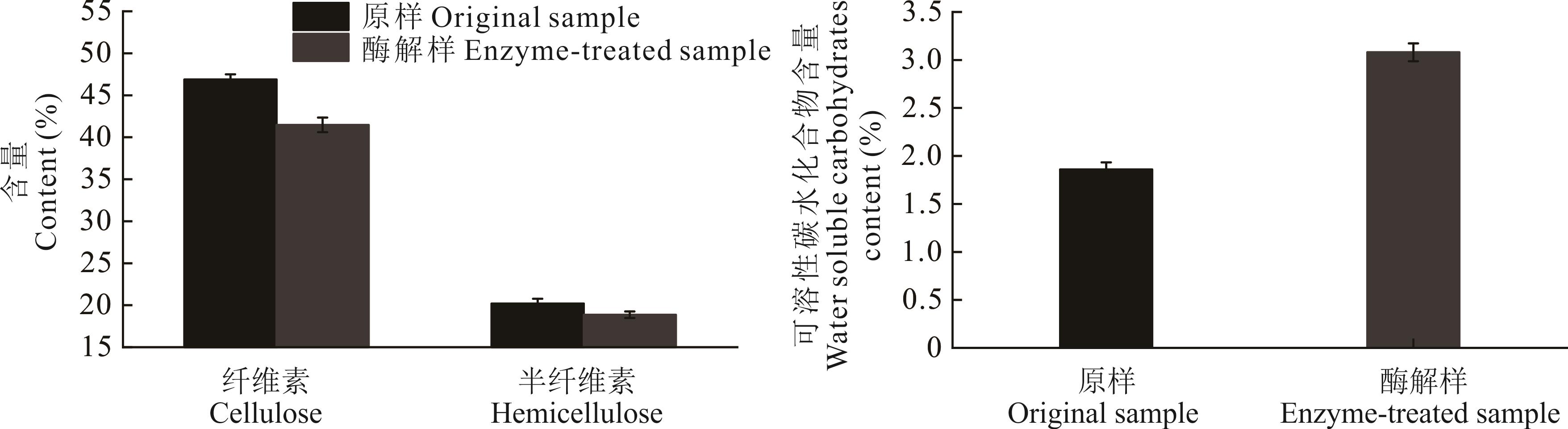
图1 酶解处理后柠条纤维组分及可溶性碳水化合物含量变化
Fig.1 Changes in fiber components and WSC content of C. korshinskii after enzymatic hydrolysis treatment
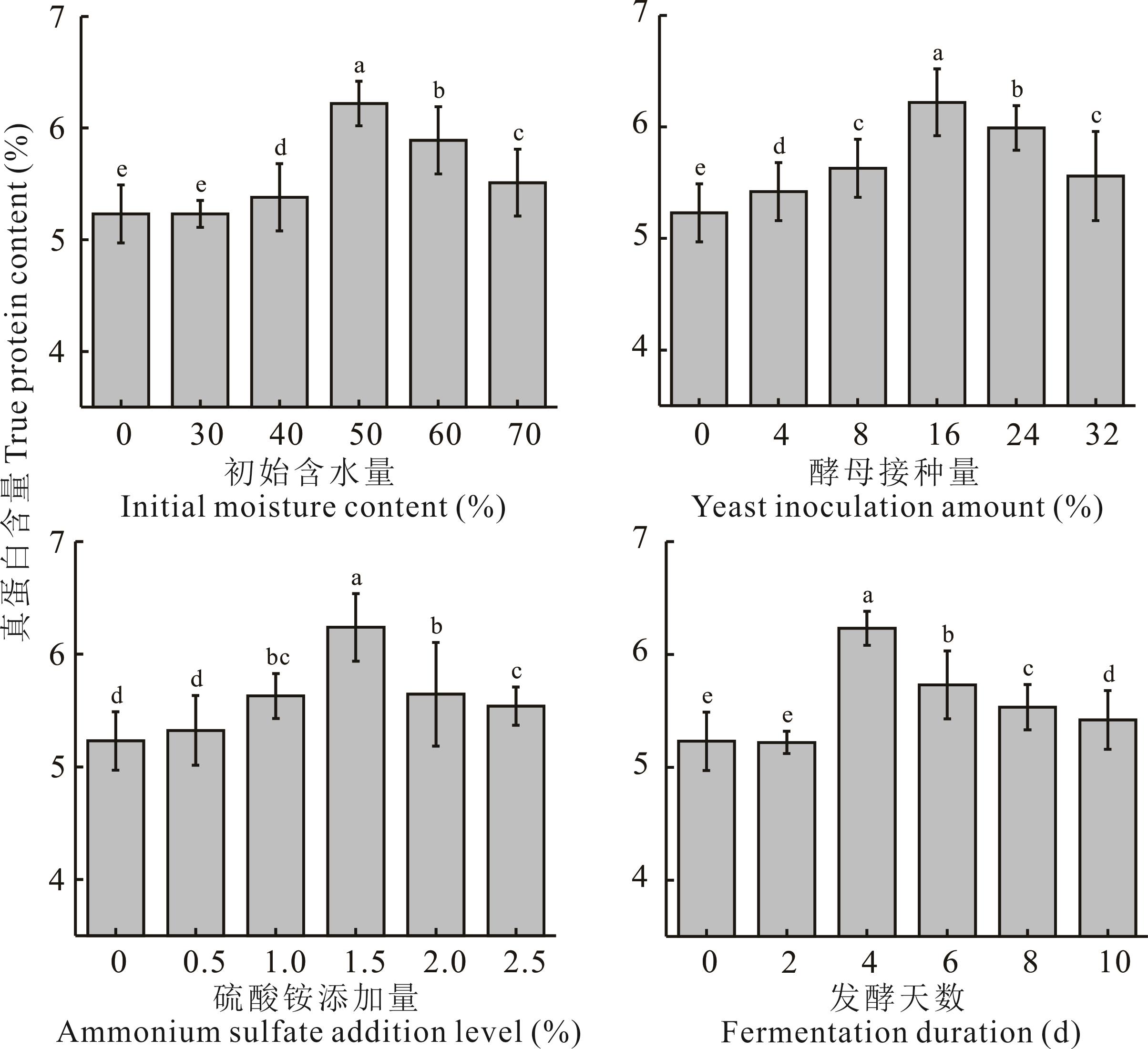
图2 不同条件对柠条发酵饲料真蛋白含量的影响不同小写字母表示差异显著(P<0.05)。Different lowercase letters indicate significant differences (P<0.05).
Fig.2 Effect of different conditions on the true protein content of C. korshinskii fermented feed
试验组 Experimental group | 初始含水量 Initial moisture content (%) | 酵母添加量 Yeast inoculation amount (%) | 硫酸铵添加量Ammonium sulfate addition level (%) | 发酵天数 Fermentation duration (d) | 真蛋白含量 True protein content (%) | 试验组 Experimental group | 初始含水量 Initial moisture content (%) | 酵母添加量 Yeast inoculation amount (%) | 硫酸铵添加量Ammonium sulfate addition level (%) | 发酵天数 Fermentation duration (d) | 真蛋白含量 True protein content (%) |
|---|---|---|---|---|---|---|---|---|---|---|---|
| 1 | 40 | 8 | 1.5 | 4 | 5.51 | 16 | 50 | 24 | 2.0 | 4 | 5.66 |
| 2 | 60 | 8 | 1.5 | 4 | 5.60 | 17 | 40 | 16 | 1.0 | 4 | 5.42 |
| 3 | 40 | 24 | 1.5 | 4 | 5.76 | 18 | 60 | 16 | 1.0 | 4 | 5.41 |
| 4 | 60 | 24 | 1.5 | 4 | 5.69 | 19 | 40 | 16 | 2.0 | 4 | 5.56 |
| 5 | 50 | 16 | 1.0 | 2 | 5.36 | 20 | 60 | 16 | 2.0 | 4 | 5.61 |
| 6 | 50 | 16 | 2.0 | 2 | 5.68 | 21 | 50 | 8 | 1.5 | 2 | 5.67 |
| 7 | 50 | 16 | 1.0 | 6 | 5.60 | 22 | 50 | 24 | 1.5 | 2 | 5.65 |
| 8 | 50 | 16 | 2.0 | 6 | 5.74 | 23 | 50 | 8 | 1.5 | 6 | 5.63 |
| 9 | 40 | 16 | 1.5 | 2 | 5.52 | 24 | 50 | 24 | 1.5 | 6 | 5.89 |
| 10 | 60 | 16 | 1.5 | 2 | 5.61 | 25 | 50 | 16 | 1.5 | 4 | 6.27 |
| 11 | 40 | 16 | 1.5 | 6 | 5.73 | 26 | 50 | 16 | 1.5 | 4 | 6.28 |
| 12 | 60 | 16 | 1.5 | 6 | 5.69 | 27 | 50 | 16 | 1.5 | 4 | 6.23 |
| 13 | 50 | 8 | 1.0 | 4 | 5.36 | 28 | 50 | 16 | 1.5 | 4 | 6.22 |
| 14 | 50 | 24 | 1.0 | 4 | 5.55 | 29 | 50 | 16 | 1.5 | 4 | 6.24 |
| 15 | 50 | 8 | 2.0 | 4 | 5.61 |
表3 Box-Behnken试验结果
Table 3 Box-Behnken experimental results
试验组 Experimental group | 初始含水量 Initial moisture content (%) | 酵母添加量 Yeast inoculation amount (%) | 硫酸铵添加量Ammonium sulfate addition level (%) | 发酵天数 Fermentation duration (d) | 真蛋白含量 True protein content (%) | 试验组 Experimental group | 初始含水量 Initial moisture content (%) | 酵母添加量 Yeast inoculation amount (%) | 硫酸铵添加量Ammonium sulfate addition level (%) | 发酵天数 Fermentation duration (d) | 真蛋白含量 True protein content (%) |
|---|---|---|---|---|---|---|---|---|---|---|---|
| 1 | 40 | 8 | 1.5 | 4 | 5.51 | 16 | 50 | 24 | 2.0 | 4 | 5.66 |
| 2 | 60 | 8 | 1.5 | 4 | 5.60 | 17 | 40 | 16 | 1.0 | 4 | 5.42 |
| 3 | 40 | 24 | 1.5 | 4 | 5.76 | 18 | 60 | 16 | 1.0 | 4 | 5.41 |
| 4 | 60 | 24 | 1.5 | 4 | 5.69 | 19 | 40 | 16 | 2.0 | 4 | 5.56 |
| 5 | 50 | 16 | 1.0 | 2 | 5.36 | 20 | 60 | 16 | 2.0 | 4 | 5.61 |
| 6 | 50 | 16 | 2.0 | 2 | 5.68 | 21 | 50 | 8 | 1.5 | 2 | 5.67 |
| 7 | 50 | 16 | 1.0 | 6 | 5.60 | 22 | 50 | 24 | 1.5 | 2 | 5.65 |
| 8 | 50 | 16 | 2.0 | 6 | 5.74 | 23 | 50 | 8 | 1.5 | 6 | 5.63 |
| 9 | 40 | 16 | 1.5 | 2 | 5.52 | 24 | 50 | 24 | 1.5 | 6 | 5.89 |
| 10 | 60 | 16 | 1.5 | 2 | 5.61 | 25 | 50 | 16 | 1.5 | 4 | 6.27 |
| 11 | 40 | 16 | 1.5 | 6 | 5.73 | 26 | 50 | 16 | 1.5 | 4 | 6.28 |
| 12 | 60 | 16 | 1.5 | 6 | 5.69 | 27 | 50 | 16 | 1.5 | 4 | 6.23 |
| 13 | 50 | 8 | 1.0 | 4 | 5.36 | 28 | 50 | 16 | 1.5 | 4 | 6.22 |
| 14 | 50 | 24 | 1.0 | 4 | 5.55 | 29 | 50 | 16 | 1.5 | 4 | 6.24 |
| 15 | 50 | 8 | 2.0 | 4 | 5.61 |
方差来源 Source | 平方和 Sum of squares | 均方 Mean square | F值 F-value | P值 P-value | 显著性 Significance |
|---|---|---|---|---|---|
| 模型Model | 2.0900 | 0.1491 | 193.22 | <0.0001 | ** |
| 初始含水量Initial moisture content (A) | 0.0010 | 0.0010 | 1.31 | 0.2722 | ns |
| 酵母接种量Yeast inoculation amount (B) | 0.0560 | 0.0560 | 72.60 | <0.0001 | ** |
| 硫酸铵添加量Ammonium sulfate addition level (C) | 0.1121 | 0.1121 | 145.29 | <0.0001 | ** |
| 发酵天数Fermentation duration (D) | 0.0520 | 0.0520 | 67.39 | <0.0001 | ** |
| AB | 0.0064 | 0.0064 | 8.29 | 0.0121 | * |
| AC | 0.0009 | 0.0009 | 1.17 | 0.2985 | ns |
| BC | 0.0049 | 0.0049 | 5.47 | 0.0346 | * |
| BD | 0.0196 | 0.0196 | 25.40 | 0.0002 | ** |
| A2 | 0.7491 | 0.7491 | 970.61 | <0.0001 | ** |
| B2 | 0.5125 | 0.5125 | 664.02 | <0.0001 | ** |
| C2 | 1.0800 | 1.0800 | 1403.05 | <0.0001 | ** |
| D2 | 0.4295 | 0.4295 | 556.55 | <0.0001 | ** |
| 残差Residual | 0.0146 | 0.0010 | |||
| 失拟度Lack of fit | 0.0081 | 0.0008 | 1.21 | 0.4614 | ns |
| 纯误差Pure error | 0.0027 | 0.0007 | |||
| 总计Total | 2.1000 | ||||
| 决定系数R2 | 0.9934 | ||||
| 调整决定系数Adjusted R2 (R2Adj) | 0.9867 | ||||
| 精密度Adequate precision | 38.6307 | ||||
| 变异系数Coefficient of variation (%) | 0.5664 |
表4 Box-Behnken试验方差分析
Table 4 Box-Behnken test analysis of variance
方差来源 Source | 平方和 Sum of squares | 均方 Mean square | F值 F-value | P值 P-value | 显著性 Significance |
|---|---|---|---|---|---|
| 模型Model | 2.0900 | 0.1491 | 193.22 | <0.0001 | ** |
| 初始含水量Initial moisture content (A) | 0.0010 | 0.0010 | 1.31 | 0.2722 | ns |
| 酵母接种量Yeast inoculation amount (B) | 0.0560 | 0.0560 | 72.60 | <0.0001 | ** |
| 硫酸铵添加量Ammonium sulfate addition level (C) | 0.1121 | 0.1121 | 145.29 | <0.0001 | ** |
| 发酵天数Fermentation duration (D) | 0.0520 | 0.0520 | 67.39 | <0.0001 | ** |
| AB | 0.0064 | 0.0064 | 8.29 | 0.0121 | * |
| AC | 0.0009 | 0.0009 | 1.17 | 0.2985 | ns |
| BC | 0.0049 | 0.0049 | 5.47 | 0.0346 | * |
| BD | 0.0196 | 0.0196 | 25.40 | 0.0002 | ** |
| A2 | 0.7491 | 0.7491 | 970.61 | <0.0001 | ** |
| B2 | 0.5125 | 0.5125 | 664.02 | <0.0001 | ** |
| C2 | 1.0800 | 1.0800 | 1403.05 | <0.0001 | ** |
| D2 | 0.4295 | 0.4295 | 556.55 | <0.0001 | ** |
| 残差Residual | 0.0146 | 0.0010 | |||
| 失拟度Lack of fit | 0.0081 | 0.0008 | 1.21 | 0.4614 | ns |
| 纯误差Pure error | 0.0027 | 0.0007 | |||
| 总计Total | 2.1000 | ||||
| 决定系数R2 | 0.9934 | ||||
| 调整决定系数Adjusted R2 (R2Adj) | 0.9867 | ||||
| 精密度Adequate precision | 38.6307 | ||||
| 变异系数Coefficient of variation (%) | 0.5664 |

图3 初始含水量、酵母接种量、硫酸铵添加量、发酵天数与发酵柠条真蛋白含量关系的响应曲面和等高线图
Fig.3 Response surface and contour plots of the relationship between initial moisture content, yeast inoculation amount, ammonium sulfate addition level, fermentation duration and the true protein content of fermented C. korshinskii
| [1] | Wang L. Biological characteristics and flat stubble rejuvenation technology of Caragana korshinskii Kom. Modern Agricultural Science and Technology, 2016(3): 199-202. |
| 王林. 柠条生物学特性及平茬复壮技术. 现代农业科技, 2016(3): 199-202. | |
| [2] | Liu Y. Aqueous ammonia pretreatment facilitated cellulose enzymatic digestibility of caragana through deconstruct cell wall. Hohhot: Inner Mongolia University, 2022. |
| 刘寅. 氨水预处理解构柠条细胞壁及提高纤维素酶解率研究. 呼和浩特: 内蒙古大学, 2022. | |
| [3] | Li J S, Ma X J, Wu J, et al. Effects of different intensities of thinning on the growth and nutrient return of Caragana korshinskii. Journal of West China Forestry Science, 2023, 52(1): 57-63. |
| 李金山, 马旭君, 吴晶, 等. 不同强度平茬对柠条生长及养分归还的影响. 西部林业科学, 2023, 52(1): 57-63. | |
| [4] | Li Z L, Ma F, Hu M M, et al. Study on the nutritional value of peashrub at different frowth periods. China Feed, 2021(15): 121-123. |
| 李占丽, 马飞, 胡美美, 等. 柠条不同生长时期营养价值的研究. 中国饲料, 2021(15): 121-123. | |
| [5] | Guo G Q, Liu Y, Bao W Q, et al. Development of Caragana korshinskii fermented feed and its application in ruminant production. Feed Research, 2025, 48(20): 177-181. |
| 郭国庆, 刘洋, 包文祺, 等. 柠条发酵饲料的开发及其在反刍动物生产中的应用. 饲料研究, 2025, 48(20): 177-181. | |
| [6] | Ji T L. Study on nutrient composition and feeding effects of different treatments of Caragana korshinskii. Modern Agricultural Science and Technology, 2020(22): 183-184. |
| 姬天龙. 柠条不同处理营养成分与饲喂效果研究. 现代农业科技, 2020(22): 183-184. | |
| [7] | Jin S Q, Zhang B, Wu B, et al. Decoupling livestock and crop production at the household level in China. Nature Sustainability, 2021, 4(1): 48-55. |
| [8] | Wang L M, Wang D D, Lu J, et al. Single-cell protein in the animals feed industry: advances and future prospects. Chinese Science Bulletin, 2026, 71(31): 7208-7229. |
| 王腊梅, 王砀砀, 芦晶, 等. 单细胞蛋白在动物饲料工业中的应用及展望. 科学通报, 2026, 71(31): 7208-7229. | |
| [9] | Diao Q Y, Zhang C T. Nutrition of ruminants and protein substitution strategies in diets. Feed Industry, 2024, 45(2): 1-7. |
| 刁其玉, 张春桃. 反刍动物营养与日粮中的蛋白替代技术策略. 饲料工业, 2024, 45(2): 1-7. | |
| [10] | Zhong P X, Chen P Y, Huo P J, et al. Characterization of cotton stalk as a lignocellulosic feedstock for single-cell protein production. Bioresource Technology, 2025, 417: 131797. |
| [11] | Zeng D, Wang S, Jiang Y, et al. Recovery and upcycling of residual lactic acid and ammonium from biowaste into yeast single cell protein. Separation and Purification Technology, 2023, 314: 123632. |
| [12] | Gervasi T, Pellizzeri V, Calabrese G, et al. Production of single cell protein (SCP) from food and agricultural waste by using Saccharomyces cerevisiae. Natural Product Research, 2018, 32(6): 648-653. |
| [13] | Zhang Y J. Determination of glucose, fructose, sucrose, and starch in fruits and vegetables by anthrone spectrophotometry. Chinese Journal of Analytical Chemistry, 1977(3): 5-9. |
| 张友杰. 以蒽酮分光光度法测定果蔬中的葡萄糖、果糖、蔗糖和淀粉. 分析化学, 1977(3): 5-9. | |
| [14] | Zhou Y C, Wei X B, Li Z Z, et al. Optimization of new ultrasound-assisted extraction process for mulberry leaf protein and investigation of its antioxidant activity. Chinese Journal of Animal Nutrition, 2025, 37(4): 2716-2727. |
| 周一晨, 卫旭彪, 李震震, 等. 桑叶蛋白超声辅助提取新工艺优化及其抗氧化活性研究. 动物营养学报, 2025, 37(4): 2716-2727. | |
| [15] | Thapa S, Mishra J, Arora N, et al. Microbial cellulolytic enzymes: Diversity and biotechnology with reference to lignocellulosic biomass degradation. Reviews in Environmental Science and Bio-technology, 2020, 19(3): 621-648. |
| [16] | Song Y E, Kim C, Rachbauer L, et al. Maximizing long-term biohydrogen production with Clostridium thermocellum for high solids conversion of lignocellulosic biomass. Green Chemistry, 2025, 27(46): 14919-14933. |
| [17] | Zhao N, Wei J T, Guo W Z, et al. Effects of different treatments on nutritional components, rumen fermentation characteristics and microbial diversity of rapes straw in vitro. Feed Industry, 2023, 44(23): 55-64. |
| 赵娜, 魏金涛, 郭万正, 等. 不同处理对油菜秸秆营养成分、体外瘤胃发酵特性及菌群结构的影响. 饲料工业, 2023, 44(23): 55-64. | |
| [18] | Zhang K D, Li W, Wang Y F, et al. Processive degradation of crystalline cellulose by a multimodular endoglucanase via a wirewalking mode. Biomacromolecules, 2018, 19(5): 1686-1696. |
| [19] | Liu L Y, Hu Y B, Wang X, et al. Research progress on the application of enzymes in plant polysaccharides. Food Research and Development, 2024, 45(8): 217-224. |
| 刘丽阳, 胡彦波, 王西, 等. 酶在植物多糖研究中的应用进展. 食品研究与开发, 2024, 45(8): 217-224. | |
| [20] | Zhang L P, Qiu Y J, Lei F H, et al. Efficient co-production of xylo-oligosaccharides and fermentable sugars from sugarcane bagasse by glutamic acid pretreatment. Bioresource Technology, 2023, 387: 129704. |
| [21] | Wang S M, Wang Z B, Wang Y C, et al. Production of isoprene, one of the high-density fuel precursors, from peanut hull using the high-efficient lignin-removal pretreatment method. Biotechnology for Biofuels, 2017, 10(1): 297. |
| [22] | Zhu X Q, Wei Q W, Wang Y G, et al. Research on solid-state fermented composite protein feed from soybean, grape, and apple pomace. Feed Research, 2016, 39(4): 54-59. |
| 朱新强, 魏清伟, 王永刚, 等. 固态发酵豆渣、葡萄渣和苹果渣复合蛋白饲料的研究. 饲料研究, 2016, 39(4): 54-59. | |
| [23] | Feng X W, Xu G S, Liu Y C. Study on the fermentation effect of yeast on grape pomace. Jiangsu Agricultural Sciences, 2012, 40(2): 222-223. |
| 冯昕炜, 许贵善, 刘昱成. 酵母菌发酵葡萄渣发酵效果研究. 江苏农业科学, 2012, 40(2): 222-223. | |
| [24] | Sun C H, Chen H, Madadi M, et al. Understanding the role of porous particle characteristics and water state distribution at multi-scale variation on cellulase hydrolysis of lignocellulosic biomass. Energy, 2024, 310: 133263. |
| [25] | Wang B, Liu W, Liu L, et al. Effects of substrate characteristics of corncob residues on its enzymatic hydrolysis efficiency. Transactions of China Pulp and Paper, 2018, 33(4): 17-22. |
| 汪兵, 刘苇, 刘璐, 等. 玉米芯残渣的底物特性对其酶水解效率的影响. 中国造纸学报, 2018, 33(4): 17-22. | |
| [26] | Houria B, Habiba Z, Faiza B, et al. Solid-state fermentation for protease production using agro-industrial residues by a novel thermotolerant Streptomyces sp. isolated from algerian arid soil. FEMS Microbiology Letters, 2025, DOI: 10.1093/femsle/fnaf095. |
| [27] | Liu D, Wang H, Wang L, et al. Abiotic factors modulating metabolic pathways of lactic acid in solid-state fermentation of cereal vinegar. LWT-Food Science and Technology, 2024, 214: 117092. |
| [28] | Cadiere A, Ortiz-Julien A, Camarasa C, et al. Evolutionary engineered Saccharomyces cerevisiae wine yeast strains with increased in vivo flux through the pentose phosphate pathway. Metabolic Engineering, 2011, 13(3): 263-271. |
| [29] | Hao L L. Study on the change of nutrients and microbial flora during Caragana silage. Hohhot: Inner Mongolia Agricultural University, 2022. |
| 郝乐乐. 柠条青贮过程中营养物质与微生物菌群变化规律研究. 呼和浩特: 内蒙古农业大学, 2022. | |
| [30] | Ling X, Guo G, Chen L, et al. High ammonia nitrogen utilization yeast strains and their related enzyme activities. Microbiology China, 2020, 47(12): 4042-4049. |
| 凌晓, 郭刚, 陈雷, 等. 高氨氮利用酵母菌的筛选及相关酶活性. 微生物学通报, 2020, 47(12): 4042-4049. | |
| [31] | Chen A, Qu T, Smith J R, et al. Osmotic tolerance in Saccharomyces cerevisiae: Implications for food and bioethanol industries. Food Bioscience, 2024, 60: 104451. |
| [32] | Cao F, Ren H, Huang G D, et al. Analysis of intracellular metabolism of Saccharomyces cerevisiae in logarithmic growth stage. Food and Fermentation Industries, 2022, 48(22): 68-75. |
| 曹凤, 任红, 黄桂东, 等. 对数生长期酿酒酵母胞内代谢情况分析. 食品与发酵工业, 2022, 48(22): 68-75. | |
| [33] | Zhu Y Y, Wang X Q, Miao C L, et al. High density culture process and growth kinetics of flavor yeast A10-2. Science and Technology of Food Industry, 2022, 43(24): 153-159. |
| 朱娅媛, 王晓谦, 苗春雷, 等. 风味酵母A10-2的高密度培养及其生长动力学. 食品工业科技, 2022, 43(24): 153-159. | |
| [34] | Zhang B Y. Preliminary study on the growth and subculture process of Saccharomyces cerevisiae based on image recognition. Wuxi: Jiangnan University, 2024. |
| 张宝源. 基于图像识别的酿酒酵母生长及传代过程初步研究. 无锡: 江南大学, 2024. | |
| [35] | Swathe S A E, Raja D K, Rameshpathy M, et al. Artificial neural network-response surface methodology based multi-parametric optimization and modelling of biolipid production from Aspergillus flavus. Biomass and Bioenergy, 2025, 193: 107573. |
| [1] | 石文杰, 李小伟, 任振强, 刘吉德, 刘玲, 郝淑香, 李云霞. 毛乌素沙地不同年限柠条固沙林林下草本土壤种子库特征研究[J]. 草业学报, 2026, 35(8): 1-13. |
| [2] | 李情兵, 陈晓东, 柯文灿, 张桂杰. 有氧固态发酵工艺优化对柠条营养品质及体外消化特性的改善作用[J]. 草业学报, 2026, 35(11): 88-105. |
| [3] | 候腾思, 沈艳, 马红彬, 方鹏, 曹颖. 柠条平茬对荒漠草原土壤水分特征及水量平衡的影响[J]. 草业学报, 2024, 33(8): 15-24. |
| [4] | 曲文杰, 赵文智, 王磊, 屈建军, 杨新国. 两种旱生灌木种子萌发与幼苗复活对模拟干湿处理的响应[J]. 草业学报, 2023, 32(11): 179-187. |
| [5] | 朱志昊, 孟晨, 王兴, 宋乃平, 王丽, 徐苗苗, 杜灵通. 荒漠草原人工柠条引入后土壤团聚体几何分布及拓扑结构演变特征[J]. 草业学报, 2023, 32(11): 53-64. |
| [6] | 田英, 许喆, 朱丽珍, 王俊, 温学飞. 生长季不同月份平茬对柠条人工林地土壤细菌群落特性的影响[J]. 草业学报, 2022, 31(5): 40-50. |
| [7] | 张茹, 李建平, 彭文栋, 王芳, 李志刚. 柠条枝条覆盖对宁夏荒漠草原土壤水热及补播牧草生物量的影响[J]. 草业学报, 2021, 30(4): 58-67. |
| [8] | 畅志鹏, 孙莹莹, 李佳阳, 龚春梅. 柠条CkCAD基因的克隆转化及其抗旱功能分析[J]. 草业学报, 2021, 30(3): 68-80. |
| [9] | 常海涛, 刘任涛, 陈蔚, 张安宁, 左小安. 内蒙古乌拉特荒漠草原红砂灌丛林引入柠条后地面节肢动物群落结构分布特征[J]. 草业学报, 2020, 29(12): 188-197. |
| [10] | 孙毅, 闫兴富. 不同生境下柠条种子出苗及幼苗生长特[J]. 草业学报, 2016, 25(7): 186-195. |
| [11] | 杨阳,刘秉儒,宋乃平,杨新国. 人工柠条灌丛密度对荒漠草原土壤养分空间分布的影响[J]. 草业学报, 2014, 23(5): 107-115. |
| [12] | 贾彦霞,王新谱. 盐池四墩子人工柠条带—草地群落交错带地表甲虫多样性研究[J]. 草业学报, 2013, 22(5): 345-350. |
| [13] | 任爱琴,易津,高洪文,李俊,王学敏. 柠条锦鸡儿CkNCED1基因启动子的克隆及表达分析[J]. 草业学报, 2013, 22(2): 165-170. |
| [14] | 冯燕,王彦荣,胡小文. 水分胁迫对两种荒漠灌木幼苗生长与水分利用效率的影响[J]. 草业学报, 2011, 20(4): 293-298. |
| [15] | 杨治平,张强,周怀平,陈明昌. 不同施磷水平对饲用柠条营养和产量的影响[J]. 草业学报, 2010, 19(2): 103-108. |
| 阅读次数 | ||||||
|
全文 |
|
|||||
|
摘要 |
|
|||||
