

ISSN 1004-5759 CN 62-1105/S
草业学报 ›› 2026, Vol. 35 ›› Issue (11): 88-105.DOI: 10.11686/cyxb2025455
李情兵1( ), 陈晓东1, 柯文灿2,3, 张桂杰1()
收稿日期:2025-11-10
修回日期:2025-12-12
出版日期:2026-11-20
发布日期:2026-10-12
通讯作者:
张桂杰
作者简介:Corresponding author. E-mail: guijiezhang@nxu.edu.cn基金资助:
Qing-bing LI1(), Xiao-dong CHEN1, Wen-can KE2,3, Gui-jie ZHANG1()
Received:2025-11-10
Revised:2025-12-12
Online:2026-11-20
Published:2026-10-12
Contact:
Gui-jie ZHANG
摘要:
旨在研究嗜热毁丝霉(Mt)与枯草芽孢杆菌(Bs)复合发酵对柠条营养品质、体外消化特性及瘤胃微生物群落结构的影响,并优化其有氧固态发酵工艺。以初花期柠条为原料,设置以下处理:1)对照组(CK);2)Mt与Bs复合菌组(Bs-Mt)。通过单因素试验结合Box-Behnken响应面法,对温度、含水量、接种比、时间及接种量进行工艺优化,在最优条件下发酵6 d后,测定柠条木质纤维素降解率、营养成分、微观结构、体外瘤胃发酵参数及瘤胃微生物群落结构。结果表明:1)最优发酵工艺参数为温度39.6 ℃、含水量49.93%、接种比(Mt∶Bs)1.00∶1.27、接种量20%,此条件下木质纤维素降解率达15.30%;2)与CK组相比,Bs-Mt组中性洗涤纤维(NDF)、酸性洗涤纤维(ADF)与酸性洗涤木质素(ADL)含量显著降低(P<0.05),粗脂肪(EE)含量显著升高(P<0.05),扫描电镜显示发酵后柠条表面结构由致密变为疏松多孔;3)Bs-Mt组显著提高了体外瘤胃发酵液中氨态氮(NH?-N)、微生物蛋白(MCP)、总挥发性脂肪酸(TVFA)含量及体外干物质消化率(IVDMD)和体外中性洗涤纤维消化率(IVNDFD)(P<0.05),有机物消化率(OMD)与代谢能(ME)较CK组分别提升77.3%与101.4%(P<0.01);4)发酵后瘤胃微生物中纤维杆菌门相对丰度显著升高(P<0.05),属水平上月形单胞菌属与芽孢杆菌属显著富集(P<0.05)。综上,优化后的固态发酵工艺可有效破坏柠条纤维结构,提升其营养品质与瘤胃发酵效率,为柠条资源的高值化饲料开发提供理论依据。
李情兵, 陈晓东, 柯文灿, 张桂杰. 有氧固态发酵工艺优化对柠条营养品质及体外消化特性的改善作用[J]. 草业学报, 2026, 35(11): 88-105.
Qing-bing LI, Xiao-dong CHEN, Wen-can KE, Gui-jie ZHANG. Optimization of an aerobic solid-state fermentation process for improving the nutritional quality and in vitro digestibility of Caragana korshinskii[J]. Acta Prataculturae Sinica, 2026, 35(11): 88-105.
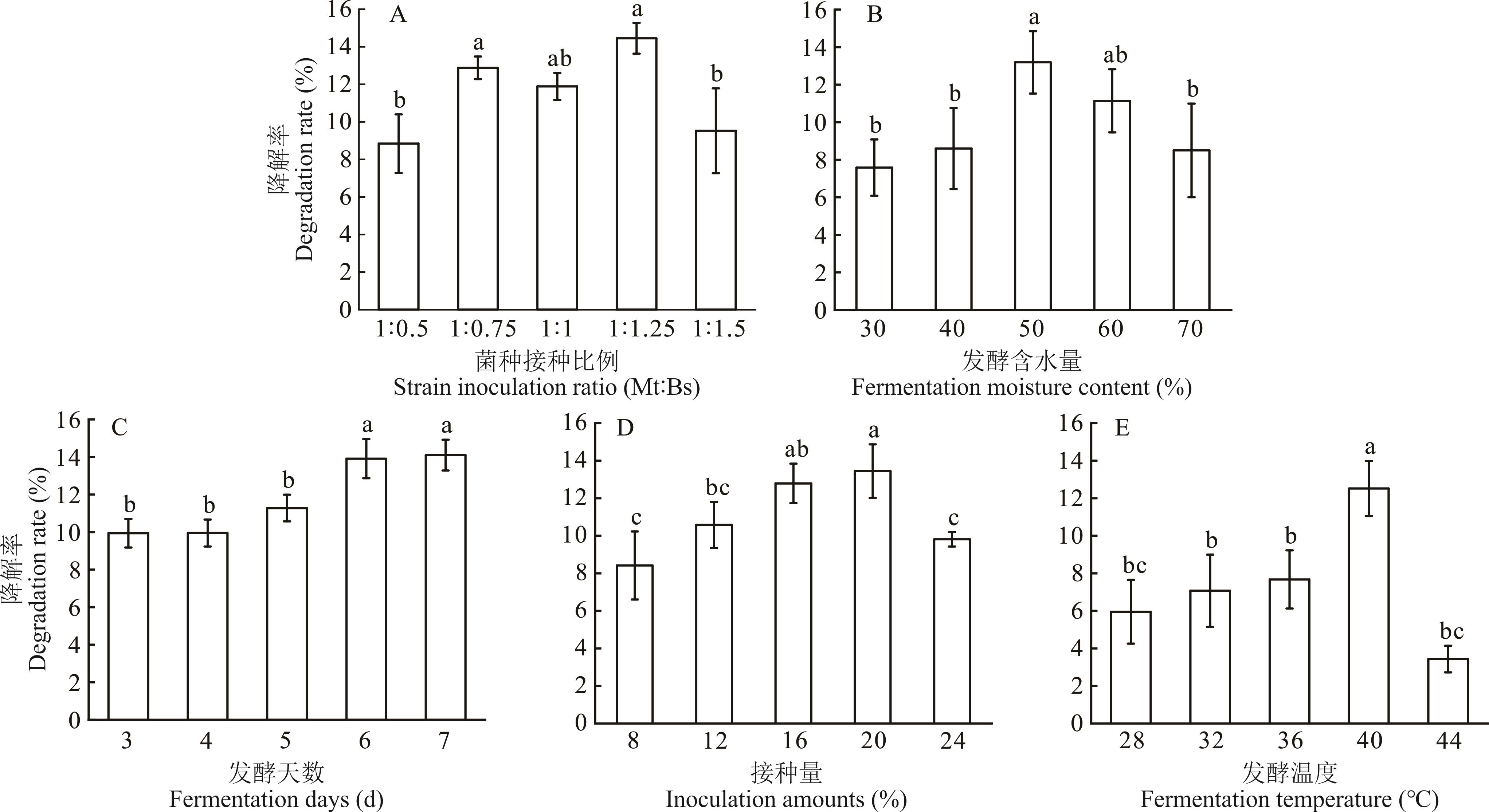
图1 不同因素对柠条木质纤维素降解率的影响不同小写字母表示差异显著(P<0.05)。Different lowercase letters indicated a significant difference (P<0.05).
Fig.1 Effect of different factors on the lignocellulose degradation rate of C. korshinskii
编码值 Code | 因素Factor | ||
|---|---|---|---|
| 温度Temperature (℃, A) | 含水量Moisture content (%, B) | 接种比Inoculation ratio (Mt∶Bs, C) | |
| -1 | 36 | 40 | 1∶1 |
| 0 | 40 | 50 | 1∶1.25 |
| 1 | 44 | 60 | 1∶1.5 |
表1 响应面因素与编码
Table 1 Response surface factors and codes
编码值 Code | 因素Factor | ||
|---|---|---|---|
| 温度Temperature (℃, A) | 含水量Moisture content (%, B) | 接种比Inoculation ratio (Mt∶Bs, C) | |
| -1 | 36 | 40 | 1∶1 |
| 0 | 40 | 50 | 1∶1.25 |
| 1 | 44 | 60 | 1∶1.5 |
试验序号 Test sequence number | 温度 Temperature (℃, A) | 含水量 Moisture content (%, B) | 接种比 Inoculation ratio (Mt∶Bs, C) | 木质纤维素降解率 Degradation rate of lignocellulosic biomass (%) | 试验序号 Test sequence number | 温度 Temperature (℃, A) | 含水量 Moisture content (%, B) | 接种比 Inoculation ratio (Mt∶Bs, C) | 木质纤维素降解率 Degradation rate of lignocellulosic biomass (%) |
|---|---|---|---|---|---|---|---|---|---|
| 1 | 40 | 50 | 1∶1.25 | 14.57 | 10 | 36 | 50 | 1∶1 | 7.56 |
| 2 | 36 | 40 | 1∶1.25 | 8.85 | 11 | 36 | 50 | 1∶1.5 | 9.91 |
| 3 | 40 | 60 | 1∶1.5 | 7.99 | 12 | 40 | 50 | 1∶1.25 | 13.95 |
| 4 | 36 | 60 | 1∶1.25 | 8.91 | 13 | 44 | 50 | 1∶1.5 | 6.97 |
| 5 | 40 | 50 | 1∶1.25 | 13.52 | 14 | 40 | 60 | 1∶1 | 8.73 |
| 6 | 44 | 40 | 1∶1.25 | 7.82 | 15 | 44 | 50 | 1∶1 | 7.82 |
| 7 | 44 | 60 | 1∶1.25 | 8.47 | 16 | 40 | 40 | 1∶1 | 7.17 |
| 8 | 40 | 50 | 1∶1.25 | 13.67 | 17 | 40 | 40 | 1∶1.5 | 9.86 |
| 9 | 40 | 50 | 1∶1.25 | 14.69 |
表2 响应面试验设计与结果
Table 2 Response surface experimental design and results
试验序号 Test sequence number | 温度 Temperature (℃, A) | 含水量 Moisture content (%, B) | 接种比 Inoculation ratio (Mt∶Bs, C) | 木质纤维素降解率 Degradation rate of lignocellulosic biomass (%) | 试验序号 Test sequence number | 温度 Temperature (℃, A) | 含水量 Moisture content (%, B) | 接种比 Inoculation ratio (Mt∶Bs, C) | 木质纤维素降解率 Degradation rate of lignocellulosic biomass (%) |
|---|---|---|---|---|---|---|---|---|---|
| 1 | 40 | 50 | 1∶1.25 | 14.57 | 10 | 36 | 50 | 1∶1 | 7.56 |
| 2 | 36 | 40 | 1∶1.25 | 8.85 | 11 | 36 | 50 | 1∶1.5 | 9.91 |
| 3 | 40 | 60 | 1∶1.5 | 7.99 | 12 | 40 | 50 | 1∶1.25 | 13.95 |
| 4 | 36 | 60 | 1∶1.25 | 8.91 | 13 | 44 | 50 | 1∶1.5 | 6.97 |
| 5 | 40 | 50 | 1∶1.25 | 13.52 | 14 | 40 | 60 | 1∶1 | 8.73 |
| 6 | 44 | 40 | 1∶1.25 | 7.82 | 15 | 44 | 50 | 1∶1 | 7.82 |
| 7 | 44 | 60 | 1∶1.25 | 8.47 | 16 | 40 | 40 | 1∶1 | 7.17 |
| 8 | 40 | 50 | 1∶1.25 | 13.67 | 17 | 40 | 40 | 1∶1.5 | 9.86 |
| 9 | 40 | 50 | 1∶1.25 | 14.69 |
方差来源 Source of variance | 平方和 Sum of squares | 自由度 Degree of freedom | 均方 Mean square | F值 F-value | P值 P-value | 显著性 Significance |
|---|---|---|---|---|---|---|
| 模型Model | 126.14 | 9 | 14.02 | 67.79 | <0.0001 | *** |
| A | 2.15 | 1 | 2.15 | 10.41 | 0.0145 | * |
| B | 0.02 | 1 | 0.02 | 0.10 | 0.7658 | |
| C | 1.49 | 1 | 1.49 | 7.21 | 0.0313 | * |
| AB | 0.09 | 1 | 0.09 | 0.43 | 0.5309 | |
| AC | 2.56 | 1 | 2.56 | 12.37 | 0.0098 | ** |
| BC | 2.94 | 1 | 2.94 | 14.21 | 0.0070 | ** |
| A2 | 37.15 | 1 | 37.15 | 179.67 | <0.0001 | *** |
| B2 | 28.43 | 1 | 28.43 | 137.51 | <0.0001 | *** |
| C2 | 39.08 | 1 | 39.08 | 189.01 | <0.0001 | *** |
| 残差Residual error | 1.45 | 7 | 0.21 | |||
| 失拟项Lack of fit | 0.34 | 3 | 0.11 | 0.41 | 0.7574 | |
| 纯误差Pure error | 1.11 | 4 | 0.28 | |||
| 校正总平方和Corrected total sum of squares | 127.59 | 16 | ||||
| 决定系数Coefficient of determination (R2) | 0.9887 | |||||
| 调整决定系数Adjusted R-squared (R2Adj) | 0.9741 | |||||
| 变异系数Coefficient of variation (CV, %) | 4.53 |
表3 响应面试验结果的方差分析
Table 3 Analysis of variance of response surface experimental results
方差来源 Source of variance | 平方和 Sum of squares | 自由度 Degree of freedom | 均方 Mean square | F值 F-value | P值 P-value | 显著性 Significance |
|---|---|---|---|---|---|---|
| 模型Model | 126.14 | 9 | 14.02 | 67.79 | <0.0001 | *** |
| A | 2.15 | 1 | 2.15 | 10.41 | 0.0145 | * |
| B | 0.02 | 1 | 0.02 | 0.10 | 0.7658 | |
| C | 1.49 | 1 | 1.49 | 7.21 | 0.0313 | * |
| AB | 0.09 | 1 | 0.09 | 0.43 | 0.5309 | |
| AC | 2.56 | 1 | 2.56 | 12.37 | 0.0098 | ** |
| BC | 2.94 | 1 | 2.94 | 14.21 | 0.0070 | ** |
| A2 | 37.15 | 1 | 37.15 | 179.67 | <0.0001 | *** |
| B2 | 28.43 | 1 | 28.43 | 137.51 | <0.0001 | *** |
| C2 | 39.08 | 1 | 39.08 | 189.01 | <0.0001 | *** |
| 残差Residual error | 1.45 | 7 | 0.21 | |||
| 失拟项Lack of fit | 0.34 | 3 | 0.11 | 0.41 | 0.7574 | |
| 纯误差Pure error | 1.11 | 4 | 0.28 | |||
| 校正总平方和Corrected total sum of squares | 127.59 | 16 | ||||
| 决定系数Coefficient of determination (R2) | 0.9887 | |||||
| 调整决定系数Adjusted R-squared (R2Adj) | 0.9741 | |||||
| 变异系数Coefficient of variation (CV, %) | 4.53 |

图2 温度、含水量、接种比对柠条木质纤维素降解率影响的响应曲面和等高线图
Fig.2 Response surface and contour plots of C. korshinskii lignocellulosic biomass degradation rate as affected by temperature, moisture content, and inoculation ratio
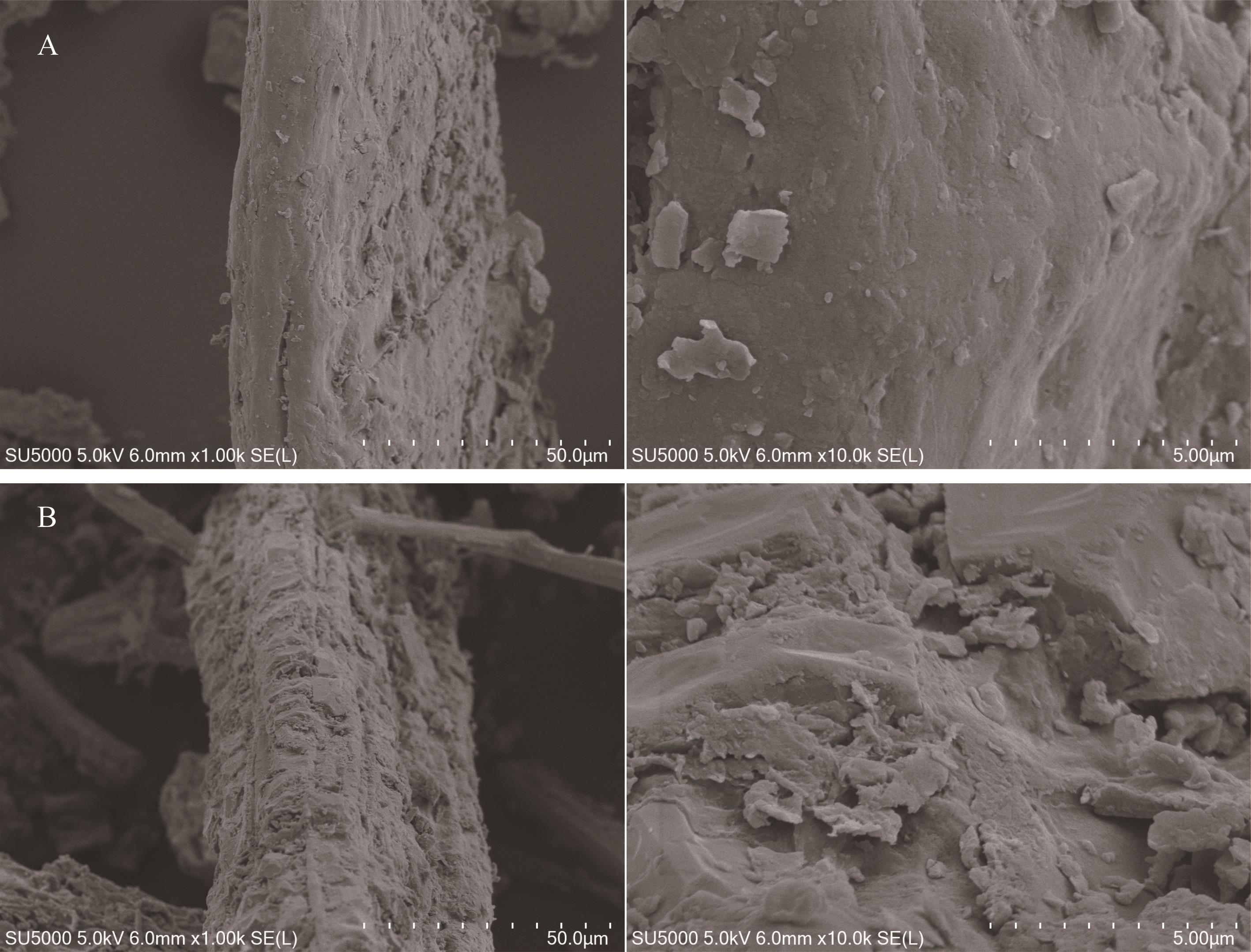
图3 降解前/后柠条的表面组织结构A, B: 降解前后的柠条表面组织结构Surface tissue structure of C. korshinskii before/after degradation. ×1.00 k: 放大倍数为1000倍The magnification is 1000 times; ×10.0 k: 放大倍数为10000倍The magnification is 10000 times.
Fig.3 Surface tissue structure of C. korshinskii before/after degradation
| 项目Item | CK | Bs-Mt | P值P-value |
|---|---|---|---|
| 粗灰分Crude ash | 3.91±0.09 | 3.97±0.15 | 0.60 |
| 粗脂肪Ether extract (EE) | 1.15±0.06 | 1.48±0.07 | <0.05 |
| 粗蛋白Crude protein (CP) | 9.94±0.71 | 10.85±0.12 | 0.09 |
| 淀粉Starch | 1.10±0.06 | 0.62±0.10 | <0.05 |
| 可溶性碳水化合物Water soluble carbohydrates (WSC) | 3.12±0.19 | 3.40±0.09 | 0.09 |
| 中性洗涤纤维Neutral detergent fiber (NDF) | 72.32±2.35 | 61.25±0.30 | <0.01 |
| 酸性洗涤纤维Acid detergent fiber (ADF) | 57.08±2.96 | 50.60±1.66 | <0.05 |
| 酸性洗涤木质素Acid detergent lignin (ADL) | 10.05±0.14 | 9.25±0.06 | <0.01 |
表4 柠条降解前后的营养成分(干物质基础)
Table 4 Nutrient composition of C. korshinskii before and after degradation (dry matter basis,%)
| 项目Item | CK | Bs-Mt | P值P-value |
|---|---|---|---|
| 粗灰分Crude ash | 3.91±0.09 | 3.97±0.15 | 0.60 |
| 粗脂肪Ether extract (EE) | 1.15±0.06 | 1.48±0.07 | <0.05 |
| 粗蛋白Crude protein (CP) | 9.94±0.71 | 10.85±0.12 | 0.09 |
| 淀粉Starch | 1.10±0.06 | 0.62±0.10 | <0.05 |
| 可溶性碳水化合物Water soluble carbohydrates (WSC) | 3.12±0.19 | 3.40±0.09 | 0.09 |
| 中性洗涤纤维Neutral detergent fiber (NDF) | 72.32±2.35 | 61.25±0.30 | <0.01 |
| 酸性洗涤纤维Acid detergent fiber (ADF) | 57.08±2.96 | 50.60±1.66 | <0.05 |
| 酸性洗涤木质素Acid detergent lignin (ADL) | 10.05±0.14 | 9.25±0.06 | <0.01 |
| 项目Item | CK | Bs-Mt | P值P-value |
|---|---|---|---|
| pH | 6.83±0.04 | 6.85±0.02 | 0.21 |
| 氨态氮Ammonia nitrogen (NH3-N, mg·dL-1) | 10.90±0.36 | 14.67±0.06 | <0.01 |
| 微生物蛋白Microbial protein (MCP, mg·mL-1) | 5.82±0.42 | 9.64±1.67 | <0.05 |
| 乙酸Acetic acid (AA, mmol·L-1) | 18.60±0.73 | 25.53±0.95 | <0.01 |
| 丙酸Propionic acid (PA, mmol·L-1) | 6.18±0.22 | 8.40±0.14 | <0.01 |
| 异丁酸Isobutyric acid (IBA, mmol·L-1) | 0.89±0.03 | 1.07±0.04 | <0.05 |
| 丁酸Butyric acid (BA, mmol·L-1) | 2.94±0.14 | 5.17±0.12 | <0.01 |
| 异戊酸Isovaleric acid (IVA, mmol·L-1) | 0.71±0.03 | 0.94±0.05 | <0.05 |
| 戊酸Valeric acid (VA, mmol·L-1) | 0.94±0.05 | 0.87±0.02 | 0.62 |
| 总挥发性脂肪酸Total volatile fatty acids (TVFA, mmol·L-1) | 30.94±0.73 | 41.97±1.20 | <0.01 |
| 乙丙比Acetate acid/propionate acid (A/P) | 3.13±0.14 | 3.04±0.06 | 0.12 |
| 体外干物质消化率In vitro dry matter digestibility (IVDMD, %) | 28.28±2.40 | 39.45±1.32 | <0.01 |
| 体外中性洗涤纤维消化率In vitro neutral detergent fiber digestibility (IVNDFD, %) | 9.70±1.13 | 12.21±0.85 | <0.01 |
表5 发酵柠条对体外瘤胃发酵参数及消化率的影响
Table 5 Effects of fermented C. korshinskii on in vitro ruminal fermentation parameters and digestibility rate
| 项目Item | CK | Bs-Mt | P值P-value |
|---|---|---|---|
| pH | 6.83±0.04 | 6.85±0.02 | 0.21 |
| 氨态氮Ammonia nitrogen (NH3-N, mg·dL-1) | 10.90±0.36 | 14.67±0.06 | <0.01 |
| 微生物蛋白Microbial protein (MCP, mg·mL-1) | 5.82±0.42 | 9.64±1.67 | <0.05 |
| 乙酸Acetic acid (AA, mmol·L-1) | 18.60±0.73 | 25.53±0.95 | <0.01 |
| 丙酸Propionic acid (PA, mmol·L-1) | 6.18±0.22 | 8.40±0.14 | <0.01 |
| 异丁酸Isobutyric acid (IBA, mmol·L-1) | 0.89±0.03 | 1.07±0.04 | <0.05 |
| 丁酸Butyric acid (BA, mmol·L-1) | 2.94±0.14 | 5.17±0.12 | <0.01 |
| 异戊酸Isovaleric acid (IVA, mmol·L-1) | 0.71±0.03 | 0.94±0.05 | <0.05 |
| 戊酸Valeric acid (VA, mmol·L-1) | 0.94±0.05 | 0.87±0.02 | 0.62 |
| 总挥发性脂肪酸Total volatile fatty acids (TVFA, mmol·L-1) | 30.94±0.73 | 41.97±1.20 | <0.01 |
| 乙丙比Acetate acid/propionate acid (A/P) | 3.13±0.14 | 3.04±0.06 | 0.12 |
| 体外干物质消化率In vitro dry matter digestibility (IVDMD, %) | 28.28±2.40 | 39.45±1.32 | <0.01 |
| 体外中性洗涤纤维消化率In vitro neutral detergent fiber digestibility (IVNDFD, %) | 9.70±1.13 | 12.21±0.85 | <0.01 |
| 项目Item | CK | Bs-Mt | P值P-value |
|---|---|---|---|
| 有机物消化率Organic matter digestibility (OMD, %) | 45.19±1.36 | 80.12±6.65 | <0.01 |
| 代谢能Metabolizable energy (ME, MJ·kg-1) | 5.72±0.23 | 11.52±1.10 | <0.01 |
| 理论最大产气量Theoretical maximum gas production (C1, mL·h-1) | 32.73±1.47 | 71.72±6.35 | <0.01 |
| 产气速率Gas production rate (C2, mL·h-1) | 1.87±0.30 | 0.93±0.01 | <0.01 |
| 产气延滞时间Lag time of gas production (C3, h) | 0.29±0.02 | 0.14±0.01 | <0.01 |
表6 发酵柠条对有机物消化率、代谢能和产气模型参数的影响
Table 6 Effects of fermented C. korshinskii on the digestibility of organic matter, metabolic energy, and gas production model parameters
| 项目Item | CK | Bs-Mt | P值P-value |
|---|---|---|---|
| 有机物消化率Organic matter digestibility (OMD, %) | 45.19±1.36 | 80.12±6.65 | <0.01 |
| 代谢能Metabolizable energy (ME, MJ·kg-1) | 5.72±0.23 | 11.52±1.10 | <0.01 |
| 理论最大产气量Theoretical maximum gas production (C1, mL·h-1) | 32.73±1.47 | 71.72±6.35 | <0.01 |
| 产气速率Gas production rate (C2, mL·h-1) | 1.87±0.30 | 0.93±0.01 | <0.01 |
| 产气延滞时间Lag time of gas production (C3, h) | 0.29±0.02 | 0.14±0.01 | <0.01 |
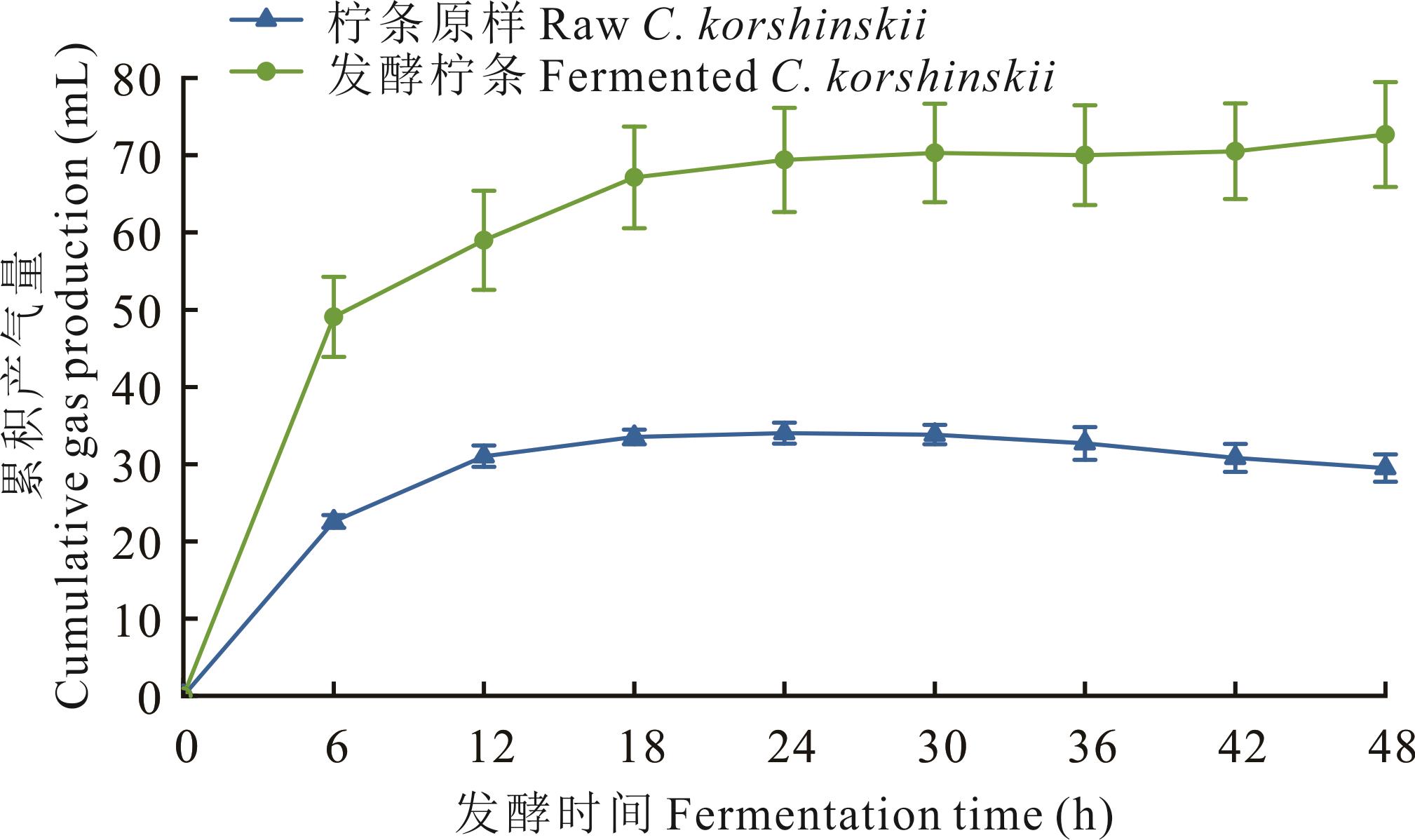
图4 发酵柠条与柠条原样的体外产气规律
Fig.4 Gas production kinetics of fermented versus raw C. korshinskiiin vitro system
项目 Item | 组别Group | P值 P-value | |
|---|---|---|---|
| CK | Bs-Mt | ||
| 覆盖度Coverage | 0.99±0.00 | 0.99±0.00 | 0.733 |
| Sobs指数Sobs index | 1157.67±69.33 | 1058.67±41.10 | 0.100 |
| Ace指数Ace index | 1167.20±76.25 | 1069.33±39.73 | 0.119 |
| Chao指数Chao index | 1160.63±71.29 | 1061.87±39.58 | 0.104 |
Shannon指数 Shannon index | 6.40±0.01 | 6.01±0.05 | <0.010 |
Simpson指数 Simpson index | 0.003 | 0.007 | <0.050 |
表7 发酵柠条对瘤胃体外发酵菌群Alpha多样性的影响
Table 7 Effects of fermented C. korshinskii on the Alpha diversity of the rumen microbial community in in vitro fermentation
项目 Item | 组别Group | P值 P-value | |
|---|---|---|---|
| CK | Bs-Mt | ||
| 覆盖度Coverage | 0.99±0.00 | 0.99±0.00 | 0.733 |
| Sobs指数Sobs index | 1157.67±69.33 | 1058.67±41.10 | 0.100 |
| Ace指数Ace index | 1167.20±76.25 | 1069.33±39.73 | 0.119 |
| Chao指数Chao index | 1160.63±71.29 | 1061.87±39.58 | 0.104 |
Shannon指数 Shannon index | 6.40±0.01 | 6.01±0.05 | <0.010 |
Simpson指数 Simpson index | 0.003 | 0.007 | <0.050 |
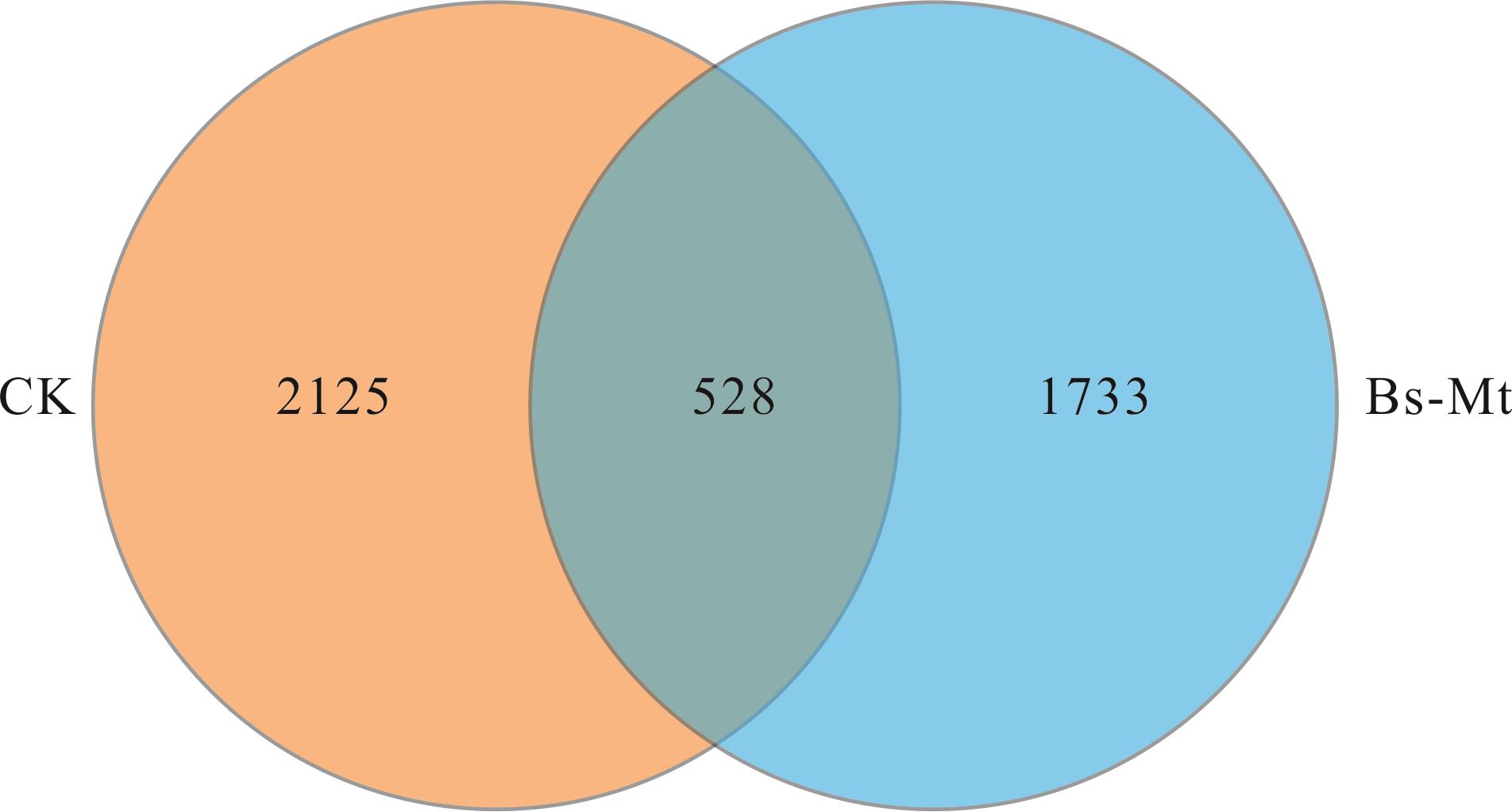
图5 瘤胃微生物群中扩增子序列变异数量的Venn图
Fig.5 Venn diagram showing the number of amplicon sequence variants (ASVs) in the rumen microbiota
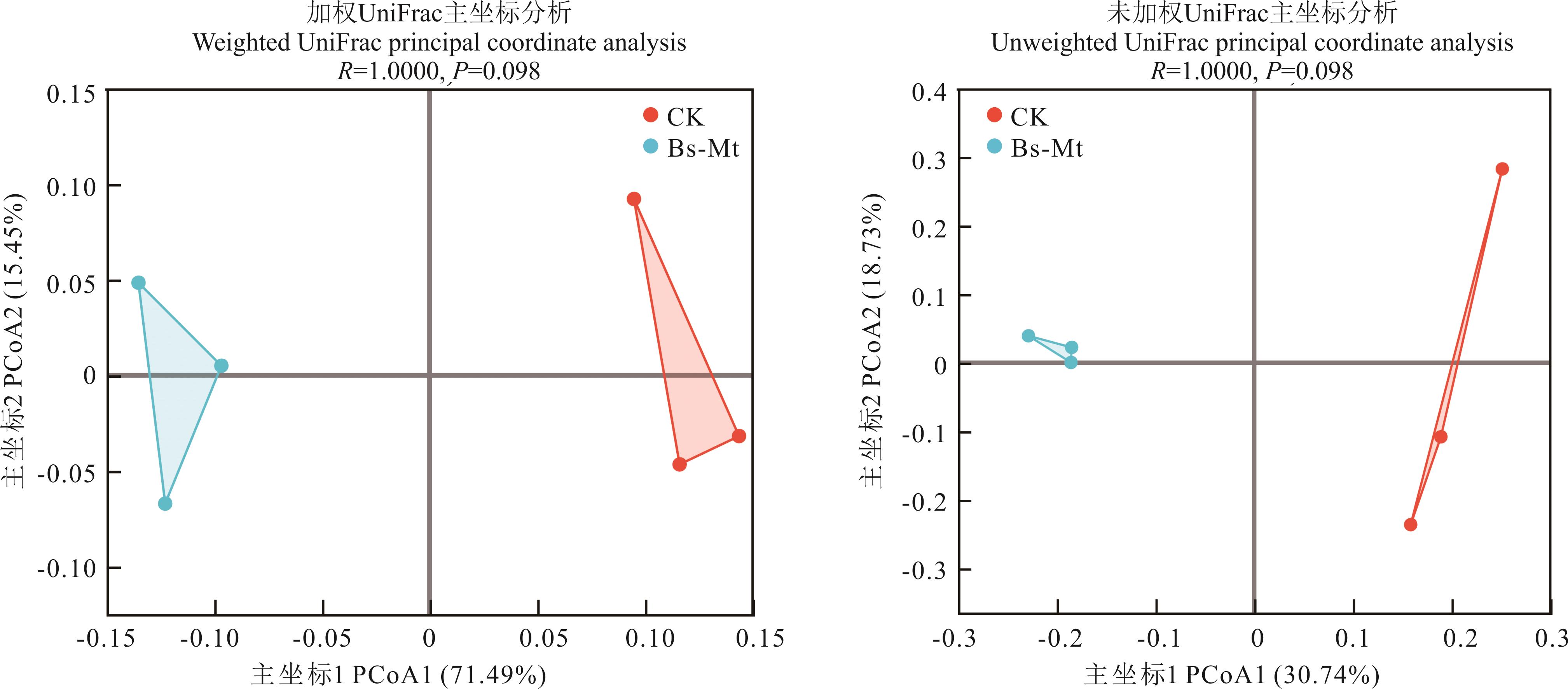
图6 发酵柠条瘤胃体外发酵菌群的主坐标分析
Fig.6 Principal coordinate analysis (PCoA) of the rumen microbial community from the in vitro fermentation of fermented C. korshinskii

图7 柠条原样与发酵柠条瘤胃体外发酵菌群在门和属水平上的组成A: 门水平微生物组成Microbial composition at phylum level; B: 属水平微生物组成Microbial composition at genus level; C: 门水平微生物差异Microbial difference at phylum level; D: 属水平微生物差异Microbial difference at genus level.
Fig.7 Microbial community composition of raw and fermented C. korshinskii during in vitro rumen fermentation at the phylum and genus levels
| [1] | Bai B C, Qiu R, Sun L, et al. Effect isolated lactic acid bacteria inoculation on the quality, bacterial composition and metabolic characterization of C. korshinskii silage. Chemical and Biological Technologies in Agriculture, 2024, 11(1): 67. |
| [2] | Huang F, Liu J, Wang B, et al. The impacts of shrub branch covering on soil respiration in a desert steppe of Ningxia. Acta Ecologica Sinica, 2025, 45(7): 3218-3228. |
| 黄飞, 刘静, 王博, 等. 灌枝覆盖对宁夏荒漠草地土壤呼吸的影响. 生态学报, 2025, 45(7): 3218-3228. | |
| [3] | Li Z L, Ma F, Hu M M, et al. Study on the nutritional value of peashrub at different growth periods. China Feed, 2021(15): 121-123. |
| 李占丽, 马飞, 胡美美, 等. 柠条不同生长时期营养价值的研究. 中国饲料, 2021(15): 121-123. | |
| [4] | Yang F Y, Wu M X, Wang X K. Research progress in woody forage. Feed Industry, 2025, 46(6): 1-7. |
| 杨富裕, 吴铭鑫, 王学凯. 木本饲料研究进展. 饲料工业, 2025, 46(6): 1-7. | |
| [5] | Shi J H. Construction of complex fermentation flora and its effect on lignocellulose degradation of Caragana. Yinchuan: Ningxia University, 2024. |
| 史金红. 复合发酵菌群对柠条青贮饲料品质及木质纤维素降解的影响. 银川: 宁夏大学, 2024. | |
| [6] | Wu Z Y, Peng K, Zhang Y, et al. Lignocellulose dissociation with biological pretreatment towards the biochemical platform: A review. Materials Today Bio, 2022, 16: 100445. |
| [7] | Wu Q, Zhang Y X, Zhao L, et al. Strategies for efficient degradation of lignocellulose from straw: Synergistic effects of acid-base pretreatment and functional microbial agents in composting. Chemical Engineering Journal, 2025, 508: 161048. |
| [8] | Casciatori F P, Mafra N S C, Rodrigues N A, et al. Flow configuration and packing density of sugarcane bagasse and wheat bran affecting enzymes production by solid-state fermentation. BioEnergy Research, 2024, 17(1): 187-197. |
| [9] | Beijing Kelimeishi Biotechnology Co., Ltd. A novel Myceliophthora thermophila strain and its application: China, CN102352320A. 2012-02-15. |
| 北京可力美施生物科技有限公司. 一种嗜热毁丝霉新菌株及其应用: 中国, CN102352320A. 2012-02-15. | |
| [10] | Liu Q, Li J G, Zhang C Y, et al. Research progress of genome editing technologies for industrial filamentous fungi. Synthetic Biology Journal, 2021, 2(2): 256-273. |
| 刘倩, 李金根, 张晨阳, 等. 工业丝状真菌基因组编辑技术研究进展. 合成生物学, 2021, 2(2): 256-273. | |
| [11] | Dahiya S, Kumar A, Singh B. Enhanced endoxylanase production by Myceliophthora thermophila using rice straw and its synergism with phytase in improving nutrition. Process Biochemistry, 2020, 94: 235-242. |
| [12] | Liu G W, Gong H X, Tang H R, et al. Enhanced lignocellulose degradation in Bacillus subtilis RLI2019 through CRISPR/Cas9-mediated chromosomal integration of ternary cellulase genes. International Journal of Biological Macromolecules, 2025, 306(Pt 3): 141727. |
| [13] | Wang S C, Long H C, Hu X R, et al. The co-inoculation of Trichoderma viridis and Bacillus subtilis improved the aerobic composting efficiency and degradation of lignocellulose. Bioresource Technology, 2024, 394: 130285. |
| [14] | Chen Y L. Study on the factors and mechanism affecting the stability of structure and function of lignocellulosic degradation complex strains. Yichang: China Three Gorges University, 2022. |
| 陈永伦. 影响木质纤维素降解复合菌系结构和功能稳定性的因素及机理研究. 宜昌: 三峡大学, 2022. | |
| [15] | Liu X F, Hou Y, Ma J Q, et al. Efficient degradation and optimization of fermentation conditions of actinomycetes from corn cob. Transactions of the Chinese Society for Agricultural Machinery, 2020, 51(11): 329-337. |
| 刘晓飞, 侯艳, 马京求, 等. 降解玉米芯木质纤维素放线菌的筛选与发酵条件优化. 农业机械学报, 2020, 51(11): 329-337. | |
| [16] | State Administration for Market Regulation, Standardization Administration of the People’s Republic of China. Animal feeding stuffs-Determination of crude ash: GB/T 6438-2007. Beijing: Standards Press of China, 2007. |
| 国家市场监督管理总局, 中国国家标准化管理委员会. 饲料中粗灰分的测定: GB/T 6438-2007. 北京: 中国标准出版社, 2007. | |
| [17] | State Administration for Market Regulation, Standardization Administration of the People’s Republic of China. Determination of crude protein in feeds-Kjeldahl method: GB/T 6432-2018. Beijing: Standards Press of China, 2018. |
| 国家市场监督管理总局, 中国国家标准化管理委员会. 饲料中粗蛋白的测定 凯氏定氮法: GB/T 6432-2018. 北京: 中国标准出版社, 2018. | |
| [18] | State Administration for Market Regulation, Standardization Administration of the People’s Republic of China. Determination of crude fat in feeds: GB/T 6433-2006. Beijing: Standards Press of China, 2006. |
| 国家市场监督管理总局, 中国国家标准化管理委员会. 饲料中粗脂肪的测定: GB/T 6433-2006. 北京: 中国标准出版社, 2006. | |
| [19] | Van Soest P J, Robertson J B, Lewis B A. Methods for dietary fiber, neutral detergent fiber, and nonstarch polysaccharides in relation to animal nutrition. Journal of Dairy Science, 1991, 74(10): 3583-3597. |
| [20] | State Administration for Market Regulation, Standardization Administration of the People’s Republic of China. Determination of acid detergent lignin in feedstuffs: GB/T 20805-2006. Beijing: Standards Press of China, 2006. |
| 国家市场监督管理总局, 中国国家标准化管理委员会. 饲料中酸性洗涤木质素(ADL)的测定: GB/T 20805-2006. 北京: 中国标准出版社, 2006. | |
| [21] | Murphy R P. A method for the extraction of plant samples and the determination of total soluble carbohydrates. Journal of the Science of Food and Agriculture, 1958, 9(11): 714-717. |
| [22] | Liu R F, Wang Y W. Optimization of conditions for determination of organic acids in corn silage by HPLC. Feed Research, 2023, 46(2): 113-116. |
| 刘瑞芳, 王艺伟. 优化高效液相色谱测定玉米青贮饲料中有机酸条件的研究. 饲料研究, 2023, 46(2): 113-116. | |
| [23] | Feng Z C, Gao M. Improvement of method for determining ammonia nitrogen concentration in rumen fluid by colorimetry. Animal Husbandry and Feed Science, 2010, 31(Z1): 37. |
| 冯宗慈, 高民. 通过比色测定瘤胃液氨氮含量方法的改进. 畜牧与饲料科学, 2010, 31(Z1): 37. | |
| [24] | Makkar H P, Sharma O P, Dawra R K, et al. Simple determination of microbial protein in rumen liquor. Journal of Dairy Science, 1982, 65(11): 2170-2173. |
| [25] | National Feed Industry Standardization Technical Committee (SAC/TC 76). Determination of total starch content in feed Enzymatic method: GB/T 42491-2023. Beijing: Standards Press of China, 2023. |
| 全国饲料工业标准化技术委员会 (SAC/TC 76). 饲料中淀粉总含量的测定 酶法: GB/T 42491-2023. 北京: 中国标准出版社, 2023. | |
| [26] | Menke K H, Raab L, Salewski A, et al. The estimation of the digestibility and metabolizable energy content of ruminant feedingstuffs from the gas production when they are incubated with rumen liquor in vitro. The Journal of Agricultural Science, 1979, 93(1): 217-222. |
| [27] | Sundarraj A A, Thottiam V R, Sriramulu G. Optimized extraction and characterization of pectin from jackfruit (Artocarpus integer) wastes using response surface methodology. International Journal of Biological Macromolecules, 2018, 106: 698-703. |
| [28] | Zhou Y C, Wei X B, Li Z Z, et al. Optimization of new ultrasound-assisted extraction process for mulberry leaf protein and investigation of its antioxidant activity. Chinese Journal of Animal Nutrition, 2025, 37(4): 2716-2727. |
| 周一晨, 卫旭彪, 李震震, 等. 桑叶蛋白超声辅助提取新工艺优化及其抗氧化活性研究. 动物营养学报, 2025, 37(4): 2716-2727. | |
| [29] | Huang Q Y, Yan H B, Liu Y H, et al. Effects of microalgae-bacteria inoculation ratio on biogas slurry treatment and microorganism interactions in the symbiosis system. Journal of Cleaner Production, 2022, 362: 132271. |
| [30] | Qiu W Y, Li M, Chen S Y, et al. Constructing Escherichia coli synthetic microbial communities for simultaneously utilizing mixed sugars to product L-lactic acid. Journal of Chinese Institute of Food Science and Technology, 2024, 24(7): 208-218. |
| 邱炜玥, 李敏, 陈思宇, 等. 构建大肠杆菌合成生物群落利用混合糖同步发酵生产L-乳酸. 中国食品学报, 2024, 24(7): 208-218. | |
| [31] | Zhu L B, Han Q N, Shen N N, et al. Study on degradation of cellulose from steam-blasted reed straw by solid-state fermentation with mixed bacteria. Feed Research, 2024, 47(23): 134-139. |
| 朱龙博, 韩倩男, 申娜娜, 等. 混菌固态发酵降解蒸汽爆破芦苇秸秆纤维素的研究. 饲料研究, 2024, 47(23): 134-139. | |
| [32] | Kashyap P, Sabu A, Pandey A, et al. Extra-cellular L-glutaminase production by Zygosaccharomyces rouxii under solid-state fermentation. Process Biochemistry, 2002, 38(3): 307-312. |
| [33] | Jin G, Zhu Y, Rinzema A, et al. Water dynamics during solid-state fermentation by Aspergillus oryzae YH6. Bioresource Technology, 2019, 277: 68-76. |
| [34] | Jiao Y H, Gao T Y, Gong J G, et al. Study on optimization of solid-state fermentation with mixed bacteria to improve nutritional value of seabuckthorn fruit residue. Feed Research, 2024, 47(24): 75-79. |
| 焦奕豪, 高腾雨, 龚建刚, 等. 混菌固态发酵对改善沙棘果渣营养价值工艺优化的研究. 饲料研究, 2024, 47(24): 75-79. | |
| [35] | Ding X Q, Yao L, Hou Y, et al. Optimization of culture conditions during the solid-state fermentation of tea residue using mixed strains. Waste and Biomass Valorization, 2020, 11(12): 6667-6675. |
| [36] | Yang Y. Research on fermentation of mixed probiotics to improve feed quality of palm meal. Huai’an: Huaiyin Institute of Technology, 2023. |
| 杨阳. 混菌发酵改善棕榈粕品质的研究. 淮安: 淮阴工学院, 2023. | |
| [37] | Zhao J. Optimization of cellulose production conditions and transcriptome analysis of Myceliophthora thermophlia. Xinyang: Xinyang Normal University, 2023. |
| 赵佳. 嗜热毁丝霉产纤维素酶条件优化及转录组分析. 信阳: 信阳师范学院, 2023. | |
| [38] | Gauvry E, Mathot A, Couvert O, et al. Effects of temperature, pH and water activity on the growth and the sporulation abilities of Bacillus subtilis BSB1. International Journal of Food Microbiology, 2021, 337: 108915. |
| [39] | Yao K Y, Zhang T Z, Wang H F, et al. Upgrading of by-product from beverage industry through solid-state fermentation with Candida utilis and Bacillus subtilis. Letters in Applied Microbiology, 2018, 67(6): 557-563. |
| [40] | Han Q N, Li N, Zheng Z, et al. Screen and process optimization of compound enzymes for fiber component degradation of steam explosion bamboo powder. Chinese Journal of Animal Nutrition, 2025, 37(7): 4863-4875. |
| 韩倩男, 李宁, 郑梓, 等. 蒸汽爆破竹粉纤维组分降解复合酶筛选及工艺优化. 动物营养学报, 2025, 37(7): 4863-4875. | |
| [41] | Zhou J, Huang W M, Qin L J, et al. Construction of mixed fermentation system of four PGPR strains and evaluation of its promoting effect. Biotechnology Bulletin, 2021, 37(4): 116-126. |
| 周静, 黄文茂, 秦利军, 等. 四株PGPR菌株混菌发酵体系的构建及促生效应评价. 生物技术通报, 2021, 37(4): 116-126. | |
| [42] | Islam S, Miah M A S, Islam M F, et al. Exploring the effects of spontaneous and solid-state fermentation on the physicochemical, functional and structural properties of whole wheat flour (Triticum aestivum L.). Innovative Food Science & Emerging Technologies, 2024, 97: 103798. |
| [43] | Wang J W, Zhang W Q, Liu Y X. Thermochemical treatment of lignocellulosic biomass Ceratophyllum demersum at temperatures below 100 ℃ to prepare the carbon adsorbent. ACS Sustainable Chemistry & Engineering, 2025, 13(14): 5394-5402. |
| [44] | Chen J M, Cai Y F, Wang Z, et al. Construction of a synthetic microbial community based on multiomics linkage technology and analysis of the mechanism of lignocellulose degradation. Bioresource Technology, 2023, 389: 129799. |
| [45] | Lara E C, Basso F C, de Assis F B, et al. Changes in the nutritive value and aerobic stability of corn silages inoculated with Bacillus subtilis alone or combined with Lactobacillus plantarum. Animal Production Science, 2016, 56(11): 1867-1874. |
| [46] | Zou J H. Enzymatic mechanism of cellulose degradation by Myceliophthora thermophile. Beijing: Chinese Academy of Agricultural Sciences, 2023. |
| 邹佳欢. 嗜热毁丝霉高效降解纤维素的酶学机制研究. 北京: 中国农业科学院, 2023. | |
| [47] | Wang S M, Wang Z, Wang N, et al. Efficient conversion of corn straw to feed protein through solid-state fermentation using a thermophilic microbial consortium. Waste Management, 2025, 194: 298-308. |
| [48] | Cheng Z Z, Aibibula·Yimamu, Li F M, et al. Evaluation of feeding effect of pepper straw and its silage with different treatments on lambs. Chinese Journal of Animal Nutrition, 2024, 36(1): 387-396. |
| 程志泽, 艾比布拉·伊马木, 李凤鸣, 等. 辣椒秸秆及其不同处理的青贮对羔羊饲喂效果评价. 动物营养学报, 2024, 36(1): 387-396. | |
| [49] | Chen J M, Cai Y F, Wang Z, et al. Solid-state fermentation of corn straw using synthetic microbiome to produce fermented feed: the feed quality and conversion mechanism. Science of the Total Environment, 2024, 920: 171034. |
| [50] | Huang W Q, Hu X, Zeng J R, et al. Changing the nutrient composition and enhancing the hydrolytic enzyme activity of citrus pulp residue by cofermentation with Candida utilis and Bacillus subtilis. Process Biochemistry, 2021, 107: 83-90. |
| [51] | Xia T, Nie Y, Chen Y, et al. Structural and physicochemical properties and changes in vitro digestion and fermentation of soluble dietary fiber from tea residues modified by fermentation. Food Chemistry, 2025, 473: 142926. |
| [52] | Zhuang Q Y, Zhao L W, Luo C L, et al. Effects of yeast culture on in vitro rumen methane emission, fermentation parameters and microbiota of dairy cows. Chinese Journal of Animal Nutrition, 2025, 37(2): 1059-1070. |
| 庄巧越, 赵丽伟, 雒诚龙, 等. 酵母培养物对奶牛体外瘤胃甲烷排放、发酵参数及微生物区系的影响. 动物营养学报, 2025, 37(2): 1059-1070. | |
| [53] | Niu D Z, Zuo S S, Jiang D, et al. Treatment using white rot fungi changed the chemical composition of wheat straw and enhanced digestion by rumen microbiota in vitro. Animal Feed Science and Technology, 2018, 237: 46-54. |
| [54] | Zheng M H, Zuo S S, Niu D G, et al. Effect of four species of white rot fungi on the chemical composition and in vitro rumen degradability of naked oat straw. Waste and Biomass Valorization, 2021, 12(1): 435-443. |
| [55] | Qu J J, Pu X X, Huo J B, et al. Effects of steam explosion and steam explosion+fermentation on nutritional components, in vitro rumen fermentation characteristics and methane production of bagasse. Chinese Journal of Animal Nutrition, 2024, 36(6): 4003-4013. |
| 曲佳静, 普宣宣, 霍家斌, 等. 蒸汽爆破和蒸汽爆破+发酵处理对甘蔗渣营养成分、体外瘤胃发酵特征和甲烷产量的影响. 动物营养学报, 2024, 36(6): 4003-4013. | |
| [56] | He Y, Wang H B, Yu Z T, et al. Effects of the gender differences in cattle rumen fermentation on anaerobic fermentation of wheat straw. Journal of Cleaner Production, 2018, 205: 845-853. |
| [57] | Lorenzana-Moreno A V, Leal L H, Corona L, et al. Production of 17 strains of edible mushroom grown on corn stover and its effect on the chemical composition and ruminal in vitro digestibility of the residual substrate. PLoS One, 2023, 18(5): e286514. |
| [58] | Esen S. Optimizing ruminant nutrition: insights from a comprehensive analysis of silage composition and in vitro gas production dynamics using nonlinear models. BioSystems, 2023, 234: 105062. |
| [59] | Zhang M M, Liang G G, Zhang X L, et al. The gas production, ruminal fermentation parameters, and microbiota in response to Clostridium butyricum supplementation on in vitro varying with media pH levels. Frontiers in Microbiology, 2022, 13: 960623. |
| [60] | Su H P, Shen N, Ding C G, et al. Effects of selenium nanoparticles on growth performance, serum indexes, rumen fermentation parameters and microflora structure of Shaanbei white cashmere goats. Chinese Journal of Animal Nutrition, 2025, 37(9): 6072-6083. |
| 苏红萍, 沈娜, 丁常根, 等. 纳米硒对陕北白绒山羊生长性能、血清指标、瘤胃发酵参数和菌群结构的影响. 动物营养学报, 2025, 37(9): 6072-6083. | |
| [61] | Ransom-Jones E, Jones D L, McCarthy A J, et al. The fibrobacteres: an important phylum of cellulose-degrading bacteria. Microbial Ecology, 2012, 63(2): 267-281. |
| [62] | Yang G Y, Zhu Y N, Xie X J, et al. Advances in termite-symbiotic microbe system in degradation of lignocelluloses. Acta Microbiologica Sinica, 2020, 60(12): 2621-2634. |
| 羊桂英, 朱娅宁, 谢晓俊, 等. 白蚁-共生微生物系统降解木质纤维素研究进展. 微生物学报, 2020, 60(12): 2621-2634. | |
| [63] | Zhang K M, Li C Y, Liu Y W, et al. The association between vegetable and red meat consumption and gut microbiota in subjects with high risk of colorectal cancer. Acta Nutrimenta Sinica, 2023, 45(4): 371-377. |
| 张克明, 李春燕, 刘奕玮, 等. 结直肠癌高危人群蔬菜和红肉摄入频率与肠道菌群关系的研究. 营养学报, 2023, 45(4): 371-377. | |
| [64] | Mao S Y, Long L M, Zhu W Y. Effect of Selenomonas ruminantium alone, or in combination with yeast cultures, on in vitro rumen bacterial fermentation. Acta Prataculturae Sinica, 2010, 19(4): 176-186. |
| 毛胜勇, 龙黎明, 朱伟云. 体外研究反刍兽新月形单胞菌及与酵母联用对瘤胃微生物发酵的影响. 草业学报, 2010, 19(4): 176-186. | |
| [65] | Wang S S, Zhang Z Q, Lyu Q X, et al. Research advances in the application of Bacillus probiotics in rabbit production. Chinese Journal of Rabbit Farming, 2025, 44(1): 30-34. |
| 王帅帅, 张自强, 吕琼霞, 等. 芽孢杆菌属益生菌在家兔生产中的应用研究进展. 中国养兔杂志, 2025, 44(1): 30-34. | |
| [66] | Fuerniss L K, Kreikemeier K K, Reed L D, et al. Cecal microbiota of feedlot cattle fed a four-species Bacillus supplement. Journal of Animal Science, 2022, 100(10): skac258. |
| [1] | 石文杰, 李小伟, 任振强, 刘吉德, 刘玲, 郝淑香, 李云霞. 毛乌素沙地不同年限柠条固沙林林下草本土壤种子库特征研究[J]. 草业学报, 2026, 35(8): 1-13. |
| [2] | 候腾思, 沈艳, 马红彬, 方鹏, 曹颖. 柠条平茬对荒漠草原土壤水分特征及水量平衡的影响[J]. 草业学报, 2024, 33(8): 15-24. |
| [3] | 曲文杰, 赵文智, 王磊, 屈建军, 杨新国. 两种旱生灌木种子萌发与幼苗复活对模拟干湿处理的响应[J]. 草业学报, 2023, 32(11): 179-187. |
| [4] | 朱志昊, 孟晨, 王兴, 宋乃平, 王丽, 徐苗苗, 杜灵通. 荒漠草原人工柠条引入后土壤团聚体几何分布及拓扑结构演变特征[J]. 草业学报, 2023, 32(11): 53-64. |
| [5] | 崔艺燕, 李家洲, 田志梅, 邓盾, 鲁慧杰, 刘志昌, 容庭, 马现永. 康宁木霉固态发酵改善茶渣营养价值[J]. 草业学报, 2022, 31(7): 96-110. |
| [6] | 田英, 许喆, 朱丽珍, 王俊, 温学飞. 生长季不同月份平茬对柠条人工林地土壤细菌群落特性的影响[J]. 草业学报, 2022, 31(5): 40-50. |
| [7] | 邹诗雨, 陈思葵, 唐启源, 陈东, 陈元伟, 邓攀, 黄胥莱, 李付强. 青贮剂对再生稻头季全株青贮品质和体外瘤胃发酵特性的影响[J]. 草业学报, 2021, 30(7): 122-132. |
| [8] | 张茹, 李建平, 彭文栋, 王芳, 李志刚. 柠条枝条覆盖对宁夏荒漠草原土壤水热及补播牧草生物量的影响[J]. 草业学报, 2021, 30(4): 58-67. |
| [9] | 畅志鹏, 孙莹莹, 李佳阳, 龚春梅. 柠条CkCAD基因的克隆转化及其抗旱功能分析[J]. 草业学报, 2021, 30(3): 68-80. |
| [10] | 常海涛, 刘任涛, 陈蔚, 张安宁, 左小安. 内蒙古乌拉特荒漠草原红砂灌丛林引入柠条后地面节肢动物群落结构分布特征[J]. 草业学报, 2020, 29(12): 188-197. |
| [11] | 陈雅坤,王建平,卜登攀,刘宁,刘威. 复合酶制剂对瘤胃发酵及泌乳早期奶牛生产性能的影响[J]. 草业学报, 2018, 27(4): 170-177. |
| [12] | 孙毅, 闫兴富. 不同生境下柠条种子出苗及幼苗生长特[J]. 草业学报, 2016, 25(7): 186-195. |
| [13] | 杨阳,刘秉儒,宋乃平,杨新国. 人工柠条灌丛密度对荒漠草原土壤养分空间分布的影响[J]. 草业学报, 2014, 23(5): 107-115. |
| [14] | 贾彦霞,王新谱. 盐池四墩子人工柠条带—草地群落交错带地表甲虫多样性研究[J]. 草业学报, 2013, 22(5): 345-350. |
| [15] | 王东升,黄江丽,张志红,田晓娟,黄黄,印遇龙,丁建南. 凤仙花植株乙醇浸提液和固体粉剂对瘤胃体外发酵代谢参数的影响[J]. 草业学报, 2013, 22(2): 87-93. |
| 阅读次数 | ||||||
|
全文 |
|
|||||
|
摘要 |
|
|||||
