

ISSN 1004-5759 CN 62-1105/S
草业学报 ›› 2026, Vol. 35 ›› Issue (1): 40-52.DOI: 10.11686/cyxb2025059
张译尹1,2,3( ), 肖爱萍1,4(), 王斌1,2,3, 王腾飞1,2,3, 胡海英1,2,3, 兰剑1,2,3()
收稿日期:2025-02-26
修回日期:2025-04-28
出版日期:2026-01-20
发布日期:2025-11-13
通讯作者:
兰剑
作者简介:E-mail: ndlanjian@163.com基金资助:
Yi-yin ZHANG1,2,3(), Ai-ping XIAO1,4(), Bin WANG1,2,3, Teng-fei WANG1,2,3, Hai-ying HU1,2,3, Jian LAN1,2,3()
Received:2025-02-26
Revised:2025-04-28
Online:2026-01-20
Published:2025-11-13
Contact:
Jian LAN
摘要:
通过探讨混播模式下不同施氮水平对草地生产性能、经济效益、能量利用效率和生态效能指数的影响,可为氮素高效利用和生态可持续发展提供科学依据。于2021-2023年在宁夏大学四墩子草学野外科学研究基地开展田间定位试验,采用双因素试验设计,设置2个种植模式(SS:饲用高粱单播;SL:饲用高粱/拉巴豆混播)和4个施氮水平(N0:0 kg·hm-2;N90:90 kg·hm-2;N180:180 kg·hm-2;N270:270 kg·hm-2)。结果表明:混播与氮素调控的协同效应显著提高了系统干草产量和粗蛋白产量,且在施氮量为180 kg·hm-2水平下表现出最优生产性能,干草产量(29.08 t·hm-2)和粗蛋白产量(2.62 t·hm-2)均达到最高,较饲用高粱单播模式平均提高了20.69%~23.86%和21.03%~26.89%。经济效益分析显示,在180 kg·hm-2施氮水平下饲用高粱/拉巴豆混播模式的年均净收入和净产出能量均为最高,较不施肥分别提高33.94%和21.32%,表现出良好的经济-能源协同效应。此外,饲用高粱/拉巴豆混播模式下施氮量为90 kg·hm-2时能量利用效率和能量生产力最高,分别为10.84和0.60 kg·MJ-1,较不施肥分别提高了1.94%和1.95%。综合草地生产性能、经济效益、能量利用效率以及生态效能指数对不同种植模式进行可持续评价得出,混播结合施氮180 kg·hm-2处理下可持续指数最高(0.97)。因此,西北干旱区饲用高粱/拉巴豆混播种植系统的最佳施氮量为180 kg·hm-2,以相对较低的氮肥投入提高了牧草产量和农业系统的可持续性。
张译尹, 肖爱萍, 王斌, 王腾飞, 胡海英, 兰剑. 饲用高粱/拉巴豆混播模式下施氮量对草地生产力和能量利用效率的影响[J]. 草业学报, 2026, 35(1): 40-52.
Yi-yin ZHANG, Ai-ping XIAO, Bin WANG, Teng-fei WANG, Hai-ying HU, Jian LAN. Effect of nitrogen application on grass productivity and energy use efficiency in a mixed forage sorghum/lablab planting[J]. Acta Prataculturae Sinica, 2026, 35(1): 40-52.
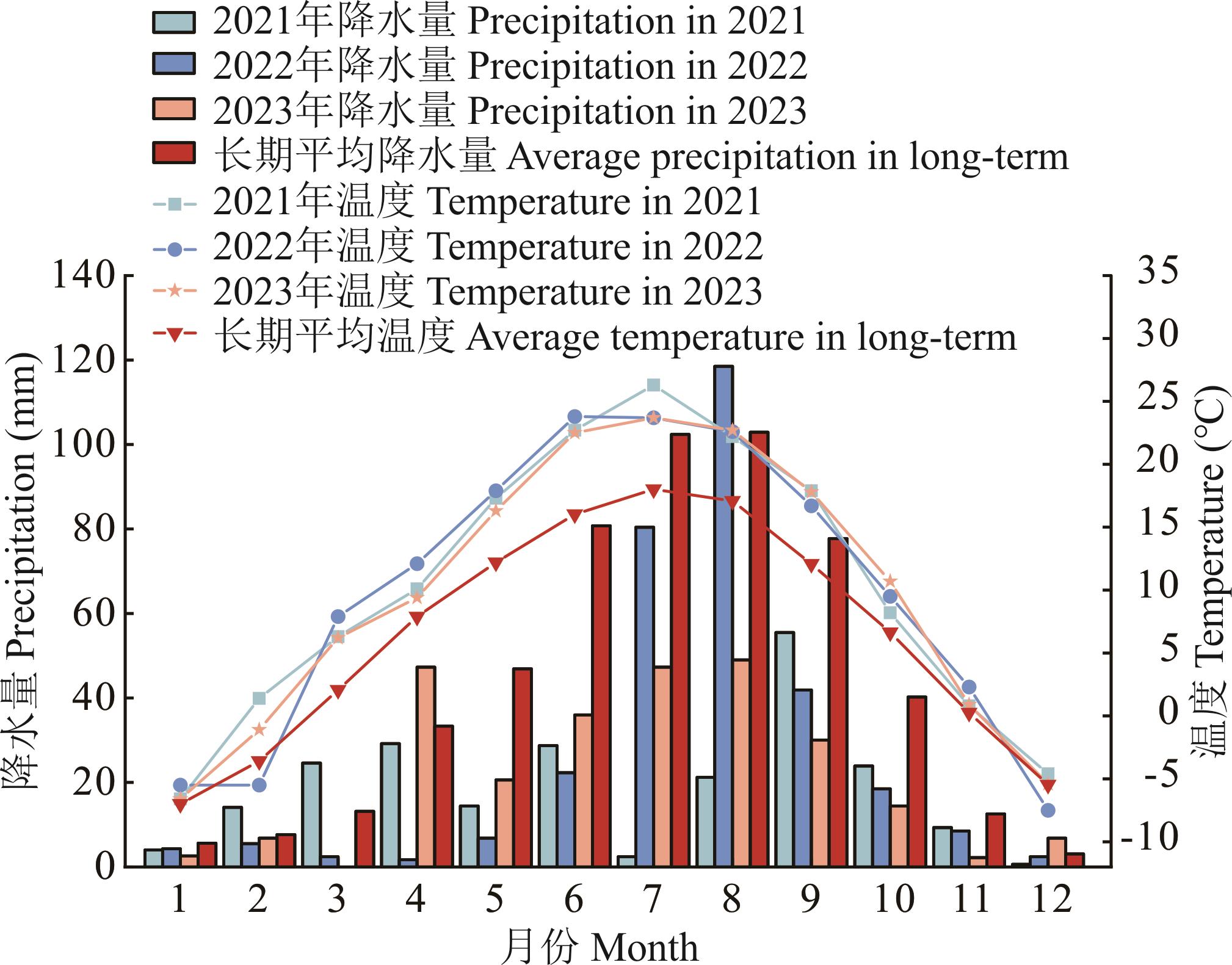
图1 2021-2023年试验区不同月份降水量和温度
Fig.1 Precipitation and temperature in different months of the test area in 2021-2023
种植模式 Cropping patterns | 施氮水平 Nitrogen application levels | 投入成本Input cost (yuan·hm-2) | |||||||
|---|---|---|---|---|---|---|---|---|---|
人工 Labor | 拖拉机 Tractor | 肥料 Fertilizer | 农药 Pesticide | 滴灌带 Drip irrigation tape | 电费 Electricity bill | 种子 Seed | 总计 Total | ||
| SS | N0 | 2313.36 | 1985.04 | 858.00 | 909.36 | 750.24 | 251.28 | 720.00 | 7787.28 |
| N90 | 2313.36 | 1985.04 | 1344.24 | 909.36 | 750.24 | 251.28 | 720.00 | 8273.52 | |
| N180 | 2313.36 | 1985.04 | 1830.48 | 909.36 | 750.24 | 251.28 | 720.00 | 8759.76 | |
| N270 | 2313.36 | 1985.04 | 2316.72 | 909.36 | 750.24 | 251.28 | 720.00 | 9246.00 | |
| SL | N0 | 2431.44 | 2309.76 | 858.00 | 763.92 | 750.24 | 243.36 | 2947.68 | 10304.40 |
| N90 | 2431.44 | 2309.76 | 1344.24 | 763.92 | 750.24 | 243.36 | 2947.68 | 10790.64 | |
| N180 | 2431.44 | 2309.76 | 1830.48 | 763.92 | 750.24 | 243.36 | 2947.68 | 11276.88 | |
| N270 | 2431.44 | 2309.76 | 2316.72 | 763.92 | 750.24 | 243.36 | 2947.68 | 11763.12 | |
表1 年平均(2021-2023年)农业投入经济成本
Table 1 Annual average (2021-2023) economic cost of agricultural inputs
种植模式 Cropping patterns | 施氮水平 Nitrogen application levels | 投入成本Input cost (yuan·hm-2) | |||||||
|---|---|---|---|---|---|---|---|---|---|
人工 Labor | 拖拉机 Tractor | 肥料 Fertilizer | 农药 Pesticide | 滴灌带 Drip irrigation tape | 电费 Electricity bill | 种子 Seed | 总计 Total | ||
| SS | N0 | 2313.36 | 1985.04 | 858.00 | 909.36 | 750.24 | 251.28 | 720.00 | 7787.28 |
| N90 | 2313.36 | 1985.04 | 1344.24 | 909.36 | 750.24 | 251.28 | 720.00 | 8273.52 | |
| N180 | 2313.36 | 1985.04 | 1830.48 | 909.36 | 750.24 | 251.28 | 720.00 | 8759.76 | |
| N270 | 2313.36 | 1985.04 | 2316.72 | 909.36 | 750.24 | 251.28 | 720.00 | 9246.00 | |
| SL | N0 | 2431.44 | 2309.76 | 858.00 | 763.92 | 750.24 | 243.36 | 2947.68 | 10304.40 |
| N90 | 2431.44 | 2309.76 | 1344.24 | 763.92 | 750.24 | 243.36 | 2947.68 | 10790.64 | |
| N180 | 2431.44 | 2309.76 | 1830.48 | 763.92 | 750.24 | 243.36 | 2947.68 | 11276.88 | |
| N270 | 2431.44 | 2309.76 | 2316.72 | 763.92 | 750.24 | 243.36 | 2947.68 | 11763.12 | |
投入来源 Input source | SS (MJ·hm-2) | SL (MJ·hm-2) | 能量当量系数 Energy equivalent coefficient | 参考文献 References | ||||||
|---|---|---|---|---|---|---|---|---|---|---|
| N0 | N90 | N180 | N270 | N0 | N90 | N180 | N270 | |||
| 人工Human labor | 192.8 | 192.8 | 192.8 | 192.8 | 202.6 | 202.6 | 202.6 | 202.6 | 1.96 MJ·h-1 | [ |
| 燃料Fuels | 90.0 | 90.0 | 90.0 | 90.0 | 95.4 | 95.4 | 95.4 | 95.4 | 56.31 MJ·L-1 | [ |
| 机械Farm machinery | 37.5 | 37.5 | 37.5 | 37.5 | 45.0 | 45.0 | 45.0 | 45.0 | 332 MJ·h-1 | [ |
| 氮肥Chemical fertilizer-N | 0 | 90 | 180 | 270 | 0 | 90 | 180 | 270 | 60.6 MJ·kg-1 | [ |
| 磷肥Chemical fertilizer-P2O5 | 150 | 150 | 150 | 150 | 150 | 150 | 150 | 150 | 11.1 MJ·kg-1 | [ |
| 钾肥Chemical fertilizer-K2O | 90 | 90 | 90 | 90 | 90 | 90 | 90 | 90 | 6.7 MJ·kg-1 | [ |
| 农药Pesticide | 0.75 | 0.75 | 0.75 | 0.75 | 0.63 | 0.63 | 0.63 | 0.63 | 120 MJ·kg-1 | [ |
| 滴灌带Drip irrigation belt | 75 | 75 | 75 | 75 | 75 | 75 | 75 | 75 | 76 MJ·kg-1 | [ |
| 电费Electricity bill | 838 | 838 | 838 | 838 | 812 | 812 | 812 | 812 | 11.93 MJ·Wh-1 | [ |
| 高粱种子Forage sorghum seed | 18 | 18 | 18 | 18 | 18 | 18 | 18 | 18 | 43.5 MJ·kg-1 | [ |
| 拉巴豆种子Lablab seed | 0 | 0 | 0 | 0 | 49.5 | 49.5 | 49.5 | 49.5 | 23.8 MJ·kg-1 | [ |
表2 年平均(2021-2023年)农业生产投入量
Table 2 Average annual (2021-2023) agricultural production inputs
投入来源 Input source | SS (MJ·hm-2) | SL (MJ·hm-2) | 能量当量系数 Energy equivalent coefficient | 参考文献 References | ||||||
|---|---|---|---|---|---|---|---|---|---|---|
| N0 | N90 | N180 | N270 | N0 | N90 | N180 | N270 | |||
| 人工Human labor | 192.8 | 192.8 | 192.8 | 192.8 | 202.6 | 202.6 | 202.6 | 202.6 | 1.96 MJ·h-1 | [ |
| 燃料Fuels | 90.0 | 90.0 | 90.0 | 90.0 | 95.4 | 95.4 | 95.4 | 95.4 | 56.31 MJ·L-1 | [ |
| 机械Farm machinery | 37.5 | 37.5 | 37.5 | 37.5 | 45.0 | 45.0 | 45.0 | 45.0 | 332 MJ·h-1 | [ |
| 氮肥Chemical fertilizer-N | 0 | 90 | 180 | 270 | 0 | 90 | 180 | 270 | 60.6 MJ·kg-1 | [ |
| 磷肥Chemical fertilizer-P2O5 | 150 | 150 | 150 | 150 | 150 | 150 | 150 | 150 | 11.1 MJ·kg-1 | [ |
| 钾肥Chemical fertilizer-K2O | 90 | 90 | 90 | 90 | 90 | 90 | 90 | 90 | 6.7 MJ·kg-1 | [ |
| 农药Pesticide | 0.75 | 0.75 | 0.75 | 0.75 | 0.63 | 0.63 | 0.63 | 0.63 | 120 MJ·kg-1 | [ |
| 滴灌带Drip irrigation belt | 75 | 75 | 75 | 75 | 75 | 75 | 75 | 75 | 76 MJ·kg-1 | [ |
| 电费Electricity bill | 838 | 838 | 838 | 838 | 812 | 812 | 812 | 812 | 11.93 MJ·Wh-1 | [ |
| 高粱种子Forage sorghum seed | 18 | 18 | 18 | 18 | 18 | 18 | 18 | 18 | 43.5 MJ·kg-1 | [ |
| 拉巴豆种子Lablab seed | 0 | 0 | 0 | 0 | 49.5 | 49.5 | 49.5 | 49.5 | 23.8 MJ·kg-1 | [ |

图2 不同种植模式及施氮水平对归一化植被指数的影响SS: 饲用高粱单播Forage sorghum monoculture; SL: 饲用高粱/拉巴豆混播Forage sorghum/lablab mixed cropping. H: 表示截至收获期的生长天数,2021、2022和2023年收获期的生长天数分别为127、123和134 d. The number of growing days until harvest is 127, 123, and 134 days for the 2021, 2022, and 2023 harvests, respectively. 下同The same below.
Fig.2 Effects of different cropping patterns and nitrogen application levels on normalized difference vegetation index (NDVI)
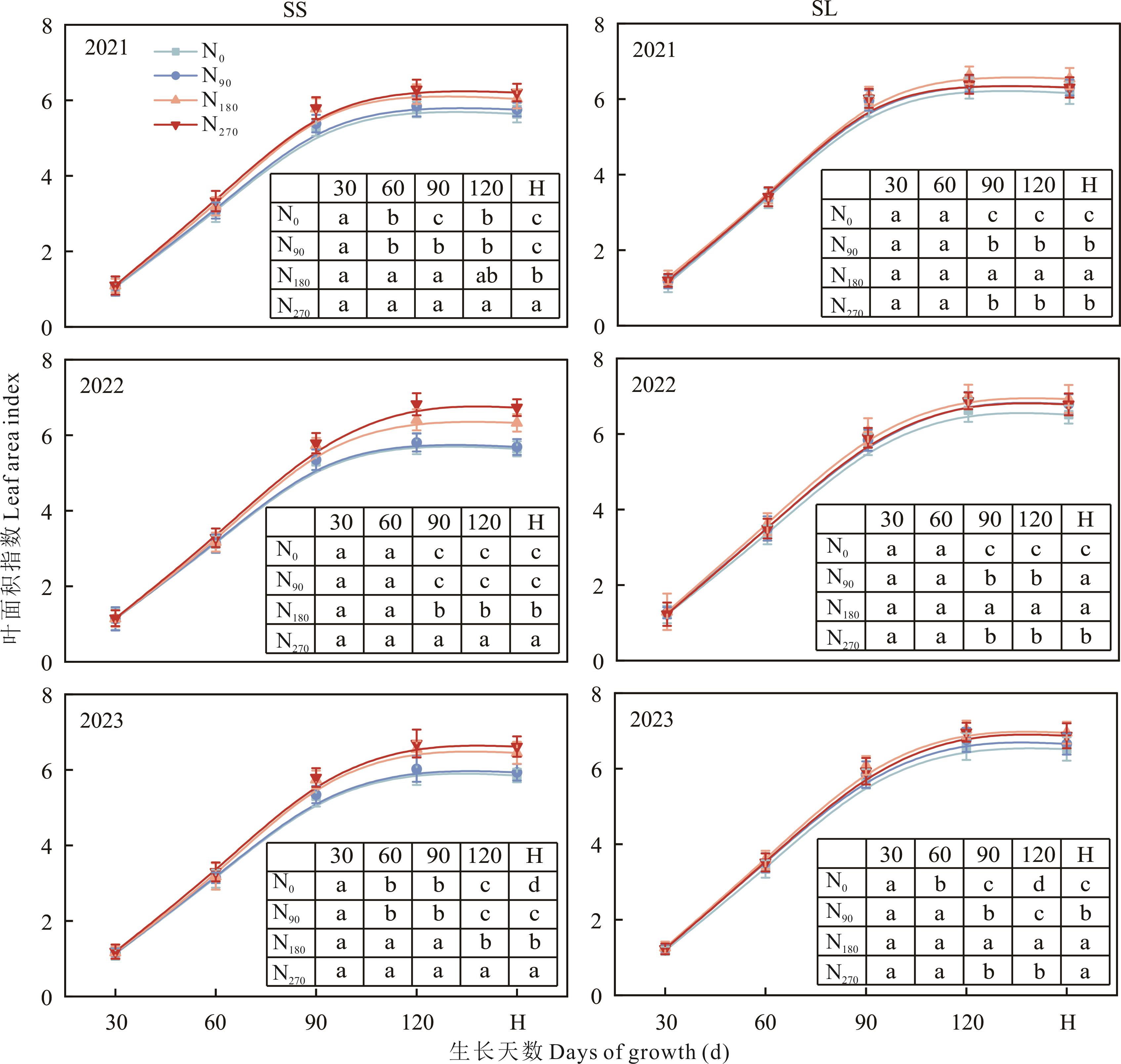
图3 不同种植模式及施氮水平对叶面积指数的影响
Fig.3 Effects of different cropping patterns and nitrogen application levels on leaf area index

图4 不同种植模式及施氮水平对干草产量和粗蛋白产量的影响P: 种植模式Cropping patterns; N: 施氮水平Nitrogen application levels; P×N: 种植模式与施氮水平交互作用The interaction between cropping patterns and nitrogen application levels. 不同小写字母表示不同处理间差异显著(P<0.05)。Different lowercase letters indicate significant differences among different treatments (P<0.05). *: P<0.05; **: P<0.01; ***: P<0.001. 下同The same below.
Fig.4 Effects of different cropping patterns and nitrogen application levels on dry matter yield and crude protein yield
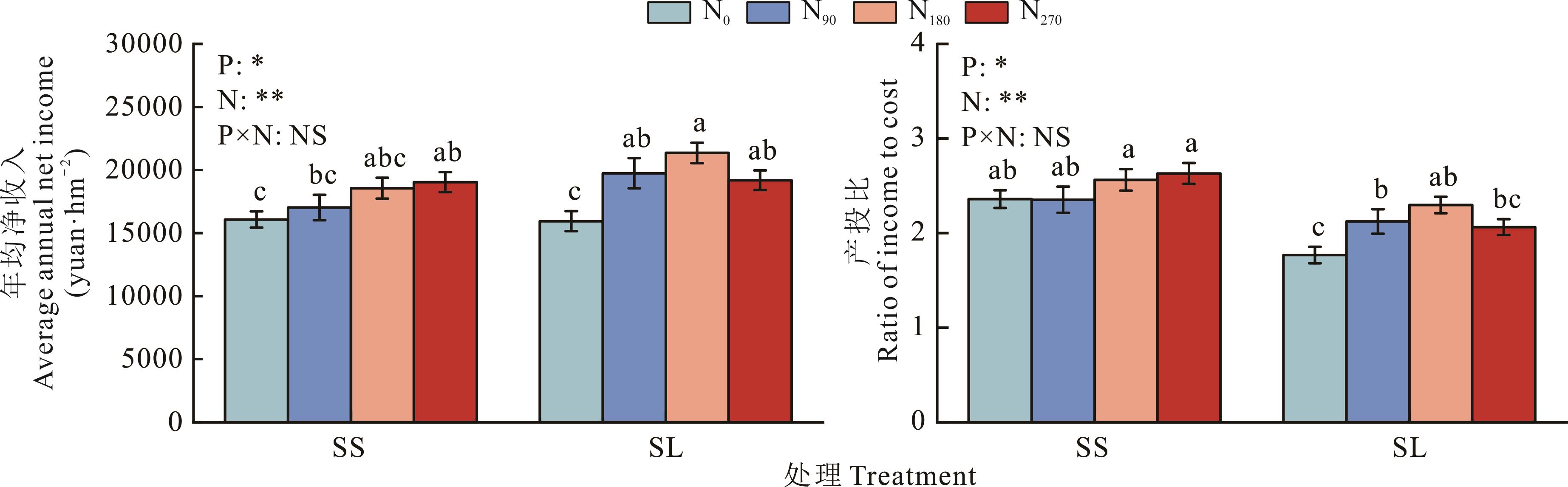
图5 不同种植模式及施氮水平对3年(2021-2023年)平均经济效益的影响
Fig.5 Effects of different cropping patterns and nitrogen application levels on annual average (2021-2023) economic performance
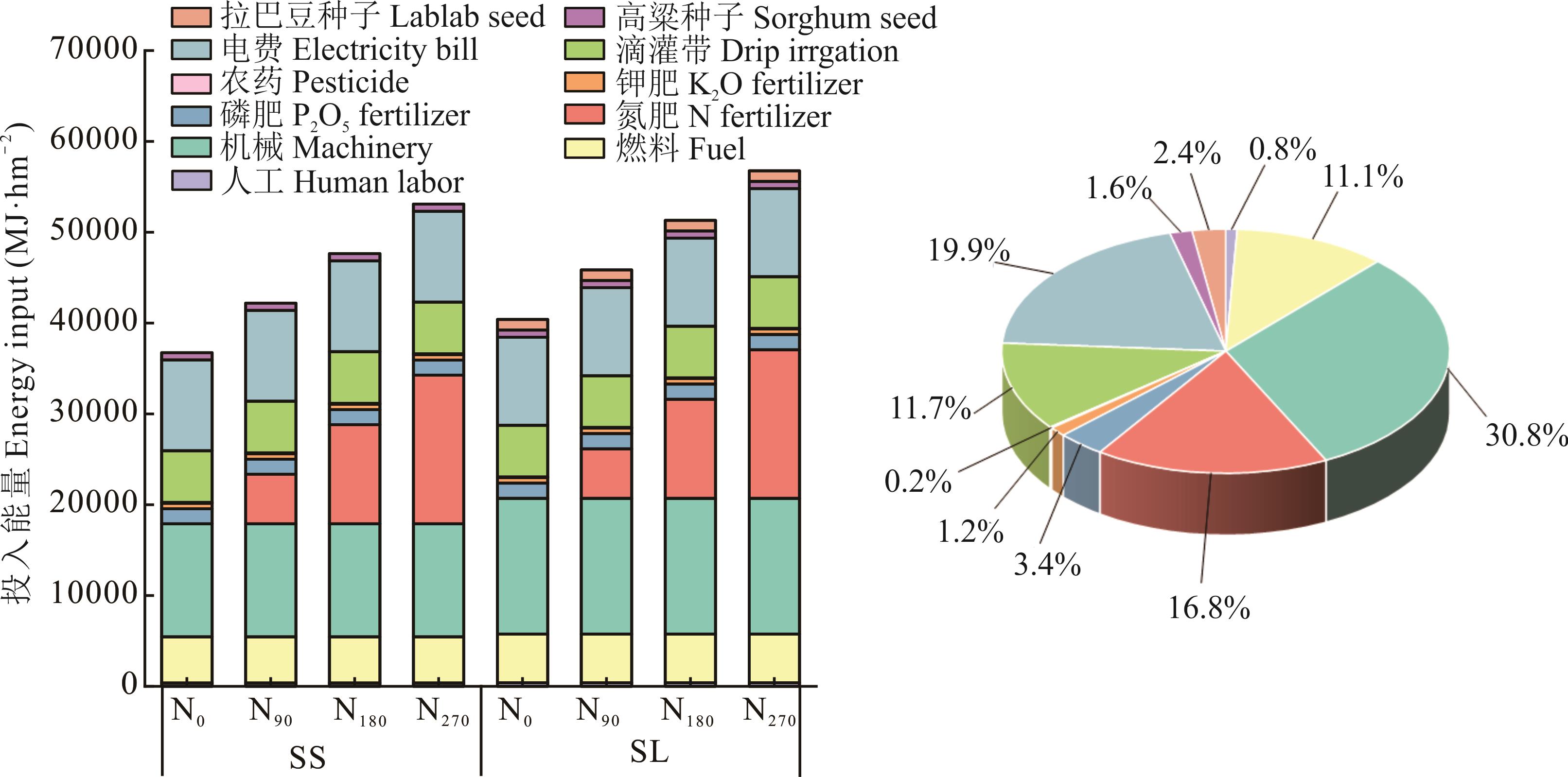
图6 不同种植模式及施氮水平下各组成部分的能量投入占比
Fig.6 Percentage of energy input of each component under different cropping patterns and nitrogen application levels
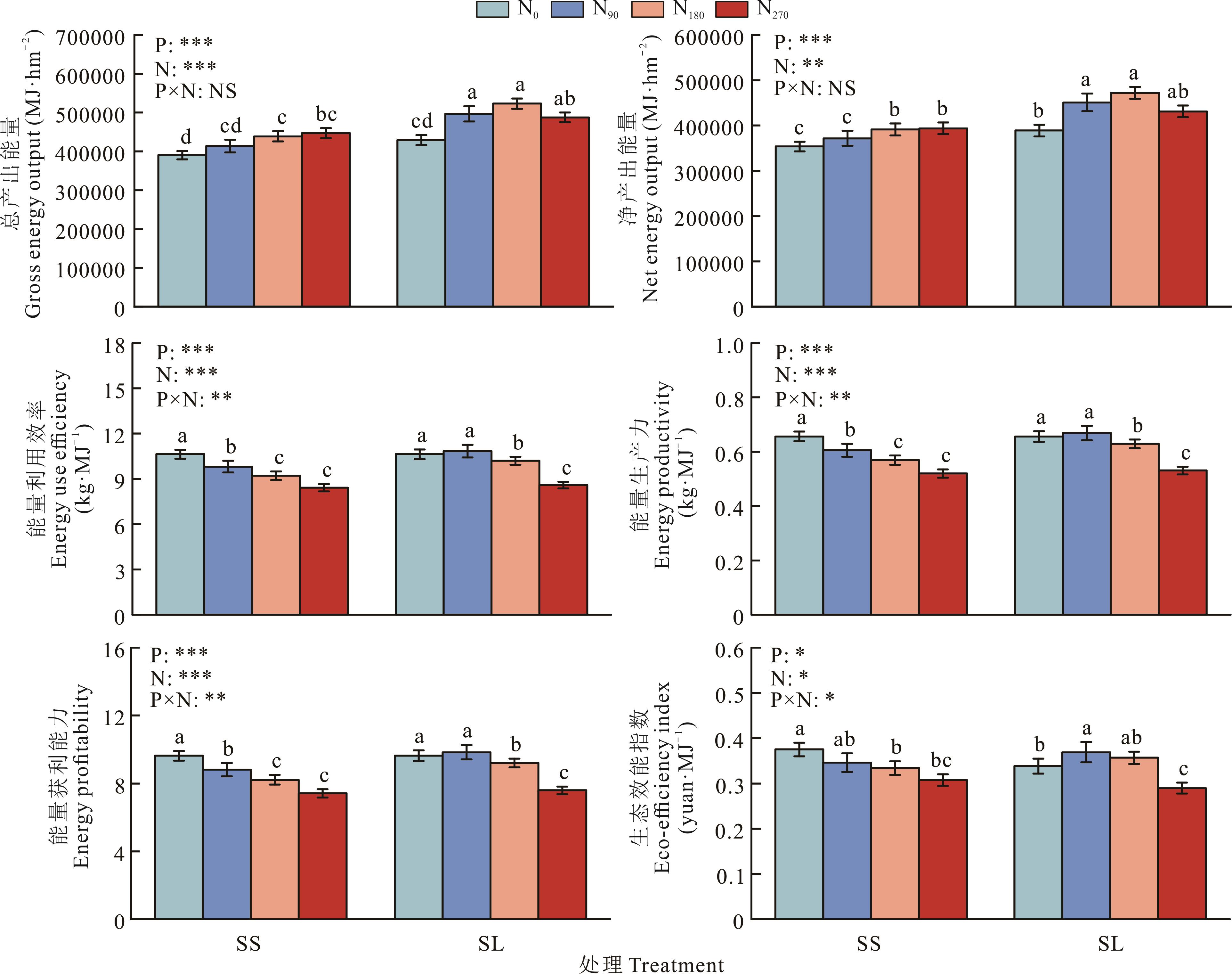
图7 不同种植模式及施氮水平对3年(2021-2023)平均能量利用的影响
Fig.7 Effects of different cropping patterns and nitrogen application levels on average annual (2021-2023) energy utilization
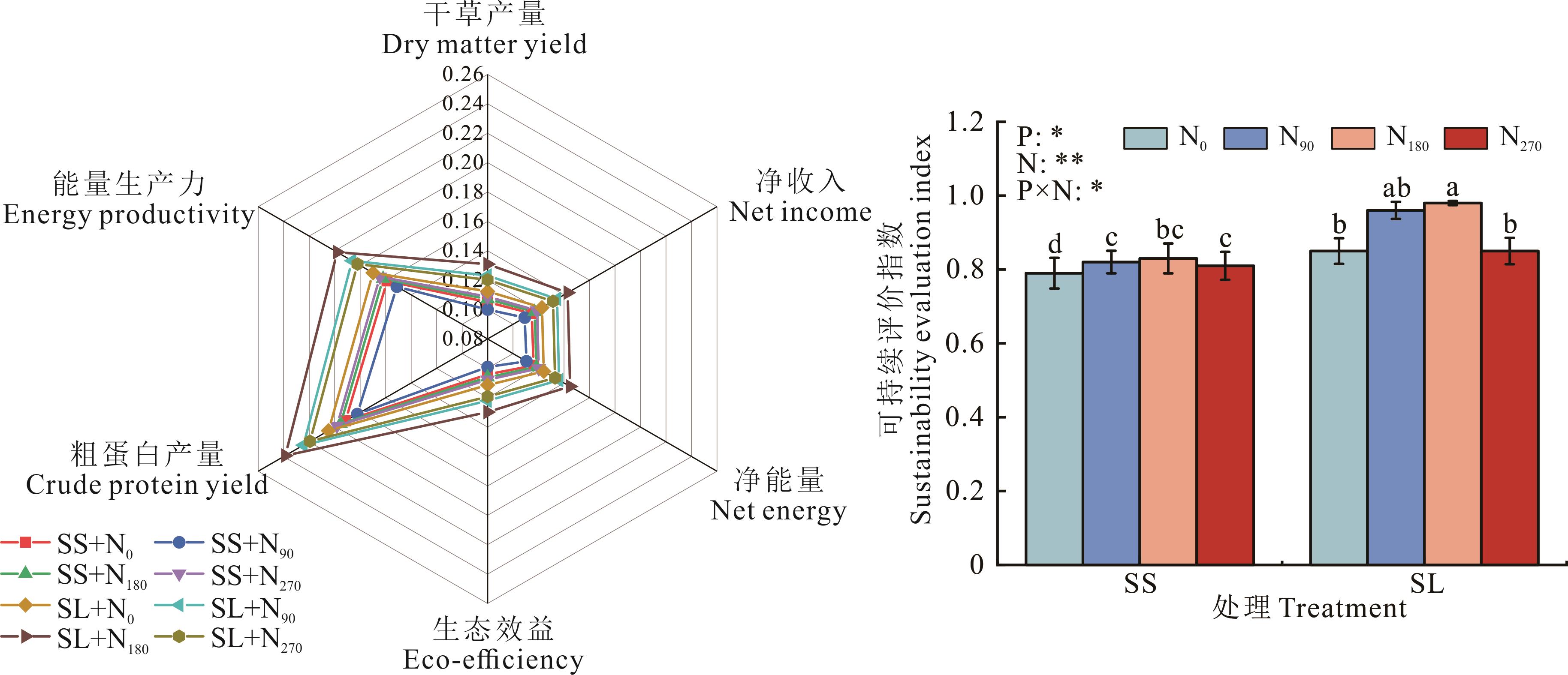
图8 可持续评价指数
Fig.8 Sustainability evaluation index
| [1] | Wang B, Deng J Q, Wang T F, et al. Effect of seeding options on interspecific competition in oat (Avena sativa L.)-common vetch (Vicia sativa L.) forage crops. Agronomy, 2022, 12(12): 3119. |
| [2] | Xiong Z Q, Zhang X X. Key role of efficient nitrogen application in low carbon agriculture. Journal of Plant Nutrition and Fertilizers, 2017, 23(6): 1433-1440. |
| 熊正琴, 张晓旭. 氮肥高效施用在低碳农业中的关键作用. 植物营养与肥料学报, 2017, 23(6): 1433-1440. | |
| [3] | Ding Y L, Zhao N N, Li M, et al. Carbon source/sink and carbon footprint estimation for field crop production and spatial characterization in northern Shaanxi Province. Acta Ecologica Sinica, 2024, 44(11): 4574-4583. |
| 丁也璐, 赵娜娜, 黎明, 等. 陕北农田作物生产碳源/汇及碳足迹空间特征. 生态学报, 2024, 44(11): 4574-4583. | |
| [4] | Tongwane M I, Moeletsi M E. A review of greenhouse gas emissions from the agriculture sector in Africa. Agricultural Systems, 2018, 166(10): 124-134. |
| [5] | Gan Y T, Liang C, Chai Q, et al. Improving farming practices reduces the carbon footprint of spring wheat production. Nature Communications, 2014, 5(10): 5012. |
| [6] | Liu C, Cutforth H, Chai Q, et al. Farming tactics to reduce the carbon footprint of crop cultivation in semiarid areas. Agronomy for Sustainable Development, 2016, 36(4): 69. |
| [7] | Peng S B. Reflection on China’s rice production strategies during the transition period. Scientia Sinica (Vitae), 2014, 44(8): 845-850. |
| [8] | Dearing J A, Zhang K, Cao W D, et al. Who determines the trade-offs between agricultural production and environmental quality? An evolutionary perspective from rural eastern China. International Journal of Agricultural Sustainability, 2019, 17(5): 347-366. |
| [9] | Li C, Hoffland E, Kuyper T W, et al. Syndromes of production in intercropping impact yield gains. Nature Plants, 2020, 6(6): 653-660. |
| [10] | Chen X S, Wu S W, Nan L L, et al. Effects of fertilization on forage yield and quality of Legume-Gramineae mixtures in the Hexi Corridor region. Chinese Journal of Grassland, 2024, 46(6): 57-65. |
| 陈孝善, 吴世文, 南丽丽, 等. 施肥对河西走廊豆禾混播草地产量及品质的影响. 中国草地学报, 2024, 46(6): 57-65. | |
| [11] | Wu G L, Liu Z H, Zhang L, et al. Effects of artificial grassland establishment on soil nutrients and carbon properties in a black-soil-type degraded grassland. Plant and Soil, 2010, 333(12): 469-479. |
| [12] | Xia L L, Xia Y Q, Li B L, et al. Integrating agronomic practices to reduce greenhouse gas emissions while increasing the economic return in a rice-based cropping system. Agriculture Ecosystems & Environment, 2016, 231(9): 24-33. |
| [13] | Zhao X, Wang S Q, Xing G X. Maintaining rice yield and reducing N pollution by substituting winter legume for wheat in a heavily-fertilized rice-based cropping system of southeast China. Agriculture Ecosystems & Environment, 2015, 202(4): 79-89. |
| [14] | Shcherbak I, Millar N, Robertson G P. Global metaanalysis of the nonlinear response of soil nitrous oxide (N2O) emissions to fertilizer nitrogen. Proceedings of the National Academy of Sciences, 2014, 111(25): 199-204. |
| [15] | Schroll H. Energy-flow and ecological sustainability in Danish agriculture. Agriculture, Ecosystems & Environment, 1994, 51(3): 301-310. |
| [16] | Nasso N N O D, Bosco S, Bene C D, et al. Energy efficiency in long-term Mediterranean cropping systems with different management intensities. Energy, 2011, 36(4): 1924-1930. |
| [17] | Ma R S, Jiang C Z, Gao W, et al. Effects of slow-release N fertilizer on growth and water-and N-use efficiencies of forage sweet sorghum under three different irrigation regimes. Acta Prataculturae Sinica, 2023, 32(10): 71-81. |
| 马仁诗, 蒋丛泽, 高玮, 等. 不同水分条件下缓释氮肥对饲用甜高粱生长和水氮利用效率的影响. 草业学报, 2023, 32(10): 71-81. | |
| [18] | Wang B, Shi J M, Wang T F, et al. Effect of nitrogen application on production performance and nitrogen fertilizer contribution of forage sorghum/lablab mixed cropping. Acta Prataculturae Sinica, 2025, 34(4): 53-63. |
| 王斌, 史佳梅, 王腾飞, 等. 施氮对饲用高粱/拉巴豆混播草地生产性能和氮肥贡献率的影响. 草业学报, 2025, 34(4): 53-63. | |
| [19] | Marsalis M A, Angadi S V, Govea C. Dry matter yield and nutritive value of corn, forage sorghum, and BMR forage sorghum at different plant populations and nitrogen rates. Field Crops Research, 2010, 116(1/2): 52-57. |
| [20] | Umesh M R, Angadi S, Begna S, et al. Intercropping and species interactions on physiological and light use characteristics of forage cereals-legumes combinations in semi-arid regions. Field Crops Research, 2023, 290(1): 108755. |
| [21] | Liu X H, Xu W X, Li Z J, et al. The missteps, improvement and application of carbon footprint methodology in farmland ecosystems with the case study of analyzing the carbon efficiency of China’s intensive farming. Chinese Journal of Agricultural Resources and Regional Planning, 2014, 35(1): 1-7. |
| 刘巽浩, 徐文修, 李增嘉, 等. 农田生态系统碳足迹法: 误区、改进与应用—兼析中国集约农作碳效率(续). 中国农业资源与区划, 2014, 35(1): 1-7. | |
| [22] | West T O, Marland G. A synthesis of carbon sequestration, carbon emissions, and net carbon flux in agriculture: comparing tillage practices in the United States. Agriculture Ecosystems & Environment, 2002, 91(1/3): 217-232. |
| [23] | Deng J Q, Ni H, Zhang Z X, et al. Designing productive, energy-efficient, and environmentally friendly production systems by replacing fallow period with annual forage cultivation on the Loess Plateau of China. Journal of Cleaner Production, 2021, 320(10): 128660. |
| [24] | Gou Z W, Yin W, Chai Q, et al. Analysis of sustainability of multiple cropping green manure in wheat-maize intercropping after wheat harvested in arid irrigation areas. Scientia Agricultura Sinica, 2022, 55(7): 1319-1331. |
| 苟志文, 殷文, 柴强, 等. 干旱灌区小麦间作玉米麦后复种绿肥的可持续性分析. 中国农业科学, 2022, 55(7): 1319-1331. | |
| [25] | Wang S, Li K L, Nie J W, et al. Economic benefits and carbon footprint of a spring mung bean-summer maize cropping system in the North China Plain. Chinese Journal of Eco-Agriculture, 2020, 28(6): 910-919. |
| 王上, 李康利, 聂江文, 等. 华北平原春绿豆-夏玉米种植模式经济效益和碳足迹评价. 中国生态农业学报(中英文), 2020, 28(6): 910-919. | |
| [26] | Li Y J, Ma P J, Wu J H, et al. Effects of interplanting with Dolichos lablab on agronomic traits and yield of two varieties of silage maize. Acta Prataculturae Sinica, 2019, 28(9): 209-216. |
| 李亚娇, 马培杰, 吴佳海, 等. 不同品种青贮玉米与拉巴豆套种对青贮玉米农艺性状及产量的影响. 草业学报, 2019, 28(9): 209-216. | |
| [27] | Baxevanos D, Tsialtas I T, Dimitrios N V, et al. Cultivar competitiveness in pea-oat intercrops under Mediterranean conditions. Field Crops Research, 2017, 214(12): 94-103. |
| [28] | Nandi S, Maitra S, Shankar T, et al. Impact of intercropping of vegetable legumes in summer maize on productivity and competitive ability of crops. Crop Research, 2022, 57(3): 122-127. |
| [29] | Wang B, Deng J Q, Wang T F, et al. Optimizing nitrogen application rates to maximize productivity while reducing environmental risk by regulating nitrogen and water utilization in mixed cropping systems. Agricultural Water Management, 2024, 303(10): 109053. |
| [30] | Du Q, Zhou L, Chen P, et al. Relay-intercropping soybean with maize maintains soil fertility and increases nitrogen recovery efficiency by reducing nitrogen input. The Crop Journal, 2020, 8(1): 140-152. |
| [31] | Hu F, Zhao C, Feng F X, et al. Improving N management through intercropping alleviates the inhibitory effect of mineral N on nodulation in pea. Plant & Soil, 2017, 412(1/2): 235-251. |
| [32] | Cai S Y, Pittelkow C M, Zhao X, et al. Winter legume-rice rotations can reduce nitrogen pollution and carbon footprint while maintaining net ecosystem economic benefits. Journal of Cleaner Production, 2018, 195(10): 289-300. |
| [33] | Billore S D, Joshi O P. Effect of spatial arrangement of soybean and sorghum in intercropping on productivity and energy use efficiency. Journal of Oilseeds Research, 2005, 22(1): 194-196. |
| [34] | Singh R J, Ghosh B N, Sharma N K, et al. Energy budgeting and emergy synthesis of rainfed maize-wheat rotation system with different soil amendment applications. Ecological Indicators, 2016, 61(2): 753-765. |
| [1] | 王红林, 文斌, 左艳春, 张凯, 吴子周, 严旭, 袁正才, 邓榆川, 肖蔹, 陈慧, 寇晶, 傅祥超, 杜周和. 全株饲料桑添加量对川白獭兔幼兔肠道形态、血液生化指标、肌肉中氨基酸含量及经济效益的影响[J]. 草业学报, 2025, 34(8): 199-210. |
| [2] | 任春燕, 郝志云, 邴睿, 霍应栋, 赵海碧, 尹鹏飞, 唐德富, 蔺淑琴, 王继卿. 开食料添加纤维素酶对羔羊生产性能、器官发育、肌肉脂肪酸组成及血清抗氧化指标的影响[J]. 草业学报, 2025, 34(7): 120-131. |
| [3] | 项凌飞, 张峰举, 麻冬梅, 刘金龙, 兰剑, 邓建强, 胡海英, 王斌, 蔡春江, 马巧利. 氮磷钾配施对盐碱地湖南稷子生产性能和营养品质的影响[J]. 草业学报, 2025, 34(7): 185-195. |
| [4] | 陈薪宇, 邓正昕, 王子芳, 谢军, 代文才, 高明. 铵态氮肥施用量对不同类型紫色土氮淋失及表面电化学性质的影响[J]. 草业学报, 2025, 34(7): 69-82. |
| [5] | 刘启林, 王小军, 王金兰, 刘文辉, 马巧玲, 李建辉, 张生原, 曹文侠, 李文. 氮磷配施对高寒区老芒麦饲草产量的影响[J]. 草业学报, 2025, 34(6): 193-202. |
| [6] | 王腾飞, 马霞, 刘金龙, 王斌, 张译尹, 李佳旺, 马江萍, 王小兵, 兰剑. 引黄灌区复种饲用燕麦种植模式产量、品质及经济效益分析[J]. 草业学报, 2025, 34(4): 27-37. |
| [7] | 张晓娟, 魏娇娇, 陈彩锦, 李雪雪, 马宏秀, 李凯, 陈永伟, 孙权. 氮肥周年优化对灌区饲用小黑麦-青贮玉米复种系统生产力的影响[J]. 草业学报, 2025, 34(4): 38-52. |
| [8] | 王斌, 史佳梅, 王腾飞, 张译尹, 马江萍, 李佳旺, 王小兵, 邓建强, 兰剑. 施氮对饲用高粱/拉巴豆混播草地生产性能和氮肥贡献率的影响[J]. 草业学报, 2025, 34(4): 53-63. |
| [9] | 马江萍, 张译尹, 王腾飞, 王斌, 兰剑. 饲用高粱与拉巴豆混播对种间关系及草地生产力的影响[J]. 草业学报, 2025, 34(3): 111-122. |
| [10] | 赵雅姣, 刘晓静, 蔺芳. 适宜于黄土高原半干旱区豆禾饲草间套作组合的筛选[J]. 草业学报, 2025, 34(3): 97-110. |
| [11] | 王文虎, 梁国玲, 刘文辉, 王凤宇, 李文. 青藏高原区8份老芒麦资源农艺性状与生产性能综合评价[J]. 草业学报, 2025, 34(2): 123-132. |
| [12] | 卢小倩, 陈金露, 杨卫君, 郭青云, 王单丽, 赵红梅. 氮肥减量配施腐植酸对北疆滴灌玉米田土壤真菌群落的影响[J]. 草业学报, 2025, 34(10): 120-131. |
| [13] | 赵文军, 梁婷, 王剑松, 刘魁, 冯瑜, 王正旭, 徐梓荷, 朱云聪, 孙蒙猛, 李湘伟, 付利波, 尹梅, 周国朋, 陈华, 曹卫东. 种植翻压光叶紫花苕配合氮肥减施提高烤烟产量和土壤质量[J]. 草业学报, 2025, 34(10): 74-84. |
| [14] | 李中利, 蒋丛泽, 马仁诗, 高玮, 受娜, 沈禹颖, 杨宪龙. 陇东旱塬区5个饲用甜高粱品种生产适宜性评价[J]. 草业学报, 2024, 33(8): 50-62. |
| [15] | 桑瑞娟, 崔超杰, 何云, 张晓霞, 姚晋, 董春阳, 孙浩, 史莹华, 朱晓艳, 李德锋. 豫北地区18个秋播饲用燕麦品种抗倒伏特性及生产性能评价[J]. 草业学报, 2024, 33(8): 74-85. |
| 阅读次数 | ||||||
|
全文 |
|
|||||
|
摘要 |
|
|||||
