
ISSN 1004-5759 CN 62-1105/S
Acta Prataculturae Sinica ›› 2027, Vol. 36 ›› Issue (1): 163-179.DOI: 10.11686/cyxb2026021
Feng-jiao CHEN( ), Wen-juan KANG(), Bing-sen ZHAO, Yi-lin HAN, Wen-kai LI
Received:2026-01-13
Revised:2026-03-30
Online:2027-01-20
Published:2026-11-25
Contact:
Wen-juan KANG
Feng-jiao CHEN, Wen-juan KANG, Bing-sen ZHAO, Yi-lin HAN, Wen-kai LI. Genetic diversity analysis and DNA molecular ID construction of 32 alfalfa (Medicago sativa) accessions[J]. Acta Prataculturae Sinica, 2027, 36(1): 163-179.
序号 No. | 品种/株系名称 Variety/strain name | 简称 Abbreviation | 序号 No. | 品种/株系名称 Variety/strain name | 简称 Abbreviation |
|---|---|---|---|---|---|
| 1 | 6010 | LY | 5 | 甘农9号Gannong No.9 | G9 |
| 2 | 甘农12号Gannong No.12 | G12 | 6 | WL298HQ | W298 |
| 3 | 甘农3号Gannong No.3 | G3 | 7 | WL319HQ | W319 |
| 4 | 甘农7号Gannong No.7 | G7 | 8 | 游客Youke | YK |
Table 1 Information on eight alfalfa varieties
序号 No. | 品种/株系名称 Variety/strain name | 简称 Abbreviation | 序号 No. | 品种/株系名称 Variety/strain name | 简称 Abbreviation |
|---|---|---|---|---|---|
| 1 | 6010 | LY | 5 | 甘农9号Gannong No.9 | G9 |
| 2 | 甘农12号Gannong No.12 | G12 | 6 | WL298HQ | W298 |
| 3 | 甘农3号Gannong No.3 | G3 | 7 | WL319HQ | W319 |
| 4 | 甘农7号Gannong No.7 | G7 | 8 | 游客Youke | YK |
序号 No. | 品种/株系名称 Variety/strain name | 序号 No. | 品种/株系名称 Variety/strain name | 序号 No. | 品种/株系名称 Variety/strain name | 序号 No. | 品种/株系名称 Variety/strain name |
|---|---|---|---|---|---|---|---|
| 1 | LY-DH | 7 | G3-DH | 13 | G9-DH | 19 | W319-DH |
| 2 | LY-DZ | 8 | G3-DZ | 14 | G9-DZ | 20 | W319-DZ |
| 3 | LY-Dzhu | 9 | G3-Dzhu | 15 | G9-Dzhu | 21 | W319-Dzhu |
| 4 | G12-DH | 10 | G7-DH | 16 | W298-DH | 22 | YK-DH |
| 5 | G12-DZ | 11 | G7-DZ | 17 | W298-DZ | 23 | YK-DZ |
| 6 | G12-Dzhu | 12 | G7-Dzhu | 18 | W298-Dzhu | 24 | YK-Dzhu |
Table 2 24 F1 generation lines name
序号 No. | 品种/株系名称 Variety/strain name | 序号 No. | 品种/株系名称 Variety/strain name | 序号 No. | 品种/株系名称 Variety/strain name | 序号 No. | 品种/株系名称 Variety/strain name |
|---|---|---|---|---|---|---|---|
| 1 | LY-DH | 7 | G3-DH | 13 | G9-DH | 19 | W319-DH |
| 2 | LY-DZ | 8 | G3-DZ | 14 | G9-DZ | 20 | W319-DZ |
| 3 | LY-Dzhu | 9 | G3-Dzhu | 15 | G9-Dzhu | 21 | W319-Dzhu |
| 4 | G12-DH | 10 | G7-DH | 16 | W298-DH | 22 | YK-DH |
| 5 | G12-DZ | 11 | G7-DZ | 17 | W298-DZ | 23 | YK-DZ |
| 6 | G12-Dzhu | 12 | G7-Dzhu | 18 | W298-Dzhu | 24 | YK-Dzhu |
序号 No. | 引物 Primers | 序号 No. | 引物 Primers | 序号 No. | 引物 Primers | 序号 No. | 引物 Primers | 序号 No. | 引物 Primers | 序号 No. | 引物 Primers | 序号 No. | 引物 Primers |
|---|---|---|---|---|---|---|---|---|---|---|---|---|---|
| 1 | AFCT45 | 10 | AFCTT1 | 19 | A1Fl | 28 | MTIC475 | 37 | AFCt32 | 46 | B14B03 | 55 | BE112 |
| 2 | MTIC251 | 11 | MTIC332 | 20 | AFCT45 | 29 | A11OS | 38 | AFca1 | 47 | BI10 | 56 | BE92 |
| 3 | MTIC250 | 12 | MTB330 | 21 | BE149 | 30 | AFCA1 | 39 | AFca11 | 48 | MTIC432 | 57 | BF123 |
| 4 | MTIC183 | 13 | AFCTT1 | 22 | MTIC237 | 31 | ACT012 | 40 | MTB76 | 49 | Act012 | 58 | m206 |
| 5 | MTIC475 | 14 | MA1368684 | 23 | B14B03 | 32 | MSEST9 | 41 | MAA600456 | 50 | AL73 | 59 | m230 |
| 6 | MTB340 | 15 | MA1369471 | 24 | MTB60 | 33 | MSEST15 | 42 | aw01 | 51 | AW123 | 60 | Ms-27 |
| 7 | MTB292 | 16 | MT1EC2A | 25 | AGATO11 | 34 | MSEST43 | 43 | AW11 | 52 | AW282 | 61 | Ms-64 |
| 8 | MTB200 | 17 | ICCEM0105 | 26 | AFCTT1 | 35 | MSEST94 | 44 | AW166 | 53 | AW300 | 62 | MT1E04 |
| 9 | MTB60 | 18 | AFCT60 | 27 | AGATO12 | 36 | AFCt11 | 45 | aw690665 | 54 | aw695900 | 63 | MTIC249 |
Table 3 63 pairs of SSR primers
序号 No. | 引物 Primers | 序号 No. | 引物 Primers | 序号 No. | 引物 Primers | 序号 No. | 引物 Primers | 序号 No. | 引物 Primers | 序号 No. | 引物 Primers | 序号 No. | 引物 Primers |
|---|---|---|---|---|---|---|---|---|---|---|---|---|---|
| 1 | AFCT45 | 10 | AFCTT1 | 19 | A1Fl | 28 | MTIC475 | 37 | AFCt32 | 46 | B14B03 | 55 | BE112 |
| 2 | MTIC251 | 11 | MTIC332 | 20 | AFCT45 | 29 | A11OS | 38 | AFca1 | 47 | BI10 | 56 | BE92 |
| 3 | MTIC250 | 12 | MTB330 | 21 | BE149 | 30 | AFCA1 | 39 | AFca11 | 48 | MTIC432 | 57 | BF123 |
| 4 | MTIC183 | 13 | AFCTT1 | 22 | MTIC237 | 31 | ACT012 | 40 | MTB76 | 49 | Act012 | 58 | m206 |
| 5 | MTIC475 | 14 | MA1368684 | 23 | B14B03 | 32 | MSEST9 | 41 | MAA600456 | 50 | AL73 | 59 | m230 |
| 6 | MTB340 | 15 | MA1369471 | 24 | MTB60 | 33 | MSEST15 | 42 | aw01 | 51 | AW123 | 60 | Ms-27 |
| 7 | MTB292 | 16 | MT1EC2A | 25 | AGATO11 | 34 | MSEST43 | 43 | AW11 | 52 | AW282 | 61 | Ms-64 |
| 8 | MTB200 | 17 | ICCEM0105 | 26 | AFCTT1 | 35 | MSEST94 | 44 | AW166 | 53 | AW300 | 62 | MT1E04 |
| 9 | MTB60 | 18 | AFCT60 | 27 | AGATO12 | 36 | AFCt11 | 45 | aw690665 | 54 | aw695900 | 63 | MTIC249 |
| 项目Item | 添加量Addition amount (μL) |
|---|---|
| 2×San Taq PCR Mix | 10.0 |
| DNA模板DNA template | 2.0 |
| 上游引物Forward primer | 0.5 |
| 下游引物Reverse primer | 0.5 |
| ddH2O | 7.0 |
Table 4 PCR reaction system
| 项目Item | 添加量Addition amount (μL) |
|---|---|
| 2×San Taq PCR Mix | 10.0 |
| DNA模板DNA template | 2.0 |
| 上游引物Forward primer | 0.5 |
| 下游引物Reverse primer | 0.5 |
| ddH2O | 7.0 |
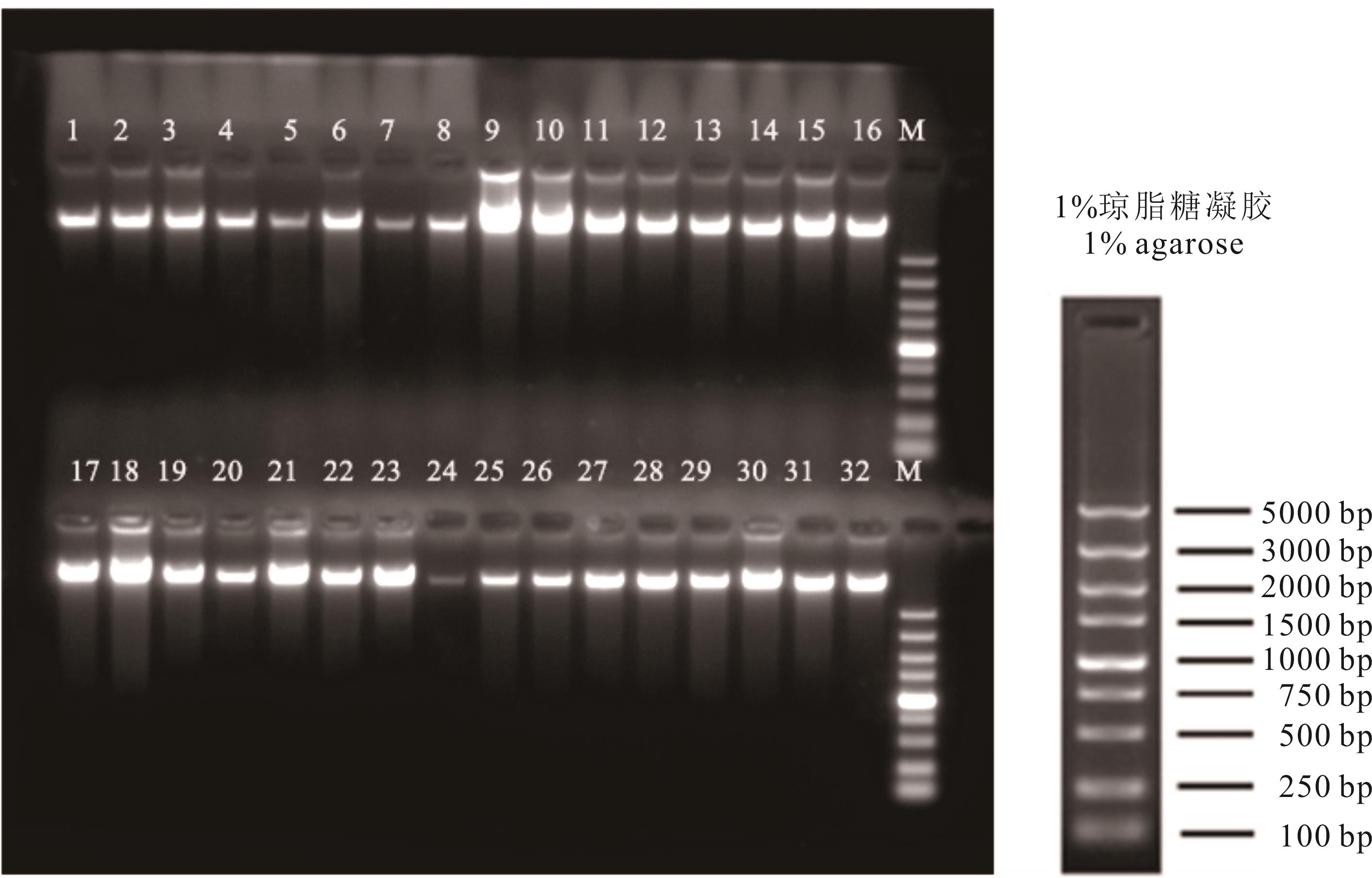
Fig.1 DNA testing of 32 test materials
引物 Primers | 正向 Forward (5′-3′) | 反向 Reverse (5′-3′) | 扩增总条带数 Total amplified bands (No.) | 多态性条带数 Number of polymorphic bands (No.) | 多态性比率 Percentage of polymorphic bands (%) |
|---|---|---|---|---|---|
| MTIC475 | GGATTGAAATGCACTCTCTC | TTAATAAACGCCGCTCCT | 3.0 | 2.0 | 67 |
| MSEST9 | ACAACATGGCTTCAACACCT | TCACCCACCAAATCAGAATC | 6.0 | 6.0 | 100 |
| MSEST94 | AACTCCCAAACTCAGAACCC | TCCTCGTTCTCGAACTTGTC | 5.0 | 5.0 | 100 |
| MAA600456 | GGGTTTTTGATCCAGATCTT | AAGGTGGTCATACGAGCTCC | 8.0 | 8.0 | 100 |
| aw01 | ACCTGTTCTAAGGGAGATTTCG | CAGGGGAAGCATACAAAACC | 4.0 | 4.0 | 100 |
| AW11 | ATTCGCAGTGAGCTGATCCT | GACATTTGCAGACCACCATT | 5.0 | 5.0 | 100 |
| AW123 | AGTCCCTGCAAAATCCCTTC | CATGTTTCCGGTTCTGGTTT | 5.0 | 5.0 | 100 |
| BE92 | AGTTCAAACCCTTACCCTTCA | GATGAGGATGATGATGAATTGG | 7.0 | 7.0 | 100 |
| m230 | TTACCATATTAACCCCCGCA | CGCATATCACCTCCCAGAAT | 4.0 | 4.0 | 100 |
| Ms-27 | GTAGTGAAGGACCAAGAAATGA | CAAGAAATTGTAATCTCCATTG | 5.0 | 5.0 | 100 |
| 平均值Average | 5.2 | 5.1 | 97 |
Table 5 Amplification of 10 pairs of SSR primers
引物 Primers | 正向 Forward (5′-3′) | 反向 Reverse (5′-3′) | 扩增总条带数 Total amplified bands (No.) | 多态性条带数 Number of polymorphic bands (No.) | 多态性比率 Percentage of polymorphic bands (%) |
|---|---|---|---|---|---|
| MTIC475 | GGATTGAAATGCACTCTCTC | TTAATAAACGCCGCTCCT | 3.0 | 2.0 | 67 |
| MSEST9 | ACAACATGGCTTCAACACCT | TCACCCACCAAATCAGAATC | 6.0 | 6.0 | 100 |
| MSEST94 | AACTCCCAAACTCAGAACCC | TCCTCGTTCTCGAACTTGTC | 5.0 | 5.0 | 100 |
| MAA600456 | GGGTTTTTGATCCAGATCTT | AAGGTGGTCATACGAGCTCC | 8.0 | 8.0 | 100 |
| aw01 | ACCTGTTCTAAGGGAGATTTCG | CAGGGGAAGCATACAAAACC | 4.0 | 4.0 | 100 |
| AW11 | ATTCGCAGTGAGCTGATCCT | GACATTTGCAGACCACCATT | 5.0 | 5.0 | 100 |
| AW123 | AGTCCCTGCAAAATCCCTTC | CATGTTTCCGGTTCTGGTTT | 5.0 | 5.0 | 100 |
| BE92 | AGTTCAAACCCTTACCCTTCA | GATGAGGATGATGATGAATTGG | 7.0 | 7.0 | 100 |
| m230 | TTACCATATTAACCCCCGCA | CGCATATCACCTCCCAGAAT | 4.0 | 4.0 | 100 |
| Ms-27 | GTAGTGAAGGACCAAGAAATGA | CAAGAAATTGTAATCTCCATTG | 5.0 | 5.0 | 100 |
| 平均值Average | 5.2 | 5.1 | 97 |
引物 Primers | 等位基因数 Number of alleles | 有效等位基因数 Effective number of alleles | Nei’s基因多样性指数 Nei’s gene diversity index | 香农多样性指数 Shannon diversity index | 多态信息含量 Polymorphism information content |
|---|---|---|---|---|---|
| MTIC475 | 1.67 | 1.2014 | 0.1454 | 0.3871 | 0.42 |
| MSEST9 | 2.00 | 1.6471 | 0.3692 | 0.6329 | 0.80 |
| MSEST94 | 2.00 | 1.3999 | 0.2558 | 0.4957 | 0.65 |
| MAA600456 | 2.00 | 1.4206 | 0.2556 | 0.3965 | 0.80 |
| aw01 | 2.00 | 1.6554 | 0.3699 | 0.6527 | 0.68 |
| AW11 | 2.00 | 1.5603 | 0.3263 | 0.5772 | 0.71 |
| AW123 | 2.00 | 1.6012 | 0.3289 | 0.5718 | 0.71 |
| BE92 | 2.00 | 1.2644 | 0.1740 | 0.2908 | 0.66 |
| m230 | 2.00 | 1.6140 | 0.3692 | 0.6597 | 0.70 |
| Ms-27 | 2.00 | 1.6384 | 0.3500 | 0.6031 | 0.72 |
| 平均Average | 1.97 | 1.5003 | 0.2944 | 0.5268 | 0.69 |
| 标准差Standard deviation | 0.11 | 0.1676 | 0.0829 | 0.1284 | 0.11 |
Table 6 Genetic diversity analysis of 32 alfalfa samples by SSR markers
引物 Primers | 等位基因数 Number of alleles | 有效等位基因数 Effective number of alleles | Nei’s基因多样性指数 Nei’s gene diversity index | 香农多样性指数 Shannon diversity index | 多态信息含量 Polymorphism information content |
|---|---|---|---|---|---|
| MTIC475 | 1.67 | 1.2014 | 0.1454 | 0.3871 | 0.42 |
| MSEST9 | 2.00 | 1.6471 | 0.3692 | 0.6329 | 0.80 |
| MSEST94 | 2.00 | 1.3999 | 0.2558 | 0.4957 | 0.65 |
| MAA600456 | 2.00 | 1.4206 | 0.2556 | 0.3965 | 0.80 |
| aw01 | 2.00 | 1.6554 | 0.3699 | 0.6527 | 0.68 |
| AW11 | 2.00 | 1.5603 | 0.3263 | 0.5772 | 0.71 |
| AW123 | 2.00 | 1.6012 | 0.3289 | 0.5718 | 0.71 |
| BE92 | 2.00 | 1.2644 | 0.1740 | 0.2908 | 0.66 |
| m230 | 2.00 | 1.6140 | 0.3692 | 0.6597 | 0.70 |
| Ms-27 | 2.00 | 1.6384 | 0.3500 | 0.6031 | 0.72 |
| 平均Average | 1.97 | 1.5003 | 0.2944 | 0.5268 | 0.69 |
| 标准差Standard deviation | 0.11 | 0.1676 | 0.0829 | 0.1284 | 0.11 |

Fig.2 Genetic similarity coefficients and genetic distances of SSR molecular markers for 32 materials
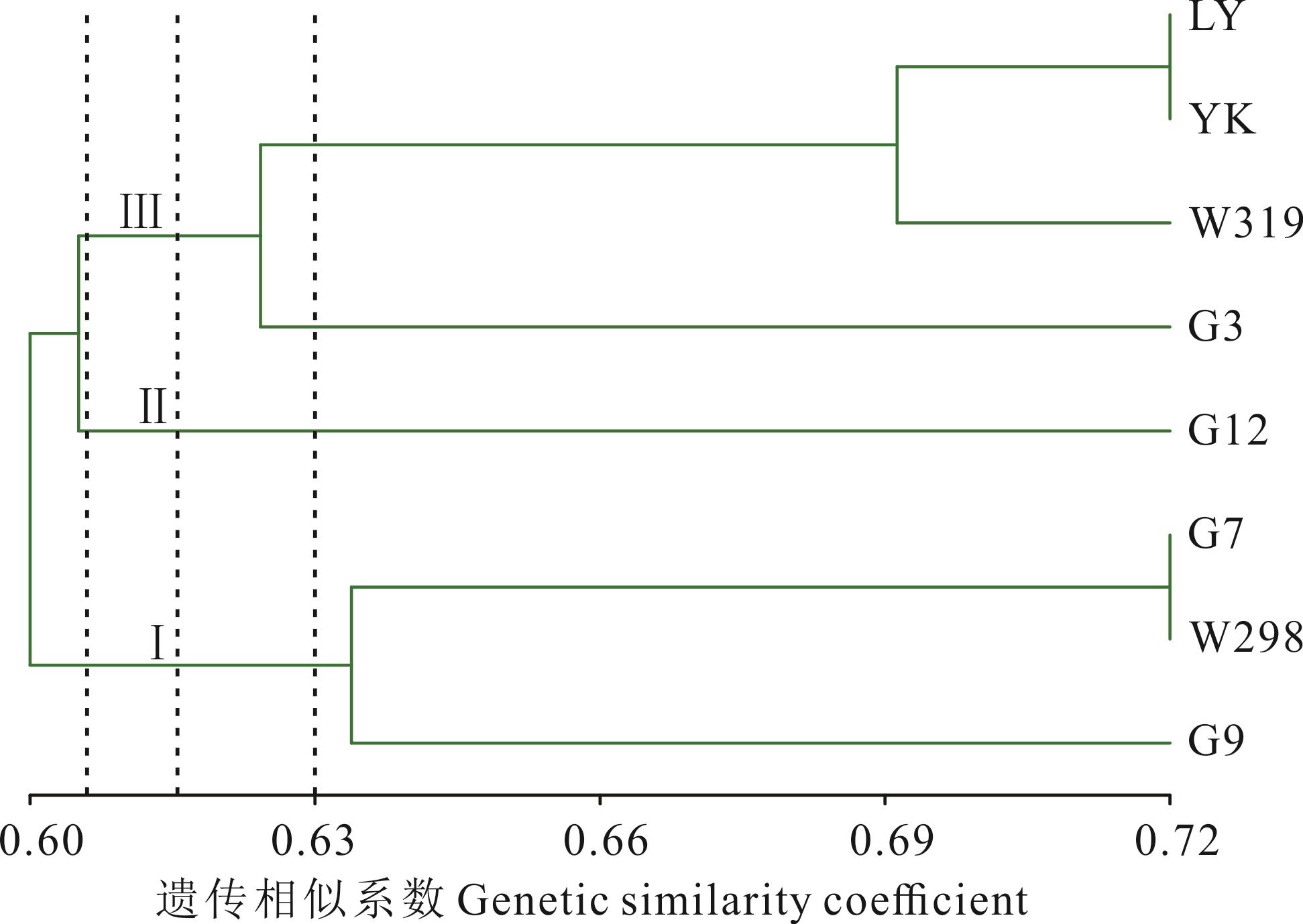
Fig.3 Clustering analysis of genetic similarity coefficients among 8 parental lines

Fig.4 Cluster analysis of genetic similarity coefficients among 8 parental lines and 24 F1 hybrids
引物 Primers | 区分材料数Sort by material quantity (No.) | 区分率 Identification rate (%) |
|---|---|---|
| MSEST9 | 9 | 28.13 |
| MAA600456 | 14 | 43.75 |
| AW11 | 6 | 18.75 |
| AW123 | 4 | 12.50 |
| Ms-27 | 8 | 25.00 |
Table 7 Effect of 5 SSR primers on the differentiation of alfalfa material
引物 Primers | 区分材料数Sort by material quantity (No.) | 区分率 Identification rate (%) |
|---|---|---|
| MSEST9 | 9 | 28.13 |
| MAA600456 | 14 | 43.75 |
| AW11 | 6 | 18.75 |
| AW123 | 4 | 12.50 |
| Ms-27 | 8 | 25.00 |
品种/株系名称 Variety/strain name | 分子身份证编码 Molecular ID code | 品种/株系名称 Variety/strain name | 分子身份证编码 Molecular ID code |
|---|---|---|---|
| LY | 10100000001010001100111001101 | G3-Dzhu | 11100000100100011100110001101 |
| G12 | 01111100001001010100111011111 | G7-DH | 11010000110001011000100001101 |
| G3 | 01110101101000001110110101101 | G7-DZ | 00101000110001011000100001101 |
| G7 | 10100000110101010101110001101 | G7-Dzhu | 10110100011000010010100001001 |
| G9 | 01110010110000010000111011101 | G9-DH | 10011000101010111000011001101 |
| W298 | 01101000110011010101011000101 | G9-DZ | 11010000100010010100011001101 |
| W319 | 11011000110010111000101001001 | G9-Dzhu | 11010000101000110000011010101 |
| YK | 10010000110011011101101001110 | W298-DH | 01110000110010011100011000001 |
| LY-DH | 01110000100010011000001001000 | W298-DZ | 01110000101001001101101001011 |
| LY-DZ | 01110000011010010100011000101 | W298-Dzhu | 01000000110010101100011001101 |
| LY-Dzhu | 11101000011000011000011000101 | W319-DH | 10011000110010010100101001101 |
| G12-DH | 00010000001010010100111001101 | W319-DZ | 01110000100000010100001001101 |
| G12-DZ | 11001000001010110000111001101 | W319-Dzhu | 10011000110000010100101001101 |
| G12-Dzhu | 11001000001010010100111001110 | YK-DH | 10110000100001010100101001000 |
| G3-DH | 00010001100000011100111001001 | YK-DZ | 00011000100010010100100001000 |
| G3-DZ | 01000000001010011100011001001 | YK-Dzhu | 00011000100010110000001001110 |
Table 8 Molecular ID codes of 32 alfalfa accessions
品种/株系名称 Variety/strain name | 分子身份证编码 Molecular ID code | 品种/株系名称 Variety/strain name | 分子身份证编码 Molecular ID code |
|---|---|---|---|
| LY | 10100000001010001100111001101 | G3-Dzhu | 11100000100100011100110001101 |
| G12 | 01111100001001010100111011111 | G7-DH | 11010000110001011000100001101 |
| G3 | 01110101101000001110110101101 | G7-DZ | 00101000110001011000100001101 |
| G7 | 10100000110101010101110001101 | G7-Dzhu | 10110100011000010010100001001 |
| G9 | 01110010110000010000111011101 | G9-DH | 10011000101010111000011001101 |
| W298 | 01101000110011010101011000101 | G9-DZ | 11010000100010010100011001101 |
| W319 | 11011000110010111000101001001 | G9-Dzhu | 11010000101000110000011010101 |
| YK | 10010000110011011101101001110 | W298-DH | 01110000110010011100011000001 |
| LY-DH | 01110000100010011000001001000 | W298-DZ | 01110000101001001101101001011 |
| LY-DZ | 01110000011010010100011000101 | W298-Dzhu | 01000000110010101100011001101 |
| LY-Dzhu | 11101000011000011000011000101 | W319-DH | 10011000110010010100101001101 |
| G12-DH | 00010000001010010100111001101 | W319-DZ | 01110000100000010100001001101 |
| G12-DZ | 11001000001010110000111001101 | W319-Dzhu | 10011000110000010100101001101 |
| G12-Dzhu | 11001000001010010100111001110 | YK-DH | 10110000100001010100101001000 |
| G3-DH | 00010001100000011100111001001 | YK-DZ | 00011000100010010100100001000 |
| G3-DZ | 01000000001010011100011001001 | YK-Dzhu | 00011000100010110000001001110 |
序号 No. | 品种/株系名称 Variety/strain name | 字符串及条形码 Strings and bar codes | 二维码 Two-dimensional code |
|---|---|---|---|
| 1 | LY |  |  |
| 2 | G12 |  |  |
| 3 | G3 |  |  |
| 4 | G7 |  |  |
| 5 | G9 |  |  |
| 6 | W298 |  |  |
| 7 | W319 |  |  |
| 8 | YK |  |  |
| 9 | LY-DH |  |  |
| 10 | LY-DZ |  |  |
| 11 | LY-Dzhu |  |  |
| 12 | G12-DH |  |  |
| 13 | G12-DZ |  |  |
| 14 | G12-Dzhu |  |  |
| 15 | G3-DH |  |  |
| 16 | G3-DZ |  |  |
| 17 | G3-Dzhu |  |  |
| 18 | G7-DH |  |  |
| 19 | G7-DZ |  |  |
| 20 | G7-Dzhu |  |  |
| 21 | G9-DH |  |  |
| 22 | G9-DZ |  |  |
| 23 | G9-Dzhu |  |  |
| 24 | W298-DH |  |  |
| 25 | W298-DZ |  |  |
| 26 | W298-Dzhu |  |  |
| 27 | W319-DH |  |  |
| 28 | W319-DZ |  |  |
| 29 | W319-Dzhu |  |  |
| 30 | YK-DH |  |  |
| 31 | YK-DZ |  |  |
| 32 | YK-Dzhu |  |  |
Table 9 DNA molecular identification of barcode and two-dimensional code of 32 alfalfa materials
序号 No. | 品种/株系名称 Variety/strain name | 字符串及条形码 Strings and bar codes | 二维码 Two-dimensional code |
|---|---|---|---|
| 1 | LY | | |
| 2 | G12 | | |
| 3 | G3 | | |
| 4 | G7 | | |
| 5 | G9 | | |
| 6 | W298 | | |
| 7 | W319 | | |
| 8 | YK | | |
| 9 | LY-DH | | |
| 10 | LY-DZ | | |
| 11 | LY-Dzhu | | |
| 12 | G12-DH | | |
| 13 | G12-DZ | | |
| 14 | G12-Dzhu | | |
| 15 | G3-DH | | |
| 16 | G3-DZ | | |
| 17 | G3-Dzhu | | |
| 18 | G7-DH | | |
| 19 | G7-DZ | | |
| 20 | G7-Dzhu | | |
| 21 | G9-DH | | |
| 22 | G9-DZ | | |
| 23 | G9-Dzhu | | |
| 24 | W298-DH | | |
| 25 | W298-DZ | | |
| 26 | W298-Dzhu | | |
| 27 | W319-DH | | |
| 28 | W319-DZ | | |
| 29 | W319-Dzhu | | |
| 30 | YK-DH | | |
| 31 | YK-DZ | | |
| 32 | YK-Dzhu | | |
| [1] | Rafinska K, Pomastowski P, Wrona O, et al. Medicago sativa as a source of secondary metabolites for agriculture and pharmaceutical industry. Phytochemistry Letters, 2017, 20: 520-539. |
| [2] | Szumacher-Strabel M, Stochmal A, Cieslak A, et al. Structural and quantitative changes of saponins in fresh alfalfa compared to alfalfa silage. Journal of the Science of Food and Agriculture, 2019, 99(5): 2243-2250. |
| [3] | Yuan X J, Wen A, Dong Z H, et al. Effects of formic acid and potassium diformate on the fermentation quality, chemical composition and aerobic stability of alfalfa silage. Grass and Forage Science, 2017, 72(4): 833-839. |
| [4] | Radović J, Sokolović D, Marković J. Alfalfa-most important perennial forage legume in animal husbandry. Biotechnology in Animal Husbandry, 2009, 25(5/6): 465-475. |
| [5] | Kamran M, Yan Z, Jia Q. Irrigation and nitrogen fertilization influence on alfalfa yield, nutritive value, and resource use efficiency in an arid environment. Field Crops Research, 2022, 284: 108587. |
| [6] | Jiang Y Z, Zhang J B, Nan Z B, et al. Competitiveness analysis of alfalfa international trade in China. Pratacultural Science, 2016, 33(2): 322-329. |
| 江影舟, 张洁冰, 南志标, 等. 中国苜蓿国际贸易竞争力分析. 草业科学, 2016, 33(2): 322-329. | |
| [7] | Kang A M, Long R J, Shi S L, et al. The nutrition and feeding value of alfalfa. Grassland and Turf, 2002, 12(3): 31-33. |
| 康爱民, 龙瑞军, 师尚礼, 等. 苜蓿的营养与饲用价值. 草原与草坪, 2002, 12(3): 31-33. | |
| [8] | Chen L, Jin L, Wang X J, et al. Advances in agronomic trait associations with molecular markers of alfalfa (Medicago sativa L.). Genomics and Applied Biology, 2009, 28(1): 179-186. |
| 陈丽, 金樑, 王晓娟, 等. 苜蓿重要农艺性状关联分子标记研究进展. 基因组学与应用生物学, 2009, 28(1): 179-186. | |
| [9] | Lin L, Wang Z L, Fu T, et al. Genetic relationships of 39 Cerasus cultivars by ISSR analysis. Bulletin of Botanical Research, 2016, 36(2): 297-304. |
| 林立, 王志龙, 付涛, 等. 39个樱花品种亲缘关系的ISSR分析. 植物研究, 2016, 36(2): 297-304. | |
| [10] | Shi Y, Tong Z K, Gao Y H. Development of EST-SSR markers and genetic diversity analysis in Lycoris sprengeri. Journal of Nuclear Agricultural Sciences, 2018, 32(6): 1089-1096. |
| 石艳, 童再康, 高燕会. 换锦花EST-SSR 标记开发及遗传多样性分析. 核农学报, 2018, 32(6): 1089-1096. | |
| [11] | Flajoulot S, Ronfort J, Baudouin P, et al. Genetic diversity among alfalfa (Medicago sativa) cultivars coming from a breeding program, using SSR markers. Theoretical and Applied Genetics, 2005, 111(7): 1420-1429. |
| [12] | Zhang X J. Preliminary study of the heterosis of Medicago varia using morphological method and SSR, EST-SSR. Hohhot: Inner Mongolia University, 2008. |
| 张旭婧. 利用形态学方法和SSR、EST-SSR技术对杂花苜蓿杂种优势的初步研究. 呼和浩特: 内蒙古大学, 2008. | |
| [13] | Wang L R. Evaluation of the adaptability of alfalfa resources in Qinghai and genetic diversity analysis. Xining: Qinghai University, 2024. |
| 王龙然. 青海省紫花苜蓿资源适应性评价及遗传多样性分析. 西宁: 青海大学, 2024. | |
| [14] | Zheng Y S, Zhang H, Wang X M, et al. Construction of DNA profile database of wheat reference varieties and its application in wheat DUS test. Journal of Plant Genetic Resources, 2019, 20(4): 845-853. |
| 郑永胜, 张晗, 王雪梅, 等. 小麦DUS测试已知品种DNA指纹数据库构建及其应用. 植物遗传资源学报, 2019, 20(4): 845-853. | |
| [15] | Ma B. Screening of cold resistance and genetic diversity of alfalfa germplasm at seedling stage. Lanzhou: Gansu Agricultural University, 2024. |
| 马彪. 苜蓿种质苗期抗寒性筛选及遗传多样性研究. 兰州: 甘肃农业大学, 2024. | |
| [16] | Chen Z Y, Huang X Y, Tang H, et al. ISSR analysis on genetic diversity for germplasm resources of Rubus suavissimus. Acta Horticulturae Sinica, 2017, 44(1): 161-169. |
| 陈宗游, 黄夕洋, 唐辉, 等. 广西甜茶种质资源遗传多样性的ISSR分析. 园艺学报, 2017, 44(1): 161-169. | |
| [17] | Zhang S Q, Li J F, Shi S L. The relationship between developmental processes of reproductive organs and infection quantity of endogenous rhizobia. Jiangsu Journal of Agricultural Sciences, 2009, 25(5): 997-1001. |
| 张淑卿, 李剑峰, 师尚礼. 苜蓿繁殖器官发育过程与内生根瘤菌侵染数量的关系. 江苏农业学报, 2009, 25(5): 997-1001. | |
| [18] | Xu N L, Yu H X, Yao M M, et al. Analysis of genetic diversity based on SSR and SRAP markers and agronomic traits of wheat resources. Journal of Agricultural Science and Technology, 2023, 25(3): 30-46. |
| 许娜丽, 余慧霞, 姚明明, 等. 基于SSR和SRAP标记小麦资源遗传多样性及农艺性状分析. 中国农业科技导报, 2023, 25(3): 30-46. | |
| [19] | Liu H, Zhou X R, Yu X N, et al. Current situation and prospect of identification and evaluation of quality traits in crop germplasm resources. Journal of Plant Genetic Resources, 2014, 15(1): 215-221. |
| 刘浩, 周闲容, 于晓娜, 等. 作物种质资源品质性状鉴定评价现状与展望. 植物遗传资源学报, 2014, 15(1): 215-221. | |
| [20] | Peng L J, Mu K H, Zhang J W, et al. Genetic diversity analysis of Phaseolus vulgaris based on SSR and ISSR markers. Molecular Plant Breeding, 2022, 20(21): 7161-7173. |
| 彭丽娟, 牟柯澴, 张健伟, 等. 基于SSR及ISSR标记的菜豆遗传多样性分析. 分子植物育种, 2022, 20(21): 7161-7173. | |
| [21] | Nybom H. Comparison of different nuclear DNA markers for estimating intraspecific genetic diversity in plants. Molecular Ecology, 2004, 13(5): 1143-1155. |
| [22] | Taheri S, Abdullah T L, Abdullah N A P, et al. Genetic relationships among five varieties of Curcuma alismatifolia (Zingiberaceae) based on ISSR markers. Genetics and Molecular Research, 2012, 11(3): 3069-3076. |
| [23] | Bao W H. Genetic diversity analysis and fingerprint construction of main jujube cultivars in Peking. Hohhot: Inner Mongolia Agricultural University, 2023. |
| 包文慧. 北京市枣主栽品种的遗传多样性分析及指纹图谱构建. 呼和浩特: 内蒙古农业大学, 2023. | |
| [24] | Liu M P, Fu D L, Tian M, et al. Analysis on genetic variation of Armeniaca cathayana F1 hybrids by ISSR. Journal of Central South University of Forestry & Technology, 2011, 31(10): 100-104. |
| 刘梦培, 傅大立, 田敏, 等. 华仁杏3个杂交组合F1子代遗传变异的ISSR分析. 中南林业科技大学学报, 2011, 31(10): 100-104. | |
| [25] | Wang X J, Sun Y H, Yang X L, et al. Advances in construction of genetic linkage maps in Medicago sativa and their applications. Acta Prataculturae Sinica, 2008, 17(3): 119-127. |
| 王晓娟, 孙月华, 杨晓莉, 等. 苜蓿遗传图谱构建及其应用. 草业学报, 2008, 17(3): 119-127. | |
| [26] | Miao Y B. Genetic evaluation and clone allocation of breeding resources in Pinus sylvestris var. mongolica from different improved generations. Beijing: Beijing Forestry University, 2018. |
| 苗禹博. 不同改良代樟子松育种资源遗传评价与无性系配置研究. 北京: 北京林业大学, 2018. | |
| [27] | Bai D. Genetic diversity of leaf color cline Leymus chinensis offspring under heterogeneous habitats. Shenyang: Liaoning University, 2012. |
| 白丹. 异质生境羊草叶色渐变群子代的遗传多样性研究. 沈阳: 辽宁大学, 2012. | |
| [28] | Wang Z Y, Liu L Y, Liu M, et al. Genetic analysis of tall fescue based on EST-SSR markers and seed characteristics. Pratacultural Science, 2022, 39(1): 66-74. |
| 王子玥, 刘凌云, 刘曼, 等. 基于EST-SSR和种子特征的苇状羊茅遗传分析. 草业科学, 2022, 39(1): 66-74. | |
| [29] | Li Q, Ruozha Z, Li C J, et al. Genetic diversity of 36 Medicago falcata populations in Xinjiang based on SSR analysis. Chinese Journal of Grassland, 2021, 43(2): 1-7. |
| 李倩, 若扎·扎尔汗, 李陈建, 等. 36份新疆野生黄花苜蓿SSR水平的差异性研究. 中国草地学报, 2021, 43(2): 1-7. | |
| [30] | Ma B, Nan L L, Yao Y H, et al. Genetic diversity analysis of alfalfa based on ISSR and SSR markers. Acta Agriculturae Boreali-Sinica, 2023, 38(S1): 39-48. |
| 马彪, 南丽丽, 姚宇恒, 等. 基于ISSR及SSR标记的苜蓿遗传多样性分析. 华北农学报, 2023, 38(S1): 39-48. | |
| [31] | Xu L F, Ge L, Yuan S X, et al. Using the fluorescent labeled SSR markers to establish molecular identity of lily germplasms. Acta Horticulturae Sinica, 2014, 41(10): 2055-2064. |
| 徐雷锋, 葛亮, 袁素霞, 等. 利用荧光标记SSR构建百合种质资源分子身份证. 园艺学报, 2014, 41(10): 2055-2064. | |
| [32] | Luo Z Y, Hu X, Wu Z D, et al. Genome-wide survey and development of novel SSR markers in Erianthus fulvus. Scientia Agricultura Sinica, 2025, 58(5): 851-866. |
| 罗正英, 胡鑫, 吴转娣, 等. 蔗茅全基因组SSR标记特征分析与开发. 中国农业科学, 2025, 58(5): 851-866. | |
| [33] | Ran C Y. Phenotypic diversity of different forage oat varieties in ecological regions of Gansu Province and construction of their DNA molecular identities. Lanzhou: Gansu Agricultural University, 2024. |
| 冉婵宇. 不同饲用燕麦品种在甘肃不同生态区的表型多样性及其DNA分子身份证构建. 兰州: 甘肃农业大学, 2024. |
| [1] | Dong-wen YU, Xiao-tong WANG, Yong-long MA, Xuan WU, Jin-hui YANG, Yu-hua TONG, Shu-xia LI. Effects of 2,4-epibrassinolide on the physiological characteristics of alfalfa under drought stress [J]. Acta Prataculturae Sinica, 2026, 35(9): 63-74. |
| [2] | Jin-hui YANG, Xiao-tong WANG, Yong-long MA, Dong-wen YU, Yu-hua TONG, Shu-xia LI. Effect of CeO2 NPs on the salt tolerance of alfalfa seedlings [J]. Acta Prataculturae Sinica, 2026, 35(8): 45-54. |
| [3] | Zhao-peng HUANG, Rong HE, Li-li NAN, Jia-le LIU, Wen-ke YANG. Effects of exogenous melatonin on endogenous hormones and organic acids in alfalfa seedlings under low-phosphorus stress [J]. Acta Prataculturae Sinica, 2026, 35(8): 55-64. |
| [4] | Xia WANG, Meng-yu YAN, Qian-xi WANG, Zhen-wu WEI, Jia WEI, Zheng-feng CAO, Yan-yan LV, Chuan-jie ZHANG, Xue-yang MIN. A comparative study of the yield of alfalfa (Medicago sativa) varieties with different fall dormancy in the Yangtze-Huaihe region [J]. Acta Prataculturae Sinica, 2026, 35(8): 65-83. |
| [5] | Fen-qi CHEN, Jin-qing ZHANG, Yi-jian YU, Zhen-yu LI. Identification, bioinformatics analysis of AP2 subfamily genes and MsBBM gene cloning in alfalfa [J]. Acta Prataculturae Sinica, 2026, 35(7): 117-134. |
| [6] | Hao-zhen LIU, Jia-lu CHAO, Shi-qin ZHAO, Cheng WANG, Jing-hong ZHANG, Shou-jiang SUN. Genome-wide identification of BBR-BPC genes in Medicago sativa and their transcript profiles in response to seed aging [J]. Acta Prataculturae Sinica, 2026, 35(7): 135-150. |
| [7] | Bo-hong ZHANG, Xiang MA, Ze-liang JU, Lian-xue DUAN, Xiao-jun WANG, Zhi-feng JIA. Genetic diversity analysis and multi-trait evaluation of oat germplasm under different ecological conditions [J]. Acta Prataculturae Sinica, 2026, 35(7): 151-164. |
| [8] | Wu LI, Jia-jing LI, Jie-bing LI, Zhen-zhou LI, Ming GUO, Yan NIU, Hao SUN, De-feng LI, Ying-hua SHI, Zhen-tian LI, Bo-shuai LIU, Ya-lei CUI, Zhi-chang WANG, Yong-tao LI, Xiao-yan ZHU. Optimization of fermentation and ultrasound-assisted extraction parameters for alfalfa saponins [J]. Acta Prataculturae Sinica, 2026, 35(7): 201-216. |
| [9] | Jiang-ping MA, Li-juan CAO, Wen-wen ZHANG, Meng-yu ZHAO, Teng-fei WANG, Yi-yin ZHANG, Bin WANG, Jia-wang LI, Xiao-bing WANG, Jian LAN. Effects of reseeding and phosphorus application on productivity and soil in improvement of degraded alfalfa stands [J]. Acta Prataculturae Sinica, 2026, 35(7): 92-104. |
| [10] | Jiang-bo XU, Chang-wei MEI, Dong CHEN, Run-yao JIANG, Song-chang GUO, Xiu-hong WU, Ju-ying LUO, Hai-yuan HUANG, Fang LIU. The effect of alfalfa meal on the average daily gain, slaughter performance, meat quality, and serum biochemical indicators of two different hybrid lines of Liangsan pigs [J]. Acta Prataculturae Sinica, 2026, 35(6): 202-215. |
| [11] | Meng-yu REN, Li-qun WANG, Li-li NAN, Jia-yu GUO. Responses of new alfalfa lines to salt stress [J]. Acta Prataculturae Sinica, 2026, 35(6): 24-34. |
| [12] | Wen-hui DENG, Xiao-na ZHAO, Jia-yi YONG, Si-yu GUAN, Guo-qiang HU, Teng-fei WANG, Hai-ying HU. Effects of intercropping oat with different densities on alfalfa seed yield and its constituent factors [J]. Acta Prataculturae Sinica, 2026, 35(4): 100-111. |
| [13] | Ping MA, Zhi-guo LIU, Yu-shu SHA, Ya-ling LIU, Xiao-mei TUO, Bing-zhe FU, Xue-qing GAO. Nitrogen utilization characteristics of alfalfa at the seedling stage and screening of nitrogen-efficient varieties [J]. Acta Prataculturae Sinica, 2026, 35(4): 112-123. |
| [14] | Tian ZHANG, Hua-juan LENG, Jing CUI, Fei HE, Xue WANG, Ming-na LI, Qing-chuan YANG, Jun-mei KANG. Identification of synaptotagmin gene family members in alfalfa and their transcript profiles under abiotic stresses [J]. Acta Prataculturae Sinica, 2026, 35(4): 158-168. |
| [15] | Yu-hua TONG, Xiao-tong WANG, Yong-long MA, Jin-hui YANG, Dong-wen YU, Shu-xia LI. Effects of a chitosan seed soaking treatment on seed germination and growth of alfalfa under saline alkali stress [J]. Acta Prataculturae Sinica, 2026, 35(3): 245-256. |
| Viewed | ||||||
|
Full text |
|
|||||
|
Abstract |
|
|||||
