
ISSN 1004-5759 CN 62-1105/S
Acta Prataculturae Sinica ›› 2026, Vol. 35 ›› Issue (9): 1-7.DOI: 10.11686/cyxb2026025
Jia-bao ZHANG( )
)
Received:2026-01-19
Revised:2026-01-26
Online:2026-09-20
Published:2026-07-27
Jia-bao ZHANG. Harnessing soil biotic potential to enrich soil carbon and ecological functionality of cultivated soil[J]. Acta Prataculturae Sinica, 2026, 35(9): 1-7.

Fig.1 Driving mechanisms of soil fauna and microorganisms on soil organic carbon dynamics[2,11-12]

Fig.2 Determination of formulas for bacterial- and fungal-derived carbon[14]

Fig. 3 Viral regulation of soil carbon cycling under long-term straw returning and N fertilization[17]
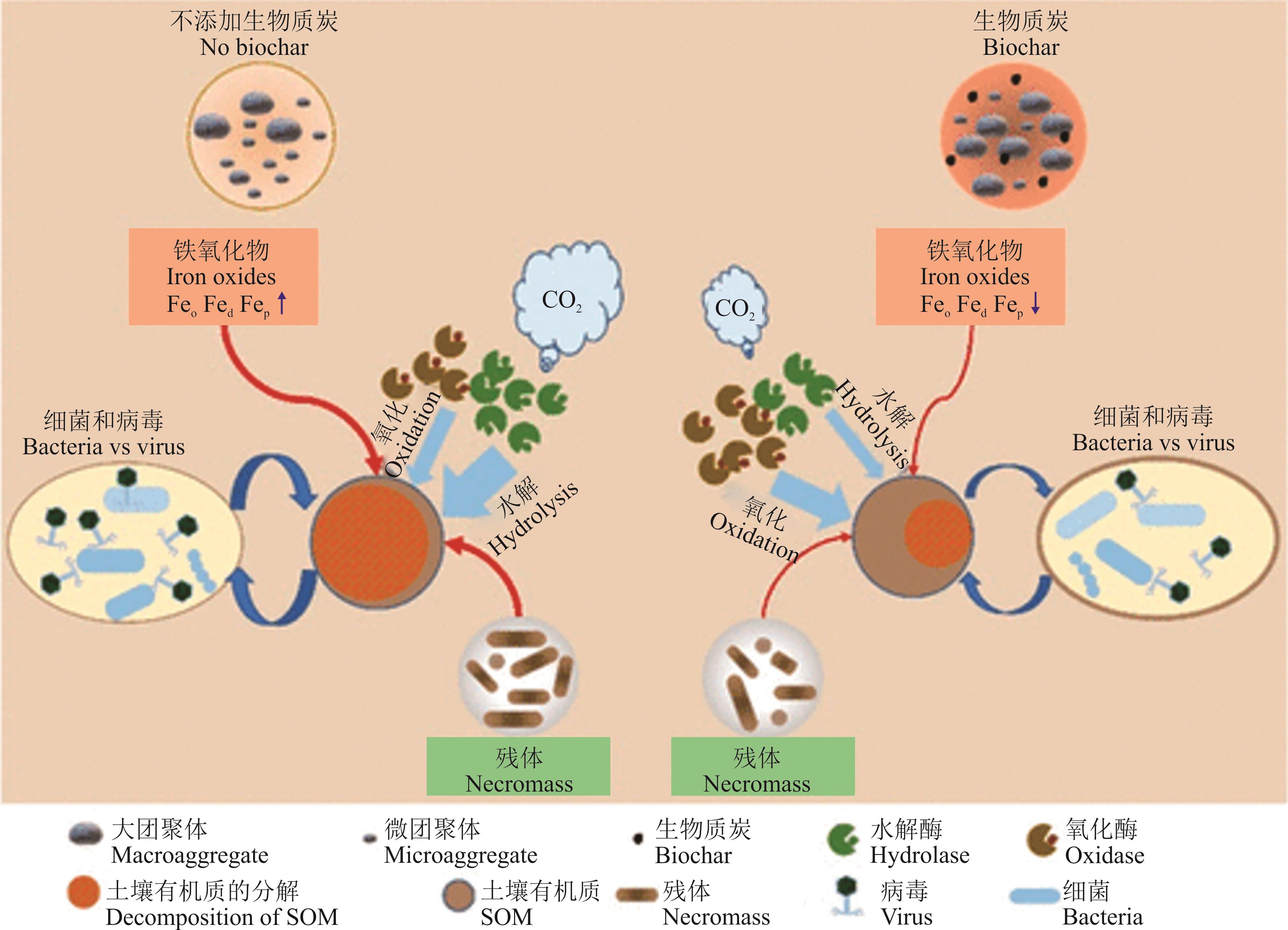
Fig. 4 Mechanism schematic of biochar-driven SOC accumulation in paddy soil via modulating iron oxides, enzyme activity, and the virus-bacteria interaction[20]
| [1] | Lal R. Soil carbon sequestration impacts on global climate change and food security. Science, 2004, 304(5677): 1623-1627. |
| [2] | Zhang J B. Improving inherent soil productivity underpins agricultural sustainability. Pedosphere, 2023, 33(1): 3-5. |
| [3] | Nielsen U N, Wall D H, Six J. Soil biodiversity and the environment. Annual Review of Environment and Resources, 2015, 40(1): 63-90. |
| [4] | Kononova M M. Soil organic matter: Its nature, its role in soil formation and in soil fertility. Oxford, England: Pergamon, 2013. |
| [5] | Lehmann J, Kleber M. The contentious nature of soil organic matter. Nature, 2015, 528(7580): 60-68. |
| [6] | Liang C, Schimel J P, Jastrow J D. The importance of anabolism in microbial control over soil carbon storage. Nature Microbiology, 2017, 2(8): 17105. |
| [7] | Cotrufo M F, Wallenstein M D, Boot C M, et al. The microbial efficiency-matrix stabilization (MEMS) framework integrates plant litter decomposition with soil organic matter stabilization: do labile plant inputs form stable soil organic matter? Global Change Biology, 2013, 19(4): 988-995. |
| [8] | Huang W G, Kuzyakov Y, Niu S L, et al. Drivers of microbially and plant-derived carbon in topsoil and subsoil. Global Change Biology, 2023, 29(22): 6188-6200. |
| [9] | Liang C, Amelung W, Lehmann J, et al. Quantitative assessment of microbial necromass contribution to soil organic matter. Global Change Biology, 2019, 25(11): 3578-3590. |
| [10] | Jansson J K, Wu R. Soil viral diversity, ecology and climate change. Nature Reviews Microbiology, 2023, 21(5): 296-311. |
| [11] | Liang C, Zhu X F. The soil microbial carbon pump as a new concept for terrestrial carbon sequestration. Science China Earth Sciences, 2021, 64(4): 545-558. |
| [12] | Sun B, Zhu A N, Yao R J, et al. Research progress on barrier remediation technology and productivity enhancement model for fluvo-aquic soil, red soil, and saline-alkali soil. Acta Pedologica Sinica, 2023, 60(5): 1231-1247. |
| 孙波, 朱安宁, 姚荣江, 等. 潮土、红壤和盐碱地障碍消减技术与产能提升模式研究进展. 土壤学报, 2023, 60(5): 1231-1247. | |
| [13] | Appuhn A, Jörgensen R G. Microbial colonisation of roots as a function of plant species. Soil Biology & Biochemistry, 2006, 38(5): 1040-1051. |
| [14] | Hu H, Qian C, Xue K, et al. Reducing the uncertainty in estimating soil microbial-derived carbon storage. Proceedings of the National Academy of Sciences, 2024, 121(35): e2401916121. |
| [15] | Li S, Huang W G, Ma B, et al. Viral diversity mediates carbon allocation for ecosystem multifunctionality across biomes. Global Change Biology, 2025, 31(8): e70412. |
| [16] | Meng X T, Zhang X C, Li Y N, et al. Nitrogen fertilizer builds soil organic carbon under straw return mainly via microbial necromass formation. Soil Biology & Biochemistry, 2024, 188: 109223. |
| [17] | Liu M F, Zhou G X, Zhang C Z, et al. Impact of virus-mediated modifications in bacterial communities on the accumulation of soil organic carbon. Advanced Science, 2025, 12(30): e06449. |
| [18] | Freeman C, Ostle N, Kang H. An enzymic “latch” on a global carbon store. Nature, 2001, 409(6817): 149. |
| [19] | Feng X, Zhao Y, Wang H, et al. Iron-organic carbon interactions in wetlands: implications for wetland carbon preservation under global changes. Global Change Biology, 2025, 31(6): e70300. |
| [20] | Zhou G X, Chen L, Zhang C Z, et al. Bacteria-virus interactions are more crucial in soil organic carbon storage than iron protection in biochar-amended paddy soils. Environmental Science & Technology, 2023, 57(48): 19713-19722. |
| [1] | Ruo-hong LI, Chang-ran LI, Jia-yi FU, Xin-yu HU, Pei-sheng MAO. Effects of nano-iron priming and biochar encrusting on the salt tolerance of Festuca sinensis at the seed germination and seedling growth stages [J]. Acta Prataculturae Sinica, 2026, 35(8): 32-44. |
| [2] | Yi-han WANG, Lu-meng SHI, Zhi-jian LI, Bang-wei ZHOU. Effects of grass species and biochar application rate on soda saline-alkali soil improvement and forage growth in northeast China [J]. Acta Prataculturae Sinica, 2026, 35(5): 139-150. |
| [3] | Jia-li LIAN, Jing CHEN, Xue-qing YANG, Ying ZHAO, Xu LUO, Cui HAN, Jian-ping LI. Effects of precipitation changes on the soil organic carbon distribution and stability of organic carbon pool in desert steppe [J]. Acta Prataculturae Sinica, 2026, 35(5): 85-98. |
| [4] | Chang LIU, Ji-shan CHEN, Rui-fen ZHU, Wan-bin SUN, Bo YAO, Shi-kui DONG. Mitigation of soil microbial carbon and phosphorus limitations through organic fertilizer and biochar inputs in subtropical cultivated grassland [J]. Acta Prataculturae Sinica, 2026, 35(4): 54-66. |
| [5] | Jing WANG, Xu-dong LI, Tian-hu HAN, De-cao NIU, Chun-li BAI, Ding GUO. Distribution of soil aggregates in different vegetation micro-patches in alpine meadows and the relationship with organic carbon mineralization [J]. Acta Prataculturae Sinica, 2026, 35(2): 15-27. |
| [6] | Jian-min RAN, Xiao-yan SONG, Dan WANG, Chang-ting WANG. Changes in soil organic carbon fractions and carbon sequestration potential of degraded alpine meadows [J]. Acta Prataculturae Sinica, 2025, 34(9): 38-52. |
| [7] | Jun-ling CHEN, Sha-sha WANG, Jing YE, Yi LIN, Yi-xiang WANG. Soil carbon mineralization in an orchard with and without interplanted ground cover species and its temperature sensitivity under long-term conditions [J]. Acta Prataculturae Sinica, 2025, 34(9): 53-64. |
| [8] | Yu-xia WANG, Ling-tong DU, Zhi-yuan YI, Xiao LUO, Li SU, Cheng-long QIAO, Bin XUE. Spatial variation and factors influencing the soil organic carbon pool in grape-producing areas at the eastern foothills of Helan Mountain in Ningxia [J]. Acta Prataculturae Sinica, 2025, 34(7): 41-53. |
| [9] | Wen-li QIN, Jing ZHANG, Guang-min XIAO, Su-qian CUI, Jian-xun YE, Jian-fei ZHI, Li-feng ZHANG, Nan XIE, Wei FENG, Zhen-yu LIU, Xuan PAN, Yun-xia DAI, Zhong-kuan LIU. Effects of partial replacement of chemical nitrogen fertilizers with green manure on soil physical properties and maize (Zea mays) yield [J]. Acta Prataculturae Sinica, 2025, 34(6): 27-45. |
| [10] | Jia-xin LI, Ya-hong JING, Jun ZHANG, Si-pu JING, Yu-xing YANG, Bo-yang FAN, Wen-jie LU. Analysis of spatial characteristics of soil nutrients in grasslands in the Fenhe River upper reaches using GIS technology and cluster analysis [J]. Acta Prataculturae Sinica, 2025, 34(3): 17-28. |
| [11] | Kong-qin WEI, Jun-wei ZHAO, Qian-bing ZHANG. Effects of phosphorus application on soil respiration rate and active organic carbon components of alfalfa [J]. Acta Prataculturae Sinica, 2024, 33(2): 80-92. |
| [12] | Si-yuan LI, Yu-xuan CUI, Zong-jiu SUN, Hui-xia LIU, Hua-wei YE. Effect of grazing exclusion on soil organic carbon and stoichiometry characteristics of soil microbial biomass in sagebrush desert [J]. Acta Prataculturae Sinica, 2023, 32(6): 58-70. |
| [13] | Xin GUO, Huan LUO, Xue-mei XU, Ai-xia MA, Zhen-yan SHANG, Tian-hu HAN, De-cao NIU, Hai-yan WEN, Xu-dong LI. Effects of litter decomposition with different qualities on soil organic carbon content and its stability in grassland on the Loess Plateau [J]. Acta Prataculturae Sinica, 2023, 32(5): 83-93. |
| [14] | Yi-chao CHEN, Xiao-ying SUN, Zhi-jie XIE, Pan ZHOU, Lu ZHANG, Xue-li GAO, Dong LI, Xiao-feng LIU. Screening of rhizosphere growth promoting bacteria and their application in tailings improvement [J]. Acta Prataculturae Sinica, 2022, 31(7): 50-63. |
| [15] | Zhan-dong PAN, Qian-qian MA, Xiao-long CHEN, Li-qun CAI, Xue-mei CAI, Bo DONG, Jun WU, Ren-zhi ZHANG. Effects of biochar addition on nutrient levels and humus and its components in dry farmland soils on the Loess Plateau [J]. Acta Prataculturae Sinica, 2022, 31(2): 14-24. |
| Viewed | ||||||
|
Full text |
|
|||||
|
Abstract |
|
|||||
