
ISSN 1004-5759 CN 62-1105/S
Acta Prataculturae Sinica ›› 2026, Vol. 35 ›› Issue (10): 61-78.DOI: 10.11686/cyxb2025443
Previous Articles Next Articles
Min-hua YIN1( ), Wen-jing CHANG1, Jian-xin YIN2, Ya-ya DUAN1, Hai-yan LI1, Yan-biao WANG1, Yan-xia KANG1(), Yan-lin MA1, Ya-yu WANG1, Guang-ping QI1
Received:2025-10-23
Revised:2026-01-12
Online:2026-10-20
Published:2026-09-09
Contact:
Yan-xia KANG
Min-hua YIN, Wen-jing CHANG, Jian-xin YIN, Ya-ya DUAN, Hai-yan LI, Yan-biao WANG, Yan-xia KANG, Yan-lin MA, Ya-yu WANG, Guang-ping QI. Optimization of alfalfa pasture planting patterns and nitrogen fertilizer management to reduce greenhouse gas emissions[J]. Acta Prataculturae Sinica, 2026, 35(10): 61-78.
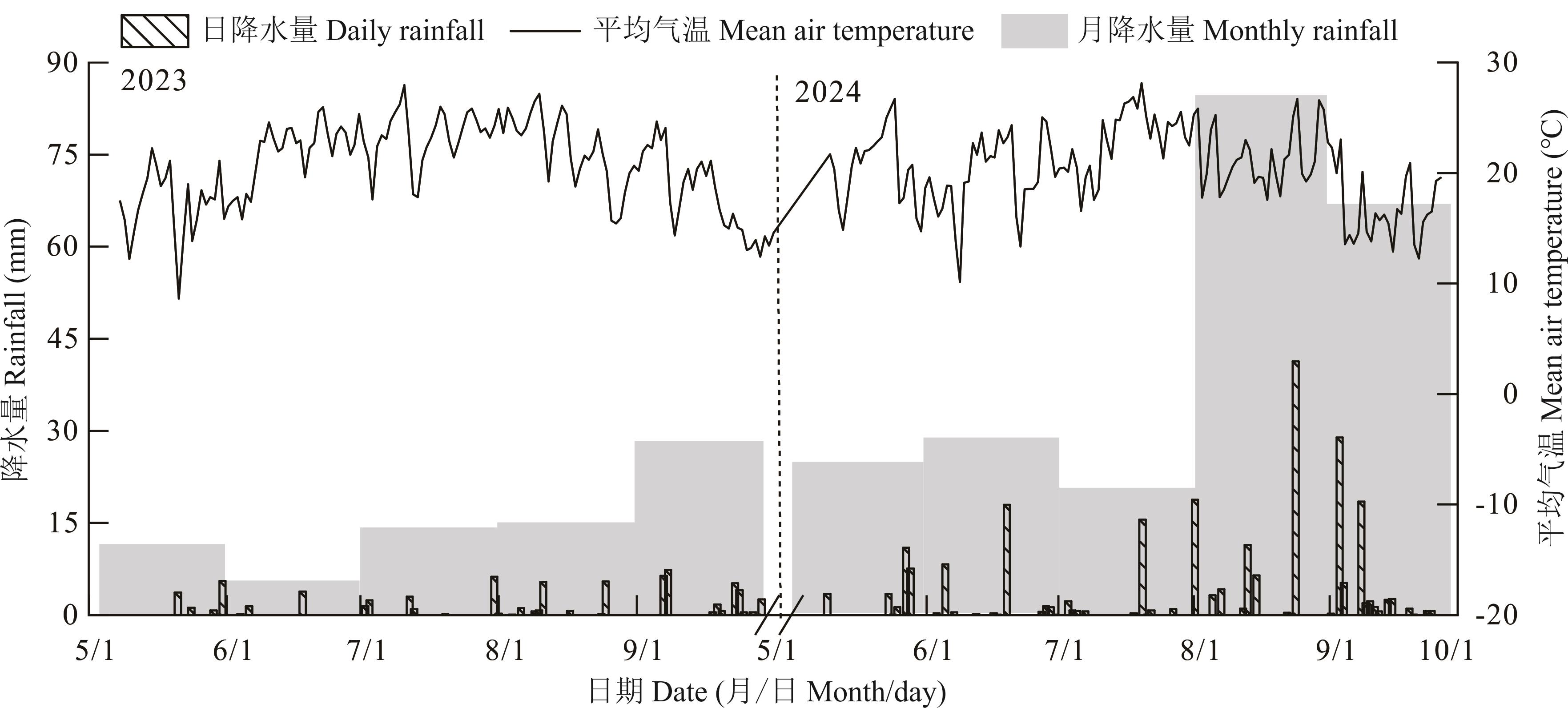
Fig.1 Rainfall and air temperature distributions during alfalfa growth period
种植模式 Cropping patterns | 氮肥运筹Nitrogen fertilizer management | ||
|---|---|---|---|
氮肥类型 Nitrogen fertilizer types | 施氮水平 Nitrogen application levels (kg·hm-2) | 三茬施用比例 Application rate among three crops | |
平作Flat planting (FP) | 尿素Urea (U) | 80 (U1) | 6∶2∶2 |
| 160 (U2) | 6∶2∶2 | ||
| 240 (U3) | 6∶2∶2 | ||
| 控释氮肥Controlled release nitrogen fertilizer (C) | 80 (C1) | 1∶0∶0 | |
| 160 (C2) | 1∶0∶0 | ||
| 240 (C3) | 1∶0∶0 | ||
| 不施氮肥 No nitrogen fertilization (N0) | 0 (N0) | - | |
| 垄覆生物降解地膜种植Ridge-furrow planting with biodegradable film mulching over ridge (BM) | 尿素Urea (U) | 80 (U1) | 6∶2∶2 |
| 160 (U2) | 6∶2∶2 | ||
| 240 (U3) | 6∶2∶2 | ||
| 控释氮肥Controlled release nitrogen fertilizer (C) | 80 (C1) | 1∶0∶0 | |
| 160 (C2) | 1∶0∶0 | ||
| 240 (C3) | 1∶0∶0 | ||
| 不施氮肥 No nitrogen fertilization (N0) | 0 (N0) | - | |
| 垄覆普通地膜Ridge-furrow planting with plastic film mulching over ridge (PM) | 尿素Urea (U) | 80 (U1) | 6∶2∶2 |
| 160 (U2) | 6∶2∶2 | ||
| 240 (U3) | 6∶2∶2 | ||
| 控释氮肥Controlled release nitrogen fertilizer (C) | 80 (C1) | 1∶0∶0 | |
| 160 (C2) | 1∶0∶0 | ||
| 240 (C3) | 1∶0∶0 | ||
| 不施氮肥No nitrogen fertilization (N0) | 0 (N0) | - | |
Table 1 Experimental design
种植模式 Cropping patterns | 氮肥运筹Nitrogen fertilizer management | ||
|---|---|---|---|
氮肥类型 Nitrogen fertilizer types | 施氮水平 Nitrogen application levels (kg·hm-2) | 三茬施用比例 Application rate among three crops | |
平作Flat planting (FP) | 尿素Urea (U) | 80 (U1) | 6∶2∶2 |
| 160 (U2) | 6∶2∶2 | ||
| 240 (U3) | 6∶2∶2 | ||
| 控释氮肥Controlled release nitrogen fertilizer (C) | 80 (C1) | 1∶0∶0 | |
| 160 (C2) | 1∶0∶0 | ||
| 240 (C3) | 1∶0∶0 | ||
| 不施氮肥 No nitrogen fertilization (N0) | 0 (N0) | - | |
| 垄覆生物降解地膜种植Ridge-furrow planting with biodegradable film mulching over ridge (BM) | 尿素Urea (U) | 80 (U1) | 6∶2∶2 |
| 160 (U2) | 6∶2∶2 | ||
| 240 (U3) | 6∶2∶2 | ||
| 控释氮肥Controlled release nitrogen fertilizer (C) | 80 (C1) | 1∶0∶0 | |
| 160 (C2) | 1∶0∶0 | ||
| 240 (C3) | 1∶0∶0 | ||
| 不施氮肥 No nitrogen fertilization (N0) | 0 (N0) | - | |
| 垄覆普通地膜Ridge-furrow planting with plastic film mulching over ridge (PM) | 尿素Urea (U) | 80 (U1) | 6∶2∶2 |
| 160 (U2) | 6∶2∶2 | ||
| 240 (U3) | 6∶2∶2 | ||
| 控释氮肥Controlled release nitrogen fertilizer (C) | 80 (C1) | 1∶0∶0 | |
| 160 (C2) | 1∶0∶0 | ||
| 240 (C3) | 1∶0∶0 | ||
| 不施氮肥No nitrogen fertilization (N0) | 0 (N0) | - | |
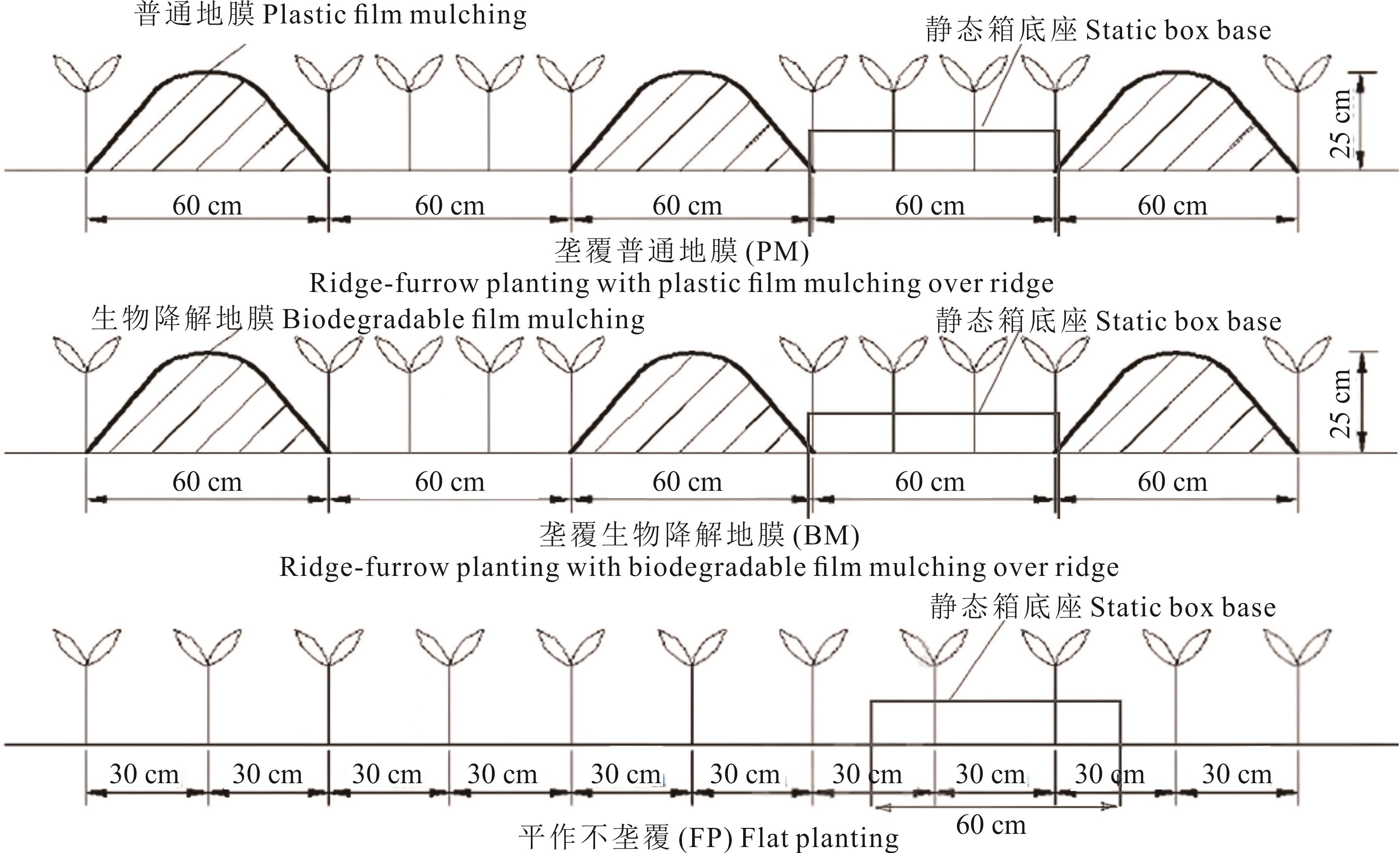
Fig.2 Alfalfa cropping pattern

Fig.3 Soil available nitrogen content
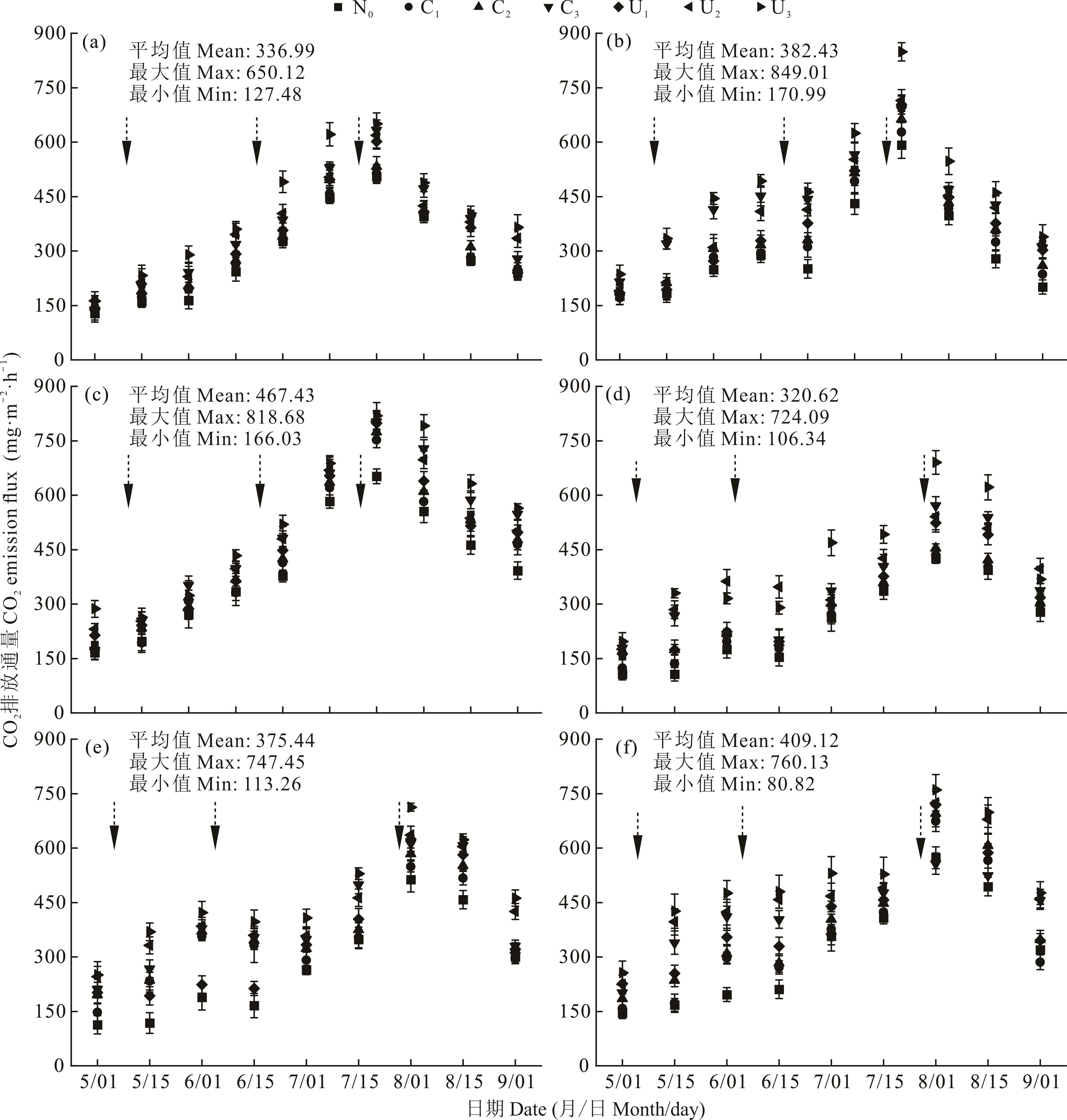
Fig.4 Effects of planting pattern and nitrogen management on CO2 emission flux in alfalfa grassland
| 年份 Year | P | L | T | P×L | P×T | L×T | P×L×T |
|---|---|---|---|---|---|---|---|
| 2023 | 455.30** | 108.44** | 178.25** | 5.28* | 1.41* | 0.71ns | 0.18ns |
| 2024 | 232.63** | 377.10** | 238.99** | 2.59* | 13.61** | 28.50* | 0.58ns |
Table 2 Analysis of variance for cumulative CO2 emissions in alfalfa grasslands under different planting patterns and nitrogen managements
| 年份 Year | P | L | T | P×L | P×T | L×T | P×L×T |
|---|---|---|---|---|---|---|---|
| 2023 | 455.30** | 108.44** | 178.25** | 5.28* | 1.41* | 0.71ns | 0.18ns |
| 2024 | 232.63** | 377.10** | 238.99** | 2.59* | 13.61** | 28.50* | 0.58ns |

Fig.5 Effects of planting pattern and nitrogen management on annual cumulative CO? emission in alfalfa grassland

Fig.6 Effects of planting pattern and nitrogen management on CH4 emission flux in alfalfa grassland
| 年份 Year | P | L | T | P×L | P×T | L×T | P×L×T |
|---|---|---|---|---|---|---|---|
| 2023 | 222.38** | 207.56** | 8.60* | 57.26** | 52.76** | 37.24** | 1.72ns |
| 2024 | 65.79** | 65.82** | 31.27** | 6.49* | 1.05ns | 9.45** | 1.28ns |
Table 3 Analysis of variance for cumulative CH4 absorption in alfalfa grasslands under different planting patterns and nitrogen managements
| 年份 Year | P | L | T | P×L | P×T | L×T | P×L×T |
|---|---|---|---|---|---|---|---|
| 2023 | 222.38** | 207.56** | 8.60* | 57.26** | 52.76** | 37.24** | 1.72ns |
| 2024 | 65.79** | 65.82** | 31.27** | 6.49* | 1.05ns | 9.45** | 1.28ns |
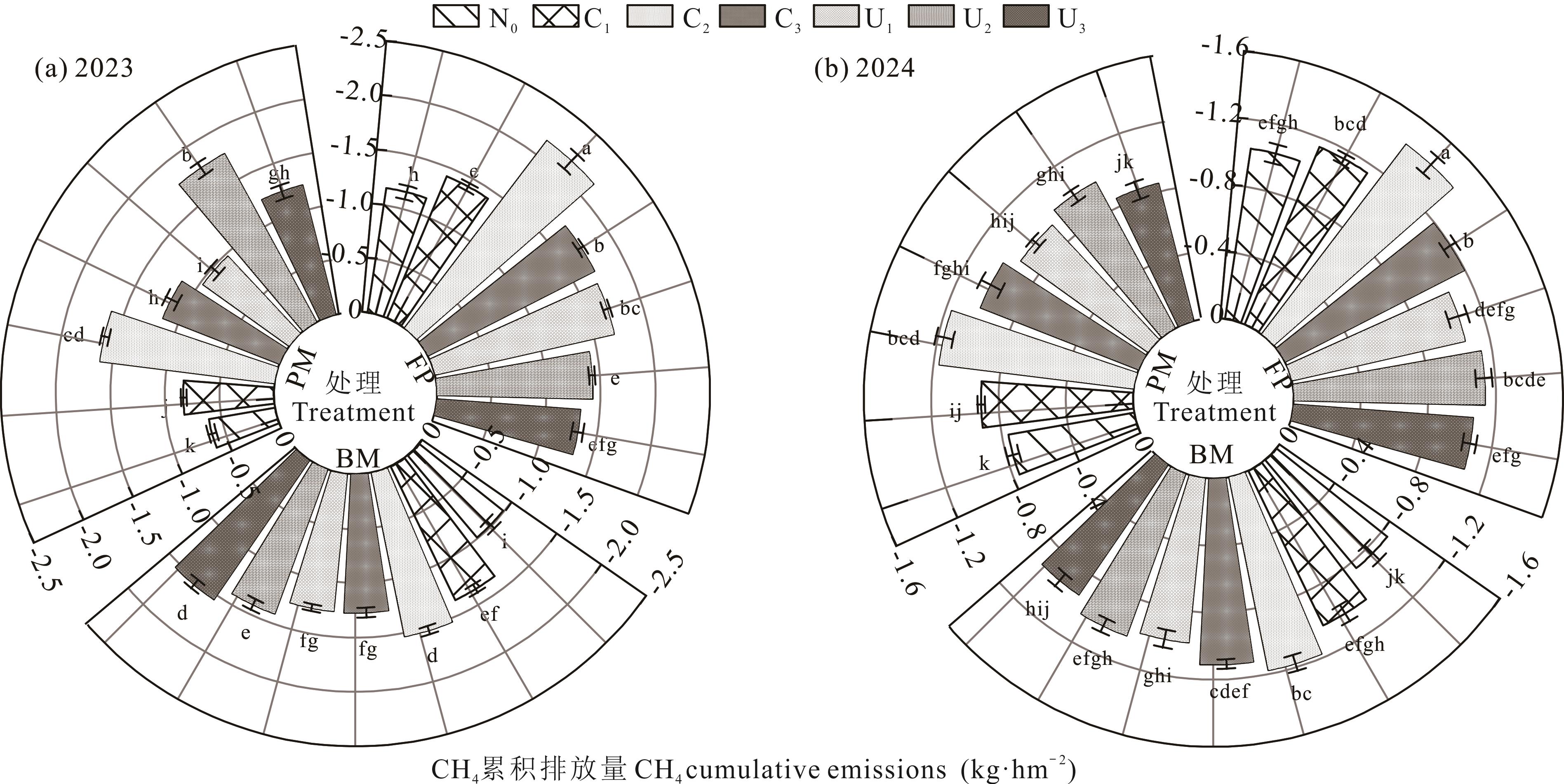
Fig.7 Effects of planting pattern and nitrogen management on annual cumulative CH4 emission in alfalfa grassland

Fig.8 Effects of planting pattern and nitrogen management on N2O emission flux in alfalfa grassland
| 年份 Year | P | L | T | P×L | P×T | L×T | P×L×T |
|---|---|---|---|---|---|---|---|
| 2023 | 33.61** | 131.28** | 44.03** | 0.04ns | 0.17ns | 10.92* | 0.51ns |
| 2024 | 82.33** | 229.04** | 84.36** | 4.48ns | 0.14ns | 17.24** | 0.15ns |
Table 4 Analysis of variance for cumulative N2O emissions in alfalfa grasslands under different planting patterns and nitrogen managements
| 年份 Year | P | L | T | P×L | P×T | L×T | P×L×T |
|---|---|---|---|---|---|---|---|
| 2023 | 33.61** | 131.28** | 44.03** | 0.04ns | 0.17ns | 10.92* | 0.51ns |
| 2024 | 82.33** | 229.04** | 84.36** | 4.48ns | 0.14ns | 17.24** | 0.15ns |

Fig.9 Effects of planting pattern and nitrogen management on annual cumulative N2O emission in alfalfa grassland
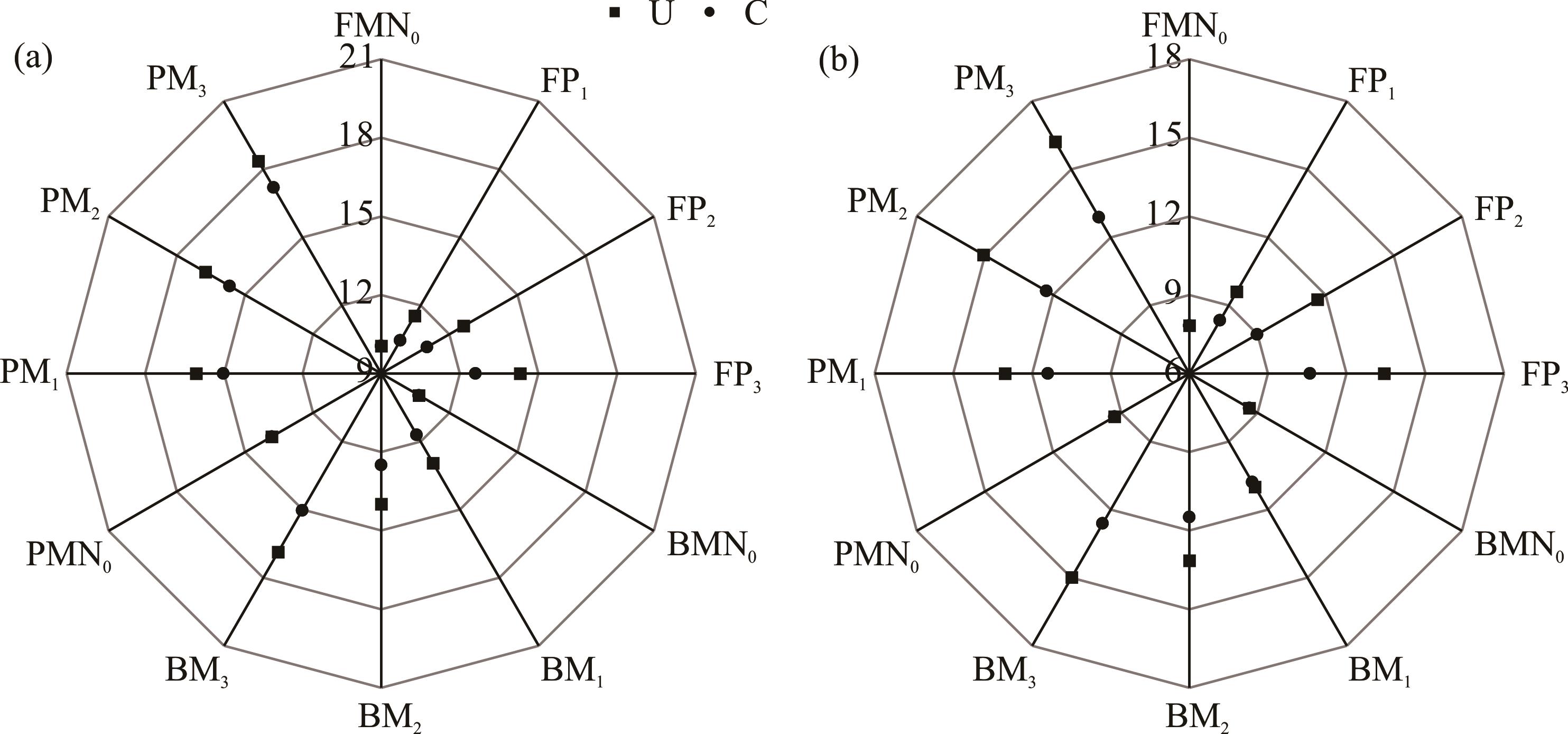
Fig.10 Effects of planting pattern and nitrogen management on global warming potential in alfalfa grassland

Fig.11 Effects of planting pattern and nitrogen management on alfalfa yields
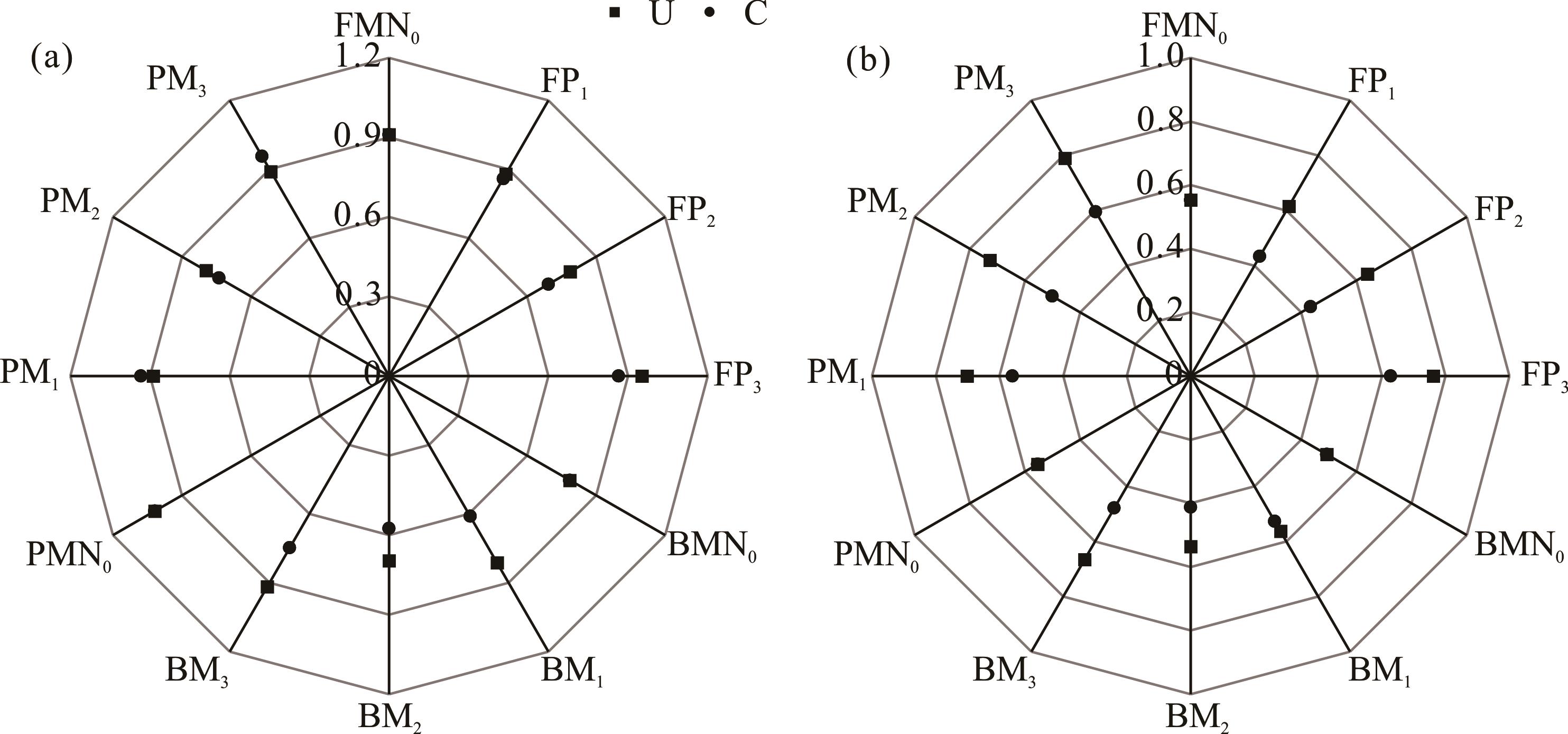
Fig.12 Effects of planting pattern and nitrogen management on greenhouse gas intensity in alfalfa grassland
| [1] | Lee H, Romero J. IPCC, 2023: Climate change 2023: synthesis report//Contribution of working groups I, II and III to the sixth assessment report of the intergovernmental panel on climate change. Geneva, Switzerland: Intergovernmental Panel on Climate Change (IPCC), 2023. |
| [2] | Hu T H, Xiong K N, Wang J. Intercropping peanut under forests can reduce soil N2O emissions in karst desertification control. Forests, 2023, 14(8): 1652. |
| [3] | Searchinger T, Waite R, Hanson C, et al. Creating a sustainable food future: A menu of solutions to feed nearly 10 billion people by 2050. Washington, DC: World Resources Institute, 2019. |
| [4] | Liu T Q, Li S H, Guo L J, et al. Advantages of nitrogen fertilizer deep placement in greenhouse gas emissions and net ecosystem economic benefits from no-tillage paddy fields. Journal of Cleaner Production, 2020, 263: 121322. |
| [5] | Sakuraba Y, Chaganzhana, Mabuchi A, et al. Enhanced NRT1.1/NPF6.3 expression in shoots improves growth under nitrogen deficiency stress in Arabidopsis. Communications Biology, 2021, 4: 256. |
| [6] | Bolo P, Muna M M, Kinyua M, et al. Nitrogen and phosphorus mineralization and their corresponding monetary values under long-term integrated soil fertility management practices. Journal of Sustainable Agriculture and Environment, 2024, 3(2): e12100. |
| [7] | Wu P, Fu L, Li H, et al. Suitable fertilizer application depth can increase nitrogen use efficiency and maize yield by reducing gaseous nitrogen losses. Science of the Total Environment, 2021, 781: 146787. |
| [8] | Verma K K, Song X P, Degu H D, et al. Recent advances in nitrogen and nano-nitrogen fertilizers for sustainable crop production: a mini-review. Chemical and Biological Technologies in Agriculture, 2023, 10: 111. |
| [9] | Dekyi D, Zeng K, Yin B, et al. Eliminaing NH3, NO and N2O emissions simultaneously in a wheat field by urea point placement. Soil and Fertilizer Sciences in China, 2024(6): 18-26. |
| 德吉卓玛, 曾科, 尹斌, 等. 尿素穴施削减麦田NH3挥发、NO和N2O排放. 中国土壤与肥料, 2024(6): 18-26. | |
| [10] | Saravanakumar S. Integrated nitrogen management in rice (Oryza sativa) under system rice intensification. Indian Journal of Agricultural Sciences, 2020, 90(5): 843-846. |
| [11] | Huang P, Zhang J B, Zhu A N, et al. Coupled water and nitrogen (N) management as a key strategy for the mitigation of gaseous N losses in the Huang-Huai-Hai Plain. Biology and Fertility of Soils, 2014, 51(3): 331-342. |
| [12] | Wei T B, Chai Q, Wang W M, et al. Effects of coupling of irrigation and nitrogen application as well as planting density on photosynthesis and dry matter accumulation characteristics of maize in oasis irrigated areas. Scientia Agricultura Sinica, 2019, 52(3): 428-444. |
| 魏廷邦, 柴强, 王伟民, 等. 水氮耦合及种植密度对绿洲灌区玉米光合作用和干物质积累特征的调控效应. 中国农业科学, 2019, 52(3): 428-444. | |
| [13] | Li X Y, Ding Z J, Yan J W, et al. Interaction effect and model of water and nitrogen under degradable film mulching in dripirrigated sandy farmland. Transactions of the Chinese Society for Agricultural Machinery, 2018, 49(7): 261-270. |
| 李仙岳, 丁宗江, 闫建文, 等.沙区降解膜覆盖下滴灌农田水氮交互效应与模型研究. 农业机械学报, 2018, 49(7): 261-270. | |
| [14] | Liu Z H, Cai L, Zhao X L, et al. Effect of decomposition of polyethylene residue film on soil water infiltration. China Environmental Science, 2022, 42(12): 5768-5774. |
| 刘子涵, 才璐, 赵小丽, 等. 聚乙烯残膜破碎过程对土壤水分入渗的影响. 中国环境科学, 2022, 42(12): 5768-5774. | |
| [15] | Belyaeva O, Ward G, Wijesinghe T, et al. Influence of soil organic matter, fertilizer formulation and season on fertilizer nitrogen use efficiency in temperate pastures. Nutrient Cycling in Agroecosystems, 2024, 129: 133-150. |
| [16] | Chen N Y, Li X Y, Shi H B, et al. Assessment and modeling of maize evapotranspiration and yield with plastic and biodegradable film mulch. Agricultural and Forest Meteorology, 2021, 307: 108474. |
| [17] | Hu G H, Wang J K, Wang Y L, et al. Effects of biodegradable film mulching on nitrogen use efficiency and yield of machine-transplanted rice. Ecology and Environmental Sciences, 2020, 29(5): 977-986. |
| 胡国辉, 王久坤, 王亚梁, 等. 生物可降解膜覆盖对机插水稻氮素利用及产量的影响. 生态环境学报, 2020, 29(5): 977-986. | |
| [18] | Huang Y L, Qin R Z, Wei H H, et al. Plastic film mulching application improves potato yields, reduces ammonia emissions, but boosts the greenhouse gas emissions in China. Journal of Environmental Management, 2024, 353: 120241. |
| [19] | Yin M H, Ma Y L, Kang Y X, et al. Effects of nitrogen application on alfalfa yield and quality in China-A Meta-analysis. Acta Prataculturae Sinica, 2022, 31(9): 36-49. |
| 银敏华, 马彦麟, 康燕霞, 等. 氮素添加对中国苜蓿产量与品质效应的Meta分析. 草业学报, 2022, 31(9): 36-49. | |
| [20] | Xia X, Gong Z P. Research advance on the relationship between nitrogen and Leguminous nitrogen fixation. Journal of Northeast Agricultural University, 2017, 48(1): 79-88. |
| 夏玄, 龚振平. 氮素与豆科作物固氮关系研究进展. 东北农业大学学报, 2017, 48(1): 79-88. | |
| [21] | Zhang Y L, Hu Z Z, Zhao H X, et al. Effect of the seeding-year clipping on the biomass and regrowth rate of grass-legume mixed grassland. Acta Agrestia Sinica, 2004(4): 308-312. |
| 张永亮, 胡自治, 赵海新, 等. 刈割对混播当年生物量及再生速率的影响. 草地学报, 2004(4): 308-312. | |
| [22] | Zhang Y Y, Wang B, Wang T F, et al. Effects of intercropping triticale with alfalfa on system yield, resource utilization, and alfalfa seed yield. Acta Prataculturae Sinica, 2025, 34(8): 43-53. |
| 张译尹, 王斌, 王腾飞, 等. 苜蓿种子田间作小黑麦对饲草产量、水分利用及苜蓿种子产量的影响. 草业学报, 2025, 34(8): 43-53. | |
| [23] | Tao X S, Yan Y E, Zhou X L. Study on the soil properties of desert grassland in the edge of Jingtai oasis. Pratacultural Science, 2009, 26(6): 29-34. |
| 陶雪松, 闫月娥, 周晓雷. 景泰绿洲边缘荒漠草地土壤特征研究. 草业科学, 2009, 26(6): 29-34. | |
| [24] | Huang Y X, Yang Y, Zhang P, et al. Review on soil microbes regulating ecosystem carbon sink function. Acta Ecologica Sinica, 2025, 45(17): 8297-8310. |
| 黄云鑫, 杨阳, 张鹏, 等. 土壤微生物调控生态系统碳汇功能研究进展. 生态学报, 2025, 45(17): 8297-8310. | |
| [25] | Zhang W W, Gu J, Zhang Y Z, et al. Effects of PBAT/PLA biodegradable film mulching on greenhouse gas emissions in rain-fed maize farmland of Northeast China. Science of the Total Environment, 2024, 957: 177725. |
| [26] | Zhao Z M, Shi F X, Guan F C. Effects of plastic mulching on soil CO2 efflux in a cotton field in northwestern China. Scientific Reports, 2022, 12: 4969. |
| [27] | Xu K, Wu X D, Xie Y Z, et al. Main factors controlling soil CO2 efflux from alfalfa fields of different standing ages in an arid area. Ecology and Environmental Sciences, 2013, 22(10): 1671-1677. |
| 徐坤, 吴旭东, 谢应忠, 等. 干旱区不同种植年限苜蓿人工草地土壤CO2排放的主要影响因素. 生态环境学报, 2013, 22(10): 1671-1677. | |
| [28] | Chi Y B, Yang P L, Ren S M, et al. Finding the optimal fertilizer type and rate to balance yield and soil GHG emissions under reclaimed water irrigation. Science of the Total Environment, 2020, 729: 138954. |
| [29] | Tian S Z, Liu Z, Wang B W, et al. Balancing the use of maize residues for soil amendment and forage. Plant, Soil and Environment, 2016, 62(11): 490-496. |
| [30] | Anderson C R, Peterson M E, Frampton R A, et al. Rapid increases in soil pH solubilise organic matter, dramatically increase denitrification potential and strongly stimulate microorganisms from the Firmicutes phylum. PeerJ, 2018, 6: e6090. |
| [31] | Deng X W, Yang J J, Chen H, et al. Advances in the research of methane oxidation in forest soils. Ecology and Environmental Sciences, 2012, 21(3): 577-583. |
| 邓湘雯, 杨晶晶, 陈槐, 等. 森林土壤氧化(吸收)甲烷研究进展. 生态环境学报, 2012, 21(3): 577-583. | |
| [32] | Liu J L, Chen X P, Zhan A, et al. Methane uptake in semiarid farmland subjected to different mulching and nitrogen fertilization regimes. Biology and Fertility of Soils, 2016, 52(7): 941-950. |
| [33] | Lan T, Zhang H, Han Y, et al. Regulating CH4, N2O, and NO emissions from an alkaline paddy field under rice-wheat rotation with controlled release N fertilizer. Environmental Science and Pollution Research, 2021, 28(14): 18246-18259. |
| [34] | Parthiban K O, Karthigeyan C, Saravanan N, et al. Influence of nutrients on oxidation of low-level methane by mixed methanotrophic consortia. Environmental Science and Pollution Research, 2016, 23(20): 4346-4357. |
| [35] | Li X S, Yue S C, Li S Q, et al. Effect of film mulching and nitrogen fertilizer on CH4 absorption of rainfed spring maize farmland. Agricultural Research in the Arid Areas, 2017, 35(4): 1-9, 53. |
| 李晓莎, 岳善超, 李世清, 等. 覆膜和氮肥用量对雨养春玉米农田甲烷吸收的影响. 干旱地区农业研究, 2017, 35(4): 1-9, 53. | |
| [36] | Shrestha P M, Frenzel P, Conrad R, et al. Effect of nitrogen fertilization on methane oxidation, abundance, community structure, and gene expression of methanotrophs in the rice rhizosphere. The ISME Journal, 2010, 4(12): 1545-1556. |
| [37] | Zhang L H, Yuan F H, Bai J H, et al. Phosphorus alleviation of nitrogen-suppressed methane sink in global grasslands. Ecology Letters, 2020, 23(5): 821-830. |
| [38] | Li Q, Peng C H, Zhang J B, et al. Nitrogen addition decreases methane uptake caused by methanotroph and methanogen imbalances in a Moso bamboo forest. Scientific Reports, 2021, 11(1): 5578. |
| [39] | Al-barakah F N, Mridha M A. Symbiotic nitrogen fixation in alfalfa (Medicago sativa L.) by Sinorhizobium meliloti at Al-qassim regions, Saudi Arabia. Pakistan Journal of Botany, 2016, 48(1): 345-348. |
| [40] | Wang X Y, Gao Y Z. Advances in the mechanism of cereal/legume intercropping promotion of symbiotic nitrogen fixation. Chinese Science Bulletin, 2020, 65(2): 142-149. |
| 王旭燕, 高永卓. 禾本科/豆科间作促进豆科共生固氮的机制研究进展. 科学通报, 2020, 65(2): 142-149. | |
| [41] | Yang R, Zheng J, Fan J L, et al. Effects of different film mulching methods on greenhouse gas emissions and yield of dryland summer maize. Agricultural Research in the Arid Areas, 2020, 38(4): 285-292, 302. |
| 杨睿, 郑静, 范军亮, 等. 覆膜方式对旱作夏玉米产量和温室气体排放的影响. 干旱地区农业研究, 2020, 38(4): 285-292, 302. | |
| [42] | Yu X J, Chai J L, Xu C L, et al. Effects of different planting methods on growth of alfalfa and weeds in Gannan alpine region. Scientia Agricultura Sinica, 2016, 49(4): 791-801. |
| 鱼小军, 柴锦隆, 徐长林, 等. 覆膜种植对甘南高寒区苜蓿生长和杂草数量的影响. 中国农业科学, 2016, 49(4): 791-801. | |
| [43] | Yoshiura C A, Venturini A M, Braga L P, et al. Responses of low-cost input combinations on the microbial structure of the maize rhizosphere for greenhouse gas mitigation and plant biomass production. Frontiers in Plant Science, 2021, 12: 683658. |
| [44] | Soares J R, Cantarella H, Vargas V P, et al. Enhanced-efficiency fertilizers in nitrous oxide emissions from urea applied to sugarcane. Journal of Environmental Quality, 2015, 44(2): 423-430. |
| [45] | Xie W Y, Zhou H P, Yang Z X, et al. Effects of different slow controlled-release fertilizers on grain yield and nitrogen fate in continuous spring maize production. Journal of Soil and Water Conservation, 2019, 33(3): 207-214. |
| 解文艳, 周怀平, 杨振兴, 等. 不同缓控释氮肥对连作春玉米产量及氮肥去向的影响. 水土保持学报, 2019, 33(3): 207-214. | |
| [46] | Yang J G, Zou G Y, Liu B C. Review and prospect for development of new-type fertilizers in China over past decade. Modern Chemical Industry, 2024, 44(11): 6-11. |
| 杨俊刚, 邹国元, 刘宝存. 我国新型肥料发展近十年回顾与展望. 现代化工, 2024, 44(11): 6-11. | |
| [47] | Wang X X, Cao B, Liang H S, et al. Combined appilcation of controlled-release nitrogen fertilizer and water-soluble fertilizer to reduce N2O emission in greenhouse soil. Journal of Plant Nutrition and Fertilizers, 2019, 25(12): 2084-2094. |
| 王学霞, 曹兵, 梁红胜, 等. 控释氮肥与水溶肥配施减少设施土壤N2O排放的机理. 植物营养与肥料学报, 2019, 25(12): 2084-2094. | |
| [48] | Chen Q, Hu N J, Zhang Q, et al. Effects of biodegradable plastic film mulching on the global warming potential, carbon footprint, and economic benefits of garlic production. Agronomy, 2024, 14(3): 504. |
| [49] | Li N, Qi W, Jiang C X, et al. Effects of plastic film mulching on soil respiration and its sensitivity to temperature and water content. Environmental Technology & Innovation, 2024, 36: 103780. |
| [50] | Guo K J, Hou Y F, Wang L W, et al. Study on the optimal nitrogen application rate with N₂O emission reducing and yield increasing under mulching in potato field based on DNDC model. Ecology and Environmental Sciences, 2018, 27(9): 1658-1664. |
| 郭康军, 侯玉芳, 王立为, 等. 基于DNDC模型覆膜马铃薯N2O减排增产的优化施氮量研究. 生态环境学报, 2018, 27(9): 1658-1664. | |
| [51] | Wu K K, Zhang Z, Feng L S, et al. Effects of corn stalks and urea on N2O production from corn field soil. Agronomy, 2021, 11(10): 2009. |
| [52] | Wang W, Guo L P, Li Y C, et al. Greenhouse gas intensity of three main crops and implications for low-carbon agriculture in China. Climatic Change, 2014, 128(12): 57-70. |
| [53] | Chen H, Liu J J, Zhang A F, et al. Effects of straw and plastic film mulching on greenhouse gas emissions in Loess Plateau, China: A field study of 2 consecutive wheat-maize rotation cycles. Science of the Total Environment, 2017, 579(2): 814-824. |
| [54] | Cheng Z P, Bai L F, Wang Z, et al. Strip-till farming: combining controlled-release blended fertilizer to enhance rainfed maize yield while reducing greenhouse gas emissions. Agronomy, 2024, 14(1): 136. |
| [55] | Wang X X, Cao B, Zhou Y P, et al. Effects of long-term controlled-release urea on soil greenhouse gas emissions in an open-field lettuce system. Plants, 2024, 13(8): 1071. |
| [56] | Xu L, Xue D, Sun J Y, et al. Effects of nitrogen addition on carbon components in the ombrotrophic peatland, southwestern Hubei, China. Chinese Journal of Applied and Environmental Biology, 2025, 31(3): 412-421. |
| 徐玲, 薛丹, 孙嘉悦, 等. 氮添加对鄂西南贫营养型泥炭地碳组分的影响. 应用与环境生物学报, 2025, 31(3): 412-421. | |
| [57] | Sun M Y, Liu J H, Zhao B P, et al. Effects of full-film mulching and ridging planting on the rainfed potato growth and soil characteristics. Journal of Soil and Water Conservation, 2018, 32(5): 262-276. |
| 孙梦媛, 刘景辉, 赵宝平, 等. 全覆膜垄作种植对旱作马铃薯生长和土壤特性的影响. 水土保持学报, 2018, 32(5): 262-276. |
| [1] | Dong-wen YU, Xiao-tong WANG, Yong-long MA, Xuan WU, Jin-hui YANG, Yu-hua TONG, Shu-xia LI. Effects of 2,4-epibrassinolide on the physiological characteristics of alfalfa under drought stress [J]. Acta Prataculturae Sinica, 2026, 35(9): 63-74. |
| [2] | Jin-hui YANG, Xiao-tong WANG, Yong-long MA, Dong-wen YU, Yu-hua TONG, Shu-xia LI. Effect of CeO2 NPs on the salt tolerance of alfalfa seedlings [J]. Acta Prataculturae Sinica, 2026, 35(8): 45-54. |
| [3] | Zhao-peng HUANG, Rong HE, Li-li NAN, Jia-le LIU, Wen-ke YANG. Effects of exogenous melatonin on endogenous hormones and organic acids in alfalfa seedlings under low-phosphorus stress [J]. Acta Prataculturae Sinica, 2026, 35(8): 55-64. |
| [4] | Xia WANG, Meng-yu YAN, Qian-xi WANG, Zhen-wu WEI, Jia WEI, Zheng-feng CAO, Yan-yan LV, Chuan-jie ZHANG, Xue-yang MIN. A comparative study of the yield of alfalfa (Medicago sativa) varieties with different fall dormancy in the Yangtze-Huaihe region [J]. Acta Prataculturae Sinica, 2026, 35(8): 65-83. |
| [5] | Fen-qi CHEN, Jin-qing ZHANG, Yi-jian YU, Zhen-yu LI. Identification, bioinformatics analysis of AP2 subfamily genes and MsBBM gene cloning in alfalfa [J]. Acta Prataculturae Sinica, 2026, 35(7): 117-134. |
| [6] | Hao-zhen LIU, Jia-lu CHAO, Shi-qin ZHAO, Cheng WANG, Jing-hong ZHANG, Shou-jiang SUN. Genome-wide identification of BBR-BPC genes in Medicago sativa and their transcript profiles in response to seed aging [J]. Acta Prataculturae Sinica, 2026, 35(7): 135-150. |
| [7] | Wu LI, Jia-jing LI, Jie-bing LI, Zhen-zhou LI, Ming GUO, Yan NIU, Hao SUN, De-feng LI, Ying-hua SHI, Zhen-tian LI, Bo-shuai LIU, Ya-lei CUI, Zhi-chang WANG, Yong-tao LI, Xiao-yan ZHU. Optimization of fermentation and ultrasound-assisted extraction parameters for alfalfa saponins [J]. Acta Prataculturae Sinica, 2026, 35(7): 201-216. |
| [8] | Jiang-ping MA, Li-juan CAO, Wen-wen ZHANG, Meng-yu ZHAO, Teng-fei WANG, Yi-yin ZHANG, Bin WANG, Jia-wang LI, Xiao-bing WANG, Jian LAN. Effects of reseeding and phosphorus application on productivity and soil in improvement of degraded alfalfa stands [J]. Acta Prataculturae Sinica, 2026, 35(7): 92-104. |
| [9] | Jiang-bo XU, Chang-wei MEI, Dong CHEN, Run-yao JIANG, Song-chang GUO, Xiu-hong WU, Ju-ying LUO, Hai-yuan HUANG, Fang LIU. The effect of alfalfa meal on the average daily gain, slaughter performance, meat quality, and serum biochemical indicators of two different hybrid lines of Liangsan pigs [J]. Acta Prataculturae Sinica, 2026, 35(6): 202-215. |
| [10] | Meng-yu REN, Li-qun WANG, Li-li NAN, Jia-yu GUO. Responses of new alfalfa lines to salt stress [J]. Acta Prataculturae Sinica, 2026, 35(6): 24-34. |
| [11] | Wen-hui DENG, Xiao-na ZHAO, Jia-yi YONG, Si-yu GUAN, Guo-qiang HU, Teng-fei WANG, Hai-ying HU. Effects of intercropping oat with different densities on alfalfa seed yield and its constituent factors [J]. Acta Prataculturae Sinica, 2026, 35(4): 100-111. |
| [12] | Ping MA, Zhi-guo LIU, Yu-shu SHA, Ya-ling LIU, Xiao-mei TUO, Bing-zhe FU, Xue-qing GAO. Nitrogen utilization characteristics of alfalfa at the seedling stage and screening of nitrogen-efficient varieties [J]. Acta Prataculturae Sinica, 2026, 35(4): 112-123. |
| [13] | Tian ZHANG, Hua-juan LENG, Jing CUI, Fei HE, Xue WANG, Ming-na LI, Qing-chuan YANG, Jun-mei KANG. Identification of synaptotagmin gene family members in alfalfa and their transcript profiles under abiotic stresses [J]. Acta Prataculturae Sinica, 2026, 35(4): 158-168. |
| [14] | Yu-hua TONG, Xiao-tong WANG, Yong-long MA, Jin-hui YANG, Dong-wen YU, Shu-xia LI. Effects of a chitosan seed soaking treatment on seed germination and growth of alfalfa under saline alkali stress [J]. Acta Prataculturae Sinica, 2026, 35(3): 245-256. |
| [15] | Jian-min DU, Zhan-jun WANG, Wei WANG, Xue-peng MA, Dong-ning LI, Ji-xiang LI. Response of drying rate and nutrient content changes to the main environmental factors during alfalfa natural drying in irrigation areas [J]. Acta Prataculturae Sinica, 2026, 35(2): 131-142. |
| Viewed | ||||||
|
Full text |
|
|||||
|
Abstract |
|
|||||
